

IEC 60068-2-1:2025
(Main)Environmental testing - Part 2-1: Tests - Test A: Cold
General Information
- Abstract
IEC 60068-2-1:2025 specifies temperature tests at low temperatures, generally referred to as "cold tests", that are applicable to non-heat-dissipating and heat-dissipating specimens, to determine the ability of components, equipment, or other articles to be used, transported or stored at low temperature.
This document is applicable to energized as well as non-energized specimens that normally achieve temperature stability during the test. The specimens can be subject to test in packed condition (to simulate transportation and storage) or in unpacked condition (to simulate use).
This document does not specify tests to determine the impact of temperature changes on specimens.
This seventh edition cancels and replaces the sixth edition published in 2007. This edition constitutes a technical revision.
This edition includes the following significant technical changes with respect to the previous edition:
a) revision of the introduction and scope;
b) inclusion of new figures and symbols for clarification purposes;
c) clarification of the test procedure for ascertaining high or low air velocity in the test chamber;
d) clarification of the requirements for measuring points around, on or in specimens;
e) reintroduction of the nomogram procedure for the correction of the conditioning temperature when testing with high air velocity (Test Ad and Test Ae);
f) revision of the temperature tolerances of the test;
g) revision of standardized requirements for the relevant specification and test report;
h) inclusion of the advantages and disadvantages of the testing procedures.
- Status
- Published
- Publication Date
- 22-Sep-2025
- Technical Committee
- TC 104 - Environmental conditions, classification and methods of test
- Drafting Committee
- MT 16 - TC 104/MT 16
- Current Stage
- PPUB - Publication issued
- Start Date
- 23-Sep-2025
- Completion Date
- 03-Oct-2025
Buy Documents
IEC 60068-2-1:2025 - Environmental testing - Part 2-1: Tests - Test A: Cold Released:9/23/2025
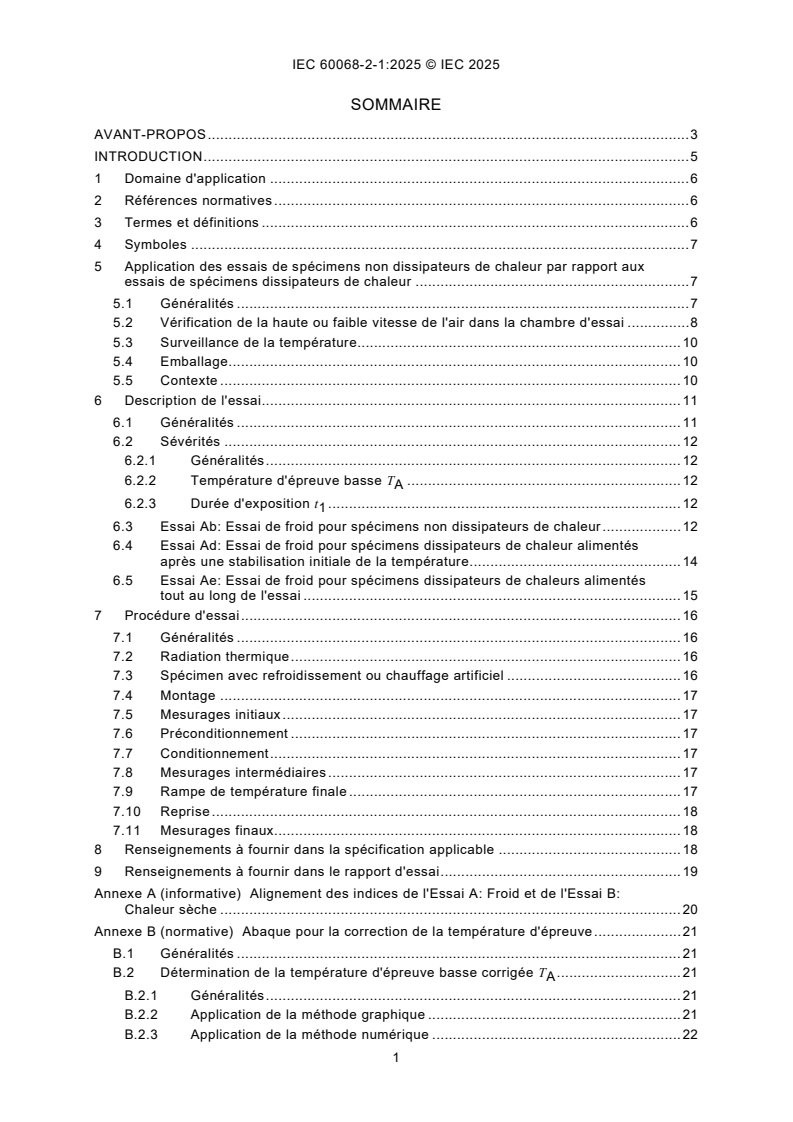
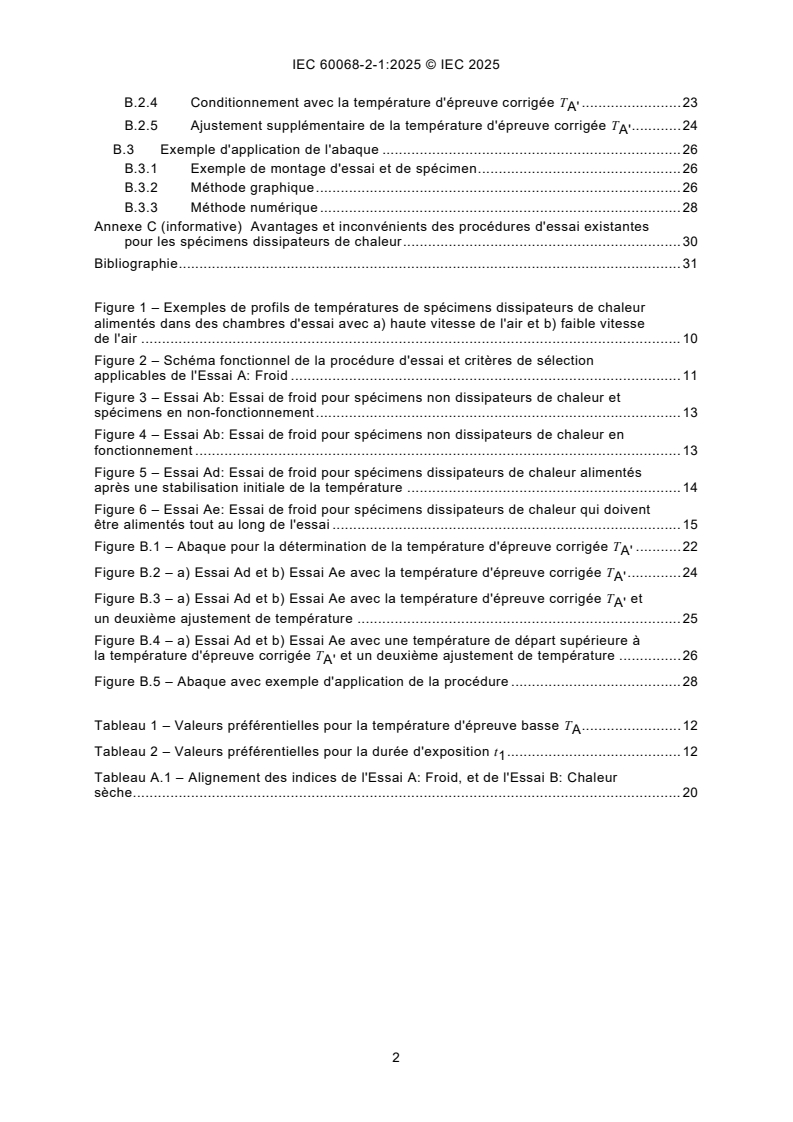
IEC 60068-2-1:2025 - Essais d'environnement - Partie 2-1: Essais - Essai A: Froid Released:9/23/2025
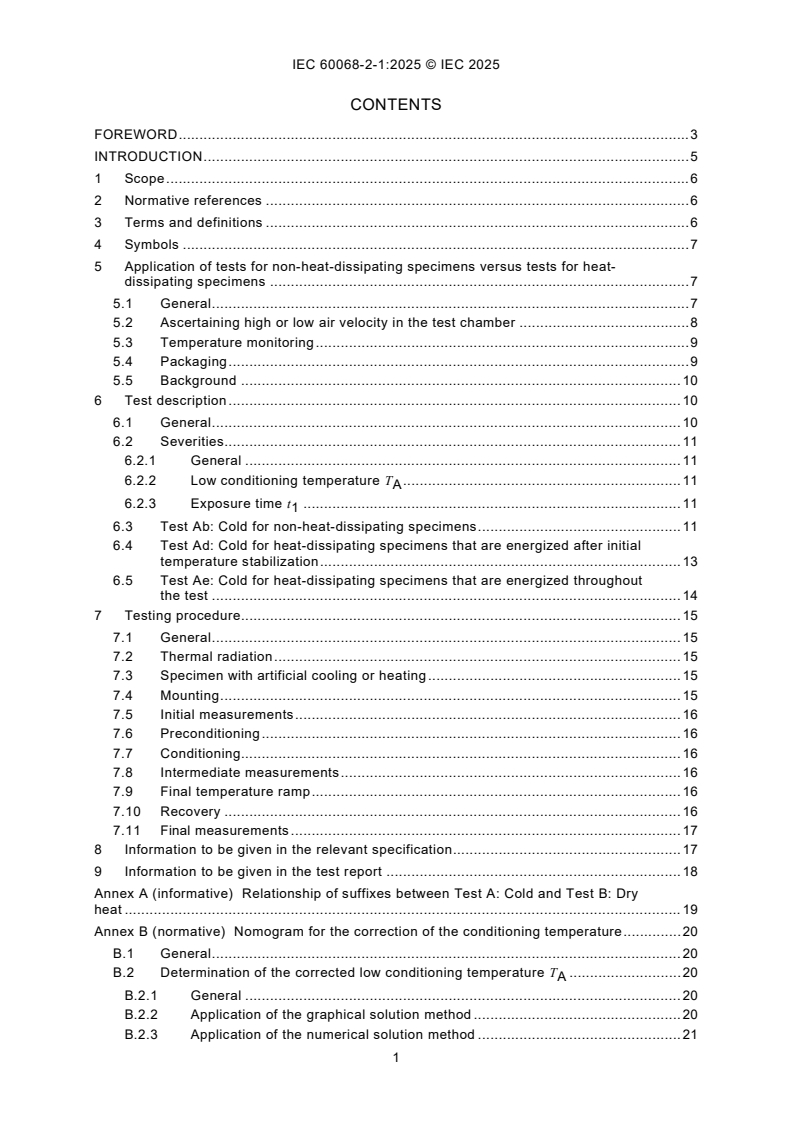
IEC 60068-2-1:2025 - Environmental testing - Part 2-1: Tests - Test A: Cold Released:9/23/2025
Overview
IEC 60068-2-1:2025 is the seventh edition of the International Electrotechnical Commission (IEC) standard for environmental testing, focusing specifically on cold temperature testing, known as Test A: Cold. This standard provides procedures to determine the ability of non-heat-dissipating and heat-dissipating components, equipment, or other articles to withstand low temperatures during use, transportation, or storage. It offers guidance for both energized and non-energized specimens, in packed or unpacked conditions, supporting manufacturers and testing laboratories in ensuring the reliability and safety of products intended for low-temperature environments.
The 2025 revision introduces significant clarifications and updates over the previous edition, including refined test procedures, updated requirements for temperature measurement, revised temperature tolerances, and enhanced documentation recommendations.
Key Topics
- Test Scope: Defines how to conduct cold tests on a wide range of specimens, both heat-dissipating and non-heat-dissipating, in various operational and packaging statuses.
- Test Methods:
- Test Ab: For non-heat-dissipating specimens, typically using high air velocity.
- Test Ad: For heat-dissipating specimens energized after stabilization, with low air velocity.
- Test Ae: For heat-dissipating specimens energized throughout the test, with low air velocity.
- Temperature Control: Specifies preferred conditioning temperatures (e.g., –65 °C, –55 °C, –40 °C) and test durations (e.g., 2 h, 16 h, 72 h), along with tolerances and procedures for achieving temperature stability.
- Air Velocity: Details methods for identifying high or low air velocity conditions in test chambers and their impact on specimen testing, especially for heat-dissipating items.
- Measurement & Monitoring: Clarifies procedures for selecting representative temperature measurement points and managing potential specimen damage during measurement.
- Documentation: Introduces standardized information requirements for relevant specifications and test reports, ensuring consistency and transparency.
Applications
IEC 60068-2-1:2025 is essential for industries and organizations requiring validation of equipment for cold climate performance, including:
- Electronics and Electrical Equipment: Ensures proper functioning of circuit boards, controls, sensors, and assemblies exposed to cold environments in fields such as automotive, aerospace, railway, and telecommunications.
- Transport and Storage: Validates that products can survive low temperatures during global logistics operations, when tested in both packaged and unpackaged formats.
- Reliability Testing: Supports assessment of product durability, informing design improvements and quality assurance processes.
- Standards Compliance: Enables manufacturers to meet international requirements for product qualification and market access.
Testing according to IEC 60068-2-1 helps reduce warranty claims, ensures operational safety, and demonstrates due diligence in product development for cold environments.
Related Standards
IEC 60068-2-1:2025 is part of the comprehensive IEC 60068 series on environmental testing. Important related standards include:
- IEC 60068-1: General guidance for environmental testing procedures.
- IEC 60068-2-2: Dry heat testing (complementary to Test A: Cold).
- IEC 60068-5-2: Guide to drafting of test methods - terms and definitions.
- IEC 60721 series: Classification of environmental conditions.
- IEC 60068-3 series: Provides additional guidance on performing, confirming, and evaluating environmental tests and test chambers.
By following IEC 60068-2-1 and its related standards, organizations can ensure consistent, reliable, and internationally recognized approaches to environmental testing of products for low temperature conditions.
Keywords: IEC 60068-2-1:2025, environmental testing, cold test, low temperature test, heat-dissipating specimens, non-heat-dissipating specimens, air velocity, temperature stability, equipment reliability, international standards, product qualification.
Relations
- Effective Date
- 05-Sep-2023
Buy Documents
IEC 60068-2-1:2025 - Environmental testing - Part 2-1: Tests - Test A: Cold Released:9/23/2025
IEC 60068-2-1:2025 - Essais d'environnement - Partie 2-1: Essais - Essai A: Froid Released:9/23/2025
IEC 60068-2-1:2025 - Environmental testing - Part 2-1: Tests - Test A: Cold Released:9/23/2025
Get Certified
Connect with accredited certification bodies for this standard

IMP NDT d.o.o.
Non-destructive testing services. Radiography, ultrasonic, magnetic particle, penetrant, visual inspection.
Inštitut za kovinske materiale in tehnologije
Institute of Metals and Technology. Materials testing, metallurgical analysis, NDT.
Q Techna d.o.o.
NDT and quality assurance specialist. 30+ years experience. NDT personnel certification per ISO 9712, nuclear and thermal power plant inspections, QA/
Sponsored listings
Frequently Asked Questions
IEC 60068-2-1:2025 is a standard published by the International Electrotechnical Commission (IEC). Its full title is "Environmental testing - Part 2-1: Tests - Test A: Cold". This standard covers: IEC 60068-2-1:2025 specifies temperature tests at low temperatures, generally referred to as "cold tests", that are applicable to non-heat-dissipating and heat-dissipating specimens, to determine the ability of components, equipment, or other articles to be used, transported or stored at low temperature. This document is applicable to energized as well as non-energized specimens that normally achieve temperature stability during the test. The specimens can be subject to test in packed condition (to simulate transportation and storage) or in unpacked condition (to simulate use). This document does not specify tests to determine the impact of temperature changes on specimens. This seventh edition cancels and replaces the sixth edition published in 2007. This edition constitutes a technical revision. This edition includes the following significant technical changes with respect to the previous edition: a) revision of the introduction and scope; b) inclusion of new figures and symbols for clarification purposes; c) clarification of the test procedure for ascertaining high or low air velocity in the test chamber; d) clarification of the requirements for measuring points around, on or in specimens; e) reintroduction of the nomogram procedure for the correction of the conditioning temperature when testing with high air velocity (Test Ad and Test Ae); f) revision of the temperature tolerances of the test; g) revision of standardized requirements for the relevant specification and test report; h) inclusion of the advantages and disadvantages of the testing procedures.
IEC 60068-2-1:2025 specifies temperature tests at low temperatures, generally referred to as "cold tests", that are applicable to non-heat-dissipating and heat-dissipating specimens, to determine the ability of components, equipment, or other articles to be used, transported or stored at low temperature. This document is applicable to energized as well as non-energized specimens that normally achieve temperature stability during the test. The specimens can be subject to test in packed condition (to simulate transportation and storage) or in unpacked condition (to simulate use). This document does not specify tests to determine the impact of temperature changes on specimens. This seventh edition cancels and replaces the sixth edition published in 2007. This edition constitutes a technical revision. This edition includes the following significant technical changes with respect to the previous edition: a) revision of the introduction and scope; b) inclusion of new figures and symbols for clarification purposes; c) clarification of the test procedure for ascertaining high or low air velocity in the test chamber; d) clarification of the requirements for measuring points around, on or in specimens; e) reintroduction of the nomogram procedure for the correction of the conditioning temperature when testing with high air velocity (Test Ad and Test Ae); f) revision of the temperature tolerances of the test; g) revision of standardized requirements for the relevant specification and test report; h) inclusion of the advantages and disadvantages of the testing procedures.
IEC 60068-2-1:2025 is classified under the following ICS (International Classification for Standards) categories: 19.040 - Environmental testing. The ICS classification helps identify the subject area and facilitates finding related standards.
IEC 60068-2-1:2025 has the following relationships with other standards: It is inter standard links to IEC 60068-2-1:2007. Understanding these relationships helps ensure you are using the most current and applicable version of the standard.
IEC 60068-2-1:2025 is available in PDF format for immediate download after purchase. The document can be added to your cart and obtained through the secure checkout process. Digital delivery ensures instant access to the complete standard document.
Standards Content (Sample)
IEC 60068-2-1 ®
Edition 7.0 2025-09
INTERNATIONAL
STANDARD
Environmental testing -
Part 2-1: Tests - Test A: Cold
ICS 19.040 ISBN 978-2-8327-0731-9
All rights reserved. Unless otherwise specified, no part of this publication may be reproduced or utilized in any form or
by any means, electronic or mechanical, including photocopying and microfilm, without permission in writing from either
IEC or IEC's member National Committee in the country of the requester. If you have any questions about IEC copyright
or have an enquiry about obtaining additional rights to this publication, please contact the address below or your local
IEC member National Committee for further information.
IEC Secretariat Tel.: +41 22 919 02 11
3, rue de Varembé info@iec.ch
CH-1211 Geneva 20 www.iec.ch
Switzerland
About the IEC
The International Electrotechnical Commission (IEC) is the leading global organization that prepares and publishes
International Standards for all electrical, electronic and related technologies.
About IEC publications
The technical content of IEC publications is kept under constant review by the IEC. Please make sure that you have the
latest edition, a corrigendum or an amendment might have been published.
IEC publications search - IEC Products & Services Portal - products.iec.ch
webstore.iec.ch/advsearchform Discover our powerful search engine and read freely all the
The advanced search enables to find IEC publications by a publications previews, graphical symbols and the glossary.
variety of criteria (reference number, text, technical With a subscription you will always have access to up to date
committee, …). It also gives information on projects, content tailored to your needs.
replaced and withdrawn publications.
Electropedia - www.electropedia.org
The world's leading online dictionary on electrotechnology,
IEC Just Published - webstore.iec.ch/justpublished
Stay up to date on all new IEC publications. Just Published containing more than 22 500 terminological entries in English
details all new publications released. Available online and and French, with equivalent terms in 25 additional languages.
once a month by email. Also known as the International Electrotechnical Vocabulary
(IEV) online.
IEC Customer Service Centre - webstore.iec.ch/csc
If you wish to give us your feedback on this publication or
need further assistance, please contact the Customer
Service Centre: sales@iec.ch.
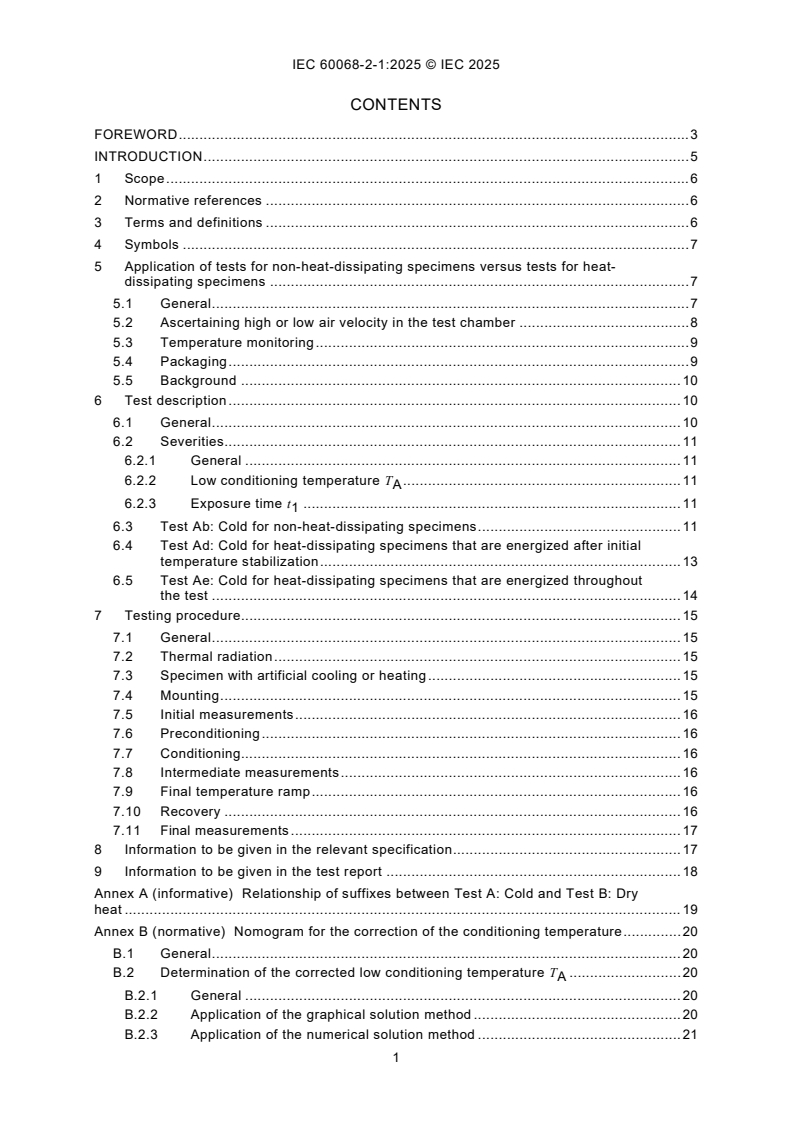
CONTENTS
FOREWORD . 3
INTRODUCTION . 5
1 Scope . 6
2 Normative references . 6
3 Terms and definitions . 6
4 Symbols . 7
5 Application of tests for non-heat-dissipating specimens versus tests for heat-
dissipating specimens . 7
5.1 General . 7
5.2 Ascertaining high or low air velocity in the test chamber . 8
5.3 Temperature monitoring . 9
5.4 Packaging . 9
5.5 Background . 10
6 Test description . 10
6.1 General . 10
6.2 Severities. 11
6.2.1 General . 11
6.2.2 Low conditioning temperature T . 11
A
6.2.3 Exposure time t . 11
6.3 Test Ab: Cold for non-heat-dissipating specimens . 11
6.4 Test Ad: Cold for heat-dissipating specimens that are energized after initial
temperature stabilization . 13
6.5 Test Ae: Cold for heat-dissipating specimens that are energized throughout
the test . 14
7 Testing procedure. 15
7.1 General . 15
7.2 Thermal radiation . 15
7.3 Specimen with artificial cooling or heating . 15
7.4 Mounting . 15
7.5 Initial measurements . 16
7.6 Preconditioning . 16
7.7 Conditioning. 16
7.8 Intermediate measurements . 16
7.9 Final temperature ramp . 16
7.10 Recovery . 16
7.11 Final measurements . 17
8 Information to be given in the relevant specification . 17
9 Information to be given in the test report . 18
Annex A (informative) Relationship of suffixes between Test A: Cold and Test B: Dry
heat . 19
Annex B (normative) Nomogram for the correction of the conditioning temperature . 20
B.1 General . 20
B.2 Determination of the corrected low conditioning temperature T . 20
A
B.2.1 General . 20
B.2.2 Application of the graphical solution method . 20
B.2.3 Application of the numerical solution method . 21
B.2.4 Conditioning with the corrected conditioning temperature T . 22
A'
B.2.5 Further adjustment of the corrected low conditioning temperature T . 23
A'
B.3 Example of application of the nomogram . 25
B.3.1 Example of test setup and specimen . 25
B.3.2 Graphical solution method . 25
B.3.3 Numerical solution method . 26
Annex C (informative) Advantages and disadvantages of available test procedures for
heat-dissipating specimens . 28
Bibliography . 29
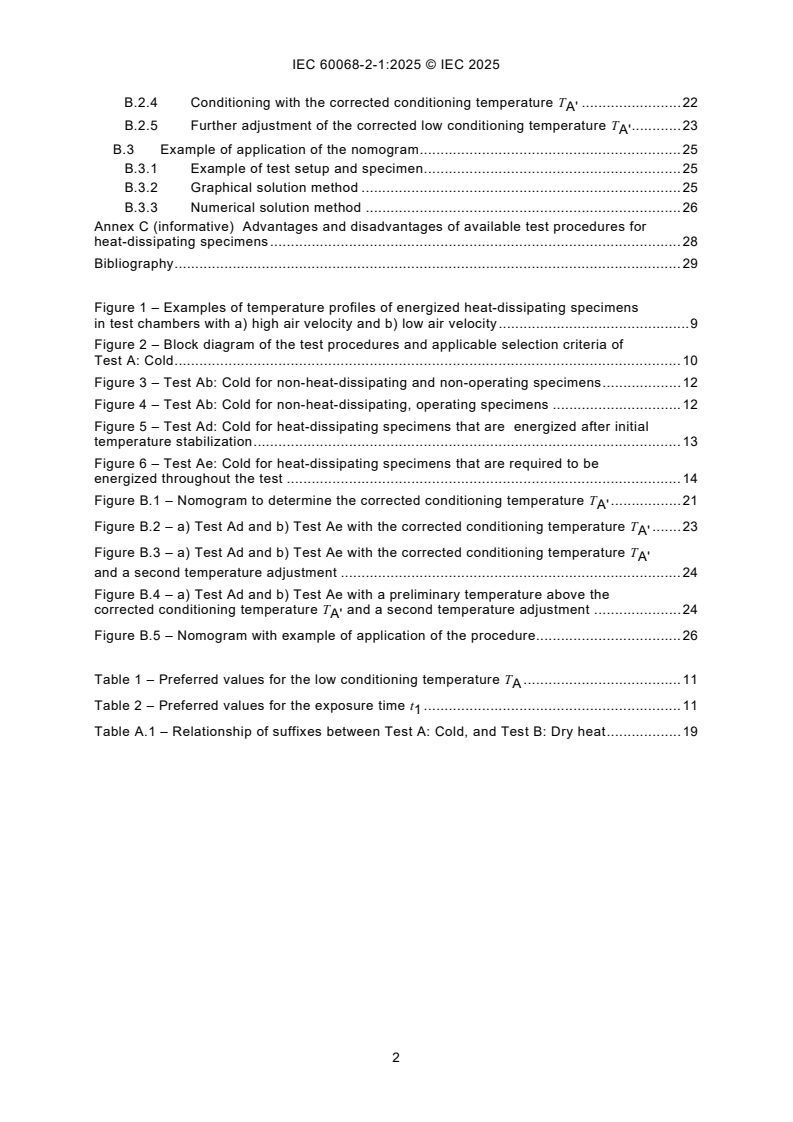
Figure 1 – Examples of temperature profiles of energized heat-dissipating specimens
in test chambers with a) high air velocity and b) low air velocity . 9
Figure 2 – Block diagram of the test procedures and applicable selection criteria of
Test A: Cold . 10
Figure 3 – Test Ab: Cold for non-heat-dissipating and non-operating specimens . 12
Figure 4 – Test Ab: Cold for non-heat-dissipating, operating specimens . 12
Figure 5 – Test Ad: Cold for heat-dissipating specimens that are energized after initial
temperature stabilization . 13
Figure 6 – Test Ae: Cold for heat-dissipating specimens that are required to be
energized throughout the test . 14
Figure B.1 – Nomogram to determine the corrected conditioning temperature T . 21
A'
Figure B.2 – a) Test Ad and b) Test Ae with the corrected conditioning temperature T . 23
A'
Figure B.3 – a) Test Ad and b) Test Ae with the corrected conditioning temperature T
A'
and a second temperature adjustment . 24
Figure B.4 – a) Test Ad and b) Test Ae with a preliminary temperature above the
corrected conditioning temperature T and a second temperature adjustment . 24
A'
Figure B.5 – Nomogram with example of application of the procedure. 26
Table 1 – Preferred values for the low conditioning temperature T . 11
A
Table 2 – Preferred values for the exposure time t . 11
Table A.1 – Relationship of suffixes between Test A: Cold, and Test B: Dry heat . 19
INTERNATIONAL ELECTROTECHNICAL COMMISSION
____________
Environmental testing -
Part 2-1: Tests - Test A: Cold
FOREWORD
1) The International Electrotechnical Commission (IEC) is a worldwide organization for standardization comprising
all national electrotechnical committees (IEC National Committees). The object of IEC is to promote international
co-operation on all questions concerning standardization in the electrical and electronic fields. To this end and
in addition to other activities, IEC publishes International Standards, Technical Specifications, Technical Reports,
Publicly Available Specifications (PAS) and Guides (hereafter referred to as "IEC Publication(s)"). Their
preparation is entrusted to technical committees; any IEC National Committee interested in the subject dealt with
may participate in this preparatory work. International, governmental and non-governmental organizations liaising
with the IEC also participate in this preparation. IEC collaborates closely with the International Organization for
Standardization (ISO) in accordance with conditions determined by agreement between the two organizations.
2) The formal decisions or agreements of IEC on technical matters express, as nearly as possible, an international
consensus of opinion on the relevant subjects since each technical committee has representation from all
interested IEC National Committees.
3) IEC Publications have the form of recommendations for international use and are accepted by IEC National
Committees in that sense. While all reasonable efforts are made to ensure that the technical content of IEC
Publications is accurate, IEC cannot be held responsible for the way in which they are used or for any
misinterpretation by any end user.
4) In order to promote international uniformity, IEC National Committees undertake to apply IEC Publications
transparently to the maximum extent possible in their national and regional publications. Any divergence between
any IEC Publication and the corresponding national or regional publication shall be clearly indicated in the latter.
5) IEC itself does not provide any attestation of conformity. Independent certification bodies provide conformity
assessment services and, in some areas, access to IEC marks of conformity. IEC is not responsible for any
services carried out by independent certification bodies.
6) All users should ensure that they have the latest edition of this publication.
7) No liability shall attach to IEC or its directors, employees, servants or agents including individual experts and
members of its technical committees and IEC National Committees for any personal injury, property damage or
other damage of any nature whatsoever, whether direct or indirect, or for costs (including legal fees) and
expenses arising out of the publication, use of, or reliance upon, this IEC Publication or any other IEC
Publications.
8) Attention is drawn to the Normative references cited in this publication. Use of the referenced publications is
indispensable for the correct application of this publication.
9) IEC draws attention to the possibility that the implementation of this document may involve the use of (a)
patent(s). IEC takes no position concerning the evidence, validity or applicability of any claimed patent rights in
respect thereof. As of the date of publication of this document, IEC had not received notice of (a) patent(s), which
may be required to implement this document. However, implementers are cautioned that this may not represent
the latest information, which may be obtained from the patent database available at https://patents.iec.ch. IEC
shall not be held responsible for identifying any or all such patent rights.
IEC 60068-2-1 has been prepared by IEC technical committee 104: Environmental conditions,
classification and methods of test. It is an International Standard.
This seventh edition cancels and replaces the sixth edition published in 2007. This edition
constitutes a technical revision.
This edition includes the following significant technical changes with respect to the previous
edition:
a) revision of the introduction and scope;
b) inclusion of new figures and symbols for clarification purposes;
c) clarification of the test procedure for ascertaining high or low air velocity in the test chamber;
d) clarification of the requirements for measuring points around, on or in specimens;
e) reintroduction of the nomogram procedure for the correction of the conditioning temperature
when testing with high air velocity (Test Ad and Test Ae);
f) revision of the temperature tolerances of the test;
g) revision of standardized requirements for the relevant specification and test report;
h) inclusion of the advantages and disadvantages of the testing procedures.
The text of this International Standard is based on the following documents:
Draft Report on voting
104/1107/FDIS 104/1127/RVD
Full information on the voting for its approval can be found in the report on voting indicated in
the above table.
The language used for the development of this International Standard is English.
This document was drafted in accordance with ISO/IEC Directives, Part 2, and developed in
accordance with ISO/IEC Directives, Part 1 and ISO/IEC Directives, IEC Supplement, available
at www.iec.ch/members_experts/refdocs. The main document types developed by IEC are
described in greater detail at www.iec.ch/publications.
A list of all the parts in the IEC 60068 series, under the general title Environmental testing, can
be found on the IEC website.
The committee has decided that the contents of this document will remain unchanged until the
stability date indicated on the IEC website under webstore.iec.ch in the data related to the
specific document. At this date, the document will be
– reconfirmed,
– withdrawn, or
– revised.
INTRODUCTION
The working ranges and performance of equipment and machinery (a device) can be
significantly affected or limited by ambient temperatures. The degree of this influence can
depend on temperature distributions of the environment as well as temperatures on components
of the device itself. In order to determine the existing degree of influence and to ensure that the
device is suitably designed for its ambient conditions, tests are carried out with cold or dry heat
(IEC 60068-2-2), or both. During the test detailed in this document, it will be taken into account
whether the tested device itself emits heat or not.
Reducing the air flow within the test chamber can be required to reduce the air velocity at heat-
dissipating specimens. This can be achieved by using air baffles or adjusting the air flow of the
test chamber. If the reduction of air velocity is not practical or possible due to the required test
conditions, this document provides an alternative test procedure without the need for adjustable
air flow as well as guidance on selecting the applicable test procedure.
1 Scope
This part of IEC 60068 specifies temperature tests at low temperatures, generally referred to
as "cold tests", that are applicable to non-heat-dissipating and heat-dissipating specimens, to
determine the ability of components, equipment, or other articles to be used, transported or
stored at low temperature.
This document is applicable to energized as well as non-energized specimens that normally
achieve temperature stability during the test. The specimens can be subject to test in packed
condition (to simulate transportation and storage) or in unpacked condition (to simulate use).
This document does not specify tests to determine the impact of temperature changes on
specimens.
2 Normative references
The following documents are referred to in the text in such a way that some or all of their content
constitutes requirements of this document. For dated references, only the edition cited applies.
For undated references, the latest edition of the referenced document (including any
amendments) applies.
IEC 60068-1, Environmental testing - Part 1: General and guidance
IEC 60068-5-2, Environmental testing - Part 5: Guide to drafting of test methods - Terms and
definitions
IEC 60721 (all parts), Classification of environmental conditions
3 Terms and definitions
For the purposes of this document, the terms and definitions given in IEC 60068-1,
IEC 60068-5-2 and the following apply.
ISO and IEC maintain terminology databases for use in standardization at the following
addresses:
– IEC Electropedia: available at https://www.electropedia.org/
– ISO Online browsing platform: available at https://www.iso.org/obp
3.1
low air velocity
velocity of conditioning airflow within a working space which is sufficient to maintain conditions
but low enough so that the temperature at the relevant point or relevant points on the test
specimen is not reduced by more than 5 K by the influence of the circulation of the air
Note 1 to entry: The relevant points to be considered are determined by the relevant test specification.
3.2
high air velocity
velocity of conditioning airflow within a working space, which in order to maintain conditions,
also reduces the temperature at the relevant point or relevant points on the test specimen by
more than 5 K by the influence of the circulation of the air
4 Symbols
T low conditioning temperature [°C]
A
T corrected low conditioning temperature (nomogram procedure) [°C]
A'
T temperature of standard atmospheric conditions for measurement and tests (15 °C to
STD
35 °C) [°C]
T measured ambient temperature in the vicinity of the specimen, either in the test
Ca
chamber or the laboratory air, without forced convection (see 5.2) [°C]
T measured test chamber temperature with forced convection (see 5.2) [°C]
Cb
T temperature of the energized specimen at the specified conditioning temperature [°C]
S
T temperature of the energized specimen at the temperature of standard atmospheric
Sa
conditions without forced convection (see 5.2) [°C]
T temperature of the energized specimen at the temperature of standard atmospheric
Sb
conditions with forced convection (see 5.2) [°C]
∆T temperature difference between the energized specimen and the air [K]
S
∆T temperature difference between the energized specimen without forced convection
Sa/b
(T ) and with forced convection (T ) at the temperature of standard atmospheric
Sa Sb
conditions [K]
dT temperature change rate [K/min]
R
t stabilization time of specimen temperature before exposure to the low conditioning
s
temperature [min or h]
t stabilization time of specimen temperature after energizing [min or h]
s0
exposure time of the specimen to the low conditioning temperature [h]
t
5 Application of tests for non-heat-dissipating specimens versus tests for
heat-dissipating specimens
5.1 General
This test is subdivided as follows:
– Test Ab: Cold for non-heat-dissipating specimens;
– Test Ad: Cold for heat-dissipating specimens that are energized after initial temperature
stabilization;
– Test Ae: Cold for heat-dissipating specimens that are energized throughout the test.
A specimen, while energized, is considered to be heat-dissipating only if the hottest point on its
surface or any other relevant point, measured in free air conditions (i.e., with low air velocity
circulation), is more than 5 K above the ambient temperature of the surrounding atmosphere
after temperature stability has been reached (see IEC 60068-1).
NOTE 1 In some cases, for example for test specimens with air-permeable housings, the relevant measuring points
can be located inside the external housing.
Tests of heat-dissipating and non-heat-dissipating specimens generally differ in the air velocity
applied. Non-heat-dissipating specimens are typically tested at high air velocity to reduce the
time required to reach temperature stability. Heat-dissipating specimens are generally tested
at low air velocity to allow for the formation of local hotspots similar to those that would appear
in installed applications. Annex A gives an overview of the relevant test conditions and shows
the relationship of suffixes between Test A: Cold and Test B: Dry heat.
It is possible that testing with low air velocity does not apply to heat-dissipating specimens with
an external housing and built-in fan, provided that the representative measuring point is located
at a point inside the external housing which is not affected by external air movement. Ensure
that the induced air movement does not interfere with the operation of the built-in fan, if not
specified otherwise.
NOTE 2 The induced air movement can have an influence on the operation of a built-in fan if both air movements
act either in the same or opposite direction.
Where it is not feasible to test heat-dissipating specimens with low air velocity, for example due
to the required test conditions, Annex B gives an alternative procedure for testing with high air
velocity.
The relevant specification shall state which test procedure shall be applied. The advantages
and disadvantages of both test procedures should be considered when specifying the intended
test. For more information on these advantages and disadvantages, see Annex C.
When the relevant specification calls for a storage or transportation test or does not specify an
applied load during the test, Test Ab applies.
5.2 Ascertaining high or low air velocity in the test chamber
To ascertain whether high or low air velocity prevails in the test chamber, the cooling effect of
the air movement on the specimen shall be determined. Therefore, the specimen's temperature
shall be measured with and without forced convection by the test chamber's fan. Both
temperatures shall be compared in accordance with the following procedure. It is recommended
to ascertain the prevailing air velocity in the test chamber for every specimen, since the
occurring cooling effect can vary for different specimens.
Under standard atmospheric conditions for measurements and test (see IEC 60068-1) with an
air velocity < 0,2 m/s, achieved without forced convection, the heat-dissipating specimen shall
be switched on or electrically loaded as specified for the low temperature at which the test is to
be carried out.
When temperature stability of the specimen has been reached, the temperature of a
representative point around or on the specimen and the ambient temperature T shall be
Ca
measured using a suitable monitoring device. Either the hottest point or any point of particular
interest on the specimen can be used as representative point for measuring the temperature of
the energized specimen T without forced convection.
Sa
NOTE 1 To determine the representative point, an infrared camera can be helpful.
The temperature reached at each point shall then be noted. This measurement may be done in
an open test chamber (e.g. with an opened door or a lifted test space enclosure, if applicable)
or outside of the test chamber to prevent an improper temperature rise of the surrounding air.
NOTE 2 The operation of a heat-dissipating specimen in a closed and switched-off test chamber leads to a
temperature rise within the test space. In a small test chamber or with a large heat load, the temperature rise can
influence the measurement result.
NOTE 3 The temperature T is the temperature in the vicinity of the specimen during the measurement without
Ca
forced convection. It can be the temperature in the test chamber or the temperature of the laboratory air, depending
on where the test was done.
The specimen is then introduced into the test chamber, if applicable, and the test chamber is
switched on. The temperature is set to the previously recorded temperature T .
Ca
Once temperature stability of the energized specimen has been achieved, the temperature of
the representative point and the test chamber temperature T shall be measured. The
Cb
temperatures T and T shall be measured at the same point around or on the specimen.
Sa Sb
NOTE 4 The temperature T is the test chamber temperature during the test with forced convection. It can vary
Cb
marginally from temperature T .
Ca
The following applies:
∆=T TT–
(1)
Sa/b Sa Sb
If the temperature difference ∆T between the temperature of the specimen with and without
Sa/b
forced convection is more than 5 K (or a value stated by the relevant specification) this value
shall be noted in the test report and the test chamber is considered to have high air velocity.
The specimen is then switched off and any operational loading conditions removed.
For some specimens, for example large specimens or specimens with a complex geometry,
more than one representative point around or on the specimen can be used for measuring the
temperature of the specimen. For some specimens, for example specimens with air-permeable
housings, the relevant measuring point or points can be located inside the external housing.
The relevant specification shall state the number and location of the measuring points.
Figure 1 shows a comparison of examples of temperature profiles in test chambers with high
and low air velocity.
a) temperature profile of an energized heat- b) temperature profile of an energized heat-
dissipating specimen in a test chamber with high dissipating specimen in a test chamber with low air
air velocity velocity
Figure 1 – Examples of temperature profiles of energized heat-dissipating specimens in
test chambers with a) high air velocity and b) low air velocity
5.3 Temperature monitoring
The air temperature in the test chamber shall be measured by temperature sensors located at
such a distance from the specimen that the effect of the dissipation is negligible. Suitable
precautions shall be taken to avoid heat radiation affecting these measurements.
5.4 Packaging
Packaging shall be removed unless the relevant specification requires it to remain in place or
heating elements are incorporated in the package. For storage and transportation tests, the
specimen may be tested with its packaging in place.
NOTE Packaged specimens are expected to stabilize at chamber temperature after a certain exposure time.
5.5 Background
To facilitate the choice of test method, a diagrammatic representation of the various procedures
is given in Figure 2.
Figure 2 – Block diagram of the test procedures and
applicable selection criteria of Test A: Cold
6 Test description
6.1 General
For each test, the test chamber shall be at the temperature of standard atmospheric condition
, 15 °C to 35 °C, when the test specimens are introduced. The temperature shall then be
T
STD
gradually lowered to the low conditioning temperature T appropriate to the degree of severity,
A
as specified in the relevant specification.
NOTE 1 The gradual temperature change prevents detrimental effects on the specimen caused by thermal stress
due to the change of temperature. For more information on thermal stress caused by temperature change, see
IEC 60068-2-14.
The temperature change rate dT within the chamber shall not exceed 1 K/min, averaged over
R
a period of not more than 5 min. The relevant specification shall define the functioning of the
specimen under test. Further requirements for each test are noted in 6.3, 6.4 and 6.5.
Any cooling or heating devices of the specimen shall be in accordance with the requirement in
the relevant specification.
NOTE 2 IEC 60068-3-1 provides general guidance for the performance of Tests A and B. IEC 60068-3-6 provides
guidance for the confirmation of performance of test chambers without specimen. IEC 60068-3-7 provides further
information on testing with test specimens within the test chamber.
6.2 Severities
6.2.1 General
The severities, as indicated by the low conditioning temperature T and the exposure time t ,
A 1
shall be specified by the relevant specification. If these values are not given in the relevant
specification, they shall be:
a) chosen from the values given in Table 1 (see 6.2.2) and Table 2 (see 6.2.3); or
b) derived from known environments if these give significantly different values; or
c) derived from other known sources of relevant data (for example the IEC 60721 series or
field data from the specimen).
6.2.2 Low conditioning temperature T
A
Table 1 – Preferred values for the low conditioning temperature T
A
–65 °C –55 °C –50 °C –40 °C –33 °C
–25 °C –20 °C –10 °C –5 °C +5 °C
6.2.3 Exposure time t
Table 2 – Preferred values for the exposure time t
2 h 16 h
72 h 96 h
NOTE For further information on the test duration, IEC TR 60721-4 series can be helpful.
6.3 Test Ab: Cold for non-heat-dissipating specimens
Test Ab is intended for non-heat-dissipating specimens which are subjected to the low
conditioning temperature T with high air velocity for a time long enough for the specimen to
A
achieve temperature stability and maintain the test conditions for the specified exposure time
t .
The specimen is introduced into the test chamber which is at the temperature of standard
atmospheric condition for measurement and tests T , 15 °C to 35 °C. The temperature is then
STD
adjusted to the low conditioning temperature T appropriate to the degree of severity, as
A
specified in the relevant specification. After temperature stability of the test specimen has been
reached, the specimen stays exposed to the low conditioning temperature T for the specified
A
(see Figure 3). A representative point (or points) on or inside the specimen
exposure time t
may be used for this measurement.
NOTE 1 For further information on thermal stability, see IEC 60068-1.
If a measuring point on or inside the specimen can damage the specimen, a representative
point (or points) around the specimen may be used instead.
Figure 3 – Test Ab: Cold for non-heat-dissipating and non-operating specimens
Specimens under test are normally in non-operating conditions. High air velocity circulation is
normally used for this test.
NOTE 2 In the case of a non-heat-dissipating specimen in Test Ab, high air velocity in the test chamber can be
assumed, when no measures are taken to disturb the air flow (e.g. by bulkheading installations, like perforated plates
or air baffles, or the reduction of the overall air flow within the test chamber).
Specimens that are required to be operational but do not meet the requirements of being heat-
dissipating shall be energized after temperature stabilization at the low conditioning
temperature T is achieved (see Figure 4), if not specified otherwise. A functional test shall be
A
performed as specified in the relevant specification, if applicable. A further stabilization time of
the specimen temperature (t ) can be necessary. The specimen shall then be exposed to the
s0
low conditioning temperature T for the specified exposure time t .
A 1
Figure 4 – Test Ab: Cold for non-heat-dissipating, operating specimens
6.4 Test Ad: Cold for heat-dissipating specimens that are energized after initial
temperature stabilization
Test Ad is intended for heat-dissipating specimens which are subjected to the low conditioning
temperature T with low air velocity for a time long enough for the specimens to achieve
A
temperature stability and maintain the test conditions for the specified exposure time t . The
specimens are energized after the initial temperature stabilization.
The specimen is introduced into the test chamber which is at the temperature of standard
, 15 °C to 35 °C. The temperature is then
atmospheric condition for measurement and tests T
STD
adjusted to the low conditioning temperature T appropriate to the degree of severity, as
A
specified in the relevant specification.
Figure 5 – Test Ad: Cold for heat-dissipating specimens that are
energized after initial temperature stabilization
After the temperature stabilization period of the specimen t before exposure to the low
s
conditioning temperature, the specimen is energized, stabilized again and then exposed to the
low conditioning temperature T for the specified exposure time t . A representative point (or
A 1
points) on or inside the specimen may be used for this measurement. The specimen shall
remain in the operating condition as specified by the relevant specification.
NOTE 1 For further information on thermal stability, see IEC 60068-1.
If a measuring point on or inside the specimen can damage the specimen, a representative
point (or points) around the specimen may be used instead.
Low air velocity circulation is normally used for this test. If necessary, a test is performed to
determine if the test chamber fulfils the requirements of low air velocity (see 5.2). If low air
velocity is not suitable for this test, the test procedure described in Annex B may be used.
NOTE 2 For further information on testing with low air velocity, see Annex C.
6.5 Test Ae: Cold for heat-dissipating specimens that are energized throughout the
test
Test Ae is intended for heat-dissipating specimens which are subjected to the low conditioning
temperature T with low air velocity for a time long enough for the specimen to achieve
A
temperature stability and maintain the test conditions for the specified exposure time t . The
specimens are energized during the temperature change of the test chamber temperature and
the specified exposure time t .
The specimen is introduced into the test chamber which is at the temperature of standard
atmospheric condition for measurement and tests T , 15 °C to 35 °C. The specimen shall
STD
then be switched on or electrically loaded and checked to ascertain whether it is capable of
functioning in accordance with the relevant specification.
The specimen shall remain in the operating condition as specified by the relevant specification.
Following the temperature stabilization period of the specimen after energizing t the test
s0
chamber temperature is adjusted to the low conditioning temperature T appropriate to the
A
degree of severity as specified in the relevant specification.
Figure 6 – Test Ae: Cold for heat-dissipating specimens
that are required to be energized throughout the test
After the stabilization period of the specimen t before exposure to the low conditioning
s
temperature, the specimen is exposed to the low conditioning temperature T for the specified
A
exposure time t . A representative point (or points) on or inside the specimen may be used for
this measurement.
NOTE 1 For further information on thermal stability, see IEC 60068-1.
If a measuring point on or inside the specimen can damage the specimen, a representative
point (or points) around the specimen may be used instead.
Low air velocity circulation is normally used for this test. If necessary, a test is performed to
determine if the test chamber fulfils the requirements of low air velocity (see 5.2). If low air
velocity is not suitable for this test, the test procedure described in Annex B may be used.
NOTE 2 For further information on testing with low air velocity, see Annex C.
7 Testing procedure
7.1 General
The test chamber shall be large enough compared with the size and amount of heat-dissipation
of the test sample.
The temperature shall be within ±2 K of the test severity temperature during the steady-state
condition. The air temperature in the working space shall be measured in accordance with 5.3.
NOTE 1 For further information on the working space, IEC 60068-3-6 can be helpful.
Where, due to the size of the chamber, it is not feasible to maintain these tolerances, the
tolerance may be widened to ±3 K down to –25 °C and ±5 K down to –65 °C. When this is done,
the tolerance used shall be noted in the test report.
The temperature tolerance given in this document is intended to take into account errors in the
measurement, slow changes of temperature, and temperature variations of the working space.
The temperature refers to the control sensor of the test chamber, if not specified otherwise.
The tolerances stated in this document do not take measurement uncertainty into consideration.
NOTE 2 This tolerance is valid for an empty test space during stabilized temperature conditions of the test. In some
conditions, where the specimen has a negligible impact on the chamber control, the tolerances can still be valid for
the chamber with specimen(s).
The dimensions of the test sample shall be such that it is entirely within the working space of
the test chamber.
7.2 Thermal radiation
The ability of the specimen to transfer heat by thermal radiation shall be minimized. This will
normally result in the screening of any heating or cooling elements from the specimen and
ensuring that parts of the chamber surfaces are not significantly different in temperature from
that of the conditioning air.
7.3 Specimen with artificial cooling or heating
The relevant specification shall define the characteristics of the coolant supplied to the
specimen. When the coolant is air, the air shall not be contaminated by oil and dry enough to
avoid moisture problems.
An air-cooled specimen might show a different behaviour when tested in an enclosed test space
with high and low air velocity in the test chamber when compared to a free ambient
measurement. The experimental determination of these differences is recommended, if
unknown and not specified otherwise.
7.4 Mounting
The dimensions of the specimen shall be such that it is entirely within the working space of the
test chamber. The specimen shall not be placed directly on the floor of the test chamber. The
position of the specimen shall be specified in the relevant specification.
Thermal conductivity and other relevant characteristics of the mounting and connections of the
test specimen shall be specified in the relevant specification. When the test specimen is
intended for use with specific mounting devices, these shall be used for testing.
Where no specific mounting is specified, the thermal conductivity of the mounting shall be low,
so that for all practical purposes the specimen is thermally isolated.
7.5 Initial measurements
The specimens shall be visually inspected and electrically and mechanically checked as
required by the relevant specification.
7.6 Preconditioning
Preconditioning shall be specified in the relevant specification, if applicable.
7.7 Conditioning
Test Ab, Test Ad or Test Ae shall be performed in accordance with 6.3, 6.4 or 6.5, respectively.
The specimen shall be exposed to the low conditioning temperature T for the exposure time
A
t , as detailed in the relevant specification.
For the exceptional cases when the specimen does not achieve temperature stability, the
exposure time of the test starts at the time that the specimen is energized. Such cases are
typically caused by specimens having long duty cycles.
7.8 Intermediate measurements
The relevant specification may call for loading or measurements, or both, during or at the end
of conditioning while the specimen is still in the test chamber. If such measurements are
required, the relevant specification shall define the measurements and the period(s) after which
they shall be carried out. For these measurements, the specimen shall not be removed from
the chamber.
If it is desired to know the performance of the type of specimen before the end of the specified
exposure time, one additional lot will be required for each specified exposure time. Recovery
and final measurements should be performed separately for each lot.
7.9 Final temperature ramp
If the specimen remains in operating or loaded condition during the Test Ab or Test Ad, it shall
be switched off or unloaded before the temperature is raised. During Test Ae the specimen
shall remain operational throughout the recovery period.
, the specimen shall remain in the chamber and the
At the end of the specified exposure time t
temperature shall be gradually raised to the temperature of standard atmospheric conditions
for
...
IEC 60068-2-1 ®
Edition 7.0 2025-09
NORME
INTERNATIONALE
Essais d'environnement -
Partie 2-1: Essais - Essai A: Froid
ICS 19.040 ISBN 978-2-8327-0731-9
Droits de reproduction réservés. Sauf indication contraire, aucune partie de cette publication ne peut être reproduite ni
utilisée sous quelque forme que ce soit et par aucun procédé, électronique ou mécanique, y compris la photocopie et
les microfilms, sans l'accord écrit de l'IEC ou du Comité national de l'IEC du pays du demandeur. Si vous avez des
questions sur le copyright de l'IEC ou si vous désirez obtenir des droits supplémentaires sur cette publication, utilisez
les coordonnées ci-après ou contactez le Comité national de l'IEC de votre pays de résidence.
IEC Secretariat Tel.: +41 22 919 02 11
3, rue de Varembé info@iec.ch
CH-1211 Geneva 20 www.iec.ch
Switzerland
A propos de l'IEC
La Commission Electrotechnique Internationale (IEC) est la première organisation mondiale qui élabore et publie des
Normes internationales pour tout ce qui a trait à l'électricité, à l'électronique et aux technologies apparentées.
A propos des publications IEC
Le contenu technique des publications IEC est constamment revu. Veuillez vous assurer que vous possédez l’édition la
plus récente, un corrigendum ou amendement peut avoir été publié.
Recherche de publications IEC - IEC Products & Services Portal - products.iec.ch
webstore.iec.ch/advsearchform Découvrez notre puissant moteur de recherche et consultez
La recherche avancée permet de trouver des publications gratuitement tous les aperçus des publications, symboles
IEC en utilisant différents critères (numéro de référence, graphiques et le glossaire. Avec un abonnement, vous aurez
texte, comité d’études, …). Elle donne aussi des toujours accès à un contenu à jour adapté à vos besoins.
informations sur les projets et les publications remplacées
ou retirées. Electropedia - www.electropedia.org
Le premier dictionnaire d'électrotechnologie en ligne au
IEC Just Published - webstore.iec.ch/justpublished monde, avec plus de 22 500 articles terminologiques en
Restez informé sur les nouvelles publications IEC. Just anglais et en français, ainsi que les termes équivalents
Published détaille les nouvelles publications parues. dans 25 langues additionnelles. Egalement appelé
Disponible en ligne et une fois par mois par email. Vocabulaire Electrotechnique International (IEV) en ligne.
Service Clients - webstore.iec.ch/csc
Si vous désirez nous donner des commentaires sur cette
publication ou si vous avez des questions contactez-
nous: sales@iec.ch.
SOMMAIRE
AVANT-PROPOS . 3
INTRODUCTION . 5
1 Domaine d'application . 6
2 Références normatives . 6
3 Termes et définitions . 6
4 Symboles . 7
5 Application des essais de spécimens non dissipateurs de chaleur par rapport aux
essais de spécimens dissipateurs de chaleur . 7
5.1 Généralités . 7
5.2 Vérification de la haute ou faible vitesse de l'air dans la chambre d'essai . 8
5.3 Surveillance de la température. 10
5.4 Emballage . 10
5.5 Contexte . 10
6 Description de l'essai. 11
6.1 Généralités . 11
6.2 Sévérités . 12
6.2.1 Généralités . 12
6.2.2 Température d'épreuve basse T . 12
A
6.2.3 Durée d'exposition t . 12
6.3 Essai Ab: Essai de froid pour spécimens non dissipateurs de chaleur . 12
6.4 Essai Ad: Essai de froid pour spécimens dissipateurs de chaleur alimentés
après une stabilisation initiale de la température . 14
6.5 Essai Ae: Essai de froid pour spécimens dissipateurs de chaleurs alimentés
tout au long de l'essai . 15
7 Procédure d'essai . 16
7.1 Généralités . 16
7.2 Radiation thermique . 16
7.3 Spécimen avec refroidissement ou chauffage artificiel . 16
7.4 Montage . 17
7.5 Mesurages initiaux . 17
7.6 Préconditionnement . 17
7.7 Conditionnement . 17
7.8 Mesurages intermédiaires . 17
7.9 Rampe de température finale . 17
7.10 Reprise . 18
7.11 Mesurages finaux. 18
8 Renseignements à fournir dans la spécification applicable . 18
9 Renseignements à fournir dans le rapport d'essai . 19
Annexe A (informative) Alignement des indices de l'Essai A: Froid et de l'Essai B:
Chaleur sèche . 20
Annexe B (normative) Abaque pour la correction de la température d'épreuve . 21
B.1 Généralités . 21
B.2 Détermination de la température d'épreuve basse corrigée T . 21
A
B.2.1 Généralités . 21
B.2.2 Application de la méthode graphique . 21
B.2.3 Application de la méthode numérique . 22
B.2.4 Conditionnement avec la température d'épreuve corrigée T . 23
A'
B.2.5 Ajustement supplémentaire de la température d'épreuve corrigée T . 24
A'
B.3 Exemple d'application de l'abaque . 26
B.3.1 Exemple de montage d'essai et de spécimen . 26
B.3.2 Méthode graphique . 26
B.3.3 Méthode numérique . 28
Annexe C (informative) Avantages et inconvénients des procédures d'essai existantes
pour les spécimens dissipateurs de chaleur . 30
Bibliographie . 31
Figure 1 – Exemples de profils de températures de spécimens dissipateurs de chaleur
alimentés dans des chambres d'essai avec a) haute vitesse de l'air et b) faible vitesse
de l'air . 10
Figure 2 – Schéma fonctionnel de la procédure d'essai et critères de sélection
applicables de l'Essai A: Froid . 11
Figure 3 – Essai Ab: Essai de froid pour spécimens non dissipateurs de chaleur et
spécimens en non-fonctionnement . 13
Figure 4 – Essai Ab: Essai de froid pour spécimens non dissipateurs de chaleur en
fonctionnement . 13
Figure 5 – Essai Ad: Essai de froid pour spécimens dissipateurs de chaleur alimentés
après une stabilisation initiale de la température . 14
Figure 6 – Essai Ae: Essai de froid pour spécimens dissipateurs de chaleur qui doivent
être alimentés tout au long de l'essai . 15
Figure B.1 – Abaque pour la détermination de la température d'épreuve corrigée T . 22
A'
Figure B.2 – a) Essai Ad et b) Essai Ae avec la température d'épreuve corrigée T . 24
A'
Figure B.3 – a) Essai Ad et b) Essai Ae avec la température d'épreuve corrigée T et
A'
un deuxième ajustement de température . 25
Figure B.4 – a) Essai Ad et b) Essai Ae avec une température de départ supérieure à
la température d'épreuve corrigée T et un deuxième ajustement de température . 26
A'
Figure B.5 – Abaque avec exemple d'application de la procédure . 28
Tableau 1 – Valeurs préférentielles pour la température d'épreuve basse T . 12
A
Tableau 2 – Valeurs préférentielles pour la durée d'exposition t . 12
Tableau A.1 – Alignement des indices de l'Essai A: Froid, et de l'Essai B: Chaleur
sèche . 20
COMMISSION ÉLECTROTECHNIQUE INTERNATIONALE
____________
Essais d'environnement -
Partie 2-1: Essais - Essai A: Froid
AVANT-PROPOS
1) La Commission Électrotechnique Internationale (IEC) est une organisation mondiale de normalisation composée
de l'ensemble des comités électrotechniques nationaux (Comités nationaux de l'IEC). L'IEC a pour objet de
favoriser la coopération internationale pour toutes les questions de normalisation dans les domaines de
l'électricité et de l'électronique. À cet effet, l'IEC – entre autres activités – publie des Normes internationales,
des Spécifications techniques, des Rapports techniques, des Spécifications accessibles au public (PAS) et des
Guides (ci-après dénommés "Publication(s) de l'IEC"). Leur élaboration est confiée à des comités d'études, aux
travaux desquels tout Comité national intéressé par le sujet traité peut participer. Les organisations
internationales, gouvernementales et non gouvernementales, en liaison avec l'IEC, participent également aux
travaux. L'IEC collabore étroitement avec l'Organisation Internationale de Normalisation (ISO), selon des
conditions fixées par accord entre les deux organisations.
2) Les décisions ou accords officiels de l'IEC concernant les questions techniques représentent, dans la mesure du
possible, un accord international sur les sujets étudiés, étant donné que les Comités nationaux de l'IEC intéressés
sont représentés dans chaque comité d'études.
3) Les Publications de l'IEC se présentent sous la forme de recommandations internationales et sont agréées
comme telles par les Comités nationaux de l'IEC. Tous les efforts raisonnables sont entrepris afin que l'IEC
s'assure de l'exactitude du contenu technique de ses publications; l'IEC ne peut pas être tenue responsable de
l'éventuelle mauvaise utilisation ou interprétation qui en est faite par un quelconque utilisateur final.
4) Dans le but d'encourager l'uniformité internationale, les Comités nationaux de l'IEC s'engagent, dans toute la
mesure possible, à appliquer de façon transparente les Publications de l'IEC dans leurs publications nationales
et régionales. Toutes divergences entre toutes Publications de l'IEC et toutes publications nationales ou
régionales correspondantes doivent être indiquées en termes clairs dans ces dernières.
5) L'IEC elle-même ne fournit aucune attestation de conformité. Des organismes de certification indépendants
fournissent des services d'évaluation de conformité et, dans certains secteurs, accèdent aux marques de
conformité de l'IEC. L'IEC n'est responsable d'aucun des services effectués par les organismes de certification
indépendants.
6) Tous les utilisateurs doivent s'assurer qu'ils sont en possession de la dernière édition de cette publication.
7) Aucune responsabilité ne doit être imputée à l'IEC, à ses administrateurs, employés, auxiliaires ou mandataires,
y compris ses experts particuliers et les membres de ses comités d'études et des Comités nationaux de l'IEC,
pour tout préjudice causé en cas de dommages corporels et matériels, ou de tout autre dommage de quelque
nature que ce soit, directe ou indirecte, ou pour supporter les coûts (y compris les frais de justice) et les dépenses
découlant de la publication ou de l'utilisation de cette Publication de l'IEC ou de toute autre Publication de l'IEC,
ou au crédit qui lui est accordé.
8) L'attention est attirée sur les références normatives citées dans cette publication. L'utilisation de publications
référencées est obligatoire pour une application correcte de la présente publication.
9) L'IEC attire l'attention sur le fait que la mise en application du présent document peut entraîner l'utilisation d'un
ou de plusieurs brevets. L'IEC ne prend pas position quant à la preuve, à la validité et à l'applicabilité de tout
droit de brevet revendiqué à cet égard. À la date de publication du présent document, l'IEC n'avait pas reçu
notification qu'un ou plusieurs brevets pouvaient être nécessaires à sa mise en application. Toutefois, il y a lieu
d'avertir les responsables de la mise en application du présent document que des informations plus récentes
sont susceptibles de figurer dans la base de données de brevets, disponible à l'adresse https://patents.iec.ch.
L'IEC ne saurait être tenue pour responsable de ne pas avoir identifié de tels droits de brevets.
L'IEC 60068-2-1 a été établie par le comité d'études 104 de l'IEC: Conditions, classification et
essais d'environnement. Il s'agit d'une Norme internationale.
Cette septième édition annule et remplace la sixième édition parue en 2007. Cette édition
constitue une révision technique.
Cette édition inclut les modifications techniques majeures suivantes par rapport à l'édition
précédente:
a) révision de l'introduction et du domaine d'application;
b) ajout de nouvelles figures et de nouveaux symboles à des fins de clarification;
c) clarification de la procédure d'essai pour la vérification de la haute ou faible vitesse de l'air
dans la chambre d'essai;
d) clarification des exigences pour le mesurage des points autour ou au-dessus des
spécimens;
e) réintroduction de la procédure d'abaque pour la correction de la température d'épreuve lors
de l'essai avec haute vitesse de l'air (Essai Ad et Essai Ae);
f) révision des tolérances de température de l'essai;
g) révision des exigences normalisées pour la spécification applicable et le rapport d'essai;
h) ajout des avantages et inconvénients des procédures d'essai.
Le texte de cette Norme internationale est issu des documents suivants:
Projet Rapport de vote
104/1107/FDIS 104/1127/RVD
Le rapport de vote indiqué dans le tableau ci-dessus donne toute information sur le vote ayant
abouti à son approbation.
La langue employée pour l'élaboration de cette Norme internationale est l'anglais.
Ce document a été rédigé selon les Directives ISO/IEC, Partie 2, il a été développé selon les
Directives ISO/IEC, Partie 1 et les Directives ISO/IEC, Supplément IEC, disponibles sous
www.iec.ch/members_experts/refdocs. Les principaux types de documents développés par
l'IEC sont décrits plus en détail sous www.iec.ch/publications.
Une liste de toutes les parties de la série IEC 60068, sous le titre général Essais
d'environnement, se trouve sur le site web de l'IEC.
Le comité a décidé que le contenu de ce document ne sera pas modifié avant la date de stabilité
indiquée sur le site web de l'IEC sous webstore.iec.ch dans les données relatives au document
recherché. À cette date, le document sera
– reconduit,
– supprimé, ou
– révisé.
INTRODUCTION
Les plages de fonctionnement et les performances des équipements et des machines
(dispositifs) peuvent être considérablement affectées ou limitées par les températures
ambiantes. Le degré de cette influence peut dépendre de la distribution de la température aussi
bien autour des équipements que sur les composants du dispositif lui-même. Pour déterminer
le degré d'influence qui existe et assurer que le dispositif est conçu de façon appropriée pour
ses conditions ambiantes, des essais de froid ou de chaleur sèche (IEC 60068-2-2), ou les
deux, sont réalisés. Pendant l'essai décrit dans le présent document, le fait que le dispositif
soumis à l'essai émette ou non de la chaleur est pris en compte.
Il peut être exigé de réduire l'écoulement de l'air au sein de la chambre d'essai pour réduire la
vitesse de l'air au niveau des spécimens dissipateurs de chaleur. Cela peut être réalisé à l'aide
de chicanes d'air ou en réglant l'écoulement de l'air de la chambre d'essai. Dans le cas où la
réduction de la vitesse de l'air n'est pas pratique ou est impossible en raison des conditions
d'essai exigées, le présent document fournit une procédure d'essai alternative qui ne nécessite
pas d'écoulement d'air réglable, ainsi que des recommandations sur le choix de la procédure
d'essai applicable.
1 Domaine d'application
La présente partie de l'IEC 60068 spécifie les essais de température à basse température,
généralement appelés "essais de froid", qui sont applicables aux spécimens non dissipateurs
de chaleur et dissipateurs de chaleur, afin de déterminer l'aptitude des composants,
équipements ou autres articles destinés à être utilisés, transportés ou stockés à basse
température.
Le présent document s'applique aux spécimens alimentés et non alimentés qui atteignent
généralement une stabilité thermique au cours de l'essai. Les spécimens peuvent être soumis
à l'essai emballés (pour simuler le transport et le stockage) ou non emballés (pour simuler
l'utilisation).
Le présent document ne spécifie pas les essais permettant de déterminer l'impact des
variations de température sur les spécimens.
2 Références normatives
Les documents suivants sont cités dans le texte de sorte qu'ils constituent, pour tout ou partie
de leur contenu, des exigences du présent document. Pour les références datées, seule
l'édition citée s'applique. Pour les références non datées, la dernière édition du document de
référence s'applique (y compris les éventuels amendements).
IEC 60068-1, Essais d'environnement - Partie 1: Généralités et lignes directrices
IEC 60068-5-2, Essais d'environnement - Partie 5-2: Guide pour la rédaction des méthodes
d'essais – Termes et définitions
IEC 60721 (toutes les parties), Classification des conditions d'environnement
3 Termes et définitions
Pour les besoins du présent document, les termes et les définitions de l'IEC 60068-1 et
l'IEC 60068-5-2 ainsi que les suivants s'appliquent.
L'ISO et l'IEC tiennent à jour des bases de données terminologiques destinées à être utilisées
en normalisation, consultables aux adresses suivantes:
– IEC Electropedia: disponible à l'adresse https://www.electropedia.org/
– ISO Online browsing platform: disponible à l'adresse https://www.iso.org/obp
3.1
faible vitesse de l'air
vitesse de l'écoulement d'air d'épreuve au sein d'un espace de travail, qui est suffisante pour
maintenir des conditions, mais suffisamment faible pour que la température au(x) point(s)
correspondant(s) du spécimen d'essai ne soit pas réduite de plus de 5 K par l'influence de la
circulation de l'air
Note 1 à l'article: Les points correspondants à prendre en considération sont déterminés par la spécification d'essai
applicable.
3.2
haute vitesse de l'air
vitesse de l'écoulement d'air d'épreuve au sein d'un espace de travail, qui permet de maintenir
des conditions, mais aussi de réduire la température au(x) point(s) correspondant(s) du
spécimen d'essai de plus de 5 K par l'influence de la circulation de l'air
4 Symboles
T température d'épreuve basse [°C]
A
T température d'épreuve basse corrigée (procédure avec abaque) [°C]
A'
T température des conditions atmosphériques normalisées de mesure et d'essai (15 °C
STD
à 35 °C) [°C]
T température ambiante mesurée à proximité du spécimen, soit dans la chambre d'essai,
Ca
soit dans l'air du laboratoire, sans convection forcée (voir le 5.2) [°C]
T température mesurée de la chambre d'essai, avec convection forcée (voir le 5.2) [°C]
Cb
T température du spécimen alimenté à la température d'épreuve spécifiée [°C]
S
T température du spécimen alimenté à la température des conditions atmosphériques
Sa
normalisées, sans convection forcée (voir le 5.2) [°C]
T température du spécimen alimenté à la température des conditions atmosphériques
Sb
normalisées, avec convection forcée (voir le 5.2) [°C]
∆T différence de température entre le spécimen alimenté et l'air [K]
S
∆T différence de température entre le spécimen alimenté sans convection forcée (T ) et
Sa/b Sa
avec convection forcée (T ) à la température des conditions atmosphériques
Sb
normalisées [K]
dT vitesse de variation de la température [K/min]
R
t temps de stabilisation en température du spécimen avant exposition à la température
s
d'épreuve basse [min ou h]
t temps de stabilisation en température du spécimen après recharge [min ou h]
s0
t durée d'exposition du spécimen à la température d'épreuve basse [h]
5 Application des essais de spécimens non dissipateurs de chaleur par
rapport aux essais de spécimens dissipateurs de chaleur
5.1 Généralités
L'essai se subdivise de la façon suivante:
– essai Ab: Essai de froid pour spécimens non dissipateurs de chaleur;
– essai Ad: Essai de froid pour spécimens dissipateurs de chaleur alimentés après une
stabilisation initiale de la température;
– essai Ae: Essai de froid pour spécimens dissipateurs de chaleurs alimentés tout au long de
l'essai.
Un spécimen alimenté est considéré comme dissipateur de chaleur seulement lorsque la
température de son point le plus chaud, ou tout autre point pertinent, mesurée dans des
conditions d'air calme (c'est-à-dire avec une vitesse faible de circulation de l'air), est supérieure
de plus de 5 K à la température de l'atmosphère environnante lorsque la stabilité thermique a
été atteinte (voir l'IEC 60068-1).
NOTE 1 Dans certains cas, par exemple pour les spécimens d'essai avec des enveloppes perméables à l'air, il est
possible que les points de mesure pertinents soient situés à l'intérieur de l'enveloppe externe.
Les essais sur des spécimens dissipateurs et non dissipateurs de chaleur diffèrent
généralement par la vitesse de l'air appliquée. Les spécimens non dissipateurs de chaleur sont
généralement soumis à l'essai avec une haute vitesse de l'air afin de réduire la durée exigée
pour que la température se stabilise. Les spécimens dissipateurs de chaleur sont généralement
soumis à l'essai avec une faible vitesse de l'air afin de permettre la formation de points chauds
semblables à ceux qui pourraient apparaître dans des applications installées. L'Annexe A
donne un aperçu des conditions d'essai applicables et présente l'alignement des indices de
l'Essai A: Froid et de l'Essai B: Chaleur sèche.
Il est possible que les essais avec une faible vitesse de l'air ne s'appliquent pas aux spécimens
dissipateurs de chaleur qui comportent une enveloppe externe avec ventilateur intégré, à
condition que le point de mesure représentatif soit situé à l'intérieur de l'enveloppe externe et
qu'il ne soit pas affecté par le mouvement d'air interne. S'assurer que le mouvement d'air
provoqué n'interfère pas avec le fonctionnement du ventilateur intégré, sauf spécification
contraire.
NOTE 2 Le mouvement d'air provoqué peut avoir une influence sur le fonctionnement d'un ventilateur intégré si les
deux mouvements d'air vont tous les deux dans la même direction ou dans une direction opposée.
Lorsqu'il n'est pas possible de soumettre à l'essai des spécimens dissipateurs de chaleur avec
une faible vitesse de l'air, par exemple en raison des conditions d'essai exigées, l'Annexe B
donne une procédure alternative permettant de soumettre à l'essai ces spécimens avec une
haute vitesse de l'air.
La spécification applicable doit établir quelle procédure d'essai doit être appliquée. Il convient
de prendre en considération les avantages et inconvénients des deux procédures d'essai lors
de la spécification de l'essai prévu. Pour plus d'informations sur ces avantages et
inconvénients, voir l'Annexe C.
Lorsque la spécification applicable prescrit un essai de stockage ou de transport ou ne spécifie
pas de conditions de dissipation pendant l'essai, l'Essai Ab s'applique.
5.2 Vérification de la haute ou faible vitesse de l'air dans la chambre d'essai
Pour vérifier si la haute ou la faible vitesse de l'air prévaut dans la chambre d'essai, le
refroidissement exercé par le mouvement de l'air sur le spécimen doit être déterminé. Par
conséquent, la température du spécimen doit être mesurée avec et sans convection forcée par
le ventilateur de la chambre d'essai. Les deux températures doivent être comparées
conformément à la procédure suivante. Il est recommandé de vérifier la vitesse de l'air existant
dans la chambre d'essai pour chaque spécimen, car le refroidissement occasionné peut varier
pour différents spécimens.
Sous conditions atmosphériques normalisées pour le mesurage et l'essai (voir l'IEC 60068-1)
avec une vitesse de l'air < 0,2 m/s obtenue sans convection forcée, le spécimen dissipateur de
chaleur doit être mis sous tension ou soumis électriquement à des conditions de dissipation
telles que spécifiées pour la faible température à laquelle l'essai est réalisé.
Lorsque la stabilité thermique du spécimen est atteinte, la température d'un point représentatif
autour du ou sur le spécimen et la température ambiante T doivent être mesurées en utilisant
Ca
un dispositif de contrôle adéquat. Le point le plus chaud ou tout point du spécimen représentant
un intérêt particulier peut être utilisé comme point représentatif pour le mesurage de la
température du spécimen alimenté T sans convection forcée.
Sa
NOTE 1 Pour déterminer le point représentatif, une caméra infrarouge peut s'avérer utile.
La température obtenue en tout point doit alors être notée. Ce mesurage peut être réalisé dans
une chambre d'essai ouverte (par exemple avec une porte ouverte ou avec une enveloppe de
la zone d'essai surélevée, le cas échéant) ou à l'extérieur de la chambre d'essai afin d'éviter
un échauffement inapproprié de l'air environnant.
NOTE 2 Un spécimen dissipateur de chaleur qui fonctionne dans une chambre d'essai fermée et désactivée mène
à un échauffement au sein de la zone d'essai. Dans une chambre d'essai de petite taille ou avec une importante
charge thermique, l'échauffement peut avoir une influence sur le résultat de mesure.
NOTE 3 La température T est la température à proximité du spécimen pendant le mesurage sans convection
Ca
forcée. Il peut s'agir de la température au sein de la chambre d'essai ou de la température de l'air du laboratoire,
selon l'endroit où l'essai est réalisé.
Le spécimen est ensuite introduit dans la chambre d'essai, le cas échéant, et la chambre d'essai
est activée. La température est réglée sur la température préalablement enregistrée T .
Ca
Dès lors que la température du spécimen alimenté est stabilisée, la température du point
représentatif et celle de la chambre d'essai T doivent être mesurées. Les températures T
Cb Sa
et T doivent être mesurées au même point autour du ou sur le spécimen.
Sb
NOTE 4 La température T est la température à proximité du spécimen pendant le mesurage avec convection
Cb
forcée. Elle peut légèrement varier à partir de la température T .
Ca
La formule suivante s'applique:
∆=T TT–
(1)
Sa/b Sa Sb
Si la différence de température ΔT entre la température du spécimen avec et sans
Sa/b
convection forcée dépasse 5 K (ou une valeur donnée par la spécification applicable), cette
différence doit être notée dans le rapport d'essai et la chambre d'essai est considérée comme
ayant une haute vitesse de l'air. Le spécimen est alors mis hors tension et toutes les conditions
de dissipation de fonctionnement sont annulées.
Pour certains spécimens, par exemple les spécimens de grande taille ou avec une géométrie
complexe, plusieurs points représentatifs autour du ou sur le spécimen peuvent être utilisés
pour mesurer la température du spécimen. Pour certains spécimens, par exemple les
spécimens avec des enveloppes perméables à l'air, le ou les points de mesure peuvent se
situer à l'intérieur de l'enveloppe externe. La spécification applicable doit établir le nombre et
l'emplacement des points de mesure.
La Figure 1 compare des exemples de profils de températures dans des chambres d'essai avec
haute et faible vitesse de l'air.
a) profil de température d'un spécimen b) profil de température d'un spécimen
dissipateur de chaleur alimenté dans une dissipateur de chaleur alimenté dans une
chambre d'essai avec haute vitesse de l'air chambre d'essai avec faible vitesse de l'air
Figure 1 – Exemples de profils de températures de spécimens dissipateurs de chaleur
alimentés dans des chambres d'essai avec a) haute vitesse de l'air
et b) faible vitesse de l'air
5.3 Surveillance de la température
La température de l'air dans la chambre d'essai doit être mesurée par des capteurs de
température localisés à une distance telle du spécimen que l'effet de la dissipation est
négligeable. Des précautions appropriées doivent être prises pour éviter que des radiations de
chaleur affectent ces mesurages.
5.4 Emballage
L'emballage doit être retiré à moins que la spécification applicable n'exige qu'il reste en place
ou que des éléments chauffants soient incorporés dedans. Pour les essais de stockage et de
transport, le spécimen peut être soumis à l'essai avec son emballage en place.
NOTE Il est prévu que les spécimens emballés se stabilisent à la température de la chambre après une certaine
durée d'exposition.
5.5 Contexte
Pour faciliter le choix de la méthode d'essai, un diagramme représentant les différentes
procédures est donné à la Figure 2.
Figure 2 – Schéma fonctionnel de la procédure d'essai et
critères de sélection applicables de l'Essai A: Froid
6 Description de l'essai
6.1 Généralités
Pour chaque essai, la chambre d'essai doit être à la température des conditions
atmosphériques normalisées T , entre 15 °C et 35 °C, lors de l'introduction des spécimens
STD
d'essai. La température doit ensuite être progressivement abaissée à la température d'épreuve
basse T correspondant au degré de sévérité spécifié dans la spécification applicable.
A
NOTE 1 La modification progressive de la température évite les effets destructifs sur le spécimen provoqués par
les contraintes thermiques dues au changement de température. Pour plus d'informations sur les contraintes
thermiques dues au changement de température, voir l'IEC 60068-2-14.
La vitesse de variation de la température dT dans la chambre d'essai ne doit pas excéder
R
1 K/min, en moyenne sur une période ne dépassant pas 5 min. La spécification applicable doit
définir le fonctionnement du spécimen soumis à l'essai. Des exigences complémentaires
relatives à chaque essai sont données aux 6.3, 6.4 et 6.5.
Chaque dispositif de refroidissement ou de chauffage du spécimen doit être conforme aux
exigences de la spécification applicable.
NOTE 2 L'IEC 60068-3-1 fournit des recommandations générales relatives aux performances des Essais A et B.
L'IEC 60068-3-6 fournit des recommandations relatives à la confirmation des performances des chambres d'essai
sans spécimen. L'IEC 60068-3-7 fournit des informations complémentaires relatives aux essais avec spécimens
d'essai au sein de la chambre d'essai.
6.2 Sévérités
6.2.1 Généralités
Les sévérités, comme cela est indiqué par la température d'épreuve basse T et la durée
A
d'exposition t , doivent être spécifiées par la spécification applicable. Si ces valeurs ne sont
pas données dans la spécification applicable, il faut:
a) les choisir parmi celles indiquées dans le Tableau 1 (voir le 6.2.2) et le Tableau 2 (voir le
6.2.3); ou
b) les déduire des environnements connus si ceux-ci donnent des valeurs significativement
différentes; ou
c) les déduire d'autres sources connues issues de données pertinentes (par exemple la série
IEC 60721, ou des données de terrain issues du spécimen).
6.2.2 Température d'épreuve basse T
A
Tableau 1 – Valeurs préférentielles pour la température d'épreuve basse T
A
–65 °C –55 °C –50 °C –40 °C –33 °C
–25 °C –20 °C –10 °C –5 °C +5 °C
6.2.3 Durée d'exposition t
Tableau 2 – Valeurs préférentielles pour la durée d'exposition t
2 h 16 h
72 h 96 h
NOTE La série IEC TR 60721-4 peut apporter des informations complémentaires sur la durée des essais.
6.3 Essai Ab: Essai de froid pour spécimens non dissipateurs de chaleur
L'Essai Ab est destiné aux spécimens non dissipateurs de chaleur qui sont soumis à la
température d'épreuve basse T avec une haute vitesse de l'air pendant une durée suffisante
A
pour que le spécimen atteigne la stabilité thermique et maintienne les conditions d'essai
pendant la durée d'exposition spécifiée t .
Le spécimen est introduit dans la chambre d'essai qui est à la température des conditions
atmosphériques normalisées pendant le mesurage et les essais T , entre 15 °C et 35 °C. La
STD
température est ensuite réglée à la température d'épreuve basse T correspondant au degré
A
de sévérité spécifié dans la spécification applicable. Lorsque la stabilité thermique du spécimen
est atteinte, celui-ci reste exposé à la température d'épreuve basse T pendant la durée
A
d'exposition spécifiée t (voir la Figure 3). Un ou plusieurs points représentatifs sur ou à
l'intérieur du spécimen peuvent être utilisés pour ce mesurage.
NOTE 1 Pour des informations complémentaires sur la stabilité thermale, voir l'IEC 60068-1.
Si un point de mesure sur ou à l'intérieur du spécimen est susceptible d'endommager ce dernier,
un ou plusieurs points représentatifs autour du spécimen peuvent être choisis en lieu et place.
Figure 3 – Essai Ab: Essai de froid pour spécimens non dissipateurs de chaleur
et spécimens en non-fonctionnement
Les spécimens en essai sont généralement placés dans des conditions de non-fonctionnement.
Une circulation d'air à haute vitesse est généralement utilisée pour cet essai.
NOTE 2 Un spécimen non dissipateur de chaleur pendant l'Essai Ab implique une haute vitesse de l'air
lorsqu'aucune mesure n'est prise pour perturber l'écoulement de l'air (par exemple en cloisonnant les installations
telles que les plaques perforées ou les chicanes d'air, ou en réduisant l'écoulement global de l'air au sein de la
chambre d'essai).
Les spécimens qui doivent fonctionner mais qui ne satisfont pas aux exigences relatives à la
dissipation de chaleur doivent être alimentés après stabilisation de la température à la
température d'épreuve basse T (voir la Figure 4), sauf spécification contraire. Un essai
A
fonctionnel doit être réalisé comme cela est spécifié dans la spécification applicable, le cas
échéant. Un temps supplémentaire de stabilisation en température du spécimen (t ) peut être
s0
nécessaire. Le spécimen doit être exposé à la température d'épreuve basse T pendant la
A
durée d'exposition spécifiée t .
Figure 4 – Essai Ab: Essai de froid pour spécimens
non dissipateurs de chaleur en fonctionnement
6.4 Essai Ad: Essai de froid pour spécimens dissipateurs de chaleur alimentés après
une stabilisation initiale de la température
L'Essai Ad est destiné aux spécimens dissipateurs de chaleur qui sont soumis à la température
d'épreuve basse T avec une faible vitesse de l'air pendant une durée suffisante pour que les
A
spécimens atteignent la stabilité thermique et maintiennent les conditions d'essai pendant la
durée d'exposition spécifiée t . Les spécimens sont alimentés après une stabilisation initiale de
la température.
Le spécimen est introduit dans la chambre d'essai qui est à la température des conditions
atmosphériques normalisées pendant le mesurage et les essais T , entre 15 °C et 35 °C. La
STD
température est ensuite réglée à la température d'épreuve basse T correspondant au degré
A
de sévérité spécifié dans la spécification applicable.
Figure 5 – Essai Ad: Essai de froid pour spécimens dissipateurs de chaleur
alimentés après une stabilisation initiale de la température
Après la période de stabilisation thermique du spécimen t avant exposition à la température
s
d'épreuve basse, celui-ci est alimenté et, après une nouvelle stabilisation, exposé à la
température d'épreuve basse T pendant la durée d'exposition spécifiée t . Un ou plusieurs
A 1
points représentatifs sur ou à l'intérieur du spécimen peuvent être utilisés pour ce mesurage.
Le spécimen doit rester dans les conditions de fonctionnement comme cela est spécifié dans
la spécification applicable.
NOTE 1 Pour des informations complémentaires sur la stabilité thermale, voir l'IEC 60068-1.
Si un point de mesure sur ou à l'intérieur du spécimen est susceptible d'endommager ce dernier,
un ou plusieurs points représentatifs autour du spécimen peuvent être choisis en lieu et place.
Une circulation d'air à faible vitesse est généralement utilisée pour cet essai. Si nécessaire, un
essai est réalisé pour déterminer si la chambre d'essai satisfait aux exigences de faible vitesse
de l'air (voir le 5.2). Si une faible vitesse de l'air n'est pas adaptée à cet essai, la procédure
d'essai décrite à l'Annexe B peut être utilisée.
NOTE 2 Pour des informations complémentaires sur les essais avec faible vitesse de l'air, voir l'Annexe C.
6.5 Essai Ae: Essai de froid pour spécimens dissipateurs de chaleurs alimentés tout
au long de l'essai
L'Essai Ae est destiné aux spécimens dissipateurs de chaleur qui sont soumis à la température
d'épreuve basse T avec une faible vitesse de l'air pendant une durée suffisante pour que le
A
spécimen atteigne la stabilité thermique et maintienne les conditions d'essai pendant la durée
d'exposition spécifiée t . Les spécimens sont alimentés pendant la modification de la
température de la chambre d'essai et pendant la durée d'exposition spécifiée t .
Le spécimen est introduit dans la chambre d'essai qui est à la température des conditions
atmosphériques normalisées pendant le mesurage et les essais T , entre 15 °C et 35 °C. Il
STD
doit ensuite être mis sous tension ou soumis électriquement à des conditions de dissipation et
sa capacité à fonctionner doit être vérifiée conformément à la spécification applicable.
Le spécimen doit rester dans les conditions de fonctionnement comme cela est spécifié dans
la spécification applicable.
Après la période de stabilisation thermique du spécimen après recharge t , la température de
s0
la chambre d'essai est réglée à la température d'épreuve basse T correspondant au degré de
A
sévérité spécifié dans la spécification applicable.
Figure 6 – Essai Ae: Essai de froid pour spécimens dissipateurs de chaleur
qui doivent être alimentés tout au long de l'essai
Après la période de stabilisation du spécimen t avant exposition à la température d'épreuve
s
basse, celui-ci est exposé à la température d'épreuve basse T pendant la durée d'exposition
A
spécifiée t . Un ou plusieurs points représentatifs sur ou à l'intérieur du spécimen peuvent être
utilisés pour ce mesurage.
NOTE 1 Pour des informations complémentaires sur la stabilité thermale, voir l'IEC 60068-1.
Si un point de mesure sur ou à l'intérieur du spécimen est susceptible d'endommager ce dernier,
un ou plusieurs points représentatifs autour du spécimen peuvent être choisis en lieu et place.
Une circulation d'air à faible vitesse est généralement utilisée pour cet essai. Si nécessaire, un
essai est réalisé pour déterminer si la chambre d'essai satisfait aux exigences de faible vitesse
de l'air (voir le 5.2). Si une faible vitesse de l'air n'est pas adaptée à cet essai, la procédure
d'essai décrite à l'Annexe B peut être utilisée.
NOTE 2 Pour des informations complémentaires sur les essais avec faible vitesse de l'air, voir l'Annexe C.
7 Procédure d'essai
7.1 Généralités
La chambre d'essai doit être suffisamment grande comparée à la taille et à la quantité de
dissipation de chaleur de l'échantillon d'essai.
La température doit être à ±2 K de la température définissant la sévérité de l'essai durant les
conditions en régime continu. La température de l'air dans l'espace de travail doit être mesurée
selon le 5.3.
NOTE 1 La série IEC 60068-3 peut apporter des informations complémentaires sur l'espace de travail.
Dans le cas où les dimensions de la chambre d'essai ne permettent pas de maintenir ces
tolérances, la tolérance peut être élargie à ±3 K jusqu'à –25 °C et à ±5 K jusqu'à –65 °C.
Lorsque ceci e
...
IEC 60068-2-1 ®
Edition 7.0 2025-09
INTERNATIONAL
STANDARD
NORME
INTERNATIONALE
Environmental testing -
Part 2-1: Tests - Test A: Cold
Essais d'environnement -
Partie 2-1: Essais - Essai A: Froid
ICS 19.040 ISBN 978-2-8327-0731-9
All rights reserved. Unless otherwise specified, no part of this publication may be reproduced or utilized in any form or
by any means, electronic or mechanical, including photocopying and microfilm, without permission in writing from either
IEC or IEC's member National Committee in the country of the requester. If you have any questions about IEC copyright
or have an enquiry about obtaining additional rights to this publication, please contact the address below or your local
IEC member National Committee for further information.
Droits de reproduction réservés. Sauf indication contraire, aucune partie de cette publication ne peut être reproduite ni
utilisée sous quelque forme que ce soit et par aucun procédé, électronique ou mécanique, y compris la photocopie et
les microfilms, sans l'accord écrit de l'IEC ou du Comité national de l'IEC du pays du demandeur. Si vous avez des
questions sur le copyright de l'IEC ou si vous désirez obtenir des droits supplémentaires sur cette publication, utilisez
les coordonnées ci-après ou contactez le Comité national de l'IEC de votre pays de résidence.
IEC Secretariat Tel.: +41 22 919 02 11
3, rue de Varembé info@iec.ch
CH-1211 Geneva 20 www.iec.ch
Switzerland
About the IEC
The International Electrotechnical Commission (IEC) is the leading global organization that prepares and publishes
International Standards for all electrical, electronic and related technologies.
About IEC publications
The technical content of IEC publications is kept under constant review by the IEC. Please make sure that you have the
latest edition, a corrigendum or an amendment might have been published.
IEC publications search - IEC Products & Services Portal - products.iec.ch
webstore.iec.ch/advsearchform Discover our powerful search engine and read freely all the
The advanced search enables to find IEC publications by a publications previews, graphical symbols and the glossary.
variety of criteria (reference number, text, technical With a subscription you will always have access to up to date
committee, …). It also gives information on projects, content tailored to your needs.
replaced and withdrawn publications.
Electropedia - www.electropedia.org
IEC Just Published - webstore.iec.ch/justpublished The world's leading online dictionary on electrotechnology,
Stay up to date on all new IEC publications. Just Published containing more than 22 500 terminological entries in English
details all new publications released. Available online and and French, with equivalent terms in 25 additional languages.
once a month by email. Also known as the International Electrotechnical Vocabulary
(IEV) online.
IEC Customer Service Centre - webstore.iec.ch/csc
If you wish to give us your feedback on this publication or
need further assistance, please contact the Customer
Service Centre: sales@iec.ch.
A propos de l'IEC
La Commission Electrotechnique Internationale (IEC) est la première organisation mondiale qui élabore et publie des
Normes internationales pour tout ce qui a trait à l'électricité, à l'électronique et aux technologies apparentées.
A propos des publications IEC
Le contenu technique des publications IEC est constamment revu. Veuillez vous assurer que vous possédez l’édition la
plus récente, un corrigendum ou amendement peut avoir été publié.
Recherche de publications IEC - IEC Products & Services Portal - products.iec.ch
webstore.iec.ch/advsearchform Découvrez notre puissant moteur de recherche et consultez
La recherche avancée permet de trouver des publications gratuitement tous les aperçus des publications, symboles
IEC en utilisant différents critères (numéro de référence, graphiques et le glossaire. Avec un abonnement, vous aurez
texte, comité d’études, …). Elle donne aussi des toujours accès à un contenu à jour adapté à vos besoins.
informations sur les projets et les publications remplacées
ou retirées. Electropedia - www.electropedia.org
Le premier dictionnaire d'électrotechnologie en ligne au
IEC Just Published - webstore.iec.ch/justpublished monde, avec plus de 22 500 articles terminologiques en
Restez informé sur les nouvelles publications IEC. Just anglais et en français, ainsi que les termes équivalents
Published détaille les nouvelles publications parues. dans 25 langues additionnelles. Egalement appelé
Disponible en ligne et une fois par mois par email. Vocabulaire Electrotechnique International (IEV) en ligne.
Service Clients - webstore.iec.ch/csc
Si vous désirez nous donner des commentaires sur cette
publication ou si vous avez des questions contactez-
nous: sales@iec.ch.
CONTENTS
FOREWORD . 3
INTRODUCTION . 5
1 Scope . 6
2 Normative references . 6
3 Terms and definitions . 6
4 Symbols . 7
5 Application of tests for non-heat-dissipating specimens versus tests for heat-
dissipating specimens . 7
5.1 General . 7
5.2 Ascertaining high or low air velocity in the test chamber . 8
5.3 Temperature monitoring . 9
5.4 Packaging . 9
5.5 Background . 10
6 Test description . 10
6.1 General . 10
6.2 Severities. 11
6.2.1 General . 11
6.2.2 Low conditioning temperature T . 11
A
6.2.3 Exposure time t . 11
6.3 Test Ab: Cold for non-heat-dissipating specimens . 11
6.4 Test Ad: Cold for heat-dissipating specimens that are energized after initial
temperature stabilization . 13
6.5 Test Ae: Cold for heat-dissipating specimens that are energized throughout
the test . 14
7 Testing procedure. 15
7.1 General . 15
7.2 Thermal radiation . 15
7.3 Specimen with artificial cooling or heating . 15
7.4 Mounting . 15
7.5 Initial measurements . 16
7.6 Preconditioning . 16
7.7 Conditioning. 16
7.8 Intermediate measurements . 16
7.9 Final temperature ramp . 16
7.10 Recovery . 16
7.11 Final measurements . 17
8 Information to be given in the relevant specification . 17
9 Information to be given in the test report . 18
Annex A (informative) Relationship of suffixes between Test A: Cold and Test B: Dry
heat . 19
Annex B (normative) Nomogram for the correction of the conditioning temperature . 20
B.1 General . 20
B.2 Determination of the corrected low conditioning temperature T . 20
A
B.2.1 General . 20
B.2.2 Application of the graphical solution method . 20
B.2.3 Application of the numerical solution method . 21
B.2.4 Conditioning with the corrected conditioning temperature T . 22
A'
B.2.5 Further adjustment of the corrected low conditioning temperature T . 23
A'
B.3 Example of application of the nomogram . 25
B.3.1 Example of test setup and specimen . 25
B.3.2 Graphical solution method . 25
B.3.3 Numerical solution method . 26
Annex C (informative) Advantages and disadvantages of available test procedures for
heat-dissipating specimens . 28
Bibliography . 29
Figure 1 – Examples of temperature profiles of energized heat-dissipating specimens
in test chambers with a) high air velocity and b) low air velocity . 9
Figure 2 – Block diagram of the test procedures and applicable selection criteria of
Test A: Cold . 10
Figure 3 – Test Ab: Cold for non-heat-dissipating and non-operating specimens . 12
Figure 4 – Test Ab: Cold for non-heat-dissipating, operating specimens . 12
Figure 5 – Test Ad: Cold for heat-dissipating specimens that are energized after initial
temperature stabilization . 13
Figure 6 – Test Ae: Cold for heat-dissipating specimens that are required to be
energized throughout the test . 14
Figure B.1 – Nomogram to determine the corrected conditioning temperature T . 21
A'
Figure B.2 – a) Test Ad and b) Test Ae with the corrected conditioning temperature T . 23
A'
Figure B.3 – a) Test Ad and b) Test Ae with the corrected conditioning temperature T
A'
and a second temperature adjustment . 24
Figure B.4 – a) Test Ad and b) Test Ae with a preliminary temperature above the
corrected conditioning temperature T and a second temperature adjustment . 24
A'
Figure B.5 – Nomogram with example of application of the procedure. 26
Table 1 – Preferred values for the low conditioning temperature T . 11
A
Table 2 – Preferred values for the exposure time t . 11
Table A.1 – Relationship of suffixes between Test A: Cold, and Test B: Dry heat . 19
INTERNATIONAL ELECTROTECHNICAL COMMISSION
____________
Environmental testing -
Part 2-1: Tests - Test A: Cold
FOREWORD
1) The International Electrotechnical Commission (IEC) is a worldwide organization for standardization comprising
all national electrotechnical committees (IEC National Committees). The object of IEC is to promote international
co-operation on all questions concerning standardization in the electrical and electronic fields. To this end and
in addition to other activities, IEC publishes International Standards, Technical Specifications, Technical Reports,
Publicly Available Specifications (PAS) and Guides (hereafter referred to as "IEC Publication(s)"). Their
preparation is entrusted to technical committees; any IEC National Committee interested in the subject dealt with
may participate in this preparatory work. International, governmental and non-governmental organizations liaising
with the IEC also participate in this preparation. IEC collaborates closely with the International Organization for
Standardization (ISO) in accordance with conditions determined by agreement between the two organizations.
2) The formal decisions or agreements of IEC on technical matters express, as nearly as possible, an international
consensus of opinion on the relevant subjects since each technical committee has representation from all
interested IEC National Committees.
3) IEC Publications have the form of recommendations for international use and are accepted by IEC National
Committees in that sense. While all reasonable efforts are made to ensure that the technical content of IEC
Publications is accurate, IEC cannot be held responsible for the way in which they are used or for any
misinterpretation by any end user.
4) In order to promote international uniformity, IEC National Committees undertake to apply IEC Publications
transparently to the maximum extent possible in their national and regional publications. Any divergence between
any IEC Publication and the corresponding national or regional publication shall be clearly indicated in the latter.
5) IEC itself does not provide any attestation of conformity. Independent certification bodies provide conformity
assessment services and, in some areas, access to IEC marks of conformity. IEC is not responsible for any
services carried out by independent certification bodies.
6) All users should ensure that they have the latest edition of this publication.
7) No liability shall attach to IEC or its directors, employees, servants or agents including individual experts and
members of its technical committees and IEC National Committees for any personal injury, property damage or
other damage of any nature whatsoever, whether direct or indirect, or for costs (including legal fees) and
expenses arising out of the publication, use of, or reliance upon, this IEC Publication or any other IEC
Publications.
8) Attention is drawn to the Normative references cited in this publication. Use of the referenced publications is
indispensable for the correct application of this publication.
9) IEC draws attention to the possibility that the implementation of this document may involve the use of (a)
patent(s). IEC takes no position concerning the evidence, validity or applicability of any claimed patent rights in
respect thereof. As of the date of publication of this document, IEC had not received notice of (a) patent(s), which
may be required to implement this document. However, implementers are cautioned that this may not represent
the latest information, which may be obtained from the patent database available at https://patents.iec.ch. IEC
shall not be held responsible for identifying any or all such patent rights.
IEC 60068-2-1 has been prepared by IEC technical committee 104: Environmental conditions,
classification and methods of test. It is an International Standard.
This seventh edition cancels and replaces the sixth edition published in 2007. This edition
constitutes a technical revision.
This edition includes the following significant technical changes with respect to the previous
edition:
a) revision of the introduction and scope;
b) inclusion of new figures and symbols for clarification purposes;
c) clarification of the test procedure for ascertaining high or low air velocity in the test chamber;
d) clarification of the requirements for measuring points around, on or in specimens;
e) reintroduction of the nomogram procedure for the correction of the conditioning temperature
when testing with high air velocity (Test Ad and Test Ae);
f) revision of the temperature tolerances of the test;
g) revision of standardized requirements for the relevant specification and test report;
h) inclusion of the advantages and disadvantages of the testing procedures.
The text of this International Standard is based on the following documents:
Draft Report on voting
104/1107/FDIS 104/1127/RVD
Full information on the voting for its approval can be found in the report on voting indicated in
the above table.
The language used for the development of this International Standard is English.
This document was drafted in accordance with ISO/IEC Directives, Part 2, and developed in
accordance with ISO/IEC Directives, Part 1 and ISO/IEC Directives, IEC Supplement, available
at www.iec.ch/members_experts/refdocs. The main document types developed by IEC are
described in greater detail at www.iec.ch/publications.
A list of all the parts in the IEC 60068 series, under the general title Environmental testing, can
be found on the IEC website.
The committee has decided that the contents of this document will remain unchanged until the
stability date indicated on the IEC website under webstore.iec.ch in the data related to the
specific document. At this date, the document will be
– reconfirmed,
– withdrawn, or
– revised.
INTRODUCTION
The working ranges and performance of equipment and machinery (a device) can be
significantly affected or limited by ambient temperatures. The degree of this influence can
depend on temperature distributions of the environment as well as temperatures on components
of the device itself. In order to determine the existing degree of influence and to ensure that the
device is suitably designed for its ambient conditions, tests are carried out with cold or dry heat
(IEC 60068-2-2), or both. During the test detailed in this document, it will be taken into account
whether the tested device itself emits heat or not.
Reducing the air flow within the test chamber can be required to reduce the air velocity at heat-
dissipating specimens. This can be achieved by using air baffles or adjusting the air flow of the
test chamber. If the reduction of air velocity is not practical or possible due to the required test
conditions, this document provides an alternative test procedure without the need for adjustable
air flow as well as guidance on selecting the applicable test procedure.
1 Scope
This part of IEC 60068 specifies temperature tests at low temperatures, generally referred to
as "cold tests", that are applicable to non-heat-dissipating and heat-dissipating specimens, to
determine the ability of components, equipment, or other articles to be used, transported or
stored at low temperature.
This document is applicable to energized as well as non-energized specimens that normally
achieve temperature stability during the test. The specimens can be subject to test in packed
condition (to simulate transportation and storage) or in unpacked condition (to simulate use).
This document does not specify tests to determine the impact of temperature changes on
specimens.
2 Normative references
The following documents are referred to in the text in such a way that some or all of their content
constitutes requirements of this document. For dated references, only the edition cited applies.
For undated references, the latest edition of the referenced document (including any
amendments) applies.
IEC 60068-1, Environmental testing - Part 1: General and guidance
IEC 60068-5-2, Environmental testing - Part 5: Guide to drafting of test methods - Terms and
definitions
IEC 60721 (all parts), Classification of environmental conditions
3 Terms and definitions
For the purposes of this document, the terms and definitions given in IEC 60068-1,
IEC 60068-5-2 and the following apply.
ISO and IEC maintain terminology databases for use in standardization at the following
addresses:
– IEC Electropedia: available at https://www.electropedia.org/
– ISO Online browsing platform: available at https://www.iso.org/obp
3.1
low air velocity
velocity of conditioning airflow within a working space which is sufficient to maintain conditions
but low enough so that the temperature at the relevant point or relevant points on the test
specimen is not reduced by more than 5 K by the influence of the circulation of the air
Note 1 to entry: The relevant points to be considered are determined by the relevant test specification.
3.2
high air velocity
velocity of conditioning airflow within a working space, which in order to maintain conditions,
also reduces the temperature at the relevant point or relevant points on the test specimen by
more than 5 K by the influence of the circulation of the air
4 Symbols
T low conditioning temperature [°C]
A
T corrected low conditioning temperature (nomogram procedure) [°C]
A'
T temperature of standard atmospheric conditions for measurement and tests (15 °C to
STD
35 °C) [°C]
T measured ambient temperature in the vicinity of the specimen, either in the test
Ca
chamber or the laboratory air, without forced convection (see 5.2) [°C]
T measured test chamber temperature with forced convection (see 5.2) [°C]
Cb
T temperature of the energized specimen at the specified conditioning temperature [°C]
S
T temperature of the energized specimen at the temperature of standard atmospheric
Sa
conditions without forced convection (see 5.2) [°C]
T temperature of the energized specimen at the temperature of standard atmospheric
Sb
conditions with forced convection (see 5.2) [°C]
∆T temperature difference between the energized specimen and the air [K]
S
∆T temperature difference between the energized specimen without forced convection
Sa/b
(T ) and with forced convection (T ) at the temperature of standard atmospheric
Sa Sb
conditions [K]
dT temperature change rate [K/min]
R
t stabilization time of specimen temperature before exposure to the low conditioning
s
temperature [min or h]
t stabilization time of specimen temperature after energizing [min or h]
s0
exposure time of the specimen to the low conditioning temperature [h]
t
5 Application of tests for non-heat-dissipating specimens versus tests for
heat-dissipating specimens
5.1 General
This test is subdivided as follows:
– Test Ab: Cold for non-heat-dissipating specimens;
– Test Ad: Cold for heat-dissipating specimens that are energized after initial temperature
stabilization;
– Test Ae: Cold for heat-dissipating specimens that are energized throughout the test.
A specimen, while energized, is considered to be heat-dissipating only if the hottest point on its
surface or any other relevant point, measured in free air conditions (i.e., with low air velocity
circulation), is more than 5 K above the ambient temperature of the surrounding atmosphere
after temperature stability has been reached (see IEC 60068-1).
NOTE 1 In some cases, for example for test specimens with air-permeable housings, the relevant measuring points
can be located inside the external housing.
Tests of heat-dissipating and non-heat-dissipating specimens generally differ in the air velocity
applied. Non-heat-dissipating specimens are typically tested at high air velocity to reduce the
time required to reach temperature stability. Heat-dissipating specimens are generally tested
at low air velocity to allow for the formation of local hotspots similar to those that would appear
in installed applications. Annex A gives an overview of the relevant test conditions and shows
the relationship of suffixes between Test A: Cold and Test B: Dry heat.
It is possible that testing with low air velocity does not apply to heat-dissipating specimens with
an external housing and built-in fan, provided that the representative measuring point is located
at a point inside the external housing which is not affected by external air movement. Ensure
that the induced air movement does not interfere with the operation of the built-in fan, if not
specified otherwise.
NOTE 2 The induced air movement can have an influence on the operation of a built-in fan if both air movements
act either in the same or opposite direction.
Where it is not feasible to test heat-dissipating specimens with low air velocity, for example due
to the required test conditions, Annex B gives an alternative procedure for testing with high air
velocity.
The relevant specification shall state which test procedure shall be applied. The advantages
and disadvantages of both test procedures should be considered when specifying the intended
test. For more information on these advantages and disadvantages, see Annex C.
When the relevant specification calls for a storage or transportation test or does not specify an
applied load during the test, Test Ab applies.
5.2 Ascertaining high or low air velocity in the test chamber
To ascertain whether high or low air velocity prevails in the test chamber, the cooling effect of
the air movement on the specimen shall be determined. Therefore, the specimen's temperature
shall be measured with and without forced convection by the test chamber's fan. Both
temperatures shall be compared in accordance with the following procedure. It is recommended
to ascertain the prevailing air velocity in the test chamber for every specimen, since the
occurring cooling effect can vary for different specimens.
Under standard atmospheric conditions for measurements and test (see IEC 60068-1) with an
air velocity < 0,2 m/s, achieved without forced convection, the heat-dissipating specimen shall
be switched on or electrically loaded as specified for the low temperature at which the test is to
be carried out.
When temperature stability of the specimen has been reached, the temperature of a
representative point around or on the specimen and the ambient temperature T shall be
Ca
measured using a suitable monitoring device. Either the hottest point or any point of particular
interest on the specimen can be used as representative point for measuring the temperature of
the energized specimen T without forced convection.
Sa
NOTE 1 To determine the representative point, an infrared camera can be helpful.
The temperature reached at each point shall then be noted. This measurement may be done in
an open test chamber (e.g. with an opened door or a lifted test space enclosure, if applicable)
or outside of the test chamber to prevent an improper temperature rise of the surrounding air.
NOTE 2 The operation of a heat-dissipating specimen in a closed and switched-off test chamber leads to a
temperature rise within the test space. In a small test chamber or with a large heat load, the temperature rise can
influence the measurement result.
NOTE 3 The temperature T is the temperature in the vicinity of the specimen during the measurement without
Ca
forced convection. It can be the temperature in the test chamber or the temperature of the laboratory air, depending
on where the test was done.
The specimen is then introduced into the test chamber, if applicable, and the test chamber is
switched on. The temperature is set to the previously recorded temperature T .
Ca
Once temperature stability of the energized specimen has been achieved, the temperature of
the representative point and the test chamber temperature T shall be measured. The
Cb
temperatures T and T shall be measured at the same point around or on the specimen.
Sa Sb
NOTE 4 The temperature T is the test chamber temperature during the test with forced convection. It can vary
Cb
marginally from temperature T .
Ca
The following applies:
∆=T TT–
(1)
Sa/b Sa Sb
If the temperature difference ∆T between the temperature of the specimen with and without
Sa/b
forced convection is more than 5 K (or a value stated by the relevant specification) this value
shall be noted in the test report and the test chamber is considered to have high air velocity.
The specimen is then switched off and any operational loading conditions removed.
For some specimens, for example large specimens or specimens with a complex geometry,
more than one representative point around or on the specimen can be used for measuring the
temperature of the specimen. For some specimens, for example specimens with air-permeable
housings, the relevant measuring point or points can be located inside the external housing.
The relevant specification shall state the number and location of the measuring points.
Figure 1 shows a comparison of examples of temperature profiles in test chambers with high
and low air velocity.
a) temperature profile of an energized heat- b) temperature profile of an energized heat-
dissipating specimen in a test chamber with high dissipating specimen in a test chamber with low air
air velocity velocity
Figure 1 – Examples of temperature profiles of energized heat-dissipating specimens in
test chambers with a) high air velocity and b) low air velocity
5.3 Temperature monitoring
The air temperature in the test chamber shall be measured by temperature sensors located at
such a distance from the specimen that the effect of the dissipation is negligible. Suitable
precautions shall be taken to avoid heat radiation affecting these measurements.
5.4 Packaging
Packaging shall be removed unless the relevant specification requires it to remain in place or
heating elements are incorporated in the package. For storage and transportation tests, the
specimen may be tested with its packaging in place.
NOTE Packaged specimens are expected to stabilize at chamber temperature after a certain exposure time.
5.5 Background
To facilitate the choice of test method, a diagrammatic representation of the various procedures
is given in Figure 2.
Figure 2 – Block diagram of the test procedures and
applicable selection criteria of Test A: Cold
6 Test description
6.1 General
For each test, the test chamber shall be at the temperature of standard atmospheric condition
, 15 °C to 35 °C, when the test specimens are introduced. The temperature shall then be
T
STD
gradually lowered to the low conditioning temperature T appropriate to the degree of severity,
A
as specified in the relevant specification.
NOTE 1 The gradual temperature change prevents detrimental effects on the specimen caused by thermal stress
due to the change of temperature. For more information on thermal stress caused by temperature change, see
IEC 60068-2-14.
The temperature change rate dT within the chamber shall not exceed 1 K/min, averaged over
R
a period of not more than 5 min. The relevant specification shall define the functioning of the
specimen under test. Further requirements for each test are noted in 6.3, 6.4 and 6.5.
Any cooling or heating devices of the specimen shall be in accordance with the requirement in
the relevant specification.
NOTE 2 IEC 60068-3-1 provides general guidance for the performance of Tests A and B. IEC 60068-3-6 provides
guidance for the confirmation of performance of test chambers without specimen. IEC 60068-3-7 provides further
information on testing with test specimens within the test chamber.
6.2 Severities
6.2.1 General
The severities, as indicated by the low conditioning temperature T and the exposure time t ,
A 1
shall be specified by the relevant specification. If these values are not given in the relevant
specification, they shall be:
a) chosen from the values given in Table 1 (see 6.2.2) and Table 2 (see 6.2.3); or
b) derived from known environments if these give significantly different values; or
c) derived from other known sources of relevant data (for example the IEC 60721 series or
field data from the specimen).
6.2.2 Low conditioning temperature T
A
Table 1 – Preferred values for the low conditioning temperature T
A
–65 °C –55 °C –50 °C –40 °C –33 °C
–25 °C –20 °C –10 °C –5 °C +5 °C
6.2.3 Exposure time t
Table 2 – Preferred values for the exposure time t
2 h 16 h
72 h 96 h
NOTE For further information on the test duration, IEC TR 60721-4 series can be helpful.
6.3 Test Ab: Cold for non-heat-dissipating specimens
Test Ab is intended for non-heat-dissipating specimens which are subjected to the low
conditioning temperature T with high air velocity for a time long enough for the specimen to
A
achieve temperature stability and maintain the test conditions for the specified exposure time
t .
The specimen is introduced into the test chamber which is at the temperature of standard
atmospheric condition for measurement and tests T , 15 °C to 35 °C. The temperature is then
STD
adjusted to the low conditioning temperature T appropriate to the degree of severity, as
A
specified in the relevant specification. After temperature stability of the test specimen has been
reached, the specimen stays exposed to the low conditioning temperature T for the specified
A
(see Figure 3). A representative point (or points) on or inside the specimen
exposure time t
may be used for this measurement.
NOTE 1 For further information on thermal stability, see IEC 60068-1.
If a measuring point on or inside the specimen can damage the specimen, a representative
point (or points) around the specimen may be used instead.
Figure 3 – Test Ab: Cold for non-heat-dissipating and non-operating specimens
Specimens under test are normally in non-operating conditions. High air velocity circulation is
normally used for this test.
NOTE 2 In the case of a non-heat-dissipating specimen in Test Ab, high air velocity in the test chamber can be
assumed, when no measures are taken to disturb the air flow (e.g. by bulkheading installations, like perforated plates
or air baffles, or the reduction of the overall air flow within the test chamber).
Specimens that are required to be operational but do not meet the requirements of being heat-
dissipating shall be energized after temperature stabilization at the low conditioning
temperature T is achieved (see Figure 4), if not specified otherwise. A functional test shall be
A
performed as specified in the relevant specification, if applicable. A further stabilization time of
the specimen temperature (t ) can be necessary. The specimen shall then be exposed to the
s0
low conditioning temperature T for the specified exposure time t .
A 1
Figure 4 – Test Ab: Cold for non-heat-dissipating, operating specimens
6.4 Test Ad: Cold for heat-dissipating specimens that are energized after initial
temperature stabilization
Test Ad is intended for heat-dissipating specimens which are subjected to the low conditioning
temperature T with low air velocity for a time long enough for the specimens to achieve
A
temperature stability and maintain the test conditions for the specified exposure time t . The
specimens are energized after the initial temperature stabilization.
The specimen is introduced into the test chamber which is at the temperature of standard
, 15 °C to 35 °C. The temperature is then
atmospheric condition for measurement and tests T
STD
adjusted to the low conditioning temperature T appropriate to the degree of severity, as
A
specified in the relevant specification.
Figure 5 – Test Ad: Cold for heat-dissipating specimens that are
energized after initial temperature stabilization
After the temperature stabilization period of the specimen t before exposure to the low
s
conditioning temperature, the specimen is energized, stabilized again and then exposed to the
low conditioning temperature T for the specified exposure time t . A representative point (or
A 1
points) on or inside the specimen may be used for this measurement. The specimen shall
remain in the operating condition as specified by the relevant specification.
NOTE 1 For further information on thermal stability, see IEC 60068-1.
If a measuring point on or inside the specimen can damage the specimen, a representative
point (or points) around the specimen may be used instead.
Low air velocity circulation is normally used for this test. If necessary, a test is performed to
determine if the test chamber fulfils the requirements of low air velocity (see 5.2). If low air
velocity is not suitable for this test, the test procedure described in Annex B may be used.
NOTE 2 For further information on testing with low air velocity, see Annex C.
6.5 Test Ae: Cold for heat-dissipating specimens that are energized throughout the
test
Test Ae is intended for heat-dissipating specimens which are subjected to the low conditioning
temperature T with low air velocity for a time long enough for the specimen to achieve
A
temperature stability and maintain the test conditions for the specified exposure time t . The
specimens are energized during the temperature change of the test chamber temperature and
the specified exposure time t .
The specimen is introduced into the test chamber which is at the temperature of standard
atmospheric condition for measurement and tests T , 15 °C to 35 °C. The specimen shall
STD
then be switched on or electrically loaded and checked to ascertain whether it is capable of
functioning in accordance with the relevant specification.
The specimen shall remain in the operating condition as specified by the relevant specification.
Following the temperature stabilization period of the specimen after energizing t the test
s0
chamber temperature is adjusted to the low conditioning temperature T appropriate to the
A
degree of severity as specified in the relevant specification.
Figure 6 – Test Ae: Cold for heat-dissipating specimens
that are required to be energized throughout the test
After the stabilization period of the specimen t before exposure to the low conditioning
s
temperature, the specimen is exposed to the low conditioning temperature T for the specified
A
exposure time t . A representative point (or points) on or inside the specimen may be used for
this measurement.
NOTE 1 For further information on thermal stability, see IEC 60068-1.
If a measuring point on or inside the specimen can damage the specimen, a representative
point (or points) around the specimen may be used instead.
Low air velocity circulation is normally used for this test. If necessary, a test is performed to
determine if the test chamber fulfils the requirements of low air velocity (see 5.2). If low air
velocity is not suitable for this test, the test procedure described in Annex B may be used.
NOTE 2 For further information on testing with low air velocity, see Annex C.
7 Testing procedure
7.1 General
The test chamber shall be large enough compared with the size and amount of heat-dissipation
of the test sample.
The temperature shall be within ±2 K of the test severity temperature during the steady-state
condition. The air temperature in the working space shall be measured in accordance with 5.3.
NOTE 1 For further information on the working space, IEC 60068-3-6 can be helpful.
Where, due to the size of the chamber, it is not feasible to maintain these tolerances, the
tolerance may be widened to ±3 K down to –25 °C and ±5 K down to –65 °C. When this is done,
the tolerance used shall be noted in the test report.
The temperature tolerance given in this document is intended to take into account errors in the
measurement, slow changes of temperature, and temperature variations of the working space.
The temperature refers to the control sensor of the test chamber, if not specified otherwise.
The tolerances stated in this document do not take measurement uncertainty into consideration.
NOTE 2 This tolerance is valid for an empty test space during stabilized temperature conditions of the test. In some
conditions, where the specimen has a negligible impact on the chamber control, the tolerances can still be valid for
the chamber with specimen(s).
The dimensions of the test sample shall be such that it is entirely within the working space of
the test chamber.
7.2 Thermal radiation
The ability of the specimen to transfer heat by thermal radiation shall be minimized. This will
normally result in the screening of any heating or cooling elements from the specimen and
ensuring that parts of the chamber surfaces are not significantly different in temperature from
that of the conditioning air.
7.3 Specimen with artificial cooling or heating
The relevant specification shall define the characteristics of the coolant supplied to the
specimen. When the coolant is air, the air shall not be contaminated by oil and dry enough to
avoid moisture problems.
An air-cooled specimen might show a different behaviour when tested in an enclosed test space
with high and low air velocity in the test chamber when compared to a free ambient
measurement. The experimental determination of these differences is recommended, if
unknown and not specified otherwise.
7.4 Mounting
The dimensions of the specimen shall be such that it is entirely within the working space of the
test chamber. The specimen shall not be placed directly on the floor of the test
...