

IEC TR 60216-7-2:2024
(Main)Electrical insulating materials - Thermal endurance properties - Part 7-2: Accelerated determination of relative thermal endurance using analytical test methods (RTEA) - Results of the round robin tests to validate procedures of IEC TS 60216-7-1 by non-isothermal kinetic analysis of thermogravimetric data
General Information
- Abstract
IEC TR 60216-7-2:2024 is intended to validate the procedures of IEC TS 60216-7-1 in providing a similar temperature index to conventional methods used in other parts of the IEC 60216 series. The round robin test results do not provide statistical analysis for precision. The round robin test focuses on preliminary studies to understand the evaluation and calculation procedures, influence on apparatus, and data variance among laboratories before determination of precision. This second edition cancels and replaces the first edition published in 2016. This edition constitutes a technical revision.
This edition includes the following significant technical changes with respect to the previous edition:
a) Annex A (informative) has been added to provide a round robin test with a different polymer type - polybuthylene terephthalate (PBY) - as an additional use case of the method in accordance with IEC TS 60216-7-1;
b) Tables 3 to 11 have been corrected by adding units, and texts have been refined for more technical clarifications of the procedures and observations.
- Status
- Published
- Publication Date
- 18-Sep-2024
- Technical Committee
- TC 112 - Evaluation and qualification of electrical insulating materials and systems
- Drafting Committee
- WG 1 - TC 112/WG 1
- Current Stage
- PPUB - Publication issued
- Start Date
- 19-Sep-2024
- Completion Date
- 11-Oct-2024
Buy Documents
IEC TR 60216-7-2:2024 - Electrical insulating materials - Thermal endurance properties - Part 7-2: Accelerated determination of relative thermal endurance using analytical test methods (RTEA) - Results of the round robin tests to validate procedures of IEC TS 60216-7-1 by non-isothermal kinetic analysis of thermogravimetric data Released:9/19/2024
IEC TR 60216-7-2:2024 RLV - Electrical insulating materials - Thermal endurance properties - Part 7-2: Accelerated determination of relative thermal endurance using analytical test methods (RTEA) - Results of the round robin tests to validate procedures of IEC TS 60216-7-1 by non-isothermal kinetic analysis of thermogravimetric data Released:9/19/2024
Overview
IEC TR 60216-7-2:2024 is a technical report from the International Electrotechnical Commission (IEC) focused on electrical insulating materials and their thermal endurance properties. This document presents the results of round robin tests conducted to validate the procedures described in IEC TS 60216-7-1. The validation is carried out through non-isothermal kinetic analysis using thermogravimetric data, providing an accelerated determination of relative thermal endurance (RTEA) for electrical insulating materials. The second edition of this report supersedes the 2016 edition and incorporates technical updates for enhanced clarity and broader applicability.
IEC TR 60216-7-2 is especially relevant for professionals working with polymeric insulation materials in the electrical and electronics industries, providing insights into advanced thermal analysis methodologies and the consistency of results across multiple laboratories.
Key Topics
Objective and Scope
- Validation of IEC TS 60216-7-1 by comparing analytical test methods with conventional approaches from the IEC 60216 series.
- Focus on preliminary interlaboratory studies, evaluating test procedures, apparatus influence, and data variance.
Round Robin Test Approach
- Use of thermogravimetric analysis (TGA) performed at multiple heating rates to assess thermal degradation behavior.
- Involvement of multiple laboratories and materials, primarily polyesters reinforced with glass fibers.
- Evaluation using both Method A (degree of conversion from reference material) and Method B (fixed degree of conversion).
Technical Changes in Second Edition
- Addition of Annex A with new round robin data using polybuthylene terephthalate (PBY), demonstrating the versatility of the method.
- Correction of data tables to include units and technical clarifications, improving reproducibility and understanding of analytical procedures.
Terminology and Measurement Principles
- RTE (Relative Temperature Endurance Index) and TI (Temperature Index) as key indicators of thermal endurance.
- Activation energy as an essential parameter in assessing degradation behavior.
- Considerations for sample preparation, apparatus calibration, and treatment of laboratory variance.
Applications
IEC TR 60216-7-2 provides practical value for:
Electrical Equipment Manufacturers
- Enables accelerated assessment of the thermal lifespan of insulating materials.
- Supports design and certification of components exposed to high thermal stress.
Testing Laboratories
- Offers validated methodologies for quantifying thermal endurance properties using TGA and analytical calculations.
- Facilitates interlaboratory comparisons and aids in standardizing test procedures.
Quality Assurance and Material Development
- Helps material scientists and engineers evaluate new polymeric insulations or reformulated materials against known standards.
- Offers a foundation for establishing benchmarks and ensuring consistency in insulation performance.
Standardization and Regulatory Compliance
- Assists in meeting global requirements for the testing and approval of electrical insulating materials.
Related Standards
- IEC TS 60216-7-1: Specifies the methods for accelerated determination of thermal endurance using analytical test methods.
- IEC 60216 Series: Covers the general evaluation of thermal endurance properties for electrical insulating materials.
- ISO 11358-2: Provides procedures for thermogravimetric analysis of polymers.
- IEC 60216-5: Details procedures for conventional thermal ageing tests of insulating materials.
Conclusion
IEC TR 60216-7-2:2024 is a crucial resource for industry stakeholders aiming to implement modern, efficient, and internationally validated methods for evaluating the thermal endurance of electrical insulating materials. By presenting interlaboratory findings and clarifying analytical procedures, this technical report drives the adoption of accelerated, reliable testing protocols, ultimately supporting robust product development and regulatory compliance in electrical insulation systems.
Keywords: IEC TR 60216-7-2:2024, electrical insulating materials, thermal endurance, thermogravimetric analysis, round robin test, IEC TS 60216-7-1, temperature index, accelerated test methods, polymer insulation, international standards.
Relations
- Effective Date
- 05-Sep-2023
Buy Documents
IEC TR 60216-7-2:2024 - Electrical insulating materials - Thermal endurance properties - Part 7-2: Accelerated determination of relative thermal endurance using analytical test methods (RTEA) - Results of the round robin tests to validate procedures of IEC TS 60216-7-1 by non-isothermal kinetic analysis of thermogravimetric data Released:9/19/2024
IEC TR 60216-7-2:2024 RLV - Electrical insulating materials - Thermal endurance properties - Part 7-2: Accelerated determination of relative thermal endurance using analytical test methods (RTEA) - Results of the round robin tests to validate procedures of IEC TS 60216-7-1 by non-isothermal kinetic analysis of thermogravimetric data Released:9/19/2024
Get Certified
Connect with accredited certification bodies for this standard

IMQ S.p.A. (Certification)
Italian electrical product certification.

SLG Prüf- und Zertifizierungs GmbH
German testing and certification body.

UL Solutions
Global safety science company with testing, inspection and certification.
Sponsored listings
Frequently Asked Questions
IEC TR 60216-7-2:2024 is a technical report published by the International Electrotechnical Commission (IEC). Its full title is "Electrical insulating materials - Thermal endurance properties - Part 7-2: Accelerated determination of relative thermal endurance using analytical test methods (RTEA) - Results of the round robin tests to validate procedures of IEC TS 60216-7-1 by non-isothermal kinetic analysis of thermogravimetric data". This standard covers: IEC TR 60216-7-2:2024 is intended to validate the procedures of IEC TS 60216-7-1 in providing a similar temperature index to conventional methods used in other parts of the IEC 60216 series. The round robin test results do not provide statistical analysis for precision. The round robin test focuses on preliminary studies to understand the evaluation and calculation procedures, influence on apparatus, and data variance among laboratories before determination of precision. This second edition cancels and replaces the first edition published in 2016. This edition constitutes a technical revision. This edition includes the following significant technical changes with respect to the previous edition: a) Annex A (informative) has been added to provide a round robin test with a different polymer type - polybuthylene terephthalate (PBY) - as an additional use case of the method in accordance with IEC TS 60216-7-1; b) Tables 3 to 11 have been corrected by adding units, and texts have been refined for more technical clarifications of the procedures and observations.
IEC TR 60216-7-2:2024 is intended to validate the procedures of IEC TS 60216-7-1 in providing a similar temperature index to conventional methods used in other parts of the IEC 60216 series. The round robin test results do not provide statistical analysis for precision. The round robin test focuses on preliminary studies to understand the evaluation and calculation procedures, influence on apparatus, and data variance among laboratories before determination of precision. This second edition cancels and replaces the first edition published in 2016. This edition constitutes a technical revision. This edition includes the following significant technical changes with respect to the previous edition: a) Annex A (informative) has been added to provide a round robin test with a different polymer type - polybuthylene terephthalate (PBY) - as an additional use case of the method in accordance with IEC TS 60216-7-1; b) Tables 3 to 11 have been corrected by adding units, and texts have been refined for more technical clarifications of the procedures and observations.
IEC TR 60216-7-2:2024 is classified under the following ICS (International Classification for Standards) categories: 19.020 - Test conditions and procedures in general; 29.020 - Electrical engineering in general; 29.035.01 - Insulating materials in general. The ICS classification helps identify the subject area and facilitates finding related standards.
IEC TR 60216-7-2:2024 has the following relationships with other standards: It is inter standard links to IEC TR 60216-7-2:2016. Understanding these relationships helps ensure you are using the most current and applicable version of the standard.
IEC TR 60216-7-2:2024 is available in PDF format for immediate download after purchase. The document can be added to your cart and obtained through the secure checkout process. Digital delivery ensures instant access to the complete standard document.
Standards Content (Sample)
IEC TR 60216-7-2 ®
Edition 2.0 2024-09
TECHNICAL
REPORT
colour
inside
Electrical insulating materials – Thermal endurance properties –
Part 7-2: Accelerated determination of relative thermal endurance using
analytical test methods (RTEA) – Results of the round robin tests to validate
procedures of IEC TS 60216-7-1 by non-isothermal kinetic analysis of
thermogravimetric data
All rights reserved. Unless otherwise specified, no part of this publication may be reproduced or utilized in any form
or by any means, electronic or mechanical, including photocopying and microfilm, without permission in writing from
either IEC or IEC's member National Committee in the country of the requester. If you have any questions about IEC
copyright or have an enquiry about obtaining additional rights to this publication, please contact the address below or
your local IEC member National Committee for further information.
IEC Secretariat Tel.: +41 22 919 02 11
3, rue de Varembé info@iec.ch
CH-1211 Geneva 20 www.iec.ch
Switzerland
About the IEC
The International Electrotechnical Commission (IEC) is the leading global organization that prepares and publishes
International Standards for all electrical, electronic and related technologies.
About IEC publications
The technical content of IEC publications is kept under constant review by the IEC. Please make sure that you have the
latest edition, a corrigendum or an amendment might have been published.
IEC publications search - webstore.iec.ch/advsearchform IEC Products & Services Portal - products.iec.ch
The advanced search enables to find IEC publications by a Discover our powerful search engine and read freely all the
variety of criteria (reference number, text, technical publications previews, graphical symbols and the glossary.
committee, …). It also gives information on projects, replaced With a subscription you will always have access to up to date
and withdrawn publications. content tailored to your needs.
IEC Just Published - webstore.iec.ch/justpublished
Electropedia - www.electropedia.org
Stay up to date on all new IEC publications. Just Published
The world's leading online dictionary on electrotechnology,
details all new publications released. Available online and once
containing more than 22 500 terminological entries in English
a month by email.
and French, with equivalent terms in 25 additional languages.
Also known as the International Electrotechnical Vocabulary
IEC Customer Service Centre - webstore.iec.ch/csc
(IEV) online.
If you wish to give us your feedback on this publication or need
further assistance, please contact the Customer Service
Centre: sales@iec.ch.
IEC TR 60216-7-2 ®
Edition 2.0 2024-09
TECHNICAL
REPORT
colour
inside
Electrical insulating materials – Thermal endurance properties –
Part 7-2: Accelerated determination of relative thermal endurance using
analytical test methods (RTEA) – Results of the round robin tests to validate
procedures of IEC TS 60216-7-1 by non-isothermal kinetic analysis of
thermogravimetric data
INTERNATIONAL
ELECTROTECHNICAL
COMMISSION
ICS 19.020; 29.020; 29.035.01 ISBN 978-2-8322-9692-9
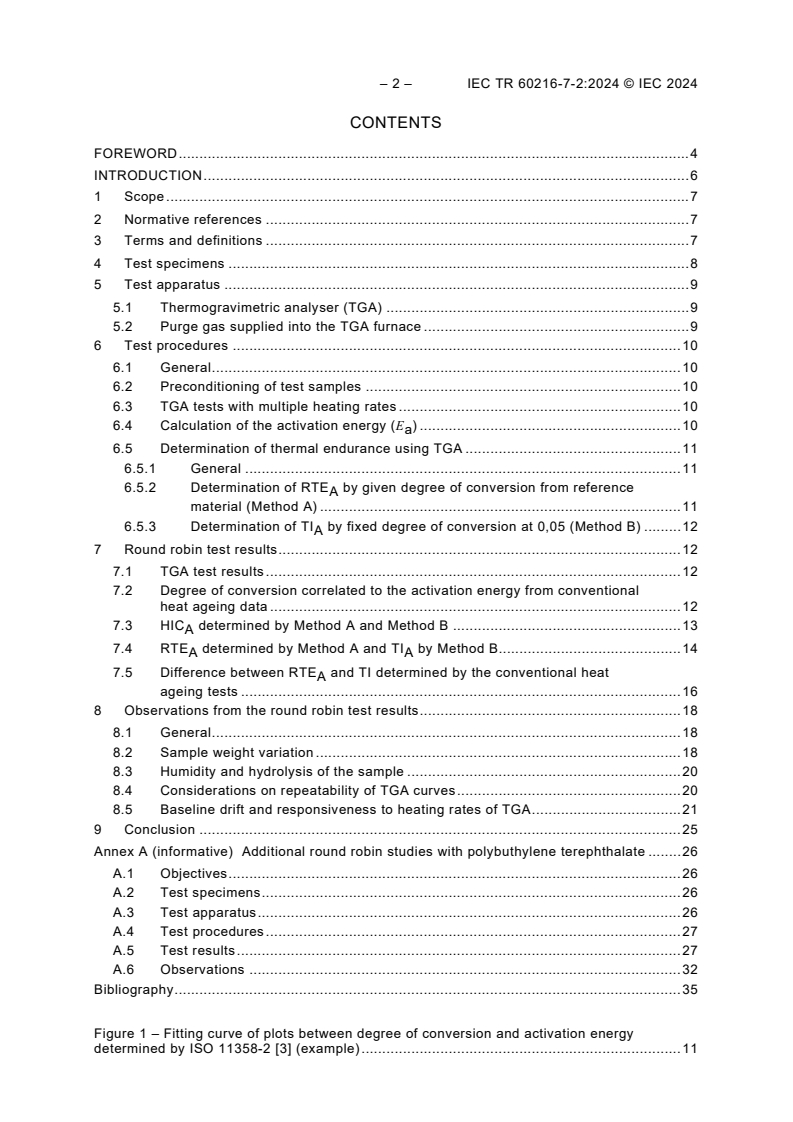
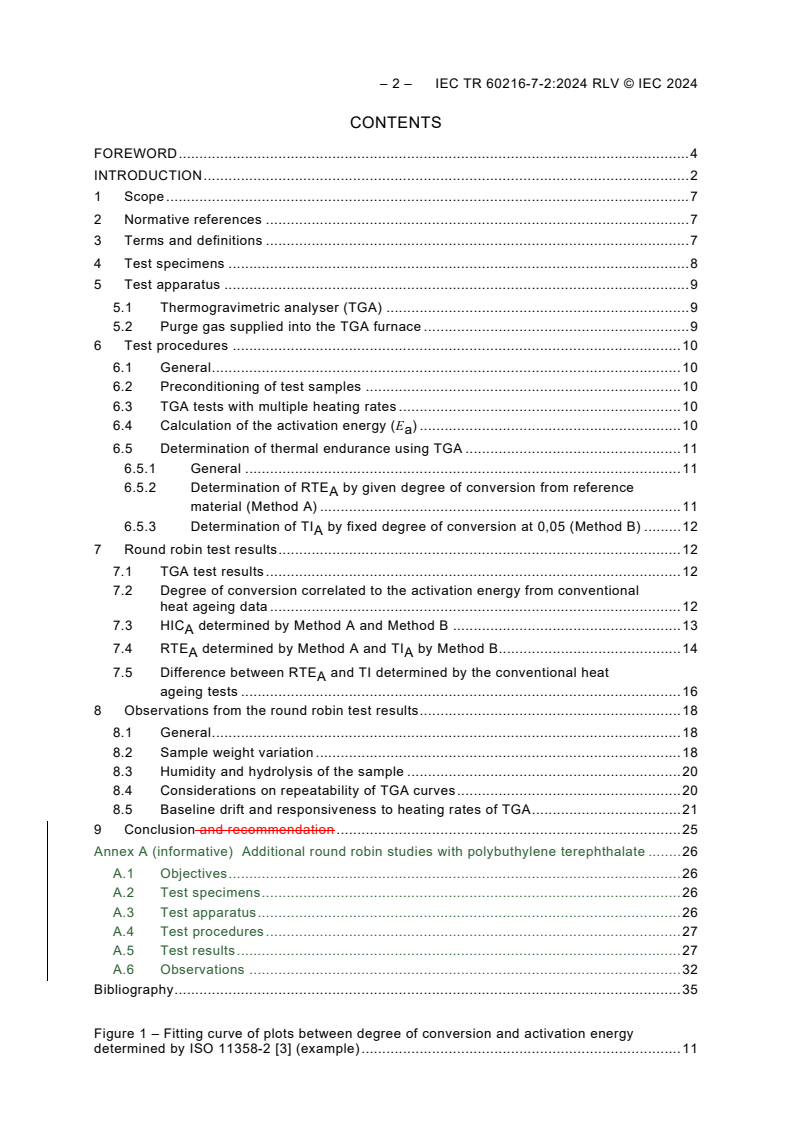
– 2 – IEC TR 60216-7-2:2024 © IEC 2024
CONTENTS
FOREWORD . 4
INTRODUCTION . 6
1 Scope . 7
2 Normative references . 7
3 Terms and definitions . 7
4 Test specimens . 8
5 Test apparatus . 9
5.1 Thermogravimetric analyser (TGA) . 9
5.2 Purge gas supplied into the TGA furnace . 9
6 Test procedures . 10
6.1 General . 10
6.2 Preconditioning of test samples . 10
6.3 TGA tests with multiple heating rates . 10
6.4 Calculation of the activation energy (E ) . 10
a
6.5 Determination of thermal endurance using TGA . 11
6.5.1 General . 11
6.5.2 Determination of RTE by given degree of conversion from reference
A
material (Method A) . 11
6.5.3 Determination of TI by fixed degree of conversion at 0,05 (Method B) . 12
A
7 Round robin test results . 12
7.1 TGA test results . 12
7.2 Degree of conversion correlated to the activation energy from conventional
heat ageing data . 12
7.3 HIC determined by Method A and Method B . 13
A
7.4 RTE determined by Method A and TI by Method B. 14
A A
7.5 Difference between RTE and TI determined by the conventional heat
A
ageing tests . 16
8 Observations from the round robin test results . 18
8.1 General . 18
8.2 Sample weight variation . 18
8.3 Humidity and hydrolysis of the sample . 20
8.4 Considerations on repeatability of TGA curves . 20
8.5 Baseline drift and responsiveness to heating rates of TGA . 21
9 Conclusion . 25
Annex A (informative) Additional round robin studies with polybuthylene terephthalate . 26
A.1 Objectives . 26
A.2 Test specimens . 26
A.3 Test apparatus . 26
A.4 Test procedures . 27
A.5 Test results . 27
A.6 Observations . 32
Bibliography . 35
Figure 1 – Fitting curve of plots between degree of conversion and activation energy
determined by ISO 11358-2 [3] (example) . 11
Figure 2 – Correlation between the initial sample mass of sample A and the difference
of RTE (TI ) from TI . 19
A A
Figure 3 – Correlation between the initial sample mass of sample B and the difference
of RTE (TI ) from TI . 19
A A
Figure 4 – Overlay charts of TGA curves in multiple heating rates in multiple
laboratories (enlarged) . 22
Figure 5 – Logarithm plots for activation energy calculation . 23
Figure 6 – Fitting curves of degree of conversion versus activation energy by TGA . 24
Figure A.1 – Effect of sample amount on Ea (data provided by laboratory E) . 33
Figure A.2 – Summary of factors affecting the TGA kinetic study for determination of
RTE and TI . 34
A A
Table 1 – Heat ageing properties of the test specimens by the conventional procedure
described in IEC 60216-5 [4] . 9
Table 2 – Degree of conversion identical to the activation energy of the conventional
heat ageing . 13
Table 3 – HIC determined by Method A and Method B for dielectric strength . 13
A
Table 4 – HIC determined by Method A and Method B for tensile strength . 14
A
Table 5 – HIC determined by Method A and Method B for impact strength . 14
A
Table 6 – RTE determined by Method A and TI by Method B for dielectric strength . 15
A A
Table 7 – RTE determined by Method A and TI by Method B for tensile strength . 15
A A
Table 8 – RTE determined by Method A and TI by Method B for impact strength . 16
A A
Table 9 – Difference between RTE or TI , and TI for dielectric strength . 16
A A
Table 10 – Difference between RTE or TI , and TI for tensile strength . 17
A A
Table 11 – Difference between RTE or TI , and TI for impact strength . 17
A A
Table 12 – Comparison of degree of conversion with original or rerun data at 8 K/min . 21
Table A.1 – Heat ageing properties of the PBT test specimens by the conventional
procedure in accordance with IEC 60216-5 [4] . 26
Table A.2 – Degrees of conversion at the activation energy identical to that from
conventional heat ageing . 27
Table A.3 – HIC determined by Method A and Method B for dielectric strength . 28
A
Table A.4 – HIC determined by Method A and Method B for tensile strength . 28
A
Table A.5 – HIC determined by Method A and Method B for impact strength . 29
A
Table A.6 – RTE determined by Method A and TI by Method B for dielectric strength . 29
A A
Table A.7 – RTE determined by Method A and TI by Method B for tensile strength . 30
A A
Table A.8 – RTE determined by Method A and TI by Method B for impact strength . 30
A A
Table A.9 – Difference between RTE or TI , and TI for dielectric strength . 31
A A
Table A.10 – Difference between RTE or TI , and TI for tensile strength . 31
A A
Table A.11 – Difference between RTE or TI , and TI for impact strength . 32
A A
– 4 – IEC TR 60216-7-2:2024 © IEC 2024
INTERNATIONAL ELECTROTECHNICAL COMMISSION
____________
ELECTRICAL INSULATING MATERIALS –
THERMAL ENDURANCE PROPERTIES –
Part 7-2: Accelerated determination of relative thermal endurance using
analytical test methods (RTEA) – Results of the round robin tests to
validate procedures of IEC TS 60216-7-1 by non-isothermal kinetic
analysis of thermogravimetric data
FOREWORD
1) The International Electrotechnical Commission (IEC) is a worldwide organization for standardization comprising
all national electrotechnical committees (IEC National Committees). The object of IEC is to promote international
co-operation on all questions concerning standardization in the electrical and electronic fields. To this end and
in addition to other activities, IEC publishes International Standards, Technical Specifications, Technical Reports,
Publicly Available Specifications (PAS) and Guides (hereafter referred to as "IEC Publication(s)"). Their
preparation is entrusted to technical committees; any IEC National Committee interested in the subject dealt with
may participate in this preparatory work. International, governmental and non-governmental organizations liaising
with the IEC also participate in this preparation. IEC collaborates closely with the International Organization for
Standardization (ISO) in accordance with conditions determined by agreement between the two organizations.
2) The formal decisions or agreements of IEC on technical matters express, as nearly as possible, an international
consensus of opinion on the relevant subjects since each technical committee has representation from all
interested IEC National Committees.
3) IEC Publications have the form of recommendations for international use and are accepted by IEC National
Committees in that sense. While all reasonable efforts are made to ensure that the technical content of IEC
Publications is accurate, IEC cannot be held responsible for the way in which they are used or for any
misinterpretation by any end user.
4) In order to promote international uniformity, IEC National Committees undertake to apply IEC Publications
transparently to the maximum extent possible in their national and regional publications. Any divergence between
any IEC Publication and the corresponding national or regional publication shall be clearly indicated in the latter.
5) IEC itself does not provide any attestation of conformity. Independent certification bodies provide conformity
assessment services and, in some areas, access to IEC marks of conformity. IEC is not responsible for any
services carried out by independent certification bodies.
6) All users should ensure that they have the latest edition of this publication.
7) No liability shall attach to IEC or its directors, employees, servants or agents including individual experts and
members of its technical committees and IEC National Committees for any personal injury, property damage or
other damage of any nature whatsoever, whether direct or indirect, or for costs (including legal fees) and
expenses arising out of the publication, use of, or reliance upon, this IEC Publication or any other IEC
Publications.
8) Attention is drawn to the Normative references cited in this publication. Use of the referenced publications is
indispensable for the correct application of this publication.
9) IEC draws attention to the possibility that the implementation of this document may involve the use of (a)
patent(s). IEC takes no position concerning the evidence, validity or applicability of any claimed patent rights in
respect thereof. As of the date of publication of this document, IEC had not received notice of (a) patent(s), which
may be required to implement this document. However, implementers are cautioned that this may not represent
the latest information, which may be obtained from the patent database available at https://patents.iec.ch. IEC
shall not be held responsible for identifying any or all such patent rights.
IEC TR 60216-7-2 has been prepared by IEC technical committee 112: Evaluation and
qualification of electrical insulating materials and systems. It is a Technical Report.
This second edition cancels and replaces the first edition published in 2016. This edition
constitutes a technical revision.
This edition includes the following significant technical changes with respect to the previous
edition:
a) Annex A (informative) has been added to provide a round robin test with a different polymer
type – polybuthylene terephthalate (PBY) – as an additional use case of the method in
accordance with IEC TS 60216-7-1;
b) Tables 3 to 11 have been corrected by adding units, and texts have been refined for more
technical clarifications of the procedures and observations.
The text of this Technical Report is based on the following documents:
Draft Report on voting
112/651/DTR 112/658/RVDTR
Full information on the voting for its approval can be found in the report on voting indicated in
the above table.
The language used for the development of this Technical Report is English.
This document was drafted in accordance with ISO/IEC Directives, Part 2, and developed in
accordance with ISO/IEC Directives, Part 1 and ISO/IEC Directives, IEC Supplement, available
at www.iec.ch/members_experts/refdocs. The main document types developed by IEC are
described in greater detail at www.iec.ch/publications.
A list of all parts in the IEC 60216 series, published under the general title Electrical insulating
materials – Thermal endurance properties, can be found on the IEC website.
The committee has decided that the contents of this document will remain unchanged until the
stability date indicated on the IEC website under webstore.iec.ch in the data related to the
specific document. At this date, the document will be
• reconfirmed,
• withdrawn, or
• revised.
IMPORTANT – The "colour inside" logo on the cover page of this document indicates
that it contains colours which are considered to be useful for the correct understanding
of its contents. Users should therefore print this document using a colour printer.
– 6 – IEC TR 60216-7-2:2024 © IEC 2024
INTRODUCTION
IEC technical committee 112, (IEC TC 112) has been working on the development of
IEC TS 60216-7-1 [1] that considers the use of activation energy determined through thermal
analytical tools plus abbreviated conventional heat ageing to determine a thermal index on a
polymeric compound. At the same time, the Underwriters Laboratories Long-Term Thermal
Aging Forum (UL LTTA Forum) has been discussing alternative methods that can speed up the
determination of a thermal index. Members of the IEC TC 112 and of the UL LTTA Forum have
made joint efforts to determine whether the Technical Specification developed by IEC TC 112
can be used to offer an alternative method of evaluating polymeric compounds for a thermal
index.
Members of IEC TC 112 and the UL LTTA Forum decided to conduct a round robin test (RRT)
using thermogravimetric analysis (TGA) according to ISO 11358-2 [3] on a known compound,
with a known activation energy determined through conventional ageing with a view to validate
the acceptability of IEC TS 60216-7-1, and to determine whether a similar thermal index can be
calculated. The round robin testing was conducted with conventional TGA by multiple heating
rates. However, running isothermal tests can be a follow-up of this RRT.
___________
Numbers in square brackets refer to the Bibliography.
ELECTRICAL INSULATING MATERIALS –
THERMAL ENDURANCE PROPERTIES –
Part 7-2: Accelerated determination of relative thermal endurance using
analytical test methods (RTEA) – Results of the round robin tests to
validate procedures of IEC TS 60216-7-1 by non-isothermal kinetic
analysis of thermogravimetric data
1 Scope
This part of IEC 60216 is intended to validate the procedures of IEC TS 60216-7-1 in providing
a similar temperature index to conventional methods used in other parts of the IEC 60216 series.
The round robin test results do not provide statistical analysis for precision. The round robin
test focuses on preliminary studies to understand the evaluation and calculation procedures,
influence on apparatus, and data variance among laboratories before determination of precision.
2 Normative references
There are no normative references in this document.
3 Terms and definitions
For the purposes of this document, the following terms and definitions apply.
ISO and IEC maintain terminology databases for use in standardization at the following
addresses:
• IEC Electropedia: available at https://www.electropedia.org/
• ISO Online browsing platform: available at https://www.iso.org/obp
3.1
activation energy
Arrhenius activation energy
E
a
empirical parameter characterizing the exponential temperature dependence of the reaction
rate constant
3.2
end-point
limit for a diagnostic property value based on which the thermal endurance is evaluated
3.3
time to end-point
failure time
time to reach the end-point or conventional failure
– 8 – IEC TR 60216-7-2:2024 © IEC 2024
3.4
relative temperature endurance index
RTE
numerical value of the temperature in degrees Celsius at which the estimated time to end-point
of the candidate material is the same as the estimated time to end-point of the reference
material at a temperature equal to its assessed temperature index
Note 1 to entry: RTE is the relative temperature endurance index calculated through the analytical procedure.
A
3.5
temperature endurance index
TI
numerical value of the temperature in degrees Celsius derived from the thermal endurance
relationship at a time of 20 000 h (or other specified time)
Note 1 to entry: TI is the temperature index calculated through the analytical procedure.
A
[SOURCE: IEC 60050-212:2010, 212-12-11 [2], modified – "characterizing the thermal
capability of an insulating material or an insulation system" has been replaced with "derived
from the thermal endurance relationship at a time of 20 000 h (or other specified time)" and the
two notes to entry have been replaced by a new note to entry.]
3.6
halving interval
HIC
numerical value of the temperature interval in kelvin which expresses the halving of the time to
end-point taken at the temperature equal to TI
Note 1 to entry: HIC is the halving interval calculated through the analytical procedure.
A
3.7
degree of conversion
α
quantity of products present at a particular time and temperature during a reaction compared
with the final quantity of the products
[SOURCE: ISO 11358-2:2021, 3.3 [3], modified – The symbol "C" has been replaced with "α"
and the notes to entry have been deleted.]
4 Test specimens
For the round robin test, one generic type of polymer, liquid crystal polyester (LCP), was pre-
selected. Although it is known that materials can undergo more than one transition, the round
robin test verified the assumption that one single thermal degradation reaction is predominant
and directly correlated to the end-point of dielectric strength as a diagnostic property.
NOTE Since different materials can undergo more than one transition, the validity of results obtained from the
evaluation of thermal endurance properties using TGA are assessed for the different materials.
LCP originally has very little entwining of molecules exhibiting crystalline properties as a liquid.
Hence, there is less thermal transformation between solid and liquid, or between oven ageing
conditions of conventional thermal endurance test and TGA conditions at higher temperature
ranges. In addition, LCP molecular chains align themselves when moulded, and this generates
a self-reinforcing effect, thereby resulting in high mechanical and electrical stress resistance.
In this round robin, two LCP materials (LCP sample A, LCP sample B) were chosen as test
samples which already have the conventional heat oven ageing data of dielectric strength,
tensile strength, and impact strength to validate the acceptability of whether or not RTE can
A
be similar to RTE. Both sample A and sample B consist of 30 % glass fibres reinforced materials.
Configurations of monomers are the only differences between the samples which influence the
difference in thermal resistance, as shown in Table 1.
The samples were homogenized by freeze-pulverization from test plaques. 100 mg each of
freeze-pulverized powders from the same batch were prepared and provided to eleven testing
laboratories for evaluation, after pre-drying at 140 °C for 4 h.
Table 1 – Heat ageing properties of the test specimens by
the conventional procedure described in IEC 60216-5 [4]
Time to end-point at Time to end-point at Time to end-point at
50 % retention of initial 50 % retention of initial 50 % retention of initial
Temperature
dielectric strength tensile strength impact strength
in ovens
h h h
LCP LCP LCP LCP LCP LCP
ºC
Sample A Sample B Sample A Sample B Sample A Sample B
290 1 141 1 215 1 860
285 2 896 1 789 2 870
280 1 917 3 229 2 655
275 5 591 3 083 4 164
270 4 300 4 597 3 920
265 8 255 6 706 8 412
260 5 848 7 625 6 640
250 9 600
TI (ºC) 250,0 241,5 249,1 246,2 249,1 234,7
E (kJ/mol)
130,6 142,3 165,2 145,9 134,5 102,9
a
5 Test apparatus
5.1 Thermogravimetric analyser (TGA)
A thermogravimetric analyser (TGA) in accordance with ISO 11358-1 [5] was used for the
determination of RTE concerning the test samples. In fact, a number of commercial
A
instruments suitable for the measurement are available and various models of TGAs were used
for evaluation of the test samples by the participating laboratories. Before the RRT, weight and
temperature calibrations were implemented based on ISO 11358-1 and TGA apparatus
manufacturer's guidance.
5.2 Purge gas supplied into the TGA furnace
For purge gas into the TGA furnace, air was chosen to assume oxidative thermal degradation,
as well as degradation of electrical and mechanical strengths with test specimens in oven
ageing. Most of the laboratory participants selected dry air (water content less than 1 ppm ),
but air supplied from the facility (compressed air with or without an air dryer) was used in a few
laboratories.
___________
ppm = parts per million.
– 10 – IEC TR 60216-7-2:2024 © IEC 2024
6 Test procedures
6.1 General
Thermal analysis with TGA of the test samples was evaluated with reference to ISO 11358-2 [3]
and IEC TS 60216-7-1 in principle. A few modifications of test conditions and more detailed
procedures were added as follows.
6.2 Preconditioning of test samples
5 mg ± 0,5 mg of the test sample were initially measured in each laboratory and mounted on
the empty pan in the furnace opened. Then the furnace was closed and pre-conditioned in
equilibrium at 100 °C for 1 h before heating tests were started. The weight value just before the
heating test (time at 0 s in the heating run, or 60 min at the end of the equilibrium) was used
for calculation on the degree of conversion.
NOTE ISO 11358-2 [3] requires using test samples of identical mass ±1 % of the initial weight in multiple heating
conditions which is much narrower than the above. Influence on the initial mass deviation is taken into consideration
in 7.2.
6.3 TGA tests with multiple heating rates
Multiple heating rates testing at 1 K/min, 2 K/min, 4 K/min, 6 K/min and 8 K/min were selected
for evaluation which resulted in the lowest and highest heating rates differing by a factor of 8,
in accordance with ISO 11358-2 [3]. Evaluation temperature range was set between 100 °C and
700 °C. Each heating rate test was run one time each for sample A and sample B, but 8 K/min
was evaluated twice as an approximate check and to consider repeatability.
6.4 Calculation of the activation energy (E )
a
After TGA data with multiple heating rates were obtained, the activation energies were
calculated for given degrees of conversion in accordance with Equation (2) in
ISO 11358-2:2021 [3]. Then, both values of degree of conversion and the activation energies
were plotted between 1 % and 19 % with 2 % interval of degree of conversion and a cubic curve
fitting approximately was performed as shown in Figure 1. Equation (2) in ISO 11358-2:2021 [3]
was used for the selection of appropriate activation energy and degree of conversion to
determine RTE .
A
For example, if the activation energy of a reference material was already determined as
150 kJ/mol by the conventional heat ageing (e.g. dielectric strength), the corresponding degree
of conversion of the reference material can be read and obtained with the equation of the fitting
curve graph (see Figure 1). Then the corresponding degree of conversion for this reference
material can be used for reading the activation energy of a candidate material from another
graph which was also evaluated with ISO 11358-2 [3] and had a similar degree of conversion
versus the activation energy fitting curve for the candidate material.
All TGA raw data were submitted by eleven participating laboratories and analysis with
ISO 11358-2 [3] was carried out by one of the laboratories with the analytical tool, to avoid any
discrepancy among various software calculations.
Figure 1 – Fitting curve of plots between degree of conversion and
activation energy determined by ISO 11358-2 [3] (example)
6.5 Determination of thermal endurance using TGA
6.5.1 General
The activation energy given by the above procedure can be used for the determination of RTE
A
by calculating with time to end-point at the highest temperature, which was determined by the
conventional heat ageing test under IEC 60216-5 [4], and procedures in accordance with
IEC TS 60216-7-1.
In accordance with ISO 11358-2 [3], various activation energies can be obtained per certain
degrees of conversion calculated with multiple heating rate data of TGA. Therefore, degrees of
conversion were chosen appropriately to be correlated to thermal degradation derived by
properties and the conventional heat ageing data which are described in 6.5.2 (Method A). On
the other hand, the fixed degree of conversion at 0,05 and activation energy are sometimes
used experimentally for prediction of end-point of properties [6], [7], which is described in 6.5.3
(Method B).
6.5.2 Determination of RTE by given degree of conversion from reference material
A
(Method A)
After the cubic approximation between the degree of conversion and the activation energy is
determined (see 6.4), the degree of conversion for the reference material is given from the
equation where the activation energy is the same as that from the Arrhenius equation of
conventional heat ageing data. The activation energy of the candidate material is then
determined from the cubic approximation of the candidate material where the degree of
conversion for the candidate material is assumed to be the same as the given degree of
conversion for the reference material. In Method A, RTE can be obtained.
A
NOTE The assumption that the degree of conversion for the candidate material is the same as the given degree of
conversion for the reference material, is validated since the candidate material can be of the same type of the
reference material.
– 12 – IEC TR 60216-7-2:2024 © IEC 2024
6.5.3 Determination of TI by fixed degree of conversion at 0,05 (Method B)
A
In Method B, the fixed degree of conversion at 0,05 can be selected to calculate the activation
energy of the candidate material, with regard to practical experiences [7], [8]. In Method B it is
unnecessary to use reference material data to determine the activation energy of the candidate
material in accordance with ISO 11358-2 [3] and the thermal indices of materials can be
determined as TI by the activation energy when the degree of conversion is 0,05.
A
In this round robin test, TI and RTE at 20 000 h of LCP sample A and sample B were
A A
determined by using Method A and Method B respectively.
7 Round robin test results
7.1 TGA test results
All the raw TGA test data were obtained from eleven laboratories (a, b, c, d, e, f, g, h, i, j and
k). Figure 4 shows typical examples of overlay TGA curves at multiple heating rates magnified
to show the degrees of conversion between 0 and 0,02. Figure 5 provides typical examples of
logarithm graphs between reciprocal temperatures and heating rates for certain degrees of
conversions. Figure 6 shows cubic approximation between degree of conversions and activation
energies to read appropriate activation energy for the determination of RTE or TI .
A A
7.2 Degree of conversion correlated to the activation energy from conventional heat
ageing data
Degrees of conversion at the activation energy identical to that from conventional heat ageing
were determined with reference to ISO 11358-2 [3] and IEC TS 60216-7-1 which are shown in
Table 2.
It was observed that both sample A and sample B had very low initial thermal degradation under
TGA (around 3 % or 4 % mass loss) which were correlated to thermal degradation of the
dielectric strength under a heating oven, in terms of the identical activation energies. For
reproducibility in laboratories, however, relatively high deviations are observed (around 30 %
of the average degree of conversion) for both sample A and sample B. In addition, three
laboratories (b, d, and j) were not able to obtain a degree of conversion identical to that of the
activation energy of conventional heat ageing, because all of the activation energies were found
to be higher than the ones determined by heat ageing in the considered range.
Table 2 – Degree of conversion identical to the activation energy
of the conventional heat ageing
Laboratory Degree of conversion identical to Degree of conversion identical to
activation energy of the activation energy of the
conventional heating, sample A conventional heating, sample B
a 0,032 7 0,019 9
b N/A 0,039 3
c 0,040 8 0,043 7
d N/A 0,037 8
e 0,037 7 0,024 4
f 0,021 9 0,040 6
g 0,036 7 0,024 6
h 0,034 2 0,037 1
i 0,051 5 0,032 1
j N/A 0,015 0
k 0,060 0 0,031 1
Average 0,032 7 0,031 4
Standard deviation 0,013 6 0,009 3
NOTE N/A means that in the cubic approximation of activation versus the degree of conversion, the equation did
not provide a solution.
7.3 HIC determined by Method A and Method B
A
HIC determined by Method A and Method B according to IEC TS 60216-7-1 is shown in Table 3,
A
Table 4 and Table 5 for dielectric strength, tensile strength and impact strength, respectively.
Table 3 – HIC determined by Method A and Method B for dielectric strength
A
Laboratory Method A Method B
HIC of sample A HIC of sample B HIC of sample A HIC of sample B
A A A A
K K K K
a 10,4 9,5 9,8 7,9
b 8,8 N/A 8,6 7,6
c 12,1 11,7 11,6 10,6
d 8,6 N/A 7,9 9,7
e 14,4 9,0 12,6 8,1
f 10,6 16,7 10,0 9,1
g 13,5 10,3 10,0 9,0
h 12,2 9,2 11,5 7,0
i 20,7 8,6 13,0 8,8
j 11,0 N/A 9,1 7,7
k 11,7 12,7 10,4 9,6
Average 12,2 11,0 10,4 8,6
Standard deviation 3,2 2,5 1,5 1,0
NOTE N/A means that in the cubic approximation of activation versus the degree of conversion, the equation did
not provide a solution.
– 14 – IEC TR 60216-7-2:2024 © IEC 2024
Table 4 – HIC determined by Method A and Method B for tensile strength
A
Laboratory Method A Method B
HIC of sample A HIC of sample B HIC of sample A HIC of sample B
A A A A
K K K K
a 10,0 9,1 9,6 7,9
b 8,7 7,5 8,3 7,6
c 11,5 9,3 11,3 10,7
d 8,5 16,4 7,9 9,7
e 13,9 7,8 12,2 8,4
f 10,1 8,8 9,8 9,2
g 12,6 9,1 9,7 7,9
h 11,9 6,3 11,2 7,1
i 18,8 7,9 12,6 8,8
j 10,1 11,0 8,8 7,8
k 11,1 9,3 10,1 9,6
Average 11,6 9,3 10,1 8,6
Standard deviation 2,9 2,6 1,5 1,1
Table 5 – HIC determined by Method A and Method B for impact strength
A
Laboratory Method A Method B
HIC of sample A HIC of sample B HIC of sample A HIC of sample B
A A A A
K K K K
a 9,3 8,4 9,8 8,1
b 8,3 6,6 8,5 7,7
c 20,5 11,6 11,6 11,0
d 10,0 N/A 8,1 9,9
e 12,7 9,2 12,6 8,6
f 11,6 16,6 10,0 9,4
g 14,8 10,3 10,0 9,2
h N/A 8,0 11,5 7,2
i 32,4 8,9 13,0 9,0
j 10,5 N/A 9,0 7,9
k 12,2 16,4 10,4 9,8
Average 14,2 10,7 10,4 8,9
Standard deviation 7,3 3,6 1,6 1,1
7.4 RTE determined by Method A and TI by Method B
A A
RTE determined by Method A and TI by Method B are shown in Table 6, Table 7, and Table 8
A A
for dielectric strength, tensile strength, and impact strength, respectively.
Table 6 – RTE determined by Method A and TI by Method B for dielectric strength
A A
Laboratory Method A Method B
RTE of sample A RTE of sample B TI of sample A TI of sample B
A A A A
°C °C °C °C
a 255,0 249,2 256,7 256,4
b 259,7 N/A 260,4 257,7
c 249,9 238,9 251,2 243,8
d 260,2 N/A 262,3 248,2
e 242,8 251,4 248,3 255,2
f 254,3 213,7 256,1 250,7
g 245,5 245,3 256,2 251,4
h 249,5 250,5 251,6 260,1
i 222,7 253,0 247,1 252,4
j 253,0 N/A 258,8 257,0
k 251,1 234,2 254,9 248,7
Average 249,3 243,1 254,9 253,3
Standard deviation 10,3 13,2 4,9 4,9
Table 7 – RTE determined by Method A and TI by Method B for tensile strength
A A
Laboratory Method A Method B
RTE of sample A RTE of sample B TI of sample A TI of sample B
A A A A
°C °C °C °C
a 250,7 250,7 252,4 256,1
b 255,6 257,8 256,8 257,5
c 245,3 249,6 246,1 243,4
d 256,2 215,2 258,2 247,9
e 236,3 256,5 242,8 253,9
f 250,5 252,0 251,7 250,4
g 241,4 243,6 251,8 250,1
h 243,8 263,2 246,6 259,9
i 216,9 256,3 241.5 252,1
j 250,6 241,8 255,2 256,6
k 247,0 249,8 250,4 248,4
Average 244,9 248,8 250,3 252,4
Standard deviation 11,0 12,7 5,5 4,9
– 16 – IEC TR 60216-7-2:2024 © IEC 2024
Table 8 – RTE determined by Method A and TI by Method B for impact strength
A A
Laboratory Method A Method B
RTE of sample A RTE of sample B TI of sample A TI of sample B
A A A A
°C °C °C °C
a 257,8 259,3 256,3 260,7
b 260,7 266,2 260,1 261,9
c 222,3 247,0 250,7 249,6
d 255,7 N/A 261,5 253,6
e 247,4 256,4 247,8 258,8
f 250,8 227,1 255,7 255,7
g 240,8 252,1 255,7 256,4
h N/A 260,9 251,1 264,1
i 179,8 257,7 246,6 257,2
j 254,3 N/A 258,8 261,2
k 248,9 227,6 254,5 254,0
Average 241,9 250,5 254,4 257,6
Standard deviation 24,4 14,2 4,9 4,3
7.5 Difference between RTE and TI determined by the conventional heat ageing tests
A
Differences between RTE or TI and TI, which is a numerical value remaining after TI is
A A
deducted from RTE or TI , are shown in Table 9, Table 10, and Table 11 for dielectric strength,
A A
tensile strength, and impact strength, respectively.
Table 9 – Difference between RTE or TI , and TI for dielectric strength
A A
Laboratory Method A Method B
RTE -TI of RTE -TI of TI -TI of TI -TI of
A A A A
sample A sample B sample A sample B
°C °C °C °C
a 5 7,7 6,7 14,9
b 9,7 N/A 10,4 16,2
c −0,1 −2,6 1,2 2,3
d 10,2 N/A 12,3 6,7
e −7,2 9,9 −1,7 13,7
f 4,3 −27,8 6,1 9,2
g −4,5 3,8 6,2 9,9
h −0,5 9,0 1,6 18,6
i −27,3 11,5 −2,9 10,9
j 3,0 N/A 8,8 15,5
k 1,1 −7,3 4,9 7,2
Average −0,6 0,5 4,9 11,4
Mean 1,1 5,8 6,1 10,9
Standard deviation 10,3 13,2 4,9 4,9
Table 10 – Difference between RTE or TI , and TI for tensile strength
A A
Laboratory Method A Method B
RTE -TI of RTE -TI of TI -TI of TI -TI of
A A A A
sample A sample B sample A sample B
°C °C °C °C
a 0,7 9,2 2,4 14,6
b 5,6 N/A 6,8 16,0
c −4,7 8,1 −3,9 1,9
d 6,2 N/A 8,2 6,4
e −13,7 15,0 −7,2 12,4
f 0,5 10,5 1,7 8,9
g −8,6 2,1 1,8 8,6
h −6,2 21,7 −3,4 18,4
i −33,1 14,8 −8,5 10,6
j 0,6 N/A 5,2 15,1
k −3,0 8,3 0,4 6,9
Average −5,1 11,2 0,3 10,9
Mean −3,0 9,8 1,7 10,6
Standard deviation 11,0 5,9 5,5 4,9
Table 11 – Difference between RTE or TI , and TI for impact strength
A A
Laboratory Method A Method B
RTE -TI of RTE -TI of TI -TI of TI -TI of
A A A A
sample A sample B sample A sample B
°C °C °C °C
a 7,8 17,8 6,3 19,2
b 10,7 N/A 10,1 20,4
c −27,7 5,5 0,7 8,1
d 5,7 N/A 11,5 12,1
e −2,6 14,9 −2,2 17,3
f 0,8 −14,4 5,7 14,2
g −9,2 10,6 5,7 14,9
h N/A 19,4 1,1 22,6
i −70,2 16,2 −3,4 15,7
j 4,3 N/A 8,8 19,7
k −1,1 −13,9 4,5 12,5
Average −8,2 7,0 4,4 16,1
Mean −0,1 12,8 5,7 15,7
Standard deviation 24,4 13,8 4,9 4,3
– 18 – IEC TR 60216-7-2:2024 © IEC 2024
8 Observations from the round robin test results
8.1 General
In the round robin test, the following productive points were observed for the validation of
IEC TS 60216-7-1:
– both RTE and TI determined in these round robin tests mostly had similar values to TI by
A A
conventional heat ageing with a difference in temperature of 20 °C or less in most cases,
and
– Method A using the degree of conversion given by the calculation failed to provide solutions
of RTE in a few laboratories and their standard deviations were also relatively high,
A
whereas Method B using the fixed degree of conversion based on experiences at 0,05
provided lower standard variations between laboratories.
It is noted, however, that results show differences between the laboratories, with differences in
temperature exceeding 20 °C in some instances of the report.
In particular, the difference of within 20 °C from the conventional heat ageing is useful, because
the conventional RTE in accordance with the IEC 60216 series also contains this level of
reproducibility issues due to variation factors of heating ovens, test plaques and lot-to-lot
variation of materials, etc.
As a practical example of implementing long term thermal endurance evaluation according to
IEC 60216-8 [9], a certification of the thermal endurance properties provides the industry with
a temperature classification with some increments according to the temperature assigned such
as 20 °C increments over 180 °C of RTI, 10 °C increments from 130 °C through 180 °C and
5 °C increments up to 130 °C [10].
As TI of the two LCP materials evaluated in this document have been determined over 180 °C,
20 °C or less difference between RTE or TI and TI, conformity with the temperature
A A
classification in accordance with the above conventional heat ageing methods can be
established.
On the other hand, the round robin test also raised technical concerns as follows:
– laboratory i determined an RTE of the LCP sample A significantly different from those by
A
other laboratories in all the three properties, and
– a few laboratories were not able to determine RTE of sample B, because the degree of
A
conversion was not appropriately calculated from the fitting curve in 6.4.
The round robin test participants discussed the rationale, and the following potential factors
which ca
...
IEC TR 60216-7-2 ®
Edition 2.0 2024-09
REDLINE VERSION
TECHNICAL
REPORT
colour
inside
Electrical insulating materials – Thermal endurance properties –
Part 7-2: Accelerated determination of relative thermal endurance using
analytical test methods (RTEA) – Results of the round robin tests to validate
procedures of IEC TS 60216-7-1 by non-isothermal kinetic analysis of
thermogravimetric data
All rights reserved. Unless otherwise specified, no part of this publication may be reproduced or utilized in any form
or by any means, electronic or mechanical, including photocopying and microfilm, without permission in writing from
either IEC or IEC's member National Committee in the country of the requester. If you have any questions about IEC
copyright or have an enquiry about obtaining additional rights to this publication, please contact the address below or
your local IEC member National Committee for further information.
IEC Secretariat Tel.: +41 22 919 02 11
3, rue de Varembé info@iec.ch
CH-1211 Geneva 20 www.iec.ch
Switzerland
About the IEC
The International Electrotechnical Commission (IEC) is the leading global organization that prepares and publishes
International Standards for all electrical, electronic and related technologies.
About IEC publications
The technical content of IEC publications is kept under constant review by the IEC. Please make sure that you have the
latest edition, a corrigendum or an amendment might have been published.
IEC publications search - webstore.iec.ch/advsearchform IEC Products & Services Portal - products.iec.ch
The advanced search enables to find IEC publications by a Discover our powerful search engine and read freely all the
variety of criteria (reference number, text, technical publications previews, graphical symbols and the glossary.
committee, …). It also gives information on projects, replaced With a subscription you will always have access to up to date
and withdrawn publications. content tailored to your needs.
IEC Just Published - webstore.iec.ch/justpublished
Electropedia - www.electropedia.org
Stay up to date on all new IEC publications. Just Published
The world's leading online dictionary on electrotechnology,
details all new publications released. Available online and once
containing more than 22 500 terminological entries in English
a month by email.
and French, with equivalent terms in 25 additional languages.
Also known as the International Electrotechnical Vocabulary
IEC Customer Service Centre - webstore.iec.ch/csc
(IEV) online.
If you wish to give us your feedback on this publication or need
further assistance, please contact the Customer Service
Centre: sales@iec.ch.
IEC TR 60216-7-2 ®
Edition 2.0 2024-09
REDLINE VERSION
TECHNICAL
REPORT
colour
inside
Electrical insulating materials – Thermal endurance properties –
Part 7-2: Accelerated determination of relative thermal endurance using
analytical test methods (RTEA) – Results of the round robin tests to validate
procedures of IEC TS 60216-7-1 by non-isothermal kinetic analysis of
thermogravimetric data
INTERNATIONAL
ELECTROTECHNICAL
COMMISSION
ICS 19.020; 29.020; 29.035.01 ISBN 978-2-8322-9761-2
– 2 – IEC TR 60216-7-2:2024 RLV © IEC 2024
CONTENTS
FOREWORD . 4
INTRODUCTION . 2
1 Scope . 7
2 Normative references . 7
3 Terms and definitions . 7
4 Test specimens . 8
5 Test apparatus . 9
5.1 Thermogravimetric analyser (TGA) . 9
5.2 Purge gas supplied into the TGA furnace . 9
6 Test procedures . 10
6.1 General . 10
6.2 Preconditioning of test samples . 10
6.3 TGA tests with multiple heating rates . 10
6.4 Calculation of the activation energy (E ) . 10
a
6.5 Determination of thermal endurance using TGA . 11
6.5.1 General . 11
6.5.2 Determination of RTE by given degree of conversion from reference
A
material (Method A) . 11
6.5.3 Determination of TI by fixed degree of conversion at 0,05 (Method B) . 12
A
7 Round robin test results . 12
7.1 TGA test results . 12
7.2 Degree of conversion correlated to the activation energy from conventional
heat ageing data . 12
7.3 HIC determined by Method A and Method B . 13
A
7.4 RTE determined by Method A and TI by Method B. 14
A A
7.5 Difference between RTE and TI determined by the conventional heat
A
ageing tests . 16
8 Observations from the round robin test results . 18
8.1 General . 18
8.2 Sample weight variation . 18
8.3 Humidity and hydrolysis of the sample . 20
8.4 Considerations on repeatability of TGA curves . 20
8.5 Baseline drift and responsiveness to heating rates of TGA . 21
9 Conclusion and recommendation . 25
Annex A (informative) Additional round robin studies with polybuthylene terephthalate . 26
A.1 Objectives . 26
A.2 Test specimens . 26
A.3 Test apparatus . 26
A.4 Test procedures . 27
A.5 Test results . 27
A.6 Observations . 32
Bibliography . 35
Figure 1 – Fitting curve of plots between degree of conversion and activation energy
determined by ISO 11358-2 [3] (example) . 11
Figure 2 – Correlation between the initial sample mass of sample A and the difference
of RTE (TI ) from TI . 19
A A
Figure 3 – Correlation between the initial sample mass of sample B and the difference
of RTE (TI ) from TI . 19
A A
Figure 4 – Overlay charts of TGA curves in multiple heating rates in multiple
laboratories (enlarged) . 22
Figure 5 – Logarithm plots for activation energy calculation . 23
Figure 6 – Fitting curves of degree of conversion versus activation energy by TGA . 24
Figure A.1 – Effect of sample amount on Ea (data provided by laboratory E) . 33
Figure A.2 – Summary of factors affecting the TGA kinetic study for determination of
RTE and TI . 34
A A
Table 1 – Heat ageing properties of the test specimens by the conventional procedure
described in IEC 60216-5 [4] . 9
Table 2 – Degree of conversion identical to the activation energy of the conventional
heat ageing . 13
Table 3 – HIC determined by Method A and Method B for dielectric strength . 13
A
Table 4 – HIC determined by Method A and Method B for tensile strength . 14
A
Table 5 – HIC determined by Method A and Method B for impact strength . 14
A
Table 6 – RTE determined by Method A and TI by Method B for dielectric strength . 15
A A
Table 7 – RTE determined by Method A and TI by Method B for tensile strength . 15
A A
Table 8 – RTE determined by Method A and TI by Method B for impact strength . 16
A A
Table 9 – Difference between RTE or TI , and TI for dielectric strength . 16
A A
Table 10 – Difference between RTE or TI , and TI for tensile strength . 17
A A
Table 11 – Difference between RTE or TI , and TI for impact strength . 17
A A
Table 12 – Comparison of degree of conversion with original or rerun data at 8 K/min . 21
Table A.1 – Heat ageing properties of the PBT test specimens by the conventional
procedure in accordance with IEC 60216-5 [4] . 26
Table A.2 – Degrees of conversion at the activation energy identical to that from
conventional heat ageing . 27
Table A.3 – HIC determined by Method A and Method B for dielectric strength . 28
A
Table A.4 – HIC determined by Method A and Method B for tensile strength . 28
A
Table A.5 – HIC determined by Method A and Method B for impact strength . 29
A
Table A.6 – RTE determined by Method A and TI by Method B for dielectric strength . 29
A A
Table A.7 – RTE determined by Method A and TI by Method B for tensile strength . 30
A A
Table A.8 – RTE determined by Method A and TI by Method B for impact strength . 30
A A
Table A.9 – Difference between RTE or TI , and TI for dielectric strength . 31
A A
Table A.10 – Difference between RTE or TI , and TI for tensile strength . 31
A A
Table A.11 – Difference between RTE or TI , and TI for impact strength . 32
A A
– 4 – IEC TR 60216-7-2:2024 RLV © IEC 2024
INTERNATIONAL ELECTROTECHNICAL COMMISSION
____________
ELECTRICAL INSULATING MATERIALS –
THERMAL ENDURANCE PROPERTIES –
Part 7-2: Accelerated determination of relative thermal endurance using
analytical test methods (RTEA) – Results of the round robin tests to
validate procedures of IEC TS 60216-7-1 by non-isothermal kinetic
analysis of thermogravimetric data
FOREWORD
1) The International Electrotechnical Commission (IEC) is a worldwide organization for standardization comprising
all national electrotechnical committees (IEC National Committees). The object of IEC is to promote international
co-operation on all questions concerning standardization in the electrical and electronic fields. To this end and
in addition to other activities, IEC publishes International Standards, Technical Specifications, Technical Reports,
Publicly Available Specifications (PAS) and Guides (hereafter referred to as "IEC Publication(s)"). Their
preparation is entrusted to technical committees; any IEC National Committee interested in the subject dealt with
may participate in this preparatory work. International, governmental and non-governmental organizations liaising
with the IEC also participate in this preparation. IEC collaborates closely with the International Organization for
Standardization (ISO) in accordance with conditions determined by agreement between the two organizations.
2) The formal decisions or agreements of IEC on technical matters express, as nearly as possible, an international
consensus of opinion on the relevant subjects since each technical committee has representation from all
interested IEC National Committees.
3) IEC Publications have the form of recommendations for international use and are accepted by IEC National
Committees in that sense. While all reasonable efforts are made to ensure that the technical content of IEC
Publications is accurate, IEC cannot be held responsible for the way in which they are used or for any
misinterpretation by any end user.
4) In order to promote international uniformity, IEC National Committees undertake to apply IEC Publications
transparently to the maximum extent possible in their national and regional publications. Any divergence between
any IEC Publication and the corresponding national or regional publication shall be clearly indicated in the latter.
5) IEC itself does not provide any attestation of conformity. Independent certification bodies provide conformity
assessment services and, in some areas, access to IEC marks of conformity. IEC is not responsible for any
services carried out by independent certification bodies.
6) All users should ensure that they have the latest edition of this publication.
7) No liability shall attach to IEC or its directors, employees, servants or agents including individual experts and
members of its technical committees and IEC National Committees for any personal injury, property damage or
other damage of any nature whatsoever, whether direct or indirect, or for costs (including legal fees) and
expenses arising out of the publication, use of, or reliance upon, this IEC Publication or any other IEC
Publications.
8) Attention is drawn to the Normative references cited in this publication. Use of the referenced publications is
indispensable for the correct application of this publication.
9) IEC draws attention to the possibility that the implementation of this document may involve the use of (a)
patent(s). IEC takes no position concerning the evidence, validity or applicability of any claimed patent rights in
respect thereof. As of the date of publication of this document, IEC had not received notice of (a) patent(s), which
may be required to implement this document. However, implementers are cautioned that this may not represent
the latest information, which may be obtained from the patent database available at https://patents.iec.ch. IEC
shall not be held responsible for identifying any or all such patent rights.
This redline version of the official IEC Standard allows the user to identify the changes
made to the previous edition IEC TR 60216-7-2:2016. A vertical bar appears in the margin
wherever a change has been made. Additions are in green text, deletions are in
strikethrough red text.
IEC TR 60216-7-2 has been prepared by IEC technical committee 112: Evaluation and
qualification of electrical insulating materials and systems. It is a Technical Report.
This second edition cancels and replaces the first edition published in 2016. This edition
constitutes a technical revision.
This edition includes the following significant technical changes with respect to the previous
edition:
a) Annex A (informative) has been added to provide a round robin test with a different polymer
type – polybuthylene terephthalate (PBY) – as an additional use case of the method in
accordance with IEC TS 60216-7-1;
b) Tables 3 to 11 have been corrected by adding units, and texts have been refined for more
technical clarifications of the procedures and observations.
The text of this Technical Report is based on the following documents:
Draft Report on voting
112/651/DTR 112/658/RVDTR
Full information on the voting for its approval can be found in the report on voting indicated in
the above table.
The language used for the development of this Technical Report is English.
This document was drafted in accordance with ISO/IEC Directives, Part 2, and developed in
accordance with ISO/IEC Directives, Part 1 and ISO/IEC Directives, IEC Supplement, available
at www.iec.ch/members_experts/refdocs. The main document types developed by IEC are
described in greater detail at www.iec.ch/publications.
A list of all parts in the IEC 60216 series, published under the general title Electrical insulating
materials – Thermal endurance properties, can be found on the IEC website.
The committee has decided that the contents of this document will remain unchanged until the
stability date indicated on the IEC website under webstore.iec.ch in the data related to the
specific document. At this date, the document will be
• reconfirmed,
• withdrawn, or
• revised.
IMPORTANT – The "colour inside" logo on the cover page of this document indicates
that it contains colours which are considered to be useful for the correct understanding
of its contents. Users should therefore print this document using a colour printer.
– 6 – IEC TR 60216-7-2:2024 RLV © IEC 2024
INTRODUCTION
IEC technical committee 112, (IEC TC 112) has been working on the development of
IEC TS 60216-7-1 [1] that considers the use of activation energy determined through thermal
analytical tools plus abbreviated conventional heat ageing to determine a thermal index on a
polymeric compound. At the same time, the Underwriters Laboratories Long-Term Thermal
Aging Forum (UL LTTA Forum) has been discussing alternative methods that could can speed
up the determination of a thermal index. Members of the IEC TC 112 and of the UL LTTA Forum
have made joint efforts to determine whether the Technical Specification developed by
IEC TC 112 can be used to offer an alternative method of evaluating polymeric compounds for
a thermal index.
Members of IEC TC 112 and the UL LTTA Forum decided to conduct a round robin test (RRT)
using thermogravimetric analysis (TGA) according to ISO 11358-2 [3] on a known compound,
with a known activation energy determined through conventional ageing with a view to validate
the acceptability of IEC TS 60216-7-1, and to determine whether a similar thermal index could
can be calculated. The round robin testing was conducted with conventional TGA by multiple
heating rates. However, running isothermal tests can be a follow-up of this RRT.
___________
Numbers in square brackets refer to the Bibliography.
ELECTRICAL INSULATING MATERIALS –
THERMAL ENDURANCE PROPERTIES –
Part 7-2: Accelerated determination of relative thermal endurance using
analytical test methods (RTEA) – Results of the round robin tests to
validate procedures of IEC TS 60216-7-1 by non-isothermal kinetic
analysis of thermogravimetric data
1 Scope
This part of IEC 60216 is intended to validate the procedures of IEC TS 60216-7-1 in providing
a similar temperature index to conventional methods used in other parts of the IEC 60216 series.
The round robin test results do not provide statistical analysis for precision. The round robin
test focuses on preliminary studies to understand the evaluation and calculation procedures,
influence on apparatus, and data variance among laboratories before determination of precision.
2 Normative references
There are no normative references in this document.
3 Terms and definitions
For the purposes of this document, the following terms and definitions apply.
ISO and IEC maintain terminology databases for use in standardization at the following
addresses:
• IEC Electropedia: available at https://www.electropedia.org/
• ISO Online browsing platform: available at https://www.iso.org/obp
3.1
activation energy
Arrhenius activation energy
E
a
empirical parameter characterizing the exponential temperature dependence of the reaction
rate constant
[SOURCE: IUPAC “Goldbook”]
3.2
end-point
limit for a diagnostic property value based on which the thermal endurance is evaluated
3.3
time to end-point
failure time
time to reach the end-point or conventional failure
– 8 – IEC TR 60216-7-2:2024 RLV © IEC 2024
3.4
relative temperature endurance index
RTE
numerical value of the temperature in degrees Celsius at which the estimated time to end-point
of the candidate material is the same as the estimated time to end-point of the reference
material at a temperature equal to its assessed temperature index
Note 1 to entry: RTE is the relative temperature endurance index calculated through the analytical procedure.
A
3.5
temperature endurance index
TI
numerical value of the temperature in degrees Celsius derived from the thermal endurance
relationship at a time of 20 000 h (or other specified time)
Note 1 to entry: TI is the temperature index calculated through the analytical procedure.
A
[SOURCE: IEC 60050-212:2010, 212-12-11 [2], modified – the two notes have been deleted
and replaced by a new note "characterizing the thermal capability of an insulating material or
an insulation system" has been replaced with "derived from the thermal endurance relationship
at a time of 20 000 h (or other specified time)" and the two notes to entry have been replaced
by a new note to entry.]
3.6
halving interval
HIC
numerical value of the temperature interval in kelvin which expresses the halving of the time to
end-point taken at the temperature equal to TI
Note 1 to entry: HIC is the halving interval calculated through the analytical procedure.
A
3.7
degree of conversion
α
quantity of products present at a particular time and temperature during a reaction compared
with the final quantity of the products
[SOURCE: ISO 11358-2:20142021, 3.3 [3], modified – The symbol "C" has been replaced with
"α" and the notes to entry have been deleted.]
4 Test specimens
For the round robin test, one generic type of polymer, liquid crystal polyester (LCP), was pre-
selected. Although it is known that materials can undergo more than one transition, the round
robin test verified the assumption that one single thermal degradation reaction is predominant
and directly correlated to the end-point of dielectric strength as a diagnostic property.
NOTE Since different materials can undergo more than one transition, the validity of results obtained from the
evaluation of thermal endurance properties using TGA are assessed for the different materials.
LCP originally has very little entwining of molecules exhibiting crystalline properties as a liquid.
Hence, there is less thermal transformation between solid and liquid, or between oven ageing
conditions of conventional thermal endurance test and TGA conditions at higher temperature
ranges. In addition, LCP molecular chains align themselves when moulded, and this generates
a self-reinforcing effect, thereby resulting in high mechanical and electrical stress resistance.
In this round robin, two LCP materials (LCP sample A, LCP sample B) were chosen as test
samples which already have the conventional heat oven ageing data of dielectric strength,
tensile strength, and impact strength to validate the acceptability of whether or not RTE can
A
be similar to RTE. Both sample A and sample B consist of 30 % glass fibres reinforced materials.
Configurations of monomers are the only differences between the samples which influence the
difference in thermal resistance, as shown in Table 1.
The samples were homogenized by freeze-pulverization from test plaques. 100 mg each of
freeze-pulverized powders from the same batch were prepared and provided to eleven testing
laboratories for evaluation, after pre-drying at 140 °C for 4 h.
Table 1 – Heat ageing properties of the test specimens by
the conventional procedure described in IEC 60216-5 [4]
Time to end-point at Time to end-point at Time to end-point at
50 % retention of initial 50 % retention of initial 50 % retention of initial
Temperature
dielectric strength tensile strength impact strength
in ovens
h h h
LCP LCP LCP LCP LCP LCP
ºC
Sample A Sample B Sample A Sample B Sample A Sample B
290 1 141 1 215 1 860
285 2 896 1 789 2 870
280 1 917 3 229 2 655
275 5 591 3 083 4 164
270 4 300 4 597 3 920
265 8 255 6 706 8 412
260 5 848 7 625 6 640
250 9 600
TI (ºC) 250,0 241,5 249,1 246,2 249,1 234,7
E (kJ/mol)
130,6 142,3 165,2 145,9 134,5 102,9
a
5 Test apparatus
5.1 Thermogravimetric analyser (TGA)
A thermogravimetric analyser (TGA) in accordance with ISO 11358-1 [5] was used for the
determination of RTE concerning the test samples. In fact, a number of commercial
A
instruments suitable for the document measurement are available and various models of TGAs
were used for evaluation of the test samples by the participating laboratories. Before the RRT,
weight and temperature calibrations were implemented based on ISO 11358-1 and TGA
apparatus manufacturer's guidance.
5.2 Purge gas supplied into the TGA furnace
For purge gas into the TGA furnace, air was chosen to assume oxidative thermal degradation,
as well as degradation of electrical and mechanical strengths with test specimens in oven
ageing. Most of the laboratory participants selected dry air (water content less than 1 ppm ),
but air supplied from the facility (compressed air with or without an air dryer) was used in a few
laboratories.
___________
ppm = parts per million.
– 10 – IEC TR 60216-7-2:2024 RLV © IEC 2024
6 Test procedures
6.1 General
Thermal analysis with TGA of the test samples was evaluated with reference to ISO 11358-2 [3]
and IEC TS 60216-7-1 in principle. A few modifications of test conditions and more detailed
procedures were added as follows.
6.2 Preconditioning of test samples
5 mg ± 0,5 mg of the test sample were initially measured in each laboratory and mounted on
the empty pan in the furnace opened. Then the furnace was closed and pre-conditioned in
equilibrium at 100 °C for 1 h before heating tests were started. The weight value just before the
heating test (time at 0 s in the heating run, or 60 min at the end of the equilibrium) was used
for calculation on the degree of conversion.
NOTE ISO 11358-2 [3] requires using test samples of identical mass ±1 % of the initial weight in multiple heating
conditions which is much narrower than the above. Influence on the initial mass deviation is taken into consideration
in 7.2.
6.3 TGA tests with multiple heating rates
Multiple heating rates testing at 1 K/min, 2 K/min, 4 K/min, 6 K/min and 8 K/min were selected
for evaluation which resulted in the lowest and highest heating rates differing by a factor of 8,
in accordance with ISO 11358-2 [3]. Evaluation temperature range was set between 100 °C and
700 °C. Each heating rate test was run one time each for sample A and sample B, but 8 K/min
was evaluated twice as an approximate check and to consider repeatability.
6.4 Calculation of the activation energy (E )
a
After TGA data with multiple heating rates were obtained, the activation energies were
calculated for given degrees of conversion in accordance with Equation (2) in
ISO 11358-2:20142021 [3]. Then, both values of degree of conversion and the activation
energies were plotted between 1 % and 19 % with 2 % interval of degree of conversion to
analyse the cubic approximation for drawing the fitting curve of the plots and a cubic curve
fitting approximately was performed as shown in Figure 1. Equation (2) in
ISO 11358-2:20142021 [3] was used for the selection of appropriate activation energy and
degree of conversion to determine RTE .
A
For example, if the activation energy of a reference material was already determined as
150 kJ/mol by the conventional heat ageing (e.g. dielectric strength), the corresponding degree
of conversion of the reference material can be read and obtained with the equation of the fitting
curve graph (see Figure 1). Then the corresponding degree of conversion for this reference
material can be used for reading the activation energy of a candidate material from another
graph which was also evaluated with ISO 11358-2 [3] and had another fitting curve of activation
energy and a similar degree of conversion versus the activation energy fitting curve for the
candidate material.
All TGA raw data were submitted by eleven participating laboratories and analysis with
ISO 11358-2 [3] was carried out by one of the laboratories with the analytical tool, to avoid any
discrepancy among various software calculations.
Figure 1 – Fitting curve of plots between degree of conversion and
activation energy determined by ISO 11358-2 [3] (example)
6.5 Determination of thermal endurance using TGA
6.5.1 General
The activation energy given by the above procedure can be used for the determination of RTE
A
by calculating with time to end-point at the highest temperature, which was determined by the
conventional heat ageing test under IEC 60216-5 [4], and procedures in accordance with
IEC TS 60216-7-1.
In accordance with ISO 11358-2 [3], various activation energies can be obtained per certain
degrees of conversion calculated with multiple heating rate data of TGA. Therefore, degrees of
conversion were chosen appropriately to be correlated to thermal degradation derived by
properties and the conventional heat ageing data which are described in 6.5.2 (Method A). On
the other hand, the fixed degree of conversion at 0,05 and activation energy are sometimes
used experimentally for prediction of end-point of properties [6], [7], which is described in 6.5.3
(Method B).
6.5.2 Determination of RTE by given degree of conversion from reference material
A
(Method A)
After the cubic approximation between the degree of conversion and the activation energy is
determined (see 6.4), the degree of conversion for the reference material is given from the
equation where the activation energy is the same as that from the Arrhenius equation of
conventional heat ageing data. The activation energy of the candidate material is then
determined from the cubic approximation of the candidate material where the degree of
conversion for the candidate material is assumed to be the same as the given degree of
conversion for the reference material. In Method A, RTE can be obtained.
A
NOTE The assumption that the degree of conversion for the candidate material is the same as the given degree of
conversion for the reference material, is validated since the candidate material can be of the same type of the
reference material.
– 12 – IEC TR 60216-7-2:2024 RLV © IEC 2024
6.5.3 Determination of TI by fixed degree of conversion at 0,05 (Method B)
A
In Method B, the fixed degree of conversion at 0,05 can be selected to calculate the activation
energy of the candidate material, with regard to practical experiences [7], [8]. In Method B it is
unnecessary to use reference material data to determine the activation energy of the candidate
material in accordance with ISO 11358-2 [3] and the thermal indices of materials can be
determined as TI by the activation energy when the degree of conversion is 0,05.
A
In this round robin test, TI and RTE at 20 000 h of LCP sample A and sample B were
A A
determined by using Method A and Method B respectively.
7 Round robin test results
7.1 TGA test results
All the raw TGA test data were obtained from eleven laboratories (a, b, c, d, e, f, g, h, i, j and
k). Figure 4 shows typical examples of overlay TGA curves at multiple heating rates magnified
to show the degrees of conversion between 0 and 0,02. Figure 5 provides typical examples of
logarithm graphs between reciprocal temperatures and heating rates for certain degrees of
conversions. Figure 6 shows cubic approximation between degree of conversions and activation
energies to read appropriate activation energy for the determination of RTE or TI .
A A
7.2 Degree of conversion correlated to the activation energy from conventional heat
ageing data
Degrees of conversion at the activation energy identical to that from conventional heat ageing
were determined with reference to ISO 11358-2 [3] and IEC TS 60216-7-1 which are shown in
Table 2.
It was observed that both sample A and sample B had very low initial thermal degradation under
TGA (around 3 % or 4 % mass loss) which were correlated to thermal degradation of the
dielectric strength under a heating oven, in terms of the identical activation energies. For
reproducibility in laboratories, however, relatively high deviations are observed (around 30 %
of the average degree of conversion) for both sample A and sample B. In addition, three
laboratories (b, d, and j) were not able to obtain a degree of conversion identical to that of the
activation energy of conventional heat ageing, because all of the activation energies were found
to be higher than the ones determined by heat ageing in the considered range.
Table 2 – Degree of conversion identical to the activation energy
of the conventional heat ageing
Laboratory Degree of conversion identical to Degree of conversion identical to
activation energy of the activation energy of the
conventional heating, sample A conventional heating, sample B
a 0,032 7 0,019 9
b N/A 0,039 3
c 0,040 8 0,043 7
d N/A 0,037 8
e 0,037 7 0,024 4
f 0,021 9 0,040 6
g 0,036 7 0,024 6
h 0,034 2 0,037 1
i 0,051 5 0,032 1
j N/A 0,015 0
k 0,060 0 0,031 1
Average 0,032 7 0,031 4
Standard deviation 0,013 6 0,009 3
NOTE N/A means that in the cubic approximation of activation versus the degree of conversion, the equation did
not provide a solution.
7.3 HIC determined by Method A and Method B
A
HIC determined by Method A and Method B according to IEC TS 60216-7-1 is shown in Table 3,
A
Table 4 and Table 5 for dielectric strength, tensile strength and impact strength, respectively.
Table 3 – HIC determined by Method A and Method B for dielectric strength
A
Laboratory Method A Method B
HIC of sample A HIC of sample B HIC of sample A HIC of sample B
A A A A
K K K K
a 10,4 9,5 9,8 7,9
b 8,8 N/A 8,6 7,6
c 12,1 11,7 11,6 10,6
d 8,6 N/A 7,9 9,7
e 14,4 9,0 12,6 8,1
f 10,6 16,7 10,0 9,1
g 13,5 10,3 10,0 9,0
h 12,2 9,2 11,5 7,0
i 20,7 8,6 13,0 8,8
j 11,0 N/A 9,1 7,7
k 11,7 12,7 10,4 9,6
Average 12,2 11,0 10,4 8,6
Standard deviation 3,2 2,5 1,5 1,0
NOTE N/A means that in the cubic approximation of activation versus the degree of conversion, the equation did
not provide a solution.
– 14 – IEC TR 60216-7-2:2024 RLV © IEC 2024
Table 4 – HIC determined by Method A and Method B for tensile strength
A
Laboratory Method A Method B
HIC of sample A HIC of sample B HIC of sample A HIC of sample B
A A A A
K K K K
a 10,0 9,1 9,6 7,9
b 8,7 7,5 8,3 7,6
c 11,5 9,3 11,3 10,7
d 8,5 16,4 7,9 9,7
e 13,9 7,8 12,2 8,4
f 10,1 8,8 9,8 9,2
g 12,6 9,1 9,7 7,9
h 11,9 6,3 11,2 7,1
i 18,8 7,9 12,6 8,8
j 10,1 11,0 8,8 7,8
k 11,1 9,3 10,1 9,6
Average 11,6 9,3 10,1 8,6
Standard deviation 2,9 2,6 1,5 1,1
Table 5 – HIC determined by Method A and Method B for impact strength
A
Laboratory Method A Method B
HIC of sample A HIC of sample B HIC of sample A HIC of sample B
A A A A
K K K K
a 9,3 8,4 9,8 8,1
b 8,3 6,6 8,5 7,7
c 20,5 11,6 11,6 11,0
d 10,0 N/A 8,1 9,9
e 12,7 9,2 12,6 8,6
f 11,6 16,6 10,0 9,4
g 14,8 10,3 10,0 9,2
h N/A 8,0 11,5 7,2
i 32,4 8,9 13,0 9,0
j 10,5 N/A 9,0 7,9
k 12,2 16,4 10,4 9,8
Average 14,2 10,7 10,4 8,9
Standard deviation 7,3 3,6 1,6 1,1
7.4 RTE determined by Method A and TI by Method B
A A
RTE determined by Method A and TI by Method B are shown in Table 6, Table 7, and Table 8
A A
for dielectric strength, tensile strength, and impact strength, respectively.
Table 6 – RTE determined by Method A and TI by Method B for dielectric strength
A A
Laboratory Method A Method B
RTE of sample A RTE of sample B TI of sample A TI of sample B
A A A A
°C °C °C °C
a 255,0 249,2 256,7 256,4
b 259,7 N/A 260,4 257,7
c 249,9 238,9 251,2 243,8
d 260,2 N/A 262,3 248,2
e 242,8 251,4 248,3 255,2
f 254,3 213,7 256,1 250,7
g 245,5 245,3 256,2 251,4
h 249,5 250,5 251,6 260,1
i 222,7 253,0 247,1 252,4
j 253,0 N/A 258,8 257,0
k 251,1 234,2 254,9 248,7
Average 249,3 243,1 254,9 253,3
Standard deviation 10,3 13,2 4,9 4,9
Table 7 – RTE determined by Method A and TI by Method B for tensile strength
A A
Laboratory Method A Method B
RTE of sample A RTE of sample B TI of sample A TI of sample B
A A A A
°C °C °C °C
a 250,7 250,7 252,4 256,1
b 255,6 257,8 256,8 257,5
c 245,3 249,6 246,1 243,4
d 256,2 215,2 258,2 247,9
e 236,3 256,5 242,8 253,9
f 250,5 252,0 251,7 250,4
g 241,4 243,6 251,8 250,1
h 243,8 263,2 246,6 259,9
i 216,9 256,3 241.5 252,1
j 250,6 241,8 255,2 256,6
k 247,0 249,8 250,4 248,4
Average 244,9 248,8 250,3 252,4
Standard deviation 11,0 12,7 5,5 4,9
– 16 – IEC TR 60216-7-2:2024 RLV © IEC 2024
Table 8 – RTE determined by Method A and TI by Method B for impact strength
A A
Laboratory Method A Method B
RTE of sample A RTE of sample B TI of sample A TI of sample B
A A A A
°C °C °C °C
a 257,8 259,3 256,3 260,7
b 260,7 266,2 260,1 261,9
c 222,3 247,0 250,7 249,6
d 255,7 N/A 261,5 253,6
e 247,4 256,4 247,8 258,8
f 250,8 227,1 255,7 255,7
g 240,8 252,1 255,7 256,4
h N/A 260,9 251,1 264,1
i 179,8 257,7 246,6 257,2
j 254,3 N/A 258,8 261,2
k 248,9 227,6 254,5 254,0
Average 241,9 250,5 254,4 257,6
Standard deviation 24,4 14,2 4,9 4,3
7.5 Difference between RTE and TI determined by the conventional heat ageing tests
A
Differences between RTE or TI and TI, which is a numerical value remaining after TI is
A A
deducted from RTE or TI , are shown in Table 9, Table 10, and Table 11 for dielectric strength,
A A
tensile strength, and impact strength, respectively.
Table 9 – Difference between RTE or TI , and TI for dielectric strength
A A
Laboratory Method A Method B
RTE -TI of RTE -TI of TI -TI of TI -TI of
A A A A
sample A sample B sample A sample B
°C °C °C °C
a 5 7,7 6,7 14,9
b 9,7 N/A 10,4 16,2
c −0,1 −2,6 1,2 2,3
d 10,2 N/A 12,3 6,7
e −7,2 9,9 −1,7 13,7
f 4,3 −27,8 6,1 9,2
g −4,5 3,8 6,2 9,9
h −0,5 9,0 1,6 18,6
i −27,3 11,5 −2,9 10,9
j 3,0 N/A 8,8 15,5
k 1,1 −7,3 4,9 7,2
Average −0,6 0,5 4,9 11,4
Mean 1,1 5,8 6,1 10,9
Standard deviation 10,3 13,2 4,9 4,9
Table 10 – Difference between RTE or TI , and TI for tensile strength
A A
Laboratory Method A Method B
RTE -TI of RTE -TI of TI -TI of TI -TI of
A A A A
sample A sample B sample A sample B
°C °C °C °C
a 0,7 9,2 2,4 14,6
b 5,6 N/A 6,8 16,0
c −4,7 8,1 −3,9 1,9
d 6,2 N/A 8,2 6,4
e −13,7 15,0 −7,2 12,4
f 0,5 10,5 1,7 8,9
g −8,6 2,1 1,8 8,6
h −6,2 21,7 −3,4 18,4
i −33,1 14,8 −8,5 10,6
j 0,6 N/A 5,2 15,1
k −3,0 8,3 0,4 6,9
Average −5,1 11,2 0,3 10,9
Mean −3,0 9,8 1,7 10,6
Standard deviation 11,0 5,9 5,5 4,9
Table 11 – Difference between RTE or TI , and TI for impact strength
A A
Laboratory Method A Method B
RTE -TI of RTE -TI of TI -TI of TI -TI of
A A A A
sample A sample B sample A sample B
°C °C °C °C
a 7,8 17,8 6,3 19,2
b 10,7 N/A 10,1 20,4
c −27,7 5,5 0,7 8,1
d 5,7 N/A 11,5 12,1
e −2,6 14,9 −2,2 17,3
f 0,8 −14,4 5,7 14,2
g −9,2 10,6 5,7 14,9
h N/A 19,4 1,1 22,6
i −70,2 16,2 −3,4 15,7
j 4,3 N/A 8,8 19,7
k −1,1 −13,9 4,5 12,5
Average −8,2 7,0 4,4 16,1
Mean −0,1 12,8 5,7 15,7
Standard deviation 24,4 13,8 4,9 4,3
– 18 – IEC TR 60216-7-2:2024 RLV © IEC 2024
8 Observations from the round robin test results
8.1 General
In the round robin test, the following productive points were observed for the validation of
IEC TS 60216-7-1:
– both RTE and TI determined in these round robin tests mostly had similar values to TI by
A A
conventional heat ageing with a difference in temperature of 20 °C or less in most cases,
and
– Method A using the degree of conversion given by the calculation failed to provide solutions
of RTE in a few laboratories and their standard deviations were also relatively high,
A
whereas Method B using the fixed degree of conversion based on experiences at 0,05
provided lower standard variations between laboratories.
It is noted, however, that results show differences between the laboratories, with differences in
temperature exceeding 20 °C in some instances of the report.
In particular, the difference of within 20 °C from the conventional heat ageing is useful, because
the conventional RTE in accordance with the IEC 60216 series also contains this level of
reproducibility issues due to variation factors of heating ovens, test plaques and lot-to-lot
variation of materials, etc.
As a practical example of implementing long term thermal endurance evaluation according to
IEC 60216-8 [9], a certification of the thermal endurance properties provides the industry with
a temperature classification with some increments according to the temperature assigned such
as 20 °C increments over 180 °C of RTI, 10 °C increments from 130 °C through 180 °C and
5 °C increments up to 130 °C [10].
As TI of the two LCP materials evaluated in this document have been determined over 180 °C,
20 °C or less difference between RTE or TI and TI, conformity with the temperature
A A
classification in accordance with the above conventional heat ageing methods can be
established.
On the other hand,
...