

IEC 61133:2016
(Main)Railway applications - Rolling stock - Testing of rolling stock on completion of construction and before entry into service
General Information
- Abstract
IEC 61133:2016 specifies general criteria to demonstrate by testing that newly constructed complete railway vehicles conform with standards or other normative documents. This International Standard, as a whole or in part, applies to all railway vehicles except special purpose vehicles such as track-laying machines, ballast cleaners and personnel carriers. The extent of application of the standard for particular vehicles will be specifically mentioned in the contract, to take account, where necessary, of any legislative requirements. The main technical changes with regard to the previous edition are as follows:
- references to standards other than international have been removed from the main text so the notes refer solely to Annex B;
- Annex B has been updated with the latest European information,
- and cross-references between the TSIs and ENs and the clauses of IEC 61133 have been added.
- Status
- Published
- Publication Date
- 23-Feb-2016
- Technical Committee
- TC 9 - Electrical equipment and systems for railways
- Drafting Committee
- MT 32 - TC 9/MT 32
- Current Stage
- PPUB - Publication issued
- Start Date
- 24-Feb-2016
- Completion Date
- 29-Feb-2016
Buy Documents
IEC 61133:2016 RLV - Railway applications - Rolling stock - Testing of rolling stock on completion of construction and before entry into service Released:2/24/2016
IEC 61133:2016 - Railway applications - Rolling stock - Testing of rolling stock on completion of construction and before entry into service Released:2/24/2016
Overview
IEC 61133:2016 - "Railway applications - Rolling stock - Testing of rolling stock on completion of construction and before entry into service" - defines general criteria and test regimes to demonstrate by testing that newly constructed complete railway vehicles conform to applicable standards and other normative documents. The standard applies to all railway vehicles except special-purpose machines (for example, track‑laying machines, ballast cleaners and personnel carriers). The extent of application for particular vehicles is determined in the contract and by any legislative requirements.
Notable editorial changes in the 2016 edition:
- removal of non‑international standard references from the main text (now in Annex B),
- Annex B updated with current European information,
- added cross‑references between TSIs/ENs and IEC 61133 clauses.
Key topics and requirements
- Test planning and third‑party facilities: requirements for test plans, test coordination and use of independent test facilities.
- Categories of tests: preliminary adjustment tests; acceptance tests (type tests, routine tests, tests required by approval authorities); and investigation tests.
- Test conditions: definitions for static and dynamic test environments, loading and instrumentation requirements.
- Validation documentation: required documentation to demonstrate compliance and to support entry into service.
- Detailed static and dynamic test schedules: structured test requirements for major vehicle systems, including (but not limited to) gauging, weighing, lifting, sealing, electrical insulation, protective bonding, air and hydraulic systems, friction brakes and parking brakes, traction and auxiliary power, thermal engines, doors, HVAC, lighting, software‑controlled systems, operability/maintainability, noise and vibration, vehicle/track interaction, braking and traction performance, EMC, aerodynamic effects and current‑collector compatibility.
- Safety‑related testing: specific guidance for tests that have safety implications and for routine safety verification.
Practical applications
- Commissioning and entry‑into‑service testing for newly built rolling stock.
- Acceptance testing in supplier–operator contracts to verify contractual and regulatory compliance.
- Framework for safety certification and approval authority assessments.
- Test program development for manufacturers, independent test laboratories and integrators.
- Basis for defining factory acceptance tests (FAT), site acceptance tests (SAT) and type approval campaigns.
Who uses this standard
- Rolling stock manufacturers and integrators
- Railway operators and infrastructure managers
- Approval authorities and certification bodies
- Third‑party test laboratories and commissioning teams
- Procurement and contract managers specifying acceptance criteria
Related standards
- References and cross‑references to relevant European TSIs and ENs are collected in Annex B of IEC 61133:2016. For project compliance, users should consult applicable TSIs/ENs and national legislation in addition to IEC 61133.
Keywords: IEC 61133:2016, railway rolling stock testing, entry into service testing, acceptance tests, type tests, routine tests, static tests, dynamic tests, validation documentation.
Relations
- Effective Date
- 05-Sep-2023
Buy Documents
IEC 61133:2016 RLV - Railway applications - Rolling stock - Testing of rolling stock on completion of construction and before entry into service Released:2/24/2016
IEC 61133:2016 - Railway applications - Rolling stock - Testing of rolling stock on completion of construction and before entry into service Released:2/24/2016
Get Certified
Connect with accredited certification bodies for this standard

IRIS Certification (UNIFE)
International Railway Industry Standard certification.

TÜV SÜD Rail GmbH
TÜV SÜD railway certification services.

Bureau Veritas Railway Certification
Railway and transportation certification.
Sponsored listings
Frequently Asked Questions
IEC 61133:2016 is a standard published by the International Electrotechnical Commission (IEC). Its full title is "Railway applications - Rolling stock - Testing of rolling stock on completion of construction and before entry into service". This standard covers: IEC 61133:2016 specifies general criteria to demonstrate by testing that newly constructed complete railway vehicles conform with standards or other normative documents. This International Standard, as a whole or in part, applies to all railway vehicles except special purpose vehicles such as track-laying machines, ballast cleaners and personnel carriers. The extent of application of the standard for particular vehicles will be specifically mentioned in the contract, to take account, where necessary, of any legislative requirements. The main technical changes with regard to the previous edition are as follows: - references to standards other than international have been removed from the main text so the notes refer solely to Annex B; - Annex B has been updated with the latest European information, - and cross-references between the TSIs and ENs and the clauses of IEC 61133 have been added.
IEC 61133:2016 specifies general criteria to demonstrate by testing that newly constructed complete railway vehicles conform with standards or other normative documents. This International Standard, as a whole or in part, applies to all railway vehicles except special purpose vehicles such as track-laying machines, ballast cleaners and personnel carriers. The extent of application of the standard for particular vehicles will be specifically mentioned in the contract, to take account, where necessary, of any legislative requirements. The main technical changes with regard to the previous edition are as follows: - references to standards other than international have been removed from the main text so the notes refer solely to Annex B; - Annex B has been updated with the latest European information, - and cross-references between the TSIs and ENs and the clauses of IEC 61133 have been added.
IEC 61133:2016 is classified under the following ICS (International Classification for Standards) categories: 45.060.01 - Railway rolling stock in general. The ICS classification helps identify the subject area and facilitates finding related standards.
IEC 61133:2016 has the following relationships with other standards: It is inter standard links to IEC 61133:2006. Understanding these relationships helps ensure you are using the most current and applicable version of the standard.
IEC 61133:2016 is available in PDF format for immediate download after purchase. The document can be added to your cart and obtained through the secure checkout process. Digital delivery ensures instant access to the complete standard document.
Standards Content (Sample)
IEC 61133 ®
Edition 3.0 2016-02
REDLINE VERSION
INTERNATIONAL
STANDARD
colour
inside
Railway applications – Rolling stock – Testing of rolling stock on completion of
construction and before entry into service
All rights reserved. Unless otherwise specified, no part of this publication may be reproduced or utilized in any form
or by any means, electronic or mechanical, including photocopying and microfilm, without permission in writing from
either IEC or IEC's member National Committee in the country of the requester. If you have any questions about IEC
copyright or have an enquiry about obtaining additional rights to this publication, please contact the address below or
your local IEC member National Committee for further information.
IEC Central Office Tel.: +41 22 919 02 11
3, rue de Varembé Fax: +41 22 919 03 00
CH-1211 Geneva 20 info@iec.ch
Switzerland www.iec.ch
About the IEC
The International Electrotechnical Commission (IEC) is the leading global organization that prepares and publishes
International Standards for all electrical, electronic and related technologies.
About IEC publications
The technical content of IEC publications is kept under constant review by the IEC. Please make sure that you have the
latest edition, a corrigenda or an amendment might have been published.
IEC Catalogue - webstore.iec.ch/catalogue Electropedia - www.electropedia.org
The stand-alone application for consulting the entire The world's leading online dictionary of electronic and
bibliographical information on IEC International Standards, electrical terms containing 20 000 terms and definitions in
Technical Specifications, Technical Reports and other English and French, with equivalent terms in 15 additional
documents. Available for PC, Mac OS, Android Tablets and languages. Also known as the International Electrotechnical
iPad. Vocabulary (IEV) online.
IEC publications search - www.iec.ch/searchpub IEC Glossary - std.iec.ch/glossary
The advanced search enables to find IEC publications by a 65 000 electrotechnical terminology entries in English and
variety of criteria (reference number, text, technical French extracted from the Terms and Definitions clause of
committee,…). It also gives information on projects, replaced IEC publications issued since 2002. Some entries have been
and withdrawn publications. collected from earlier publications of IEC TC 37, 77, 86 and
CISPR.
IEC Just Published - webstore.iec.ch/justpublished
Stay up to date on all new IEC publications. Just Published IEC Customer Service Centre - webstore.iec.ch/csc
details all new publications released. Available online and If you wish to give us your feedback on this publication or
also once a month by email. need further assistance, please contact the Customer Service
Centre: csc@iec.ch.
IEC 61133 ®
Edition 3.0 2016-02
REDLINE VERSION
INTERNATIONAL
STANDARD
colour
inside
Railway applications – Rolling stock – Testing of rolling stock on completion of
construction and before entry into service
INTERNATIONAL
ELECTROTECHNICAL
COMMISSION
ICS 45.060 ISBN 978-2-8322-3217-0
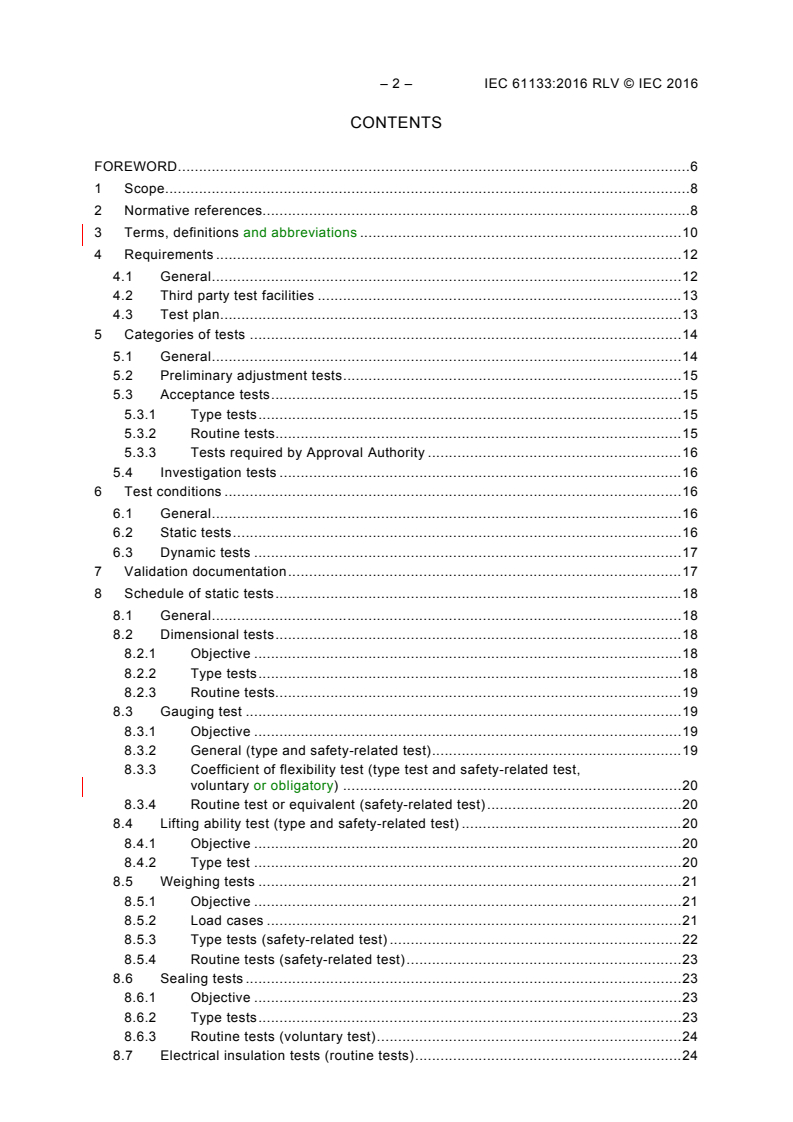
– 2 – IEC 61133:2016 RLV © IEC 2016
CONTENTS
FOREWORD . 6
1 Scope . 8
2 Normative references. 8
3 Terms, definitions and abbreviations . 10
4 Requirements . 12
4.1 General . 12
4.2 Third party test facilities . 13
4.3 Test plan . 13
5 Categories of tests . 14
5.1 General . 14
5.2 Preliminary adjustment tests . 15
5.3 Acceptance tests . 15
5.3.1 Type tests . 15
5.3.2 Routine tests. 15
5.3.3 Tests required by Approval Authority . 16
5.4 Investigation tests . 16
6 Test conditions . 16
6.1 General . 16
6.2 Static tests . 16
6.3 Dynamic tests . 17
7 Validation documentation . 17
8 Schedule of static tests . 18
8.1 General . 18
8.2 Dimensional tests . 18
8.2.1 Objective . 18
8.2.2 Type tests . 18
8.2.3 Routine tests. 19
8.3 Gauging test . 19
8.3.1 Objective . 19
8.3.2 General (type and safety-related test) . 19
8.3.3 Coefficient of flexibility test (type test and safety-related test,
voluntary or obligatory) . 20
8.3.4 Routine test or equivalent (safety-related test) . 20
8.4 Lifting ability test (type and safety-related test) . 20
8.4.1 Objective . 20
8.4.2 Type test . 20
8.5 Weighing tests . 21
8.5.1 Objective . 21
8.5.2 Load cases . 21
8.5.3 Type tests (safety-related test) . 22
8.5.4 Routine tests (safety-related test) . 23
8.6 Sealing tests . 23
8.6.1 Objective . 23
8.6.2 Type tests . 23
8.6.3 Routine tests (voluntary test) . 24
8.7 Electrical insulation tests (routine tests) . 24
8.7.1 General . 24
8.7.2 Voltage withstand test . 24
8.7.3 Insulation impedance test . 24
8.8 Protective bonding and return circuits tests (routine and safety-related test) . 25
8.9 Air system tests . 25
8.9.1 General . 25
8.9.2 Air tightness of main reservoirs and other air equipment (routine and
safety-related test) . 25
8.9.3 Air tightness of brake cylinders and auxiliary reservoirs (routine and
safety-related test) . 26
8.9.4 Checking operation of compressed air equipment (type and safety-
related test where appropriate) . 26
8.10 Hydraulic system tests (type, routine and safety-related test where
appropriate) . 27
8.11 Friction brake system tests . 27
8.11.1 General . 27
8.11.2 Pneumatically applied brake systems . 27
8.11.3 Other systems (type, routine and safety-related as appropriate) . 28
8.11.4 Sanding systems (type, routine and safety-related test) . 28
8.12 Parking brake type tests (safety-related test) . 28
8.13 Auxiliary power supply system tests . 29
8.13.1 Objective . 29
8.13.2 Type tests (safety-related tests where appropriate) . 29
8.13.3 Routine tests. 29
8.14 Battery charging tests . 29
8.14.1 Objective . 29
8.14.2 Type test . 29
8.14.3 Routine test . 30
8.15 Auxiliary and control system tests . 30
8.15.1 Objective . 30
8.15.2 General tests . 31
8.15.3 Train control (safety-related tests where appropriate) . 31
8.15.4 Door control systems (safety-related test) . 32
8.15.5 Heating, ventilation and air-conditioning system tests (safety-related
test where appropriate) . 32
8.15.6 Lighting system (interior) . 33
8.15.7 Other systems (type, routine and safety-related tests where
appropriate) . 33
8.15.8 Software controlled systems (safety-related test where appropriate) . 34
8.16 Tests on thermal engine and associated generating sets or transmission . 34
8.16.1 General . 34
8.16.2 Operating speed tests of the thermal engine (type tests) . 34
8.16.3 Thermal engine protective devices (type test) . 34
8.16.4 Thermal engine fluid, air and exhaust circuits (routine test, safety-
related test where appropriate) . 35
8.16.5 Engine driven auxiliaries . 35
8.16.6 Cranking of the thermal engine (type test) . 35
8.16.7 Operation of the thermal engine . 35
8.17 Traction system tests (type, routine and safety-related tests where
appropriate) . 36
– 4 – IEC 61133:2016 RLV © IEC 2016
8.18 Operability and maintainability (type test) . 36
8.18.1 General . 36
8.18.2 Cabs and traincrew areas (safety-related test) . 37
8.18.3 Passenger areas (safety-related test where appropriate) . 38
8.18.4 Rescue (safety-related test where required) . 38
8.19 Noise and vibration tests (type test, safety-related test where appropriate) . 38
8.20 Safety-related system tests (routine tests) . 38
9 Schedule of dynamic tests . 39
9.1 General . 39
9.2 Traction performance (tractive effort/speed characteristics) . 39
9.2.1 Type test . 39
9.2.2 Routine test . 40
9.3 Traction performance (journey time check) (voluntary type test) . 40
9.4 Braking tests . 41
9.4.1 Type test (safety-related tests) . 41
9.4.2 Routine tests (safety-related tests) . 45
9.5 Traction and braking thermal capacity tests (type test, safety-related test
where appropriate) . 45
9.6 Resistance to motion (voluntary type test). 46
9.7 Speed regulating system tests (type and routine tests, safety-related where
appropriate) . 46
9.8 Automatic train protection systems (type, routine and safety-related tests) . 47
9.9 Vehicle/track interaction . 47
9.9.1 Safety of running . 47
9.9.2 Suspension clearances, inter-vehicle clearances (voluntary type and
safety-related test where appropriate) . 48
9.10 Ride comfort quality (voluntary tests) . 49
9.10.1 Objective . 49
9.10.2 Type test . 49
9.10.3 Routine test (voluntary test) . 49
9.11 Kinematic gauging envelope . 49
9.11.1 Type test (safety-related test) . 49
9.11.2 Routine test (voluntary) . 49
9.12 Operation of wheel flange lubricators (safety-related routine test only) . 49
9.13 Current collector and power supply contact system compatibility tests
(safety-related type test only) . 50
9.14 Aerodynamic effects (type tests only, safety-related where appropriate) . 50
9.15 Electromagnetic compatibility (type tests only) . 51
9.15.1 Internal interference within the vehicle (safety-related where
appropriate) . 51
9.15.2 External interference produced by the vehicle (safety-related where
appropriate) . 51
9.15.3 Radio frequency interference (safety-related) . 52
9.15.4 External interference to the vehicle (safety-related) . 52
9.15.5 Electrostatic discharges (voluntary test) . 52
9.16 Interruption and voltage/jump and short circuit test (voluntary type test only) . 52
9.16.1 General . 52
9.16.2 Voltage jump tests . 53
9.16.3 Interruption tests . 53
9.16.4 Voltage variation testing . 54
9.16.5 Short circuit test . 54
9.17 Noise tests . 54
9.17.1 Type test . 54
9.17.2 Routine test (voluntary test) . 54
9.18 Air systems – compressor duty cycle (type test, safety-related where
appropriate) . 54
9.19 Windscreen wipers (type test) . 55
9.20 Train control system (type test, safety-related where appropriate) . 55
Annex A (informative) List of tests . 57
Annex B (informative) Requirements for the European Community – Legal requirement
in accordance with IEC Administrative Circular AC/135/2002 . 62
B.1 Introduction General . 62
B.2 Legal references . 62
B.2.1 Directives . 62
B.2.2 Technical specifications for interoperability . 63
B.3 European Standards relevant to Clauses in IEC 61133 . 62
Bibliography . 67
Table 1 – Recommended load cases . 21
Table A.1 – List of static tests (1 of 4) . 57
Table A.2 – List of dynamic tests (1 of 2) . 60
– 6 – IEC 61133:2016 RLV © IEC 2016
INTERNATIONAL ELECTROTECHNICAL COMMISSION
____________
RAILWAY APPLICATIONS – ROLLING STOCK –
TESTING OF ROLLING STOCK ON COMPLETION OF
CONSTRUCTION AND BEFORE ENTRY INTO SERVICE
FOREWORD
1) The International Electrotechnical Commission (IEC) is a worldwide organization for standardization comprising
all national electrotechnical committees (IEC National Committees). The object of IEC is to promote
international co-operation on all questions concerning standardization in the electrical and electronic fields. To
this end and in addition to other activities, IEC publishes International Standards, Technical Specifications,
Technical Reports, Publicly Available Specifications (PAS) and Guides (hereafter referred to as “IEC
Publication(s)”). Their preparation is entrusted to technical committees; any IEC National Committee interested
in the subject dealt with may participate in this preparatory work. International, governmental and non-
governmental organizations liaising with the IEC also participate in this preparation. IEC collaborates closely
with the International Organization for Standardization (ISO) in accordance with conditions determined by
agreement between the two organizations.
2) The formal decisions or agreements of IEC on technical matters express, as nearly as possible, an international
consensus of opinion on the relevant subjects since each technical committee has representation from all
interested IEC National Committees.
3) IEC Publications have the form of recommendations for international use and are accepted by IEC National
Committees in that sense. While all reasonable efforts are made to ensure that the technical content of IEC
Publications is accurate, IEC cannot be held responsible for the way in which they are used or for any
misinterpretation by any end user.
4) In order to promote international uniformity, IEC National Committees undertake to apply IEC Publications
transparently to the maximum extent possible in their national and regional publications. Any divergence
between any IEC Publication and the corresponding national or regional publication shall be clearly indicated in
the latter.
5) IEC itself does not provide any attestation of conformity. Independent certification bodies provide conformity
assessment services and, in some areas, access to IEC marks of conformity. IEC is not responsible for any
services carried out by independent certification bodies.
6) All users should ensure that they have the latest edition of this publication.
7) No liability shall attach to IEC or its directors, employees, servants or agents including individual experts and
members of its technical committees and IEC National Committees for any personal injury, property damage or
other damage of any nature whatsoever, whether direct or indirect, or for costs (including legal fees) and
expenses arising out of the publication, use of, or reliance upon, this IEC Publication or any other IEC
Publications.
8) Attention is drawn to the Normative references cited in this publication. Use of the referenced publications is
indispensable for the correct application of this publication.
9) Attention is drawn to the possibility that some of the elements of this IEC Publication may be the subject of
patent rights. IEC shall not be held responsible for identifying any or all such patent rights.
This redline version of the official IEC Standard allows the user to identify the changes
made to the previous edition. A vertical bar appears in the margin wherever a change
has been made. Additions are in green text, deletions are in strikethrough red text.
International Standard IEC 61133 has been prepared by IEC technical committee 9: Electrical
equipment and systems for railways.
This standard is derived from EN 50215.
This third edition cancels and replaces the second edition, published in 2006; it constitutes a
technical revision.
The main technical changes with regard to the previous edition are as follows:
• References to standards other than international have been removed from the main text so
the notes refer solely to Annex B;
• Annex B has been updated with the latest European information, and cross-references
between the TSIs and ENs and the clauses of IEC 61133 have been added.
The text of this standard is based on the the second edition and the following documents:
FDIS Report on voting
9/2096/FDIS 9/2132/RVD
Full information on the voting for the approval of this standard can be found in the report on
voting indicated in the above table.
This publication has been drafted in accordance with the ISO/IEC Directives, Part 2.
The committee has decided that the contents of this publication will remain unchanged until
the stability date indicated on the IEC web site under "http://webstore.iec.ch" in the data
related to the specific publication. At this date, the publication will be
• reconfirmed,
• withdrawn,
• replaced by a revised edition, or
• amended.
IMPORTANT – The “colour inside” logo on the cover page of this publication indicates
that it contains colours which are considered to be useful for the correct understanding
of its contents. Users should therefore print this publication using a colour printer.
– 8 – IEC 61133:2016 RLV © IEC 2016
RAILWAY APPLICATIONS – ROLLING STOCK –
TESTING OF ROLLING STOCK ON COMPLETION OF
CONSTRUCTION AND BEFORE ENTRY INTO SERVICE
1 Scope
This International Standard specifies general criteria to demonstrate by testing that newly
constructed complete railway vehicles conform with standards or other normative documents.
This International Standard, as a whole or in part, applies to all railway vehicles except
special purpose vehicles such as track-laying machines, ballast cleaners and personnel
carriers. The extent of application of the standard for particular vehicles will be specifically
mentioned in the contract, to take account, where necessary, of any legislative requirements.
NOTE 1 The parts of the standard which are applicable will depend on the type of vehicle (e.g. passenger, freight,
powered trailer, etc.).
NOTE 2 The scope of this standard excludes railbound and road/rail vehicles for construction and maintenance of
railway infrastructure.
NOTE 3 This standard does not deal with tests carried out on components or equipment before fitting to the
vehicle.
In so far as this International Standard is applicable, it may be used for the following:
– generator sets mounted on a vehicle provided for auxiliary purposes;
– electrical transmission used on trolley buses or similar vehicles;
– control and auxiliary equipment of vehicles with non-electrical propulsion systems;
– vehicles guided, supported or electrically propelled by systems which do not use the
adhesion between wheel and rail.
NOTE 4 Specific technical requirements apply to vehicles which operate on the railways in the European Union.
The source of those requirements is given in Annex B. Where a European requirement applies to a given clause, a
note has been inserted at the end of the clause.
2 Normative references
The following documents, in whole or in part, are normatively referenced in this document and
are indispensable for its application. For dated references, only the edition cited applies. For
undated references, the latest edition of the referenced document (including any
amendments) applies.
IEC 60077 (all parts), Railway applications – Electric equipment for rolling stock
IEC 60310:2004 2015, Railway applications – Traction transformers and inductors on board
rolling stock
IEC 60322:2001, Railway applications – Electric equipment for rolling stock – Rules for power
resistors of open construction
IEC 60349 (all parts), Electric traction – Rotating electrical machines for rail and road
IEC 60349-1:2002, Electric traction – Rotating electrical machines for rail and road vehicles –
Part 1: Machines other than electronic convertor-fed alternating current motors
IEC 60349-2:2002, Electric traction – Rotating electrical machines for rail and road vehicles –
Part 2: Electronic convertor-fed alternating current motors
IEC 60494-1:2002 2013, Railway applications – Rolling stock – Pantographs – Characteristics
and tests – Part 1: Pantographs for main line vehicles
IEC 60494-2:2002 2013, Railway applications – Rolling stock – Pantographs – Characteristics
and tests – Part 2: Pantographs for metros and light rail vehicles
IEC 60529:2001 1989, Degrees of protection provided by enclosures (IP Code)
IEC 60571:1998 2012, Railway applications – Electronic equipment used on rail vehicles
rolling stock
IEC 60850:2000 2014, Railway applications – Supply voltages of traction systems
IEC 61287 (all parts), Railway applications – Power convertors installed on board rolling stock
IEC 61287-1:2005, Railway applications – Power convertors installed on board rolling stock –
Part 1: Characteristics and test methods
IEC 61377-1:2006, Railway applications – Rolling stock – Part 1: Combined testing of
inverter-fed alternating current motors and their control system
IEC 61377-2:2002, Railway applications – Rolling stock – Combined testing – Part 2:
Chopper-fed direct current traction motors and their control
IEC 61377-3:2002, Railway applications – Rolling stock – Part 3: Combined testing of
alternating current motors, fed by an indirect converter, and their control system
IEC 61991:2000, Railway applications – Rolling stock – Protective provisions against
electrical hazards
IEC 62236-3-1:2003 2008, Railway applications – Electromagnetic compatibility – Part 3-1:
Rolling stock – Train and complete vehicle
IEC 62236-3-2:2003 2008, Railway applications – Electromagnetic compatibility – Part 3-2:
Rolling stock – Apparatus
IEC 62278:2002, Railway applications – Specification and demonstration of reliability,
availability, maintainability and safety (RAMS)
IEC 62313:2009, Railway applications – Power supply and rolling stock – Technical criteria for
the coordination between power supply (substation) and rolling stock
IEC 62425, Railway applications – Communication, signalling and processing systems –
Safety related electronic systems for signalling
IEC 62427:2007, Railway applications – Compatibility between rolling stock and train
detection systems
IEC 62845, Railway applications – Radio remote control system of traction vehicles for
shunting application
__________
To be published.
– 10 – IEC 61133:2016 RLV © IEC 2016
IEC 62846, Railway applications – Current collection systems – Requirements for and
validation of measurements of the dynamic interaction between pantograph and overhead
contact line
ISO/IEC 17025:2005, General requirements for the competence of testing and calibration
laboratories
ISO 3095:2005, Acoustics – Railway applications – Measurement of noise emitted by
railbound vehicles
ISO 3381:2005, Railway applications – Acoustics – Measurement of noise inside rail
railbound vehicles
ISO 9001:2015, Quality management systems – Requirements
NOTE For applications in the European Union, see also the references in Annex B.
rd
UIC Leaflet 623-1: 3 Edition, 2005, Approval procedures for the diesel engines of motive
power units
rd
UIC Leaflet 623-2: 3 Edition, 2005, Approval tests for the diesel engines of motive power
units
rd
UIC Leaflet 623-3: 3 Edition, 2003, Series test and acceptance conditions for diesel
engines of motive power units
3 Terms, definitions and abbreviations
For the purposes of this document, the following terms, definitions and abbreviations apply:
3.1
a.c.
alternating current
3.2
approval authority
any body other than the purchaser with the legal right to require tests to be performed on
vehicles within the scope of this standard and to whom compliance verification must is
demonstrated
Note 1 to entry: These bodies may can be different in each country and may can include national or international
regulatory bodies, national safety authorities, infrastructure controllers managers, and, in Europe, Notified Bodies
(see Annex B).
3.3
contract
all the component parts of the technical specifications agreed between manufacturer and
purchaser, consisting of purchaser’s technical specifications, manufacturer’s technical
responses, minutes of meetings, and any other formal contract documents
3.4
d.c.
direct current
__________
To be published.
3.5
EMC
electromagnetic compatibility
3.6
infrastructure controller manager
organisation which controls manages the railway infrastructure, including, for example, track,
signalling, communications and structures
3.7
IP
ingress Protection
3.8
manufacturer
organisation which has the technical responsibility for the supply of the vehicle system.
Note 1 to entry: There may can be more than one manufacturer where the contract for the vehicle is split in two or
more parts.
3.9
manufacturer’s works
location where the assembly of the vehicles is completed and where static tests are generally
performed
3.10
modification level
definition of equipment modification status for which the test results are valid
3.11
purchaser
organisation which orders and will own the vehicle
Note 1 to entry: The purchaser may can have the responsibility for direct negotiations with the manufacturer,
unless that responsibility is delegated to the user, a main contractor or a consultant.
3.12
quality plan
document specifying which procedures and associated resources shall be are applied by
whom and when to a specific project, product, process or contract (ISO 9000)
3.13
routine test
test to which each vehicle is subjected to during or after manufacture to ascertain whether it
complies with the specified criteria
3.14
safety-related
carries responsibility for safety
3.15
supplier
organisation which has the responsibility for the supply of individual items of equipment or
groups of equipment to the manufacturer
3.16
supplier's works
location where individual items of equipment or groups of equipment are manufactured
– 12 – IEC 61133:2016 RLV © IEC 2016
3.17
test plan
plan of the tests to be undertaken by the manufacturer as presented within its quality plan,
including all supporting information on the conduct of the tests
Note 1 to entry: In the context of this standard, the test plan includes all subordinate test specifications.
3.18
type test
test of one or more devices, system or complete vehicle to show that the design meets the
required specifications and the relevant standards
3.19
UIC
Union Internationale des Chemins de Fer (International Union of Railways)
3.20
user
organisation which will use the vehicle
Note 1 to entry: The user will be a train operator and may can be the purchaser, or another party who uses the
vehicle on behalf of the purchaser through, for example, a leasing arrangement.
3.21
validation documentation
documented evidence that a product, process or service is in conformance with specified
requirements or other normative documents
3.22
voluntary test
any additional test (either type or routine) added to the Test Plan by agreement between the
manufacturer and the purchaser
3.23
WSP
wheelslide protection
4 Requirements
4.1 General
The manufacturer shall exercise control over all activities affecting the quality of the products
to ensure that the requirements of the standards or other normative documents to which the
declaration refers are met.
For this purpose the manufacturer shall have at his disposal all necessary means for carrying
out this control at all levels (for example raw materials, supplies, production, finished products
or packing). Information on the manufacturer's quality system and the results of tests as
appropriate shall be available.
The manufacturer shall establish and maintain a quality system. This shall include auditable
procedures covering the final inspection and test operations, including workmanship
standards, test specifications, test records, calibration of test instruments and equipment,
document control, control of non-conforming products and personnel training.
NOTE It is recommended that manufacturers operate a quality system in accordance with
ISO 9001.
The quality plan for the design, production, inspection and testing of the product shall
include a test plan defining how the manufacturer will demonstrate conformance to the
specified requirements.
The configuration (type numbers, serial numbers, modification status) of key components,
including revisions of software, shall be recorded as a “quality” record.
The contract shall define the various tests to be undertaken on completed vehicles and
before entry into service to assure the purchaser that:
– the vehicles comply with the technical requirements of the contract (type tests, 3.18, see
also 5.3.1);
– every vehicle conforms to the design standard proved in the type tests (routine tests, 3.13,
see also 5.3.2);
– the vehicles comply with the appropriate legislation (national or regional);
– the vehicles are compatible with the railway system on which they are intended to run as
defined in writing by the infrastructure manager.
Inspection of the vehicle, including equipment installation, piping and wiring, and all
component type and routine tests shall be successfully completed according to the relevant
standards and specifications, except as permitted by 6.1, before the tests within the scope of
this standard are commenced. The tests covered by this standard are to demonstrate correct
interfacing with the functions of the vehicle.
This standard does not cover the following types of testing:
– endurance and reliability,
– development,
– investigative (except for guidance only),
– system test, such as subassembly or system combined test.
NOTE The European requirements for product verification and tests are specified in Annex B.
4.2 Third party test facilities
If it is intended to use third party test facilities this shall be declared and agreed at the time of
contract with details of the third party, its, the test facilities required and the accreditation
expected included in the test plan (see 4.3).
This shall of necessity apply to:
– static tests necessitating the vehicle to be moved to a specialised test centre not
belonging to either the manufacturer or the purchaser;
– dynamic tests on another system not belonging to either the manufacturer or the user.
It is recommended that third party test facilities are accredited to ISO/IEC 17025.
NOTE 1 The purchaser or the approval authority of the country concerned may require tests to
be carried out by an accredited test facility independent of the manufacturer.
NOTE 2 The European requirements for tests are specified in the technical specifications for interoperability as
identified in Annex B.
4.3 Test plan
The various tests to be undertaken by the manufacturer shall be presented by the
manufacturer within its quality plan as a test plan which shall detail the following:
– 14 – IEC 61133:2016 RLV © IEC 2016
a) the test programme;
b) the component and equipment type tests to be completed before undertaking each vehicle
test;
c) the test facilities to be used, including, as appropriate, their accreditation and competence
details, and their level of independence from the manufacturer;
d) the test methods;
e) the vehicle loading conditions for each test;
f) the environmental conditions for each test;
g) the limits and tolerances of any test measuring methods;
h) the success criteria for each test;
i) the corrective action process;
i) the validation documentation.
The test plan may include referenced test specifications to include some of the details above.
Where the contract requires validation of certain tests or documents by the purchaser or any
approval authorities, these shall be identified in the test plan. In the case where the contract
or the approval authorities require evidence to be kept, the requirement shall be included in
the test plan and the purchaser shall agree the test specification.
Where the contract requires safety to be demonstrated by a series of tests derived from a
safety or risk assessment performed in accordance with IEC 62278, or as required by an
external Approval Authority, then these tests shall be included in the test programme and
identified as such in the test plan. The term “safety-related” is used (see definition 3.14,
derived from IEC 62425) in this standard to identify those tests which might be in this
category. The final decision on whether a test is safety-related rests with those who determine
the contribution made by the test to the responsibility for safety.
The auditable process used to derive the information for the test plan shall ensure that the list
of tests produced to support the validation documentation is comprehensive.
The configuration (type numbers, serial numbers, modification status) of key components,
including revisions of software, shall be recorded as a “quality” record.
On successful completion of each test the validation documentation shall be prepared by the
manufacturer.
5 Categories of tests
5.1 General
The test plan shall present the tests to be carried out in the following categories:
a) preliminary adjustment tests (see 5.2);
b) acceptance tests, which include:
• type tests, see 5.3.1;
• routine tests,
...
IEC 61133 ®
Edition 3.0 2016-02
INTERNATIONAL
STANDARD
NORME
INTERNATIONALE
Railway applications – Rolling stock – Testing of rolling stock on completion of
construction and before entry into service
Applications ferroviaires – Matériel roulant – Essais de matériel roulant après
achèvement et avant mise en service
All rights reserved. Unless otherwise specified, no part of this publication may be reproduced or utilized in any form
or by any means, electronic or mechanical, including photocopying and microfilm, without permission in writing from
either IEC or IEC's member National Committee in the country of the requester. If you have any questions about IEC
copyright or have an enquiry about obtaining additional rights to this publication, please contact the address below or
your local IEC member National Committee for further information.
Droits de reproduction réservés. Sauf indication contraire, aucune partie de cette publication ne peut être reproduite
ni utilisée sous quelque forme que ce soit et par aucun procédé, électronique ou mécanique, y compris la photocopie
et les microfilms, sans l'accord écrit de l'IEC ou du Comité national de l'IEC du pays du demandeur. Si vous avez des
questions sur le copyright de l'IEC ou si vous désirez obtenir des droits supplémentaires sur cette publication, utilisez
les coordonnées ci-après ou contactez le Comité national de l'IEC de votre pays de résidence.
IEC Central Office Tel.: +41 22 919 02 11
3, rue de Varembé Fax: +41 22 919 03 00
CH-1211 Geneva 20 info@iec.ch
Switzerland www.iec.ch
About the IEC
The International Electrotechnical Commission (IEC) is the leading global organization that prepares and publishes
International Standards for all electrical, electronic and related technologies.
About IEC publications
The technical content of IEC publications is kept under constant review by the IEC. Please make sure that you have the
latest edition, a corrigenda or an amendment might have been published.
IEC Catalogue - webstore.iec.ch/catalogue Electropedia - www.electropedia.org
The stand-alone application for consulting the entire The world's leading online dictionary of electronic and
bibliographical information on IEC International Standards, electrical terms containing 20 000 terms and definitions in
Technical Specifications, Technical Reports and other English and French, with equivalent terms in 15 additional
documents. Available for PC, Mac OS, Android Tablets and languages. Also known as the International Electrotechnical
iPad. Vocabulary (IEV) online.
IEC publications search - www.iec.ch/searchpub IEC Glossary - std.iec.ch/glossary
The advanced search enables to find IEC publications by a 65 000 electrotechnical terminology entries in English and
variety of criteria (reference number, text, technical French extracted from the Terms and Definitions clause of
committee,…). It also gives information on projects, replaced IEC publications issued since 2002. Some entries have been
and withdrawn publications. collected from earlier publications of IEC TC 37, 77, 86 and
CISPR.
IEC Just Published - webstore.iec.ch/justpublished
Stay up to date on all new IEC publications. Just Published IEC Customer Service Centre - webstore.iec.ch/csc
details all new publications released. Available online and If you wish to give us your feedback on this publication or
also once a month by email. need further assistance, please contact the Customer Service
Centre: csc@iec.ch.
A propos de l'IEC
La Commission Electrotechnique Internationale (IEC) est la première organisation mondiale qui élabore et publie des
Normes internationales pour tout ce qui a trait à l'électricité, à l'électronique et aux technologies apparentées.
A propos des publications IEC
Le contenu technique des publications IEC est constamment revu. Veuillez vous assurer que vous possédez l’édition la
plus récente, un corrigendum ou amendement peut avoir été publié.
Catalogue IEC - webstore.iec.ch/catalogue Electropedia - www.electropedia.org
Application autonome pour consulter tous les renseignements
Le premier dictionnaire en ligne de termes électroniques et
bibliographiques sur les Normes internationales,
électriques. Il contient 20 000 termes et définitions en anglais
Spécifications techniques, Rapports techniques et autres
et en français, ainsi que les termes équivalents dans 15
documents de l'IEC. Disponible pour PC, Mac OS, tablettes
langues additionnelles. Egalement appelé Vocabulaire
Android et iPad.
Electrotechnique International (IEV) en ligne.
Recherche de publications IEC - www.iec.ch/searchpub
Glossaire IEC - std.iec.ch/glossary
La recherche avancée permet de trouver des publications IEC 65 000 entrées terminologiques électrotechniques, en anglais
en utilisant différents critères (numéro de référence, texte, et en français, extraites des articles Termes et Définitions des
comité d’études,…). Elle donne aussi des informations sur les publications IEC parues depuis 2002. Plus certaines entrées
projets et les publications remplacées ou retirées. antérieures extraites des publications des CE 37, 77, 86 et
CISPR de l'IEC.
IEC Just Published - webstore.iec.ch/justpublished
Service Clients - webstore.iec.ch/csc
Restez informé sur les nouvelles publications IEC. Just
Published détaille les nouvelles publications parues. Si vous désirez nous donner des commentaires sur cette
Disponible en ligne et aussi une fois par mois par email. publication ou si vous avez des questions contactez-nous:
csc@iec.ch.
IEC 61133 ®
Edition 3.0 2016-02
INTERNATIONAL
STANDARD
NORME
INTERNATIONALE
Railway applications – Rolling stock – Testing of rolling stock on completion of
construction and before entry into service
Applications ferroviaires – Matériel roulant – Essais de matériel roulant après
achèvement et avant mise en service
INTERNATIONAL
ELECTROTECHNICAL
COMMISSION
COMMISSION
ELECTROTECHNIQUE
INTERNATIONALE
ICS 45.060 ISBN 978-2-8322-3178-4
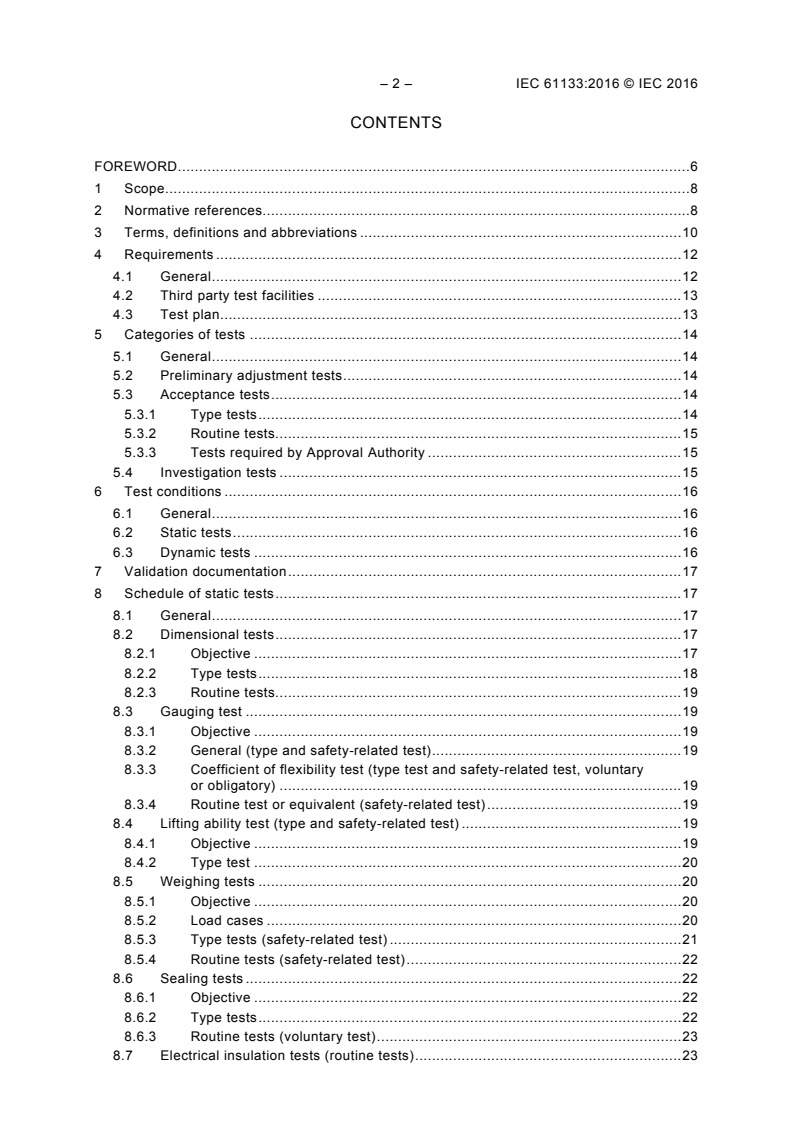
– 2 – IEC 61133:2016 © IEC 2016
CONTENTS
FOREWORD . 6
1 Scope . 8
2 Normative references. 8
3 Terms, definitions and abbreviations . 10
4 Requirements . 12
4.1 General . 12
4.2 Third party test facilities . 13
4.3 Test plan . 13
5 Categories of tests . 14
5.1 General . 14
5.2 Preliminary adjustment tests . 14
5.3 Acceptance tests . 14
5.3.1 Type tests . 14
5.3.2 Routine tests. 15
5.3.3 Tests required by Approval Authority . 15
5.4 Investigation tests . 15
6 Test conditions . 16
6.1 General . 16
6.2 Static tests . 16
6.3 Dynamic tests . 16
7 Validation documentation . 17
8 Schedule of static tests . 17
8.1 General . 17
8.2 Dimensional tests . 17
8.2.1 Objective . 17
8.2.2 Type tests . 18
8.2.3 Routine tests. 19
8.3 Gauging test . 19
8.3.1 Objective . 19
8.3.2 General (type and safety-related test) . 19
8.3.3 Coefficient of flexibility test (type test and safety-related test, voluntary
or obligatory) . 19
8.3.4 Routine test or equivalent (safety-related test) . 19
8.4 Lifting ability test (type and safety-related test) . 19
8.4.1 Objective . 19
8.4.2 Type test . 20
8.5 Weighing tests . 20
8.5.1 Objective . 20
8.5.2 Load cases . 20
8.5.3 Type tests (safety-related test) . 21
8.5.4 Routine tests (safety-related test) . 22
8.6 Sealing tests . 22
8.6.1 Objective . 22
8.6.2 Type tests . 22
8.6.3 Routine tests (voluntary test) . 23
8.7 Electrical insulation tests (routine tests) . 23
8.7.1 General . 23
8.7.2 Voltage withstand test . 23
8.7.3 Insulation impedance test . 24
8.8 Protective bonding and return circuits tests (routine and safety-related test) . 24
8.9 Air system tests . 24
8.9.1 General . 24
8.9.2 Air tightness of main reservoirs and other air equipment (routine and
safety-related test) . 25
8.9.3 Air tightness of brake cylinders and auxiliary reservoirs (routine and
safety-related test) . 25
8.9.4 Checking operation of compressed air equipment (type and safety-
related test where appropriate) . 25
8.10 Hydraulic system tests (type, routine and safety-related test where
appropriate) . 26
8.11 Friction brake system tests . 26
8.11.1 General . 26
8.11.2 Pneumatically applied brake systems . 27
8.11.3 Other systems (type, routine and safety-related as appropriate) . 27
8.11.4 Sanding systems (type, routine and safety-related test) . 27
8.12 Parking brake type tests (safety-related test) . 28
8.13 Auxiliary power supply system tests . 28
8.13.1 Objective . 28
8.13.2 Type tests (safety-related tests where appropriate) . 28
8.13.3 Routine tests. 29
8.14 Battery charging tests . 29
8.14.1 Objective . 29
8.14.2 Type test . 29
8.14.3 Routine test . 29
8.15 Auxiliary and control system tests . 30
8.15.1 Objective . 30
8.15.2 General tests . 30
8.15.3 Train control (safety-related tests where appropriate) . 31
8.15.4 Door control systems (safety-related test) . 31
8.15.5 Heating, ventilation and air-conditioning system tests (safety-related
test where appropriate) . 32
8.15.6 Lighting system (interior) . 32
8.15.7 Other systems (type, routine and safety-related tests where
appropriate) . 32
8.15.8 Software controlled systems (safety-related test where appropriate) . 33
8.16 Tests on thermal engine and associated generating sets or transmission . 33
8.16.1 General . 33
8.16.2 Operating speed tests of the thermal engine (type tests) . 33
8.16.3 Thermal engine protective devices (type test) . 34
8.16.4 Thermal engine fluid, air and exhaust circuits (routine test, safety-
related test where appropriate) . 34
8.16.5 Engine driven auxiliaries . 34
8.16.6 Cranking of the thermal engine (type test) . 34
8.16.7 Operation of the thermal engine . 34
8.17 Traction system tests (type, routine and safety-related tests where
appropriate) . 35
– 4 – IEC 61133:2016 © IEC 2016
8.18 Operability and maintainability (type test) . 36
8.18.1 General . 36
8.18.2 Cabs and traincrew areas (safety-related test) . 36
8.18.3 Passenger areas (safety-related test where appropriate) . 37
8.18.4 Rescue (safety-related test where required) . 37
8.19 Noise and vibration tests (type test, safety-related test where appropriate) . 37
8.20 Safety-related system tests (routine tests) . 37
9 Schedule of dynamic tests . 38
9.1 General . 38
9.2 Traction performance (tractive effort/speed characteristics) . 38
9.2.1 Type test . 38
9.2.2 Routine test . 39
9.3 Traction performance (journey time check) (voluntary type test) . 39
9.4 Braking tests . 40
9.4.1 Type test (safety-related tests) . 40
9.4.2 Routine tests (safety-related tests) . 44
9.5 Traction and braking thermal capacity tests (type test, safety-related test
where appropriate) . 44
9.6 Resistance to motion (voluntary type test). 45
9.7 Speed regulating system tests (type and routine tests, safety-related where
appropriate) . 45
9.8 Automatic train protection systems (type, routine and safety-related tests) . 46
9.9 Vehicle/track interaction . 46
9.9.1 Safety of running . 46
9.9.2 Suspension clearances, inter-vehicle clearances (voluntary type and
safety-related test where appropriate) . 47
9.10 Ride comfort quality (voluntary tests) . 48
9.10.1 Objective . 48
9.10.2 Type test . 48
9.10.3 Routine test (voluntary test) . 48
9.11 Kinematic envelope . 48
9.11.1 Type test (safety-related test) . 48
9.11.2 Routine test (voluntary) . 48
9.12 Operation of wheel flange lubricators (safety-related routine test only) . 48
9.13 Current collector and power supply contact system compatibility tests
(safety-related type test only) . 49
9.14 Aerodynamic effects (type tests only, safety-related where appropriate) . 49
9.15 Electromagnetic compatibility (type tests only) . 50
9.15.1 Internal interference within the vehicle (safety-related where
appropriate) . 50
9.15.2 External interference produced by the vehicle (safety-related where
appropriate) . 50
9.15.3 Radio frequency interference . 51
9.15.4 External interference to the vehicle . 51
9.15.5 Electrostatic discharges (voluntary test) . 51
9.16 Interruption and voltage/jump and short circuit test (voluntary type test only) . 51
9.16.1 General . 51
9.16.2 Voltage jump tests . 52
9.16.3 Interruption tests . 52
9.16.4 Voltage variation testing . 52
9.16.5 Short circuit test . 53
9.17 Noise tests . 53
9.17.1 Type test . 53
9.17.2 Routine test (voluntary test) . 53
9.18 Air systems – compressor duty cycle (type test, safety-related where
appropriate) . 53
9.19 Windscreen wipers (type test) . 54
9.20 Train control system (type test, safety-related where appropriate) . 54
Annex A (informative) List of tests . 56
Annex B (informative) Requirements for the European Community – Legal requirement
in accordance with AC/135/2002 . 61
B.1 General . 61
B.2 Legal references . 61
B.2.1 Directives . 61
B.2.2 Technical specifications for interoperability . 61
B.3 European Standards relevant to Clauses in IEC 61133 . 62
Bibliography . 65
Table 1 – Recommended load cases . 20
Table A.1 – List of static tests (1 of 4) . 56
Table A.2 – List of dynamic tests (1 of 2) . 59
– 6 – IEC 61133:2016 © IEC 2016
INTERNATIONAL ELECTROTECHNICAL COMMISSION
____________
RAILWAY APPLICATIONS – ROLLING STOCK –
TESTING OF ROLLING STOCK ON COMPLETION OF
CONSTRUCTION AND BEFORE ENTRY INTO SERVICE
FOREWORD
1) The International Electrotechnical Commission (IEC) is a worldwide organization for standardization comprising
all national electrotechnical committees (IEC National Committees). The object of IEC is to promote
international co-operation on all questions concerning standardization in the electrical and electronic fields. To
this end and in addition to other activities, IEC publishes International Standards, Technical Specifications,
Technical Reports, Publicly Available Specifications (PAS) and Guides (hereafter referred to as “IEC
Publication(s)”). Their preparation is entrusted to technical committees; any IEC National Committee interested
in the subject dealt with may participate in this preparatory work. International, governmental and non-
governmental organizations liaising with the IEC also participate in this preparation. IEC collaborates closely
with the International Organization for Standardization (ISO) in accordance with conditions determined by
agreement between the two organizations.
2) The formal decisions or agreements of IEC on technical matters express, as nearly as possible, an international
consensus of opinion on the relevant subjects since each technical committee has representation from all
interested IEC National Committees.
3) IEC Publications have the form of recommendations for international use and are accepted by IEC National
Committees in that sense. While all reasonable efforts are made to ensure that the technical content of IEC
Publications is accurate, IEC cannot be held responsible for the way in which they are used or for any
misinterpretation by any end user.
4) In order to promote international uniformity, IEC National Committees undertake to apply IEC Publications
transparently to the maximum extent possible in their national and regional publications. Any divergence
between any IEC Publication and the corresponding national or regional publication shall be clearly indicated in
the latter.
5) IEC itself does not provide any attestation of conformity. Independent certification bodies provide conformity
assessment services and, in some areas, access to IEC marks of conformity. IEC is not responsible for any
services carried out by independent certification bodies.
6) All users should ensure that they have the latest edition of this publication.
7) No liability shall attach to IEC or its directors, employees, servants or agents including individual experts and
members of its technical committees and IEC National Committees for any personal injury, property damage or
other damage of any nature whatsoever, whether direct or indirect, or for costs (including legal fees) and
expenses arising out of the publication, use of, or reliance upon, this IEC Publication or any other IEC
Publications.
8) Attention is drawn to the Normative references cited in this publication. Use of the referenced publications is
indispensable for the correct application of this publication.
9) Attention is drawn to the possibility that some of the elements of this IEC Publication may be the subject of
patent rights. IEC shall not be held responsible for identifying any or all such patent rights.
International Standard IEC 61133 has been prepared by IEC technical committee 9: Electrical
equipment and systems for railways.
This standard is derived from EN 50215.
This third edition cancels and replaces the second edition, published in 2006; it constitutes a
technical revision.
The main technical changes with regard to the previous edition are as follows:
• References to standards other than international have been removed from the main text so
the notes refer solely to Annex B;
• Annex B has been updated with the latest European information, and cross-references
between the TSIs and ENs and the clauses of IEC 61133 have been added.
The text of this standard is based on the the second edition and the following documents:
FDIS Report on voting
9/2096/FDIS 9/2132/RVD
Full information on the voting for the approval of this standard can be found in the report on
voting indicated in the above table.
This publication has been drafted in accordance with the ISO/IEC Directives, Part 2.
The committee has decided that the contents of this publication will remain unchanged until
the stability date indicated on the IEC web site under "http://webstore.iec.ch" in the data
related to the specific publication. At this date, the publication will be
• reconfirmed,
• withdrawn,
• replaced by a revised edition, or
• amended.
– 8 – IEC 61133:2016 © IEC 2016
RAILWAY APPLICATIONS – ROLLING STOCK –
TESTING OF ROLLING STOCK ON COMPLETION OF
CONSTRUCTION AND BEFORE ENTRY INTO SERVICE
1 Scope
This International Standard specifies general criteria to demonstrate by testing that newly
constructed complete railway vehicles conform with standards or other normative documents.
This International Standard, as a whole or in part, applies to all railway vehicles except
special purpose vehicles such as track-laying machines, ballast cleaners and personnel
carriers. The extent of application of the standard for particular vehicles will be specifically
mentioned in the contract, to take account, where necessary, of any legislative requirements.
NOTE 1 The parts of the standard which are applicable will depend on the type of vehicle (e.g. passenger, freight,
powered trailer, etc.).
NOTE 2 The scope of this standard excludes railbound and road/rail vehicles for construction and maintenance of
railway infrastructure.
NOTE 3 This standard does not deal with tests carried out on components or equipment before fitting to the
vehicle.
In so far as this International Standard is applicable, it may be used for the following:
– generator sets mounted on a vehicle provided for auxiliary purposes;
– electrical transmission used on trolley buses or similar vehicles;
– control and auxiliary equipment of vehicles with non-electrical propulsion systems;
– vehicles guided, supported or electrically propelled by systems which do not use the
adhesion between wheel and rail.
NOTE 4 Specific technical requirements apply to vehicles which operate on the railways in the European Union.
The source of those requirements is given in Annex B. Where a European requirement applies to a given clause, a
note has been inserted at the end of the clause.
2 Normative references
The following documents, in whole or in part, are normatively referenced in this document and
are indispensable for its application. For dated references, only the edition cited applies. For
undated references, the latest edition of the referenced document (including any
amendments) applies.
IEC 60077 (all parts), Railway applications – Electric equipment for rolling stock
IEC 60310:2015, Railway applications – Traction transformers and inductors on board rolling
stock
IEC 60322:2001, Railway applications – Electric equipment for rolling stock – Rules for power
resistors of open construction
IEC 60349 (all parts), Electric traction – Rotating electrical machines for rail and road
IEC 60494-1:2013, Railway applications – Rolling stock – Pantographs – Characteristics and
tests – Part 1: Pantographs for main line vehicles
IEC 60494-2:2013, Railway applications – Rolling stock – Pantographs – Characteristics and
tests – Part 2: Pantographs for metros and light rail vehicles
IEC 60529:1989, Degrees of protection provided by enclosures (IP Code)
IEC 60571:2012, Railway applications – Electronic equipment used on rolling stock
IEC 60850:2014, Railway applications – Supply voltages of traction systems
IEC 61287 (all parts), Railway applications – Power convertors installed on board rolling stock
IEC 61377-1, Railway applications – Rolling stock – Part 1: Combined testing of inverter-fed
alternating current motors and their control system
IEC 61377-2, Railway applications – Rolling stock – Combined testing – Part 2: Chopper-fed
direct current traction motors and their control
IEC 61377-3, Railway applications – Rolling stock – Part 3: Combined testing of alternating
current motors, fed by an indirect converter, and their control system
IEC 61991:2000, Railway applications – Rolling stock – Protective provisions against
electrical hazards
IEC 62236-3-1:2008, Railway applications – Electromagnetic compatibility – Part 3-1: Rolling
stock – Train and complete vehicle
IEC 62236-3-2:2008, Railway applications – Electromagnetic compatibility – Part 3-2: Rolling
stock – Apparatus
IEC 62278:2002, Railway applications – Specification and demonstration of reliability,
availability, maintainability and safety (RAMS)
IEC 62313:2009, Railway applications – Power supply and rolling stock – Technical criteria for
the coordination between power supply (substation) and rolling stock
IEC 62425, Railway applications – Communication, signalling and processing systems –
Safety related electronic systems for signalling
IEC 62427:2007, Railway applications – Compatibility between rolling stock and train
detection systems
IEC 62845, Railway applications – Radio remote control system of traction vehicles for
shunting application
IEC 62846, Railway applications – Current collection systems – Requirements for and
validation of measurements of the dynamic interaction between pantograph and overhead
contact line
ISO/IEC 17025, General requirements for the competence of testing and calibration
laboratories
__________
To be published.
– 10 – IEC 61133:2016 © IEC 2016
ISO 3095, Acoustics – Railway applications – Measurement of noise emitted by railbound
vehicles
ISO 3381, Railway applications – Acoustics – Measurement of noise inside railbound vehicles
ISO 9001:2015, Quality management systems – Requirements
NOTE For applications in the European Union, see also the references in Annex B.
3 Terms, definitions and abbreviations
For the purposes of this document, the following terms, definitions and abbreviations apply:
3.1
a.c.
alternating current
3.2
approval authority
any body other than the purchaser with the legal right to require tests to be performed on
vehicles within the scope of this standard and to whom compliance verification is
demonstrated
Note 1 to entry: These bodies can be different in each country and can include national or international regulatory
bodies, national safety authorities, infrastructure managers, and, in Europe, Notified Bodies (see Annex B).
3.3
contract
all the component parts of the technical specifications agreed between manufacturer and
purchaser, consisting of purchaser’s technical specifications, manufacturer’s technical
responses, minutes of meetings, and any other formal contract documents
3.4
d.c.
direct current
3.5
EMC
electromagnetic compatibility
3.6
infrastructure manager
organisation which manages the railway infrastructure, including, for example, track,
signalling, communications and structures
3.7
IP
ingress Protection
3.8
manufacturer
organisation which has the technical responsibility for the supply of the vehicle system
Note 1 to entry: There can be more than one manufacturer where the contract for the vehicle is split in two or
more parts.
3.9
manufacturer’s works
location where the assembly of the vehicles is completed and where static tests are generally
performed
3.10
modification level
definition of equipment modification status for which the test results are valid
3.11
purchaser
organisation which orders and will own the vehicle
Note 1 to entry: The purchaser can have the responsibility for direct negotiations with the manufacturer, unless
that responsibility is delegated to the user, a main contractor or a consultant.
3.12
quality plan
document specifying which procedures and associated resources are applied by whom and
when to a specific project, product, process or contract (ISO 9000)
3.13
routine test
test to which each vehicle is subjected to during or after manufacture to ascertain whether it
complies with the specified criteria
3.14
safety-related
carries responsibility for safety
3.15
supplier
organisation which has the responsibility for the supply of individual items of equipment or
groups of equipment to the manufacturer
3.16
supplier's works
location where individual items of equipment or groups of equipment are manufactured
3.17
test plan
plan of the tests to be undertaken by the manufacturer as presented within its quality plan,
including all supporting information on the conduct of the tests
Note 1 to entry: In the context of this standard, the test plan includes all subordinate test specifications.
3.18
type test
test of one or more devices, system or complete vehicle to show that the design meets the
required specifications and the relevant standards
3.19
UIC
Union Internationale des Chemins de Fer (International Union of Railways)
3.20
user
organisation which will use the vehicle
– 12 – IEC 61133:2016 © IEC 2016
Note 1 to entry: The user will be a train operator and can be the purchaser, or another party who uses the vehicle
on behalf of the purchaser through, for example, a leasing arrangement.
3.21
validation documentation
documented evidence that a product, process or service is in conformance with specified
requirements or other normative documents
3.22
voluntary test
any additional test (either type or routine) added to the test plan by agreement between the
manufacturer and the purchaser
3.23
WSP
wheelslide protection
4 Requirements
4.1 General
The manufacturer shall exercise control over all activities affecting the quality of the products
to ensure that the requirements of the standards or other normative documents to which the
declaration refers are met.
For this purpose the manufacturer shall have at his disposal all necessary means for carrying
out this control at all levels (for example raw materials, supplies, production, finished products
or packing). Information on the manufacturer's quality system and the results of tests as
appropriate shall be available.
The manufacturer shall establish and maintain a quality system. This shall include auditable
procedures covering the final inspection and test operations, including workmanship
standards, test specifications, test records, calibration of test instruments and equipment,
document control, control of non-conforming products and personnel training.
It is recommended that manufacturers operate a quality system in accordance with ISO 9001.
The quality plan for the design, production, inspection and testing of the product shall
include a test plan defining how the manufacturer will demonstrate conformance to the
specified requirements.
The configuration (type numbers, serial numbers, modification status) of key components,
including revisions of software, shall be recorded as a “quality” record.
The contract shall define the various tests to be undertaken on completed vehicles and
before entry into service to assure the purchaser that:
– the vehicles comply with the technical requirements of the contract (type tests, 3.18, see
also 5.3.1);
– every vehicle conforms to the design standard proved in the type tests (routine tests, 3.13,
see also 5.3.2);
– the vehicles comply with the appropriate legislation (national or regional);
– the vehicles are compatible with the railway system on which they are intended to run as
defined in writing by the infrastructure manager.
Inspection of the vehicle, including equipment installation, piping and wiring, and all
component type and routine tests shall be successfully completed according to the relevant
standards and specifications, except as permitted by 6.1, before the tests within the scope of
this standard are commenced. The tests covered by this standard are to demonstrate correct
interfacing with the functions of the vehicle.
This standard does not cover the following types of testing:
– endurance and reliability,
– development,
– investigative (except for guidance only),
– system test, such as subassembly or system combined test.
NOTE The European requirements for product verification and tests are specified in Annex B.
4.2 Third party test facilities
If it is intended to use third party test facilities this shall be declared and agreed with details,
the test facilities required and the accreditation expected included in the test plan (see 4.3).
This shall of necessity apply to:
– static tests necessitating the vehicle to be moved to a specialised test centre not
belonging to either the manufacturer or the purchaser;
– dynamic tests on another system not belonging to either the manufacturer or the user.
It is recommended that third party test facilities are accredited to ISO/IEC 17025.
The purchaser or the approval authority of the country concerned may require tests to be
carried out by an accredited test facility independent of the manufacturer.
4.3 Test plan
The various tests to be undertaken shall be presented by the manufacturer within its quality
plan as a test plan which shall detail the following:
a) the test programme;
b) the component and equipment type tests to be completed before undertaking each vehicle
test;
c) the test facilities to be used, including, as appropriate, their accreditation and competence
details, and their level of independence from the manufacturer;
d) the test methods;
e) the vehicle loading conditions for each test;
f) the environmental conditions for each test;
g) the limits and tolerances of any test measuring methods;
h) the success criteria for each test;
i) the validation documentation.
The test plan may include referenced test specifications to include some of the details above.
Where the contract requires validation of certain tests or documents by the purchaser or any
approval authorities, these shall be identified in the test plan. In the case where the contract
or the approval authorities require evidence to be kept, the requirement shall be included in
the test plan and the purchaser shall agree the test specification.
Where the contract requires safety to be demonstrated by a series of tests derived from a
safety or risk asse
...