

IEC 61363-1:1998
(Main)Electrical installations of ships and mobile and fixed offshore units - Part 1: Procedures for calculating short-circuit currents in three-phase a.c.
General Information
- Abstract
Outlines procedures for calculating short-circuit currents that may occur on a marine or offshore a.c. electrical installation. The calculation methods are for use on unmeshed three-phase alternating current systems. This standard cancels and replaces IEC 60363, published in 1972.
- Status
- Published
- Publication Date
- 25-Feb-1998
- Current Stage
- PPUB - Publication issued
- Start Date
- 26-Feb-1998
- Completion Date
- 31-Mar-1998
Buy Documents


IEC 61363-1:1998 - Electrical installations of ships and mobile and fixed offshore units - Part 1: Procedures for calculating short-circuit currents in three-phase a.c. Released:2/26/1998
Overview
IEC 61363-1:1998 is an international standard published by the International Electrotechnical Commission (IEC) that defines procedures for calculating short-circuit currents in three-phase alternating current (a.c.) electrical installations specific to ships and mobile or fixed offshore units. This standard provides detailed methods tailored for unmeshed three-phase a.c. systems commonly found in marine and offshore environments. It replaces the earlier IEC 60363 (1972), reflecting updated technology and practices.
This standard ensures accurate evaluation of short-circuit currents, essential for the design, operation, and safety of electrical installations in demanding marine and offshore settings.
Key Topics
Scope and Purpose
IEC 61363-1 focuses on the procedures necessary for determining short-circuit currents in three-phase a.c. systems on ships and offshore platforms. It addresses both mobile units and fixed offshore installations, ensuring comprehensive coverage of maritime electrical safety.Definitions and Symbols
The standard provides clear definitions, symbols, subscripts, and superscripts used in short-circuit calculations. Reference is made to IEC 60050 (International Electrotechnical Vocabulary) and other IEC publications for standard terminology and graphical symbols.System Components and Modeling
The document details components used in these electrical systems, including:- Synchronous machines (generators and motors)
- Asynchronous motors
- Shaft generators
- Converter-fed motors
- Cables, transformers, and reactors
Accurate modeling of these components is critical for reliable short-circuit current calculations.
Calculation Methods and Assumptions
Various calculation techniques are outlined, supported by simplifying assumptions to balance accuracy and complexity. The methods consider factors like stator resistance, motor preload conditions, and transient phenomena in short circuits.Equivalent Generator Application
Procedures are provided for evaluating equivalent machines and generators, which simplify complex system components into manageable models for calculation purposes.System-Level Calculations
Instructions for evaluating short-circuit currents on busbars, transformers, generators in parallel, and static converters are included to cover real-world system arrangements.Interpretation of Results
The standard guides users on interpreting short-circuit current calculations for low voltage (up to 1 kV) and medium voltage (above 1 kV) systems, ensuring results inform practical design and safety decisions.
Applications
Marine Electrical Installations
This standard is vital for engineers designing and maintaining electrical systems on commercial ships, naval vessels, and other marine craft that rely on three-phase a.c. power.Offshore Oil and Gas Platforms
Ensuring reliable power systems offshore requires precise short-circuit current calculations to protect equipment and personnel on both fixed platforms and mobile offshore units (e.g., drilling rigs).Safety and Protection System Design
Accurate short-circuit current calculation supports the correct sizing of circuit protection devices such as circuit breakers and fuses, minimizing downtime and damage from fault conditions.Regulatory Compliance
Adherence to IEC 61363-1 facilitates compliance with international maritime electrical safety regulations, enhancing equipment certification and system approvals.Engineering Studies and Simulations
The documented procedures aid electrical engineers in performing comprehensive fault current studies, capacity evaluations, and system optimizations for complex marine power networks.
Related Standards
- IEC 60050 – International Electrotechnical Vocabulary: Provides standardized terminology referenced in IEC 61363-1.
- IEC 60027 – Letter Symbols to Be Used in Electrical Technology: Supports consistent symbol usage in calculations.
- IEC 60417 – Graphical Symbols for Use on Equipment: Provides standard graphical symbols.
- IEC 60617 – Graphical Symbols for Diagrams: Adds further clarity for technical documentation and schematics.
- IEC 60363 – Previous version of this standard, now replaced.
- Marine and Offshore Electrical Standards – Other IEC and IMO standards complement IEC 61363-1, covering aspects such as equipment installation, electromagnetic compatibility, and safety management.
By following IEC 61363-1:1998, maritime and offshore electrical engineers can perform precise, reliable short-circuit current calculations essential for safe and efficient design, operation, and maintenance of three-phase a.c. electrical installations in challenging marine environments. This standard is a cornerstone for electrical safety and performance in the marine and offshore sectors.
Relations
- Effective Date
- 15-Sep-2026
- Effective Date
- 10-Feb-2026
Buy Documents
IEC 61363-1:1998 - Electrical installations of ships and mobile and fixed offshore units - Part 1: Procedures for calculating short-circuit currents in three-phase a.c. Released:2/26/1998
Get Certified
Connect with accredited certification bodies for this standard

DNV
DNV is an independent assurance and risk management provider.

Lloyd's Register
Lloyd's Register is a global professional services organisation specialising in engineering and technology.

FSC International
Forest Stewardship Council certification.
Sponsored listings
Frequently Asked Questions
IEC 61363-1:1998 is a standard published by the International Electrotechnical Commission (IEC). Its full title is "Electrical installations of ships and mobile and fixed offshore units - Part 1: Procedures for calculating short-circuit currents in three-phase a.c.". This standard covers: Outlines procedures for calculating short-circuit currents that may occur on a marine or offshore a.c. electrical installation. The calculation methods are for use on unmeshed three-phase alternating current systems. This standard cancels and replaces IEC 60363, published in 1972.
Outlines procedures for calculating short-circuit currents that may occur on a marine or offshore a.c. electrical installation. The calculation methods are for use on unmeshed three-phase alternating current systems. This standard cancels and replaces IEC 60363, published in 1972.
IEC 61363-1:1998 is classified under the following ICS (International Classification for Standards) categories: 47.020.60 - Electrical equipment of ships and of marine structures. The ICS classification helps identify the subject area and facilitates finding related standards.
IEC 61363-1:1998 has the following relationships with other standards: It is inter standard links to prEN IEC/IEEE 80005-3:2026, EN 50368:2003. Understanding these relationships helps ensure you are using the most current and applicable version of the standard.
IEC 61363-1:1998 is available in PDF format for immediate download after purchase. The document can be added to your cart and obtained through the secure checkout process. Digital delivery ensures instant access to the complete standard document.
Standards Content (Sample)
NORME
CEI
INTERNATIONALE
IEC
61363-1
INTERNATIONAL
Première édition
STANDARD
First edition
1998-02
Installations électriques à bord des navires
et des plates-formes mobiles et fixes en mer –
Partie 1:
Evaluation des courants de court-circuit
en c.a. triphasé
Electrical installations of ships and mobile
and fixed offshore units –
Part 1:
Procedures for calculating short-circuit currents
in three-phase a.c.
Numéro de référence
Reference number
CEI/IEC 61363-1:1998
Numéros des publications Numbering
Depuis le 1er janvier 1997, les publications de la CEI As from 1 January 1997 all IEC publications are
sont numérotées à partir de 60000. issued with a designation in the 60000 series.
Publications consolidées Consolidated publications
Les versions consolidées de certaines publications de Consolidated versions of some IEC publications
la CEI incorporant les amendements sont disponibles. including amendments are available. For example,
Par exemple, les numéros d’édition 1.0, 1.1 et 1.2 edition numbers 1.0, 1.1 and 1.2 refer, respectively, to
indiquent respectivement la publication de base, la the base publication, the base publication
publication de base incorporant l’amendement 1, et la incorporating amendment 1 and the base publication
publication de base incorporant les amendements 1 incorporating amendments 1 and 2.
et 2.
Validité de la présente publication Validity of this publication
Le contenu technique des publications de la CEI est The technical content of IEC publications is kept under
constamment revu par la CEI afin qu'il reflète l'état constant review by the IEC, thus ensuring that the
actuel de la technique. content reflects current technology.
Des renseignements relatifs à la date de Information relating to the date of the reconfirmation of
reconfirmation de la publication sont disponibles dans the publication is available in the IEC catalogue.
le Catalogue de la CEI.
Les renseignements relatifs à ces révisions, à l'établis- Information on the revision work, the issue of revised
sement des éditions révisées et aux amendements editions and amendments may be obtained from
peuvent être obtenus auprès des Comités nationaux de IEC National Committees and from the following
la CEI et dans les documents ci-dessous: IEC sources:
• Bulletin de la CEI • IEC Bulletin
• Annuaire de la CEI • IEC Yearbook
Accès en ligne* On-line access*
• Catalogue des publications de la CEI • Catalogue of IEC publications
Publié annuellement et mis à jour régulièrement Published yearly with regular updates
(Accès en ligne)* (On-line access)*
Terminologie, symboles graphiques Terminology, graphical and letter
et littéraux symbols
En ce qui concerne la terminologie générale, le lecteur For general terminology, readers are referred to
se reportera à la CEI 60050: Vocabulaire Electro- IEC 60050: International Electrotechnical Vocabulary
technique International (VEI). (IEV).
Pour les symboles graphiques, les symboles littéraux For graphical symbols, and letter symbols and signs
et les signes d'usage général approuvés par la CEI, le approved by the IEC for general use, readers are
referred to publications IEC 60027: Letter symbols to
lecteur consultera la CEI 60027: Symboles littéraux à
utiliser en électrotechnique, la CEI 60417: Symboles be used in electrical technology, IEC 60417: Graphical
graphiques utilisables sur le matériel. Index, relevé et symbols for use on equipment. Index, survey and
compilation des feuilles individuelles, et la CEI 60617: compilation of the single sheets and IEC 60617:
Symboles graphiques pour schémas. Graphical symbols for diagrams.
Publications de la CEI établies par IEC publications prepared by the same
le même comité d'études technical committee
L'attention du lecteur est attirée sur les listes figurant The attention of readers is drawn to the end pages of
à la fin de cette publication, qui énumèrent les this publication which list the IEC publications issued
publications de la CEI préparées par le comité by the technical committee which has prepared the
d'études qui a établi la présente publication. present publication.
* Voir adresse «site web» sur la page de titre. * See web site address on title page.
NORME
CEI
INTERNATIONALE
IEC
61363-1
INTERNATIONAL
Première édition
STANDARD
First edition
1998-02
Installations électriques à bord des navires
et des plates-formes mobiles et fixes en mer –
Partie 1:
Evaluation des courants de court-circuit
en c.a. triphasé
Electrical installations of ships and mobile
and fixed offshore units –
Part 1:
Procedures for calculating short-circuit currents
in three-phase a.c.
IEC 1998 Droits de reproduction réservés Copyright - all rights reserved
Aucune partie de cette publication ne peut être reproduite ni No part of this publication may be reproduced or utilized in
utilisée sous quelque forme que ce soit et par aucun any form or by any means, electronic or mechanical,
procédé, électronique ou mécanique, y compris la photo- including photocopying and microfilm, without permission in
copie et les microfilms, sans l'accord écrit de l'éditeur. writing from the publisher.
International Electrotechnical Commission 3, rue de Varembé Geneva, Switzerland
Telefax: +41 22 919 0300 e-mail: inmail@iec.ch IEC web site http: //www.iec.ch
CODE PRIX
Commission Electrotechnique Internationale
PRICE CODE X
International Electrotechnical Commission
Pour prix, voir catalogue en vigueur
For price, see current catalogue
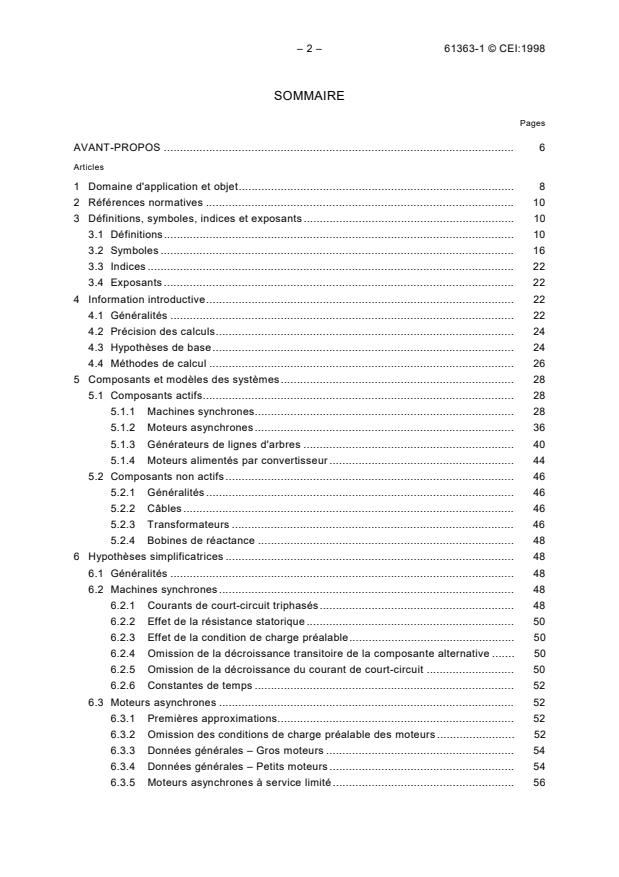
– 2 – 61363-1 © CEI:1998
SOMMAIRE
Pages
AVANT-PROPOS . 6
Articles
1 Domaine d'application et objet. 8
2 Références normatives . 10
3 Définitions, symboles, indices et exposants . 10
3.1 Définitions. 10
3.2 Symboles . 16
3.3 Indices . 22
3.4 Exposants . 22
4 Information introductive. 22
4.1 Généralités . 22
4.2 Précision des calculs. 24
4.3 Hypothèses de base. 24
4.4 Méthodes de calcul . 26
5 Composants et modèles des systèmes. 28
5.1 Composants actifs. 28
5.1.1 Machines synchrones. 28
5.1.2 Moteurs asynchrones. 36
5.1.3 Générateurs de lignes d'arbres . 40
5.1.4 Moteurs alimentés par convertisseur . 44
5.2 Composants non actifs . 46
5.2.1 Généralités . 46
5.2.2 Câbles . 46
5.2.3 Transformateurs . 46
5.2.4 Bobines de réactance . 48
6 Hypothèses simplificatrices . 48
6.1 Généralités . 48
6.2 Machines synchrones . 48
6.2.1 Courants de court-circuit triphasés. 48
6.2.2 Effet de la résistance statorique . 50
6.2.3 Effet de la condition de charge préalable. 50
6.2.4 Omission de la décroissance transitoire de la composante alternative . 50
6.2.5 Omission de la décroissance du courant de court-circuit . 50
6.2.6 Constantes de temps . 52
6.3 Moteurs asynchrones . 52
6.3.1 Premières approximations. 52
6.3.2 Omission des conditions de charge préalable des moteurs . 52
6.3.3 Données générales – Gros moteurs . 54
6.3.4 Données générales – Petits moteurs . 54
6.3.5 Moteurs asynchrones à service limité. 56
61363-1 © IEC:1998 – 3 –
CONTENTS
Page
FOREWORD . 7
Clause
1 Scope and object . 9
2 Normative references. 11
3 Definitions, symbols, subscripts and superscripts . 11
3.1 Definitions . 11
3.2 Symbols. 17
3.3 Subscripts. 23
3.4 Superscripts . 23
4 Introductory information . 23
4.1 General . 23
4.2 Calculation accuracy. 25
4.3 Basic assumptions . 25
4.4 Calculation methods . 27
5 System components and models . 29
5.1 Active components. 29
5.1.1 Synchronous machines. 29
5.1.2 Asynchronous motors . 37
5.1.3 Shaft generators. 41
5.1.4 Converter fed motors. 45
5.2 Non-active components. 47
5.2.1 General . 47
5.2.2 Cables. 47
5.2.3 Transformers. 47
5.2.4 Reactors. 49
6 Simplifying assumptions. 49
6.1 General . 49
6.2 Synchronous machines . 49
6.2.1 Three-phase short-circuit currents . 49
6.2.2 Effect of stator resistance . 51
6.2.3 Effect of preload condition . 51
6.2.4 Neglecting transient component decay of the a.c. component. 51
6.2.5 Neglecting short-circuit current decay . 51
6.2.6 Time constants. 53
6.3 Asynchronous motors. 53
6.3.1 First approximations . 53
6.3.2 Neglecting the motor preload conditions. 53
6.3.3 General data for large motors . 55
6.3.4 General data for small motors. 55
6.3.5 Limited service asynchronous motors . 57
– 4 – 61363-1 © CEI:1998
Articles Pages
7 Application du générateur équivalent . 56
7.1 Généralités . 56
7.2 Hypothèses . 56
7.3 Evaluation du moteur équivalent. 56
7.3.1 Généralités . 56
7.3.2 Détermination des paramètres du moteur équivalent . 58
7.4 Evaluation du générateur équivalent . 58
7.4.1 Généralités . 58
7.4.2 Composante alternative I (t) . 60
ac
*
7.4.3 Constante de temps subtransitoire T" du générateur équivalent . 60
d
*
7.4.4 Constante de temps transitoire T' du générateur équivalent . 60
d
*
7.4.5 Constante de temps c.c., T . 62
dc
*
7.4.6 Impédances des générateurs équivalents. 62
8 Calcul de systèmes . 64
8.1 Généralités . 64
8.2 Influence des composants non actifs reliés en série aux composants actifs . 64
8.2.1 Généralités . 64
8.2.2 Générateurs . 64
8.2.3 Moteurs . 66
8.3 Courants de court-circuit sur les barres omnibus des générateurs . 66
8.3.1 Générateurs fonctionnant en parallèle. 66
8.3.2 Moteurs raccordés directement . 68
8.3.3 Moteurs et/ou générateurs raccordés aux autres barres-bus. 68
8.4 Courants de court-circuit sur les barrettes reliées directement aux barres
de générateurs. 68
8.5 Transformateurs. 70
8.6 Convertisseurs statiques reliés à une machine à vitesse contrôlée. 70
8.7 Procédures de calcul. 72
8.7.1 Généralités . 72
8.7.2 Procédure d'étude des court-circuits . 72
8.7.3 Définition du système et du problème; préparation d'un schéma d'étude. 72
8.7.4 Identification des paramètres caractéristiques des composants . 72
8.7.5 Schéma des impédances du système. 74
8.7.6 Calcul approché. 74
8.7.7 Recherche des approximations appropriées . 74
8.7.8 Calcul du système. 74
8.7.9 Résumé des calculs. 74
9 Interprétation et application des résultats . 76
9.1 Généralités . 76
9.2 Systèmes basse tension (jusqu’à 1 kV). 76
9.3 Systèmes moyenne tension (au dessus de 1 kV) . 78
61363-1 © IEC:1998 – 5 –
Clause Page
7 Application of the equivalent generator . 57
7.1 General . 57
7.2 Assumptions . 57
7.3 Evaluation of the equivalent motor. 57
7.3.1 General . 57
7.3.2 Determination of the equivalent motor parameters . 59
7.4 Evaluation of the equivalent generator. 59
7.4.1 General . 59
7.4.2 AC component I (t) . 61
ac
*
7.4.3 Equivalent generator subtransient time constant T" . 61
d
*
7.4.4 Equivalent generator transient time constant T’d . 61
*
7.4.5 DC time constant T’ . 63
dc
*
7.4.6 Equivalent generator impedance. 63
8 System calculations . 65
8.1 General . 65
8.2 Effects of non-active components connected in series with active components . 65
8.2.1 General . 65
8.2.2 Generators . 65
8.2.3 Motors. 67
8.3 Short-circuit current at the generator busbars. 67
8.3.1 Running parallel connected generators . 67
8.3.2 Directly connected motors . 69
8.3.3 Motors and/or generators connected to other busses . 69
8.4 Short-circuit currents at secondary busses directly connected to the generator bus 69
8.5 Transformers . 71
8.6 Semi-conductor converters used on variable speed drives. 71
8.7 Calculation procedures . 73
8.7.1 General . 73
8.7.2 Short-circuit study procedure . 73
8.7.3 Definition of the system and problem and preparation of
a system study diagram . 73
8.7.4 Component characteristic parameter identification . 73
8.7.5 System impedance diagram . 75
8.7.6 Approximate calculation. 75
8.7.7 Estimate of suitable approximations. 75
8.7.8 System calculation. 75
8.7.9 Calculation summary . 75
9 Interpretation and application of the results . 77
9.1 General . 77
9.2 Systems up to 1 kV . 77
9.3 Systems above 1 kV . 79
– 6 – 61363-1 © CEI:1998
COMMISSION ÉLECTROTECHNIQUE INTERNATIONALE
––––––––––––
INSTALLATIONS ÉLECTRIQUES À BORD DES NAVIRES ET
DES PLATES-FORMES MOBILES ET FIXES EN MER –
Partie 1: Evaluation des courants de court-circuit en c.a. triphasé
AVANT-PROPOS
1) La CEI (Commission Electrotechnique Internationale) est une organisation mondiale de normalisation composée
de l'ensemble des comités électrotechniques nationaux (Comités nationaux de la CEI). La CEI a pour objet de
favoriser la coopération internationale pour toutes les questions de normalisation dans les domaines de
l'électricité et de l'électronique. A cet effet, la CEI, entre autres activités, publie des Normes Internationales.
Leur élaboration est confiée à des comités d'études, aux travaux desquels tout Comité national intéressé par le
sujet traité peut participer. Les organisations internationales, gouvernementales et non gouvernementales, en
liaison avec la CEI, participent également aux travaux. La CEI collabore étroitement avec l'Organisation
Internationale de Normalisation (ISO), selon des conditions fixées par accord entre les deux organisations.
2) Les décisions ou accords officiels de la CEI concernant les questions techniques, représentent, dans la mesure
du possible un accord international sur les sujets étudiés, étant donné que les Comités nationaux intéressés
sont représentés dans chaque comité d’études.
3) Les documents produits se présentent sous la forme de recommandations internationales. Ils sont publiés
comme normes, rapports techniques ou guides et agréés comme tels par les Comités nationaux.
4) Dans le but d'encourager l'unification internationale, les Comités nationaux de la CEI s'engagent à appliquer de
façon transparente, dans toute la mesure possible, les Normes internationales de la CEI dans leurs normes
nationales et régionales. Toute divergence entre la norme de la CEI et la norme nationale ou régionale
correspondante doit être indiquée en termes clairs dans cette dernière.
5) La CEI n’a fixé aucune procédure concernant le marquage comme indication d’approbation et sa responsabilité
n’est pas engagée quand un matériel est déclaré conforme à l’une de ses normes.
6) L’attention est attirée sur le fait que certains des éléments de la présente Norme internationale peuvent faire
l’objet de droits de propriété intellectuelle ou de droits analogues. La CEI ne saurait être tenue pour
responsable de ne pas avoir identifié de tels droits de propriété et de ne pas avoir signalé leur existence.
La présente partie de la Norme internationale CEI 61363 a été établie par le comité d’études 18
de la CEI: Installations électriques des navires et des unités mobiles et fixes en mer.
Cette norme annule et remplace la CEI 60363, parue en 1972.
Le texte de cette norme est issu des documents suivants:
FDIS Rapport de vote
18/831/FDIS 18/837/RVD
Le rapport de vote indiqué dans le tableau ci-dessus donne toute information sur le vote ayant
abouti à l'approbation de cette norme.
61363-1 © IEC:1998 – 7 –
INTERNATIONAL ELECTROTECHNICAL COMMISSION
–––––––––
ELECTRICAL INSTALLATIONS OF SHIPS AND
MOBILE AND FIXED OFFSHORE UNITS –
Part 1: Procedures for calculating short-circuit
currents in three-phase a.c.
FOREWORD
1) The IEC (International Electrotechnical Commission) is a worldwide organization for standardization comprising
all national electrotechnical committees (IEC National Committees). The object of the IEC is to promote
international co-operation on all questions concerning standardization in the electrical and electronic fields. To
this end and in addition to other activities, the IEC publishes International Standards. Their preparation is
entrusted to technical committees; any IEC National Committee interested in the subject dealt with may
participate in this preparatory work. International, governmental and non-governmental organizations liaising
with the IEC also participate in this preparation. The IEC collaborates closely with the International Organization
for Standardization (ISO) in accordance with conditions determined by agreement between the two
organizations.
2) The formal decisions or agreements of the IEC on technical matters express, as nearly as possible, an
international consensus of opinion on the relevant subjects since each technical committee has representation
from all interested National Committees.
3) The documents produced have the form of recommendations for international use and are published in the form
of standards, technical reports or guides and they are accepted by the National Committees in that sense.
4) In order to promote international unification, IEC National Committees undertake to apply IEC International
Standards transparently to the maximum extent possible in their national and regional standards. Any
divergence between the IEC Standard and the corresponding national or regional standard shall be clearly
indicated in the latter.
5) The IEC provides no marking procedure to indicate its approval and cannot be rendered responsible for any
equipment declared to be in conformity with one of its standards.
6) Attention is drawn to the possibility that some of the elements of this International Standard may be the subject
of patent rights. The IEC shall not be held responsible for identifying any or all such patent rights.
This part of International Standard IEC 61363 has been prepared by IEC technical committee 18:
Electrical installations of ships and of mobile and fixed offshore units.
This standard cancels and replaces IEC 60363, published in 1972.
The text of this standard is based on the following documents:
FDIS Report on voting
18/831/FDIS 18/837/RVD
Full information on the voting for the approval of this standard can be found in the report on
voting indicated in the above table.
– 8 – 61363-1 © CEI:1998
INSTALLATIONS ÉLECTRIQUES À BORD DES NAVIRES ET
DES PLATES-FORMES MOBILES ET FIXES EN MER –
Partie 1: Evaluation des courants de court-circuit en c.a. triphasé
1 Domaine d'application et objet
La présente Norme internationale indique les procédures de calcul des courants de court-
circuit qui peuvent survenir dans les installations électriques (c.a.) marines ou offshore.
Les méthodes de calcul peuvent être appliquées aux systèmes à courant alternatif triphasé en
réseau non maillé,
a) fonctionnant à 50 Hz ou 60 Hz;
b) présentant l’une quelconque des tensions spécifiées dans le tableau 2 de la CEI 60092-201;
c) ayant un ou plusieurs niveaux de tension différents;
d) comportant des générateurs, des moteurs (synchrones et asynchrones), des transformateurs,
des réactances bobinées, des câbles et des convertisseurs;
e) dont le neutre est connecté à la coque du navire à travers une impédance (destinée à limiter
le courant de court-circuit s’écoulant vers la coque du navire);
f) dont le neutre est isolé de la coque du navire.
Seules les conditions de court-circuit des trois phases sont étudiées, c'est-à-dire avec les
conducteurs des trois phases connectés ensemble, ou connectés à la coque du navire et pour
lesquelles le court-circuit apparaît simultanément sur les trois pôles. Le calcul des courants de
court-circuit dus à des conditions asymétriques peut conduire à des composantes apériodiques
c.c. plus élevées et n’est pas pris en considération dans la présente norme.
Les formules de calcul et les méthodes donnent une précision suffisante pour déterminer le
courant de court-circuit pendant les 100 premières millisecondes d'un défaut. Elles peuvent
être utilisées pour le calcul de courant de court-circuit pour des périodes supérieures à 100 ms
dans le cas d'un système de bus auquel les générateurs sont directement connectés. Au-delà
de cette période, l'action des régulateurs de tension sur le système peut devenir prédominante
et les calculs prenant en compte cette action sont considérés comme sortant du domaine de la
présente norme.
La présente norme a pour objet de proposer des formules de calcul des courants de court-
circuit des composants actifs d'un système électrique et d'indiquer comment ils peuvent être
simplifiés pour les besoins de l'étude lors du calcul des courants de court-circuit pouvant se
produire en divers endroits du système. Les calculs donnent une estimation des courants de
court-circuit attendus, au moment où les composants actifs du système produisent leur
contribution maximale.
Les formules de calcul sont établies à partir des théories de base de l'ingénierie électrique
applicables aux composants des systèmes. Pour simplifier les méthodes de calcul, tout en
maintenant un niveau de précision acceptable, les hypothèses pertinentes sont indiquées, ainsi
que leurs effets sur les résultats des calculs.
La présente norme expose une méthodologie de calcul. Elle aide à l'application des formules
simplifiées et à l'interprétation des résultats correspondants, au moment du choix d'un appareil
de coupure. Elle n'est pas destinée à fournir d’autres informations, en plus du calcul des
courants de court-circuit pouvant survenir dans le réseau.
61363-1 © IEC:1998 – 9 –
ELECTRICAL INSTALLATIONS OF SHIPS AND
MOBILE AND FIXED OFFSHORE UNITS –
Part 1: Procedures for calculating short-circuit
currents in three-phase a.c.
1 Scope and object
This International Standard outlines procedures for calculating short-circuit currents that may
occur on a marine or offshore a.c. electrical installation.
The calculation methods are for use on unmeshed three-phase alternating current systems,
a) operating at 50 Hz or 60 Hz;
b) having any system voltage specified in IEC 60092-201 table 2;
c) having one or more different voltage levels;
d) comprising generators, motors (both synchronous and asynchronous), transformers, reactor
coils, cables, and converter units;
e) having their neutral point connected to the ship’s hull through an impedance (designed to
limit the short-circuit current flowing to the ship’s hull);
f) having their neutral point isolated from the ship’s hull.
The calculation procedures are for a three-phase symmetrical short-circuit condition i.e. three-
phase conductors shorted together, or shorted to the ship’s hull and for which the short-circuit
occurs on all three poles simultaneously. The calculation of short-circuit currents resulting from
asymmetric short-circuit conditions can lead to higher aperiodic (d.c.) components of the short-
circuit current and is not considered in this standard.
The calculating formulae and methods described produce sufficiently accurate results to
calculate the short-circuit current during the first 100 ms of a fault condition. They can be used
to calculate the short-circuit current for periods longer than 100 ms when calculating on a bus
system to which the generators are directly connected. For time periods beyond 100 ms the
controlling effects of the system voltage regulators may be predominant. Calculations including
the voltage regulator effects are not considered in this standard.
The object of this standard is to present formulae for calculating short-circuit currents of the
active components of an electrical system and to indicate how such formulae may be simplified
when calculating the short-circuit current at various locations on the electrical system. The
calculations give estimates of the prospective short-circuit current when the system’s active
components produce their maximum contribution.
The calculating formulae are developed from basic electrical engineering theories relevant to
the system components. To simplify the calculation methods yet retain an acceptable level of
accuracy in the results, suitable assumptions are outlined and their effects on the calculation
results indicated.
This standard provides a calculation procedure. It gives guidance on the interpretation and
application of simplifying formulae and the corresponding results when applied to the selection
of switchgear. The standard is not intended to provide any other information other than the
calculation of the short-circuit current which may flow in the network.
– 10 – 61363-1 © CEI:1998
Pour la compréhension des méthodes et des conséquences des résultats, il est supposé que la
personne responsable de l'étude est familiarisée avec les bases utiles de l'ingénierie
électrique.
2 Références normatives
Les documents normatifs suivants contiennent des dispositions qui, par suite de la référence
qui y est faite, constituent des dispositions valables pour la présente Norme internationale. Au
moment de la publication, les éditions indiquées étaient en vigueur. Tout document normatif
est sujet à révision et les parties prenantes aux accords fondés sur la présente Norme
internationale sont invitées à rechercher la possibilité d'appliquer les éditions les plus récentes
des documents normatifs indiqués ci-après. Les membres de la CEI et de l'ISO possèdent le
registre des Normes internationales en vigueur.
CEI 60034-4:1985, Machines électriques tournantes – Partie 4: Méthodes pour la détermination
à partir d'essais des grandeurs des machines synchrones
CEI 60038:1983, Tensions normales de la CEI
CEI 60050(151):1978, Vocabulaire Electrotechnique International (VEI) – Chapitre 151:
Dispositifs électriques et magnétiques
CEI 60050(411):1996, Vocabulaire Electrotechnique International (VEI) – Chapitre 411:
Machines tournantes
CEI 60050(441):1984, Vocabulaire Electrotechnique International (VEI) – Chapitre 441:
Appareillage et fusibles
CEI 60092-201:1994, Installations électriques à bord des navires – Partie 201: Conception des
systèmes – Généralités
CEI 60092-202:1994, Installations électriques à bord des navires – Partie 202: Conception des
systèmes – Protection
CEI 60909:1988, Calcul des courants de court-circuit dans les réseaux triphasés à courant
alternatif
3 Définitions, symboles, indices et exposants
3.1 Définitions
Pour les besoins de la présente Norme internationale, les définitions et symboles suivants sont
applicables
3.1.1
court-circuit
connexion accidentelle ou intentionnelle, par une résistance ou une impédance relativement
faible, de deux ou plusieurs points d'un circuit se trouvant normalement à des tensions
différentes. [VEI 151-03-41]
3.1.2
courant de court-circuit
surintensité résultant d’un court-circuit ou due à un défaut ou à un branchement incorrect dans
un circuit électrique. [VEI 441-11-07]
61363-1 © IEC:1998 – 11 –
In order to understand the methods, and consequences of the results, it is assumed that the
person responsible for initiating the short-circuit current calculations, is thoroughly familiar with
valid electrical engineering fundamentals.
2 Normative references
The following normative documents contain provisions which, through reference in this text,
constitute provisions of this International Standard. At the time of publication, the editions
indicated were valid. All normative documents are subject to revision, and parties to
agreements based on this International Standard are encouraged to investigate the possibility
of applying the most recent editions of the normative documents indicated below. Members of
IEC and ISO maintain registers of currently valid International Standards.
IEC 60034-4:1985, Rotating electrical machines – Part 4: Methods for determining synchronous
machine quantities from tests
IEC 60038:1983, IEC standard voltages
IEC 60050(151):1978, International Electrotechnical Vocabulary (IEV) – Chapter 151: Electrical
and magnetic devices
IEC 60050(411):1996, International Electrotechnical Vocabulary (IEV) – Chapter 411: Rotating
machinery
IEC 60050(441):1984, International Electrotechnical Vocabulary (IEV) – Chapter 441:
Switchgear, controlgear and fuses
IEC 60092-201:1994, Electrical installations in ships – Part 201: System design – General
IEC 60092-202:1994, Electrical installations in ships – Part 202: System design – Protection
IEC 60909:1988, Short-circuit current calculation in three-phase a.c. systems
3 Definitions, symbols, subscripts and superscripts
3.1 Definitions
For the purpose of this International Standard the following definitions and symbols apply.
3.1.1
short circuit
accidental or intentional connection, by a relatively low resistance or impedance, of two or
more points in a circuit which are normally at different voltages. [IEV 151-03-41]
3.1.2
short-circuit current
over-current resulting from a short circuit due to a fault or an incorrect connection in an electric
circuit. [IEV 441-11-07]
– 12 – 61363-1 © CEI:1998
3.1.3
courant présumé (pour un dispositif de sectionnement)
courant de court-circuit qui s'écoulerait dans le circuit si chaque pôle du dispositif était
remplacé par un conducteur d'impédance négligeable. [VEI 441-17-01 modifié]
3.1.4
courant de court circuit symétrique
valeur efficace de la composante symétrique alternative d’un courant de court-circuit présumé,
la composante apériodique éventuelle du courant étant négligée. (3.4 de la CEI 60909)
3.1.5
courant de court-circuit symétrique initial I"
k
valeur efficace de la composante symétrique CA d'un courant de court-circuit présumé
(disponible), applicable au moment du court-circuit si l'impédance conserve sa valeur au temps
zéro (3.5 de la CEI 60909. Voir également la figure 2).
3.1.6
courant de court-circuit subtransitoire I" en axe direct
kd
valeur efficace du courant de court-circuit parcourant un circuit avec machine(s) tournante(s)
d'impédance (réactance) égale à l’impédance (réactance) subtransitoire du circuit.
3.1.7
courant de court-circuit transitoire I' en axe direct
kd
valeur efficace du courant de court-circuit parcourant un circuit avec machine(s) tournante(s)
d'impédance (réactance), égale à l’impédance (réactance) transitoire du circuit.
3.1.8
courant de court-circuit permanent I en axe direct
kd
valeur efficace du courant de court-circuit symétrique parcourant un circuit avec générateur(s)
et qui demeure après l'extinction du phénomène transitoire.
3.1.9
composante apériodique (c.c.) du courant de court-circuit i
dc
composante du courant apparaissant dans un circuit immédiatement après un court-circuit
brusque, les composantes du fondamental et aux fréquences plus élevées étant exclues
NOTE – C'est la valeur moyenne entre enveloppes supérieure et inférieure du courant de court-circuit décroissant
de la valeur initiale A jusqu'à zéro (voir figure 2).
3.1.10
courant de court-circuit crête i
p
valeur instantanée maximale possible du courant de court-circuit présumé (disponible) (voir
figure 2 et voir 3.8 de la CEI 60909).
NOTE – En courts-circuits triphasés, il est supposé que le court-circuit intervient simultanément sur tous les
conducteurs de phase.
3.1.11
constante de temps subtransitoire longitudinale en court-circuit T''
d
temps nécessaire pour que la composante à amortissement rapide du courant longitudinal
dans l'induit en court-circuit, présente dans les toutes premières périodes qui suivent une
variation brusque des conditions de fonctionnement, décroisse jusqu'à 1/e, c'est-à-dire 0,368
fois sa valeur initiale, la machine tournant à sa vitesse nominale. [VEI 411-48-30, modifiée]
3.1.12
constante de temps subtransitoire longitudinale à circuit ouvert T"
do
temps nécessaire pour que la composante à amortissement rapide de la tension de l'induit à circuit
ouvert, due au flux longitudinal, présente dans les toutes premières périodes qui suivent une
variation brusque des conditions de fonctionnement, décroisse jusqu'à 1/e, c'est-à-dire 0,368 fois
sa valeur initiale, la machine tournant à sa vitesse nominale. [VEI 411-48-29, modifiée]
61363-1 © IEC:1998 – 13 –
3.1.3
prospective current (with respect to a switching device)
short-circuit current that would flow in the circuit if each pole of the device were replaced by a
conductor of negligible impedance. [IEV 441-17-01, modified]
3.1.4
symmetrical short-circuit current
r.m.s. value of the a.c. symmetrical component of a prospective (available) short-circuit current,
the aperiodic component of current, if any, being neglected. (IEC 60909, subclause 3.4)
3.1.5
initial symmetrical short-circuit current I"
k
r.m.s. value of the a.c. symmetrical component of a prospective (available) short-circuit current
applicable at the instant of short circuit if the impedance remains at zero-time value. (3.5 of
IEC 60909, see also figure 2).
3.1.6
subtransient short-circuit current I" in the direct axis
kd
r.m.s. value of the short-circuit current flowing through a circuit with rotating machine(s) having
an impedance (reactance) equal to the subtransient impedance (reactance) of the circuit.
3.1.7
transient short-circuit current I' in the direct axis
kd
r.m.s. value of the short-circuit current flowing through a circuit with rotating machine(s) having
an impedance (reactance) equal to the transient impedance (reactance) of the circuit.
3.1.8
steady-state short-circuit current I in the direct axis
kd
r.m.s. value of the short-circu
...