


IEC TR 62572-2:2008
(Main)Fibre optic active components and devices - Reliability standards - Part 2: Laser module degradation
General Information
- Abstract
IEC/TR 62572-2:2008(E) provides guidance on:
- the testing that a system supplier should ensure is in a place prior to procurement of a laser module from a laser module manufacturer;
- a range of activities expected of a system supplier to verify a laser module manufacturer's reliability claims.
This technical report deals with reliability assessment of laser modules used for telecommunication guidance on testing, use of failure criteria and reliability predictions is provided.
- Status
- Published
- Publication Date
- 07-Sep-2008
- Technical Committee
- SC 86C - Fibre optic systems, sensing and active devices
- Current Stage
- PPUB - Publication issued
- Start Date
- 08-Sep-2008
- Completion Date
- 31-Dec-2008
Overview
IEC TR 62572-2:2008 - Fibre optic active components and devices: Reliability standards - Part 2: Laser module degradation is a technical report that provides guidance for the reliability assessment of laser modules used in telecommunications. It helps system suppliers (SS) verify laser module manufacturers’ (LMM) reliability claims and specifies the kinds of testing and verification activities a buyer should require prior to procurement. The report focuses on failure mechanisms, guidance on service‑life testing and screening (including burn‑in), use of failure criteria, and approaches for lifetime and failure‑rate prediction.
Key Topics
- Failure mechanisms: Describes degradation sources affecting laser diodes and complete modules - e.g., semiconductor material defects, facet degradation, metallization and bond failures, monitor photodiode issues, TEC/thermistor failures, and packaging/fibre alignment instability.
- Guidance on testing: Recommendations for service‑life testing, screening and burn‑in procedures, and scale of testing that a system supplier should expect from a manufacturer.
- Failure criteria: How to define and apply electrical and optical failure limits during life tests (for example, monitoring threshold/operating current, optical output power and spectral changes).
- Reliability predictions: Methods for lifetime and failure‑rate prediction, including statistical distributions (log‑normal) and use of activation energy for accelerated testing when experimentally determined values are not available.
- Practical test considerations: Temperature cycling, high‑temperature storage and other environmental tests that influence module degradation and reliability assessment.
- Figures and tables: Illustrative module cross‑sections, failure‑mode diagrams, example screening/test condition tables and failure‑criteria tables to support procurement and verification activities.
Applications and Who Uses It
IEC TR 62572-2 is intended for:
- System suppliers (SS) procuring laser modules for telecommunications or data transmission equipment - to define procurement requirements and supplier verification plans.
- Laser module manufacturers (LMMs) - to align reliability claims, test methods and reporting with buyer expectations.
- Reliability and test engineers - for defining life tests, burn‑in, environmental screening and statistical analysis of field life.
- Procurement, QA and design teams - for risk assessment, parts qualification and supplier audits in telecom, datacom, transport and aerospace systems employing fibre‑optic transmitters.
Practical uses include drafting detail specifications, designing qualification plans, interpreting life‑test data and setting pass/fail criteria for production modules.
Related Standards
Normative and related references cited in the report include:
- IEC 60068‑2‑1, IEC 60068‑2‑14 (environmental testing)
- IEC 60747‑1, IEC 60749‑1 (semiconductor device standards)
- ISO 9000 (quality management fundamentals)
- MIL‑STD‑883G (microcircuit test methods)
Keywords: IEC TR 62572-2:2008, laser module degradation, fibre optic active components, reliability assessment, laser module testing, failure mechanisms, lifetime prediction, telecommunications.
Relations
- Effective Date
- 05-Sep-2023
- Effective Date
- 10-Feb-2026
- Effective Date
- 10-Feb-2026
- Effective Date
- 10-Feb-2026
- Effective Date
- 10-Feb-2026
Get Certified
Connect with accredited certification bodies for this standard

ANCE
Mexican certification and testing association.

Intertek Slovenia
Intertek testing, inspection, and certification services in Slovenia.

LNE (Laboratoire National de Métrologie et d'Essais)
French national laboratory for metrology and testing.
Sponsored listings
Frequently Asked Questions
IEC TR 62572-2:2008 is a technical report published by the International Electrotechnical Commission (IEC). Its full title is "Fibre optic active components and devices - Reliability standards - Part 2: Laser module degradation". This standard covers: IEC/TR 62572-2:2008(E) provides guidance on: - the testing that a system supplier should ensure is in a place prior to procurement of a laser module from a laser module manufacturer; - a range of activities expected of a system supplier to verify a laser module manufacturer's reliability claims. This technical report deals with reliability assessment of laser modules used for telecommunication guidance on testing, use of failure criteria and reliability predictions is provided.
IEC/TR 62572-2:2008(E) provides guidance on: - the testing that a system supplier should ensure is in a place prior to procurement of a laser module from a laser module manufacturer; - a range of activities expected of a system supplier to verify a laser module manufacturer's reliability claims. This technical report deals with reliability assessment of laser modules used for telecommunication guidance on testing, use of failure criteria and reliability predictions is provided.
IEC TR 62572-2:2008 is classified under the following ICS (International Classification for Standards) categories: 31.260 - Optoelectronics. Laser equipment; 33.180.01 - Fibre optic systems in general. The ICS classification helps identify the subject area and facilitates finding related standards.
IEC TR 62572-2:2008 has the following relationships with other standards: It is inter standard links to IEC 61751:1998, EN 62572-3:2012, EN 62572-3:2014, EN 62343-2:2011, EN 62572-3:2016. Understanding these relationships helps ensure you are using the most current and applicable version of the standard.
IEC TR 62572-2:2008 is available in PDF format for immediate download after purchase. The document can be added to your cart and obtained through the secure checkout process. Digital delivery ensures instant access to the complete standard document.
Standards Content (Sample)
IEC/TR 62572-2
Edition 1.0 2008-09
TECHNICAL
REPORT
Fibre optic active components and devices – Reliability standards –
Part 2: Laser module degradation
IEC/TR 62572-2:2008(E)
All rights reserved. Unless otherwise specified, no part of this publication may be reproduced or utilized in any form
or by any means, electronic or mechanical, including photocopying and microfilm, without permission in writing from
either IEC or IEC's member National Committee in the country of the requester.
If you have any questions about IEC copyright or have an enquiry about obtaining additional rights to this publication,
please contact the address below or your local IEC member National Committee for further information.
IEC Central Office
3, rue de Varembé
CH-1211 Geneva 20
Switzerland
Email: inmail@iec.ch
Web: www.iec.ch
About the IEC
The International Electrotechnical Commission (IEC) is the leading global organization that prepares and publishes
International Standards for all electrical, electronic and related technologies.
About IEC publications
The technical content of IEC publications is kept under constant review by the IEC. Please make sure that you have the
latest edition, a corrigenda or an amendment might have been published.
ƒ Catalogue of IEC publications: www.iec.ch/searchpub
The IEC on-line Catalogue enables you to search by a variety of criteria (reference number, text, technical committee,…).
It also gives information on projects, withdrawn and replaced publications.
ƒ IEC Just Published: www.iec.ch/online_news/justpub
Stay up to date on all new IEC publications. Just Published details twice a month all new publications released. Available
on-line and also by email.
ƒ Electropedia: www.electropedia.org
The world's leading online dictionary of electronic and electrical terms containing more than 20 000 terms and definitions
in English and French, with equivalent terms in additional languages. Also known as the International Electrotechnical
Vocabulary online.
ƒ Customer Service Centre: www.iec.ch/webstore/custserv
If you wish to give us your feedback on this publication or need further assistance, please visit the Customer Service
Centre FAQ or contact us:
Email: csc@iec.ch
Tel.: +41 22 919 02 11
Fax: +41 22 919 03 00
IEC/TR 62572-2
Edition 1.0 2008-09
TECHNICAL
REPORT
Fibre optic active components and devices – Reliability standards –
Part 2: Laser module degradation
INTERNATIONAL
ELECTROTECHNICAL
COMMISSION
PRICE CODE
U
ICS 33.180; 31.260 ISBN 2-8318-9993-1
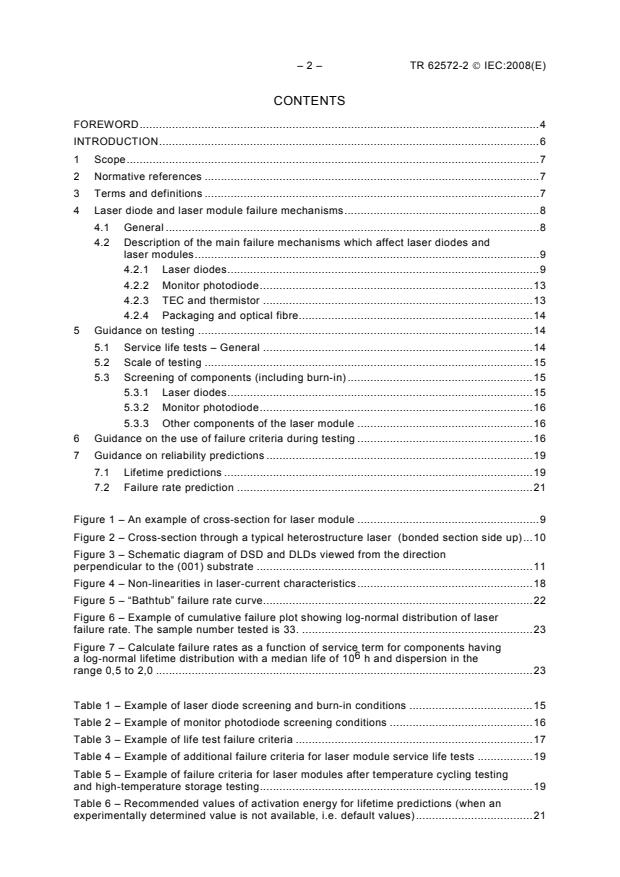
– 2 – TR 62572-2 © IEC:2008(E)
CONTENTS
FOREWORD.4
INTRODUCTION.6
1 Scope.7
2 Normative references .7
3 Terms and definitions .7
4 Laser diode and laser module failure mechanisms.8
4.1 General .8
4.2 Description of the main failure mechanisms which affect laser diodes and
laser modules.9
4.2.1 Laser diodes.9
4.2.2 Monitor photodiode.13
4.2.3 TEC and thermistor .13
4.2.4 Packaging and optical fibre.14
5 Guidance on testing .14
5.1 Service life tests – General .14
5.2 Scale of testing .15
5.3 Screening of components (including burn-in) .15
5.3.1 Laser diodes.15
5.3.2 Monitor photodiode.16
5.3.3 Other components of the laser module .16
6 Guidance on the use of failure criteria during testing .16
7 Guidance on reliability predictions .19
7.1 Lifetime predictions .19
7.2 Failure rate prediction .21
Figure 1 – An example of cross-section for laser module .9
Figure 2 – Cross-section through a typical heterostructure laser (bonded section side up).10
Figure 3 – Schematic diagram of DSD and DLDs viewed from the direction
perpendicular to the (001) substrate .11
Figure 4 – Non-linearities in laser-current characteristics.18
Figure 5 – “Bathtub” failure rate curve.22
Figure 6 – Example of cumulative failure plot showing log-normal distribution of laser
failure rate. The sample number tested is 33. .23
Figure 7 – Calculate failure rates as a function of service term for components having
a log-normal lifetime distribution with a median life of 10 h and dispersion in the
range 0,5 to 2,0 .23
Table 1 – Example of laser diode screening and burn-in conditions .15
Table 2 – Example of monitor photodiode screening conditions .16
Table 3 – Example of life test failure criteria .17
Table 4 – Example of additional failure criteria for laser module service life tests .19
Table 5 – Example of failure criteria for laser modules after temperature cycling testing
and high-temperature storage testing.19
Table 6 – Recommended values of activation energy for lifetime predictions (when an
experimentally determined value is not available, i.e. default values).
TR 62572-2 © IEC:2008(E) – 3 –
Table 7 – Coefficient for upper and lower level of median life in log-normal distribution,
(tmp/tmh)1/σ .26
Table 8 – Multiplying coefficient for upper and lower level of dispersion.27
Table 9 – Failure rate for an exponential lifetime distribution .28
– 4 – TR 62572-2 © IEC:2008(E)
INTERNATIONAL ELECTROTECHNICAL COMMISSION
____________
FIBRE OPTIC ACTIVE COMPONENTS AND DEVICES –
RELIABILITY STANDARDS –
Part 2: Laser module degradation
FOREWORD
1) The International Electrotechnical Commission (IEC) is a worldwide organization for standardization comprising
all national electrotechnical committees (IEC National Committees). The object of IEC is to promote
international co-operation on all questions concerning standardization in the electrical and electronic fields. To
this end and in addition to other activities, IEC publishes International Standards, Technical Specifications,
Technical Reports, Publicly Available Specifications (PAS) and Guides (hereafter referred to as “IEC
Publication(s)”). Their preparation is entrusted to technical committees; any IEC National Committee interested
in the subject dealt with may participate in this preparatory work. International, governmental and non-
governmental organizations liaising with the IEC also participate in this preparation. IEC collaborates closely
with the International Organization for Standardization (ISO) in accordance with conditions determined by
agreement between the two organizations.
2) The formal decisions or agreements of IEC on technical matters express, as nearly as possible, an international
consensus of opinion on the relevant subjects since each technical committee has representation from all
interested IEC National Committees.
3) IEC Publications have the form of recommendations for international use and are accepted by IEC National
Committees in that sense. While all reasonable efforts are made to ensure that the technical content of IEC
Publications is accurate, IEC cannot be held responsible for the way in which they are used or for any
misinterpretation by any end user.
4) In order to promote international uniformity, IEC National Committees undertake to apply IEC Publications
transparently to the maximum extent possible in their national and regional publications. Any divergence
between any IEC Publication and the corresponding national or regional publication shall be clearly indicated in
the latter.
5) IEC provides no marking procedure to indicate its approval and cannot be rendered responsible for any
equipment declared to be in conformity with an IEC Publication.
6) All users should ensure that they have the latest edition of this publication.
7) No liability shall attach to IEC or its directors, employees, servants or agents including individual experts and
members of its technical committees and IEC National Committees for any personal injury, property damage or
other damage of any nature whatsoever, whether direct or indirect, or for costs (including legal fees) and
expenses arising out of the publication, use of, or reliance upon, this IEC Publication or any other IEC
Publications.
8) Attention is drawn to the Normative references cited in this publication. Use of the referenced publications is
indispensable for the correct application of this publication.
9) Attention is drawn to the possibility that some of the elements of this IEC Publication may be the subject of
patent rights. IEC shall not be held responsible for identifying any or all such patent rights.
The main task of IEC technical committees is to prepare International Standards. However, a
technical committee may propose the publication of a technical report when it has collected
data of a different kind from that which is normally published as an International Standard, for
example "state of the art".
IEC 61751-2, which is a technical report, has been prepared by subcommittee 86C: Fibre
optic systems and active devices of IEC technical committee 86: Fibre optics, based on the
Standard IEC 61751 prepared by subcommittee 47C: Optoelectronic, display and imaging
devices, of IEC technical committee 47: Semiconductor devices.
The field of this technical report will henceforth be placed under the responsibility of IEC
technical committee 86: Fibre optics.
TR 62572-2 © IEC:2008(E) – 5 –
The text of this technical report is based on the following documents:
Enquiry draft Report on voting
86C/833/DTR 86C/847/RVC
Full information on the voting for the approval of this technical report can be found in the
report on voting indicated in the above table.
This publication has been drafted in accordance with the ISO/IEC Directives, Part 2.
A list of all parts of IEC 62752 series, under the general title Fibre optic active components
and devices – Reliability standards, can be found on the IEC website.
The committee has decided that the contents of this publication will remain unchanged until
the maintenance result date indicated on the IEC web site under "http://webstore.iec.ch" in
the data related to the specific publication. At this date, the publication will be
• reconfirmed,
• withdrawn,
• replaced by a revised edition, or
• amended.
A bilingual version of this publication may be issued at a later date.
– 6 – TR 62572-2 © IEC:2008(E)
INTRODUCTION
The laser modules covered by this technical report are purchased by a system supplier (SS)
to be inserted in equipments which in turn are supplied/sold to a system operator (SO), for
example, a telecommunications company (see definitions in Clause 3).
For the system operator to act as an informed buyer, knowledge of the potential risks posed
by the use of critical components is required.
Optoelectronic component technology is continuing to develop. Consequently, during product
development phases, many failure mechanisms in laser modules have been identified. These
failure mechanisms, if undetected, could result in very short laser lifetime in system use.
TR 62572-2 © IEC:2008(E) – 7 –
FIBRE OPTIC ACTIVE COMPONENTS AND DEVICES –
RELIABILITY STANDARDS –
Part 2: Laser module degradation
1 Scope
This technical report deals with reliability assessment of laser modules used for
telecommunication guidance on testing, use of failure criteria and reliability predictions is
provided.
This technical report provides guidance on:
– the testing that a system supplier should ensure is in a place prior to procurement of a
laser module from a laser module manufacturer;
– a range of activities expected of a system supplier to verify a laser module manufacturer’s
reliability claims.
2 Normative references
The following referenced documents are indispensable for the application of this document.
For dated references, only the edition cited applies. For undated references, the latest edition
of the referenced document (including any amendments) applies.
IEC 60068-2-1: Environmental testing – Part 2-1: Tests. Tests A: Cold
IEC 60068-2-14: Environmental testing – Part 2-14: Tests. Test N: Change of temperature
IEC 60747-1: Semiconductor devices Part 1: General
IEC 60749-1: Semiconductor devices – Mechanical and climatic test methods Part 1: General
ISO 9000: Quality management systems – Fundamentals and vocabulary
MIL-STD-883G: Test method standard, microcircuits
3 Terms and definitions
For the purposes of this document, the following terms and definitions apply.
3.1
laser module
packaged assembly containing a laser diode with/without photodiode
NOTE The module may also include a cooler and temperature sensor to enable laser temperature to be controlled
and monitored. The optical output is normally via an optical fibre pigtail.
3.2
submount
substrate upon which a laser is mounted for assembly into the subcarrier
– 8 – TR 62572-2 © IEC:2008(E)
3.3
subcarrier
substrate upon which a laser diode and/or photodiode may be mounted for assembly into the
laser module
NOTE Components on submounts are also subject to qualification testing.
3.4
laser module manufacturer (LMM)
manufacturer of laser modules who provides devices meeting the requirements of the relevant
detail specification (DS) and the customer’s reliability requirements
3.5
system supplier (SS)
manufacturer of telecommunications/data transmission equipment containing optoelectronic
semiconductor lasers, i.e. laser module customer
3.6
system operator (SO)
network operator of telecommunications/data transmission equipment containing
optoelectronic semiconductor lasers in the transmission path
NOTE The system may also be part of other more extensive systems, for example telecommunications, rail, road
vehicles, aerospace or weapons.
3.7
capability qualifying components (CQC)
components selected to represent critical stages of the process and limiting or boundary
characteristics of mechanical and electro-optic design.
4 Laser diode and laser module failure mechanisms
4.1 General
Much of the published laser reliability data (and also reliability data from laser manufacturers)
is from the service life testing of laser chips bonded onto submounts or special headers. The
results usually show increasing threshold or operating currents leading to eventual failure.
However, other laser characteristics can also degrade and should be monitored during life
testing, for example, light-output spectrum.
Practical laser transmitters, as used in fibre transmission systems, contain several other
important piece parts and components that are also vulnerable to failure. For example,
reduced fibre output power, due to instability in the fibre to laser chip alignment, is a
significant failure mechanism in laser modules. Less information is available on the stability of
the output from receptacle packages.
Various kinds of laser module have been used in fibre transmission systems. An example
structure for laser module is shown in Figure 1 in which the laser chip is mounted on a
submount within a dual-in-line package with a fibre pigtail. The temperature of the laser
submount is often controlled using a TEC, with a thermistor as a temperature sensor. Some
distributed feedback laser modules for use in high bit-rate optical fibre systems also contain
optical isolators to prevent reflected optical power from adversely affecting the laser operation.
Advanced modules containing integrated circuits for some control functions are also available.
TR 62572-2 © IEC:2008(E) – 9 –
Fibre fixing arrangement
Monitor photodiode
Thermistor
Laser chip
Fibre subassembly
Subcarrier
TEC
IEC 1515/08
Figure 1 – An example of cross-section for laser module
4.2 Description of the main failure mechanisms which affect laser diodes
and laser modules
4.2.1 Laser diodes
Two typical cross-sections through a ridge waveguide and a buried heterostructure type
InGaAsP/InP laser are shown in Figure 2. A wide range of failure mechanisms has been
identified in laser diodes associated with material defects in the semiconductor material, facet
degradation, both p and n-side metallizations and with the bond to the heatsink. These failure
mechanisms are discussed in more detail below.
– 10 – TR 62572-2 © IEC:2008(E)
p-metal contact
p-type InGaAsP
InGaAsP active layer
p-type InP
n-type InP
Solder
Submount
IEC 1516/08
Figure 2a – Ridge waveguide type
p-metal contact
p InP
p-type InP
InGaAsP active layer
n-type blocking layer
p-type blocking layer
n InP
n contact metallization
Solder
Submount
IEC 1517/08
Figure 2b – Buried heterostructure type
Figure 2 – Cross-section through a typical heterostructure laser
(bonded section side up)
a) Degradation due to the growth of material defects
TR 62572-2 © IEC:2008(E) – 11 –
A common cause of rapid failure in early lasers was the growth of dark line defects (DLDs)
and dark spot defects (DSDs) – network of dislocations leading to localized regions of strong
non-radiative recombination, and hence increased threshold currents or even complete loss of
light output. The defects could be observed as dark lines or spots when the
electroluminescence topograph of the light emitting region through the substrate of laser is
monitored and the cathode-luminescence or electron-beam-induced current (EBIC) topograph
is observed in a scanning-electron-microscope. They were a particular problem in early
GaAIAs/GaAs (850 nm) lasers, in which they were associated with defects threading up
through the epitaxial layers from the substrate. Networks and microloops of dislocation grow
due to non-radiative-recombination-enhanced defect motion. Another type of defect growth is
accelerated by mechanical stress within the laser, for example caused by bonding. The
difference of the two types of dislocation can be distinguished by the growth direction, <100>
equivalent direction: non-radiative recombination and <110> equivalent direction: mechanical
stress. Here, <100> and <110> indicates the crystal axes of the cubic semiconductor crystal.
Penetration of copper from the laser submount has also been seen to contribute to the growth
of arrays of dark spot defects when copper is used without any cover metal. In 1 300-nm- and
1 550-nm-band lasers fabricated from the InGaAsP/InP material system, dislocation networks
mainly grow as a result of mechanical stress introduced by thermal expansion mismatch
between semiconductor and electrode metal, between laser chip and heat sink, etc.
Schematic diagrams of DSD and DLDs are shown in Figure 3.
Active region
<110> DLD
<100> DLD
Facet Facet
DSD
<110> DLD
IEC 1518/08
Figure 3 – Schematic diagram of DSD and DLDs viewed from the direction
perpendicular to the (001) substrate
In strained quantum well lasers, a large amount of the mechanical shear stress exists within
the quantum well layers. If the total thickness of well layers is comparable to the critical
thickness of the strained quantum well structure or more, dislocation grows due to mechanical
stress.
Rapid failures due to DLDs and DSDs have largely been eliminated by the use of low-defect
density substrates and greatly improved epitaxial material growth and structure with low
mechanical stress. A rigorous burn-in screen can effectively remove any individual lasers
which may still suffer from this problem. Although rapid failures due to material problems have
largely been eliminated, lasers in general still show gradual long-term degradation under
normal operating conditions, leading to a slow rise in threshold current or change in efficiency.
The manner in which degradation occurs is dependent on the laser structure, and the rate
(and hence the laser lifetime) is very dependent on the quality of the material growth and on
batch-to-batch processing variations.
In buried heterostructure (BH) lasers, defects tend to grow along the side walls of the active
layer which are exposed to atmosphere before the growth of the blocking layers. These
defects lead to increased non-radiative recombination and hence to an increase in threshold
current. In InGaAsP/InP lasers, the slope efficiency is generally unchanged (at a given
current). Two stages of degradation have been reported, a rapid first stage which saturates,
– 12 – TR 62572-2 © IEC:2008(E)
followed by a much lower rate of long-term degradation. A short period of high temperature
and current stress, applied as a burn-in, will saturate the first stage degradation. The user
should therefore only observe the gradual long-term increase in threshold or operating current.
With ridge waveguide lasers, the active layer is not cut during processing, with the result that
sidewalls are not exposed to atmosphere during overgrowth. Ridge lasers do not in general
therefore exhibit the two-stage degradation exhibited by BH lasers, but tend only to show
gradual degradation after an initial settling down period.
The cause of the gradual long-term increase in threshold current, which continues after any
first stage has saturated, is not clearly understood, but is thought to be associated with the
accumulation or generation of point defects within the active region which give rise to
increased non-radiative recombination. In BH InGaAsP/InP lasers, the gradual long-term
increase in threshold current is mainly caused by the increase in the defects along the
sidewalls of the active layer.
b) Blocking layer leakage
Increased leakage currents in the blocking layers of buried heterostructure lasers have been
reported leading to increased threshold currents. However, blocking layer degradation is not a
general problem.
c) Facet degradation
Laser facets are vulnerable to catastrophic damage (COD) due to high-optical power output
induced by high-current transients, and even slight transient damage has been shown to lead
to increased degradation rates in GaAIAs/GaAs lasers, and hence reduced laser lifetimes.
InGaAsP/InP lasers are generally somewhat less sensitive to facet damage than
GaAIAs/GaAs lasers. The facets of all types of lasers can be damaged by handling during
assembly.
Oxidation of the facet, leading to increased threshold currents, was observed to be a problem
in early GaAIAs/GaAs (850 nm) lasers and strained quantum well InGaAs/GaAs (980 nm)
lasers, but was largely suppressed by the use of coatings such as Al O .
2 3
InGaAsP/InP lasers are far less vulnerable to this problem and, under normal operation, facet
degradation is generally insignificant.
Contamination within a laser package can lead to build-up of contaminates (for example
carbon, chlorine, copper) along the line of the active region on the facets and hence to
reduced light output. This contamination on the facet also absorbs the emitted light and leads
to catastrophic damage, if the absorption is large, for example, hydrocarbon on the facet of
InGaAs/GaAs lasers used for pumping Er-doped fibre amplifier.
d) Laser metallization and bonding
A common cause of failure in early GaAIAs/GaAs lasers was increased thermal impedance
due to the formation of indium/gold intermetallics in the laser die bond. This was due to the
use of indium solder in conjunction with gold layer metallization or gold-plated submounts.
This problem can be minimized by careful control of gold layer thickness, but operation of
lasers with this bonding system at temperatures greater than 50 °C is still risky. Indium solder
is no longer widely used for InGaAsP/InP lasers, but is often required for GaAIAs/GaAs lasers
where a low-stress solder is essential.
Laser failures have been seen to be due to metal penetration into the active layer, including
gold from metallization and copper submounts. Effective barrier metals are therefore essential
in both lasers and submounts, for example TiPtAu for laser p-side metallizations and for
submounts formed with silicon, ceramics, etc.
TR 62572-2 © IEC:2008(E) – 13 –
Sudden laser failures have been observed because of short-circuits of whisker growth, but
these can be eliminated by the corrected choice of solder. Solders having high melting points,
such as AuSn (80:20), can give reliable bonds for InGaAsP/InP lasers.
e) Electrical surge and ESD
Most lasers which failed during handling or measuring are influenced by electrical surge or
ESD. The weakest part in a laser is destroyed under the electrical surge or ESD. Lasers to
which damage is introduced by the ESD and surge tend to show a large degradation rate
under long term operation even if no failure is observed during handling or measuring. The
endurance level of the surge and ESD gradually decreases during operation. In forward surge,
COD occurs in short wavelength lasers such as GaAIAs/GaAs lasers and melting of
semiconductor between the metal and semiconductor interface in long wavelength lasers such
as InGaAsP/InP lasers. In reverse surge, destruction of the pn-junction is common.
f) Change in laser characteristics
The slow degradation described above leads to various changes in lasing characteristics
because of increasing threshold current, decreasing slope efficiency, heat generation at
degraded or deteriorated point, etc. in addition to decreasing power under constant current
operation and increasing current under constant power operation (or constant monitor PD
current). Those changes are lasing wavelength change, lasing instability, optical noise
increase, etc. The magnitude of the characteristic changes varies widely with properties of
laser material.
The lasing wavelength change is critical in optical fibre systems employing dense wavelength-
division-multiplexing (DWDM) techniques. This wavelength change is influenced from
refractive index change in laser cavity, band-filling effect, and Joule heating. Refractive index
reduction and band-filling effect shortens lasing wavelength, and Joule heating lengthens
lasing wavelength through refractive index increase and band-gap shrinkage. The refractive
index reduction and the band-filling are introduced by increasing in injected carrier density
within laser cavity. The lasing wavelength change is governed with these factors under
degradation, and the band-filling and the band-gap shrinkage are dominant in FP laser and
refractive index change which determines effective grating pitch of grating is dominant in
distributed feedback (DFB) laser. The wavelength is lengthened under degradation if
additional Joule heating is dominant. This case is often observed under constant power
operation because operating current increases to keep output power constant. If the
additional Joule heating is ignored, the lasing wavelength is shortened under degradation.
From the material viewpoint, InGaAsP/InP lasers tend to show more stable characteristics
under the degradation when compared with AlGaAs/GaAs lasers because laser cavity
degradation, which means optical absorption increase due to DSD and DLD generation, and
so forth, occurs very slowly in InGaAsP and InP material.
4.2.2 Monitor photodiode
Several kinds of photodiode are used as back-facet monitors in the laser module. For 850 nm
operation, silicon pin photodetectors are used, and for long wavelengths either germanium or
III-V pin detectors can be used. There are two-main types of InGaAs/InP photodiode available,
having either a mesa or a planar structure.
The dominant cause of failure in photodiodes is increased dark (leakage) current. Mesa
structures, which have an exposed p-n junction at the surface, are particularly vulnerable to
increased surface leakage. An improvement in the stability of the mesa pin can be obtained
by the use of an organic passivation or dielectric film coating, but the best reliability is
normally achieved by planar devices.
4.2.3 TEC and thermistor
TEC is constructed from a series of p and n doped bismuth telluride elements soldered to
copper bus bars within a sandwich of ceramic plates. They are relatively fragile devices and
vulnerable to mechanical stresses arising from mounting them within the package and from
– 14 – TR 62572-2 © IEC:2008(E)
thermal mismatch with other package materials. Diffusion of metal ions into the elements from
the solder or metallization can lead to loss of cooling efficiency, and metallurgical reactions in
solders can lead to weakened joints and cracked elements.
Changes in the thermistor resistance can occur due to reactions within the metallization and
solder. Increased laser drive currents then follow as the laser submount is controlled at a
higher temperature than intended.
4.2.4 Packaging and optical fibre
A critical alignment is required between the fibre tip and laser facet in order to maintain a
constant light output from the fibre pigtail. For lasers coupled to single-mode fibres, alignment
is required to within a micrometre, unless lenses are used to reduce the alignment tolerance.
Some very early failures have been observed in laser module service life tests due to fibre
alignment instability and consequent loss of fibre light output. Failures due to dislocation
between laser and fibre have also been observed during temperature cycling testing.
Temperature cycling testing can also reveal vulnerability to fibre breaks due to shrinkage of
the fibre pigtail. As with other hermetic packages, a dry inert gas atmosphere is required
within the package to avoid problems such as metallization corrosion. Therefore, hermeticity
and gas analysis testing are required. Contamination, for example residual chlorine from
solvent residues, resulting from inadequate cleaning can exacerbate corrosion problems.
5 Guidance on testing
5.1 Service life tests – General
To demonstrate the long-term stability of laser modules, accelerated ageing is required.
Thermally accelerated testing is the most widely used method of providing component
reliability data in a test of reasonable duration, and is also appropriate for laser diodes and
photodiodes.
For thermal overstress, the relationship between lifetime and temperature is derived from the
Arrhenius relationship:
t /t = exp [(E /k)(1/T – 1/T)] (1)
1 2 a 1 2
where
t and t are the lifetimes at temperatures T and T respectively;
1 2 1 2
k is Boltzmann’s constant;
T and T are absolute temperatures, in degrees Kelvin;
1 2
E is the activation energy for the failure mechanism.
a
In order to obtain an estimate of the reliability of laser modules, life testing of the laser diodes
is not sufficient. Many kinds of failure mechanisms which cause field failures are associated
with packaging and therefore life tests as well as environmental testing of complete modules
are essential. The results of life tests of laser diodes on submounts, monitor photodiodes, or
other included components, provide necessary supporting data on the reliability of the key
active devices. As a matter of fact, on such components, life tests can be performed over a
wider temperature range without the limitations imposed by packaging materials. Such life
testing is most readily performed by the component manufacturer. However, the laser
customer system supplier should perform an independent test of complete modules (sample
size > 10 per test). To obtain valid results, all life test components have to be representative
of the standard production processes, including burn-in and screening tests (where
appropriate, see DS).
TR 62572-2 © IEC:2008(E) – 15 –
5.2 Scale of testing
The scale of reliability testing will be dependent on the system requirements and system
operator application and, in particular, the failure rate (or lifetime) and the confidence level
required. The sample size selected should enable the total failure rate (wear-out + random
failure rate) to be determined with sufficient accuracy for the system construction. To
demonstrate a low total failure rate to a high level of confidence, accumulated component
hours on many hundreds of components may be required (see Clause 6). Field data and
water validation and burn-in results may be used to life test results to give increased
confidence. Periodic testing on a smaller sample size is required to ensure that predictions
remain valid.
5.3 Screening of components (including burn-in)
The screening test should be designed by the laser module manufacturer specifically for his
particular technology. Any approach based on similarity to that which is performed by other
manufacturers, is good for comparison purposes, but can be ineffective in achieving the
actual screening goal. This is particularly true for fibre optic components whose technology is
not yet mature and varies significantly from supplier to supplier.
Where a manufacturer can demonstrate component and process stability, screening
procedures may be revised.
5.3.1 Laser diodes
With a laser diode, either on a submount or in an appropriate submodule without fibre, the
stress applied is a combination of temperature and optical power or driving current. Probably
the most widely used screening procedure is the so-called APC burn-in (automatic power
control), where the optical power is kept constant by means of a photodiode with a feedback
circuit. Another widely used procedure is the ACC burn-in (automatic current control) where
high current and high temperature are applied. A short ACC test is not expected to reduce
device lifetime, and is therefore ideal for screening.
For most current laser technologies, a two-step burn-in should be used, during which laser
degradation is measured, see Table 1.
Table 1 – Example of laser diode screening and burn-in conditions
a b
Conditions Step 1 Step 2
ACC APC
c
Temperature 100 °C minimum T
op max
d
Duration (h) 96 h 96 h
e
Failure criterion ΔI /I > x % ΔI /I > y %, < x %
th tho th tho
a
Step 1 laser diode burn-in should be sufficiently rigorous to achieve saturated initial degradation.
b
Step 2 is sometimes performed with the laser diode in its final package (module). Parameters other than
threshold current can also be monitored, but an important requirement is that the rate of degradation in step 2 is
significantly less than that in step 1 and commensurate with the requirements of the DS.
c
For some buried heterostructure (BH) type lasers, high-temperature ageing may introduce different
degradation mechanisms when compared with the mechanisms observed under relatively lower temperature
operating conditions. Therefore, the step 1 burn-in temperature may be set below 100 °C for these BH type
lasers.
d
Duration will depend on temperature.
e
The necessary failure criteria x % and y % will depend on the behaviour of the particular laser technology,
and in particular on initial saturable degradation.
– 16 – TR 62572-2 © IEC:2008(E)
Examples of ACC conditions are 100 °C, 150 mA for 96 h or 125 °C, 100 mA for 24 h. A
widely used APC condition is 70 °C with the laser operating at its maximum rated power.
5.3.2 Monitor photodiode
Monitor photodiodes are in laser modules to control the optical power by means of external
feedback. Because high performance is not required of them in terms of speed and sensitivity,
they are normally large area pin diodes based on Si for 800 nm to 900 nm and on InGaAs
for 1 300 nm to 1 550 nm.
A standard burn-in for pin photodiodes is the so-called HTRB (high-temperature reverse bias)
carried out at fixed reverse bias (for example V = 0,8 of the specified breakdown voltage or l
r r
at the breakdown point) at very high temperature (125 °C to 200 °C). Again, parameter
stabilization is important, especially as these devices are sensitive to surface contamination,
possibly induced during manufacturing.
Table 2 – Example of monitor photodiode screening conditions
Bias conditions V = 0,8 breakdown (specified)
r
Temperature 125 °C to 200 °C
Duration 48 h to 96 h
Failure criterion Δ I /I > 100 %
r ro
5.3.3 Other components of the laser module
Other parts have to have adequate reliability.
Here is a list of the components that could be screened prior to assembly:
a) TEC (thermoelectric cooler): power cycling;
b) active components: high-temperature, reverse bias;
c) optical components: insertion loss repeatability.
The thermoelectric cooler can be especially important, as its influence on short-term reliability
is not clear.
6 Guidance on the use of failure criteria during testing
The failure criteria that should be applied during testing of laser diodes, photodiodes and
laser modules should be stated in the detail specification (DS). The criteria are dependent on
the application and should be agreed between the system supplier and laser module
manufacturer, both in terms of the parameters that are specified and also the values of these
parameters which are defined as failure criteria. Similarly, measurement methods and
conditions will depend on the application and device specifications.
Most endurance or environmental tests that can be performed on laser modules or devices on
submounts will produce parametric changes rather than complete failures. Parametric
changes, for example laser threshold current, lasing wavelength, or fibre output power,
therefore, have to be extrapolated to determine when specification failures will occur. An
exception to this general observation is the photodiode where failures of dark current
specification limit can readily be obtained during high-temperature life tests on discrete
devices.
Parameters which are generally measured at frequent intervals during life tests to allow life-
times to be determined (by extrapolation if necessary) are given in Table 3. Certain
parameters may be omitted if measurement techniques degrade life test data.
TR 62572-2 © IEC:2008(E) – 17 –
Table 4 gives examples of additional failure criteria.
Table 5 provides suggested failure criteria for laser modules after temperature cycling testing.
Variations of the following parameters and values given in Tables 3, 4 and 5 are acceptable
where it can be shown to be necessary to meet a particular system requirement. The criteria
should be stated in the (DS).
Table 3 – Example of life test failure criteria
Devices Parameters Failure criteria Measurement conditions
Laser Threshold current or 50 % increase* or 10 mA increase 25 °C or life test temperature
diode operating current if l <20 mA
th
Slope efficiency 10 % change* 25 °C or life test temperature
Forward voltage 10 % change* 25 °C or life test temperature
Kinks in L/I curve Kink-free within T , 25 °C, T
op min op max
1,2 × P
nom
(linearity change ≤10 %)*
Wavelength See DS and application See DS
Photodiode Dark current USL or 10 nA increase* 25 °C
Laser Laser threshold or 50 % increase* or 10 mA increase 25 °C or
module operating current if I <20 mA
th
Life test temperature
Fibre output power 10 % change* Life test temperature I set to
mon
initial value
Kinks in L/I curve Kink-free within 1,2 × P T , 25 °C, T
nom op min op max
(linearity change ≤10 %)*
Wavelength See DS and application See DS
Tracking ratio
op min op max
(I /P ) level
mon fibre
Photodiode dark current USL or 10 nA increase* 25 °C
Thermistor resistance 5 % change* 25 °C or submount life test
temperature T
s
TEC current ±10 % change* To maintain constant ΔT during
life test
TEC voltage ±10 % change*
* Change of pre- and post- test values in the DS. See Figure 4.
NOTE 1 Additional parameters should be measured at the start and finish of the life tests, and periodically
during long life tests, provided these measurements do not degrade the life test data. Some of these
measurements can be readily made, for example, light/current (L/l) and current/voltage (l/V), but others are
relatively time-consuming and may not be performed on all life tests/samples (to be specified in the DS).
Examples of parameters are given in Table 4. Other parameters which are required for specified system
applications (for example coherent or linear systems) include optical noise, light output linearity, chirp and
spectral linewidth. This list is not exhaustive.
NOTE 2 Measurements which are susceptible to reflected optical power (for example spectral performance and
noise should be made with the laser module terminated with a return loss representative of the system
application (to be specified in the DS).
– 18 – TR 62572-2 © IEC:2008(E)
Maximum deviation
in differential ± 10 %
Drive forward current
IEC 1519/08
Figure 4a – Kinks in radiant power – forward current (L/I) curve
Maximum deviation
in differential ± 15 %
Drive forward current
IEC 1520/08
Figure 4b – Snap-on of radiant power output
Figure 4 – Non-linearities in laser-current characteristics
Radiant power output
Radiant power output
First differential of L/I
First differential of L/I
curve (dL/dI)
curv
...