

IEC 61869-3:2011
(Main)Instrument transformers - Part 3: Additional requirements for inductive voltage transformers
General Information
- Abstract
IEC 61869-3:2011 applies to new inductive voltage transformers for use with electrical measuring instruments and electrical protective devices at frequencies from 15 Hz to 100 Hz. This standard replaces IEC 60044-2: Inductive Voltage Transformers.
This publication is to be read in conjunction with IEC 61869-1:2007.
- Status
- Published
- Publication Date
- 12-Jul-2011
- Technical Committee
- TC 38 - Instrument Transformers
- Drafting Committee
- WG 33 - TC 38/WG 33
- Current Stage
- PPUB - Publication issued
- Start Date
- 13-Jul-2011
- Completion Date
- 15-Jul-2011
Overview
IEC 61869-3:2011 – Instrument Transformers – Part 3: Additional Requirements for Inductive Voltage Transformers is an International Standard developed by the International Electrotechnical Commission (IEC). This standard specifies the requirements and testing procedures for new inductive voltage transformers intended for electrical measuring instruments and protective devices within the frequency range of 15 Hz to 100 Hz. IEC 61869-3:2011 updates and replaces IEC 60044-2, ensuring harmonization and consistency with modern practice and the broader IEC 61869 series. This document should be read alongside IEC 61869-1:2007, which details the general requirements for instrument transformers.
Key Topics
Scope and Applicability
- Applies to all new inductive voltage transformers used with electrical measuring and protective devices
- Covers both single-phase and three-phase systems, with several references to their specific requirements
Definitions and Ratings
- Provides standard definitions for key terms such as primary and secondary windings, rated voltages, accuracy classes, and thermal limiting output
- Clarifies voltage transformer types: measuring, protective, and residual voltage windings
Performance Requirements
- Details rated insulation levels and rated outputs (with standard VA ratings)
- Specifies standard accuracy classes for measuring (0.1, 0.2, 0.5, 1.0, 3.0) and protective (3P, 6P) voltage transformers
- Outlines limits for voltage error and phase displacement for each class
Design and Construction
- Stipulates temperature rise limits for components to ensure reliable operation in various environmental conditions
- Mandates markings and rating plate requirements for safe identification and use
Testing Procedures
- Lists type, routine, and special tests for performance verification, including impulse voltage and electromagnetic compatibility (EMC) testing
- Establishes guidelines for measuring capacitance, dielectric dissipation, and short-circuit withstand capability
Applications
IEC 61869-3:2011 is essential for manufacturers, utilities, and system integrators in the design, production, installation, and maintenance of electrical measurement and protection systems. Typical applications include:
Power Generation and Transmission
- Ensuring voltage transformers provide accurate voltage scaling for metering, billing, and protective relay schemes
Distribution Networks
- Supporting reliable, safe operation of low, medium, and high-voltage networks by providing critical input to control and protection devices
Industrial Electrical Installations
- Integrating voltage transformers for monitoring and safeguarding machinery and process reliability
Switchgear and Substations
- Specifying instrument transformers that meet global safety and performance benchmarks required for modern switchgear and substations
Adhering to IEC 61869-3:2011 ensures equipment interoperability, regulatory compliance, safety, and performance in a wide range of electrical networks.
Related Standards
For comprehensive implementation, IEC 61869-3:2011 should be used with related standards, including:
- IEC 61869-1:2007 – General requirements for instrument transformers (mandatory reference)
- IEC 60038 – Standard voltages
- IEC 60028 – International standard of resistance for copper
- IEC 61869 Series – Covers other types of instrument transformers, such as current transformers (Part 2), combined transformers (Part 4), and capacitive voltage transformers (Part 5)
- IEC 60044-2 – Replaced by IEC 61869-3 for inductive voltage transformer requirements
These standards collectively establish a robust framework for the use and specification of instrument transformers across the electrical industry.
In summary, IEC 61869-3:2011 plays a critical role in standardizing inductive voltage transformer requirements, supporting the global demand for accuracy, reliability, and safety in electrical measurement and protection systems.
Relations
- Effective Date
- 05-Sep-2023
- Effective Date
- 05-Sep-2023
- Effective Date
- 05-Sep-2023
Get Certified
Connect with accredited certification bodies for this standard

BSMI (Bureau of Standards, Metrology and Inspection)
Taiwan's standards and inspection authority.
Sponsored listings
Frequently Asked Questions
IEC 61869-3:2011 is a standard published by the International Electrotechnical Commission (IEC). Its full title is "Instrument transformers - Part 3: Additional requirements for inductive voltage transformers". This standard covers: IEC 61869-3:2011 applies to new inductive voltage transformers for use with electrical measuring instruments and electrical protective devices at frequencies from 15 Hz to 100 Hz. This standard replaces IEC 60044-2: Inductive Voltage Transformers. This publication is to be read in conjunction with IEC 61869-1:2007.
IEC 61869-3:2011 applies to new inductive voltage transformers for use with electrical measuring instruments and electrical protective devices at frequencies from 15 Hz to 100 Hz. This standard replaces IEC 60044-2: Inductive Voltage Transformers. This publication is to be read in conjunction with IEC 61869-1:2007.
IEC 61869-3:2011 is classified under the following ICS (International Classification for Standards) categories: 17.220.20 - Measurement of electrical and magnetic quantities. The ICS classification helps identify the subject area and facilitates finding related standards.
IEC 61869-3:2011 has the following relationships with other standards: It is inter standard links to IEC 60044-2:1997/AMD1:2000, IEC 60044-2:1997, IEC 60044-2:1997/AMD2:2002. Understanding these relationships helps ensure you are using the most current and applicable version of the standard.
IEC 61869-3:2011 is available in PDF format for immediate download after purchase. The document can be added to your cart and obtained through the secure checkout process. Digital delivery ensures instant access to the complete standard document.
Standards Content (Sample)
IEC 61869-3 ®
Edition 1.0 2011-07
INTERNATIONAL
STANDARD
NORME
INTERNATIONALE
Instrument transformers –
Part 3: Additional requirements for inductive voltage transformers
Transformateurs de mesure –
Partie 3: Exigences supplémentaires concernant les transformateurs inductifs
de tension
All rights reserved. Unless otherwise specified, no part of this publication may be reproduced or utilized in any form or by
any means, electronic or mechanical, including photocopying and microfilm, without permission in writing from either IEC or
IEC's member National Committee in the country of the requester.
If you have any questions about IEC copyright or have an enquiry about obtaining additional rights to this publication,
please contact the address below or your local IEC member National Committee for further information.
Droits de reproduction réservés. Sauf indication contraire, aucune partie de cette publication ne peut être reproduite
ni utilisée sous quelque forme que ce soit et par aucun procédé, électronique ou mécanique, y compris la photocopie
et les microfilms, sans l'accord écrit de la CEI ou du Comité national de la CEI du pays du demandeur.
Si vous avez des questions sur le copyright de la CEI ou si vous désirez obtenir des droits supplémentaires sur cette
publication, utilisez les coordonnées ci-après ou contactez le Comité national de la CEI de votre pays de résidence.
IEC Central Office
3, rue de Varembé
CH-1211 Geneva 20
Switzerland
Email: inmail@iec.ch
Web: www.iec.ch
About the IEC
The International Electrotechnical Commission (IEC) is the leading global organization that prepares and publishes
International Standards for all electrical, electronic and related technologies.
About IEC publications
The technical content of IEC publications is kept under constant review by the IEC. Please make sure that you have the
latest edition, a corrigenda or an amendment might have been published.
Catalogue of IEC publications: www.iec.ch/searchpub
The IEC on-line Catalogue enables you to search by a variety of criteria (reference number, text, technical committee,…).
It also gives information on projects, withdrawn and replaced publications.
IEC Just Published: www.iec.ch/online_news/justpub
Stay up to date on all new IEC publications. Just Published details twice a month all new publications released. Available
on-line and also by email.
Electropedia: www.electropedia.org
The world's leading online dictionary of electronic and electrical terms containing more than 20 000 terms and definitions
in English and French, with equivalent terms in additional languages. Also known as the International Electrotechnical
Vocabulary online.
Customer Service Centre: www.iec.ch/webstore/custserv
If you wish to give us your feedback on this publication or need further assistance, please visit the Customer Service
Centre FAQ or contact us:
Email: csc@iec.ch
Tel.: +41 22 919 02 11
Fax: +41 22 919 03 00
A propos de la CEI
La Commission Electrotechnique Internationale (CEI) est la première organisation mondiale qui élabore et publie des
normes internationales pour tout ce qui a trait à l'électricité, à l'électronique et aux technologies apparentées.
A propos des publications CEI
Le contenu technique des publications de la CEI est constamment revu. Veuillez vous assurer que vous possédez
l’édition la plus récente, un corrigendum ou amendement peut avoir été publié.
Catalogue des publications de la CEI: www.iec.ch/searchpub/cur_fut-f.htm
Le Catalogue en-ligne de la CEI vous permet d’effectuer des recherches en utilisant différents critères (numéro de référence,
texte, comité d’études,…). Il donne aussi des informations sur les projets et les publications retirées ou remplacées.
Just Published CEI: www.iec.ch/online_news/justpub
Restez informé sur les nouvelles publications de la CEI. Just Published détaille deux fois par mois les nouvelles
publications parues. Disponible en-ligne et aussi par email.
Electropedia: www.electropedia.org
Le premier dictionnaire en ligne au monde de termes électroniques et électriques. Il contient plus de 20 000 termes et
définitions en anglais et en français, ainsi que les termes équivalents dans les langues additionnelles. Egalement appelé
Vocabulaire Electrotechnique International en ligne.
Service Clients: www.iec.ch/webstore/custserv/custserv_entry-f.htm
Si vous désirez nous donner des commentaires sur cette publication ou si vous avez des questions, visitez le FAQ du
Service clients ou contactez-nous:
Email: csc@iec.ch
Tél.: +41 22 919 02 11
Fax: +41 22 919 03 00
IEC 61869-3 ®
Edition 1.0 2011-07
INTERNATIONAL
STANDARD
NORME
INTERNATIONALE
Instrument transformers –
Part 3: Additional requirements for inductive voltage transformers
Transformateurs de mesure –
Partie 3: Exigences supplémentaires concernant les transformateurs inductifs
de tension
INTERNATIONAL
ELECTROTECHNICAL
COMMISSION
COMMISSION
ELECTROTECHNIQUE
PRICE CODE
INTERNATIONALE
CODE PRIX U
ICS 17.220.20 ISBN 978-2-88912-544-9
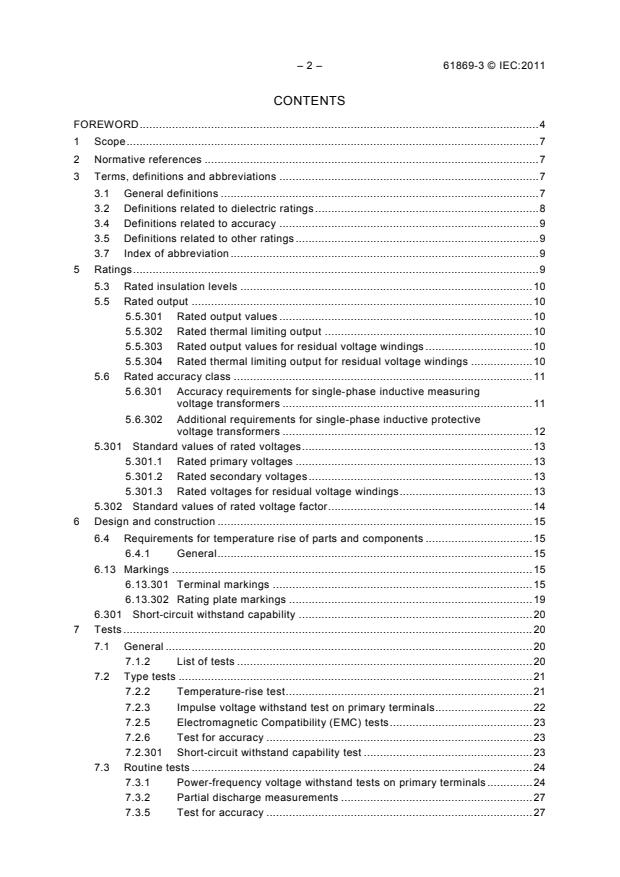
– 2 – 61869-3 © IEC:2011
CONTENTS
FOREWORD . 4
1 Scope . 7
2 Normative references . 7
3 Terms, definitions and abbreviations . 7
3.1 General definitions . 7
3.2 Definitions related to dielectric ratings . 8
3.4 Definitions related to accuracy . 9
3.5 Definitions related to other ratings . 9
3.7 Index of abbreviation . 9
5 Ratings . 9
5.3 Rated insulation levels . 10
5.5 Rated output . 10
5.5.301 Rated output values . 10
5.5.302 Rated thermal limiting output . 10
5.5.303 Rated output values for residual voltage windings . 10
5.5.304 Rated thermal limiting output for residual voltage windings . 10
5.6 Rated accuracy class . 11
5.6.301 Accuracy requirements for single-phase inductive measuring
voltage transformers . 11
5.6.302 Additional requirements for single-phase inductive protective
voltage transformers . 12
5.301 Standard values of rated voltages . 13
5.301.1 Rated primary voltages . 13
5.301.2 Rated secondary voltages . 13
5.301.3 Rated voltages for residual voltage windings . 13
5.302 Standard values of rated voltage factor . 14
6 Design and construction . 15
6.4 Requirements for temperature rise of parts and components . 15
6.4.1 General . 15
6.13 Markings . 15
6.13.301 Terminal markings . 15
6.13.302 Rating plate markings . 19
6.301 Short-circuit withstand capability . 20
7 Tests . 20
7.1 General . 20
7.1.2 List of tests . 20
7.2 Type tests . 21
7.2.2 Temperature-rise test . 21
7.2.3 Impulse voltage withstand test on primary terminals . 22
7.2.5 Electromagnetic Compatibility (EMC) tests . 23
7.2.6 Test for accuracy . 23
7.2.301 Short-circuit withstand capability test . 23
7.3 Routine tests . 24
7.3.1 Power-frequency voltage withstand tests on primary terminals . 24
7.3.2 Partial discharge measurements . 27
7.3.5 Test for accuracy . 27
61869-3 © IEC:2011 – 3 –
7.4 Special tests . 27
7.4.3 Measurement of capacitance and dielectric dissipation factor . 27
7.4.6 Internal arc fault test . 28
Figure 301 – Single-phase transformer with fully insulated terminals and a single
secondary . 16
Figure 302 – Single-phase transformer with a neutral primary terminal with reduced
insulation and a single secondary . 16
Figure 303 – Three-phase assembly with a single secondary . 16
Figure 304 – Single-phase transformer with two secondaries . 17
Figure 305 – Three-phase assembly with two secondaries . 17
Figure 306 – Single-phase transformer with one multi-tap secondary . 17
Figure 307 – Three-phase assembly with one multi-tap secondary . 17
Figure 308 – Single-phase transformer with two multi-tap secondaries . 18
Figure 309 – Single-phase transformer with one residual voltage winding . 18
Figure 310 – Three-phase transformer with one residual voltage winding. 18
Figure 311 – Example of a typical rating plate . 20
Figure 312 – Example of a rating plate with typical data . 20
Figure 313 – Common mode (separate source) test voltage application . 26
Figure 314 – Differential mode (induced) test voltage application – Primary excitation . 26
Figure 315 – Differential mode (induced) test voltage application – Secondary
excitation . 27
Table 301 – Limits of voltage error and phase displacement for measuring voltage
transformers . 11
Table 302 – Limits of voltage error and phase displacement for protective voltage
transformers . 12
Table 303 – Rated voltages for secondary windings intended to produce a residual
voltage . 14
Table 10 – List of tests . 21
Table 305 – Burden ranges for accuracy tests . 23
– 4 – 61869-3 © IEC:2011
INTERNATIONAL ELECTROTECHNICAL COMMISSION
____________
INSTRUMENT TRANSFORMERS –
Part 3: Additional requirements for inductive voltage transformers
FOREWORD
1) The International Electrotechnical Commission (IEC) is a worldwide organization for standardization comprising
all national electrotechnical committees (IEC National Committees). The object of IEC is to promote
international co-operation on all questions concerning standardization in the electrical and electronic fields. To
this end and in addition to other activities, IEC publishes International Standards, Technical Specifications,
Technical Reports, Publicly Available Specifications (PAS) and Guides (hereafter referred to as “IEC
Publication(s)”). Their preparation is entrusted to technical committees; any IEC National Committee interested
in the subject dealt with may participate in this preparatory work. International, governmental and non-
governmental organizations liaising with the IEC also participate in this preparation. IEC collaborates closely
with the International Organization for Standardization (ISO) in accordance with conditions determined by
agreement between the two organizations.
2) The formal decisions or agreements of IEC on technical matters express, as nearly as possible, an international
consensus of opinion on the relevant subjects since each technical committee has representation from all
interested IEC National Committees.
3) IEC Publications have the form of recommendations for international use and are accepted by IEC National
Committees in that sense. While all reasonable efforts are made to ensure that the technical content of IEC
Publications is accurate, IEC cannot be held responsible for the way in which they are used or for any
misinterpretation by any end user.
4) In order to promote international uniformity, IEC National Committees undertake to apply IEC Publications
transparently to the maximum extent possible in their national and regional publications. Any divergence
between any IEC Publication and the corresponding national or regional publication shall be clearly indicated in
the latter.
5) IEC itself does not provide any attestation of conformity. Independent certification bodies provide conformity
assessment services and, in some areas, access to IEC marks of conformity. IEC is not responsible for any
services carried out by independent certification bodies.
6) All users should ensure that they have the latest edition of this publication.
7) No liability shall attach to IEC or its directors, employees, servants or agents including individual experts and
members of its technical committees and IEC National Committees for any personal injury, property damage or
other damage of any nature whatsoever, whether direct or indirect, or for costs (including legal fees) and
expenses arising out of the publication, use of, or reliance upon, this IEC Publication or any other IEC
Publications.
8) Attention is drawn to the Normative references cited in this publication. Use of the referenced publications is
indispensable for the correct application of this publication.
9) Attention is drawn to the possibility that some of the elements of this IEC Publication may be the subject of
patent rights. IEC shall not be held responsible for identifying any or all such patent rights.
This International Standard IEC 61869-3 has been prepared by subcommittee 38: Instrument
transformers.
This standard replaces IEC 60044-2: Inductive Voltage Transformers.
The text of this standard is based on the following documents:
FDIS Report on voting
38/410/FDIS 38/413/RVD
Full information on the voting for the approval of this standard can be found in the report on
voting indicated in the above table.
This publication has been drafted in accordance with the ISO/IEC Directives, Part 2.
61869-3 © IEC:2011 – 5 –
This standard is Part 3 of IEC 61869, published under the general title Instrument
transformers.
This part 3 is to be read in conjunction with, and is based on, IEC 61869-1, General
Requirements - first edition (2007)- however the reader is encouraged to use its most recent
edition.
This Part 3 follows the structure of IEC 61869-1 and supplements or modifies its
corresponding clauses.
When a particular clause/subclause of Part 1 is not mentioned in this Part 3, that
clause/subclause applies as far as is reasonable. When this standard states “addition”,
“modification” or “replacement”, the relevant text in Part 1 is to be adapted accordingly.
For additional clauses, subclauses, figures, tables, annexes or notes, the following numbering
system is used:
– clauses, subclauses, tables, figures and notes that are numbered starting from 301 are
additional to those in Part 1;
– additional annexes are lettered 3A, 3B, etc.
An overview of the planned set of standards at the date of publication of this document is
given below. The updated list of standards issued by IEC TC38 is available at the website:
www.iec.ch.
– 6 – 61869-3 © IEC:2011
PRODUCT FAMILY STANDARDS PRODUCT PRODUCTS OLD
STANDARD STANDARD
ADDITIONAL REQUIREMENTS FOR 60044-1
61869-2
CURRENT TRANSFORMERS
60044-6
ADDITIONAL REQUIREMENTS FOR 60044-2
61869-3
INDUCTIVE VOLTAGE TRANSFORMERS
ADDITIONAL REQUIREMENTS FOR 60044-3
61869-4
COMBINED TRANSFORMERS
ADDITIONAL REQUIREMENTS FOR 60044-5
61869-5
CAPACITIVE VOLTAGE TRANSFORMERS
61869-1
ADDITIONAL REQUIREMENTS FOR 60044-7
61869-6 61869-7
ELECTRONIC VOLTAGE
GENERAL
TRANSFORMERS
REQUIREMENTS
ADDITIONAL
FOR
GENERAL
INSTRUMENT REQUIREMENT ADDITIONAL REQUIREMENTS FOR 60044-8
61869-8
TRANSFORMERS ELECTRONIC CURRENT
FOR
TRANSFORMERS
ELECTRONIC
INSTRUMENT
TRANSFORMERS
DIGITAL INTERFACE FOR INSTRUMENT
61869-9
AND LOW
TRANSFORMERS
POWER STAND
ALONE
ADDITIONAL REQUIREMENTS FOR LOW-
61869-10
SENSORS
POWER STAND-ALONE CURRENT
SENSORS
ADDITIONAL REQUIREMENTS FOR LOW 60044-7
61869-11
POWER STAND ALONE VOLTAGE
SENSOR
ADDITIONAL REQUIREMENTS FOR
61869-12
COMBINED ELECTRONIC INSTRUMENT
TRANSFORMER OR COMBINED STAND
ALONE SENSORS
STAND ALONE MERGING UNIT
61869-13
The committee has decided that the contents of this publication will remain unchanged until
the stability date indicated on the IEC web site under "http://webstore.iec.ch" in the data
related to the specific publication. At this date, the publication will be
• reconfirmed,
• withdrawn,
• replaced by a revised edition, or
• amended.
61869-3 © IEC:2011 – 7 –
INSTRUMENT TRANSFORMERS –
Part 3: Additional requirements for inductive voltage transformers
1 Scope
This part of IEC 61869 applies to new inductive voltage transformers for use with electrical
measuring instruments and electrical protective devices at frequencies from 15 Hz to 100 Hz.
NOTE 301 Requirements specific to three-phase voltage transformers are not included in this standard but, so far
as they are relevant, the requirements in clauses 4 to 10 apply to these transformers and a few references to them
are included in those clauses (e.g. see 3.1.303, 5.301.1, 5.301.2, 5.5.301, 6.13.301.1 and Table 304).
All the transformers shall be suitable for measuring purposes, but, in addition, certain types
may be suitable for protection purposes. Transformers for the dual purpose of measurement
and protection shall comply with all clauses of this standard.
2 Normative references
Clause 2 of IEC 61869-1:2007 is applicable with the following additions:
IEC 60028, International Standard of resistance for copper
IEC 60038, IEC standard voltages
IEC 61869-1:2007, Instrument transformers – Part 1: General requirements
3 Terms, definitions and abbreviations
For the purposes of this document, the terms and definitions in IEC 61869-1:2007 apply with
the following additions:
3.1 General definitions
3.1.301
voltage transformer
instrument transformer in which the secondary voltage, in normal conditions of use, is
substantially proportional to the primary voltage and differs in phase from it by an angle which
is approximately zero for an appropriate direction of the connections
[IEC 60050-321:1986, 321-03-01]
3.1.302
unearthed voltage transformer
voltage transformer which has all parts of its primary winding, including terminals, insulated
from earth to a level corresponding to its rated insulation level
3.1.303
earthed voltage transformer
single-phase voltage transformer which is intended to have one end of its primary winding
directly earthed or a three-phase voltage transformer which is intended to have the star-point
of its primary winding directly earthed
– 8 – 61869-3 © IEC:2011
3.1.304
measuring voltage transformer
voltage transformer intended to transmit an information signal to measuring instruments,
integrating meters and similar apparatus
[IEC 60050-321:1986 , 321-03-04 modified]
3.1.305
protective voltage transformer
voltage transformer intended to transmit an information signal to electrical protective and
control devices
[IEC 60050-321:1986 , 321-03-05]
3.1.306
primary winding
winding to which the voltage to be transformed is applied
3.1.307
secondary winding
winding which supplies the voltage circuits of measuring instruments, meters, relays or similar
apparatus
3.1.308
residual voltage winding
winding of a single-phase voltage transformer intended, in a set of three single-phase
transformers, for connection in broken delta for the purpose of:
a) producing a residual voltage under earth-fault conditions;
b) damping of relaxation oscillations (ferro-resonances).
3.2 Definitions related to dielectric ratings
3.2.301
rated primary voltage
U
pr
value of the primary voltage which appears in the designation of the transformer and on which
its performance is based
[IEC 60050-321:1986, 321-01-12 modified]
3.2.302
rated secondary voltage
U
sr
value of the secondary voltage which appears in the designation of the transformer and on
which its performance is based
[IEC 60050-321:1986, 321-01-16 modified]
3.2.303
rated voltage factor
F
v
multiplying factor to be applied to the rated primary voltage to determine the maximum voltage
at which a transformer must comply with the relevant thermal requirements for a specified
time and with the relevant accuracy requirements
61869-3 © IEC:2011 – 9 –
3.4 Definitions related to accuracy
3.4.3
ratio error
ε
Definition 3.4.3 of IEC 61869-1:2007 is applicable with the following additional text:
The ratio error (voltage error), expressed in per cent, is given by the formula:
k × U − U
r S P
ε = ×100 [%]
U
P
where
k is the rated transformation ratio;
r
U is the actual primary voltage;
p
U is the actual secondary voltage when U is applied under the conditions of measurement.
s p
3.5 Definitions related to other ratings
3.5.301
thermal limiting output
value of the apparent power at rated voltage which can be taken from a secondary winding
without exceeding the limits of temperature rise.
NOTE 301 In this condition the limits of voltage error and phase displacement, for all secondary windings, most
probably may be exceeded.
NOTE 302 In the case of more than one secondary winding, the thermal limiting output is to be given separately.
3.7 Index of abbreviations
Subclause 3.7 of IEC 61869-1 is replaced by the following:
IT Instrument Transformer
CT Current Transformer
CVT Capacitive Voltage Transformer
VT Voltage Transformer
AIS Air-Insulated Switchgear
GIS Gas-Insulated Switchgear
k
actual transformation ratio
k rated transformation ratio
r
ε ratio error
Δφ phase displacement
S
rated output
r
U highest voltage for system
sys
U
highest voltage for equipment
m
U rated primary voltage
Pr
U
rated secondary voltage
Sr
F rated voltage factor
V
f
rated frequency
R
F mechanical load
F
relative leakage rate
rel
– 10 – 61869-3 © IEC:2011
5 Ratings
Clause 5 of IEC 61869-1 is applicable with the following modifications:
NOTE 301 Please note that additional voltage ratings, to be considered together with Subclause 5.2: Highest
voltage for equipment, are given in 5.301: Standard values of rated voltages. In future revision of IEC 61869 the
layout of this clause will be rearranged.
5.3 Rated insulation levels
5.3.3.301 Power-frequency withstand voltage for the earthed terminal
The rated power-frequency short-duration withstand voltage shall be 3 kV (r.m.s.).
5.5 Rated output
5.5.301 Rated output values
The standard values of rated output at a power factor of 1, expressed in voltamperes, are:
1,0 - 2,5 - 5,0 - 10 VA (burden range I)
The standard values of rated output at a power factor of 0,8 lagging, expressed in
voltamperes, are:
10 - 25 - 50 - 100 VA (burden range II)
The rated output of a three-phase transformer shall be the rated output per phase.
NOTE 301 For a given transformer, provided one of the values of rated output is standard and associated with a
standard accuracy class, the declaration of other rated outputs, which may be non-standard values but associated
with other standard accuracy classes, is not precluded.
5.5.302 Rated thermal limiting output
The rated thermal limiting output shall be specified in voltamperes; the standard values are:
25 - 50 - 100 VA and their decimal multiples,
related to the rated secondary voltage with unity power factor.
5.5.303 Rated output values for residual voltage windings
The rated output of windings intended to be connected in broken delta with similar windings to
produce a residual voltage shall be specified in voltamperes and the value shall be chosen
from the values specified in 5.5.301.
5.5.304 Rated thermal limiting output for residual voltage windings
The rated thermal limiting output of the residual voltage winding shall be specified in
voltamperes; the standard values are:
25 - 50 - 100 VA and their decimal multiples,
related to the rated secondary voltage with unity power factor.
NOTE 301 Where a thermal limiting output is assigned to a residual voltage winding connected in a broken delta,
it should be noted that these windings are only loaded under fault conditions and therefore for a limited duration.
Deviating from the definition in 3.5.301, the rated thermal output of the residual voltage winding should be referred
to a duration of 8 h.
61869-3 © IEC:2011 – 11 –
5.6 Rated accuracy class
5.6.301 Accuracy requirements for single-phase inductive measuring voltage
transformers
5.6.301.1 Accuracy class designation for measuring voltage transformers
For measuring voltage transformers, the accuracy class is designated by the highest
permissible percentage voltage error at rated voltage and with rated burden, prescribed for
the accuracy class concerned.
5.6.301.2 Standard accuracy classes for measuring voltage transformers
The standard accuracy classes for single-phase inductive measuring voltage transformers
are:
0,1 – 0,2 – 0,5 – 1,0 – 3,0
NOTE 301 Guidance on appropriate accuracy classes will be included in a future annex.
5.6.301.3 Limits of voltage error and phase displacement for measuring voltage
transformers
The voltage error and phase displacement at rated frequency shall not exceed the values
given in Table 301 at any voltage between 80 % and 120 % of rated voltage and with burdens:
• any value from 0 VA to 100 % of the rated burden, at a power factor equal to 1 for
burden range I.
• between 25 % and 100 % of rated burden at a power factor of 0,8 lagging for burden
range II.
The errors shall be determined at the terminals of the transformer and shall include the
effects of any fuses or resistors as an integral part of the transformer.
For transformers with tappings on the secondary winding, the accuracy requirements refer to
the highest transformation ratio, unless otherwise specified.
Table 301 – Limits of voltage error and phase displacement for
measuring voltage transformers
Voltage (ratio) error ε Phase displacement Δφ
u
Class
±%
±Minutes ±Centiradians
0,1 0,1 5 0,15
0,2 0,2 10 0,3
0,5 0,5 20 0,6
1,0 1,0 40 1,2
3,0 3,0 Not specified Not specified
NOTE Where transformers have two separate secondary windings, allowance must be
made for the mutual interdependence. It is necessary to specify an output range for each
winding under test and each should meet the accuracy requirements within this range with
the untested windings at any burden from zero to rated value.
If no specification of output ranges is supplied, these ranges for the winding under test
shall be from 25 % to 100 % of the rated output for each winding.
If one of the windings is loaded only occasionally for short periods or only used as a
residual voltage winding, its effect upon other windings may be neglected.
– 12 – 61869-3 © IEC:2011
5.6.302 Additional requirements for single-phase inductive protective voltage
transformers
5.6.302.1 Accuracy class designation for protective voltage transformers
All voltage transformers intended for protective purposes, with the exception of residual
voltage windings, shall be assigned a measuring accuracy class in accordance with 5.6.301.1
and 5.6.301.2. In addition, they shall be assigned one of the accuracy classes specified in
5.6.302.2.
The accuracy class for a protective voltage transformer is designated by the highest
permissible percentage voltage error prescribed for the accuracy class concerned, from 5 %
of rated voltage to a voltage corresponding to the rated voltage factor (see 5.302). This
expression is followed by the letter P.
5.6.302.2 Standard accuracy classes for protective voltage transformers
The standard accuracy classes for protective voltage transformers are 3P and 6P, and the
same limits of voltage error and phase displacement will normally apply at both 5 % of rated
voltage and at the voltage corresponding to the rated voltage factor. At 2 % of rated voltage,
the error limits will be twice as high as those at 5 % of rated voltage.
5.6.302.3 Limits of voltage error and phase displacement for protective voltage
transformers
The voltage error and phase displacement at rated frequency shall not exceed the values in
Table 302 at 5 % of rated voltage and at rated voltage multiplied by the rated voltage factor
(1,2, 1,5 or 1,9) with burdens of:
• any value from 0 VA to 100 % of the rated burden, at a power factor equal to 1 for
burden range I.
• between 25 % and 100 % of rated burden at a power factor of 0,8 lagging for burden
range II.
At 2 % of rated voltage, the limits of voltage error and phase displacement will be twice as
high as those given in Table 302.
Table 302 – Limits of voltage error and phase displacement
for protective voltage transformers
Phase displacement Δφ
Voltage (ratio) error ε
Class u
±Minutes ±Centiradians
±%
3P 3,0 120 3,5
6P 6,0 240 7,0
NOTE When ordering transformers having two separate secondary windings,
because of their interdependence, the user should specify two output ranges, one
for each winding, the upper limit of each output range corresponding to a standard
rated output value. Each winding should fulfill its respective accuracy requirements
within its output range, whilst at the same time the other winding has an output of
any value from zero up to 100 % of the upper limit of its output range. In proving
compliance with this requirement, it is sufficient to test at extreme values only. If no
specification of output ranges is supplied, these ranges are deemed to be from 25 %
to 100 % of the rated output for each winding
5.6.302.4 Accuracy class for residual voltage windings
The accuracy class for a residual voltage winding shall be 6P or better, as defined in
5.6.302.1 and 5.6.302.2.
61869-3 © IEC:2011 – 13 –
NOTE 301 If a residual voltage winding is used for special purposes, another standard accuracy class in
accordance with 5.6.301.1, 5.6.301.2, 5.6.302.1 and 5.6.302.2 can be agreed between manufacturer and
purchaser.
NOTE 302 If the residual voltage winding is used only for damping purposes, an accuracy class designation is not
mandatory.
5.301 Standard values of rated voltages
5.301.1 Rated primary voltages
The standard values of rated primary voltage of three-phase transformers and of single-phase
transformers for use in a single-phase system or between lines in a three-phase system shall
be one of the values of rated system voltage designated as being usual values in IEC 60038.
The standard values of rated primary voltage of a single-phase transformer connected
between one line of a three-phase system and earth or between a system neutral point and
earth shall be 1/√3 times one of the values of rated system voltage.
NOTE 301 The performance of a voltage transformer as a measuring or protection transformer is based on the
rated primary voltage, whereas the rated insulation level is based on one of the highest voltages for equipment of
IEC 60038.
5.301.2 Rated secondary voltages
The rated secondary voltage shall be chosen according to the practice at the location where
the transformer is to be used. The values given below are considered standard values for
single-phase transformers in single-phase systems or connected line-to-line in three-phase
systems and for three-phase transformers.
a) Based on the current practice of a group of European countries:
– 100 V and 110 V;
– 200 V for extended secondary circuits.
b) Based on the current practice in the United States and Canada:
– 120 V for distribution systems;
– 115 V for transmission systems;
– 230 V for extended secondary circuits.
For single-phase transformers intended to be used phase-to-earth in three-phase systems
where the rated primary voltage is a number divided by √3, the rated secondary voltage shall
be one of the fore-mentioned values divided by √3, thus retaining the value of the rated trans-
formation ratio.
NOTE 301 The rated secondary voltage for windings intended to produce a residual secondary voltage is given in
5.301.3
5.301.3 Rated voltages for residual voltage windings
Rated secondary voltages of windings intended to be connected in broken delta with similar
windings to produce a residual voltage are given in Table 303.
– 14 – 61869-3 © IEC:2011
Table 303 – Rated voltages for secondary windings intended
to produce a residual voltage
Preferred values Alternative (non-preferred) values
V V
100 110 200
100 110 200
3 3 3
100 110 200
3 3 3
NOTE Where system conditions are such that the preferred values of rated
secondary voltages would produce a residual voltage that is too low, the non-
preferred values may be used, but attention is drawn to the need to take
precautions for purposes of safety.
5.302 Standard values of rated voltage factor
The voltage factor is determined by the maximum operating voltage which, in turn, is de-
pendent on the system and the voltage transformer primary winding earthing conditions.
The standard voltage factors appropriate to the different earthing conditions are given in
Table 304, together with the permissible duration of maximum operating voltage (i.e. rated
time).
Table 304 – Standard values of rated voltage factors
Rated voltage Method of connecting the primary winding
Rated time
factor and system earthing conditions
Between phases in any network
1,2 Continuous
Between transformer star-point and earth in any network
1,2 Continuous Between phase and earth in an effectively earthed neutral system (IEC 61869-
1:2007, 3.2.7a)
1,5 30 s
1,2 Continuous
Between phase and earth in a non-effectively earthed neutral system
(IEC 61869-1:2007, 3.2.7b)
1,9 30 s
with automatic earth-fault tripping
1,2 Continuous Between phase and earth in an isolated neutral system (IEC 61869-1:2007, 3.2.4)
without automatic earth-fault tripping or in a resonant earthed system (IEC 61869-
1,9 8 h
1:2007, 3.2.5) without automatic earth-fault tripping
NOTE 1 The highest continuous operating voltage of an inductive voltage transformer is equal to the highest
voltage for equipment (divided by √3 for transformers connected between a phase of a three-phase system and
earth) or the rated primary voltage multiplied by the factor 1,2, whichever is the lowest.
NOTE 2 Reduced rated times are permissible by agreement between manufacturer and purchaser.
61869-3 © IEC:2011 – 15 –
6 Design and construction
6.4 Requirements for temperature rise of parts and components
6.4.1 General
Clause 6.4.1 of IEC 61869-1:2007 is applicable with the following additional text:
Unless otherwise specified, the temperature rise of a voltage transformer at the specified
voltage, at rated frequency and at rated burden, or at the highest rated burden if there are
several rated burdens, at any power factor between 0,8 lagging and unity, shall not exceed
the appropriate value given in Table 5 of IEC 61869-1:2007.
When the transformer is fitted with a conservator tank or has an inert gas above the oil, or is
hermetically sealed the temperature rise of the oil at the top of the tank or housing shall not
exceed 55 K.
When the transformer is not so fitted or arranged, the temperature rise of the oil at the top of
the tank or housing shall not exceed 50 K.
The temperature rise measured on the external surface of the core and other metallic parts
where in contact with, or adjacent to, insulation shall not exceed the appropriate value in
Table 5 of IEC 61869-1:2007.
6.13 Markings
6.13.301 Terminal markings
6.13.301.1 General rules
These markings are applicable to single-phase voltage transformers and also to sets of
single-phase voltage transformers assembled as one unit and connected as a three-phase
voltage transformer or to a three-phase voltage transformer having a common core for the
three phases.
6.13.301.2 Method of marking
Capital letters A, B, C and N denote the primary-winding terminals and the lower-case letters
a, b, c and n denote the corresponding secondary-winding terminals.
The letters A, B and C denote fully insulated terminals and the letter N denotes a terminal
intended to be earthed and the insulation of which is less than that of the other terminal(s).
The letters da and dn denote the terminals of windings intended to supply a residual voltage.
6.13.301.3 Markings to be used
Markings shall be in accordance with Figures 301 to 310 as appropriate.
– 16 – 61869-3 © IEC:2011
A B A N
a b
a n
IEC 1294/11 IEC 1295/11
Figure 301 – Single-phase transformer Figure 302 – Single-phase transformer
with fully insulated terminals with a neutral primary terminal with
and a single secondary reduced insulation and a single secondary
C
A B N
c
a b n
IEC 1296/11
Figure 303 – Three-phase assembly with a single secondary
61869-3 © IEC:2011 – 17 –
A B or C
N A B N
1c
1a 1b 1n
1a or
1b 1n
2a 2b 2c
2n
or
2a 2b 2n
IEC 1297/11 IEC 1298/11
Figure 304 – Single-phase transformer Figure 305 – Three-phase assembly
with two secondaries with two secondaries
or A B C
N N
A B
a3 b3 c3
a2
b2 c2
or
a3 b n
a1 a2
a1 b1 c1
n
IEC 1299/11
IEC 1300/11
Figure 306 – Single-phase transformer Figure 307 – Three-phase assembly with
with one multi-tap secondary one multi-tap secondary
– 18 – 61869-3 © IEC:2011
or
N
A B
or
1a2 1n
1a1 1b
2a2 or
2a1 2b 2n
IEC 1301/11
Figure 308 – Single-phase transformer with two multi-tap secondaries
A
B C N
A N
a n
a n
b c
da dn
IEC 1302/11
da dn
IEC 1303/11
Figure 309 – Single-phase transformer with Figure 310 – Three-phase transformer with
one residual voltage winding one residual voltage winding
61869-3 © IEC:2011 – 19 –
6.13.301.4 Indication of relative polarities
Terminals having corresponding capital and lower-case markings shall have the same polarity
at the same instant.
6.13.302 Rating plate markings
6.13.302.1 General
In addition to those markings stated in IEC 61869-1:2007, Clause 6.13, all voltage
transformers shall carry the following markings:
a) the rated primary and secondary voltage (e.g. 66/0,11 kV);
b) rated output and the corresponding accuracy class (e.g. 50 VA Class 1.0);
NOTE 301 When two separate secondary windings are provided, the marking should indicate the output range of
each secondary winding in VA, the corresponding accuracy class and the rated voltage of each winding.
In addition, the following information should be marked:
c) rated voltage factor and corresponding rated time.
NOTE 302 For gas insulated voltage transformers, the highest voltage of the voltage transformer shall be
indicated on the rating plate as the rated voltage for equipment.
For voltage transformers belonging to burden range I, this rating shall be indicated
immediately before the burden indication (for example, 0 VA-10 VA class 0,2).
NOTE 303 The rating plate may contain information concerning several combinations of output and accuracy
class that the transformer can satisfy.
An example of a typical rating plate is given in Figure 311 and one showing typical data in
Figure 312.
6.13.302.2 Marking of the rating plate of a measuring voltage transformer
The rating plate shall carry the appropriate information in accordance with 6.13.302.1.
The accuracy class shall be indicated following the indications of the corresponding rated
output (e.g. 100 VA, class 0,5).
6.13.302.3 Marking of the rating plate of a protective voltage transformer
The rating plate shall carry the appropriate information in accordance with 6.13.302.1. In the
case of small voltage transformers with limited space, it may be necessary to restrict the data
and/or split the data into separate labels.
The accuracy class shall be indicated after the corresponding rated output.
– 20 – 61869-3 © IEC:2011
MANUFACTURE
...