

IEC 60601-2-91:2026
(Main)Medical electrical equipment - Part 2-91: Particular requirements for basic safety and essential performance of non-thermal plasma wound treatment equipment
- Abstract
IEC 60601-2-91:2026 applies to the BASIC SAFETY and ESSENTIAL PERFORMANCE of NON-THERMAL PLASMA WOUND TREATMENT EQUIPMENT and NON-THERMAL PLASMA WOUND TREATMENT ACCESSORIES.
NON-THERMAL PLASMA WOUND TREATMENT EQUIPMENT and NON-THERMAL PLASMA WOUND TREATMENT ACCESSORIES are not intended to supply heat to the PATIENT. They are used to treat chronic and acute wounds and biological tissue as well as diverse skin and itching diseases.
HAZARDS inherent in the intended physiological function of PLASMA WOUND TREATMENT EQUIPMENT and NON-THERMAL PLASMA WOUND TREATMENT ACCESSORIES within the scope of this document are covered by specific requirements in 7.2.13 of IEC 60601-1:2005, IEC 60601-1:2005/AMD1:2012 and IEC 60601-1:2005/AMD2:2020.
This document does not apply to ME EQUIPMENT intended for the haemostasis of biological tissue (see IEC 60601-2-2 and IEC 60601-2-76).
- Status
- Published
- Publication Date
- 18-Jun-2026
- Technical Committee
- SC 62D - Particular medical equipment, software, and systems
- Drafting Committee
- WG 41 - Non-thermal plasma wound treatment equipment
- Current Stage
- PPUB - Publication issued - 60 Publication
- Start Date
- 19-Jun-2026
- Due Date
- 17-Jul-2026
- Completion Date
- 17-Jul-2026
Buy Documents
IEC 60601-2-91:2026 - Appareils électromédicaux - Partie 2-91: Exigences particulieres pour la sécurité de base et les performances essentielles des appareils de traitement des plaies par plasma non thermique
iec60601-2-91{ed1.0}en - Medical electrical equipment - Part 2-91: Particular requirements for basic safety and essential performance of non-thermal plasma wound treatment equipment
IEC 60601-2-91:2026 is an International Electrotechnical Commission standard for the basic safety and essential performance of non-thermal plasma wound treatment equipment and non-thermal plasma wound treatment accessories. It applies to devices used for chronic and acute wounds, biological tissue, and certain skin and itching diseases, and it focuses on the hazards created by the plasma process, the electrical output, and the emitted reactive species. For manufacturers, test labs, and regulators, it adds particular requirements and test methods to IEC 60601-1.
What does IEC 60601-2-91:2026 specify?
IEC 60601-2-91:2026 specifies particular requirements for non-thermal plasma wound treatment equipment and accessories, with the aim of controlling basic safety and essential performance for this medical electrical equipment. It is written as a particular standard in the IEC 60601 series, so its clause numbering follows IEC 60601-1 with the prefix 201.
The scope covers equipment and accessories that are not intended to supply heat to the patient. It excludes ME equipment intended for haemostasis of biological tissue.
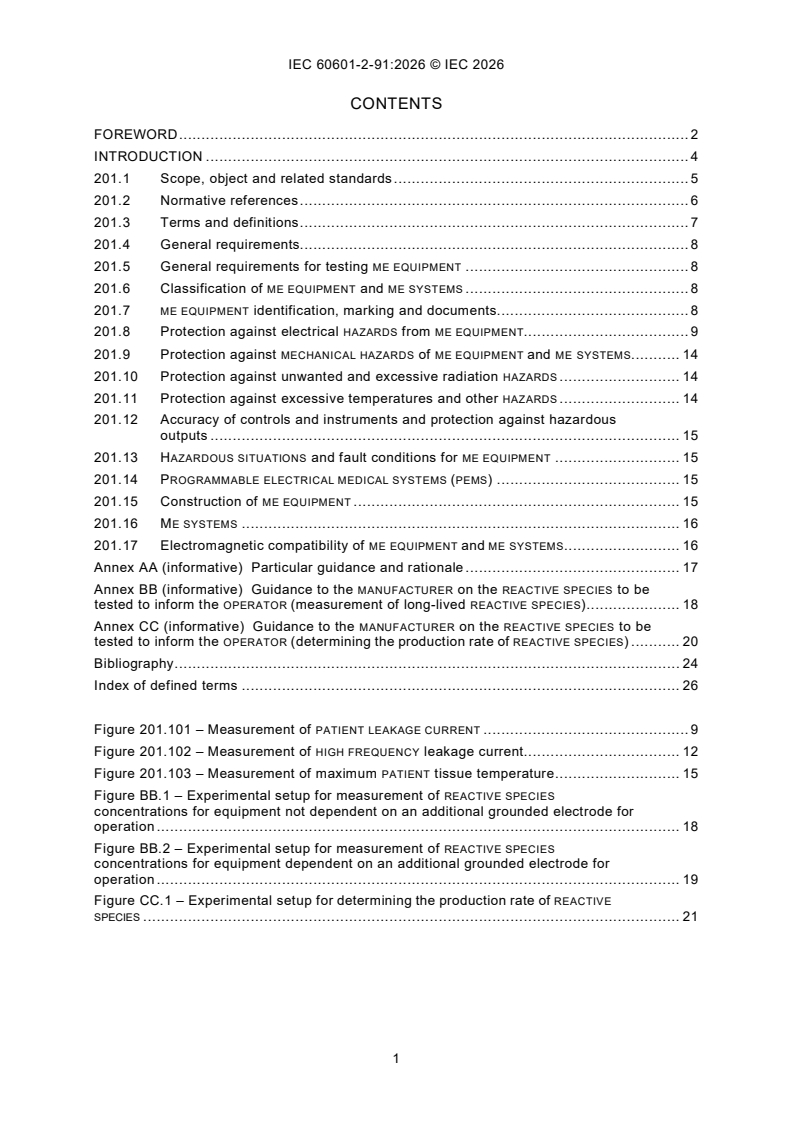
The document is organized into Clause 201.1 to Clause 201.17, plus three informative annexes.
| Annex | What it covers |
|---|---|
| Annex AA | Particular guidance and rationale |
| Annex BB | Guidance to the manufacturer on reactive species tested to inform the operator - measurement of long-lived reactive species |
| Annex CC | Guidance to the manufacturer on reactive species tested to inform the operator - determining the production rate of reactive species |
What are the key requirements of IEC 60601-2-91:2026?
IEC 60601-2-91:2026 adds practical controls for patient contact, leakage currents, insulation, temperature, and reactive species. In practice, this means manufacturers must design the equipment, its accessories, the instructions for use, and the test program around the specific hazards of non-thermal plasma.
Patient contact, marking, and instructions for use
Clause 201.7 requires instructions for use to give the recommended distance between the accessory tip and the patient, the maximum high frequency peak voltage, a list of compatible accessories, and warnings when long-lived reactive species may exceed safety thresholds. This matters because the user needs clear operating limits and compatible parts to avoid unsafe combinations or use at the wrong distance.
The same clause includes a specific warning about direct contact between non-thermal plasma wound treatment accessories and the patient’s eyes unless the risk analysis shows that the contact risk is acceptable. That means the manufacturer must assess eye exposure and communicate any restrictions clearly.
Applied parts and patient leakage current
Clause 201.4 treats a non-thermal plasma wound treatment accessory as an applied part. In practice, accessory design and risk analysis have to assume patient-contact behavior even when contact is brief or incidental.
Clause 201.8.7.3.101 limits patient leakage current from the non-thermal plasma to the values for the declared applied part type in normal condition and single fault condition. The current is measured with the setup shown in Figure 201.101 using a copper plate sized to cover the active treated zone or 100 mm by 100 mm, whichever is greater. This is important because it ties the electrical limit to the actual treated area, not just to a generic lab setup.
Insulation and high frequency leakage of accessories
Clause 201.8.8.3.101 requires non-thermal plasma wound treatment accessories and their cords to be insulated enough to reduce unintended thermal burn risk under normal use. It also requires preconditioning by cleaning, disinfection, or sterilization cycles as specified in the instructions for use, plus saline immersion for the insulated parts before electrical tests. That means the insulation has to survive realistic use, not just a fresh-as-made sample.
Clause 201.8.8.3.102 sets a high frequency leakage current limit for accessory insulation and defines a saline-soaked test arrangement. The test uses a frequency chosen by the manufacturer or the operating waveform, and it measures leakage through the external insulation surface. This matters because the plasma system may use high frequency voltages, so the accessory insulation must contain those currents.
Dielectric strength of accessories
Clause 201.8.8.3.103 requires accessory insulation to withstand a high frequency peak voltage at 120% of the maximum peak voltage produced by the compatible equipment. Clause 201.8.8.3.104 then requires the same insulation, including the part already tested at high frequency, to withstand a DC or mains frequency peak voltage above the manufacturer-declared maximum. In practice, the accessory must pass both plasma-related stress and conventional mains-frequency insulation stress.
These tests also cover detachable cords, detachable electrodes, and connectors, with special handling of saline wrap or saline immersion. That is important because the weak point in many systems is not the generator but the accessory, cord, or connector.
Temperature and reactive species
Clause 201.11.1.2.2 requires a temperature measurement on a grounded copper plate under the accessory at the intended use distance, using the maximum output setting or the maximum operating time in the instructions for use, whichever is longer. This shows whether the treatment setup creates unacceptable surface heating where it contacts or approaches tissue.
Clause 201.11.101 requires the manufacturer to identify, in the risk analysis, the risks from reactive species such as ozone, nitrogen monoxide, and nitrogen dioxide, and the measures used to reduce those risks. Compliance is checked through the risk management file and the instructions for use. That means chemical exposure is treated as a core safety topic, not an optional extra.
Use of the IEC 60601-1 framework
Clauses 201.5, 201.6, 201.9 to 201.17 retain the IEC 60601-1 structure for testing, classification, mechanical hazards, radiation hazards, hazardous situations, programmable electrical medical systems, construction, me systems, and EMC. For users of the standard, this means the plasma-specific rules sit on top of the general medical electrical equipment framework rather than replacing it.
What terms does IEC 60601-2-91:2026 define?
IEC 60601-2-91:2026 defines the terms needed to describe the treatment zone, the plasma process, and the accessory system.
- ACTIVE TREATED ZONE - the area of tissue being treated during intended use.
- NON-THERMAL PLASMA - a partially ionized gas with electrons, ions, ambient molecules, and electromagnetic radiation that is not intended to supply heat to the patient.
- NON-THERMAL PLASMA WOUND TREATMENT ACCESSORY - an accessory, often the applied part, used to apply non-thermal plasma at the patient’s intended treatment site.
- NON-THERMAL PLASMA WOUND TREATMENT EQUIPMENT - medical electrical equipment that treats wounds using non-thermal plasma together with related accessories.
- REACTIVE SPECIES - reactive atoms or molecules generated in the non-thermal plasma that can reach the respiratory tract of the patient and operator.
- WOUND TREATMENT - treatment by non-thermal plasma for biological tissue in wounds or for skin and itching diseases.
Who uses IEC 60601-2-91:2026?
IEC 60601-2-91:2026 is used by manufacturers of medical electrical wound treatment systems, especially teams working on design, electrical safety, risk management, and labeling. It is also used by test laboratories and conformity assessment bodies that verify leakage current, insulation, temperature, and reactive species-related claims.
Quality managers, regulatory affairs staff, and buyers can use it to check whether a product family is really intended for non-thermal plasma wound treatment and whether the supplied accessories and instructions match that intended use. Clinicians and procurement teams can use the accessory and warning requirements to compare compatible systems and understand operating limits.
Which standards are used with IEC 60601-2-91:2026?
IEC 60601-2-91:2026 is built on IEC 60601-1:2005 and its amendments IEC 60601-1:2005/AMD1:2012 and IEC 60601-1:2005/AMD2:2020, which provide the general medical electrical equipment requirements that this part amends and supplements. The standard also uses ISO 14971 terminology for risk, risk analysis, risk management, and the risk management file.
Two companion standards are named in the scope as not applying here: IEC 60601-1-3 and IEC 60601-1-10. The document also refers to IEC 60601-2-2 and IEC 60601-2-76 for haemostasis equipment outside its scope.
What does the IEC 60601-2-91:2026 document contain?
IEC 60601-2-91:2026 contains clause-by-clause amendments to the IEC 60601-1 structure, plus specific test figures and informative guidance annexes. The body of the document includes measurement setups for patient leakage current, high frequency leakage current, and maximum patient tissue temperature, each tied to the active treated zone and intended use distance.
It also contains detailed accessory tests for saline preconditioning, high frequency dielectric strength, and mains frequency dielectric strength. Those procedures are used to show that cords, electrodes, handles, and connectors can withstand realistic plasma-related electrical stress.
Annex BB and Annex CC give manufacturer guidance for measuring long-lived reactive species and for determining production rates of reactive species. Annex CC also includes a chamber-based method with concentration measurements and calculation steps that can support product characterization, risk evaluation, and user information.
Buy Documents
IEC 60601-2-91:2026 - Appareils électromédicaux - Partie 2-91: Exigences particulieres pour la sécurité de base et les performances essentielles des appareils de traitement des plaies par plasma non thermique
iec60601-2-91{ed1.0}en - Medical electrical equipment - Part 2-91: Particular requirements for basic safety and essential performance of non-thermal plasma wound treatment equipment
Get Certified
Connect with accredited certification bodies for this standard

BSI Group
BSI (British Standards Institution) is the business standards company that helps organizations make excellence a habit.

TÜV Rheinland
TÜV Rheinland is a leading international provider of technical services.

TÜV SÜD
TÜV SÜD is a trusted partner of choice for safety, security and sustainability solutions.
Sponsored listings
Frequently Asked Questions
IEC 60601-2-91:2026 is a standard published by the International Electrotechnical Commission (IEC). Its full title is "Medical electrical equipment - Part 2-91: Particular requirements for basic safety and essential performance of non-thermal plasma wound treatment equipment". This standard covers: IEC 60601-2-91:2026 applies to the BASIC SAFETY and ESSENTIAL PERFORMANCE of NON-THERMAL PLASMA WOUND TREATMENT EQUIPMENT and NON-THERMAL PLASMA WOUND TREATMENT ACCESSORIES. NON-THERMAL PLASMA WOUND TREATMENT EQUIPMENT and NON-THERMAL PLASMA WOUND TREATMENT ACCESSORIES are not intended to supply heat to the PATIENT. They are used to treat chronic and acute wounds and biological tissue as well as diverse skin and itching diseases. HAZARDS inherent in the intended physiological function of PLASMA WOUND TREATMENT EQUIPMENT and NON-THERMAL PLASMA WOUND TREATMENT ACCESSORIES within the scope of this document are covered by specific requirements in 7.2.13 of IEC 60601-1:2005, IEC 60601-1:2005/AMD1:2012 and IEC 60601-1:2005/AMD2:2020. This document does not apply to ME EQUIPMENT intended for the haemostasis of biological tissue (see IEC 60601-2-2 and IEC 60601-2-76).
IEC 60601-2-91:2026 applies to the BASIC SAFETY and ESSENTIAL PERFORMANCE of NON-THERMAL PLASMA WOUND TREATMENT EQUIPMENT and NON-THERMAL PLASMA WOUND TREATMENT ACCESSORIES. NON-THERMAL PLASMA WOUND TREATMENT EQUIPMENT and NON-THERMAL PLASMA WOUND TREATMENT ACCESSORIES are not intended to supply heat to the PATIENT. They are used to treat chronic and acute wounds and biological tissue as well as diverse skin and itching diseases. HAZARDS inherent in the intended physiological function of PLASMA WOUND TREATMENT EQUIPMENT and NON-THERMAL PLASMA WOUND TREATMENT ACCESSORIES within the scope of this document are covered by specific requirements in 7.2.13 of IEC 60601-1:2005, IEC 60601-1:2005/AMD1:2012 and IEC 60601-1:2005/AMD2:2020. This document does not apply to ME EQUIPMENT intended for the haemostasis of biological tissue (see IEC 60601-2-2 and IEC 60601-2-76).
IEC 60601-2-91:2026 is classified under the following ICS (International Classification for Standards) categories: 11.040.99 - Other medical equipment; 11.140 - Hospital equipment. The ICS classification helps identify the subject area and facilitates finding related standards.
IEC 60601-2-91:2026 is available in PDF format for immediate download after purchase. The document can be added to your cart and obtained through the secure checkout process. Digital delivery ensures instant access to the complete standard document.
Standards Content (Sample)
Contents
- 4 ACCESSOIRE DE TRAITEMENT DES PLAIES PAR PLASMA NON THERMIQUE
- 4 ACCESSOIRE DE TRAITEMENT DES PLAIES PAR PLASMA NON THERMIQUE
- 1 ACCESSOIRE DE TRAITEMENT DES PLAIES PAR PLASMA NON THERMIQUE
- Annexe AA
- Annexe BB
- 1 ACCESSOIRE DE TRAITEMENT DES PLAIES PAR PLASMA NON THERMIQUE
- 1 ACCESSOIRE DE TRAITEMENT DES PLAIES PAR PLASMA NON THERMIQUE
- Annexe CC
- 6 APPAREIL EM
- Bibliographie
INTRODUCTION Les exigences minimales de sécurité spécifiées dans le présent document sont considérées comme assurant un degré pratique de sécurité au cours du fonctionnement des APPAREILS DE TRAITEMENT DES PLAIES PAR PLASMA NON THERMIQUE.
Le présent document modifie et complète l'IEC 60601-1:2005, l'IEC 60601-1:2005/AMD1:2012 et l'IEC 60601-1:2005/AMD2:2020, Appareils électromédicaux - Partie 1: Exigences générales pour la sécurité de base et les performances essentielles.
Les exigences sont suivies de spécifications pour les essais correspondants. Le présent document a pour objet de définir la sécurité et de fournir les méthodes d'essai pour évaluer les DANGERS liés à l'APPAREIL EM DE TRAITEMENT DES PLAIES PAR PLASMA NON THERMIQUE. Cela inclurait les DANGERS potentiels suivants: température du gaz plasmatique, niveau d'O3, niveau d'oxydes d'azote, fuite électrique et isolation électrique. Le présent document portera exclusivement sur les APPAREILS DE TRAITEMENT DES PLAIES PAR PLASMA NON THERMIQUE. Les APPAREILS ELECTROMEDICAUX conventionnels traitent les plaies individuellement à l'aide de stimulation électrique, de chaleur, de rayonnement et de lumière. Contrairement aux appareils médicaux conventionnels, les appareils médicaux à plasma traitent les plaies en combinant ESPECES REACTIVES, électrons, ions, champs électromagnétiques, lumière visible et rayonnement UV. Il n'existe aucune recommandation concernant la sécurité et les méthodes de mesure pour les APPAREILS DE TRAITEMENT DES PLAIES PAR PLASMA NON THERMIQUE, contrairement aux autres appareils médicaux conventionnels. Par conséquent, une norme relative aux APPAREILS DE TRAITEMENT DES PLAIES PAR PLASMA NON THERMIQUE peut assurer la sécurité et les PERFORMANCES ESSENTIELLES.
201.1 Domaine d'application, objet et normes connexes L'IEC 60601-1:2005, l'IEC 60601-1:2005/AMD1:2012 et l'IEC 60601-1:2005/AMD2:2020, Article 1 s'applique, avec les exceptions suivantes:
201.1.1 Domaine d'application Remplacement:
La présente partie de l'IEC 60601 s'applique à la SECURITE DE BASE et aux PERFORMANCES ESSENTIELLES des APPAREILS DE TRAITEMENT DES PLAIES PAR PLASMA NON THERMIQUE et des ACCESSOIRES DE TRAITEMENT DES PLAIES PAR PLASMA NON THERMIQUE. Les APPAREILS DE TRAITEMENT DES PLAIES PAR PLASMA NON THERMIQUE et les ACCESSOIRES DE TRAITEMENT DES PLAIES PAR PLASMA NON THERMIQUE ne sont pas destinés à fournir de la chaleur au PATIENT. Ils sont utilisés pour traiter les plaies aiguës et chroniques, ainsi que les tissus biologiques, mais aussi différentes maladies de la peau et démangeaisons. Les DANGERS inhérents à la fonction physiologique prévue des appareils de traitement des plaies par plasma et des ACCESSOIRES DE TRAITEMENT DES PLAIES PAR PLASMA NON THERMIQUE compris dans le domaine d'application du présent document sont couverts par des exigences spécifiques dans le 7.2.13 de l'IEC 60601-1:2005, l'IEC 60601-1:2005/AMD1:2012 et l'IEC 60601-1:2005/AMD2:2020.
Le présent document ne s'applique pas aux APPAREILS EM destinés à l'hémostase des tissus
biologiques (voir l'IEC 60601-2-2 [1] et l'IEC 60601-2-76 [2]). 201.1.2 Objet Remplacement:
Le présent document a pour objet d'établir des exigences particulières en matière de SECURITE et de PERFORMANCES ESSENTIELLES pour les APPAREILS DE TRAITEMENT DES PLAIES PAR DE BASE PLASMA NON THERMIQUE et LES ACCESSOIRES DE TRAITEMENT DES PLAIES PAR PLASMA NON THERMIQUE, comme cela est défini aux 201.3.204 et 201.3.203.
201.1.3 Normes collatérales Addition:
Le présent document fait référence aux normes collatérales applicables énumérées à l'Article 2 de l'IEC 60601-1:2005, l'IEC 60601-1:2005/AMD1:2012 et l'IEC 60601-1:2005/AMD2:2020 et à l'Article 201.2 du présent document.
L'IEC 60601-1-3 [3] et l'IEC 60601-1-10 [4] ne s'appliquent pas. Toutes les autres normes collatérales publiées dans la série IEC 60601-1 s'appliquent telles qu'elles sont publiées.
Les chiffres entre crochets se réfèrent à la Bibliographie.
201.1.4 Normes particulières Addition:
Dans la série IEC 60601, des normes particulières peuvent modifier, remplacer ou supprimer des exigences contenues dans l'IEC 60601-1:2005, l'IEC 60601-1:2005/AMD1:2012 et l'IEC 60601-1:2005/AMD2:2020 et dans les normes collatérales en fonction de l'APPAREIL EM concerné. Elles peuvent également ajouter des exigences supplémentaires pour la SECURITE DE BASE et les PERFORMANCES ESSENTIELLES.
Une exigence d'une norme particulière prévaut sur l'exigence correspondante de l'IEC 60601-1:2005, l'IEC 60601-1:2005/AMD1:2012 et l'IEC 60601-1:2005/AMD2:2020. La numérotation des articles et des paragraphes du présent document correspond à celle de l'IEC 60601-1:2005, l'IEC 60601-1:2005/AMD1:2012 et l'IEC 60601-1:2005/AMD2:2020 avec le préfixe "201" (par exemple, le 201.1 du présent document concerne le contenu de l'Article 1 de l'IEC 60601-1:2005, l'IEC 60601-1:2005/AMD1:2012 et l'IEC 60601-1:2005/AMD2:2020) ou à celle de la norme collatérale applicable avec le préfixe "20x", où x représente le ou les derniers chiffres du numéro de document de la norme collatérale (par exemple, le 202.4 du présent document concerne le contenu de l'Article 4 de la norme collatérale IEC 60601-1-2, le 203.4 du présent document concerne le contenu de l'Article 4 de la norme collatérale IEC 60601-1-3, etc.). Les modifications apportées au texte de l'IEC 60601-1:2005, l'IEC 60601-1:2005/AMD1:2012 et l'IEC 60601-1:2005/AMD2:2020 sont précisées en utilisant les termes suivants:
"Remplacement" signifie que l'article ou le paragraphe de l'IEC 60601-1:2005, l'IEC 60601-1:2005/AMD1:2012 et l'IEC 60601-1:2005/AMD2:2020 ou de la norme collatérale applicable est remplacé complètement par le texte du présent document. "Addition" signifie que le texte du présent document vient s'ajouter aux exigences de l'IEC 60601-1:2005, l'IEC 60601-1:2005/AMD1:2012 et l'IEC 60601-1:2005/AMD2:2020 ou de la norme collatérale applicable.
"Amendement" signifie que l'article ou le paragraphe de l'IEC 60601-1:2005, l'IEC 60601-1:2005/AMD1:2012 et l'IEC 60601-1:2005/AMD2:2020 ou de la norme collatérale applicable est modifié comme cela est indiqué par le texte du présent document. Les paragraphes, figures ou tableaux qui sont ajoutés à ceux de l'IEC 60601-1:2005, l'IEC 60601-1:2005/AMD1:2012 et l'IEC 60601-1:2005/AMD2:2020 sont numérotés à partir de 201.101. Toutefois, en raison du fait que les définitions dans l'IEC 60601-1:2005, l'IEC 60601-1:2005/AMD1:2012 et l'IEC 60601-1:2005/AMD2:2020 sont numérotées de 3.1 à 3.154, les définitions qui sont ajoutées dans le présent document sont numérotées à partir de 201.3.201. Les annexes supplémentaires sont nommées AA, BB, etc., et les points supplémentaires aa), bb), etc.
Lorsque le présent document ne comprend pas d'article ou de paragraphe correspondant, l'article ou le paragraphe de l'IEC 60601-1:2005, l'IEC 60601-1:2005/AMD1:2012 et l'IEC 60601-1:2005/AMD2:2020 ou de la norme collatérale applicable, bien qu'il puisse être sans objet, s'applique sans modification; lorsqu'il est demandé qu'une partie quelconque de l'IEC 60601-1:2005, l'IEC 60601-1:2005/AMD1:2012 et l'IEC 60601-1:2005/AMD2:2020 ou de la norme collatérale applicable, bien que potentiellement pertinente, ne s'applique pas, cela est expressément mentionné dans le présent document.
201.2 Références normatives Les documents suivants sont cités dans le texte de sorte qu'ils constituent, pour tout ou partie de leur contenu, des exigences du présent document. Pour les références datées, seule l'édition citée s'applique. Pour les références non datées, la dernière édition du document de référence s'applique (y compris les éventuels amendements).
Addition:
IEC 60601-1:2005, Appareils électromédicaux - Partie 1: Exigences générales pour la sécurité de base et les performances essentielles IEC 60601-1:2005/AMD1:2012 IEC 60601-1:2005/AMD2:2020 201.3 Termes et définitions Pour les besoins du présent document, les termes et les définitions de l'IEC 60601-1:2005, l'IEC 60601-1:2005/AMD1:2012 et l'IEC 60601-1:2005/AMD2:2020 ainsi que les suivants s'appliquent. L'ISO et l'IEC tiennent à jour des bases de données terminologiques destinées à être utilisées en normalisation, consultables aux adresses suivantes:
- IEC Electropedia: disponible à l'adresse http://www.electropedia.org - ISO Online browsing platform: disponible à l'adresse http://www.iso.org/obp NOTE Un index des termes définis est donné après la Bibliographie. Addition:
201.3.201 ZONE TRAITEE ACTIVE zone du tissu traité pendant l'UTILISATION PREVUE 201.3.202 *PLASMA NON THERMIQUE gaz partiellement ionisé composé d'ESPECES REACTIVES avec des électrons, des ions, des molécules ambiantes et des rayonnements électromagnétiques, qui n'est pas destiné à fournir de la chaleur au PATIENT conformément à l'UTILISATION PREVUE 201.3.203 *ACCESSOIRE DE TRAITEMENT DES PLAIES PAR PLASMA NON THERMIQUE ACCESSOIRE, qui peut être la PARTIE APPLIQUEE d'un APPAREIL DE TRAITEMENT DES PLAIES PAR PLASMA NON THERMIQUE, destiné à l'application de PLASMA NON THERMIQUE pour assurer le TRAITEMENT DES PLAIES à l'endroit prévu chez le PATIENT Note 1 à l'article: Une PARTIE APPLIQUEE du TRAITEMENT DES PLAIES PAR PLASMA NON THERMIQUE est la partie qui entre nécessairement en contact avec le PATIENT. Les parties qui peuvent entrer accidentellement en contact avec le PATIENT lors de l'application du PLASMA NON THERMIQUE sont considérées comme des PARTIES APPLIQUEES (voir le 4.6 de l'IEC 60601-1:2005, l'IEC 60601-1:2005/AMD1:2012 et l'IEC 60601-1:2005/AMD2:2020). Note 2 à l'article: Les ACCESSOIRES DE TRAITEMENT DES PLAIES PAR PLASMA NON THERMIQUE peuvent comprendre des APPAREILS DE TRAITEMENT DES PLAIES PAR PLASMA NON cordons et des connecteurs destinés à être raccordés à des THERMIQUE, ainsi que des APPAREILS ELECTROMEDICAUX autres que les APPAREILS DE TRAITEMENT DES PLAIES PAR PLASMA NON THERMIQUE qui peuvent être connectés électriquement au circuit du PATIENT. Note 3 à l'article: Tous les ACCESSOIRES utilisés avec les APPAREILS DE TRAITEMENT DES PLAIES PAR PLASMA NON THERMIQUE ne sont pas des ACCESSOIRES DE TRAITEMENT DES PLAIES PAR PLASMA NON THERMIQUE. 201.3.204 APPAREIL DE TRAITEMENT DES PLAIES PAR PLASMA NON THERMIQUE APPAREIL EM de traitement des plaies associé à un ACCESSOIRE connexe DE TRAITEMENT DES PLAIES PAR PLASMA NON THERMIQUE qui utilise le PLASMA NON THERMIQUE pour favoriser la guérison des plaies 201.3.205 ESPECES REACTIVES atomes ou molécules réactifs générés dans le PLASMA NON THERMIQUE et dont la durée de vie est suffisante pour atteindre les voies respiratoires du PATIENT et de l'OPERATEUR
201.3.206 *TRAITEMENT DES PLAIES action du traitement par PLASMA NON THERMIQUE sur les tissus biologiques dans le cadre de plaies ou de différentes maladies de la peau et démangeaisons 201.4 Exigences générales L'IEC 60601-1:2005, l'IEC 60601-1:2005/AMD1:2012 et l'IEC 60601-1:2005/AMD2:2020, Article 4 s'applique, avec les exceptions suivantes:
201.4.6 Parties d'APPAREIL EM ou de SYSTEME EM en contact avec le PATIENT Addition:
NOTE 1 Un ACCESSOIRE DE TRAITEMENT DES PLAIES PAR PLASMA NON THERMIQUE est considéré comme une PARTIE APPLIQUEE.
NOTE 2 L'ANALYSE DES RISQUES comprend une évaluation visant à déterminer si les parties qui peuvent entrer en contact avec le PATIENT, mais qui ne correspondent pas à la définition des PARTIES APPLIQUEES, sont soumises aux exigences applicables aux PARTIES APPLIQUEES.
201.5 Exigences générales relatives aux essais des APPAREILS EM L'IEC 60601-1:2005, l'IEC 60601-1:2005/AMD1:2012 et l'IEC 60601-1:2005/AMD2:2020, Article 5 s'applique.
201.6 Classification des APPAREILS EM et des SYSTEMES EM L'IEC 60601-1:2005, l'IEC 60601-1:2005/AMD1:2012 et l'IEC 60601-1:2005/AMD2:2020, Article 6 s'applique.
201.7 Identification, marquage et documentation des APPAREILS EM L'IEC 60601-1:2005, l'IEC 60601-1:2005/AMD1:2012 et l'IEC 60601-1:2005/AMD2:2020, Article 7 s'applique, avec les exceptions suivantes:
201.7.9.2.2 Avertissements et consignes de sécurité Addition:
Ne pas permettre aux ACCESSOIRES DE TRAITEMENT DES PLAIES PAR PLASMA NON THERMIQUE d'entrer en contact direct avec les yeux des PATIENTS, sauf si l'ANALYSE DES RISQUES détermine qu'il n'existe pas de RISQUE inacceptable lié au contact avec les yeux. Paragraphe complémentaire:
201.7.9.2.2.101 Informations complémentaires dans les instructions d'utilisation Les instructions d'utilisation doivent inclure:
- La distance recommandée conformément à l'UTILISATION PREVUE entre l'extrémité distale de l'APPAREIL DE TRAITEMENT DES PLAIES PAR PLASMA NON THERMIQUE et le PATIENT.
- La tension de crête A HAUTE FREQUENCE maximale qui peut être délivrée par l'APPAREIL DE TRAITEMENT DES PLAIES PAR PLASMA NON THERMIQUE.
- Une liste des ACCESSOIRES DE TRAITEMENT DES PLAIES PAR PLASMA NON THERMIQUE compatibles avec l'APPAREIL DE TRAITEMENT DES PLAIES PAR PLASMA NON THERMIQUE (voir 201.8.8.3.103).
- Lorsqu'il existe un RISQUE que les seuils de sécurité des ESPECES REACTIVES à longue durée de vie (par exemple: ozone, monoxyde d'azote, dioxyde d'azote [5], [6]) soient dépassés, des avertissements et des mesures appropriés doivent être indiqués. 201.8 Protection contre les DANGERS d'origine électrique provenant des APPAREILS EM L'IEC 60601-1:2005, l'IEC 60601-1:2005/AMD1:2012 et l'IEC 60601-1:2005/AMD2:2020, Article 8 s'applique, avec les exceptions suivantes:
201.8.7.3 Valeurs admissibles Paragraphe complémentaire:
201.8.7.3.101 COURANTS DE FUITE PATIENT Afin d'éviter les chocs électriques, le COURANT DE FUITE PATIENT qui provient du PLASMA NON THERMIQUE ne doit pas dépasser les limites données dans le Tableau 3 de l'IEC 60601-1:2005 pour le type déclaré de PARTIE APPLIQUEE en CONDITION NORMALE et en CONDITION DE PREMIER DEFAUT.
La vérification est effectuée comme suit:
Le COURANT DE FUITE PATIENT est mesuré selon la Figure 201.101 à l'aide du dispositif de mesure (DM), comme cela est défini à la Figure 12 de l'IEC 60601-1:2005 et l'IEC 60601-1:2005/AMD1:2012. La surface de la plaque de cuivre d'une épaisseur de 1 mm doit être égale à 120 % de la ZONE TRAITEE ACTIVE ou à 100 mm × 100 mm, si cette valeur est plus élevée, à la distance d'UTILISATION PREVUE. La surface de la plaque de cuivre doit être suffisamment propre pour permettre de mesurer le COURANT DE FUITE sans impédance supplémentaire. La table se trouve à 1 m au-dessus du plan conducteur mis à la terre.
Légende 1 réseau d'alimentation 2 table en matériau isolant, située à 1 m au-dessus du plan conducteur 3 appareil
4 ACCESSOIRE DE TRAITEMENT DES PLAIES PAR PLASMA NON THERMIQUE
5 plaque de cuivre plate (120 % de la ZONE TRAITEE ACTIVE ou 100 mm × 100 mm × 1 mm, si cette valeur est plus élevée) 6 dispositif de mesure (DM) de l'IEC 60601-1 7 compteur de courant 8 plan conducteur mis à la terre Figure 201.101 – Mesurage du COURANT DE FUITE PATIENT 201.8.8.3 Tension de tenue Amendement:
Les exigences et les essais pour les ACCESSOIRES DE TRAITEMENT DES PLAIES PAR PLASMA NON THERMIQUE sont indiqués au 201.8.8.3.101.
Conditions d'essai complémentaires:
aa) Si, au cours de l'essai de tension de tenue d'un isolant solide qui constitue un MOYEN DE PROTECTION DU PATIENT, un claquage ou un contournement se produit dans l'atmosphère à la DISTANCE DANS L'AIR spécifiée au 8.9 de l'IEC 60601-1:2005, l'IEC 60601-1:2005/AMD1:2012 et l'IEC 60601-1:2005/AMD2:2020, une barrière isolante peut être placée pour empêcher ce claquage afin que l'isolant de protection puisse être soumis à l'essai.
bb) Si, au cours de l'essai de tension de tenue d'un isolant solide qui constitue un MOYEN DE PROTECTION DU PATIENT, un claquage ou un contournement se produit à la LIGNE DE FUITE spécifiée au 8.9 de l'IEC 60601-1:2005, l'IEC 60601-1:2005/AMD1:2012 et l'IEC 60601-1:2005/AMD2:2020, alors l'essai doit être effectué sur les composants qui assurent un MOYEN DE PROTECTION DU PATIENT, tels que les transformateurs, les relais, les optocoupleurs ou les LIGNES DE FUITE sur les cartes de circuits imprimés.
Paragraphes complémentaires:
201.8.8.3.101 Isolation des ACCESSOIRES DE TRAITEMENT DES PLAIES PAR PLASMA NON THERMIQUE Les ACCESSOIRES DE TRAITEMENT DES PLAIES PAR PLASMA NON THERMIQUE et les cordons qui leur sont associés doivent être suffisamment isolés pour atténuer le RISQUE de brûlure thermique involontaire encouru par le PATIENT et l'OPERATEUR dans des conditions d'UTILISATION NORMALE. La vérification est effectuée comme suit:
Les échantillons d'essai, autres que ceux marqués pour un usage unique, doivent avoir été soumis aux méthodes de nettoyage, de désinfection et de stérilisation en respectant le nombre de cycles spécifié dans les instructions d'utilisation. Voir 7.9.2.12 dans l'IEC 60601-1:2005. Les parties isolées de tous les ACCESSOIRES DE TRAITEMENT DES PLAIES PAR PLASMA NON THERMIQUE, autres que la tête et le connecteur, doivent être préconditionnées par immersion dans une solution saline à 0,9 % pendant 12 h. Les conducteurs actifs qui peuvent avoir été exposés lors de la préparation des essais, ainsi que l'isolation des cordons des ACCESSOIRES DE TRAITEMENT DES PLAIES PAR PLASMA NON THERMIQUE situés à moins de 100 mm des extrémités, doivent être protégés contre tout contact avec la solution saline. Après achèvement du préconditionnement, l'excès de solution saline doit être éliminé des surfaces et des cavités par l'application de secousses ou essuyage à l'aide d'un chiffon sec. Immédiatement après le préconditionnement de la solution saline, les essais électriques applicables doivent être réalisés dans l'ordre suivant:
- fuite A HAUTE FREQUENCE (201.8.8.3.102);
- tension de tenue A HAUTE FREQUENCE (201.8.8.3.103);
- tension de tenue à fréquence du réseau (201.8.8.3.104).
...
Contents
- 1 Supply mains
- 2 Table, made of insulating material, at a height of 1 m above the conductive plane
- 3 Equipment
- 4 NON-THERMAL PLASMA WOUND TREATMENT ACCESSORY
- 7 Current meter
- 8 Earthed conductive plane
- 1 Supply mains
- 2 Table, made of insulating material, at a height of 1 m above the conductive plane
- 3 Equipment
- 4 NON-THERMAL PLASMA WOUND TREATMENT ACCESSORY
- 7 Current meter
- 8 Saline-soaked wrap covered by 100 mm metal foil
- 9 Earthed conductive plane
- 1 NON-THERMAL PLASMA WOUND TREATMENT ACCESSORY
- 2 Copper plate grounded electrically
- 3 Thermocouple
- Annex AA
- Annex BB
- 1 NON-THERMAL PLASMA WOUND TREATMENT ACCESSORY
- 2 Detector
- 1 NON-THERMAL PLASMA WOUND TREATMENT ACCESSORY
- 2 Detector
- 3 Grounded copper plate with holes
- Annex CC
- 6 ME device
- Bibliography
INTRODUCTION The minimum safety requirements specified in this document are considered to provide for a practical degree of safety in the operation of NON-THERMAL PLASMA WOUND TREATMENT EQUIPMENT. This document amends and supplements IEC 60601-1:2005, IEC 60601-1:2005/AMD1:2012 and IEC 60601-1:2005/AMD2:2020, Medical electrical equipment - Part 1: General requirements for basic safety and essential performance.
The requirements are followed by specifications for the relevant tests. This document is to define the safety of, and provides the test methods to evaluate the HAZARDS of NON-THERMAL PLASMA WOUND TREATMENT ME. This would include the following potential HAZARDS: plasma gas temperature, O level, nitrogen oxide level, electrical leakage, and
electrical insulation. This document will be limited to NON-THERMAL PLASMA WOUND TREATMENT EQUIPMENT.
Conventional MEDICAL ELECTRICAL EQUIPMENT treats wounds individually using electrical stimulation, heat, radiation, and light. Unlike conventional medical devices, plasma medical devices treat wounds using a combination of REACTIVE SPECIES, electrons, ions, electromagnetic fields, visible light and (v)UV radiation. There is no guidance on safety and the measurement methods for NON-THERMAL PLASMA WOUND TREATMENT EQUIPMENT in comparison with other conventional medical equipment. Therefore, a standard for NON-THERMAL PLASMA WOUND TREATMENT EQUIPMENT can provide safety and ESSENTIAL PERFORMANCE.
201.1 Scope, object and related standards IEC 60601-1:2005, IEC 60601-1:2005/AMD1:2012 and IEC 60601-1:2005/AMD2:2020, Clause 1, applies, except as follows:
201.1.1 Scope Replacement:
This part of IEC 60601 applies to the BASIC SAFETY and ESSENTIAL PERFORMANCE of NON-THERMAL PLASMA WOUND TREATMENT EQUIPMENT and NON-THERMAL PLASMA WOUND TREATMENT ACCESSORIES.
NON-THERMAL PLASMA WOUND TREATMENT EQUIPMENT and NON-THERMAL PLASMA WOUND TREATMENT ACCESSORIES are not intended to supply heat to the PATIENT. They are used to treat chronic and acute wounds and biological tissue as well as diverse skin and itching diseases. HAZARDS inherent in the intended physiological function of PLASMA WOUND TREATMENT EQUIPMENT and NON-THERMAL PLASMA WOUND TREATMENT ACCESSORIES within the scope of this document are covered by specific requirements in 7.2.13 of IEC 60601-1:2005, IEC 60601-1:2005/AMD1:2012 and IEC 60601-1:2005/AMD2:2020.
This document does not apply to ME EQUIPMENT intended for the haemostasis of biological tissue
(see IEC 60601-2-2[1] and IEC 60601-2-76[2]).
201.1.2 Object Replacement:
The object of this document is to establish particular BASIC SAFETY and ESSENTIAL PERFORMANCE requirements for NON-THERMAL PLASMA WOUND TREATMENT EQUIPMENT and NON-THERMAL PLASMA WOUND TREATMENT ACCESSORIES, as defined in 201.3.204 and 201.3.203. 201.1.3 Collateral standards Addition:
This document refers to those applicable collateral standards that are listed in Clause 2 of IEC 60601-1:2005, IEC 60601-1:2005/AMD1:2012 and IEC 60601-1:2005/AMD2:2020 and Clause 201.2 of this document.
IEC 60601-1-3[3] and IEC 60601-1-10[4] do not apply. All other published collateral standards in the IEC 60601-1 series apply as published.
201.1.4 Particular standards Addition:
In the IEC 60601 series, particular standards may modify, replace or delete requirements contained in IEC 60601-1:2005, IEC 60601-1:2005/AMD1:2012 and IEC 60601-1:2005/AMD2:2020 and collateral standards as appropriate for the particular ME EQUIPMENT under consideration, and may add other BASIC SAFETY and ESSENTIAL PERFORMANCE requirements.
Numbers in square brackets refer to the Bibliography.
A requirement of a particular standard takes priority over IEC 60601-1:2005, IEC 60601-1:2005/AMD1:2012 and IEC 60601-1:2005/AMD2:2020.
The numbering of clauses and subclauses of this document corresponds to that of IEC 60601-1:2005, IEC 60601-1:2005/AMD1:2012 and IEC 60601-1:2005/AMD2:2020 with the prefix "201" (e.g. 201.1 in this document addresses the content of Clause 1 of IEC 60601-1:2005, IEC 60601-1:2005/AMD1:2012 and IEC 60601-1:2005/AMD2:2020) or applicable collateral standard with the prefix "20x" where x is the final digit(s) of the collateral standard document number (e.g. 202.4 in this document addresses the content of Clause 4 of the IEC 60601-1-2 collateral standard, 203.4 in this document addresses the content of Clause 4 of the 60601-1-3 collateral standard, etc.). The changes to the text of IEC 60601-1:2005, IEC 60601-1:2005/AMD1:2012 and IEC 60601-1:2005/AMD2:2020 are specified by the use of the following words:
"Replacement" means that the clause or subclause of IEC 60601-1:2005, IEC 60601-1:2005/AMD1:2012 and IEC 60601-1:2005/AMD2:2020 or applicable collateral standard is replaced completely by the text in this document.
"Addition" means that the text of this document is additional to the requirements of IEC 60601-1:2005, IEC 60601-1:2005/AMD1:2012 and IEC 60601-1:2005/AMD2:2020 or applicable collateral standard.
"Amendment" means that the clause or subclause of IEC 60601-1:2005, IEC 60601-1:2005/AMD1:2012 and IEC 60601-1:2005/AMD2:2020 or applicable collateral standard is amended as indicated by the text of this document. Subclauses, figures or tables which are additional to those of IEC 60601-1:2005, IEC 60601-1:2005/AMD1:2012 and IEC 60601-1:2005/AMD2:2020 are numbered starting from 201.101. However, due to the fact that definitions in IEC 60601-1:2005, IEC 60601-1:2005/AMD1:2012 and IEC 60601-1:2005/AMD2:2020 are numbered 3.1 through 3.154, additional definitions in this document are numbered beginning from 201.3.201. Additional annexes are lettered AA, BB, etc., and additional items aa), bb), etc. Where there is no corresponding clause or subclause in this document, the clause or subclause of IEC 60601-1:2005, IEC 60601-1:2005/AMD1:2012 and IEC 60601-1:2005/AMD2:2020 or applicable collateral standard, although possibly not relevant, applies without modification; where it is intended that any part of IEC 60601-1:2005, IEC 60601-1:2005/AMD1:2012 and IEC 60601-1:2005/AMD2:2020 or applicable collateral standard, although possibly relevant, is not to be applied, a statement to that effect is given in this document. 201.2 Normative references The following documents are referred to in the text in such a way that some or all of their content constitutes requirements of this document. For dated references, only the edition cited applies. For undated references, the latest edition of the referenced document (including any amendments) applies.
Addition:
IEC 60601-1:2005, Medical electrical equipment – Part 1: General requirements for basic safety and essential performance IEC 60601-1:2005/AMD1:2012 IEC 60601-1:2005/AMD2:2020
201.3 Terms and definitions For the purposes of this document, the terms and definitions given in IEC 60601-1:2005, IEC 60601-1:2005/AMD1:2012 and IEC 60601-1:2005/AMD2:2020, and the following apply. ISO and IEC maintain terminological databases for use in standardization at the following addresses:
- IEC Electropedia: available at http://www.electropedia.org - ISO Online browsing platform: available at http://www.iso.org/obp NOTE An index of defined terms is given after the Bibliography. Addition:
201.3.201 ACTIVE TREATED ZONE area of the treated tissue during INTENDED USE 201.3.202 *NON-THERMAL PLASMA partially ionized gas consisting of REACTIVE SPECIES with electrons, ions, ambient molecules and PATIENT according to the electromagnetic radiation, that is not intended to supply heat to the INTENDED USE 201.3.203 *NON-THERMAL PLASMA WOUND TREATMENT ACCESSORY ACCESSORY, which can be the APPLIED PART of NON-THERMAL PLASMA WOUND TREATMENT EQUIPMENT, intended for application of NON-THERMAL PLASMA to provide WOUND TREATMENT at the PATIENT intended site of the Note 1 to entry: An APPLIED PART of the NON-THERMAL PLASMA WOUND TREATMENT is the part which necessarily comes into contact with the PATIENT. Parts, that can accidentally come into contact with the PATIENT during application of NON-THERMAL PLASMA are treated as APPLIED PART (see 4.6 of IEC 60601-1:2005, IEC 60601-1:2005/AMD1:2012 and IEC 60601-1:2005/AMD2:2020).
Note 2 to entry: NON-THERMAL PLASMA WOUND TREATMENT ACCESSORIES can include cords and connectors for attachment to NON-THERMAL PLASMA WOUND TREATMENT EQUIPMENT, as well as MEDICAL ELECTRICAL EQUIPMENT other than NON-THERMAL PLASMA WOUND TREATMENT EQUIPMENT that can be electrically connected to the PATIENT circuit. Note 3 to entry: Not all ACCESSORIES used with NON-THERMAL PLASMA WOUND TREATMENT EQUIPMENT are NON- THERMAL PLASMA WOUND TREATMENT ACCESSORIES.
201.3.204 NON-THERMAL PLASMA WOUND TREATMENT EQUIPMENT ME EQUIPMENT that treat wounds together with related NON-THERMAL PLASMA WOUND TREATMENT ACCESSORY using NON-THERMAL PLASMA for the purpose of promoting wound recovery 201.3.205 REACTIVE SPECIES reactive atoms or molecules generated in the NON-THERMAL PLASMA with sufficient lifetime to reach the respiratory tract of PATIENT and OPERATOR 201.3.206 *WOUND TREATMENT action of treatment by NON-THERMAL PLASMA to biological tissue in wound or diverse skin and itching diseases
201.4 General requirements IEC 60601-1:2005, IEC 60601-1:2005/AMD1:2012 and IEC 60601-1:2005/AMD2:2020, Clause 4, applies, except as follows:
201.4.6 ME EQUIPMENT or ME SYSTEM parts that contact the PATIENT Addition:
NOTE 1 A non-THERMAL PLASMA WOUND TREATMENT ACCESSORY is considered an APPLIED PART. NOTE 2 The RISK ANALYSIS includes an assessment of whether parts that can come into contact with the PATIENT, but fall outside the definition of APPLIED PARTS, is subject to the requirements for APPLIED PARTS. 201.5 General requirements for testing ME EQUIPMENT IEC 60601-1:2005, IEC 60601-1:2005/AMD1:2012 and IEC 60601-1:2005/AMD2:2020, Clause 5, applies.
201.6 Classification of ME EQUIPMENT and ME SYSTEMS IEC 60601-1:2005, IEC 60601-1:2005/AMD1:2012 and IEC 60601-1:2005/AMD2:2020, Clause 6, applies.
201.7 ME EQUIPMENT identification, marking and documents IEC 60601-1:2005, IEC 60601-1:2005/AMD1:2012 and IEC 60601-1:2005/AMD2:2020 applies, Clause 7, except as follows:
201.7.9.2.2 Warnings and safety notices Addition:
NON-THERMAL PLASMA WOUND TREATMENT ACCESSORIES to come in direct contact Do not allow with the PATIENTS' eyes, unless the RISK ANALYSIS determines that no unacceptable RISK exists from contact with the eye.
Additional subclause:
201.7.9.2.2.101 Additional information in the instructions for use The instructions for use shall include:
- The recommended distance according to the INTENDED USE between the distal end of the NON-THERMAL PLASMA WOUND TREATMENT EQUIPMENT and the PATIENT.
- The maximum HIGH FREQUENCY peak voltage that can be output by the NON-THERMAL PLASMA WOUND TREATMENT EQUIPMENT.
- A list of NON-THERMAL PLASMA WOUND TREATMENT ACCESSORIES that are compatible with the NON-THERMAL PLASMA WOUND TREATMENT EQUIPMENT (see 201.8.8.3.103).
- When there is a RISK that safety thresholds of long-lived REACTIVE SPECIES (examples:
ozone, nitrogen monoxide, nitrogen dioxide [5], [6]) will be exceeded, appropriate warnings and measures shall be listed.
201.8 Protection against electrical HAZARDS from ME EQUIPMENT IEC 60601-1:2005, IEC 60601-1:2005/AMD1:2012 and IEC 60601-1:2005/AMD2:2020, Clause 8, applies, except as follows:
201.8.7.3 Allowable values Additional subclause:
201.8.7.3.101 PATIENT LEAKAGE CURRENTS In order to prevent electric shock, PATIENT LEAKAGE CURRENT from the NON-THERMAL PLASMA shall not exceed the limits from Table 3 of IEC 60601-1:2005 for the declared APPLIED PART type in NORMAL CONDITION and SINGLE FAULT CONDITION.
Compliance is checked as follows:
The PATIENT LEAKAGE CURRENT is measured according to Figure 201.101 using the measuring device (MD) as defined in Figure 12 of IEC 60601-1:2005 and IEC 60601-1:2005/AMD1:2012. The area of the 1 mm thick copper plate shall be the greater of 120 % of the ACTIVE TREATED ZONE or 100 mm × 100 mm whichever is greater at the INTENDED USE distance. The copper plate surface shall be clean enough to measure the LEAKAGE CURRENT without additional impedance. The height of the table is 1 m from the earthed conductive plane.
Key
1 Supply mains
2 Table, made of insulating material, at a height of 1 m above the conductive plane
3 Equipment
4 NON-THERMAL PLASMA WOUND TREATMENT ACCESSORY
5 Flat copper plate (120 % of the ACTIVE TREATED ZONE or 100 mm × 100 mm × 1 mm, whichever is greater) 6 Measuring Device (MD) from IEC 60601-1
7 Current meter
8 Earthed conductive plane
Figure 201.101 – Measurement of PATIENT LEAKAGE CURRENT
201.8.8.3 Dielectric strength Amendment:
The requirements and tests for NON-THERMAL PLASMA WOUND TREATMENT ACCESSORIES are given in 201.8.8.3.101.
Additional test conditions:
aa) If, during dielectric strength testing of solid insulation forming MEANS OF PATIENT PROTECTION, a breakdown or flashover occurs through the atmosphere at the AIR CLEARANCE specified in 8.9 of IEC 60601-1:2005, IEC 60601-1:2005/AMD1:2012 and IEC 60601-1:2005/AMD2:2020, an insulating barrier can be placed to prevent this breakdown so that the protective insulation can be tested.
bb) If, during dielectric strength testing of solid insulation forming MEANS OF PATIENT PROTECTION, a breakdown or flashover occurs at the CREEPAGE DISTANCE specified in 8.9 of IEC 60601-1:2005, IEC 60601-1:2005/AMD1:2012 and IEC 60601-1:2005/AMD2:2020, then the test shall be carried out on the components which provide MEANS OF PATIENT PROTECTION, such as transformers, relays, optocouplers or CREEPAGE DISTANCES on printed circuit boards.
Additional subclauses:
201.8.8.3.101 NON-THERMAL PLASMA WOUND TREATMENT ACCESSORY insulation NON-THERMAL PLASMA WOUND TREATMENT ACCESSORIES and cords of NON-THERMAL PLASMA WOUND TREATMENT ACCESSORIES shall be sufficiently insulated to mitigate unintended thermal burn RISK to the PATIENT and OPERATOR under conditions of NORMAL USE. Compliance is checked as follows:
Test samples, other than those marked for single use, shall have undergone the cleaning, disinfection and sterilization methods using the number of cycles as specified in the instructions for use. See 7.9.2.12 of IEC 60601-1:2005.
The insulated parts of all NON-THERMAL PLASMA WOUND TREATMENT ACCESSORIES, other than the head and connector, shall be preconditioned by immersion in 0,9 % saline for 12 h. Operative conductors which can have been exposed in preparation for testing, as well as the insulation of the cords of NON-THERMAL PLASMA WOUND TREATMENT ACCESSORIES within 100 mm of the ends, shall be protected from contact with saline. Upon completion of this preconditioning, excess saline shall be removed from surfaces and cavities by shaking or wiping with a dry cloth. Immediately following saline preconditioning, applicable electrical testing shall be conducted in the following order:
- HIGH FREQUENCY leakage (201.8.8.3.102);
- HIGH FREQUENCY dielectric strength (201.8.8.3.103);
- mains frequency dielectric strength (201.8.8.3.104).
...