


IEC 62453-306:2009
(Main)Field device tool (FDT) interface specification - Part 306: Communication profile integration - IEC 61784 CPF 6
Field device tool (FDT) interface specification - Part 306: Communication profile integration - IEC 61784 CPF 6
IEC 62453-306:2009 provides information for integrating the INTERBUS® technology into the FDT standard (IEC 62453-2). Communication Profile Family 6 (commonly known as INTERBUS®) defines communication profiles based on IEC 61158-2 Type 8, IEC 61158-3-8, IEC 61158-4-8, IEC 61158-5-8, and IEC 61158-6-8. The basic profiles CP 6/1 (INTERBUS) and CP 6/3 (INTERBUS minimal subset) are defined in IEC 61784-1. This part, in conjunction with the other parts of the first edition of the IEC 62453 series cancels and replaces IEC/PAS 62453-1, IEC/PAS 62453-2, IEC/PAS 62453-3, IEC/PAS 62453-4 and IEC/PAS 62453-5 published in 2006, and constitutes a technical revision. This bilingual version (2013-09) corresponds to the monolingual English version, published in 2009-06.
This publication is to be read in conjunction with IEC 62453-2:2009.
Spécification des interfaces des outils des dispositifs de terrain (FDT) - Partie 306: Intégration des profils de communication - CEI 61784 CPF 6
La CEI 62453-306:2009 fournit des informations pour intégrer la technologie INTERBUS® dans la norme de FDT (CEI 62453-2). La Famille de Profils de Communication 6 (généralement connue sous le nom de INTERBUS®) définit les profils de communication basés sur la CEI 61158-2 Type 8, la CEI 61158-3-8, la CEI 61158-4-8, la CEI 61158-5-8, et sur la CEI 61158-6-8. Les profils de base CP 6/1 (INTERBUS) et CP 6/3 (sous-ensemble minimal d'INTERBUS) sont définis dans la CEI 61784-1. Cette partie, conjointement avec les autres parties de la première édition de la série CEI 62453 annule et remplace la CEI/PAS 62453-1, la CEI/PAS 62453-2, la CEI/PAS 62453-3, la CEI/PAS 62453-4 et la CEI/PAS 62453-5 publiées en 2006, et constitue une révision technique. La présente version bilingue (2013-09) correspond à la version anglaise monolingue publiée en 2009-06.
Cette publication doit être lue conjointement avec la CEI 62453-2:2009.
General Information
- Status
- Published
- Publication Date
- 29-Jun-2009
- Technical Committee
- SC 65E - Devices and integration in enterprise systems
- Current Stage
- PPUB - Publication issued
- Start Date
- 30-Jun-2009
- Completion Date
- 15-Jul-2009
Relations
- Replaces
IEC PAS 62453-4:2006 - Field Device Tool (FDT) interface specification - Part 4: HART communication - Effective Date
- 05-Sep-2023
- Effective Date
- 05-Sep-2023
- Effective Date
- 05-Sep-2023
- Effective Date
- 05-Sep-2023
- Effective Date
- 05-Sep-2023
Overview
IEC 62453-306:2009 is part of the IEC 62453 series that defines how to integrate INTERBUS® (IEC 61784 Communication Profile Family 6, CPF 6) into the FDT (Field Device Tool) architecture. This part provides the protocol-specific interface specification and guidance needed to map INTERBUS communication features into FDT Device Type Managers (DTMs) and engineering tools. It is intended to be read in conjunction with IEC 62453-2 and does not modify the core FDT specification.
Key Topics
- Protocol integration (CPF 6 / INTERBUS): Defines the protocol identifier and how INTERBUS (CP 6/1 and CP 6/3 minimal subset) is represented in FDT bus category data. Based on IEC 61158 Type 8 specifications.
- DTM services & Process Channel objects: Specifies Process Channel objects and DTM service requirements for accessing instance and device data over INTERBUS.
- Protocol-specific behavior: Describes expected behavior, including handling of INTERBUS non-cyclic services (PCP - Peripherals Communication Protocol).
- Data type mappings: Defines protocol-specific usage of general FDT data types plus common, network management, communication and channel parameter data types for consistent engineering-tool representation.
- Device identification & topology: Covers structured and simple identification data types, topology scan data types and scan/boot-sequence parameters for discovery and device type identification.
- Network management & parameter access: Includes parameter access data types and semantics for parameter read/write operations consistent with INTERBUS services.
- Conformance and interoperability: Aligns with other parts of the IEC 62453 series to ensure multi-vendor DTM and engineering tool interoperability in heterogeneous control systems.
Applications / Who Uses It
- Device manufacturers - to develop INTERBUS-capable DTMs that integrate with FDT-compliant engineering tools.
- System integrators & automation engineers - to enable consistent device discovery, configuration, diagnostics and lifecycle management of INTERBUS devices within larger automation projects.
- Control system vendors & tool developers - to implement support for INTERBUS CPF 6 in planning, engineering and asset management software.
- Process industry projects - where heterogeneous fieldbuses are integrated into unified engineering environments for scalable, interoperable device management.
Related Standards
- IEC 62453-1 (Overview and guidance)
- IEC 62453-2 (FDT concepts and detailed description) - essential companion document
- IEC 61158 parts (2, 3-8, 4-8, 5-8, 6-8) - physical, data-link and application layer specs for Type 8 (INTERBUS)
- IEC 61784-1 (Fieldbus profiles - CPF 6 definitions)
Keywords: IEC 62453-306, FDT, INTERBUS, IEC 61784 CPF 6, DTM, fieldbus integration, device identification, topology scan, process automation.
IEC 62453-306:2009 - Field device tool (FDT) interface specification - Part 306: Communication profile integration - IEC 61784 CPF 6 Released:6/30/2009 Isbn:9782889107230

IEC 62453-306:2009 - Field device tool (FDT) interface specification - Part 306: Communication profile integration - IEC 61784 CPF 6
Frequently Asked Questions
IEC 62453-306:2009 is a standard published by the International Electrotechnical Commission (IEC). Its full title is "Field device tool (FDT) interface specification - Part 306: Communication profile integration - IEC 61784 CPF 6". This standard covers: IEC 62453-306:2009 provides information for integrating the INTERBUS® technology into the FDT standard (IEC 62453-2). Communication Profile Family 6 (commonly known as INTERBUS®) defines communication profiles based on IEC 61158-2 Type 8, IEC 61158-3-8, IEC 61158-4-8, IEC 61158-5-8, and IEC 61158-6-8. The basic profiles CP 6/1 (INTERBUS) and CP 6/3 (INTERBUS minimal subset) are defined in IEC 61784-1. This part, in conjunction with the other parts of the first edition of the IEC 62453 series cancels and replaces IEC/PAS 62453-1, IEC/PAS 62453-2, IEC/PAS 62453-3, IEC/PAS 62453-4 and IEC/PAS 62453-5 published in 2006, and constitutes a technical revision. This bilingual version (2013-09) corresponds to the monolingual English version, published in 2009-06. This publication is to be read in conjunction with IEC 62453-2:2009.
IEC 62453-306:2009 provides information for integrating the INTERBUS® technology into the FDT standard (IEC 62453-2). Communication Profile Family 6 (commonly known as INTERBUS®) defines communication profiles based on IEC 61158-2 Type 8, IEC 61158-3-8, IEC 61158-4-8, IEC 61158-5-8, and IEC 61158-6-8. The basic profiles CP 6/1 (INTERBUS) and CP 6/3 (INTERBUS minimal subset) are defined in IEC 61784-1. This part, in conjunction with the other parts of the first edition of the IEC 62453 series cancels and replaces IEC/PAS 62453-1, IEC/PAS 62453-2, IEC/PAS 62453-3, IEC/PAS 62453-4 and IEC/PAS 62453-5 published in 2006, and constitutes a technical revision. This bilingual version (2013-09) corresponds to the monolingual English version, published in 2009-06. This publication is to be read in conjunction with IEC 62453-2:2009.
IEC 62453-306:2009 is classified under the following ICS (International Classification for Standards) categories: 25.040.40 - Industrial process measurement and control; 35.100.05 - Multilayer applications; 35.110 - Networking. The ICS classification helps identify the subject area and facilitates finding related standards.
IEC 62453-306:2009 has the following relationships with other standards: It is inter standard links to IEC PAS 62453-4:2006, IEC PAS 62453-5:2006, IEC PAS 62453-2:2006, IEC PAS 62453-3:2006, IEC PAS 62453-1:2006. Understanding these relationships helps ensure you are using the most current and applicable version of the standard.
IEC 62453-306:2009 is available in PDF format for immediate download after purchase. The document can be added to your cart and obtained through the secure checkout process. Digital delivery ensures instant access to the complete standard document.
Standards Content (Sample)
IEC 62453-306 ®
Edition 1.0 2009-06
INTERNATIONAL
STANDARD
Field device tool (FDT) interface specification –
Part 306: Communication profile integration – IEC 61784 CPF 6
All rights reserved. Unless otherwise specified, no part of this publication may be reproduced or utilized in any form
or by any means, electronic or mechanical, including photocopying and microfilm, without permission in writing from
either IEC or IEC's member National Committee in the country of the requester.
If you have any questions about IEC copyright or have an enquiry about obtaining additional rights to this publication,
please contact the address below or your local IEC member National Committee for further information.
IEC Central Office
3, rue de Varembé
CH-1211 Geneva 20
Switzerland
Email: inmail@iec.ch
Web: www.iec.ch
About the IEC
The International Electrotechnical Commission (IEC) is the leading global organization that prepares and publishes
International Standards for all electrical, electronic and related technologies.
About IEC publications
The technical content of IEC publications is kept under constant review by the IEC. Please make sure that you have the
latest edition, a corrigenda or an amendment might have been published.
ƒ Catalogue of IEC publications: www.iec.ch/searchpub
The IEC on-line Catalogue enables you to search by a variety of criteria (reference number, text, technical committee,…).
It also gives information on projects, withdrawn and replaced publications.
ƒ IEC Just Published: www.iec.ch/online_news/justpub
Stay up to date on all new IEC publications. Just Published details twice a month all new publications released. Available
on-line and also by email.
ƒ Electropedia: www.electropedia.org
The world's leading online dictionary of electronic and electrical terms containing more than 20 000 terms and definitions
in English and French, with equivalent terms in additional languages. Also known as the International Electrotechnical
Vocabulary online.
ƒ Customer Service Centre: www.iec.ch/webstore/custserv
If you wish to give us your feedback on this publication or need further assistance, please visit the Customer Service
Centre FAQ or contact us:
Email: csc@iec.ch
Tel.: +41 22 919 02 11
Fax: +41 22 919 03 00
IEC 62453-306 ®
Edition 1.0 2009-06
INTERNATIONAL
STANDARD
Field device tool (FDT) interface specification –
Part 306: Communication profile integration – IEC 61784 CPF 6
INTERNATIONAL
ELECTROTECHNICAL
COMMISSION
PRICE CODE
U
ICS 25.040.40; 35.100.05; 35.110 ISBN 978-2-88910-723-0
– 2 – 62453-306 © IEC:2009(E)
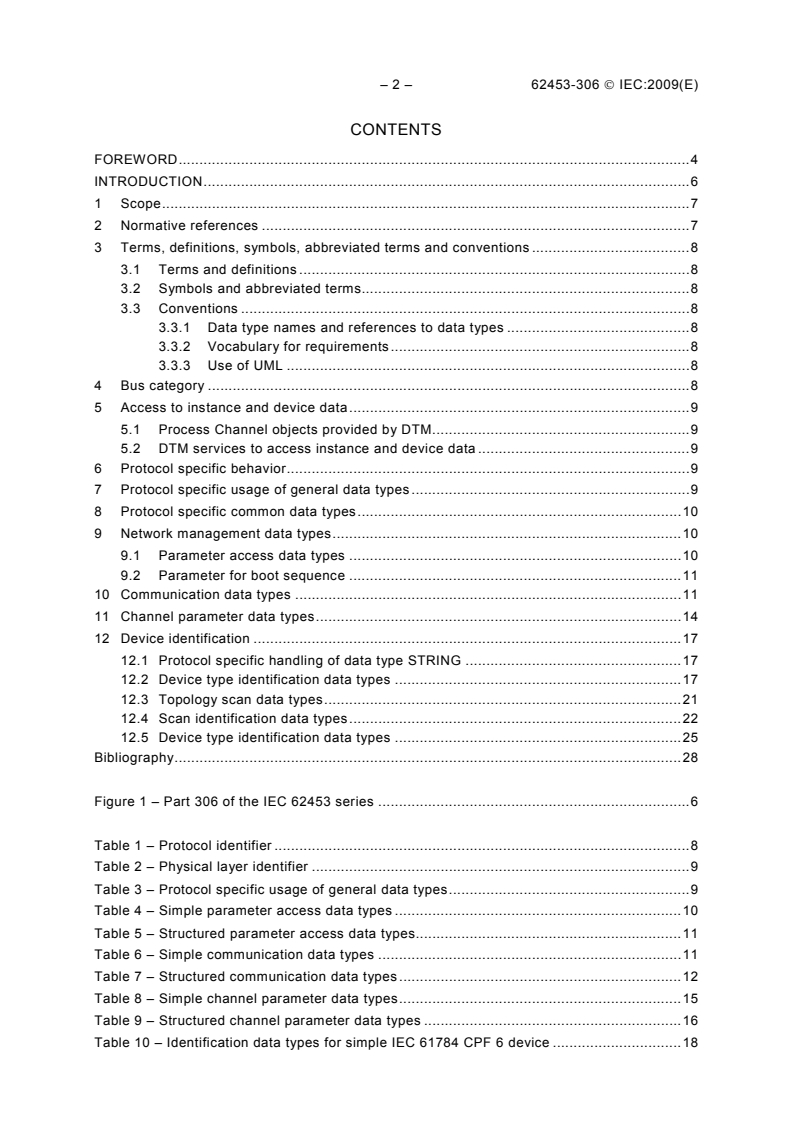
CONTENTS
FOREWORD.4
INTRODUCTION.6
1 Scope.7
2 Normative references .7
3 Terms, definitions, symbols, abbreviated terms and conventions .8
3.1 Terms and definitions .8
3.2 Symbols and abbreviated terms.8
3.3 Conventions .8
3.3.1 Data type names and references to data types .8
3.3.2 Vocabulary for requirements.8
3.3.3 Use of UML .8
4 Bus category .8
5 Access to instance and device data.9
5.1 Process Channel objects provided by DTM.9
5.2 DTM services to access instance and device data .9
6 Protocol specific behavior.9
7 Protocol specific usage of general data types .9
8 Protocol specific common data types.10
9 Network management data types.10
9.1 Parameter access data types .10
9.2 Parameter for boot sequence .11
10 Communication data types .11
11 Channel parameter data types.14
12 Device identification .17
12.1 Protocol specific handling of data type STRING .17
12.2 Device type identification data types .17
12.3 Topology scan data types.21
12.4 Scan identification data types.22
12.5 Device type identification data types .25
Bibliography.28
Figure 1 – Part 306 of the IEC 62453 series .6
Table 1 – Protocol identifier .8
Table 2 – Physical layer identifier .9
Table 3 – Protocol specific usage of general data types.9
Table 4 – Simple parameter access data types .10
Table 5 – Structured parameter access data types.11
Table 6 – Simple communication data types .11
Table 7 – Structured communication data types.12
Table 8 – Simple channel parameter data types.15
Table 9 – Structured channel parameter data types .16
Table 10 – Identification data types for simple IEC 61784 CPF 6 device .18
62453-306 © IEC:2009(E) – 3 –
Table 11 – Identification data types for IEC 61784 CPF 6 PCP device .19
Table 12 – Identification data types for IEC 61784 CPF 6 base profile device .20
Table 13 – Simple identification data types with protocol independent semantics.21
Table 14 – Structured identification data types with protocol independent semantics .21
Table 15 – Simple device type identification data types .21
Table 16 – Structured device type identification data type.22
Table 17 – Simple scan identification data types.22
Table 18 – Structured scan identification data types .23
Table 19 – Simple device type identification data types .25
Table 20 – Structured device type identification data types .25
– 4 – 62453-306 © IEC:2009(E)
INTERNATIONAL ELECTROTECHNICAL COMMISSION
____________
FIELD DEVICE TOOL (FDT) INTERFACE SPECIFICATION –
Part 306: Communication profile integration –
IEC 61784 CPF 6
FOREWORD
1) The International Electrotechnical Commission (IEC) is a worldwide organization for standardization comprising
all national electrotechnical committees (IEC National Committees). The object of IEC is to promote
international co-operation on all questions concerning standardization in the electrical and electronic fields. To
this end and in addition to other activities, IEC publishes International Standards, Technical Specifications,
Technical Reports, Publicly Available Specifications (PAS) and Guides (hereafter referred to as “IEC
Publication(s)”). Their preparation is entrusted to technical committees; any IEC National Committee interested
in the subject dealt with may participate in this preparatory work. International, governmental and non-
governmental organizations liaising with the IEC also participate in this preparation. IEC collaborates closely
with the International Organization for Standardization (ISO) in accordance with conditions determined by
agreement between the two organizations.
2) The formal decisions or agreements of IEC on technical matters express, as nearly as possible, an international
consensus of opinion on the relevant subjects since each technical committee has representation from all
interested IEC National Committees.
3) IEC Publications have the form of recommendations for international use and are accepted by IEC National
Committees in that sense. While all reasonable efforts are made to ensure that the technical content of IEC
Publications is accurate, IEC cannot be held responsible for the way in which they are used or for any
misinterpretation by any end user.
4) In order to promote international uniformity, IEC National Committees undertake to apply IEC Publications
transparently to the maximum extent possible in their national and regional publications. Any divergence
between any IEC Publication and the corresponding national or regional publication shall be clearly indicated in
the latter.
5) IEC provides no marking procedure to indicate its approval and cannot be rendered responsible for any
equipment declared to be in conformity with an IEC Publication.
6) All users should ensure that they have the latest edition of this publication.
7) No liability shall attach to IEC or its directors, employees, servants or agents including individual experts and
members of its technical committees and IEC National Committees for any personal injury, property damage or
other damage of any nature whatsoever, whether direct or indirect, or for costs (including legal fees) and
expenses arising out of the publication, use of, or reliance upon, this IEC Publication or any other IEC
Publications.
8) Attention is drawn to the Normative references cited in this publication. Use of the referenced publications is
indispensable for the correct application of this publication.
9) Attention is drawn to the possibility that some of the elements of this IEC Publication may be the subject of
patent rights. IEC shall not be held responsible for identifying any or all such patent rights.
International Standard IEC 62453-306 has been prepared by subcommittee 65E: Devices and
integration in enterprise systems, of IEC technical committee 65: Industrial-process
measurement, control and automation.
This part, in conjunction with the other parts of the first edition of the IEC 62453 series
cancels and replaces IEC/PAS 62453-1, IEC/PAS 62453-2, IEC/PAS 62453-3, IEC/PAS
62453-4 and IEC/PAS 62453-5 published in 2006, and constitutes a technical revision.
Each part of the IEC 62453-3xy series is intended to be read in conjunction with IEC 62453-2.
62453-306 © IEC:2009(E) – 5 –
The text of this standard is based on the following documents:
FDIS Report on voting
65E/129/FDIS 65E/142/RVD
Full information on the voting for the approval of this standard can be found in the report on
voting indicated in the above table.
This publication has been drafted in accordance with the ISO/IEC Directives, Part 2.
A list of all parts of the IEC 62453 series, under the general title Field Device Tool (FDT)
interface specification, can be found on the IEC website.
The committee has decided that the contents of this publication will remain unchanged until
the maintenance result date indicated on the IEC web site under "http://webstore.iec.ch" in
the data related to the specific publication. At this date, the publication will be
• reconfirmed,
• withdrawn,
• replaced by a revised edition, or
• amended.
A bilingual version of this publication may be issued at a later date.
– 6 – 62453-306 © IEC:2009(E)
INTRODUCTION
This part of IEC 62453 is an interface specification for developers of FDT (Field Device Tool)
components for function control and data access within a client/server architecture. The
specification is a result of an analysis and design process to develop standard interfaces to
facilitate the development of servers and clients by multiple vendors that need to interoperate
seamlessly.
With the integration of fieldbusses into control systems, there are a few other tasks which
need to be performed. In addition to fieldbus- and device-specific tools, there is a need to
integrate these tools into higher-level system-wide planning- or engineering tools. In
particular, for use in extensive and heterogeneous control systems, typically in the area of the
process industry, the unambiguous definition of engineering interfaces that are easy to use for
all those involved is of great importance.
A device-specific software component, called DTM (Device Type Manager), is supplied by the
field device manufacturer with its device. The DTM is integrated into engineering tools via the
FDT interfaces defined in this standard. The approach to integration is in general open for all
kind of fieldbusses and thus meets the requirements for integrating different kinds of devices
into heterogeneous control systems.
Figure 1 shows how IEC 62453-306 is aligned in the structure of the IEC 62453 series.
Part 306
Communication
profile integration –
IEC 61784 CPF 6
IEC 1133/09
Figure 1 – Part 306 of the IEC 62453 series
62453-306 © IEC:2009(E) – 7 –
FIELD DEVICE TOOL (FDT) INTERFACE SPECIFICATION –
Part 306: Communication profile integration –
IEC 61784 CPF 6
1 Scope
Communication Profile Family 6 (commonly known as INTERBUS® ) defines communication
profiles based on IEC 61158-2 Type 8, IEC 61158-3-8, IEC 61158-4-8, IEC 61158-5-8, and
IEC 61158-6-8. The basic profiles CP 6/1 (INTERBUS) and CP 6/3 (INTERBUS minimal
subset) are defined in IEC 61784-1.
This part of IEC 62453 provides information for integrating the INTERBUS® technology into
the FDT standard (IEC 62453-2).
This part of the IEC 62453 specifies communication and other services.
This standard neither contains the FDT specification nor modifies it.
2 Normative references
The following referenced documents are indispensable for the application of this specification.
For dated references, only the edition cited applies. For undated references, the latest edition
of the referenced document (including any amendments) applies
IEC 61158-2, Industrial communication networks – Fieldbus specifications – Part 2: Physical
layer specification and service definition
IEC 61158-3-8, Industrial communication networks – Fieldbus specifications – Part 3-8: Data-
link layer service definition – Type 8 elements
IEC 61158-4-8, Industrial communication networks – Fieldbus specifications – Part 4-8: Data-
link layer protocol specification – Type 8 elements
IEC 61158-5-8, Industrial communication networks – Fieldbus specifications – Part 5-8:
Application layer service definition – Type 8 elements
IEC 61158-6-8, Industrial communication networks – Fieldbus specifications – Part 6-8:
Application layer protocol specification – Type 8 elements
IEC 61784-1, Industrial communication networks – Profiles – Part 1: Fieldbus profiles
IEC 62453-1:2009, Field Device Tool (FDT) interface specification – Part 1: Overview and
guidance
IEC 62453-2:2009, Field Device Tool (FDT) interface specification – Part 2: Concepts and
detailed description
—————————
INTERBUS ® is the trade name of Phoenix Contact GmbH & Co. KG., control of trade name use is given to the
non-profit organisation INTERBUS Club. This information is given for the convenience of users of this
International Standard and does not constitute an endorsement by IEC of the trademark holder or any of its
products. Compliance to this profile does not require use of the trade name INTERBUS. Use of the trade name
INTERBUS requires permission of the INTERBUS Club.
– 8 – 62453-306 © IEC:2009(E)
3 Terms, definitions, symbols, abbreviated terms and conventions
3.1 Terms and definitions
For the purposes of this document, the terms and definitions given in IEC 62453-1 and
IEC 62453-2 apply.
3.2 Symbols and abbreviated terms
For the purposes of this document, the symbols and abbreviations given in IEC 62453-1,
IEC 62453-2 and the following apply.
PCP Peripherals Communication Protocol. Non-cyclic services of IEC 61784 CPF 6
FDCML Field Device Configuration Markup Language
PMS Peripherals Message Specification
UML Unified Modelling Language
3.3 Conventions
3.3.1 Data type names and references to data types
The conventions for naming and referencing of data types are explained in IEC 62453-2,
Clause A.1
3.3.2 Vocabulary for requirements
The following expressions are used when specifying requirements.
Usage of “shall” or “mandatory” No exceptions allowed.
Usage of “should” or “recommended” Strong recommendation. It may make sense in special
exceptional cases to differ from the described behavior.
Usage of “can’ or “optional’ Function or behavior may be provided, depending on
defined conditions.
3.3.3 Use of UML
Figures in this document are using UML notation as defined in Annex A of IEC 62453-1.
4 Bus category
IEC 61784 CPF 6 protocol is identified in the protocolId element of the structured data type
'fdt:BusCategory' by the following unique identifier (Table 1):
Table 1 – Protocol identifier
Identifier Value ProtocolId name Description
655D3F69-B757-4236-8E80-B0F78023B1DD ‘INTERBUS PCP’ Support of IEC 61784 CP 6/1
79079A7E-FF25-4709-ADB9-8AF16A4FFF82 ‘INTERBUS’ Support of IEC 61784 CP 6/3
IEC 61784 CPF 6 uses the following unique identifier for its physical layers (Table 2).
62453-306 © IEC:2009(E) – 9 –
Table 2 – Physical layer identifier
PhysicalLayer Element Description
D0D08238-B89C-11D9-AE7F-0000CB534BBC LB ST
D0D08239-B89C-11D9-AE7F-0000CB534BBC LB 2-wire
D0D0823A-B89C-11D9-AE7F-0000CB534BBC LB Fiber Optics
D0D0823B-B89C-11D9-AE7F-0000CB534BBC LB Inline
D0D0823C-B89C-11D9-AE7F-0000CB534BBC LB Loop2
D0D0823D-B89C-11D9-AE7F-0000CB534BBC LB Fieldline Modular
D0D0823E-B89C-11D9-AE7F-0000CB534BBC LB Installations-Loop
D0D0823F-B89C-11D9-AE7F-0000CB534BBC RB 2-wire
D0D08240-B89C-11D9-AE7F-0000CB534BBC RB Fiber Optics
D0D08241-B89C-11D9-AE7F-0000CB534BBC RB Fiber Optics HCS
D0D08242-B89C-11D9-AE7F-0000CB534BBC RB Installation
5 Access to instance and device data
5.1 Process Channel objects provided by DTM
The minimum set of provided data should be:
• process values modeled as FDT-Channel objects including the ranges and scaling.
5.2 DTM services to access instance and device data
The services InstanceItemList and DeviceItemList shall provide access to at least to all
mandatory parameters of the IEC 61784 CPF 6 Base Profile.
6 Protocol specific behavior
Not applicable.
7 Protocol specific usage of general data types
The following table (Table 3) shows how general data types, defined in IEC 62453-2 within
namespace 'fdt', are used with IEC 61784 CPF 6 devices.
Table 3 – Protocol specific usage of general data types
Attribute Description for use in IEC 61784 CPF 6
fdt:address The address property is not mandatory for the exposed parameters in
the DTMs. But if the address property is used the string shall be
constructed according to the rules of the semanticId. That means the
property ‘semanticId’ is always the same as the property ‘address’
fdt:protocolId See 3. 3
fdt:physicalLayer See Clause 5
fdt:deviceTypeId The property "fdt:DtmDeviceType/@deviceTypeId" shall contain the
Identification Code (Ident Code) according to the IEC 61784 CPF 6
specification (1 Byte). The Ident Code shall be entered in decimal format
fdt:subDeviceType Enter manufacturer specific value here
fdt:vendor The attribute fdt:DtmDeviceType/VersionInformation/@vendor shall
contain the Manufacturer’s_Name, which is returned in the PCP service
– 10 – 62453-306 © IEC:2009(E)
Attribute Description for use in IEC 61784 CPF 6
“Identify Confirmation”
fdt:name The attribute fdt:DtmDeviceType/VersionInformation/@name shall
contain the Device_Name, which is returned in the PCP service “Identify
Confirmation”
fdt:version The attribute fdt:DtmDeviceType/VersionInformation/@version shall
contain the Revision, which is returned in the PCP service “Identify
Confirmation”
fdt:deviceTypeInformation The deviceTypeInformation should not be used to provide the FDCML
file information. The deviceTypeInformationPath attribute should be
used instead
fdt:deviceTypeInformationPath The attribute shall contain the full path to the FDCML file including the
file name
fdt:semanticId The semanticId’s for IEC 61784 CPF 6 are defined for the cyclic and
acyclic bus access.
fdt:applicationDomain
Cyclic Bus Access
The applicationDomain is: FDT_INTERBUS.
The semanticId follows the process access information of Process
Channels.
The semanticId is: BitPositionXX.BitLengthYY
XX and YY are based on decimal format without leading ‘0’.
Acyclic Bus Access
The applicationDomain is: FDT_INTERBUS_PCP.
The semanticId follows the PCP access information of Process
Channels and of device parameters.
The semanticId is: InvokeIDXX.IndexYY.SubIndexZZ
XX, YY and ZZ are based on decimal format without leading ‘0’
8 Protocol specific common data types
Not applicable.
9 Network management data types
9.1 Parameter access data types
The data types specified in this subclause are used in the following services:
• NetworkManagementInfoRead service;
• NetworkManagementInfoWrite service.
The data types describe the address information of an IEC 61784 CPF 6 device (see Table 4
and Table 5)
Table 4 – Simple parameter access data types
Data type Definition Description
systemNumber USINT System number of the address information according to the
IEC 61784 CPF 6 specification
segmentNumber USINT Segment number of the address information according to the
IEC 61784 CPF 6 specification
positionNumber USINT Position number of the address information according to the
IEC 61784 CPF 6 specification
62453-306 © IEC:2009(E) – 11 –
Table 5 – Structured parameter access data types
Data type Definition Description
Elementary data types Usage Multiplicity
Address STRUCT The address information of an IEC 61784 CPF 6
device.
systemNumber M [1.1]
segmentNumber M [1.1]
positionNumber M [1.1]
9.2 Parameter for boot sequence
After the Offline-Parameterization the parameter should be exported via the IDtmParameter
Interface. Then a Communication DTM can collect the data, configure the cyclic
communication of the IEC 61784 CPF 6 network and generate a boot sequence, where the
parameter will be written to the physical devices. All boot parameters shall be included in a
DTMVariables list named “BOOT_PARAMS”. The boot parameter will be written subsequently
to the devices.
10 Communication data types
The data types described in this clause are used in the following services:
• connect service;
• disconnect service;
• transaction service.
The service arguments contain the address information and the communication data
(explained in Table 6 and
Table 7).
The data types described in this clause are defined for the following namespace.
Namespace: fdtinterbus
Table 6 – Simple communication data types
Data type Definition Description
systemNumber USINT System number of the address information according to the
IEC 61784 CPF 6 specification
segmentNumber USINT Segment number of the address information according to the
IEC 61784 CPF 6 specification
positionNumber USINT Position number of the address information according to the
IEC 61784 CPF 6 specification
errorCode ARRAY OF Contains information why a service could not be successfully
USINT executed
index UINT Address information according to the IEC 61784 CPF 6 specification
subIndex USINT Address information according to the IEC 61784 CPF 6 specification
communicationReference UUID Mandatory identifier for a communication link to a device This
identifier is allocated by the communication component during the
connect. The address information shall be used for all following
communication calls
NO
...
IEC 62453-306 ®
Edition 1.0 2009-06
INTERNATIONAL
STANDARD
NORME
INTERNATIONALE
colour
inside
Field device tool (FDT) interface specification –
Part 306: Communication profile integration – IEC 61784 CPF 6
Spécification des interfaces des outils des dispositifs de terrain (FDT) –
Partie 306: Intégration des profils de communication – CEI 61784 CPF 6
All rights reserved. Unless otherwise specified, no part of this publication may be reproduced or utilized in any form
or by any means, electronic or mechanical, including photocopying and microfilm, without permission in writing from
either IEC or IEC's member National Committee in the country of the requester.
If you have any questions about IEC copyright or have an enquiry about obtaining additional rights to this publication,
please contact the address below or your local IEC member National Committee for further information.
Droits de reproduction réservés. Sauf indication contraire, aucune partie de cette publication ne peut être reproduite ni
utilisée sous quelque forme que ce soit et par aucun procédé, électronique ou mécanique, y compris la photocopie et les
microfilms, sans l'accord écrit de la CEI ou du Comité national de la CEI du pays du demandeur.
Si vous avez des questions sur le copyright de la CEI ou si vous désirez obtenir des droits supplémentaires sur cette
publication, utilisez les coordonnées ci-après ou contactez le Comité national de la CEI de votre pays de résidence.
IEC Central Office Tel.: +41 22 919 02 11
3, rue de Varembé Fax: +41 22 919 03 00
CH-1211 Geneva 20 info@iec.ch
Switzerland www.iec.ch
About the IEC
The International Electrotechnical Commission (IEC) is the leading global organization that prepares and publishes
International Standards for all electrical, electronic and related technologies.
About IEC publications
The technical content of IEC publications is kept under constant review by the IEC. Please make sure that you have the
latest edition, a corrigenda or an amendment might have been published.
Useful links:
IEC publications search - www.iec.ch/searchpub Electropedia - www.electropedia.org
The advanced search enables you to find IEC publications The world's leading online dictionary of electronic and
by a variety of criteria (reference number, text, technical electrical terms containing more than 30 000 terms and
committee,…). definitions in English and French, with equivalent terms in
It also gives information on projects, replaced and additional languages. Also known as the International
withdrawn publications. Electrotechnical Vocabulary (IEV) on-line.
IEC Just Published - webstore.iec.ch/justpublished Customer Service Centre - webstore.iec.ch/csc
Stay up to date on all new IEC publications. Just Published If you wish to give us your feedback on this publication
details all new publications released. Available on-line and or need further assistance, please contact the
also once a month by email. Customer Service Centre: csc@iec.ch.
A propos de la CEI
La Commission Electrotechnique Internationale (CEI) est la première organisation mondiale qui élabore et publie des
Normes internationales pour tout ce qui a trait à l'électricité, à l'électronique et aux technologies apparentées.
A propos des publications CEI
Le contenu technique des publications de la CEI est constamment revu. Veuillez vous assurer que vous possédez
l’édition la plus récente, un corrigendum ou amendement peut avoir été publié.
Liens utiles:
Recherche de publications CEI - www.iec.ch/searchpub Electropedia - www.electropedia.org
La recherche avancée vous permet de trouver des Le premier dictionnaire en ligne au monde de termes
publications CEI en utilisant différents critères (numéro de électroniques et électriques. Il contient plus de 30 000
référence, texte, comité d’études,…). termes et définitions en anglais et en français, ainsi que
Elle donne aussi des informations sur les projets et les les termes équivalents dans les langues additionnelles.
publications remplacées ou retirées. Egalement appelé Vocabulaire Electrotechnique
International (VEI) en ligne.
Just Published CEI - webstore.iec.ch/justpublished
Service Clients - webstore.iec.ch/csc
Restez informé sur les nouvelles publications de la CEI.
Just Published détaille les nouvelles publications parues. Si vous désirez nous donner des commentaires sur
Disponible en ligne et aussi une fois par mois par email. cette publication ou si vous avez des questions
contactez-nous: csc@iec.ch.
IEC 62453-306 ®
Edition 1.0 2009-06
INTERNATIONAL
STANDARD
NORME
INTERNATIONALE
colour
inside
Field device tool (FDT) interface specification –
Part 306: Communication profile integration – IEC 61784 CPF 6
Spécification des interfaces des outils des dispositifs de terrain (FDT) –
Partie 306: Intégration des profils de communication – CEI 61784 CPF 6
INTERNATIONAL
ELECTROTECHNICAL
COMMISSION
COMMISSION
ELECTROTECHNIQUE
PRICE CODE
INTERNATIONALE
CODE PRIX U
ICS 25.040.40; 35.100.05; 35.110 ISBN 978-2-8322-1097-0
– 2 – 62453-306 IEC:2009
CONTENTS
FOREWORD . 4
INTRODUCTION . 6
1 Scope . 7
2 Normative references . 7
3 Terms, definitions, symbols, abbreviated terms and conventions . 8
3.1 Terms and definitions . 8
3.2 Symbols and abbreviated terms. 8
3.3 Conventions . 8
3.3.1 Data type names and references to data types . 8
3.3.2 Vocabulary for requirements . 8
3.3.3 Use of UML . 8
4 Bus category . 8
5 Access to instance and device data . 9
5.1 Process Channel objects provided by DTM . 9
5.2 DTM services to access instance and device data . 9
6 Protocol specific behavior . 9
7 Protocol specific usage of general data types . 9
8 Protocol specific common data types . 10
9 Network management data types . 10
9.1 Parameter access data types . 10
9.2 Parameter for boot sequence . 11
10 Communication data types . 11
11 Channel parameter data types . 14
12 Device identification . 17
12.1 Protocol specific handling of data type STRING . 17
12.2 Device type identification data types . 17
12.3 Topology scan data types . 21
12.4 Scan identification data types . 22
12.5 Device type identification data types . 25
Bibliography . 28
Figure 1 – Part 306 of the IEC 62453 series . 6
Table 1 – Protocol identifier . 8
Table 2 – Physical layer identifier . 9
Table 3 – Protocol specific usage of general data types . 9
Table 4 – Simple parameter access data types . 10
Table 5 – Structured parameter access data types. 11
Table 6 – Simple communication data types . 11
Table 7 – Structured communication data types . 12
Table 8 – Simple channel parameter data types . 15
Table 9 – Structured channel parameter data types . 16
Table 10 – Identification data types for simple IEC 61784 CPF 6 device . 18
62453-306 IEC:2009 – 3 –
Table 11 – Identification data types for IEC 61784 CPF 6 PCP device . 19
Table 12 – Identification data types for IEC 61784 CPF 6 base profile device . 20
Table 13 – Simple identification data types with protocol independent semantics . 21
Table 14 – Structured identification data types with protocol independent semantics . 21
Table 15 – Simple device type identification data types . 21
Table 16 – Structured device type identification data type . 22
Table 17 – Simple scan identification data types . 22
Table 18 – Structured scan identification data types . 23
Table 19 – Simple device type identification data types . 25
Table 20 – Structured device type identification data types . 25
– 4 – 62453-306 IEC:2009
INTERNATIONAL ELECTROTECHNICAL COMMISSION
____________
FIELD DEVICE TOOL (FDT) INTERFACE SPECIFICATION –
Part 306: Communication profile integration –
IEC 61784 CPF 6
FOREWORD
1) The International Electrotechnical Commission (IEC) is a worldwide organization for standardization comprising
all national electrotechnical committees (IEC National Committees). The object of IEC is to promote
international co-operation on all questions concerning standardization in the electrical and electronic fields. To
this end and in addition to other activities, IEC publishes International Standards, Technical Specifications,
Technical Reports, Publicly Available Specifications (PAS) and Guides (hereafter referred to as “IEC
Publication(s)”). Their preparation is entrusted to technical committees; any IEC National Committee interested
in the subject dealt with may participate in this preparatory work. International, governmental and non-
governmental organizations liaising with the IEC also participate in this preparation. IEC collaborates closely
with the International Organization for Standardization (ISO) in accordance with conditions determined by
agreement between the two organizations.
2) The formal decisions or agreements of IEC on technical matters express, as nearly as possible, an international
consensus of opinion on the relevant subjects since each technical committee has representation from all
interested IEC National Committees.
3) IEC Publications have the form of recommendations for international use and are accepted by IEC National
Committees in that sense. While all reasonable efforts are made to ensure that the technical content of IEC
Publications is accurate, IEC cannot be held responsible for the way in which they are used or for any
misinterpretation by any end user.
4) In order to promote international uniformity, IEC National Committees undertake to apply IEC Publications
transparently to the maximum extent possible in their national and regional publications. Any divergence
between any IEC Publication and the corresponding national or regional publication shall be clearly indicated in
the latter.
5) IEC provides no marking procedure to indicate its approval and cannot be rendered responsible for any
equipment declared to be in conformity with an IEC Publication.
6) All users should ensure that they have the latest edition of this publication.
7) No liability shall attach to IEC or its directors, employees, servants or agents including individual experts and
members of its technical committees and IEC National Committees for any personal injury, property damage or
other damage of any nature whatsoever, whether direct or indirect, or for costs (including legal fees) and
expenses arising out of the publication, use of, or reliance upon, this IEC Publication or any other IEC
Publications.
8) Attention is drawn to the Normative references cited in this publication. Use of the referenced publications is
indispensable for the correct application of this publication.
9) Attention is drawn to the possibility that some of the elements of this IEC Publication may be the subject of
patent rights. IEC shall not be held responsible for identifying any or all such patent rights.
International Standard IEC 62453-306 has been prepared by subcommittee 65E: Devices and
integration in enterprise systems, of IEC technical committee 65: Industrial-process
measurement, control and automation.
This part, in conjunction with the other parts of the first edition of the IEC 62453 series
cancels and replaces IEC/PAS 62453-1, IEC/PAS 62453-2, IEC/PAS 62453-3, IEC/PAS
62453-4 and IEC/PAS 62453-5 published in 2006, and constitutes a technical revision.
Each part of the IEC 62453-3xy series is intended to be read in conjunction with IEC 62453-2.
62453-306 IEC:2009 – 5 –
This bilingual version (2013-09) corresponds to the monolingual English version, published in
2009-06.
The text of this standard is based on the following documents:
FDIS Report on voting
65E/129/FDIS 65E/142/RVD
Full information on the voting for the approval of this standard can be found in the report on
voting indicated in the above table.
The French version of this standard has not been voted upon.
This publication has been drafted in accordance with the ISO/IEC Directives, Part 2.
A list of all parts of the IEC 62453 series, under the general title Field Device Tool (FDT)
interface specification, can be found on the IEC website.
The committee has decided that the contents of this publication will remain unchanged until
the maintenance result date indicated on the IEC web site under "http://webstore.iec.ch" in
the data related to the specific publication. At this date, the publication will be
• reconfirmed,
• withdrawn,
• replaced by a revised edition, or
• amended.
– 6 – 62453-306 IEC:2009
INTRODUCTION
This part of IEC 62453 is an interface specification for developers of FDT (Field Device Tool)
components for function control and data access within a client/server architecture. The
specification is a result of an analysis and design process to develop standard interfaces to
facilitate the development of servers and clients by multiple vendors that need to interoperate
seamlessly.
With the integration of fieldbusses into control systems, there are a few other tasks which
need to be performed. In addition to fieldbus- and device-specific tools, there is a need to
integrate these tools into higher-level system-wide planning- or engineering tools. In
particular, for use in extensive and heterogeneous control systems, typically in the area of the
process industry, the unambiguous definition of engineering interfaces that are easy to use for
all those involved is of great importance.
A device-specific software component, called DTM (Device Type Manager), is supplied by the
field device manufacturer with its device. The DTM is integrated into engineering tools via the
FDT interfaces defined in this standard. The approach to integration is in general open for all
kind of fieldbusses and thus meets the requirements for integrating different kinds of devices
into heterogeneous control systems.
Figure 1 shows how IEC 62453-306 is aligned in the structure of the IEC 62453 series.
Part 306
Communication
profile integration –
IEC 61784 CPF 6
IEC 1133/09
Figure 1 – Part 306 of the IEC 62453 series
62453-306 IEC:2009 – 7 –
FIELD DEVICE TOOL (FDT) INTERFACE SPECIFICATION –
Part 306: Communication profile integration –
IEC 61784 CPF 6
1 Scope
Communication Profile Family 6 (commonly known as INTERBUS® ) defines communication
profiles based on IEC 61158-2 Type 8, IEC 61158-3-8, IEC 61158-4-8, IEC 61158-5-8, and
IEC 61158-6-8. The basic profiles CP 6/1 (INTERBUS) and CP 6/3 (INTERBUS minimal
subset) are defined in IEC 61784-1.
This part of IEC 62453 provides information for integrating the INTERBUS® technology into
the FDT standard (IEC 62453-2).
This part of the IEC 62453 specifies communication and other services.
This standard neither contains the FDT specification nor modifies it.
2 Normative references
The following referenced documents are indispensable for the application of this specification.
For dated references, only the edition cited applies. For undated references, the latest edition
of the referenced document (including any amendments) applies
IEC 61158-2, Industrial communication networks – Fieldbus specifications – Part 2: Physical
layer specification and service definition
IEC 61158-3-8, Industrial communication networks – Fieldbus specifications – Part 3-8: Data-
link layer service definition – Type 8 elements
IEC 61158-4-8, Industrial communication networks – Fieldbus specifications – Part 4-8: Data-
link layer protocol specification – Type 8 elements
IEC 61158-5-8, Industrial communication networks – Fieldbus specifications – Part 5-8:
Application layer service definition – Type 8 elements
IEC 61158-6-8, Industrial communication networks – Fieldbus specifications – Part 6-8:
Application layer protocol specification – Type 8 elements
IEC 61784-1, Industrial communication networks – Profiles – Part 1: Fieldbus profiles
IEC 62453-1:2009, Field Device Tool (FDT) interface specification – Part 1: Overview and
guidance
IEC 62453-2:2009, Field Device Tool (FDT) interface specification – Part 2: Concepts and
detailed description
—————————
INTERBUS ® is the trade name of Phoenix Contact GmbH & Co. KG., control of trade name use is given to the
non-profit organisation INTERBUS Club. This information is given for the convenience of users of this
International Standard and does not constitute an endorsement by IEC of the trademark holder or any of its
products. Compliance to this profile does not require use of the trade name INTERBUS. Use of the trade name
INTERBUS requires permission of the INTERBUS Club.
– 8 – 62453-306 IEC:2009
3 Terms, definitions, symbols, abbreviated terms and conventions
3.1 Terms and definitions
For the purposes of this document, the terms and definitions given in IEC 62453-1 and
IEC 62453-2 apply.
3.2 Symbols and abbreviated terms
For the purposes of this document, the symbols and abbreviations given in IEC 62453-1,
IEC 62453-2 and the following apply.
PCP Peripherals Communication Protocol. Non-cyclic services of IEC 61784 CPF 6
FDCML Field Device Configuration Markup Language
PMS Peripherals Message Specification
UML Unified Modelling Language
3.3 Conventions
3.3.1 Data type names and references to data types
The conventions for naming and referencing of data types are explained in IEC 62453-2,
Clause A.1
3.3.2 Vocabulary for requirements
The following expressions are used when specifying requirements.
Usage of “shall” or “mandatory” No exceptions allowed.
Usage of “should” or “recommended” Strong recommendation. It may make sense in special
exceptional cases to differ from the described behavior.
Usage of “can’ or “optional’ Function or behavior may be provided, depending on
defined conditions.
3.3.3 Use of UML
Figures in this document are using UML notation as defined in Annex A of IEC 62453-1.
4 Bus category
IEC 61784 CPF 6 protocol is identified in the protocolId element of the structured data type
'fdt:BusCategory' by the following unique identifier (Table 1):
Table 1 – Protocol identifier
Identifier Value ProtocolId name Description
655D3F69-B757-4236-8E80-B0F78023B1DD ‘INTERBUS PCP’ Support of IEC 61784 CP 6/1
79079A7E-FF25-4709-ADB9-8AF16A4FFF82 ‘INTERBUS’ Support of IEC 61784 CP 6/3
IEC 61784 CPF 6 uses the following unique identifier for its physical layers (Table 2).
62453-306 IEC:2009 – 9 –
Table 2 – Physical layer identifier
PhysicalLayer Element Description
D0D08238-B89C-11D9-AE7F-0000CB534BBC LB ST
D0D08239-B89C-11D9-AE7F-0000CB534BBC LB 2-wire
D0D0823A-B89C-11D9-AE7F-0000CB534BBC LB Fiber Optics
D0D0823B-B89C-11D9-AE7F-0000CB534BBC LB Inline
D0D0823C-B89C-11D9-AE7F-0000CB534BBC LB Loop2
D0D0823D-B89C-11D9-AE7F-0000CB534BBC LB Fieldline Modular
D0D0823E-B89C-11D9-AE7F-0000CB534BBC LB Installations-Loop
D0D0823F-B89C-11D9-AE7F-0000CB534BBC RB 2-wire
D0D08240-B89C-11D9-AE7F-0000CB534BBC RB Fiber Optics
D0D08241-B89C-11D9-AE7F-0000CB534BBC RB Fiber Optics HCS
D0D08242-B89C-11D9-AE7F-0000CB534BBC RB Installation
5 Access to instance and device data
5.1 Process Channel objects provided by DTM
The minimum set of provided data should be:
• process values modeled as FDT-Channel objects including the ranges and scaling.
5.2 DTM services to access instance and device data
The services InstanceItemList and DeviceItemList shall provide access to at least to all
mandatory parameters of the IEC 61784 CPF 6 Base Profile.
6 Protocol specific behavior
Not applicable.
7 Protocol specific usage of general data types
The following table (Table 3) shows how general data types, defined in IEC 62453-2 within
namespace 'fdt', are used with IEC 61784 CPF 6 devices.
Table 3 – Protocol specific usage of general data types
Attribute Description for use in IEC 61784 CPF 6
fdt:address The address property is not mandatory for the exposed parameters in
the DTMs. But if the address property is used the string shall be
constructed according to the rules of the semanticId. That means the
property ‘semanticId’ is always the same as the property ‘address’
fdt:protocolId See 3.3
fdt:physicalLayer See Clause 5
fdt:deviceTypeId The property "fdt:DtmDeviceType/@deviceTypeId" shall contain the
Identification Code (Ident Code) according to the IEC 61784 CPF 6
specification (1 Byte). The Ident Code shall be entered in decimal format
fdt:subDeviceType Enter manufacturer specific value here
fdt:vendor The attribute fdt:DtmDeviceType/VersionInformation/@vendor shall
contain the Manufacturer’s_Name, which is returned in the PCP service
– 10 – 62453-306 IEC:2009
Attribute Description for use in IEC 61784 CPF 6
“Identify Confirmation”
fdt:name The attribute fdt:DtmDeviceType/VersionInformation/@name shall
contain the Device_Name, which is returned in the PCP service “Identify
Confirmation”
fdt:version The attribute fdt:DtmDeviceType/VersionInformation/@version shall
contain the Revision, which is returned in the PCP service “Identify
Confirmation”
fdt:deviceTypeInformation The deviceTypeInformation should not be used to provide the FDCML
file information. The deviceTypeInformationPath attribute should be
used instead
fdt:deviceTypeInformationPath The attribute shall contain the full path to the FDCML file including the
file name
fdt:semanticId The semanticId’s for IEC 61784 CPF 6 are defined for the cyclic and
acyclic bus access.
fdt:applicationDomain
Cyclic Bus Access
The applicationDomain is: FDT_INTERBUS.
The semanticId follows the process access information of Process
Channels.
The semanticId is: BitPositionXX.BitLengthYY
XX and YY are based on decimal format without leading ‘0’.
Acyclic Bus Access
The applicationDomain is: FDT_INTERBUS_PCP.
The semanticId follows the PCP access information of Process
Channels and of device parameters.
The semanticId is: InvokeIDXX.IndexYY.SubIndexZZ
XX, YY and ZZ are based on decimal format without leading ‘0’
8 Protocol specific common data types
Not applicable.
9 Network management data types
9.1 Parameter access data types
The data types specified in this subclause are used in the following services:
• NetworkManagementInfoRead service;
• NetworkManagementInfoWrite service.
The data types describe the address information of an IEC 61784 CPF 6 device (see Table 4
and Table 5)
Table 4 – Simple parameter access data types
Data type Definition Description
systemNumber USINT System number of the address information according to the
IEC 61784 CPF 6 specification
segmentNumber USINT Segment number of the address information according to the
IEC 61784 CPF 6 specification
positionNumber USINT Position number of the address information according to the
IEC 61784 CPF 6 specification
62453-306 IEC:2009 – 11 –
Table 5 – Structured parameter access data types
Data type Definition Description
Elementary data types Usage Multiplicity
Address STRUCT The address information of an IEC 61784 CPF 6
device.
systemNumber M [1.1]
segmentNumber M [1.1]
positionNumber M [1.1]
9.2 Parameter for boot sequence
After the Offline-Parameterization the parameter should be exported via the IDtmParameter
Interface. Then a Communication DTM can collect the data, configure the cyclic
communication of the IEC 61784 CPF 6 network and generate a boot sequence, where the
parameter will be written to the physical devices. All boot parameters shall be included in a
DTMVariables list named “BOOT_PARAMS”. The boot parameter will be written subsequently
to the devices.
10 Communication data types
The data types described in this clause are used in the following services:
• connect service;
• disconnect service;
• transaction service.
The service arguments contain the address information and the communication data
(explained in Table 6 and Table 7).
The data types described in this clause are defined for the following namespace.
Namespace: fdtinterbus
Table 6 – Simple communication data types
Data type Definition Description
systemNumber USINT System number of the address information according to the
IEC 61784 CPF 6 specification
segmentNumber USINT Segment number of the address information according to the
IEC 61784 CPF 6 specification
positionNumber USINT Position number of the address information according to the
IEC 61784 CPF 6 specification
errorCode ARRAY OF Contains information why a service could not be successfully
USINT executed
index UINT Address information according to the IEC 61784 CPF 6 specification
subIndex USINT Address information according to the IEC 61784 CPF 6 specification
communicationReference UUID Mandatory identifier for a communication link to a device This
identifier is allocated by the communication component during the
connect. The address information shall be used for all following
communication calls
NOTE This is not the communication reference of the PMS.
invokeId USINT Job number for parallel services according to the IEC 61784 CPF 6
specification
reasonCode USINT Cause for a connection abort
– 12 – 62453-306 IEC:2009
Data type Definition Description
abortDetail ARRAY OF Additional information for a connection abort
USINT
password USINT Password for the communication relationship to access device objects
accessGroup USINT Manufacturer specific assignment of the controller board to an access
group for which an access authorization for device objects is specified
versionOD UINT Version number of the object directory
profile UINT Identification of the device profile
protection USINT Indicates whether the access rights are checked when accessing
device objects
manufacturerName STRING Manufacturer name of the device
deviceName STRING The name of the device
revision STRING The revision number of the device
sequenceTime UDINT Period of time in [ms] for the whole sequence
delayTime UDINT Delay time in [ms] between two communication calls
schemaVersion INT Defines the version of the schema
systemTag STRING System Tag of a DTM. It is strongly recommended to provide the
attribute in the Request document
Table 7 – Structured communication data types
Data type Definition Description
Elementary data types U Multiplicity
s
a
g
e
Abort STRUCT Describes the abort
communicationReference M [1.1]
reasonCode M [1.1]
…abortDetail M [1.1]
ConnectRequest STRUCT Describes the communication request
to establish a connection to an
IEC 61784 CPF 6 PCP device
fdt:nodeId O [0.1]
systemNumber M [1.1]
segmentNumber M [1.1]
postionNumber M [1.1]
password M [1.1]
accessGroup M [1.1]
fdt:systemTag O [0.1]
ConnectResponse STRUCT Describes the communication response
to the ConnectRequest
fdt:nodeId O [0.1]
systemNumber M [1.1]
segmentNumber M [1.1]
postionNumber M [1.1]
versionOD M [1.1]
profile M [1.1]
62453-306 IEC:2009 – 13 –
Data type Definition Description
Elementary data types U Multiplicity
s
a
g
e
protection M [1.1]
communicationReference M [1.1]
errorCode M [1.1]
ReadRequest STRUCT Describes the communication request
to read device objects
fdt:nodeId O [0.1]
invokeId M [1.1]
index M [1.1]
subIndex M [1.1]
communicationReference M [1.1]
ReadResponse STRUCT Describes the communication response
to the ReadRequest
fdt:nodeId O [0.1]
communicationReference M [1.1]
errorCode M [1.1]
fdt:CommunicationDate M [1.1]
DisconnectRequest STRUCT Describes the communication request
to release a connection to an
IEC 61784 CPF 6 PCP device
(Abort_Request)
fdt:nodeId O [0.1]
reasonCode M [1.1]
abortDetail M [1.1]
communicationReference M [1.1]
DisconnectResponse STRUCT Describes the corresponding response
to a DisconnectRequest
fdt:nodeId O [0.1]
communicationReference M [1.1]
errorCode M [1.1]
WriteRequest STRUCT Describes the communication request
to write device objects
fdt:nodeId O [0.1]
invokeId M [1.1]
index M [1.1]
subIndex M [1.1]
communicationReference M [1.1]
fdt:CommunicationDate M [1.1]
WriteResponse STRUCT Describes the communication response
to the WriteRequest
fdt:nodeId O [0.1]
communicationReference M [1.1]
errorCode M [1.1]
– 14 – 62453-306 IEC:2009
Data type Definition Description
Elementary data types U Multiplicity
s
a
g
e
IdentifyRequest STRUCT Describes the communication request
to identify the device
fdt:nodeId O [0.1]
invokeId M [1.1]
communicationReference M [1.1]
IdentifyResponse STRUCT Describes the communication response
to the IdentifyRequest
fdt:nodeId O [0.1]
communicationReference M [1.1]
manufacturerName M [1.1]
deviceName M [1.1]
revision M [1.1]
errorCode M [1.1]
SequenceBegin STRUCT Describes the sequence begin
sequenceTime O [0.1]
delayTime O [0.1]
communicationReference M [1.1]
SequenceEnd STRUCT Describes the sequence end
communicationReference M [1.1]
SequenceStart STRUCT Describes the sequence start
communicationReference M [1.1]
11 Channel parameter data types
It is up to a DTM whether it provides any channels. If a DTM allows a Frame Application,
other DTMs, or a controller the direct access to its process values via IEC 61784 CPF 6
protocol, it should provide FDT-Channel objects as described in this clause. Only the
complete description of all channels belonging to an IEC 61784 CPF 6 process value allows
proper access for external applications.
The description of channels, especially of the process values, allows the Frame Application to
support the device in a more efficient way.
The data types are used at GetChannelParameters service and SetChannelParameters
services.
The information returned by the GetChannelParameters service describes how to access an
I/O value via IEC 61784 CPF 6 protocol (see Table 8 and Table 9).
The data types described in this clause are defined for the following namespace.
Namespace: ibschannel
62453-306 IEC:2009 – 15 –
Table 8 – Simple channel parameter data types
Data type Definition Description
index UINT Address information according to the IEC 61784 CPF 6
specification for channels accessible via PCP
subIndex USINT Address information according to the IEC 61784 CPF 6
specification for channels accessible via PCP
invokeId USINT Job number for parallel services
bitLength UDINT Additional data type information especially for fieldbus
specific data types like 12 bit integer
bitPosition UDINT Address information for channels accessible via
IEC 61784 CPF 6
frameApplicationTag STRING Frame Application specific tag used for identification and
navigation. The DTM should display this tag at channel
specific user interfaces
gatewayBusCategory UUID Unique identifier for a supported bus type like
IEC 61784 CPF 6 according to the FDT specific CATID
invalidBit UDINT Bit position of the invalid status channel accessible via
IEC 61784 CPF 6
logic enumeration ( Additional data type information: positive negative
positive |
negative )
simulationBit UDINT Bit position of the simulation status channel accessible via
IEC 61784 CPF 6
protectedByChannelAssignment BOOL TRUE if the channel is set to read only by the Frame
Application. Usually set to TRUE if a channel assignment
exists
schemaVersion INT Defines the version of the schema
statusChannel BOOL TRUE if the channel is for status information only.
substituteValueBit UDINT Bit position of the substitute channel accessible via
IEC 61784 CPF 6
– 16 – 62453-306 IEC:2009
Table 9 – Structured channel parameter data types
Data type Definition Description
Elementary data types U Multiplicity
s
a
g
e
ProcessAddress STRUCT Address information for channels
accessible via IEC 61784 CPF 6
fdt:nodeId O [0.1]
bitPosition M [1.1]
bitLenght M [1.1]
PcpAddress STRUCT Address information for channels
accessible via IEC 61784 CPF 6 PCP
fdt:nodeId O [0.1]
invokeId M [1.1]
index M [1.1]
subIndex M [1.1]
bitPosition O [0.1]
bitLength O [0.1]
StatusInformation STRUCT Description of additional status
information for channels accessible via
IEC 61784 CPF 6
fdt:nodeId O [0.1]
logic M [1.1]
invalidBit O [0.1]
simulationBit O [0.1]
substituteBaluBit O [0.1]
FDTChannel STRUCT Description of the channel
fdt:nodeId O [0.1]
fdt:tag M [1.1]
fdt:id M [1.1]
fdt:descriptor O [0.1]
protectedByChannel- M [1.1]
Assignment
fdt:dataType M [1.1]
fdt:signalType M [1.1]
frameApplicationTag O [0.1]
appId:applicationId O [0.1]
fdt:SemanticInformation O [0.*]
fdt:BitEnumeratorEntries O [0.1]
fdt:EnumeratorEntries O [0.1]
fdt:Unit O [0.1]
ProcessAddress O [0.1]
PcpAddress O [0.1]
StatusInformation O [0.1]
fdt:Alarms O [0.1]
fdt:Ranges O [0.1]
fdt:Deadband O [0.1]
fdt:SubstituteValue O [0.1]
62453-306 IEC:2009 – 17 –
Data type Definition Description
Elementary data types U Multiplicity
s
a
g
e
FDTChannelType STRUCT Description of the channel component in
case of channels with gateway
functionality
fdt:nodeId O [0.1]
fdt:VersionInformation M [1.1]
gatewayBusCategory O [0.1]
statusChannel O [0.1]
12 Device identification
There are different IEC 61784 CPF 6 specific identification elements.
An IEC 61784 CPF 6 scan may detect different device types: IEC 61784 CPF 6 devices
following the base profile, IEC 61784 CPF 6 PCP devices and simple IEC 61784 CPF 6
devices.
The following rule shall be applied for IEC 61784 CPF 6 Communication Channels:
• if an IEC 61784 CPF 6 base profile is available, create an IEC 61784 CPF 6 base
profile identification;
• otherwise check IEC 61784 CPF 6 PCP;
• otherwise create a simple IEC 61784 CPF 6 device identification.
12.1 Protocol specific handling of data type STRING
IEC 61784 CPF 6 char array rules
• In all strings based on char ranges defined in the field bus protocol specification, the
leading spaces are left trimmed. The char array is to be filled with 0x20h (blank).
• In VisibleStrings, invisible characters provided by a device have to be replaced by ‘?’.
Characters within VisibleStrings, which are not defined in the 7 bit ASCII/ANSI
character set, are considered to be invisible.
12.2 Device type identification data types
The IEC 61784 CPF 6 device type identification data types provide general data types with a
protocol specific semantic (see Table 10, Table 11 and Table 12) as well as data types
without such a mapping (see Table 13).
The data types described in this clause are defined for the following namespace.
Namespace: ibsident
– 18 – 62453-306 IEC:2009
Table 10 – Identification data types for simple IEC 61784 CPF 6 device
IEC 61784 CPF 6 Semantic element name Data request in physical device Protocol IEC 61784 FDT data type (display Specification
Attribute specific CPF 6 Data Format) reference
name Format
busProtocol IdBusProtocol For all non-IEC 61784 CPF 6 PCP device: “protocol_IBS” enumeration(protocol_IB
S | protocol_IBS_PCP |
protocol_IBS_BASE_PR
OFILE)
systemNumber IdAddress Logical addressing information in Nested IEC 61784 CPF 6 System Unsigned8 STRING
Systems Number (systemNumber.
segmentNumber.
positionNumber)
segmentNumber Data from IEC 61784 CPF 6 Configuration Frame Segment Unsigned8
Number
positionNumber Position Unsigned8
Number
identCode IdTypeId Data from IEC 61784 CPF 6 Configuration Frame Ident Code Unsigned8 STRING
(identCode/
PDLength/
PALength)
PDLength Process Data Unsigned8
Length
PALength Parameter Unsigned8
Channel
Length
manufacturer Can be used by DTM for a vendor specific device
SpecificExtension identification information
62453-306 IEC:2009 – 19 –
Table 11 – Identification data types for IEC 61784 CPF 6 PCP device
IEC 61784 CPF 6 Semantic element Data request in physical Protocol specific name IEC 61784 CPF 6 FDT data type (display Specification
Attribute name device Data Format format) reference
systemNumber, segmentNumber, positionNumber and manufacturerSpecificExtension as defined in IEC 61784 CPF 6 table
busProtocol IdBusProtocol For all IEC 61784 CPF 6 enumeration(protocol_IBS |
Standard PCP devices: protocol_IBS_PCP |
“protocol_IBS_PCP” protocol_IBS_BASE_PROFILE)
deviceName IdTypeId Identify_Request ProductName Visible-String STRING
manufacturerName IdManufacturer Identify_Request VendorName Visible-String STRING
firmwareRevision IdSoftwareVersion Identify_Request FirmwareVersion Visible-String STRING
identCode Data from IEC 61784 CPF 6 Ident Code Unsigned8 USINT (dec)
Configuration Frame
PDLength Data from IEC 61784 CPF 6 Process Data Length Unsigned8 USINT (dec)
Configuration Frame
PALength Data from IEC 61784 CPF 6 Parameter Channel Length Unsigned8 USINT (dec)
Configuration Frame
– 20 – 62453-306 IEC:2009
Table 12 – Identification data types for IEC 61784 CPF 6 base profile device
IEC 61784 CPF 6 Semantic element Data request in physical Protocol specific name IEC 61784 CPF 6 FDT data type (display Specification
Attribute name device Data Format format) reference
systemNumber, segmentNumber, positionNumber and manufacturerSpecificExtension as defined in IEC 61784 CPF 6 table
identCode, PDLength and PALength as defined in IEC 61784 CPF 6 PCP table
busProtocol IdBusProtocol For all IEC 61784 CPF 6 enumeration(protocol_IBS |
devices implementing the protocol_IBS_PCP |
IEC 61784 CPF 6 Base Profile: protocol_IBS_BASE_PROFILE)
“protocol_IBS_BASE_PROFILE”
deviceName IdTypeId Index 0007 ProductName 58 Octets Visible STRING [58]
String
manufacturerName IdManufacturer Index 0001 VendorName 58 Octets Visible STRING [58]
String
firmwareRevision IdSoftwareVersion Index 000C, Second Record FirmwareVersion 48 Octets Visible STRING [48]
IEC 61784 CPF 6 “Version” String
hardwareRevision IdHardwareRevsion Index 000B, Second Record HardwareVersion 48 Octets Visible STRING [48]
Entry “Version” String
orderId Index 000A OrderNumber 58 Octets Visible STRING [58]
String
vendorId Index 0002 VendorID 6 Octets Visible STRING [6]
String
deviceFamily Index 0004 DeviceFamily 58 Octets Visible STRING [58]
String
pcpVersion Index 000D, Second Record PCPVersion 48 Octets Visible STRING [48]
IEC 61784 CPF 6 “Version” String
commProfile Index 000E CommProfile 3 Octets Visible STRING [3]
String
62453-306 IEC:2009 – 21 –
Table 13 – Simple identification data types with protocol independent semantics
Data type Definition Description
schemaVersion INT Identifies the schema version
idDTMSupportLevel enumeration ( enumeration
genericSupport |
genericSupport
profileSupport |
blockspecificProfileSupport
profileSupport
| specificSupport |
identSupport ) blockspecificProfileSupport
specificSupport
match STRING Used by Device DTM to define a regular expression which
shall match to scanned physical define identification
information
nomatch STRING Used by Device DTM to define a regular expression which
shall not match to scanned physical define identification
information.
Used by Device DTM to indicate if identification i
...
Questions, Comments and Discussion
Ask us and Technical Secretary will try to provide an answer. You can facilitate discussion about the standard in here.
Loading comments...