

IEC 62343-2:2011
(Main)Dynamic modules - Part 2: Reliability qualification
General Information
- Abstract
IEC 62343-2:2011 applies to dynamic modules and devices (DMs) which are commercially available. Examples are tuneable chromatic dispersion compensators, reconfigurable optical cross-connects, and dynamic channel equalizers. (Optical amplifiers are not included in this list, but are treated in IEC 61291-5-2). For reliability qualification purposes, some information about the internal components, parts and interconnections is needed; these internal parts are treated as black boxes. This standard gives requirements for the evaluation of DM reliability by combining the reliability of such internal black boxes.
- Status
- Published
- Publication Date
- 13-Mar-2011
- Technical Committee
- SC 86C - Fibre optic systems, sensing and active devices
- Drafting Committee
- WG 5 - TC 86/SC 86C/WG 5
- Current Stage
- DELPUB - Deleted Publication
- Start Date
- 28-Jul-2014
- Completion Date
- 28-Aug-2026
Overview
IEC 62343-2:2011 is an international standard published by the International Electrotechnical Commission (IEC) that addresses the reliability qualification of dynamic modules (DMs). This standard specifically targets commercially available dynamic optical modules such as tuneable chromatic dispersion compensators, reconfigurable optical cross-connects, and dynamic channel equalizers. It excludes optical amplifiers, which fall under IEC 61291-5-2.
The reliability qualification process outlined in IEC 62343-2:2011 applies a black-box approach to internal components, parts, and interconnections within these modules. It provides a structured methodology to evaluate reliability by combining data from individual internal elements, ensuring telecom-grade performance and robustness in dynamic modules.
Key Topics
Scope and Application
IEC 62343-2:2011 applies to dynamic modules commercially available in the telecommunications market, focusing on reliability testing and qualification requirements.Reliability Qualification Approach
- Individual qualification of internal components based on IEC or industrial standards when available
- Targeted testing at the DM assembly level addressing degradation mechanisms and failure modes not identified at component levels
- Use of established reliability parameters such as Mean Time Between Failure (MTBF) and Failures In Time (FIT)
Qualification Requirements
- Minimum reliability qualification tests and pass/fail criteria
- Emphasis on failure analysis, reliability calculations, and use of recommended IEC reliability test methods (e.g., vibration, impact, fibre retention)
- Consideration of design types in testing (Design 1 and Design 2 DMs)
Testing Responsibilities and Processes
- Thorough characterization of components and assemblies
- Utilization of Failure Mode and Effects Analysis (FMEA) and qualification-by-similarity techniques to optimize test scope
- Reliability prediction through combining reliability data from internal “black box” parts
Applications
IEC 62343-2:2011 supports manufacturers, designers, and qualification engineers involved with dynamic optical modules in telecommunications. By following this standard, stakeholders can:
- Ensure product quality and reliability to meet industry expectations for continuous operation under specified environmental conditions
- Facilitate telecom-grade certification and market acceptance of optical dynamic modules
- Optimize qualification processes by integrating component-level data and system-level testing, reducing redundancy while effectively identifying failure mechanisms
- Support ongoing product improvement and monitoring by applying standardized reliability metrics such as MTBF and FIT values
Typical products and use cases include:
- Tuneable chromatic dispersion compensators adjusting signal quality in high-speed optical networks
- Reconfigurable optical cross-connects enabling dynamic network routing and flexibility
- Dynamic channel equalizers that stabilize optical signal transmission across varying conditions
Related Standards
IEC 62343-2:2011 references several pertinent standards essential for thorough reliability qualification of dynamic modules:
- IEC 61291-5-2 - Reliability qualification for optical amplifiers, complementary to dynamic modules in system architectures
- IEC 61300 series - Basic test and measurement procedures for fibre optic interconnecting devices and passive components, including tests for vibration (Part 2-1), fibre retention (Part 2-4), and impact (Part 2-12)
- IEC 62005-9-2 - Reliability qualification for single fibre optic connector sets (single mode)
- IEC 62372 - Reliability standards for fibre optic active components and devices
- ISO 9000 - Quality management fundamentals and vocabulary, ensuring quality assurance compatibility
By integrating IEC 62343-2:2011 with these complementary standards, manufacturers and test labs can develop a comprehensive reliability strategy tailored to the challenges of evolving dynamic module technologies.
Adherence to IEC 62343-2:2011 equips stakeholders in the optical telecommunications industry with a robust and internationally accepted framework to validate reliability, ensure functional performance, and accelerate market readiness for dynamic optical modules critical to tomorrow’s high-capacity networks.
Relations
- Effective Date
- 05-Sep-2023
Get Certified
Connect with accredited certification bodies for this standard

ANCE
Mexican certification and testing association.

Intertek Slovenia
Intertek testing, inspection, and certification services in Slovenia.

LNE (Laboratoire National de Métrologie et d'Essais)
French national laboratory for metrology and testing.
Sponsored listings
Frequently Asked Questions
IEC 62343-2:2011 is a standard published by the International Electrotechnical Commission (IEC). Its full title is "Dynamic modules - Part 2: Reliability qualification". This standard covers: IEC 62343-2:2011 applies to dynamic modules and devices (DMs) which are commercially available. Examples are tuneable chromatic dispersion compensators, reconfigurable optical cross-connects, and dynamic channel equalizers. (Optical amplifiers are not included in this list, but are treated in IEC 61291-5-2). For reliability qualification purposes, some information about the internal components, parts and interconnections is needed; these internal parts are treated as black boxes. This standard gives requirements for the evaluation of DM reliability by combining the reliability of such internal black boxes.
IEC 62343-2:2011 applies to dynamic modules and devices (DMs) which are commercially available. Examples are tuneable chromatic dispersion compensators, reconfigurable optical cross-connects, and dynamic channel equalizers. (Optical amplifiers are not included in this list, but are treated in IEC 61291-5-2). For reliability qualification purposes, some information about the internal components, parts and interconnections is needed; these internal parts are treated as black boxes. This standard gives requirements for the evaluation of DM reliability by combining the reliability of such internal black boxes.
IEC 62343-2:2011 is classified under the following ICS (International Classification for Standards) categories: 33.180.01 - Fibre optic systems in general. The ICS classification helps identify the subject area and facilitates finding related standards.
IEC 62343-2:2011 has the following relationships with other standards: It is inter standard links to IEC 62343-2:2014. Understanding these relationships helps ensure you are using the most current and applicable version of the standard.
IEC 62343-2:2011 is available in PDF format for immediate download after purchase. The document can be added to your cart and obtained through the secure checkout process. Digital delivery ensures instant access to the complete standard document.
Standards Content (Sample)
IEC 62343-2 ®
Edition 1.0 2011-03
INTERNATIONAL
STANDARD
NORME
INTERNATIONALE
Dynamic modules –
Part 2: Reliability qualification
Modules dynamiques –
Partie 2: Qualification de fiabilité
All rights reserved. Unless otherwise specified, no part of this publication may be reproduced or utilized in any form or by
any means, electronic or mechanical, including photocopying and microfilm, without permission in writing from either IEC or
IEC's member National Committee in the country of the requester.
If you have any questions about IEC copyright or have an enquiry about obtaining additional rights to this publication,
please contact the address below or your local IEC member National Committee for further information.
Droits de reproduction réservés. Sauf indication contraire, aucune partie de cette publication ne peut être reproduite
ni utilisée sous quelque forme que ce soit et par aucun procédé, électronique ou mécanique, y compris la photocopie
et les microfilms, sans l'accord écrit de la CEI ou du Comité national de la CEI du pays du demandeur.
Si vous avez des questions sur le copyright de la CEI ou si vous désirez obtenir des droits supplémentaires sur cette
publication, utilisez les coordonnées ci-après ou contactez le Comité national de la CEI de votre pays de résidence.
IEC Central Office
3, rue de Varembé
CH-1211 Geneva 20
Switzerland
Email: inmail@iec.ch
Web: www.iec.ch
About the IEC
The International Electrotechnical Commission (IEC) is the leading global organization that prepares and publishes
International Standards for all electrical, electronic and related technologies.
About IEC publications
The technical content of IEC publications is kept under constant review by the IEC. Please make sure that you have the
latest edition, a corrigenda or an amendment might have been published.
Catalogue of IEC publications: www.iec.ch/searchpub
The IEC on-line Catalogue enables you to search by a variety of criteria (reference number, text, technical committee,…).
It also gives information on projects, withdrawn and replaced publications.
IEC Just Published: www.iec.ch/online_news/justpub
Stay up to date on all new IEC publications. Just Published details twice a month all new publications released. Available
on-line and also by email.
Electropedia: www.electropedia.org
The world's leading online dictionary of electronic and electrical terms containing more than 20 000 terms and definitions
in English and French, with equivalent terms in additional languages. Also known as the International Electrotechnical
Vocabulary online.
Customer Service Centre: www.iec.ch/webstore/custserv
If you wish to give us your feedback on this publication or need further assistance, please visit the Customer Service
Centre FAQ or contact us:
Email: csc@iec.ch
Tel.: +41 22 919 02 11
Fax: +41 22 919 03 00
A propos de la CEI
La Commission Electrotechnique Internationale (CEI) est la première organisation mondiale qui élabore et publie des
normes internationales pour tout ce qui a trait à l'électricité, à l'électronique et aux technologies apparentées.
A propos des publications CEI
Le contenu technique des publications de la CEI est constamment revu. Veuillez vous assurer que vous possédez
l’édition la plus récente, un corrigendum ou amendement peut avoir été publié.
Catalogue des publications de la CEI: www.iec.ch/searchpub/cur_fut-f.htm
Le Catalogue en-ligne de la CEI vous permet d’effectuer des recherches en utilisant différents critères (numéro de référence,
texte, comité d’études,…). Il donne aussi des informations sur les projets et les publications retirées ou remplacées.
Just Published CEI: www.iec.ch/online_news/justpub
Restez informé sur les nouvelles publications de la CEI. Just Published détaille deux fois par mois les nouvelles
publications parues. Disponible en-ligne et aussi par email.
Electropedia: www.electropedia.org
Le premier dictionnaire en ligne au monde de termes électroniques et électriques. Il contient plus de 20 000 termes et
définitions en anglais et en français, ainsi que les termes équivalents dans les langues additionnelles. Egalement appelé
Vocabulaire Electrotechnique International en ligne.
Service Clients: www.iec.ch/webstore/custserv/custserv_entry-f.htm
Si vous désirez nous donner des commentaires sur cette publication ou si vous avez des questions, visitez le FAQ du
Service clients ou contactez-nous:
Email: csc@iec.ch
Tél.: +41 22 919 02 11
Fax: +41 22 919 03 00
IEC 62343-2 ®
Edition 1.0 2011-03
INTERNATIONAL
STANDARD
NORME
INTERNATIONALE
Dynamic modules –
Part 2: Reliability qualification
Modules dynamiques –
Partie 2: Qualification de fiabilité
INTERNATIONAL
ELECTROTECHNICAL
COMMISSION
COMMISSION
ELECTROTECHNIQUE
PRICE CODE
INTERNATIONALE
CODE PRIX R
ICS 33.180 ISBN 978-2-88912-405-3
– 2 – 62343-2 © IEC:2011
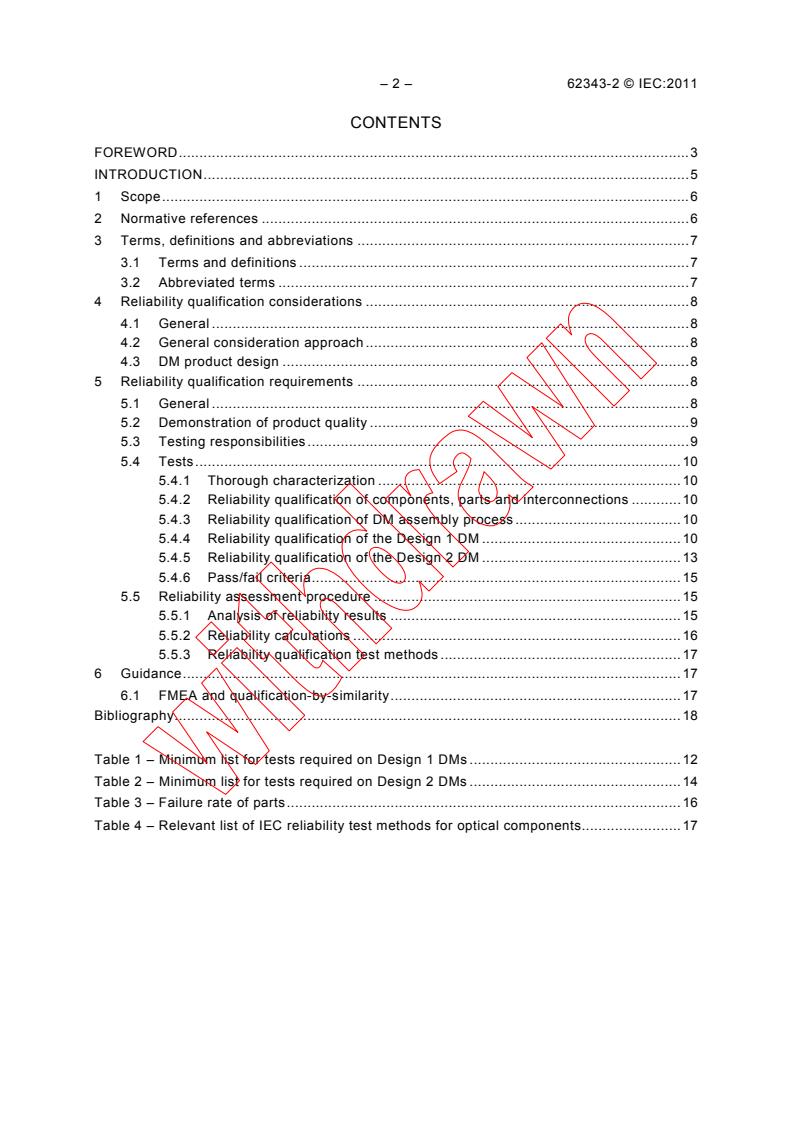
CONTENTS
FOREWORD . 3
INTRODUCTION . 5
1 Scope . 6
2 Normative references . 6
3 Terms, definitions and abbreviations . 7
3.1 Terms and definitions . 7
3.2 Abbreviated terms . 7
4 Reliability qualification considerations . 8
4.1 General . 8
4.2 General consideration approach . 8
4.3 DM product design . 8
5 Reliability qualification requirements . 8
5.1 General . 8
5.2 Demonstration of product quality . 9
5.3 Testing responsibilities . 9
5.4 Tests . 10
5.4.1 Thorough characterization . 10
5.4.2 Reliability qualification of components, parts and interconnections . 10
5.4.3 Reliability qualification of DM assembly process . 10
5.4.4 Reliability qualification of the Design 1 DM . 10
5.4.5 Reliability qualification of the Design 2 DM . 13
5.4.6 Pass/fail criteria . 15
5.5 Reliability assessment procedure . 15
5.5.1 Analysis of reliability results . 15
5.5.2 Reliability calculations . 16
5.5.3 Reliability qualification test methods . 17
6 Guidance . 17
6.1 FMEA and qualification-by-similarity . 17
Bibliography . 18
Table 1 – Minimum list for tests required on Design 1 DMs . 12
Table 2 – Minimum list for tests required on Design 2 DMs . 14
Table 3 – Failure rate of parts . 16
Table 4 – Relevant list of IEC reliability test methods for optical components. 17
62343-2 © IEC:2011 – 3 –
INTERNATIONAL ELECTROTECHNICAL COMMISSION
____________
DYNAMIC MODULES –
Part 2: Reliability qualification
FOREWORD
1) The International Electrotechnical Commission (IEC) is a worldwide organization for standardization comprising
all national electrotechnical committees (IEC National Committees). The object of IEC is to promote
international co-operation on all questions concerning standardization in the electrical and electronic fields. To
this end and in addition to other activities, IEC publishes International Standards, Technical Specifications,
Technical Reports, Publicly Available Specifications (PAS) and Guides (hereafter referred to as “IEC
Publication(s)”). Their preparation is entrusted to technical committees; any IEC National Committee interested
in the subject dealt with may participate in this preparatory work. International, governmental and non-
governmental organizations liaising with the IEC also participate in this preparation. IEC collaborates closely
with the International Organization for Standardization (ISO) in accordance with conditions determined by
agreement between the two organizations.
2) The formal decisions or agreements of IEC on technical matters express, as nearly as possible, an international
consensus of opinion on the relevant subjects since each technical committee has representation from all
interested IEC National Committees.
3) IEC Publications have the form of recommendations for international use and are accepted by IEC National
Committees in that sense. While all reasonable efforts are made to ensure that the technical content of IEC
Publications is accurate, IEC cannot be held responsible for the way in which they are used or for any
misinterpretation by any end user.
4) In order to promote international uniformity, IEC National Committees undertake to apply IEC Publications
transparently to the maximum extent possible in their national and regional publications. Any divergence
between any IEC Publication and the corresponding national or regional publication shall be clearly indicated in
the latter.
5) IEC itself does not provide any attestation of conformity. Independent certification bodies provide conformity
assessment services and, in some areas, access to IEC marks of conformity. IEC is not responsible for any
services carried out by independent certification bodies.
6) All users should ensure that they have the latest edition of this publication.
7) No liability shall attach to IEC or its directors, employees, servants or agents including individual experts and
members of its technical committees and IEC National Committees for any personal injury, property damage or
other damage of any nature whatsoever, whether direct or indirect, or for costs (including legal fees) and
expenses arising out of the publication, use of, or reliance upon, this IEC Publication or any other IEC
Publications.
8) Attention is drawn to the Normative references cited in this publication. Use of the referenced publications is
indispensable for the correct application of this publication.
9) Attention is drawn to the possibility that some of the elements of this IEC Publication may be the subject of
patent rights. IEC shall not be held responsible for identifying any or all such patent rights.
International Standard IEC 62343-2 has been prepared by subcommittee 86C: Fibre optic
systems and active devices, of IEC technical committee 86: Fibre optics.
The text of this standard is based on the following documents:
CDV Report on voting
86C/960/CDV 86C/978/RVC
Full information on the voting for the approval of this standard can be found in the report on
voting indicated in the above table.
This publication has been drafted in accordance with the ISO/IEC Directives, Part 2.
– 4 – 62343-2 © IEC:2011
The committee has decided that the contents of this publication will remain unchanged until
the stability date indicated on the IEC web site under "http://webstore.iec.ch" in the data
related to the specific publication. At this date, the publication will be
• reconfirmed,
• withdrawn,
• replaced by a revised edition, or
• amended.
62343-2 © IEC:2011 – 5 –
INTRODUCTION
This part of IEC 62243 is dedicated to the subject of reliability qualification of dynamic
modules. Since the technology is quite new and still evolving, amendments and new editions
to this document can be expected at a shorter interval.
– 6 – 62343-2 © IEC:2011
DYNAMIC MODULES –
Part 2: Reliability qualification
1 Scope
This part of IEC 62343 applies to dynamic modules and devices (DMs) which are
commercially available. Examples are tuneable chromatic dispersion compensators,
reconfigurable optical cross-connects, and dynamic channel equalizers. (Optical amplifiers
are not included in this list, but are treated in IEC 61291-5-2).
For reliability qualification purposes, some information about the internal components, parts
and interconnections is needed; these internal parts are treated as black boxes. This standard
gives requirements for the evaluation of DM reliability by combining the reliability of such
internal black boxes.
The objectives of this part of IEC 62343 are the following:
• to specify the requirements for the reliability qualification of DMs;
• to give the minimum list of reliability qualification tests, requirements on failure criteria
during testing and on reliability predictions, and give the relevant normative references.
2 Normative references
The following documents are indispensable for the application of this document. For dated
references, only the edition cited applies. For undated references, the latest edition of the
referenced document (including any amendments) applies.
IEC 61300-2-1, Fibre optic interconnecting devices and passive components – Basic test and
measurement procedures – Part 2-1: Tests – Vibration (sinusoidal)
IEC 61300-2-4, Fibre optic interconnecting devices and passive components – Basic test and
measurement procedures – Part 2-4: Tests – Fibre/cable retention
IEC 61300-2-12, Fibre optic interconnecting devices and passive components – Basic test
and measurement procedures – Part 2-12: Tests – Impact
IEC 61300-3-1, Fibre optic interconnecting devices and passive components – Basic test and
measurement procedures – Part 3-1: Examinations and measurements – Visual examination
IEC 62005-9-2, Reliability of fibre optic interconnecting devices and passive optical
components – Part 9-2: Reliability qualification for single fibre optic connector sets – Single
mode
IEC 62372 (all parts), Fibre optic active components and devices – Reliability standards
ISO 9000, Quality management systems – Fundamentals and vocabulary
62343-2 © IEC:2011 – 7 –
3 Terms, definitions and abbreviations
3.1 Terms and definitions
For the purposes of this document, the following terms and definitions apply.
3.1.1
failure
non-compliance to product specification or change in parameters as set by the standard or
agreed by the customer and supplier
3.1.2
qualification
commonly used as the abbreviation for Reliability Qualification. It is used as a formal testing
to determine whether or not the product is suitable for telecom applications and therefore,
“pass or fail” is the expected outcome
NOTE This is different from reliability test, which is in nature a reliability “engineering test”. Reliability tests are
designed to understand the reliability consideration or estimate the reliability of the product. Pass or fail is not the
main output.
3.1.3
reliability
There are two common uses of this term:
a) minimum period of DM continuous operation without failure at specified operating and
environmental conditions
b) probability to perform required functions at specified operating and environmental
conditions
NOTE The reliability of a DM is expressed by either of the following two parameters: mean time between failure
(MTBF) and failures in time (FIT):
• The MTBF is the mean period of DM continuous operation without any failure at specified operating and
environmental conditions.
• The FIT is the number of failures expected in 10 device-hours at specified operating and environmental
conditions.
3.2 Abbreviated terms
Each abbreviation introduced in this International Standard is explained in the text at least the
first time it appears. However, for an easier understanding of the whole text, the following is a
list of all abbreviations used in this International Standard:
DM Dynamic Module
DS Detail Specification
ESD Electrostatic Discharge
FIT Failure In Time
FMEA Failure Mode and Effects Analysis
MTBF Mean Time Between Failure
RH Relative Humidity
UCL Upper Confidence Level
– 8 – 62343-2 © IEC:2011
4 Reliability qualification considerations
4.1 General
Since DMs are relatively new products in the commercial market and involve different
technologies, the requirements included in this standard will need to be reviewed as
technology progresses.
4.2 General consideration approach
It is worth emphasizing the fundamental approach of reliability qualification adopted in this
standard:
a) Any parts that can be effectively qualified on their individual levels must be qualified at
that level. Their qualification shall be based on IEC standards or other industrial standards
in the absence of such IEC standards.
b) The qualification tests required at DM level must be based on the degradation
mechanisms and failure modes that cannot be effectively detected in the lower part levels.
At the DM level, the qualification tests shall not attempt to discover or identify those
degradation mechanisms and failure modes that can be discovered in the lower assembly
levels than the final product level. For example, if all parts in the DM can be effectively
tested for damp heat-accelerated degradations, there is no need to repeat the damp heat
test at the DM level.
4.3 DM product design
A DM is an assembly of various components, parts, and interconnections. There are two basic
designs in the current commercial DM market:
a) Design 1: Parts (as a general term that includes components, parts and interconnections
used to build a DM from this point on for this standard) are packaged separately. Their
packages are usually either hermetic or moisture-resistant. They are integrated into a
housing (usually non-hermetic or not moisture-resistant).
b) Design 2: Some parts used in DMs are unpackaged basic optical elements (e.g. crystals,
lenses, mirrors, etc.). These parts cannot be effectively qualified by themselves. These
parts/elements are integrated and packaged inside a hermetic box or moisture-resistant
box.
In Design 1, the individual parts can be tested and qualified individually and therefore, the DM
qualification does not have to repeat the tests that are performed in the part levels for the
same degradation mechanisms and failure modes.
In Design 2, the DM qualification is again focused on the tests that cannot be effectively
performed in the lower assembly levels (i.e., the basic part level). However, in this case there
are usually more tests required since the parts cannot be effectively tested at the part level
individually.
Due to the differences in the designs, and therefore different mechanisms and failure modes,
different qualification test approaches must be developed separately. They are described in
5.4.4 for Design 1 and 5.4.5 for Design 2, respectively.
5 Reliability qualification requirements
5.1 General
For the purpose of this International Standard, each internal component, part, and
interconnection shall be treated as a black box. It is also important to point out that the parts
in the DM of this design include the fibre splicing, fibre routing, and fibre anchoring, as well as
how the fibre exits from the housing and how parts are mounted.
62343-2 © IEC:2011 – 9 –
This International Standard is based on the assumption that the reliability of a DM can be
evaluated with sufficient confidence from the FIT rates of its internal black boxes when the
assembly process of the constituents has been qualified.
There are degradation and failures not due to part failures. An example is the fibre routing
and fibre holders. The quality and reliability of the assembling, for example fibre routing, must
be assessed and qualified through the process evaluation and qualification. The procedures
to qualify the assembly process are described in 5.4.3.
The internal black boxes often constituting a DM are listed below.
• Passive optical components, including patch cords, pigtails, connectors and splices.
• Active optical components.
• Electronics, including PCBs, electrical connectors, etc.
• Others (e.g., the fibre splicing, fibre routing, and fibre anchoring, as well as how the fibre
exits from the housing and how components are mounted).
The DM manufacturers shall declare the number and type of the internal black boxes
constituting the DM and give the failure rates (in FITs) for each black box.
The DM failure rate shall be calculated by suitably combining the failure rates in FITs of its
black boxes, as described in the next section. The model and assumptions used in DM failure
rate calculation must be provided and justified for review, if the DM Manufacturer is so
requested.
5.2 Demonstration of product quality
Since the reliability qualification tests are performed on a limited number of units, it is
essential to have a quality management system in place to assure that the quality of all units
is consistent. Testing on a limited number of samples will be representative of the production
units to be delivered after the qualification is completed.
This International Standard (where required by the detailed specification) specifies the
minimum mandatory requirements to assess reliability qualification of a DM and is intended to
be part of a total DM reliability program and quality management system developed and
implemented by the DM manufacturer.
The DM manufacturer shall demonstrate:
• a documented and audited manufacturing process, including the reliability qualification of
purchased parts, in accordance with ISO 9000;
• Performance data of production units shall be available for review, and its distribution
must show processes are under adequate controls;
• a reliability qualification programme, including, for example, accelerated life testing, burn-
in and screening of parts and DMs;
• a reliability qualification maintenance programme to ensure continuity of qualification
status (this can be achieved by means of periodic reliability qualification tests of the
product or similar products);
• a procedure to ensure an appropriate feedback to development and production on
reliability issues.
5.3 Testing responsibilities
The DM manufacturer is responsible to perform reliability qualification testing.
– 10 – 62343-2 © IEC:2011
The testing detailed in this standard is to be performed by the DM manufacturer. Additional
testing may be specified in the detailed specification.
5.4 Tests
5.4.1 Thorough characterization
A thorough characterisation of the product for its performance (may be beyond those in the
performance specifications) over all operating conditions (may be beyond those in the
operating condition specifications) shall be performed. The data shall be collected and
analysed (minimal for the mean and standard deviation), and be available for review.
5.4.2 Reliability qualification of components, parts and interconnections
All components, parts, and interconnections used to build DMs shall be qualified according to
the appropriate IEC standards for each of them. The components may include, but are not
limited to, variable optical attenuators (VOAs), taps/splitters, detectors, isolators, circulators,
electronic components, splicing connections (including the packaging or re-coating), crystals,
mirrors, prisms, etc.
If the IEC standards for the parts are under development or not yet available, the IEC
standards for parts of similar failure modes and degradation mechanisms should be adopted.
An analysis of similarity of failure modes and degradation mechanisms shall be provided to
support the approach.
Considerations must be given to designs that use many pieces of same parts. The failure
rates of such parts may significantly contribute to the overall system failure rate or downtime.
The cumulative degradation from individual parts should also be investigated. The results may
require tests on additional samples or more stringent failure definitions.
Additionally, the pass/fail criteria of the part qualification must be thoroughly examined to
determine whether or not the part qualification is adequate. For an example, if several 1x2
taps are used in a series design, not only the failure rate but also the degradation is multiplied
(i.e. 0,5 dB pass/fail criterion is multiplied), which may not be acceptable. The pass/fail
criterion of the parts commonly defined as 0,5 dB changes in insertion loss is much too loose
for the needs of a product such as a DM. The assessment of tighter criteria must be carried
out and the qualification status justified.
5.4.3 Reliability qualification of DM assembly process
Fibre routing and component mounting are both important module assembling processes, and
they can be significant failure rate contributors if they are not done properly. Their designs
and processes must be thoroughly documented and tested. Any changes must be supported
by adequate experiment data.
If the fibre routing is thoroughly documented and controlled (e.g., through performance
measurements before and after routing) and the final DM is qualified, the fibre routing process
can be considered as a qualified process and can be used in other similar products to
produce a product that is claimed to be qualified by similarity.
5.4.4 Reliability qualification of the Design 1 DM
As described in 5.1 for Design 1, parts (components used to build a DM) are packaged
separately. Their packages are usually either hermetic or moisture-resistant. They are
integrated into a housing (usually non-hermetic or not moisture-resistant).
A reliability qualification procedure related to the complete DM is described in Table 1. It
gives the minimum list of tests to be performed on DMs in order to assure reliability.
62343-2 © IEC:2011 – 11 –
On the basis of the reliability assurance required for the reliability tests for the DM internal
black boxes, the sampling level is generally low (for example a few samples for each DM
type).
In some specific cases the use of adhesives in the DM can be considered as a critical process
and shall require separate qualification. Depending on the possible function of the adhesive
(mechanical anchoring, splice protection, index matching, etc.), the different failure modes
shall be addressed and supported by reliability/qualification data.
The main point in the reliability qualification of the Design 1 DM is to ensure the reliability of
each part is not degraded in the manufacturing process used.
– 12 – 62343-2 © IEC:2011
Table 1 – Minimum list for tests required on Design 1 DMs
Test Condition Duration Samples
Active high temperature aging 85 ºC 2 000 h 3
T /T
op, min op, max
Operational temperature cycling Q = 100 cycles 3
>1 ºC/min
100 mm height drop
a See table below in
Drop (impact) for <10 kg & 75 mm 3
c
drop for 10 kg-25 Kg
Non-operational
10 to 55Hz, 1,52
b
mechanical test
Vibration 2 h per direction 3
mm, 1octave/min
See table below in
c
Pull 5/10/100 N 3
c
40 G, 5ms for +/-z-
axis,
20 G, 5ms for +/-x-
d
Operational shock 3 times/direction 3
axis,
10 G, 5ms for +/-y-
axis
50 to 500 Hz,
2 G for z-axis,
d
Operational vibration 2 sweeps/direction 3
1 G for x-axis,
0,5 G for y-axis
NOTE 1 No failures are allowed.
NOTE 2 Tests may be performed sequentially or in parallel.
NOTE 3 If the storage temperature is lower than the specified humidity temperature, another test at
T and RH ≥ 85 % is done.
stg,max
NOTE 4 For “operational” tests, relevant parameters should be monitored during the test.
NOTE 5 A reference to the temperature cycle test method is provided in Annex B.
NOTE 6 T is the DM minimum storage temperature;
stg,min
T is the DM maximum storage temperature;
stg,max
T is the DM maximum operating temperature;
op,max
G is the standard value of gravity acceleration (9,806 65 m/s ).
a
Mechanical test: Impact (drop) (IEC 61300-2-12 for drop)
Mass Drop height
kg mm
0 to < 10 100
10 to < 25 75
b
Mechanical test: vibration(sinusoidal, IEC 61300-2-1)
c
Pigtail testing (pull test) [the first figure in each row is the outer diameter of the buffered or cabled fibre
to which the specified test conditions do apply]
2 mm: 20 to100 N, 3 times, 5 s pulls
Cable
900 μm 10 N, 3 times, 5 s pulls
retention 61300-2-4
(pull)
250 μm: 5 N, 3 times, 5 s p
lls
d
The directions of the x, y and z-axes are defined by mounting direction to a board in a equipment (x-
axis: the direction which is according to the front and back of the board to be mounted when the board
is installed in a piece of equipment, y-axis: the direction which is according to the gravity (up and down)
of the board to be mounted when the board is installed in a piece of equipment, z-axis: the direction
which is perpendicular to the board to be mounted.) If a tester cannot define the mounting direction, the
test shall be done in the most severe conditions for all directions.
62343-2 © IEC:2011 – 13 –
It is essential that the evaluated DMs are entirely representative of standard production and
have passed all the production procedures and/or specified (where applicable in the DS) burn-
in and screening procedures.
Aspects of the test conditions not provided in the present standard are given in the relevant
detail specifications.
5.4.5 Reliability qualification of the Design 2 DM
In this DM design, Design 2, not all parts can be effectively tested by themselves (see 4.2).
Therefore, many of the long-term environmental tests can only be effectively tested and
qualified in the DM final product assembly level.
For example, some of the parts may have been qualified by the damp heat test but others
may not pass the damp heat test as required for telecommunications applications. Therefore,
the DM units with all the parts assembled must be tested in damp heat conditions. This may
seem redundant but it is necessary.
Table 2 gives a minimum list for tests required on Design 2 DMs.
– 14 – 62343-2 © IEC:2011
Table 2 – Minimum list for tests required on Design 2 DMs
Test Condition Duration Samples
Active high temperature aging 85 ºC 2 000 h 3
T /T
op, min op, max
Operational temperature cycling Q = 100 cycles 3
>1 ºC/min
a
Damp heat 85ºC/85% RH Q = 500 h 3
100 mm height
drop for <10 Kg See table below in
b
Drop (impact) 3
d
& 75 mm drop
for 10 Kg-25 Kg
Non-operational
10 to 55Hz,
mechanical test
c
Vibration 1,52mm,1octave/ 2 h per direction 3
min
See table below in
d
Pull 5/10/100 N 3
d
40 G, 5ms for +/-
z-axis,
20 G, 5ms for +/-
e
Operational shock 3 times/direction 3
x-axis,
10 G, 5ms for +/-
y-axis
50 to 500 Hz,
2 G for z-axis,
e
Operational vibration 2 sweeps/direction 3
1 G for x-axis,
0,5 G for y-axis
Hermeticity (checked before and after
ΔT=100 ºC 15 cycles
dummy
liquid-to-liquid thermal shock)
box
NOTE 1 No failures are allowed.
NOTE 2 Tests may be performed sequentially or in parallel.
NOTE 3 If the storage temperature is lower than the specified humidity temperature, another
test at T and RH ≥ 85 % is done.
stg,max
NOTE 4 For “operational” tests, relevant parameters should be monitored during the test.
NOTE 5 A reference to the temperature cycle test method is provided in annex B.
NOTE 6 T is the DM minimum storage temperature;
stg,min
T is the DM maximum storage temperature;
stg,max
T is the DM maximum operating temperature;
op,max
G is the standard value of gravity acceleration (9,80665 m/s ).
62343-2 © IEC:2011 – 15 –
a
Damp heat: the damp heat test at 85 °C/85 % RH for 100 hours has been advocated by
some manufacturers. These test conditions may be used. Otherwise, the damp heat test
at 40 °C/93 % RH for a much longer duration may be used with the actual duration to be
determined by the acceleration factor.
b
Mechanical test: impact (IEC 61300-3-12)
Mass Drop height
kg mm
0 to <
10 100
10 to < 25 75
c
Mechanical test: vibration(sinusoidal, IEC61300-2-1)
d
Pigtail testing (pull test) [the first figure in each row is the outer diameter of the buffered
or cabled fibre to which the specified test conditions do apply]
2 mm: 20-100 N, 3 times, 5 s pulls
Cable
retention
900 μm 10 N, 3 times, 5 s pulls 61300-2-4
(pull)
250 μm: 5 N, 3 times, 5 s pulls
e
The direction of the x, y and z-axes are defined by mounting direction to a board in a
piece of equipment (x-axis: the direction which is according to the front and back of the
board to be mounted when the board is installed in a piece of equipment, y-axis: the
direction which is according to the gravity (up and down) of the board to be mounted when
the board is installed in a piece of equipment, z-axis: the direction which is perpendicular
to the board to be mounted.) If a tester cannot define the mounting direction, the test shall
be done in the most severe conditions for all directions.
It is essential that the evaluated DMs are entirely representative of standard production and
have passed all the production procedures and/or specified (where applicable in the DS) burn-
in and screening procedures.
Aspects of the test conditions not provided in the present standard are given in the relevant
standards.
5.4.6 Pass/fail criteria
It should be noted that the commonly used failure criterion of a drift of higher than 0,5 dB in
insertion loss (IL) is a guideline. For DWDM DMs, such as wavelength blockers, centre
wavelength drift shall be defined as a failure criterion. The actual and practical criteria should
be developed based on the degradation allowed for the expected life of the product. An
example is provided below to illustrate the determination.
Example:
• The acceleration factor of the testing condition to the operating condition is 50.
• The beginning-of-life parametric measurement is 1,0 dB below the End-Of-Life spec.
• Assume the expected life is 20 years.
• Allowed degradation for a 2 000-hour testing is: (1,0*50*2 000)/(20*365,25*24) = 0,57 dB
• Readers should be noted that not only IL is a parameter should be considered for pass/fail,
but also are other parameters to be included.
5.5 Reliability assessment procedure
5.5.1 Analysis of reliability results
The DM customer/SS shall have a procedure to analyze and verify reliability claims of a DM
manufacturer. In particular, the procedure should include the analysis of:
• lifetest data for the complete dynamic module;
• lifetest data for internal parts;
– 16 – 62343-2 © IEC:2011
• environmental test results.
The analysis of results leads to reporting the reliability parameters of the DM for each type of
device or sub-system. Minimum reliability parameters shall be presented as in table 4 (see
below).
5.5.2 Reliability calculations
A reliability prediction regarding the complete DM is provided by the DM manufacturer, based
on the failure rates (in FIT “failure in time”) of the internal black boxes composing the DM
(Design 1) or based on the data for the complete DM (Design 2).
The failure rates of the internal black boxes shall be given by the DM manufacturer taking into
account the basic values issued from the cumulated component-hours issued from the
different parts included in DM. The calculations for each internal black box shall be based on
the current standards regarding reliability calculations.
The reliability calculations will also include the wear-out failures. The FIT figures given for
each internal black box shall take into account all expected failure modes.
The FIT figures of the internal black boxes shall be combined to give the failure rate of the
Design 1 DM as explained in Table 3.
Table 3 – Failure rate of parts
Number of
Element Measured value (UCL 95 %)
elements
Splice n A FIT (random failure)
2 2
Connector n A FIT (random failure)
3 3
Electronics n A FIT (random failure)
4 4
A FIT (random and wear-out
(4+1)
n
Active component type 1
(4+1)
failure)
A FIT (random and wear-out
(4+2)
Active component type 2 n
(4+2)
failure)
………………………………………… …………………………………………………
A FIT (random and wear-out
(4+m)
Active component type m n
(4+m)
failure)
Other internal component type 1 n A FIT (random failure)
(4+m+1) (4+m+1)
Other internal component type 2 n A FIT (random failure)
(4+m+2) (4+m+2)
………………………………………… ……………………………….
Other internal component type h n A FIT (random failure)
(4+m+h) (4+m+h)
Passive optical component type 1 n A FIT (random failure)
(4+m+h+1) (4+m+h+1)
Passive optical component type 2 n A FIT (random failure)
(4+m+h+2) (4+m+h+2)
………………………………………… ……………………………….
Passive optical component type k n A FIT (wear-out failure)
(4+m+h+k) (4+m+h+k)
Fibre routing
Optical component attachment n A FIT
(4+m+h+k) (4+m+h+k)
Any other failure modes identified
n A FIT
(4+m+h+k) (4+m+h+k)
in FMECA
TOTAL FAILURE RATE ∑ A *n
i i I
NOTE n is the number of components of each type included in the DM.
i
62343-2 © IEC:2011 – 17 –
5.5.3 Reliability qualification test methods
Table 4 shows a list of normative references relevant reliability qualification tests and test
conditions for constituting components used for DMs.
Table 4 – Relevant list of IEC reliability test methods for optical components
Constituting components Reference (Reliability qualification
document number)
Passive optical components 62005-9-1
Optical connectors 62005-9-1
Active optical components 62572 series
6 Guidance
6.1 FMEA and qualification-by-similarity
It is worth emphasizing that the reliability assessment or qualification tests must be based on
the degradation mechanisms and failure modes. The appropriate accelerated tests can be
developed once the degradation mechanisms, failure modes, and their acceleration factors
are understood. To begin with, the Failure Mode and Effects Analysis (FMEA) should be
developed. A set of reliability tests should be planned and conducted as the result of FMEA.
The testing results can be used to develop additional tests or refined tests to better
understand the degradation mechanisms or develop the acceleration models.
Where a range of dynamic modules is produced by a DM manufacturer, there may be some
significant similarity between different type codes. A combination of results from different test
programmes, where appropriate, is therefore permitted.
Consideration should be given to the fact that minor differences in technology or processing
can sometimes have a major impact on reliability, whilst not being apparent during quality
assessment.
As a minimum, FMEA must be carried out for all varieties of products that are considered
“similar” and claimed to be “qualified” by “similarity”. FMEA must be done thoroughly in order
to be an effective tool to consider “Qualified-By-Similarity”. Its thoroughness can be checked
against the failure mode analysis (FMA) to manufacturing drop-out and customer returns.
NOTE Evidence should be presented which demonstrates that all results are directly relevant.
– 18 – 62343-2 © IEC:2011
Bibliography
IEC 61751: Laser modules used for telecommunication – Reliability assessment
IEC TR 61931: Fibre optic – Terminology
IEC 61291-5-2: Optical amplifiers – Part 5-2: Qualification specifications – Reliability
qualification for optical fibre amplifiers
IEC 62343-6-5: Part 6-5 Dynamic Modules – Investigation of operating mechanical shock and
vibration test for dynamic devices
ISO 9001-2000: Quality management systems – Requirements
____________
– 20 – 62343-2 © CEI:2011
SOMMAIRE
AVANT-PROPOS . 21
INTRODUCTION . 23
1 Domaine d’application . 24
2 Références normatives . 24
3 Termes, définitions et abréviations . 25
3.1 Termes et définitions . 25
3.2 Termes abrégés . 25
4 Considérations sur la qualification de fiabilité . 26
4.1 Généralités. 26
4.2 Méthode de la considération générale . 26
4.3 Conception d'un produit à module dynamique. 26
5 Exigences sur la qualification de fiabilité . 27
5.1 Généralités. 27
5.2 Démonstration de la qualité d’un produit. 27
5.3 Responsabilité des essais . 28
5.4 Essais . 28
5.4.1 Caractérisation minutieuse . 28
5.4.2 Qualification de fiabilité des composants, des pièces et des
interconnexions . 28
5.4.3 Qualificatio
...