


IEC 61280-1-4:2023
(Main)Fibre optic communication subsystem test procedures - Part 1-4: General communication subsystems - Light source encircled flux measurement method
Fibre optic communication subsystem test procedures - Part 1-4: General communication subsystems - Light source encircled flux measurement method
IEC 61280-1-4:2023 establishes the characterization process of the encircled flux measurement method of light sources intended to be used with multimode fibre. This document sets forth a procedure for the collection of two-dimensional fibre optic nearfield greyscale data and subsequent reduction to one-dimensional data expressed as a set of three sampled parametric functions of radius from the fibre’s optical centre. Estimation of the fibre core diameter is not an objective of this document. This third edition cancels and replaces the second edition published in 2009. This edition constitutes a technical revision. This edition includes the following significant technical changes with respect to the previous edition:
- improvement of calibration procedure and calibration traceability;
- improvement of fibre shaker description and requirements;
- addition of pulsed light sources;
- removal of a poorly traceable calibration process using a micro positioner.
Procédures d’essai des sous-systèmes de télécommunication fibroniques - Partie 1-4: Sous-systèmes généraux de télécommunication - Méthode de mesure du flux inscrit de la source optique
L'IEC 61280-1-4:2023 stipule le processus de caractérisation de la méthode de mesure du flux inscrit de sources optiques destinées à être utilisées avec des fibres multimodales. Le présent document définit une procédure consistant à collecter des données fibroniques de champ proche, bidimensionnelles et en niveaux de gris, puis à les réduire en données unidimensionnelles exprimées sous la forme d’un ensemble de trois fonctions paramétriques échantillonnées du rayon par rapport au centre optique de la fibre. Cette troisième édition annule et remplace la deuxième édition parue en 2009. Cette édition constitue une révision technique. Cette édition inclut les modifications techniques majeures suivantes par rapport à l’édition précédente:
- amélioration de la procédure et de la traçabilité de l’étalonnage;
- amélioration de la description et des exigences relatives à l’agitateur de fibre;
- ajout des sources optiques pulsées;
- suppression d’un processus d’étalonnage utilisant un micropositionneur, en raison de sa faible traçabilité.
General Information
- Status
- Published
- Publication Date
- 18-Jan-2023
- Technical Committee
- SC 86C - Fibre optic systems, sensing and active devices
- Drafting Committee
- WG 1 - TC 86/SC 86C/WG 1
- Current Stage
- PPUB - Publication issued
- Start Date
- 19-Jan-2023
- Completion Date
- 17-Feb-2023
Relations
- Effective Date
- 05-Sep-2023
Overview
IEC 61280-1-4:2023 specifies the encircled flux measurement method for light sources used with multimode fibre. The standard defines a traceable procedure to collect two‑dimensional near‑field greyscale images of a fibre output and to reduce them to one‑dimensional radial functions describing the source launch: intensity, incremental flux, and encircled flux as functions of radius from the optical centre. Estimating fibre core diameter is explicitly not an objective. This third edition (2023) updates calibration, measurement hardware and computation methods to improve precision and traceability.
Key Topics
- Measurement principle: capture calibrated 2D near‑field images and convert to three sampled radial functions (intensity, incremental flux, encircled flux).
- Data reduction: specifies numerical processing (e.g., trapezoidal or higher‑order integration), ring width parameter, integration limit, and baseline subtraction to reduce DC drift and improve repeatability.
- Apparatus and components: requirements for camera/detector, image digitizer, magnifying optics, attenuator, input port, calibration light source, fibre shaker, and test jumper assemblies.
- Calibration and traceability: improved calibration procedures and traceability requirements to ensure reproducible encircled flux results; the 2023 edition removes poorly traceable micro‑positioner calibration processes and aligns geometric calibration with established methodologies (see references such as IEC 61745).
- Pulsed sources: explicit inclusion of pulsed light sources in measurement scope and procedures.
- Measurement workflow: raw and dark image acquisition, corrected images, optical‑centre (centroid) determination, and computation of encircled flux.
Applications
IEC 61280-1-4:2023 is used where controlled multimode launch characterization is required:
- Manufacturers of multimode lasers, LEDs and transceivers for qualifying source launch conditions.
- Test laboratories and calibration houses performing standardized encircled flux measurements and reporting.
- System integrators and installers verifying launch conditions for consistent multimode link insertion‑loss measurements.
- Standards bodies and R&D groups modeling multimode link performance (minimum guaranteed length) and validating simulation inputs.
- Quality and acceptance testing of multimode components and links to ensure measurement reproducibility across instruments and sites.
Related Standards
- IEC 61745 (geometric calibration methodology reference)
- Other parts of the IEC 61280 series (fibre optic communication subsystem test procedures) for complementary test methods.
Keywords: IEC 61280-1-4:2023, encircled flux, multimode fibre, light source measurement, nearfield greyscale data, calibration traceability, fibre shaker, pulsed light sources, geometric calibration.
Buy Documents



IEC 61280-1-4:2023 RLV - Fibre optic communication subsystem test procedures - Part 1-4: General communication subsystems - Light source encircled flux measurement method Released:1/19/2023


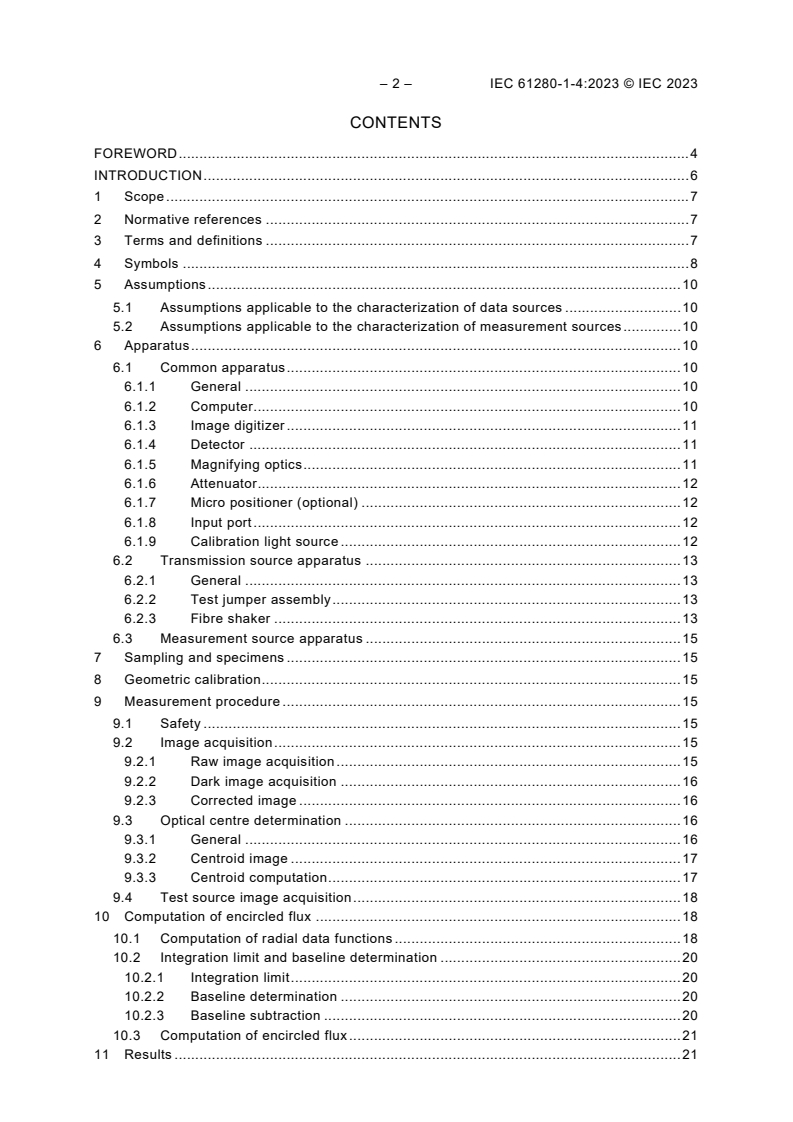
IEC 61280-1-4:2023 - Fibre optic communication subsystem test procedures - Part 1-4: General communication subsystems - Light source encircled flux measurement method Released:1/19/2023
Get Certified
Connect with accredited certification bodies for this standard

TL 9000 QuEST Forum
Telecommunications quality management system.

ANCE
Mexican certification and testing association.

Intertek Slovenia
Intertek testing, inspection, and certification services in Slovenia.
Sponsored listings
Frequently Asked Questions
IEC 61280-1-4:2023 is a standard published by the International Electrotechnical Commission (IEC). Its full title is "Fibre optic communication subsystem test procedures - Part 1-4: General communication subsystems - Light source encircled flux measurement method". This standard covers: IEC 61280-1-4:2023 establishes the characterization process of the encircled flux measurement method of light sources intended to be used with multimode fibre. This document sets forth a procedure for the collection of two-dimensional fibre optic nearfield greyscale data and subsequent reduction to one-dimensional data expressed as a set of three sampled parametric functions of radius from the fibre’s optical centre. Estimation of the fibre core diameter is not an objective of this document. This third edition cancels and replaces the second edition published in 2009. This edition constitutes a technical revision. This edition includes the following significant technical changes with respect to the previous edition: - improvement of calibration procedure and calibration traceability; - improvement of fibre shaker description and requirements; - addition of pulsed light sources; - removal of a poorly traceable calibration process using a micro positioner.
IEC 61280-1-4:2023 establishes the characterization process of the encircled flux measurement method of light sources intended to be used with multimode fibre. This document sets forth a procedure for the collection of two-dimensional fibre optic nearfield greyscale data and subsequent reduction to one-dimensional data expressed as a set of three sampled parametric functions of radius from the fibre’s optical centre. Estimation of the fibre core diameter is not an objective of this document. This third edition cancels and replaces the second edition published in 2009. This edition constitutes a technical revision. This edition includes the following significant technical changes with respect to the previous edition: - improvement of calibration procedure and calibration traceability; - improvement of fibre shaker description and requirements; - addition of pulsed light sources; - removal of a poorly traceable calibration process using a micro positioner.
IEC 61280-1-4:2023 is classified under the following ICS (International Classification for Standards) categories: 33.180.01 - Fibre optic systems in general. The ICS classification helps identify the subject area and facilitates finding related standards.
IEC 61280-1-4:2023 has the following relationships with other standards: It is inter standard links to IEC 61280-1-4:2009. Understanding these relationships helps ensure you are using the most current and applicable version of the standard.
IEC 61280-1-4:2023 is available in PDF format for immediate download after purchase. The document can be added to your cart and obtained through the secure checkout process. Digital delivery ensures instant access to the complete standard document.
Standards Content (Sample)
IEC 61280-1-4 ®
Edition 3.0 2023-01
REDLINE VERSION
INTERNATIONAL
STANDARD
colour
inside
Fibre optic communication subsystem test procedures –
Part 1-4: General communication subsystems – Light source encircled flux
measurement method
All rights reserved. Unless otherwise specified, no part of this publication may be reproduced or utilized in any form
or by any means, electronic or mechanical, including photocopying and microfilm, without permission in writing from
either IEC or IEC's member National Committee in the country of the requester. If you have any questions about IEC
copyright or have an enquiry about obtaining additional rights to this publication, please contact the address below or
your local IEC member National Committee for further information.
IEC Secretariat Tel.: +41 22 919 02 11
3, rue de Varembé info@iec.ch
CH-1211 Geneva 20 www.iec.ch
Switzerland
About the IEC
The International Electrotechnical Commission (IEC) is the leading global organization that prepares and publishes
International Standards for all electrical, electronic and related technologies.
About IEC publications
The technical content of IEC publications is kept under constant review by the IEC. Please make sure that you have the
latest edition, a corrigendum or an amendment might have been published.
IEC publications search - webstore.iec.ch/advsearchform IEC Products & Services Portal - products.iec.ch
The advanced search enables to find IEC publications by a Discover our powerful search engine and read freely all the
variety of criteria (reference number, text, technical publications previews. With a subscription you will always have
committee, …). It also gives information on projects, replaced access to up to date content tailored to your needs.
and withdrawn publications.
Electropedia - www.electropedia.org
IEC Just Published - webstore.iec.ch/justpublished
The world's leading online dictionary on electrotechnology,
Stay up to date on all new IEC publications. Just Published
containing more than 22 300 terminological entries in English
details all new publications released. Available online and once
and French, with equivalent terms in 19 additional languages.
a month by email.
Also known as the International Electrotechnical Vocabulary
(IEV) online.
IEC Customer Service Centre - webstore.iec.ch/csc
If you wish to give us your feedback on this publication or need
further assistance, please contact the Customer Service
Centre: sales@iec.ch.
IEC 61280-1-4 ®
Edition 3.0 2023-01
REDLINE VERSION
INTERNATIONAL
STANDARD
colour
inside
Fibre optic communication subsystem test procedures –
Part 1-4: General communication subsystems – Light source encircled flux
measurement method
INTERNATIONAL
ELECTROTECHNICAL
COMMISSION
ICS 33.180.01 ISBN 978-2-8322-6399-0
– 2 – IEC 61280-1-4:2023 RLV © IEC 2023
CONTENTS
FOREWORD . 4
INTRODUCTION . 2
0.1 General .
0.2 Changes from previous edition .
0.3 Assumptions applicable to the characterization of data sources .
0.4 Assumptions applicable to the characterization of measurement sources .
1 Scope . 7
2 Normative references . 7
3 Terms and definitions . 7
4 Symbols . 9
5 Assumptions . 10
5.1 Assumptions applicable to the characterization of data sources . 10
5.2 Assumptions applicable to the characterization of measurement sources . 10
6 Apparatus . 10
6.1 Common apparatus . 10
6.1.1 General . 10
6.1.2 Computer. 11
6.1.3 Image digitizer . 11
6.1.4 Detector . 11
6.1.5 Magnifying optics . 12
6.1.6 Attenuation Attenuator . 12
6.1.7 Micro positioner (optional) . 13
6.1.8 Input port . 13
6.1.9 Calibration light source . 13
6.2 Transmission source apparatus . 13
6.2.1 General . 13
6.2.2 Test jumper assembly . 14
6.2.3 Fibre shaker . 14
6.3 Measurement source apparatus . 15
7 Sampling and specimens . 15
8 Geometric calibration . 16
9 Measurement procedure . 16
9.1 Safety . 16
9.2 Image acquisition . 16
9.2.1 Raw image acquisition . 16
9.2.2 Dark image acquisition . 17
9.2.3 Corrected image . 17
9.3 Optical centre determination . 17
9.3.1 General . 17
9.3.2 Centroid image . 17
9.3.3 Centroid computation . 18
9.4 Test source image acquisition . 18
10 Computation of encircled flux . 19
10.1 Computation of radial data functions . 19
10.2 Integration limit and baseline determination . 21
10.2.1 Integration limit . 21
10.2.2 Baseline determination . 21
10.2.3 Baseline subtraction . 21
10.3 Computation of encircled flux . 21
11 Results . 22
11.1 Information available with each measurement . 22
11.2 Information available upon request . 22
12 Specification information . 22
Annex A (informative) Measurement sensitivity considerations . 24
A.1 Baseline averaging considerations . 24
A.2 Pixel sensitivity variation calibration . 26
A.3 Correlated double sampling . 26
A.4 Imperfections of practical detectors and optics . 27
Annex B (informative) Theory of geometric calibration using the micropositioner .
Annex C (normative) Procedure for geometric calibration using the micropositioner .
Bibliography . 37
Figure 1 – Apparatus block diagram . 11
Figure 2 – Typical set-up for transmission source measurement . 14
Figure 3 – Fibre shaker example . 15
Figure 4 – Pixel and ring illustration . 19
Figure A.1 – Core images from instrument A and instrument B . 24
Figure A.2 – Compressed core images from instrument A and instrument B . 25
Figure A.3 – Intensity versus radius for instruments A and B. 25
– 4 – IEC 61280-1-4:2023 RLV © IEC 2023
INTERNATIONAL ELECTROTECHNICAL COMMISSION
____________
FIBRE OPTIC COMMUNICATION SUBSYSTEM
TEST PROCEDURES –
Part 1-4: General communication subsystems –
Light source encircled flux measurement method
FOREWORD
1) The International Electrotechnical Commission (IEC) is a worldwide organization for standardization comprising
all national electrotechnical committees (IEC National Committees). The object of IEC is to promote international
co-operation on all questions concerning standardization in the electrical and electronic fields. To this end and
in addition to other activities, IEC publishes International Standards, Technical Specifications, Technical Reports,
Publicly Available Specifications (PAS) and Guides (hereafter referred to as "IEC Publication(s)"). Their
preparation is entrusted to technical committees; any IEC National Committee interested in the subject dealt with
may participate in this preparatory work. International, governmental and non-governmental organizations liaising
with the IEC also participate in this preparation. IEC collaborates closely with the International Organization for
Standardization (ISO) in accordance with conditions determined by agreement between the two organizations.
2) The formal decisions or agreements of IEC on technical matters express, as nearly as possible, an international
consensus of opinion on the relevant subjects since each technical committee has representation from all
interested IEC National Committees.
3) IEC Publications have the form of recommendations for international use and are accepted by IEC National
Committees in that sense. While all reasonable efforts are made to ensure that the technical content of IEC
Publications is accurate, IEC cannot be held responsible for the way in which they are used or for any
misinterpretation by any end user.
4) In order to promote international uniformity, IEC National Committees undertake to apply IEC Publications
transparently to the maximum extent possible in their national and regional publications. Any divergence between
any IEC Publication and the corresponding national or regional publication shall be clearly indicated in the latter.
5) IEC itself does not provide any attestation of conformity. Independent certification bodies provide conformity
assessment services and, in some areas, access to IEC marks of conformity. IEC is not responsible for any
services carried out by independent certification bodies.
6) All users should ensure that they have the latest edition of this publication.
7) No liability shall attach to IEC or its directors, employees, servants or agents including individual experts and
members of its technical committees and IEC National Committees for any personal injury, property damage or
other damage of any nature whatsoever, whether direct or indirect, or for costs (including legal fees) and
expenses arising out of the publication, use of, or reliance upon, this IEC Publication or any other IEC
Publications.
8) Attention is drawn to the Normative references cited in this publication. Use of the referenced publications is
indispensable for the correct application of this publication.
9) Attention is drawn to the possibility that some of the elements of this IEC Publication may be the subject of patent
rights. IEC shall not be held responsible for identifying any or all such patent rights.
This redline version of the official IEC Standard allows the user to identify the changes
made to the previous edition IEC 61280‑1‑4:2009. A vertical bar appears in the margin
wherever a change has been made. Additions are in green text, deletions are in
strikethrough red text.
IEC 61280‑1‑4 has been prepared by subcommittee 86C: Fibre optic systems and active
devices, of IEC technical committee 86: Fibre optics. It is an International Standard.
This third edition cancels and replaces the second edition published in 2009. This edition
constitutes a technical revision.
This edition includes the following significant technical changes with respect to the previous
edition:
a) improvement of calibration procedure and calibration traceability;
b) improvement of fibre shaker description and requirements;
c) addition of pulsed light sources;
d) removal of a poorly traceable calibration process using a micro positioner.
The text of this International Standard is based on the following documents:
Draft Report on voting
86C/1806/CDV 86C/1828/RVC
Full information on the voting for its approval can be found in the report on voting indicated in
the above table.
The language used for the development of this International Standard is English.
This document was drafted in accordance with ISO/IEC Directives, Part 2, and developed in
accordance with ISO/IEC Directives, Part 1 and ISO/IEC Directives, IEC Supplement, available
at www.iec.ch/members_experts/refdocs. The main document types developed by IEC are
described in greater detail at www.iec.ch/publications.
A list of all parts of the IEC 61280 series can be found, under the general title Fibre optic
communication subsystem test procedures, on the IEC website.
The committee has decided that the contents of this document will remain unchanged until the
stability date indicated on the IEC website under webstore.iec.ch in the data related to the
specific document. At this date, the document will be
• reconfirmed,
• withdrawn,
• replaced by a revised edition, or
• amended.
IMPORTANT – The "colour inside" logo on the cover page of this document indicates that it
contains colours which are considered to be useful for the correct understanding of its
contents. Users should therefore print this document using a colour printer.
– 6 – IEC 61280-1-4:2023 RLV © IEC 2023
INTRODUCTION
0.1 General
This part of IEC 61280 is used specifies how to measure the encircled flux of a multimode light
source. Encircled flux is a measure, as a function of radius, of the fraction of the cumulative
output power to the total output power radiating from as a function of radial distance from the
centre of the multimode optical fibre’s core.
The basic approach is to collect two-dimensional (2D) nearfield data, using a calibrated camera,
and to mathematically convert the 2D data into three normalized functions of radial distance
from the fibre’s optical centre. The three functions are intensity, incremental flux, and encircled
flux. Intensity has dimension optical power per area; incremental flux has dimension power per
differential of radius; and encircled flux has dimension total optical power, all three being
functions of radius. The intensity represents optical power per surface area (in watts per square
meter). The incremental flux represents optical power per radius differential (in watts per meter),
and the encircled flux represents a fraction of the cumulative output power to the total output
power.
These three radial functions are intended to characterize fibre optic laser sources either for use
in mathematical models predicting the minimum guaranteed length of a communications link, or
to qualify a light source to measure insertion loss in multimode links.
0.2 Changes from previous edition
This edition of the standard differs from its predecessor in both scope and content. Many of the
content changes improve the measurement precision. Several changes have been made to the
computation procedure:
• the integration methodology of the radial functions was simple summation, and is now
specified to use trapezoidal integration or other higher-order techniques (see 9.3);
• a baseline subtraction step is specified to improve immunity to DC drifts (see 9.2.2 and
9.2.3);
• the ring width parameter is explicitly specified (see 9.2.1);
• the integration limit is specified (see 9.3).
The geometric calibration of the apparatus microscope now specifies either (depending on the
application) the methodology of IEC 61745 or the original technique using the micropositioning
stage (see Clause 7). Pixel sensitivity uniformity correction is now optional.
0.3 Assumptions applicable to the characterization of data sources
The 50-µm or 62,5-µm core near-parabolic graded-index multimode fibre used as the “test
jumper assembly” is treated as if it possessed perfect circular symmetry about its optical centre,
as asymmetries in the launched optical flux distributions will dominate any lopsidedness of the
test jumper assembly. It is further assumed that all cladding modes will be stripped by passage
through the specified ten metres or more of fibre. The modes of a mode group need not carry
equal flux. (In fact, with such short fibres, one thousand metres or less, unequal distribution of
flux in the modes of a group is the norm, not the exception.)
0.4 Assumptions applicable to the characterization of measurement sources
Measurement sources are assumed to be sufficiently broadband and incoherent that speckle is
not a problem, and to have a sufficiently symmetrical nearfield distribution that the truncated
centroid of that nearfield indicates the location of the optical centre of the fibre with sufficient
accuracy for the purposes of this standard.
FIBRE OPTIC COMMUNICATION SUBSYSTEM
TEST PROCEDURES –
Part 1-4: General communication subsystems –
Light source encircled flux measurement method
1 Scope
This part of IEC 61280 is intended to characterize the encircled flux of two types of light
sources: transmission light sources, which are usually coherent and substantially under-excite
the mode volume of a multimode fibre, and measurement light sources, which are incoherent
and excite most of the mode volume of a multimode fibre.
This part of IEC 61280 establishes the characterization process of the encircled flux
measurement method of light sources intended to be used with multimode fibre.
This document sets forth a standard procedure for the collection of two-dimensional fibre optic
nearfield greyscale data and subsequent reduction to one-dimensional data expressed as a set
of three sampled parametric functions of radius from the fibre’s optical centre. This revision of
IEC 61280-1-4 continues to fulfil its original purpose, characterization of transmission light
sources, which enables the accurate mathematical prediction of minimum guaranteed link
length in 1 gigabit per second or greater fibre optic data communication systems. New to this
revision is support for improved measurement precision of insertion loss in multimode fibre optic
links through the characterization of measurement light sources.
Estimation of the fibre core diameter is not an objective of this document.
2 Normative references
The following documents are referred to in the text in such a way that some or all of their content
constitutes requirements of this document. For dated references, only the edition cited applies.
For undated references, the latest edition of the referenced document (including any
amendments) applies.
IEC 60793-2-10, Optical fibres – Part 2-10: Product specifications – Sectional specification for
category A1 multimode fibres
IEC 60825-1, Safety of laser products – Part 1: Equipment classification and requirements
IEC 61745:1988, End-face image analysis procedure for the calibration of optical fibre geometry
test sets
3 Terms and definitions
For the purposes of this document, the following terms and definitions apply.
ISO and IEC maintain terminology databases for use in standardization at the following
addresses:
• IEC Electropedia: available at https://www.electropedia.org/
• ISO Online browsing platform: available at https://www.iso.org/obp
– 8 – IEC 61280-1-4:2023 RLV © IEC 2023
3.1
calibration light source
light source used to find the optical centre of a multimode fibre
3.2
centroid image
image used to determine the optical centre of the multimode fibre core
3.3
corrected image
image which has had a dark image subtracted from it and whose elements have had uniformity
correction applied
3.4
dark image
image taken with the measured light source either turned off or not installed in the input port
Note 1 to entry: Stray light and electrical signals of the detection system will remain in the dark image.
3.5
image
two-dimensional rectangular array of numbers whose elements are pixels and whose pixel
values linearly correspond to the optical power falling on the pixels
3.6
light source
something that emits light that is coupled into a fibre, the output of which can be measured
EXAMPLE Calibration light source, transmission light source, light source used for attenuation measurements.
3.7
measurement light source
light source intended to be used in the measurement of attenuation
3.8
nominal core radius
half the nominal core diameter of the multimode fibre to be measured
3.9
ring smoothing
technique to reduce the two dimensional near field image into a 1-D near field intensity profile
while cancelling the effects of the periodic spacing of imager pixels of finite area
3.10
transmission light source
light source used to transmit digital data over multimode fibre optic links
3.11
uniformity correction
process to correct the sensitivity of a pixel so that it performs substantially like an average pixel
3.12
valid pixel
optical detection element in the detector matrix whose sensitivity, when corrected, is within 5 %
of the mean sensitivity of the average conversion efficiency of the detector
4 Symbols
B baseline intensity
NOTE 1 This value is determined from a region of the computed near field just outside the
core boundary.
D distance from the centre of the centroid image to the nearest boundary of
the image
set of distances from the centre of the centroid image to, respectively, the
D , D , D , D
L R T B
left, right, top and bottom boundaries of the image
NOTE 2 The minimum of this set is used to compute D.
EF(i) encircled flux vector
EF'(i) non-normalized encircled flux vector
i
index parameter used in the parametric result vectors R(i), I(i) and EF(i) and
EF(i)
I matrix of pixel intensities of a dark image as measured by the detector and
dark
digitizer
I matrix of pixel intensities of the light source, before correction, as measured
raw
by the detector and image digitizer
I near-field intensity matrix
r,c
NOTE 3 This is a matrix of pixel intensities, based on I , as measured by the detector and
raw
corrected using U and I .
dark
I(i) ring-smoothed intensity vector, each element being the arithmetic average
of the set of radial coordinates of all the pixels in a given ring
N number of rings used to compute the 1-D near field
R
N number of rows in an image
r
NOTE 4 All columns in an image have the same number of rows.
N number of columns in an image
c
NOTE 5 All rows in an image have the same number of columns.
P most intense valid pixel in the centroid image
Max
P least intense valid pixel in the centroid image
Min
R radial coordinate, in μm, of the centre of any pixel, referenced to the optical
centre X , Y
0 0
R(i) ring-smoothed radial vector, each element being the arithmetic average of
th
the radii of all the pixels in the i ring
R integration limit along the radius
max
S column-weighted summation of all pixel intensities greater than T in the
c
centroid image
S (i) intensity summation vector used in ring smoothing
I
S summation of all pixel intensities greater than T in the centroid image
P
S (i) pixel counting vector used in ring smoothing
N
S (i) radius summation vector used in ring smoothing
R
S row-weighted summation of all pixel intensities greater than T in the centroid
r
image
– 10 – IEC 61280-1-4:2023 RLV © IEC 2023
S horizontal geometric calibration factor (along columns)
x
S vertical geometric calibration factor (along rows)
Y
T threshold used to determine which pixels in the centroid image will be used
to determine the optical centre
NOTE 6 All pixels greater than or equal to T are used to compute the centroid.
U sensitivity correction matrix, applied to a dark-subtracted image to reduce
r,c
non-uniformity of the detector’s pixel-to-pixel conversion efficiency
W half-width, in μm, of the rings used to compute the 1-D near field
X X axis (column) location of the centre of the centroid image
Y Y axis (row) location of the centre of the centroid image
5 Assumptions
5.1 Assumptions applicable to the characterization of data sources
The 50 μm or 62,5 μm core near-parabolic graded-index multimode fibre used as the "test
jumper assembly" is treated as if it possessed perfect circular symmetry about its optical centre,
because asymmetries in the launched optical flux distributions will dominate any distortions
introduced by the test jumper assembly, such as lateral and angular misalignments. It is further
assumed that all cladding modes will be stripped by passage through the specified ten metres
or more of fibre. The modes of a mode group need not carry equal flux. In fact, with such short
fibres, one thousand metres or less, unequal distribution of flux in the modes of a group is the
norm, not the exception.
5.2 Assumptions applicable to the characterization of measurement sources
Measurement sources are assumed to be sufficiently broadband and incoherent, so that speckle
is not a problem, and to have a sufficiently symmetrical nearfield distribution, so that the
truncated centroid of that nearfield indicates the location of the optical centre of the fibre with
sufficient accuracy for the purposes of this document.
6 Apparatus
6.1 Common apparatus
6.1.1 General
Figure 1 below shows an apparatus block diagram.
a
The image digitizer may can be either part of a camera or a computer add-in board.
b
The detector electronics are usually integral to the camera and digitizer.
c
Attenuation is best placed in the collimating region of the optical path, but not all optical designs will have an
accessible collimating region. When this is not possible, the attenuation should be placed on the detector side of
the optics.
d
When a micro positioner (not shown) is employed, the input port will be physically attached to it.
Figure 1 – Apparatus block diagram
6.1.2 Computer
A computer is required, because the acquired image contains many thousands of pixels, and
the reduction of the image to encircled flux requires substantial computation. The computer will
usually be connected to the image digitizer to control the acquisition of an image through
software and may can also control the micro positioner (and the source, if correlated double
sampling is implemented).
6.1.3 Image digitizer
The nearfield of the fibre core is imaged onto the detector and then digitized by the image
digitizer. The image digitizer may can be an integral part of a camera, which also contains the
detector, or may can be an add-in frame-grabber board in the computer.
Automatic circuitry in the digitizer, for example AGC or automatic gain control (ABC) often found
in video cameras, shall be disabled.
6.1.4 Detector
The detector is typically a charge-coupled device (CCD) or complementary metal-oxide
semiconductor (CMOS) camera. Other types of array cameras may can be considered. In any
case, detectors shall be both nominally linear and memoryless; this excludes for instance lead
sulphide vidicon detectors. Absolute radiometric measurement of flux (optical power flow) is not
required.
Automatic circuitry in the detector, for example AGC or automatic gain control often found in
video cameras, shall be disabled.
The difference in conversion sensitivity from pixel to pixel in the detector will affect the
measurement accuracy. The non-uniformity in the corrected conversion efficiency of the
detector shall not exceed ±5 %. It is possible to calibrate and correct a detector, whose
uncorrected uniformity is worse than 5 %, by applying a pixel-by-pixel sensitivity correction
matrix, U, to the raw image. Often, this correction is part of the camera function (and so each
element of U may can be taken as unity). Sometimes, the correction matrix may can be supplied
provided by the detector supplier. In other cases, the correction matrix shall be determined by
the procedure outlined in Clause A.2.
– 12 – IEC 61280-1-4:2023 RLV © IEC 2023
Detectors can have invalid pixels, which are pixels whose corrected conversion efficiency
exceeds ±5 % of the average conversion efficiency of the detector. Invalid pixels will often
produce no signal or, a completely saturated signal, or be stuck at some intermediate value.
Detectors whose invalid pixel count exceeds 0,1 % of the total number of pixels shall be
rejected.
In most cameras and image digitizers, the setting of the "black level" is user adjustable. Since
the detector will be slightly noisy, it is important that the detector and digitizer do not clip random
black signals at zero (in common systems, random noise in a detector will have a standard
deviation less than 0,5 % of the saturation level). To ensure no clipping of the noise, when
settable, set the black level to produce a small positive signal (typically at least five times the
standard deviation of the noise) when no light is impinging on the detector.
6.1.5 Magnifying optics
Suitable optics shall be provided to project the magnified image of the input port onto the
detector, in such a way that the detector can measure the entire nearfield flux distribution. The
numerical aperture of the magnifying optics shall exceed the nominal numerical aperture of the
fibres (as specified in the fibre’s family specification) used in calibration or measurement.
Microscope objectives are often appropriate for this purpose.
NOTE 1 When a microscope objective is used, its actual magnification as used in the present apparatus generally
will not be the same as the nominal magnification factor engraved into the side of the objective, because the present
apparatus differs from the standard microscope for which that nominal magnification factor was computed. The
geometric calibration procedures outlined in Clause 8 determine the actual magnification.
NOTE 2 When characterizing measurement light sources, measurement precision is important, so optical distortion
is kept to a minimum. Care in selection and application of the lenses and other optical components should be
considered. Plan-type microscope objectives are an example of suitable optics. The procedures found in IEC 61745
can be used to assess the optical integrity of the apparatus.
NOTE 3 Reflections from optical surfaces may can seriously degrade the measurement of
encircled flux. Anti-reflection coating at the wavelength of measurement or other forms of
reflection control may can be considered to reduce reflections.
Measurement precision is important when characterizing measurement light sources, so that
optical distortion is kept to a minimum. Careful selection and application of the lenses and other
optical components is recommended. Plan-type microscope objectives are an example of
suitable optics. The procedures found in IEC 61745:2017 can be used to assess the optical
integrity of the apparatus.
It is important that the distance between the detector and all elements of the magnifying optics
be held fixed once calibration is performed. When the relationship between these elements
changes, the magnification is expected to change enough that recalibration will be required.
Focusing shall be accomplished by changing only the distance between input port and the
magnifying optics.
6.1.6 Attenuation Attenuator
Often, the optical flux of the source will saturate the detector and the only effective solution is
to employ optical attenuation. Any attenuation element shall not reduce the numerical aperture
of the optical system and shall not be the source of significant reflections or optical distortions,
which will bias the resulting encircled flux.
NOTE 1 When neutral density filters are used in the optical system, geometric distortions may can be introduced.
NOTE 2 Changing the attenuation between the optical centre image and the image of the measured source may
can cause the location of the optical centre of the measurement source to move away from that determined using
the optical centre image, causing errors in the resulting radial data functions.
6.1.7 Micro positioner (optional)
The micro positioner is an optional part of the apparatus. Depending on the apparatus design,
it is possible to rely on connector ferrule geometry to place the image completely onto the
detector without a micro positioner. In many implementations, only a focus adjustment (Z axis)
is necessary, and in some cases, all three axes may only require alignment during construction
or maintenance of the apparatus. Using the ferrule to place the fibre core image onto the
detector does not relieve the requirement of finding the optical centre as required by 9.3.
When used, the purpose of the micro positioner is to bring the projected image of the fibre face
into focus on the detector and to determine the magnification of the apparatus (see Clause 8).
Mechanical locking mechanisms or their equivalents are required for all three axes to prevent
mechanical drift during measurement. The micro positioner can optionally be driven by motors
and can optionally employ feedback mechanisms to control the actual position of the stage (and
thus the fibre face). When geometric calibration is done using the micropositioner (see Clause
7 and Annex C), the performance requirements are specified in Annex B; otherwise, the only
performance requirement is in the focal axis, which shall have high enough resolution to bring
the fibre end into sufficient focus to achieve the required measurement precision.
6.1.8 Input port
The input port is where the calibration artefacts and measurement samples are connected to
the apparatus. The input port characteristics depend on which type of source is to be
characterized.
When characterizing transmission light sources, the input port is the distal end of the test jumper
assembly. The proximal end of the test jumper assembly will be imaged onto the detector. When
a micro positioner is used, the proximal end will be attached to the micro positioner.
When characterizing measurement light sources, the input port is commonly a connector
bulkhead or its equivalent. When a micro positioner is employed, the bulkhead will be attached
to the micro positioner.
See 6.2 and 6.3 for particular requirements.
6.1.9 Calibration light source
The calibration light source is used when calibrating the apparatus (see Clause 8). When this
source is used to illuminate the test jumper assembly, the calibration source shall overfill the
modes of the jumper. Optionally, a mode scrambler may can be used with the chosen calibration
source to ensure more uniform overfilling of the fibre. See IEC 60793-1-41 for information on
mode scramblers.
Any spectrally broad non-coherent light source, such as a tungsten-halogen lamp, a xenon arc
lamp, or a light-emitting diode (LED), may can be used to overfill the fibre of the test jumper
assembly. When calibrating the apparatus for the characterization of measurement light
sources, the centre wavelength of the calibration source shall be within 30 nm of the nominal
wavelength of the light sources to be qualified, and its spectral width (i.e., full width at half
maximum) shall be no more than 100 nm. When calibrating the apparatus for the
characterization of transmission light sources, the spectral characteristics of the calibration
source are not specified, but it is recommended that its spectrum be similar to the sources to
be characterized. The chosen calibration source shall be stable in intensity over a time period
sufficient to perform the measurements.
6.2 Transmission source apparatus
6.2.1 General
When characterizing transmission light sources, the input port of the apparatus consists of two
elements, the test jumper assembly and the fibre shaker (see Figure 2 below).
– 14 – IEC 61280-1-4:2023 RLV © IEC 2023
Figure 2 – Typical set-up for transmission source measurement
6.2.2 Test jumper assembly
The purpose of the test jumper assembly is to strip cladding modes, and to allow speckle to be
averaged out by mechanical flexing of a portion of the test jumper assembly. The test jumper
assembly is used only when qualifying light sources for multimode transmission.
The test jumper assembly shall be at least 10 m in length, made of germanium-doped near-
parabolic graded-index fused-silica multimode "glass", an IEC 60793‑2‑10 class A1-OM2 to
OM5 fibre with a core diameter of either 50 μm or class A1-OM1 fibre with a core diameter
62,5 μm. The test jumper assembly shall consist of a single, uncut length of fibre with
connectors at each end. The test jumper assembly connectors shall have single-mode
mechanical tolerances, even though the fibre is multimode.
6.2.3 Fibre shaker
The purpose of the fibre shaker is to change the differential path length of the various modes
in the test jumper, ensuring that speckle in the averaged image will be reduced, as the image
is averaged. Speckle reduction can be accomplished in a variety of ways and shall be good
enough to ensure sufficient repeatability in the measurement of encircled flux. Shaking of the
test jumper assembly with a mechanical device is required to reduce speckle.
Part of the test jumper assembly shall be mechanically shaken continuously in each of three
nominally orthogonal directions (using three independent shaker mechanisms) during the
measurement, making at least one hundred shake cycles in each of the three directions during
the measurement period. The shake frequencies in the three directions shall be chosen such
that the three shake cycles synchronize no more often than once every five hundred cycles of
the middle shake frequency.
A fibre shaker mechanism may can be of any design as long as it induces large amplitude
movements and flexing in the optical fibre. Fibre transverse displacements of more than 25 mm
are suggested. The fibre shakers shall include a fibre holding fixture for securely holding the
fibre.
One exemplary mechanism, shown in Figure 3, has three turns of fibre coiled into a 3-ply figure-
eight arrangement, with the loops each being approximately 120 mm in diameter. A motor-
driven eccentric drives a slider back and forth at about one stroke per second, alternately
flattening and stretching one loop of the figure eight with 25-mm amplitude. Three such
mechanisms in series will consume about 3 × 3 × (2 × π × 0,120) = 6,8 m of the test jumper
assembly’s fibre.
NOTE 1 Only one figure-eight loop of the three loops is shown here, for visual clarity. Fibre clips are used to keep
fibre in place, in addition to elastic fibre clamps that prevent transmission of fibre motion. Loose fibre clips not shown.
NOTE 2 Fibre is moved back and forth as shown, with a peak-to-peak amplitude of about 25 mm, distorting one
fibre loop.
Figure 3 – Fibre shaker example
Another exemplary approach is to hang large loose loops of fibre in front of a large fan which
blows these loops about, the turbulence in the stream of the fan randomizing the motion.
NOTE 1 The fibre ends leading into and out of the fibre shakers are mechanically fixed or stabilized to prevent
movement of fibres at connection points. In addition, the fibre shakers are mechanically isolated from the rest of the
test setup so that vibrations are not transmitted to connection points throughout the apparatus, or to the micro
positioner, detector, or magnifying optics. Vibration reduction is easier if the fibre shaker is both statically and
dynamically balanced, and if all moving components are light in weight.
NOTE 2 There is no required relation between the measurement period (containing the one hundred strokes) and
the acquisition time of an image. Typically, in each measurement period, many individual images are taken and later
summed or averaged by the computer; this technique may can help to avoid detector saturation. The detector and
digitizer may be able to can per
...
IEC 61280-1-4 ®
Edition 3.0 2023-01
INTERNATIONAL
STANDARD
NORME
INTERNATIONALE
colour
inside
Fibre optic communication subsystem test procedures –
Part 1-4: General communication subsystems – Light source encircled flux
measurement method
Procédures d’essai des sous-systèmes de télécommunication fibroniques –
Partie 1-4: Sous-systèmes généraux de télécommunication – Méthode de
mesure du flux inscrit de la source optique
All rights reserved. Unless otherwise specified, no part of this publication may be reproduced or utilized in any form
or by any means, electronic or mechanical, including photocopying and microfilm, without permission in writing from
either IEC or IEC's member National Committee in the country of the requester. If you have any questions about IEC
copyright or have an enquiry about obtaining additional rights to this publication, please contact the address below or
your local IEC member National Committee for further information.
Droits de reproduction réservés. Sauf indication contraire, aucune partie de cette publication ne peut être reproduite ni
utilisée sous quelque forme que ce soit et par aucun procédé, électronique ou mécanique, y compris la photocopie et
les microfilms, sans l'accord écrit de l'IEC ou du Comité national de l'IEC du pays du demandeur. Si vous avez des
questions sur le copyright de l'IEC ou si vous désirez obtenir des droits supplémentaires sur cette publication, utilisez
les coordonnées ci-après ou contactez le Comité national de l'IEC de votre pays de résidence.
IEC Secretariat Tel.: +41 22 919 02 11
3, rue de Varembé info@iec.ch
CH-1211 Geneva 20 www.iec.ch
Switzerland
About the IEC
The International Electrotechnical Commission (IEC) is the leading global organization that prepares and publishes
International Standards for all electrical, electronic and related technologies.
About IEC publications
The technical content of IEC publications is kept under constant review by the IEC. Please make sure that you have the
latest edition, a corrigendum or an amendment might have been published.
IEC publications search - webstore.iec.ch/advsearchform IEC Products & Services Portal - products.iec.ch
The advanced search enables to find IEC publications by a Discover our powerful search engine and read freely all the
variety of criteria (reference number, text, technical publications previews. With a subscription you will always have
committee, …). It also gives information on projects, replaced access to up to date content tailored to your needs.
and withdrawn publications.
Electropedia - www.electropedia.org
IEC Just Published - webstore.iec.ch/justpublished
The world's leading online dictionary on electrotechnology,
Stay up to date on all new IEC publications. Just Published
containing more than 22 300 terminological entries in English
details all new publications released. Available online and once
and French, with equivalent terms in 19 additional languages.
a month by email.
Also known as the International Electrotechnical Vocabulary
(IEV) online.
IEC Customer Service Centre - webstore.iec.ch/csc
If you wish to give us your feedback on this publication or need
further assistance, please contact the Customer Service
Centre: sales@iec.ch.
A propos de l'IEC
La Commission Electrotechnique Internationale (IEC) est la première organisation mondiale qui élabore et publie des
Normes internationales pour tout ce qui a trait à l'électricité, à l'électronique et aux technologies apparentées.
A propos des publications IEC
Le contenu technique des publications IEC est constamment revu. Veuillez vous assurer que vous possédez l’édition la
plus récente, un corrigendum ou amendement peut avoir été publié.
Recherche de publications IEC - Découvrez notre puissant moteur de recherche et consultez
webstore.iec.ch/advsearchform gratuitement tous les aperçus des publications. Avec un
La recherche avancée permet de trouver des publications IEC abonnement, vous aurez toujours accès à un contenu à jour
en utilisant différents critères (numéro de référence, texte, adapté à vos besoins.
comité d’études, …). Elle donne aussi des informations sur les
projets et les publications remplacées ou retirées. Electropedia - www.electropedia.org
Le premier dictionnaire d'électrotechnologie en ligne au monde,
IEC Just Published - webstore.iec.ch/justpublished
avec plus de 22 300 articles terminologiques en anglais et en
Restez informé sur les nouvelles publications IEC. Just
français, ainsi que les termes équivalents dans 19 langues
Published détaille les nouvelles publications parues.
additionnelles. Egalement appelé Vocabulaire
Disponible en ligne et une fois par mois par email.
Electrotechnique International (IEV) en ligne.
Service Clients - webstore.iec.ch/csc
Si vous désirez nous donner des commentaires sur cette
publication ou si vous avez des questions contactez-nous:
sales@iec.ch.
IEC Products & Services Portal - products.iec.ch
IEC 61280-1-4 ®
Edition 3.0 2023-01
INTERNATIONAL
STANDARD
NORME
INTERNATIONALE
colour
inside
Fibre optic communication subsystem test procedures –
Part 1-4: General communication subsystems – Light source encircled flux
measurement method
Procédures d’essai des sous-systèmes de télécommunication fibroniques –
Partie 1-4: Sous-systèmes généraux de télécommunication – Méthode de
mesure du flux inscrit de la source optique
INTERNATIONAL
ELECTROTECHNICAL
COMMISSION
COMMISSION
ELECTROTECHNIQUE
INTERNATIONALE
ICS 33.180.01 ISBN 978-2-8322-6361-7
– 2 – IEC 61280-1-4:2023 © IEC 2023
CONTENTS
FOREWORD . 4
INTRODUCTION . 6
1 Scope . 7
2 Normative references . 7
3 Terms and definitions . 7
4 Symbols . 8
5 Assumptions . 10
5.1 Assumptions applicable to the characterization of data sources . 10
5.2 Assumptions applicable to the characterization of measurement sources . 10
6 Apparatus . 10
6.1 Common apparatus . 10
6.1.1 General . 10
6.1.2 Computer. 10
6.1.3 Image digitizer . 11
6.1.4 Detector . 11
6.1.5 Magnifying optics . 11
6.1.6 Attenuator . 12
6.1.7 Micro positioner (optional) . 12
6.1.8 Input port . 12
6.1.9 Calibration light source . 12
6.2 Transmission source apparatus . 13
6.2.1 General . 13
6.2.2 Test jumper assembly . 13
6.2.3 Fibre shaker . 13
6.3 Measurement source apparatus . 15
7 Sampling and specimens . 15
8 Geometric calibration . 15
9 Measurement procedure . 15
9.1 Safety . 15
9.2 Image acquisition . 15
9.2.1 Raw image acquisition . 15
9.2.2 Dark image acquisition . 16
9.2.3 Corrected image . 16
9.3 Optical centre determination . 16
9.3.1 General . 16
9.3.2 Centroid image . 17
9.3.3 Centroid computation . 17
9.4 Test source image acquisition . 18
10 Computation of encircled flux . 18
10.1 Computation of radial data functions . 18
10.2 Integration limit and baseline determination . 20
10.2.1 Integration limit . 20
10.2.2 Baseline determination . 20
10.2.3 Baseline subtraction . 20
10.3 Computation of encircled flux . 21
11 Results . 21
11.1 Information available with each measurement . 21
11.2 Information available upon request . 21
12 Specification information . 22
Annex A (informative) Measurement sensitivity considerations . 23
A.1 Baseline averaging considerations . 23
A.2 Pixel sensitivity variation calibration . 25
A.3 Correlated double sampling . 25
A.4 Imperfections of practical detectors and optics . 26
Bibliography . 28
Figure 1 – Apparatus block diagram . 10
Figure 2 – Typical set-up for transmission source measurement . 13
Figure 3 – Fibre shaker example . 14
Figure 4 – Pixel and ring illustration . 18
Figure A.1 – Core images from instrument A and instrument B . 23
Figure A.2 – Compressed core images from instrument A and instrument B . 24
Figure A.3 – Intensity versus radius for instruments A and B. 24
– 4 – IEC 61280-1-4:2023 © IEC 2023
INTERNATIONAL ELECTROTECHNICAL COMMISSION
____________
FIBRE OPTIC COMMUNICATION SUBSYSTEM
TEST PROCEDURES –
Part 1-4: General communication subsystems –
Light source encircled flux measurement method
FOREWORD
1) The International Electrotechnical Commission (IEC) is a worldwide organization for standardization comprising
all national electrotechnical committees (IEC National Committees). The object of IEC is to promote international
co-operation on all questions concerning standardization in the electrical and electronic fields. To this end and
in addition to other activities, IEC publishes International Standards, Technical Specifications, Technical Reports,
Publicly Available Specifications (PAS) and Guides (hereafter referred to as "IEC Publication(s)"). Their
preparation is entrusted to technical committees; any IEC National Committee interested in the subject dealt with
may participate in this preparatory work. International, governmental and non-governmental organizations liaising
with the IEC also participate in this preparation. IEC collaborates closely with the International Organization for
Standardization (ISO) in accordance with conditions determined by agreement between the two organizations.
2) The formal decisions or agreements of IEC on technical matters express, as nearly as possible, an international
consensus of opinion on the relevant subjects since each technical committee has representation from all
interested IEC National Committees.
3) IEC Publications have the form of recommendations for international use and are accepted by IEC National
Committees in that sense. While all reasonable efforts are made to ensure that the technical content of IEC
Publications is accurate, IEC cannot be held responsible for the way in which they are used or for any
misinterpretation by any end user.
4) In order to promote international uniformity, IEC National Committees undertake to apply IEC Publications
transparently to the maximum extent possible in their national and regional publications. Any divergence between
any IEC Publication and the corresponding national or regional publication shall be clearly indicated in the latter.
5) IEC itself does not provide any attestation of conformity. Independent certification bodies provide conformity
assessment services and, in some areas, access to IEC marks of conformity. IEC is not responsible for any
services carried out by independent certification bodies.
6) All users should ensure that they have the latest edition of this publication.
7) No liability shall attach to IEC or its directors, employees, servants or agents including individual experts and
members of its technical committees and IEC National Committees for any personal injury, property damage or
other damage of any nature whatsoever, whether direct or indirect, or for costs (including legal fees) and
expenses arising out of the publication, use of, or reliance upon, this IEC Publication or any other IEC
Publications.
8) Attention is drawn to the Normative references cited in this publication. Use of the referenced publications is
indispensable for the correct application of this publication.
9) Attention is drawn to the possibility that some of the elements of this IEC Publication may be the subject of patent
rights. IEC shall not be held responsible for identifying any or all such patent rights.
IEC 61280‑1‑4 has been prepared by subcommittee 86C: Fibre optic systems and active
devices, of IEC technical committee 86: Fibre optics. It is an International Standard.
This third edition cancels and replaces the second edition published in 2009. This edition
constitutes a technical revision.
This edition includes the following significant technical changes with respect to the previous
edition:
a) improvement of calibration procedure and calibration traceability;
b) improvement of fibre shaker description and requirements;
c) addition of pulsed light sources;
d) removal of a poorly traceable calibration process using a micro positioner.
The text of this International Standard is based on the following documents:
Draft Report on voting
86C/1806/CDV 86C/1828/RVC
Full information on the voting for its approval can be found in the report on voting indicated in
the above table.
The language used for the development of this International Standard is English.
This document was drafted in accordance with ISO/IEC Directives, Part 2, and developed in
accordance with ISO/IEC Directives, Part 1 and ISO/IEC Directives, IEC Supplement, available
at www.iec.ch/members_experts/refdocs. The main document types developed by IEC are
described in greater detail at www.iec.ch/publications.
A list of all parts of the IEC 61280 series can be found, under the general title Fibre optic
communication subsystem test procedures, on the IEC website.
The committee has decided that the contents of this document will remain unchanged until the
stability date indicated on the IEC website under webstore.iec.ch in the data related to the
specific document. At this date, the document will be
• reconfirmed,
• withdrawn,
• replaced by a revised edition, or
• amended.
IMPORTANT – The "colour inside" logo on the cover page of this document indicates that it
contains colours which are considered to be useful for the correct understanding of its
contents. Users should therefore print this document using a colour printer.
– 6 – IEC 61280-1-4:2023 © IEC 2023
INTRODUCTION
This part of IEC 61280 specifies how to measure the encircled flux of a multimode light source.
Encircled flux is a fraction of the cumulative output power to the total output power as a function
of radial distance from the centre of the multimode optical fibre’s core.
The basic approach is to collect two-dimensional (2D) nearfield data, using a calibrated camera,
and to mathematically convert the 2D data into three normalized functions of radial distance
from the fibre’s optical centre. The three functions are intensity, incremental flux, and encircled
flux. The intensity represents optical power per surface area (in watts per square meter). The
incremental flux represents optical power per radius differential (in watts per meter), and the
encircled flux represents a fraction of the cumulative output power to the total output power.
These three radial functions are intended to characterize fibre optic laser sources either for use
in mathematical models predicting the minimum guaranteed length of a communications link, or
to qualify a light source to measure insertion loss in multimode links.
FIBRE OPTIC COMMUNICATION SUBSYSTEM
TEST PROCEDURES –
Part 1-4: General communication subsystems –
Light source encircled flux measurement method
1 Scope
This part of IEC 61280 establishes the characterization process of the encircled flux
measurement method of light sources intended to be used with multimode fibre.
This document sets forth a procedure for the collection of two-dimensional fibre optic nearfield
greyscale data and subsequent reduction to one-dimensional data expressed as a set of three
sampled parametric functions of radius from the fibre’s optical centre.
Estimation of the fibre core diameter is not an objective of this document.
2 Normative references
The following documents are referred to in the text in such a way that some or all of their content
constitutes requirements of this document. For dated references, only the edition cited applies.
For undated references, the latest edition of the referenced document (including any
amendments) applies.
IEC 60793-2-10, Optical fibres – Part 2-10: Product specifications – Sectional specification for
category A1 multimode fibres
IEC 60825-1, Safety of laser products – Part 1: Equipment classification and requirements
3 Terms and definitions
For the purposes of this document, the following terms and definitions apply.
ISO and IEC maintain terminology databases for use in standardization at the following
addresses:
• IEC Electropedia: available at https://www.electropedia.org/
• ISO Online browsing platform: available at https://www.iso.org/obp
3.1
calibration light source
light source used to find the optical centre of a multimode fibre
3.2
centroid image
image used to determine the optical centre of the multimode fibre core
3.3
corrected image
image which has had a dark image subtracted from it and whose elements have had uniformity
correction applied
– 8 – IEC 61280-1-4:2023 © IEC 2023
3.4
dark image
image taken with the measured light source either turned off or not installed in the input port
Note 1 to entry: Stray light and electrical signals of the detection system will remain in the dark image.
3.5
image
two-dimensional rectangular array of numbers whose elements are pixels and whose pixel
values linearly correspond to the optical power falling on the pixels
3.6
light source
something that emits light that is coupled into a fibre, the output of which can be measured
EXAMPLE Calibration light source, transmission light source, light source used for attenuation measurements.
3.7
measurement light source
light source intended to be used in the measurement of attenuation
3.8
nominal core radius
half the nominal core diameter of the multimode fibre to be measured
3.9
ring smoothing
technique to reduce the two dimensional near field image into a 1-D near field intensity profile
while cancelling the effects of the periodic spacing of imager pixels of finite area
3.10
transmission light source
light source used to transmit digital data over multimode fibre optic links
3.11
uniformity correction
process to correct the sensitivity of a pixel so that it performs substantially like an average pixel
3.12
valid pixel
optical detection element in the detector matrix whose sensitivity, when corrected, is within 5 %
of the mean sensitivity of the average conversion efficiency of the detector
4 Symbols
B baseline intensity
NOTE 1 This value is determined from a region of the computed near field just outside the
core boundary.
D distance from the centre of the centroid image to the nearest boundary of
the image
D , D , D , D set of distances from the centre of the centroid image to, respectively, the
L R T B
left, right, top and bottom boundaries of the image
NOTE 2 The minimum of this set is used to compute D.
EF(i) encircled flux vector
EF'(i) non-normalized encircled flux vector
i index parameter used in the parametric result vectors and EF(i)
I matrix of pixel intensities of a dark image as measured by the detector and
dark
digitizer
matrix of pixel intensities of the light source, before correction, as measured
I
raw
by the detector and image digitizer
I near-field intensity matrix
r,c
NOTE 3 This is a matrix of pixel intensities, based on I , as measured by the detector and
raw
corrected using U and I .
dark
smoothed intensity vector, each element being the arithmetic average
I(i) ring-
of the set of radial coordinates of all the pixels in a given ring
N number of rings used to compute the 1-D near field
R
N number of rows in an image
r
NOTE 4 All columns in an image have the same number of rows.
N number of columns in an image
c
NOTE 5 All rows in an image have the same number of columns.
P most intense valid pixel in the centroid image
Max
P least intense valid pixel in the centroid image
Min
R radial coordinate, in μm, of the centre of any pixel, referenced to the optical
centre X , Y
0 0
R(i) ring-smoothed radial vector, each element being the arithmetic average of
th
the radii of all the pixels in the i ring
R integration limit along the radius
max
S column-weighted summation of all pixel intensities greater than T in the
c
centroid image
S (i) intensity summation vector used in ring smoothing
I
S summation of all pixel intensities greater than T in the centroid image
P
S (i) pixel counting vector used in ring smoothing
N
S (i) radius summation vector used in ring smoothing
R
S row-weighted summation of all pixel intensities greater than T in the centroid
r
image
S horizontal geometric calibration factor (along columns)
x
S vertical geometric calibration factor (along rows)
Y
T threshold used to determine which pixels in the centroid image will be used
to determine the optical centre
NOTE 6 All pixels greater than or equal to T are used to compute the centroid.
U sensitivity correction matrix, applied to a dark-subtracted image to reduce
r,c
non-uniformity of the detector’s pixel-to-pixel conversion efficiency
W half-width, in μm, of the rings used to compute the 1-D near field
X X axis (column) location of the centre of the centroid image
Y Y axis (row) location of the centre of the centroid image
– 10 – IEC 61280-1-4:2023 © IEC 2023
5 Assumptions
5.1 Assumptions applicable to the characterization of data sources
The 50 μm or 62,5 μm core near-parabolic graded-index multimode fibre used as the "test
jumper assembly" is treated as if it possessed perfect circular symmetry about its optical centre,
because asymmetries in the launched optical flux distributions will dominate any distortions
introduced by the test jumper assembly, such as lateral and angular misalignments. It is further
assumed that all cladding modes will be stripped by passage through the specified ten metres
or more of fibre. The modes of a mode group need not carry equal flux. In fact, with such short
fibres, one thousand metres or less, unequal distribution of flux in the modes of a group is the
norm, not the exception.
5.2 Assumptions applicable to the characterization of measurement sources
Measurement sources are assumed to be sufficiently broadband and incoherent, so that speckle
is not a problem, and to have a sufficiently symmetrical nearfield distribution, so that the
truncated centroid of that nearfield indicates the location of the optical centre of the fibre with
sufficient accuracy for the purposes of this document.
6 Apparatus
6.1 Common apparatus
6.1.1 General
Figure 1 below shows an apparatus block diagram.
a
The image digitizer can be either part of a camera or a computer add-in board.
b
The detector electronics are usually integral to the camera and digitizer.
c
Attenuation is best placed in the collimating region of the optical path, but not all optical designs will have an
accessible collimating region. When this is not possible, the attenuation should be placed on the detector side of
the optics.
d
When a micro positioner (not shown) is employed, the input port will be physically attached to it.
Figure 1 – Apparatus block diagram
6.1.2 Computer
A computer is required, because the acquired image contains many thousands of pixels, and
the reduction of the image to encircled flux requires substantial computation. The computer will
usually be connected to the image digitizer to control the acquisition of an image through
software and can also control the micro positioner (and the source, if correlated double sampling
is implemented).
6.1.3 Image digitizer
The nearfield of the fibre core is imaged onto the detector and then digitized by the image
digitizer. The image digitizer can be an integral part of a camera, which also contains the
detector, or can be an add-in frame-grabber board in the computer.
Automatic circuitry in the digitizer, for example automatic gain control (ABC) often found in
video cameras, shall be disabled.
6.1.4 Detector
The detector is typically a charge-coupled device (CCD) or complementary metal-oxide
semiconductor (CMOS) camera. Other types of array cameras can be considered. In any case,
detectors shall be both nominally linear and memoryless. Absolute radiometric measurement of
flux (optical power flow) is not required.
Automatic circuitry in the detector, for example automatic gain control often found in video
cameras, shall be disabled.
The difference in conversion sensitivity from pixel to pixel in the detector will affect the
measurement accuracy. The non-uniformity in the corrected conversion efficiency of the
detector shall not exceed ±5 %. It is possible to calibrate and correct a detector, whose
uncorrected uniformity is worse than 5 %, by applying a pixel-by-pixel sensitivity correction
matrix, U, to the raw image. Often, this correction is part of the camera function (and so each
element of U can be taken as unity). Sometimes, the correction matrix can be provided by the
detector supplier. In other cases, the correction matrix shall be determined by the procedure
outlined in Clause A.2.
Detectors can have invalid pixels, which are pixels whose corrected conversion efficiency
exceeds ±5 % of the average conversion efficiency of the detector. Invalid pixels will often
produce no signal, a completely saturated signal, or be stuck at some intermediate value.
Detectors whose invalid pixel count exceeds 0,1 % of the total number of pixels shall be
rejected.
In most cameras and image digitizers, the setting of the "black level" is user adjustable. Since
the detector will be slightly noisy, it is important that the detector and digitizer do not clip random
black signals at zero (in common systems, random noise in a detector will have a standard
deviation less than 0,5 % of the saturation level). To ensure no clipping of the noise, when
settable, set the black level to produce a small positive signal (typically at least five times the
standard deviation of the noise) when no light is impinging on the detector.
6.1.5 Magnifying optics
Suitable optics shall be provided to project the magnified image of the input port onto the
detector, in such a way that the detector can measure the entire nearfield flux distribution. The
numerical aperture of the magnifying optics shall exceed the nominal numerical aperture of the
fibres (as specified in the fibre’s family specification) used in calibration or measurement.
Microscope objectives are often appropriate for this purpose.
NOTE When a microscope objective is used, its actual magnification as used in the present apparatus generally
will not be the same as the nominal magnification factor engraved into the side of the objective, because the present
apparatus differs from the standard microscope for which that nominal magnification factor was computed. The
geometric calibration procedures outlined in Clause 8 determine the actual magnification.
Reflections from optical surfaces can seriously degrade the measurement of encircled flux. Anti-
reflection coating at the wavelength of measurement or other forms of reflection control can be
considered to reduce reflections.
Measurement precision is important when characterizing measurement light sources, so that
optical distortion is kept to a minimum. Careful selection and application of the lenses and other
– 12 – IEC 61280-1-4:2023 © IEC 2023
optical components is recommended. Plan-type microscope objectives are an example of
suitable optics. The procedures found in IEC 61745:2017 can be used to assess the optical
integrity of the apparatus.
It is important that the distance between the detector and all elements of the magnifying optics
be held fixed once calibration is performed. When the relationship between these elements
changes, the magnification is expected to change enough that recalibration will be required.
Focusing shall be accomplished by changing only the distance between input port and the
magnifying optics.
6.1.6 Attenuator
Often, the optical flux of the source will saturate the detector and the only effective solution is
to employ optical attenuation. Any attenuation element shall not reduce the numerical aperture
of the optical system and shall not be the source of significant reflections or optical distortions,
which will bias the resulting encircled flux.
NOTE 1 When neutral density filters are used in the optical system, geometric distortions can be introduced.
NOTE 2 Changing the attenuation between the optical centre image and the image of the measured source can
cause the location of the optical centre of the measurement source to move away from that determined using the
optical centre image, causing errors in the resulting radial data functions.
6.1.7 Micro positioner (optional)
The micro positioner is an optional part of the apparatus. Depending on the apparatus design,
it is possible to rely on connector ferrule geometry to place the image completely onto the
detector without a micro positioner. In many implementations, only a focus adjustment (Z axis)
is necessary, and in some cases, all three axes may only require alignment during construction
or maintenance of the apparatus. Using the ferrule to place the fibre core image onto the
detector does not relieve the requirement of finding the optical centre as required by 9.3.
When used, the purpose of the micro positioner is to bring the projected image of the fibre face
into focus on the detector and to determine the magnification of the apparatus (see Clause 8).
Mechanical locking mechanisms or their equivalents are required for all three axes to prevent
mechanical drift during measurement. The micro positioner can optionally be driven by motors
and can optionally employ feedback mechanisms to control the actual position of the stage (and
thus the fibre face).
6.1.8 Input port
The input port is where the calibration artefacts and measurement samples are connected to
the apparatus. The input port characteristics depend on which type of source is to be
characterized.
When characterizing transmission light sources, the input port is the distal end of the test jumper
assembly. The proximal end of the test jumper assembly will be imaged onto the detector. When
a micro positioner is used, the proximal end will be attached to the micro positioner.
When characterizing measurement light sources, the input port is commonly a connector
bulkhead or its equivalent. When a micro positioner is employed, the bulkhead will be attached
to the micro positioner.
See 6.2 and 6.3 for particular requirements.
6.1.9 Calibration light source
The calibration light source is used when calibrating the apparatus (see Clause 8). When this
source is used to illuminate the test jumper assembly, the calibration source shall overfill the
modes of the jumper. Optionally, a mode scrambler can be used with the chosen calibration
source to ensure more uniform overfilling of the fibre. See IEC 60793-1-41 for information on
mode scramblers.
Any spectrally broad non-coherent light source, such as a tungsten-halogen lamp, a xenon arc
lamp, or a light-emitting diode (LED), can be used to overfill the fibre of the test jumper
assembly. When calibrating the apparatus for the characterization of measurement light
sources, the centre wavelength of the calibration source shall be within 30 nm of the nominal
wavelength of the light sources to be qualified, and its spectral width (i.e., full width at half
maximum) shall be no more than 100 nm. When calibrating the apparatus for the
characterization of transmission light sources, the spectral characteristics of the calibration
source are not specified, but it is recommended that its spectrum be similar to the sources to
be characterized. The chosen calibration source shall be stable in intensity over a time period
sufficient to perform the measurements.
6.2 Transmission source apparatus
6.2.1 General
When characterizing transmission light sources, the input port of the apparatus consists of two
elements, the test jumper assembly and the fibre shaker (see Figure 2 below).
Figure 2 – Typical set-up for transmission source measurement
6.2.2 Test jumper assembly
The purpose of the test jumper assembly is to strip cladding modes, and to allow speckle to be
averaged out by mechanical flexing of a portion of the test jumper assembly. The test jumper
assembly is used only when qualifying light sources for multimode transmission.
The test jumper assembly shall be at least 10 m in length, made of germanium-doped near-
parabolic graded-index fused-silica multimode "glass", an IEC 60793‑2‑10 class A1-OM2 to
OM5 fibre with a core diameter of 50 μm or class A1-OM1 fibre with a core diameter 62,5 μm.
The test jumper assembly shall consist of a single, uncut length of fibre with connectors at each
end. The test jumper assembly connectors shall have single-mode mechanical tolerances, even
though the fibre is multimode.
6.2.3 Fibre shaker
The purpose of the fibre shaker is to change the differential path length of the various modes
in the test jumper, ensuring that speckle in the averaged image will be reduced, as the image
is averaged. Speckle reduction can be accomplished in a variety of ways and shall be good
– 14 – IEC 61280-1-4:2023 © IEC 2023
enough to ensure sufficient repeatability in the measurement of encircled flux. Shaking of the
test jumper assembly with a mechanical device is required to reduce speckle.
Part of the test jumper assembly shall be mechanically shaken continuously in each of three
nominally orthogonal directions (using three independent shaker mechanisms) during the
measurement, making at least one hundred shake cycles in each of the three directions during
the measurement period. The shake frequencies in the three directions shall be chosen such
that the three shake cycles synchronize no more often than once every five hundred cycles of
the middle shake frequency.
A fibre shaker mechanism can be of any design as long as it induces large amplitude
movements and flexing in the optical fibre. Fibre transverse displacements of more than 25 mm
are suggested. The fibre shakers shall include a fibre holding fixture for securely holding the
fibre.
One exemplary mechanism, shown in Figure 3, has three turns of fibre coiled into a 3-ply figure-
eight arrangement, with the loops each being approximately 120 mm in diameter. A motor-
driven eccentric drives a slider back and forth at about one stroke per second, alternately
flattening and stretching one loop of the figure eight with 25-mm amplitude. Three such
mechanisms in series will consume about 3 × 3 × (2 × π × 0,120) = 6,8 m of the test jumper
assembly’s fibre.
NOTE 1 Only one figure-eight loop of the three loops is shown here, for visual clarity. Fibre clips are used to keep
fibre in place, in addition to elastic fibre clamps that prevent transmission of fibre motion. Loose fibre clips not shown.
NOTE 2 Fibre is moved back and forth as shown, with a peak-to-peak amplitude of about 25 mm, distorting one
fibre loop.
Figure 3 – Fibre shaker example
Another exemplary approach is to hang large loose loops of fibre in front of a large fan which
blows these loops about, the turbulence in the stream of the fan randomizing the motion.
NOTE 1 The fibre ends leading into and out of the fibre shakers are mechanically fixed or stabilized to prevent
movement of fibres at connection points. In addition, the fibre shakers are mechanically isolated from the rest of the
test setup so that vibrations are not transmitted to connection points throughout the apparatus, or to the micro
positioner, detector, or magnifying optics. Vibration reduction is easier if the fibre shaker is both statically and
dynamically balanced, and if all moving components are light in weight.
NOTE 2 There is no required relation between the measurement period (containing the one hundred strokes) and
the acquisition time of an image. Typically, in each measurement period, many individual images are taken and later
summed or averaged by the computer; this technique can help to avoid detector saturation. The detector and digitizer
can perform an equivalent function independently. The image will be relatively speckle free when one hundred shake
cycles are averaged in this way.
6.3 Measurement source apparatus
The apparatus as described in 6.1 is sufficient to characterize measurement light sources. Fibre
shaking or other speckle reduction techniques shall not be employed.
NOTE This document does not address the characterization of OTDR transmitters, which will display significant
speckle. At the time of publication of this document, the characterization of encircled flux for OTDRs was still under
study.
7 Sampling and specimens
Light sources to be tested shall be chosen and prepared as defined by the user of this
document, who shall document the sampling and preparation procedures used. The only
requirements on the light sources under test are that they have an operating wavelength
compatible with the detector and have optical connectors or splices compatible with the input
port of the apparatus. The construction details of the light sources are otherwise unspecified.
When qualifying lasers, the laser drive current shall be sufficient to ensure that the laser always
acts as a laser, rather than as a light-emitting diode (LED).
8 Geometric calibration
Calibration of the apparatus is critical to the accuracy of this measurement procedure (see
Clause A.4 for a description of the kinds of noise and errors that calibration can correct).
Calibration shall be performed periodically and should be performed at least monthly. If the
calibration is known to drift significantly during a measurement interval, the source(s) of the
drift shall be identified and eliminated. If the apparatus is disassembled, or its components in
the optical path or affecting the optical path are otherwise manipulated, calibration shall be
performed before measurements are made.
The purpose of geometric calibration is to obtain the measurement data needed to compute the
magnification factors S and S which have units of microns per pixel. These factors will be
X Y
used to convert camera coordinates to fibre end-face coordinates. Thes
...
Questions, Comments and Discussion
Ask us and Technical Secretary will try to provide an answer. You can facilitate discussion about the standard in here.
Loading comments...