

IEC TR 61282-14:2024
(Main)Fibre optic communication system design guidelines - Part 14: Determination of the uncertainties of attenuation measurements in fibre plants
General Information
- Abstract
IEC TR 61282-14:2024, which is a Technical Report, establishes a detailed analysis and calculations of the uncertainties related to the measurement of the attenuation of both multimode and single-mode optical fibre cabling, using optical light sources and power meters. It also includes simplified analysis and calculation of the uncertainties related to the measurement of the attenuation of single-mode optical fibre cabling using OTDRs. This document contains an attached file in the form of an Excel spreadsheet. This file is intended to be used as a complement and does not form an integral part of the document. This third edition cancels and replaces the second edition published in 2019. This edition constitutes a technical revision. This edition includes the following significant technical changes with respect to the previous edition:
a) addition of uncertainties calculation for optical time domain reflectometer (OTDR) measurement methods based on the analysis provided in 61280-4-3;
b) addition of uncertainties calculation for passive optical networks (PON);
c) update of the list of reference grade connectors;
d) addition of probability distribution in Table D.1.
- Status
- Published
- Publication Date
- 29-Apr-2024
- Technical Committee
- SC 86C - Fibre optic systems, sensing and active devices
- Drafting Committee
- WG 1 - TC 86/SC 86C/WG 1
- Current Stage
- PPUB - Publication issued
- Start Date
- 30-Apr-2024
- Completion Date
- 24-May-2024
Buy Documents

iectr61282-14{ed3.0}en - IEC TR 61282-14:2024 - Fibre optic communication system design guidelines - Part 14: Determination of the uncertainties of attenuation measurements in fibre plants Released:4/30/2024

iectr61282-14{ed3.0.RLV}en - IEC TR 61282-14:2024 RLV - Fibre optic communication system design guidelines - Part 14: Determination of the uncertainties of attenuation measurements in fibre plants Released:4/30/2024
Overview
IEC TR 61282-14:2024 - "Fibre optic communication system design guidelines - Part 14" - is a Technical Report that defines methods to determine the uncertainties of attenuation measurements in fibre plants. It covers detailed uncertainty analysis and calculation for attenuation testing of multimode and single-mode cabling using optical light sources and power meters (LSPM) and provides a simplified uncertainty analysis for OTDR-based measurements. This third edition (2024) updates the 2019 edition and adds OTDR uncertainty methods (per IEC 61280‑4‑3), PON uncertainty calculations, an updated list of reference‑grade connectors, and probability distribution details in Table D.1. An accompanying Excel spreadsheet is provided as a complementary tool.
Key Topics and Technical Requirements
- Measurement models for LSPM and OTDR methods, including unidirectional and bidirectional OTDR measurement models.
- Classification and evaluation of uncertainty sources:
- Instrument-related (power meter noise, source stability, OTDR non‑linearity)
- Method/setup (reference configurations: one‑cord, two‑cord, three‑cord, equipment cord)
- Environmental and operator influences
- Cabling effects (launch conditions, connectors, splitters, PON elements)
- Uncertainty evaluation methods:
- Type A (statistical) and Type B (other/estimated) evaluations
- Calculation of combined standard uncertainty, expanded uncertainty, and determination of coverage factor k (degrees of freedom)
- Use of sensitivity coefficients and correlation handling
- Informative annexes with mathematical basis, practical evaluation guidance, typical uncertainty values, and conversion between linear and dB scales.
- Inclusion of a complementary Excel spreadsheet to assist uncertainty calculations (informative, not normative).
Practical Applications and Who Uses It
This TR is essential for professionals involved in fibre‑optic testing, quality assurance, and network deployment:
- Test engineers and field technicians - to quantify measurement confidence and create measurement uncertainty budgets.
- Designers and network planners - to assess link budgets and compliance margins accounting for measurement uncertainty.
- Calibration laboratories and certification bodies - for validating test procedures and reporting expanded uncertainties.
- Network operators and integrators - especially those deploying PON or conducting OTDR-based acceptance tests.
- Standards writers and spec authors - for consistent specification of acceptable loss limits and measurement reporting.
Related Standards
- IEC 61280‑4‑1, IEC 61280‑4‑2, IEC 61280‑4‑3 (LSPM and OTDR test methods)
- ISO/IEC 14763‑3:2014 (installation testing practices)
- Other parts of IEC 61282 series (fibre optic design guidelines)
Keywords: IEC TR 61282-14:2024, attenuation measurements, uncertainty, fibre optic, OTDR, light source and power meter, PON, multimode, single-mode, measurement uncertainty.
Relations
- Effective Date
- 05-Sep-2023
Buy Documents
iectr61282-14{ed3.0}en - IEC TR 61282-14:2024 - Fibre optic communication system design guidelines - Part 14: Determination of the uncertainties of attenuation measurements in fibre plants Released:4/30/2024
iectr61282-14{ed3.0.RLV}en - IEC TR 61282-14:2024 RLV - Fibre optic communication system design guidelines - Part 14: Determination of the uncertainties of attenuation measurements in fibre plants Released:4/30/2024
Get Certified
Connect with accredited certification bodies for this standard

ANCE
Mexican certification and testing association.

Intertek Slovenia
Intertek testing, inspection, and certification services in Slovenia.

LNE (Laboratoire National de Métrologie et d'Essais)
French national laboratory for metrology and testing.
Sponsored listings
Frequently Asked Questions
IEC TR 61282-14:2024 is a technical report published by the International Electrotechnical Commission (IEC). Its full title is "Fibre optic communication system design guidelines - Part 14: Determination of the uncertainties of attenuation measurements in fibre plants". This standard covers: IEC TR 61282-14:2024, which is a Technical Report, establishes a detailed analysis and calculations of the uncertainties related to the measurement of the attenuation of both multimode and single-mode optical fibre cabling, using optical light sources and power meters. It also includes simplified analysis and calculation of the uncertainties related to the measurement of the attenuation of single-mode optical fibre cabling using OTDRs. This document contains an attached file in the form of an Excel spreadsheet. This file is intended to be used as a complement and does not form an integral part of the document. This third edition cancels and replaces the second edition published in 2019. This edition constitutes a technical revision. This edition includes the following significant technical changes with respect to the previous edition: a) addition of uncertainties calculation for optical time domain reflectometer (OTDR) measurement methods based on the analysis provided in 61280-4-3; b) addition of uncertainties calculation for passive optical networks (PON); c) update of the list of reference grade connectors; d) addition of probability distribution in Table D.1.
IEC TR 61282-14:2024, which is a Technical Report, establishes a detailed analysis and calculations of the uncertainties related to the measurement of the attenuation of both multimode and single-mode optical fibre cabling, using optical light sources and power meters. It also includes simplified analysis and calculation of the uncertainties related to the measurement of the attenuation of single-mode optical fibre cabling using OTDRs. This document contains an attached file in the form of an Excel spreadsheet. This file is intended to be used as a complement and does not form an integral part of the document. This third edition cancels and replaces the second edition published in 2019. This edition constitutes a technical revision. This edition includes the following significant technical changes with respect to the previous edition: a) addition of uncertainties calculation for optical time domain reflectometer (OTDR) measurement methods based on the analysis provided in 61280-4-3; b) addition of uncertainties calculation for passive optical networks (PON); c) update of the list of reference grade connectors; d) addition of probability distribution in Table D.1.
IEC TR 61282-14:2024 is classified under the following ICS (International Classification for Standards) categories: 33.180.01 - Fibre optic systems in general. The ICS classification helps identify the subject area and facilitates finding related standards.
IEC TR 61282-14:2024 has the following relationships with other standards: It is inter standard links to IEC TR 61282-14:2019. Understanding these relationships helps ensure you are using the most current and applicable version of the standard.
IEC TR 61282-14:2024 is available in PDF format for immediate download after purchase. The document can be added to your cart and obtained through the secure checkout process. Digital delivery ensures instant access to the complete standard document.
Standards Content (Sample)
IEC TR 61282-14 ®
Edition 3.0 2024-04
TECHNICAL
REPORT
Fibre optic communication system design guidelines –
Part 14: Determination of the uncertainties of attenuation measurements in fibre
plants
All rights reserved. Unless otherwise specified, no part of this publication may be reproduced or utilized in any form
or by any means, electronic or mechanical, including photocopying and microfilm, without permission in writing from
either IEC or IEC's member National Committee in the country of the requester. If you have any questions about IEC
copyright or have an enquiry about obtaining additional rights to this publication, please contact the address below or
your local IEC member National Committee for further information.
IEC Secretariat Tel.: +41 22 919 02 11
3, rue de Varembé info@iec.ch
CH-1211 Geneva 20 www.iec.ch
Switzerland
About the IEC
The International Electrotechnical Commission (IEC) is the leading global organization that prepares and publishes
International Standards for all electrical, electronic and related technologies.
About IEC publications
The technical content of IEC publications is kept under constant review by the IEC. Please make sure that you have the
latest edition, a corrigendum or an amendment might have been published.
IEC publications search - webstore.iec.ch/advsearchform IEC Products & Services Portal - products.iec.ch
The advanced search enables to find IEC publications by a Discover our powerful search engine and read freely all the
variety of criteria (reference number, text, technical publications previews, graphical symbols and the glossary.
committee, …). It also gives information on projects, replaced With a subscription you will always have access to up to date
and withdrawn publications. content tailored to your needs.
IEC Just Published - webstore.iec.ch/justpublished
Electropedia - www.electropedia.org
Stay up to date on all new IEC publications. Just Published
The world's leading online dictionary on electrotechnology,
details all new publications released. Available online and once
containing more than 22 500 terminological entries in English
a month by email.
and French, with equivalent terms in 25 additional languages.
Also known as the International Electrotechnical Vocabulary
IEC Customer Service Centre - webstore.iec.ch/csc
(IEV) online.
If you wish to give us your feedback on this publication or need
further assistance, please contact the Customer Service
Centre: sales@iec.ch.
IEC TR 61282-14 ®
Edition 3.0 2024-04
TECHNICAL
REPORT
Fibre optic communication system design guidelines –
Part 14: Determination of the uncertainties of attenuation measurements in fibre
plants
INTERNATIONAL
ELECTROTECHNICAL
COMMISSION
ICS 33.180.01 ISBN 978-2-8322-8827-6
– 2 – IEC TR 61282-14:2024 © IEC 2024
CONTENTS
FOREWORD . 5
INTRODUCTION . 7
1 Scope . 8
2 Normative references . 8
3 Terms, definitions, and abbreviated terms . 8
3.1 Terms and definitions . 8
3.2 Abbreviated terms . 10
4 Overview of uncertainty . 10
4.1 What is uncertainty? . 10
4.2 Origin of uncertainties . 11
4.3 What could not be considered as uncertainty? . 11
5 Fibre cabling attenuation measurement . 11
5.1 Test methods . 11
5.2 Sources of uncertainty to be considered . 11
5.2.1 Analysis . 11
5.2.2 Uncertainties due to the environment . 14
5.2.3 Uncertainties due to operator skills . 14
5.2.4 Uncertainties due to test methods . 14
5.2.5 Uncertainties due to measuring instruments . 14
5.2.6 Uncertainties due to the setup . 16
5.2.7 Uncertainties due to cabling. 16
6 Uncertainties estimation . 17
6.1 Light source power meter measurement methods . 17
6.1.1 Measurement model . 17
6.1.2 Accumulation of uncertainties . 19
6.2 OTDR methods . 20
6.2.1 Measurement model for unidirectional methods . 20
6.2.2 OTDR bidirectional measurements . 21
7 General representation of the formula using sensitivity coefficients . 24
8 Calculation . 28
8.1 Combined standard uncertainty . 28
8.2 Expanded uncertainty . 28
8.3 Determination of the coverage factor k . 28
8.3.1 General approach . 28
8.3.2 Discussion . 28
8.3.3 Typical values of degree of freedom . 29
Annex A (informative) Mathematical basis. 31
A.1 General . 31
A.2 Type A evaluation of uncertainty . 31
A.3 Type B evaluation of uncertainty . 32
A.4 Determining the combined standard uncertainty . 32
A.5 Reporting . 33
Annex B (informative) Test methods . 34
B.1 LSPM test methods as per IEC 61280-4-1 and 61280-4-2 . 34
B.1.1 General . 34
B.1.2 Measurement configuration . 34
B.1.3 One-cord reference configuration . 34
B.1.4 Two-cord reference configuration . 35
B.1.5 Three-cord reference configuration . 35
B.1.6 Equipment cord reference configuration . 35
B.2 OTDR Test methods as per IEC 61280-4-2 and 61280-4-3 . 35
B.2.1 Unidirectional measurement . 35
B.2.2 Bi-directional measurement . 36
B.2.3 OTDR test method on PON . 36
B.2.4 Filtered OTDR on PON . 37
B.3 Test methods defined in ISO/IEC 14763-3 . 38
B.3.1 General . 38
B.3.2 Channels . 39
B.3.3 Links. 40
Annex C (informative) Evaluation of uncertainties . 41
C.1 Type A uncertainties . 41
C.1.1 General . 41
C.1.2 Evaluation of optical source instability and associated uncertainties . 41
C.2 Type B uncertainties . 41
C.2.1 General . 41
C.2.2 Evaluation of the power meter noise . 42
C.2.3 Elements to be considered for power meter stability analysis . 42
C.2.4 Evaluation of the centre wavelength dependence (LS or OTDR) . 42
C.2.5 Spectral width dependence . 45
C.2.6 Evaluation of the uncertainties due to MM launch conditions . 45
C.2.7 Evaluation of the PDL . 46
C.2.8 Uncertainty of absolute power measurement of power meters . 47
C.2.9 Relative uncertainty arising from non-linearity of the OTDR . 47
C.2.10 Uncertainty arising from OTDR noise . 47
C.2.11 Practical determination of uncertainty arising from OTDR noise . 50
C.2.12 Relative uncertainty arising from OTDR cursor placement . 53
C.2.13 Considerations on backscatter coefficient . 54
Annex D (informative) Typical values of uncertainties . 55
Annex E (informative) Linear to dB scale conversion of uncertainties . 58
E.1 Definition of decibel . 58
E.2 Conversion of relative uncertainties . 58
Bibliography . 60
Figure 1 – Fishbone analysis . 13
Figure 2 – Measurement model for light source and power meter . 17
Figure 3 – Measurement model for OTDRs . 21
Figure B.1 – Measurement configuration . 34
Figure B.2 – One-cord reference measurement . 34
Figure B.3 – Two-cord reference measurement . 35
Figure B.4 – Three-cord reference measurement . 35
Figure B.5 – Equipment cord reference measurement . 35
Figure B.6 – Location of the cabling under test ports . 36
Figure B.7 – Graphic determination of F and F . 37
1 2
– 4 – IEC TR 61282-14:2024 © IEC 2024
Figure B.8 – Graphic determination of F and F . 38
1 2
Figure B.9 – Channel measurement configuration . 39
Figure B.10 – Channel reference measurement . 39
Figure B.11 – Link measurement configuration . 40
Figure B.12 – Link reference measurement . 40
Figure C.1 – Typical spectral response of a fibre . 43
Figure C.2 – Observed PLC splitter wavelength dependency and mathematical model . 45
Figure C.3 – Uncertainties due to the launch conditions for a given loss . 46
Figure C.4 – Linear regression location for some OTDR method . 48
Figure C.5 – Confidence band of the linear regression . 49
Figure C.6 – OTDR trace and noise . 51
Figure C.7 – Noise asymmetry function of R . 53
DM
Figure C.8 – Measurement validity limits . 53
Table 1 – Source of uncertainty (raw list) . 12
Table 2 – Uncertainties due to measuring instruments . 14
Table 3 – Uncertainties due to the setup . 16
Table 4 – Uncertainties due to cabling . 17
Table 5 – Correlation coefficients . 23
Table 6 – Sensitivity coefficients for LSPM methods in IEC 61280-4-1, IEC 61280-4-2,
and IEC 61280-4-3 . 25
Table 7 – Sensitivity coefficients for OTDR methods in IEC 61280-4-2 and
IEC 61280-4-3 . 26
Table 8 – Values of k for different values of v . 29
Table 9 – Typical values of v . 29
i
Table C.1 – Spectral attenuation coefficients . 44
Table C.2 – Sensitivity coefficients . 44
Table D.1 – Typical values of uncertainties and distribution . 56
Table D.2 – Typical values of uncertainties related to connectors . 57
INTERNATIONAL ELECTROTECHNICAL COMMISSION
____________
FIBRE OPTIC COMMUNICATION SYSTEM DESIGN GUIDELINES –
Part 14: Determination of the uncertainties
of attenuation measurements in fibre plants
FOREWORD
1) The International Electrotechnical Commission (IEC) is a worldwide organization for standardization comprising
all national electrotechnical committees (IEC National Committees). The object of IEC is to promote international
co-operation on all questions concerning standardization in the electrical and electronic fields. To this end and
in addition to other activities, IEC publishes International Standards, Technical Specifications, Technical Reports,
Publicly Available Specifications (PAS) and Guides (hereafter referred to as "IEC Publication(s)"). Their
preparation is entrusted to technical committees; any IEC National Committee interested in the subject dealt with
may participate in this preparatory work. International, governmental and non-governmental organizations liaising
with the IEC also participate in this preparation. IEC collaborates closely with the International Organization for
Standardization (ISO) in accordance with conditions determined by agreement between the two organizations.
2) The formal decisions or agreements of IEC on technical matters express, as nearly as possible, an international
consensus of opinion on the relevant subjects since each technical committee has representation from all
interested IEC National Committees.
3) IEC Publications have the form of recommendations for international use and are accepted by IEC National
Committees in that sense. While all reasonable efforts are made to ensure that the technical content of IEC
Publications is accurate, IEC cannot be held responsible for the way in which they are used or for any
misinterpretation by any end user.
4) In order to promote international uniformity, IEC National Committees undertake to apply IEC Publications
transparently to the maximum extent possible in their national and regional publications. Any divergence between
any IEC Publication and the corresponding national or regional publication shall be clearly indicated in the latter.
5) IEC itself does not provide any attestation of conformity. Independent certification bodies provide conformity
assessment services and, in some areas, access to IEC marks of conformity. IEC is not responsible for any
services carried out by independent certification bodies.
6) All users should ensure that they have the latest edition of this publication.
7) No liability shall attach to IEC or its directors, employees, servants or agents including individual experts and
members of its technical committees and IEC National Committees for any personal injury, property damage or
other damage of any nature whatsoever, whether direct or indirect, or for costs (including legal fees) and
expenses arising out of the publication, use of, or reliance upon, this IEC Publication or any other IEC
Publications.
8) Attention is drawn to the Normative references cited in this publication. Use of the referenced publications is
indispensable for the correct application of this publication.
9) IEC draws attention to the possibility that the implementation of this document may involve the use of (a)
patent(s). IEC takes no position concerning the evidence, validity or applicability of any claimed patent rights in
respect thereof. As of the date of publication of this document, IEC had not received notice of (a) patent(s), which
may be required to implement this document. However, implementers are cautioned that this may not represent
the latest information, which may be obtained from the patent database available at https://patents.iec.ch. IEC
shall not be held responsible for identifying any or all such patent rights.
IEC TR 61282-14 has been prepared by 86C: Fibre optic systems and active devices, of IEC
technical committee 86: Fibre optics. It is a Technical Report.
This document contains an attached file in the form of an Excel spreadsheet. This file is
intended to be used as a complement and does not form an integral part of the document.
This third edition cancels and replaces the second edition published in 2019. This edition
constitutes a technical revision.
This edition includes the following significant technical changes with respect to the previous
edition:
a) addition of uncertainties calculation for optical time domain reflectometer (OTDR)
measurement methods based on the analysis provided in 61280-4-3;
– 6 – IEC TR 61282-14:2024 © IEC 2024
b) addition of uncertainties calculation for passive optical networks (PON);
c) update of the list of reference grade connectors;
d) addition of probability distribution in Table D.1.
The text of this Technical Report is based on the following documents:
Draft Report on voting
86C/1913/DTR 86C/1923/RVDTR
Full information on the voting for its approval can be found in the report on voting indicated in
the above table.
The language used for the development of this Technical Report is English.
This document was drafted in accordance with ISO/IEC Directives, Part 2, and developed in
accordance with ISO/IEC Directives, Part 1 and ISO/IEC Directives, IEC Supplement, available
at www.iec.ch/members_experts/refdocs. The main document types developed by IEC are
described in greater detail at www.iec.ch/publications.
A list of all parts in the IEC 61282 series, published under the general title Fibre optic
communication system design guidelines, can be found on the IEC website.
The committee has decided that the contents of this document will remain unchanged until the
stability date indicated on the IEC website under webstore.iec.ch in the data related to the
specific document. At this date, the document will be
• reconfirmed,
• withdrawn, or
• revised.
IMPORTANT – The "colour inside" logo on the cover page of this document indicates
that it contains colours which are considered to be useful for the correct understanding
of its contents. Users should therefore print this document using a colour printer.
INTRODUCTION
Reference documents such as ISO/IEC Guide 98-3, Guide to the uncertainty of measurement
(GUM), detail methods for the determination of the uncertainty of a measurement.
This document shows a practical application of these methods for the determination of the
uncertainty in attenuation measurements of fibre optic cabling as defined in IEC 61280-4-1,
IEC 61280-4-2, and IEC 61280-4-3, using optical light sources and power meters or OTDRs,
with the exception of multimode OTDRs.
It includes the review of all contributing factors to uncertainty (such as launch conditions,
spectral width, stability of source, power meter polarization, resolution, linearity, and quality of
test cord connectors) to determine the overall measurement uncertainty. This part of IEC 61282
applies to the measurement of single-mode or multimode fibres without restrictions to the fibre
parameters, including mode field diameter, core diameter, and NA. However, numerical values
given in Clause C.2 and typical values given in Annex D are not valid for multimode fibres types
A2, A3, and A4.
The list of uncertainties presented in this document is related to this particular application and
measurement conditions that are compliant with measurement requirements defined by
IEC 61280-4-1, IEC 61280-4-2, and IEC 61280-4-3.
The reference document for general uncertainty calculations is ISO/IEC Guide 98-3, and this
document does not intend to replace it. This document only presents examples, and it is good
practice to use it in conjunction with ISO/IEC Guide 98-3. A brief introduction to the
determination of measurement uncertainty according to ISO/IEC Guide 98-3 is given in
Annex A.
This document is associated with a calculation spreadsheet (Excel) containing practical
calculations.
– 8 – IEC TR 61282-14:2024 © IEC 2024
FIBRE OPTIC COMMUNICATION SYSTEM DESIGN GUIDELINES –
Part 14: Determination of the uncertainties
of attenuation measurements in fibre plants
1 Scope
This part of IEC 61282, which is a Technical Report, establishes a detailed analysis and
calculations of the uncertainties related to the measurement of the attenuation of both
multimode and single-mode optical fibre cabling, using optical light sources and power meters.
It also includes simplified analysis and calculation of the uncertainties related to the
measurement of the attenuation of single-mode optical fibre cabling using OTDRs.
2 Normative references
There are no normative references in this document.
3 Terms, definitions, and abbreviated terms
3.1 Terms and definitions
For the purposes of this document, the following terms and definitions apply.
ISO and IEC maintain terminology databases for use in standardization at the following
addresses:
• IEC Electropedia: available at https://www.electropedia.org/
• ISO Online browsing platform: available at https://www.iso.org/obp
3.1.1
attenuation
A
reduction of optical power induced by transmission through a medium such as cabling,
characterized by
A = 10× log P P
( )
dB 10 in out
where
P and P are the optical powers into and out of the cabling, typically measured in mW
in out
Note 1 to entry: Attenuation is expressed in dB.
3.1.2
calibration
set of operations that establish, under specified conditions, the relationship between the values
of quantities indicated by a measuring instrument and the corresponding values realized by
standards
3.1.3
encircled flux
EF
fraction of the radial-weighted cumulative near field power to the total radial-weighted output
power as a function of radial distance from the optical centre of the core
3.1.4
measurement repeatability
measurement precision under a set of repeatability conditions of measurement
3.1.5
measurement reproducibility
reproducibility
measurement precision under reproducibility conditions of measurement
3.1.6
polarization dependent loss
PDL
maximum variation of attenuation to a variation of the state of polarization (SOP) over all SOPs
Note 1 to entry: PDL is expressed in dB.
3.1.7
nonlinearity
NL
relative difference, for a power meter, between the response at a given input power P and the
response at a reference input power P , characterized by
rP
( )
R PP/1−
( )
NL 0
rP
( )
where
rP = P P P is the response of the power meter at input power P;
( ) ( )
read
P P is the reading of the power meter at input power P
( )
read
Note 1 to entry: If expressed in decibels, the nonlinearity is calculated as:
rP
( )
R PP/ 10×log
( )
NLdB 0 10
rP
( )
Note 2 to entry: The nonlinearity is equal to zero at the reference power.
3.1.8
uncertainty of measurement
parameter, associated with the result of a measurement, that characterizes the dispersion of
the values that could reasonably be attributed to the measurand
3.1.9
stability
ability of a measuring instrument to keep its performance characteristics within a specified
range during a specified time interval, all other conditions being the same
=
=
– 10 – IEC TR 61282-14:2024 © IEC 2024
3.1.10
repeatability condition
condition of measurement that includes the same measurement procedure, same operators,
same measuring system, same operating conditions and same location, and replicates
measurements on the same or similar objects over a short period of time
3.1.11
reproducibility condition
condition of measurement that includes different locations, operators, measuring systems, and
replicate measurements on the same or similar objects
3.1.12
standard uncertainty
u
uncertainty of a measurement result expressed as a standard deviation
Note 1 to entry: For further information, see ISO/IEC Guide 98-3.
3.1.13
type A uncertainty
type of uncertainty obtained by a statistical analysis of a series of observations, such as when
evaluating certain random effects of measurement
Note 1 to entry: For further information, see A.2 and ISO/IEC Guide 98-3.
3.1.14
type B uncertainty
type of uncertainty obtained by means other than a statistical analysis of observations, for
example an estimation of probable sources of uncertainty, such as when evaluating systematic
effects of measurement
Note 1 to entry: For further information, see A.3 and ISO/IEC Guide 98-3.
3.2 Abbreviated terms
APC angled physical contact (description of connector style)
LSPM light source power meter
NA numerical aperture
OPM optical power meter
OTDR Optical time domain reflectometer
PC physical contact (description of connector style that is not angled)
PON passive optical network
4 Overview of uncertainty
4.1 What is uncertainty?
According to ISO/IEC Guide 98-3 (GUM), the uncertainty of a measurement is the quantified
doubt that exists about the result of any measurement. For every measurement, even the most
careful, there is always a margin of doubt.
For example, when measuring the attenuation of fibre optic cabling, the operator could observe
variations of the displayed power level on the power meter and, hence, be unable to decide
which value to record. This variation of the displayed value is an element of doubt regarding
the result of the measurement.
4.2 Origin of uncertainties
Uncertainties come from measurement devices, the item to be measured, the measurement
process, operator skills, references used, and the environment.
4.3 What could not be considered as uncertainty?
Unknown parameters that contribute directly or indirectly to the quantity to be measured cannot
be considered as uncertainties. For example, when measuring the attenuation of cabling that is
composed of different fibres, the mode field diameters or numerical apertures (NA) of the
different fibres in the cabling are usually unknown; however, a mismatch of these parameters
can significantly contribute to the measured attenuation.
Also, poor knowledge of measurement conditions generates uncertainties, but itself is not
directly an uncertainty. A common example is the wavelength of the optical source: if the
wavelength of the source is known with an uncertainty <1 nm, the measurement condition can
be precisely specified. Conversely, if the wavelength of the source is known to be within a range
of 40 nm, the possible variation of the attenuation of the device under test can be estimated
based on the typical variation of attenuation over the wavelength range for a given length of
fibre.
5 Fibre cabling attenuation measurement
5.1 Test methods
Four attenuation test methods use an optical light source and power meter (LSPM) to measure
input and output power levels of the cabling under test to determine the attenuation. These
methods are designated respectively,
• one-cord,
• three-cord,
• two-cord, and
• equipment cord method.
The main functional difference between these methods is the way the input power level, known
as the reference power level (P ), is measured (see B.1).
in
Additionally, one test method uses an OTDR to determine the attenuation of the cabling under
test (see Annex B).
When the cabling under test is a PON, the one-cord method using a light source and a power
meter and two OTDR methods can be used (see Annex B).
Refer to IEC 61280-4-1, IEC 61280-4-2, and IEC 61280-4-3 for more details.
NOTE Test methods presented in ISO/IEC 14763-3 have different names and are slightly different. See
Clause B.3
5.2 Sources of uncertainty to be considered
5.2.1 Analysis
An extensive analysis of the source of uncertainties to be considered has been conducted. This
resulted in the sorted source of uncertainties listed in Table 1.
– 12 – IEC TR 61282-14:2024 © IEC 2024
Table 1 – Source of uncertainty (raw list)
Source of uncertainty Type of origin Index
Measurement source instability (power deviation over time) Measurement devices 01
Source wavelength Measurement devices 02
Source spectrum (spectral width) Measurement devices 03
Laser speckle Measurement devices 04
Launch condition for multimode fibres (dependent upon the Measurement devices 05
compliance or noncompliance with the EF template and a
function of the attenuation of the measured cabling)
Power meter nonlinearity Measurement devices 06
Power meter reading resolution Measurement devices 07
Power meter spatial uniformity References used 08
Power meter polarization sensitivity Measurement devices 09
Power meter noise Measurement devices 10
Power meter stability Measurement devices 11
Power meter calibration References used 12
OTDR wavelength Measurement devices 13
OTDR spectrum (spectral width) Measurement devices 14
OTDR nonlinearity Measurement devices 15
OTDR reading resolution Measurement devices 16
OTDR cursors placement Measurement devices 17
OTDR noise Measurement devices 18
Test cord connector or fibre attenuation uncertainty References used 19
Connector mating repeatability (test cord or cabling) References used or item to be 20
measured
Connector PDL References used or item to be 21
measured
Reflections (FP cavity) References used or item to be 22
measured
Connector end face cleanliness Operator skills 23
Fibre handling Operator skills 24
Calculation errors Measurement process 25
NA of the fibre Item to be measured 26
Core diameter of the fibre or mode filed diameter Item to be measured 27
Fibre nonlinearity Item to be measured 28
Fibre backscatter coefficient Item to be measured 29
Spectral dependence of splitters Item to be measured 30
Temperature Environment 31
Humidity Environment 32
Some of the uncertainties listed in Table 1 are negligible or it will be necessary to group them
together to be estimated; however, some of them apply to different domains. Figure 1 presents
an organised list of these uncertainties.
Figure 1 – Fishbone analysis
– 14 – IEC TR 61282-14:2024 © IEC 2024
5.2.2 Uncertainties due to the environment
It is assumed that environmental parameters (temperature and humidity) generate negligible
variations of the attenuation of the fibre and that fibre environmental conditions are reported as
measurement conditions.
Temperature and humidity can generate source and power meter instability. These instabilities
will be reported in 5.2.5 (see also C.1.2).
NOTE This corresponds to uncertainties reported as index 31 and 32 in Table 1.
5.2.3 Uncertainties due to operator skills
It is assumed that operators follow approved procedures for connector end face inspection and
cleaning, so the connector attenuation is as expected.
It is also assumed that operator skills do not create additional uncertainty variations to those
included with connector mating repeatability.
NOTE This corresponds to uncertainties reported as index 23 and 24 in Table 1.
5.2.4 Uncertainties due to test methods
Test methods do not affect the uncertainties directly, because different numbers of connectors
are used depending on the method used. The accumulation of uncertainties takes into account
the correct amount of uncertainties related to the connectors.
Calculation errors due to truncation of results can exist in this type of measurement, especially
if measurements are controlled by an external computer. However, most of the time, users
simply calculate the attenuation by an embedded dBr (decibel relative) function that can be
assumed to have no more errors than the rounding error of the optical power meter (OPM) –
see 5.2.5.
NOTE This corresponds to uncertainty reported as index 25 in Table 1.
5.2.5 Uncertainties due to measuring instruments
Table 2 provides a list of the uncertainties to be taken into account for the measurement devices
group.
Table 2 – Uncertainties due to measuring instruments
Reference/ Index Description Concerned Apply Apply Other conditions
symbol element to P to P
in out
5.2.5.1 01 Relative uncertainty arising from the Source Yes Yes
instability of the optical source and
u
Pstat any other instabilities (assumed to
include instability due to multiple
reflections)
5.2.5.2 02 Relative attenuation uncertainty Source No Yes
arising from the uncertainty of the
u
λs
optical source wavelength. See C.2.4
and C.2.5.
5.2.5.3 05 Relative uncertainty due to the Source and No Yes MM
multimode launch condition. See cabling
u
MMLC C.2.6.
5.2.5.4 06 Relative uncertainty arising from the Power No Yes One power meter
nonlinearity of the power meter. This meter
u
Lin contribution will only be considered
when using the same power meter for
the measurement of P and of P
in out
Reference/ Index Description Concerned Apply Apply Other conditions
symbol element to P to P
in out
5.2.5.5 07 Relative uncertainty arising from the Power Yes Yes
finite display resolution of power meter meter
u
i
Displ
i
5.2.5.6 08 Relative uncertainty arising from Power Yes Yes If angled physical
power meter spatial uniformity. Only meter contact (APC) and
u
Pspace significant for single-mode physical contact
measurements and when using a (PC) connectors
different type of connector for P and are used
in
and using the same power
of P
out
One power meter
meter for the measurement of P and
in
P
out
5.2.5.7 09 Relative uncertainty arising from the Power Yes Yes SM
polarization dependency of power
meter
u
meter i (see C.2.7)
PDR
i
5.2.5.8 10 Relative uncertainty arising from Power Yes Yes
power meter noise becomes negligible meter
u
Pnoise
if power level remains 30 dB over the
power meter noise level (see C.2.2).
Relative uncertainty arising from Power
5.2.5.9 11 Yes Yes
power meter instability (see C.2.3) meter
u
PM
stabin
u
PM
stabout
5.2.5.10 12 Relative uncertainties of the absolute Power Yes Yes If two different
power measurements of P and of meter power meters are
in
u
used
abs P . These uncertainties are
P
out
in
considered only when performing
u
abs
measurements of P and P using
P
out in out
two different power meters. The use of
two different power meters is not
recommended (see also C.2.8).
5.2.5.11 13 Relative attenuation uncertainty OTDR Yes Yes
arising from the uncertainty of the
u
λOTDR OTDR wavelength. See C.2.4 and
C.2.5.
5.2.5.12 15 Relative uncertainty arising from the OTDR No Yes
nonlinearity of the OTDR.
u
NLOTDR
5.2.5.13 17 Relative uncertainty arising from the OTDR Yes Yes
finite display resolution of OTDR
u
ROTDR
5.2.5.14 18 Relative uncertainty arising from OTDR Yes Yes Will be evaluated
OTDR noise on backscattered power two times
u
NOTDR
trace. (See C.2.11) because noise
amplitudes at F
(P ) and F (P )
in 2 out
are different.
5.2.5.15 16 Relative uncertainty arising from the OTDR Yes Yes
cursor placement of OTDR
u
OTDR
When measuring fibre optic cabling, and assuming the spectrum of the sources used is
symmetrical, the variation of the spectral width does not cause variation of the attenuation of
the cabling. Hence, uncertainties due to the spectral width are assumed to be negligible.
NOTE 1 This corresponds to uncertainty reported as index 03 and 14 in Table 1.
– 16 – IEC TR 61282-14:2024 © IEC 2024
The speckle due to a laser source used to measure a multimode cabling can affect the stability
of the power meter measurements. However, this would occur only if the power meter detector
is not spatially uniform; hence, uncertainties due to laser source speckle are assumed to be
negligible.
NOTE 2 This corresponds to uncertainty reported as index 04 in Table 1.
5.2.6 Uncertainties due to the setup
Table 3 provides a list of the uncertainties to be taken into account for the setup group.
Table 3 – Uncertainties due to the setup
Reference / Index Description Concerned Apply to Apply to Other conditions
P P
Symbol element
in out
5.2.6.1 19 Mating reproducibility Ref cords Yes No
(setup)
u
Mreprod
5.2.6.2 20 Relative uncertainty related Ref cords Yes No Dependent on
to the repeatability of the method used
u
Mating
test cord connector mating
5.2.6.3 21 Relative uncertainty related Ref cords Yes Yes SM and APC
to the PDL of the test cord
u
CPDL
APC connectors
5.2.6.4 29 Relative uncertainty due to Ref cords and Yes Yes OTDR only
the variation of backscatter cabling
u
BCC coefficient along the
cabling
5.2.6.5 29 Relative uncertainty due to Ref cords Yes Yes OTDR only
the remaining difference of
u
BCLTL backscatter coefficient
between the launch and the
tail cable
Mismatch of test cord fibre parameters like core diameter (or mode field diameter) and NA can
generate variation of the connector attenuation. Uncertainty due to test cord fibre parameters
is assumed to be included in the relative uncertainty of the attenuation of the test cord
connectors.
NOTE 1 This corresponds to uncertainties reported as index 26 and 27 in Table 1.
Reflections can exist between the optical input port of the power meter and the cabling
connector. Multiple reflections can exist in all optical connectors causing variation of either the
source or higher loss, or both. Uncertainty due to multiple reflections is assumed to be included
in the relative stability of the source and in the attenuation of the test cord connectors.
NOTE 2 This corresponds to uncertainty reported as index 22 in Table 1.
5.2.7 Uncertainties due to cabling
Table 4 provides the list of the uncertainties to be taken into account for the cabling group.
Table 4 – Uncertainties due to cabling
Reference Index Description Concerned Apply to Apply to Other conditions
element P P
in out
5.2.7.1 19 Mating reproducibility (cabling) Ref cords No Yes
u
Mreproduc
5.2.7.2 20 Relative uncertainty related to Cabling No Yes Quantity of
the repeatability of the test cord connectors depends
u
Mating connector mating to cabling on method used
connectors
5.2.7.3 21 Relative uncertainty related to Cabling No No,
the PDL of the cabling APC negligible
u
CPDL
connectors when
mated
5.2.7.4 30 Relative uncertainty due to Cabling No Yes PON only
splitter wavelength dependence
u
SWD
Mismatch of test cord fibre parameters such as core diameter (or mode field diameter) and NA
can generate variations in the connector attenuation. Uncertainty due to test cord fibre
parameters is a
...
IEC TR 61282-14 ®
Edition 3.0 2024-04
REDLINE VERSION
TECHNICAL
REPORT
colour
inside
Fibre optic communication system design guidelines –
Part 14: Determination of the uncertainties of attenuation measurements in fibre
plants
All rights reserved. Unless otherwise specified, no part of this publication may be reproduced or utilized in any form
or by any means, electronic or mechanical, including photocopying and microfilm, without permission in writing from
either IEC or IEC's member National Committee in the country of the requester. If you have any questions about IEC
copyright or have an enquiry about obtaining additional rights to this publication, please contact the address below or
your local IEC member National Committee for further information.
IEC Secretariat Tel.: +41 22 919 02 11
3, rue de Varembé info@iec.ch
CH-1211 Geneva 20 www.iec.ch
Switzerland
About the IEC
The International Electrotechnical Commission (IEC) is the leading global organization that prepares and publishes
International Standards for all electrical, electronic and related technologies.
About IEC publications
The technical content of IEC publications is kept under constant review by the IEC. Please make sure that you have the
latest edition, a corrigendum or an amendment might have been published.
IEC publications search - webstore.iec.ch/advsearchform IEC Products & Services Portal - products.iec.ch
The advanced search enables to find IEC publications by a Discover our powerful search engine and read freely all the
variety of criteria (reference number, text, technical publications previews, graphical symbols and the glossary.
committee, …). It also gives information on projects, replaced With a subscription you will always have access to up to date
and withdrawn publications. content tailored to your needs.
IEC Just Published - webstore.iec.ch/justpublished
Electropedia - www.electropedia.org
Stay up to date on all new IEC publications. Just Published
The world's leading online dictionary on electrotechnology,
details all new publications released. Available online and once
containing more than 22 500 terminological entries in English
a month by email.
and French, with equivalent terms in 25 additional languages.
Also known as the International Electrotechnical Vocabulary
IEC Customer Service Centre - webstore.iec.ch/csc
(IEV) online.
If you wish to give us your feedback on this publication or need
further assistance, please contact the Customer Service
Centre: sales@iec.ch.
IEC TR 61282-14 ®
Edition 3.0 2024-04
REDLINE VERSION
TECHNICAL
REPORT
colour
inside
Fibre optic communication system design guidelines –
Part 14: Determination of the uncertainties of attenuation measurements in fibre
plants
INTERNATIONAL
ELECTROTECHNICAL
COMMISSION
ICS 33.180.01 ISBN 978-2-8322-8867-2
– 2 – IEC TR 61282-14:2024 RLV © IEC 2024
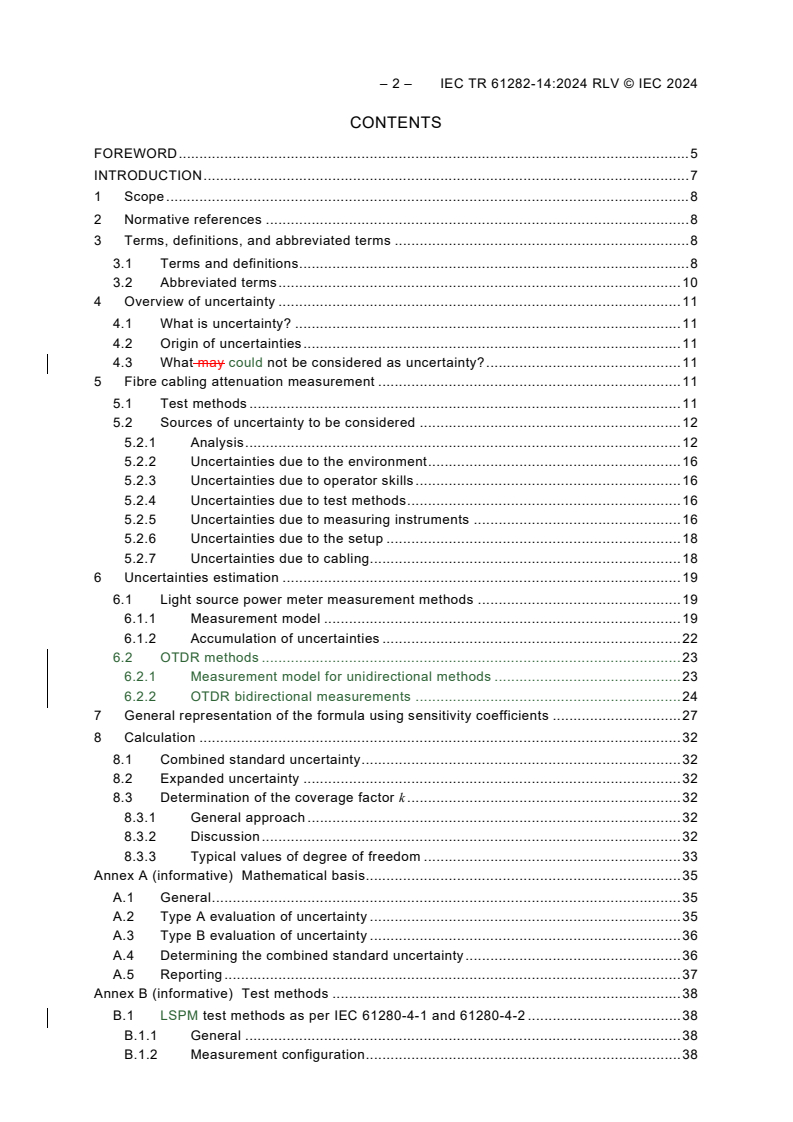
CONTENTS
FOREWORD . 5
INTRODUCTION . 7
1 Scope . 8
2 Normative references . 8
3 Terms, definitions, and abbreviated terms . 8
3.1 Terms and definitions . 8
3.2 Abbreviated terms . 10
4 Overview of uncertainty . 11
4.1 What is uncertainty? . 11
4.2 Origin of uncertainties . 11
4.3 What may could not be considered as uncertainty? . 11
5 Fibre cabling attenuation measurement . 11
5.1 Test methods . 11
5.2 Sources of uncertainty to be considered . 12
5.2.1 Analysis . 12
5.2.2 Uncertainties due to the environment . 16
5.2.3 Uncertainties due to operator skills . 16
5.2.4 Uncertainties due to test methods . 16
5.2.5 Uncertainties due to measuring instruments . 16
5.2.6 Uncertainties due to the setup . 18
5.2.7 Uncertainties due to cabling. 18
6 Uncertainties estimation . 19
6.1 Light source power meter measurement methods . 19
6.1.1 Measurement model . 19
6.1.2 Accumulation of uncertainties . 22
6.2 OTDR methods . 23
6.2.1 Measurement model for unidirectional methods . 23
6.2.2 OTDR bidirectional measurements . 24
7 General representation of the formula using sensitivity coefficients . 27
8 Calculation . 32
8.1 Combined standard uncertainty . 32
8.2 Expanded uncertainty . 32
8.3 Determination of the coverage factor k . 32
8.3.1 General approach . 32
8.3.2 Discussion . 32
8.3.3 Typical values of degree of freedom . 33
Annex A (informative) Mathematical basis. 35
A.1 General . 35
A.2 Type A evaluation of uncertainty . 35
A.3 Type B evaluation of uncertainty . 36
A.4 Determining the combined standard uncertainty . 36
A.5 Reporting . 37
Annex B (informative) Test methods . 38
B.1 LSPM test methods as per IEC 61280-4-1 and 61280-4-2 . 38
B.1.1 General . 38
B.1.2 Measurement configuration . 38
B.1.3 One-cord reference configuration . 38
B.1.4 Two-cord reference configuration . 39
B.1.5 Three-cord reference configuration . 39
B.1.6 Equipment cord reference configuration . 39
B.2 OTDR Test methods as per IEC 61280-4-2 and 61280-4-3 . 39
B.2.1 Unidirectional measurement . 39
B.2.2 Bi-directional measurement . 40
B.2.3 OTDR test method on PON . 40
B.2.4 Filtered OTDR on PON . 41
B.3 Test methods defined in ISO/IEC 14763-3:2014 . 42
B.3.1 General . 42
B.3.2 Channels . 43
B.3.3 Links. 44
Annex C (informative) Evaluation of uncertainties . 45
C.1 Type A uncertainties . 45
C.1.1 General . 45
C.1.2 Evaluation of optical source instability and associated uncertainties . 45
C.2 Type B uncertainties . 45
C.2.1 General . 45
C.2.2 Evaluation of the power meter noise . 46
C.2.3 Elements to be considered for power meter stability analysis . 46
C.2.4 Evaluation of the centre wavelength dependence (LS or OTDR) . 46
C.2.5 Spectral width dependence . 49
C.2.6 Evaluation of the uncertainties due to MM launch conditions . 49
C.2.7 Evaluation of the PDL . 50
C.2.8 Uncertainty of absolute power measurement of power meters . 51
C.2.9 Relative uncertainty arising from non-linearity of the OTDR . 51
C.2.10 Uncertainty arising from OTDR noise . 52
C.2.11 Practical determination of uncertainty arising from OTDR noise . 54
C.2.12 Relative uncertainty arising from OTDR cursor placement . 57
C.2.13 Considerations on backscatter coefficient . 58
Annex D (informative) Typical values of uncertainties . 59
Annex E (informative) Linear to dB scale conversion of uncertainties . 63
E.1 Definition of decibel . 63
E.2 Conversion of relative uncertainties . 63
Bibliography . 65
Figure 1 – Fishbone analysis . 15
Figure 2 – Measurement model for light source and power meter . 19
Figure 3 – Measurement model for OTDRs . 23
Figure B.1 – Measurement configuration . 38
Figure B.2 – One-cord reference measurement . 38
Figure B.3 – Two-cord reference measurement . 39
Figure B.4 – Three-cord reference measurement . 39
Figure B.5 – Equipment cord reference measurement . 39
Figure B.6 – Location of the cabling under test ports . 40
Figure B.7 – Graphic determination of F and F . 41
1 2
– 4 – IEC TR 61282-14:2024 RLV © IEC 2024
Figure B.8 – Graphic determination of F and F . 42
1 2
Figure B.9 – Measurement on channel Channel measurement configuration . 43
Figure B.10 – Channel reference measurement . 43
Figure B.11 – Link measurement configuration . 44
Figure B.12 – Link reference measurement . 44
Figure C.1 – Typical spectral response of a fibre . 47
Figure C.2 – Observed PLC splitter wavelength dependency and mathematical model . 49
Figure C.3 – Uncertainties due to the launch conditions for a given loss . 50
Figure C.4 – Linear regression location for some OTDR method . 52
Figure C.5 – Confidence band of the linear regression . 53
Figure C.6 – OTDR trace and noise . 55
Figure C.7 – Noise asymmetry function of R . 57
DM
Figure C.8 – Measurement validity limits . 57
Table 1 – Source of uncertainty (raw list) . 12
Table 2 – Uncertainties due to measuring instruments . 16
Table 3 – Uncertainties due to the setup . 18
Table 4 – Uncertainties due to cabling . 19
Table 5 – Correlation coefficients . 26
Table 6 – Sensitivity coefficients for LSPM methods in IEC 61280-4-1, IEC 61280-4-2,
and IEC 61280-4-3 . 28
Table 7 – Sensitivity coefficients for ISO/IEC 14763-3:2014 OTDR methods in
IEC 61280-4-2 and IEC 61280-4-3 . 30
Table 8 – Values of k for different values of v . 33
Table 9 – Typical values of v . 33
i
Table C.1 – Spectral attenuation coefficients . 48
Table C.2 – Sensitivity coefficients . 48
Table D.1 – Typical values of uncertainties and distribution . 60
Table D.2 – Typical values of uncertainties related to connectors . 62
INTERNATIONAL ELECTROTECHNICAL COMMISSION
____________
FIBRE OPTIC COMMUNICATION SYSTEM DESIGN GUIDELINES –
Part 14: Determination of the uncertainties
of attenuation measurements in fibre plants
FOREWORD
1) The International Electrotechnical Commission (IEC) is a worldwide organization for standardization comprising
all national electrotechnical committees (IEC National Committees). The object of IEC is to promote international
co-operation on all questions concerning standardization in the electrical and electronic fields. To this end and
in addition to other activities, IEC publishes International Standards, Technical Specifications, Technical Reports,
Publicly Available Specifications (PAS) and Guides (hereafter referred to as "IEC Publication(s)"). Their
preparation is entrusted to technical committees; any IEC National Committee interested in the subject dealt with
may participate in this preparatory work. International, governmental and non-governmental organizations liaising
with the IEC also participate in this preparation. IEC collaborates closely with the International Organization for
Standardization (ISO) in accordance with conditions determined by agreement between the two organizations.
2) The formal decisions or agreements of IEC on technical matters express, as nearly as possible, an international
consensus of opinion on the relevant subjects since each technical committee has representation from all
interested IEC National Committees.
3) IEC Publications have the form of recommendations for international use and are accepted by IEC National
Committees in that sense. While all reasonable efforts are made to ensure that the technical content of IEC
Publications is accurate, IEC cannot be held responsible for the way in which they are used or for any
misinterpretation by any end user.
4) In order to promote international uniformity, IEC National Committees undertake to apply IEC Publications
transparently to the maximum extent possible in their national and regional publications. Any divergence between
any IEC Publication and the corresponding national or regional publication shall be clearly indicated in the latter.
5) IEC itself does not provide any attestation of conformity. Independent certification bodies provide conformity
assessment services and, in some areas, access to IEC marks of conformity. IEC is not responsible for any
services carried out by independent certification bodies.
6) All users should ensure that they have the latest edition of this publication.
7) No liability shall attach to IEC or its directors, employees, servants or agents including individual experts and
members of its technical committees and IEC National Committees for any personal injury, property damage or
other damage of any nature whatsoever, whether direct or indirect, or for costs (including legal fees) and
expenses arising out of the publication, use of, or reliance upon, this IEC Publication or any other IEC
Publications.
8) Attention is drawn to the Normative references cited in this publication. Use of the referenced publications is
indispensable for the correct application of this publication.
9) IEC draws attention to the possibility that the implementation of this document may involve the use of (a)
patent(s). IEC takes no position concerning the evidence, validity or applicability of any claimed patent rights in
respect thereof. As of the date of publication of this document, IEC had not received notice of (a) patent(s), which
may be required to implement this document. However, implementers are cautioned that this may not represent
the latest information, which may be obtained from the patent database available at https://patents.iec.ch. IEC
shall not be held responsible for identifying any or all such patent rights.
This redline version of the official IEC Standard allows the user to identify the changes
made to the previous edition IEC TR 61282-14:2019. A vertical bar appears in the margin
wherever a change has been made. Additions are in green text, deletions are in
strikethrough red text.
– 6 – IEC TR 61282-14:2024 RLV © IEC 2024
IEC TR 61282-14 has been prepared by 86C: Fibre optic systems and active devices, of IEC
technical committee 86: Fibre optics. It is a Technical Report.
This document contains an attached file in the form of an Excel spreadsheet. This file is
intended to be used as a complement and does not form an integral part of the document.
This third edition cancels and replaces the second edition published in 2019. This edition
constitutes a technical revision.
This edition includes the following significant technical changes with respect to the previous
edition:
a) addition of uncertainties calculation for optical time domain reflectometer (OTDR)
measurement methods based on the analysis provided in 61280-4-3;
b) addition of uncertainties calculation for passive optical networks (PON);
c) update of the list of reference grade connectors;
d) addition of probability distribution in Table D.1.
The text of this Technical Report is based on the following documents:
Draft Report on voting
86C/1913/DTR 86C/1923/RVDTR
Full information on the voting for its approval can be found in the report on voting indicated in
the above table.
The language used for the development of this Technical Report is English.
This document was drafted in accordance with ISO/IEC Directives, Part 2, and developed in
accordance with ISO/IEC Directives, Part 1 and ISO/IEC Directives, IEC Supplement, available
at www.iec.ch/members_experts/refdocs. The main document types developed by IEC are
described in greater detail at www.iec.ch/publications.
A list of all parts in the IEC 61282 series, published under the general title Fibre optic
communication system design guidelines, can be found on the IEC website.
The committee has decided that the contents of this document will remain unchanged until the
stability date indicated on the IEC website under webstore.iec.ch in the data related to the
specific document. At this date, the document will be
• reconfirmed,
• withdrawn, or
• revised.
IMPORTANT – The "colour inside" logo on the cover page of this document indicates
that it contains colours which are considered to be useful for the correct understanding
of its contents. Users should therefore print this document using a colour printer.
INTRODUCTION
The determination of the uncertainty of every measurement is a key activity, which should be
performed by applying dedicated methods as extensively presented in reference documents
such as ISO/IEC Guide 98-3:2008, Guide to the uncertainty of measurement (GUM).
This document shows a practical application of these methods for the determination of the
measurement uncertainty of the attenuation of fibre optic cabling using optical light sources and
power meters as defined in IEC 61280-4-1 and IEC 61280-4-2.
Reference documents such as ISO/IEC Guide 98-3, Guide to the uncertainty of measurement
(GUM), detail methods for the determination of the uncertainty of a measurement.
This document shows a practical application of these methods for the determination of the
uncertainty in attenuation measurements of fibre optic cabling as defined in IEC 61280-4-1,
IEC 61280-4-2, and IEC 61280-4-3, using optical light sources and power meters or OTDRs,
with the exception of multimode OTDRs.
It includes the review of all contributing factors to uncertainty (such as launch conditions,
spectral width, stability of source, power meter polarization, resolution, linearity, and quality of
test cord connectors) to determine the overall measurement uncertainty. This part of IEC 61282
applies to the measurement of single-mode or multimode fibres without restrictions to the fibre
parameters, including mode field diameter, core diameter, and NA. However, numerical values
given in Clause C.2 and typical values given in Annex D are not valid for multimode fibres types
A2, A3, and A4.
The list of uncertainties presented in this document is related to this particular application and
should be reconsidered if measurement conditions that are not compliant with measurement
requirements defined by IEC 61280-4-1, IEC 61280-4-2, and IEC 61280-4-3.
The reference document for general uncertainty calculations is ISO/IEC Guide 98-3:2008, and
this document does not intend to replace it. This document only presents examples, and should
be used it is good practice to use it in conjunction with ISO/IEC Guide 98-3:2008. A brief
introduction to the determination of measurement uncertainty according to ISO/IEC Guide 98-
3:2008 is given in Annex A.
This document is associated with a calculation spreadsheet (Excel) containing practical
calculations.
– 8 – IEC TR 61282-14:2024 RLV © IEC 2024
FIBRE OPTIC COMMUNICATION SYSTEM DESIGN GUIDELINES –
Part 14: Determination of the uncertainties
of attenuation measurements in fibre plants
1 Scope
This part of IEC 61282, which is a Technical Report, establishes a detailed analysis and
calculations of the uncertainties related to the measurement of the attenuation of both
multimode and single-mode optical fibre cabling, using optical light sources and power meters.
It also includes simplified analysis and calculation of the uncertainties related to the
measurement of the attenuation of single-mode optical fibre cabling using OTDRs.
2 Normative references
The following documents are referred to in the text in such a way that some or all of their content
constitutes requirements of this document. For dated references, only the edition cited applies.
For undated references, the latest edition of the referenced document (including any
amendments) applies.
IEC 61280-4-1:2009, Fibre-optic communication subsystem test procedures – Part 4-1:
Installed cable plant – Multimode attenuation measurement
IEC 61280-4-2:2014, Fibre-optic communication subsystem test procedures – Part 4-2:
Installed cable plant – Single-mode attenuation and optical return loss measurement
ISO/IEC Guide 98-3:2008, Uncertainty of measurement – Part 3: Guide to the expression of
uncertainty in measurement (GUM:1995)
There are no normative references in this document.
3 Terms, definitions, and abbreviated terms
3.1 Terms and definitions
For the purposes of this document, the following terms and definitions apply.
ISO and IEC maintain terminology databases for use in standardization at the following
addresses:
• IEC Electropedia: available at https://www.electropedia.org/
• ISO Online browsing platform: available at https://www.iso.org/obp
3.1.1
attenuation
L A
reduction of optical power induced by transmission through a medium such as cabling,
characterized by
L = 10 × log (P /P )
dB 10 in out
A = 10× log (P P )
dB 10 in out
where
P and P are the optical powers into and out of the cabling, typically measured in mW
in out
Note 1 to entry: Attenuation is expressed in dB.
3.1.2
calibration
set of operations that establish, under specified conditions, the relationship between the values
of quantities indicated by a measuring instrument and the corresponding values realized by
standards
3.1.3
encircled flux
EF
fraction of the radial-weighted cumulative near field power to the total radial-weighted output
power as a function of radial distance from the optical centre of the core
3.1.4
measurement repeatability
measurement precision under a set of repeatability conditions of measurement
3.1.5
measurement reproducibility
reproducibility
measurement precision under reproducibility conditions of measurement
3.1.6
polarization dependent loss
PDL
maximum variation of attenuation to a variation of the state of polarization (SOP) over all SOPs
Note 1 to entry: PDL is expressed in dB.
3.1.7
nonlinearity
NL
relative difference, for a power meter, between the response at a given input power P and the
response at a reference input power P , characterized by
rP
( )
nl −1
P/ P
rP
( )
rP( )
R PP/1−
( )
NL 0
rP
( )
where
rP = P P P
( ) ( ) is the response of the power meter at input power P;
read
P P is the reading of the power meter at input power P
( )
read
Note 1 to entry: If expressed in decibels, the nonlinearity is calculated as:
=
=
– 10 – IEC TR 61282-14:2024 RLV © IEC 2024
rP
( )
NL 10×log (dB)
PP/ 10
rP
( )
rP
( )
R PP/ 10×log
( )
NLdB 0 10
rP
( )
Note 2 to entry: The nonlinearity is equal to zero at the reference power.
3.1.8
uncertainty of measurement
quantified doubt about the result of a measurement
parameter, associated with the result of a measurement, that characterizes the dispersion of
the values that could reasonably be attributed to the measurand
3.1.9
stability
ability of a measuring instrument to keep its performance characteristics within a specified
range during a specified time interval, all other conditions being the same
3.1.10
repeatability condition
condition of measurement that includes the same measurement procedure, same operators,
same measuring system, same operating conditions and same location, and replicates
measurements on the same or similar objects over a short period of time
3.1.11
reproducibility condition
condition of measurement that includes different locations, operators, measuring systems, and
replicate measurements on the same or similar objects
3.1.12
standard uncertainty
u
uncertainty of a measurement result expressed as a standard deviation
Note 1 to entry: For further information, see ISO/IEC Guide 98-3.
3.1.13
type A uncertainty
type of uncertainty obtained by a statistical analysis of a series of observations, such as when
evaluating certain random effects of measurement
Note 1 to entry: For further information, see A.2 and ISO/IEC Guide 98-3.
3.1.14
type B uncertainty
type of uncertainty obtained by means other than a statistical analysis of observations, for
example an estimation of probable sources of uncertainty, such as when evaluating systematic
effects of measurement
Note 1 to entry: For further information, see A.3 and ISO/IEC Guide 98-3.
3.2 Abbreviated terms
APC angled physical contact (description of connector style)
CW continuous wave
LSPM light source power meter
=
=
NA numerical aperture
OPM optical power meter
OTDR Optical time domain reflectometer
PC physical contact (description of connector style that is not angled)
PON passive optical network
4 Overview of uncertainty
4.1 What is uncertainty?
According to ISO/IEC Guide 98-3:2008 (GUM), the uncertainty of a measurement is the
quantified doubt that exists about the result of any measurement. For every measurement, even
the most careful, there is always a margin of doubt.
For example, when measuring the attenuation of fibre optic cabling, the operator may could
observe variations of the displayed power level on the power meter and, hence, be unable to
know which value should be recorded decide which value to record. This variation of the
displayed value is an element of doubt regarding the result of the measurement.
4.2 Origin of uncertainties
Uncertainties come from measurement devices, the item to be measured, the measurement
process, operator skills, references used, and the environment.
4.3 What may could not be considered as uncertainty?
Unknown parameters that contribute directly or indirectly to the quantity to be measured cannot
be considered as uncertainties. For example, when measuring a cabling, mode field diameter
or numerical aperture of different fibres of cabling the attenuation of cabling that is composed
of different fibres, the mode field diameters or numerical apertures (NA) of the different fibres
in the cabling are usually unknown; however, a mismatch of these parameters causes can
significantly contribute to the measured attenuation.
Also, poor knowledge of measurement conditions generates uncertainties, but itself is not
directly an uncertainty. A common example is the wavelength of the optical source: if the
wavelength of the source is known with an uncertainty <1 nm, the measurement condition can
be precisely specified. Conversely, if the wavelength of the source is known to be within a range
of 40 nm, the possible variation of the attenuation of the device under test should can be
estimated based on the typical variation of attenuation over the wavelength range for a given
length of fibre.
5 Fibre cabling attenuation measurement
5.1 Test methods
Three Four attenuation test methods use an optical light source and power meter (LSPM) to
measure input and output power levels of the cabling under test to determine the attenuation.
These methods are designated respectively,
• one-cord,
• three-cord,
• two-cord, and
• equipment cord method.
The main functional difference between these methods is the way the input power level, known
as the reference power level (P ), is measured (see B.1).
in
– 12 – IEC TR 61282-14:2024 RLV © IEC 2024
Additionally, one test method uses an OTDR to determine the attenuation of the cabling under
test (see Annex B).
When the cabling under test is a PON, the one-cord method using a light source and a power
meter and two OTDR methods can be used (see Annex B).
Refer to IEC 61280-4-1, IEC 61280-4-2, and IEC 61280-4-3 for more details.
NOTE Test methods presented in ISO/IEC 14763-3 have different names and are slightly different. See
Clause B.3
5.2 Sources of uncertainty to be considered
5.2.1 Analysis
An extensive analysis of the source of uncertainties to be considered has been conducted. This
resulted in the sorted source of uncertainties listed in Table 1.
Table 1 – Source of uncertainty (raw list)
Source of uncertainty Type of origin Index
Measurement source instability (power deviation over time) Measurement devices 01
Source wavelength Measurement devices 02
Source spectrum (spectral width) Measurement devices 03
Laser speckle Measurement devices 04
Launch condition for multimode fibres (dependent upon the Measurement devices 05
compliance or noncompliance with the EF template and a
function of the attenuation of the measured cabling)
Power meter nonlinearity Measurement devices 06
Power meter reading resolution Measurement devices 07
Power meter spatial uniformity References used 08
Power meter polarization sensitivity Measurement devices 09
Power meter noise Measurement devices 10
Power meter stability Measurement devices 11
Power meter calibration References used 12
OTDR wavelength Measurement devices 13
OTDR spectrum (spectral width) Measurement devices 14
OTDR nonlinearity Measurement devices 15
OTDR reading resolution Measurement devices 16
OTDR cursors placement Measurement devices 17
OTDR noise Measurement devices 18
Test cord connector or fibre attenuation uncertainty References used 19
Connector mating repeatability (test cord or cabling) References used or item to be 20
measured
Connector PDL References used or item to be 21
measured
Reflections (FP cavity) References used or item to be 22
measured
Connector end face cleanliness Operator skills 23
Fibre handling Operator skills 24
Calculation errors Measurement process 25
NA of the fibre Item to be measured 26
Source of uncertainty Type of origin Index
Core diameter of the fibre or mode filed diameter Item to be measured 27
Fibre nonlinearity Item to be measured 28
Fibre backscatter coefficient Item to be measured 29
Spectral dependence of splitters Item to be measured 30
Temperature Environment 31
Humidity Environment 32
Some of the uncertainties listed in Table 1 are negligible or need it will be necessary to group
them together to be estimated; however, some of them apply to different domains. Figure 1
presents an organised list of these uncertainties.
Environment Man: Operator skills Method: Measurement
Two cords
Connector end face
Measurement process
cleanliness (17)
Humidity (24)
Circulation errors (19)
Fibre and connectors
handling (18)
One cord Three cords
Temperature (23)
Cabling (link or channel)
The uncertainties of the attenuation measurement of a cabling
Optical power meter
calibration (12)
Reading Stability: Type A
Connectors
resolution (07) uncertainties (11)
Reflexions (16) Speckle (04)
NA (20) Nonlinearity (22)
Launch
PDL (15)
Mating
Optical power
conditions (05)
Un-stability
repeatability (14)
Fibre
meter
(01)
Ref cords
Spatial
Nonlinearity
Core uniformity (08)
(06) Core diameter (21)
Source
diameter (21)
Polarisation
PDL (15) Reflexions (16)
Spectral
Noise (10) sensitivity (9)
NA (20) width (03)
Central
Connectors
wavelength (02)
Fibre
Wavelength
Detector
Change
Mating repeatability (14)
Measurement references Machine: Measurement device Material: Cabling
IEC
Figure 1 – Fishbone analysis
– 16 – IEC TR 61282-14:2024 RLV © IEC 2024
5.2.2 Uncertainties due to the environment
It is assumed that environmental parameters (temperature and humidity) generate negligible
variations of the attenuation of the fibre and that fibre environmental conditions are reported as
measurement conditions.
Temperature and humidity can generate source and power meter instability. These instabilities
shall will be reported in 5.2.5 (see also C.1.2).
NOTE This corresponds to uncertainties reported as index 31 and 32 in Table 1.
5.2.3 Uncertainties due to operator skills
It is assumed that operators follow approved procedures for connector end face inspection and
cleaning, so the connector attenuation is as expected.
It is also assumed that operator skills do not create additional uncertainty variations to those
included with connector mating repeatability.
NOTE This corresponds to uncertainties reported as index 23 and 24 in Table 1.
5.2.4 Uncertainties due to test methods
Test methods do not affect the uncertainties directly, because different numbers of connectors
are used depending on the method used. The accumulation of uncertainties takes into account
the correct amount of uncertainties related to the connectors.
Calculation errors due to truncation of results may can exist in this type of measurement,
especially if measurements are controlled by an external computer. However, most of the time,
users simply calculate the attenuation by an embedded dBr (decibel relative) function that can
be assumed to have no more errors than the rounding error of the optical power meter (OPM)
– see 5.2.5.
NOTE This corresponds to uncertainty reported as index 25 in Table 1.
5.2.5 Uncertainties due to measuring instruments
Table 2 provides a list of the uncertainties to be taken into account for the measurement devices
group.
Table 2 – Uncertainties due to measuring instruments
Reference/ Index Description Concerned Apply Apply Other conditions
symbol element to P to P
in out
5.2.5.1 01 Relative uncertainty arising from the Source Yes Yes
instability of the optical source and
u
Pstat any other instabilities (assumed to
include instability due to multiple
reflections)
5.2.5.2 02 Relative attenuation uncertainty Source No Yes If unknown
arising from the uncertainty of the
u
λs
optical source wavelength. See C.2.4
and C.2.5.
5.2.5.3 05 Relative uncertainty due to the Source and No Yes MM
multimode launch condition. See cabling
u
MMLC C.2.6.
5.2.5.4 06 Relative uncertainty arising from the Power No Yes One power meter
nonlinearity of the power meter. This meter
u
Lin contribution will only be considered
when using the same power meter for
the measurement of P and of P
in out
Reference/ Index Description Concerned Apply Apply Other conditions
symbol element to P to P
in out
5.2.5.5 07 Relative uncertainty arising from the Power Yes Yes
finite display resolution of power meter meter
u i
Displ
i
5.2.5.6 08 Relative uncertainty arising from Power Yes Yes If angled physical
power meter spatial uniformity. Only meter contact (APC) and
u
Pspace significant for single-mode physical contact
measurements and when using a (PC) connectors
different type of connector for P and are used
in
of P and using the same power
out
One power meter
meter for the measurement of P and
in
P
out
5.2.5.7 09 Relative uncertainty arising from the Power Yes Yes SM
polarization dependency of power meter
u meter i (see C.2.7)
PDR
i
5.2.5.8 10 Relative uncertainty arising from Power Yes Yes
power meter noise becomes negligible meter
u
Pnoise if power level remains 30 dB over the
power meter noise level (see C.2.2).
5.2.5.9 11 Relative uncertainty arising from Power Yes Yes
power meter instability (see C.2.3) meter
u
PM
stabin
u
PM
stabout
5.2.5.10 12 Relative uncertainties of the absolute Power Yes Yes If two different
power measurements of P and of meter power meters are
in
u used
abs
P . These uncertainties need to be
P
in out
are considered only when performing
u
abs
P measurements of P and P using
out
in out
two different power meters. The use of
two different power meters is not
recommended (see also C.2.8).
5.2.5.11 13 Relative attenuation uncertainty OTDR Yes Yes
arising from the uncertainty of the
u
λOTDR OTDR wavelength. See C.2.4 and
C.2.5.
5.2.5.12 15 Relative uncertainty arising from the OTDR No Yes
nonlinearity of the OTDR.
u
NLOTDR
5.2.5.13 17 Relative uncertainty arising from the OTDR Yes Yes
finite display resolution of OTDR
u
ROTDR
5.2.5.14 18 Relative uncertainty arising from OTDR Yes Yes Will be evaluated
OTDR noise on backscattered power two times
u
NOTDR trace. (See C.2.11) because noise
amplitudes at F
(P ) and F (P )
in 2 out
are different.
5.2.5.15 16 Relative uncertainty arising from the OTDR Yes Yes
cursor placement of OTDR
u
OTDR
When measuring fibre optic cabling, and assuming the spectrum of the sources used is
symmetrical, the variation of the spectral width does not cause variation of the attenuation of
the cabling. Hence, uncertainties due to the spectral width are assumed to be negligible.
NOTE 1 This corresponds to uncertainty reported as index 03 and 14 in Table 1.
– 18 – IEC TR 61282-14:2024 RLV © IEC 2024
The
...