

IEC 60669-1:2017
(Main)Switches for household and similar fixed-electrical installations - Part 1: General requirements
General Information
- Abstract
IEC 60669-1:2017 applies to manually operated general purpose functional switches, for alternating current (AC) only with a rated voltage not exceeding 440 V with a rated current not exceeding 63 A, intended for household and similar fixed electrical installations, either indoors or outdoors. For switches provided with screwless terminals, the rated current is limited to 16 A. This fourth edition cancels and replaces the third edition published in 1998, Amendment 1:1999 and Amendment 2:2006. This edition constitutes a technical revision. This edition includes the following significant technical changes with respect to the previous edition:
a) change of the scope for motor load switches;
b) deletion of some dated normative references;
c) changes to the definitions;
d) in Clause 5 the number of specimens to be used for the tests are clearly given in Table 1 (Corresponding Annex A of IEC 60669-1:1998 was therefore deleted);
e) in Clause 5 it was clarified on which switches the tests of Clause 19 shall be carried out;
f) requirements concerning 13 A switches have been included;
g) mandatory indication that a terminal is suitable for rigid conductor only;
h) requirements and test conditions for flexible conductors have been included in Clause 12;
i) requirements for pilot light units have been included;
j) new test for self-ballasted lamp loads in 19.3;
k) Table 20 has been completely redrawn to cover normal, mini and micro-gap switches and renumbered Table 21;
l) new informative Annex B including changes planned for the future in order to align IEC 60669-1 with the requirements of IEC 60998 (all parts), IEC 60999 (all parts) and IEC 60228;
m) new informative Annex C about the circuit development for 19.3;
n) new informative Annex D including additional requirements for insulation-piercing terminals;
o) new informative Annex E including additional requirements and tests for switches intended to be used at a temperature lower than -5 °C.
The contents of the corrigendum of January 2020 have been included in this copy.
- Status
- Published
- Publication Date
- 21-Feb-2017
- Technical Committee
- SC 23B - Plugs, socket-outlets and switches
- Drafting Committee
- MT 4 - TC 23/SC 23B/MT 4
- Current Stage
- PPUB - Publication issued
- Start Date
- 22-Feb-2017
- Completion Date
- 03-Mar-2017
Buy Documents
IEC 60669-1:2017 RLV - Switches for household and similar fixed-electrical installations - Part 1: General requirements Released:2/22/2017
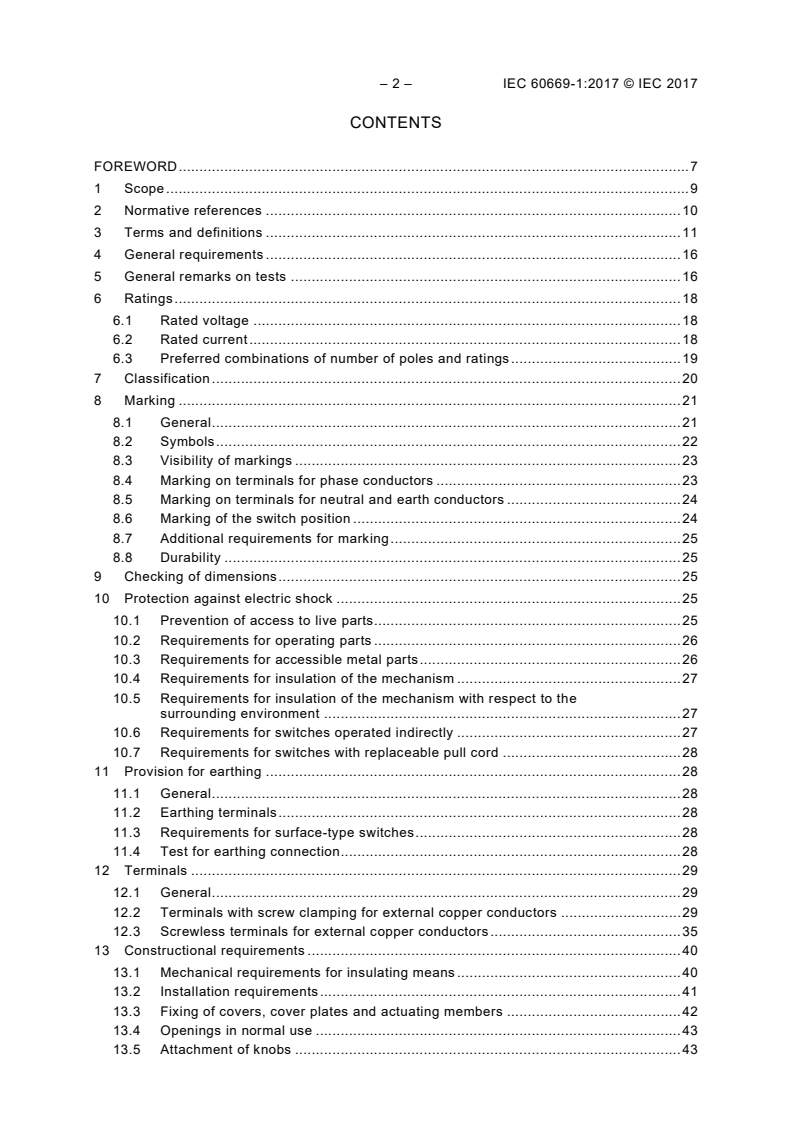
IEC 60669-1:2017 - Switches for household and similar fixed-electrical installations - Part 1: General requirements Released:2/22/2017
Overview
IEC 60669-1:2017 - "Switches for household and similar fixed-electrical installations - Part 1: General requirements" - is the fourth edition international standard specifying safety, performance and testing requirements for manually operated general-purpose AC switches intended for household and similar fixed electrical installations. It applies to switches with a rated voltage ≤ 440 V and rated current ≤ 63 A (screwless terminals limited to 16 A). This edition (2017) is a technical revision that updates definitions, test specimen rules, and adds requirements for pilot lights, flexible conductors, self‑ballasted lamp loads and low‑temperature use.
Key Topics and Technical Requirements
- Scope & Ratings: Rated voltage and current limits; special restriction for screwless terminals.
- Classification & Marking: Requirements for identification, visibility and terminal markings (including mandatory marking when a terminal is suitable for rigid conductors only).
- Terminals & Connections: Requirements and test conditions for screw-clamp and screwless terminals, including insulation‑piercing terminal requirements (Annex D).
- Insulation & Protection: Protection against electric shock, insulation resistance, clearances, creepage distances and enclosure ingress protection (IP).
- Mechanical & Thermal Performance: Mechanical strength, temperature‑rise, resistance to ageing, humidity, heat and fire.
- Making/Breaking Capacity: Tests for inductive loads, externally ballasted lamps and a new test for self‑ballasted lamp loads (Clause 19.3).
- Pilot Light Units & Flexible Conductors: New mandatory requirements and test conditions (Clause 12, pilot light requirements).
- Test Methods & Specimens: Clarified specimen counts in Clause 5 and clearer assignment of Clause 19 tests; Table redraws for normal, mini and micro-gap switches.
- Informative Annexes: Annex B (planned alignment with IEC 60998/60999/60228), Annex C (circuit development for 19.3), Annex D (insulation‑piercing terminal requirements) and Annex E (low‑temperature additional tests).
Applications and Who Uses This Standard
- Switch manufacturers - product design, performance verification and conformity testing.
- Test laboratories & certification bodies - type testing and compliance assessment for household and similar switches.
- R&D and compliance engineers - ensuring product designs meet electrical safety, EMC and mechanical requirements.
- Electrical installers and specifiers - selecting compliant switches for residential, commercial and outdoor fixed installations.
- Regulators and procurement teams - specifying safety-compliant switch products for building codes and tenders.
Related Standards
- IEC 60998 (connectors for household appliances) - alignment planned (Annex B)
- IEC 60999 (insulation-piercing connectors) - alignment planned (Annex B)
- IEC 60228 (conductors) - referenced for conductor requirements (Annex B)
- Other parts of IEC 60669 series (switches) for specialized switch types
Keywords: IEC 60669-1, household switches, electrical installations, switch testing, rated current, screwless terminals, pilot light, self‑ballasted lamp test, insulation‑piercing terminals.
Relations
- Effective Date
- 05-Sep-2023
- Effective Date
- 05-Sep-2023
- Effective Date
- 05-Sep-2023
- Effective Date
- 05-Sep-2023
- Effective Date
- 05-Sep-2023
Buy Documents
IEC 60669-1:2017 RLV - Switches for household and similar fixed-electrical installations - Part 1: General requirements Released:2/22/2017
IEC 60669-1:2017 - Switches for household and similar fixed-electrical installations - Part 1: General requirements Released:2/22/2017
Get Certified
Connect with accredited certification bodies for this standard

IMQ S.p.A. (Certification)
Italian electrical product certification.

SLG Prüf- und Zertifizierungs GmbH
German testing and certification body.

UL Solutions
Global safety science company with testing, inspection and certification.
Sponsored listings
Frequently Asked Questions
IEC 60669-1:2017 is a standard published by the International Electrotechnical Commission (IEC). Its full title is "Switches for household and similar fixed-electrical installations - Part 1: General requirements". This standard covers: IEC 60669-1:2017 applies to manually operated general purpose functional switches, for alternating current (AC) only with a rated voltage not exceeding 440 V with a rated current not exceeding 63 A, intended for household and similar fixed electrical installations, either indoors or outdoors. For switches provided with screwless terminals, the rated current is limited to 16 A. This fourth edition cancels and replaces the third edition published in 1998, Amendment 1:1999 and Amendment 2:2006. This edition constitutes a technical revision. This edition includes the following significant technical changes with respect to the previous edition: a) change of the scope for motor load switches; b) deletion of some dated normative references; c) changes to the definitions; d) in Clause 5 the number of specimens to be used for the tests are clearly given in Table 1 (Corresponding Annex A of IEC 60669-1:1998 was therefore deleted); e) in Clause 5 it was clarified on which switches the tests of Clause 19 shall be carried out; f) requirements concerning 13 A switches have been included; g) mandatory indication that a terminal is suitable for rigid conductor only; h) requirements and test conditions for flexible conductors have been included in Clause 12; i) requirements for pilot light units have been included; j) new test for self-ballasted lamp loads in 19.3; k) Table 20 has been completely redrawn to cover normal, mini and micro-gap switches and renumbered Table 21; l) new informative Annex B including changes planned for the future in order to align IEC 60669-1 with the requirements of IEC 60998 (all parts), IEC 60999 (all parts) and IEC 60228; m) new informative Annex C about the circuit development for 19.3; n) new informative Annex D including additional requirements for insulation-piercing terminals; o) new informative Annex E including additional requirements and tests for switches intended to be used at a temperature lower than -5 °C. The contents of the corrigendum of January 2020 have been included in this copy.
IEC 60669-1:2017 applies to manually operated general purpose functional switches, for alternating current (AC) only with a rated voltage not exceeding 440 V with a rated current not exceeding 63 A, intended for household and similar fixed electrical installations, either indoors or outdoors. For switches provided with screwless terminals, the rated current is limited to 16 A. This fourth edition cancels and replaces the third edition published in 1998, Amendment 1:1999 and Amendment 2:2006. This edition constitutes a technical revision. This edition includes the following significant technical changes with respect to the previous edition: a) change of the scope for motor load switches; b) deletion of some dated normative references; c) changes to the definitions; d) in Clause 5 the number of specimens to be used for the tests are clearly given in Table 1 (Corresponding Annex A of IEC 60669-1:1998 was therefore deleted); e) in Clause 5 it was clarified on which switches the tests of Clause 19 shall be carried out; f) requirements concerning 13 A switches have been included; g) mandatory indication that a terminal is suitable for rigid conductor only; h) requirements and test conditions for flexible conductors have been included in Clause 12; i) requirements for pilot light units have been included; j) new test for self-ballasted lamp loads in 19.3; k) Table 20 has been completely redrawn to cover normal, mini and micro-gap switches and renumbered Table 21; l) new informative Annex B including changes planned for the future in order to align IEC 60669-1 with the requirements of IEC 60998 (all parts), IEC 60999 (all parts) and IEC 60228; m) new informative Annex C about the circuit development for 19.3; n) new informative Annex D including additional requirements for insulation-piercing terminals; o) new informative Annex E including additional requirements and tests for switches intended to be used at a temperature lower than -5 °C. The contents of the corrigendum of January 2020 have been included in this copy.
IEC 60669-1:2017 is classified under the following ICS (International Classification for Standards) categories: 29.120.40 - Switches. The ICS classification helps identify the subject area and facilitates finding related standards.
IEC 60669-1:2017 has the following relationships with other standards: It is inter standard links to IEC 60669-1:2017/COR1:2020, IEC 60669-1:1998/AMD1:1999, IEC 60669-1:1998, IEC 60669-1:1998/ISH1:2012, IEC 60669-1:1998/AMD2:2006. Understanding these relationships helps ensure you are using the most current and applicable version of the standard.
IEC 60669-1:2017 is available in PDF format for immediate download after purchase. The document can be added to your cart and obtained through the secure checkout process. Digital delivery ensures instant access to the complete standard document.
Standards Content (Sample)
IEC 60669-1 ®
Edition 4.0 2017-02
REDLINE VERSION
INTERNATIONAL
STANDARD
colour
inside
Switches for household and similar fixed electrical installations –
Part 1: General requirements
All rights reserved. Unless otherwise specified, no part of this publication may be reproduced or utilized in any form
or by any means, electronic or mechanical, including photocopying and microfilm, without permission in writing from
either IEC or IEC's member National Committee in the country of the requester. If you have any questions about IEC
copyright or have an enquiry about obtaining additional rights to this publication, please contact the address below or
your local IEC member National Committee for further information.
IEC Central Office Tel.: +41 22 919 02 11
3, rue de Varembé Fax: +41 22 919 03 00
CH-1211 Geneva 20 info@iec.ch
Switzerland www.iec.ch
About the IEC
The International Electrotechnical Commission (IEC) is the leading global organization that prepares and publishes
International Standards for all electrical, electronic and related technologies.
About IEC publications
The technical content of IEC publications is kept under constant review by the IEC. Please make sure that you have the
latest edition, a corrigenda or an amendment might have been published.
IEC Catalogue - webstore.iec.ch/catalogue Electropedia - www.electropedia.org
The stand-alone application for consulting the entire The world's leading online dictionary of electronic and
bibliographical information on IEC International Standards, electrical terms containing 20 000 terms and definitions in
Technical Specifications, Technical Reports and other English and French, with equivalent terms in 16 additional
documents. Available for PC, Mac OS, Android Tablets and languages. Also known as the International Electrotechnical
iPad. Vocabulary (IEV) online.
IEC publications search - www.iec.ch/searchpub IEC Glossary - std.iec.ch/glossary
The advanced search enables to find IEC publications by a 65 000 electrotechnical terminology entries in English and
variety of criteria (reference number, text, technical French extracted from the Terms and Definitions clause of
committee,…). It also gives information on projects, replaced IEC publications issued since 2002. Some entries have been
and withdrawn publications. collected from earlier publications of IEC TC 37, 77, 86 and
CISPR.
IEC Just Published - webstore.iec.ch/justpublished
Stay up to date on all new IEC publications. Just Published IEC Customer Service Centre - webstore.iec.ch/csc
details all new publications released. Available online and If you wish to give us your feedback on this publication or
also once a month by email. need further assistance, please contact the Customer Service
Centre: csc@iec.ch.
IEC 60669-1 ®
Edition 4.0 2017-02
REDLINE VERSION
INTERNATIONAL
STANDARD
colour
inside
Switches for household and similar fixed electrical installations –
Part 1: General requirements
INTERNATIONAL
ELECTROTECHNICAL
COMMISSION
ICS 29.120.40 ISBN 978-2-8322-3999-5
– 2 – IEC 60669-1:2017 RLV © IEC 2017
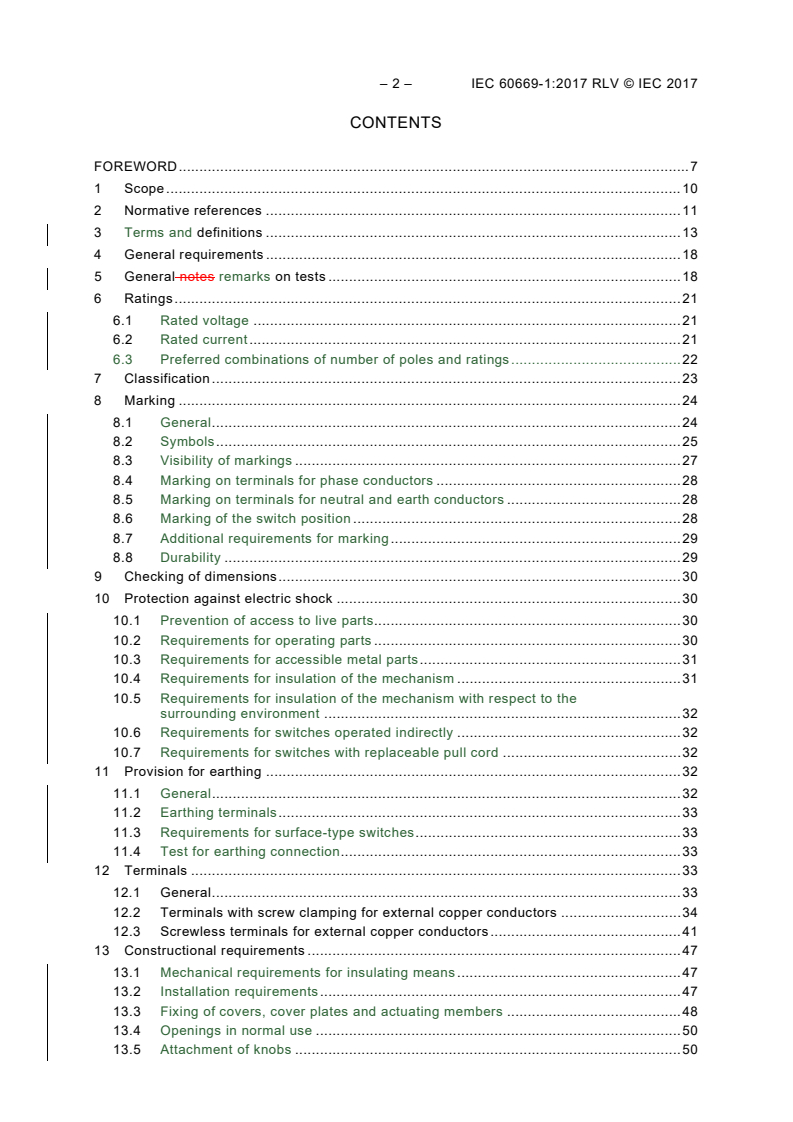
CONTENTS
FOREWORD . 7
1 Scope . 10
2 Normative references . 11
3 Terms and definitions . 13
4 General requirements . 18
5 General notes remarks on tests . 18
6 Ratings . 21
6.1 Rated voltage . 21
6.2 Rated current . 21
6.3 Preferred combinations of number of poles and ratings . 22
7 Classification . 23
8 Marking . 24
8.1 General . 24
8.2 Symbols . 25
8.3 Visibility of markings . 27
8.4 Marking on terminals for phase conductors . 28
8.5 Marking on terminals for neutral and earth conductors . 28
8.6 Marking of the switch position . 28
8.7 Additional requirements for marking . 29
8.8 Durability . 29
9 Checking of dimensions . 30
10 Protection against electric shock . 30
10.1 Prevention of access to live parts. 30
10.2 Requirements for operating parts . 30
10.3 Requirements for accessible metal parts . 31
10.4 Requirements for insulation of the mechanism . 31
10.5 Requirements for insulation of the mechanism with respect to the
surrounding environment . 32
10.6 Requirements for switches operated indirectly . 32
10.7 Requirements for switches with replaceable pull cord . 32
11 Provision for earthing . 32
11.1 General . 32
11.2 Earthing terminals . 33
11.3 Requirements for surface-type switches . 33
11.4 Test for earthing connection . 33
12 Terminals . 33
12.1 General . 33
12.2 Terminals with screw clamping for external copper conductors . 34
12.3 Screwless terminals for external copper conductors . 41
13 Constructional requirements . 47
13.1 Mechanical requirements for insulating means . 47
13.2 Installation requirements . 47
13.3 Fixing of covers, cover plates and actuating members . 48
13.4 Openings in normal use . 50
13.5 Attachment of knobs . 50
13.6 Mounting means . 50
13.7 Combination of switches . 50
13.8 Accessories combined with switches . 50
13.9 Surface-type switches having an IP code higher than IP20 . 50
13.10 Installation in a box . 51
13.11 Connection of a second current-carrying conductor . 51
13.12 Inlet openings . 51
13.13 Provision for back entry from a conduit . 53
13.14 Switch provided with membranes or the like for inlet openings . 53
13.15 Requirements for membranes in inlet openings . 53
13.16 Pilot light units . 54
14 Mechanism . 54
14.1 Indication of the position . 54
14.2 Rest and intermediate position . 54
14.3 Undue arcing . 54
14.4 Making and breaking . 54
14.5 Action of the mechanism without cover or cover plate . 55
14.6 Pull force for cord-operated switches . 55
15 Resistance to ageing, to harmful ingress of water protection provided by
enclosures of switches and resistance to humidity . 55
15.1 Resistance to ageing . 55
15.2 Resistance to harmful ingress of water.
15.2 Protection provided by enclosures of switches . 57
15.2.1 General . 57
15.2.2 Protection against access to hazardous parts and against harmful
effects due to ingress of solid foreign objects . 57
15.2.3 Protection against harmful effects due to ingress of water . 58
15.3 Resistance to humidity . 59
16 Insulation resistance and electric strength . 59
16.1 General . 59
16.2 Test for measuring the insulation resistance . 59
16.3 Electric strength test . 62
17 Temperature rise . 65
17.1 General . 65
17.2 Switches incorporating pilot lights . 66
18 Making and breaking capacity . 67
18.1 General . 67
18.2 Overload . 67
18.3 Overload test with filament lamps . 69
19 Normal operation . 69
19.1 Test for switches intended for inductive loads . 69
19.2 Test for switches intended for externally ballasted lamp loads . 72
19.3 Test for switches intended for self ballasted lamp loads . 74
20 Mechanical strength . 78
20.1 General . 78
20.2 Pendulum hammer test . 78
20.3 Test on the main parts of surface-type switches . 81
20.4 Screwed glands . 81
– 4 – IEC 60669-1:2017 RLV © IEC 2017
20.5 Covers, cover plates or actuating members – accessibility to live parts . 82
20.5.1 General . 82
20.5.2 Verification of the non-removal of covers, cover plates or actuating
members . 82
20.5.3 Verification of the removal of covers, cover plates or actuating members. 82
20.6 Covers, cover plates or actuating members – accessibility to non-earthed
metal parts separated from live parts . 82
20.7 Covers, cover plates or actuating members – accessibility to insulating
parts, earthed metal parts, the live parts of SELV ≤ 25 V AC and 60 V DC or
metal parts separated from live parts . 83
20.8 Covers, cover plates or actuating members – application of gauges . 83
20.9 Grooves, holes and reverse tapers . 83
20.10 Additional test for cord-operated switch . 83
21 Resistance to heat . 84
21.1 General . 84
21.2 Basic heating test . 84
21.3 Ball-pressure test on parts of insulating material necessary to retain current-
carrying parts and parts of the earthing circuit in position . 84
21.4 Ball-pressure test on parts of insulating material not necessary to retain
current-carrying parts and parts of the earthing circuit in position. 85
22 Screws, current-carrying parts and connections . 85
22.1 General . 85
22.2 Correct insertion of screws . 86
22.3 Contact pressure of electrical connections . 86
22.4 Screws and rivets, used both as electrical and mechanical connections . 86
22.5 Material of current-carrying parts . 86
22.6 Contacts subjected to sliding actions . 87
22.7 Thread-forming and thread-cutting screws . 87
23 Creepage distances, clearances and distances through sealing compound . 88
23.1 General . 88
23.2 Insulating compound . 91
24 Resistance of insulating material to abnormal heat, to fire and to tracking . 91
24.1 Resistance to abnormal heat and to fire . 91
24.2 Resistance to tracking . 92
25 Resistance to rusting . 92
26 EMC requirements . 93
26.1 Immunity . 93
26.2 Emission . 93
Annex A (normative) Survey of specimens needed for tests .
(normative) Additional requirements for switches having facilities for the
outlet and retention of flexible cables . 119
Annex B (informative) Changes planned for the future in order to align IEC 60669-1
with the requirements of IEC 60998 (all parts), IEC 60999 (all parts) and IEC 60228 . 122
Annex C (informative) Circuit development (19.3) . 139
C.1 Rationale . 139
C.2 I and I t for normal operation tests . 139
peak
C.2.1 General . 139
C.2.2 Switching a single lamp . 139
C.2.3 Switching multiple lamps . 141
Annex D (informative) Additional requirements for insulation-piercing terminals . 143
Annex E (informative) Additional requirements and tests for switches intended to be
used at a temperature lower than −5 °C . 153
Bibliography . 155
Figure 1 – Pillar terminals . 94
Figure 2 – Screw head terminals and stud terminals . 96
Figure 3 – Saddle terminals . 97
Figure 4 – Lug terminals . 98
Figure 5 – Mantle terminals. 99
Figure 6 – Thread-forming screw . 99
Figure 7 – Thread-cutting screw . 99
Figure 8 – Classification according to connections . 100
Figure 9 – Standard test finger .
Figure 9 – Test apparatus for checking damage to conductors . 102
Figure 10 – Information for deflection test . 103
Figure 11 – Circuit diagrams for making and breaking capacity and normal operation . 105
Figure 12 – Apparatus for making and breaking capacity and normal operation tests .
Figure 12 – Circuit diagrams for testing switches . 106
Figure 13 – Arrangement for test on cover-plates . 106
Figure 14 – Gauge (thickness: about 2 mm) for the verification of the outline of covers,
cover-plates or actuating members . 107
Figure 15 – Impact test apparatus .
Figure 15 – Example of application of the gauge of Figure 14 on covers fixed without
screws on a mounting surface or supporting surface . 108
Figure 16 – Pendulum impact test apparatus (striking element) .
Figure 16 – Examples of applications of the gauge of Figure 14 in accordance with the
requirements of 20.8 . 110
Figure 17 – Mounting support for sample .
Figure 17 – Gauge for verification of grooves, holes and reverse tapers . 111
Figure 18 – Mounting support for flush type switches .
Figure 18 – Sketch showing the direction of application of the gauge of Figure 17 . 112
Figure 19 – Ball-pressure apparatus . 113
Figure 20 – Determining parts of insulating material to be tested – Diagrammatic
representation (see 24.1) . 113
Figure 21 – Test wall in accordance with the requirements of 15.2.3 . 114
Figure 22 – Direction for the conductor pull of 30 N for 1 min . 116
Figure 23 – Examples of membranes and grommets . 117
Figure C.1 – 120 V 15 W (LT spice model) . 140
Figure C.2 – 230 V 15 W (LT spice model) . 141
Figure C.3 – Model for multiple lamp loads . 142
Figure C.4 – I and I t for multiple lamp loads . 142
peak
Figure D.1 − Example of insulation-piercing terminals . 151
Figure D.2 – Example of test-points . 151
Figure D.3 – Temperature cycle for the voltage drop test of 12.4.11 . 152
– 6 – IEC 60669-1:2017 RLV © IEC 2017
Table 1 – Number of specimens needed for the tests . 19
Table 2 – Relationship between rated current of the switch and rated power of the SBL
circuit . 21
Table 3 – Preferred combinations of numbers of poles and ratings . 22
Table 4 – Relationship between rated currents and connectable cross-sectional areas
of copper conductors . 34
Table 5 – Tightening torque for the verification of the mechanical strength of screw-
type terminals . 36
Table 6 – Composition of conductors .
Table 6 – Test values for flexion and pull out for copper conductors . 37
Table 7 – Test values for pulling out test . 38
Table 8 – Relationship between rated currents and connectable cross-sectional areas
of copper conductors for screwless terminals . 41
Table 9 – Test current for the verification of electrical and thermal stresses in normal
use of screwless terminals . 44
Table 10 – Cross-sectional areas of rigid copper conductors for deflection test of
screwless terminals . 46
Table 11 – Deflection test forces . 46
Table 12 – Forces to be applied to covers, cover-plates or actuating members whose
fixing is not dependent on screws . 49
Table 13 – External cable diameter limits for surface type switches . 52
Table 14 – Points of application of the test voltage for the verification of insulation
resistance and electric strength . 61
Table 15 – Test voltage, points of application and minimum values of insulating
resistance for the verification of dielectric strength . 63
Table 16 – Temperature-rise test currents and cross-sectional areas of copper
conductors . 65
Table 17 – Fractions of total number of operations. 68
Table 18 – Number of operations for normal operation test . 70
Table 19 – Values for I and I t depending on the type of distribution system . 75
peak
Table 20 – Calculated circuit parameters . 76
Table 21 – Height of fall for impact test . 79
Table 22 – Torque for the verification of the mechanical strength of glands . 81
Table 23 – Creepage distances, clearances and distances through insulating sealing
compound . 89
Table A.1 – Limits of external dimensions of flexible cables . 120
Table C.1 – Lamp . 139
Table D.1 – Specimens needed for Clause 12 for insulation-piercing terminals (IPTs) . 144
Table D.2 – Relationship between rated currents and connectable cross-sectional
areas of copper conductors for insulation-piercing terminals . 146
Table D.3 – Test current for the verification of electrical and thermal stresses in
normal use of insulation-piercing terminals . 150
INTERNATIONAL ELECTROTECHNICAL COMMISSION
____________
SWITCHES FOR HOUSEHOLD AND SIMILAR
FIXED ELECTRICAL INSTALLATIONS –
Part 1: General requirements
FOREWORD
1) The International Electrotechnical Commission (IEC) is a worldwide organization for standardization comprising
all national electrotechnical committees (IEC National Committees). The object of IEC is to promote
international co-operation on all questions concerning standardization in the electrical and electronic fields. To
this end and in addition to other activities, IEC publishes International Standards, Technical Specifications,
Technical Reports, Publicly Available Specifications (PAS) and Guides (hereafter referred to as “IEC
Publication(s)”). Their preparation is entrusted to technical committees; any IEC National Committee interested
in the subject dealt with may participate in this preparatory work. International, governmental and non-
governmental organizations liaising with the IEC also participate in this preparation. IEC collaborates closely
with the International Organization for Standardization (ISO) in accordance with conditions determined by
agreement between the two organizations.
2) The formal decisions or agreements of IEC on technical matters express, as nearly as possible, an international
consensus of opinion on the relevant subjects since each technical committee has representation from all
interested IEC National Committees.
3) IEC Publications have the form of recommendations for international use and are accepted by IEC National
Committees in that sense. While all reasonable efforts are made to ensure that the technical content of IEC
Publications is accurate, IEC cannot be held responsible for the way in which they are used or for any
misinterpretation by any end user.
4) In order to promote international uniformity, IEC National Committees undertake to apply IEC Publications
transparently to the maximum extent possible in their national and regional publications. Any divergence
between any IEC Publication and the corresponding national or regional publication shall be clearly indicated in
the latter.
5) IEC itself does not provide any attestation of conformity. Independent certification bodies provide conformity
assessment services and, in some areas, access to IEC marks of conformity. IEC is not responsible for any
services carried out by independent certification bodies.
6) All users should ensure that they have the latest edition of this publication.
7) No liability shall attach to IEC or its directors, employees, servants or agents including individual experts and
members of its technical committees and IEC National Committees for any personal injury, property damage or
other damage of any nature whatsoever, whether direct or indirect, or for costs (including legal fees) and
expenses arising out of the publication, use of, or reliance upon, this IEC Publication or any other IEC
Publications.
8) Attention is drawn to the Normative references cited in this publication. Use of the referenced publications is
indispensable for the correct application of this publication.
9) Attention is drawn to the possibility that some of the elements of this IEC Publication may be the subject of
patent rights. IEC shall not be held responsible for identifying any or all such patent rights.
This redline version of the official IEC Standard allows the user to identify the changes
made to the previous edition. A vertical bar appears in the margin wherever a change
has been made. Additions are in green text, deletions are in strikethrough red text.
– 8 – IEC 60669-1:2017 RLV © IEC 2017
International Standard IEC 60669-1 has been prepared by subcommittee 23B: Plugs, socket-
outlets and switches, of IEC technical committee 23:
This fourth edition cancels and replaces the third edition published in 1998,
Amendment 1:1999 and Amendment 2:2006. This edition constitutes a technical revision.
This edition includes the following significant technical changes with respect to the previous
edition:
a) change of the scope for motor load switches;
b) deletion of some dated normative references;
c) changes to the definitions;
d) in Clause 5 the number of specimens to be used for the tests are clearly given in Table 1
(Corresponding Annex A of IEC 60669-1:1998 was therefore deleted);
e) in Clause 5 it was clarified on which switches the tests of Clause 19 shall be carried out;
f) requirements concerning 13 A switches have been included;
g) mandatory indication that a terminal is suitable for rigid conductor only;
h) requirements and test conditions for flexible conductors have been included in Clause 12;
i) requirements for pilot light units have been included;
j) new test for self-ballasted lamp loads in 19.3;
k) Table 20 has been completely redrawn to cover normal, mini and micro-gap switches and
renumbered Table 23;
l) new informative Annex B including changes planned for the future in order to align
IEC 60669-1 with the requirements of IEC 60998 (all parts), IEC 60999 (all parts) and
IEC 60228;
m) new informative Annex C about the circuit development for 19.3;
n) new informative Annex D including additional requirements for insulation-piercing
terminals;
o) new informative Annex E including additional requirements and tests for switches intended
to be used at a temperature lower than −5 °C.
The text of this standard is based on the following documents:
FDIS Report on voting
23B/1235/FDIS 23B/1241/RVD
Full information on the voting for the approval of this standard can be found in the report on
voting indicated in the above table.
This publication has been drafted in accordance with the ISO/IEC Directives, Part 2.
In this standard, the following print types are used:
• compliance statements: in italic type
A list of all parts in the IEC 60669 series, published under the general title Switches for
household and similar fixed electrical installations, can be found on the IEC website.
The committee has decided that the contents of this publication will remain unchanged until
the stability date indicated on the IEC website under "http://webstore.iec.ch" in the data
related to the specific publication. At this date, the publication will be
• reconfirmed,
• withdrawn,
• replaced by a revised edition, or
• amended.
The contents of the corrigendum of January 2020 have been included in this copy.
IMPORTANT – The 'colour inside' logo on the cover page of this publication indicates
that it contains colours which are considered to be useful for the correct
understanding of its contents. Users should therefore print this document using a
colour printer.
– 10 – IEC 60669-1:2017 RLV © IEC 2017
SWITCHES FOR HOUSEHOLD AND SIMILAR
FIXED ELECTRICAL INSTALLATIONS –
Part 1: General requirements
1 Scope
This part of IEC 60669 applies to manually operated general purpose functional switches, for
alternating current (AC) only with a rated voltage not exceeding 440 V with a rated current not
exceeding 63 A, intended for household and similar fixed electrical installations, either indoors
or outdoors.
For switches provided with screwless terminals, the rated current is limited to 16 A.
NOTE 1 An extension of the scope to switches for rated voltages higher than 440 V is under consideration. The
rated current is limited to 16 A for switches provided with insulation piercing terminals (IPT’s) according to
Annex D.
Switches covered by this document are, where applicable, intended for the control in normal
use of all of the following loads:
– a circuit for a tungsten filament lamp load;
– a circuit for an externally ballasted lamp load (for example LED, CFL, fluorescent lamp
load);
– a circuit for a self ballasted lamp load (for example LEDi or CFLi);
– a circuit for a substantially resistive load with a power factor not less than 0,95;
– a single phase circuit for motor load with a rated current not exceeding 3 A at 250 V
(750 VA) and 4,5 A at 120 V (540 VA) and a power factor not less than 0,6. This applies to
both switches rated not less than 10 A that have not undergone additional tests and to
momentary switches rated not less than 6 A that have not undergone additional tests.
NOTE 2 In the following country the suitability of a switch intended to control the inrush current of a motor shall
be tested: AU.
This document also applies to boxes for switches, with the exception of mounting boxes for
flush-type switches.
NOTE 3 In this standard specific requirements are given for boxes, while General requirements for boxes for
*
ordinary flush-type switches are given in IEC 60670-1.
It also applies to switches such as:
– switches incorporating pilot lights;
– electromagnetic remote control switches (particular requirements are given in part 2
IEC 60669-2-2);
– switches incorporating a time-delay device (particular requirements are given in part 2
IEC 60669-2-3);
– combinations of switches and other functions (with the exception of switches combined
with fuses);
– electronic switches (particular requirements are given in part 2 IEC 60669-2-1);
– switches having facilities for the outlet and retention of flexible cables (see Annex A);
___________
*
See note 1 to 7.1.4.
– isolating switches (particular requirements are given in IEC 60669-2-4);
– switches and related accessories for use in home and building electronic systems
(particular requirements are given in IEC 60669-2-5);
– firemen’s switches (particular requirements are given in IEC 60669-2-6).
NOTE 3 – The minimum length of the flexible cable used with these switches may be governed by National Wiring
Rules.
Switches complying with this document are suitable for use at ambient temperatures not
normally exceeding +25 40 °C, but occasionally reaching their average over a period of 24 h
does not exceed +35 °C, with a lower limit of the ambient air temperature of –5 °C.
NOTE 4 Additional requirements for flush-type non-ordinary switches are under consideration. For lower
temperatures see Annex E.
NOTE 5 Switches complying with this document are suitable only for incorporation in
equipment in such a way and in such a place that it is unlikely that the surrounding ambient
temperature exceeds +35 °C.
In locations where special conditions prevail, such as in ships, vehicles and the like and in
hazardous locations, for example where explosions are liable to occur, special construction
and/or additional requirements may be required.
This standard does not include requirements and tests for switches with protection against
ingress of solid foreign bodies. These are under consideration.
2 Normative references
The following documents are referred to in the text in such a way that some or all of their
content constitutes requirements of this document. For dated references, only the edition
cited applies. For undated references, the latest edition of the referenced document (including
any amendments) applies.
IEC 60038:2009, IEC standard voltages
IEC 60068-2-75:2014, Environmental testing – Part 2-75: Tests – Test Eh: Hammer tests
IEC 60112:1979 2009, Method for the determination of the proof and the comparative tracking
indices of solid insulating materials under moist conditions
IEC 60212:1971 2010, Standard conditions for use prior to and during the testing of solid
electrical insulation materials
IEC 60227-1:1993, Polyvinyl chloride insulated cables of rated voltages up to and including
450/750 V – Part 1: General requirements
IEC 60227-3:1993, Polyvinyl chloride insulated cables of rated voltages up to and including
450/750 V – Part 3: Non-sheathed cables for fixed wiring
IEC 60227-4:1992, Polyvinyl chloride insulated cables of rated voltages up to and including
450/750 V – Part 4: Sheathed cables for fixed wiring
IEC 60227-5:1979 2011, Polyvinyl chloride insulated cables of rated voltages up to and
including 450/750 V – Part 5: Flexible cables (cords)
Amendment 1 (1987)
IEC 60228:2004, Conductors of insulated cables
– 12 – IEC 60669-1:2017 RLV © IEC 2017
IEC 60245-1:1994, Rubber insulated cables – Rated voltages up to and including 450/750 V –
Part 1: General requirements
IEC 60245-4:1994 2011, Rubber insulated cables – Rated voltages up to and including
450/750 V – Part 4: Cords and flexible cables
IEC 60364-4-46: 1981, Electrical installations of buildings – Part 4: Protection for safety –
Chapter 46: Isolation and switching
IEC 60417:1973, Graphical symbols for use on equipment. Index, survey and compilation of
the single sheets (available from: http://www.graphical-symbols.info/equipment)
IEC 60529:1989, Degrees of protection provided by enclosures (IP Code)
IEC 60529:1989/AMD1:1999
IEC 60529:1989/AMD2:2013
IEC 60669-2-1:2002, Switches for household and similar fixed electrical installations –
Part 2-1: Particular requirements – Electronic switches
IEC 60669-2-1:2002/AMD1:2008
IEC 60669-2-1:2002/AMD2:2015
IEC 60670:1989, General requirements for enclosures for accessories for household and
similar fixed-electrical installations
IEC 60695-2-1: 1991, Fire hazard testing – Part 2: Test methods – Section 1: Glow-wire test
and guidance
IEC 60695-2-10:2000, Fire hazard testing – Part 2-10: Glowing/hot-wire based test methods –
Glow-wire apparatus and common test procedure
IEC 60695-2-11:2014, Fire hazard testing – Part 2-11: Glowing/hot-wire based test methods –
Glow-wire flammability test method for end-products (GWEPT)
IEC 60998: Connecting devices for low voltage circuits for household and similar purposes
IEC 60998-1:1990 2002, Connecting devices for low voltage circuits for household and similar
purposes – Part 1: General requirements
IEC 60998-2-1:1990, Connecting devices for low voltage circuits for household and similar
purposes – Part 2-1: Particular requirements for connecting devices as separate entities with
screw-type clamping units
IEC 60998-2-2:1991, Connecting devices for low v
...
IEC 60669-1 ®
Edition 4.0 2017-02
INTERNATIONAL
STANDARD
NORME
INTERNATIONALE
colour
inside
Switches for household and similar fixed electrical installations –
Part 1: General requirements
Interrupteurs pour installations électriques fixes domestiques et analogues –
Partie 1: Exigences générales
All rights reserved. Unless otherwise specified, no part of this publication may be reproduced or utilized in any form
or by any means, electronic or mechanical, including photocopying and microfilm, without permission in writing from
either IEC or IEC's member National Committee in the country of the requester. If you have any questions about IEC
copyright or have an enquiry about obtaining additional rights to this publication, please contact the address below or
your local IEC member National Committee for further information.
Droits de reproduction réservés. Sauf indication contraire, aucune partie de cette publication ne peut être reproduite
ni utilisée sous quelque forme que ce soit et par aucun procédé, électronique ou mécanique, y compris la photocopie
et les microfilms, sans l'accord écrit de l'IEC ou du Comité national de l'IEC du pays du demandeur. Si vous avez des
questions sur le copyright de l'IEC ou si vous désirez obtenir des droits supplémentaires sur cette publication, utilisez
les coordonnées ci-après ou contactez le Comité national de l'IEC de votre pays de résidence.
IEC Central Office Tel.: +41 22 919 02 11
3, rue de Varembé Fax: +41 22 919 03 00
CH-1211 Geneva 20 info@iec.ch
Switzerland www.iec.ch
About the IEC
The International Electrotechnical Commission (IEC) is the leading global organization that prepares and publishes
International Standards for all electrical, electronic and related technologies.
About IEC publications
The technical content of IEC publications is kept under constant review by the IEC. Please make sure that you have the
latest edition, a corrigenda or an amendment might have been published.
IEC Catalogue - webstore.iec.ch/catalogue Electropedia - www.electropedia.org
The stand-alone application for consulting the entire The world's leading online dictionary of electronic and
bibliographical information on IEC International Standards, electrical terms containing 20 000 terms and definitions in
Technical Specifications, Technical Reports and other English and French, with equivalent terms in 16 additional
documents. Available for PC, Mac OS, Android Tablets and languages. Also known as the International Electrotechnical
iPad. Vocabulary (IEV) online.
IEC publications search - www.iec.ch/searchpub IEC Glossary - std.iec.ch/glossary
The advanced search enables to find IEC publications by a 65 000 electrotechnical terminology entries in English and
variety of criteria (reference number, text, technical French extracted from the Terms and Definitions clause of
committee,…). It also gives information on projects, replaced IEC publications issued since 2002. Some entries have been
and withdrawn publications. collected from earlier publications of IEC TC 37, 77, 86 and
CISPR.
IEC Just Published - webstore.iec.ch/justpublished
Stay up to date on all new IEC publications. Just Published IEC Customer Service Centre - webstore.iec.ch/csc
details all new publications released. Available online and If you wish to give us your feedback on this publication or
also once a month by email. need further assistance, please contact the Customer Service
Centre: csc@iec.ch.
A propos de l'IEC
La Commission Electrotechnique Internationale (IEC) est la première organisation mondiale qui élabore et publie des
Normes internationales pour tout ce qui a trait à l'électricité, à l'électronique et aux technologies apparentées.
A propos des publications IEC
Le contenu technique des publications IEC est constamment revu. Veuillez vous assurer que vous possédez l’édition la
plus récente, un corrigendum ou amendement peut avoir été publié.
Catalogue IEC - webstore.iec.ch/catalogue Electropedia - www.electropedia.org
Application autonome pour consulter tous les renseignements
Le premier dictionnaire en ligne de termes électroniques et
bibliographiques sur les Normes internationales,
électriques. Il contient 20 000 termes et définitions en anglais
Spécifications techniques, Rapports techniques et autres
et en français, ainsi que les termes équivalents dans 16
documents de l'IEC. Disponible pour PC, Mac OS, tablettes
langues additionnelles. Egalement appelé Vocabulaire
Android et iPad.
Electrotechnique International (IEV) en ligne.
Recherche de publications IEC - www.iec.ch/searchpub
Glossaire IEC - std.iec.ch/glossary
65 000 entrées terminologiques électrotechniques, en anglais
La recherche avancée permet de trouver des publications IEC
en utilisant différents critères (numéro de référence, texte, et en français, extraites des articles Termes et Définitions des
comité d’études,…). Elle donne aussi des informations sur les publications IEC parues depuis 2002. Plus certaines entrées
projets et les publications remplacées ou retirées. antérieures extraites des publications des CE 37, 77, 86 et
CISPR de l'IEC.
IEC Just Published - webstore.iec.ch/justpublished
Service Clients - webstore.iec.ch/csc
Restez informé sur les nouvelles publications IEC. Just
Published détaille les nouvelles publications parues. Si vous désirez nous donner des commentaires sur cette
Disponible en ligne et aussi une fois par mois par email. publication ou si vous avez des questions contactez-nous:
csc@iec.ch.
IEC 60669-1 ®
Edition 4.0 2017-02
INTERNATIONAL
STANDARD
NORME
INTERNATIONALE
colour
inside
Switches for household and similar fixed electrical installations –
Part 1: General requirements
Interrupteurs pour installations électriques fixes domestiques et analogues –
Partie 1: Exigences générales
INTERNATIONAL
ELECTROTECHNICAL
COMMISSION
COMMISSION
ELECTROTECHNIQUE
INTERNATIONALE
ICS 29.120.40 ISBN 978-2-8322-3901-8
– 2 – IEC 60669-1:2017 © IEC 2017
CONTENTS
FOREWORD . 7
1 Scope . 9
2 Normative references . 10
3 Terms and definitions . 11
4 General requirements . 16
5 General remarks on tests . 16
6 Ratings . 18
6.1 Rated voltage . 18
6.2 Rated current . 18
6.3 Preferred combinations of number of poles and ratings . 19
7 Classification . 20
8 Marking . 21
8.1 General . 21
8.2 Symbols . 22
8.3 Visibility of markings . 23
8.4 Marking on terminals for phase conductors . 23
8.5 Marking on terminals for neutral and earth conductors . 24
8.6 Marking of the switch position . 24
8.7 Additional requirements for marking . 25
8.8 Durability . 25
9 Checking of dimensions . 25
10 Protection against electric shock . 25
10.1 Prevention of access to live parts. 25
10.2 Requirements for operating parts . 26
10.3 Requirements for accessible metal parts . 26
10.4 Requirements for insulation of the mechanism . 27
10.5 Requirements for insulation of the mechanism with respect to the
surrounding environment . 27
10.6 Requirements for switches operated indirectly . 27
10.7 Requirements for switches with replaceable pull cord . 28
11 Provision for earthing . 28
11.1 General . 28
11.2 Earthing terminals . 28
11.3 Requirements for surface-type switches . 28
11.4 Test for earthing connection . 28
12 Terminals . 29
12.1 General . 29
12.2 Terminals with screw clamping for external copper conductors . 29
12.3 Screwless terminals for external copper conductors . 35
13 Constructional requirements . 40
13.1 Mechanical requirements for insulating means . 40
13.2 Installation requirements . 41
13.3 Fixing of covers, cover plates and actuating members . 42
13.4 Openings in normal use . 43
13.5 Attachment of knobs . 43
13.6 Mounting means . 44
13.7 Combination of switches . 44
13.8 Accessories combined with switches . 44
13.9 Surface-type switches having an IP code higher than IP20 . 44
13.10 Installation in a box . 45
13.11 Connection of a second current-carrying conductor . 45
13.12 Inlet openings . 45
13.13 Provision for back entry from a conduit . 46
13.14 Switch provided with membranes or the like for inlet openings . 47
13.15 Requirements for membranes in inlet openings . 47
13.16 Pilot light units . 48
14 Mechanism . 48
14.1 Indication of the position . 48
14.2 Rest and intermediate position . 48
14.3 Undue arcing . 48
14.4 Making and breaking . 48
14.5 Action of the mechanism without cover or cover plate . 48
14.6 Pull force for cord-operated switches . 49
15 Resistance to ageing, protection provided by enclosures of switches and
resistance to humidity . 49
15.1 Resistance to ageing . 49
15.2 Protection provided by enclosures of switches . 50
15.2.1 General . 50
15.2.2 Protection against access to hazardous parts and against harmful
effects due to ingress of solid foreign objects . 50
15.2.3 Protection against harmful effects due to ingress of water . 51
15.3 Resistance to humidity . 52
16 Insulation resistance and electric strength . 52
16.1 General . 52
16.2 Test for measuring the insulation resistance . 52
16.3 Electric strength test . 54
17 Temperature rise . 57
17.1 General . 57
17.2 Switches incorporating pilot lights . 58
18 Making and breaking capacity . 59
18.1 General . 59
18.2 Overload . 59
18.3 Overload test with filament lamps . 61
19 Normal operation . 61
19.1 Test for switches intended for inductive loads . 61
19.2 Test for switches intended for externally ballasted lamp loads . 63
19.3 Test for switches intended for self ballasted lamp loads . 66
20 Mechanical strength . 69
20.1 General . 69
20.2 Pendulum hammer test . 69
20.3 Test on the main parts of surface-type switches . 72
20.4 Screwed glands . 72
20.5 Covers, cover plates or actuating members – accessibility to live parts . 72
– 4 – IEC 60669-1:2017 © IEC 2017
20.5.1 General . 72
20.5.2 Verification of the non-removal of covers, cover plates or actuating
members . 73
20.5.3 Verification of the removal of covers, cover plates or actuating members. 73
20.6 Covers, cover plates or actuating members – accessibility to non-earthed
metal parts separated from live parts . 73
20.7 Covers, cover plates or actuating members – accessibility to insulating
parts, earthed metal parts, the live parts of SELV ≤ 25 V AC and 60 V DC or
metal parts separated from live parts . 73
20.8 Covers, cover plates or actuating members – application of gauges . 74
20.9 Grooves, holes and reverse tapers . 74
20.10 Additional test for cord-operated switch . 74
21 Resistance to heat . 74
21.1 General . 74
21.2 Basic heating test . 75
21.3 Ball-pressure test on parts of insulating material necessary to retain current-
carrying parts and parts of the earthing circuit in position . 75
21.4 Ball-pressure test on parts of insulating material not necessary to retain
current-carrying parts and parts of the earthing circuit in position. 75
22 Screws, current-carrying parts and connections . 76
22.1 General . 76
22.2 Correct insertion of screws . 76
22.3 Contact pressure of electrical connections . 77
22.4 Screws and rivets used both as electrical and mechanical connections . 77
22.5 Material of current-carrying parts . 77
22.6 Contacts subjected to sliding actions . 78
22.7 Thread-forming and thread-cutting screws . 78
23 Creepage distances, clearances and distances through sealing compound . 78
23.1 General . 78
23.2 Insulating compound . 81
24 Resistance of insulating material to abnormal heat, to fire and to tracking . 81
24.1 Resistance to abnormal heat and to fire . 81
24.2 Resistance to tracking . 82
25 Resistance to rusting . 82
26 EMC requirements . 83
26.1 Immunity . 83
26.2 Emission . 83
Annex A (normative) Additional requirements for switches having facilities for the
outlet and retention of flexible cables . 103
Annex B (informative) Changes planned for the future in order to align IEC 60669-1
with the requirements of IEC 60998 (all parts), IEC 60999 (all parts) and IEC 60228 . 106
Annex C (informative) Circuit development (19.3) . 123
C.1 Rationale . 123
C.2 I and I t for normal operation tests . 123
peak
C.2.1 General . 123
C.2.2 Switching a single lamp . 123
C.2.3 Switching multiple lamps . 125
Annex D (informative) Additional requirements for insulation-piercing terminals . 127
Annex E (informative) Additional requirements and tests for switches intended to be
used at a temperature lower than −5 °C . 137
Bibliography . 139
Figure 1 – Pillar terminals . 84
Figure 2 – Screw head terminals and stud terminals . 86
Figure 3 – Saddle terminals . 86
Figure 4 – Lug terminals . 87
Figure 5 – Mantle terminals. 88
Figure 6 – Thread-forming screw . 88
Figure 7 – Thread-cutting screw . 88
Figure 8 – Classification according to connections . 89
Figure 9 – Test apparatus for checking damage to conductors . 90
Figure 10 – Information for deflection test . 91
Figure 11 – Circuit diagrams for making and breaking capacity and normal operation . 92
Figure 12 – Circuit diagrams for testing switches . 93
Figure 13 – Arrangement for test on cover-plates . 93
Figure 14 – Gauge (thickness: about 2 mm) for the verification of the outline of covers,
cover-plates or actuating members . 94
Figure 15 – Example of application of the gauge of Figure 14 on covers fixed without
screws on a mounting surface or supporting surface . 95
Figure 16 – Examples of applications of the gauge of Figure 14 in accordance with the
requirements of 20.8 . 96
Figure 17 – Gauge for verification of grooves, holes and reverse tapers . 97
Figure 18 – Sketch showing the direction of application of the gauge of Figure 17 . 97
Figure 19 – Ball-pressure apparatus . 98
Figure 20 – Determining parts of insulating material to be tested – Diagrammatic
representation (see 24.1) . 98
Figure 21 – Test wall in accordance with the requirements of 15.2.3 . 99
Figure 22 – Direction for the conductor pull of 30 N for 1 min . 101
Figure 23 – Examples of membranes and grommets . 102
Figure C.1 – 120 V 15 W (LT spice model) . 124
Figure C.2 – 230 V 15 W (LT spice model) . 125
Figure C.3 – Model for multiple lamp loads . 126
Figure C.4 – I and I t for multiple lamp loads . 126
peak
Figure D.1 − Example of insulation-piercing terminals . 135
Figure D.2 – Example of test-points . 135
Figure D.3 – Temperature cycle for the voltage drop test of 12.4.11 . 136
Table 1 – Number of specimens needed for the tests . 17
Table 2 – Relationship between rated current of the switch and rated power of the SBL
circuit . 19
Table 3 – Preferred combinations of numbers of poles and ratings . 19
Table 4 – Relationship between rated currents and connectable cross-sectional areas
of copper conductors . 29
– 6 – IEC 60669-1:2017 © IEC 2017
Table 5 – Tightening torque for the verification of the mechanical strength of screw-
type terminals . 31
Table 6 – Test values for flexion and pull out for copper conductors . 32
Table 7 – Test values for pulling out test . 33
Table 8 – Relationship between rated currents and connectable cross-sectional areas
of copper conductors for screwless terminals . 35
Table 9 – Test current for the verification of electrical and thermal stresses in normal
use of screwless terminals . 38
Table 10 – Cross-sectional areas of rigid copper conductors for deflection test of
screwless terminals . 40
Table 11 – Deflection test forces . 40
Table 12 – Forces to be applied to covers, cover-plates or actuating members whose
fixing is not dependent on screws . 43
Table 13 – External cable diameter limits for surface type switches . 46
Table 14 – Points of application of the test voltage for the verification of insulation
resistance and electric strength . 53
Table 15 – Test voltage, points of application and minimum values of insulating
resistance for the verification of electric strength . 56
Table 16 – Temperature-rise test currents and cross-sectional areas of copper
conductors . 57
Table 17 – Fractions of total number of operations. 60
Table 18 – Number of operations for normal operation test . 62
Table 19 – Values for I and I t depending on the type of distribution system . 67
peak
Table 20 – Calculated circuit parameters . 67
Table 21 – Height of fall for impact test . 70
Table 22 – Torque for the verification of the mechanical strength of glands . 72
Table 23 – Creepage distances, clearances and distances through insulating sealing
compound . 79
Table A.1 – Limits of external dimensions of flexible cables . 104
Table C.1 – Lamp . 123
Table D.1 – Specimens needed for Clause 12 for insulation-piercing terminals (IPTs) . 128
Table D.2 – Relationship between rated currents and connectable cross-sectional
areas of copper conductors for insulation-piercing terminals . 130
Table D.3 – Test current for the verification of electrical and thermal stresses in
normal use of insulation-piercing terminals . 134
INTERNATIONAL ELECTROTECHNICAL COMMISSION
____________
SWITCHES FOR HOUSEHOLD AND SIMILAR
FIXED ELECTRICAL INSTALLATIONS –
Part 1: General requirements
FOREWORD
1) The International Electrotechnical Commission (IEC) is a worldwide organization for standardization comprising
all national electrotechnical committees (IEC National Committees). The object of IEC is to promote
international co-operation on all questions concerning standardization in the electrical and electronic fields. To
this end and in addition to other activities, IEC publishes International Standards, Technical Specifications,
Technical Reports, Publicly Available Specifications (PAS) and Guides (hereafter referred to as “IEC
Publication(s)”). Their preparation is entrusted to technical committees; any IEC National Committee interested
in the subject dealt with may participate in this preparatory work. International, governmental and non-
governmental organizations liaising with the IEC also participate in this preparation. IEC collaborates closely
with the International Organization for Standardization (ISO) in accordance with conditions determined by
agreement between the two organizations.
2) The formal decisions or agreements of IEC on technical matters express, as nearly as possible, an international
consensus of opinion on the relevant subjects since each technical committee has representation from all
interested IEC National Committees.
3) IEC Publications have the form of recommendations for international use and are accepted by IEC National
Committees in that sense. While all reasonable efforts are made to ensure that the technical content of IEC
Publications is accurate, IEC cannot be held responsible for the way in which they are used or for any
misinterpretation by any end user.
4) In order to promote international uniformity, IEC National Committees undertake to apply IEC Publications
transparently to the maximum extent possible in their national and regional publications. Any divergence
between any IEC Publication and the corresponding national or regional publication shall be clearly indicated in
the latter.
5) IEC itself does not provide any attestation of conformity. Independent certification bodies provide conformity
assessment services and, in some areas, access to IEC marks of conformity. IEC is not responsible for any
services carried out by independent certification bodies.
6) All users should ensure that they have the latest edition of this publication.
7) No liability shall attach to IEC or its directors, employees, servants or agents including individual experts and
members of its technical committees and IEC National Committees for any personal injury, property damage or
other damage of any nature whatsoever, whether direct or indirect, or for costs (including legal fees) and
expenses arising out of the publication, use of, or reliance upon, this IEC Publication or any other IEC
Publications.
8) Attention is drawn to the Normative references cited in this publication. Use of the referenced publications is
indispensable for the correct application of this publication.
9) Attention is drawn to the possibility that some of the elements of this IEC Publication may be the subject of
patent rights. IEC shall not be held responsible for identifying any or all such patent rights.
International Standard IEC 60669-1 has been prepared by subcommittee 23B: Plugs, socket-
outlets and switches, of IEC technical committee 23:
This fourth edition cancels and replaces the third edition published in 1998,
Amendment 1:1999 and Amendment 2:2006. This edition constitutes a technical revision.
This edition includes the following significant technical changes with respect to the previous
edition:
a) change of the scope for motor load switches;
b) deletion of some dated normative references;
c) changes to the definitions;
d) in Clause 5 the number of specimens to be used for the tests are clearly given in Table 1
(Corresponding Annex A of IEC 60669-1:1998 was therefore deleted);
e) in Clause 5 it was clarified on which switches the tests of Clause 19 shall be carried out;
– 8 – IEC 60669-1:2017 © IEC 2017
f) requirements concerning 13 A switches have been included;
g) mandatory indication that a terminal is suitable for rigid conductor only;
h) requirements and test conditions for flexible conductors have been included in Clause 12;
i) requirements for pilot light units have been included;
j) new test for self-ballasted lamp loads in 19.3;
k) Table 20 has been completely redrawn to cover normal, mini and micro-gap switches and
renumbered Table 23;
l) new informative Annex B including changes planned for the future in order to align
IEC 60669-1 with the requirements of IEC 60998 (all parts), IEC 60999 (all parts) and
IEC 60228;
m) new informative Annex C about the circuit development for 19.3;
n) new informative Annex D including additional requirements for insulation-piercing
terminals;
o) new informative Annex E including additional requirements and tests for switches intended
to be used at a temperature lower than −5 °C.
The text of this standard is based on the following documents:
FDIS Report on voting
23B/1235/FDIS 23B/1241/RVD
Full information on the voting for the approval of this standard can be found in the report on
voting indicated in the above table.
This publication has been drafted in accordance with the ISO/IEC Directives, Part 2.
In this standard, the following print types are used:
• compliance statements: in italic type
A list of all parts in the IEC 60669 series, published under the general title Switches for
household and similar fixed electrical installations, can be found on the IEC website.
The committee has decided that the contents of this publication will remain unchanged until
the stability date indicated on the IEC website under "http://webstore.iec.ch" in the data
related to the specific publication. At this date, the publication will be
• reconfirmed,
• withdrawn,
• replaced by a revised edition, or
• amended.
The contents of the corrigendum of January 2020 have been included in this copy.
IMPORTANT – The 'colour inside' logo on the cover page of this publication indicates
that it contains colours which are considered to be useful for the correct
understanding of its contents. Users should therefore print this document using a
colour printer.
SWITCHES FOR HOUSEHOLD AND SIMILAR
FIXED ELECTRICAL INSTALLATIONS –
Part 1: General requirements
1 Scope
This part of IEC 60669 applies to manually operated general purpose functional switches, for
alternating current (AC) only with a rated voltage not exceeding 440 V with a rated current not
exceeding 63 A, intended for household and similar fixed electrical installations, either indoors
or outdoors.
For switches provided with screwless terminals, the rated current is limited to 16 A.
NOTE 1 The rated current is limited to 16 A for switches provided with insulation piercing terminals (IPT’s)
according to Annex D.
Switches covered by this document are, where applicable, intended for the control in normal
use of all of the following loads:
– a circuit for a tungsten filament lamp load;
– a circuit for an externally ballasted lamp load (for example LED, CFL, fluorescent lamp
load);
– a circuit for a self ballasted lamp load (for example LEDi or CFLi);
– a circuit for a substantially resistive load with a power factor not less than 0,95;
– a single phase circuit for motor load with a rated current not exceeding 3 A at 250 V
(750 VA) and 4,5 A at 120 V (540 VA) and a power factor not less than 0,6. This applies to
both switches rated not less than 10 A that have not undergone additional tests and to
momentary switches rated not less than 6 A that have not undergone additional tests.
NOTE 2 In the following country the suitability of a switch intended to control the inrush current of a motor shall
be tested: AU.
This document also applies to boxes for switches, with the exception of mounting boxes for
flush-type switches.
NOTE 3 General requirements for boxes for flush-type switches are given in IEC 60670-1.
It also applies to switches such as
– switches incorporating pilot lights;
– electromagnetic remote control switches (particular requirements are given in
IEC 60669-2-2);
– switches incorporating a time-delay device (particular requirements are given in
IEC 60669-2-3);
– combinations of switches and other functions (with the exception of switches combined
with fuses);
– electronic switches (particular requirements are given in IEC 60669-2-1);
– switches having facilities for the outlet and retention of flexible cables (see Annex A);
– isolating switches (particular requirements are given in IEC 60669-2-4);
– switches and related accessories for use in home and building electronic systems
(particular requirements are given in IEC 60669-2-5);
– firemen’s switches (particular requirements are given in IEC 60669-2-6).
– 10 – IEC 60669-1:2017 © IEC 2017
Switches complying with this document are suitable for use at ambient temperatures not
normally exceeding +40 °C, but their average over a period of 24 h does not exceed +35 °C,
with a lower limit of the ambient air temperature of –5 °C.
NOTE 4 For lower temperatures see Annex E.
Switches complying with this document are suitable only for incorporation in equipment in
such a way and in such a place that it is unlikely that the surrounding ambient temperature
exceeds +35 °C.
In locations where special conditions prevail, such as in ships, vehicles and the like and in
hazardous locations, for example where explosions are liable to occur, special construction
and/or additional requirements may be required.
2 Normative references
The following documents are referred to in the text in such a way that some or all of their
content constitutes requirements of this document. For dated references, only the edition
cited applies. For undated references, the latest edition of the referenced document (including
any amendments) applies.
IEC 60038:2009, IEC standard voltages
IEC 60068-2-75:2014, Environmental testing – Part 2-75: Tests – Test Eh: Hammer tests
IEC 60112:2009, Method for the determination of the proof and the comparative tracking
indices of solid insulating materials
IEC 60212:2010, Standard conditions for use prior to and during the testing of solid electrical
insulation materials
IEC 60227-5:2011, Polyvinyl chloride insulated cables of rated voltages up to and including
450/750 V – Part 5: Flexible cables (cords)
IEC 60228:2004, Conductors of insulated cables
IEC 60245-4:2011, Rubber insulated cables – Rated voltages up to and including 450/750 V –
Part 4: Cords and flexible cables
IEC 60417, Graphical symbols for use on equipment (available from: http://www.graphical-
symbols.info/equipment)
IEC 60529:1989, Degrees of protection provided by enclosures (IP Code)
IEC 60529:1989/AMD1:1999
IEC 60529:1989/AMD2:2013
IEC 60669-2-1:2002, Switches for household and similar fixed electrical installations –
Part 2-1: Particular requirements – Electronic switches
IEC 60669-2-1:2002/AMD1:2008
IEC 60669-2-1:2002/AMD2:2015
IEC 60695-2-10:2000, Fire hazard testing – Part 2-10: Glowing/hot-wire based test methods –
Glow-wire apparatus and common test procedure
IEC 60695-2-11:2014, Fire hazard testing – Part 2-11: Glowing/hot-wire based test methods –
Glow-wire flammability test method for end-products (GWEPT)
IEC 60998-1:2002, Connecting devices for low-voltage circuits for household and similar
purposes – Part 1: General requirements
IEC 60998-2-1, Connecting devices for low-voltage circuits for household and similar
purposes – Part 2-1: Particular requirements for connecting devices as separate entities with
screw-type clamping units
IEC 60998-2-2, Connecting devices for low-voltage circuits for household and similar
purposes – Part 2-2: Particular requirements for connecting devices as separate entities with
screwles
...