


IEC 61158-4:2003
(Main)Digital data communications for measurement and control - Fieldbus for use in industrial control systems - Part 4: Data link protocol specification
General Information
- Abstract
This part of IEC 61158 is one of a series produced to facilitate the interconnection of automation system components. It is related to other standards in the set as defined by the three-layer Fieldbus Reference Model, which is based in part on the Basic Reference Model for Open Systems Interconnection. Both Reference Models subdivide the area of standardization for interconnection into a series of layers of specification, each of manageable size. The Data Link Protocol provides the Data Link Service by making use of the services available from the Physical Layer. The contents of the corrigendum of July 2004 have been included in this copy.
- Status
- Replaced
- Publication Date
- 26-May-2003
- Technical Committee
- SC 65C - Industrial networks
- Drafting Committee
- WG 9 - TC 65/SC 65C/WG 9
- Current Stage
- DELPUB - Deleted Publication
- Start Date
- 14-Dec-2007
- Completion Date
- 28-Aug-2026
Relations
- Effective Date
- 05-Sep-2023
- Effective Date
- 05-Sep-2023
- Effective Date
- 05-Sep-2023
- Effective Date
- 05-Sep-2023
- Effective Date
- 05-Sep-2023
- Effective Date
- 05-Sep-2023
- Effective Date
- 05-Sep-2023
- Effective Date
- 05-Sep-2023
- Effective Date
- 05-Sep-2023
- Effective Date
- 05-Sep-2023
- Effective Date
- 05-Sep-2023
- Effective Date
- 05-Sep-2023
- Effective Date
- 05-Sep-2023
- Effective Date
- 05-Sep-2023
- Effective Date
- 05-Sep-2023
Get Certified
Connect with accredited certification bodies for this standard

BSI Group
BSI (British Standards Institution) is the business standards company that helps organizations make excellence a habit.

DVS-ZERT GmbH
German welding certification society.
CARES (UK Certification Authority for Reinforcing Steels)
UK certification for reinforcing steels and construction.
Sponsored listings
Frequently Asked Questions
IEC 61158-4:2003 is a standard published by the International Electrotechnical Commission (IEC). Its full title is "Digital data communications for measurement and control - Fieldbus for use in industrial control systems - Part 4: Data link protocol specification". This standard covers: This part of IEC 61158 is one of a series produced to facilitate the interconnection of automation system components. It is related to other standards in the set as defined by the three-layer Fieldbus Reference Model, which is based in part on the Basic Reference Model for Open Systems Interconnection. Both Reference Models subdivide the area of standardization for interconnection into a series of layers of specification, each of manageable size. The Data Link Protocol provides the Data Link Service by making use of the services available from the Physical Layer. The contents of the corrigendum of July 2004 have been included in this copy.
This part of IEC 61158 is one of a series produced to facilitate the interconnection of automation system components. It is related to other standards in the set as defined by the three-layer Fieldbus Reference Model, which is based in part on the Basic Reference Model for Open Systems Interconnection. Both Reference Models subdivide the area of standardization for interconnection into a series of layers of specification, each of manageable size. The Data Link Protocol provides the Data Link Service by making use of the services available from the Physical Layer. The contents of the corrigendum of July 2004 have been included in this copy.
IEC 61158-4:2003 is classified under the following ICS (International Classification for Standards) categories: 25.040.40 - Industrial process measurement and control; 35.100.20 - Data link layer; 35.240.50 - IT applications in industry. The ICS classification helps identify the subject area and facilitates finding related standards.
IEC 61158-4:2003 has the following relationships with other standards: It is inter standard links to IEC 61158-4-7:2007, IEC 61158-4-3:2007, IEC 61158-4-19:2007, IEC 61158-4-8:2007, IEC 61158-4-14:2007, IEC 61158-4-2:2007, IEC 61158-4-16:2007, IEC 61158-4-17:2007, IEC 61158-4-1:2007, IEC 61158-4-18:2007, IEC 61158-4-4:2007, IEC 61158-4-11:2007, IEC 61158-4-12:2007, IEC 61158-4-13:2007, IEC 61158-4:2003/COR1:2004. Understanding these relationships helps ensure you are using the most current and applicable version of the standard.
IEC 61158-4:2003 is available in PDF format for immediate download after purchase. The document can be added to your cart and obtained through the secure checkout process. Digital delivery ensures instant access to the complete standard document.
Standards Content (Sample)
INTERNATIONAL IEC
STANDARD
61158-4
Third edition
2003-05
Digital data communications
for measurement and control –
Fieldbus for use in industrial
control systems –
Part 4:
Data link protocol specification
Reference number
Publication numbering
As from 1 January 1997 all IEC publications are issued with a designation in the
60000 series. For example, IEC 34-1 is now referred to as IEC 60034-1.
Consolidated editions
The IEC is now publishing consolidated versions of its publications. For example,
edition numbers 1.0, 1.1 and 1.2 refer, respectively, to the base publication, the
base publication incorporating amendment 1 and the base publication incorporating
amendments 1 and 2.
Further information on IEC publications
The technical content of IEC publications is kept under constant review by the IEC,
thus ensuring that the content reflects current technology. Information relating to
this publication, including its validity, is available in the IEC Catalogue of
publications (see below) in addition to new editions, amendments and corrigenda.
Information on the subjects under consideration and work in progress undertaken
by the technical committee which has prepared this publication, as well as the list
of publications issued, is also available from the following:
• IEC Web Site (www.iec.ch)
• Catalogue of IEC publications
The on-line catalogue on the IEC web site (http://www.iec.ch/searchpub/cur_fut.htm)
enables you to search by a variety of criteria including text searches, technical
committees and date of publication. On-line information is also available on
recently issued publications, withdrawn and replaced publications, as well as
corrigenda.
• IEC Just Published
This summary of recently issued publications (http://www.iec.ch/online_news/
justpub/jp_entry.htm) is also available by email. Please contact the Customer
Service Centre (see below) for further information.
• Customer Service Centre
If you have any questions regarding this publication or need further assistance,
please contact the Customer Service Centre:
Email: custserv@iec.ch
Tel: +41 22 919 02 11
Fax: +41 22 919 03 00
INTERNATIONAL IEC
STANDARD 61158-4
Third edition
2003-05
Digital data communications
for measurement and control –
Fieldbus for use in industrial
control systems –
Part 4:
Data link protocol specification
© IEC 2003 – Copyright - all rights reserved
No part of this publication may be reproduced or utilized in any form or by any means, electronic or
mechanical, including photocopying and microfilm, without permission in writing from the publisher.
International Electrotechnical Commission, 3, rue de Varembé, PO Box 131, CH-1211 Geneva 20, Switzerland
Telephone: +41 22 919 02 11 Telefax: +41 22 919 03 00 E-mail: inmail@iec.ch Web: www.iec.ch
PRICE CODE
Commission Electrotechnique Internationale XH
International Electrotechnical Commission
Международная Электротехническая Комиссия
For price, see current catalogue
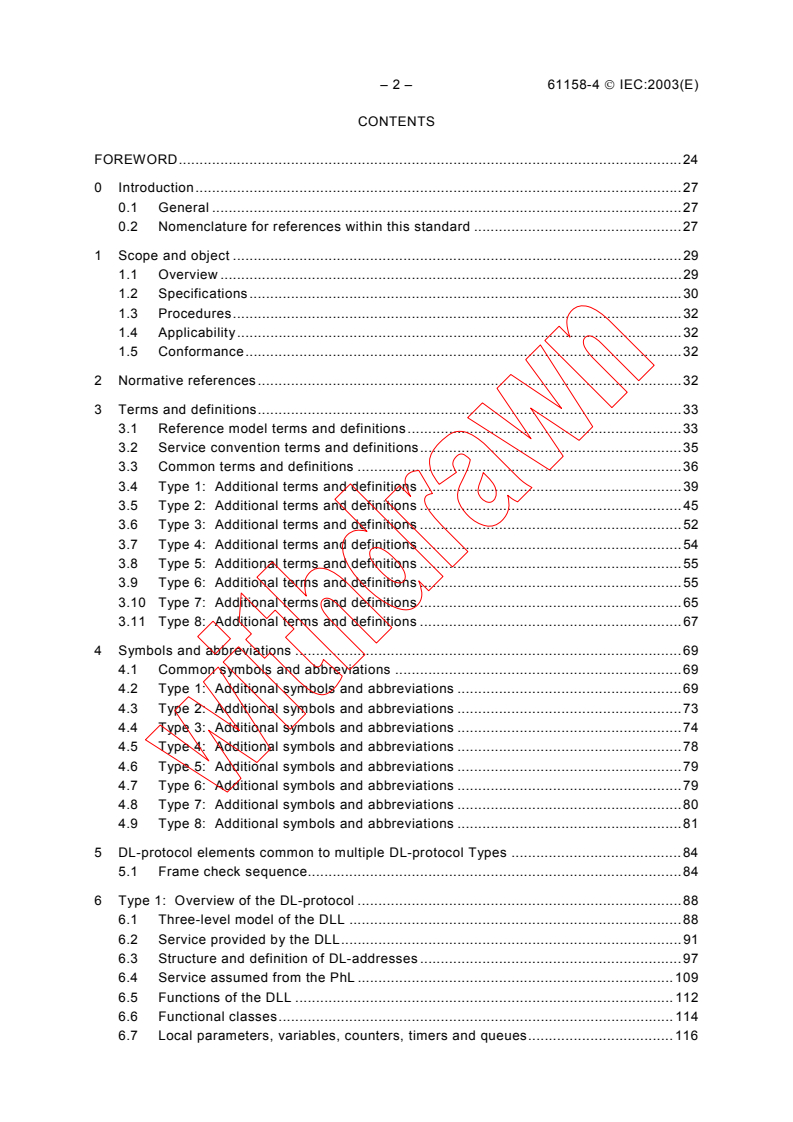
– 2 – 61158-4 IEC:2003(E)
CONTENTS
FOREWORD.24
0 Introduction.27
0.1 General .27
0.2 Nomenclature for references within this standard .27
1 Scope and object .29
1.1 Overview .29
1.2 Specifications.30
1.3 Procedures.32
1.4 Applicability.32
1.5 Conformance.32
2 Normative references.32
3 Terms and definitions.33
3.1 Reference model terms and definitions.33
3.2 Service convention terms and definitions.35
3.3 Common terms and definitions .36
3.4 Type 1: Additional terms and definitions .39
3.5 Type 2: Additional terms and definitions .45
3.6 Type 3: Additional terms and definitions .52
3.7 Type 4: Additional terms and definitions .54
3.8 Type 5: Additional terms and definitions .55
3.9 Type 6: Additional terms and definitions .55
3.10 Type 7: Additional terms and definitions .65
3.11 Type 8: Additional terms and definitions .67
4 Symbols and abbreviations .69
4.1 Common symbols and abbreviations .69
4.2 Type 1: Additional symbols and abbreviations .69
4.3 Type 2: Additional symbols and abbreviations .73
4.4 Type 3: Additional symbols and abbreviations .74
4.5 Type 4: Additional symbols and abbreviations .78
4.6 Type 5: Additional symbols and abbreviations .79
4.7 Type 6: Additional symbols and abbreviations .79
4.8 Type 7: Additional symbols and abbreviations .80
4.9 Type 8: Additional symbols and abbreviations .81
5 DL-protocol elements common to multiple DL-protocol Types .84
5.1 Frame check sequence.84
6 Type 1: Overview of the DL-protocol .88
6.1 Three-level model of the DLL .88
6.2 Service provided by the DLL.91
6.3 Structure and definition of DL-addresses .97
6.4 Service assumed from the PhL .109
6.5 Functions of the DLL .112
6.6 Functional classes.114
6.7 Local parameters, variables, counters, timers and queues.116
61158-4 IEC:2003(E) – 3 –
7 Type 1: General structure and encoding of PhIDUs and DLPDUs, and related
elements of procedure .130
7.1 PhIDU structure and encoding.130
7.2 Common DLPDU structure, encoding and elements of procedure .130
8 Type 1: DLPDU-specific structure, encoding and elements of procedure.139
8.1 Establish Connection (EC) DLPDU .141
8.2 Disconnect Connection (DC) DLPDU .143
8.3 Reset Connection (RC) DLPDU .146
8.4 Compel Acknowledgement (CA) DLPDU.147
8.5 Compel Data (CD) DLPDU .154
8.6 Exchange Data (ED) DLPDU .162
8.7 Data (DT) DLPDU.170
8.8 Status Response (SR) DLPDU .178
8.9 Compel Time (CT) DLPDU .181
8.10 Time Distribution (TD) DLPDU.182
8.11 Round-Trip-Delay Query (RQ) DLPDU.184
8.12 Round-Trip-Delay Reply (RR) DLPDU .186
8.13 Probe Node DL-address (PN) DLPDU.188
8.14 Probe Response (PR) DLPDU .191
8.15 Pass Token (PT) DLPDU .192
8.16 Execute Sequence (ES) DLPDU .201
8.17 Return Token (RT) DLPDU .208
8.18 Request Interval (RI) DLPDU.209
8.19 Claim LAS (CL) DLPDU.210
8.20 Transfer LAS (TL) DLPDU .212
8.21 Wakeup (WK) DLPDU.216
8.22 Idle (IDLE) DLPDU .217
8.23 Spare DLPDUs .218
8.24 Reserved (not to be used) DLPDUs .220
9 Type 1: DLPDU-parameter structure and encoding .221
9.1 Structure and encoding of EC-PARAMETERS .221
9.2 Structure and encoding of DC-PARAMETERS .226
9.3 Structure and encoding of RC-PARAMETERS .226
9.4 Structure and encoding of SD-Parameters.228
9.5 Structure and encoding of SR-parameters .235
9.6 Structure and encoding of TD-parameters .237
9.7 Structure and encoding of RQ-parameters.239
9.8 Structure and encoding of RR-parameters .240
9.9 Structure and encoding of PN-parameters .240
9.10 Structure and encoding of DD-parameters .242
10 Type 1: DL-service elements of procedure .243
10.1 Operation of the DL(SAP)-address, buffer and queue management services .243
10.2 Operation of the connection-mode services .247
10.3 Operation of the connectionless-mode services.288
10.4 Operation of the scheduling guidance services.300
– 4 – 61158-4 IEC:2003(E)
11 Type 1: DL-support subprotocol .310
11.1 Scope 310
11.2 Overview of LAS operation .310
11.3 DL-support subprotocol definition .311
11.4 Elements of Procedures for receiving SPDUs .345
12 Type 1: Other DLE elements of procedure.347
12.1 DLE initialization .347
12.2 LAS behavior and operation .351
12.3 DL-support operation.358
12.4 DL-bridge elements of procedure and bridge sub-protocol .363
12.5 DL-management-information .393
12.6 Implementation profiles .398
13 Type 1: PICS proforma.404
13.1 Introduction .404
13.2 Scope. 404
13.3 Normative references .404
13.4 Definitions .404
13.5 Abbreviations .404
13.6 Conformance.405
13.7 Instructions .405
13.8 Identification.406
13.9 Implementation profile .407
13.10 Major low-level capabilities.411
13.11 Major high-level capabilities .425
14 Type 2: Overview of the DL-protocol .434
14.1 General .434
14.2 Services provided by the DL.436
14.3 Structure and definition of DL-addresses .437
14.4 Services assumed from the PhL .439
14.5 Functional classes.441
15 Type 2: General structure and encoding of PhIDUs and DLPDUs and related
elements of procedure .442
15.1 Overview .442
15.2 Media access procedure.442
15.3 DLPDU structure and encoding .445
15.4 Lpacket components.447
15.5 DLPDU procedures.449
15.6 Summary of DLL support services and objects .450
16 Type 2: Specific DLPDU structure, encoding and procedures .453
16.1 Modeling language .453
16.2 DLS user services .455
16.3 Generic Tag Lpacket .461
16.4 Moderator Lpacket .461
16.5 Time distribution Lpacket.463
16.6 UCMM Lpacket.465
16.7 Keeper UCMM Lpacket.465
16.8 TUI Lpacket.466
61158-4 IEC:2003(E) – 5 –
16.9 Link parameters Lpacket and tMinus Lpacket .467
16.10 I’m alive Lpacket .469
16.11 Ping Lpackets.470
16.12 WAMI Lpacket .472
16.13 Debug Lpacket .472
17 Type 2: Objects for station management .474
17.1 General .474
17.2 ControlNet object .475
17.3 Keeper object .485
17.4 Scheduling object .508
17.5 TCP/IP interface object .517
17.6 Ethernet link object.524
18 Type 2: Other DLE elements of procedure .529
18.1 Network Attachment Monitor (NAM).529
18.2 Calculating link parameters .536
19 Type 2: Detailed specification of DL components .544
19.1 General .544
19.2 Access Control Machine (ACM) .544
19.3 TxLLC. 561
19.4 RxLLC. 565
19.5 Transmit Machine (TxM).568
19.6 Receive Machine (RxM).571
19.7 Serializer.577
19.8 Deserializer .578
19.9 DLL management .579
20 Type 3: Overview of the DL-protocol .582
20.1 General .582
20.2 Overview of the medium access control and transmission protocol .582
20.3 Transmission modes and DL-entity.583
20.4 Service assumed from the PhL .588
20.5 Operational elements .590
20.6 Cycle and system reaction times .605
21 Type 3: General structure and encoding of DLPDUs, and related elements of
procedure . 609
21.1 DLPDU granularity.609
21.2 Length octet (LE, LEr) .610
21.3 Address octet .610
21.4 Control octet (FC).613
21.5 DLPDU content error detection.616
21.6 DATA_UNIT .617
21.7 Error control procedures.618
22 Type 3: DLPDU-specific structure, encoding and elements of procedure .619
22.1 DLPDUs of fixed length with no data field .619
22.2 DLPDUs of fixed length with data field.621
22.3 DLPDUs with variable data field length.622
22.4 Token DLPDU .624
– 6 – 61158-4 IEC:2003(E)
22.5 ASP DLPDU .625
22.6 SYNCH DLPDU .625
22.7 Time Event (TE) DLPDU.625
22.8 Clock Value (CV) DLPDU .625
22.9 Transmission procedures .626
23 Type 3: Other DLE elements of procedure.629
23.1 DL-entity initialization .629
23.2 States of the media access control of the DL-entity .629
23.3 Clock synchronization protocol .635
24 Type 4: Data Link Protocol Definition .640
24.1 Overview of the DL-protocol .640
24.2 General structure and encoding of PhIDUs and DLPDUs, and related
elements of procedure.651
24.3 DLPDU-specific structure, encoding and elements of procedure .657
24.4 DL-service elements of procedure .661
24.5 Route mechanism.664
24.6 Link-access system .668
24.7 Local variables, counters and queues.668
25 Type 5: .671
26 Type 6: Connection-oriented DL-protocol and related matters .673
26.1 Connection mode data transfer using TDMA principles .673
26.2 Bus access and data transmission.673
26.3 Overview of bus synchronization .675
26.4 Connection mode data transfer.678
26.5 DLM-connectionless service .706
26.6 Other real-time services .720
26.7 Bridge architecture and operation.724
26.8 Bus configuration .726
26.9 Conformance.736
27 Type 6: MAC elements of procedure .738
27.1 Procedures related to bus startup and bus operation .738
27.2 Medium access control (MAC) .743
28 Type 7: Overview of the DL-protocol .746
28.1 Overall description of medium allocation .746
28.2 Types of entities .748
28.3 Addressing .751
28.4 Flow control.757
28.5 Graphical representation .759
29 Type 7: General structure and encoding of PhIDUs and DLPDUs and related
elements of procedure .760
29.1 DLPDU formats and components.760
29.2 Description of each DLPDU component .760
29.3 PhIDU structure and encoding.762
29.4 Common DLPDU structure, encoding and elements of procedure .763
29.5 Valid DLPDU types.763
29.6 DLL timers.765
61158-4 IEC:2003(E) – 7 –
30 Type 7: DLPDU-specific structure, encoding and element of procedure.771
30.1 General .771
30.2 Buffer read .771
30.3 Buffer write.771
30.4 Buffer transfer .771
30.5 Specified explicit request.772
30.6 Free explicit request.778
30.7 Messaging.781
30.8 Acknowledged messaging .786
30.9 Numbering of acknowledged messages .790
30.10 Behavior with mismatched parameters .792
31 Type 7: DL-service elements of procedure, interfaces and conformance .795
31.1 General .795
31.2 Producer/consumer entity.795
31.3 Protocol elements by service.798
31.4 Bus arbitrator operation.806
31.5 B r i d g e s . 8 1 3
31.6 Interfaces .820
31.7 Conformance.822
32 Type 8: DL-protocol .825
32.1 Overview .825
32.2 DL-service Interface (DLI) .825
32.3 Peripherals data link (PDL).829
32.4 Basic Link Layer (BLL) .864
32.5 Medium Access Control (MAC) .880
32.6 Peripherals network management for layer 2 (PNM2) .912
32.7 Parameters and monitoring times of the DLL .920
Annex A (informative) – Types 1, 2, 3 (synchronous), 5 (first FCS), 6, 7 and 8:
Exemplary FCS implementations.926
Annex B (informative) – Type 1: Formal protocol finite state machines.928
B.1 Basic reception and transmission FSMs .928
B.2 FSMs for DLCs.940
B.3 FSMs for scheduling.946
B.4 FSMs for bridges .946
Annex C (informative) – Type 1: DLPDU and DL-addressing short-form summaries .947
C.1 Fields used in short-form summaries .947
C.2 DLPDU short-form summary grouped by function .949
C.3 DLPDU short-form summary in alphabetic order of DLPDU names .951
C.4 DLPDU short-form summary in alphabetic order of DLPDU acronyms.952
C.5 DLPDU FC code-point assignment matrix – overview and detail .953
C.6 SD-parameters (status and data-description parameters) of CA, CD, ED and
DT DLPDUs.956
C.7 EC parameters of EC DLPDUs .959
C.8 Parameters of DC and RC DLPDUs.961
C.9 Parameters of TD, RQ and RR DLPDUs .963
C.10 Parameters of PN, PT, ES and RI DLPDUs .965
C.11 Addressing summary extracted from figures and tables of 6.3 .967
– 8 – 61158-4 IEC:2003(E)
Annex D (informative) – Type 2: Indicators and Switches.971
D.1 Purpose.971
D.2 General indicator requirements.971
D.3 Common indicator requirements .971
D.4 Module status indicator .972
D.5 Network status indicators .972
D.6 Switches.975
Annex E (normative) – Type 3: DL-Protocol state machines.977
E.1 Overall structure.977
E.2 Variation of state machines in different devices .979
E.3 DL Data Resource .979
E.4 FLC / DLM.984
E.5 MAC . 1009
E.6 SRU . 1038
Annex F (informative) – Type 3: Exemplary token procedure and message transfer
periods. 1056
F.1 Procedure of token passing . 1056
F.2 Examples for token passing procedure . 1057
F.3 Examples for message transfer periods – asynchronous transmission . 1061
F.4 Examples for message transfer periods – synchronous transmission. 1062
Annex G (informative) – Type 7: Object Modeling . 1063
G.1 Modeling of the IDENTIFIER object . 1063
G.2 Description of the IDENTIFIER object attributes . 1064
G.3 Modeling of the QUEUE object . 1068
G.4 Description of the QUEUE object attributes . 1068
G.5 Modeling of the BUFFER object. 1069
G.6 Description of the BUFFER object attributes. 1069
Annex H (informative) – Type 7: Topology of multi-segment DL-subnetwork . 1070
H.1 Introduction . 1070
H.2 Global specification . 1070
H.3 Local specification. 1071
H.4 Properties. 1071
H.5 Methods . 1072
Annex I (informative) – Type 7: Management of transmission errors . 1075
I.1 Transmission of RP_DAT_XX . 1075
I.2 Transmission of a free RP_RQ(1/2) . 1075
I.3 Transmission of the specified RP_RQ1. 1076
I.4 Transmission of RP_MSG_NOACK. 1077
I.5 Transmission of RP_MSG_ACK. 1079
Annex J (informative) – Type 8: Implementation possibilities of definite PNM2
functions . 1082
J.1 Acquiring the current configuration . 1082
J.2 Comparing the acquired and stored configurations prior to a DL-subnetwork
error . 1085
BIBLIOGRAPHY . 1092
INDEX . 1094
61158-4 IEC:2003(E) – 9 –
Figure 1 – Relationship of IEC 61158-4 to other fieldbus layers and to users of the
fieldbus Data Link service .27
Figure 2 – Relationships of DLSAPs, DLSAP-addresses and group DL-addresses .38
Figure 3 – Relationships of DLCEPs and DLCEP-addresses to DLSAPs, DLSAP-
addresses and group DL-addresses.40
Figure 4 – Basic Structure of a DL-address.98
Figure 5 – Basic Structure of a Sublink Selector .98
Figure 6 – DL-address Alternative Structures.99
Figure 7 – Basic Structure of MAC-addresses.109
Figure 8 – Representation of a DL-address as a MAC-address .109
Figure 9 – Linear relationships of sending and receiving DLCEP sequence-number
variables.122
Figure 10 – DL-address alternative structures.133
Figure 11 – SHORT DL-address field – alternative implicit structures.133
Figure 12 – NODE DL-address field – implicit structure .134
Figure 13 – State transition diagram for a DLCEP.247
Figure 14 – Projection of the sending and receiving DLCEP sequence-number variables
of Figure 9 onto the cyclic sequence-number parameters of CA, CD, DT, ED and
RC DLPDUs, with consequent determination of required actions.264
Figure 15 – State transitions of a DLE .347
Figure 16 – Bridged network topology.364
Figure 17 – Spanning tree representation .365
Figure 18 – DLSDU transit delay, DLPDU lifetime and bridge forwarding delay.369
Figure 19 – Forwarding and delivering a received DLPDU .373
Figure 20 – Forwarding a locally-originated DLPDU .374
Figure 21 – Republishing a DLSDU received from another link .375
Figure 22 – Bridge architecture.376
Figure 23 – Replacement for [IL] Fig 3-2 Bridge ports .385
Figure 24 – Replacement for [IL] Fig 3-3 Bridge architecture .386
Figure 25 – Data Link Layer internal architecture .435
Figure 26 – Basic Structure of a MAC ID address .437
Figure 27 – Basic Structure of a Generic tag address .437
Figure 28 – Basic Structure of a Fixed tag address .438
Figure 29 – M_symbols and Manchester encoding at 5 MHz (informative).439
Figure 30 – NUT structure.443
Figure 31 – Media access during scheduled time .443
Figure 32 – Media access during unscheduled time .
...