

IEC 61158-4-14:2007
(Main)Industrial communication networks - Fieldbus specifications - Part 4-14: Data-link layer protocol specification - Type 14 elements
General Information
- Abstract
IEC 61158-4-14:2007 specifies
- procedures for the timely transfer of data and control information from one data-link user entity to a peer user entity, and among the data-link entities forming the distributed data-link service provider;
- procedures for giving communications opportunities to all participating DL entities, sequentially and in a cyclic manner for deterministic and synchronized transfer at cyclic intervals up to one millisecond;
- procedures for giving communication opportunities available for time-critical data transmission together with non-time-critical data transmission without prejudice to the time-critical data transmission;
- procedures for giving cyclic and acyclic communication opportunities for time-critical data transmission with prioritized access;
- procedures for giving communication opportunities based on standard ISO/IEC 8802-3 medium access control, with provisions for nodes to be added or removed during normal operation;
- the structure of the fieldbus DLPDUs used for the transfer of data and control information by the protocol of this standard, and their representation as physical interface data units. This first edition and its companion parts of the IEC 61158-4 subseries cancel and replace IEC 61158-4:2003 and constitutes a technical addition. This part and its Type 14 companion parts also cancel and replace IEC/PAS 62409, published in 2005. This edition includes the following changes:
- deletion of the former Type 6 fieldbus, and the placeholder for a Type 5 fieldbus data link layer, for lack of market relevance;
- addition of new types of fieldbuses;
- division of this part into multiple parts numbered -4 1, -4 2, , -4-19. This bilingual version (2015-06) corresponds to the English version, published in 2007-12.
- Status
- Published
- Publication Date
- 13-Dec-2007
- Technical Committee
- SC 65C - Industrial networks
- Drafting Committee
- WG 9 - TC 65/SC 65C/WG 9
- Current Stage
- DELPUB - Deleted Publication
- Start Date
- 05-Aug-2010
- Completion Date
- 28-Aug-2026
Buy Documents
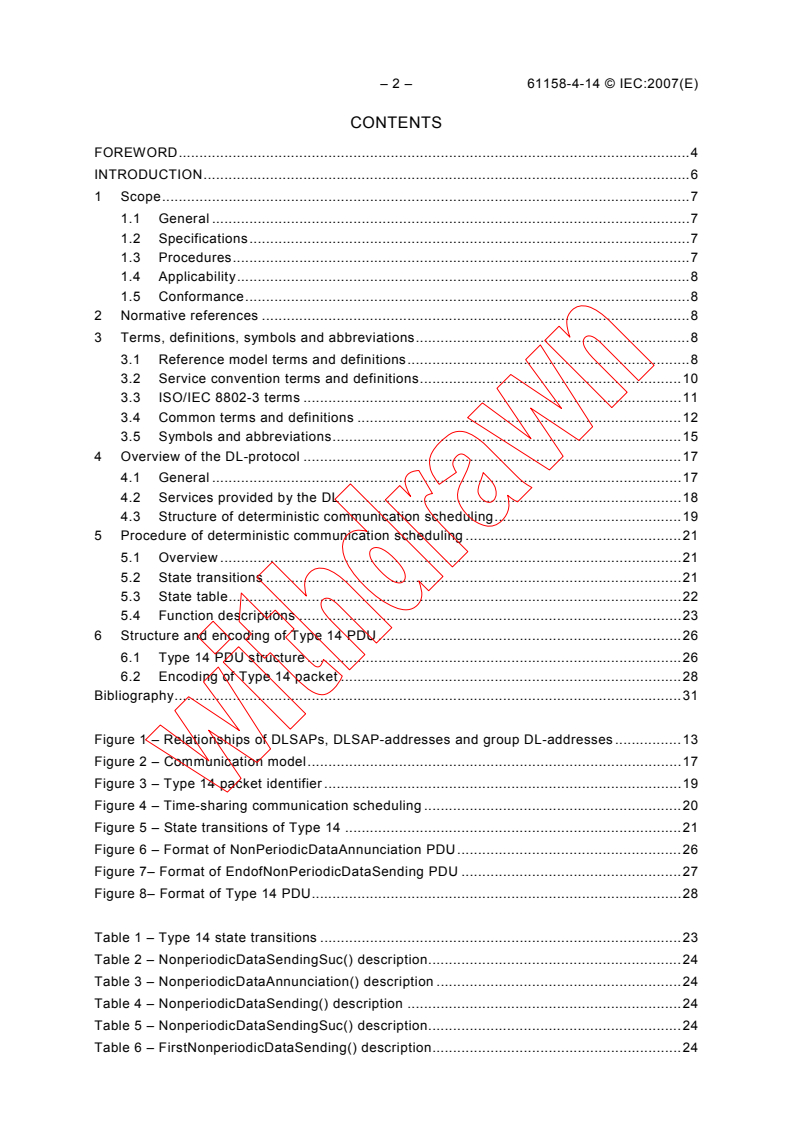
IEC 61158-4-14:2007 - Industrial communication networks - Fieldbus specifications - Part 4-14: Data-link layer protocol specification - Type 14 elements Released:12/14/2007
IEC 61158-4-14:2007 - Industrial communication networks - Fieldbus specifications - Part 4-14: Data-link layer protocol specification - Type 14 elements Released:12/14/2007
Overview
IEC 61158-4-14:2007 is an international standard that defines the data-link layer protocol (Type 14) for industrial fieldbus communications. It specifies the rules and procedures that enable timely, deterministic transfer of data and control information between peer data-link user entities (DLEs) and among the distributed data-link service providers. The protocol supports synchronized cyclic operation (restarted synchronously each cycle) with cyclic intervals up to one millisecond, and combines time‑critical and non‑time‑critical traffic with prioritized access.
Key topics and technical requirements
- Deterministic communication scheduling: Sequential, cyclic allocation of communication opportunities to participating DL entities for synchronized, predictable transfers.
- Cyclic and acyclic access: Support for both periodic (cyclic) and event-driven (acyclic) messaging within the same cycle.
- Time-critical vs non-time-critical traffic: Mechanisms to ensure time-critical data is transmitted without prejudice from non-time-critical traffic; prioritized access and timing guarantees.
- Integration with ISO/IEC 8802-3 MAC: Medium access control based on standard Ethernet MAC (ISO/IEC 8802-3) with provisions for nodes to be added or removed during normal operation (hot‑plugging).
- PDU/DLPDU structure and encoding: Definition of the fieldbus Data-Link Protocol Data Units (DLPDUs) and their mapping to physical interface data units for reliable transfer of data/control information.
- Synchronous cycle restart: Cycles start synchronously across nodes, enabling deterministic timing behavior for distributed automation.
- Conformance and applicability: Procedures expressed as interactions between peer DLEs (via fieldbus DLPDUs) and between DL-service providers and users (via DLS primitives).
Applications and who uses it
IEC 61158-4-14 is targeted at systems requiring strict timing and determinism in industrial communications:
- Factory and process automation where real‑time control and synchronized data exchange are essential.
- Distributed control systems, motion control networks, and I/O subsystems using fieldbus technologies.
- Device and module manufacturers implementing Type 14 data-link functionality in controllers, I/O modules, and industrial Ethernet interfaces.
- System integrators, test laboratories, procurement teams and standards engineers who need specifications for interoperability, testing and acceptance.
Related standards
- IEC 61158 series (Fieldbus specifications) - the broader family defining multiple protocol types.
- IEC 61158-1 - fieldbus reference model (three-layer model).
- IEC 61784 - profiles and permitted protocol combinations (licensing/IPR constraints).
- ISO/IEC 8802-3 - Ethernet MAC standard used as the basis for medium access.
Note: Some protocol elements are subject to patent claims (e.g., scheduling method for deterministic Ethernet by Zhejiang SUPCON). Users should verify intellectual property and licensing requirements when implementing Type 14 solutions.
Relations
- Effective Date
- 05-Sep-2023
- Effective Date
- 05-Sep-2023
- Effective Date
- 05-Sep-2023
- Effective Date
- 05-Sep-2023
Buy Documents
IEC 61158-4-14:2007 - Industrial communication networks - Fieldbus specifications - Part 4-14: Data-link layer protocol specification - Type 14 elements Released:12/14/2007
IEC 61158-4-14:2007 - Industrial communication networks - Fieldbus specifications - Part 4-14: Data-link layer protocol specification - Type 14 elements Released:12/14/2007
Get Certified
Connect with accredited certification bodies for this standard

BSI Group
BSI (British Standards Institution) is the business standards company that helps organizations make excellence a habit.

DVS-ZERT GmbH
German welding certification society.
CARES (UK Certification Authority for Reinforcing Steels)
UK certification for reinforcing steels and construction.
Sponsored listings
Frequently Asked Questions
IEC 61158-4-14:2007 is a standard published by the International Electrotechnical Commission (IEC). Its full title is "Industrial communication networks - Fieldbus specifications - Part 4-14: Data-link layer protocol specification - Type 14 elements". This standard covers: IEC 61158-4-14:2007 specifies - procedures for the timely transfer of data and control information from one data-link user entity to a peer user entity, and among the data-link entities forming the distributed data-link service provider; - procedures for giving communications opportunities to all participating DL entities, sequentially and in a cyclic manner for deterministic and synchronized transfer at cyclic intervals up to one millisecond; - procedures for giving communication opportunities available for time-critical data transmission together with non-time-critical data transmission without prejudice to the time-critical data transmission; - procedures for giving cyclic and acyclic communication opportunities for time-critical data transmission with prioritized access; - procedures for giving communication opportunities based on standard ISO/IEC 8802-3 medium access control, with provisions for nodes to be added or removed during normal operation; - the structure of the fieldbus DLPDUs used for the transfer of data and control information by the protocol of this standard, and their representation as physical interface data units. This first edition and its companion parts of the IEC 61158-4 subseries cancel and replace IEC 61158-4:2003 and constitutes a technical addition. This part and its Type 14 companion parts also cancel and replace IEC/PAS 62409, published in 2005. This edition includes the following changes: - deletion of the former Type 6 fieldbus, and the placeholder for a Type 5 fieldbus data link layer, for lack of market relevance; - addition of new types of fieldbuses; - division of this part into multiple parts numbered -4 1, -4 2, , -4-19. This bilingual version (2015-06) corresponds to the English version, published in 2007-12.
IEC 61158-4-14:2007 specifies - procedures for the timely transfer of data and control information from one data-link user entity to a peer user entity, and among the data-link entities forming the distributed data-link service provider; - procedures for giving communications opportunities to all participating DL entities, sequentially and in a cyclic manner for deterministic and synchronized transfer at cyclic intervals up to one millisecond; - procedures for giving communication opportunities available for time-critical data transmission together with non-time-critical data transmission without prejudice to the time-critical data transmission; - procedures for giving cyclic and acyclic communication opportunities for time-critical data transmission with prioritized access; - procedures for giving communication opportunities based on standard ISO/IEC 8802-3 medium access control, with provisions for nodes to be added or removed during normal operation; - the structure of the fieldbus DLPDUs used for the transfer of data and control information by the protocol of this standard, and their representation as physical interface data units. This first edition and its companion parts of the IEC 61158-4 subseries cancel and replace IEC 61158-4:2003 and constitutes a technical addition. This part and its Type 14 companion parts also cancel and replace IEC/PAS 62409, published in 2005. This edition includes the following changes: - deletion of the former Type 6 fieldbus, and the placeholder for a Type 5 fieldbus data link layer, for lack of market relevance; - addition of new types of fieldbuses; - division of this part into multiple parts numbered -4 1, -4 2, , -4-19. This bilingual version (2015-06) corresponds to the English version, published in 2007-12.
IEC 61158-4-14:2007 is classified under the following ICS (International Classification for Standards) categories: 25.040.40 - Industrial process measurement and control; 35.100.20 - Data link layer. The ICS classification helps identify the subject area and facilitates finding related standards.
IEC 61158-4-14:2007 has the following relationships with other standards: It is inter standard links to IEC PAS 62409:2005, IEC 61158-4:2003, IEC 61158-4:2003/COR1:2004, IEC 61158-4-14:2010. Understanding these relationships helps ensure you are using the most current and applicable version of the standard.
IEC 61158-4-14:2007 is available in PDF format for immediate download after purchase. The document can be added to your cart and obtained through the secure checkout process. Digital delivery ensures instant access to the complete standard document.
Standards Content (Sample)
IEC 61158-4-14
Edition 1.0 2007-12
INTERNATIONAL
STANDARD
Industrial communication networks – Fieldbus specifications –
Part 4-14: Data-link layer protocol specification – Type 14 elements
All rights reserved. Unless otherwise specified, no part of this publication may be reproduced or utilized in any form
or by any means, electronic or mechanical, including photocopying and microfilm, without permission in writing from
either IEC or IEC's member National Committee in the country of the requester.
If you have any questions about IEC copyright or have an enquiry about obtaining additional rights to this publication,
please contact the address below or your local IEC member National Committee for further information.
IEC Central Office
3, rue de Varembé
CH-1211 Geneva 20
Switzerland
Email: inmail@iec.ch
Web: www.iec.ch
About the IEC
The International Electrotechnical Commission (IEC) is the leading global organization that prepares and publishes
International Standards for all electrical, electronic and related technologies.
About IEC publications
The technical content of IEC publications is kept under constant review by the IEC. Please make sure that you have the
latest edition, a corrigenda or an amendment might have been published.
ƒ Catalogue of IEC publications: www.iec.ch/searchpub
The IEC on-line Catalogue enables you to search by a variety of criteria (reference number, text, technical committee,…).
It also gives information on projects, withdrawn and replaced publications.
ƒ IEC Just Published: www.iec.ch/online_news/justpub
Stay up to date on all new IEC publications. Just Published details twice a month all new publications released. Available
on-line and also by email.
ƒ Electropedia: www.electropedia.org
The world's leading online dictionary of electronic and electrical terms containing more than 20 000 terms and definitions
in English and French, with equivalent terms in additional languages. Also known as the International Electrotechnical
Vocabulary online.
ƒ Customer Service Centre: www.iec.ch/webstore/custserv
If you wish to give us your feedback on this publication or need further assistance, please visit the Customer Service
Centre FAQ or contact us:
Email: csc@iec.ch
Tel.: +41 22 919 02 11
Fax: +41 22 919 03 00
IEC 61158-4-14
Edition 1.0 2007-12
INTERNATIONAL
STANDARD
Industrial communication networks – Fieldbus specifications –
Part 4-14: Data-link layer protocol specification – Type 14 elements
INTERNATIONAL
ELECTROTECHNICAL
COMMISSION
PRICE CODE
V
ICS 35.100.20; 25.040.40 ISBN 2-8318-9438-7
– 2 – 61158-4-14 © IEC:2007(E)
CONTENTS
FOREWORD.4
INTRODUCTION.6
1 Scope.7
1.1 General .7
1.2 Specifications.7
1.3 Procedures.7
1.4 Applicability.8
1.5 Conformance.8
2 Normative references .8
3 Terms, definitions, symbols and abbreviations.8
3.1 Reference model terms and definitions.8
3.2 Service convention terms and definitions.10
3.3 ISO/IEC 8802-3 terms .11
3.4 Common terms and definitions .12
3.5 Symbols and abbreviations.15
4 Overview of the DL-protocol .17
4.1 General .17
4.2 Services provided by the DL.18
4.3 Structure of deterministic communication scheduling.19
5 Procedure of deterministic communication scheduling .21
5.1 Overview .21
5.2 State transitions .21
5.3 State table.22
5.4 Function descriptions .23
6 Structure and encoding of Type 14 PDU.26
6.1 Type 14 PDU structure .26
6.2 Encoding of Type 14 packet .28
Bibliography.31
Figure 1 – Relationships of DLSAPs, DLSAP-addresses and group DL-addresses .13
Figure 2 – Communication model.17
Figure 3 – Type 14 packet identifier .19
Figure 4 – Time-sharing communication scheduling .20
Figure 5 – State transitions of Type 14 .21
Figure 6 – Format of NonPeriodicDataAnnunciation PDU.26
Figure 7– Format of EndofNonPeriodicDataSending PDU .27
Figure 8– Format of Type 14 PDU.28
Table 1 – Type 14 state transitions .23
Table 2 – NonperiodicDataSendingSuc() description.24
Table 3 – NonperiodicDataAnnunciation() description .24
Table 4 – NonperiodicDataSending() description .24
Table 5 – NonperiodicDataSendingSuc() description.24
Table 6 – FirstNonperiodicDataSending() description.24
61158-4-14 © IEC:2007(E) – 3 –
Table 7 – NonperiodicDataPriority() description .25
Table 8 – NonperiodicDataTimeEnough() description.25
Table 9 – NonperiodicDataSending() description .25
Table 10 – EndOfNonperiodicDataSending() description.25
Table 11 – IsDeviceConfigured() description.25
Table 12 – CountOffsetTime() description.26
Table 13 – DataSendingTiming() description.26
Table 14 – RecEndofNonPeriodicDataSending() description .26
Table 15 – NonPeriodicDataAnnunciation message encoding .29
Table 16 – EndofNonPeriodicDataSending message encoding.29
Table 17 – Type 14 message encoding .30
– 4 – 61158-4-14 © IEC:2007(E)
INTERNATIONAL ELECTROTECHNICAL COMMISSION
____________
INDUSTRIAL COMMUNICATION NETWORKS –
FIELDBUS SPECIFICATIONS –
Part 4-14: Data-link layer protocol specification – Type 14 elements
FOREWORD
1) The International Electrotechnical Commission (IEC) is a worldwide organization for standardization comprising
all national electrotechnical committees (IEC National Committees). The object of IEC is to promote
international co-operation on all questions concerning standardization in the electrical and electronic fields. To
this end and in addition to other activities, IEC publishes International Standards, Technical Specifications,
Technical Reports, Publicly Available Specifications (PAS) and Guides (hereafter referred to as “IEC
Publication(s)”). Their preparation is entrusted to technical committees; any IEC National Committee interested
in the subject dealt with may participate in this preparatory work. International, governmental and non-
governmental organizations liaising with the IEC also participate in this preparation. IEC collaborates closely
with the International Organization for Standardization (ISO) in accordance with conditions determined by
agreement between the two organizations.
2) The formal decisions or agreements of IEC on technical matters express, as nearly as possible, an international
consensus of opinion on the relevant subjects since each technical committee has representation from all
interested IEC National Committees.
3) IEC Publications have the form of recommendations for international use and are accepted by IEC National
Committees in that sense. While all reasonable efforts are made to ensure that the technical content of IEC
Publications is accurate, IEC cannot be held responsible for the way in which they are used or for any
misinterpretation by any end user.
4) In order to promote international uniformity, IEC National Committees undertake to apply IEC Publications
transparently to the maximum extent possible in their national and regional publications. Any divergence
between any IEC Publication and the corresponding national or regional publication shall be clearly indicated in
the latter.
5) IEC provides no marking procedure to indicate its approval and cannot be rendered responsible for any
equipment declared to be in conformity with an IEC Publication.
6) All users should ensure that they have the latest edition of this publication.
7) No liability shall attach to IEC or its directors, employees, servants or agents including individual experts and
members of its technical committees and IEC National Committees for any personal injury, property damage or
other damage of any nature whatsoever, whether direct or indirect, or for costs (including legal fees) and
expenses arising out of the publication, use of, or reliance upon, this IEC Publication or any other IEC
Publications.
8) Attention is drawn to the Normative references cited in this publication. Use of the referenced publications is
indispensable for the correct application of this publication.
NOTE Use of some of the associated protocol types is restricted by their intellectual-property-right holders. In all
cases, the commitment to limited release of intellectual-property-rights made by the holders of those rights permits
a particular data-link layer protocol type to be used with physical layer and application layer protocols in Type
combinations as specified explicitly in the IEC 61784 series. Use of the various protocol types in other
combinations may require permission from their respective intellectual-property-right holders.
IEC draws attention to the fact that it is claimed that compliance with this standard may involve the use of patents
as follows, where the [xx] notation indicates the holder of the patent right:
Type 14 and possibly other Types:
CN200410088676.7 [SP] Scheduling method with deterministic communication based on Ethernet
IEC takes no position concerning the evidence, validity and scope of these patent rights.
The holders of these patent rights have assured IEC that they are willing to negotiate licences under reasonable
and non-discriminatory terms and conditions with applicants throughout the world. In this respect, the statement of
the holders of these patent rights are registered with IEC. Information may be obtained from:
[SP] Zhejiang SUPCON Technology Co., Ltd.
Dongqin FENG
Liuhe Road 309, Bingjiang District,
Hangzhou, 310053
CHINA
Attention is drawn to the possibility that some of the elements of this standard may be the subject of patent rights
other than those identified above. IEC shall not be held responsible for identifying any or all such patent rights.
61158-4-14 © IEC:2007(E) – 5 –
International Standard IEC 61158-4-14 has been prepared by subcommittee 65C: Industrial
networks, of IEC technical committee 65: Industrial-process measurement, control and
automation.
This first edition and its companion parts of the IEC 61158-4 subseries cancel and replace
IEC 61158-4:2003. This edition of this part constitutes a technical addition. This part and its
Type 14 companion parts also cancel and replace IEC/PAS 62409, published in 2005.
This edition of IEC 61158-4 includes the following significant changes from the previous
edition:
a) deletion of the former Type 6 fieldbus, and the placeholder for a Type 5 fieldbus data link
layer, for lack of market relevance;
b) addition of new types of fieldbuses;
c) division of this part into multiple parts numbered -4-1, -4-2, …, -4-19.
The text of this standard is based on the following documents:
FDIS Report on voting
65C/474/FDIS 65C/485/RVD
Full information on the voting for the approval of this standard can be found in the report on
voting indicated in the above table.
This publication has been drafted in accordance with ISO/IEC Directives, Part 2.
The committee has decided that the contents of this publication will remain unchanged until
the maintenance result date indicated on the IEC web site under http://webstore.iec.ch in the
data related to the specific publication. At this date, the publication will be:
• reconfirmed;
• withdrawn;
• replaced by a revised edition, or
• amended.
NOTE The revision of this standard will be synchronized with the other parts of the IEC 61158 series.
The list of all the parts of the IEC 61158 series, under the general title Industrial
communication networks – Fieldbus specifications, can be found on the IEC web site.
– 6 – 61158-4-14 © IEC:2007(E)
INTRODUCTION
This part of IEC 61158 is one of a series produced to facilitate the interconnection of
automation system components. It is related to other standards in the set as defined by the
“three-layer” fieldbus reference model described in IEC 61158-1.
The data-link protocol provides the data-link service by making use of the services available
from the physical layer. The primary aim of this standard is to provide a set of rules for
communication expressed in terms of the procedures to be carried out by peer data-link
entities (DLEs) at the time of communication. These rules for communication are intended to
provide a sound basis for development in order to serve a variety of purposes:
a) as a guide for implementors and designers;
b) for use in the testing and procurement of equipment;
c) as part of an agreement for the admittance of systems into the open systems environment;
d) as a refinement to the understanding of time-critical communications within OSI.
This standard is concerned, in particular, with the communication and interworking of sensors,
effectors and other automation devices. By using this standard together with other standards
positioned within the OSI or fieldbus reference models, otherwise incompatible systems may
work together in any combination.
61158-4-14 © IEC:2007(E) – 7 –
INDUSTRIAL COMMUNICATION NETWORKS –
FIELDBUS SPECIFICATIONS –
Part 4-14: Data-link layer protocol specification – Type 14 elements
1 Scope
1.1 General
The data-link layer provides basic time-critical messaging communications between devices in
an automation environment.
This protocol provides communication opportunities to all participating data-link entities
a) in a synchronously-starting cyclic manner, according to a pre-established schedule, and
b) in a cyclic or acyclic asynchronous manner, as requested each cycle by each of those
data-link entities.
Thus this protocol can be characterized as one which provides cyclic and acyclic access
asynchronously but with a synchronous restart of each cycle.
1.2 Specifications
This standard specifies
a) procedures for the timely transfer of data and control information from one data-link user
entity to a peer user entity, and among the data-link entities forming the distributed data-
link service provider;
b) procedures for giving communications opportunities to all participating DL-entities,
sequentially and in a cyclic manner for deterministic and synchronized transfer at cyclic
intervals up to one millisecond;
c) procedures for giving communication opportunities available for time-critical data
transmission together with non-time-critical data transmission without prejudice to the
time-critical data transmission;
d) procedures for giving cyclic and acyclic communication opportunities for time-critical data
transmission with prioritized access;
e) procedures for giving communication opportunities based on standard ISO/ IEC 8802-3
medium access control, with provisions for nodes to be added or removed during normal
operation;
f) the structure of the fieldbus DLPDUs used for the transfer of data and control information
by the protocol of this standard, and their representation as physical interface data units.
1.3 Procedures
The procedures are defined in terms of
a) the interactions between peer DL-entities (DLEs) through the exchange of fieldbus
DLPDUs;
b) the interactions between a DL-service (DLS) provider and a DLS-user in the same system
through the exchange of DLS primitives;
c) the interactions between a DLS-provider and a Ph-service provider in the same system
through the exchange of Ph-service primitives.
– 8 – 61158-4-14 © IEC:2007(E)
1.4 Applicability
These procedures are applicable to instances of communication between systems which
support time-critical communications services within the data-link layer of the OSI or fieldbus
reference models, and which require the ability to interconnect in an open systems
interconnection environment.
Profiles provide a simple multi-attribute means of summarizing an implementation’s
capabilities, and thus its applicability to various time-critical communications needs.
1.5 Conformance
This standard also specifies conformance requirements for systems implementing these
procedures. This standard does not contain tests to demonstrate compliance with such
requirements.
2 Normative references
The following referenced documents are indispensable for the application of this standard. For
dated references, only the edition cited applies. For undated references, the latest edition of
the referenced document (including any amendments) applies.
IEC 61158-3-14, Industrial communication networks – Fieldbus specifications - Part 3-14:
Data-link layer service definition – Type 14 elements
ISO/IEC 7498-1, Information technology – Open Systems Interconnection – Basic Reference
Model: The Basic Model
ISO/IEC 7498-3, Information technology – Open Systems Interconnection – Basic Reference
Model: Naming and addressing
ISO/IEC 8802-3, Information technology – Telecommunications and information exchange
between systems – Local and metropolitan area networks – Specific requirements – Part 3:
Carrier sense multiple access with collision detection (CSMA/CD) access method and
physical layer specifications
ISO/IEC 8824-1, Information technology – Abstract Syntax Notation One (ASN.1):
Specification of basic notation
ISO/IEC 10731, Information technology – Open Systems Interconnection – Basic Reference
Model – Conventions for the definition of OSI services
RFC 768, User Datagram Protocol
RFC 791, Internet protocol
3 Terms, definitions, symbols and abbreviations
For the purposes of this standard, the following terms, definitions, symbols and abbreviations
apply.
3.1 Reference model terms and definitions
This standard is based in part on the concepts developed in ISO/IEC 7498-1 and ISO/IEC
7498-3, and makes use of the following terms defined therein.
61158-4-14 © IEC:2007(E) – 9 –
3.1.1 called-DL-address [7498-3]
3.1.2 calling-DL-address [7498-3]
3.1.3 centralized multi-end-point-connection [7498-1]
3.1.4 correspondent (N)-entities [7498-1]
correspondent DL-entities (N=2)
correspondent Ph-entities (N=1)
3.1.5 demultiplexing [7498-1]
3.1.6 DL-address [7498-3]
3.1.7 DL-address-mapping [7498-1]
3.1.8 DL-connection [7498-1]
3.1.9 DL-connection-end-point [7498-1]
3.1.10 DL-connection-end-point-identifier [7498-1]
3.1.11 DL-connection-mode transmission [7498-1]
3.1.12 DL-connectionless-mode transmission [7498-1]
3.1.13 DL-data-sink [7498-1]
3.1.14 DL-data-source [7498-1]
3.1.15 DL-duplex-transmission [7498-1]
3.1.16 DL-facility [7498-1]
3.1.17 DL-local-view [7498-3]
3.1.18 DL-name [7498-3]
3.1.19 DL-protocol [7498-1]
3.1.20 DL-protocol-connection-identifier [7498-1]
3.1.21 DL-protocol-control-information [7498-1]
3.1.22 DL-protocol-data-unit [7498-1]
3.1.23 DL-protocol-version-identifier [7498-1]
3.1.24 DL-relay [7498-1]
3.1.25 DL-service-connection-identifier [7498-1]
3.1.26 DL-service-data-unit [7498-1]
3.1.27 DL-simplex-transmission [7498-1]
3.1.28 DL-subsystem [7498-1]
3.1.29 DL-user-data [7498-1]
3.1.30 flow control [7498-1]
3.1.31 layer-management [7498-1]
3.1.32 multiplexing [7498-3]
– 10 – 61158-4-14 © IEC:2007(E)
3.1.33 naming-(addressing)-authority [7498-3]
3.1.34 naming-(addressing)-domain [7498-3]
3.1.35 naming-(addressing)-subdomain [7498-3]
3.1.36 (N)-entity [7498-1]
DL-entity
Ph-entity
3.1.37 (N)-interface-data-unit [7498-1]
DL-service-data-unit (N=2)
Ph-interface-data-unit (N=1)
3.1.38 (N)-layer [7498-1]
DL-layer (N=2)
Ph-layer (N=1)
3.1.39 (N)-service [7498-1]
DL-service (N=2)
Ph-service (N=1)
3.1.40 (N)-service-access-point [7498-1]
DL-service-access-point (N=2)
Ph-service-access-point (N=1)
3.1.41 (N)-service-access-point-address [7498-1]
DL-service-access-point-address (N=2)
Ph-service-access-point-address (N=1)
3.1.42 peer-entities [7498-1]
3.1.43 Ph-interface-control-information [7498-1]
3.1.44 Ph-interface-data [7498-1]
3.1.45 primitive name [7498-3]
3.1.46 reassembling [7498-1]
3.1.47 recombining [7498-1]
3.1.48 reset [7498-1]
3.1.49 responding-DL-address [7498-3]
3.1.50 routing [7498-1]
3.1.51 segmenting [7498-1]
3.1.52 sequencing [7498-1]
3.1.53 splitting [7498-1]
3.1.54 synonymous name [7498-3]
3.1.55 systems-management [7498-1]
3.2 Service convention terms and definitions
This standard also makes use of the following terms defined in ISO/IEC 10731 as they apply
to the data-link layer:
61158-4-14 © IEC:2007(E) – 11 –
3.2.1 acceptor
3.2.2 asymmetrical service
3.2.3 confirm (primitive);
requestor.deliver (primitive)
3.2.4 deliver (primitive)
3.2.5 DL-confirmed-facility
3.2.6 DL-facility
3.2.7 DL-local-view
3.2.8 DL-mandatory-facility
3.2.9 DL-non-confirmed-facility
3.2.10 DL-provider-initiated-facility
3.2.11 DL-provider-optional-facility
3.2.12 DL-service-primitive;
primitive
3.2.13 DL-service-provider
3.2.14 DL-service-user
3.2.15 DL-user-optional-facility
3.2.16 indication (primitive)
acceptor.deliver (primitive)
3.2.17 multi-peer
3.2.18 request (primitive);
requestor.submit (primitive)
3.2.19 requestor
3.2.20 response (primitive);
acceptor.submit (primitive)
3.2.21 submit (primitive)
3.2.22 symmetrical service
3.3 ISO/IEC 8802-3 terms
This standard also makes use of the following terms defined in ISO/IEC 8802-3 as they apply
to the data-link layer:
– 12 – 61158-4-14 © IEC:2007(E)
3.3.1 destination address
3.3.2 frame check sequence
3.3.3 length/type
3.3.4 MAC frame
3.3.5 pad
3.3.6 source address
3.4 Common terms and definitions
NOTE Many definitions are common to more than one protocol Type; they are not necessarily used by all protocol
Types.
3.4.1
communication macrocycle
set of basic cycles needed for a configured communication activity in a macro network
segment
3.4.2
communication phase
elapsed fraction of a cycle, measured from some fixed origin
3.4.3
communication scheduling
algorithms and operation for data transfers occurring in a deterministic and repeatable
manner
3.4.4
cyclic
repetitive in a regular manner
3.4.5
data DLPDU
DLPDU that carries a DLSDU from a local DLS-user to a remote DLS-user
3.4.6
destination FB Instance
FB instance that receives the specified parameters
3.4.7
DL-segment, link, local link
single DL-subnetwork in which any of the connected DLEs may communicate directly, without
any intervening DL-relaying, whenever all of those DLEs that are participating in an instance
of communication are simultaneously attentive to the DL-subnetwork during the period(s) of
attempted communication
3.4.8
DLSAP
distinctive point at which DL-services are provided by a single DL-entity to a single higher-
layer entity.
NOTE This definition, derived from ISO/IEC 7498-1, is repeated here to facilitate understanding of the critical
distinction between DLSAPs and their DL-addresses. (See Figure 1.)
61158-4-14 © IEC:2007(E) – 13 –
DLS-user-entity
DLS-user-entity
DLS-users
DLSAP DLSAP DLSAP
DLSAP-
address DLSAP-
DLSAP-
group DL-
address
addresses
address
DL-layer
DL-entity
PhSA P PhSA P
Ph-layer
NOTE 1 DLSAPs and PhSAPs are depicted as ovals spanning the boundary between two adjacent layers.
NOTE 2 DL-addresses are depicted as designating small gaps (points of access) in the DLL portion of a DLSAP.
NOTE 3 A single DL-entity may have multiple DLSAP-addresses and group DL-addresses associated with a
single DLSAP.
Figure 1 – Relationships of DLSAPs, DLSAP-addresses and group DL-addresses
3.4.9
DL(SAP)-address
either an individual DLSAP-address, designating a single DLSAP of a single DLS-user, or a
group DL-address potentially designating multiple DLSAPs, each of a single DLS-user.
NOTE This terminology is chosen because ISO/IEC 7498-3 does not permit the use of the term DLSAP-address to
designate more than a single DLSAP at a single DLS-user
3.4.10
(individual) DLSAP-address
DL-address that designates only one DLSAP within the extended link
NOTE A single DL-entity may have multiple DLSAP-addresses associated with a single DLSAP.
3.4.11
extended link
DL-subnetwork, consisting of the maximal set of links interconnected by DL-relays, sharing a
single DL-name (DL-address) space, in which any of the connected DL-entities may
communicate, one with another, either directly or with the assistance of one or more of those
intervening DL-relay entities
NOTE An extended link may be composed of just a single link.
3.4.12
FCS error
error that occurs when the computed frame check sequence value after reception of all the
octets in a DLPDU does not match the expected residual
– 14 – 61158-4-14 © IEC:2007(E)
3.4.13
frame
denigrated synonym for DLPDU
3.4.14
group DL-address
DL-address that potentially designates more than one DLSAP within the extended link. A
single DL-entity may have multiple group DL-addresses associated with a single DLSAP. A
single DL-entity also may have a single group DL-
...
IEC 61158-4-14 ®
Edition 1.0 2007-12
INTERNATIONAL
STANDARD
NORME
INTERNATIONALE
Industrial communication networks – Fieldbus specifications –
Part 4-14: Data-link layer protocol specification – Type 14 elements
Réseaux de communication industriels – Spécifications des bus de terrain –
Partie 4-14: Spécification des protocoles des couches de liaison de données –
Éléments de Type 14
All rights reserved. Unless otherwise specified, no part of this publication may be reproduced or utilized in any form
or by any means, electronic or mechanical, including photocopying and microfilm, without permission in writing from
either IEC or IEC's member National Committee in the country of the requester. If you have any questions about IEC
copyright or have an enquiry about obtaining additional rights to this publication, please contact the address below or
your local IEC member National Committee for further information.
Droits de reproduction réservés. Sauf indication contraire, aucune partie de cette publication ne peut être reproduite
ni utilisée sous quelque forme que ce soit et par aucun procédé, électronique ou mécanique, y compris la photocopie
et les microfilms, sans l'accord écrit de l'IEC ou du Comité national de l'IEC du pays du demandeur. Si vous avez des
questions sur le copyright de l'IEC ou si vous désirez obtenir des droits supplémentaires sur cette publication, utilisez
les coordonnées ci-après ou contactez le Comité national de l'IEC de votre pays de résidence.
IEC Central Office Tel.: +41 22 919 02 11
3, rue de Varembé Fax: +41 22 919 03 00
CH-1211 Geneva 20 info@iec.ch
Switzerland www.iec.ch
About the IEC
The International Electrotechnical Commission (IEC) is the leading global organization that prepares and publishes
International Standards for all electrical, electronic and related technologies.
About IEC publications
The technical content of IEC publications is kept under constant review by the IEC. Please make sure that you have the
latest edition, a corrigenda or an amendment might have been published.
IEC Catalogue - webstore.iec.ch/catalogue Electropedia - www.electropedia.org
The stand-alone application for consulting the entire The world's leading online dictionary of electronic and
bibliographical information on IEC International Standards, electrical terms containing more than 30 000 terms and
Technical Specifications, Technical Reports and other definitions in English and French, with equivalent terms in 15
documents. Available for PC, Mac OS, Android Tablets and additional languages. Also known as the International
iPad. Electrotechnical Vocabulary (IEV) online.
IEC publications search - www.iec.ch/searchpub IEC Glossary - std.iec.ch/glossary
The advanced search enables to find IEC publications by a More than 60 000 electrotechnical terminology entries in
variety of criteria (reference number, text, technical English and French extracted from the Terms and Definitions
committee,…). It also gives information on projects, replaced clause of IEC publications issued since 2002. Some entries
and withdrawn publications. have been collected from earlier publications of IEC TC 37,
77, 86 and CISPR.
IEC Just Published - webstore.iec.ch/justpublished
Stay up to date on all new IEC publications. Just Published IEC Customer Service Centre - webstore.iec.ch/csc
details all new publications released. Available online and If you wish to give us your feedback on this publication or
also once a month by email. need further assistance, please contact the Customer Service
Centre: csc@iec.ch.
A propos de l'IEC
La Commission Electrotechnique Internationale (IEC) est la première organisation mondiale qui élabore et publie des
Normes internationales pour tout ce qui a trait à l'électricité, à l'électronique et aux technologies apparentées.
A propos des publications IEC
Le contenu technique des publications IEC est constamment revu. Veuillez vous assurer que vous possédez l’édition la
plus récente, un corrigendum ou amendement peut avoir été publié.
Catalogue IEC - webstore.iec.ch/catalogue Electropedia - www.electropedia.org
Application autonome pour consulter tous les renseignements
Le premier dictionnaire en ligne de termes électroniques et
bibliographiques sur les Normes internationales,
électriques. Il contient plus de 30 000 termes et définitions en
Spécifications techniques, Rapports techniques et autres
anglais et en français, ainsi que les termes équivalents dans
documents de l'IEC. Disponible pour PC, Mac OS, tablettes
15 langues additionnelles. Egalement appelé Vocabulaire
Android et iPad.
Electrotechnique International (IEV) en ligne.
Recherche de publications IEC - www.iec.ch/searchpub
Glossaire IEC - std.iec.ch/glossary
La recherche avancée permet de trouver des publications IEC Plus de 60 000 entrées terminologiques électrotechniques, en
en utilisant différents critères (numéro de référence, texte, anglais et en français, extraites des articles Termes et
comité d’études,…). Elle donne aussi des informations sur les Définitions des publications IEC parues depuis 2002. Plus
projets et les publications remplacées ou retirées. certaines entrées antérieures extraites des publications des
CE 37, 77, 86 et CISPR de l'IEC.
IEC Just Published - webstore.iec.ch/justpublished
Service Clients - webstore.iec.ch/csc
Restez informé sur les nouvelles publications IEC. Just
Published détaille les nouvelles publications parues. Si vous désirez nous donner des commentaires sur cette
Disponible en ligne et aussi une fois par mois par email. publication ou si vous avez des questions contactez-nous:
csc@iec.ch.
IEC 61158-4-14 ®
Edition 1.0 2007-12
INTERNATIONAL
STANDARD
NORME
INTERNATIONALE
Industrial communication networks – Fieldbus specifications –
Part 4-14: Data-link layer protocol specification – Type 14 elements
Réseaux de communication industriels – Spécifications des bus de terrain –
Partie 4-14: Spécification des protocoles des couches de liaison de données –
Éléments de Type 14
INTERNATIONAL
ELECTROTECHNICAL
COMMISSION
COMMISSION
ELECTROTECHNIQUE
INTERNATIONALE
ICS 35.100.20; 25.040.40 ISBN 978-2-8322-2275-1
– 2 – IEC 61158-4-14:2007 © IEC 2007
CONTENTS
FOREWORD. 4
INTRODUCTION . 6
1 Scope . 7
1.1 General . 7
1.2 Specifications . 7
1.3 Procedures . 7
1.4 Applicability . 8
1.5 Conformance . 8
2 Normative references . 8
3 Terms, definitions, symbols and abbreviations . 8
3.1 Reference model terms and definitions . 8
3.2 Service convention terms and definitions . 10
3.3 ISO/IEC 8802-3 terms . 11
3.4 Common terms and definitions . 12
3.5 Symbols and abbreviations . 15
4 Overview of the DL-protocol . 17
4.1 General . 17
4.2 Services provided by the DL . 18
4.3 Structure of deterministic communication scheduling . 19
5 Procedure of deterministic communication scheduling . 21
5.1 Overview . 21
5.2 State transitions . 21
5.3 State table . 22
5.4 Function descriptions . 23
6 Structure and encoding of Type 14 PDU . 26
6.1 Type 14 PDU structure . 26
6.2 Encoding of Type 14 packet . 28
Bibliography . 31
Figure 1 – Relationships of DLSAPs, DLSAP-addresses and group DL-addresses . 13
Figure 2 – Communication model . 17
Figure 3 – Type 14 packet identifier . 19
Figure 4 – Time-sharing communication scheduling . 20
Figure 5 – State transitions of Type 14 . 21
Figure 6 – Format of NonPeriodicDataAnnunciation PDU . 26
Figure 7– Format of EndofNonPeriodicDataSending PDU . 27
Figure 8– Format of Type 14 PDU . 28
Table 1 – Type 14 state transitions . 23
Table 2 – NonperiodicDataSendingSuc() description . 24
Table 3 – NonperiodicDataAnnunciation() description . 24
Table 4 – NonperiodicDataSending() description . 24
Table 5 – NonperiodicDataSendingSuc() description . 24
Table 6 – FirstNonperiodicDataSending() description . 24
Table 7 – NonperiodicDataPriority() description . 25
Table 8 – NonperiodicDataTimeEnough() description . 25
Table 9 – NonperiodicDataSending() description . 25
Table 10 – EndOfNonperiodicDataSending() description . 25
Table 11 – IsDeviceConfigured() description . 25
Table 12 – CountOffsetTime() description. 26
Table 13 – DataSendingTiming() description . 26
Table 14 – RecEndofNonPeriodicDataSending() description . 26
Table 15 – NonPeriodicDataAnnunciation message encoding . 29
Table 16 – EndofNonPeriodicDataSending message encoding . 29
Table 17 – Type 14 message encoding . 30
– 4 – IEC 61158-4-14:2007 © IEC 2007
INTERNATIONAL ELECTROTECHNICAL COMMISSION
____________
INDUSTRIAL COMMUNICATION NETWORKS –
FIELDBUS SPECIFICATIONS –
Part 4-14: Data-link layer protocol specification – Type 14 elements
FOREWORD
1) The International Electrotechnical Commission (IEC) is a worldwide organization for standardization comprising
all national electrotechnical committees (IEC National Committees). The object of IEC is to promote
international co-operation on all questions concerning standardization in the electrical and electronic fields. To
this end and in addition to other activities, IEC publishes International Standards, Technical Specifications,
Technical Reports, Publicly Available Specifications (PAS) and Guides (hereafter referred to as “IEC
Publication(s)”). Their preparation is entrusted to technical committees; any IEC National Committee interested
in the subject dealt with may participate in this preparatory work. International, governmental and non-
governmental organizations liaising with the IEC also participate in this preparation. IEC collaborates closely
with the International Organization for Standardization (ISO) in accordance with conditions determined by
agreement between the two organizations.
2) The formal decisions or agreements of IEC on technical matters express, as nearly as possible, an international
consensus of opinion on the relevant subjects since each technical committee has representation from all
interested IEC National Committees.
3) IEC Publications have the form of recommendations for international use and are accepted by IEC National
Committees in that sense. While all reasonable efforts are made to ensure that the technical content of IEC
Publications is accurate, IEC cannot be held responsible for the way in which they are used or for any
misinterpretation by any end user.
4) In order to promote international uniformity, IEC National Committees undertake to apply IEC Publications
transparently to the maximum extent possible in their national and regional publications. Any divergence
between any IEC Publication and the corresponding national or regional publication shall be clearly indicated in
the latter.
5) IEC provides no marking procedure to indicate its approval and cannot be rendered responsible for any
equipment declared to be in conformity with an IEC Publication.
6) All users should ensure that they have the latest edition of this publication.
7) No liability shall attach to IEC or its directors, employees, servants or agents including individual experts and
members of its technical committees and IEC National Committees for any personal injury, property damage or
other damage of any nature whatsoever, whether direct or indirect, or for costs (including legal fees) and
expenses arising out of the publication, use of, or reliance upon, this IEC Publication or any other IEC
Publications.
8) Attention is drawn to the Normative references cited in this publication. Use of the referenced publications is
indispensable for the correct application of this publication.
NOTE Use of some of the associated protocol types is restricted by their intellectual-property-right holders. In all
cases, the commitment to limited release of intellectual-property-rights made by the holders of those rights permits
a particular data-link layer protocol type to be used with physical layer and application layer protocols in Type
combinations as specified explicitly in the IEC 61784 series. Use of the various protocol types in other
combinations may require permission from their respective intellectual-property-right holders.
IEC draws attention to the fact that it is claimed that compliance with this standard may involve the use of patents
as follows, where the [xx] notation indicates the holder of the patent right:
Type 14 and possibly other Types:
CN200410088676.7 [SP] Scheduling method with deterministic communication based on Ethernet
IEC takes no position concerning the evidence, validity and scope of these patent rights.
The holders of these patent rights have assured IEC that they are willing to negotiate licences under reasonable
and non-discriminatory terms and conditions with applicants throughout the world. In this respect, the statement of
the holders of these patent rights are registered with IEC. Information may be obtained from:
[SP] Zhejiang SUPCON Technology Co., Ltd.
Dongqin FENG
Liuhe Road 309, Bingjiang District,
Hangzhou, 310053
CHINA
Attention is drawn to the possibility that some of the elements of this standard may be the subject of patent rights
other than those identified above. IEC shall not be held responsible for identifying any or all such patent rights.
International Standard IEC 61158-4-14 has been prepared by subcommittee 65C: Industrial
networks, of IEC technical committee 65: Industrial-process measurement, control and
automation.
This bilingual version (2015-06) corresponds to the English version, published in 2007-12.
This first edition and its companion parts of the IEC 61158-4 subseries cancel and replace
IEC 61158-4:2003. This edition of this part constitutes a technical addition. This part and its
Type 14 companion parts also cancel and replace IEC/PAS 62409, published in 2005.
This edition of IEC 61158-4 includes the following significant changes from the previous
edition:
a) deletion of the former Type 6 fieldbus, and the placeholder for a Type 5 fieldbus data link
layer, for lack of market relevance;
b) addition of new types of fieldbuses;
c) division of this part into multiple parts numbered -4-1, -4-2, …, -4-19.
The text of this standard is based on the following documents:
FDIS Report on voting
65C/474/FDIS 65C/485/RVD
Full information on the voting for the approval of this standard can be found in the report on
voting indicated in the above table.
The French version of this standard has not been voted upon.
This publication has been drafted in accordance with ISO/IEC Directives, Part 2.
The committee has decided that the contents of this publication will remain unchanged until
the maintenance result date indicated on the IEC web site under http://webstore.iec.ch in the
data related to the specific publication. At this date, the publication will be:
• reconfirmed;
• withdrawn;
• replaced by a revised edition, or
• amended.
NOTE The revision of this standard will be synchronized with the other parts of the IEC 61158 series.
The list of all the parts of the IEC 61158 series, under the general title Industrial
communication networks – Fieldbus specifications, can be found on the IEC web site.
– 6 – IEC 61158-4-14:2007 © IEC 2007
INTRODUCTION
This part of IEC 61158 is one of a series produced to facilitate the interconnection of
automation system components. It is related to other standards in the set as defined by the
“three-layer” fieldbus reference model described in IEC 61158-1.
The data-link protocol provides the data-link service by making use of the services available
from the physical layer. The primary aim of this standard is to provide a set of rules for
communication expressed in terms of the procedures to be carried out by peer data-link
entities (DLEs) at the time of communication. These rules for communication are intended to
provide a sound basis for development in order to serve a variety of purposes:
a) as a guide for implementors and designers;
b) for use in the testing and procurement of equipment;
c) as part of an agreement for the admittance of systems into the open systems environment;
d) as a refinement to the understanding of time-critical communications within OSI.
This standard is concerned, in particular, with the communication and interworking of sensors,
effectors and other automation devices. By using this standard together with other standards
positioned within the OSI or fieldbus reference models, otherwise incompatible systems may
work together in any combination.
INDUSTRIAL COMMUNICATION NETWORKS –
FIELDBUS SPECIFICATIONS –
Part 4-14: Data-link layer protocol specification – Type 14 elements
1 Scope
1.1 General
The data-link layer provides basic time-critical messaging communications between devices in
an automation environment.
This protocol provides communication opportunities to all participating data-link entities
a) in a synchronously-starting cyclic manner, according to a pre-established schedule, and
b) in a cyclic or acyclic asynchronous manner, as requested each cycle by each of those
data-link entities.
Thus this protocol can be characterized as one which provides cyclic and acyclic access
asynchronously but with a synchronous restart of each cycle.
1.2 Specifications
This standard specifies
a) procedures for the timely transfer of data and control information from one data-link user
entity to a peer user entity, and among the data-link entities forming the distributed data-
link service provider;
b) procedures for giving communications opportunities to all participating DL-entities,
sequentially and in a cyclic manner for deterministic and synchronized transfer at cyclic
intervals up to one millisecond;
c) procedures for giving communication opportunities available for time-critical data
transmission together with non-time-critical data transmission without prejudice to the
time-critical data transmission;
d) procedures for giving cyclic and acyclic communication opportunities for time-critical data
transmission with prioritized access;
e) procedures for giving communication opportunities based on standard ISO/IEC 8802-3
medium access control, with provisions for nodes to be added or removed during normal
operation;
f) the structure of the fieldbus DLPDUs used for the transfer of data and control information
by the protocol of this standard, and their representation as physical interface data units.
1.3 Procedures
The procedures are defined in terms of
a) the interactions between peer DL-entities (DLEs) through the exchange of fieldbus
DLPDUs;
b) the interactions between a DL-service (DLS) provider and a DLS-user in the same system
through the exchange of DLS primitives;
c) the interactions between a DLS-provider and a Ph-service provider in the same system
through the exchange of Ph-service primitives.
– 8 – IEC 61158-4-14:2007 © IEC 2007
1.4 Applicability
These procedures are applicable to instances of communication between systems which
support time-critical communications services within the data-link layer of the OSI or fieldbus
reference models, and which require the ability to interconnect in an open systems
interconnection environment.
Profiles provide a simple multi-attribute means of summarizing an implementation’s
capabilities, and thus its applicability to various time-critical communications needs.
1.5 Conformance
This standard also specifies conformance requirements for systems implementing these
procedures. This standard does not contain tests to demonstrate compliance with such
requirements.
2 Normative references
The following referenced documents are indispensable for the application of this standard. For
dated references, only the edition cited applies. For undated references, the latest edition of
the referenced document (including any amendments) applies.
IEC 61158-3-14, Industrial communication networks – Fieldbus specifications - Part 3-14:
Data-link layer service definition – Type 14 elements
ISO/IEC 7498-1, Information technology – Open Systems Interconnection – Basic Reference
Model: The Basic Model
ISO/IEC 7498-3, Information technology – Open Systems Interconnection – Basic Reference
Model: Naming and addressing
ISO/IEC 8802-3, Information technology – Telecommunications and information exchange
between systems – Local and metropolitan area networks – Specific requirements – Part 3:
Carrier sense multiple access with collision detection (CSMA/CD) access method and
physical layer specifications
ISO/IEC 8824-1, Information technology – Abstract Syntax Notation One (ASN.1):
Specification of basic notation
ISO/IEC 10731, Information technology – Open Systems Interconnection – Basic Reference
Model – Conventions for the definition of OSI services
RFC 768, User Datagram Protocol
RFC 791, Internet protocol
3 Terms, definitions, symbols and abbreviations
For the purposes of this standard, the following terms, definitions, symbols and abbreviations
apply.
3.1 Reference model terms and definitions
This standard is based in part on the concepts developed in ISO/IEC 7498-1 and ISO/IEC
7498-3, and makes use of the following terms defined therein.
3.1.1 called-DL-address [7498-3]
3.1.2 calling-DL-address [7498-3]
3.1.3 centralized multi-end-point-connection [7498-1]
3.1.4 correspondent (N)-entities [7498-1]
correspondent DL-entities (N=2)
correspondent Ph-entities (N=1)
3.1.5 demultiplexing [7498-1]
3.1.6 DL-address [7498-3]
3.1.7 DL-address-mapping [7498-1]
3.1.8 DL-connection [7498-1]
3.1.9 DL-connection-end-point [7498-1]
[7498-1]
3.1.10 DL-connection-end-point-identifier
3.1.11 DL-connection-mode transmission [7498-1]
3.1.12 DL-connectionless-mode transmission [7498-1]
3.1.13 DL-data-sink [7498-1]
[7498-1]
3.1.14 DL-data-source
3.1.15 DL-duplex-transmission [7498-1]
[7498-1]
3.1.16 DL-facility
3.1.17 DL-local-view [7498-3]
3.1.18 DL-name [7498-3]
3.1.19 DL-protocol [7498-1]
[7498-1]
3.1.20 DL-protocol-connection-identifier
3.1.21 DL-protocol-control-information [7498-1]
3.1.22 DL-protocol-data-unit [7498-1]
3.1.23 DL-protocol-version-identifier [7498-1]
[7498-1]
3.1.24 DL-relay
3.1.25 DL-service-connection-identifier [7498-1]
3.1.26 DL-service-data-unit [7498-1]
3.1.27 DL-simplex-transmission [7498-1]
3.1.28 DL-subsystem [7498-1]
3.1.29 DL-user-data [7498-1]
3.1.30 flow control [7498-1]
3.1.31 layer-management [7498-1]
3.1.32 multiplexing [7498-3]
– 10 – IEC 61158-4-14:2007 © IEC 2007
3.1.33 naming-(addressing)-authority [7498-3]
3.1.34 naming-(addressing)-domain [7498-3]
3.1.35 naming-(addressing)-subdomain [7498-3]
3.1.36 (N)-entity [7498-1]
DL-entity
Ph-entity
3.1.37 (N)-interface-data-unit [7498-1]
DL-service-data-unit (N=2)
Ph-interface-data-unit (N=1)
3.1.38 (N)-layer [7498-1]
DL-layer (N=2)
Ph-layer (N=1)
3.1.39 (N)-service [7498-1]
DL-service (N=2)
Ph-service (N=1)
3.1.40 (N)-service-access-point [7498-1]
DL-service-access-point (N=2)
Ph-service-access-point (N=1)
3.1.41 (N)-service-access-point-address [7498-1]
DL-service-access-point-address (N=2)
Ph-service-access-point-address (N=1)
3.1.42 peer-entities [7498-1]
3.1.43 Ph-interface-control-information [7498-1]
[7498-1]
3.1.44 Ph-interface-data
3.1.45 primitive name [7498-3]
3.1.46 reassembling [7498-1]
3.1.47 recombining [7498-1]
[7498-1]
3.1.48 reset
3.1.49 responding-DL-address [7498-3]
[7498-1]
3.1.50 routing
3.1.51 segmenting [7498-1]
[7498-1]
3.1.52 sequencing
3.1.53 splitting [7498-1]
3.1.54 synonymous name [7498-3]
3.1.55 systems-management [7498-1]
3.2 Service convention terms and definitions
This standard also makes use of the following terms defined in ISO/IEC 10731 as they apply
to the data-link layer:
3.2.1 acceptor
3.2.2 asymmetrical service
3.2.3 confirm (primitive);
requestor.deliver (primitive)
3.2.4 deliver (primitive)
3.2.5 DL-confirmed-facility
3.2.6 DL-facility
3.2.7 DL-local-view
3.2.8 DL-mandatory-facility
3.2.9 DL-non-confirmed-facility
3.2.10 DL-provider-initiated-facility
3.2.11 DL-provider-optional-facility
3.2.12 DL-service-primitive;
primitive
3.2.13 DL-service-provider
3.2.14 DL-service-user
3.2.15 DL-user-optional-facility
3.2.16 indication (primitive)
acceptor.deliver (primitive)
3.2.17 multi-peer
3.2.18 request (primitive);
requestor.submit (primitive)
3.2.19 requestor
3.2.20 response (primitive);
acceptor.submit (primitive)
3.2.21 submit (primitive)
3.2.22 symmetrical service
3.3 ISO/IEC 8802-3 terms
This standard also makes use of the following terms defined in ISO/IEC 8802-3 as they apply
to the data-link layer:
– 12 – IEC 61158-4-14:2007 © IEC 2007
3.3.1 destination address
3.3.2 frame check sequence
3.3.3 length/type
3.3.4 MAC frame
3.3.5 pad
3.3.6 source address
3.4 Common terms and definitions
NOTE Many definitions are common to more than one protocol Type; they are not necessarily used by all protocol
Types.
3.4.1
communication macrocycle
set of basic cycles needed for a configured communication activity in a macro network
segment
3.4.2
communication phase
elapsed fraction of a cycle, measured from some fixed origin
3.4.3
communication scheduling
algorithms and operation for data transfers occurring in a deterministic and repeatable
manner
3.4.4
cyclic
repetitive in a regular manner
3.4.5
data DLPDU
DLPDU that carries a DLSDU from a local DLS-user to a remote DLS-user
3.4.6
destination FB Instance
FB instance that receives the specified parameters
3.4.7
DL-segment, link, local link
single DL-subnetwork in which any of the connected DLEs may communicate directly, without
any intervening DL-relaying, whenever all of those DLEs that are participating in an instance
of communication are simultaneously attentive to the DL-subnetwork during the period(s) of
attempted communication
3.4.8
DLSAP
distinctive point at which DL-services are provided by a single DL-entity to a single higher-
layer entity.
NOTE This definition, derived from ISO/IEC 7498-1, is repeated here to facilitate understanding of the critical
distinction between DLSAPs and their DL-addresses. (See Figure 1.)
NOTE 1 DLSAPs and PhSAPs are depicted as ovals spanning the boundary between two adjacent layers.
NOTE 2 DL-addresses are depicted as designating small gaps (points of access) in the DLL portion of a DLSAP.
NOTE 3 A single DL-entity may have multiple DLSAP-addresses and group DL-addresses associated with a
single DLSAP.
Figure 1 – Relationships of DLSAPs, DLSAP-addresses and group DL-addresses
3.4.9
DL(SAP)-address
either an individual DLSAP-address, designating a single DLSAP of a single DLS-user, or a
group DL-address potentially designating multiple DLSAPs, each of a single DLS-user.
NOTE This terminology is chosen because ISO/IEC 7498-3 does not permit the use of the term DLSAP-address to
designate more than a single DLSAP at a single DLS-user.
3.4.10
(individual) DLSAP-address
DL-address that designates only one DLSAP within the extended link
NOTE A single DL-entity may have multiple DLSAP-addresses associated with a single DLSAP.
3.4.11
extended link
DL-subnetwork, consisting of the maximal set of links interconnected by DL-relays, sharing a
single DL-name (DL-address) space, in which any of the connected DL-entities may
communicate, one with another, either directly or with the assistance of one or more of those
intervening DL-relay entities
NOTE An extended link may be composed of just a single link.
3.4.12
FCS error
error that occurs when the computed frame check sequence value after reception of all the
octets in a DLPDU does not match the expected residual
– 14 – IEC 61158-4-14:2007 © IEC 2007
3.4.13
frame
denigrated synonym for DLPDU
3.4.14
group DL-address
DL-address that potentially designates more than one DLSAP within the extended link. A
single DL-entity may have multiple group DL-addresses associated with a single DLSAP. A
single DL-entity also may have a single group DL-address associated with more than one
DLSAP
3.4.15
micro segment
part of a network, where special scheduling is implemented
3.4.16
multipoint connection
connection from one node to many nodes.
NOTE Multipoint connections allows data transfer from a single publisher to be received by many subscriber
nodes.
3.4.17
node
single DL-entity as it appears on one local link
3.4.18
offset
number of octets from a specially designated position
3.4.19
real-time
ability of a system to provide a required result in a bounded time
3.4.20
real-time communication
transfer of data in real-time.
3.4.21
real-time Ethernet (RTE)
ISO/IEC 8802-3-based network that includes real-time communication
NOTE 1 Other communication can be supported, providing the real-time communication is not compromised.
NOTE 2 This definition is dedicated, but not limited, to ISO/IEC 8802-3. It could be applicable to other IEEE 802
specifications, for example IEEE 802.11.
3.4.22
receiving DLS-user
DL-service user that acts as a recipient of DL-user-data
NOTE A DL-service user can be concurrently both a sending and receiving DLS-user.
3.4.23
schedule
temporal arrangement of a number of related operations
3.4.24
scheduling macrocycle
time interval to implement a specific schedule
3.4.25
sending DLS-user
DL-service user that acts as a source of DL-user-data
3.4.26
time offset
time difference from a specially designated time
3.5 Symbols and abbreviations
3.5.1 ARP
Address resolution protocol
3.5.2 Cnf
Confirmation
3.5.3 CSMA/CD
Carrier sense multiple access with collision detection (protocol)
3.5.4 DHCP Dynamic host configuration protocol
3.5.5 DL-
(as a prefix) Data-link-
3.5.6 DLCEP
Data-link connection endpoint
3.5.7 DLL
Data-link layer
3.5.8 DLE
Data-link entity
3.5.9 DLM
Data-link-management
3.5.10 DLS Data-link service
3.5.11 DLSAP
Data-link service access point
3.5.12 DLSDU
DL-service-data-unit
3.5.13 ECSME
Type 14 communication scheduling management entity
3.5.14 EM_
(as a prefix) Type 14 management
3.5.15 Ind
Indication
3.5.16 IP Internet protocol
3.5.17 LLC
Logical link control
3.5.18 LMP
Link management protocol
3.5.19 MAC
Medium access control
3.5.20 MAU
Medium attachment unit
3.5.21 PAD
Pad (bits)
3.5.22 PDU Protocol data unit
3.5.23 Req
Request
3.5.24 Rsp
Response
– 16 – IEC 61158-4-14:2007 © IEC 2007
3.5.25 RTE
Real-time Ethernet
3.5.26 RT-Ethernet
Real-time Ethernet
3.5.27 SAP
Service access point
3.5.28 SDU
Service data unit
3.5.29 SME
System management entity
3.5.30 SNTP
Simple network time protocol
3.5.31 TCP
Transmission control protocol
3.5.32 UDP
User datagram protocol
3.5.33 .cnf
Confirm primitive
3.5.34 .ind
Indication primitive
3.5.35 .req
Request primitive
3.5.36 .rsp
Response primitive
4 Overview of the DL-protocol
4.1 General
4.1.1 DLL architecture
According to the basic fieldbus reference model defined in IEC 61158-1, the Type 14 DLL is
modeled in Figure 2 as an integrated Data link layer with UDP(TCP), IP, MAC and LLC
sublayers defined in ISO/IEC 8802-3 and an extension protocol defined in this part of IEC
61158 standard, where
Regular ISO/IEC 8802-3
Application layer
Real-time applications
based applications
RFC 768(UDP)/RFC 793 (TCP)
Data-link layer
RFC 791 (IP)
DLL extension sublayer
LLC/MAC defined in ISO/IEC 8802-3
Physical layer
ISO/IEC 8802-3 PhL
Figure 2 – Communication model
a) the Transfer Control Protocol (TCP) defined in RFC 793 is applied;
b) the User Datagram Protocol (UDP) defined in RFC 768 is applied;
c) the Internet Propocol (IP) defined in RFC 791 is applied;
d) the Logic Link Control (LLC) protocol defined in ISO/IEC 8802-3 is applied;
e) the Medium Access Control (MAC) layer protocol defined in ISO/IEC 8802-3 is applied.
Additionally, a DLL extension sublayer is defined as the Type 14 communication scheduling
management entity (ECSME) on ISO/IEC 8802-3 data link protocol to manage the
deterministic communication and regular communication.
This ECSME provides the following functions:
f) transparent data transferring between DLE and DLS_User specified in ISO/IEC 8802-3
without modifying the data;
g) receiving DLS_User DATA from DLS_User and buffering them;
h) transferring DLS_User DATA to DLE in configured order and priority. The DLE will send it
to Ethernet network using the protocols defined in ISO/IEC8802-3;
i) transferring decoded DLPDU from DLE to DLS_User.
ECSME supports two ways of communication scheduling:
j) free competitive communication scheduling based on the CSMA/CD;
k) deterministic communication based on the time-sharing scheduling policy defined later.
When the former scheduling is used, ECSME shall directly transfer the data between DLE and
DLS_User without any buffering or handling.
– 18 – IEC 61158-4-14:2007 © IEC 2007
When the latter k) is used, the ECSME in each Type 14 device shall transfer DLS_User DATA
to DLE according to the pre-configured timing order and priority, the DLE shall process the
data and send it to PhL, so that the collision is avoided.
4.1.2 Type 14 communication scheduling management entity (ECSME)
ECSME is the extension based on LLC defined in ISO/IEC 8802-3. It transfers data between
DLS_User and LLC without any changing.
ECSME does not alter the services provided by DLL to DLS_User defined in ISO/IEC 8802-3
as well as the interface between PhL and MAC. It only provides the transmission management
of the DLS_User data.
4.1.3 Transaction between DLL and PhL
The transactions between DLL and PhL defined in ISO/IEC 8802-3 are applied without any
changes.
4.1.4 Time synchronization
The time in all Type 14 devices shall be synchronized for the purpose of communication
scheduling (see IEC 61158-5-14).
4.2 Services provided by the DL
4.2.1 Overview
The DLL provides connectionless data transfer services and connection-mode data transfer
services defined in ISO/IEC 8802-3, RFC 791, RFC 768 and RFC 793 protocols.
4.2.2 Priority
Six levels of priority for packet transmission are defined in this specification, namely 0, 1, 2, 3,
4, 5. These are associated with the services defined in IEC 61158-5-14. The highest priority,
that is 0, is used for the cyclic sending of DLSDUs. The execution timing for this fieldbus
scheduled service can be accurate and repeatable to better than 1 ms. Services with the
highest priority normally are used with UDP/IP protocols.
The low priorities provide for sending of DLSDUs only on an as-available basis. Data on these
priorities are sent only when all other higher data priorities have been sent and a sending
opportunity is available.
4.2.3 Ethernet type identifier
This specification adopts a registered value of 0x88CB assigned by IEEE for LENGTH/TYPE
field in Ethernet frame to identify a Type 14 packet (see Figure 3).
802.3 MAC 802.2 SNAP
802.2 LLC
DSAP SSAP cntl Org
Destination Address Source Address Length DATA FCS
Type
AA AA 03 code
6 6 2 1 1 1 3 2 4
38 ~ 1492
Type
UDP/IP + Type 14
88CB
DATA
38 ~ 1492
46 ~ 1500 Octets
Ethernet Encapsulation
Destination Address Source Address Type FCS
DATA
6 6 2 4
46 ~ 1500
Type
FCS
UDP/IP + Type 14 DATA
88CB
2 4
46 ~ 1500
Figure 3 – Type 14 packet identifier
4.2.4 Time synchronization
The time in all Type 14 devices shall be synchronized for the purpose of communication
scheduling.
4.3 Structure of deterministic communication scheduling
Within a Type 14 micro-segment, the communication procedure is repeated. The time to
complete a communication procedure is called communication macrocycle and marked as T.
Each communication macrocycle (T) is divided into two phases, periodic packet transferring
phase (Tp) and non-periodic packet transferring phase (Tn) (see Figure 4).
– 20 – IEC 61158-4-14:2007 © IEC 2007
Figure 4 – Time-sharing communication scheduling
In the periodic packet transferring phase (Tp), the ECSME of each Type 14 device delivers
periodic DLS_User data to local DLE in a configured order. Local DLE will packet and send
the data on the network after it receives them.
Periodic DLS_User data contain the data relevant to process parameters, such as
measurement and control data which need to be transmitted periodically in the control loop, or
the input/output data which need to be updated cyclically between function blocks. Periodic
DLS_User data has the highest priority to be sent.
In non-periodic packet transferring phase (Tn), the ECSME of each Type 14 device delivers
non-periodic DLS_User data to local DLE according to their priority and even local IP address.
Local DLE will packet and send the data on the network after it receives them.
Non-periodic DLS_User data contain the data which do not need to send out in every
macrocycle. That is, non-periodic DLS_User data are not produced cyclically. In Type 14
systems, non-periodic DLS_User data are the primitives of program upload/download,
variable read/write, event notification, trend report and RARP, HTTP, FTP, TFTP, ICMP,
IGMP application data, etc. In other cases, the primitives of SNTP and DHCP services are
regarded as non-periodic DLS_User data.
Non-periodic data are sent out according to their priority, local IP address in time-available
way. That is,
a) if time is available, the non-periodic packet with high priority is sent first;
b) if two or more non-periodic packets in local device have identical priority, the one
produced first is sent first;
c) if two or more non-periodic packets distributed in different devices, those located in
the devices with smaller IP address are sent out first.
5 Procedure of deterministic communication scheduling
5.1 Overview
The mechanism of ECSME can be described in four states: Standby, Ready,
PeriodicDataSending and NonPeriodicDataSending. The transitions between these four states
are shown in Figure 5 and Table 1.
Figure 5 – State transitions of ECSME
5.2 State transitions
5.2.1 Standby
After being powered up, the Type 14 device shall verify all necessary operation parameters. If
these parameters have not been configured, the ECSME enters the Standby state until the
device is configured.
In Standby state, ECSME delivers data between DLS and DLS_User direct without any
processing and buffering.
After t
...