

IEC 61158-2:2003
(Main)Digital data communications for measurement and control - Fieldbus for use in industrial control systems - Part 2: Physical layer specification and service definition
General Information
- Abstract
Fieldbus is a digital serial, multidrop, data bus for communication with low-level industrial control and instrumentation devices such as transducers, actuators and local controllers. The Physical Layer provides for transparent transmission of Data Link Layer entities across physical connections. Specifies the requirements for Fieldbus component parts. Also specifies the media and network configuration requirements necessary to ensure agreed levels of: a) data integrity before Data Link error checking; b) interoperability between devices at the Physical Layer. The contents of the corrigendum of July 2004 have been included in this copy.
- Status
- Published
- Publication Date
- 26-May-2003
- Technical Committee
- SC 65C - Industrial networks
- Drafting Committee
- WG 9 - TC 65/SC 65C/WG 9
- Current Stage
- DELPUB - Deleted Publication
- Start Date
- 14-Dec-2007
- Completion Date
- 28-Aug-2026
Buy Documents
IEC 61158-2:2003 - Digital data communications for measurement and control - Fieldbus for use in industrial control systems - Part 2: Physical layer specification and service definition Released:5/27/2003
Overview
IEC 61158-2:2003 - "Digital data communications for measurement and control - Fieldbus for use in industrial control systems - Part 2: Physical layer specification and service definition" defines the Physical Layer (PhL) requirements for Fieldbus networks. It specifies how digital serial, multidrop buses carry Data Link Layer entities transparently across physical media, and sets media, connector and network configuration requirements to ensure agreed levels of data integrity (before DLL error checking) and interoperability between devices. This consolidated 2003 edition incorporates the July 2004 corrigendum.
Key Topics
- PhL services and DLL–PhL interface: service definitions and mapping of protocol data units to the physical medium.
- Medium Dependent Sublayer (MDS) and Medium Attachment Unit (MAU): detailed requirements for wire, coaxial, optical and low‑speed radio media.
- Supported media and topologies: twisted‑pair, coaxial, dual/single fibre optics, RS‑232/RS‑485 interfaces, and low‑speed radio; examples include 31.25 kbit/s and 5 Mbit/s variants.
- Encoding, timing and signaling: preamble, delimiters and encoding rules (e.g., Manchester encoding) that govern reliable transmission.
- Connectors and cabling: normative connector specifications, cable lengths, trunk/spur rules and passive star/topology guidance.
- Redundancy and repeaters: repeater machine sublayers, redundant PhLs and ring/repeater mechanisms for availability.
- Systems management and PhL management services: configuration, event and diagnostics interfaces used by higher‑level management layers.
- Normative and informative annexes: reference designs, connector schematics and test/installation guidance.
Applications
IEC 61158-2 is essential for anyone designing, installing or testing Fieldbus physical layers in industrial automation:
- Device manufacturers (transducers, actuators, I/O modules) ensuring physical‑layer interoperability.
- Control system integrators and installers implementing Fieldbus networks in process and factory automation.
- Network and hardware designers working on MAU, MDS and connector implementations for industrial environments.
- Test labs and compliance engineers verifying data integrity, cable/connector conformance and PhL services. Practical uses include sensor/actuator communication, multidrop field-level networks, robust wiring and redundancy designs for plant automation.
Related Standards
- Part of the IEC 61158 Fieldbus series - this is Part 2 (Physical layer) and is intended to be used alongside other IEC 61158 parts that define the Data Link Layer, application profiles and conformance tests. It also complements other IEC/ISO standards for industrial communications and cabling.
Keywords: IEC 61158-2, Fieldbus physical layer, industrial control systems, MDS, MAU, DLL–PhL interface, data integrity, fieldbus connectors, twisted‑pair, optical fibre, RS‑485.
Relations
- Effective Date
- 05-Sep-2023
- Effective Date
- 05-Sep-2023
- Effective Date
- 05-Sep-2023
Buy Documents
IEC 61158-2:2003 - Digital data communications for measurement and control - Fieldbus for use in industrial control systems - Part 2: Physical layer specification and service definition Released:5/27/2003
Get Certified
Connect with accredited certification bodies for this standard

BSI Group
BSI (British Standards Institution) is the business standards company that helps organizations make excellence a habit.

DVS-ZERT GmbH
German welding certification society.
CARES (UK Certification Authority for Reinforcing Steels)
UK certification for reinforcing steels and construction.
Sponsored listings
Frequently Asked Questions
IEC 61158-2:2003 is a standard published by the International Electrotechnical Commission (IEC). Its full title is "Digital data communications for measurement and control - Fieldbus for use in industrial control systems - Part 2: Physical layer specification and service definition". This standard covers: Fieldbus is a digital serial, multidrop, data bus for communication with low-level industrial control and instrumentation devices such as transducers, actuators and local controllers. The Physical Layer provides for transparent transmission of Data Link Layer entities across physical connections. Specifies the requirements for Fieldbus component parts. Also specifies the media and network configuration requirements necessary to ensure agreed levels of: a) data integrity before Data Link error checking; b) interoperability between devices at the Physical Layer. The contents of the corrigendum of July 2004 have been included in this copy.
Fieldbus is a digital serial, multidrop, data bus for communication with low-level industrial control and instrumentation devices such as transducers, actuators and local controllers. The Physical Layer provides for transparent transmission of Data Link Layer entities across physical connections. Specifies the requirements for Fieldbus component parts. Also specifies the media and network configuration requirements necessary to ensure agreed levels of: a) data integrity before Data Link error checking; b) interoperability between devices at the Physical Layer. The contents of the corrigendum of July 2004 have been included in this copy.
IEC 61158-2:2003 is classified under the following ICS (International Classification for Standards) categories: 25.040.40 - Industrial process measurement and control; 35.100.20 - Data link layer; 35.240.50 - IT applications in industry. The ICS classification helps identify the subject area and facilitates finding related standards.
IEC 61158-2:2003 has the following relationships with other standards: It is inter standard links to IEC 61158-2:2003/COR1:2004, IEC 61158-2:2000, IEC 61158-2:2007. Understanding these relationships helps ensure you are using the most current and applicable version of the standard.
IEC 61158-2:2003 is available in PDF format for immediate download after purchase. The document can be added to your cart and obtained through the secure checkout process. Digital delivery ensures instant access to the complete standard document.
Standards Content (Sample)
INTERNATIONAL IEC
STANDARD 61158-2
Third edition
2003-05
Digital data communications
for measurement and control –
Fieldbus for use in industrial
control systems –
Part 2:
Physical layer specification
and service definition
Reference number
Publication numbering
As from 1 January 1997 all IEC publications are issued with a designation in the
60000 series. For example, IEC 34-1 is now referred to as IEC 60034-1.
Consolidated editions
The IEC is now publishing consolidated versions of its publications. For example,
edition numbers 1.0, 1.1 and 1.2 refer, respectively, to the base publication, the
base publication incorporating amendment 1 and the base publication incorporating
amendments 1 and 2.
Further information on IEC publications
The technical content of IEC publications is kept under constant review by the IEC,
thus ensuring that the content reflects current technology. Information relating to
this publication, including its validity, is available in the IEC Catalogue of
publications (see below) in addition to new editions, amendments and corrigenda.
Information on the subjects under consideration and work in progress undertaken
by the technical committee which has prepared this publication, as well as the list
of publications issued, is also available from the following:
• IEC Web Site (www.iec.ch)
• Catalogue of IEC publications
The on-line catalogue on the IEC web site (http://www.iec.ch/searchpub/cur_fut.htm)
enables you to search by a variety of criteria including text searches, technical
committees and date of publication. On-line information is also available on
recently issued publications, withdrawn and replaced publications, as well as
corrigenda.
• IEC Just Published
This summary of recently issued publications (http://www.iec.ch/online_news/
justpub/jp_entry.htm) is also available by email. Please contact the Customer
Service Centre (see below) for further information.
• Customer Service Centre
If you have any questions regarding this publication or need further assistance,
please contact the Customer Service Centre:
Email: custserv@iec.ch
Tel: +41 22 919 02 11
Fax: +41 22 919 03 00
INTERNATIONAL IEC
STANDARD 61158-2
Third edition
2003-05
Digital data communications
for measurement and control –
Fieldbus for use in industrial
control systems –
Part 2:
Physical layer specification
and service definition
© IEC 2003 – Copyright - all rights reserved
No part of this publication may be reproduced or utilized in any form or by any means, electronic or
mechanical, including photocopying and microfilm, without permission in writing from the publisher.
International Electrotechnical Commission, 3, rue de Varembé, PO Box 131, CH-1211 Geneva 20, Switzerland
Telephone: +41 22 919 02 11 Telefax: +41 22 919 03 00 E-mail: inmail@iec.ch Web: www.iec.ch
PRICE CODE
Commission Electrotechnique Internationale
XH
International Electrotechnical Commission
Международная Электротехническая Комиссия
For price, see current catalogue
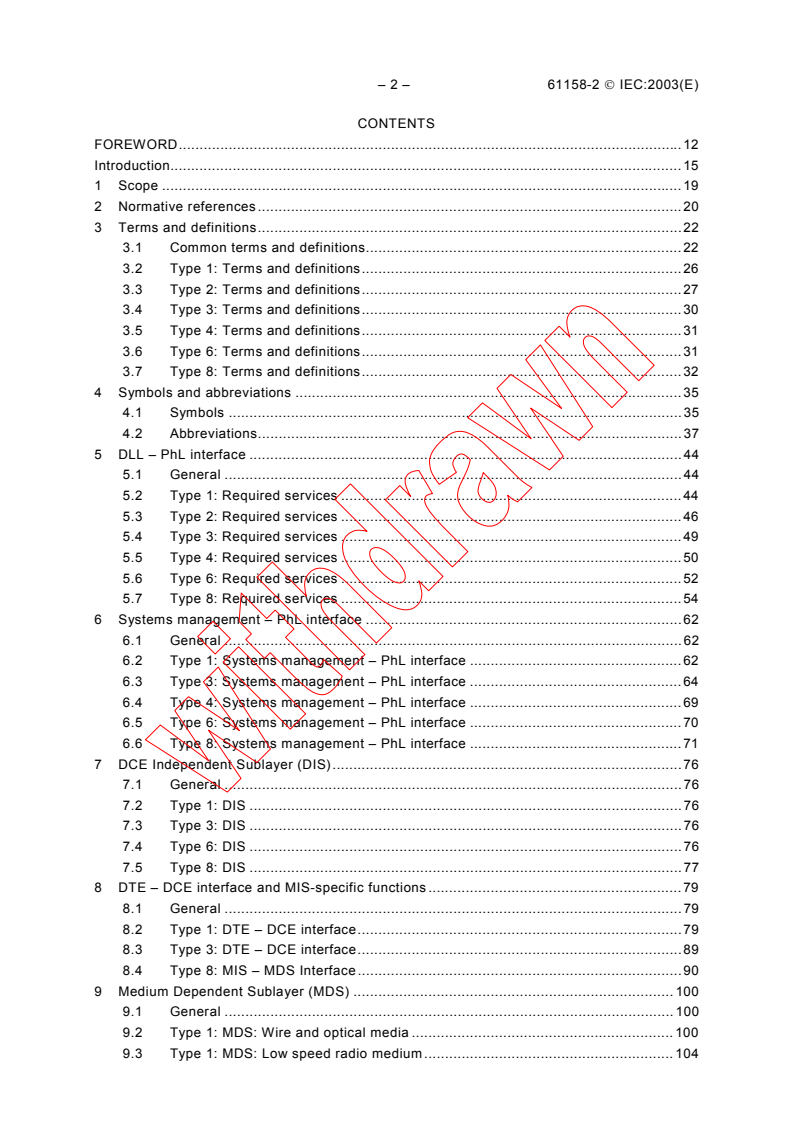
– 2 – 61158-2 ” IEC:2003(E)
CONTENTS
FOREWORD.12
Introduction.15
1 Scope .19
2 Normative references.20
3 Terms and definitions.22
3.1 Common terms and definitions.22
3.2 Type 1: Terms and definitions.26
3.3 Type 2: Terms and definitions.27
3.4 Type 3: Terms and definitions.30
3.5 Type 4: Terms and definitions.31
3.6 Type 6: Terms and definitions.31
3.7 Type 8: Terms and definitions.32
4 Symbols and abbreviations .35
4.1 Symbols .35
4.2 Abbreviations.37
5 DLL – PhL interface .44
5.1 General .44
5.2 Type 1: Required services .44
5.3 Type 2: Required services .46
5.4 Type 3: Required services .49
5.5 Type 4: Required services .50
5.6 Type 6: Required services .52
5.7 Type 8: Required services .54
6 Systems management – PhL interface .62
6.1 General .62
6.2 Type 1: Systems management – PhL interface .62
6.3 Type 3: Systems management – PhL interface .64
6.4 Type 4: Systems management – PhL interface .69
6.5 Type 6: Systems management – PhL interface .70
6.6 Type 8: Systems management – PhL interface .71
7 DCE Independent Sublayer (DIS).76
7.1 General .76
7.2 Type 1: DIS .76
7.3 Type 3: DIS .76
7.4 Type 6: DIS .76
7.5 Type 8: DIS .77
8 DTE – DCE interface and MIS-specific functions .79
8.1 General .79
8.2 Type 1: DTE – DCE interface.79
8.3 Type 3: DTE – DCE interface.89
8.4 Type 8: MIS – MDS Interface.90
9 Medium Dependent Sublayer (MDS) . 100
9.1 General . 100
9.2 Type 1: MDS: Wire and optical media . 100
9.3 Type 1: MDS: Low speed radio medium. 104
61158-2 ” IEC:2003(E) – 3 –
9.4 Type 2: MDS: Wire and optical media . 109
9.5 Type 3: MDS: Wire and optical media . 110
9.6 Type 4: MDS: Wire medium . 110
9.7 Type 6: MDS: Wire and optical media . 114
9.8 Type 8: MDS: Wire and optical media . 118
10 MDS – MAU interface. 126
10.1 General . 126
10.2 Type 1: MDS – MAU interface: wire and optical media. 126
10.3 Type 1: MDS – MAU interface: Low speed radio medium . 128
10.4 Type 2: MDS – MAU interface: Wire and optical media . 129
10.5 Type 3: MDS – MAU interface: Wire and optical media . 132
10.6 Type 8: MDS – MAU interface: Wire and optical media . 132
11 Types 1 and 7: Medium Attachment Unit: voltage mode, linear-bus-topology 150 :
twisted-pair wire medium. 135
12 Types 1 and 3: Medium Attachment Unit: 31,25 kbit/s, voltage-mode with low-
power option, bus- and tree-topology, 100 : wire medium .150
13 Type 1: Medium Attachment Unit: current mode, twisted-pair wire medium . 168
14 Type 1: Medium Attachment Unit: current mode (1 A), twisted-pair wire medium . 179
15 Types 1 and 7: Medium Attachment Unit: dual-fibre optical media. 188
16 Type 1: Medium Attachment Unit: 31,25 kbit/s, single-fibre optical medium . 195
17 Type 1: Medium Attachment Unit: low speed radio medium . 198
18 Type 2: Medium Attachment Unit: 5 Mbit/s, voltage-mode, coaxial wire medium. 207
19 Type 2: Medium Attachment Unit: 5 Mbit/s, optical medium. 219
20 Type 2: Medium Attachment Unit: Network Access Port (NAP) . 223
21 Type 3: Medium Attachment Unit: Synchronous transmission, 31,25 kbit/s, voltage
mode, wire medium . 227
22 Type 3: Medium Attachment Unit: Asynchronous Transmission, wire medium . 236
23 Type 3: Medium Attachment Unit: Asynchronous Transmission, optical medium. 242
24 Type 4: Medium Attachment Unit: RS-485. 252
25 Type 4: Medium Attachment Unit: RS-232. 254
26 Type 6: Medium Attachment Unit: RS-485. 255
27 Type 8: Medium Attachment Unit: twisted-pair wire medium . 261
28 Type 8: Medium Attachment Unit: Optical media . 266
Annex A (normative) — Type 1: Connector specification. 273
A.1 Internal connector for wire medium . 273
A.2 External connectors for wire medium . 273
A.3 External connectors for optical medium . 279
Annex B (informative) — Types 1 and 3: Cable specifications and trunk and spur
lengths for the 31,25 kbit/s voltage-mode MAU. 281
Annex C (informative) — Types 1 and 7: Optical passive stars . 283
Annex D (informative) — Types 1 and 7: Star topology . 284
Annex E (informative) — Type 1: Alternate fibres. 288
E.1 Alternate fibres for dual-fibre mode. 288
E.2 Alternate fibres for single-fibre mode . 288
Annex F (normative) — Type 2: Connector specification . 289
F.1 Connector for coaxial wire medium . 289
– 4 – 61158-2 ” IEC:2003(E)
F.2 Connector for optical medium . 289
F.3 Connector for NAP medium . 290
Annex G (normative) — Type 2: Repeater machine sublayers (RM, RRM) and
redundant PhLs. 292
G.2 Repeater Machine (RM) sublayer. 293
G.3 Redundant PhL. 295
G.4 Ring Repeater Machine (RRM) sublayer . 296
Annex H (informative) — Type 2: Reference design examples . 303
H.1 MAU: 5 Mbit/s, voltage mode, coaxial wire. 303
H.2 Network Access Port. 307
Annex I (normative) — Type 3: Connector specification . 309
I.1 Connector for synchronous transmission. 309
I.2 Connector for asynchronous transmission. 310
I.3 Connectors for fibre optic cable . 311
Annex J (normative) — Type 3: Redundancy of PhL and Medium . 312
Annex K (normative) — Type 3: Optical network topology . 313
Annex L (normative) — Type 6: Connector specification . 322
Annex M (normative) — Type 8: Connector specification . 324
M.1 External Connectors for wire medium . 324
M.2 External connectors for fibre optic medium . 325
Figure 1 – Relationship of IEC 61158-2 to other fieldbus layers and to users
of the fieldbus Physical layer service .15
Figure 2 – General model of Physical Layer.16
Figure 3 – Mapping between data units across the DLL – PhL interface.44
Figure 4 –Data service for asynchronous transmission.49
Figure 5 – Interactions for a data sequence of a master: identification cycle .56
Figure 6 – Interactions for a data sequence of a master: data cycle .57
Figure 7 – Interactions for a data sequence of a slave: identification cycle.58
Figure 8 – Interactions for a data sequence of a slave: data cycle .59
Figure 9 – Interactions for a check sequence of a master .60
Figure 10 – Interactions for a check sequence of a slave .61
Figure 11 – Reset, Set Value, Get Value.65
Figure 12 – Event service .66
Figure 13 – Interface between PhL and PNM1 in the layer model.71
Figure 14 – Reset, Set Value, Get Value PhL services.72
Figure 15 – Event PhL service .73
Figure 16 – Allocation of the interface number .74
Figure 17 – Configuration of a master .78
Figure 18 – Configuration of a slave with an alternative type of transmission .78
Figure 19 – Configuration of a bus coupler with an alternative type of transmission .78
Figure 20 – DTE/DCE sequencing machines.83
Figure 21 – State transitions with the ID cycle request service.92
Figure 22 – MIS-MDS interface: identification cycle request service.93
Figure 23 – MIS-MDS interface: identification cycle request service.94
Figure 24 – State transitions with the data cycle request service.94
61158-2 ” IEC:2003(E) – 5 –
Figure 25 – MIS-MDS interface: data cycle request service.95
Figure 26 – State transitions with the data sequence classification service .95
Figure 27 – Protocol machine for the message transmission service.96
Figure 28 – Protocol machine for the data sequence identification service .97
Figure 29 – Protocol machine for the message receipt service.98
Figure 30 – Protocol Data Unit (PhPDU) . 100
Figure 31 – PhSDU encoding and decoding . 100
Figure 32 – Manchester encoding rules . 101
Figure 33 – Preamble and delimiters. 102
Figure 34 – General model of the PhL with the low speed radio medium . 104
Figure 35 – Radio medium fieldbus code frames and radio Physical Data Units for all
but the last code frame of a corresponding PhSDU sequence . 105
Figure 36 – Radio medium fieldbus code frame. 105
Figure 37 – Radio medium fieldbus forward error correction octets 1 and 2. 106
Figure 38 – Radio medium fieldbus code frames and radio Physical Data Units example
of last code frame of a PhSDU sequence encoding. 106
Figure 39 – Manchester coded symbols . 110
Figure 40 – PhPDU format, half duplex . 111
Figure 41 – PhPDU format, full duplex . 113
Figure 42 – PhPDU. 115
Figure 43 – Ph-slot .115
Figure 44 – Preamble, Start delimiter and PAD . 117
Figure 45 – End Transfer Frame, Bus Sync and End of Data delimiters, with Strobes . 118
Figure 46 – Data sequence PhPDU. 119
Figure 47 – Structure of the header in a data sequence PhPDU. 119
Figure 48 – Check sequence PhPDU . 120
Figure 49 – Structure of a headers in a check sequence PhPDU. 120
Figure 50 – Structure of the status PhPDU. 121
Figure 51 – Structure of the header in a status PhPDU . 121
Figure 52 – Structure of the medium activity status PhPDU. 122
Figure 53 – Structure of the header in a medium activity status PhPDU . 122
Figure 54 – Reset PhPDU. 123
Figure 55 – Configuration of a master . 124
Figure 56 – Configuration of a slave . 125
Figure 57 – Configuration of a bus coupler. 125
Figure 58 – Jitter tolerance . 134
Figure 59 – Transmit circuit test configuration. 139
Figure 60 – Output waveform. 139
Figure 61 – Transmitted and received bit cell jitter (zero crossing point deviation) . 140
Figure 62 – Signal polarity . 142
Figure 63 – Receiver sensitivity and noise rejection. 143
Figure 64 – Power supply ripple and noise. 146
Figure 65 – Fieldbus coupler. 148
Figure 66 – Transition from receiving to transmitting. 155
Figure 67 – Power supply ripple and noise. 159
Figure 68 – Test circuit for single-output power supplies. 160
– 6 – 61158-2 ” IEC:2003(E)
Figure 69 – Test circuit for power distribution through an IS barrier . 161
Figure 70 – Test circuit for multiple output supplies with signal coupling . 162
Figure 71 – Fieldbus coupler. 164
Figure 72 – Protection resistors . 165
Figure 73 – Test configuration for current-mode MAU . 171
Figure 74 – Transmitted and received bit cell jitter (zero crossing point deviation) . 172
Figure 75 – Noise test circuit for current-mode MAU . 174
Figure 76 – Transmitted and received bit cell jitter (zero crossing point deviation) . 183
Figure 77 – Power supply harmonic distortion and noise. 185
Figure 78 – Optical wave shape template. 190
Figure 79 – Cellular radio topology and reuse of frequencies . 199
Figure 80 – Radio segment between wired segments topology. 200
Figure 81 – Mixed wired and radio medium fieldbus topology. 201
Figure 82 – Gaussian Minimum Shift Keying modulation with Bn = 0,41. 203
Figure 83 – Radio envelope using GMSK. 203
Figure 84 – Components of 5 Mbit/s, voltage-mode, coaxial wire PhL variant. 207
Figure 85 – Coaxial wire MAU block diagram . 208
Figure 86 – Coaxial wire MAU transmitter . 208
Figure 87 – Coaxial wire MAU receiver operation. 209
Figure 88 – Coaxial wire MAU transmit mask . 210
Figure 89 – Coaxial wire MAU receive mask . 211
Figure 90 – Transformer symbol . 212
Figure 91 – 5Mbit/s, voltage-mode, coaxial wire topology example . 214
Figure 92 – Coaxial wire medium topology limits. 215
Figure 93 – Coaxial wire medium tap electrical characteristics. 216
Figure 94 – MAU block diagram 5 Mbit/s, optical fibre medium . 219
Figure 95 – NAP reference model . 223
Figure 96 – Example of transient and permanent nodes. 224
Figure 97 – NAP transceiver . 225
Figure 98 – NAP cable. 226
Figure 99 – Power supply ripple and noise. 232
Figure 100 – Repeater in linear bus topology. 237
Figure 101 – Repeater in tree topology . 237
Figure 102 – Example for a connector with integrated inductance . 239
Figure 103 – Interconnecting wiring . 239
Figure 104 – Bus Terminator. 240
Figure 105 – Connection to the optical network. 242
Figure 106 – Principle structure of optical networking . 243
Figure 107 – Definition of the standard optical link. 244
Figure 108 – Signal template for the optical transmitter. 249
Figure 109 – Recommended interface circuit . 253
Figure 110 – Minimum interconnecting wiring. 256
Figure 111 – RS-485 Phsegment termination network . 257
Figure 112 – Example for a connector with integrated inductance . 258
Figure 113 – Maximum single Ph-segment bus topology . 259
Figure 114 – Example maximum linear bus topology with four Ph-segments . 260
61158-2 ” IEC:2003(E) – 7 –
Figure 115 – Example star topology with six Ph-segments . 260
Figure 116 – MAU of an outgoing interface . 261
Figure 117 – MAU of an incoming interface. 261
Figure 118 – Remote bus link . 262
Figure 119 – Interface to the transmission medium . 262
Figure 120 – Wiring .265
Figure 121 – Terminal resistor network . 265
Figure 122 – Fibre optic remote bus cable . 266
Figure 123 – Optical fibre remote bus link. 267
Figure 124 – Optical wave shape template optical MAU . 268
Figure A.1 – Internal fieldbus connector. 273
Figure A.2 – Contact designations for the external connector for harsh industrial environments 275
Figure A.3 – External fieldbus connector keyways, keys, and bayonet pins and grooves. 275
Figure A.4 – External fieldbus connector intermateability dimensions. 276
Figure A.5 – External fieldbus connector contact arrangement. 277
Figure A.6 – Contact designations for the external connector for typical industrial
environments . 278
Figure A.7 – External fixed (device) side connector for typical industrial environments:
dimensions .278
Figure A.8 – External free (cable) side connector for typical industrial environments:
dimensions .279
Figure A.9 – Optical connector for typical industrial environments (FC connector) . 279
Figure A.10 – Optical connector for typical industrial environments (ST connector). 280
Figure C.1 – Example of an optical passive reflective star. 283
Figure C.2 – Example of an optical passive transmitive star. 283
Figure D.1 – Example of star topology with 31,25 kbit/s, single fibre mode, optical MAU. 284
Figure D.2 – Multi-star topology with an optical MAU . 284
Figure D.3 – Example of mixture between wire and optical media for a 31,25 kbit/s bit rate 286
Figure D.4 – Example of mixture between wire and optical media . 287
Figure F.1 – Pin connector for short range optical medium. 290
Figure F.2 – Crimp ring for short range optical medium. 290
Figure G.1 – PhL repeater device reference model . 293
Figure G.2 – Reference model for redundancy. 295
Figure G.3 – Block diagram showing redundant coaxial medium and NAP . 296
Figure G.4 – Block diagram showing ring repeaters . 297
Figure G.5 – Segmentation query . 298
Figure G.6 – Segmentation response. 298
Figure G.7 – Main switch state machine. 300
Figure G.8 – Port 1 sees network activity first . 301
Figure G.9 – Port 2 sees network activity first . 302
Figure H.1 – Coaxial wire MAU RXDATA detector . 304
Figure H.2 – Coaxial wire MAU RXCARRIER detection. 305
Figure H.3 – Redundant coaxial wire MAU transceiver. 305
Figure H.4 – Single channel coaxial wire MAU transceiver. 306
Figure H.5 – Coaxial wire medium tap. 307
Figure H.6 – Non-isolated NAP transceiver . 308
Figure H.7 – Isolated NAP transceiver . 308
– 8 – 61158-2 ” IEC:2003(E)
Figure I.1 – Schematic of the station coupler . 309
Figure I.2 – Pin assignment of the male and female connectors IEC 947-5-2 (A coding) . 310
Figure I.3 – Connector pinout, front view of male and back view of female respectively . 311
Figure J.1 – Redundancy of PhL's MAU and Medium . 312
Figure K.1 – Optical MAU in a network with echo. 313
Figure K.2 – Optical MAU in a network without echo . 314
Figure K.3 – Optical MAU with echo via internal electrical feedback of the receive signal . 314
Figure K.4 – Optical MAU without echo function. 315
Figure K.5 – Optical network with star topology. 315
Figure K.6 – Optical network with ring topology. 316
Figure K.7 – Optical network with bus topology. 316
Figure K.8 – Tree structure built from a combination of star structures. 317
Figure K.9 – Application example for an ANSI TIA/EIA-485-A / fibre optic converter . 318
Figure L.1 – 9 pin subminiature D Connector pinout. 322
Figure M.1 – Outgoing interface 9-position female subminiature D connector at the device. 324
Figure M.2 – Incoming interface 9-position male subminiature D connector at the device. 324
Figure M.3 – Terminal connector at the device. 325
Figure M.4 – Ferrule of an optical F-SMA connector for polymer optical fibre
(980/1000 µm) . 325
Table 1 – Data encoding rules .47
Table 2 – Ph-STATUS indication truth table .48
Table 3 – Jabber indications .48
Table 4 – Parameter names and values for Ph-SET-VALUE request .63
Table 5 – Parameter names for Ph-EVENT indication.64
Table 6 – Summary of Ph-management services and primitives .65
Table 7 – Reset primitives and parameters .66
Table 8 – Values of PhM-Status for the Reset service.66
Table 9 – Set value primitives and parameters.67
Table 10 – Mandatory PhE-variables .67
Table 11 – Permissible values of PhE-variables.67
Table 12 – Values of PhM-Status for the set-value service.68
Table 13 – Get value primitives and parameters .68
Table 14 – Current values of PhE-variables .68
Table 15 – Values of PhM-Status for the get value service.69
Table 16 – Event primitive and parameters .69
Table 17 – New values of PhE-variables .69
Table 18 – Parameter names and values for management .70
Table 19 – Parameter names and values for Ph-SET-VALUE request.70
Table 20 – PH-RESET .73
Table 21 – Ph-SET-VALUE.73
Table 22 – PhL variables .73
Table 23 – Ph-GET-VALUE .75
Table 24 – Ph-EVENT .75
Table 25 – PhL events .75
Table 26 – Signals at DTE – DCE interface.80
Table 27 – Signal levels for an exposed DTE – DCE interface .81
Table 28 – MDS Bus Reset.91
61158-2 ” IEC:2003(E) – 9 –
Table 29 – Signals at the MIS-MDS interface.91
Table 30 – Manchester encoding rules. 101
Table 31 – Length and end of PhSDU sequence code. 107
Table 32 – MDS timing characteristics . 109
Table 33 – MDS data encoding rules . 110
Table 34 – SL bit and TxSL signal assignment. 120
Table 35 – SL bit and RxSL signal assignment . 120
Table 36 – SL bit and TxSL signal assignment. 121
Table 37 – SL bit and RxSL signal assignment . 121
Table 38 – SL bit and TxSL signal assignment. 122
Table 39 – SL bit and RxSL signal assignment . 122
Table 40 – Coding and decoding rules . 123
Table 41 – Decoding rules for the idle states . 123
Table 42 – Coding rules for the reset PhPDU. 124
Table 43 – Decoding rules of the reset PhPDU . 124
Table 44 – Minimum services at MDS – MAU interface . 126
Table 45 – Signal levels for an exposed MDS – MAU interface . 127
Table 46 – Minimum services at MDS – MAU interface . 128
Table 47 – Signal levels for an exposed MDS – MAU interface . 129
Table 48 – MDS-MAU interface definitions: 5 Mbit/s, voltage-mode, coaxial wire . 130
Table 49 – MDS-MAU interface 5 Mbit/s, optical fibre medium . 131
Table 50 – Services of the MDS-MAU interface. 132
Table 51 – Bit-rate-dependent quantities of voltage-mode networks. 135
Table 52 – MAU transmit level specification summary. 138
Table 53 – MAU transmit timing specification summary for 31,25 kbit/s operation . 138
Table 54 – MAU transmit timing specification summary for t 1 Mbit/s operation. 138
Table 55 – MAU receive circuit specification summary. 142
Table 56 – Network powered device characteristics . 145
Table 57 – Network power supply requirements . 145
Table 58 – Test cable attenuation limits . 147
Table 59 – Recommended colour coding of cables in North America. 149
Table 60 – MAU transmit level specification summary. 153
Table 61 – MAU transmit timing specification summary. 153
Table 62 – MAU receive circuit specification summary. 156
Table 63 – Network powered device characteristics . 158
Table 64 – Network power supply requirements . 158
Table 65 – Type 3 cable colour specification. 166
Table 66 – MAU transmit level specification sum
...