


IEC 61097-10:1999
(Main)Global maritime distress and safety system (GMDSS) - Part 10: Inmarsat-B ship earth station equipment - Operational and performance requirements, methods of testing and required test results
General Information
- Abstract
Specifies the minimum operational and performance requirements, technical characteristics, methods of testing and required test results for Inmarsat-B maritime class 1 ship earth stations, capable of transmitting and receiving distress and safety communications.
- Status
- Withdrawn
- Publication Date
- 16-Jun-1999
- Withdrawal Date
- 30-Jan-2011
- Technical Committee
- TC 80 - Maritime navigation and radiocommunication equipment and systems
- Drafting Committee
- WG 8 - TC 80/WG 8
- Current Stage
- WPUB - Publication withdrawn
- Start Date
- 31-Jan-2011
- Completion Date
- 28-Aug-2026
Buy Documents
IEC 61097-10:1999 - Global maritime distress and safety system (GMDSS) - Part 10: Inmarsat-B ship earth station equipment - Operational and performance requirements, methods of testing and required test results Released:6/17/1999
Buy Documents
IEC 61097-10:1999 - Global maritime distress and safety system (GMDSS) - Part 10: Inmarsat-B ship earth station equipment - Operational and performance requirements, methods of testing and required test results Released:6/17/1999
Get Certified
Connect with accredited certification bodies for this standard

ANCE
Mexican certification and testing association.

Intertek Slovenia
Intertek testing, inspection, and certification services in Slovenia.

LNE (Laboratoire National de Métrologie et d'Essais)
French national laboratory for metrology and testing.
Sponsored listings
Frequently Asked Questions
IEC 61097-10:1999 is a standard published by the International Electrotechnical Commission (IEC). Its full title is "Global maritime distress and safety system (GMDSS) - Part 10: Inmarsat-B ship earth station equipment - Operational and performance requirements, methods of testing and required test results". This standard covers: Specifies the minimum operational and performance requirements, technical characteristics, methods of testing and required test results for Inmarsat-B maritime class 1 ship earth stations, capable of transmitting and receiving distress and safety communications.
Specifies the minimum operational and performance requirements, technical characteristics, methods of testing and required test results for Inmarsat-B maritime class 1 ship earth stations, capable of transmitting and receiving distress and safety communications.
IEC 61097-10:1999 is classified under the following ICS (International Classification for Standards) categories: 33.060.20 - Receiving and transmitting equipment. The ICS classification helps identify the subject area and facilitates finding related standards.
IEC 61097-10:1999 is available in PDF format for immediate download after purchase. The document can be added to your cart and obtained through the secure checkout process. Digital delivery ensures instant access to the complete standard document.
Standards Content (Sample)
INTERNATIONAL IEC
STANDARD
61097-10
First edition
1999-06
Global maritime distress and safety system
(GMDSS) –
Part 10:
Inmarsat-B ship earth station equipment –
Operational and performance requirements,
methods of testing and required test results
Système mondial de détresse et de sécurité
en mer (SMDSM) –
Partie 10: Matériel destiné aux stations terrestres
des navires de type Inmarsat-B –
Exigences d'exploitation et de fonctionnement,
méthodes d'essai et résultats d'essai exigés
Reference number
Numbering
As from 1 January 1997 all IEC publications are issued with a designation in the
60000 series.
Consolidated publications
Consolidated versions of some IEC publications including amendments are
available. For example, edition numbers 1.0, 1.1 and 1.2 refer, respectively, to the
base publication, the base publication incorporating amendment 1 and the base
publication incorporating amendments 1 and 2.
Validity of this publication
The technical content of IEC publications is kept under constant review by the IEC,
thus ensuring that the content reflects current technology.
Information relating to the date of the reconfirmation of the publication is available
in the IEC catalogue.
Information on the subjects under consideration and work in progress undertaken
by the technical committee which has prepared this publication, as well as the list
of publications issued, is to be found at the following IEC sources:
• IEC web site*
•
Catalogue of IEC publications
Published yearly with regular updates
(On-line catalogue)*
• IEC Bulletin
Available both at the IEC web site* and as a printed periodical
Terminology, graphical and letter symbols
For general terminology, readers are referred to IEC 60050: International
Electrotechnical Vocabulary (IEV).
For graphical symbols, and letter symbols and signs approved by the IEC for
general use, readers are referred to publications IEC 60027: Letter symbols to be
used in electrical technology, IEC 60417: Graphical symbols for use on equipment.
Index, survey and compilation of the single sheets and IEC 60617: Graphical symbols
for diagrams.
* See web site address on title page.
INTERNATIONAL IEC
STANDARD
61097-10
First edition
1999-06
Global maritime distress and safety system
(GMDSS) –
Part 10:
Inmarsat-B ship earth station equipment –
Operational and performance requirements,
methods of testing and required test results
Système mondial de détresse et de sécurité
en mer (SMDSM) –
Partie 10: Matériel destiné aux stations terrestres
des navires de type Inmarsat-B –
Exigences d'exploitation et de fonctionnement,
méthodes d'essai et résultats d'essai exigés
IEC 1999 Copyright - all rights reserved
No part of this publication may be reproduced or utilized in any form or by any means, electronic or
mechanical, including photocopying and microfilm, without permission in writing from the publisher.
International Electrotechnical Commission 3, rue de Varembé Geneva, Switzerland
Telefax: +41 22 919 0300 e-mail: inmail@iec.ch IEC web site http://www.iec.ch
Commission Electrotechnique Internationale
PRICE CODE
R
International Electrotechnical Commission
For price, see current catalogue
– 2 – 61097-10 © IEC:1999(E)
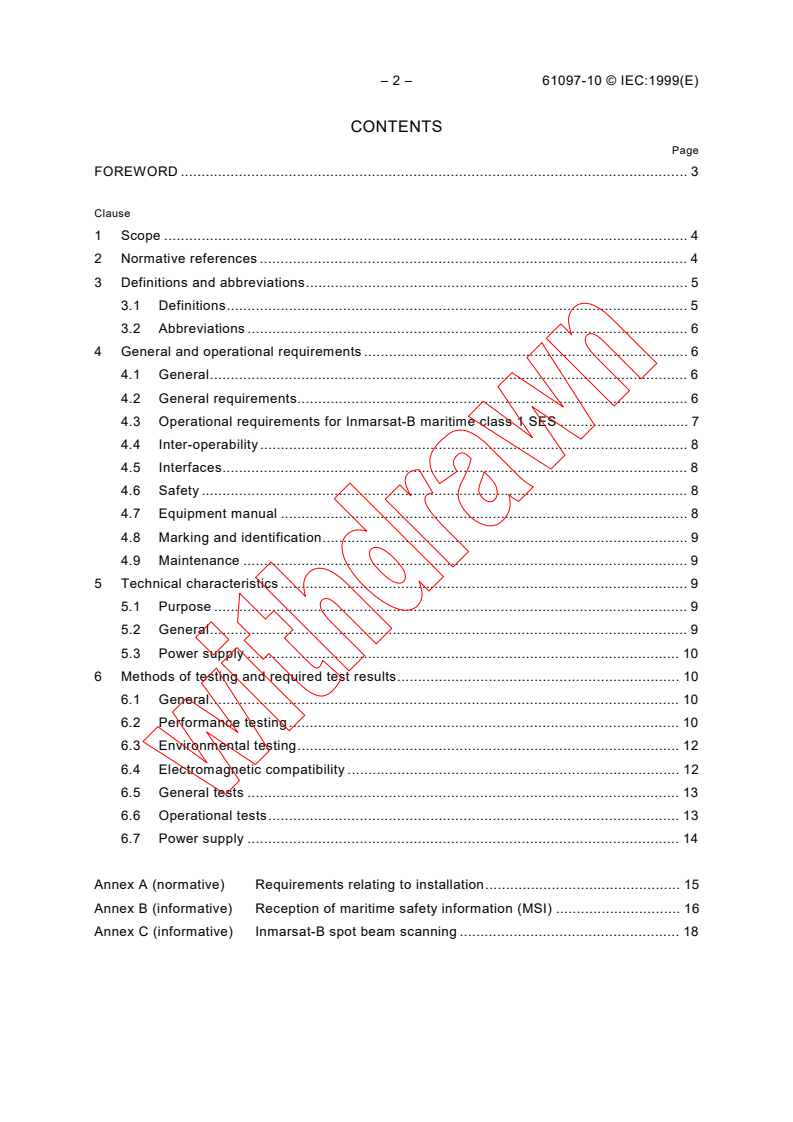
CONTENTS
Page
FOREWORD . 3
Clause
1 Scope.4
2 Normative references.4
3 Definitions and abbreviations. 5
3.1 Definitions.5
3.2 Abbreviations.6
4 General and operational requirements . 6
4.1 General.6
4.2 General requirements.6
4.3 Operational requirements for Inmarsat-B maritime class 1 SES . 7
4.4 Inter-operability.8
4.5 Interfaces.8
4.6 Safety. 8
4.7 Equipment manual.8
4.8 Marking and identification. 9
4.9 Maintenance.9
5 Technical characteristics.9
5.1 Purpose.9
5.2 General.9
5.3 Power supply.10
6 Methods of testing and required test results. 10
6.1 General.10
6.2 Performance testing.10
6.3 Environmental testing.12
6.4 Electromagnetic compatibility.12
6.5 General tests.13
6.6 Operational tests.13
6.7 Power supply.14
Annex A (normative) Requirements relating to installation. 15
Annex B (informative) Reception of maritime safety information (MSI) . 16
Annex C (informative) Inmarsat-B spot beam scanning . 18
61097-10 © IEC:1999(E) – 3 –
INTERNATIONAL ELECTROTECHNICAL COMMISSION
___________
GLOBAL MARITIME DISTRESS AND SAFETY SYSTEM (GMDSS) –
Part 10: Inmarsat-B ship earth station equipment –
Operational and performance requirements,
methods of testing and required test results
FOREWORD
1) The IEC (International Electrotechnical Commission) is a worldwide organization for standardization comprising
all national electrotechnical committees (IEC National Committees). The object of the IEC is to promote
international co-operation on all questions concerning standardization in the electrical and electronic fields. To
this end and in addition to other activities, the IEC publishes International Standards. Their preparation is
entrusted to technical committees; any IEC National Committee interested in the subject dealt with may
participate in this preparatory work. International, governmental and non-governmental organizations liaising
with the IEC also participate in this preparation. The IEC collaborates closely with the International Organization
for Standardization (ISO) in accordance with conditions determined by agreement between the two
organizations.
2) The formal decisions or agreements of the IEC on technical matters express, as nearly as possible, an
international consensus of opinion on the relevant subjects since each technical committee has representation
from all interested National Committees.
3) The documents produced have the form of recommendations for international use and are published in the form
of standards, technical reports or guides and they are accepted by the National Committees in that sense.
4) In order to promote international unification, IEC National Committees undertake to apply IEC International
Standards transparently to the maximum extent possible in their national and regional standards. Any
divergence between the IEC Standard and the corresponding national or regional standard shall be clearly
indicated in the latter.
5) The IEC provides no marking procedure to indicate its approval and cannot be rendered responsible for any
equipment declared to be in conformity with one of its standards.
6) Attention is drawn to the possibility that some of the elements of this International Standard may be the subject
of patent rights. The IEC shall not be held responsible for identifying any or all such patent rights.
International Standard IEC 61097-10 has been prepared by IEC technical committee 80:
Maritime navigation and radiocommunication equipment and systems.
The text of this standard is based on the following documents:
FDIS Report on voting
80/216/FDIS 80/231/RVD
Full information on the voting for the approval of this standard can be found in the report on
voting indicated in the above table.
Annex A forms an integral part of this standard.
Annexes B and C are for information only.
A bilingual version of this standard may be issued at a later date.
– 4 – 61097-10 © IEC:1999(E)
GLOBAL MARITIME DISTRESS AND SAFETY SYSTEM (GMDSS) –
Part 10: Inmarsat-B ship earth station equipment –
Operational and performance requirements,
methods of testing and required test results
1 Scope
This part of IEC 61097 specifies the minimum operational and performance requirements,
technical characteristics, methods of testing and required test results for Inmarsat-B maritime
class 1 ship earth stations (SES), capable of transmitting and receiving distress and safety
communications using telephony and direct-printing telegraphy, as required by regulation IV /
10.1 and 14.1 of the 1988 amendments to the 1974 International Convention for the Safety of
Life at Sea (SOLAS), for use in the GMDSS.
In order to meet the carriage requirements of the GMDSS in respect of receipt of SafetyNET
broadcasts, it is necessary to install an additional EGC receiver or a combined Inmarsat-
C/EGC receiver.
This standard takes account of IMO Resolution A.694, to which IEC 60945 is associated. When
a requirement in this standard is different from IEC 60945, the requirement in this standard
takes precedence.
This standard incorporates the performance standards of IMO Resolution A.808. It also
incorporates the relevant ITU Radio regulations.
This standard does not incorporate the Inmarsat system requirements needed for Inmarsat
type approval. For these, the latest edition of the Inmarsat-B system definition manual (SDM)
shall be consulted. When a requirement in this standard is different from one in the Inmarsat-B
SDM, reference shall be made to the most recent IMO and ITU applicable documents to
resolve the difficulty.
NOTE – All text of this standard, the wording of which is identical to that in the IMO SOLAS Convention 1974 as
amended and IMO Resolution A.808, is printed in italics and it is followed by the resolution or recommendation and
paragraph number indicated between brackets.
2 Normative references
The following normative documents contain provisions which, through reference in this text,
constitute provisions of this part of IEC 61097. For dated references, subsequent amendments
to, or revisions of, any of these publications do not apply. However, parties to agreements
based on this part of IEC 61097 are encouraged to investigate the possibility of applying the
most recent editions of the normative documents indicated below. For undated references, the
latest edition of the normative document referred to applies. Members of IEC and ISO maintain
registers of currently valid International Standards.
IEC 60945:1996, Maritime navigation and radiocommunication equipment and systems –
General requirements – Methods of testing and required test results
IEC 61162-1:1995, Maritime navigation and radiocommunication equipment and systems –
Digital interfaces – Part 1: Single talker and multiple listeners
IMO International Convention for the Safety of Life at Sea (SOLAS) 1974, as amended
61097-10 © IEC:1999(E) – 5 –
IMO Resolution A.694:1991, General requirements for shipborne radio equipment forming part
of the global maritime distress and safety system (GMDSS) and for electronic navigational aids
IMO Resolution A.808:1995, Performance standards for ship earth stations capable of two-way
communications
IMO MSC Circular 862:1998, Clarifications of certain requirements in IMO performance
standards for GMDSS equipment
ITU:1997, Radio Regulations
ITU-R SM.329-7:1997, Spurious emissions
Inmarsat:1997, Inmarsat-B system definition manual (SDM) – Issue 3.0 including change note
CN 13 – technical performance requirements (module 2, part I) and type approval procedures
(module 2, part II)
Inmarsat:1997, Inmarsat-B design and installation guidelines (DIGS)
3 Definitions and abbreviations
3.1 Definitions
For the purpose of this standard, the following definitions apply:
3.1.1
L-band
the frequency band in the range 1,4 GHz to 1,7 GHz allocated to the mobile satellite service
and in which the EUT transmits and receives
3.1.2
LES simulator
an item of test equipment designed to simulate the combined operation of an Inmarsat satellite
and an Inmarsat-B land earth station. The LES simulator interfaces to the EUT at L-band,
either by means of a small antenna or via a coaxial cable. It permits voice and telex calls to be
set up in accordance with the relevant Inmarsat-B protocols
3.1.3
SafetyNET
a service provided over a dedicated Inmarsat-C carrier, for the dissemination of maritime
safety information, such as distress alerts, weather forecasts and coastal warnings
3.1.4
carrier to noise density ratio
the ratio of unmodulated carrier power to noise power normalised to a 1 Hz bandwidth
3.1.5
performance check
in this standard, a performance check for the purpose defined in IEC 60945, comprises
standard tests A and D in 6.2.2, carried out under normal test conditions for distress priority
only
3.1.6
performance test
a performance test for the purpose defined in IEC 60945, comprises standard tests A, B, C, D
and E in 6.2.2, carried out for both distress and safety priorities
– 6 – 61097-10 © IEC:1999(E)
3.2 Abbreviations
For the purpose of this standard, the following abbreviations apply:
C/No Carrier to noise density ratio in a 1 Hz bandwidth
CR Carriage return
DIGS Design and installation guidelines (Inmarsat)
EGC Enhanced group call
EUT Equipment under test
GMDSS Global maritime distress and safety system
ID Identity
IEC International Electrotechnical Commission
IMO International Maritime Organization
Inmarsat International Mobile Satellite Organization
ISO International Organization for Standardization
ITU International Telecommunication Union
LES Land earth station
LF Line feed
MES Mobile earth station
MSI Maritime safety information
Navarea Navigation warning area (see annex B)
RCC Rescue co-ordination centre
SAR Search and rescue
SDM System definition manual
SES Ship earth station
SOLAS International convention for the Safety of Life at Sea
4 General and operational requirements
4.1 General
This clause includes the requirements taken from SOLAS and IMO Resolutions A.808 and
A.694 for which no repeatable or verifiable test can be specified or for which the test is limited
to the verification of documentation presented by the manufacturer. It contains all operational
tests, particularly those involving subjective judgement and which shall be conducted by
qualified personnel. The requirements listed in this clause are in addition to the relevant
operational requirements of IEC 60945.
4.2 General requirements
4.2.1 (SOLAS IV/10.1.1) An Immarsat ship earth station which is defined in the Inmarsat-B
SDM as a maritime class 1 SES shall be capable of:
.1 transmitting and receiving distress and safety communications using direct-printing
telegraphy;
.2 initiating and receiving distress priority calls;
.3 maintaining watch for shore-to-ship distress alerts, including those directed to specifically
defined geographical areas. This requirement should normally be met by provision of an
EGC receiver;
61097-10 © IEC:1999(E) – 7 –
.4 transmitting and receiving general radio communications, using either radiotelephony or
direct-printing telegraphy.
Annex C contains the anticipated availability of the watch-keeping capabilities for an Inmarsat-
B SES.
4.2.2 (A.808/A.2) The equipment shall be type approved by Inmarsat and shall comply with
the environmental conditions specified in its technical requirements for Inmarsat ship earth
stations capable of two-way communications.
4.2.3 (A.808/A.1) The ship earth station installation capable of telephony and direct printing
shall comply with the applicable general requirements set out in IMO resolution A.694 (17) as
detailed in IEC 60945, except as follows:
4.2.3.1 The equipment shall indicate the status of the distress alert transmission (4.2.9 of
IEC 60945).
4.2.3.2 The equipment shall be provided with facilities which permit the testing of all
operational indicators (warning, alarm and routine), displays, and audible devices required by
the relevant equipment standard (4.2.9 of IEC 60945).
4.3 Operational requirements for Inmarsat-B maritime class 1 SES
4.3.1 (A.808/A.3.1) No control external to the equipment shall be available for alteration of the
ship earth station identity.
4.3.2 (A.808/A.3.2) It shall be possible to initiate and make distress calls by telephony or
direct printing from the position at which the ship is normally navigated and from any position
designated for distress alerting. In addition, where a room is provided for radio
communications, means to initiate distress calls shall also be fitted in that room.
4.3.3 (A.808/A.3.3) Where no other means of receiving distress, urgency and safety
broadcasts or an additional distress alert relay are provided and existing levels of aural signals
produced by the telephone or teletype are considered to be inadequate, the ship earth station
equipment shall be configured to actuate an aural/visual alarm of appropriate level.
4.3.4 (A.808/A.3.4) It shall be possible to interrupt and initiate distress calls at any time.
4.3.5 (A.808/A.3.5) A distress call shall be activated only by means of a dedicated distress
button. This button shall not be any key of an ITU-T digital input panel or an ISO keyboard
provided on the equipment.
(MSC/Circular 862/1.1) This button should not be any key of an ITU-T input panel or an ISO
keyboard associated with the equipment and should be physically separated from functional
buttons/keys used for normal operation. This button should be a single button for no other
purpose than to initiate a distress alert.
4.3.6 (A.808/A.3.6) The dedicated button shall:
.1 be clearly identified; and
.2 be protected against inadvertent operation.
(MSC/Circular 862/1.2) The distress button should be red in colour and marked DISTRESS.
Where a non-transparent protective lid or cover is used, it should also be marked DISTRESS.
(MSC/Circular 862/1.3) The required protection of the distress button should consist of a
spring loaded lid or cover permanently attached to the equipment by for example hinges. It
– 8 – 61097-
...