

IEC 62676-1-1:2013
(Main)Video surveillance systems for use in security applications - Part 1-1: System requirements - General
General Information
- Abstract
IEC 62676-1-1:2013 specifies the minimum requirements and gives recommendations for Video Surveillance Systems (VSS) (so far called CCTV), installed for security applications. This Standard specifies the minimum performance requirements and functional requirements to be agreed on between customer, law-enforcement where applicable and supplier in the operational requirement, but does not include requirements for design, planning, installation, testing, operation or maintenance. This standard excludes installation of remotely monitored detector activated VSSs. This IEC Standard also applies to VSS sharing means of detection, triggering, interconnection, control, communication and power supplies with other applications.
- Status
- Published
- Publication Date
- 28-Oct-2013
- Technical Committee
- TC 79 - Alarm and electronic security systems
- Current Stage
- PPUB - Publication issued
- Start Date
- 29-Oct-2013
- Completion Date
- 15-Nov-2013


IEC 62676-1-1:2013 Overview
IEC 62676-1-1:2013 is an international standard developed by the International Electrotechnical Commission (IEC) that specifies the minimum system requirements for video surveillance systems (VSS) used in security applications. This standard forms Part 1-1 under the general series for video surveillance systems, focusing on system requirements - general principles. The standard sets out the performance and functional requirements that should be agreed upon between the customer, law enforcement authorities (where applicable), and suppliers to meet operational needs.
Key exclusions from the scope include installation, planning, and maintenance procedures, as well as systems activated solely by remotely monitored detectors. The standard also considers VSS sharing system components like detection means, control interfaces, communication protocols, interconnections, and power supplies with other applications.
Key Topics Covered
System Functional Description
- Video Environment: Discusses essential elements such as image capture, image handling, and interconnections within the system that ensure effective surveillance coverage.
- System Management: Covers data management practices, activity management including monitoring and system interfacing, and overall operational control.
- System Security: Focuses on maintaining system integrity, ensuring data and image preservation, and protecting against unauthorized access or tampering.
Security Grading and Functional Requirements
- Defines grading frameworks to classify the security level provided by a VSS and the corresponding functional capabilities required.
- Details operational requirements including system operation, activity tracking, communication interfaces, and robust security measures.
- Emphasizes environmental adaptability with classifications for indoor and outdoor installations, taking into account physical and climatic challenges.
Image Quality and Environmental Classes
- Specifies criteria for image quality to ensure reliable identification and monitoring in security applications.
- Categorizes environmental classes from indoor residential settings to harsh outdoor environments, guiding system selection and deployment strategies accordingly.
Documentation Requirements
- Specifies documentation standards for system configuration, operational instructions, and component data, to support system life cycle and user competence.
Practical Applications
IEC 62676-1-1:2013 is instrumental for organizations deploying video surveillance systems for security purposes in various environments, including:
- Government and law enforcement agencies requiring standardized video evidence quality and system interoperability.
- Commercial enterprises ensuring premises security with VSS that meet minimum functional and performance criteria.
- Facility managers looking for guidance on integrating VSS components with existing security and building management systems.
- Security solution suppliers and integrators aiming to align their products with internationally accepted system requirements.
- Operators deploying complex, multi-sensor security networks that demand standardized communication, control, and data handling practices to ensure system reliability.
Related Standards
To complement IEC 62676-1-1, other parts of the IEC 62676 series address additional aspects such as:
- Video transmission standards ensuring compatibility and interoperability across devices.
- System design, installation, and maintenance best practices.
- Specific functional requirements for motion detection, video analytics, and remote monitoring.
- Standards on cybersecurity measures tailored to video surveillance technologies.
When combined, these standards provide a comprehensive framework for the acquisition, implementation, and operation of secure and reliable video surveillance systems aligned with global best practices.
Keywords: IEC 62676-1-1, video surveillance systems, VSS, security applications, CCTV standards, system requirements, video environment, system security, functional requirements, security grading, image quality, environmental classes, video surveillance interoperability, video system documentation, IEC standards for security
Relations
- Effective Date
- 25-Aug-2026
Get Certified
Connect with accredited certification bodies for this standard

CIS Institut d.o.o.
Personal Protective Equipment (PPE) certification body. Notified Body NB-2890 for EU Regulation 2016/425 PPE.

Kiwa BDA Testing
Building and construction product certification.
Kmetijski inštitut Slovenije
Agricultural Institute of Slovenia. Soil testing, plant health, agricultural product analysis.
Sponsored listings
Frequently Asked Questions
IEC 62676-1-1:2013 is a standard published by the International Electrotechnical Commission (IEC). Its full title is "Video surveillance systems for use in security applications - Part 1-1: System requirements - General". This standard covers: IEC 62676-1-1:2013 specifies the minimum requirements and gives recommendations for Video Surveillance Systems (VSS) (so far called CCTV), installed for security applications. This Standard specifies the minimum performance requirements and functional requirements to be agreed on between customer, law-enforcement where applicable and supplier in the operational requirement, but does not include requirements for design, planning, installation, testing, operation or maintenance. This standard excludes installation of remotely monitored detector activated VSSs. This IEC Standard also applies to VSS sharing means of detection, triggering, interconnection, control, communication and power supplies with other applications.
IEC 62676-1-1:2013 specifies the minimum requirements and gives recommendations for Video Surveillance Systems (VSS) (so far called CCTV), installed for security applications. This Standard specifies the minimum performance requirements and functional requirements to be agreed on between customer, law-enforcement where applicable and supplier in the operational requirement, but does not include requirements for design, planning, installation, testing, operation or maintenance. This standard excludes installation of remotely monitored detector activated VSSs. This IEC Standard also applies to VSS sharing means of detection, triggering, interconnection, control, communication and power supplies with other applications.
IEC 62676-1-1:2013 is classified under the following ICS (International Classification for Standards) categories: 13.320 - Alarm and warning systems. The ICS classification helps identify the subject area and facilitates finding related standards.
IEC 62676-1-1:2013 has the following relationships with other standards: It is inter standard links to EN ISO 22311:2014. Understanding these relationships helps ensure you are using the most current and applicable version of the standard.
IEC 62676-1-1:2013 is available in PDF format for immediate download after purchase. The document can be added to your cart and obtained through the secure checkout process. Digital delivery ensures instant access to the complete standard document.
Standards Content (Sample)
IEC 62676-1-1 ®
Edition 1.0 2013-10
INTERNATIONAL
STANDARD
NORME
INTERNATIONALE
colourcolour
insinsiidede
Video surveillance systems for use in security applications –
Part 1-1: System requirements – General
Systèmes de vidéosurveillance destinés à être utilisés dans les applications de
sécurité –
Partie 1-1: Exigences systèmes – Généralités
All rights reserved. Unless otherwise specified, no part of this publication may be reproduced or utilized in any form
or by any means, electronic or mechanical, including photocopying and microfilm, without permission in writing from
either IEC or IEC's member National Committee in the country of the requester.
If you have any questions about IEC copyright or have an enquiry about obtaining additional rights to this publication,
please contact the address below or your local IEC member National Committee for further information.
Droits de reproduction réservés. Sauf indication contraire, aucune partie de cette publication ne peut être reproduite ni
utilisée sous quelque forme que ce soit et par aucun procédé, électronique ou mécanique, y compris la photocopie et les
microfilms, sans l'accord écrit de la CEI ou du Comité national de la CEI du pays du demandeur.
Si vous avez des questions sur le copyright de la CEI ou si vous désirez obtenir des droits supplémentaires sur cette
publication, utilisez les coordonnées ci-après ou contactez le Comité national de la CEI de votre pays de résidence.
IEC Central Office Tel.: +41 22 919 02 11
3, rue de Varembé Fax: +41 22 919 03 00
CH-1211 Geneva 20 info@iec.ch
Switzerland www.iec.ch
About the IEC
The International Electrotechnical Commission (IEC) is the leading global organization that prepares and publishes
International Standards for all electrical, electronic and related technologies.
About IEC publications
The technical content of IEC publications is kept under constant review by the IEC. Please make sure that you have the
latest edition, a corrigenda or an amendment might have been published.
Useful links:
IEC publications search - www.iec.ch/searchpub Electropedia - www.electropedia.org
The advanced search enables you to find IEC publications The world's leading online dictionary of electronic and
by a variety of criteria (reference number, text, technical electrical terms containing more than 30 000 terms and
committee,…). definitions in English and French, with equivalent terms in
It also gives information on projects, replaced and additional languages. Also known as the International
withdrawn publications. Electrotechnical Vocabulary (IEV) on-line.
IEC Just Published - webstore.iec.ch/justpublished Customer Service Centre - webstore.iec.ch/csc
Stay up to date on all new IEC publications. Just Published If you wish to give us your feedback on this publication
details all new publications released. Available on-line and or need further assistance, please contact the
also once a month by email. Customer Service Centre: csc@iec.ch.
A propos de la CEI
La Commission Electrotechnique Internationale (CEI) est la première organisation mondiale qui élabore et publie des
Normes internationales pour tout ce qui a trait à l'électricité, à l'électronique et aux technologies apparentées.
A propos des publications CEI
Le contenu technique des publications de la CEI est constamment revu. Veuillez vous assurer que vous possédez
l’édition la plus récente, un corrigendum ou amendement peut avoir été publié.
Liens utiles:
Recherche de publications CEI - www.iec.ch/searchpub Electropedia - www.electropedia.org
La recherche avancée vous permet de trouver des Le premier dictionnaire en ligne au monde de termes
publications CEI en utilisant différents critères (numéro de électroniques et électriques. Il contient plus de 30 000
référence, texte, comité d’études,…). termes et définitions en anglais et en français, ainsi que
Elle donne aussi des informations sur les projets et les les termes équivalents dans les langues additionnelles.
publications remplacées ou retirées. Egalement appelé Vocabulaire Electrotechnique
International (VEI) en ligne.
Just Published CEI - webstore.iec.ch/justpublished
Service Clients - webstore.iec.ch/csc
Restez informé sur les nouvelles publications de la CEI.
Just Published détaille les nouvelles publications parues. Si vous désirez nous donner des commentaires sur
Disponible en ligne et aussi une fois par mois par email. cette publication ou si vous avez des questions
contactez-nous: csc@iec.ch.
IEC 62676-1-1 ®
Edition 1.0 2013-10
INTERNATIONAL
STANDARD
NORME
INTERNATIONALE
colour
inside
Video surveillance systems for use in security applications –
Part 1-1: System requirements – General
Systèmes de vidéosurveillance destinés à être utilisés dans les applications de
sécurité –
Partie 1-1: Exigences systèmes – Généralités
INTERNATIONAL
ELECTROTECHNICAL
COMMISSION
COMMISSION
ELECTROTECHNIQUE
PRICE CODE
INTERNATIONALE
CODE PRIX XA
ICS 13.320 ISBN 978-2-8322-1157-1
– 2 – 62676-1-1 © IEC:2013
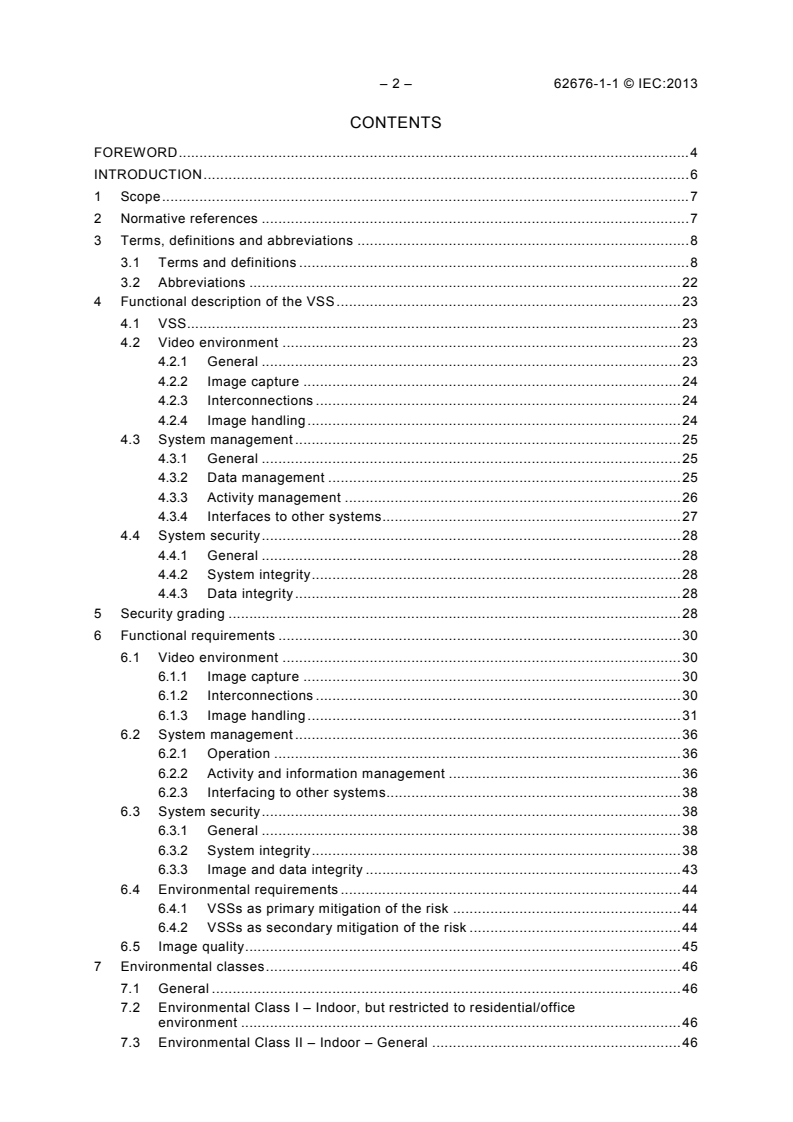
CONTENTS
FOREWORD . 4
INTRODUCTION . 6
1 Scope . 7
2 Normative references . 7
3 Terms, definitions and abbreviations . 8
3.1 Terms and definitions . 8
3.2 Abbreviations . 22
4 Functional description of the VSS . 23
4.1 VSS . 23
4.2 Video environment . 23
4.2.1 General . 23
4.2.2 Image capture . 24
4.2.3 Interconnections . 24
4.2.4 Image handling . 24
4.3 System management . 25
4.3.1 General . 25
4.3.2 Data management . 25
4.3.3 Activity management . 26
4.3.4 Interfaces to other systems . 27
4.4 System security . 28
4.4.1 General . 28
4.4.2 System integrity . 28
4.4.3 Data integrity . 28
5 Security grading . 28
6 Functional requirements . 30
6.1 Video environment . 30
6.1.1 Image capture . 30
6.1.2 Interconnections . 30
6.1.3 Image handling . 31
6.2 System management . 36
6.2.1 Operation . 36
6.2.2 Activity and information management . 36
6.2.3 Interfacing to other systems . 38
6.3 System security . 38
6.3.1 General . 38
6.3.2 System integrity . 38
6.3.3 Image and data integrity . 43
6.4 Environmental requirements . 44
6.4.1 VSSs as primary mitigation of the risk . 44
6.4.2 VSSs as secondary mitigation of the risk . 44
6.5 Image quality . 45
7 Environmental classes . 46
7.1 General . 46
7.2 Environmental Class I – Indoor, but restricted to residential/office
environment . 46
7.3 Environmental Class II – Indoor – General . 46
62676-1-1 © IEC:2013 – 3 –
7.4 Environmental Class III – Outdoor, but sheltered from direct rain and
sunshine, or indoor with extreme environmental conditions . 46
7.5 Environmental Class IV – Outdoor – General . 46
8 Documentation . 47
8.1 System documentation . 47
8.2 Instructions relating to operation . 47
8.3 System component documentation . 47
Annex A (normative) Special national conditions . 48
Annex B (informative) Video export in homeland security systems . 49
Bibliography . 50
Figure 1 – VSS . 23
Figure 2 – Example for VSS . 24
Figure 3 – Activity management . 27
Figure 4 – Risk and security grades . 29
Figure 5 – Reference to ISO 12233 resolution measurement chart (unit in ×100 lines) . 45
Table 1 – Storage . 31
Table 2 – Archiving and backup . 33
Table 3 – System logs . 38
Table 4 – Monitoring of interconnections . 39
Table 5 – Tamper detection . 40
Table 6 – Level of access . 41
Table 7 – Authorisation code requirements . 42
Table 8 – Data access . 42
Table 9 – Access to system logs . 42
Table 10 – Access to system set-up . 43
Table 11 – Data labelling . 43
– 4 – 62676-1-1 © IEC:2013
INTERNATIONAL ELECTROTECHNICAL COMMISSION
____________
VIDEO SURVEILLANCE SYSTEMS FOR
USE IN SECURITY APPLICATIONS –
Part 1-1: System requirements – General
FOREWORD
1) The International Electrotechnical Commission (IEC) is a worldwide organization for standardization comprising
all national electrotechnical committees (IEC National Committees). The object of IEC is to promote
international co-operation on all questions concerning standardization in the electrical and electronic fields. To
this end and in addition to other activities, IEC publishes International Standards, Technical Specifications,
Technical Reports, Publicly Available Specifications (PAS) and Guides (hereafter referred to as “IEC
Publication(s)”). Their preparation is entrusted to technical committees; any IEC National Committee interested
in the subject dealt with may participate in this preparatory work. International, governmental and non-
governmental organizations liaising with the IEC also participate in this preparation. IEC collaborates closely
with the International Organization for Standardization (ISO) in accordance with conditions determined by
agreement between the two organizations.
2) The formal decisions or agreements of IEC on technical matters express, as nearly as possible, an international
consensus of opinion on the relevant subjects since each technical committee has representation from all
interested IEC National Committees.
3) IEC Publications have the form of recommendations for international use and are accepted by IEC National
Committees in that sense. While all reasonable efforts are made to ensure that the technical content of IEC
Publications is accurate, IEC cannot be held responsible for the way in which they are used or for any
misinterpretation by any end user.
4) In order to promote international uniformity, IEC National Committees undertake to apply IEC Publications
transparently to the maximum extent possible in their national and regional publications. Any divergence
between any IEC Publication and the corresponding national or regional publication shall be clearly indicated in
the latter.
5) IEC itself does not provide any attestation of conformity. Independent certification bodies provide conformity
assessment services and, in some areas, access to IEC marks of conformity. IEC is not responsible for any
services carried out by independent certification bodies.
6) All users should ensure that they have the latest edition of this publication.
7) No liability shall attach to IEC or its directors, employees, servants or agents including individual experts and
members of its technical committees and IEC National Committees for any personal injury, property damage or
other damage of any nature whatsoever, whether direct or indirect, or for costs (including legal fees) and
expenses arising out of the publication, use of, or reliance upon, this IEC Publication or any other IEC
Publications.
8) Attention is drawn to the Normative references cited in this publication. Use of the referenced publications is
indispensable for the correct application of this publication.
9) Attention is drawn to the possibility that some of the elements of this IEC Publication may be the subject of
patent rights. IEC shall not be held responsible for identifying any or all such patent rights.
International Standard IEC 62676-1-1 has been prepared by IEC technical committee 79:
Alarm and electronic security systems.
The text of this standard is based on the following documents:
FDIS Report on voting
79/432/FDIS 79/445/RVD
Full information on the voting for the approval of this standard can be found in the report on
voting indicated in the above table.
This publication has been drafted in accordance with the ISO/IEC Directives, Part 2.
The reader's attention is drawn to the fact that Annex A lists all of the “in-some-country”
clauses on differing practices of a less permanent nature relating to the subject of this
standard.
62676-1-1 © IEC:2013 – 5 –
A list of all parts in the IEC 62676, published under the general title Video surveillance
systems for use in security applications, can be found on the IEC website.
The committee has decided that the contents of this publication will remain unchanged until
the stability date indicated on the IEC web site under "http://webstore.iec.ch" in the data
related to the specific publication. At this date, the publication will be
• reconfirmed,
• withdrawn,
• replaced by a revised edition, or
• amended.
IMPORTANT – The 'colour inside' logo on the cover page of this publication indicates
that it contains colours which are considered to be useful for the correct
understanding of its contents. Users should therefore print this document using a
colour printer.
– 6 – 62676-1-1 © IEC:2013
INTRODUCTION
The IEC Technical Committee 79 in charge of alarm and electronic security systems together
with many governmental organisations, test houses and equipment manufacturers has defined
a common framework for video surveillance transmission in order to achieve interoperability
between products.
The IEC 62676 series of standards on video surveillance system is divided into 4 independent
parts:
Part 1: System requirements
Part 2: Video transmission protocols
Part 3: Analog and digital video interfaces
Part 4: Application guidelines (to be published)
Each part has its own clauses on scope, references, definitions and requirements.
This IEC 62676-1 series consists of 2 subparts, numbered parts 1-1 and 1-2 respectively:
IEC 62676-1-1, System requirements – General
IEC 62676-1-2, System requirements – Performance requirements for video transmission
The first subpart of this IEC 62676-1 series applies to systems for surveillance of private and
public areas. It includes four security grades and four environmental classes.
This IEC Standard is intended to assist Video Surveillance System (VSS) companies,
manufacturers, system integrators, installers, consultants, owners, users, insurers and law
enforcement in achieving a complete and accurate specification of the surveillance system.
This International Standard does not specify the type of technology for a certain observation
task.
Due to the wide range of VSS applications e.g. security, safety, public safety, transportation,
etc. only the minimum requirements are covered in this standard.
For specific applications e.g. in homeland security, additional requirements need to be
applied, which are defined in the annex of this standard.
This IEC Standard is not intended to be used for testing individual VSS components.
Today VSSs reside in security networks using IT infrastructure, equipment and connections
within the protected site itself.
62676-1-1 © IEC:2013 – 7 –
VIDEO SURVEILLANCE SYSTEMS FOR
USE IN SECURITY APPLICATIONS –
Part 1-1: System requirements – General
1 Scope
This part of IEC 62676 specifies the minimum requirements and gives recommendations for
Video Surveillance Systems (VSS), so far called CCTV, installed for security applications.
This Standard specifies the minimum performance requirements and functional requirements
to be agreed on between customer, law-enforcement where applicable and supplier in the
operational requirement, but does not include requirements for design, planning, installation,
testing, operation or maintenance. This standard excludes installation of remotely monitored
detector activated VSSs.
This IEC Standard also applies to VSS sharing means of detection, triggering,
interconnection, control, communication and power supplies with other applications. The
operation of a VSS is not be adversely influenced by other applications.
Requirements are specified for VSS components where the relevant environment is classified.
This classification describes the environment in which the VSS component may be expected
to operate as designed. When the requirements of the four environmental classes are
inadequate, due to the extreme conditions experienced in certain geographic locations,
special national conditions may be applied (see Annex A).
2 Normative references
The following documents, in whole or in part, are normatively referenced in this document and
are indispensable for its application. For dated references, only the edition cited applies. For
undated references, the latest edition of the referenced document (including any
amendments) applies.
IEC 60065, Audio, video and similar electronic apparatus – Safety requirements
IEC 60068-2-75, Environmental testing – Part 2-75: Tests – Test Eh: Hammer tests
IEC 60529, Degrees of protection provided by enclosures (IP Code)
IEC 60950-1, Information technology equipment – Safety – Part 1: General requirements
IEC 61000-6-1:2005, Electromagnetic compatibility (EMC) – Part 6-1: Generic standards –
Immunity for residential, commercial and light-industrial environments
IEC 61000-6-2:2005, Electromagnetic compatibility (EMC) – Part 6-2: Generic standards –
Immunity for industrial environments
IEC 61000-6-3, Electromagnetic compatibility (EMC) – Part 6-3: Generic standards –
Emission standard for residential, commercial and light-industrial environments
IEC 61000-6-4, Electromagnetic compatibility (EMC) – Part 6-4: Generic standards –
Emission standard for industrial environments
– 8 – 62676-1-1 © IEC:2013
IEC 62262, Degrees of protection provided by enclosures for electrical equipment against
external mechanical impacts (IK code)
IEC 62599-1:2010, Alarm systems – Part 1: Environmental test methods
IEC 62599-2:2010, Alarm systems – Part 2: Electromagnetic compatibility – Immunity
requirements for components of fire and security alarm systems
IEC 62676-4, Video surveillance systems for use in security applications – Part 4: Application
guidelines
ISO 12233:2000, Photography – Electronic still-picture cameras – Resolution measurements
3 Terms, definitions and abbreviations
3.1 Terms and definitions
For the purposes of this document, the following terms and definitions apply.
3.1.1
access level
level of access to particular functions of the VSS, defining the user rights of an operator, to
control and configure the system as well as the access to data on the VSS
3.1.2
acknowledge
action of a user to accept a message or an indication
3.1.3
action
deliberate operation or act by the user which is part of alarm procedure
3.1.4
Advanced Streaming Format
proprietary digital audio/digital video container format, especially meant for streaming media
3.1.5
alarm
warning of the presence of any hazard to life, property or the environment
3.1.6
alarm condition
condition of an alarm system, or part thereof, which results from the response of the system
to the presence of a hazard
3.1.7
alarm message
message from the system to an operator, to describe time, type and location of an alarm
3.1.8
alarm procedure
indications and manual or automatic controls as response to an alarm condition
___________
To be published.
62676-1-1 © IEC:2013 – 9 –
3.1.9
alarm receiving centre
continuously manned centre to which information concerning the status of one or more alarm
systems is reported
3.1.10
alert
warning addressed to persons for their information or to request intervention (e.g. by police,
service personnel) in response to an alarm, tamper or fault
EXAMPLE: Visual-alert, acoustic/ audible-alert, external-alert.
Note 1 to entry: Sometimes the term “alarm warning” is used instead.
3.1.11
alternative device
VSS component of the same type as the primary device
3.1.12
archive
data stored on a long term permanent or partially permanent storage
EXAMPLE: CD’s or digital tapes are considered to be ‘archived’.
3.1.13
area of interest
region in the scene monitored by an image capturing device
3.1.14
audio video interleave format
proprietary multimedia format containing audio and video data in a standard container that
allows synchronous audio-with-video playback
3.1.15
authentication
method to verify whether an image has been altered
3.1.16
authorisation
permission to gain access to specified functions or components of a VSS
3.1.17
authorisation codes
physical or logical keys which permit access to VSS functions
3.1.18
automatic number plate recognition
optical character recognition on images to read and extract the alphanumerics of the licence
plate of vehicles
3.1.19
automatic teller machine
device that provides a method of financial transactions in public space without the need for a
human clerk
3.1.20
auxiliary equipment
video system used not as primary mitigation of the risk
– 10 – 62676-1-1 © IEC:2013
3.1.21
backup image
an accurate and complete replica of the primary image, irrespective of media
3.1.22
throughput
(relating to interconnection) data transfer rate or amount of data that can be transferred from
one point to another in a given time period
Note 1 to entry: Throughput is quoted in bits per s.
3.1.23
capacity
(relating to recording) the total amount of stored information that a storage media or medium
can hold.
Note 1 to entry: It is expressed as a quantity of bits or bytes.
3.1.24
VSS
system consisting of camera equipment, storage, monitoring and associated equipment for
transmission and controlling purposes
Note 1 to entry: CCTV systems are included in the more general term ´VSS´.
3.1.25
channel
single path for conveying digital or analogue data, distinguished from other parallel paths
EXAMPLE: Video input or output channel.
3.1.26
checksum
unique value or key computed by an algorithm for a data packet, based on the information it
contains
Note 1 to entry: It is passed along with the data to authenticate that the data has not been tampered with. Any
change to the image data, metadata or image sequence would cause a change in the resultant checksum.
3.1.27
compression
the process of reducing the size of a data (image) file
3.1.28
compression rate
ratio of a file’s or image’s uncompressed size compared to its compressed size
Note 1 to entry: A high compression rate means smaller image files and lower image quality and vice versa.
3.1.29
common interconnection
interconnection used by several video and data channels and/or other applications
3.1.30
communication
transmission of messages and/or signals between VSS components
3.1.31
component
functional part of the VSS
62676-1-1 © IEC:2013 – 11 –
3.1.32
continually
recurring frequently at regular intervals
3.1.33
contrast
(relating to image) difference in visual properties that makes an object (or its representation in
an image) distinguishable from other objects and the background
Note 1 to entry: In visual perception of the real world, contrast is determined by the difference in the colour and
brightness of the object and other objects within the same field of view.
3.1.34
data
image, meta and other data of the VSS
3.1.35
data acquisition
sampling of information to generate data by processing of signals with appropriate sensors
converting the measurement parameter to a signal
3.1.36
data backup
process of copying data to enable the recovery of the original recording in the event that the
original recording is lost or damaged
3.1.37
database
structured collection of records or data. Records are retrieved in answer to queries
3.1.38
data identification
capability to find, retrieve or delete specific data without ambiguity e.g. by the use of unique
IDs
3.1.39
data integrity
condition when data has not been modified or altered from its source either maliciously or by
accident and in which data are maintained during any operation, such as transmission,
storage, and retrieval, in order to preserve data for their intended use
3.1.40
data management
management of user-actions, audio-/video-data and general information’s that are not part of
the activity management
3.1.41
data manipulation protection
means to guarantee the integrity of data
EXAMPLE: Certified data handling, encryption, watermarking and limited access to the data.
3.1.42
default (by)
parameter settings stored in equipment by the manufacturer that can replace settings
configured during commissioning or in later use
– 12 – 62676-1-1 © IEC:2013
3.1.43
decryption
process of changing encrypted data into plain data using a cryptographic algorithm and key
3.1.44
digital image
image consisting of pixels using ranges of discrete values
3.1.45
digital video recorder
system that is capable of recording, playback, backup and export of digital images captured
by image sources.
Note 1 to entry: A Network Video Recorder is included within this definition.
3.1.46
documentation
(relating to the system) paperwork (or other media) prepared during the design, installation
and hand over of the system recording details of the VSS
Note 1 to entry: Component documentation may be provided by the manufacturer on paper or an alternative.
medium
3.1.47
electronic article surveillance
technological method for preventing shoplifting e.g. from retail stores
3.1.48
encryption
cryptographic transformation of data that conceals the data original meaning to prevent it from
being known or used
3.1.49
equidistant interval
constant distance in time, when sampling values of a continuous signal
3.1.50
essential functions
vital functions of a VSS, which are image capturing, transmission, recording and/or
presentation
3.1.51
event
incident in the real world
EXAMPLE: A fire (burning house), an intrusion (broken door) or moving person, a power-failure, a short circuit,
presence of an intruder.
3.1.52
event driven action
user or system activity driven by an alarm- or trigger-signal
3.1.53
event recording
event controlled recording or storing of image signals for a pre-determined time
3.1.54
exact copy
transfer of data from original recording location or master copy to secondary storage, if digital
as bit for bit copy
62676-1-1 © IEC:2013 – 13 –
3.1.55
export
transfer of data from the original location to a secondary storage location with a minimum of
necessary changes
3.1.56
external input
external source connected to a dedicated input on the VSS
3.1.57
external interconnection
interconnections exchanging data over the boundary of the system
3.1.58
external system
VSS receiving and sending information and control signals but not providing VSS functions
3.1.59
failover
capability to switch over automatically to a redundant or standby component or system, upon
the failure or abnormal termination of the previously active component or system
3.1.60
fail-safe
function or method which ensures that a failure of equipment, process, or system does not
propagate beyond the immediate environs of the failing entity
EXAMPLE: A device causing no harm or at least a minimum of harm to other devices or hazards to personnel on
failure or operator error.
Note 1 to entry: A fail-safe system has been designed in a way that the probability of a failure is extremely low to
accomplish its assigned mission regardless of environmental factors.
3.1.61
fault
VSS condition of one or more components or interconnections that prevents the VSS or part
thereof from operating normally
3.1.62
fault message
message from the system to an operator, to describe time, type and location of a fault
3.1.63
fingerprint
method of generating a unique ‘fingerprint’ of the original recorded image that cannot be
reproduced if the image is altered
3.1.64
graphics interchange format
8-bit-per-pixel bitmap image format
3.1.65
hazard
incident that the VSS is designed to detect
EXAMPLE: Smoke or movement.
– 14 – 62676-1-1 © IEC:2013
3.1.66
illumination
(related to imaging device) level of illumination (illuminance) at the sensor of the imaging
device;
(related to scene) level of illumination (illuminance) on the area to be kept under surveillance
3.1.67
image
visual representation of a scene viewed by a camera
Note 1 to entry: In this document the term image includes multiple images in an image stream.
3.1.68
image analysis
the extraction of quantitative information from an image beyond which is readily apparent
through visual examination
3.1.69
image capturing
transformation of images from an optical- or scanning-device in video-signals or digital data
format
3.1.70
image rate
numbers of images per second
3.1.71
imaging chain
components and functions affecting the image quality consisting of image capturing, coding,
interconnections, transmission, handling, storage, decoding and display
3.1.72
image handling
any activity that transforms an input image into an output image with as little changes as
possible
3.1.73
image processing
method to change or analyse (digital) images with algorithms or (software) procedures
EXAMPLE: Compressing and encryption of images, methods for image content analysis.
3.1.74
image scene
collection of visual information of the physical area being across the width of the imaging
sensor where something occurs (an incident or event)
3.1.75
image sequence
linear group of images handled as one entity, usually time indexed
3.1.76
image source
device that delivers video data
62676-1-1 © IEC:2013 – 15 –
3.1.77
image stream
a series of consecutive images from the same image source which are transmitted from one
system component to another
3.1.78
image quality
measurement of how accurately an observed image represents a real object as a collection of
sharpness, brightness, color reproduction, visual resolution, evenness of illumination,
contrast, geometry, etc.
3.1.79
incident
an occurrence or activity of interest that the VSS is intended to view or record and which may
need a response by an operator
3.1.80
indication
information (in audible, visual or any other form) provided to assist the user in the operation of
a VSS
3.1.81
instant replay
playback of recently recorded images from storage
EXAMPLE: Playback of an image sequence right after an incident or event.
3.1.82
interconnections
medium by which messages and/or signals are transmitted between VSS components
3.1.83
JPEG
a common standard for image compression, defined by the Joint Photographic Experts Group
EXAMPLE: A standard CRT has a Kell factor of 0,7 for NTSC pictures with a vertical visual resolution of 338 lines
(483 × 0,7) and a PAL picture 403 lines (576 × 0,7).
Note 1 to entry: The JPEG file format is ISO 10918 series.
3.1.84
latency time
delay between initiation of a request and the required effect of the request
3.1.85
liquid crystal display
thin, flat display device made up of any number of colour or monochrome pixels arrayed in
front of a light source or reflector
3.1.86
location identifying data
data which uniquely identifies the physical location of a device
3.1.87
logical authorisation key code
numeric or alphabetic codes entered by an authorized user to gain access to restricted
functions or parts of the VSS
– 16 – 62676-1-1 © IEC:2013
3.1.88
key
object with mechanical, logical or electronic code that unlocks a locking mechanism to
transform encrypted data into original data
3.1.89
master copy
backup as identical copy of the original recording, in digital systems an exact bit for bit copy
3.1.90
maximum storage time
retention period or specified time for which images are to be held in a primary storage
medium
3.1.91
meta data
any secondary information or data associated with images in a VSS
EXAMPLE: Time and date, text strings, location identifying data, audio and any other associated, linked or
processed information.
3.1.92
monitoring
(relating to component condition) process of verifying that interconnections and components
are functioning correctly;
(relating to operator activity) viewing live images in order to detect events or incidents
3.1.93
MPEG
common standard used for coding and compression of moving images, defined by Moving
Picture Experts Group in different versions
EXAMPLE: Examples are MPEG-2 and MPEG-4.
3.1.94
multiplexer
switching device providing the simultaneous or sequential representation of several data
streams such as video audio, etc. via one single transmission medium
3.1.95
normal operation
state of the VSS when not in power-up or power down procedures and no fault is present
3.1.96
non-relevant security application
security system not used as primary mitigation of the risk
3.1.97
notification
passing an alarm or a message of the VSS to an external system
3.1.98
object mask
means to mark an object of the area of interest in the camera image display
62676-1-1 © IEC:2013 – 17 –
3.1.99
obscuring
preventing the imaging device from viewing any part of the area of interest other than by
moving the device
3.1.100
operational requirement
key document for system designers, which clearly defines the operational parameters of the
VSS according to the agreed expectations
3.1.101
operator
authorised individual (a user) using a VSS for its intended purpose
3.1.102
operator log
system log of events and operations which have been handled on a workstation or by a
certain operator
3.1.103
original recording
first instance of unaltered images in persistent on-line storage, primary or original image
stored on media suitable for long-term storage
3.1.104
physical authorisation key
implement used by an authorized user to gain access to restricted functions or parts of a VSS
(mechanical key, magnetic card, electronic token or similar)
3.1.105
physical storage size
size of a storage medium expressed in its characteristic unit
EXAMPLE: For digital medium bytes, gigabyte (GB) or terabyte (TB) are used.
3.1.106
picture
image
3.1.107
pixel
smallest possible element of an image
Note 1 to entry: Acronym for picture element.
3.1.108
playback
viewing of previously recorded images from storage media
3.1.109
point of sale data
data generated by a point of sale terminal
3.1.110
power supply
part of the VSS to supply the VSS with electrical power
– 18 – 62676-1-1 © IEC:2013
3.1.111
presentation
function of VSS displaying images and data to the user
3.1.112
prime power source
power source used to support a VSS under normal operating conditions
3.1.113
primary image
refers to the first instance in which an image is recorded onto any media
3.1.114
primary storage
storage used to store data that is not in active use and non-volatile for the preservation of
stored information e.g. for later retrieval or in an event of power loss
3.1.115
privacy masking
blocking out or obscuring areas of an image for privacy reasons
3.1.116
protected
maintaining and preventing deletion of stored images, in original condition, for longer than the
set retention time
3.1.117
redundant array of independent disks RAID 5
data storage architecture dividing and replicating data among multiple hard disks so that
failure of one disk will not cause a loss of recorded data
3.1.118
relevant security application
security system used as primary mitigation of the risk
3.1.119
restore (alarm)
action of a user to change the state of a subsystem or detector from the alarm-, fault- or
tamper condition to its previous condition
3.1.120
repetitive failure
rapidly repeating and duplicating signals for no identifiable reason causing additional or
unwanted messages for the same fault condition
3.1.121
remote operation
operation at remote workstation connected by external interconnections that are not part of
the VSS
3.1.122
resolution (format)
description of the size of a digital image in pixels e.g. 720P, 1080P, 640X480 etc. pixels/inch
or number of pixels of a video-frame, monitoring device, print out
visual resolution – measure of the ability of a camera or video system to delineate and
reproduce detail from the original scene or image
62676-1-1 © IEC:2013 – 19 –
Note 1 to entry: Measurements are typically given in pixels/inch, height and width in pixels, total number of pixels
etc
3.1.123
recording rate
image rate for one input channel or a complete recording device
3.1.124
recorded information
any data recorded on any recording medium (e.g. electronic, magnetic or optical) containing
information of events and camera views that have happened in the past
3.1.125
redundancy
methods to secure a system against component failures by doubling elements which
autonomously ensure operation in case of a failure
EXAMPLE: Redundant or fail-safe systems continue operation automatically with a second component in case of
failure of the primary one. For redundant communication the system switches automatically to the second
communication channel, if the first channel does not give a response.
3.1.126
remote video response centre
operation which is continually manned and capable of receiving multiple concurrent VSS
images from remote locations for the purpose of interacting with site(s) to provide security and
related services
3.1.127
remote workstation
a secondary or auxiliary control station located at some distance from the VSS or the
pro
...