

IEC 62394:2013
(Main)Service diagnostic interface for consumer electronics products and networks - Implementation for echonet
General Information
- Abstract
IEC 62394:2013 specifies requirements for service diagnostic software to be implemented in products that incorporate a digital interface. It does not specify requirements for carrying out remote diagnosis or for manufacturer-dependent software. It is based upon the ECHONET specification version 2.11, ECHONET Lite specification version 1.01 and APPENDIX Detailed Requirements for ECHONET Device objects Release B because this interface will be used in future products. The use of this connection and existing communication protocols enable implementation in products at low cost, with maximum flexibility and efficiency. This second edition cancels and replaces the first edition, published in 2006, and constitutes a technical revision. It includes the following changes:
- addition of new message structure (frame format);
- updates of the device object super class specifications for the property configurations shared by all device objects;
- addition of the property configurations defined by each device object;
- updates of normative references.
- Status
- Published
- Publication Date
- 25-Sep-2013
- Technical Committee
- TC 100 - Audio, video and multimedia systems and equipment
- Current Stage
- DELPUB - Deleted Publication
- Start Date
- 11-Apr-2017
- Completion Date
- 28-Aug-2026
Overview
IEC 62394:2013 is an international standard developed by the International Electrotechnical Commission (IEC) that defines the requirements for a service diagnostic interface (SDI) specifically designed for consumer electronics products and networks. This standard focuses on implementing the SDI based on the ECHONET specification version 2.11, ECHONET Lite version 1.01, and associated detailed requirements, ensuring broad compatibility and future-readiness for networked consumer devices.
The intent behind IEC 62394:2013 is to streamline and harmonize the way manufacturers provide diagnostic access to devices, reducing cost and complexity for service centers and enhancing interoperability among diverse brands and products within smart home and appliance networks.
Key Topics
Standardized Service Diagnostic Interface (SDI):
Specifies requirements for diagnostic software within consumer electronic products that feature a digital interface. SDI ensures consistent communication between external diagnostic units and various product types.ECHONET-Based Implementation:
Utilizes ECHONET and ECHONET Lite communication protocols for device and network interaction, promoting low-cost, scalable, and efficient integration.Device and Network Coverage:
Addresses both stand-alone consumer electronics and devices operating within broader home appliance networks, accommodating diverse manufacturer ecosystems.Diagnostic Controller Requirements:
Defines the use of an external controller (such as a PC or dedicated unit) with both standardized and manufacturer-specific diagnostic software modules.Updates and Enhancements:
The 2013 edition introduces new message structures (frame formats), updated device superclass property specifications, added property configurations per device object, and revised normative references.Software & Hardware Requirements:
Specifies minimum requirements for both the device under test (DUT) and the diagnostic controller to ensure seamless diagnosis, configuration, and maintenance via the SDI.
Applications
Consumer Electronics Servicing:
Enables efficient fault diagnosis and maintenance for a wide variety of consumer devices-such as air conditioners, refrigerators, washers, lighting systems, and energy management devices-by supporting a unified interface compatible across manufacturers.Smart Home & IoT Networks:
Supports diagnosis within complex home networks using ECHONET-based communications, making it easier to identify and troubleshoot malfunctioning devices among interconnected household systems.Product Development:
Facilitates manufacturers in designing products that are easily serviceable and compatible with standardized diagnostic equipment, thereby reducing after-sale servicing time and improving customer satisfaction.Reduction of Equipment Overhead:
Allows service workshops to use a single unified diagnostic interface rather than investing in multiple, brand-specific diagnostic units.Future-Proofing:
Designed for compatibility with upcoming product generations and emerging networked environments in both residential and commercial contexts.
Related Standards
ECHONET Specification Version 2.11 & ECHONET Lite Version 1.01:
The communication framework underpinning the SDI, enabling standardized messaging and device interoperability in smart home ecosystems.ISO/IEC 14543 – Home Electronic System (HES):
International standards for open data communication in building automation and residential networks.IEC 60730 – Automatic Electrical Controls:
Covers safety requirements for electrical control devices, often referenced in smart home appliance standards.IEC 62952 – Battery Management for Consumer Electronics:
Relevant for devices featuring energy storage and management.
For more details and the most current version, consult the official IEC website or your national standards body.
Keywords: IEC 62394:2013, service diagnostic interface, SDI, ECHONET, ECHONET Lite, consumer electronics, smart home, device diagnostics, networked appliances, maintenance, service workshop, interoperability, international standard.
Relations
- Effective Date
- 05-Sep-2023
- Effective Date
- 05-Sep-2023
Get Certified
Connect with accredited certification bodies for this standard

BSI Group
BSI (British Standards Institution) is the business standards company that helps organizations make excellence a habit.

NYCE
Mexican standards and certification body.

ANCE
Mexican certification and testing association.
Sponsored listings
Frequently Asked Questions
IEC 62394:2013 is a standard published by the International Electrotechnical Commission (IEC). Its full title is "Service diagnostic interface for consumer electronics products and networks - Implementation for echonet". This standard covers: IEC 62394:2013 specifies requirements for service diagnostic software to be implemented in products that incorporate a digital interface. It does not specify requirements for carrying out remote diagnosis or for manufacturer-dependent software. It is based upon the ECHONET specification version 2.11, ECHONET Lite specification version 1.01 and APPENDIX Detailed Requirements for ECHONET Device objects Release B because this interface will be used in future products. The use of this connection and existing communication protocols enable implementation in products at low cost, with maximum flexibility and efficiency. This second edition cancels and replaces the first edition, published in 2006, and constitutes a technical revision. It includes the following changes: - addition of new message structure (frame format); - updates of the device object super class specifications for the property configurations shared by all device objects; - addition of the property configurations defined by each device object; - updates of normative references.
IEC 62394:2013 specifies requirements for service diagnostic software to be implemented in products that incorporate a digital interface. It does not specify requirements for carrying out remote diagnosis or for manufacturer-dependent software. It is based upon the ECHONET specification version 2.11, ECHONET Lite specification version 1.01 and APPENDIX Detailed Requirements for ECHONET Device objects Release B because this interface will be used in future products. The use of this connection and existing communication protocols enable implementation in products at low cost, with maximum flexibility and efficiency. This second edition cancels and replaces the first edition, published in 2006, and constitutes a technical revision. It includes the following changes: - addition of new message structure (frame format); - updates of the device object super class specifications for the property configurations shared by all device objects; - addition of the property configurations defined by each device object; - updates of normative references.
IEC 62394:2013 is classified under the following ICS (International Classification for Standards) categories: 33.160.99 - Other audio, video and audiovisual equipment; 35.110 - Networking. The ICS classification helps identify the subject area and facilitates finding related standards.
IEC 62394:2013 has the following relationships with other standards: It is inter standard links to IEC 62394:2006, IEC 62394:2017. Understanding these relationships helps ensure you are using the most current and applicable version of the standard.
IEC 62394:2013 is available in PDF format for immediate download after purchase. The document can be added to your cart and obtained through the secure checkout process. Digital delivery ensures instant access to the complete standard document.
Standards Content (Sample)
IEC 62394 ®
Edition 2.0 2013-09
INTERNATIONAL
STANDARD
NORME
INTERNATIONALE
colour
inside
Service diagnostic interface for consumer electronics products and networks –
Implementation for echonet
Interface de diagnostic de service pour produits et réseaux électroniques grand
public – Implémentation pour echonet
All rights reserved. Unless otherwise specified, no part of this publication may be reproduced or utilized in any form
or by any means, electronic or mechanical, including photocopying and microfilm, without permission in writing from
either IEC or IEC's member National Committee in the country of the requester.
If you have any questions about IEC copyright or have an enquiry about obtaining additional rights to this publication,
please contact the address below or your local IEC member National Committee for further information.
Droits de reproduction réservés. Sauf indication contraire, aucune partie de cette publication ne peut être reproduite ni
utilisée sous quelque forme que ce soit et par aucun procédé, électronique ou mécanique, y compris la photocopie et les
microfilms, sans l'accord écrit de la CEI ou du Comité national de la CEI du pays du demandeur.
Si vous avez des questions sur le copyright de la CEI ou si vous désirez obtenir des droits supplémentaires sur cette
publication, utilisez les coordonnées ci-après ou contactez le Comité national de la CEI de votre pays de résidence.
IEC Central Office Tel.: +41 22 919 02 11
3, rue de Varembé Fax: +41 22 919 03 00
CH-1211 Geneva 20 info@iec.ch
Switzerland www.iec.ch
About the IEC
The International Electrotechnical Commission (IEC) is the leading global organization that prepares and publishes
International Standards for all electrical, electronic and related technologies.
About IEC publications
The technical content of IEC publications is kept under constant review by the IEC. Please make sure that you have the
latest edition, a corrigenda or an amendment might have been published.
Useful links:
IEC publications search - www.iec.ch/searchpub Electropedia - www.electropedia.org
The advanced search enables you to find IEC publications The world's leading online dictionary of electronic and
by a variety of criteria (reference number, text, technical electrical terms containing more than 30 000 terms and
committee,…). definitions in English and French, with equivalent terms in
It also gives information on projects, replaced and additional languages. Also known as the International
withdrawn publications. Electrotechnical Vocabulary (IEV) on-line.
IEC Just Published - webstore.iec.ch/justpublished Customer Service Centre - webstore.iec.ch/csc
Stay up to date on all new IEC publications. Just Published If you wish to give us your feedback on this publication
details all new publications released. Available on-line and or need further assistance, please contact the
also once a month by email. Customer Service Centre: csc@iec.ch.
A propos de la CEI
La Commission Electrotechnique Internationale (CEI) est la première organisation mondiale qui élabore et publie des
Normes internationales pour tout ce qui a trait à l'électricité, à l'électronique et aux technologies apparentées.
A propos des publications CEI
Le contenu technique des publications de la CEI est constamment revu. Veuillez vous assurer que vous possédez
l’édition la plus récente, un corrigendum ou amendement peut avoir été publié.
Liens utiles:
Recherche de publications CEI - www.iec.ch/searchpub Electropedia - www.electropedia.org
La recherche avancée vous permet de trouver des Le premier dictionnaire en ligne au monde de termes
publications CEI en utilisant différents critères (numéro de électroniques et électriques. Il contient plus de 30 000
référence, texte, comité d’études,…). termes et définitions en anglais et en français, ainsi que
Elle donne aussi des informations sur les projets et les les termes équivalents dans les langues additionnelles.
publications remplacées ou retirées. Egalement appelé Vocabulaire Electrotechnique
International (VEI) en ligne.
Just Published CEI - webstore.iec.ch/justpublished
Service Clients - webstore.iec.ch/csc
Restez informé sur les nouvelles publications de la CEI.
Just Published détaille les nouvelles publications parues. Si vous désirez nous donner des commentaires sur
Disponible en ligne et aussi une fois par mois par email. cette publication ou si vous avez des questions
contactez-nous: csc@iec.ch.
IEC 62394 ®
Edition 2.0 2013-09
INTERNATIONAL
STANDARD
NORME
INTERNATIONALE
colour
inside
Service diagnostic interface for consumer electronics products and networks –
Implementation for echonet
Interface de diagnostic de service pour produits et réseaux électroniques grand
public – Implémentation pour echonet
INTERNATIONAL
ELECTROTECHNICAL
COMMISSION
COMMISSION
ELECTROTECHNIQUE
PRICE CODE
INTERNATIONALE
CODE PRIX XH
ICS 33.160.99; 35.110 ISBN 978-2-8322-1118-2
– 2 – 62394 © IEC:2013
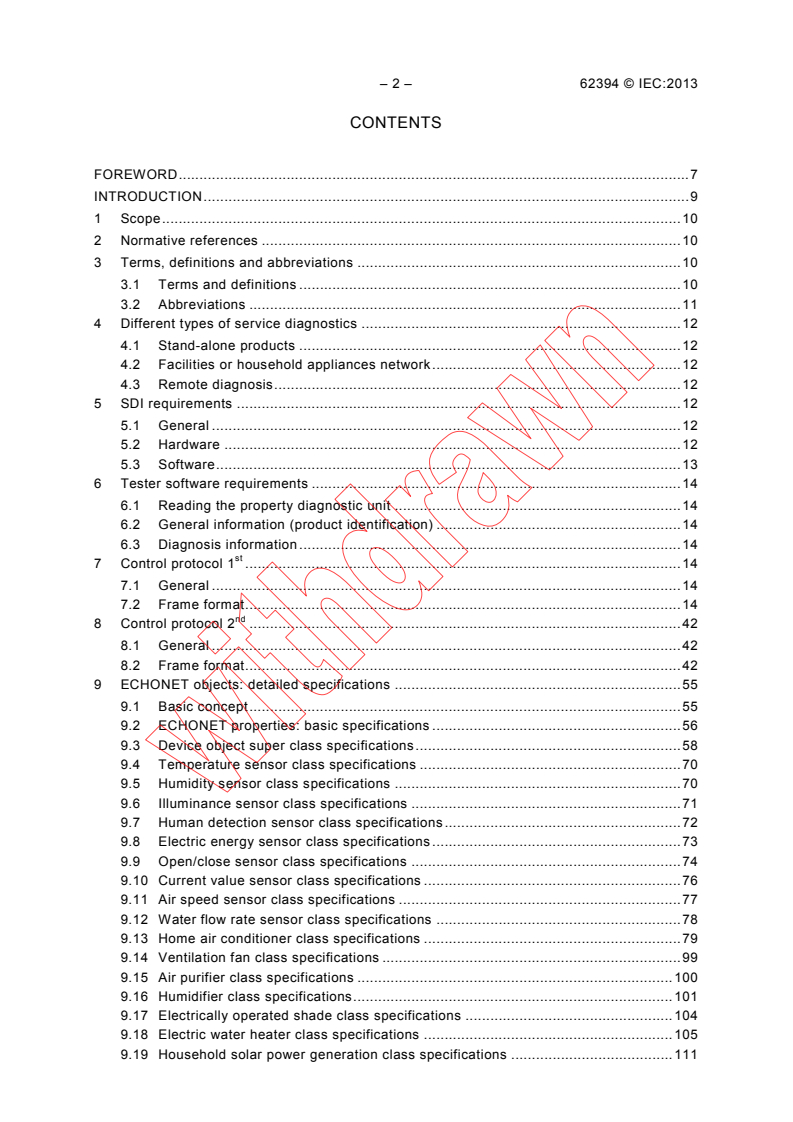
CONTENTS
FOREWORD . 7
INTRODUCTION . 9
1 Scope . 10
2 Normative references . 10
3 Terms, definitions and abbreviations . 10
3.1 Terms and definitions . 10
3.2 Abbreviations . 11
4 Different types of service diagnostics . 12
4.1 Stand-alone products . 12
4.2 Facilities or household appliances network . 12
4.3 Remote diagnosis . 12
5 SDI requirements . 12
5.1 General . 12
5.2 Hardware . 12
5.3 Software . 13
6 Tester software requirements . 14
6.1 Reading the property diagnostic unit . 14
6.2 General information (product identification) . 14
6.3 Diagnosis information . 14
st
7 Control protocol 1 . 14
7.1 General . 14
7.2 Frame format . 14
nd
8 Control protocol 2 . 42
8.1 General . 42
8.2 Frame format . 42
9 ECHONET objects: detailed specifications . 55
9.1 Basic concept . 55
9.2 ECHONET properties: basic specifications . 56
9.3 Device object super class specifications . 58
9.4 Temperature sensor class specifications . 70
9.5 Humidity sensor class specifications . 70
9.6 Illuminance sensor class specifications . 71
9.7 Human detection sensor class specifications . 72
9.8 Electric energy sensor class specifications . 73
9.9 Open/close sensor class specifications . 74
9.10 Current value sensor class specifications . 76
9.11 Air speed sensor class specifications . 77
9.12 Water flow rate sensor class specifications . 78
9.13 Home air conditioner class specifications . 79
9.14 Ventilation fan class specifications . 99
9.15 Air purifier class specifications . 100
9.16 Humidifier class specifications . 101
9.17 Electrically operated shade class specifications . 104
9.18 Electric water heater class specifications . 105
9.19 Household solar power generation class specifications . 111
62394 © IEC:2013 – 3 –
9.20 Floor heater class specifications . 113
9.21 Fuel cell class specifications . 118
9.22 Storage battery class specifications. 125
9.23 Electric vehicle charge-discharge system class specifications . 133
9.24 Water flow meter class specifications . 142
9.25 Power distribution board metering class specifications . 146
9.26 Smart electric meter class specifications . 166
9.27 Smart gas meter class specifications . 177
9.28 General light class specifications. 184
9.29 Refrigerator class specifications . 187
9.30 Microwave oven class specifications . 197
9.31 Washer and dryer class specifications . 213
9.32 Clothes dryer class specifications . 235
9.33 Cooking heater class specifications . 237
9.34 Switch class specifications . 243
10 Property map description format . 244
Bibliography . 245
Figure 1 – ECHONET frame for plain data format . 15
Figure 2 – EHD detailed specifications . 16
Figure 3 – Configuration of SEA and DEA when an individual address is specified . 17
Figure 4 – DEA (broadcast-stipulated) address configuration . 17
Figure 5 – Broadcast target stipulation code . 18
Figure 6 – Node group stipulation bit specifications . 18
Figure 7 – OHD detailed specifications . 19
Figure 8 – EOJ detailed specifications . 19
Figure 9 – EPC detailed specifications . 21
Figure 10 – ESV detailed specifications . 21
Figure 11 – EDATA configuration in property value write service . 25
Figure 12 – EDATA configuration in property value read service . 25
Figure 13 – EDATA configuration in property value notification service . 26
Figure 14 – EDATA configuration in property value element-stipulated write service . 27
Figure 15 – EDATA configuration in property value element-stipulated read service . 28
Figure 16 – EDATA configuration in property value element-stipulated notification
service . 29
Figure 17 – EDATA configuration in property value element-stipulated addition . 30
Figure 18 – EDATA configuration in property value element-stipulated deletion . 31
Figure 19 – EDATA configuration in property value element-stipulated existence
confirmation . 32
Figure 20 – EDATA configuration in property value element addition . 33
Figure 21 – EDATA configuration in property value notification (response required) . 33
Figure 22 – EDATA configuration in property value element-stipulated notification
(response required) . 34
Figure 23 – CpESV configuration . 35
Figure 24 – Relationship between write request (requiring no response) and write
"process-not-possible" response . 38
– 4 – 62394 © IEC:2013
Figure 25 – Relationship between write request (requiring a response), write "accepted"
response, and write "process-not-possible" response. 39
Figure 26 – Relationship between read request (requiring a response), read "accepted"
response, and read "process-not-possible" response . 40
Figure 27 – Notification message format . 41
Figure 28 – Relationship between property value notification (requiring a response) and
property value notification response . 41
Figure 29 – Processing target property counter for three requests . 42
Figure 30 – Property data counter . 42
Figure 31 – ECHONET Lite frame format . 43
Figure 32 – Detailed specifications of ELHD1 . 43
Figure 33 – Detailed specifications of ELHD2 . 44
Figure 34 – Detailed specifications of EOJ code . 44
Figure 35 – ELSV code detailed specifications . 45
Figure 36 – ELDATA configuration for property value write service
(no response required) . 48
Figure 37 – ELDATA configuration for property value write service (response required) . 49
Figure 38 – ELDATA configuration for property value read service . 50
Figure 39 – ELDATA configuration for property value write and read service . 51
Figure 40 – ELDATA configuration for property value notification service . 52
Figure 41 – ELDATA configuration for property value notification (response required)
service . 53
Figure 42 – EPC detailed specifications . 54
Figure 43 – ECHONET Lite Property data counter . 55
Figure 44 – Example of array elements . 57
Figure 45 – Example of property value element deletion . 58
Figure 46 – Example of property value element addition . 58
Figure 47 – Data structure of “identification number” property . 64
Figure 48 – Data structure of “manufacturer’s fault code” property . 65
Figure 49 – Air flow direction (vertical) setting . 90
Figure 50 – Air flow direction (horizontal) setting . 91
Figure 51 – Mounted air cleaning method . 93
Figure 52 – Air purifier function setting . 94
Figure 53 – Air refresh method. 94
Figure 54 – Air refresher function setting . 95
Figure 55 – Self-cleaning method. 95
Figure 56 – Self-cleaning function setting . 96
Figure 57 – Implemented ion emission method . 104
Figure 58 – Daily timer setting . 117
Figure 59 – Stove . 240
Table 1 – Bit pattern for hop count . 16
Table 2 – List of class group codes . 20
Table 3 – List of ESV codes for requests . 23
Table 4 – List of ESV codes for response/notification . 23
62394 © IEC:2013 – 5 –
Table 5 – List of ESV codes for “response-not-possible” responses . 24
Table 6 – List of CpESV codes for request/notification . 36
Table 7 – List of CpESV codes for "accepted" response . 37
Table 8 – List of CpESV codes for "process-not-possible" response . 37
Table 9 – List of class group codes . 45
Table 10 – List of service codes for request . 47
Table 11 – List of ELSV codes for response/notification . 47
Table 12 – List of ELSV codes for “response not possible”. 48
Table 13 – EPC code allocation table . 54
Table 14 – Data types, data sizes, and overflow/underflow codes . 57
Table 15 – List of device object super class configuration properties . 59
Table 16 – Installation location (space) types and the bit values assigned to them . 63
Table 17 – Fault-content property value assignments . 67
Table 18 – List of temperature sensor properties . 70
Table 19 – List of humidity sensor properties . 71
Table 20 – List of illuminance sensor properties. 71
Table 21 – List of human detection sensor properties . 72
Table 22 – List of electric energy sensor properties . 73
Table 23 – List of open/close sensor properties . 75
Table 24 – List of current value sensor properties . 76
Table 25 – List of air speed sensor properties . 77
Table 26 – List of water flow rate sensor properties . 78
Table 27 – List of home air conditioner properties . 79
Table 28 – Air flow direction (horizontal) setting . 91
Table 29 – List of ventilation fan properties . 99
Table 30 – List of air purifier properties . 100
Table 31 – List of humidifier properties . 102
Table 32 – List of electrically operated shade properties . 105
Table 33 – List of electric water heater properties . 106
Table 34 – List of household solar power generation properties . 111
Table 35 – List of floor heater properties . 114
Table 36 – List of fuel cell properties . 119
Table 37 – List of storage battery properties . 126
Table 38 – List of electric vehicle charge-discharge system properties. 133
Table 39 – List of water flow meter properties . 142
Table 40 – List of power distribution board metering properties . 146
Table 41 – List of smart electric meter properties . 167
Table 42 – List of smart gas meter properties . 177
Table 43 – Security data information property . 182
Table 44 – gas consumption log information property . 184
Table 45 – List of general light properties . 184
Table 46 – List of refrigerator properties . 187
Table 47 – List of microwave oven properties . 198
– 6 – 62394 © IEC:2013
Table 48 – Heating status property . 204
Table 49 – Automatic heating setting property . 205
Table 50 – Automatic heating cycle codes . 206
Table 51 – Prompt message codes . 210
Table 52 – 2 bytes bitmap definition for each accessory . 211
Table 53 – List of washer and dryer properties . 213
Table 54 – washer and dryer setting property . 219
Table 55 – washer and dryer cycle option list 1 property . 225
Table 56 – Washer and dryer cycle option list 2 property . 225
Table 57 – Washer and dryer cycle option list 3 property . 226
Table 58 – Current stage of washer and dryer cycle property . 229
Table 59 – List of clothes dryer properties . 236
Table 60 – List of cooking heater properties. 238
Table 61 – List of switch properties . 243
Table 62 – Property map description format . 244
62394 © IEC:2013 – 7 –
INTERNATIONAL ELECTROTECHNICAL COMMISSION
____________
SERVICE DIAGNOSTIC INTERFACE FOR CONSUMER
ELECTRONICS PRODUCTS AND NETWORKS –
IMPLEMENTATION FOR ECHONET
FOREWORD
1) The International Electrotechnical Commission (IEC) is a worldwide organization for standardization comprising
all national electrotechnical committees (IEC National Committees). The object of IEC is to promote international
co-operation on all questions concerning standardization in the electrical and electronic fields. To this end and in
addition to other activities, IEC publishes International Standards, Technical Specifications, Technical Reports,
Publicly Available Specifications (PAS) and Guides (hereafter referred to as “IEC Publication(s)”). Their
preparation is entrusted to technical committees; any IEC National Committee interested in the subject dealt with
may participate in this preparatory work. International, governmental and non-governmental organizations liaising
with the IEC also participate in this preparation. IEC collaborates closely with the International Organization for
Standardization (ISO) in accordance with conditions determined by agreement between the two organizations.
2) The formal decisions or agreements of IEC on technical matters express, as nearly as possible, an international
consensus of opinion on the relevant subjects since each technical committee has representation from all
interested IEC National Committees.
3) IEC Publications have the form of recommendations for international use and are accepted by IEC National
Committees in that sense. While all reasonable efforts are made to ensure that the technical content of IEC
Publications is accurate, IEC cannot be held responsible for the way in which they are used or for any
misinterpretation by any end user.
4) In order to promote international uniformity, IEC National Committees undertake to apply IEC Publications
transparently to the maximum extent possible in their national and regional publications. Any divergence between
any IEC Publication and the corresponding national or regional publication shall be clearly indicated in the latter.
5) IEC itself does not provide any attestation of conformity. Independent certification bodies provide conformity
assessment services and, in some areas, access to IEC marks of conformity. IEC is not responsible for any
services carried out by independent certification bodies.
6) All users should ensure that they have the latest edition of this publication.
7) No liability shall attach to IEC or its directors, employees, servants or agents including individual experts and
members of its technical committees and IEC National Committees for any personal injury, property damage or
other damage of any nature whatsoever, whether direct or indirect, or for costs (including legal fees) and expenses
arising out of the publication, use of, or reliance upon, this IEC Publication or any other IEC Publications.
8) Attention is drawn to the Normative references cited in this publication. Use of the referenced publications is
indispensable for the correct application of this publication.
9) Attention is drawn to the possibility that some of the elements of this IEC Publication may be the subject of patent
rights. IEC shall not be held responsible for identifying any or all such patent rights.
International Standard IEC 62394 has been prepared by technical area 9: Audio, video and
multimedia applications for end-user network, of IEC technical committee 100: Audio, video and
multimedia systems and equipment.
This second edition cancels and replaces the first edition, published in 2006, and constitutes a
technical revision.
This edition includes the following significant technical changes with respect to the previous
edition:
– addition of new message structure (frame format);
– updates of the device object super class specifications for the property configurations
shared by all device objects;
– addition of the property configurations defined by each device object;
– updates of normative references.
– 8 – 62394 © IEC:2013
The text of this standard is based on the following documents:
FDIS Report on voting
100/2182/FDIS 100/2214/RVD
Full information on the voting for the approval of this standard can be found in the report on
voting indicated in the above table.
This publication has been drafted in accordance with the ISO/IEC Directives, Part 2.
The committee has decided that the contents of this publication will remain unchanged until the
stability date indicated on the IEC web site under "http://webstore.iec.ch" in the data related to
the specific publication. At this date, the publication will be
• reconfirmed,
• withdrawn,
• replaced by a revised edition, or
• amended.
IMPORTANT – The 'colour inside' logo on the cover page of this publication indicates
that it contains colours which are considered to be useful for the correct understanding
of its contents. Users should therefore print this document using a colour printer.
62394 © IEC:2013 – 9 –
INTRODUCTION
Consumer products are often repaired by service workshops, which service a wide range of
products developed by different manufacturers.
For highly complex products, fault diagnosis becomes increasingly difficult and time consuming.
To facilitate diagnosis, manufacturers often develop built-in diagnostic software that
communicates with an external diagnostic unit through a service diagnostic interface (SDI).
To avoid the need for a service workshop to purchase several different diagnostic units from
different manufacturers for different products, a standardized SDI is proposed for use by all
manufacturers of any products requiring a diagnostic interface. The result will be that only one
SDI is needed in the service workshops.
The SDI should be suitable for diagnosis in a facilities or household appliances network in which
different products from different manufacturers are connected together. The interface should
also allow for future development.
The standard SDI should
– be usable in future products,
– be easily connectable to a product or a network,
– be inexpensive,
– not limit product design.
– 10 – 62394 © IEC:2013
SERVICE DIAGNOSTIC INTERFACE FOR CONSUMER
ELECTRONICS PRODUCTS AND NETWORKS –
IMPLEMENTATION FOR ECHONET
1 Scope
This International Standard specifies requirements for service diagnostic software to be
implemented in products that incorporate a digital interface. It does not specify requirements for
carrying out remote diagnosis or for manufacturer-dependent software.
The SDI (Service Diagnostic Interface) requires an external controller (exclusive or
general-purpose/PC) into which service diagnostic software can be loaded. Part of the controller
software should be standardized while another part of this controller software should be unique
to the manufacturer.
To reach a common approach in servicing all products from all manufacturers, it is necessary to
standardize specific items to be tested in products and in controllers’ diagnostic software.
The SDI is based upon the ECHONET specification version 2.11, ECHONET Lite specification
version 1.01 and APPENDIX Detailed Requirements for ECHONET Device objects Release B
because this interface will be used in future products. The use of this connection and existing
communication protocols enable implementation in products at low cost, with maximum
flexibility and efficiency.
The SDI consists of
• specific hardware and software requirements of the device under test (DUT);
• specific requirements of the controller:
– the service software;
– an ECHONET interface;
• the connection between the controller and the DUT.
This standard provides the minimal requirements necessary to carry out computerized diagnosis.
It covers the standardized software of the controller as well as the standardized software and
provisions in the DUT.
2 Normative references
The following documents, in whole or in part, are normatively referenced in this document and
are indispensable for its application. For dated references, only the edition cited applies. For
undated references, the latest edition of the referenced document (including any amendments)
applies.
(void)
3 Terms, definitions and abbreviations
3.1 Terms and definitions
For the purposes of this document, the following terms and definitions apply.
62394 © IEC:2013 – 11 –
3.1.1
ECHONET specifications
specifications designed to enable the use of various kinds of transmission media (for example,
power line, low-power radiofrequency, ETHERNET, Bluetooth®
3.1.2
remote diagnosis
diagnosis of a product via telephone, Internet, etc.
3.2 Abbreviations
CpESV Compound ECHONET service
DEA Destination ECHONET address
DEOJ Destination ECHONET object
DUT Device under test
EBC ECHONET byte counter
EDATA ECHONET DATA
EDT ECHONET property value data
EHD ECHONET headers
ELDATA ECHONET Lite DATA
ELHD ECHONET Lite headers
ELPDC ECHONET Lite Property data counter
ELSV ECHONET Lite service
EOJ ECHONET objects
EPC ECHONET property
ESV ECHONET service
EVPS Electric Vehicle Power System
LSB Least Significant Bit
MSB Most Significant Bit
OEM Original equipment manufacturer
OHD Object message header
OPC Processing target property counter
PC Personal computer
PDC Property data counter
PEDATA Plane EDATA (Plane ECHONET data)
ROM Read-only memory
SDI Service diagnostic interface
SEA Source ECHONET address
SEOJ Source ECHONET object
SOC State of Charge
TID Transaction ID
V2H Vehicle to Home
____________
ETHERNET is the trademark of a product supplied by Xerox Corporation.
Bluetooth is the trademark of a product supplied by Bluetooth SIG, Inc.
This information is given for the convenience of users of this standard and does not constitute an endorsement by
IEC of the product named. Equivalent products may be used if they can be shown to lead to the same results.
– 12 – 62394 © IEC:2013
4 Different types of service diagnostics
4.1 Stand-alone products
For stand-alone products, a connection is made between the diagnostic controller and the DUT,
where the DUT is from any manufacturer and of any type.
4.2 Facilities or household appliances network
In a facilities or household appliances network, a connection is made between the diagnostic
controller and a network of facilities or household appliances. Several different facilities or
household appliances are interconnected and not all of them are necessarily from the same
manufacturer.
In this case, the SDI shall list the products on the network, detect which facilities or appliances
are causing problem, and diagnose the product concerned.
4.3 Remote diagnosis
In addition to the configurations described in 4.1 and 4.2, a link can be made (for example, via
telephone, the Internet, etc.) between the diagnostic controller in the workshop and a
DUT/network at the customer’s home. Therefore, if a product has both an ECHONET interface
and a remote connection capability, this product should be able to transfer the diagnostic data,
as described in this standard, through the remote connection.
5 SDI requirements
5.1 General
The SDI consists of
• hardware and software, both in the DUT and in the test equipment (“tester”);
• the connection between the tester and the DUT.
The total SDI can be divided into the parts described in 5.2 and 5.3.
5.2 Hardware
5.2.1 Tester hardware
The hardware used for testing shall be a controller exclusive computer or general-purpose
controller (for example, desktop or laptop PC) provided with at least one suitable network
interface which enables the transfer of the ECHONET frame, as specified in 7.2, and running the
necessary diagnostic software.
NOTE The minimum requirements for the tester hardware depend on the respective tester platform.
5.2.2 Facilities or household appliances network
For the connection between the tester and the DUT, the “facilities or household appliances
network” shall be used. For the diagnosis of the DUT using the network, the tester shall be
connected to the facilities or household appliances network that conforms to the requirements of
7.1.
62394 © IEC:2013 – 13 –
5.2.3 DUT hardware
5.2.3.1 General
The DUT shall be provided with at least one network interface which enables the transfer of the
ECHONET frame as specified in 7.2.
5.2.3.2 Facilities or household appliances network
For diagnosis on a network, the tester shall, where possible, be connected to a “facilities or
household appliances network” that conforms to the requirements of 7.1.
5.3 Software
5.3.1 General
The software for the SDI can be divided into two parts (tester and DUT) of which each part again
can be divided into mandatory (SDI common) software and non-mandatory
(manufacturer-dependent) software.
5.3.2 Tester software
The software platform of the tester shall be able to handle the ECHONET frame as specified in
7.2.
The SDI common software on the tester shall have the following functionalities:
a) initiate a service of “property value read request”, as specified in 7.2.9;
b) read out the service of “property value read response” and “property value notification” of all
products, as specified in 7.2.9;
c) display a list of all products connected to the facilities or household appliances network to
which the tester is connected. On the display shall be listed the
– manufacturer code property,
– place-of-business code property,
– product code property,
– serial number property,
– date-of-manufacture property;
d) display an indication of the fault status property which describes the occurrence of an error
in an actual device. The property code used as a property value is 0 × 41 when an error
exists or 0 × 42 when no error exists and is found to be “OK” or “Not OK” as specified in 9.3.6;
e) display an indication of the fault content property which describes the content of an error in
an actual device as specified in 9.3.6.
5.3.3 DUT software requirements for the SDI
The DUT shall be able to handle the ECHONET frame as specified in 7.2.
In addition, the SDI common software in the DUT shall be able to
a) run a self-test routine;
b) receive a service of “property value read request” as specified in 7.2.9 which is initiated by
the tester and response a service of “property value read response” as specified in 7.2.9;
c) initiate a service of “property value notification” as specified in 7.2.9.
– 14 – 62394 © IEC:2013
6 Tester software requirements
6.1 Reading the property diagnostic unit
The common application shall be able to retrieve from the SDI-compliant devices and display the
information specified in 6.1 to 6.3.
6.2 General information (product identification)
The manufacturer code property, the place-of-business code property, the product code
property and the serial number property shall be read from the DUT and displayed. These
property data shall always be available as specified in 9.30. The tester shall display this
information for all devices in the system.
NOTE The manufacturer code displayed might not be the same as the name on the physical device.
6.3 Diagnosis information
After start-up of the general information software, the diagnosis information shall be displayed.
st
7 Control protocol 1
7.1 General
The ECHONET specifications were designed to enable the use of various kinds of transmission
media (for example, power line, low-power radiofrequency, ETHERNET, Bluetooth®). Slow
transmission speeds discourage large data transfers, and it is desirable to
...