

IEC 60839-7-1
Alarm systems - Part 7-1: Message formats and protocols for serial data interfaces in alarm transmission systems - General
General Information
- Abstract
Describes the requirements for standard serial data interfaces in alarm transmission systems. Gives an outline of how alarm transmission systems are connected and the various types of serial data interfaces that might be employed.
- Status
- Not Published
- Technical Committee
- TC 79 - Alarm and electronic security systems
- Current Stage
- PPUB - Publication issued
- Start Date
- 09-Mar-2001

Overview
IEC 60839-7-1 - Alarm systems: Part 7-1 - provides the general framework for message formats and protocols for serial data interfaces in alarm transmission systems. It describes requirements for standard serial interfaces, outlines how alarm transmission systems are connected, and identifies the types of serial interfaces that may be employed. The standard also introduces the OSI reference model as applied to alarm communications and includes informative annexes with message structure and examples.
Key topics and requirements
- Scope and purpose: Defines requirements for serial data interfaces used to transport alarm system messages between supervised premises, transceivers and receivers.
- Message types: Classifies messages such as alarm messages, commands, informative messages and transmission system messages (as per the standard’s definitions).
- Functional states: Defines logical functional parts and their states (normal, alarm, outstanding alarm, tamper, test, disabled).
- OSI reference model mapping: Explains application of the OSI model (Layers 1–4 emphasized) to alarm transmission - covering physical, data link and transport layer responsibilities for alarm systems.
- Interface types: Outlines three main interface roles:
- Alarm system interface (between control and indicating equipment and transceivers),
- Intermediate interface (between networked transmission elements),
- Terminal interface (towards receiving or monitoring endpoints).
- Security and integrity elements: Includes definitions such as message authentication code (MAC) and link control concepts like master/slave, originator/receiver, and window size (acknowledgement behavior).
- Informative annexes: Annex A (message structure) and Annex B (practical examples and figures) illustrate typical protocol structures and deployment options.
Applications and who uses it
IEC 60839-7-1 is used by:
- Alarm system manufacturers designing serial interfaces for control and indicating equipment (CIE) and alarm transceivers.
- System integrators and installers ensuring interoperability between alarm panels, digital communicators and monitoring centers.
- Alarm monitoring/receiving centers (ARCs) and service providers that accept serial alarm data over PSTN or dedicated links.
- Network and device designers implementing protocols over ITU-T V.24/V.28, V.23, two‑wire ISO/IEC 8482 interfaces or plug‑in transceivers.
- Certification bodies and testers validating compliance and message-handling behavior.
Related standards
IEC 60839-7-1 is part of the IEC 60839-7 series. Relevant related parts include:
- IEC 60839-7-2 (common application layer),
- IEC 60839-7-3 (data link layer),
- IEC 60839-7-4 (transport layer),
- IEC 60839-7-5, -7, -11, -12, -20 (specific interface and signalling methods), and referenced telecom standards such as ISO/IEC 8482, ITU‑T V.23, V.24, V.28.
Keywords: IEC 60839-7-1, alarm transmission systems, serial data interfaces, message formats, protocols, alarm systems, OSI model, CIE, V.24, V.23, ISO/IEC 8482.
Get Certified
Connect with accredited certification bodies for this standard

CIS Institut d.o.o.
Personal Protective Equipment (PPE) certification body. Notified Body NB-2890 for EU Regulation 2016/425 PPE.

Kiwa BDA Testing
Building and construction product certification.
Kmetijski inštitut Slovenije
Agricultural Institute of Slovenia. Soil testing, plant health, agricultural product analysis.
Sponsored listings
Frequently Asked Questions
IEC 60839-7-1 is a standard published by the International Electrotechnical Commission (IEC). Its full title is "Alarm systems - Part 7-1: Message formats and protocols for serial data interfaces in alarm transmission systems - General". This standard covers: Describes the requirements for standard serial data interfaces in alarm transmission systems. Gives an outline of how alarm transmission systems are connected and the various types of serial data interfaces that might be employed.
Describes the requirements for standard serial data interfaces in alarm transmission systems. Gives an outline of how alarm transmission systems are connected and the various types of serial data interfaces that might be employed.
IEC 60839-7-1 is classified under the following ICS (International Classification for Standards) categories: 13.320 - Alarm and warning systems. The ICS classification helps identify the subject area and facilitates finding related standards.
IEC 60839-7-1 is available in PDF format for immediate download after purchase. The document can be added to your cart and obtained through the secure checkout process. Digital delivery ensures instant access to the complete standard document.
Standards Content (Sample)
SLOVENSKI STANDARD
01-junij-2002
Alarm systems - Part 7-1: Message formats and protocols for serial data interfaces
in alarm transmission systems - General
Alarm systems - Part 7-1: Message formats and protocols for serial data interfaces in
alarm transmission systems - General
Systèmes d'alarme - Partie 7-1: Formats de message et protocoles pour les interfaces
de données série dans les systèmes de transmission d'alarme - Généralités
Ta slovenski standard je istoveten z: IEC 60839-7-1
ICS:
13.320 Alarmni in opozorilni sistemi Alarm and warning systems
35.200 Vmesniška in povezovalna Interface and interconnection
oprema equipment
2003-01.Slovenski inštitut za standardizacijo. Razmnoževanje celote ali delov tega standarda ni dovoljeno.
NORME CEI
INTERNATIONALE IEC
60839-7-1
INTERNATIONAL
Première édition
STANDARD
First edition
2001-03
Systèmes d'alarme –
Partie 7-1:
Formats de message et protocoles pour
les interfaces de données série dans
les systèmes de transmission d'alarme –
Généralités
Alarm systems –
Part 7-1:
Message formats and protocols for serial
data interfaces in alarm transmission systems –
General
IEC 2001 Droits de reproduction réservés Copyright - all rights reserved
Aucune partie de cette publication ne peut être reproduite ni No part of this publication may be reproduced or utilized in
utilisée sous quelque forme que ce soit et par aucun procédé, any form or by any means, electronic or mechanical,
électronique ou mécanique, y compris la photocopie et les including photocopying and microfilm, without permission in
microfilms, sans l'accord écrit de l'éditeur. writing from the publisher.
International Electrotechnical Commission 3, rue de Varembé Geneva, Switzerland
Telefax: +41 22 919 0300 e-mail: inmail@iec.ch IEC web site http://www.iec.ch
CODE PRIX
Commission Electrotechnique Internationale
R
PRICE CODE
International Electrotechnical Commission
Pour prix, voir catalogue en vigueur
For price, see current catalogue
60839-7-1 © IEC:2001 – 3 –
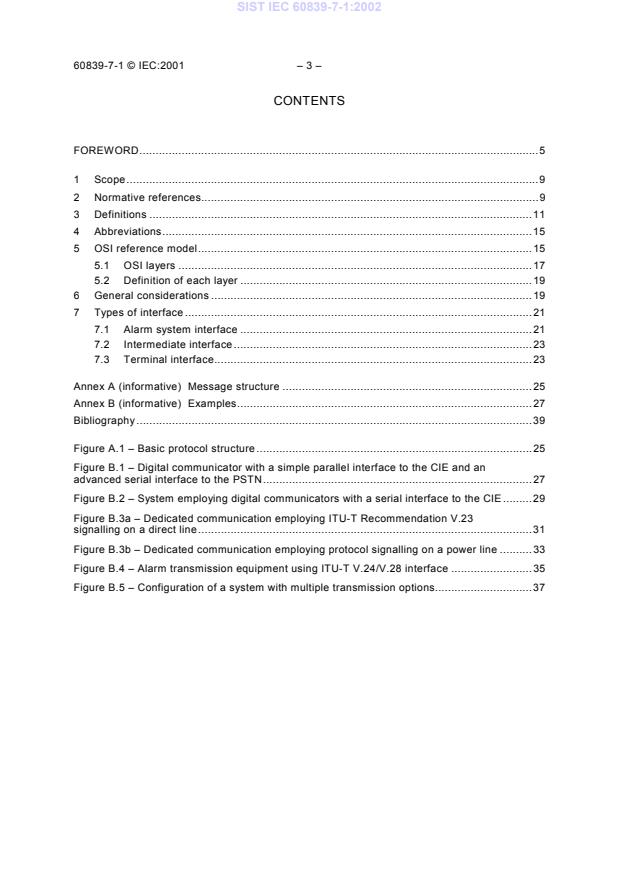
CONTENTS
FOREWORD.5
1 Scope.9
2 Normative references.9
3 Definitions .11
4 Abbreviations.15
5 OSI reference model.15
5.1 OSI layers .17
5.2 Definition of each layer .19
6 General considerations .19
7 Types of interface .21
7.1 Alarm system interface .21
7.2 Intermediate interface.23
7.3 Terminal interface.23
Annex A (informative) Message structure .25
Annex B (informative) Examples.27
Bibliography .39
Figure A.1 – Basic protocol structure.25
Figure B.1 – Digital communicator with a simple parallel interface to the CIE and an
advanced serial interface to the PSTN.27
Figure B.2 – System employing digital communicators with a serial interface to the CIE .29
Figure B.3a – Dedicated communication employing ITU-T Recommendation V.23
signalling on a direct line.31
Figure B.3b – Dedicated communication employing protocol signalling on a power line .33
Figure B.4 – Alarm transmission equipment using ITU-T V.24/V.28 interface .35
Figure B.5 – Configuration of a system with multiple transmission options.37
60839-7-1 © IEC:2001 – 5 –
INTERNATIONAL ELECTROTECHNICAL COMMISSION
__________
ALARM SYSTEMS –
Part 7-1: Message formats and protocols for serial data interfaces
in alarm transmission systems – General
FOREWORD
1) The IEC (International Electrotechnical Commission) is a worldwide organization for standardization comprising
all national electrotechnical committees (IEC National Committees). The object of the IEC is to promote
international co-operation on all questions concerning standardization in the electrical and electronic fields. To
this end and in addition to other activities, the IEC publishes International Standards. Their preparation is
entrusted to technical committees; any IEC National Committee interested in the subject dealt with may
participate in this preparatory work. International, governmental and non-governmental organizations liaising
with the IEC also participate in this preparation. The IEC collaborates closely with the International Organization
for Standardization (ISO) in accordance with conditions determined by agreement between the two
organizations.
2) The formal decisions or agreements of the IEC on technical matters express, as nearly as possible, an
international consensus of opinion on the relevant subjects since each technical committee has representation
from all interested National Committees.
3) The documents produced have the form of recommendations for international use and are published in the form
of standards, technical specifications, technical reports or guides and they are accepted by the National
Committees in that sense.
4) In order to promote international unification, IEC National Committees undertake to apply IEC International
Standards transparently to the maximum extent possible in their national and regional standards. Any
divergence between the IEC Standard and the corresponding national or regional standard shall be clearly
indicated in the latter.
5) The IEC provides no marking procedure to indicate its approval and cannot be rendered responsible for any
equipment declared to be in conformity with one of its standards.
6) Attention is drawn to the possibility that some of the elements of this International Standard may be the subject
of patent rights. The IEC shall not be held responsible for identifying any or all such patent rights.
International Standard IEC 60839-7-1 has been prepared by IEC technical committee 79: Alarm
systems.
This bilingual version (2001-11) replaces the English version.
The text of this standard is based on the following documents:
FDIS Report on voting
79/198/FDIS 79/208/RVD
Full information on the voting for the approval of this standard can be found in the report on
voting indicated in the above table.
This publication has been drafted in accordance with the ISO/IEC Directives, Part 3.
Annexes A and B are for information only.
The committee has decided that the contents of this publication will remain unchanged
until 2004. At this date, the publication will be
• reconfirmed;
• withdrawn;
• replaced by a revised edition, or
• amended.
60839-7-1 © IEC:2001 – 7 –
systems – Part 7: Message formats and protocols for serial data interfaces in alarm
transmission systems.
IEC 60839-7-2: Common application layer protocol
IEC 60839-7-3: Common data link layer protocol
IEC 60839-7-4: Common transport layer protocol
IEC 60839-7-5: Alarm system interfaces employing a two-wire configuration in accordance
with ISO/IEC 8482
IEC 60839-7-6: Alarm system interfaces employing ITU-T Recommendation V.24/V.28
signalling
IEC 60839-7-7: Alarm system interfaces for plug-in alarm system transceivers
Recommendation V.23 signalling at interfaces with the PSTN
Recommendation V.23 signalling
IEC 60839-7-20: Terminal interfaces employing ITU-T Recommendation V.24/V.28 signalling
60839-7-1 © IEC:2001 – 9 –
ALARM SYSTEMS –
Part 7-1: Message formats and protocols for serial data interfaces
in alarm transmission systems – General
1 Scope
This part of IEC 60839 describes the requirements for standard serial data interfaces in alarm
transmission systems. It gives an outline of how alarm transmission systems are connected
and the various types of serial data interfaces that might be employed. This part includes a
range of examples.
2 Normative references
The following referenced documents are indispensable for the application of this document. For
dated references, only the edition cited applies. For undated references, the latest edition of
the referenced document (including any amendments) applies.
IEC 60839-7-2, Alarm systems – Part 7-2: Message formats and protocols for serial data
interfaces in alarm transmission systems – Common application layer protocol
IEC 60839-7-5, Alarm systems – Part 7-5: Message formats and protocols for serial data
interfaces in alarm transmission systems – Alarm system interface employing a two-wire
configuration in accordance with ISO/IEC 8482
IEC 60839-7-7, Alarm systems – Part 7-7: Message formats and protocols for serial data
interfaces in alarm transmission systems – Alarm system interface for plug-in alarm system
transceivers
interfaces in alarm transmission systems – Serial protocol for use by digital communicator
systems using ITU-T Recommendation V.23 signalling at interfaces with the PSTN
interfaces in alarm transmission systems – PTT Interfaces for dedicated communications using
ITU-T Recommendation V.23 signalling
IEC 60839-7-20, Alarm systems – Part 7-20: Message formats and protocols for serial data
interfaces in alarm transmission systems – Terminal interfaces employing ITU-T
Recommendation V.24/V.28 signalling
ISO/IEC 8482, Information technology – Telecommunications and information exchange
between systems – Twisted pair multipoint interconnections
ITU-T Recommendation V.23, 600/1 200-baud modem standardized for use in the general
switched telephone network
ITU-T Recommendation V.24, List of definitions for interchange circuits between data terminal
1)
equipment (DTE) and data circuit-terminating equipment (DCE)
ITU-T Recommendation V.28, Electrical characteristics for unbalanced double-current inter-
change circuits
___________
1)
To be published.
60839-7-1 © IEC:2001 – 11 –
3 Definitions
For the purpose of this part of IEC 60839, the following definitions apply.
3.1
alarm system messages
messages that convey information about the status of an alarm system
These may comprise:
3.1.1
alarm messages
messages that convey the presence of a hazard or a potential hazard to life or property, or the
removal of such a hazard, including messages that convey the status of an alarm since the
alarm transmission system is only responsible for decoding the type of the transmitted
message
3.1.2
commands
messages that give instructions to an alarm system or to part of the alarm transmission system
3.1.3
informative messages
messages that give information about the status of functions of an alarm system
3.1.4
transmission system messages
messages that convey the status of parts of the alarm transmission system, including
messages which report the status of the alarm system transceiver
NOTE The format and treatment of such messages may be the same as for alarm system messages.
3.2
alarm channel
part of the logical alarm transmission path across which information about the status of
separately identifiable logical functional parts of the connected alarm system are passed
3.3
functional part
logical function which may include individual detectors, groups of detectors and sections of the
common parts of the system (for example power supply unit (PSU), warning device, etc.)
NOTE Such a functional part may be in one or more of the following states as shown below.
3.3.1
normal condition
status of a functional part when it is fully operational and not in any other condition
3.3.2
alarm condition
status of a functional part which results from the response of that functional part to the
presence of an abnormal condition indicating the presence of a hazard (or a potential hazard)
which has not been acknowledged by either its successful transmission or by a local manual
action
60839-7-1 © IEC:2001 – 13 –
3.3.3
outstanding alarm
status of a functional part which results from the response of that functional part to the
presence of an abnormal condition indicating the presence of a hazard (or a potential hazard)
which has been acknowledged by either its successful transmission or by a local manual action
3.3.4
tamper
status of a functional part which results from the operation of a tamper device within that
functional part
3.3.5
test condition
status of the functional part which results from changing the status out of normal condition for
test purposes
3.3.6
disabled
status of the functional part in which the normal functions have been taken out of service
3.4
alarm system transceiver
alarm transmission equipment, which is located at the supervised premises or at a satellite
station
3.5
master
item of equipment which controls the messages on the link and to which messages are either
sent or received
3.6
slave
item of equipment on the link which is not in control and which can only transmit a message in
response to the master, in response to a request from it
3.7
data link data
information element, a data link message or a message originating from LAYER 4 –
TRANSPORT
3.8
originator
item of equipment which initiates the data communications on a link
NOTE This need not be the item which initiates the physical/logical connection.
3.9
receiver
item of equipment on a link which accepts data communication initiated on a link by another
item of equipment (an ORIGINATOR)
3.10
message authentication code (MAC)
code ensuring that the message arrives from the correct source
3.11
window size
maximum number of messages which may be transmitted without receiving ACK.
60839-7-1 © IEC:2001 – 15 –
4 Abbreviations
ACK acknowledgement
CCTV closed circuit television
ITU-T International Telecommunication Union – Telecommunications
CIE control and indicating equipment
CR carriage return
CRC cyclic redundancy check
DLLA data link layer authentication
HEX hexadecimal
ID identity
INIT initiated
ISO International Standards Organization
ISDN Integrated System Digital Network
Ki secondary key
MAC message authentication code
Mk master key
LSB least significant (byte) octet
OSI open system interconnection
PSTN Public Switched Telephone Network
PTT Post, Telegraph and Telephone
R1 random number
Rs random seed
STX start of text
TTL transistor transistor logic
5 OSI reference model
The open system interconnection (OSI) reference model was developed by the International
Standards Organization (ISO) both to provide a commonly agreed way of describing,
understanding and analyzing the various functions of complex communications systems. It also
provides a framework for drafting international standards.
The reference model views the functions of a system as being divided into a number of layers.
There are formally 7 LAYERS (1-7), though layers 0 and 8 are now commonly added as
described below.
The layered structure enables changes to be made to the different functions without affecting
the other layers. In actual systems, some layers may be omitted. Designers are free to
implement the layers individually or to combine them.
60839-7-1 © IEC:2001 – 17 –
It was also developed to enable a variety of applications to be operated over any combination
of current or future network technologies without the need for changes in the applications
themselves. Thus, there is a fundamental division in the model so as to provide a stable
boundary between applications and the real networks being used. This occurs at LAYER 3 –
NETWORK layer of the reference model.layers in the OSI reference model are shown below.
5.1 OSI layers
LAYER 0 – MECHANICAL is only required in cases where there is a need to specify the
physical shape of connectors and modules that connect directly to each other. An example
would be defining the maximum size and connector arrangements of plug-in digital
communicators, so that manufacturers of control and indicating equipment could have a
standard space and connector layout into which communicators from a number of other
manufacturers could fit.
LAYERS 1 to 3 reflect the logical division of the functions in any network. LAYER 1 –
PHYSICAL defines the physical and electrical interface characteristics of the interface to the
actual transmission medium. It provides a totally transparent transmission path. LAYER 2 –
DATA LINK is responsible for any low level formatting of the data into blocks and for the
provision of error detection and/or correction. LAYER 3 – NETWORK provides addressing and
routing in networks with multiple terminals, as well as basic call set-up and clear down
procedures.
LAYER 4 – TRANSPORT – In some applications, these lower levels do not provide all the
transmission features required by the application. Within the context of alarm transmission, this
might apply to the provision of higher levels of error detection and correction, scrambling and
encryption and linking short blocks together to form longer messages. These additional
features are provided in this layer.
The layers above LAYER 4 are concerned with the management and synchronization of the
data, and should be independent of the data transmission systems used. LAYER 5 – SESSION
is used to manage systems where different applications share the same transmission system.
LAYER 6 – PRESENTATION is responsible for changing the format of the data, where the two
end applications have different ways of presenting the data. These two layers are unlikely to
feature in an alarm transmission system.
LAYER 7 – APPLICATION is the top level that provides the actual transmission service to the
application, it is the window through which the application sees the alarm transmission service.
LAYER 8 – NETWORK MANAGEMENT is a common format for the control and management of
transmission equipment, particularly more complex switching and multiplexing equipment. It
can be considered as a specialized, alternative presentation/application layer for use by the
network managers to monitor the transmission system.
60839-7-1 © IEC:2001 – 19 –
LAYER 8 - NETWORK MANAGEMENT
LAYER 7 - APPLICATION
USERS OF TRANSPORT SERVICE
LAYER 6 - PRESENTATION
LAYER 5 - SESSION
LAYER 4 - TRANSPORT TRANSPORTS
SERVICE
LAYER 3 - NETWORK
NETWORK
LAYER 2 - DATA LINK
SERVICE
LAYER 1 - PHYSICAL
LAYER 0 - MECHANICAL
5.2 Definition of each layer
Each layer in the reference model is defined by three sets of requirements:
a) the serv
...