

IEC 60364-5-52
Electrical installations of buildings - Part 5-52: Selection and erection of electrical equipment - Wiring systems
General Information
- Abstract
Deals with the selection and erection of wiring systems.
- Status
- Not Published
- Technical Committee
- TC 64 - Electrical installations and protection against electric shock
- Current Stage
- PPUB - Publication issued
- Start Date
- 20-Aug-2001
Buy Documents


Overview
IEC 60364-5-52 - "Electrical installations of buildings - Part 5-52: Selection and erection of electrical equipment - Wiring systems" is an international standard that specifies principles and requirements for the selection, installation and erection of wiring systems in buildings. Part of the IEC 60364 series, this standard addresses wiring system types, external influences, conductor sizing, current-carrying capacity, voltage drop, electrical connections, fire containment and maintainability. Annex A (normative) provides tabulated current‑carrying capacities and other annexes give informative calculation methods and guidance.
Key topics and technical requirements
- Types of wiring systems and recommended methods of installation for different environments.
- External influences affecting wiring selection, including ambient temperature, water, solid foreign bodies, corrosive substances, mechanical impact, vibration, fauna/flora, solar radiation, seismic effects and wind.
- Current‑carrying capacities and correction/reduction factors for different cable types and installation methods (detailed tables in Annex A).
- Conductor cross‑sectional area and minimum sizing principles to meet thermal and mechanical requirements.
- Voltage drop considerations for consumer installations and how to limit voltage drop through conductor selection and layout.
- Electrical connections: requirements for reliable joints and terminations.
- Fire safety and containment: selection and erection measures to minimise spread of fire, including sealing penetrations and precautions within fire‑segregated compartments.
- Proximity to other services: coordination with non‑electrical services to avoid interference or hazards.
- Maintainability and cleaning: installation practices that allow inspection, maintenance and cleaning access.
Practical applications
IEC 60364-5-52 is used to:
- Select cable types and insulation suitable for environmental and mechanical stresses.
- Determine appropriate conductor sizes using current‑carrying capacity tables and correction factors.
- Design wiring routes to limit voltage drop and reduce fire spread risk.
- Specify installation methods (in air, in ducts, buried, in conduit, trunking) that meet operational and safety requirements.
- Prepare installation and inspection checklists for contractors and electrical inspectors.
Keywords: IEC 60364-5-52, wiring systems, electrical installations, current-carrying capacity, conductor sizing, voltage drop, fire safety, cable selection.
Who should use this standard
- Electrical designers and consulting engineers
- Building services contractors and installation electricians
- Inspection bodies, authorities having jurisdiction and code writers
- Facility managers and maintenance teams
Related standards
Normative references in IEC 60364-5-52 include (among others): IEC 60228, IEC 60287, IEC 60332, IEC 60529, IEC 60614, IEC 60439-2, IEC 61200-52, and ISO 834. For protective conductor requirements see IEC 60364-5-54.
Buy Documents
Get Certified
Connect with accredited certification bodies for this standard

DIBt (Deutsches Institut für Bautechnik)
German Institute for Building Technology.
DIN CERTCO
DIN Group product certification.

Kiwa BDA Testing
Building and construction product certification.
Sponsored listings
Frequently Asked Questions
IEC 60364-5-52 is a standard published by the International Electrotechnical Commission (IEC). Its full title is "Electrical installations of buildings - Part 5-52: Selection and erection of electrical equipment - Wiring systems". This standard covers: Deals with the selection and erection of wiring systems.
Deals with the selection and erection of wiring systems.
IEC 60364-5-52 is classified under the following ICS (International Classification for Standards) categories: 13.260 - Protection against electric shock. Live working; 91.140.50 - Electricity supply systems. The ICS classification helps identify the subject area and facilitates finding related standards.
IEC 60364-5-52 is associated with the following European legislation: EU Directives/Regulations: TRRTP129. When a standard is cited in the Official Journal of the European Union, products manufactured in conformity with it benefit from a presumption of conformity with the essential requirements of the corresponding EU directive or regulation.
IEC 60364-5-52 is available in PDF format for immediate download after purchase. The document can be added to your cart and obtained through the secure checkout process. Digital delivery ensures instant access to the complete standard document.
Standards Content (Sample)
SLOVENSKI SIST IEC 60364-5-52:2006
STANDARD
september 2006
Električne inštalacije zgradb – 5-52. del: Izbira in namestitev električne
opreme – Inštalacijski sistemi
Electrical installations of buildings - Part 5-52: Selection and erection of electrical
equipment - Wiring systems
ICS 91.140.50 Referenčna številka
© Standard je založil in izdal Slovenski inštitut za standardizacijo. Razmnoževanje ali kopiranje celote ali delov tega dokumenta ni dovoljeno
Edition 2.0 2001-08
INTERNATIONAL
STANDARD
NORME
INTERNATIONALE
Electrical installations of buildings –
Part 5-52: Selection and erection of electrical equipment – Wiring systems
Installations électriques des bâtiments –
Partie 5-52: Choix et mise en œuvre des matériels électriques – Canalisations
INTERNATIONAL
ELECTROTECHNICAL
COMMISSION
COMMISSION
ELECTROTECHNIQUE
PRICE CODE
INTERNATIONALE
XB
CODE PRIX
ICS 13.260; 91.140.50 ISBN 2-8318-5879-8
– 2 – 60364-5-52 © IEC:2001
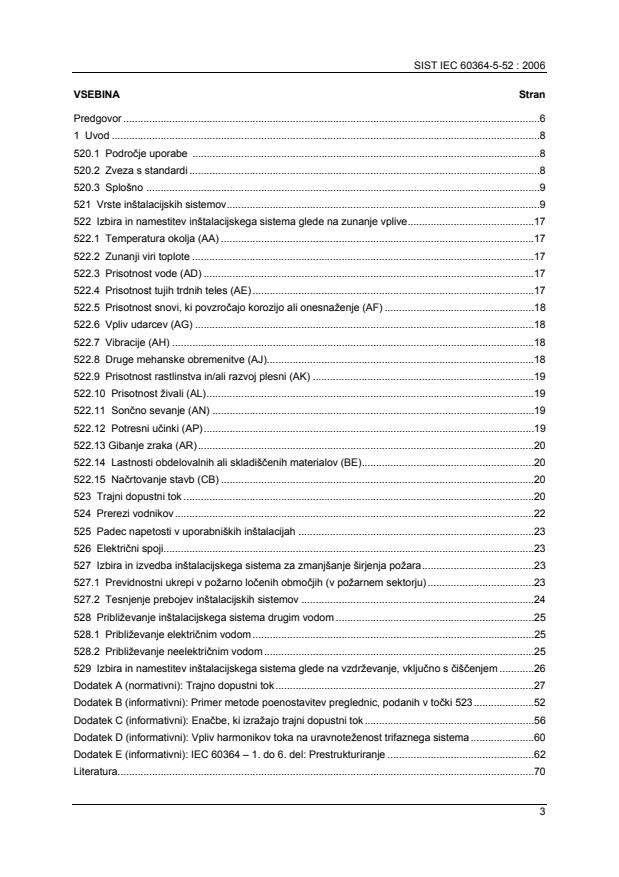
CONTENTS
FOREWORD.5
520 Introduction.6
520.1 Scope.6
520.2 Normative references.6
520.3 General.13
521 Types of wiring systems .13
522 Selection and erection of wiring systems in relation to external influences .15
522.1 Ambient temperature (AA).15
522.2 External heat sources.15
522.3 Presence of water (AD) .15
522.4 Presence of solid foreign bodies (AE) .16
522.5 Presence of corrosive or polluting substances (AF).16
522.6 Impact (AG).16
522.7 Vibration (AH).16
522.8 Other mechanical stresses (AJ).16
522.9 Presence of flora and/or mould growth (AK) .17
522.10 Presence of fauna (AL) .17
522.11 Solar radiation (AN) .17
522.12 Seismic effects (AP).18
522.13 Wind (AS) .18
522.14 Nature of processed or stored materials (BE) .18
522.15 Building design (CB) .18
523 Current-carrying capacities.18
524 Cross-sectional areas of conductors.39
525 Voltage drop in consumers' installations.21
526 Electrical connections.21
527 Selection and erection of wiring systems to minimize the spread of fire.22
527.1 Precautions within a fire-segregated compartment .22
527.2 Sealing of wiring system penetrations .22
528 Proximity of wiring systems to other services .23
528.1 Proximity to electrical services .23
528.2 Proximity to non-electrical services .24
529 Selection and erection of wiring systems in relation to maintainability,
including cleaning .24
Annex A (normative) Current-carrying capacities .25
Annex B (informative) Example of a method of simplification of the tables of clause 523.51
Annex C (informative) Formulae to express current-carrying capacities .55
Annex D (informative) Effect of harmonic currents on balanced three-phase systems .58
Annex E (informative) IEC 60364 – Parts 1 to 6: Restructuring .60
Bibliography.64
60364-5-52 © IEC:2001 – 3 –
Table 52-1 (52F) – Selection of wiring systems.8
Table 52-2 (52G) – Erection of wiring systems.8
Table 52-3 (52H) – Examples of methods of installation providing instructions for obtaining
current-carrying capacity .9
Table 52-4 (52-A) – Maximum operating temperatures for types of insulation.18
Table 52-5 (52J) – Minimum cross-sectional area of conductors .21
Table A.52-1 (52-B1) – Schedule of reference methods of installation which form the basis
of the tabulated current-carrying capacities.30
Table A.52-2 (52-C1) – Current-carrying capacities in amperes for methods of installation
in table A.52-1 (52-B1) – PVC insulation/two loaded conductors/copper or aluminium –
Conductor temperature: 70 °C/Ambient temperature: 30 °C in air, 20 °C in ground .32
Table A.52-3 (52-C2) – Current-carrying capacities in amperes for methods of installation
in table A.52-1 (52-B1) – XLPE or EPR insulation/two loaded conductors/copper or
aluminium – Conductor temperature: 90 °C/Ambient temperature: 30 °C in air, 20 °C
in ground .33
Table A.52-4 (52-C3) – Current-carrying capacities in amperes for methods of installation
in table A.52-1 (52-B1) – PVC insulation/three loaded conductors/copper or aluminium –
Conductor temperature: 70 °C/Ambient temperature: 30 °C in air, 20 °C in ground .34
Table A.52-5 (52-C4) – Current-carrying capacities in amperes for methods of installation
in table A.52-1 (52-B1) – XLPE or EPR insulation/three loaded conductors/copper or
aluminium – Conductor temperature: 90 °C/Ambient temperature: 30 °C in air, 20 °C
in ground .35
Table A.52-6 (52-C5) – Current-carrying capacities in amperes for installation method C
of table A.52-1 (52-B1) – Mineral insulation/copper conductors and sheath – PVC covered
or bare exposed to touch (see note 2) Metallic sheath temperature: 70 °C/Reference
ambient temperature: 30 °C .36
Table A.52-7 (52-C6) – Current-carrying capacities in amperes for installation method C
of table A.52-1 (52-B1) – Mineral insulation/copper conductors and sheath – Bare cable
not exposed to touch and not in contact with combustible material Metallic sheath
temperature: 105 °C/Reference ambient temperature: 30 °C.37
Table A.52-8 (52-C7) – Current-carrying capacities in amperes for installation methods E,
F and G of table A.52-1 (52-B1) – Mineral insulation/Copper conductors and sheath/PVC
covered or bare exposed to touch (see note 2) Metallic sheath temperature:
70 °C/Reference ambient temperature: 30 °C .38
Table A.52-9 (52-C8) – Current-carrying capacities in amperes for installation methods E,
F and G of table A.52-1 (52-B1) – Mineral insulation/Copper conductors and sheath/ Bare
cable not exposed to touch (see note 2) Metallic sheath temperature: 105 °C/Reference
ambient temperature: 30 °C .39
Table A.52-10 (52-C9) – Current-carrying capacities in amperes for installation methods E,
F and G of table A.52-1 (52-B1) – PVC insulation/Copper conductors Conductor
temperature: 70 °C/Reference ambient temperature: 30 °C.40
Table A.52-11 (52-C10) – Current-carrying capacities in amperes for installation
methods E, F and G of table A.52-1 (52-B1) – PVC insulation/Aluminium conductors
Conductor temperature: 70 °C/Reference ambient temperature: 30 °C.41
Table A.52-12 (52-C11) – Current-carrying capacities in amperes for installation
methods E, F and G of table A.52-1 (52-B1) – XLPE or EPR insulation/Copper
conductors – Conductor temperature: 90 °C/Reference ambient temperature: 30 °C.42
Table A.52-13 (52-C12) – Current-carrying capacities in amperes for installation
methods E, F and G of table A.52-1 (52-B1) – XLPE or EPR insulation/Aluminium
conductors Conductor temperature: 90 °C/Reference ambient temperature: 30 °C.43
Table A.52-14 (52-D1) – Correction factor for ambient air temperatures other than 30 °C
to be applied to the current-carrying capacities for cables in the air .44
– 4 – 60364-5-52 © IEC:2001
Table A.52-15 (52-D2) – Correction factors for ambient ground temperatures other than
20 °C to be applied to the current-carrying capacities for cables in ducts in the ground.45
Table A.52-16 (52-D3) – Correction factors for cables in buried ducts for soil thermal
resistivities other than 2,5 K·m/W to be applied to the current-carrying capacities for
reference method D .45
Table A.52-17 (52-E1) – Reduction factors for groups of more than one circuit or of more
than one multi-core cable to be used with current carrying capacities of tables A.52-2
(52-C1) to A.52-13 (52-C12) .46
Table A.52-18 (52-E2) – Reduction factors for more than one circuit, cables laid directly
in the ground – Installation method D in tables A.52-2 (52-C1) to A.52-5 (52-C4) –
Single-core or multi-core cables.47
Table A.52-19 (52-E3) – Reduction factors for more than one circuit, cables laid in
ducts in the ground – Installation method D in tables A.52-2 (52-C1) to A.52-5 (52-C4) .48
Table A.52-20 (52-E4) – Reduction factors for group of more than one multi-core cable to
be applied to reference ratings for multi-core cables in free air – Method of installation E
in tables A.52-8 (52-C7) to A.52-13 (52-C12) .49
Table A.52-21 (52-E5) – Reduction factors for groups of more than one circuit of single-
core cables (note 2) to be applied to reference rating for one circuit of single-core cables
in free air – Method of installation F in tables A.52-8 (52-C7) to A.52-13) (52-C12).50
Table B.52-1 (A.52-1) – Current-carrying capacity in amperes .52
Table B.52-2 (A.52-2) – Current-carrying capacities (in amperes) .53
Table B.52-3 (A.52-3) – Reduction factors for groups of several circuits or of several
multi-core cables (to be used with current-carrying capacities of table B.52-1) (A.52-1) .54
Table C.52-1 (B.52-1) – Table of coefficients and exponents .56
Table D.52-1 (C.52-1) – Reduction factors for harmonic currents in four-core and
five-core cables .59
Table E.1 – Relationship between re-structured and original parts .60
Table E.2 – Relationship between new and old clause numbering.62
60364-5-52 © IEC:2001 – 5 –
INTERNATIONAL ELECTROTECHNICAL COMMISSION
–––––––––
ELECTRICAL INSTALLATIONS OF BUILDINGS –
Part 5-52: Selection and erection of electrical equipment –
Wiring systems
FOREWORD
1) The IEC (International Electrotechnical Commission) is a worldwide organization for standardization comprising
all national electrotechnical committees (IEC National Committees). The object of the IEC is to promote
international co-operation on all questions concerning standardization in the electrical and electronic fields. To
this end and in addition to other activities, the IEC publishes International Standards. Their preparation is
entrusted to technical committees; any IEC National Committee interested in the subject dealt with may
participate in this preparatory work. International, governmental and non-governmental organizations liaising
with the IEC also participate in this preparation. The IEC collaborates closely with the International
Organization for Standardization (ISO) in accordance with conditions determined by agreement between the
two organizations.
2) The formal decisions or agreements of the IEC on technical matters express, as nearly as possible, an
international consensus of opinion on the relevant subjects since each technical committee has representation
from all interested National Committees.
3) The documents produced have the form of recommendations for international use and are published in the form
of standards, technical specifications, technical reports or guides and they are accepted by the National
Committees in that sense.
4) In order to promote international unification, IEC National Committees undertake to apply IEC International
Standards transparently to the maximum extent possible in their national and regional standards. Any
divergence between the IEC Standard and the corresponding national or regional standard shall be clearly
indicated in the latter.
5) The IEC provides no marking procedure to indicate its approval and cannot be rendered responsible for any
equipment declared to be in conformity with one of its standards.
6) Attention is drawn to the possibility that some of the elements of this International Standard may be the subject
of patent rights. The IEC shall not be held responsible for identifying any or all such patent rights.
International Standard IEC 60364-5-52 has been prepared by IEC technical committee 64:
Electrical installations and protection against electric shock.
The IEC 60364 series (parts 1 to 6), is currently being restructured, without any technical
changes, into a more simple form (see annex E).
According to a unanimous decision by the Committee of Action (CA/1720/RV (2000-03-21)),
the restructured parts of IEC 60364 have not been submitted to National Committees for
approval.
The text of this second edition of IEC 60364-5-52 is compiled from and replaces
– part 5-52, first edition (1993) and its amendment 1 (1997);
– part 5-523, second edition (1999).
This publication has been drafted, as close as possible, in accordance with the
ISO/IEC Directives, Part 3.
Annex A forms an integral part of this standard.
Annexes B, C, D and E are for information only.
The committee has decided that the contents of this publication will remain unchanged
until 2005. At this date, the publication will be
• reconfirmed;
• withdrawn;
• replaced by a revised edition, or
• amended.
– 6 – 60364-5-52 © IEC:2001
ELECTRICAL INSTALLATIONS OF BUILDINGS –
Part 5-52: Selection and erection of electrical equipment –
Wiring systems
520 Introduction
520.1 Scope
Part 5-52 of IEC 60364 deals with the selection and erection of wiring systems.
NOTE This standard also applies in general to protective conductors, while IEC 60364-5-54 contains further
requirements for those conductors.
520.2 Normative references
The following normative documents contain provisions which, through reference in this text,
constitute provisions of this part of IEC 60364. For dated references, subsequent amend-
ments to, or revisions of, any of these publications do not apply. However, parties to
agreements based on this part of IEC 60364 are encouraged to investigate the possibility of
applying the most recent editions of the normative documents indicated below. For undated
references, the latest edition of the normative document referred to applies. Members of IEC
and ISO maintain registers of currently valid International Standards.
IEC 60228: 1978, Conductors of insulated cables
IEC 60287-1-1:1994, Electric cables – Calculation of the current rating – Part 1: Current rating
equations (100 % load factor) and calculation of losses – Section 1: General
IEC 60287-2-1:1994, Electric cables – Calculation of the current rating – Part 2: Thermal
resistance – Section 1: Calculation of thermal resistance
IEC 60287-3-1:1995, Electric cables – Calculation of the current rating – Part 3: Sections on
1)
operating conditions – Section 1: Reference operating conditions and selection of cable type
IEC 60332-1:1993, Tests on electric cables under fire conditions – Part 1: Test on a single
vertical insulated wire or cable
IEC 60332-3-24:2000, Tests on electric cables under fire conditions – Part 3-24: Test for
vertical flame spread of vertically-mounted bunched wire or cables – Category C
IEC 60439-2:2000, Low-voltage switchgear and controlgear assemblies – Part 2: Particular
requirements for busbar trunking systems (busways)
2)
IEC 60529:1989, Degrees of protection provided by enclosures (IP Code)
IEC 60614 (all parts), Specification for conduits for electrical installations
IEC 61200-52:1993, Electrical installation guide – Part 52: Selection and erection of electrical
equipment – Wiring systems
ISO 834 (all parts) Fire-resistance tests – Elements of building construction
________
1)
A consoldated edition 1.1 exists (1999) that includes IEC 60287-3-1 (1995) and its amendment 1 (1999).
2)
A consoldated edition 2.1 exists (2001) that includes IEC 60529 (1989) and its amendment 1 (1999).
60364-5-52 © IEC:2001 – 7 –
520.3 General
Consideration shall be given to the application of the fundamental principles of IEC 60364-1
as it applies to cables and conductors, to their termination and/or jointing, to their associated
supports or suspensions and their enclosures or methods of protection against external
influences.
521 Types of wiring systems
521.1 The method of installation of a wiring system in relation to the type of conductor or
cable used shall be in accordance with table 52-1, provided the external influences are
covered by the requirements of the relevant product standards.
521.2 The method of installation of a wiring system in relation to the situation concerned
shall be in accordance with table 52-2.
521.3 Examples of wiring systems together with reference to the appropriate table of current-
carrying capacity are shown in table 52-3.
NOTE 1 Other types of wiring systems, not covered in this standard, may be used provided they comply with the
general rules of this standard.
NOTE 2 Table 52-3 gives the reference method of installation where it is considered that the same current-
carrying capacities can safely be used. It is not implied that all these items are necessarily recognized in national
rules of all countries.
521.4 Busbar trunking systems
Busbar trunking systems shall comply with IEC 60439-2 and shall be installed in accordance
with the manufacturer's instructions. The installation shall be in accordance with the
requirements of clauses 522 (with the exception of 522.1.1, 522.3.3, 522.8.7, 522.8.8
and 522.8.9), 525, 526, 527 and 528.
521.5 AC circuits
Conductors of a.c. circuits installed in ferromagnetic enclosures shall be arranged so that all
conductors of each circuit are contained in the same enclosure.
NOTE If this condition is not fulfilled, overheating and excessive voltage drop may occur due to inductive effects.
– 8 – 60364-5-52 © IEC:2001
Table 52-1 (52F) – Selection of wiring systems
Method of installation
Conductors and Cable
cables trunking
Cable ladder
(including
Without Clipped Cable Cable tray On in- Support
Conduit skirting
sulators wire
fixings direct ducting Cable
trunking,
brackets
flush floor
trunking)
Bare conductors – – – – – – + –
Insulated – – + + + – + –
conductors
Sheathed Multi- + + + + + + 0 +
cables core
(including
Single 0 + + + + + 0 +
armoured
-core
and
mineral
insulated)
+ Permitted.
– Not permitted.
0 Not applicable, or not normally used in practice.
Table 52-2 (52G) – Erection of wiring systems
Method of installation
Cable
trunking
Cable ladder,
Situations (including
Without With Cable On Support
Conduit skirting cable tray, cable
fixings fixings ducting insulators wire
trunking, brackets
flush floor
trunking)
Building voids 40, 46, 0 15,16, – 43 30, 31, 32, 33, 34 – –
15, 16 41,42
Cable channel 56 56 54, 55 0 44, 45 30, 31, 32, 33, 34 – –
Buried in 72, 73 0 70, 71 – 70, 71 0 – –
ground
Embedded in 57, 58 3 1, 2, 59, 50, 51, 52, 44, 45 0 – –
structure 60 53
Surface – 20, 21, 4, 5 6, 7, 8, 9, 6, 7, 8, 30, 31, 32, 33, 34 36 –
mounted 22, 23 12, 13, 14 9
Overhead – – 0 10, 11 – 30, 31, 32, 33, 34 36 35
Immersed 80 80 0 – 0 0 – –
The number in each box indicates the item number in table 52-3.
– Not permitted.
0 Not applicable or not normally used in practice.
60364-5-52 © IEC:2001 – 9 –
Table 52-3 (52H) – Examples of methods of installation providing instructions for obtaining
current-carrying capacity
NOTE The illustrations are not intended to depict actual product or installation practices but are indicative of the
method described.
Reference method of
installation to be used to
Item
Methods of installation Description obtain current-carrying
No.
capacity
(see annex A)
Insulated conductors or single-core
Room
Room
1 cables in conduit in a thermally A1
a
insulated wall
Room Multi-core cables in conduit in a
Room
2 A2
a
thermally insulated wall
Room
Room Multi-core cable direct in a thermally
3 A1
a
insulated wall
Insulated conductors or single-core
cables in conduit on a wooden, or
4 B1
masonry wall or spaced less than
0,3 × conduit diameter from it
Multi-core cable in conduit on a
wooden, or masonry wall or spaced
5 B2
less than 0,3 × conduit diameter
from it
Insulated conductors or single-core
cables in cable trunking on a
wooden wall
B1
b
– run horizontally
b, c
– run vertically
6 7
Multi-core cable in cable trunking on
a wooden wall
d
Under consideration
b
– run horizontally
b, c
– run vertically
8 9
a 2
The inner skin of the wall has a thermal conductance of not less than 10 W/m ·K.
b
Values given for installation methods B1 and B2 in annex A are for a single circuit. Where there is more than
one circuit in the trunking the group reduction factor given in table A.52-17 is applicable, irrespective of the
presence of an internal barrier or partition.
c
Care shall be taken where the cable runs vertically and ventilation is restricted. The ambient temperature at
the top of the vertical section can be increased considerably. The matter is under consideration.
d
Values for reference method B2 may be used.
– 10 – 60364-5-52 © IEC:2001
Table 52-3 (continued)
Reference method of
installation to be used to
Item
Methods of installation Description obtain current-carrying
No.
capacity
(see annex A)
Insulated conductors or single-core B1
a
cable in suspended cable trunking
Multi-core cable in suspended cable
11 B2
a
trunking
10 11
Insulated conductors or single-core
12 A1
b
cable run in mouldings
Insulated conductors or single-core
B1
cables in skirting trunking
TV TV
ISDN ISDN
Multi-core cable in skirting trunking B2
13 14
Insulated conductors in conduit or
15 single-core or multi-core cable in A1
c
architrave
Insulated conductors in conduit or
16 single-core or multi-core cable in A1
c
window frames
Single-core or multi-core cables:
20 C
– fixed on, or spaced less than 0,3 ×
cable diameter from a wooden wall
C, with item 3 of
21 – fixed directly under a wooden ceiling
table A.52-17
22 – spaced from a ceiling Under consideration
a
Values given for installation methods B1 and B2 in annex A are for a single circuit. Where there is more than
one circuit in the trunking the group reduction factor given in table A.52-17 is applicable, irrespective of the
presence of an internal barrier or partition.
b
The thermal resistivity of the enclosure is assumed to be poor because of the material of construction and
possible air spaces. Where the construction is thermally equivalent to methods of installation 6 or 7, reference
method B1 may be used.
c
The thermal resistivity of the enclosure is assumed to be poor because of the material of construction and
possible air spaces. Where the construction is thermally equivalent to methods of installation 6, 7, 8, or 9,
reference methods B1 or B2 may be used.
60364-5-52 © IEC:2001 – 11 –
Table 52-3 (continued)
Reference method of
Item Methods of installation Description installation to be used to
No. obtain current-carrying
capacity
(see annex A)
> < > 0,3 D
e
≥0,3 D
e
c
30 C with item 2
On unperforated tray
a
of table A.52-17
> < ≥0,3 D
> 0,3 D e
e
> < > 0,3 D
e
≥0,3 D
e
c
31 E or F with item 4
On perforated tray
a, b
of table A.52-17
≥0,3 D
> < > 0,3 D e
e
> 0,3 D
> <
e
≥0,3 D
e
c
32 E or F
On brackets or on a wire mesh
> 0,3 D
≥0,3 De
> < e
33 Spaced more than 0,3 times E or F
cable diameter from a wall with item 4 or 5
of table A.52-17
a, b
or method G
34 On ladder E or F
35 Single-core or multi-core cable E or F
suspended from or incorporating
a support wire
36 Bare or insulated conductors on G
insulators
a
For certain applications it may be more appropriate to use specific factors, for example tables A.52-20 and
A.52-21 (see A.52.4.2 of annex A).
b
Care shall be taken where the cable runs vertically and ventilation is restricted. The ambient temperature at the
top of the vertical section can be increased considerably. The matter is under consideration.
c
D = the external diameter of a multi-core cable:
e
– 2,2 x the cable diameter when three single core cables are bound in trefoil, or
– 3 x the cable diameter when three single core cables are laid in flat formation.
– 12 – 60364-5-52 © IEC:2001
Table 52-3 (continued)
Item No. Methods of installation Description Reference method of
installation to be used to
obtain current-carrying
capacity
(see annex A)
40 Single-core or multi-core cable in a
1,5 D ≤ V < 20 D
e e
a, 2
building void
B2
V
V
D
D e
e
V ≥ 20 D
e
B1
Single-core or multi-core cable in conduit
d
in a building void
Under consideration
Insulated conductors in cable ducting
1,5 D ≤ V < 20 D
e e
a, c, d
in a building void
24 V
V B2
D
e
D
e
V ≥ 20 D
e
B1
Single-core or multi-core cable in cable Under consideration
d
ducting in a building void
VV
D
e
D
e
Insulated conductors in cable ducting in 1,5 D ≤ V < 5 D
e e
masonry having a thermal resistivity not
B2
a, b, d
V
V greater than 2 K·m/W
5 D ≤ V < 50 D
e e
B1
Single-core or multi-core cable in cable Under consideration
ducting in masonry having a thermal
d
resistivity not greater than 2 K·m/W
Single-core or multi-core cable:
1,5 D ≤ V < 5 D
e e
– in a ceiling void
V
B2
V a, b
– in a suspended floor
D
D
ee
5 D ≤ V < 50 D
e e
B1
Insulated conductors or single-core
B1
50 cable in flush cable trunking in the floor
Multi-core cable in flush cable trunking B2
51 in the floor
a
V = the smaller dimension or diameter of a masonry duct or void, or the vertical depth of a rectangular duct,
floor or ceiling void.
b
D = the external diameter of a multi-core cable:
e
– 2,2 × the cable diameter when three single core cables are bound in trefoil, or
– 3 × the cable diameter when three single core cables are laid in flat formation.
c
D = external diameter of conduit or vertical depth of cable ducting.
e
d
Care shall be taken where the cable runs vertically and ventilation is restricted. The ambient temperature at the
top of the vertical section can be increased considerably. The matter is under consideration.
60364-5-52 © IEC:2001 – 13 –
Table 52-3 (continued)
Reference method of
installation to be used to
Item
Methods of installation Description obtain current-carrying
No.
capacity
(see annex A)
Insulated conductors or single-core
TV TV B1
cables in embedded trunking
ISDN ISDN
Multi-core cable in embedded trunking B2
52 53
1,5 D ≤ V < 20 D
e e
Insulated conductors or single-core
V
V
cables in conduit in an unventilated
B2
D
D e
e
cable channel run horizontally or
V ≥ 20 D
e
a, b
vertically
B1
Insulated conductors in conduit in
55 an open or ventilated cable channel B1
c, d
in the floor
Sheathed single-core or multi-core
56 cable in an open or ventilated cable B1
d
channel run horizontally or vertically
Single-core or multi-core cable direct in
masonry having a thermal resistivity
not greater than 2 K·m/W
57 C
Without added mechanical
e, f
protection
Single-core or multi-core cable direct in
masonry having a thermal resistivity
58 C
not greater than 2 K·m/W
e, f
With added mechanical protection
a
De = external diameter of conduit
V = internal depth of the channel
The depth of the channel is more important than the width.
b
Care shall be taken where the cable runs vertically and ventilation is restricted. The ambient temperature at the
top of the vertical section can be increased considerably. The matter is under consideration.
c
For multi-core cable installed in method 55, use ratings for reference method B2.
d
It is recommended that these methods of installation are used only in areas where access is restricted to
authorised persons so that the reduction in current carrying capacity and the fire hazard due to the accumulation
of debris can be prevented.
e 2
For cables having conductors not greater than 16 mm , the current-carrying capacity may be higher.
f
Thermal resistivity of masonry is not greater than 2 K·m/W.
– 14 – 60364-5-52 © IEC:2001
Table 52-3 (continued)
Reference method of
installation to be used to
Item
Methods of installation Description obtain current-carrying
No.
capacity
(see annex A)
Insulated conductors or single-core
59 B1
a
Cables in conduit in masonry
a
60 Multi-core cables in conduit in masonry B2
Multi-core cable in conduit or in cable
70 D
ducting in the ground
Single-core cable in conduit or in cable
71 D
ducting in the ground
Sheathed single-core or multi-core cables
D
direct in the ground
– without added mechanical protection
(see note)
Sheathed single-core or multi-core cables
73 D
direct in the ground
– with added mechanical protection
(see note)
Sheathed single-core or multi-core cables
80 Under consideration
immersed in water
NOTE The inclusion of directly buried cables in this item is satisfactory when the soil thermal resistivity is of
the order of 2,5 K·m/W. For lower soil resistivities, the current-carrying capacity for directly buried cables is
appreciably higher than for cables in ducts.
a
Thermal resistivity of masonry is not greater than 2 K·m/W.
60364-5-52 © IEC:2001 – 15 –
521.6 Conduits and trunking systems
Several circuits are allowed in the same conduit or trunking provided all conductors are
insulated for the highest nominal voltage present.
522 Selection and erection of wiring systems in relation to external influences
NOTE The external influences categorized in table 51A of IEC 60364-5-51 which are of significance to wiring
systems are included in this clause.
522.1 Ambient temperature (AA)
522.1.1 Wiring systems shall be selected and erected so as to be suitable for the highest
local ambient temperature and to ensure that the limiting temperature indicated in table 54-4
will not be exceeded.
522.1.2 Wiring system components including cables and wiring accessories shall only be
installed or handled at temperatures within the limits stated in the relevant product
specification or as given by the manufacturers.
522.2 External heat sources
522.2.1 In order to avoid the effects of heat from external sources, one of the following
methods or an equally effective method shall be used to protect wiring systems:
– shielding;
– placing sufficiently far from the source of heat;
– selecting a system with due regard for the additional temperature rise which may occur;
– local reinforcement or substitution of insulating material.
NOTE Heat from external sources may be radiated, convected or conducted, e.g.
– from hot water systems,
– from plant appliances and luminaires,
– from manufacturing process,
– through heat conducting materials,
– from solar gain of the wiring system or its surrounding medium.
522.3 Presence of water (AD)
522.3.1 Wiring systems shall be selected and erected so that no damage is caused by the
ingress of water. The completed wiring system shall comply with the IP degree of protection
relevant to the particular location.
NOTE In general, the sheaths and insulation of cables for fixed installations may be regarded, when intact, as
proof against penetration by moisture. Special considerations apply to cables liable to frequent splashing,
immersion or submersion.
522.3.2 Where water may collect or condensation may form in wiring systems, provision shall
be made for its escape.
522.3.3 Where wiring systems may be subjected to waves (AD6), protection against mecha-
nical damage shall be afforded by one or more of the methods of 522.6, 522.7 and 522.8.
– 16 – 60364-5-52 © IEC:2001
522.4 Presence of solid foreign bodies (AE)
522.4.1 Wiring systems shall be selected and erected so as to minimize the danger arising
from the ingress of solid foreign bodies. The completed wiring system shall comply with the IP
degree of protection relevant to the particular location.
522.4.2 In a location where dust in significant quantity is present (AE4), additional precautions
shall be taken to prevent the accumulation of dust or other substances in quantities which
could adversely affect the heat dissipation from the wiring system.
NOTE A wiring system which facilitates the removal of dust may be necessary (see clause 529).
522.5 Presence of corrosive or polluting substances (AF)
522.5.1 Where the presence of corrosive or polluting substances, including water, is likely to
give rise to corrosion or deterioration, parts of the wiring system likely to be affected shall be
suitably protected or manufactured from a material resistant to such substances.
NOTE Suitable protection for application during erection may include protective tapes, paints or grease.
522.5.2 Dissimilar metals liable to initiate electrolytic action shall not be placed in contact with
each other, unless special arrangements are made to avoid the consequences of such
contacts.
522.5.3 Materials liable to cause mutual or individual deterioration or hazardous degradation
shall not be placed in contact with each other.
522.6 Impact (AG)
522.6.1 Wiring systems shall be selected and erected so as to minimize the damage arising
from mechanical stress, e.g. by impact, penetration or compression.
522.6.2 In fixed installations where impacts of medium severity (AG2) or high severity (AG3)
can occur protection shall be afforded by:
– the mechanical characteristics of the wiring system; or
– the location selected; or
– the provision of additional local or general mechanical protection; or
– by any combination of the above.
522.7 Vibration (AH)
522.7.1 Wiring systems supported by or fixed to structures of equipment subject to vibration
of medium severity (AH2) or high severity (AH3) shall be suitable for such conditions,
particularly where cables and cable connections are concerned.
NOTE Special attention should be paid to connections to vibrating equipment. Local measures may be adopted
such as flexible wiring systems.
522.7.2 Fixed installation of suspended current-using equipment, e.g. luminaires, shall be
connected by cable with flexible core. Where no vibration nor movement can be expected,
cable with non-flexible core may be used
522.8 Other mechanical stresses (AJ)
522.8.1 Wiring systems shall be selected and erected so as to prevent during installation,
use or maintenance, damage to the sheath and insulation of cables and insulated conductors
and their terminations.
60364-5-52 © IEC:2001 – 17 –
522.8.2 (522.8.1.1) When buried in the structure, conduits or cable ducting systems shall be
completely erected for each circuit before any insulated conductor or cable is drawn in.
522.8.3 (522.8.1.2) The radius of every bend in a wiring system shall be such that
conductors or cables shall not suffer damage.
522.8.4 (522.8.1.3) Where the conductors or cables are not supported continuously due to
the method of the installation, they shall be supported by suitable means at appropriate
intervals in such a manner that the conductors or cables do not suffer damage by their own
weight.
522.8.5 (522.8.1.4) Where a permanent tensile stress is applied to the wiring system (e.g.
by its own weight in vertical runs) a suitable type of cable or conductor with appropriate cross-
sectional areas and method of mounting shall be selected in such a manner that the
conductors or cables do not suffer damage by their own weight.
522.8.6 (522.8.1.5) Wiring systems intended for the drawing in or out of conductors or
cables shall have adequate means of access to allow this operation.
522.8.7 (522.8.1.6) Wiring systems buried in floors shall be sufficiently protected to prevent
damage caused by the intended use of the floor.
522.8.8 (522.8.1.7) Wiring systems which are rigidly fixed and buried in the walls shall be
run horizontally or vertically or parallel to the room edges.
Wiring systems concealed in the structure but not fixed may follow the shortest practical
route.
522.8.9 (522.8.1.8) Flexible wiring systems shall be installed so that excessive tensile
stress to the conductors and connections is avoided.
522.9 Presence of flora and/or mould growth (AK)
522.9.1 Where the conditions experienced or expected constitute a hazard (AK2), the wiring
system shall be selected accordingly or special protective measures shall be adopted.
NOTE An installation method which facilitates the removal of such growths may be necessary (see clause 529).
522.10 Presence of fauna (AL)
522.10.1 Where conditions experienced or expected constitute a hazard (AL2) the wiring
system shall be selected accordingly or special protective measures shall be adopted,
for example, by:
– the mechanical characteristics of the wiring system; or
– the location selected; or
– the provision of additional local or general mechanical protection; or
– by any combination of the above.
522.11 Solar radiation (AN)
522.11.1 Where significant solar radiation (AN2) is experienced or expected, a wiring system
suitable for the conditions shall be selected and erected or adequate shielding shall be
provided.
NOTE See also 522.2.1 dealing with temperature rise.
– 18 – 60364-5-52 © IEC:2001
522.12 Seismic effects (AP)
522.12.1 The wiring system shall be selected and erected with due regard to the seismic
hazards of the location of the installation.
522.12.2 Where the seismic hazards experienced are low severity (AP2) or higher, particular
attention shall be paid to the following:
– the fixing of wiring systems to the building structure;
– the connections between the fixed wiring and all items of essential equipment, e.g. safety
services, shall be selected for their flexible quality.
522.13 Wind (AR)
522.13.1 See 522.7, Vibration (AH), and 522.8, Other mechanical stresses (AJ).
522.14 Nature of processed or stored materials (BE)
522.14.1 See 527, Selection and erection of wiring systems to minimize the spread of fire.
522.15 (522.14) Building design (CB)
522.15.1 (522.14.1) Where risks due to structural movement exist (CB3), the cable support
and protection system employed shall be capable of permitting relative movement so that
conductors and cables are not subjected to excessive mechanical stress.
522.15.2 (522.14.2) For flexible or unstable structures (CB4), flexible wiring systems shall
be used.
523 Current-carrying capacities
523.1 (523.1.3) The current to be carried by any conductor for sustained periods during
normal operation shall be such that the appropriate temperature limit specified in table 52-4 is
not exceeded. The value of current shall be selected in accordance with 523.2, or determined
in accordance with 523.3.
Table 52-4 (52-A) – Maximum operating temperatures for types of insulation
a
Type of insulation
Temperature limit
°C
Polyvinyl-chloride (PVC) 70 at the conductor
b
Cross-linked polyethylene (XLPE) and ethylene propylene rubber (EPR)
90 at the conductor
Mineral (PVC covered or bare exposed to touch) 70 at the sheath
b, c
Mineral (bare not exposed to touch and not in contact with combustible material)
105 at the sheath
a
The maximum permissible conductor temperatures given in table 52-4 on which the tabulated current-carrying
a
capacities given in annex A are based, have been taken from IEC 60502 (1983) and IEC 60702 (1981) and
are shown on these tables.
b
Where a conductor operates at a temperature exceeding 70 °C it shall be ascertained that the equipment
connected t
...
SLOVENSKI SIST IEC 60364-5-52
STANDARD
september 2006
Električne inštalacije zgradb – 5-52. del: Izbira in namestitev električne
opreme – Inštalacijski sistemi
Electrical installations of buildings – Part 5-52: Selection and erection of electrical
equipment – Wiring systems
Installation électriques des bâtiments – Partie 5-52: Choix et mise en œuvre des
matériels électriques – Canalisations
Referenčna oznaka
ICS 13.260; 91.140.50 SIST IEC 60364-5-52:2006 (sl)
Nadaljevanje na straneh od 2 do 70
© 2010–03: Slovenski inštitut za standardizacijo. Razmnoževanje celote ali delov standarda ni dovoljeno.
SIST IEC 60364-5-52 : 2006
NACIONALNI UVOD
Standard SIST IEC 60364-5-52 (sl), Električne inštalacije zgradb – 5-52. del: Izbira in namestitev
električne opreme – Inštalacijski sistemi, 2006, ima status slovenskega standarda in je istoveten
mednarodnemu standardu IEC 60364-5-52 (en), Electrical installations of building – Part 5-52:
Selection and erection of electrical equipment – Wiring systems, 2001.
NACIONALNI PREDGOVOR
Mednarodni standard IEC 60364-5-52:2001 je pripravil tehnični odbor Mednarodne elektrotehniške
komisije IEC/TC 64 Električne inštalacije in zaščita pred električnim udarom.
Slovenski standard SIST IEC 60364-5-52:2006 je prevod mednarodnega standarda IEC 60364-5-
52:2001. V primeru spora glede besedila slovenskega prevoda v tem standardu je odločilen izvirni
evropski standard v angleškem jeziku. Slovensko izdajo standarda je pripravil tehnični odbor SIST/TC
ELI Nizkonapetostne in komunikacijske električne inštalacije.
Odločitev za privzem tega standarda po metodi ponatisa je dne 2006-07-11 sprejel tehnični odbor
SIST/TC ELI. Hkrati je odbor tudi sklenil, da se pripravi prevod standarda.
OSNOVA ZA IZDAJO STANDARDA
Privzem standarda IEC 60364-5-52:2001.
ZVEZE S STANDARDI
S privzemom tega evropskega standarda veljajo za omenjeni namen referenčnih standardov vsi
standardi, navedeni v izvirniku, razen tistih, ki so že sprejeti v nacionalno standardizacijo:
SIST EN 60332-3-24:2010 Preskusi na električnih kablih in kablih iz optičnih vlaken v požarnih
razmerah – 3-24. del: Preskus navpičnega širjenja ognja po navpično
pritrjenih snopih žic ali kablov – Kategorija C (IEC 60332-3-24:2000 +
A1:2008)
Tests on electric cables under fire conditions – Part 3-24: Test for
vertical flame spread of vertically-mounted bunched wire or cables –
Category C
SIST EN 60439-2:2000 Sestavi nizkonapetostnih stikalnih in krmilnih naprav – 2. del: Posebne
zahteve za zbiralčne razdelilne sisteme (zbiralčna vodila)
(IEC 60439-2:2000)
Low-voltage switchgear and controlgear assemblies – Part 2:
Particular requirements for busbar trunking systems (busways)
SIST EN 60529:1997 Stopnje zaščite z okrovi (kode IP) (IEC 60529:1989)
2)
Degrees of protection provided by enclosures (IP Code)
SIST IEC/TR2 61200-52:2000 Vodilo za električne inštalacije – 52. del: Izbira in namestitev
električne opreme – Inštalacijski sistem (IEC 61200-52:1993)
Electrical installation guide – Part 52: Selection and erection of
electrical equipment – Wiring systems
OPOMBI
– Nacionalni uvod in nacionalni predgovor nista sestavni del standarda.
– Povsod, kjer se v besedilu standarda uporablja izraz “mednarodni standard”, v
SIST IEC 60364-5-52 : 2006
VSEBINA Stran
Predgovor .6
1 Uvod .8
520.1 Področje uporabe .8
520.2 Zveza s standardi .8
520.3 Splošno .9
521 Vrste inštalacijskih sistemov.9
522 Izbira in namestitev inštalacijskega sistema glede na zunanje vplive.17
522.1 Temperatura okolja (AA) .17
522.2 Zunanji viri toplote .17
522.3 Prisotnost vode (AD) .17
522.4 Prisotnost tujih trdnih teles (AE).17
522.5 Prisotnost snovi, ki povzročajo korozijo ali onesnaženje (AF) .18
522.6 Vpliv udarcev (AG) .18
522.7 Vibracije (AH) .18
522.8 Druge mehanske obremenitve (AJ).18
522.9 Prisotnost rastlinstva in/ali razvoj plesni (AK) .19
522.10 Prisotnost živali (AL).19
522.11 Sončno sevanje (AN) .19
522.12 Potresni učinki (AP).19
522.13 Gibanje zraka (AR).20
522.14 Lastnosti obdelovalnih ali skladiščenih materialov (BE).20
522.15 Načrtovanje stavb (CB) .20
523 Trajni dopustni tok .20
524 Prerezi vodnikov.22
525 Padec napetosti v uporabniških inštalacijah .23
526 Električni spoji.23
527 Izbira in izvedba inštalacijskega sistema za zmanjšanje širjenja požara.23
527.1 Previdnostni ukrepi v požarno ločenih območjih (v požarnem sektorju).23
527.2 Tesnjenje prebojev inštalacijskih sistemov .24
528 Približevanje inštalacijskega sistema drugim vodom .25
528.1 Približevanje električnim vodom.25
528.2 Približevanje neelektričnim vodom.25
529 Izbira in namestitev inštalacijskega sistema glede na vzdrževanje, vključno s čiščenjem .26
Dodatek A (normativni): Trajno dopustni tok.27
Dodatek B (informativni): Primer metode poenostavitev preglednic, podanih v točki 523.52
Dodatek C (informativni): Enačbe, ki izražajo trajni dopustni tok.56
Dodatek D (informativni): Vpliv harmonikov toka na uravnoteženost trifaznega sistema .60
Dodatek E (informativni): IEC 60364 – 1. do 6. del: Prestrukturiranje .62
Literatura.70
SIST IEC 60364-5-52 : 2006
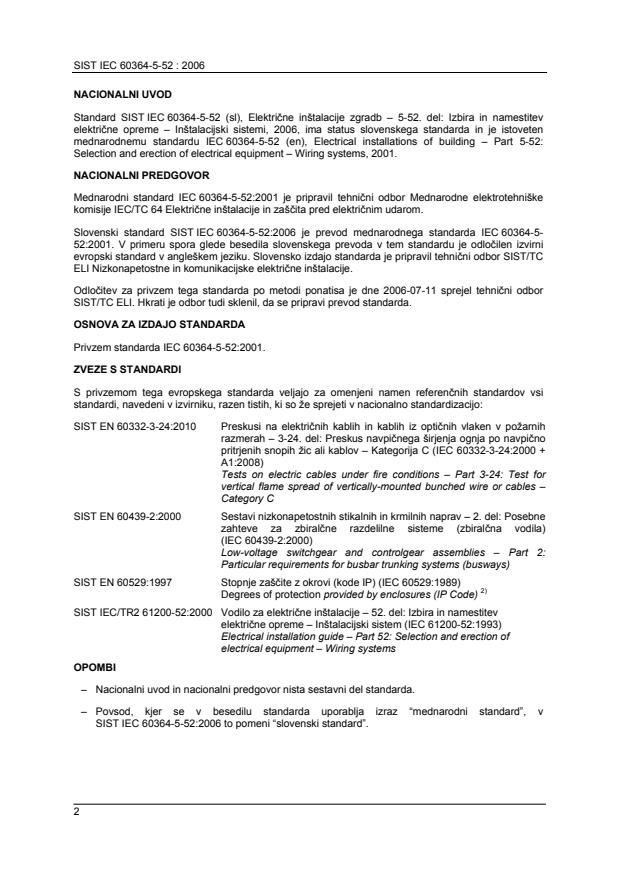
Preglednica 52-1 (52F): Izbira inštalacijskih sistemov .10
Preglednica 52-2 (52G): Namestitev inštalacijskih sistemov .10
Preglednica 52-3 (52H): Primeri načinov namestitve z navodili za določitev trajnega
dopustnega toka.11
Preglednica 52-4 (52-A): Najvišje obratovalne temperature vodnikov glede na vrsto izolacije .20
Preglednica 52-5 (52-J): Najmanjši prerezi vodnikov.22
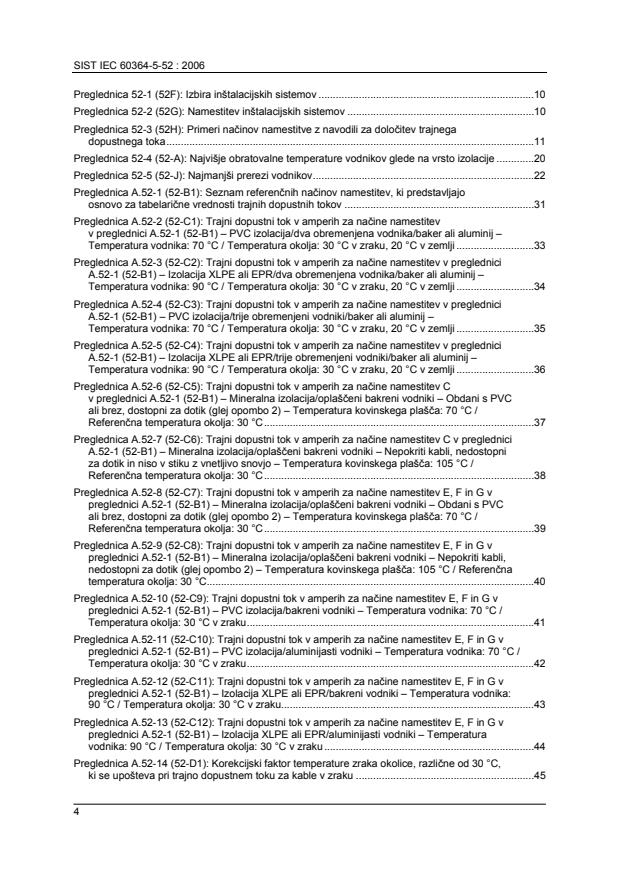
Preglednica A.52-1 (52-B1): Seznam referenčnih načinov namestitev, ki predstavljajo
osnovo za tabelarične vrednosti trajnih dopustnih tokov .31
Preglednica A.52-2 (52-C1): Trajni dopustni tok v amperih za načine namestitev
v preglednici A.52-1 (52-B1) – PVC izolacija/dva obremenjena vodnika/baker ali aluminij –
Temperatura vodnika: 70 °C / Temperatura okolja: 30 °C v zraku, 20 °C v zemlji .33
Preglednica A.52-3 (52-C2): Trajni dopustni tok v amperih za načine namestitev v preglednici
A.52-1 (52-B1) – Izolacija XLPE ali EPR/dva obremenjena vodnika/baker ali aluminij –
Temperatura vodnika: 90 °C / Temperatura okolja: 30 °C v zraku, 20 °C v zemlji .34
Preglednica A.52-4 (52-C3): Trajni dopustni tok v amperih za načine namestitev v preglednici
A.52-1 (52-B1) – PVC izolacija/trije obremenjeni vodniki/baker ali aluminij –
Temperatura vodnika: 70 °C / Temperatura okolja: 30 °C v zraku, 20 °C v zemlji .35
Preglednica A.52-5 (52-C4): Trajni dopustni tok v amperih za načine namestitev v preglednici
A.52-1 (52-B1) – Izolacija XLPE ali EPR/trije obremenjeni vodniki/baker ali aluminij –
Temperatura vodnika: 90 °C / Temperatura okolja: 30 °C v zraku, 20 °C v zemlji .36
Preglednica A.52-6 (52-C5): Trajni dopustni tok v amperih za načine namestitev C
v preglednici A.52-1 (52-B1) – Mineralna izolacija/oplaščeni bakreni vodniki – Obdani s PVC
ali brez, dostopni za dotik (glej opombo 2) – Temperatura kovinskega plašča: 70 °C /
Referenčna temperatura okolja: 30 °C.37
Preglednica A.52-7 (52-C6): Trajni dopustni tok v amperih za načine namestitev C v preglednici
A.52-1 (52-B1) – Mineralna izolacija/oplaščeni bakreni vodniki – Nepokriti kabli, nedostopni
za dotik in niso v stiku z vnetljivo snovjo – Temperatura kovinskega plašča: 105 °C /
Referenčna temperatura okolja: 30 °C.38
Preglednica A.52-8 (52-C7): Trajni dopustni tok v amperih za načine namestitev E, F in G v
preglednici A.52-1 (52-B1) – Mineralna izolacija/oplaščeni bakreni vodniki – Obdani s PVC
ali brez, dostopni za dotik (glej opombo 2) – Temperatura kovinskega plašča: 70 °C /
Referenčna temperatura okolja: 30 °C.39
Preglednica A.52-9 (52-C8): Trajni dopustni tok v amperih za načine namestitev E, F in G v
preglednici A.52-1 (52-B1) – Mineralna izolacija/oplaščeni bakreni vodniki – Nepokriti kabli,
nedostopni za dotik (glej opombo 2) – Temperatura kovinskega plašča: 105 °C / Referenčna
temperatura okolja: 30 °C.40
Preglednica A.52-10 (52-C9): Trajni dopustni tok v amperih za načine namestitev E, F in G v
preglednici A.52-1 (52-B1) – PVC izolacija/bakreni vodniki – Temperatura vodnika: 70 °C /
Temperatura okolja: 30 °C v zraku.41
Preglednica A.52-11 (52-C10): Trajni dopustni tok v amperih za načine namestitev E, F in G v
preglednici A.52-1 (52-B1) – PVC izolacija/aluminijasti vodniki – Temperatura vodnika: 70 °C /
Temperatura okolja: 30 °C v zraku.42
Preglednica A.52-12 (52-C11): Trajni dopustni tok v amperih za načine namestitev E, F in G v
preglednici A.52-1 (52-B1) – Izolacija XLPE ali EPR/bakreni vodniki – Temperatura vodnika:
90 °C / Temperatura okolja: 30 °C v zraku.43
Preglednica A.52-13 (52-C12): Trajni dopustni tok v amperih za načine namestitev E, F in G v
preglednici A.52-1 (52-B1) – Izolacija XLPE ali EPR/aluminijasti vodniki – Temperatura
vodnika: 90 °C / Temperatura okolja: 30 °C v zraku .44
Preglednica A.52-14 (52-D1): Korekcijski faktor temperature zraka okolice, različne od 30 °C,
ki se upošteva pri trajno dopustnem toku za kable v zraku .45
SIST IEC 60364-5-52 : 2006
Preglednica A.52-15 (52-D2): Korekcijski faktorji za temperature okolne zemlje,
različne od 20 °C, ki se upošteva pri trajnem dopustnem toku za kable v kanalih v zemlji .46
Preglednica A.52-16 (52-D3): Korekcijski faktorji za kable v kanalih, zakopanih v zemljo,
s toplotno upornostjo, različno od 2,5 K·m/W, ki se upošteva pri trajnem dopustnem toku za
referenčni način namestitve D.46
Preglednica A.52-17 (52-E1): Redukcijski faktorji za skupine z več kot enim tokokrogom ali
več kot enim večžilnim kablom, ki se upošteva pri trajnem dopustnem toku v preglednicah
A.52-2 (52-C1) do A.52-13 (52-C12).47
Preglednica A.52-18 (52-E2): Redukcijski faktorji za več kot en tokokrog za kable, položene
neposredno v zemlji – Način namestitve D v preglednicah A.52-2 (52-C1) do A.52-13 (52-C4) –
Enožilni ali večžilni kabli.48
Preglednica A.52-19 (52-E3): Redukcijski faktorji za več kot en tokokrog za kable, položene
v kanalih v zemlji – Način namestitve D v preglednicah A.52-2 (52-C1) do A.52-5 (52-C4) .49
Preglednica A.52-20 (52-E4): Redukcijski faktorji za skupino z več kot enim večžilnim kablom,
ki se uporablja za večžilne kable, položene prosto v zraku – Način namestitve E v preglednicah
A.52-8 (52-C7) do A.52-13 (52-C12).50
Preglednica A.52-21 (52-E5): Redukcijski faktor za skupine z več kot enim tokokrogom enožilnih
kablov (opomba 2), ki se uporablja za enožilne kable z enim tokokrogom, položene prosto
v zraku – Način namestitve F v preglednicah A.52-8 (52-C7) do A.52-13 (52-C12) .51
Preglednica B.52-1 (A.52-1): Trajni dopustni tok (v amperih).53
Preglednica B.52-2 (A.52-2): Trajni dopustni tok (v amperih).54
Preglednica B.52-3 (A.52-3): Redukcijski faktorji za skupine z več tokokrogi ali z več
večžilnimi kabli (uporabiti skupaj s trajnim dopustnim tokom v preglednici B.52-1 (A.52-1)) .55
Preglednica C.52-1 (B.52-1): Preglednica koeficientov in eksponentov .57
Preglednica D.52-1 (C.52-1): Redukcijski faktorji za harmonike toka v štirižilnih in petžilnih
kablih .61
Preglednica E.1: Povezava med prestrukturiranimi in originalnimi deli .62
Preglednica E.2: Povezava med novim in starim številčenjem točk .66
SIST IEC 60364-5-52 : 2006
MEDNARODNA ELEKTROTEHNIŠKA KOMISIJA
ELEKTRIČNE INŠTALACIJE ZGRADB
5-52. del: Izbira in namestitev električne opreme – Inštalacijski sistemi
PREDGOVOR
1) IEC (Mednarodna elektrotehniška komisija) je svetovna organizacija za standardizacijo, ki združuje
vse nacionalne elektrotehnične komiteje (nacionalni komiteji IEC). Cilj IEC je pospeševati
mednarodno sodelovanje v vseh vprašanjih standardizacije s področja elektrotehnike in
elektronike. V ta namen poleg drugih aktivnosti izdaja mednarodne standarde. Za njihovo pripravo
so odgovorni tehnični odbori (TC). Vsak nacionalni komite IEC, ki ga zanima obravnavana tema,
lahko sodeluje v tem pripravljalnem delu. Prav tako lahko v pripravi sodelujejo mednarodne
organizacije ter vladne in nevladne ustanove, ki so povezane z IEC. IEC deluje v tesni povezavi z
mednarodno organizacijo za standardizacijo ISO skladno s pogoji, določenimi v soglasju med
obema organizacijama.
2) Uradne odločitve ali sporazumi IEC o tehničnih vprašanjih, pripravljeni v tehničnih odborih, kjer so
prisotni vsi nacionalni komiteji, ki jih tema zanima, izražajo, kolikor je mogoče, mednarodno
soglasje o obravnavani temi.
3) Publikacije IEC imajo obliko priporočil za mednarodno uporabo in se izdajajo kot standardi,
tehnične specifikacije, tehnična poročila ali vodila ter jih kot takšne sprejmejo nacionalni komiteji
IEC.
4) Da bi se pospeševalo mednarodno poenotenje, so nacionalni komiteji IEC v svojih nacionalnih in
regionalnih standardih dolžni čim pregledneje uporabljati mednarodne standarde. Vsako
odstopanje med standardom IEC in ustreznim nacionalnim ali regionalnim standardom je treba v
slednjem jasno označiti.
5) IEC ni določil nobenega postopka označevanja, ki bi kazal na njegovo potrditev in ne more biti
odgovoren za katero koli opremo, ki bi bila deklarirana kot skladna z eno od njegovih publikacij.
6) Opozarjamo na možnost, da bi lahko bil kateri od elementov tega mednarodnega standarda
predmet patentnih pravic. IEC ni odgovoren za identificiranje nobene od teh patentnih pravic.
Mednarodni standard IEC 60364-5-52 je pripravil tehnični odbor IEC/TC 64 Električne inštalacije in
zaščita pred električnim udarom.
Skupina standardov IEC 60364 (deli 1 do 6) je bila prestrukturirana brez tehničnih sprememb v
preprostejšo obliko (glej dodatek E).
Po soglasni odločitvi izvršnega odbora (CA/1720/RV (2000-03-21)) prestrukturirani deli IEC 60364
niso bili predloženi nacionalnim odborom v odobritev.
Sestavljeno besedilo te druge izdaje IEC 60364-5-52 nadomešča:
– 5.52. del, prvo izdajo (1993) in njegovo dopolnilo 1 (1997);
– 5-523. del, drugo izdajo (1999).
Ta publikacija je bila oblikovana kar najbolj v skladu z direktivo ISO/IEC, 3. del.
SIST IEC 60364-5-52 : 2006
Dodatek A je sestavni del tega standarda.
Dodatki B, C, D in E so le informativni.
Tehnični odbor je sklenil, da bo vsebina tega standarda ostala nespremenjena do leta 2005. Po tem
datumu bo publikacija:
– ponovno potrjena,
– razveljavljena,
– zamenjana z revidirano (popravljeno) izdajo ali
– dopolnjena.
SIST IEC 60364-5-52 : 2006
MEDNARODNA ELEKTROTEHNIŠKA KOMISIJA
ELEKTRIČNE INŠTALACIJE ZGRADB
5-52. del: Izbira in namestitev električne opreme – Inštalacijski sistemi
1 Uvod
520.1 Področje uporabe
Del 5-52 dokumenta IEC 60364 obravnava izbiro in način namestitve inštalacijskih sistemov.
OPOMBA: Ta standard velja na splošno tudi za zaščitne vodnike, medtem ko IEC 60364-5-54 navaja še druge zahteve za
te vodnike.
520.2 Zveza s standardi
Spodaj navedeni normativni dokumenti vsebujejo določila, ki s sklicevanjem v tem besedilu tvorijo
določila tega dela IEC 60364. Pri datiranih sklicevanjih se poznejša dopolnila ali spremembe katerekoli
od teh publikacij ne upoštevajo. Stranke naj v pogodbah, ki temeljijo na tem delu IEC 60364, uporabljajo
najnovejšo izdajo normativnih dokumentov, navedenih spodaj. Pri nedatiranih sklicevanjih se uporablja
zadnja izdaja normativnih dokumentov. Člani IEC in ISO vodijo sezname trenutno veljavnih mednarodnih
standardov.
IEC 60228:1978 Vodniki izoliranih kablov
Conductors of insulated cables
IEC 60287-1-1:1994 Electric cables – Calculation of the current rating – Part 1: Current rating
equations (100 % load factor) and calculation of losses – Section 1: General
IEC 60287-2-1:1994 Electric cables – Calculation of the current rating – Part 2: Thermal resistance –
Section 1: Calculation of thermal resistance
IEC 60287-3-1:1995 Electric cables – Calculation of the current rating – Part 3: Sections on
operating conditions – Section 1: Reference operating conditions and selection
1)
of cable type
IEC 60332-1:1993 Tests on electric cables under fire conditions – Part 1: Test on a single vertical
insulated wire or cable
IEC 60332-3-24:2000 Tests on electric cables under fire conditions – Part 3-24: Test for vertical flame
spread of vertically-mounted bunched wire or cables – Category C
IEC 60439-2:2000 Sestavi nizkonapetostnih stikalnih in krmilnih naprav – 2. del: Posebne zahteve
za zbiralčne razdelilne sisteme (zbiralčna vodila)
Low-voltage switchgear and controlgear assemblies – Part 2: Particular
requirements for busbar trunking systems (busways)
2)
IEC 60529:1989 Degrees of protection provided by enclosures (IP Code)
IEC 60614 (vsi deli) Specification for conduits for electrical installations
IEC 61200-52:1993 Vodilo za električne inštalacije – 52. del: Izbira in namestitev električne opreme
– Inštalacijski sistem
Electrical installation guide – Part 52: Selection and erection of electrical
equipment – Wiring systems
ISO 834 (vsi deli) Fire-resistance tests – Elements of building construction
1)
Konsolidirana izdaja 1.1 (1999), ki vključuje IEC 60287-3-1 (1995) in dopolnilo 1 (1999).
2)
Konsolidirana izdaja 2.1 (2001), ki vključuje IEC 60529 (1989) in dopolnilo 1 (1999).
SIST IEC 60364-5-52 : 2006
520.3 Splošno
Upoštevati je treba temeljna načela IEC 60364-1, ki se uporabljajo za kable in vodnike, za njihovo
priključevanje in/ali spajanje, način nameščanja, pritrjevanja ali obešanja in za njihove okrove ali
metode zaščite pred zunanjimi vplivi.
521 Vrste inštalacijskih sistemov
521.1 Način namestitve inštalacijskega sistema glede na vrsto vodnika ali kabla, ki se uporablja, mora
biti v skladu s preglednico 52-1, pod pogojem, da so zunanji vplivi zajeti v ustreznih standardih za
posamezne proizvode.
521.2 Način namestitve inštalacijskega sistema glede na okolico mora biti v skladu s preglednico
52-2.
521.3 Primeri načinov namestitev inštalacijskih sistemov skupaj z navedbo ter sklicevanjem na
ustrezne preglednice, po katerih se izbere trajni dopustni tok, so prikazani v preglednici 52-3.
OPOMBA 1: Druge vrste inštalacijskih sistemov, ki niso zajeti v tem standardu, se lahko uporabljajo, če so v skladu s
splošnimi pravili iz tega standarda.
OPOMBA 2: Preglednica 52-3 podaja referenčne načine namestitev inštalacijskih sistemov, pri katerih se trajni dopustni toki
lahko varno uporabljajo. Ni nujno, da so vse te vrste inštalacijskih sistemov dopustne v nacionalnih pravilih v
vseh državah.
521.4 Zbiralčni razdelilni sistemi
Zbiralčni razdelilni sistemi morajo biti v skladu z IEC 60439-2 in nameščeni skladno z navodili
proizvajalca. Namestitev mora biti v skladu z zahtevami iz točk 522 (razen 522.1.1, 522.3.3, 522.8.7,
522.8.8 in 522.8.9), 525, 526, 527 in 528.
521.5 Izmenični tokokrogi
Vodniki izmeničnih tokokrogov, nameščenih v feromagnetnih ohišjih, morajo biti položeni tako, da so
vsi vodniki vsakega tokokroga v istem ohišju.
OPOMBA: Če ta pogoj ni izpolnjen, se lahko zaradi induktivnosti pojavijo pregrevanja in prevelik padec napetosti.
SIST IEC 60364-5-52 : 2006
Preglednica 52-1 (52F): Izbira inštalacijskih sistemov
Način namestitve
Kabelska
Kabelske lestev,
Vodniki in kabli
Brez Neposredno kinete Kabelski kabelske Na Z nosilno
V ceveh
pritrjevanja pritrjevanje (na steni, kanali police, izolatorjih žico
v tleh) kabelski
nosilci
Goli vodniki – – – – – – + –
Izolirani vodniki – – + + + – + –
Oplaščeni
Večžilni + + + + + + 0 +
kabli
(vključno s
kovinskim
opletom in
Enožilni 0 + + + + + 0 +
mineralno
izolacijo)
+ Dovoljeno
– Ni dovoljeno
0 Se ne uporablja ali se v praksi ponavadi ne uporablja.
Preglednica 52-2 (52G): Namestitev inštalacijskih sistemov
Način namestitve
Kabelska
Kabelske lestev,
Namestitev
Brez Neposredno kinete Kabelski kabelske Na Z nosilno
V ceveh
pritrjevanja pritrjevanje (na steni, kanali police, izolatorjih žico
v tleh) kabelski
nosilci
40, 46, 15, 16, 30, 31, 32,
V prostorih v stavbah 0 – 43 – –
15, 16 41, 42 33, 34
30, 31, 32,
Kabelski kanal 56 56 54, 55 0 44, 45 – –
33, 34
Zakopan v zemlji 72, 73 0 70, 71 – 70, 71 0 – –
1, 2, 50, 51,
Pod omet 57, 58 3 44, 45 0 – –
59, 60 52, 53
20, 21, 6, 7, 8, 9, 6, 7, 30, 31, 32,
Nad omet – 4, 5 36 –
22, 23 12, 13, 14 8, 9 33, 34
30, 31, 32,
V zraku – – 0 10, 11 – 36 35
33, 34
Potopljen v vodi 80 80 0 – 0 0 – –
Številka v vsakem okencu označuje številko pozicije v preglednici 52-3.
– Ni dovoljeno.
0 Se ne uporablja ali se v praksi ponavadi ne uporablja.
SIST IEC 60364-5-52 : 2006
Preglednica 52-3 (52H): Primeri načinov namestitve z navodili za določitev
trajnega dopustnega toka
OPOMBA: Skice ne prikazujejo dejanskega načina namestitve v praksi, ampak služijo za opis načina namestitve.
Oznaka načina
namestitve za
Zap. št. Način namestitve Opis določitev trajnega
dopustnega toka
(glej dodatek A)
Izolirani vodniki ali enožilni kabli
1 Prostor A1
a
v cevi v toplotno izolirani steni
Večžilni kabel v cevi v toplotno
2 Prostor A2
a
izolirani steni
Večžilni kabel neposredno v
3 Prostor A1
a
toplotno izolirani steni
Izolirani vodniki ali enožilni kabli
v cevi na leseni steni ali steni z
4 B1
ometom ali odmikom od stene
manj kot 0,3-kratni premer cevi
Večžilni kabli v cevi na leseni
steni ali steni z ometom ali
5 B2
odmikom od stene manj kot
0,3-kratni premer cevi
Izolirani vodniki ali enožilni kabli
v kabelskem kanalu na leseni
steni B1
b
– vodoravno
b, c
– navpično
Večžilni kabel v kabelskem
kanalu na leseni steni d
V obravnavi
b
– vodoravno
b, c
– navpično
a 2
Toplotna prevodnost notranje plasti zidu ne sme biti manj kot 10 W/m · K.
b
Vrednosti za načina namestitve B1 in B2 v dodatku A veljajo za posamezen tokokrog. Kadar je več tokokrogov v isti
cevi, se uporablja redukcijski faktor skupine tokokrogov iz preglednice A.52-17 ne glede na prisotnost notranjih pregrad
ali sten.
c
Kjer kabli potekajo navpično in je prezračevanje omejeno, se lahko temperatura okolice na vrhu navpičnega odseka
znatno poveča. Zadeva je v obravnavi.
d
Uporabijo se lahko vrednosti za referenčni način namestitve B2.
SIST IEC 60364-5-52 : 2006
Preglednica 52-3 (nadaljevanje)
Oznaka načina
namestitve za
Zap. št. Način namestitve Opis določitev trajnega
dopustnega toka
(glej dodatek A)
Izolirani vodniki ali enožilni kabli v
10 B1
a
obešenem kabelskem kanalu
Večžilni kabel v obešenem
a
11 B2
kabelskem kanalu
10 11
Izolirani vodniki ali enožilni kabli
12 A1
b
v okrasnih letvah
Izolirani vodniki ali enožilni kabli
13 v večprekatnem kabelskem B1
kanalu
14 Večžilni kabel v večprekatnem B2
kabelskem kanalu
13 14
Izolirani vodniki v kovinskem
15 profilu ali enožilni ali večžilni A1
c
kabli v vratnem okvirju
Izolirani vodniki v kovinskem
16 profilu ali enožilni ali večžilni A1
c
kabli v okenskem okvirju
Enožilni ali večžilni kabli:
– pritrjeni na leseno steno ali
20 odmaknjeni od lesene stene C
manj kot 0,3-kratni premer
kabla
– pritrjeni neposredno na lesen C s točko 3 iz
strop preglednice A.52-17
– odmaknjeni od lesenega
22 V obravnavi
stropa
a
Vrednosti za načina namestitve B1 in B2 v dodatku A veljajo za posamezen tokokrog. Kadar obstaja več tokokrogov v
istem kanalu, se uporablja redukcijski faktor skupine tokokrogov iz preglednice A.52-17 ne glede na prisotnost notranjih
pregrad ali sten v kanalu.
b
Toplotna upornost okrasnih letev je zaradi zraka v njih ter zaradi materiala predvidoma slaba. Kjer je material toplotno
enakovreden načinu namestitve 6 ali 7, se lahko uporabi način namestitve B1.
c
Toplotna upornost okvirja je zaradi zraka v njem ter zaradi materiala predvidoma slaba. Kjer je material toplotno
enakovreden načinu namestitve 6, 7, 8 ali 9, se lahko uporabita načina namestitve B1 in B2.
SIST IEC 60364-5-52 : 2006
Preglednica 52-3 (nadaljevanje)
Oznaka načina
namestitve za
določitev trajnega
Zap. št. Način namestitve Opis
dopustnega toka
(glej dodatek A)
C s točko 2 iz
c
30 Na neperforirani kabelski polici
a
preglednice A.52-17
E ali F s točko 4 iz
c
31 Na perforirani kabelski polici a, b
preglednice A.52-17
Na konzolah ali mrežastih
32 E ali F
c
kabelskih policah
E ali F s točkama 4 ali 5
Odmaknjen od stene več kot
33 iz preglednice A.52-17
0,3-kratni premer kabla a, b
ali način G
34 Na kabelski lestvi E ali F
Enožilni ali večžilni kabli z
35 nosilno žico ali obešeni na E ali F
nosilni žici
Goli ali izolirani vodniki na
36 G
podpornih izolatorjih
a
Za nekatere vrste kabelskih polic je primerneje uporabljati specifične faktorje, kot na primer v preglednicah A.52-20 in
A.52.21 (glej A.52.4.2, dodatek A).
b
Kjer kabli potekajo navpično in je prezračevanje omejeno, se lahko temperatura okolice na vrhu navpičnega odseka
znatno poveča. Zadeva je v obravnavi.
c
D = zunanji premer večžilnega kabla:
e
– 2,2-kratni premer kabla, kadar so trije enožilni kabli položeni v trojček ali
– 3-kratni premer kabla, kadar so trije enožilni kabli položeni eden ob drugem.
SIST IEC 60364-5-52 : 2006
Preglednica 52-3 (nadaljevanje)
Oznaka načina
namestitve za
Zap. št. Način namestitve Opis določitev trajnega
dopustnega toka
(glej dodatek A)
1,5 D ≤ V < 20 D
e e
Enožilni ali večžilni kabli v B2
a, 2
medprostoru
V ≥ 20 D
e
B1
Enožilni ali večžilni kabli v cevi v
42 V obravnavi
d
medprostoru
1,5 D ≤ V < 20 D
e e
B2
Izolirani vodniki v kabelskem
a, c, d
kanalu v medprostoru
V ≥ 20 D
e
B1
Enožilni ali večžilni kabli v
43 kabelskem kanalu v V obravnavi
d
medprostoru
1,5 D ≤ V < 5 D
e e
Izolirani vodniki v kabelskem
B2
kanalu v zidu s toplotno
upornostjo, manjšo od
5 D ≤ V < 50 D
e e
a, b, d
2 K · m/W
B1
Enožilni ali večžilni kabli v
kabelskem kanalu v zidu s
45 V obravnavi
toplotno upornostjo, manjšo od
d
2 K · m/W
1,5 D ≤ V < 5 D
e e
Enožilni ali večžilni kabli:
B2
46 – v sekundarnem stropu
a, b
5 D ≤ V < 50 D
e e
– v dvojnem podu
B1
Izolirani vodniki ali enožilni kabli
50 B1
v kabelskem kanalu v tleh
Večžilni kabli v kabelskem
51 B2
kanalu v tleh
a
V = manjša dimenzija ali premer obzidanega kanala ali odprtine ali navpična globina pravokotnega kanala, dvojnega poda
ali sekundarnega stropa
b
D = zunanji premer večžilnega kabla:
e
– 2,2-kratni premer kabla, kadar so trije enožilni kabli položeni v trojček ali
– 3-kratni premer kabla, kadar so trije enožilni kabli položeni eden ob drugem
c
D = zunanji premer cevi ali navpična globina kabelskega kanala
e
d
Kjer kabli potekajo navpično in je prezračevanje omejeno, se lahko temperatura okolice na vrhu navpičnega odseka
znatno poveča. Zadeva je v obravnavi.
SIST IEC 60364-5-52 : 2006
Preglednica 52-3 (nadaljevanje)
Oznaka načina
namestitve za
Zap. št.
Način namestitve Opis določitev trajnega
dopustnega toka
(glej dodatek A)
Izolirani vodniki ali enožilni kabli B1
v parapetnem kanalu
Večžilni kabli v parapetnem B2
kanalu
52 53
1,5 D ≤ V < 20 D
e e
Izolirani vodniki ali enožilni kabli
v cevi v profilu ali
B2
54 neprezračevanem vodoravnem
V ≥ 20 D
ali navpičnem kabelskem
e
a, b
kanalu
B1
Izolirani vodniki v cevi v
55 odprtem ali prezračevanem B1
c, d
talnem kabelskem kanalu
Izolirani vodniki z opletom ali
večžilni kabli v odprtem ali
56 B1
prezračevanem vodoravnem ali
d
navpičnem kabelskem kanalu
Izolirani vodniki ali večžilni kabli
neposredno v ometu iz
57 materiala s toplotno upornostjo, C
manjšo od 2 K · m/W, brez
e, f
dodatne mehanske zaščite
Izolirani vodniki ali večžilni kabli
neposredno v ometu iz
58 materiala s toplotno upornostjo, C
manjšo od 2 K · m/W, z dodatno
e, f
mehansko zaščito
a
D = zunanji premer cevi
e
V = notranja globina parapetnega kanala
Globina kanala je pomembnejša kakor širina.
b
Kjer kabli potekajo navpično in je prezračevanje omejeno, se lahko temperatura okolice na vrhu navpičnega odseka
znatno poveča. Zadeva je v obravnavi.
c
Za večžilne kable, položene po načinu namestitve 55, se uporabljajo vrednosti za referenčni način namestitve B2.
d
Priporočljivo je, da se ti načini namestitve uporabljajo samo v prostorih, kjer je dostop omejen na pooblaščene osebe, da
se lahko prepreči zmanjšanje trajno dopustnega toka in nevarnosti za požar zaradi nakopičene nesnage.
e 2
Za kable s prerezom do 16 mm je trajni dopustni tok lahko večji.
f
Toplotna upornost ometa ni večja od 2 K · m/W.
SIST IEC 60364-5-52 : 2006
Preglednica 52-3 (nadaljevanje)
Oznaka načina
namestitve za
Zap. št. Način namestitve Opis določitev trajnega
dopustnega toka
(glej dodatek A)
B1
59 Izolirani vodniki ali enožilni kabli
a
v cevi v zidu
B2
a
60 Večžilni kabli v cevi v zidu
Večžilni kabli v cevi ali v
70 D
kabelskem kanalu v zemlji
Enožilni kabli v cevi ali v
71 D
kabelskem kanalu v zemlji
Eno- ali večžilni kabli z opletom
neposredno v zemlji
72 D
– brez dodatne mehanske
zaščite (glej opombo)
Eno- ali večžilni kabli z opletom
neposredno v zemlji
73 D
– z dodatno mehansko zaščito
(glej opombo)
Eno- ali večžilni kabli z opletom,
80 potopljeni v vodi V obravnavi
OPOMBA: Neposredno zakopani kabli so lahko vključeni v to postavko, če imajo tla toplotno upornost okoli
2 K · m/W. Za nižje toplotne upornosti tal je trajni dopustni tok neposredno zakopanih kablov znatno višji kot
za kable v kanalih.
a
Toplotna upornost ometa ni večja od 2 K · m/W.
SIST IEC 60364-5-52 : 2006
521.6 Cevi in kanalski sistemi
V isti cevi ali kanalu je dovoljeno voditi več tokokrogov, če so vsi vodniki izolirani za najvišjo prisotno
nazivno napetost.
522 Izbira in namestitev inštalacijskega sistema glede na zunanje vplive
OPOMBA: V tej točki so zajeti zunanji vplivi iz preglednice 51A IEC 60364-5-51, ki so pomembni za inštalacijske sisteme,
vključene v to točko.
522.1 Temperatura okolja (AA)
522.1.1 Inštalacijski sistem je treba izbrati in namestiti tako, da je primeren za najvišjo temperaturo
okolice na tem mestu in da zagotavlja, da temperatura iz preglednice 54-4 ne bo presežena.
522.1.2 Komponente inštalacijskega sistema, vključno s kabli in priborom za ožičenje, je treba
namestiti ali uporabljati le znotraj temperaturnih meja, ki so navedene v ustrezni specifikaciji proizvoda
ali jih navedejo proizvajalci.
522.2 Zunanji viri toplote
522.2.1 Da bi se izognili učinkom toplote iz zunanjih virov, se za zaščito inštalacijskih sistemov
uporablja ena od naslednjih metod ali enako učinkovita metoda:
– z zasloni;
– z nameščanjem dovolj daleč stran od vira toplote;
– z izbiro inštalacijskega sistema z upoštevanjem povišane temperature, ki se lahko pojavi;
– z izolacijo, ojačeno na določenem mestu, ali z zamenjavo izolacijskega materiala.
OPOMBA: Toplota od zunanjih virov lahko prehaja s sevanjem, konvekcijo ali prevajanjem:
– iz toplovodnih sistemov,
– iz tovarniških naprav in svetilk,
– iz proizvodnega procesa,
– preko toplotno prevodnih materialov,
– iz sončne absorpcije inštalacijskega sistema ali obdajajočega medija.
522.3 Prisotnost vode (AD)
522.3.1 Inštalacijski sistem je treba izbrati in namestiti tako, da vdor vode ne povzroči nobene škode.
V posebnih prostorih mora celotni inštalacijski sistem imeti ustrezno stopnjo zaščite IP.
OPOMBA: Na splošno se zasloni in izolacija kablov za fiksne inštalacije, če so nepoškodovani, lahko štejejo za zaščito
pred vdorom vlage. Posebna pozornost velja za kable, ki so izpostavljeni pogostemu brizganju, potapljanju ali
potopitvi.
522.3.2 Če v inštalacijskem sistemu lahko pride do zbiranja vode ali kondenzata, je treba poskrbeti za
odvod le-tega.
522.3.3 Če je inštalacijski sistem izpostavljen valovom (AD6), je treba zagotoviti zaščito pred
mehanskimi poškodbami z eno ali več metodami 522.6, 522.7 in 522.8.
522.4 Prisotnost tujih trdnih teles (AE)
522.4.1 Inštalacijski sistem je treba izbrati in namestiti tako, da se zmanjša nevarnost pred vdorom tujih
trdnih teles. V posebnih prostorih mora imeti celotni inštalacijski sistem ustrezno stopnjo zaščite IP.
SIST IEC 60364-5-52 : 2006
522.4.2 V okoljih z rahlo zaprašenostjo (AE4) je treba predvideti dodatne varnostne ukrepe, da se
prepreči kopičenje prahu ali drugih podobnih snovi v takšnih količinah, ki bi lahko škodljivo vplivale na
odvajanje toplote iz inštalacijskega sistema.
OPOMBA: Inštalacijski sistem, pri katerem je morda potrebno odstranjevanje prahu (glej točko 529).
522.5 Prisotnost snovi, ki povzročajo korozijo ali onesnaženje (AF)
522.5.1 V okoljih, kjer so prisotne snovi, ki povzročajo korozijo ali onesnaženje, vključno z vodo, je
verjetno, da to povzroča korozijo ali poškodbe na delih inštalacijskih sistemov. Deli inštalacijskega
sistema, ki so najbolj ogroženi, morajo biti ustrezno zaščiteni ali izdelani iz materiala, odpornega proti
takšnim snovem.
OPOMBA: Primerno zaščito je pri namestitvi mogoče doseči z zaščitnimi trakovi, barvami ali mazili.
522.5.2 Različne kovine, ki bi ob stiku druga z drugo lahko sprožile kemični proces elektrolize, se ne smejo
polagati tako, da se dotikajo, razen če ni posebej urejeno, da se je mogoče izogniti posledicam takih stikov.
522.5.3 Materiali, ki v stiku drug z drugim škodljivo vplivajo drug na drugega in povzročijo poslabšanje
lastnosti ali nevarno razgradnjo, se polagajo tako, da se ne dotikajo.
522.6 Vpliv udarcev (AG)
522.6.1 Inštalacijski sistem je treba izbrati in izvesti tako, da se kar najbolj zmanjša škoda, ki nastane
z mehanskimi obremenitvami, na primer zaradi udarcev, prediranjem ali kompresijo.
522.6.2 Pri stalno položenih inštalacijah, kjer lahko pride do delovanja mehanskih sil srednjih udarcev
(AG2) ali močnih udarcev (AG3), je zaščito treba zagotoviti:
– z mehanskimi lastnostmi inštalacijskega sistema ali
– z izbrano lokacijo ali
– z uporabo dodatne ali splošne mehanske zaščite ali
– s katerokoli kombinacijo zgoraj naštetega.
522.7 Vibracije (AH)
522.7.1 Inštalacijski sistemi, ki so trajno pritrjeni ali podprti na konstrukcijo ali dele opreme, ki
povzročajo srednje udarce (AG2) ali močne udarce (AG3), morajo biti primerni za takšne pogoje, zlasti
tam, kjer so izvedene kabelske povezave in kabelski priključki.
OPOMBA: Posebno pozornost je treba nameniti priključitvam na dele opreme, ki vibrirajo. Lokalno se lahko sprejme ukrep,
kot je fleksibilni kabelski sistem.
522.7.2 Fiksne inštalacije obešenih naprav, kot na primer svetilke, morajo biti ožičene s kabli z
zvijavimi vodniki. Kjer ni pričakovati vibracij ali nihanj, se lahko uporabijo kabli s togimi vodniki.
522.8 Druge mehanske obremenitve (AJ)
522.8.1 Inštalacijski sistem je treba izbrati in namestiti tako, da se preprečijo poškodbe na opletu,
izolaciji kablov, izoliranih vodnikih in njihovih priključkih med namestitvijo, uporabo ali vzdrževanjem.
522.8.2 (522.8.1.1) Kadar so cevi ali sistemi kabelskih cevi zakopani, morajo biti pred uvlečenjem
izoliranih vodnikov ali kablov v celoti zgrajeni za vsak tokokrog posebej.
522.8.3 (522.8.1.2) Polmer vseh lokov v inštalacijskem sistemu mora biti takšen, da ne povzroči
nobene škode na vodnikih ali kablih.
SIST IEC 60364-5-52 : 2006
522.8.4 (522.8.1.3) Če vodniki ali kabli zaradi načina namestitve niso neprekinjeno pritrjeni, jih je
treba pritrditi s primernimi sredstvi v ustreznih presledkih na tak način, da vodniki in kabli ne bodo
utrpeli škode zaradi lastne teže.
522.8.5 (522.8.1.4) Kadar je prisotna stalna natezna obremenitev na inštalacijski sistem (npr. z lastno
težo pri navpičnih vodih), se za ožičenje uporablja primerna vrsta kablov ali vodnikov s primernim
prerezom, način vgradnje pa mora biti takšen, da vodniki in kabli ne utrpijo škode zaradi lastne teže.
522.8.6 (522.8.1.5) Inštalacijski sistemi, namenjeni za uvlečenje ali izvlečenje vodnikov ali kablov,
morajo imeti dostopna ustrezna sredstva, ki to omogočajo.
522.8.7 (522.8.1.6) Inštalacijski sistemi, ki so položeni/zakopani v tleh, morajo biti dovolj dobro
zaščiteni, da se prepreči škoda pri opravljanju predvidenih del na tleh.
522.8.8 (522.8.1.7) Inštalacijski sistemi, ki so trdno pritrjeni na steno ali položeni podometno, morajo
potekati vodoravno ali navpično in vzporedno z robovi prostora.
Inštalacijski sistemi v betonu (skriti v strukturi), ki niso trdno pritrjeni, lahko potekajo po najkrajši možni poti.
522.8.9 (522.8.1.8) Fleksibilni inštalacijski sistemi morajo biti nameščeni tako, da se je mogoče
izogniti pretiranim nateznim obremenitvam na vodnike in njihove priključke.
522.9 Prisotnost rastlinstva in/ali razvoj plesni (AK)
522.9.1 V pogojih, ki glede na izkušnje ali pričakovanja pomenijo nevarnost (AK2), mora biti izbran
ustrezen inštalacijski sistem ali predviden posebni zaščitni ukrep.
OPOMBA: Izbrati je treba takšen način namestitve inštalacije, ki omogoča odstranjevanje rastlin ali plesni (glej točko 529).
522.10 Prisotnost živali (AL)
522.10.1 V pogojih, ki glede na izkušnje ali pričakovanja pomenijo nevarnost (AL2), mora biti izbran
ustrezen inštalacijski sistem ali predvideni posebni zaščitni ukrepi, kot na primer:
– mehanske lastnosti inštalacijskega sistema ali
– izbrana lokacija ali
– zagotovitev dodatne lokalne ali splošne mehanske zaščite ali
– katerakoli kombinacija zgoraj naštetega.
522.11 Sončno sevanje (AN)
522.11.1 V pogojih, ki glede na izkušnje ali pričakovanja pomenijo nevarnost srednjega sončnega
sevanja (AN2), mora biti izbran in nameščen
...