

IEC 61869-2:2012
(Main)Instrument transformers - Part 2: Additional requirements for current transformers
General Information
- Abstract
IEC 61869-2:2012 is applicable to newly manufactured inductive current transformers for use with electrical measuring instruments and/or electrical protective devices having rated frequencies from 15 Hz to 100 Hz. This International Standard cancels and replaces the first edition of IEC 60044-1, published in 1996, and its Amendment 1 (2000) and Amendment 2 (2002), and the first edition of IEC 60044-6, published in 1992. Additionally it introduces technical innovations in the standardization and adaptation of the requirements for current transformers for transient performance.
This publication is to be read in conjunction with IEC 61869-1:2007.
The contents of the Interpretation Sheet 1 of January 2022 have been included in this copy.
- Status
- Published
- Publication Date
- 17-Sep-2012
- Technical Committee
- TC 38 - Instrument Transformers
- Drafting Committee
- MT 40 - TC 38/MT 40
- Current Stage
- PPUB - Publication issued
- Start Date
- 18-Sep-2012
- Completion Date
- 31-Aug-2012
Overview
IEC 61869-2:2012 is an international standard establishing additional requirements specifically for inductive current transformers used with electrical measuring instruments and protective devices. It applies to new current transformers with rated frequencies between 15 Hz and 100 Hz. This standard supersedes earlier IEC standards IEC 60044-1 and IEC 60044-6, integrating technical innovations related to transient performance and modernizing requirements for current transformers. It is designed to be used alongside IEC 61869-1:2007, which covers general requirements for instrument transformers.
Published by the International Electrotechnical Commission (IEC), IEC 61869-2 ensures harmonization of quality, safety, and performance for current transformers used in electrical power systems worldwide. The standard covers ratings, design, test procedures, and performance criteria, supporting reliable measurement and protection in electrical networks.
Key Topics
Scope and Applicability
Focuses on inductive current transformers for frequencies from 15 Hz to 100 Hz, catering to both measuring and protective applications.Ratings
Defines rated insulation levels, primary and secondary current ratings, thermal current ratings, and short-time withstand currents. It specifies accuracy classes for measuring (e.g., classes 0.1 to 1) and protective current transformers, including class assignments for selectable-ratio transformers.Design and Construction
Covers design requirements such as temperature rise limits, inter-turn insulation, markings for terminals and rating plates, and core construction to ensure accuracy and durability.Testing Procedures
Comprehensive testing includes temperature-rise tests, impulse voltage withstand tests, accuracy and short-time current tests, inter-turn overvoltage tests, and special tests like internal arc fault tests. Routine tests for production verification and sample tests for remanence factor and security factor assessments are also defined.Performance under Transient Conditions
Introduces requirements for transient performance evaluation, ensuring transformers maintain accuracy and safety during dynamic network conditions such as fault currents.
Applications
IEC 61869-2:2012 is essential for manufacturers, testing laboratories, and utilities involved with current transformers in:
- Electrical power measurement systems
- Protection schemes in substations and grid infrastructure
- Design and certification of current transformers used in metering and relaying
- Ensuring compliance with international standards for safety, accuracy, and electromagnetic compatibility
- Assessment of current transformer performance during fault and transient events, critical for grid stability and protection coordination
This standard supports improved reliability in electrical power systems by providing a rigorous framework for the specification, design, and validation of current transformers.
Related Standards
- IEC 61869-1:2007 – General requirements for instrument transformers; to be read in conjunction with IEC 61869-2.
- IEC 60044-1 and IEC 60044-6 – Older standards on current transformers, now replaced by IEC 61869-2.
- IEC 61869 (overall series) – Covers all aspects of instrument transformers including voltage transformers and other related parts.
Keywords
Instrument transformers, current transformers, IEC 61869-2, inductive current transformers, electrical measuring instruments, electrical protective devices, rated frequency, accuracy classes, transient performance, temperature rise test, impulse voltage withstand test, electrical power measurement, protection schemes, substation equipment, current transformer testing, insulation level, thermal current rating, short-time current rating, IEC standards.
Relations
- Replaces
IEC 60044-1:1996/AMD2:2002 - Amendment 2 - Instrument transformers - Part 1: Current transformers - Effective Date
- 05-Sep-2023
- Effective Date
- 05-Sep-2023
- Replaces
IEC 60044-1:1996/AMD1:2000 - Amendment 1 - Instrument transformers - Part 1: Current transformers - Effective Date
- 05-Sep-2023
- Effective Date
- 05-Sep-2023
Get Certified
Connect with accredited certification bodies for this standard

BSMI (Bureau of Standards, Metrology and Inspection)
Taiwan's standards and inspection authority.
Sponsored listings
Frequently Asked Questions
IEC 61869-2:2012 is a standard published by the International Electrotechnical Commission (IEC). Its full title is "Instrument transformers - Part 2: Additional requirements for current transformers". This standard covers: IEC 61869-2:2012 is applicable to newly manufactured inductive current transformers for use with electrical measuring instruments and/or electrical protective devices having rated frequencies from 15 Hz to 100 Hz. This International Standard cancels and replaces the first edition of IEC 60044-1, published in 1996, and its Amendment 1 (2000) and Amendment 2 (2002), and the first edition of IEC 60044-6, published in 1992. Additionally it introduces technical innovations in the standardization and adaptation of the requirements for current transformers for transient performance. This publication is to be read in conjunction with IEC 61869-1:2007. The contents of the Interpretation Sheet 1 of January 2022 have been included in this copy.
IEC 61869-2:2012 is applicable to newly manufactured inductive current transformers for use with electrical measuring instruments and/or electrical protective devices having rated frequencies from 15 Hz to 100 Hz. This International Standard cancels and replaces the first edition of IEC 60044-1, published in 1996, and its Amendment 1 (2000) and Amendment 2 (2002), and the first edition of IEC 60044-6, published in 1992. Additionally it introduces technical innovations in the standardization and adaptation of the requirements for current transformers for transient performance. This publication is to be read in conjunction with IEC 61869-1:2007. The contents of the Interpretation Sheet 1 of January 2022 have been included in this copy.
IEC 61869-2:2012 is classified under the following ICS (International Classification for Standards) categories: 17.220.20 - Measurement of electrical and magnetic quantities. The ICS classification helps identify the subject area and facilitates finding related standards.
IEC 61869-2:2012 has the following relationships with other standards: It is inter standard links to IEC 60044-1:1996/AMD2:2002, IEC 60044-1:1996, IEC 60044-1:1996/AMD1:2000, IEC 61869-2:2012/ISH1:2022. Understanding these relationships helps ensure you are using the most current and applicable version of the standard.
IEC 61869-2:2012 is available in PDF format for immediate download after purchase. The document can be added to your cart and obtained through the secure checkout process. Digital delivery ensures instant access to the complete standard document.
Standards Content (Sample)
IEC 61869-2 ®
Edition 1.0 2012-09
INTERNATIONAL
STANDARD
NORME
INTERNATIONALE
Instrument transformers –
Part 2: Additional requirements for current transformers
Transformateurs de mesure –
Partie 2: Exigences supplémentaires concernant les transformateurs de courant
All rights reserved. Unless otherwise specified, no part of this publication may be reproduced or utilized in any form
or by any means, electronic or mechanical, including photocopying and microfilm, without permission in writing from
either IEC or IEC's member National Committee in the country of the requester.
If you have any questions about IEC copyright or have an enquiry about obtaining additional rights to this publication,
please contact the address below or your local IEC member National Committee for further information.
Droits de reproduction réservés. Sauf indication contraire, aucune partie de cette publication ne peut être reproduite ni
utilisée sous quelque forme que ce soit et par aucun procédé, électronique ou mécanique, y compris la photocopie et les
microfilms, sans l'accord écrit de la CEI ou du Comité national de la CEI du pays du demandeur.
Si vous avez des questions sur le copyright de la CEI ou si vous désirez obtenir des droits supplémentaires sur cette
publication, utilisez les coordonnées ci-après ou contactez le Comité national de la CEI de votre pays de résidence.
IEC Central Office Tel.: +41 22 919 02 11
3, rue de Varembé Fax: +41 22 919 03 00
CH-1211 Geneva 20 info@iec.ch
Switzerland www.iec.ch
About the IEC
The International Electrotechnical Commission (IEC) is the leading global organization that prepares and publishes
International Standards for all electrical, electronic and related technologies.
About IEC publications
The technical content of IEC publications is kept under constant review by the IEC. Please make sure that you have the
latest edition, a corrigenda or an amendment might have been published.
Useful links:
IEC publications search - www.iec.ch/searchpub Electropedia - www.electropedia.org
The advanced search enables you to find IEC publications The world's leading online dictionary of electronic and
by a variety of criteria (reference number, text, technical electrical terms containing more than 30 000 terms and
committee,…). definitions in English and French, with equivalent terms in
It also gives information on projects, replaced and additional languages. Also known as the International
withdrawn publications. Electrotechnical Vocabulary (IEV) on-line.
IEC Just Published - webstore.iec.ch/justpublished Customer Service Centre - webstore.iec.ch/csc
Stay up to date on all new IEC publications. Just Published If you wish to give us your feedback on this publication
details all new publications released. Available on-line and or need further assistance, please contact the
also once a month by email. Customer Service Centre: csc@iec.ch.
A propos de la CEI
La Commission Electrotechnique Internationale (CEI) est la première organisation mondiale qui élabore et publie des
Normes internationales pour tout ce qui a trait à l'électricité, à l'électronique et aux technologies apparentées.
A propos des publications CEI
Le contenu technique des publications de la CEI est constamment revu. Veuillez vous assurer que vous possédez
l’édition la plus récente, un corrigendum ou amendement peut avoir été publié.
Liens utiles:
Recherche de publications CEI - www.iec.ch/searchpub Electropedia - www.electropedia.org
La recherche avancée vous permet de trouver des Le premier dictionnaire en ligne au monde de termes
publications CEI en utilisant différents critères (numéro de électroniques et électriques. Il contient plus de 30 000
référence, texte, comité d’études,…). termes et définitions en anglais et en français, ainsi que
Elle donne aussi des informations sur les projets et les les termes équivalents dans les langues additionnelles.
publications remplacées ou retirées. Egalement appelé Vocabulaire Electrotechnique
International (VEI) en ligne.
Just Published CEI - webstore.iec.ch/justpublished
Service Clients - webstore.iec.ch/csc
Restez informé sur les nouvelles publications de la CEI.
Just Published détaille les nouvelles publications parues. Si vous désirez nous donner des commentaires sur
Disponible en ligne et aussi une fois par mois par email. cette publication ou si vous avez des questions
contactez-nous: csc@iec.ch.
IEC 61869-2 ®
Edition 1.0 2012-09
INTERNATIONAL
STANDARD
NORME
INTERNATIONALE
Instrument transformers –
Part 2: Additional requirements for current transformers
Transformateurs de mesure –
Partie 2: Exigences supplémentaires concernant les transformateurs de courant
INTERNATIONAL
ELECTROTECHNICAL
COMMISSION
COMMISSION
ELECTROTECHNIQUE
PRICE CODE
INTERNATIONALE
CODE PRIX XB
ICS 17.220.20 ISBN 978-2-83220-293-7
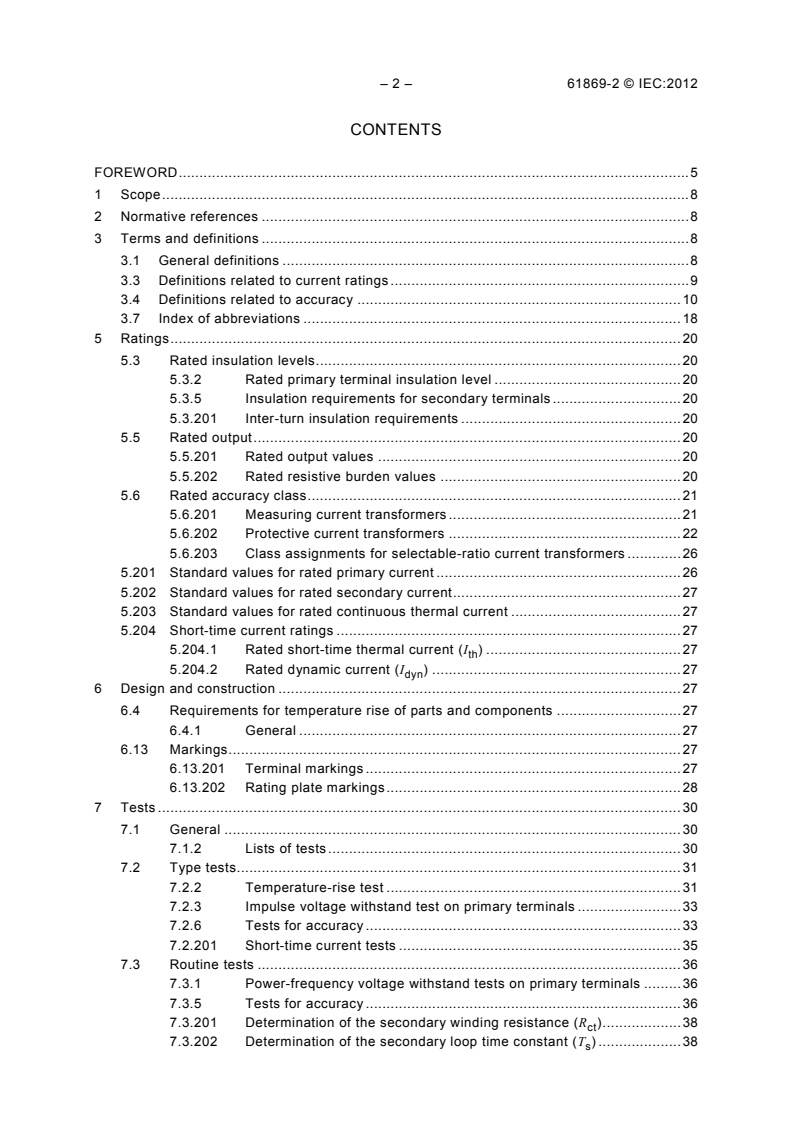
– 2 – 61869-2 © IEC:2012
CONTENTS
FOREWORD . 5
1 Scope . 8
2 Normative references . 8
3 Terms and definitions . 8
3.1 General definitions . 8
3.3 Definitions related to current ratings . 9
3.4 Definitions related to accuracy . 10
3.7 Index of abbreviations . 18
5 Ratings . 20
5.3 Rated insulation levels . 20
5.3.2 Rated primary terminal insulation level . 20
5.3.5 Insulation requirements for secondary terminals . 20
5.3.201 Inter-turn insulation requirements . 20
5.5 Rated output . 20
5.5.201 Rated output values . 20
5.5.202 Rated resistive burden values . 20
5.6 Rated accuracy class . 21
5.6.201 Measuring current transformers . 21
5.6.202 Protective current transformers . 22
5.6.203 Class assignments for selectable-ratio current transformers . 26
5.201 Standard values for rated primary current . 26
5.202 Standard values for rated secondary current . 27
5.203 Standard values for rated continuous thermal current . 27
5.204 Short-time current ratings . 27
5.204.1 Rated short-time thermal current (I ) . 27
th
5.204.2 Rated dynamic current (I ) . 27
dyn
6 Design and construction . 27
6.4 Requirements for temperature rise of parts and components . 27
6.4.1 General . 27
6.13 Markings . 27
6.13.201 Terminal markings . 27
6.13.202 Rating plate markings . 28
7 Tests . 30
7.1 General . 30
7.1.2 Lists of tests . 30
7.2 Type tests . 31
7.2.2 Temperature-rise test . 31
7.2.3 Impulse voltage withstand test on primary terminals . 33
7.2.6 Tests for accuracy . 33
7.2.201 Short-time current tests . 35
7.3 Routine tests . 36
7.3.1 Power-frequency voltage withstand tests on primary terminals . 36
7.3.5 Tests for accuracy . 36
7.3.201 Determination of the secondary winding resistance (R ) . 38
ct
7.3.202 Determination of the secondary loop time constant (T ) . 38
s
61869-2 © IEC:2012 – 3 –
7.3.203 Test for rated knee point e.m.f. (E ) and exciting current at E . 39
k k
7.3.204 Inter-turn overvoltage test . 39
7.4 Special tests . 40
7.4.3 Measurement of capacitance and dielectric dissipation factor . 40
7.4.6 Internal arc fault test . 40
7.5 Sample tests . 41
7.5.1 Determination of the remanence factor . 41
7.5.2 Determination of the instrument security factor (FS) of
measuring current transformers . 41
Annex 2A (normative) Protective current transformers classes P, PR . 42
Annex 2B (normative) Protective current transformer classes for transient
performance . 47
Annex 2C (normative) Proof of low-leakage reactance type . 63
Annex 2D (informative) Technique used in temperature rise test of oil-immersed
transformers to determine the thermal constant by an experimental estimation . 64
Annex 2E (informative) Alternative measurement of the ratio error (ε) . 66
Annex 2F (normative) Determination of the turns ratio error . 68
Figure 201 – Duty cycles . 15
Figure 202 – Primary time constant T . 16
P
Figure 203 – Secondary linked flux for different fault inception angles γ . 17
Figure 2A.1 – Vector Diagram . 42
Figure 2A.2 – Error triangle . 43
Figure 2A.3 – Typical current waveforms . 44
Figure 2A.4 – Basic circuit for 1:1 current transformer . 44
Figure 2A.5 – Basic circuit for current transformer with any ratio. 45
Figure 2A.6 – Alternative test circuit . 45
Figure 2B.1 – Short-circuit current for two different fault inception angles . 48
Figure 2B.2 – ψ (t) as the curve of the highest flux values, considering all relevant
max
fault inception angles γ . 48
Figure 2B.3 – Relevant time ranges for calculation of transient factor . 49
Figure 2B.4 – Determination of K
in time range 1 at 50 Hz for T = 1,8 s . 50
tf s
Figure 2B.5 – Determination of K in time range 1 at 60 Hz for T = 1,5 s . 50
tf s
Figure 2B.6 – Determination of K in time range 1 at 16,7 Hz for T = 5.5 s . 50
tf s
Figure 2B.7 – Limiting the magnetic flux by considering core saturation . 52
Figure 2B.8 – Basic circuit . 53
Figure 2B.9 – Determination of remanence factor by hysteresis loop . 55
Figure 2B.10 – Circuit for d.c. method . 56
Figure 2B.11 – Time-amplitude and flux-current diagrams . 56
Figure 2B.12 – Recordings with shifted flux base line . 57
Figure 2B.13 – Circuit for capacitor discharge method . 58
Figure 2B.14 – Typical records for capacitor discharge method . 59
Figure 2B.15 – Measurement of error currents . 60
Figure 2D.1 – Graphical extrapolation to ultimate temperature rise . 65
Figure 2E.1 – Simplified equivalent circuit of the current transformer . 66
– 4 – 61869-2 © IEC:2012
Table 201 – Limits of ratio error and phase displacement for measuring current
transformers (classes 0,1 to 1). 21
Table 202 – Limits of ratio error and phase displacement for measuring current
transformers (classes 0,2S and 0,5S) . 22
Table 203 – Limits of ratio error for measuring current transformers (classes 3 and 5) . 22
Table 204 – Characterisation of protective classes . 23
Table 205 – Error limits for protective current transformers class P and PR . 23
Table 206 – Error limits for TPX, TPY and TPZ current transformers. 25
Table 207 – Specification Methods for TPX, TPY and TPZ current transformers . 26
Table 208 – Marking of terminals . 28
Table 10 – List of tests . 31
61869-2 © IEC:2012 – 5 –
INTERNATIONAL ELECTROTECHNICAL COMMISSION
____________
INSTRUMENT TRANSFORMERS –
Part 2: Additional requirements for current transformers
FOREWORD
1) The International Electrotechnical Commission (IEC) is a worldwide organization for standardization comprising
all national electrotechnical committees (IEC National Committees). The object of IEC is to promote
international co-operation on all questions concerning standardization in the electrical and electronic fields. To
this end and in addition to other activities, IEC publishes International Standards, Technical Specifications,
Technical Reports, Publicly Available Specifications (PAS) and Guides (hereafter referred to as “IEC
Publication(s)”). Their preparation is entrusted to technical committees; any IEC National Committee interested
in the subject dealt with may participate in this preparatory work. International, governmental and non-
governmental organizations liaising with the IEC also participate in this preparation. IEC collaborates closely
with the International Organization for Standardization (ISO) in accordance with conditions determined by
agreement between the two organizations.
2) The formal decisions or agreements of IEC on technical matters express, as closely as possible, an
international consensus of opinion on the relevant subjects since each technical committee has representation
from all interested IEC National Committees.
3) IEC Publications have the form of recommendations for international use and are accepted by IEC National
Committees in that sense. While all reasonable efforts are made to ensure that the technical content of IEC
Publications is accurate, IEC cannot be held responsible for the way in which they are used or for any
misinterpretation by any end user.
4) In order to promote international uniformity, IEC National Committees undertake to apply IEC Publications
transparently to the maximum extent possible in their national and regional publications. Any divergence
between any IEC Publication and the corresponding national or regional publication shall be clearly indicated in
the latter.
5) IEC itself does not provide any attestation of conformity. Independent certification bodies provide conformity
assessment services and, in some areas, access to IEC marks of conformity. IEC is not responsible for any
services carried out by independent certification bodies.
6) All users should ensure that they have the latest edition of this publication.
7) No liability shall attach to IEC or its directors, employees, servants or agents including individual experts and
members of its technical committees and IEC National Committees for any personal injury, property damage or
other damage of any nature whatsoever, whether direct or indirect, or for costs (including legal fees) and
expenses arising out of the publication, use of, or reliance upon, this IEC Publication or any other IEC
Publications.
8) Attention is drawn to the Normative references cited in this publication. Use of the referenced publications is
indispensable for the correct application of this publication.
9) Attention is drawn to the possibility that some of the elements of this IEC Publication may be the subject of
patent rights. IEC shall not be held responsible for identifying any or all such patent rights.
This International Standard IEC 61869-2 Ed.1.0 has been prepared by committee 38:
Instrument transformers.
This first edition of IEC 61869-2 cancels and replaces the first edition of IEC 60044-1,
published in 1996, and its Amendment 1 (2000) and Amendment 2 (2002), and the first edition
of IEC 60044-6, published in 1992. Additionally it introduces technical innovations in the
standardization and adaptation of the requirements for current transformers for transient
performance.
The text of this standard is based on the following documents:
FDIS Report on voting
38/435/FDIS 38/437/RVD
Full information on the voting for the approval of this standard can be found in the report on
voting indicated in the above table.
– 6 – 61869-2 © IEC:2012
This publication has been drafted in accordance with the ISO/IEC Directives, Part 2.
A list of all the parts in the IEC 61869 series, published under the general title Instrument
transformers, can be found on the IEC website.
This Part 2 is to be used in conjunction with, and is based on, IEC 61869-1:2007, General
Requirements – however the reader is encouraged to use its most recent edition.
This Part 2 follows the structure of IEC 61869-1:2007 and supplements or modifies its
corresponding clauses.
When a particular clause/subclause of Part 1 is not mentioned in this Part 2, that
clause/subclause applies as far as is reasonable. When this standard states “addition”,
“modification” or “replacement”, the relevant text in Part 1 is to be adapted accordingly.
For additional clauses, subclauses, figures, tables, annexes or notes, the following numbering
system is used:
– clauses, subclauses, tables, figures and notes that are numbered starting from 201 are
additional to those in Part 1;
– additional annexes are lettered 2A, 2B, etc.
An overview of the planned set of standards at the date of publication of this document is
given below. The updated list of standards issued by IEC TC38 is available at the website:
www.iec.ch.
61869-2 © IEC:2012 – 7 –
PRODUCT FAMILY STANDARDS PRODUCT PRODUCTS OLD
STANDARD STANDARD
ADDITIONAL REQUIREMENTS FOR 60044-1
61869-2
CURRENT TRANSFORMERS 60044-6
ADDITIONAL REQUIREMENTS FOR 60044-2
61869-3
INDUCTIVE VOLTAGE TRANSFORMERS
ADDITIONAL REQUIREMENTS FOR 60044-3
61869-4
COMBINED TRANSFORMERS
ADDITIONAL REQUIREMENTS FOR 60044-5
61869-5
CAPACITIVE VOLTAGE TRANSFORMERS
ADDITIONAL REQUIREMENTS FOR 60044-7
61869-6 61869-7
61869-1:2007
ELECTRONIC VOLTAGE
TRANSFORMERS
ADDITIONAL
GENERAL
GENERAL
REQUIREMENTS
REQUIREMENT ADDITIONAL REQUIREMENTS FOR 60044-8
61869-8
FOR
ELECTRONIC CURRENT
FOR
INSTRUMENT
TRANSFORMERS
ELECTRONIC
TRANSFORMERS
INSTRUMENT
TRANSFORMERS
DIGITAL INTERFACE FOR INSTRUMENT
61869-9
AND LOW
TRANSFORMERS
POWER STAND
ALONE
ADDITIONAL REQUIREMENTS FOR LOW-
61869-10
SENSORS
POWER STAND-ALONE CURRENT
SENSORS
ADDITIONAL REQUIREMENTS FOR LOW 60044-7
61869-11
POWER STAND ALONE VOLTAGE
SENSOR
ADDITIONAL REQUIREMENTS FOR
61869-12
COMBINED ELECTRONIC INSTRUMENT
TRANSFORMER OR COMBINED STAND
ALONE SENSORS
STAND ALONE MERGING UNIT
61869-13
Since the publication of IEC 60044-6 (Requirements for protective current transformers for
transient performance) in 1992, the area of application of this kind of current transformers has
been extended. As a consequence, the theoretical background for the dimensioning according
to the electrical requirements has become much more complex. In order to keep this standard
as user-friendly as possible, the explanation of the background information will be transferred
to the Technical Report IEC 61869-100 TR, which is now in preparation.
The committee has decided that the contents of this publication will remain unchanged until
the stability date indicated on the IEC web site under "http://webstore.iec.ch" in the data
related to the specific publication. At this date, the publication will be
• reconfirmed,
• withdrawn,
• replaced by a revised edition, or
• amended.
– 8 – 61869-2 © IEC:2012
INSTRUMENT TRANSFORMERS –
Part 2: Additional requirements for Current Transformers
1 Scope
This part of IEC 61869 is applicable to newly manufactured inductive current transformers for
use with electrical measuring instruments and/or electrical protective devices having rated
frequencies from 15 Hz to 100 Hz.
2 Normative references
Clause 2 of IEC 61869-1:2007 is applicable with the following additions:
IEC 61869-1:2007, Instrument Transformers – Part 1: General requirements
3 Terms and definitions
For the purposes of this document, the terms and definitions in IEC 61869-1:2007 apply with
the following additions:
3.1 General definitions
3.1.201
current transformer
instrument transformer in which the secondary current, under normal conditions of use, is
substantially proportional to the primary current and differs in phase from it by an angle which
is approximately zero for an appropriate direction of the connections
[SOURCE: IEC 60050-321:1986, 321-02-01]
3.1.202
measuring current transformer
current transformer intended to transmit an information signal to measuring instruments and
meters
[SOURCE: IEC 60050-321:1986, 321-02-18]
3.1.203
protective current transformer
a current transformer intended to transmit an information signal to protective and control
devices
[SOURCE: IEC 60050-321: 1986, 321-02-19)
3.1.204
class P protective current transformer
protective current transformer without remanent flux limit, for which the saturation behaviour
in the case of a symmetrical short-circuit is specified
3.1.205
class PR protective current transformer
protective current transformer with remanent flux limit, for which the saturation behaviour in
the case of a symmetrical short-circuit is specified
61869-2 © IEC:2012 – 9 –
3.1.206
class PX protective current transformer
protective current transformer of low-leakage reactance without remanent flux limit for which
knowledge of the excitation characteristic and of the secondary winding resistance, secondary
burden resistance and turns ratio, is sufficient to assess its performance in relation to the
protective relay system with which it is to be used
3.1.207
class PXR protective current transformer
protective current transformer with remanent flux limit for which knowledge of the excitation
characteristic and of the secondary winding resistance, secondary burden resistance and
turns ratio, is sufficient to assess its performance in relation to the protective relay system
with which it is to be used
Note 1 to entry: An increasingly number of situations occur where low DC currents are continuously flowing through
current transformers. Therefore, in order to stop the current transformer from saturating, current transformers with
air gaps, but with the same performance as Class PX, are used.
Note 2 to entry: The air gaps for remanence reduction do not necessarily lead to a high-leakage reactance current
transformer (see Annex 2C).
3.1.208
class TPX protective current transformer for transient performance
protective current transformer without remanent flux limit, for which the saturation behaviour
in case of a transient short-circuit current is specified by the peak value of the instantaneous
error
3.1.209
class TPY protective current transformer for transient performance
protective current transformer with remanent flux limit, for which the saturation behaviour in
case of a transient short-circuit current is specified by the peak value of the instantaneous
error
3.1.210
class TPZ protective current transformer for transient performance
protective current transformer with a specified secondary time-constant, for which the
saturation behaviour in case of a transient short-circuit current is specified by the peak value
of the alternating error component
3.1.211
selectable-ratio current transformer
current transformer on which several transformation ratios are obtained by reconnecting the
primary winding sections and / or by means of taps on the secondary winding
3.3 Definitions related to current ratings
3.3.201
rated primary current
I
pr
value of the primary current on which the performance of the transformer is based
[SOURCE: IEC 60050-321:1986, 321-01-11, modified title, synonym and definition]
3.3.202
rated secondary current
I
sr
value of the secondary current on which the performance of the transformer is based
[SOURCE: IEC 60050-321:1986, 321-01-15, modified title, synonym and definition]
– 10 – 61869-2 © IEC:2012
3.3.203
rated short-time thermal current
I
th
maximum value of the primary current which a transformer will withstand for a specified short
time without suffering harmful effects, the secondary winding being short-circuited
[SOURCE: IEC 60050-321:1986, 321-02-22]
3.3.204
rated dynamic current
I
dyn
maximum peak value of the primary current which a transformer will withstand, without being
damaged electrically or mechanically by the resulting electromagnetic forces, the secondary
winding being short-circuited
[SOURCE: IEC 60050-321:1986, 321-02-24]
3.3.205
rated continuous thermal current
I
cth
value of the current which can be permitted to flow continuously in the primary winding, the
secondary winding being connected to the rated burden, without the temperature rise
exceeding the values specified
[SOURCE: IEC 60050-321:1986, 321-02-25]
3.3.206
rated primary short-circuit current
I
psc
r.m.s. value of the a.c. component of a transient primary short-circuit current on which the
accuracy performance of a current transformer is based
Note 1 to entry: While I is related to the thermal limit, I is related to the accuracy limit. Usually, I is smaller
th psc psc
than I .
th
3.3.207
exciting current
I
e
r.m.s. value of the current taken by the secondary winding of a current transformer, when a
sinusoidal voltage of rated frequency is applied to the secondary terminals, the primary and
any other windings being open-circuited
[SOURCE: IEC 60050-321:1986, 321-02-32]
3.4 Definitions related to accuracy
3.4.3
ratio error
ε
Definition 3.4.3 of IEC 61869-1:2007 is applicable with the addition of the following note:
Note 201 to entry: The current ratio error, expressed in per cent, is given by the formula:
k I −I
r s p
ε = ×100 %
I
p
where
k is the rated transformation ratio;
r
I is the actual primary current;
p
I is the actual secondary current when I is flowing, under the conditions of measurement.
s p
An explicative vector diagram is given in 2A.1.
61869-2 © IEC:2012 – 11 –
3.4.4
phase displacement
Δϕ
The definition 3.4.4 of IEC 61869-1:2007 is applicable with the addition of the following note:
Note 1 to entry: An explicative vector diagram is given in 2A.1.
3.4.201
rated resistive burden
R
b
rated value of the secondary connected resistive burden in ohms
3.4.202
secondary winding resistance
R
ct
actual secondary winding d.c. resistance in ohms corrected to 75 ºC or such other
temperature as may be specified
Note 1 to entry: R is an actual value. It shall not be confused with the upper limit for R , which can be specified
ct ct
otherwise.
3.4.203
composite error
ε
c
under steady-state conditions, the r.m.s. value of the difference between
a) the instantaneous values of the primary current, and
b) the instantaneous values of the actual secondary current multiplied by the rated
transformation ratio,
the positive signs of the primary and secondary currents corresponding to the convention for
terminal markings
Note 1 to entry: The composite error ε is generally expressed as a percentage of the r.m.s. values of the primary
c
current:
T
(k i − i ) dt
r s p
∫
T
ε = ×100 %
c
I
p
where
k is the rated transformation ratio;
r
I is the r.m.s. value of the primary current;
p
i is the instantaneous value of the primary current;
p
i is the instantaneous value of the secondary current;
s
T is the duration of one cycle.
For further explanation, refer to 2A.4.
[SOURCE: IEC 60050-321:1986, 321-02-26, modified note to entry]
3.4.204
rated instrument limit primary current
I
PL
value of the minimum primary current at which the composite error of the measuring current
transformer is equal to or greater than 10 %, the secondary burden being equal to the rated
burden
[SOURCE: IEC 60050-321:1986, 321-02-27]
– 12 – 61869-2 © IEC:2012
3.4.205
instrument security factor
FS
ratio of rated instrument limit primary current to the rated primary current
Note 1 to entry: Attention should be paid to the fact that the actual instrument security factor is affected by the
burden. When the burden value is significantly lower than rated one, larger current values will be produced on the
secondary side in the case of short-circuit current.
Note 2 to entry: In the event of system fault currents flowing through the primary winding of a current transformer,
the safety of the apparatus supplied by the transformer is at its highest when the value of the rated instrument
security factor (FS) is at its lowest.
[SOURCE: IEC 60050-321:1986, 321-02-28, modified notes to entry]
3.4.206
secondary limiting e.m.f. for measuring current transformers
E
FS
product of the instrument security factor FS, the rated secondary current and the vectorial sum
of the rated burden and the impedance of the secondary winding
Note 1 to entry: The secondary limiting e.m.f. for measuring current transformers E is calculated as
FS
2 2
E = FS × I × (R + R ) + X
FS sr ct b b
where: R is the resistive part of the rated burden;
b
X is the inductive part of the rated burden.
b
This method will give a higher value than the actual one. It was chosen in order to apply the same test method as
used for protective current transformers. Refer to 7.2.6.202 and 7.2.6.203.
[SOURCE: IEC 60050-321:1986, 321-02-31, modified title, synonym and note to entry]
3.4.207
rated accuracy limit primary current
value of primary current up to which the current transformer will comply with the requirements
for composite error
[SOURCE: IEC 60050-321:1986, 321-02-29]
3.4.208
accuracy limit factor
ALF
ratio of the rated accuracy limit primary current to the rated primary current
[SOURCE: IEC 60050-321:1986, 321-02-30]
3.4.209
secondary limiting e.m.f. for protective current transformers
E
ALF
product of the accuracy limit factor, the rated secondary current and the vectorial sum of the
rated burden and the impedance of the secondary winding
Note 1 to entry: The secondary limiting e.m.f for class P and PR protective current transformers E is calculated
ALF
as
2 2
E = ALF × I × (R + R ) + X
ALF sr ct b b
where: R is the resistive part of the rated burden;
b
X is the inductive part of the rated burden.
b
61869-2 © IEC:2012 – 13 –
3.4.210
saturation flux
Ψ
sat
maximum value of secondary linked flux in a current transformer, which corresponds to the
magnetic saturation of the core material
Note 1 to entry: The most suitable procedure for the determination of the saturation flux Ψ is given with the d.c.
sat
saturation method described in 2B.2.3.
Note 2 to entry: In the former standard IEC 60044-6, Ψ was defined as a knee point value, which characterized the
s
transition from the non-saturated to the fully saturated state of a core. This definition could not gain acceptance
because the saturation value was too low, and led to misunderstandings and contradictions. Therefore, it was
replaced by Ψ , which defines the condition of complete saturation.
sat
3.4.211
remanent flux
Ψ
r
value of secondary linked flux which would remain in the core 3 min after the interruption of a
magnetizing current of sufficient magnitude to induce saturation flux (Ψ )
sat
3.4.212
remanence factor
K
R
ratio of the remanent flux to the saturation flux, expressed as a percentage
3.4.213
secondary loop time constant
T
s
value of the time constant of the secondary loop of the current transformer obtained from the
sum of the magnetizing and the leakage inductances (L ) and the secondary loop resistance
s
)
(R
s
T = L / R
s s s
3.4.214
excitation characteristic
graphical or tabular presentation of the relationship between the r.m.s. value of the exciting
current and a sinusoidal voltage applied to the secondary terminals of a current transformer,
the primary and other windings being open-circuited, over a range of values sufficient to
define the characteristics from low levels of excitation up to 1.1 times the knee point e.m.f.
3.4.215
knee point voltage
r.m.s. value of the sinusoidal voltage at rated frequency applied to the secondary terminals of
the transformer, all other terminals being open-circuited, which, when increased by 10 %,
causes the r.m.s. value of the exciting current to increase by 50 %
[SOURCE: IEC 60050-321:1986, 321-02-34]
3.4.216
knee point e.m.f.
e.m.f. of a current transformer at rated frequency, which, when increased by 10 %, causes the
r.m.s. value of the exciting current to increase by 50 %
Note 1 to entry: While the knee point voltage can be applied to the secondary terminals of a current transformer,
the knee point e.m.f. is not directly accessible. The values of the knee point voltage and of the knee point e.m.f.
are deemed as equal, due to the minor influence of the voltage drop across the secondary winding resistance.
– 14 – 61869-2 © IEC:2012
3.4.217
rated knee point e.m.f.
E
k
lower limit of the knee point e.m.f.
Note 1 to entry: The rated knee point e.m.f. appears in the specifications of class PX and PXR protective current
transformers. It may be calculated as
E = K × (R + R )× I
k x ct b sr
3.4.218
rated turns ratio
specified ratio of the number of primary turns to the number of secondary turns
EXAMPLE 1 1/600 (meaning 1 primary turn to 600 secondary turns)
EXAMPLE 2 2/1200 (meaning 2 primary turns to 1200 secondary turns)
Note 1 to entry: The rated turns ratio appears in the specifications of class PX and PXR protective current
transformers.
Note 2 to entry: Rated turns ratio and rated transformation ratio are both defined as primary to secondary entities.
If they shall be compared, the value of the rated turns ratio has to be inverted.
3.4.219
turns ratio error
difference between the actual turns ratio and the rated turns ratio, expressed as a percentage
of the rated turns ratio
3.4.220
dimensioning factor
K
x
factor to indicate the multiple of rated secondary current (I ) occurring under power system
sr
fault conditions, inclusive of safety margins, up to which the transformer is required to meet
performance requirements
Note 1 to entry: See formula under 3.4.217.
3.4.221
instantaneous error current
i
ε
difference between the instantaneous values of the secondary current (i ) multiplied by the
s
rated transformation ratio (k ) and the primary current (i ):
r p
i = k × i - i
ε r s p
Note 1 to entry: When both alternating current components (i , i ) and direct current components (i , i )
sac pac sdc pdc
are present, the constituent components (i , i ) are separately identified as follows:
εac εdc
i = i + i = (k × i - i ) + (k × i - i )
ε εac εdc r sac pac r sdc pdc
3.4.222
peak instantaneous error
ˆ
ε
peak value (î ) of instantaneous error current (see 3.4.221) for the specified duty cycle,
ε
expressed as a percentage of the peak value of the rated primary short-circuit current:
ˆ
i
ε
ˆ
ε = ×100%
2 × I
psc
61869-2 © IEC:2012 – 15 –
3.4.223
peak alternating error component
ˆ
ε
ac
ˆ
peak value i of the alternating component of the instantaneous error current, expressed as
εac
a percentage of the peak value of the rated primary short-circuit current:
ˆ
i
εac
ˆ
ε = ×100 %
ac
2 × I
psc
3.4.224
specified duty cycle (C-O and / or C-O-C-O)
duty cycle in which, during each specified energization, the primary short circuit current is
assumed to have the worst-case inception angle (see Figure 201)
i i
p p
t t
t′
t′ t′′
al
al al
t
fr
t′ t′′
t′
C-O C-O-C-O
IEC 1547/12
Figure 201 – Duty cycles
3.4.225
Specified primary time constant
T
P
that specified value of the time constant of the d.c. component of the primary short-circuit
current on which the transient performance of the current transformer is based (see Figure
202)
– 16 – 61869-2 © IEC:2012
i
p
I × 2
psc
I × 2
psc
e
t
T
p
IEC 1548/12
Figure 202 – Primary time constant T
P
3.4.226
duration of the first fault
t′
duration of the fault in a C-O duty cycle, or of the first fault in a C-O-C-O duty cycle
Note 1 to entry: See Figure 201.
3.4.227
duration of the second fault
t′′
duration of the second fault in a C-O-C-O duty cycle
Note 1 to entry: See Figure 201.
3.4.228
specified time to accuracy limit in the first fault
t′
al
time in a C-O duty cycle, or in the first energization of a C-O-C-O duty cycle, during which the
specified accuracy has to be maintained
Note 1 to entry: See Figure 201. This time interval is usually defined by the critical measuring time of the
associated protection scheme.
3.4.229
specified time to accuracy limit in the second fault
t″
al
time in the second energization of a C-O-C-O duty cycle during which the specified accuracy
has to be maintained
Note 1 to entry: See Figure 201. This time interval is usually defined by the critical measuring time of the
associated protection scheme.
61869-2 © IEC:2012 – 17 –
3.4.230
fault repetition time
t
fr
time interval between interruption and re-application of the primary short-circuit current during
a circuit breaker auto-reclosing duty cycle in case of a non-successful fault clearance
Note 1 to entry: See Figure 201.
3.4.231
secondary loop resistance
R
s
total resistance of the secondary circuit
R = R + R
s b ct
3.4.232
rated symmetrical short-circuit current factor
K
ssc
ratio of the rated primary short circuit current to the rated primary current
I
psc
K =
ssc
I
pr
3.4.233
transient factor
K
tf
ratio of the secondary linked flux at a specified point of time in a duty cycle to the peak value
of its a.c. component
Note 1 to entry: K is calculated analytically with different formulae depending on T , T , on the duty cycle and on
tf P S
the fault inception angle. A determination of K is given in Annex 2B.1.
tf
Note 2 to entry: Figure 203 shows possible courses of the secondary linked flux for different fault inception
angles γ.
ψψ
γ = 90°
γ=90°
γ=135°
γ = 135°
γ=180°
γ = 180°
-2
t
0 0.01 0.02 0.03 0.04 0.05 0.06 0.07 0.08 0.09 t 0.1
IEC 1549/12
Figure 203 – Secondary linked flux for different fault inception angles γ
– 18 – 61869-2 © IEC:2012
3.4.234
transient dimensioning factor
K
td
dimensioning factor to consider the increase of the secondary linked flux due to a d.c.
component of the primary short circuit current
Note 1 to entry: While K is defined as a function of time, K is the definitive dimensioning parameter. K is derived
tf td td
from current transformer requirements given by the relay manufacturer (gained from relay stability type tests) or from worst-case
considerations based on the K curves (see 2B.1).
tf
3.4.235
Low-leakage reactance current transformer
current transformer for which measurements made at the secondary terminals (while primary
open-circuited) are sufficient for an assessment of its protection performance up to the
required accuracy limit
3.4.236
high-leakage reactance current transformer
current transformer which does not satisfy the r
...