

IEC 60810:2003
(Main)Lamps for road vehicles - Performance requirements
General Information
- Abstract
One of a series of IEC standards for incandescent lamps to be used in headlamps, fog-lamps and signalling lamps of road vehicles.
- Status
- Published
- Publication Date
- 13-Feb-2013
- Technical Committee
- SC 34A - Electric light sources
- Drafting Committee
- WG 6 - TC 34/SC 34A/WG 6
- Current Stage
- DELPUB - Deleted Publication
- Start Date
- 16-Dec-2014
- Completion Date
- 28-Aug-2026
Buy Documents
IEC 60810:2003 - Lamps for road vehicles - Performance requirements Released:5/21/2003
IEC 60810:2003+AMD1:2008 CSV - Lamps for road vehicles - Performance requirements Released:10/15/2008
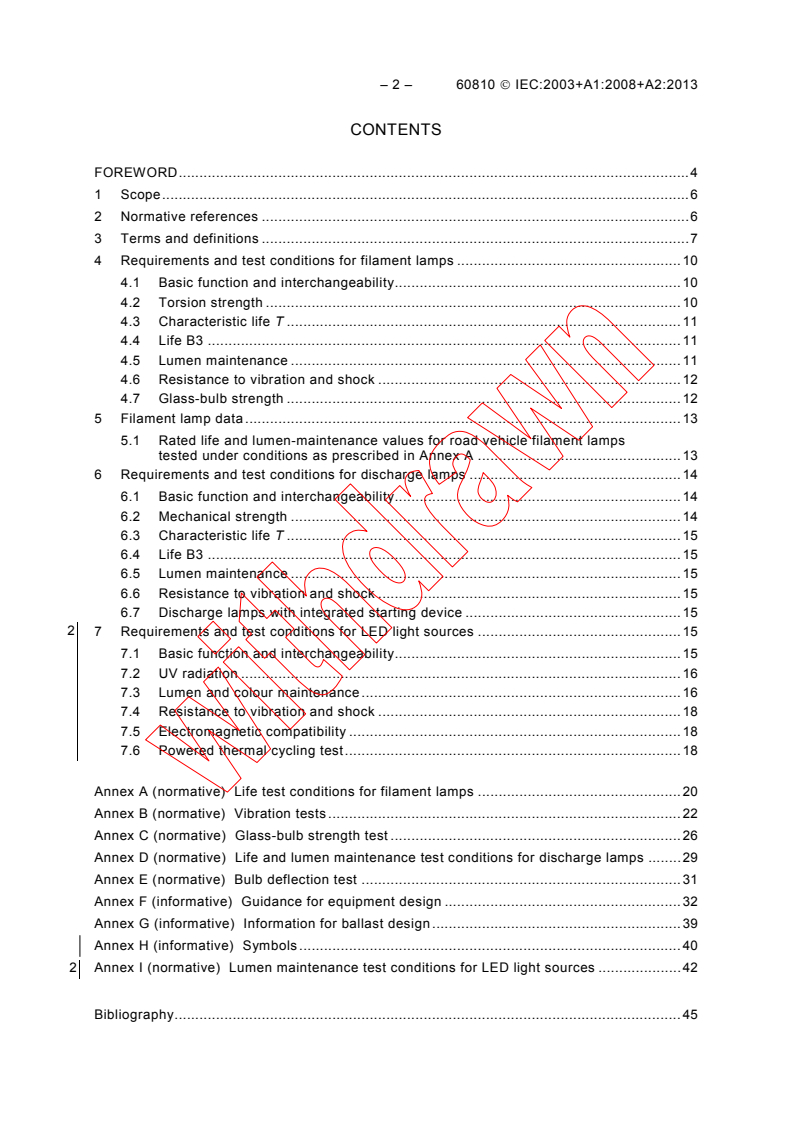
IEC 60810:2003+AMD1:2008+AMD2:2013 CSV - Lamps for road vehicles - Performance requirements Released:2/14/2013
Overview
IEC 60810:2003 is a key international standard developed by the International Electrotechnical Commission (IEC) for lamps used in road vehicles. The standard specifies performance requirements for various types of automotive lamps, including filament (incandescent), discharge, and LED light sources. The focus is on headlamps, fog-lamps, and signalling lamps, ensuring the necessary safety, durability, and effectiveness for road vehicles worldwide.
This standard provides a crucial framework for manufacturers, laboratories, and quality assurance teams involved in automotive lighting development and testing. IEC 60810 complements dimensional, electrical, and luminous specifications detailed in IEC 60809, offering practical guidelines to ensure lamps meet reliability and safety requirements throughout their service life.
Key Topics
- Lamp Types Covered: Filament (incandescent), discharge (including HID), and LED light sources.
- Performance Criteria: Requirements related to lamp life, lumen (light) maintenance, torsion and mechanical strength, resistance to vibration and shock, and glass bulb durability.
- Test Methods: Standardized methods and conditions for performance assessment, including life tests, vibration tests, UV radiation evaluation, and thermal cycling for LEDs.
- Safety and Interchangeability: Specifications for mechanical construction to ensure safe installation and replacement, cap and holder compatibility, and protection against mechanical failure.
- Reference Data: For lamps not listed specifically in the included tables, relevant performance data must be supplied by the lamp manufacturer.
Applications
IEC 60810 is widely applied across the automotive industry, particularly in the design, production, and testing of lighting components for:
- Headlamps: Ensures reliable illumination for safe nighttime and inclement weather driving.
- Fog-Lamps: Verifies performance in low-visibility conditions, contributing to road safety.
- Signalling Lamps: Covers indicators, brake lights, and other signalling devices, supporting effective vehicle communication.
Benefits in Practice
- Quality Assurance: Testing as per IEC 60810 helps manufacturers demonstrate compliance with international quality standards and ensures consistent lamp performance.
- Product Development: Design and engineering teams use these requirements to select lamp technologies and materials capable of meeting rigorous automotive conditions such as temperature variations, shocks, and continuous vibration.
- Market Access: Compliance facilitates entry into global markets by meeting harmonized requirements recognized by vehicle OEMs and regulatory authorities.
- Replacement and Maintenance: Standardized lamp outlines and performance characteristics simplify replacements and maintenance across different vehicle models.
Related Standards
- IEC 60809: Specifies dimensional, electrical, and luminous requirements for lamps used in road vehicles, serving as the foundation for performance specifications in IEC 60810.
- IEC 60050(845): International Electrotechnical Vocabulary (Lighting).
- IEC 60068 series: Environmental testing - includes vibration, temperature, and mounting of components.
- CISPR 25: Addresses radio disturbance characteristics for vehicles.
- ISO 5344: Covers test equipment for generating vibration.
- UN/ECE Regulation No. 128: Uniform provisions for approval of LED light sources in vehicles.
Summary
Implementing IEC 60810:2003 ensures that lamps for road vehicles meet critical performance, reliability, and safety requirements. By adhering to this standard, manufacturers and automotive stakeholders can assure product quality, enhance road safety, and ensure compatibility across different automotive platforms. This contributes significantly to the overall effectiveness and longevity of vehicle lighting systems in real-world driving environments.
Relations
- Amended By
IEC 60810:2003/AMD2:2013 - Amendment 2 - Lamps for road vehicles - Performance requirements - Effective Date
- 05-Sep-2023
- Amended By
IEC 60810:2003/AMD1:2008 - Amendment 1 - Lamps for road vehicles - Performance requirements - Effective Date
- 05-Sep-2023
- Effective Date
- 05-Sep-2023
- Effective Date
- 05-Sep-2023
- Effective Date
- 05-Sep-2023
Buy Documents
IEC 60810:2003 - Lamps for road vehicles - Performance requirements Released:5/21/2003
IEC 60810:2003+AMD1:2008 CSV - Lamps for road vehicles - Performance requirements Released:10/15/2008
IEC 60810:2003+AMD1:2008+AMD2:2013 CSV - Lamps for road vehicles - Performance requirements Released:2/14/2013
Get Certified
Connect with accredited certification bodies for this standard

IMQ S.p.A. (Certification)
Italian electrical product certification.

SLG Prüf- und Zertifizierungs GmbH
German testing and certification body.

UL Solutions
Global safety science company with testing, inspection and certification.
Sponsored listings
Frequently Asked Questions
IEC 60810:2003 is a standard published by the International Electrotechnical Commission (IEC). Its full title is "Lamps for road vehicles - Performance requirements". This standard covers: One of a series of IEC standards for incandescent lamps to be used in headlamps, fog-lamps and signalling lamps of road vehicles.
One of a series of IEC standards for incandescent lamps to be used in headlamps, fog-lamps and signalling lamps of road vehicles.
IEC 60810:2003 is classified under the following ICS (International Classification for Standards) categories: 29.140.99 - Other standards related to lamps. The ICS classification helps identify the subject area and facilitates finding related standards.
IEC 60810:2003 has the following relationships with other standards: It is inter standard links to IEC 60810:2003/AMD2:2013, IEC 60810:2003/AMD1:2008, IEC 60810:2014, IEC 60810:1993/AMD2:2001, IEC 60810:1993. Understanding these relationships helps ensure you are using the most current and applicable version of the standard.
IEC 60810:2003 is available in PDF format for immediate download after purchase. The document can be added to your cart and obtained through the secure checkout process. Digital delivery ensures instant access to the complete standard document.
Standards Content (Sample)
NORME CEI
INTERNATIONALE IEC
INTERNATIONAL
Troisième édition
STANDARD
Third edition
2003-05
Lampes pour véhicules routiers –
Prescriptions de performances
Lamps for road vehicles –
Performance requirements
Numéro de référence
Reference number
CEI/IEC 60810:2003
Numérotation des publications Publication numbering
Depuis le 1er janvier 1997, les publications de la CEI As from 1 January 1997 all IEC publications are
sont numérotées à partir de 60000. Ainsi, la CEI 34-1 issued with a designation in the 60000 series. For
devient la CEI 60034-1. example, IEC 34-1 is now referred to as IEC 60034-1.
Editions consolidées Consolidated editions
Les versions consolidées de certaines publications de la The IEC is now publishing consolidated versions of its
CEI incorporant les amendements sont disponibles. Par publications. For example, edition numbers 1.0, 1.1
exemple, les numéros d’édition 1.0, 1.1 et 1.2 indiquent and 1.2 refer, respectively, to the base publication,
respectivement la publication de base, la publication de the base publication incorporating amendment 1 and
base incorporant l’amendement 1, et la publication de the base publication incorporating amendments 1
base incorporant les amendements 1 et 2. and 2.
Informations supplémentaires Further information on IEC publications
sur les publications de la CEI
Le contenu technique des publications de la CEI est The technical content of IEC publications is kept
constamment revu par la CEI afin qu'il reflète l'état under constant review by the IEC, thus ensuring that
actuel de la technique. Des renseignements relatifs à the content reflects current technology. Information
cette publication, y compris sa validité, sont dispo- relating to this publication, including its validity, is
nibles dans le Catalogue des publications de la CEI available in the IEC Catalogue of publications
(voir ci-dessous) en plus des nouvelles éditions, (see below) in addition to new editions, amendments
amendements et corrigenda. Des informations sur les and corrigenda. Information on the subjects under
sujets à l’étude et l’avancement des travaux entrepris consideration and work in progress undertaken by the
par le comité d’études qui a élaboré cette publication, technical committee which has prepared this
ainsi que la liste des publications parues, sont publication, as well as the list of publications issued,
également disponibles par l’intermédiaire de: is also available from the following:
• Site web de la CEI (www.iec.ch) • IEC Web Site (www.iec.ch)
• Catalogue des publications de la CEI • Catalogue of IEC publications
Le catalogue en ligne sur le site web de la CEI The on-line catalogue on the IEC web site
(http://www.iec.ch/searchpub/cur_fut.htm) vous permet (http://www.iec.ch/searchpub/cur_fut.htm) enables
de faire des recherches en utilisant de nombreux you to search by a variety of criteria including text
critères, comprenant des recherches textuelles, par searches, technical committees and date of
comité d’études ou date de publication. Des publication. On-line information is also available
informations en ligne sont également disponibles sur on recently issued publications, withdrawn and
les nouvelles publications, les publications rempla- replaced publications, as well as corrigenda.
cées ou retirées, ainsi que sur les corrigenda.
• IEC Just Published • IEC Just Published
Ce résumé des dernières publications parues This summary of recently issued publications
(http://www.iec.ch/online_news/justpub/jp_entry.htm) (http://www.iec.ch/online_news/justpub/jp_entry.htm)
est aussi disponible par courrier électronique. is also available by email. Please contact the
Veuillez prendre contact avec le Service client Customer Service Centre (see below) for further
(voir ci-dessous) pour plus d’informations. information.
• Service clients • Customer Service Centre
Si vous avez des questions au sujet de cette If you have any questions regarding this
publication ou avez besoin de renseignements publication or need further assistance, please
supplémentaires, prenez contact avec le Service contact the Customer Service Centre:
clients:
Email: custserv@iec.ch Email: custserv@iec.ch
Tél: +41 22 919 02 11 Tel: +41 22 919 02 11
Fax: +41 22 919 03 00 Fax: +41 22 919 03 00
.
NORME CEI
INTERNATIONALE IEC
INTERNATIONAL
Troisième édition
STANDARD
Third edition
2003-05
Lampes pour véhicules routiers –
Prescriptions de performances
Lamps for road vehicles –
Performance requirements
IEC 2003 Droits de reproduction réservés Copyright - all rights reserved
Aucune partie de cette publication ne peut être reproduite ni No part of this publication may be reproduced or utilized in any
utilisée sous quelque forme que ce soit et par aucun procédé, form or by any means, electronic or mechanical, including
électronique ou mécanique, y compris la photocopie et les photocopying and microfilm, without permission in writing from
microfilms, sans l'accord écrit de l'éditeur. the publisher.
International Electrotechnical Commission, 3, rue de Varembé, PO Box 131, CH-1211 Geneva 20, Switzerland
Telephone: +41 22 919 02 11 Telefax: +41 22 919 03 00 E-mail: inmail@iec.ch Web: www.iec.ch
CODE PRIX
V
Commission Electrotechnique Internationale PRICE CODE
International Electrotechnical Commission
Международная Электротехническая Комиссия
Pour prix, voir catalogue en vigueur
For price, see current catalogue
– 2 – 60810 CEI:2003
SOMMAIRE
AVANT-PROPOS . 4
1 Domaine d’application. 6
2 Références normatives . 6
3 Termes et définitions . 8
4 Prescriptions et conditions d’essai relatives aux lampes à filament .10
4.1 Fonctions principales et interchangeabilité .10
4.2 Résistance à la torsion .10
4.3 Durée de vie caractéristique T .10
4.4 Durée B3 .10
4.5 Maintien du flux lumineux .12
4.6 Résistance aux vibrations et aux chocs .12
4.7 Résistance de l'ampoule en verre .12
5 Feuilles de caractéristiques des lampes à filament .14
5.1 Valeurs des durées de vie assignées et du maintien du flux lumineux des
lampes à filament pour véhicules routiers, essayées dans les conditions
prescrites à l'Annexe A .14
6 Prescriptions et conditions d’essai relatives aux lampes à décharge.18
6.1 Fonctions principales et interchangeabilité .18
6.2 Résistance mécanique.18
6.2.1 Fixation de l’ampoule au culot.18
6.2.2 Fixation de fil au culot (le cas échéant) .18
6.3 Durée de vie caractéristique T .18
6.4 Durée B3 .18
6.5 Maintien du flux lumineux .18
6.6 Résistance aux vibrations et aux chocs .18
6.7 Lampes à décharge à dispositif d’amorçage intégré.20
Annexe A (normative) Conditions d’essai de durée de vie relatives aux lampes à
filament.22
Annexe B (normative) Essais de vibrations .26
Annexe C (normative) Essai de résistance des ampoules en verre.34
Annexe D (normative) Conditions d’essai de durée et de maintien du flux lumineux
relatives aux lampes à décharge .40
Annexe E (normative) Essai de fléchissement de l’ampoule .44
Annexe F (informative) Conseils pour la conception des matériels .46
Annexe G (informative) Renseignements pour la conception du ballast .60
Bibliographie .62
60810 IEC:2003 – 3 –
CONTENTS
FOREWORD . 3
1 Scope . 7
2 Normative references. 7
3 Terms and definitions . 9
4 Requirements and test conditions for filament lamps .11
4.1 Basic function and interchangeability.11
4.2 Torsion strength .11
4.3 Characteristic life T.11
4.4 Life B3.11
4.5 Lumen maintenance .13
4.6 Resistance to vibration and shock .13
4.7 Glass-bulb strength .13
5 Filament lamp data .15
5.1 Rated life and lumen-maintenance values for road vehicle filament lamps
tested under conditions as prescribed in Annex A.15
6 Requirements and test conditions for discharge lamps.19
6.1 Basic function and interchangeability.19
6.2 Mechanical strength.19
6.3 Characteristic life T.19
6.4 Life B3.19
6.5 Lumen maintenance .19
6.6 Resistance to vibration and shock .19
6.7 Discharge lamps with integrated starting device .21
Annex A (normative) Life test conditions for filament lamps.23
Annex B (normative) Vibration tests .27
Annex C (normative) Glass-bulb strength test .35
Annex D (normative) Life and lumen maintenance test conditions for discharge lamps.41
Annex E (normative) Bulb deflection test.45
Annex F (informative) Guidance for equipment design.47
Annex G (informative) Information for ballast design .61
Bibliography.63
– 4 – 60810 CEI:2003
COMMISSION ÉLECTROTECHNIQUE INTERNATIONALE
____________
LAMPES POUR VÉHICULES ROUTIERS –
PRESCRIPTIONS DE PERFORMANCES
AVANT-PROPOS
1) La CEI (Commission Electrotechnique Internationale) est une organisation mondiale de normalisation
composée de l'ensemble des comités électrotechniques nationaux (Comités nationaux de la CEI). La CEI a
pour objet de favoriser la coopération internationale pour toutes les questions de normalisation dans les
domaines de l'électricité et de l'électronique. A cet effet, la CEI, entre autres activités, publie des Normes
internationales. Leur élaboration est confiée à des comités d'études, aux travaux desquels tout Comité national
intéressé par le sujet traité peut participer. Les organisations internationales, gouvernementales et non
gouvernementales, en liaison avec la CEI, participent également aux travaux. La CEI collabore étroitement
avec l'Organisation Internationale de Normalisation (ISO), selon des conditions fixées par accord entre les
deux organisations.
2) Les décisions ou accords officiels de la CEI concernant les questions techniques représentent, dans la mesure
du possible, un accord international sur les sujets étudiés, étant donné que les Comités nationaux intéressés
sont représentés dans chaque comité d’études.
3) Les documents produits se présentent sous la forme de recommandations internationales. Ils sont publiés
comme normes, spécifications techniques, rapports techniques ou guides et agréés comme tels par les
Comités nationaux.
4) Dans le but d'encourager l'unification internationale, les Comités nationaux de la CEI s'engagent à appliquer de
façon transparente, dans toute la mesure possible, les Normes internationales de la CEI dans leurs normes
nationales et régionales. Toute divergence entre la norme de la CEI et la norme nationale ou régionale
correspondante doit être indiquée en termes clairs dans cette dernière.
5) La CEI n’a fixé aucune procédure concernant le marquage comme indication d’approbation et sa responsabilité
n’est pas engagée quand un matériel est déclaré conforme à l’une de ses normes.
6) L’attention est attirée sur le fait que certains des éléments de la présente Norme internationale peuvent faire
l’objet de droits de propriété intellectuelle ou de droits analogues. La CEI ne saurait être tenue pour
responsable de ne pas avoir identifié de tels droits de propriété et de ne pas avoir signalé leur existence.
La Norme internationale CEI 60810 a été établie par le sous-comité 34A: Lampes, du comité
d'études 34 de la CEI: Lampes et équipements associés.
Cette troisième édition annule et remplace la deuxième édition parue en 1993, ainsi que ses
amendements 1(1994) et 2(2001). Elle constitue une révision technique.
Le texte de cette norme est issu des documents suivants:
FDIS Rapport de vote
34A/1031/FDIS 34A/1034/RVD
Le rapport de vote indiqué dans le tableau ci-dessus donne toute information sur le vote
ayant abouti à l'approbation de cette norme.
Cette publication a été rédigée selon les Directives ISO/CEI, Partie 2.
Le comité a décidé que le contenu de cette publication ne sera pas modifié avant 2005. A
cette date, la publication sera
• reconduite;
• supprimée;
• remplacée par une édition révisée, ou
• amendée.
60810 IEC:2003 – 5 –
INTERNATIONAL ELECTROTECHNICAL COMMISSION
____________
LAMPS FOR ROAD VEHICLES –
PERFORMANCE REQUIREMENTS
FOREWORD
1) The IEC (International Electrotechnical Commission) is a worldwide organization for standardization comprising
all national electrotechnical committees (IEC National Committees). The object of the IEC is to promote
international co-operation on all questions concerning standardization in the electrical and electronic fields. To
this end and in addition to other activities, the IEC publishes International Standards. Their preparation is
entrusted to technical committees; any IEC National Committee interested in the subject dealt with may
participate in this preparatory work. International, governmental and non-governmental organizations liaising
with the IEC also participate in this preparation. The IEC collaborates closely with the International
Organization for Standardization (ISO) in accordance with conditions determined by agreement between the
two organizations.
2) The formal decisions or agreements of the IEC on technical matters express, as nearly as possible, an
international consensus of opinion on the relevant subjects since each technical committee has representation
from all interested National Committees.
3) The documents produced have the form of recommendations for international use and are published in the form
of standards, technical specifications, technical reports or guides and they are accepted by the National
Committees in that sense.
4) In order to promote international unification, IEC National Committees undertake to apply IEC International
Standards transparently to the maximum extent possible in their national and regional standards. Any
divergence between the IEC Standard and the corresponding national or regional standard shall be clearly
indicated in the latter.
5) The IEC provides no marking procedure to indicate its approval and cannot be rendered responsible for any
equipment declared to be in conformity with one of its standards.
6) Attention is drawn to the possibility that some of the elements of this International Standard may be the subject
of patent rights. The IEC shall not be held responsible for identifying any or all such patent rights.
International Standard IEC 60810 has been prepared by subcommittee 34A: Lamps, of IEC
technical committee 34: Lamps and related equipment.
This third edition cancels and replaces the second edition published in 1993 and its
amendment 1 (1994) and amendment 2 (2001).It constitutes a technical revision.
The text of this standard is based on the following documents:
FDIS Report on voting
34A/1031/FDIS 34A/1034/RVD
Full information on the voting for the approval of this standard can be found in the report on
voting indicated in the above table.
This publication has been drafted in accordance with the ISO/IEC Directives, Part 2.
The committee has decided that the contents of this publication will remain unchanged until
2005. At this date, the publication will be
• reconfirmed;
• withdrawn;
• replaced by a revised edition, or
• amended.
– 6 – 60810 CEI:2003
LAMPES POUR VÉHICULES ROUTIERS –
PRESCRIPTIONS DE PERFORMANCES
1 Domaine d’application
La présente Norme internationale est applicable aux lampes remplaçables (lampes à filament
et lampes à décharge) destinées à être utilisées dans les projecteurs avant, feux de brouillard
et feux de signalisation des véhicules routiers. Elle s’applique particulièrement aux lampes
figurant dans la CEI 60809. Cependant, elle peut aussi être utilisée pour d’autres lampes
relevant de son domaine d’application, ainsi que pour des réalisations futures, par exemple
dans le cas où la lumière est produite par des diodes électroluminescentes (DEL).
Elle précise les prescriptions et les méthodes de vérification des caractéristiques de
performance telles que la durée de la lampe, le maintien du flux lumineux, la résistance à la
torsion, la résistance de l’ampoule de verre et la résistance aux vibrations et aux chocs. En
outre, des renseignements sont donnés sur les limites de température, les encombrements
maximaux et les surtensions maximales admissibles, en vue de guider la conception des
équipements électriques et d’éclairage.
Pour certaines des prescriptions de la présente norme, le texte renvoie à des données
figurant dans des tableaux. Pour les lampes qui n’apparaissent pas dans ces tableaux, les
données correspondantes sont fournies par le fabricant ou le vendeur responsable.
Les prescriptions de performance sont un complément aux prescriptions principales
spécifiées dans la CEI 60809. Elles ne sont cependant pas destinées à être utilisées par les
administrations pour les homologations légales de type.
NOTE Dans les divers vocabulaires et normes, différents termes sont utilisés pour désigner une «lampe à
incandescence» (VEI 845-07-04) et une «lampe à décharge» (VEI 845-07-17). La présente norme utilise les
termes «lampe à filament» et «lampe à décharge». Cependant, lorsque le terme «lampe» apparaît seul, ce terme
désigne les deux types, à moins que le contexte n’indique clairement qu’il ne s’applique qu’à l’un des types.
2 Références normatives
Les documents de référence suivants sont indispensables pour l'application du présent
document. Pour les références datées, seule l'édition citée s'applique. Pour les références
non datées, la dernière édition du document de référence s'applique (y compris les éventuels
amendements).
CEI 60050(845):1987, Vocabulaire Électrotechnique International (VEI) – Chapitre 845: Éclairage
CEI 60068-2-6:1995, Essais d'environnement – Partie 2: Essais – Essai Fc: Vibrations
(sinusoïdales) – Publication fondamentale de sécurité
CEI 60068-2-47:1999, Essais d'environnement – Partie 2-47: Méthodes d’essai – Fixation de
composants, matériels et autres articles pour essais dynamiques de vibrations, d’impacts et
autres essais similaires
CEI 60410:1973, Plans et règles d'échantillonnage pour les contrôles par attributs
CEI 60809, Lampes pour véhicules routiers – Prescriptions dimensionnelles, électriques, et
lumineuses
ISO 5344:1980, Moyens d’essais électrodynamiques utilisés pour la génération de vibrations
– Méthodes de description des caractéristiques
60810 IEC:2003 – 7 –
LAMPS FOR ROAD VEHICLES –
PERFORMANCE REQUIREMENTS
1 Scope
This International Standard is applicable to replaceable lamps (filament lamps and discharge
lamps) to be used in headlamps, fog-lamps and signalling lamps for road vehicles. It is
especially applicable to those lamps which are listed in IEC 60809. However, the standard
may also be used for other lamps falling under the scope of this standard, as well as for future
developments, e.g. such where the light is produced by light emitting diodes (LED).
It specifies requirements and test methods for the measurement of performance charac-
teristics such as lamp life, lumen maintenance, torsion strength, glass bulb strength and
resistance to vibration and shock. Moreover, information on temperature limits, maximum
lamp outlines and maximum tolerable voltage surges is given for the guidance of lighting and
electrical equipment design.
For some of the requirements given in this standard, reference is made to data given in
tables. For lamps not listed in such tables, the relevant data are supplied by the lamp
manufacturer or responsible vendor.
The performance requirements are additional to the basic requirements specified in
IEC 60809. They are, however, not intended to be used by authorities for legal type-approval
purposes.
NOTE In the various vocabularies and standards, different terms are used for "incandescent lamp"
(IEV 845-07-04) and "discharge lamp" (IEV 845-07-17). In this standard, "filament lamp" and "discharge lamp" are
used. However, where only “lamp” is written both types are meant, unless the context clearly shows that it applies
to one type only.
2 Normative references
The following referenced documents are indispensable for the application of this document.
For dated references, only the edition cited applies. For undated references, the latest edition
of the referenced document (including any amendments) applies.
IEC 60050(845):1987, International Electrotechnical Vocabulary (IEV) – Chapter 845: Lighting
IEC 60068-2-6:1995, Environmental testing – Part 2: Tests – Test Fc: Vibration (sinusoidal) –
Basic safety publication
IEC 60068-2-47:1999, Environmental testing – Part 2-47: Test methods – Mounting of
components, equipment and other articles for vibration, impact and similar dynamic tests
IEC 60410:1973, Sampling plans and procedures for inspection by attributes
IEC 60809, Lamps for road vehicles – Dimensional, electrical and luminous requirements
ISO 5344:1980, Electrodynamic test equipment for generating vibration – Methods of describ-
ing equipment characteristics
– 8 – 60810 CEI:2003
3 Termes et définitions
Pour les besoins du présent document, les définitions suivantes s'appliquent, ainsi que celles
qui sont données dans la CEI 60050(845) et la CEI 60809.
3.1
durée de vie
totalité du temps (exprimé en heures) pendant lequel une lampe a fonctionné avant d’être
hors d’usage. Une lampe à filament est considérée comme telle selon l’un ou l’autre des
critères suivants:
a) la fin de vie est l’instant où se produit la défaillance du filament;
b) la fin de vie d’une lampe à deux filaments est l’instant où se produit la défaillance de l’un
ou l’autre des filaments, si la lampe est essayée selon un cycle d’allumage impliquant le
fonctionnement alterné des deux filaments
3.2
durée de vie caractéristique
T
constante de la distribution de Weibull indiquant le temps au bout duquel 63,2 % du nombre
de lampes essayées, du même type, ont atteint la fin de leur durée de vie individuelle
3.3
durée B3
constante de la distribution de Weibull indiquant le temps au bout duquel 3 % du nombre de
lampes essayées, du même type, ont atteint la fin de leur durée de vie individuelle
3.4
maintien du flux lumineux
rapport entre le flux lumineux d'une lampe, à un instant donné de sa vie, et son flux lumineux
initial, la lampe ayant fonctionné dans des conditions spécifiées
3.5
flux lumineux initial
flux lumineux d’une lampe mesuré après le vieillissement spécifié à l’Annexe C de la
CEI 60809 pour les lampes à filament ou à l’Annexe D de la présente norme pour les lampes
à décharge
3.6
valeur assignée
valeur d'une caractéristique spécifiée, pour le fonctionnement d'une lampe, à la tension
d'essai et/ou à d'autres conditions spécifiées
3.7
température limite du pincement
température maximale admissible au pincement, afin d'assurer à une lampe une performance
satisfaisante en service
3.8
température limite de soudure
température maximale admissible de la soudure afin d'assurer à une lampe une performance
satisfaisante en service
3.9
encombrement maximal d'une lampe
contour délimitant le volume à réserver, pour la lampe, dans l'appareil correspondant
60810 IEC:2003 – 9 –
3 Terms and definitions
For the purpose of this document, the following definitions apply, in addition to the definitions
in IEC 60050(845) and IEC 60809.
3.1
life
total time (expressed in hours) during which a lamp has been operated before it becomes
useless. For filament lamps, it is considered to be so according to one of the following criteria:
a) the end of life is the time when the filament fails;
b) the life of a dual-filament lamp is the time until either filament fails, if the lamp is tested in
a switching cycle involving alternative operation of both filaments
3.2
characteristic life
T
constant of the Weibull distribution indicating the time up to which 63,2 % of a number of
tested lamps of the same type have ended their individual lives
3.3
life B3
constant of the Weibull distribution indicating the time during which 3 % of a number of the
tested lamps of the same type have reached the end of their individual lives
3.4
lumen maintenance
ratio of the luminous flux of a lamp at a given time in its life to its initial luminous flux, the
lamp being operated under specific conditions
3.5
initial luminous flux
luminous flux of a lamp measured after the ageing specified in Annex C of IEC 60809 for
filament lamps or in Annex D of this standard for discharge lamps
3.6
rated value
value of a characteristic specified for operation of a lamp at test voltage and/or other specified
conditions
3.7
pinch temperature limit
maximum admissible pinch temperature to ensure satisfactory lamp performance in service
3.8
solder temperature limit
maximum admissible solder temperature to ensure satisfactory lamp performance in service
3.9
maximum lamp outline
contour limiting the space to be reserved for the lamp in the relevant equipment
– 10 – 60810 CEI:2003
3.10
lampe pour usage intensif
lampe déclarée comme telle par le fabricant ou le vendeur responsable, et qui doit satisfaire
aux conditions d'essais d'environnement sévères spécifiées dans le Tableau B.2 de la
présente norme en complément des prescriptions spécifiées dans la CEI 60809
4 Prescriptions et conditions d’essai relatives aux lampes à filament
4.1 Fonctions principales et interchangeabilité
Les lampes à filament doivent satisfaire à la CEI 60809.
4.2 Résistance à la torsion
Le culot doit être solide et fermement fixé à l'ampoule.
La conformité est vérifiée avant et après l'essai de durée, en soumettant la lampe à filament
aux couples de torsion suivants:
lampes à filament avec culots à baïonnette
- pour les chemises de diamètre 9 mm: 0,3 Nm*
- pour les chemises de diamètre 15 mm: 1,5 Nm*
- pour les chemises de diamètre 20 mm: 3,0 Nm*
lampes à filament avec culots à vis
- pour les chemises de diamètre 10 mm: 0,8 Nm*.
Le couple de torsion ne doit pas être appliqué brusquement, mais doit augmenter progres-
sivement de 0 à la valeur spécifiée.
Les valeurs sont basées sur un niveau de non-conformité de 1 %.
4.3 Durée de vie caractéristique T
La durée T, mesurée sur un échantillonnage d'essai, d'au moins 20 lampes à filament, doit
être d'au moins 96 % de la valeur assignée donnée dans le Tableau 3.
La conformité est vérifiée par les essais de durée prescrits à l'Annexe A.
4.4 Durée B3
La durée B3 ne doit pas être inférieure à la valeur assignée donnée dans le Tableau 3.
La conformité est vérifiée par les essais de durée prescrits à l'Annexe A.
Le nombre de lampes à filament hors service avant la durée requise ne doit pas dépasser les
valeurs du Tableau 1.
———————
*
A l'étude.
60810 IEC:2003 – 11 –
3.10
heavy-duty lamp
lamp declared as such, by the manufacturer or responsible vendor, which shall comply with
the heavy-duty test conditions specified in Table B.2 of this standard in addition to the
requirements specified in IEC 60809
4 Requirements and test conditions for filament lamps
4.1 Basic function and interchangeability
Filament lamps shall comply with IEC 60809.
4.2 Torsion strength
The cap shall be strong and firmly secured to the bulb.
Compliance is checked before and after the life test by submitting the filament lamp to the
following torque values:
filament lamps with bayonet caps
*
− with 9 mm shell-diameter: 0,3 Nm ;
− with 15 mm shell-diameter: 1,5 Nm*;
− with 20 mm shell-diameter: 3,0 Nm*;
filament lamps with screw caps
− with 10 mm shell-diameter: 0,8 Nm*.
The torque shall not be applied suddenly but shall be increased progressively from 0 to the
specified amount.
Values are based on a non-compliance level of 1 %.
4.3 Characteristic life T
The life T measured on a test quantity of at least 20 filament lamps shall be at least 96 % of
the rated value, given in Table 3.
Compliance is checked by life tests as prescribed in Annex A.
4.4 Life B3
The life B3 shall not be less than the rated value given in Table 3.
Compliance is checked by life tests as prescribed in Annex A.
The number of filament lamps failing before the required time shall not exceed the values in
Table 1.
———————
*
Under consideration.
– 12 – 60810 CEI:2003
Tableau 1 – Conditions de conformité pour la durée B3
Nombre de lampes
Limite d'acceptation
à filament essayées
23 à 35 2
36 à 48 3
49 à 60 4
61 à 74 5
75 à 92 6
4.5 Maintien du flux lumineux
Le maintien du flux ne doit pas être inférieur à la valeur assignée donnée dans le Tableau 4.
Cette valeur est basée sur un niveau de non-conformité de 10 %.
4.6 Résistance aux vibrations et aux chocs
Dans le cas où la durée pratique est influencée par des vibrations ou des chocs, les
méthodes d'essai et procédures décrites dans l'Annexe B doivent être utilisées afin d'évaluer
la performance.
Les lampes à filament sont considérées comme ayant entièrement satisfait à l'essai de
vibrations aléatoires à large bande ou à bande étroite, tel qu'il est décrit à l'Annexe B, si elles
continuent à fonctionner pendant et après l'essai.
Le nombre de lampes à filament défaillantes lors de l'un des essais ne doit pas dépasser les
valeurs du Tableau 2 (valeurs basées sur un NQA de 4 %).
Tableau 2 – Conditions de conformité pour l'essai de vibrations
Nombre de lampes
Limite d'acceptation
à filament essayées
14 à 20 2
21 à 32 3
33 à 41 4
42 à 50 5
51 à 65 6
4.7 Résistance de l'ampoule en verre
Dans le cas où les ampoules sont affaiblies par une manipulation mécanique lors de leur
assemblage dans un matériel, les méthodes d'essai et procédures définies dans l'Annexe C
doivent être utilisées afin d'évaluer la performance. Les ampoules doivent supporter la force
de compression spécifiée.
60810 IEC:2003 – 13 –
Table 1 – Conditions of compliance for life B3
Number of
Acceptance number
filament lamps tested
23 to 35 2
36 to 48 3
49 to 60 4
61 to 74 5
75 to 92 6
4.5 Lumen maintenance
The lumen maintenance shall be not less than the rated value given in Table 4. This value is
based on a non-compliance level of 10 %.
4.6 Resistance to vibration and shock
In the event of service life being influenced by vibration or shock, the test methods and
schedules detailed in Annex B shall be used to assess the performance.
The filament lamps are deemed to have satisfactorily completed the wideband or narrowband
random vibration test as described in Annex B, if they continue to function during and after
the test.
The number of filament lamps failing one of the tests shall not exceed the values in Table 2
(values are based on the AQL of 4 %).
Table 2 – Conditions of compliance for the vibration test
Number of
Acceptance number
filament lamps tested
14 to 20 2
21 to 32 3
33 to 41 4
42 to 50 5
51 to 65 6
4.7 Glass-bulb strength
In the event of bulbs being impaired by mechanical handling for their assembly in equipment,
the test methods and schedules defined in Annex C shall be used to assess the performance.
The bulbs have to withstand the specified compression strength.
– 14 – 60810 CEI:2003
5 Feuilles de caractéristiques des lampes à filament
5.1 Valeurs des durées de vie assignées et du maintien du flux lumineux
des lampes à filament pour véhicules routiers, essayées dans les conditions
prescrites à l'Annexe A
Tableau 3 – Valeurs des durées de vie assignées, en fonctionnement continu
Lampe à filament Type 12 V 24 V
Feuilles de
Tension B3 T Tension B3 T
caractéristiques
d'essai d'essai
Catégorie
n° V h h V h h
60809-IEC-2110 R2 13,2 90 250 28,0 90 250
a a
60809-IEC-2120 H4 13,2 350 700 28,0
180 500
60809-IEC-2125 H6 14,0 (A l'étude) 300 – – –
60809-IEC-2305 H5 14,0 (A l'étude) 100 – – –
a a
60809-IEC-2310 H1 13,2 150 400 28,0
90 250
60809-IEC-2320 H2 13,2 90 250 28,0 90 250
a a
60809-IEC-2330 H3 13,2 150 400 28,0
90 250
b b b b
60809-IEC-3110 P21/5W 13,5 28,0
60 160 60 160
c c c c
600 1 600 600 1 600
b b b b
60809-IEC-3120 P21/4W 13,5 28,0
60 160 60 160
c c c c
600 1 600 600 1 600
a a
60809-IEC-3310 P21W 13,5 120 320 28,0
60 160
a a
60809-IEC-3320 R5W 13,5 100 300 28,0
80 225
a a
60809-IEC-3330 R10W 13,5 100 300 28,0
80 225
a a
60809-IEC-3340 T4W 13,5 300 750 28,0
120 350
a a
60809-IEC-4110 C5W 13,5 350 750 28,0
120 350
60809-IEC-4120 C21W 13,5 40 110 28,0 – –
a a
60809-IEC-4310 W3W 13,5 500 1 500 28,0
400 1 100
a a
60809-IEC-4320 W5W 13,5 200 500 28,0
120 350
NOTE 1 Les valeurs indiquées sont des exigences minimales. En fonction de spécifications particulières des
clients, différentes valeurs peuvent être obtenues, par exemple: durée de vie plus courte avec un flux lumineux
plus élevé ou durée de vie plus longue avec un maintien de flux lumineux inférieur. Ceci sera négocié entre les
fabricants de lampes à filament et leurs clients.
a
Valeurs améliorées à l'étude.
b
Filament de forte puissance.
c
Filament de faible puissance.
60810 IEC:2003 – 15 –
5 Filament lamp data
5.1 Rated life and lumen-maintenance values for road vehicle filament lamps tested
under conditions as prescribed in Annex A
Table 3 – Rated life values for continuous operation
Filament lamp Type 12 V 24 V
Data sheet Category Test B3 T Test B3 T
Nos. V h h V h h
60809-IEC-2110 R2 13,2 90 250 28,0 90 250
a a
60809-IEC-2120 H4 13,2 350 700 28,0
180 500
(Under
60809-IEC-2125 H6 14,0 300 – – –
consideration)
(Under
60809-IEC-2305 H5 14,0 100 – – –
consideration)
a a
60809-IEC-2310 H1 13,2 150 400 28,0
90 250
60809-IEC-2320 H2 13,2 90 250 28,0 90 250
a a
60809-IEC-2330 H3 13,2 150 400 28,0
90 250
b b b b
60809-IEC-3110 P21/5W 13,5 28,0
60 160 60 160
c c c c
600 1 600 600 1 600
b b b b
60809-IEC-3120 P21/4W 13,5 28,0
60 160 60 160
c c c c
600 1 600 600 1 600
a a
60809-IEC-3310 P21W 13,5 120 320 28,0
60 160
a a
60809-IEC-3320 R5W 13,5 100 300 28,0
80 225
a a
60809-IEC-3330 R10W 13,5 100 300 28,0
80 225
a a
60809-IEC-3340 T4W 13,5 300 750 28,0
120 350
a a
60809-IEC-4110 C5W 13,5 350 750 28,0
120 350
60809-IEC-4120 C21W 13,5 40 110 28,0 – –
a a
60809-IEC-4310 W3W 13,5 500 1 500 28,0
400 1 100
a a
60809-IEC-4320 W5W 13,5 200 500 28,0
120 350
NOTE 1 The values indicated are minimum requirements. Depending on some particular customers'
specifications, different values may be obtained, i.e. shorter life/higher luminous flux or longer life/lower lumen
maintenance. This has to be negotiated between filament lamp manufacturers and their customers.
a
Extended values are under consideration.
b
High-wattage filament.
c
Low-wattage filament.
– 16 – 60810 CEI:2003
Tableau 4 – Valeurs assignées de la maintenance du flux lumineux,
en fonctionnement continu
Lampe à filament Type 12 V 24 V
Feuilles de Tension Maintien Tension Maintien
caractéristiques d'essai du flux lumineux d'essai du flux lumineux
Catégorie
n° V h % V h %
c c
60809-IEC-2110 R2 13,2 85 28,0 85
55 55
d 70 28,0 d 70
110 110
c c
60809-IEC-2120 H4 13,2 85 85
110 110
d d
85 28,0 85
225 225
c
60809-IEC-2125 H6 14,0 85 –– –
d
60809-IEC-2305 H5 14,0 75 85 – – –
60809-IEC-2310 H1 13,2 170 90 28,0 170 90
60809-IEC-2320 H2 13,2 170 90 28,0 170 90
60809-IEC-2330 H3 13,2 170 90 28,0 170 90
a a
60809-IEC-3110 P21/5W 13,5 70 28,0 70
110 110
b b
70 70
750 750
a
60809-IEC-3120 P21/4W 13,5 70 28,0 (A l'étude) (A l'étude)
b
70 (A l'étude) (A l'étude)
60809-IEC-3310 P21W 13,5 110 70 28,0 110 70
60809-IEC-3320 R5W 13,5 150 70 28,0 150 70
60809-IEC-3330 R10W 13,5 150 70 28,0 150 70
60809-IEC-3340 T4W 13,5 225 70 28,0 225 70
60809-IEC-4110 C5W 13,5 225 60 28,0 225 60
60809-IEC-4120 C21W 13,5 75 60 – – –
60809-IEC-4310 W3W 13,5 750 60 28,0 750 60
60809-IEC-4320 W5W 13,5 225 60 28,0 225 60
NOTE 1 Les valeurs indiquées sont des exigences minimales. En fonction de spécifications particulières des
clients, différentes valeurs peuvent être obtenues, par exemple: durée de vie plus courte avec un flux lumineux
plus élevé ou durée de vie plus longue avec un maintien de flux lumineux inférieur. Ceci sera négocié entre les
fabricants de lampes à filament et leurs clients.
NOTE 2 Les valeurs de maintien du flux lumineux pour des temps d'opération prolongés sont à l'étude.
a
Filament de forte puissance.
b
Filament de faible puissance.
c
Filament route.
d
Filament croisement.
60810 IEC:2003 – 17 –
Table 4 – Rated lumen-maintenance values for continuous operation
Filament lamp Type 12 V 24 V
Data sheet Category Test Lumen maintenance Test Lumen maintenance
Nos.
V h % V h %
c c
60809-IEC-2110 R2 13,2 85 28,0 85
55 55
d d
70 28,0 70
110 110
c c
60809-IEC-2120 H4 13,2 85 85
110 110
d d
85 28,0 85
225 225
c
60809-IEC-2125 H6 14,0 85 –– –
d
60809-IEC-2305 H5 14,0 75 85 – – –
60809-IEC-2310 H1 13,2 170 90 28,0 170 90
60809-IEC-2320 H2 13,2 170 90 28,0 170 90
60809-IEC-2330 H3 13,2 170 90 28,0 170 90
a a
60809-IEC-3110 P21/5W 13,5 70 28,0 70
110 110
b b
70 70
750 750
a
60809-IEC-3120 P21/4W 13,5 110 70 28,0 (Under (Under
consideration) consideration)
b
750 70 (Under (Under
consideration) consideration)
60809-IEC-3310 P21W 13,5 110 70 28,0 110 70
60809-IEC-3320 R5W 13,5 150 70 28,0 150 70
60809-IEC-3330 R10W 13,5 150 70 28,0 150 70
60809-IEC-3340 T4W 13,5 225 70 28,0 225 70
60809-IEC-4110 C5W 13,5 225 60 28,0 225 60
60809-IEC-4120 C21W 13,5 75 60 – – –
60809-IEC-4310 W3W 13,5 750 60 28,0 750 60
60809-IEC-4320 W5W 13,5 225 60 28,0 225 60
NOTE 1 The values indicated are minimum requirements. Depending on some particular customers'
specifications, different values may be obtained, i.e. shorter life/higher luminous flux or longer life/lower lumen
maintenance. This has to be negotiated between filament lamp manufacturers and their customers.
NOTE 2 Lumen-maintenance values for extended operation times are under consideration.
a
High-wattage filament.
b
Low-wattage filament.
c
Main or upper beam filament.
d
Dipped or lower beam filament.
– 18 – 60810 CEI:2003
6 Prescriptions et conditions d’essai relatives aux lampes à décharge
6.1 Fonctions principales et interchangeabilité
Les lampes à décharge doivent satisfaire aux prescriptions techniques de la CEI 60809.
6.2 Résistance mécanique
6.2.1 Fixation de l’ampoule au culot
L’ampoule doit être solidement fixée au culot. La conformité est vérifiée au moyen de l’essai
de fléchissement de l’ampoule conduit conformément à l’Annexe E.
6.2.2 Fixation de fil au culot (le cas échéant)
Si un fil est fixé au culot, cette fixation doit résister à une force de traction de 60 N. La force
doit être appliquée dans la direction du fil (droit).
6.3 Durée de vie caractéristique T
Pour les lampes à décharge D1S, D2S, D1R et D2R, la durée T mesurée sur un échantillon
d’essai d’au moins 20 lampes ne doit pas être inférieure à la valeur déclarée par le fabricant,
laquelle doit être d’au moins 3 000 h. La conformité est vérifiée par les essais prescrits à
l’Annexe D.
6.4 Durée B3
Pour les lampes à décharge D1S, D2S, D1R et D2R, la durée B3 mesurée sur un échantillon
d’essai d’au moins 20 lampes ne doit pas être inférieure à la valeur déclarée par le fabricant,
laquelle doit être d’au moins 1 500 h. La conformité est vérifiée par les essais prescrits à
l’Annexe D.
6.5 Maintien du flux lumineux
Pour les lampes à décharge D1S, D2S, D1R et D2R, le maintien du flux lumineux doit être
d’au moins 60 % du flux lumineux initial. La conformité est vérifiée par les essais prescrits à
l’Annexe D.
Les valeurs sont basées sur un niveau de non-conformité de 10 %.
6.6 Résistance aux vibrations et aux chocs
Dans le cas où la durée pratique est influencée par des vibrations ou des chocs, les
méthodes
...
IEC 60810
Edition 3.1 2008-10
INTERNATIONAL
STANDARD
NORME
INTERNATIONALE
Lamps for road vehicles – Performance requirements
Lampes pour véhicules routiers – Prescriptions de performances
All rights reserved. Unless otherwise specified, no part of this publication may be reproduced or utilized in any form or by
any means, electronic or mechanical, including photocopying and microfilm, without permission in writing from either IEC or
IEC's member National Committee in the country of the requester.
If you have any questions about IEC copyright or have an enquiry about obtaining additional rights to this publication,
please contact the address below or your local IEC member National Committee for further information.
Droits de reproduction réservés. Sauf indication contraire, aucune partie de cette publication ne peut être reproduite
ni utilisée sous quelque forme que ce soit et par aucun procédé, électronique ou mécanique, y compris la photocopie
et les microfilms, sans l'accord écrit de la CEI ou du Comité national de la CEI du pays du demandeur.
Si vous avez des questions sur le copyright de la CEI ou si vous désirez obtenir des droits supplémentaires sur cette
publication, utilisez les coordonnées ci-après ou contactez le Comité national de la CEI de votre pays de résidence.
IEC Central Office
3, rue de Varembé
CH-1211 Geneva 20
Switzerland
Email: inmail@iec.ch
Web: www.iec.ch
About the IEC
The International Electrotechnical Commission (IEC) is the leading global organization that prepares and publishes
International Standards for all electrical, electronic and related technologies.
About IEC publications
The technical content of IEC publications is kept under constant review by the IEC. Please make sure that you have the
latest edition, a corrigenda or an amendment might have been published.
ƒ Catalogue of IEC publications: www.iec.ch/searchpub
The IEC on-line Catalogue enables you to search by a variety of criteria (reference number, text, technical committee,…).
It also gives information on projects, withdrawn and replaced publications.
ƒ IEC Just Published: www.iec.ch/online_news/justpub
Stay up to date on all new IEC publications. Just Published details twice a month all new publications released. Available
on-line and also by email.
ƒ Electropedia: www.electropedia.org
The world's leading online dictionary of electronic and electrical terms containing more than 20 000 terms and definitions
in English and French, with equivalent terms in additional languages. Also known as the International Electrotechnical
Vocabulary online.
ƒ Customer Service Centre: www.iec.ch/webstore/custserv
If you wish to give us your feedback on this publication or need further assistance, please visit the Customer Service
Centre FAQ or contact us:
Email: csc@iec.ch
Tel.: +41 22 919 02 11
Fax: +41 22 919 03 00
A propos de la CEI
La Commission Electrotechnique Internationale (CEI) est la première organisation mondiale qui élabore et publie des
normes internationales pour tout ce qui a trait à l'électricité, à l'électronique et aux technologies apparentées.
A propos des publications CEI
Le contenu technique des publications de la CEI est constamment revu. Veuillez vous assurer que vous possédez
l’édition la plus récente, un corrigendum ou amendement peut avoir été publié.
ƒ Catalogue des publications de la CEI: www.iec.ch/searchpub/cur_fut-f.htm
Le Catalogue en-ligne de la CEI vous permet d’effectuer des recherches en utilisant différents critères (numéro de référence,
texte, comité d’études,…). Il donne aussi des informations sur les projets et les publications retirées ou remplacées.
ƒ Just Published CEI: www.iec.ch/online_news/justpub
Restez informé sur les nouvelles publications de la CEI. Just Published détaille deux fois par mois les nouvelles
publications parues. Disponible en-ligne et aussi par email.
ƒ Electropedia: www.electropedia.org
Le premier dictionnaire en ligne au monde de termes électroniques et électriques. Il contient plus de 20 000 termes et
définitions en anglais et en français, ainsi que les termes équivalents dans les langues additionnelles. Egalement appelé
Vocabulaire Electrotechnique International en ligne.
ƒ Service Clients: www.iec.ch/webstore/custserv/custserv_entry-f.htm
Si vous désirez nous donner des commentaires sur cette publication ou si vous avez des questions, visitez le FAQ du
Service clients ou contactez-nous:
Email: csc@iec.ch
Tél.: +41 22 919 02 11
Fax: +41 22 919 03 00
IEC 60810
Edition 3.1 2008-10
INTERNATIONAL
STANDARD
NORME
INTERNATIONALE
Lamps for road vehicles – Performance requirements
Lampes pour véhicules routiers – Prescriptions de performances
INTERNATIONAL
ELECTROTECHNICAL
COMMISSION
COMMISSION
ELECTROTECHNIQUE
PRICE CODE
INTERNATIONALE
CL
CODE PRIX
ICS 29.140.99 ISBN 978-2-88910-300-3
– 2 – 60810 © IEC:2003+A1:2008
CONTENTS
FOREWORD.3
1 Scope.5
2 Normative references .5
3 Terms and definitions .6
4 Requirements and test conditions for filament lamps .7
4.1 Basic function and interchangeability.7
4.2 Torsion strength .7
4.3 Characteristic life T .7
4.4 Life B3 .7
4.5 Lumen maintenance .8
4.6 Resistance to vibration and shock .8
4.7 Glass-bulb strength .8
5 Filament lamp data.9
5.1 Rated life and lumen-maintenance values for road vehicle filament lamps
tested under conditions as prescribed in Annex A .9
6 Requirements and test conditions for discharge lamps .11
6.1 Basic function and interchangeability.11
6.2 Mechanical strength .11
6.3 Characteristic life T .11
6.4 Life B3 .11
6.5 Lumen maintenance .11
6.6 Resistance to vibration and shock .11
6.7 Discharge lamps with integrated starting device .11
Annex A (normative) Life test conditions for filament lamps .12
Annex B (normative) Vibration tests.14
Annex C (normative) Glass-bulb strength test .18
Annex D (normative) Life and lumen maintenance test conditions for discharge lamps .21
Annex E (normative) Bulb deflection test .23
Annex F (informative) Guidance for equipment design .24
Annex G (informative) Information for ballast design.31
Annex H (informative) Symbols.32
Bibliography.34
60810 © IEC:2003+A1:2008 – 3 –
INTERNATIONAL ELECTROTECHNICAL COMMISSION
____________
LAMPS FOR ROAD VEHICLES –
PERFORMANCE REQUIREMENTS
FOREWORD
1) The International Electrotechnical Commission (IEC) is a worldwide organization for standardization comprising
all national electrotechnical committees (IEC National Committees). The object of IEC is to promote
international co-operation on all questions concerning standardization in the electrical and electronic fields. To
this end and in addition to other activities, IEC publishes International Standards, Technical Specifications,
Technical Reports, Publicly Available Specifications (PAS) and Guides (hereafter referred to as “IEC
Publication(s)”). Their preparation is entrusted to technical committees; any IEC National Committee interested
in the subject dealt with may participate in this preparatory work. International, governmental and non-
governmental organizations liaising with the IEC also participate in this preparation. IEC collaborates closely
with the International Organization for Standardization (ISO) in accordance with conditions determined by
agreement between the two organizations.
2) The formal decisions or agreements of IEC on technical matters express, as nearly as possible, an international
consensus of opinion on the relevant subjects since each technical committee has representation from all
interested IEC National Committees.
3) IEC Publications have the form of recommendations for international use and are accepted by IEC National
Committees in that sense. While all reasonable efforts are made to ensure that the technical content of IEC
Publications is accurate, IEC cannot be held responsible for the way in which they are used or for any
misinterpretation by any end user.
4) In order to promote international uniformity, IEC National Committees undertake to apply IEC Publications
transparently to the maximum extent possible in their national and regional publications. Any divergence
between any IEC Publication and the corresponding national or regional publication shall be clearly indicated in
the latter.
5) IEC provides no marking procedure to indicate its approval and cannot be rendered responsible for any
equipment declared to be in conformity with an IEC Publication.
6) All users should ensure that they have the latest edition of this publication.
7) No liability shall attach to IEC or its directors, employees, servants or agents including individual experts and
members of its technical committees and IEC National Committees for any personal injury, property damage or
other damage of any nature whatsoever, whether direct or indirect, or for costs (including legal fees) and
expenses arising out of the publication, use of, or reliance upon, this IEC Publication or any other IEC
Publications.
8) Attention is drawn to the Normative references cited in this publication. Use of the referenced publications is
indispensable for the correct application of this publication.
9) Attention is drawn to the possibility that some of the elements of this IEC Publication may be the subject of
patent rights. IEC shall not be held responsible for identifying any or all such patent rights.
International Standard IEC 60810 has been prepared by subcommittee 34A: Lamps, of IEC
technical committee 34: Lamps and related equipment.
This consolidated version of IEC 60810 consists of the third edition (2003) [documents
34A/1031/FDIS and 34A/1034/RVD] and its amendment 1 (2008) [documents 34A/1244/CDV
and 34A/1283/RVC].
The technical content is therefore identical to the base edition and its amendment and has
been prepared for user convenience.
It bears the edition number 3.1.
A vertical line in the margin shows where the base publication has been modified by
amendment 1.
This publication has been drafted in accordance with the ISO/IEC Directives, Part 2.
– 4 – 60810 © IEC:2003+A1:2008
The committee has decided that the contents of the base publication and its amendments will
remain unchanged until the maintenance result date indicated on the IEC web site under
"http://webstore.iec.ch" in the data related to the specific publication. At this date,
the publication will be
• reconfirmed,
• withdrawn,
• replaced by a revised edition, or
• amended.
60810 © IEC:2003+A1:2008 – 5 –
LAMPS FOR ROAD VEHICLES –
PERFORMANCE REQUIREMENTS
1 Scope
This International Standard is applicable to replaceable lamps (filament lamps and discharge
lamps) to be used in headlamps, fog-lamps and signalling lamps for road vehicles. It is
especially applicable to those lamps which are listed in IEC 60809. However, the standard
may also be used for other lamps falling under the scope of this standard, as well as for future
developments, e.g. such where the light is produced by light emitting diodes (LED).
It specifies requirements and test methods for the measurement of performance charac-
teristics such as lamp life, lumen maintenance, torsion strength, glass bulb strength and
resistance to vibration and shock. Moreover, information on temperature limits, maximum
lamp outlines and maximum tolerable voltage surges is given for the guidance of lighting and
electrical equipment design.
For some of the requirements given in this standard, reference is made to data given in
tables. For lamps not listed in such tables, the relevant data are supplied by the lamp
manufacturer or responsible vendor.
The performance requirements are additional to the basic requirements specified in
IEC 60809. They are, however, not intended to be used by authorities for legal type-approval
purposes.
NOTE In the various vocabularies and standards, different terms are used for "incandescent lamp"
(IEV 845-07-04) and "discharge lamp" (IEV 845-07-17). In this standard, "filament lamp" and "discharge lamp" are
used. However, where only “lamp” is written both types are meant, unless the context clearly shows that it applies
to one type only.
2 Normative references
The following referenced documents are indispensable for the application of this document.
For dated references, only the edition cited applies. For undated references, the latest edition
of the referenced document (including any amendments) applies.
IEC 60050(845):1987, International Electrotechnical Vocabulary (IEV) – Chapter 845: Lighting
IEC 60068-2-6:1995, Environmental testing – Part 2: Tests – Test Fc: Vibration (sinusoidal) –
Basic safety publication
IEC 60068-2-47:1999, Environmental testing – Part 2-47: Test methods – Mounting of
components, equipment and other articles for vibration, impact and similar dynamic tests
IEC 60410:1973, Sampling plans and procedures for inspection by attributes
IEC 60809, Lamps for road vehicles – Dimensional, electrical and luminous requirements
ISO 5344:1980, Electrodynamic test equipment for generating vibration – Methods of describ-
ing equipment characteristics
– 6 – 60810 © IEC:2003+A1:2008
3 Terms and definitions
For the purpose of this document, the following definitions apply, in addition to the definitions
in IEC 60050(845) and IEC 60809.
3.1
life
total time (expressed in hours) during which a lamp has been operated before it becomes
useless. For filament lamps, it is considered to be so according to one of the following criteria:
a) the end of life is the time when the filament fails;
b) the life of a dual-filament lamp is the time until either filament fails, if the lamp is tested in
a switching cycle involving alternative operation of both filaments
3.2
characteristic life
T
constant of the Weibull distribution indicating the time up to which 63,2 % of a number of
tested lamps of the same type have ended their individual lives
3.3
life B3
constant of the Weibull distribution indicating the time during which 3 % of a number of the
tested lamps of the same type have reached the end of their individual lives
3.4
lumen maintenance
ratio of the luminous flux of a lamp at a given time in its life to its initial luminous flux, the
lamp being operated under specific conditions
3.5
initial luminous flux
luminous flux of a lamp measured after the ageing specified in Annex C of IEC 60809 for
filament lamps or in Annex D of this standard for discharge lamps
3.6
rated value
value of a characteristic specified for operation of a lamp at test voltage and/or other specified
conditions
3.7
pinch temperature limit
maximum admissible pinch temperature to ensure satisfactory lamp performance in service
3.8
solder temperature limit
maximum admissible solder temperature to ensure satisfactory lamp performance in service
3.9
maximum lamp outline
contour limiting the space to be reserved for the lamp in the relevant equipment
60810 © IEC:2003+A1:2008 – 7 –
3.10
heavy-duty lamp
lamp declared as such, by the manufacturer or responsible vendor, which shall comply with
the heavy-duty test conditions specified in Table B.2 of this standard in addition to the
requirements specified in IEC 60809
4 Requirements and test conditions for filament lamps
4.1 Basic function and interchangeability
Filament lamps shall comply with IEC 60809.
4.2 Torsion strength
The cap shall be strong and firmly secured to the bulb.
Compliance is checked before and after the life test by submitting the filament lamp to the
following torque values:
filament lamps with bayonet caps
*
− with 9 mm shell-diameter: 0,3 Nm ;
− with 15 mm shell-diameter: 1,5 Nm*;
− with 20 mm shell-diameter: 3,0 Nm*;
filament lamps with screw caps
− with 10 mm shell-diameter: 0,8 Nm*.
The torque shall not be applied suddenly but shall be increased progressively from 0 to the
specified amount.
Values are based on a non-compliance level of 1 %.
4.3 Characteristic life T
The life T measured on a test quantity of at least 20 filament lamps shall be at least 96 % of
the rated value, given in Table 3.
Compliance is checked by life tests as prescribed in Annex A.
4.4 Life B3
The life B3 shall not be less than the rated value given in Table 3.
Compliance is checked by life tests as prescribed in Annex A.
The number of filament lamps failing before the required time shall not exceed the values in
Table 1.
———————
*
Under consideration.
– 8 – 60810 © IEC:2003+A1:2008
Table 1 – Conditions of compliance for life B3
Number of
Acceptance number
filament lamps tested
23 to 35 2
36 to 48 3
49 to 60 4
61 to 74 5
75 to 92 6
4.5 Lumen maintenance
The lumen maintenance shall be not less than the rated value given in Table 4. This value is
based on a non-compliance level of 10 %.
4.6 Resistance to vibration and shock
In the event of service life being influenced by vibration or shock, the test methods and
schedules detailed in Annex B shall be used to assess the performance.
The filament lamps are deemed to have satisfactorily completed the wideband or narrowband
random vibration test as described in Annex B, if they continue to function during and after
the test.
The number of filament lamps failing one of the tests shall not exceed the values in Table 2
(values are based on the AQL of 4 %).
Table 2 – Conditions of compliance for the vibration test
Number of
Acceptance number
filament lamps tested
14 to 20 2
21 to 32 3
33 to 41 4
42 to 50 5
51 to 65 6
4.7 Glass-bulb strength
In the event of bulbs being impaired by mechanical handling for their assembly in equipment,
the test methods and schedules defined in Annex C shall be used to assess the performance.
The bulbs have to withstand the specified compression strength.
60810 © IEC:2003+A1:2008 – 9 –
5 Filament lamp data
5.1 Rated life and lumen-maintenance values for road vehicle filament lamps tested
under conditions as prescribed in Annex A
Table 3 – Rated life values for continuous operation
Filament lamp Type 12 V 24 V
Data sheet Category Test B3 T Test B3 T
Nos. V h h V h h
60809-IEC-2110 R2 13,2 90 250 28,0 90 250
a a
60809-IEC-2120 H4 13,2 350 700 28,0
180 500
(Under
60809-IEC-2125 H6 14,0 300 – – –
consideration)
(Under
60809-IEC-2305 H5 14,0 100 – – –
consideration)
a a
60809-IEC-2310 H1 13,2 150 400 28,0
90 250
60809-IEC-2320 H2 13,2 90 250 28,0 90 250
a a
60809-IEC-2330 H3 13,2 150 400 28,0
90 250
b b b b
60809-IEC-3110 P21/5W 13,5 28,0
60 160 60 160
c c c c
600 1 600 600 1 600
b b b b
60809-IEC-3120 P21/4W 13,5 28,0
60 160 60 160
c c c c
600 1 600 600 1 600
a a
60809-IEC-3310 P21W 13,5 120 320 28,0
60 160
a a
60809-IEC-3320 R5W 13,5 100 300 28,0
80 225
a a
60809-IEC-3330 R10W 13,5 100 300 28,0
80 225
a a
60809-IEC-3340 T4W 13,5 300 750 28,0
120 350
a a
60809-IEC-4110 C5W 13,5 350 750 28,0
120 350
60809-IEC-4120 C21W 13,5 40 110 28,0 – –
a a
60809-IEC-4310 W3W 13,5 500 1 500 28,0
400 1 100
a a
60809-IEC-4320 W5W 13,5 200 500 28,0
120 350
NOTE 1 The values indicated are minimum requirements. Depending on some particular customers'
specifications, different values may be obtained, i.e. shorter life/higher luminous flux or longer life/lower lumen
maintenance. This has to be negotiated between filament lamp manufacturers and their customers.
a
Extended values are under consideration.
b
High-wattage filament.
c
Low-wattage filament.
– 10 – 60810 © IEC:2003+A1:2008
Table 4 – Rated lumen-maintenance values for continuous operation
Filament lamp Type 12 V 24 V
Data sheet Category Test Lumen maintenance Test Lumen maintenance
Nos.
V h % V h %
c c
60809-IEC-2110 R2 13,2 85 28,0 85
55 55
d d
70 28,0 70
110 110
c c
60809-IEC-2120 H4 13,2 85 85
110 110
d d
85 28,0 85
225 225
c
60809-IEC-2125 H6 14,0 85 – – –
d
60809-IEC-2305 H5 14,0 75 85 – – –
60809-IEC-2310 H1 13,2 170 90 28,0 170 90
60809-IEC-2320 H2 13,2 170 90 28,0 170 90
60809-IEC-2330 H3 13,2 170 90 28,0 170 90
a a
60809-IEC-3110 P21/5W 13,5 70 28,0 70
110 110
b b
70 70
750 750
a
60809-IEC-3120 P21/4W 13,5 110 70 28,0 (Under (Under
consideration) consideration)
b
750 70 (Under (Under
consideration) consideration)
60809-IEC-3310 P21W 13,5 110 70 28,0 110 70
60809-IEC-3320 R5W 13,5 150 70 28,0 150 70
60809-IEC-3330 R10W 13,5 150 70 28,0 150 70
60809-IEC-3340 T4W 13,5 225 70 28,0 225 70
60809-IEC-4110 C5W 13,5 225 60 28,0 225 60
60809-IEC-4120 C21W 13,5 75 60 – – –
60809-IEC-4310 W3W 13,5 750 60 28,0 750 60
60809-IEC-4320 W5W 13,5 225 60 28,0 225 60
NOTE 1 The values indicated are minimum requirements. Depending on some particular customers'
specifications, different values may be obtained, i.e. shorter life/higher luminous flux or longer life/lower lumen
maintenance. This has to be negotiated between filament lamp manufacturers and their customers.
NOTE 2 Lumen-maintenance values for extended operation times are under consideration.
a
High-wattage filament.
b
Low-wattage filament.
c
Main or upper beam filament.
d
Dipped or lower beam filament.
60810 © IEC:2003+A1:2008 – 11 –
6 Requirements and test conditions for discharge lamps
6.1 Basic function and interchangeability
Discharge lamps shall comply with the technical requirements of IEC 60809.
6.2 Mechanical strength
6.2.1 Bulb-to-cap connection
The bulb shall be strongly secured to the cap. Compliance is checked by means of the bulb
deflection test conducted in accordance with Annex E.
6.2.2 Cable-to-cap connection (if any)
If the cable has a fixed connection to the cap, it shall withstand a pulling force of 60 N. The
force shall be applied in the direction of the (straight) cable.
6.3 Characteristic life T
For the D1S, D2S, D1R and D2R discharge lamps, the life T measured on a test quantity of at
least 20 lamps shall be not less than the value declared by the manufacturer, which shall be
at least 3 000 h. Compliance is checked by tests as prescribed in Annex D.
6.4 Life B3
For the D1S, D2S, D1R and D2R discharge lamps, the life B3 measured on a test quantity of
at least 20 lamps shall be not less than the value declared by the manufacturer, which shall
be at least 1 500 h. Compliance is checked by tests as prescribed in Annex D.
6.5 Lumen maintenance
For the D1S, D2S, D1R and D2R discharge lamps, the lumen maintenance shall be at least
60 % of the initial luminous flux. Compliance is checked by tests prescribed in Annex D.
Values are based on a non-compliance level of 10 %.
6.6 Resistance to vibration and shock
In the event of service life being influenced by vibration and shock, the test methods and
schedules in Annex B shall be used to assess the performance.
The discharge lamps are deemed to have satisfactorily completed the wideband or
narrowband random vibration test as described in Annex B, if they continue to function during
and after the test. Moreover, the position of the electrodes shall comply with the dimensional
requirements as prescribed in the relevant standard.
Values are based on a non-compliance level of 4 %.
NOTE It is necessary to take care to protect service employees. See the note to Clause D.3.
6.7 Discharge lamps with integrated starting device
For discharge lamps of category D1S and D1R, the starting device may be built into the cap
of the lamp. The total weight of the lamp shall not exceed 120 g. Information for ballast design
is given in Annex G.
– 12 – 60810 © IEC:2003+A1:2008
Annex A
(normative)
Life test conditions for filament lamps
A.1 Ageing
Filament lamps shall be aged at their test voltage for approximately 1 h. For dual-filament
lamps, each filament shall be aged separately. Filament lamps which fail during the ageing
period shall be omitted from the test results.
A.2 Test voltage
Measurements shall be carried out at the test voltage specified in Clause 5 of this standard
which shall be a stable d.c. or a.c. voltage with a frequency between 40 Hz and 60 Hz.
NOTE The test voltage is deemed to be stable when the momentary fluctuations do not exceed 1 % and the
deviation of the average over the test period does not exceed 0,5 % of the specified value.
A.3 Operating position
Filament lamps shall be operated on a vibration-free test rack with both lamp axis and
filament(s) horizontal. In the special case of double-filament lamps which include a shield, this
shall be under the dipped or lower-beam filament (H-H line horizontal). In the case of filament
lamps with an axial filament, the longer filament support shall be positioned above the
filament.
A.4 Switching cycle
A.4.1 Single-filament lamps
A.4.1.1 Filament lamps for continuous operation
Filament lamps shall be switched off twice daily for periods of not less than 15 min, such
periods not being considered as part of the life.
A.4.1.2 Filament lamps for intermittent operation
Filament lamps for intermittent operation as used in stop-lamps and flashing direction
indicators shall be operated in the following switching cycle:
− 15 s on for intermittent (flashing) operation;
− 15 s off;
− flashing frequency: 90/min;
− on/off ratio 1:1.
The whole flashing operation time is considered as life.
60810 © IEC:2003+A1:2008 – 13 –
A.4.2 Dual-filament lamps for headlamps
The filaments shall be operated alternately according to the following cycle and starting with
the lower beam filament:
− dipped or lower-beam filament: 15 h on/45 min off;
− main or upper-beam filament: 7,5 h on/45 min off.
The end of the life is determined by failure of either filament.
The off periods are not considered as part of the life.
NOTE The life of the lower-beam filament represents two-thirds of the total life, the life of the upper-beam
filament one-third.
A.4.3 Dual-filament lamps for light signalling equipment
Life testing shall be carried out for each filament separately. Life testing of the low-wattage
filament shall be carried out on filament lamps other than those used for life testing of the
high-wattage filament.
A.4.3.1 Filaments for continuous operation
The switching cycle shall be as specified in A.4.1.1.
A.4.3.2 Filaments for intermittent operation
The switching cycle shall be as specified in A.4.1.2.
A.5 Lumen maintenance
Tests may be interrupted for determination of the lumen maintenance.
– 14 – 60810 © IEC:2003+A1:2008
Annex B
(normative)
Vibration tests
B.1 General
These tests are designed to ensure that lamps satisfactorily completing this schedule will not
be adversely affected by shock and vibration in normal service.
Two levels of test are specified which are referred to as "standard test" and "heavy-duty test"
and the appropriate level must be selected for the intended vehicle usage.
The acceleration levels and frequency spectra used in these tests are based on extensive
investigations into the characteristics experienced at lamp mounting positions on a wide range
of vehicles and in normal service conditions.
Although the standard test relates to normal vehicle service conditions, investigations have
shown that the more arduous conditions given by heavy goods vehicles require lamps of a
greater mechanical strength.
Within the constraints of dimensional and photometric specifications, the ultimate strength of
an incandescent lamp is limited by the properties of the filament material. These restrict the
mechanical stress to which a lamp can be subjected.
Higher vibration levels may impair the performance of lamps.
Two tests methods are specified:
a) a wideband random vibration test (WBR);
a) a narrowband random vibration test (NBR).
The WBR test is the preferred one, as simulation of service conditions can be achieved most
accurately by the use of WBR equipment. However, studies have indicated that a relationship
exists between WBR and NBR vibrations. For the purpose of this standard, both tests are
equal for testing motor vehicle lamps to vibration resistance.
Analysis of vibration measurements, taken under transient conditions such as door, boot and
bonnet closures, shows compatibility with the significant features of both the WBR and NBR
test programmes.
The generally accepted requirements of a fatigue life of 10 reversals is encompassed by the
schedule in IEC 60068-2-6.
Measurements of vibration and shock characteristics in service reveal frequencies of up to
20 000 Hz.
A vibration level is expressed as acceleration spectral density (ASD). It is the spectral density
of an acceleration variable and is given in units of acceleration squared per unit frequency.
ASD spectrum defines the way ASD varies within the frequency range.
60810 © IEC:2003+A1:2008 – 15 –
The ASD levels at frequencies above 1 000 Hz are, however, so low as to be insignificant, as
the resonant frequencies of the critical construction features of most automobile lamps fall
within the range of 200 Hz to 800 Hz. This, together with problems in the design of fixtures
suitable for operation at frequencies above this level, has led to the adoption of 1 000 Hz as
the maximum limit for the test schedules (excluding half bandwidth).
B.2 Test conditions
Figure B.1 details the preferred arrangement of equipment for the testing of lamps of WBR or
NBR tests.
In order to be assured of reliable and reproducible test results the following procedures
should be followed.
B.2.1 Mounting (see IEC 60068-2-47)
The lamp caps shall be fastened rigidly to the work holders on the vibration head. This may
be achieved by clamping, soldering or embedding. Electrical connection to the lamps shall be
made by the use of soldered wires or other means such that electrical connection is ensured
during the whole test.
On tests including higher frequencies, it is essential that fixtures are designed in such a way
that the propagation path (the distance between lamp and moving coil) is always shorter than
the one-quarter wavelength of the velocity of sound in the fixture material.
B.2.2 Measuring points
A measuring point is the position at which measurements are made to ensure that the test
requirements are met. The measuring point shall be on the fixture as close as possible to the
position at which the lamp is held and the detector shall be rigidly connected to it.
If several lamps are mounted on a single fixture, the measuring point may be related to the
fixture generally rather than the lamp fixing points.
The resonant frequency of the fully loaded fixture shall always be higher than the maximum
test frequency.
B.2.3 Control point
The signal from the transducer mounted at the measuring point shall be used as a means of
maintaining the specified vibration characteristics.
B.2.4 Conditioning
Filament lamps shall be aged for 30 min at test voltage as given on the relevant data sheets
of IEC 60809. No ageing period is required for discharge lamps, but lamps which fail before
starting a vibration test shall be omitted from the test results.
B.2.5 Axis of vibration
Field measurements on vehicles have shown that automobile lamps are usually subjected to
greater stresses in the vertical plane than in either of the horizontal planes. It is therefore
recommended that a vertical direction of excitation be used for testing with the principal lamp
axis and filament(s) horizontal.
– 16 – 60810 © IEC:2003+A1:2008
B.2.6 WBR test – Basic motion
The basic motion of the control point on the test fixture (see Figure B.1) shall be rectilinear
and of a stochastic nature with a normal (Gaussian) distribution of instantaneous acceleration
values. Peak values are limited to three times the r.m.s. value as determined by the ASD
profile and its frequency range (i.e. "3σ-clipping"). Experience has shown that a peak factor
set to 2,3 at the exciter corresponds to a 3 σ test signal at the control point because of
filtering by the vibrator (see ISO 5344).
B.3 Test conditions
The test voltage for filament lamps shall be in accordance with IEC 60809. For discharge
lamps, the conditions of Clause D.2 of this standard apply.
The specific vibration test conditions are given as follows:
Narrowband random vibration test Standard test conditions Table B.1
Heavy-duty test conditions Table B.2
Wideband random vibration test
Standard test conditions Table B.3
B.3.1 Narrowband random vibration tests
Table B.1 – Vibration test on motor vehicle lamps −
Standard test conditions
Narrowband random vibration test
1 Frequency range 30 Hz to 1 050 Hz
2 Bandwidth 100 Hz
3 Sweep range 80 Hz to 1 000 Hz
4 Sweep rate 1 octave/min
5 Sweep duration (full cycle) 7,3 min
6 ASD spectrum 0,12 g /Hz (= 3,5 g eff.)
from 80 Hz to 150 Hz
0,014 g /Hz (= 1,2 g eff.)
from 150 Hz to 1 000 Hz
7 Tolerance of the acceleration values ±1 dB
8 Test duration 20 h
9 Switching cycle 20 min lit to 10 min unlit
10 Compressor speed 10 dB/s
Table B.2 – Vibration test on motor vehicle lamps −
Heavy-duty test conditions
Narrowband random vibration test
1 Frequency range 30 Hz to 1 050 Hz
2 Bandwidth 100 Hz
3 Sweep range 80 Hz to 1 000 Hz
4 Sweep rate 1 octave/min
5 Sweep duration (full cycle) 7,3 min
6 ASD spectrum 0,36 g /Hz (= 6,0 g eff.)
from 80 Hz to 150 Hz
0,09 g /Hz (= 3,0 g eff.)
from 150 Hz to 1 000 Hz
7 Tolerance of the acceleration values ±1 dB
8 Test duration 20 h
9 Switching cycle 10 min lit to 10 min unlit
10 Compressor speed 10 dB/s
60810 © IEC:2003+A1:2008 – 17 –
B.3.2 Wideband random vibration tests
Test requirements are given in Table B.3 for standard service.
Requirements for heavy-duty service are under consideration.
Table B.3 – Vibration test on motor vehicle lamps −
Standard test conditions
Wideband random vibration test
1 Frequency range 12 Hz to 1 002 Hz
2 ASD spectrum Hz g /Hz
12 0,01
12-24 0,01-0,15
24-54 0,15
54-1 002 0,15-0,0082
a
3 Total r.m.s. acceleration level 5,4 g ± 1 dB
a
4 Tolerance of the true ASD values ±3 dB
5 Switching cycle 20 min lit to 10 min unlit
6 Test duration 20 h
NOTE 1 The acceleration level increases logarithmically with the logarithm of the frequency in the range 12 Hz
to 24 Hz (12 dB/octave) and it decreases in the range 54 Hz to 1 002 Hz (–3 dB/octave). Outside the specified
frequency range, the ASD levels has to decrease with gradients as steep as possible.
NOTE 2 All data are provisional.
a
This represents "reproducibility high" according to IEC 60068-2-64.
IEC 315/02
Figure B.1 – Recommended equipment layout for vibration testing
– 18 – 60810 © IEC:2003+A1:2008
Annex C
(normative)
Glass-bulb strength test
C.1 General
If required, the test specified in this annex shall be used to determine the glass-bulb strength
of certain road vehicle filament lamps.
This test is necessary for these filament lamps because mechanical handling is utilized for
their assembly in equipment.
C.2 Test equipment and procedure
C.2.1 Principle of the test equipment
IEC 316/02
Figure C.1 – Diagrammatic sketch of the principle of the test equipment
The test apparatus consists mainly of
– a pneumatic cylinder applying the necessary force;
– two plates transmitting the force on to the test sample;
– a measuring apparatus indicating the applied force.
C.2.2 Test conditions
This apparatus shall test bulbs with a maximum diameter of 50 mm. The bulb shall be tested
with a slowly increasing compressive force. In no case shall bulbs be exposed to a shock load.
The increase of force from 0 N to 200 N shall be in 4 s to 5 s during which period the force
increases approximately in a linear manner.
60810 © IEC:2003+A1:2008 – 19 –
It shall be possible to limit the maximum force of the apparatus to 200 N by a compression
safety valve. The apparatus shall incorporate a suitable protective screen to prevent injury
from glass fragments in the event of a bulb failure during the test.
C.2.3 Requirements for plates
Each plate shall have a plane smooth surface with a diameter of approximately 20 mm and
shall be of hardened tool steel. The hardness of the plates shall lie between 55 Rockwell and
60 Rockwell (HRC).
C.3 Requirements
The compression strength of the bulb shall not fall below the values stated in the following
table taking an AQL 1 % as a basis.
Table C.1 – Compression strength
Minimum
glass-bulb strength
Category
N
R2 40
P21W 40
P21/5W 40
R5W 40
R10W 40
T4W 40
W3W 40
W5W 40
C.4 Evaluation
One of the following procedures shall be applied.
C.4.1 Assessment based on attributes
Set the test apparatus at the minimum force specified in Table C.1. A first sample is selected
randomly from the batch, the number selected being determined by the batch size (see
Table C.2). The number of bulbs failing are compared with the acceptance and rejection
numbers. If there is no decision, a second sample is tested in accordance with Table C.2.
Table C.2 – Inspection by attributes – Double sampling plan
Batch size Sample Accept Reject
1 201 to 3 200
1st sample n1 = 80 1 4
2nd sample n2 = 80 4 5
3 201 to 10 000 1st sample n1 = 125 2 5
2nd sample n2 = 125 6 7
10 001 to 35 000 1st sample n1 = 200 3 7
2nd sample n2 = 200 8 9
35 001 to 150 000 1st sample n1 = 315 5 9
2nd sample n2 = 315 12 13
NOTE If a second sample has to be taken, the number of filament lamps failing in the combined sample is
compared with the acceptance and rejection numbers in the corresponding line.
This random test, based on attributes, corresponds with IEC 60410.
– 20 – 60810 © IEC:2003+A1:2008
C.4.2 Assessment based on variables
The size of the sample (selected randomly) is determined by the batch size as shown in
Table C.3.
Each filament lamp is tested until it fails and the value at which this occurs is recorded.
The result is assessed as follows.
The lower quality statistic (Q ) is calculated using the equation:
L
X −40
Q =
L
S
where
X is the mean value of all the results in the sample.
i =n
(X − X )
i
∑
i =1
S =
n −1
where
X is the value of individual results;
i
n is the number of results.
The test is passed if: Q ≥ K
L
where
K is the acceptability constant determined from Table C.3.
Table C.3 – Inspection by variables – "S" method of assessment
Batch size Sample size Acceptability constant K
1 201 to 3 200 15 1,79
3 201 to 10 000 20 1,82
10 001 to 35 000 25 1,85
35 001 to 150 000 35 1,89
NOTE 1 The statistical basis of this method assumes that the distribution of results is
normal, or nearly so.
NOTE 2 Tests for normality may be made by the use of probability paper plots in accordance
with ISO 2854.
NOTE 3 This test, based on variables, corresponds with ISO 3951.
60810 © IEC:2003+A1:2008 – 21 –
Annex D
(normative)
Life and lumen maintenance test conditions for discharge lamps
D.1 Ageing
No ageing period is required, but lamps which fail before starting the life test shall be omitted
from the test results.
For lamps subject to the lumen maintenance test, the initial luminous flux shall be measured
after 10 switching cycles as prescribed in Clause D.4
D.2 Test circuit and test voltage
Discharge lamps shall be tested with the ballast submitted by the lamp manufacturer and,
preferably, designed to operate the lamp in a nominal 12 V system. The test voltage to the
ballast shall be 13,5 V. The power supply to the ballast shall be sufficient to secure the high-
current flow.
D.3 Burning position and operating conditions
Discharge lamps shall be operated in free air with an ambient temperature of 25 °C ± 5 °C.
The burning position shall be horizontal within 10°, with the lead wire down.
NOTE It is necessary to take care to protect service employees against high tensions occurring during starting,
run-up and operating, emitted UV radiation and risk of bulb breakage.
D.4 Switching cycle
One switching cycle is built up of the following 10 on-off periods:
On Off
Period
min min
1 20 0,2
2 8 5
3 5 3
4 3 3
5 2 3
6 1 3
7 0,5 3
8 0,3 0,3
9 20 4,7
10 20 15
– 22 – 60810 © IEC:2003+A1:2008
The total duration of one switching cycle is 120 min, during which the lamp is switched on for
79,8 min and switched off for 40,2 min. The time during which the lamp is switched off is not
considered as part of the life.
Life tests may be interrupted for the purpose of the lumen maintenance test.
D.5 Lumen maintenance
The lumen maintenance is measured after the lamp has been
...
IEC 60810 ®
Edition 3.2 2013-02
INTERNATIONAL
STANDARD
NORME
INTERNATIONALE
Lamps for road vehicles –
Performance requirements
Lampes pour véhicules routiers –
Prescriptions de performances
All rights reserved. Unless otherwise specified, no part of this publication may be reproduced or utilized in any form
or by any means, electronic or mechanical, including photocopying and microfilm, without permission in writing from
either IEC or IEC's member National Committee in the country of the requester.
If you have any questions about IEC copyright or have an enquiry about obtaining additional rights to this publication,
please contact the address below or your local IEC member National Committee for further information.
Droits de reproduction réservés. Sauf indication contraire, aucune partie de cette publication ne peut être reproduite ni
utilisée sous quelque forme que ce soit et par aucun procédé, électronique ou mécanique, y compris la photocopie et les
microfilms, sans l'accord écrit de la CEI ou du Comité national de la CEI du pays du demandeur.
Si vous avez des questions sur le copyright de la CEI ou si vous désirez obtenir des droits supplémentaires sur cette
publication, utilisez les coordonnées ci-après ou contactez le Comité national de la CEI de votre pays de résidence.
IEC Central Office Tel.: +41 22 919 02 11
3, rue de Varembé Fax: +41 22 919 03 00
CH-1211 Geneva 20 info@iec.ch
Switzerland www.iec.ch
About the IEC
The International Electrotechnical Commission (IEC) is the leading global organization that prepares and publishes
International Standards for all electrical, electronic and related technologies.
About IEC publications
The technical content of IEC publications is kept under constant review by the IEC. Please make sure that you have the
latest edition, a corrigenda or an amendment might have been published.
Useful links:
IEC publications search - www.iec.ch/searchpub Electropedia - www.electropedia.org
The advanced search enables you to find IEC publications The world's leading online dictionary of electronic and
by a variety of criteria (reference number, text, technical electrical terms containing more than 30 000 terms and
committee,…). definitions in English and French, with equivalent terms in
It also gives information on projects, replaced and additional languages. Also known as the International
withdrawn publications. Electrotechnical Vocabulary (IEV) on-line.
IEC Just Published - webstore.iec.ch/justpublished Customer Service Centre - webstore.iec.ch/csc
Stay up to date on all new IEC publications. Just Published If you wish to give us your feedback on this publication
details all new publications released. Available on-line and or need further assistance, please contact the
also once a month by email. Customer Service Centre: csc@iec.ch.
A propos de la CEI
La Commission Electrotechnique Internationale (CEI) est la première organisation mondiale qui élabore et publie des
Normes internationales pour tout ce qui a trait à l'électricité, à l'électronique et aux technologies apparentées.
A propos des publications CEI
Le contenu technique des publications de la CEI est constamment revu. Veuillez vous assurer que vous possédez
l’édition la plus récente, un corrigendum ou amendement peut avoir été publié.
Liens utiles:
Recherche de publications CEI - www.iec.ch/searchpub Electropedia - www.electropedia.org
La recherche avancée vous permet de trouver des Le premier dictionnaire en ligne au monde de termes
publications CEI en utilisant différents critères (numéro de électroniques et électriques. Il contient plus de 30 000
référence, texte, comité d’études,…). termes et définitions en anglais et en français, ainsi que
Elle donne aussi des informations sur les projets et les les termes équivalents dans les langues additionnelles.
publications remplacées ou retirées. Egalement appelé Vocabulaire Electrotechnique
International (VEI) en ligne.
Just Published CEI - webstore.iec.ch/justpublished
Service Clients - webstore.iec.ch/csc
Restez informé sur les nouvelles publications de la CEI.
Just Published détaille les nouvelles publications parues. Si vous désirez nous donner des commentaires sur
Disponible en ligne et aussi une fois par mois par email. cette publication ou si vous avez des questions
contactez-nous: csc@iec.ch.
IEC 60810 ®
Edition 3.2 2013-02
INTERNATIONAL
STANDARD
NORME
INTERNATIONALE
Lamps for road vehicles –
Performance requirements
Lampes pour véhicules routiers –
Prescriptions de performances
INTERNATIONAL
ELECTROTECHNICAL
COMMISSION
COMMISSION
ELECTROTECHNIQUE
INTERNATIONALE
ICS 29.140.99 ISBN 978-2-8322-0667-6
– 2 – 60810 IEC:2003+A1:2008+A2:2013
CONTENTS
FOREWORD . 4
1 Scope . 6
2 Normative references . 6
3 Terms and definitions . 7
4 Requirements and test conditions for filament lamps . 10
4.1 Basic function and interchangeability . 10
4.2 Torsion strength . 10
4.3 Characteristic life T . 11
4.4 Life B3 . 11
4.5 Lumen maintenance . 11
4.6 Resistance to vibration and shock . 12
4.7 Glass-bulb strength . 12
5 Filament lamp data . 13
5.1 Rated life and lumen-maintenance values for road vehicle filament lamps
tested under conditions as prescribed in Annex A . 13
6 Requirements and test conditions for discharge lamps . 14
6.1 Basic function and interchangeability . 14
6.2 Mechanical strength . 14
6.3 Characteristic life T . 15
6.4 Life B3 . 15
6.5 Lumen maintenance . 15
6.6 Resistance to vibration and shock . 15
6.7 Discharge lamps with integrated starting device . 15
7 Requirements and test conditions for LED light sources . 15
7.1 Basic function and interchangeability . 15
7.2 UV radiation . 16
7.3 Lumen and colour maintenance . 16
7.4 Resistance to vibration and shock . 18
7.5 Electromagnetic compatibility . 18
7.6 Powered thermal cycling test . 18
Annex A (normative) Life test conditions for filament lamps . 20
Annex B (normative) Vibration tests . 22
Annex C (normative) Glass-bulb strength test . 26
Annex D (normative) Life and lumen maintenance test conditions for discharge lamps . 29
Annex E (normative) Bulb deflection test . 31
Annex F (informative) Guidance for equipment design . 32
Annex G (informative) Information for ballast design . 39
Annex H (informative) Symbols . 40
2 Annex I (normative) Lumen maintenance test conditions for LED light sources . 42
Bibliography . 45
60810 IEC:2003+A1:2008+A2:2013 – 3 –
Figure 1 – Examples of LED packages . 8
Figure 2 – Example for an LED module without integrated heatsink . 9
Figure 3 – Example for an LED module with integrated heatsink . 9
Figure 4 – Example for a replaceable LED light source . 9
Figure 5 – Example for a non-replaceable LED light source . 10
Figure 6 – Extract from IEC 60068-2-14 Test Nb, showing the temperature cycle profile . 19
Figure B.1 – Recommended equipment layout for vibration testing . 25
Figure C.1 – Diagrammatic sketch of the principle of the test equipment . 26
Figure E.1 – Sketch of the test set-up . 31
Figure F.1 – Voltage surges for 12 V filament lamps − Maximum tolerable duration
for a voltage surge as a function of its height . 34
Figure F.2 – Maximum filament lamp outlines H1 . 35
Figure F.3 – Maximum filament lamp outlines H2 . 36
Figure F.4 – Maximum filament lamp outlines H3 . 37
Figure F.5 – Maximum filament lamp outlines P21W, PY21W, P21/4W and P21/5W . 38
Table 1 – Conditions of compliance for life B3 . 11
Table 2 – Conditions of compliance for the vibration test . 12
Table 3 – Rated life values for continuous operation . 13
Table 4 – Rated lumen-maintenance values for continuous operation . 14
2 Table 5 – Weighting values for calculation of k . 16
UV
Table 6 – Minimum L -B values for standardised LED light sources . 17
70 10
Table 7 – Typical “on”-times for the different functions per 100 000 km drive distance,
based on an average speed of 33,6 km/h . 17
Table 8 – Example for product data . 18
Table 9 – Temperature classes for the powered thermal cycling test . 18
Table B.1 – Vibration test on motor vehicle lamps − Standard test conditions . 24
Table B.2 – Vibration test on motor vehicle lamps − Heavy-duty test conditions . 24
Table B.3 – Vibration test on motor vehicle lamps − Standard test conditions . 25
Table C.1 – Compression strength . 27
Table C.2 – Inspection by attributes – Double sampling plan . 27
Table C.3 – Inspection by variables – "S" method of assessment . 28
2 Table I.1 – Examples for possible product data . 43
– 4 – 60810 IEC:2003+A1:2008+A2:2013
INTERNATIONAL ELECTROTECHNICAL COMMISSION
____________
LAMPS FOR ROAD VEHICLES –
PERFORMANCE REQUIREMENTS
FOREWORD
1) The International Electrotechnical Commission (IEC) is a worldwide organization for standardization comprising
all national electrotechnical committees (IEC National Committees). The object of IEC is to promote
international co-operation on all questions concerning standardization in the electrical and electronic fields. To
this end and in addition to other activities, IEC publishes International Standards, Technical Specifications,
Technical Reports, Publicly Available Specifications (PAS) and Guides (hereafter referred to as “IEC
Publication(s)”). Their preparation is entrusted to technical committees; any IEC National Committee interested
in the subject dealt with may participate in this preparatory work. International, governmental and non-
governmental organizations liaising with the IEC also participate in this preparation. IEC collaborates closely
with the International Organization for Standardization (ISO) in accordance with conditions determined by
agreement between the two organizations.
2) The formal decisions or agreements of IEC on technical matters express, as nearly as possible, an international
consensus of opinion on the relevant subjects since each technical committee has representation from all
interested IEC National Committees.
3) IEC Publications have the form of recommendations for international use and are accepted by IEC National
Committees in that sense. While all reasonable efforts are made to ensure that the technical content of IEC
Publications is accurate, IEC cannot be held responsible for the way in which they are used or for any
misinterpretation by any end user.
4) In order to promote international uniformity, IEC National Committees undertake to apply IEC Publications
transparently to the maximum extent possible in their national and regional publications. Any divergence
between any IEC Publication and the corresponding national or regional publication shall be clearly indicated in
the latter.
5) IEC itself does not provide any attestation of conformity. Independent certification bodies provide conformity
assessment services and, in some areas, access to IEC marks of conformity. IEC is not responsible for any
services carried out by independent certification bodies.
6) All users should ensure that they have the latest edition of this publication.
7) No liability shall attach to IEC or its directors, employees, servants or agents including individual experts and
members of its technical committees and IEC National Committees for any personal injury, property damage or
other damage of any nature whatsoever, whether direct or indirect, or for costs (including legal fees) and
expenses arising out of the publication, use of, or reliance upon, this IEC Publication or any other IEC
Publications.
8) Attention is drawn to the Normative references cited in this publication. Use of the referenced publications is
indispensable for the correct application of this publication.
9) Attention is drawn to the possibility that some of the elements of this IEC Publication may be the subject of
patent rights. IEC shall not be held responsible for identifying any or all such patent rights.
International Standard IEC 60810 has been prepared by subcommittee 34A: Lamps, of IEC
technical committee 34: Lamps and related equipment.
This consolidated version of IEC 60810 consists of the third edition (2003) [documents
34A/1031/FDIS and 34A/1034/RVD], its amendment 1 (2008) [documents 34A/1244/CDV and
34A/1283/RVC] and its amendment 2 (2013) [documents 34A/1629/FDIS and 34A/1646/RVD].
The technical content is therefore identical to the base edition and its amendments and has
been prepared for user convenience.
It bears the edition number 3.2.
A vertical line in the margin shows where the base publication has been modified by
amendments 1 and 2.
This publication has been drafted in accordance with the ISO/IEC Directives, Part 2.
60810 IEC:2003+A1:2008+A2:2013 – 5 –
The committee has decided that the contents of the base publication and its amendments will
remain unchanged until the stability date indicated on the IEC web site under
"http://webstore.iec.ch" in the data related to the specific publication. At this date, the
publication will be
• reconfirmed,
• withdrawn,
• replaced by a revised edition, or
• amended.
– 6 – 60810 IEC:2003+A1:2008+A2:2013
LAMPS FOR ROAD VEHICLES –
PERFORMANCE REQUIREMENTS
1 Scope
This International Standard is applicable to lamps (filament lamps, discharge lamps and LED
light sources) to be used in headlamps, fog-lamps and signalling lamps for road vehicles. It is
especially applicable to those lamps which are listed in IEC 60809. However, the standard
may also be used for other lamps falling under the scope of this standard.
It specifies requirements and test methods for the measurement of performance charac-
teristics such as lamp life, lumen maintenance, torsion strength, glass bulb strength and
resistance to vibration and shock. Moreover, information on temperature limits, maximum
lamp outlines and maximum tolerable voltage surges is given for the guidance of lighting and
electrical equipment design.
For some of the requirements given in this standard, reference is made to data given in
tables. For lamps not listed in such tables, the relevant data are supplied by the lamp
manufacturer or responsible vendor.
The performance requirements are additional to the basic requirements specified in
IEC 60809. They are, however, not intended to be used by authorities for legal type-approval
purposes.
NOTE 1 In the various vocabularies and standards, different terms are used for "incandescent lamp"
(IEV 845-07-04) and "discharge lamp" (IEV 845-07-17). In this standard, "filament lamp" and "discharge lamp" are
used. However, where only “lamp” is written both types are meant, unless the context clearly shows that it applies
to one type only.
NOTE 2 This standard does not apply to luminaires.
NOTE 3 In this standard, the term LED light source is used, in other standards the term LED lamps may be used
to describe similar products.
2 Normative references
The following referenced documents are indispensable for the application of this document.
For dated references, only the edition cited applies. For undated references, the latest edition
of the referenced document (including any amendments) applies.
IEC 60050(845):1987, International Electrotechnical Vocabulary (IEV) – Chapter 845: Lighting
2 IEC 60061-1, Lamp caps and holders together with gauges for the control of
interchangeability and safety – Lamp caps
IEC 60068-2-6:1995, Environmental testing – Part 2: Tests – Test Fc: Vibration (sinusoidal) –
Basic safety publication
IEC 60068-2-14, Environmental testing – Part 2–14: Tests – Test N: Change of temperature
IEC 60068-2-47:1999, Environmental testing – Part 2-47: Test methods – Mounting of
components, equipment and other articles for vibration, impact and similar dynamic tests
IEC 60410:1973, Sampling plans and procedures for inspection by attributes
IEC 60809, Lamps for road vehicles – Dimensional, electrical and luminous requirements
60810 IEC:2003+A1:2008+A2:2013 – 7 –
CISPR 25, Vehicles, boats and internal combustion engines – Radio disturbance
characteristics – Limits and methods of measurement for the protection of on-board receivers
ISO 5344:1980, Electrodynamic test equipment for generating vibration – Methods of describ-
ing equipment characteristics
2 UN/ECE Regulation No. 128, Uniform provisions concerning the approval of light emitting
diode (LED) light sources for use in approved lamp units on power-driven vehicles and their
trailers
3 Terms and definitions
For the purpose of this document, the following definitions apply, in addition to the definitions
in IEC 60050(845) and IEC 60809.
3.1
life
total time (expressed in hours) during which a lamp has been operated before it becomes
useless. For filament lamps, it is considered to be so according to one of the following criteria:
a) the end of life is the time when the filament fails;
b) the life of a dual-filament lamp is the time until either filament fails, if the lamp is tested in
a switching cycle involving alternative operation of both filaments
3.2
characteristic life
2 T (or T )
c
constant of the Weibull distribution indicating the time up to which 63,2 % of a number of
tested lamps of the same type have ended their individual lives
3.3
life B3
constant of the Weibull distribution indicating the time during which 3 % of a number of the
tested lamps of the same type have reached the end of their individual lives
3.4
lumen maintenance
ratio of the luminous flux of a lamp at a given time in its life to its initial luminous flux, the
lamp being operated under specific conditions
Example 1 L is the time in hours to 70 % lumen maintenance.
Example 2 L is the time in hours to 50 % lumen maintenance.
3.5
initial luminous flux
luminous flux of a lamp measured after the ageing specified in Annex C of IEC 60809 for
filament lamps or in Annex D of this standard for discharge lamps or in Annex I of this
standard for LED light sources
3.6
rated value
value of a characteristic specified for operation of a lamp at test voltage and/or other specified
conditions
– 8 – 60810 IEC:2003+A1:2008+A2:2013
3.7
pinch temperature limit
maximum admissible pinch temperature to ensure satisfactory lamp performance in service
3.8
solder temperature limit
maximum admissible solder temperature to ensure satisfactory lamp performance in service
3.9
maximum lamp outline
contour limiting the space to be reserved for the lamp in the relevant equipment
3.10
heavy-duty lamp
lamp declared as such, by the manufacturer or responsible vendor, which shall comply with
the heavy-duty test conditions specified in Table B.2 of this standard in addition to the
requirements specified in IEC 60809
3.11
life B
constant of the Weibull distribution indicating the time during which 10 % of a number of the
tested lamps of the same type have reached the end of their individual lives
3.12
LED package
solid state device embodying a p-n junction, emitting optical radiation when excited by an
electric current
Note 1 to entry: Examples are shown in Figure 1.
Note 2 to entry: In UNECE terminology the term "LED" is used with the same definition.
IEC 214/13
Figure 1 – Examples of LED packages
3.13
LED light source
light source where the visible radiation is emitted from one or more LED(s)
Note 1 to entry: An LED light source may or may not require an additional electronic control gear and may or may
not require additional provisions for thermal management.
60810 IEC:2003+A1:2008+A2:2013 – 9 –
2 3.13.1
LED module
LED light source which can only be replaced with the use of mechanical tools
NOTE 1 LED modules are generally considered as components for use in trades, professions or industries and
are generally not intended for sale to the general public.
NOTE 2 Examples are shown in Figures 2 and 3.
V or I
IEC 215/13
Figure 2 – Example for an LED module without integrated heatsink
V or I
IEC 216/13
Figure 3 – Example for an LED module with integrated heatsink
3.13.2
replaceable LED light source
LED light source which can be easily replaced without the use of special tools
NOTE 1 Replaceable LED light sources are usually intended for sale to the general public as a replacement part.
NOTE 2 An example is shown in Figure 4.
IEC 217/13
Figure 4 – Example for a replaceable LED light source
– 10 – 60810 IEC:2003+A1:2008+A2:2013
3.13.3
non-replaceable LED light source
LED light source which cannot be removed from the device or luminaire
NOTE 1 Non-replaceable LED light sources are usually intended as components for integration into the luminaire
or device by manufacturers. They are designed and intended to be indivisible parts of a lighting or light signalling
device, or of parts or modules or units of such devices.
NOTE 2 An example is shown in Figure 5.
Permanently fixed
to the device
V or I
IEC 218/13
Figure 5 – Example for a non-replaceable LED light source
3.14
T of a LED light source
p
temperature at a specified location on the surface of the LED light source (T -point) that can
p
be measured during operation of the light source and that can be correlated to the
temperature of the p-n junction of the LED
Note 1 to entry: The T -point is generally specified by the manufacturer of the LED light source or by its
p
datasheet.
3.15
electronic light source controlgear
one or more component(s) between supply and light source to control voltage and/or electrical
current of the light source
4 Requirements and test conditions for filament lamps
4.1 Basic function and interchangeability
Filament lamps shall comply with IEC 60809.
4.2 Torsion strength
The cap shall be strong and firmly secured to the bulb.
60810 IEC:2003+A1:2008+A2:2013 – 11 –
Compliance is checked before and after the life test by submitting the filament lamp to the
following torque values:
filament lamps with bayonet caps
*
− with 9 mm shell-diameter: 0,3 Nm ;
− with 15 mm shell-diameter: 1,5 Nm*;
− with 20 mm shell-diameter: 3,0 Nm*;
filament lamps with screw caps
− with 10 mm shell-diameter: 0,8 Nm*.
The torque shall not be applied suddenly but shall be increased progressively from 0 to the
specified amount.
Values are based on a non-compliance level of 1 %.
4.3 Characteristic life T
The life T measured on a test quantity of at least 20 filament lamps shall be at least 96 % of
the rated value, given in Table 3.
Compliance is checked by life tests as prescribed in Annex A.
4.4 Life B3
The life B3 shall not be less than the rated value given in Table 3.
Compliance is checked by life tests as prescribed in Annex A.
The number of filament lamps failing before the required time shall not exceed the values in
Table 1.
Table 1 – Conditions of compliance for life B3
Number of
Acceptance number
filament lamps tested
23 to 35 2
36 to 48 3
49 to 60 4
61 to 74 5
75 to 92 6
4.5 Lumen maintenance
The lumen maintenance shall be not less than the rated value given in Table 4. This value is
based on a non-compliance level of 10 %.
———————
*
Under consideration.
– 12 – 60810 IEC:2003+A1:2008+A2:2013
4.6 Resistance to vibration and shock
In the event of service life being influenced by vibration or shock, the test methods and
schedules detailed in Annex B shall be used to assess the performance.
The filament lamps are deemed to have satisfactorily completed the wideband or narrowband
random vibration test as described in Annex B, if they continue to function during and after
the test.
The number of filament lamps failing one of the tests shall not exceed the values in Table 2
(values are based on the AQL of 4 %).
Table 2 – Conditions of compliance for the vibration test
Number of
Acceptance number
filament lamps tested
14 to 20 2
21 to 32 3
33 to 41 4
42 to 50 5
51 to 65 6
4.7 Glass-bulb strength
In the event of bulbs being impaired by mechanical handling for their assembly in equipment,
the test methods and schedules defined in Annex C shall be used to assess the performance.
The bulbs have to withstand the specified compression strength.
60810 IEC:2003+A1:2008+A2:2013 – 13 –
5 Filament lamp data
5.1 Rated life and lumen-maintenance values for road vehicle filament lamps tested
under conditions as prescribed in Annex A
Table 3 – Rated life values for continuous operation
Filament lamp Type 12 V 24 V
Data sheet Category Test B3 T Test B3 T
Nos. V h h V h h
60809-IEC-2110 R2 13,2 90 250 28,0 90 250
a a
60809-IEC-2120 H4 13,2 350 700 28,0
180 500
(Under
60809-IEC-2125 H6 14,0 300 – – –
consideration)
(Under
60809-IEC-2305 H5 14,0 100 – – –
consideration)
a a
60809-IEC-2310 H1 13,2 150 400 28,0
90 250
60809-IEC-2320 H2 13,2 90 250 28,0 90 250
a a
60809-IEC-2330 H3 13,2 150 400 28,0
90 250
b b b b
60809-IEC-3110 P21/5W 13,5 28,0
60 160 60 160
c c c c
600 1 600 600 1 600
b b b b
60809-IEC-3120 P21/4W 13,5 28,0
60 160 60 160
c c c c
600 1 600 600 1 600
a a
60809-IEC-3310 P21W 13,5 120 320 28,0
60 160
a a
60809-IEC-3320 R5W 13,5 100 300 28,0
80 225
a a
60809-IEC-3330 R10W 13,5 100 300 28,0
80 225
a a
60809-IEC-3340 T4W 13,5 300 750 28,0
120 350
a a
60809-IEC-4110 C5W 13,5 350 750 28,0
120 350
60809-IEC-4120 C21W 13,5 40 110 28,0 – –
a a
60809-IEC-4310 W3W 13,5 500 1 500 28,0
400 1 100
a a
60809-IEC-4320 W5W 13,5 200 500 28,0
120 350
NOTE 1 The values indicated are minimum requirements. Depending on some particular customers'
specifications, different values may be obtained, i.e. shorter life/higher luminous flux or longer life/lower lumen
maintenance. This has to be negotiated between filament lamp manufacturers and their customers.
a
Extended values are under consideration.
b
High-wattage filament.
c
Low-wattage filament.
– 14 – 60810 IEC:2003+A1:2008+A2:2013
Table 4 – Rated lumen-maintenance values for continuous operation
Filament lamp Type 12 V 24 V
Data sheet
Category Test Lumen maintenance Test Lumen maintenance
Nos.
V h % V h %
c c
60809-IEC-2110 R2 13,2 85 28,0 85
55 55
d d
70 28,0 70
110 110
c c
60809-IEC-2120 H4 13,2 85 85
110 110
d d
85 28,0 85
225 225
c
60809-IEC-2125 H6 14,0 85 – – –
d
60809-IEC-2305 H5 14,0 75 85 – – –
60809-IEC-2310 H1 13,2 170 90 28,0 170 90
60809-IEC-2320 H2 13,2 170 90 28,0 170 90
60809-IEC-2330 H3 13,2 170 90 28,0 170 90
a a
60809-IEC-3110 P21/5W 13,5 70 28,0 70
110 110
b b
70 70
750 750
a
60809-IEC-3120 P21/4W 13,5 110 70 28,0 (Under (Under
consideration) consideration)
b
750 70 (Under (Under
consideration) consideration)
60809-IEC-3310 P21W 13,5 110 70 28,0 110 70
60809-IEC-3320 R5W 13,5 150 70 28,0 150 70
60809-IEC-3330 R10W 13,5 150 70 28,0 150 70
60809-IEC-3340 T4W 13,5 225 70 28,0 225 70
60809-IEC-4110 C5W 13,5 225 60 28,0 225 60
60809-IEC-4120 C21W 13,5 75 60 – – –
60809-IEC-4310 W3W 13,5 750 60 28,0 750 60
60809-IEC-4320 W5W 13,5 225 60 28,0 225 60
NOTE 1 The values indicated are minimum requirements. Depending on some particular customers'
specifications, different values may be obtained, i.e. shorter life/higher luminous flux or longer life/lower lumen
maintenance. This has to be negotiated between filament lamp manufacturers and their customers.
NOTE 2 Lumen-maintenance values for extended operation times are under consideration.
a
High-wattage filament.
b
Low-wattage filament.
c
Main or upper beam filament.
d
Dipped or lower beam filament.
6 Requirements and test conditions for discharge lamps
6.1 Basic function and interchangeability
Discharge lamps shall comply with the technical requirements of IEC 60809.
6.2 Mechanical strength
6.2.1 Bulb-to-cap connection
The bulb shall be strongly secured to the cap. Compliance is checked by means of the bulb
deflection test conducted in accordance with Annex E.
60810 IEC:2003+A1:2008+A2:2013 – 15 –
6.2.2 Cable-to-cap connection (if any)
If the cable has a fixed connection to the cap, it shall withstand a pulling force of 60 N. The
force shall be applied in the direction of the (straight) cable.
6.3 Characteristic life T
For the D1S, D2S, D1R and D2R discharge lamps, the life T measured on a test quantity of at
least 20 lamps shall be not less than the value declared by the manufacturer, which shall be
at least 3 000 h. Compliance is checked by tests as prescribed in Annex D.
6.4 Life B3
For the D1S, D2S, D1R and D2R discharge lamps, the life B3 measured on a test quantity of
at least 20 lamps shall be not less than the value declared by the manufacturer, which shall
be at least 1 500 h. Compliance is checked by tests as prescribed in Annex D.
6.5 Lumen maintenance
For the D1S, D2S, D1R and D2R discharge lamps, the lumen maintenance shall be at least
60 % of the initial luminous flux. Compliance is checked by tests prescribed in Annex D.
Values are based on a non-compliance level of 10 %.
6.6 Resistance to vibration and shock
In the event of service life being influenced by vibration and shock, the test methods and
schedules in Annex B shall be used to assess the performance.
The discharge lamps are deemed to have satisfactorily completed the wideband or
narrowband random vibration test as described in Annex B, if they continue to function during
and after the test. Moreover, the position of the electrodes shall comply with the dimensional
requirements as prescribed in the relevant standard.
Values are based on a non-compliance level of 4 %.
NOTE It is necessary to take care to protect service employees. See the note to Clause D.3.
6.7 Discharge lamps with integrated starting device
For discharge lamps of category D1S and D1R, the starting device may be built into the cap
of the lamp. The total weight of the lamp shall not exceed 120 g. Information for ballast design
is given in Annex G.
7 Requirements and test conditions for LED light sources
7.1 Basic function and interchangeability
LED light sources shall:
• be so designed as to be and to remain in good working order when in normal use;
• exhibit no fault in design or manufacture;
• exhibit no scores or spots on their optical surfaces which might impair their efficiency and
their optical performance.
Replaceable LED light sources shall be equipped with caps complying with IEC 60061-1. The
cap shall be strong and firmly secured to the rest of the LED light source.
– 16 – 60810 IEC:2003+A1:2008+A2:2013
To ascertain whether LED light sources conform to these requirements above, a visual
inspection, a dimension check and, where necessary, a trial fitting shall be carried out.
7.2 UV radiation
The UV-radiation of the LED light source shall be determined as:
400 nm
E (λ) S (λ) dλ
e
∫
λ =250nm
k =
UV
780 nm
k E (λ) V (λ) dλ
m e
∫
λ =380nm
where
S(λ) (unit: 1) is the spectral weighting function;
k = 683 lm/W is the maximum value of the luminous efficacy of radiation.
m
This value shall be calculated using intervals of one nm. The UV-radiation shall be weighted
according to the values as indicated in Table 5.
Table 5 – Weighting values for calculation of k
UV
λ S(λ) λ S(λ) λ S(λ)
250 0,430 305 0,060 355 0,000 16
255 0,520 310 0,015 360 0,000 13
260 0,650 315 0,003 365 0,000 11
265 0,810 320 0,001 370 0,000 09
270 1,000 325 0,000 50 375 0,000 077
275 0,960 330 0,000 41 380 0,000 064
280 0,880 335 0,000 34 385 0,000 530
285 0,770 340 0,000 28 390 0,000 044
290 0,640 345 0,000 24 395 0,000 036
295 0,540 350 0,000 20 400 0,000 030
300 0,300
NOTE Values according to "ICNIRP Guidelines on limits of exposure to ultraviolet radiation".
Wavelengths (in nanometers) chosen are representative; other values should be interpolated.
-5
If k ≤ 10 W/lm the light source is of the low-UV type.
UV
7.3 Lumen and colour maintenance
The lumen maintenance value L and the colour maintenance shall be measured on a test
quantity of at least 20 LED light sources according to the procedure given in Annex I.
For very small production batches a test quantity less than 20 may be acceptable.
The manufacturer shall declare and determine the L -T and L -B values.
70 c 70 10
The measured values shall be not less than the value declared by the manufacturer.
For LED light sources which were approved under the corresponding UN/ECE Regulation 128,
the L -B values shall be not less than specified in the Table 6.
70 10
60810 IEC:2003+A1:2008+A2:2013 – 17 –
Table 6 – Minimum L -B values for standardised LED light sources
70 10
Category according to Minimum L -B
70 10
UN/ECE R 128 (h)
a
2 200
LR1
b
1 000
a
low power function
b
high power function
Table 7 shows typical “on”-time values for the different functions per 100 000 km, for
information.
Table 7 – Typical “on”-times for the different functions per
a
100 000 km drive distance, based on an average speed of 33,6 km/h
Intended application Typical “on” times in hours per
100 000 km drive distance
b
Rear registration plate lamp 1 100
Direction indicator lamp 250
b
Front and rear position lamp 1 100
Stop lamp 500
End-outline marker lamp 1 100
Reversing lamp 50
Rear fog lamp 50
Daytime running lamp (DRL) 2 000
b
Side marker lamp 1 100
Cornering lamp 100
Low beam lamp (passing beam) 1 000
c
High beam lamp (driving beam) 100
Front fog lamp 100
a
The average driving speed is taken from the New European Driving Cycle
(NEDC).
b
In case these light sources are intended for vehicles where these functions are
also switched ON together with the DRL function, then the value of 3 100 shall be
used.
c
In case these light sources are intended for vehicles which use the 'adaptive
driving beam' function of UN/ECE R123, then the value of 200 shall be used.
NOTE If the specific requirements of the intended use are known for the LED light source, these should be taken
into account.
Compliance is checked by the tests prescribed in Annex I.
Values are based on a non-compliance level of 10 %.
Example for LED light source life-time data are given in Table 8.
– 18 – 60810 IEC:2003+A1:2008+A2:2013
Table 8 – Example for product data
Type Intended use L , B L , T
70 10 70 c
MD0815 Stop Lamp 1 500 h 2 500 h
7.4 Resistance to vibration and shock
In the event of service life being influenced by vibration and shock, the test methods and
schedules in Annex B shall be used to assess the performance.
The light sources are deemed to have satisfactorily completed the wideband or narrowband
random vibration test as described in Annex B, if they continue to function during and after
the test.
Values are based on a non-compliance level of 4 %.
NOTE It is necessary to take care to protect service employees. See the note to Clause D.3.
7.5 Electromagnetic compatibility
Replaceable LED light sources shall be classified according to CISPR 25.
7.6 Powered thermal cycling test
This test is intended to determine the ability of the LED light source to withstand changes of
ambient temperatures.
LED light sources shall be tested according to test condition “Nb” of IEC 60068-2-14, under
the following conditions (see Figure 6):
– rate of change of temperature is 3 K/min
– the exposure time t shall be a minimum of 2 h
– the number of cycles shall be 15
– the test shall be performed on a minimum of 20 LED light sources
– during the testing, the LED light source shall be continuously switched on and off in 5
minute intervals (5 min on, 5 min off, 5 min on, etc.)
– the test voltage shall be chosen according to clause I.2 of this standard
– The temperatures T and T shall be chosen according to the classes defined in Table 9.
A B
Table 9 – Temperature classes for the powered thermal cycling test
Lower temperature T Higher temperature T
A B
Class A – 40 °C + 60 °C
Class B – 40 °C + 85 °C
For LED light sources that require an external light source control gear, the light source
control gear may also be subjected to this test.
LED light sources that require additional provisions for thermal management shall be tested
with these provisions in place. A description of the thermal management design shall be
included in the test report.
60810 IEC:2003+A1:2008+A2:2013 – 19 –
T
B
t
A
Time
t
T
A
First cycle Second cycle
IEC 2239/08
Key
A start of first cycle
Figure 6 – Extract from IEC 60068-2-14 Test Nb,
showing the temperature cycle profile
After the powered thermal cycling test, the electrical and photometrical performance of the
LED light source shall be tested.
The LED light sources are deemed to have satisfactorily completed the test if they continue to
function after the test and if the photometrical and electrical performance is within the
specifications provided by the manufacturer.
Values are based on a non-compliance level of 10 %.
Temperature in the chamber
– 20 – 60810 IEC:2003+A1:2008+A2:2013
Annex A
(normative)
Life test conditions for filament lamps
A.1 Ageing
Filament lamps shall be aged at their test voltage for approximately 1 h. For dual-filament
lamps, each filament shall be aged separately. Filament lamps which fail during the ageing
period shall be omitted from the test results.
A.2 Test voltage
Measurements shall be carried out at the test voltage specified in Clause 5 of this standard
which shall be a stable d.c. or a.c. voltage with a frequency between 40 Hz and 60 Hz.
NOTE The test voltage is deemed to be stable when the momentary fluctuations do not exceed 1 % and the
deviation of the average over the test period does not exceed 0,5 % of the specified value.
A.3 Operating position
Filament lamps shall be operated on a vibration-free test rack with both lamp axis and
filament(s) horizontal. In the special case of double-filament lamps which include a shield, this
shall be under the dipped or lower-beam filament (H-H line horizontal). In the case of filament
lamps with an axial filament, the longer filament support shall be positioned above the
filament.
A.4 Switching cycle
A.4.1 Single-filament lamps
A.4.1.1 Filament lamps for continuous operation
Filament lamps shall be switched off twice daily for periods of not less than 15
...