

IEC 60352-4:1994/AMD1:2000
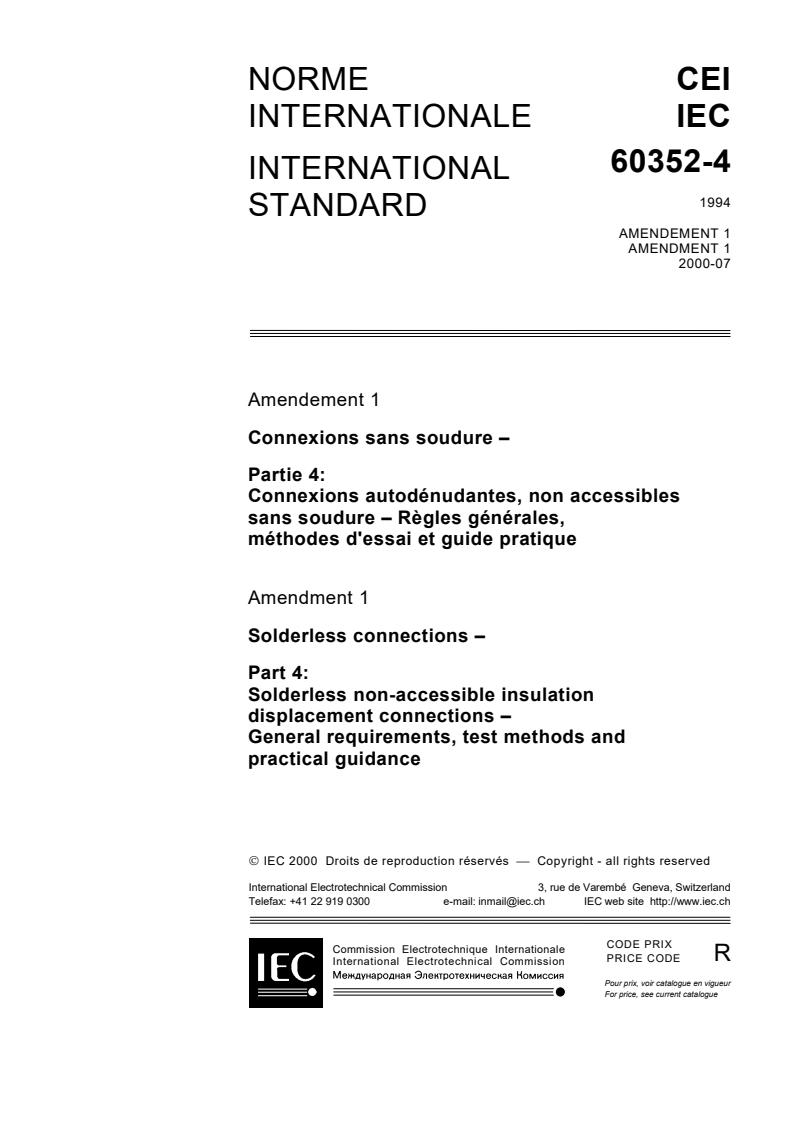
(Amendment)Amendment 1 - Solderless connections - Part 4: Solderless non-accessible insulation displacement connections - General requirements, test methods and practical guidance
General Information
- Abstract
- Status
- Published
- Publication Date
- 30-Jul-2000
- Technical Committee
- SC 48B - Electrical connectors
- Drafting Committee
- WG 6 - TC 48/SC 48B/WG 6
- Current Stage
- DELPUB - Deleted Publication
- Start Date
- 11-Jun-2020
- Completion Date
- 28-Aug-2026
Buy Documents
IEC 60352-4:1994/AMD1:2000 - Amendment 1 - Solderless connections - Part 4: Solderless non-accessible insulation displacement connections - General requirements, test methods and practical guidance
IEC 60352-4:1994/AMD1:2000 - Amendment 1 - Solderless connections - Part 4: Solderless non-accessible insulation displacement connections - General requirements, test methods and practical guidance
Overview
IEC 60352-4:1994/AMD1:2000 is an essential international standard published by the International Electrotechnical Commission (IEC) focusing on solderless connections, specifically Part 4, which addresses solderless non-accessible insulation displacement (ID) connections. This amendment provides updated general requirements, test methods, and practical guidance for manufacturers and engineers working with ID connections that are not accessible after assembly. It supports the development and validation of reliable, permanent electrical connections without solder, emphasizing durability and environmental considerations.
Key Topics
Scope of Connections: This standard covers insulation displacement connections made by specially designed insertion tools on insulated copper conductors, including solid and stranded types. It underlines that conductors made from other materials like aluminum require manufacturer-specific approvals due to differing contact and tooling requirements.
General Requirements: The amendment refines definitions and specifications for non-accessible ID connections, promoting consistent quality and performance through controlled manufacturing processes.
Test Methods: The document prescribes comprehensive test schedules (basic and full test programs), including:
- Visual and dimensional inspection of contacts and wires
- Contact resistance measurement
- Mechanical endurance via repeated connection and disconnection cycles
- Wire bending tests
- Corrosion testing, notably the flowing mixed gas corrosion test (IEC 60512-11-7 test 11g), simulating industrial atmosphere exposure
- Climatic exposure and rapid temperature variation evaluations
- Microsection analyses for structural integrity
Practical Guidance: The guide elaborates on tool selection, contact design, wire characteristics, and connector housing types (open and closed designs), aiming to optimize connection performance and assembly reliability.
Environmental Considerations: Aligning with IEC Guide 109, the amendment highlights the importance of minimizing environmental impact throughout the product lifecycle. It acknowledges the presence of materials with negative ecological effects, signaling their eventual replacement as technological alternatives become available.
Applications
IEC 60352-4:1994/AMD1:2000 supports numerous practical use cases, including:
Electromechanical Equipment Manufacturing: Ensuring high-quality, permanent connections in electronic assemblies without solder, improving production speed and reliability.
Connector Design and Testing: Assisting manufacturers in developing connectors with non-accessible ID terminations that meet stringent quality and environmental criteria.
Quality Assurance in Electronics Assembly: Facilitating robust testing programs to confirm connection integrity under mechanical and climatic stresses, critical for mission-critical electronic systems.
Environmental Compliance: Guiding product development teams in selecting materials and processes that reduce environmental impact without compromising connection performance.
Standardized Communication: Providing a globally recognized framework for suppliers, manufacturers, and certifiers to discuss and verify solderless ID connections consistently.
Related Standards
IEC Guide 109:1995 – Environmental aspects related to electrotechnical product standards, promoting eco-friendly design and manufacturing.
IEC 60512-11-7:1996 – Electromechanical components testing procedures, including climatic tests and corrosion assessments like the flowing mixed gas test (Test 11g).
IEC 60352 Series – Broader overarching standards on solderless connections, covering various types of termination techniques beyond insulation displacement.
Keywords: IEC 60352-4 amendment, solderless connections, insulation displacement connections, ID connections, electromechanical connectors, connection testing methods, non-accessible terminations, environmental impact, flowing mixed gas corrosion test, electronic assembly standards, practical guidance on ID contacts, connector quality assurance.
Relations
- Effective Date
- 05-Sep-2023
Buy Documents
IEC 60352-4:1994/AMD1:2000 - Amendment 1 - Solderless connections - Part 4: Solderless non-accessible insulation displacement connections - General requirements, test methods and practical guidance
IEC 60352-4:1994/AMD1:2000 - Amendment 1 - Solderless connections - Part 4: Solderless non-accessible insulation displacement connections - General requirements, test methods and practical guidance
Get Certified
Connect with accredited certification bodies for this standard

IMQ S.p.A. (Certification)
Italian electrical product certification.

SLG Prüf- und Zertifizierungs GmbH
German testing and certification body.

UL Solutions
Global safety science company with testing, inspection and certification.
Sponsored listings
Frequently Asked Questions
IEC 60352-4:1994/AMD1:2000 is a standard published by the International Electrotechnical Commission (IEC). Its full title is "Amendment 1 - Solderless connections - Part 4: Solderless non-accessible insulation displacement connections - General requirements, test methods and practical guidance". This standard covers: Amendment 1 - Solderless connections - Part 4: Solderless non-accessible insulation displacement connections - General requirements, test methods and practical guidance
Amendment 1 - Solderless connections - Part 4: Solderless non-accessible insulation displacement connections - General requirements, test methods and practical guidance
IEC 60352-4:1994/AMD1:2000 is classified under the following ICS (International Classification for Standards) categories: 29.120.20 - Connecting devices. The ICS classification helps identify the subject area and facilitates finding related standards.
IEC 60352-4:1994/AMD1:2000 has the following relationships with other standards: It is inter standard links to IEC 60352-4:2020. Understanding these relationships helps ensure you are using the most current and applicable version of the standard.
IEC 60352-4:1994/AMD1:2000 is available in PDF format for immediate download after purchase. The document can be added to your cart and obtained through the secure checkout process. Digital delivery ensures instant access to the complete standard document.
Standards Content (Sample)
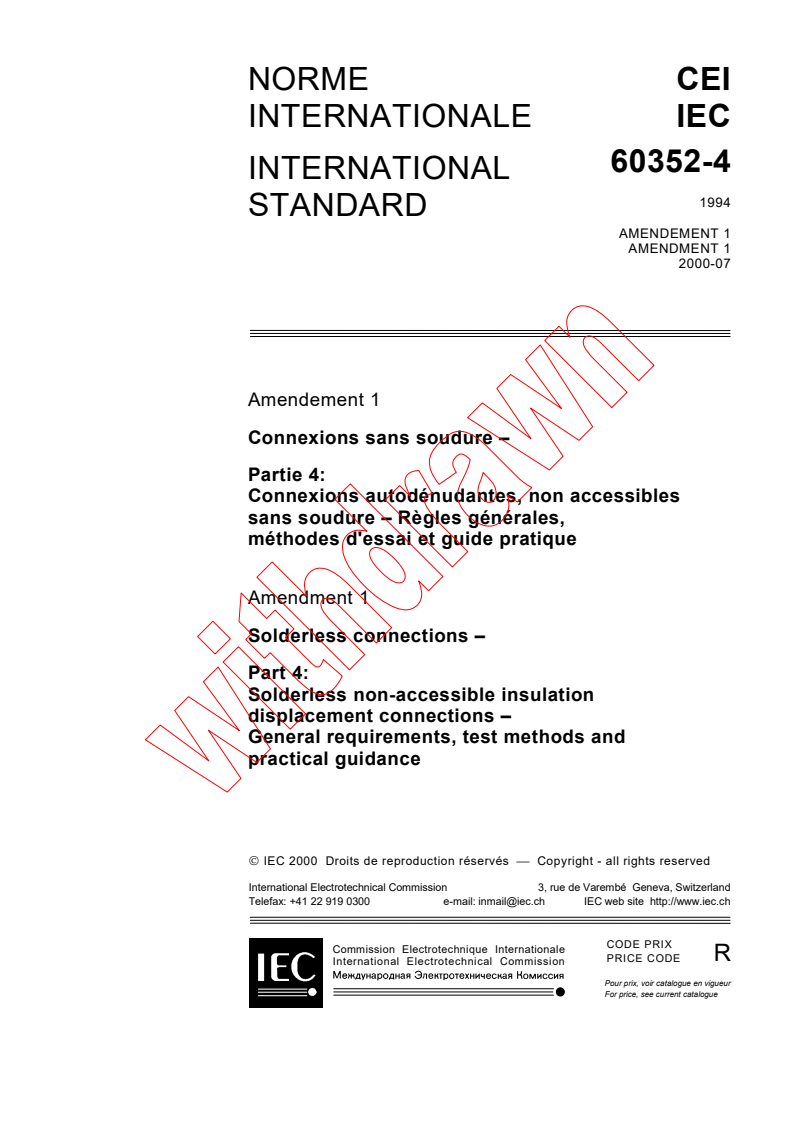
NORME CEI
INTERNATIONALE IEC
60352-4
INTERNATIONAL
STANDARD
AMENDEMENT 1
AMENDMENT 1
2000-07
Amendement 1
Connexions sans soudure –
Partie 4:
Connexions autodénudantes, non accessibles
sans soudure – Règles générales,
méthodes d'essai et guide pratique
Amendment 1
Solderless connections –
Part 4:
Solderless non-accessible insulation
displacement connections –
General requirements, test methods and
practical guidance
IEC 2000 Droits de reproduction réservés Copyright - all rights reserved
International Electrotechnical Commission 3, rue de Varembé Geneva, Switzerland
Telefax: +41 22 919 0300 e-mail: inmail@iec.ch IEC web site http://www.iec.ch
CODE PRIX
Commission Electrotechnique Internationale
R
PRICE CODE
International Electrotechnical Commission
Pour prix, voir catalogue en vigueur
For price, see current catalogue
– 2 – 60352-4 amend. 1 © CEI:2000
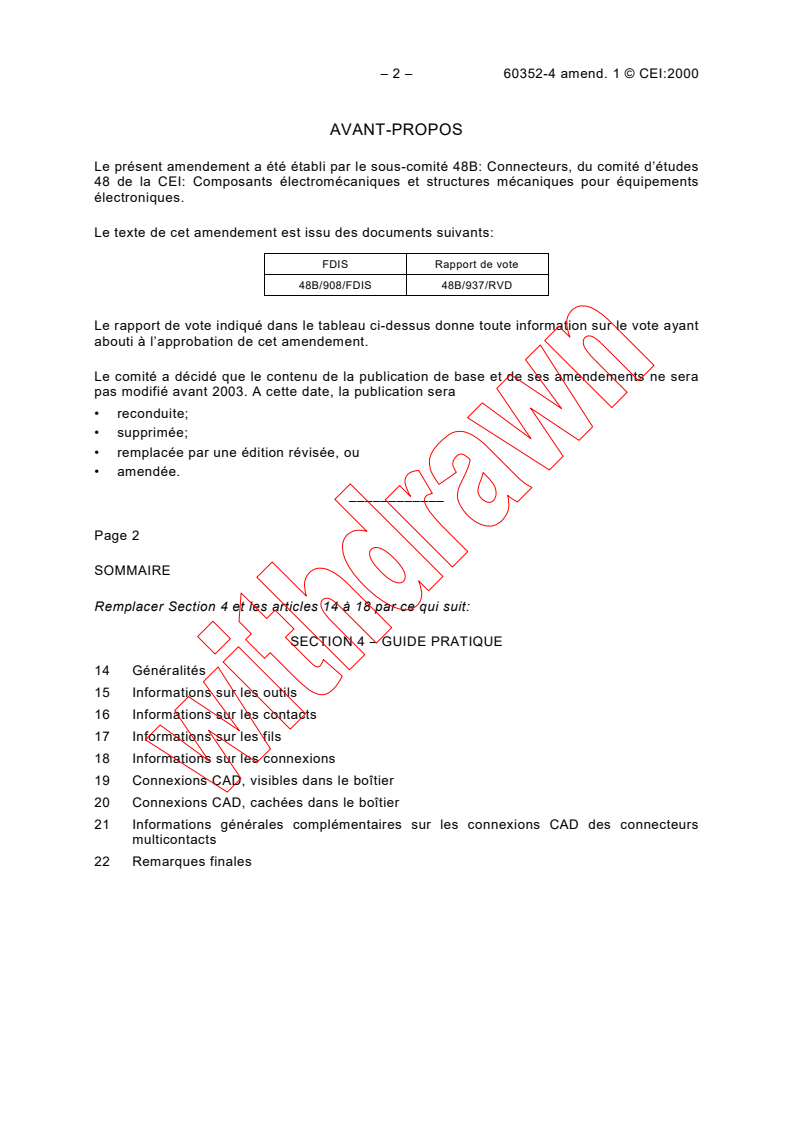
AVANT-PROPOS
Le présent amendement a été établi par le sous-comité 48B: Connecteurs, du comité d’études
48 de la CEI: Composants électromécaniques et structures mécaniques pour équipements
électroniques.
Le texte de cet amendement est issu des documents suivants:
FDIS Rapport de vote
48B/908/FDIS 48B/937/RVD
Le rapport de vote indiqué dans le tableau ci-dessus donne toute information sur le vote ayant
abouti à l’approbation de cet amendement.
Le comité a décidé que le contenu de la publication de base et de ses amendements ne sera
pas modifié avant 2003. A cette date, la publication sera
reconduite;
supprimée;
remplacée par une édition révisée, ou
amendée.
––––––––––––
Page 2
SOMMAIRE
Remplacer Section 4 et les articles 14 à 18 par ce qui suit:
SECTION 4 – GUIDE PRATIQUE
14 Généralités
15 Informations sur les outils
16 Informations sur les contacts
17 Informations sur les fils
18 Informations sur les connexions
19 Connexions CAD, visibles dans le boîtier
20 Connexions CAD, cachées dans le boîtier
21 Informations générales complémentaires sur les connexions CAD des connecteurs
multicontacts
22 Remarques finales
60352-4 Amend. 1 © IEC:2000 – 3 –
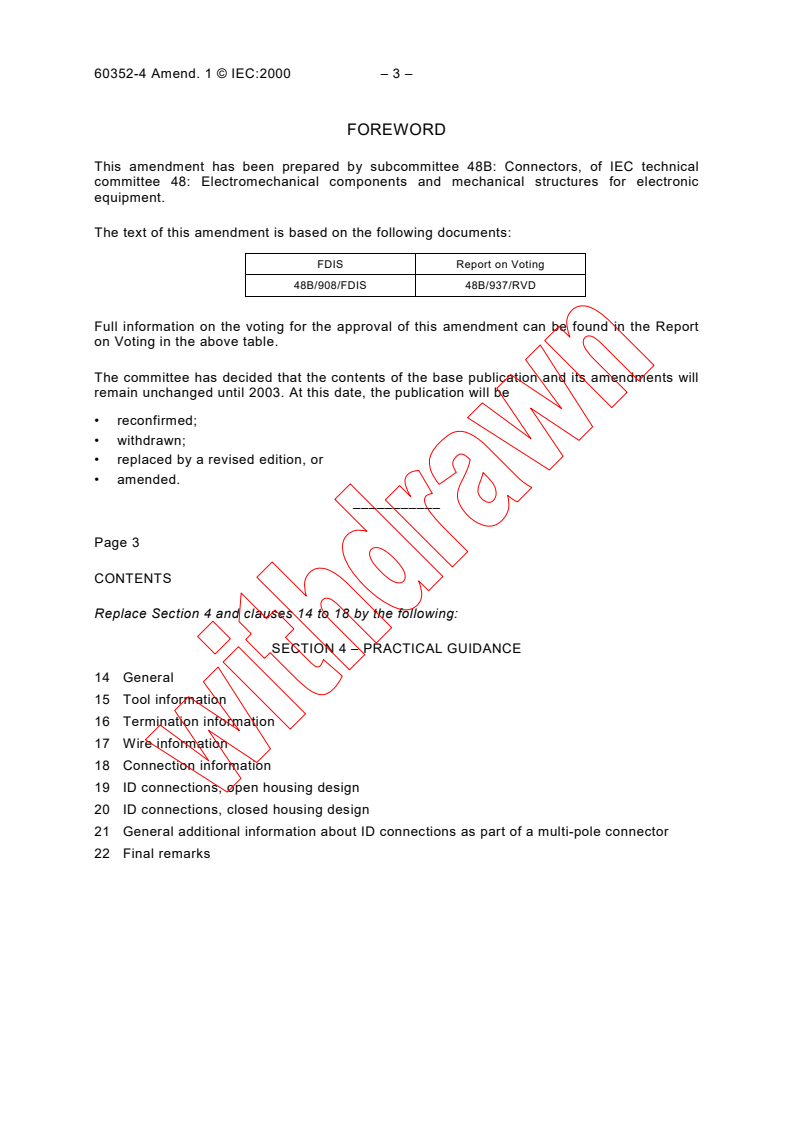
FOREWORD
This amendment has been prepared by subcommittee 48B: Connectors, of IEC technical
committee 48: Electromechanical components and mechanical structures for electronic
equipment.
The text of this amendment is based on the following documents:
FDIS Report on Voting
48B/908/FDIS 48B/937/RVD
Full information on the voting for the approval of this amendment can be found in the Report
on Voting in the above table.
The committee has decided that the contents of the base publication and its amendments will
remain unchanged until 2003. At this date, the publication will be
reconfirmed;
withdrawn;
replaced by a revised edition, or
amended.
–––––––––––
Page 3
CONTENTS
Replace Section 4 and clauses 14 to 18 by the following:
SECTION 4 – PRACTICAL GUIDANCE
14 General
15 Tool information
16 Termination information
17 Wire information
18 Connection information
19 ID connections, open housing design
20 ID connections, closed housing design
21 General additional information about ID connections as part of a multi-pole connector
22 Final remarks
– 4 – 60352-4 amend. 1 © CEI:2000
Page 8
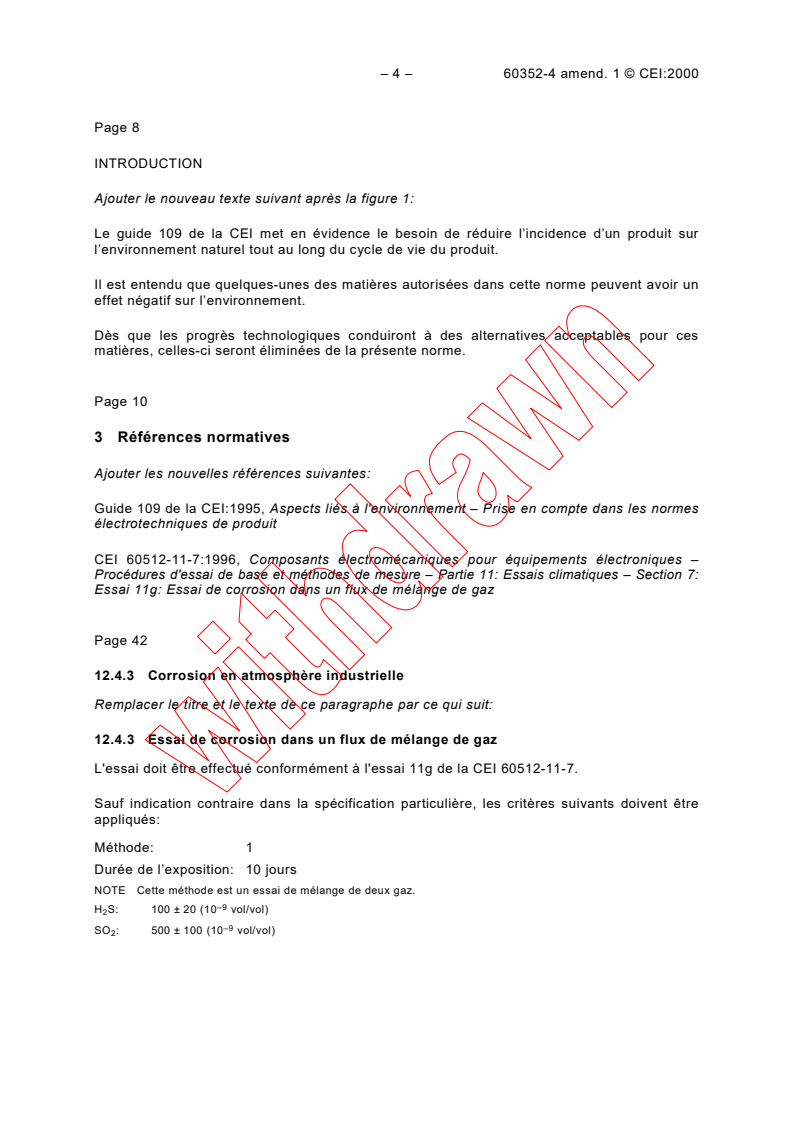
INTRODUCTION
Ajouter le nouveau texte suivant après la figure 1:
Le guide 109 de la CEI met en évidence le besoin de réduire l’incidence d’un produit sur
l’environnement naturel tout au long du cycle de vie du produit.
Il est entendu que quelques-unes des matières autorisées dans cette norme peuvent avoir un
effet négatif sur l’environnement.
Dès que les progrès technologiques conduiront à des alternatives acceptables pour ces
matières, celles-ci seront éliminées de la présente norme.
Page 10
3 Références normatives
Ajouter les nouvelles références suivantes:
Guide 109 de la CEI:1995, Aspects liés à l'environnement – Prise en compte dans les normes
électrotechniques de produit
CEI 60512-11-7:1996, Composants électromécaniques pour équipements électroniques –
Procédures d'essai de base et méthodes de mesure – Partie 11: Essais climatiques – Section 7:
Essai 11g: Essai de corrosion dans un flux de mélange de gaz
Page 42
12.4.3 Corrosion en atmosphère industrielle
Remplacer le titre et le texte de ce paragraphe par ce qui suit:
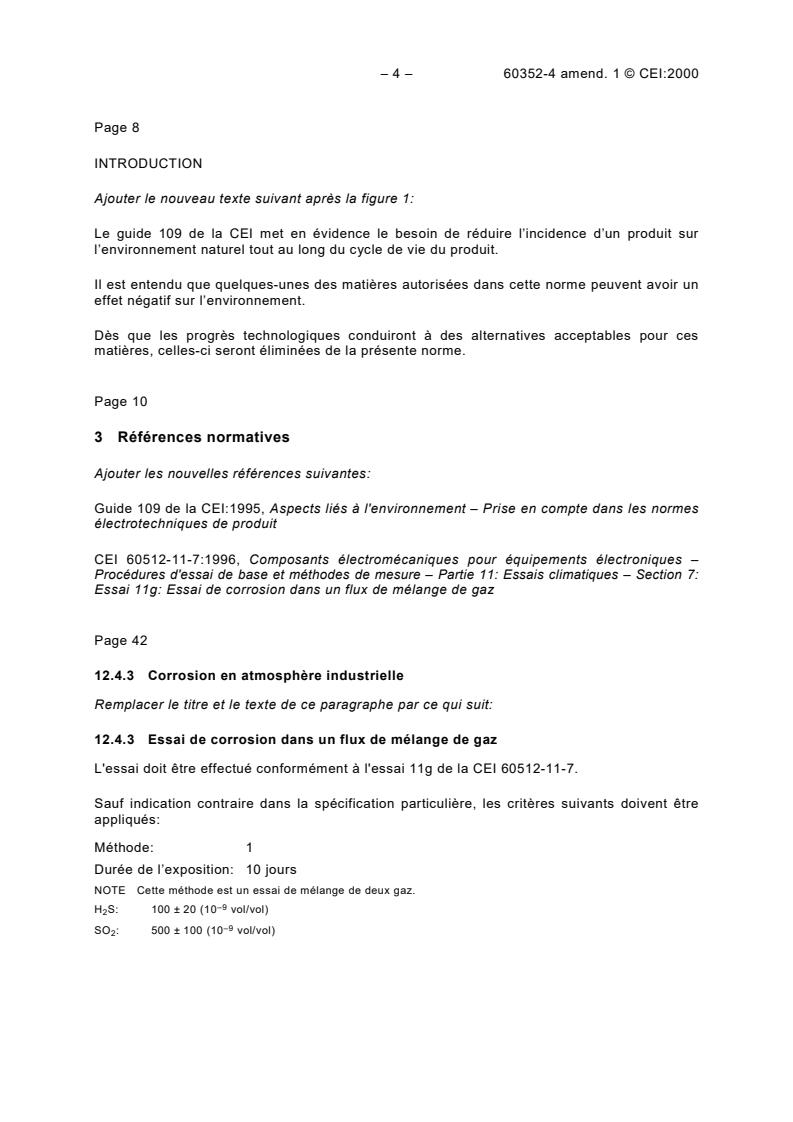
12.4.3 Essai de corrosion dans un flux de mélange de gaz
L'essai doit être effectué conformément à l'essai 11g de la CEI 60512-11-7.
Sauf indication contraire dans la spécification particulière, les critères suivants doivent être
appliqués:
Méthode: 1
Durée de l’exposition: 10 jours
NOTE Cette méthode est un essai de mélange de deux gaz.
–9
H S: 100 ± 20 (10 vol/vol)
–9
SO : 500 ± 100 (10 vol/vol)
60352-4 Amend. 1 © IEC:2000 – 5 –
Page 9
INTRODUCTION
Add, after Figure 1, the following new text:
IEC Guide 109 advocates the need to minimise the impact of a product on the natural
environment throughout the product life cycle.
It is understood that some of the materials permitted in this standard may have a negative
environmental impact.
As technological advances lead to acceptable alternatives for these materials, they will be
eliminated from the standard.
Page 11
3 Normative references
Add the following new references:
IEC Guide 109:1995, Environmental aspects – Inclusion in electrotechnical product standards
IEC 60512-11-7:1996, Electromechanical components for electronic equipment – Basic testing
procedures and measuring methods – Part 11: Climatic tests – Section 7: Test 11g: Flowing
mixed gas corrosion test
Page 43
12.4.3 Corrosion, industrial atmosphere
Replace the title and the text of this subclause by the following:
12.4.3 Flowing mixed gas, corrosion test
The test shall be carried out in accordance with test 11g of IEC 60512-11-7.
Unless otherwise specified by the detail specification, the following details shall apply:
Method: 1
Duration of exposure: 10 days
NOTE This test is a method with two mixed gases.
–9
H S: 100 ± 20 (10 vol/vol)
–9
SO : 500 ± 100 (10 vol/vol)
– 6 – 60352-4 amend. 1 © CEI:2000
Page 46
Remplacer le tableau 3 existant par le nouveau tableau 3 suivant:
Tableau 3 – Nombre de spécimens requis
Pro- Paragra- Connexions non réutilisables Connexions réutilisables
gramme phes
Pour un Pour une gamme de Pour un Pour une gamme de
d’essais
diamètre diamètres de fils diamètre diamètres de fils
de fil de fil
Maximum Minimum Maximum Minimum
seulement seulement
Programme 13.2.2.1 20 et 2 20 et 2 20 et 2 20 et 2 20 et 2 20 et 2
a a a a a a
d’essais de (optionnel) (optionnel) (optionnel) (optionnel) (optionnel) (optionnel)
base 13.2
b
2 et 2
b
13.2.2.2
2 et 2
c
c (optionnel)
(optionnel)
a a a a a a
Programme 13.3.2.1.1 2 (optionnel) 2 (optionnel) 2 (optionnel) 2 (optionnel) 2 (optionnel) 2 (optionnel)
d’essais 13.3.2.1.2 20 20 20 20 20 20
complet 13.3.2.1.3
20 20 20 20 20 20
13.3 13.3.2.1.4 20 20 20 20 20 20
b
b 40 et 2
13.3.2.2 40 et 2
c
c (optionnel)
(optionnel)
a
pour microsection
b
pour recâblage des connexions (avec le même contact, voir 12.2.3)
c
pour recâblage des connexions (avec le même contact, voir 12.2.3) et microsection
13.2.2.1 Essai des connexions CAD non accessibles des contacts réutilisables
ou non réutilisables
Remplacer la première phrase par ce qui suit:
Pour essayer les connexions CAD non réutilisables, il est requis 20 spécimens et 2 spécimens
(optionnel), et en complément, si les contacts qui admettent une gamme de diamètres de fils
doivent être essayés, 20 spécimens et 2 spécimens (optionnel).
Page 48
13.2.2.2 Essais complémentaires des connexions CAD non accessibles
des contacts réutilisables
Remplacer la première ligne par ce qui suit:
Pour essayer les connexions CAD réutilisables, il est requis en complément 2 spécimens et 2
spécimens (optionnel).
60352-4 Amend. 1 © IEC:2000 – 7 –
Page 47
Replace the existing table 3 by the following new table 3:
Table 3 – Number of specimens required
Non-reusable terminations Reusable terminations
Test For one wire For a range of wire For one wire For a range of wire
Subclause
schedule diameter diameters diameter diameters
only only
Maximum Minimum Maximum Minimum
Basic test 13.2.2.1 20 and 2 20 and 2 20 and 2 20 and 2 20 and 2 20 and 2
a a a a a a
schedule (optional) (optional) (optional) (optional) (optional) (optional)
13.2
b b
2 and 2 2 and 2
13.2.2.2
c c
(optional) (optional)
a a a a a a
Full test 13.3.2.1.1 2 (optional) 2 (optional) 2 (optional) 2 (optional) 2 (optional) 2 (optional)
schedule 13.3.2.1.2
20 20 20 20 20 20
13.3 13.3.2.1.3 20 20 20 20 20 20
13.3.2.1.4 20 20 20 20 20 20
b b
40 and 2 40 and 2
13.3.2.2
c c
(optional) (optional)
a
for microsection
b
for repeated connection (with the same termination, see 12.2.3)
c
for repeated connection (with the same termination, see 12.2.3) and microsection
13.2.2.1 Testing of non-accessible ID connections with reusable or
non-reusable terminations
Replace the first sentence by the following:
For testing non-reusable ID terminations, 20 specimens and 2 specimens (optional) are
required, and additionally, if terminations suitable for a range of wire diameters are to be
tested, 20 specimens and 2 specimens (optional).
Page 49
13.2.2.2 Additional testing of non-accessible ID connections with
reusable terminations
Replace the first line by the following:
For testing reusable ID terminations additionally 2 specimens and 2 specimens (optional) are
required.
– 8 – 60352-4 amend. 1 © CEI:2000
Page 50
13.3.2.1 Essai des connexions CAD non accessibles des contacts réutilisables
ou non réutilisables
Remplacer la première phrase par ce qui suit:
Pour essayer les connexions CAD non réutilisables, il est requis 60 spécimens et 2
spécimens (optionnel), et en complément, si les contacts qui admettent une gamme de
diamètres de fils doivent être essayés, 60 spécimens et 2 spécimens (optionnel).
Page 56
13.3.2.2 Essai complémentaire des connexions CAD non accessibles
des contacts réutilisables
Remplacer la première ligne par ce qui suit:
Pour essayer les connexions CAD réutilisables, il est requis en complément 40 spécimens et
2 spécimens (optionnel).
60352-4 Amend. 1 © IEC:2000 – 9 –
Page 51
13.3.2.1 Testing of non-accessible ID connections with reusable or
non-reusable terminations
Replace the first sentence by the following:
For testing non-reusable ID terminations, 60 specimens and 2 specimens optional are
required, and additionally, if terminations suitable for a range of wire diameters are to be
tested, 60 specimens and 2 specimens (optional).
Page 57
13.3.2.2 Additional testing of non-accessible ID-connections with
reusable terminations
Replace the first line by the following:
For testing reusable ID terminations additionally 40 specimens and 2 specimens (optional) are
required.
– 10 – 60352-4 amend. 1 © CEI:2000
Page 58
Remplacer la figure 11 existante par la nouvelle figure 11 suivante:
Examen des pièces
Examen général des contacts CAD et des fils 12.1
pour contacts CAD réutilisables ou non réutilisables
20 ou 22 kits de pièces
ou
pour contacts CAD réutilisables ou non réutilisables
2 x (20 ou 22) kits de pièces
admettant une gamme de fils
en complément
pour contacts CAD réutilisables
2 ou 4 kits de pièces
- Examen visuel essai 1a
- Examen de dimension et de masse essai 1b
Préparation des spécimens
Examen initial des connexions CAD
20 ou 22 spécimens pour contacts CAD réutilisables ou non réutilisables
ou
2 x (20 ou 22) spécimens pour contacts CAD réutilisables ou non réutilisables
admettant une gamme de fils
en complément
2 ou 4 spécimens pour contacts CAD réutilisables
- Examen visuel essai 1a
Essais
Contact CAD réutilisable
Contact CAD réutilisable
en complément
ou non réutilisable
2 spécimens ou pour
20 spécimens ou pour
2 spécimens
une gamme de fils
une gamme de fils
2 spécimens
2 x 2 spécimens (essai optionnel)
2 x 20 spécimens
(essai optionnel)
- Résistance
- Résistance
- Microsection 12.2.4
- Recâblage des
de contact 2a/2b
de contact 2a/2b
connexions 12.2.3
- Pliage du fil 12.2.1
- Recâblage des
- Microsection 12.2.4
- Variations rapides
connexions 12.2.3
de température 11d
- Résistance
- Chaleur humide
de contact 2a/2b
cyclique 11m
- Résistance
de contact 2a/2b
IEC 1552/2000
Figure 11 – Programme d’essais de base (voir 13.2)
60352-4 Amend. 1 © IEC:2000 – 11 –
Page 59
Replace the existing figure 11 by the following new figure 11:
Examination of parts
General examination of ID terminations and wires 12.1
20 or 22 sets of parts for non-reusable or reusable ID terminations
or
2 x (20 or 22) sets of parts for non-reusable or reusable ID terminations
suitable for a wire range
additionally
2 or 4 sets of parts for reusable ID terminations
- Visual examination test 1a
- Examination of dimensions and mass test 1b
Preparation of specimens
Initial examination of ID connections
20 or 22 specimens for non-reusable or reusable ID terminations
or
2 x (20 or 22) specimens for non-reusable or reusable ID terminations
suitable for a wire range
additionally
2 or 4 specimens for reusable ID terminations
- Visual examination test 1a
Testing
Non-reusable or reusable Reusable ID terminations
additionally
ID terminations
2 specimens or
20 specimens or
2 specimens
for a wire range
for a wire range 2 specimens
(optional test)
2 x 2 specimens
2 x 20 specimens
(optional test)
- Contact
- Contact
- Microsection 12.2.4
- Repeated con-
resistance 2a/2b
resistance 2a/2b
nection and
- Bending of the
- Repeated con-
disconnection 12.2.3
wire 12.2.1
nection and
- Microsection 12.2.4
- Rapid change of
disconnection 12.2.3
temperature 11d
- Contact
- Damp heat,
resistance 2a/2b
cyclic 11m
- Contact
resistance 2a/2b
IEC 1552/2000
Figure 11 – Basic test schedule (see 13.2)
– 12 – 60352-4 amend. 1 © CEI:2000
Page 60
Remplacer la figure 12 existante par la nouvelle figure 12 suivante:
Examen des pièces
Examen général des contacts CAD et des fils
12.1
pour contacts CAD réutilisables ou non réutilisables
60 ou 62 kits de pièces
ou
kits pour contacts CAD réutilisables ou non réutilisables
2 x (60 ou 62) de pièces
admettant une gamme de fils
en complément
40 ou 42 kits de pièces pour contacts CAD réutilisables
- Examen visuel essai 1a
- Examen de dimension et de masse
essai 1b
Préparation des spécimens
Examen initial des connexions CAD
62 spécimens pour contacts CAD réutilisables ou non réutilisables
ou
spécimens pour contacts CAD réutilisables ou non réutilisables
2 x (60 ou 62)
admettant une gamme de fils
en complément
40 ou 42 spécimens pour contacts CAD réutilisables
essai 1a
- Examen visuel
Essais
Contact CAD réutilisable
Contact CAD réutilisable
ou non réutilisable
en complément
- Recâblage des connexions
12.2.3
20 spécimens ou
2 spécimens ou 20 spécimens ou 20 spécimens ou
2 spécimens
20 spécimens
2 x 20 20 spécimens
2 x 2 spécimens 2 x 20 2 x 20
(essai optionnel)
a) a) a) a)
spécimens
(essai optionnel) spécimens spécimens
Groupe D
Groupe A Groupe B Groupe A Groupe C Groupe D
Groupe C
- Résistance de - Résistance de
- Résistance de - Résistance de - Résistance de
- Microsection 12.2.4 - Microsection 12.2.4
contact 2a/2b contact 2a/2b
contact 2a/2b contact 2a/2b contact 2a/2b
- Corrosion en - Flux de
- Pliage du fil 12.2.1 - Vibrations plus - Vibrations plus
atmosphère mélange de
- Charge électrique perturbation perturbation
industrielle 11g gaz 11g
et température 9b de contact 6d et 6e de contact 6d et 6e
- Résistance de - Variations rapides - Résistance de - Variations rapides - Résistance de
de température 11d de température 11d
contact 2a/2b contact 2a/2b contact 2a/2b
- Séquence - Séquence
climatique 11a climatique 11a
- Résistance de - Résistance de
contact 2a/2b contact 2a/2b
a)
Deux fois le nombre de spécimens pour une gamme de fils
IEC 1553/2000
Figure 12 – Programme d’essais complet (voir 13.3)
60352-4 Amend. 1 © IEC:2000 – 13 –
Page 61
Replace the existing figure 12 by the following new figure 12:
Examination of parts
General examination of ID terminations and wires
12.1
60 or 62 sets of parts for non-reusable or reusable ID terminations
or
2 x (60 or 62) sets of parts for non-reusable or reusable ID terminations
suitable for a wire range
additionally
40 or 42 sets of parts for reusable ID terminations
- Visual examination test 1a
- Examination of dimensions and mass
test 1b
Preparation of specimens
Initial examination of ID connections
62 specimens for non-reusable or reusable ID terminations
or
specimens
2 x (60 or 62) for non-reusable or reusable ID terminations
suitable for a wire range
additionally
40 or 42 specimens for reusable ID terminations
test 1a
- Visual examination
Testing
Non-reusable or reusable
Reusable ID terminations
ID terminations
additionally
- Repeated connection and
disconnection 12.2.3
20 specimens or
2 specimens or 20 specimens or 20 specimens or
2 specimens
20 specimens
2 x 20 20 specimens
2 x 2 specimens 2 x 20 2 x 20
(optional test)
a) a) a)
a)
specimens
(optional test) specimens specimens
Group A Group B Group D Group C
Group C Group A Group D
- Contact resis-
- Contact resis- - Contact resis- - Contact resis- - Contact resis-
- Microsection 12.2.4 - Microsection 12.2.4
tance 2a/2b
tance 2a/2b tance 2a/2b tance 2a/2b tance 2a/2b
- Bending of the - Vibration plus - Flowing mixed - Vibration plus
- Flowing mixed
contact disturb-
wire 12.2.1 gases 11g contact disturb- gases 11g
ance 6d+6e
- Electric load - Contact resis- ance 6d+ 6e - Contact resis-
and tempera- - Rapid change
tance 2a/2b - Rapid change tance 2a/2b
ture 9b of temperat ur e 11d of temperat ur e 11d
- Contact resis-
- Climatic
tance 2a/2b - Climatic
seqence 11a
sequence 11a
- Contact resis-
- Contact resis-
tance 2a/2b
tance 2a/2b
a)
Twice the number of specimens for a wire range
IEC 1553/2000
Figure 12 – Full test schedule (see 13.3)
– 14 – 60352-4 amend. 1 © CEI:2000
Page 62
SECTION 4: GUIDE PRATIQUE
Remplacer les articles existants de la section 4 pas les nouveaux articles suivants:
14 Généralités
Ce guide pratique est applicable aux connexions CAD non accessibles, réalisées sur des
conducteurs isolés, massifs ou divisés, en cuivre, et pour information seulement. Ces connexions
doivent être réalisées à l’aide d’un outil spécial pour l’insertion du fil (outil d’insertion
entièrement ou semi-automatique, ou manuel). Les conducteurs faits avec d’autres matières
(aluminium, etc.) exigent souvent des précautions spéciales en ce qui concerne les contacts
CAD et les outils d’insertion; il convient que ceux-ci soient acceptés par le fabricant.
14.1 Avantages des connexions CAD
Une connexion CAD réalisée par la technique de CAD est en général une connexion
électrique permanente entre un conducteur et un contact CAD, quelle que soit la forme. Il
existe aussi des contacts qui admettent plus d’un fil inséré dans la même fente.
De bonnes connexions électriques sont obtenues par une combinaison appropriée des outils
d’insertion, des fentes CAD, et de la section des conducteurs, et par le maintien d’une force
sur le conducteur massif ou sur les brins du conducteur.
Avantages:
– non-dénudage du fil;
– faible force d’insertion dans la fente, ce qui autorise l’insertion simultanée des fils;
– utilisation de fils discrets ou de câbles en nappe;
– méthode de réalisation efficace de connexions à chaque niveau de production;
– réalisation par machines à sertir entièrement automatiques, semi-automatiques ou à l’aide
de pinces à main;
– pas de dégradation de la caractéristique élastique des contacts CAD ou des contacts
mâles ou femelles du connecteur par la température de soudure;
– conservation de la flexibilité du conducteur au-delà de la connexion CAD;
–élimination des risques de soudure froide; pas de risque pour la santé dû aux métaux
lourds et aux vapeurs de flux, pas de brûlure, de changement de couleur et de surchauffe
de l’isolant du fil;
– bonnes connexions avec des performances mécaniques et électriques reproductibles;
– facilité du contrôle en production.
14.2 Courant limite
Le courant limite d’une connexion CAD non accessible est déterminé par le courant limite du
fil câblé ou par celui du contact CAD, selon le plus faible des deux.
Il convient de tenir compte du fait que le courant limite peut être influencé par:
– la matière du contact;
– le revêtement du contact;
– la section du conducteur;
– le revêtement du conducteur;
– le pas (espacement) du connecteur multicontact;
– le nombre de fils câblés du connecteur multicontact;
– la température ambiante.
60352-4 Amend. 1 © IEC:2000 – 15 –
Page 63
SECTION 4: PRACTICAL GUIDANCE
Replace the existing clauses of section 4 by the following new clauses:
14 General
This practical guidance is applicable for non-accessible ID connections made with insulated
stranded or solid copper conductors and is for information only. These connections shall be
produced by special wire insertion tools (fully automatic, semi-automatic or hand-operated
insertion tools). Conductors made of other materials (aluminium, etc.) often require special
actions regarding the ID-terminations and the insertion tools, which should be agreed upon by
the manufacturer.
14.1 Advantages of ID connections
An ID connection made by the ID technique is usually a permanent electrical connection
between one conductor and an ID termination of any shape. There are also terminations that
allow more than one wire insertion in the same connection slot. Good electrical connections
are achieved by exactly matching insertion tools, ID slots and conductor cross-sections and
by the maintenance of a force on the solid wire or on the conductor strands.
Advantages:
– no wire stripping;
– low insertion force into slot, which allows simultaneous insertion of wires;
– usable with ribbon cables and discrete wires;
– efficient processing of contacts at each production level;
– processing by fully automatic or semi-automatic wire insertion tool machines or with hand-
operated tools;
– no degradation of the spring characteristic of ID termination or the female or male contacts
of the connector by the soldering temperature;
– preservation of conductor flexibility behind the ID connection;
– to eliminate effects such as no cold-soldered joints, no health risk through heavy metal
and flux steam and no burnt, discoloured and overheated conductor insulations;
– good connections with reproducible electrical and mechanical values;
– easy production control.
14.2 Current-carrying capacity
The current-carrying capacity of a non-accessible ID connection is determined by the lower
value given either by the current-carrying capacity of the connected wire or by the current-
carrying capacity of the ID termination.
Consideration should be given to the fact that the current-carrying capacity can be influenced
by the
– contact material;
– surface finish of the contact;
– cross-section of the conductor;
– surface finish of the conductor;
– pitch (spacing) of a multipole connector;
– number of connected wires in a multipole connector;
– ambient temperature.
– 16 – 60352-4 amend. 1 © CEI:2000
15 Informations sur les outils
15.1 Outil d’insertion du fil
En général un outil d’insertion du fil est nécessaire pour réaliser une connexion CAD non
accessible. Si un outil est utilisé, il convient qu'il puisse accompagner le fil de chaque côté de
la fente, c’est-à-dire de part et d’autre du contact CAD, durant l’insertion du fil. Il convient que
l'outil assure aussi un bon positionnement du fil dans la fente de connexion, par exemple la
profondeur correcte du fil dans la fente. Ceci peut être réalisé par une butée de profondeur.
Le bloc de guidage associé à l’outil a une fonction importante dans l’insertion du fil (voir
15.2).
Différents types d’outils d’insertion sont utilisés, tels que:
– les outils pour insertion simultanée des fils, nécessaires pour raccorder les câbles en
nappe aux composants. Des outils particuliers sont utilisés pour les fils discrets,
permettant de peigner les fils en place avant l’insertion simultanée;
– les outils pour l’insertion individuelle de fils, pour raccorder les fils discrets aux
composants. En général, un dispositif positionne automatiquement le composant en face
de l’outil d’insertion;
– les techniques de connexion appelées «sans-outil» sont de plus en plus utilisées. Dans ce
cas, il convient d’utiliser les dispositifs d’aide à l’insertion selon les indications du
fabricant.
Les deux types d’outils peuvent être manuels ou assistés dans le cas de productions
importantes.
Informations complémentaires
a) Il est recommandé que les contacts et les outils de sertissage proviennent du même
fabricant; dans le cas contraire, l’utilisateur est responsable de la bonne fiabilité des
connexions serties.
b) Il convient que les outils fonctionnent et réalisent correctement l’insertion du ou des fils
sans endommager le contact ou le composant à câbler.
c) Afin de réaliser une connexion CAD de bonne qualité, une pince CAD doit normalement
avoir un mécanisme contrôlant le cycle d’insertion total. A la fin du cycle d’insertion total,
il convient que les poignées et les poinçons d’insertion reviennent automatiquement à la
position complètement ouverte.
Les machines à câbler entièrement automatiques et semi-automatiques réalisent le cycle
d’insertion total automatiquement.
d) Dans tous les cas, il convient que l’opération d’insertion du fil soit faite en une seule fois.
Il est recommandé d’éviter les opérations successives.
e) Il est recommandé que les pièces amovibles de l’outil, telles que les poinçons d’insertion
et les positionneurs, soient conçues de manière à ce qu’elles ne puissent s’adapter à
l’outil que de la manière correcte.
f) Il convient que les outils soient équipés d’un dispositif pour assurer le positionnement
correct des contacts CAD durant l’opération d’insertion.
g) Il est recommandé que les outils soient conçus de manière telle que seuls les réglages
nécessaires puissent être faits.
h) Il est recommandé que l’action de l’outil soit telle que les deux fentes, la fente de
connexion et la fente de support d’isolant (si elle existe), soient câblées en une seule
manoeuvre.
i) Il est recommandé que la conception de l’outil garantisse que les matrices d’un outil
particulier soient interchangeables avec celles d’autres outils de même type. Lorsque les
matrices ne sont pas interchangeables, il convient qu’elles soient marquées afin
d’identifier l’outil pour lequel elles sont conçues.
60352-4 Amend. 1 © IEC:2000 – 17 –
15 Tool information
15.1 Wire insertion tool
Generally, a wire insertion tool is required to establish a non-accessible ID connection. If a
tool is used, it should be able to act upon the wire on both sides of the connection slot, i.e. on
both sides of the ID termination, during the wire-insertion process. The tool should also
provide for a correct location of the wire in the connection slot, for example, for the correct
depth of the wire in the slot. This may be ensured by arrangement of a depth stop. The
guiding block in cooperation with the tool has an important function for the wire insertion
(see 15.2).
There are different types of wire insertion tools in use, for example:
– tools for simultaneous insertion of wires, necessary for connections between ribbon cables
and components. Specific tools are used for discrete wires, which are to be combed in
place before simultaneous insertion;
– tools for individual wire insertion for connections between discrete wires and components.
Generally a device will automatically position the component in front of the insertion tool;
– increasingly, so called "toolless" termination techniques are being used. In such cases the
manufacturer's insertion aids and instructions should be used.
Both types may be manually or power operated for mass production.
Additional information
a) Wire insertion tools and contacts with ID terminations should be delivered by the same
manufacturer, otherwise the user is responsible for a good reliable ID connection.
b) Tools should operate and correctly insert the wire(s) without damaging the termination or
the component to be connected.
c) In order to achieve a good reliable ID connection, a hand insertion tool having a full-cycle
insertion mechanism is usually necessary. On completion of the full insertion cycle, the
handles and the inserters should automatically return to the fully open position.
Fully automatic and semi-automatic wire insertion tools complete the full insertion cycle
automatically.
d) In any case, the wire insertion operation should be made in one step. Rework in additional
steps should be avoided.
e) Removable parts of the tool, such as wire inserters and location devices, should be so
designed that they can only be fitted into the tool in the correct manner.
f) Tools should be provided with means for the proper location of ID terminations and wires
during the insertion operation.
g) Tools should be so designed that only the necessary adjustments can be made.
h) The action of the tool should be such that both the wire slot and the wire insulation slot (if
any) are connected with the wire(s) in one operation.
i) The tool design should ensure that the dies for a particular tool are interchangeable with
other tools of that type. Where they are not interchangeable, they should be marked to
identify the tool for which they are suitable.
– 18 – 60352-4 amend. 1 © CEI:2000
15.2 Bloc de guidage
Un bloc de guidage, qui peut être une partie du composant, par exemple d’un connecteur,
peut être utilisé en combinaison avec l’outil d’insertion pour insérer le ou les fils ou câbles
dans les fentes de connexion. Il convient que l'outil d’insertion applique une force suffisante
au bloc de guidage. Par conception, il conv
...
NORME CEI
INTERNATIONALE IEC
60352-4
INTERNATIONAL
STANDARD
AMENDEMENT 1
AMENDMENT 1
2000-07
Amendement 1
Connexions sans soudure –
Partie 4:
Connexions autodénudantes, non accessibles
sans soudure – Règles générales,
méthodes d'essai et guide pratique
Amendment 1
Solderless connections –
Part 4:
Solderless non-accessible insulation
displacement connections –
General requirements, test methods and
practical guidance
IEC 2000 Droits de reproduction réservés Copyright - all rights reserved
International Electrotechnical Commission 3, rue de Varembé Geneva, Switzerland
Telefax: +41 22 919 0300 e-mail: inmail@iec.ch IEC web site http://www.iec.ch
CODE PRIX
Commission Electrotechnique Internationale
R
PRICE CODE
International Electrotechnical Commission
Pour prix, voir catalogue en vigueur
For price, see current catalogue
– 2 – 60352-4 amend. 1 © CEI:2000
AVANT-PROPOS
Le présent amendement a été établi par le sous-comité 48B: Connecteurs, du comité d’études
48 de la CEI: Composants électromécaniques et structures mécaniques pour équipements
électroniques.
Le texte de cet amendement est issu des documents suivants:
FDIS Rapport de vote
48B/908/FDIS 48B/937/RVD
Le rapport de vote indiqué dans le tableau ci-dessus donne toute information sur le vote ayant
abouti à l’approbation de cet amendement.
Le comité a décidé que le contenu de la publication de base et de ses amendements ne sera
pas modifié avant 2003. A cette date, la publication sera
reconduite;
supprimée;
remplacée par une édition révisée, ou
amendée.
––––––––––––
Page 2
SOMMAIRE
Remplacer Section 4 et les articles 14 à 18 par ce qui suit:
SECTION 4 – GUIDE PRATIQUE
14 Généralités
15 Informations sur les outils
16 Informations sur les contacts
17 Informations sur les fils
18 Informations sur les connexions
19 Connexions CAD, visibles dans le boîtier
20 Connexions CAD, cachées dans le boîtier
21 Informations générales complémentaires sur les connexions CAD des connecteurs
multicontacts
22 Remarques finales
60352-4 Amend. 1 © IEC:2000 – 3 –
FOREWORD
This amendment has been prepared by subcommittee 48B: Connectors, of IEC technical
committee 48: Electromechanical components and mechanical structures for electronic
equipment.
The text of this amendment is based on the following documents:
FDIS Report on Voting
48B/908/FDIS 48B/937/RVD
Full information on the voting for the approval of this amendment can be found in the Report
on Voting in the above table.
The committee has decided that the contents of the base publication and its amendments will
remain unchanged until 2003. At this date, the publication will be
reconfirmed;
withdrawn;
replaced by a revised edition, or
amended.
–––––––––––
Page 3
CONTENTS
Replace Section 4 and clauses 14 to 18 by the following:
SECTION 4 – PRACTICAL GUIDANCE
14 General
15 Tool information
16 Termination information
17 Wire information
18 Connection information
19 ID connections, open housing design
20 ID connections, closed housing design
21 General additional information about ID connections as part of a multi-pole connector
22 Final remarks
– 4 – 60352-4 amend. 1 © CEI:2000
Page 8
INTRODUCTION
Ajouter le nouveau texte suivant après la figure 1:
Le guide 109 de la CEI met en évidence le besoin de réduire l’incidence d’un produit sur
l’environnement naturel tout au long du cycle de vie du produit.
Il est entendu que quelques-unes des matières autorisées dans cette norme peuvent avoir un
effet négatif sur l’environnement.
Dès que les progrès technologiques conduiront à des alternatives acceptables pour ces
matières, celles-ci seront éliminées de la présente norme.
Page 10
3 Références normatives
Ajouter les nouvelles références suivantes:
Guide 109 de la CEI:1995, Aspects liés à l'environnement – Prise en compte dans les normes
électrotechniques de produit
CEI 60512-11-7:1996, Composants électromécaniques pour équipements électroniques –
Procédures d'essai de base et méthodes de mesure – Partie 11: Essais climatiques – Section 7:
Essai 11g: Essai de corrosion dans un flux de mélange de gaz
Page 42
12.4.3 Corrosion en atmosphère industrielle
Remplacer le titre et le texte de ce paragraphe par ce qui suit:
12.4.3 Essai de corrosion dans un flux de mélange de gaz
L'essai doit être effectué conformément à l'essai 11g de la CEI 60512-11-7.
Sauf indication contraire dans la spécification particulière, les critères suivants doivent être
appliqués:
Méthode: 1
Durée de l’exposition: 10 jours
NOTE Cette méthode est un essai de mélange de deux gaz.
–9
H S: 100 ± 20 (10 vol/vol)
–9
SO : 500 ± 100 (10 vol/vol)
60352-4 Amend. 1 © IEC:2000 – 5 –
Page 9
INTRODUCTION
Add, after Figure 1, the following new text:
IEC Guide 109 advocates the need to minimise the impact of a product on the natural
environment throughout the product life cycle.
It is understood that some of the materials permitted in this standard may have a negative
environmental impact.
As technological advances lead to acceptable alternatives for these materials, they will be
eliminated from the standard.
Page 11
3 Normative references
Add the following new references:
IEC Guide 109:1995, Environmental aspects – Inclusion in electrotechnical product standards
IEC 60512-11-7:1996, Electromechanical components for electronic equipment – Basic testing
procedures and measuring methods – Part 11: Climatic tests – Section 7: Test 11g: Flowing
mixed gas corrosion test
Page 43
12.4.3 Corrosion, industrial atmosphere
Replace the title and the text of this subclause by the following:
12.4.3 Flowing mixed gas, corrosion test
The test shall be carried out in accordance with test 11g of IEC 60512-11-7.
Unless otherwise specified by the detail specification, the following details shall apply:
Method: 1
Duration of exposure: 10 days
NOTE This test is a method with two mixed gases.
–9
H S: 100 ± 20 (10 vol/vol)
–9
SO : 500 ± 100 (10 vol/vol)
– 6 – 60352-4 amend. 1 © CEI:2000
Page 46
Remplacer le tableau 3 existant par le nouveau tableau 3 suivant:
Tableau 3 – Nombre de spécimens requis
Pro- Paragra- Connexions non réutilisables Connexions réutilisables
gramme phes
Pour un Pour une gamme de Pour un Pour une gamme de
d’essais
diamètre diamètres de fils diamètre diamètres de fils
de fil de fil
Maximum Minimum Maximum Minimum
seulement seulement
Programme 13.2.2.1 20 et 2 20 et 2 20 et 2 20 et 2 20 et 2 20 et 2
a a a a a a
d’essais de (optionnel) (optionnel) (optionnel) (optionnel) (optionnel) (optionnel)
base 13.2
b
2 et 2
b
13.2.2.2
2 et 2
c
c (optionnel)
(optionnel)
a a a a a a
Programme 13.3.2.1.1 2 (optionnel) 2 (optionnel) 2 (optionnel) 2 (optionnel) 2 (optionnel) 2 (optionnel)
d’essais 13.3.2.1.2 20 20 20 20 20 20
complet 13.3.2.1.3
20 20 20 20 20 20
13.3 13.3.2.1.4 20 20 20 20 20 20
b
b 40 et 2
13.3.2.2 40 et 2
c
c (optionnel)
(optionnel)
a
pour microsection
b
pour recâblage des connexions (avec le même contact, voir 12.2.3)
c
pour recâblage des connexions (avec le même contact, voir 12.2.3) et microsection
13.2.2.1 Essai des connexions CAD non accessibles des contacts réutilisables
ou non réutilisables
Remplacer la première phrase par ce qui suit:
Pour essayer les connexions CAD non réutilisables, il est requis 20 spécimens et 2 spécimens
(optionnel), et en complément, si les contacts qui admettent une gamme de diamètres de fils
doivent être essayés, 20 spécimens et 2 spécimens (optionnel).
Page 48
13.2.2.2 Essais complémentaires des connexions CAD non accessibles
des contacts réutilisables
Remplacer la première ligne par ce qui suit:
Pour essayer les connexions CAD réutilisables, il est requis en complément 2 spécimens et 2
spécimens (optionnel).
60352-4 Amend. 1 © IEC:2000 – 7 –
Page 47
Replace the existing table 3 by the following new table 3:
Table 3 – Number of specimens required
Non-reusable terminations Reusable terminations
Test For one wire For a range of wire For one wire For a range of wire
Subclause
schedule diameter diameters diameter diameters
only only
Maximum Minimum Maximum Minimum
Basic test 13.2.2.1 20 and 2 20 and 2 20 and 2 20 and 2 20 and 2 20 and 2
a a a a a a
schedule (optional) (optional) (optional) (optional) (optional) (optional)
13.2
b b
2 and 2 2 and 2
13.2.2.2
c c
(optional) (optional)
a a a a a a
Full test 13.3.2.1.1 2 (optional) 2 (optional) 2 (optional) 2 (optional) 2 (optional) 2 (optional)
schedule 13.3.2.1.2
20 20 20 20 20 20
13.3 13.3.2.1.3 20 20 20 20 20 20
13.3.2.1.4 20 20 20 20 20 20
b b
40 and 2 40 and 2
13.3.2.2
c c
(optional) (optional)
a
for microsection
b
for repeated connection (with the same termination, see 12.2.3)
c
for repeated connection (with the same termination, see 12.2.3) and microsection
13.2.2.1 Testing of non-accessible ID connections with reusable or
non-reusable terminations
Replace the first sentence by the following:
For testing non-reusable ID terminations, 20 specimens and 2 specimens (optional) are
required, and additionally, if terminations suitable for a range of wire diameters are to be
tested, 20 specimens and 2 specimens (optional).
Page 49
13.2.2.2 Additional testing of non-accessible ID connections with
reusable terminations
Replace the first line by the following:
For testing reusable ID terminations additionally 2 specimens and 2 specimens (optional) are
required.
– 8 – 60352-4 amend. 1 © CEI:2000
Page 50
13.3.2.1 Essai des connexions CAD non accessibles des contacts réutilisables
ou non réutilisables
Remplacer la première phrase par ce qui suit:
Pour essayer les connexions CAD non réutilisables, il est requis 60 spécimens et 2
spécimens (optionnel), et en complément, si les contacts qui admettent une gamme de
diamètres de fils doivent être essayés, 60 spécimens et 2 spécimens (optionnel).
Page 56
13.3.2.2 Essai complémentaire des connexions CAD non accessibles
des contacts réutilisables
Remplacer la première ligne par ce qui suit:
Pour essayer les connexions CAD réutilisables, il est requis en complément 40 spécimens et
2 spécimens (optionnel).
60352-4 Amend. 1 © IEC:2000 – 9 –
Page 51
13.3.2.1 Testing of non-accessible ID connections with reusable or
non-reusable terminations
Replace the first sentence by the following:
For testing non-reusable ID terminations, 60 specimens and 2 specimens optional are
required, and additionally, if terminations suitable for a range of wire diameters are to be
tested, 60 specimens and 2 specimens (optional).
Page 57
13.3.2.2 Additional testing of non-accessible ID-connections with
reusable terminations
Replace the first line by the following:
For testing reusable ID terminations additionally 40 specimens and 2 specimens (optional) are
required.
– 10 – 60352-4 amend. 1 © CEI:2000
Page 58
Remplacer la figure 11 existante par la nouvelle figure 11 suivante:
Examen des pièces
Examen général des contacts CAD et des fils 12.1
pour contacts CAD réutilisables ou non réutilisables
20 ou 22 kits de pièces
ou
pour contacts CAD réutilisables ou non réutilisables
2 x (20 ou 22) kits de pièces
admettant une gamme de fils
en complément
pour contacts CAD réutilisables
2 ou 4 kits de pièces
- Examen visuel essai 1a
- Examen de dimension et de masse essai 1b
Préparation des spécimens
Examen initial des connexions CAD
20 ou 22 spécimens pour contacts CAD réutilisables ou non réutilisables
ou
2 x (20 ou 22) spécimens pour contacts CAD réutilisables ou non réutilisables
admettant une gamme de fils
en complément
2 ou 4 spécimens pour contacts CAD réutilisables
- Examen visuel essai 1a
Essais
Contact CAD réutilisable
Contact CAD réutilisable
en complément
ou non réutilisable
2 spécimens ou pour
20 spécimens ou pour
2 spécimens
une gamme de fils
une gamme de fils
2 spécimens
2 x 2 spécimens (essai optionnel)
2 x 20 spécimens
(essai optionnel)
- Résistance
- Résistance
- Microsection 12.2.4
- Recâblage des
de contact 2a/2b
de contact 2a/2b
connexions 12.2.3
- Pliage du fil 12.2.1
- Recâblage des
- Microsection 12.2.4
- Variations rapides
connexions 12.2.3
de température 11d
- Résistance
- Chaleur humide
de contact 2a/2b
cyclique 11m
- Résistance
de contact 2a/2b
IEC 1552/2000
Figure 11 – Programme d’essais de base (voir 13.2)
60352-4 Amend. 1 © IEC:2000 – 11 –
Page 59
Replace the existing figure 11 by the following new figure 11:
Examination of parts
General examination of ID terminations and wires 12.1
20 or 22 sets of parts for non-reusable or reusable ID terminations
or
2 x (20 or 22) sets of parts for non-reusable or reusable ID terminations
suitable for a wire range
additionally
2 or 4 sets of parts for reusable ID terminations
- Visual examination test 1a
- Examination of dimensions and mass test 1b
Preparation of specimens
Initial examination of ID connections
20 or 22 specimens for non-reusable or reusable ID terminations
or
2 x (20 or 22) specimens for non-reusable or reusable ID terminations
suitable for a wire range
additionally
2 or 4 specimens for reusable ID terminations
- Visual examination test 1a
Testing
Non-reusable or reusable Reusable ID terminations
additionally
ID terminations
2 specimens or
20 specimens or
2 specimens
for a wire range
for a wire range 2 specimens
(optional test)
2 x 2 specimens
2 x 20 specimens
(optional test)
- Contact
- Contact
- Microsection 12.2.4
- Repeated con-
resistance 2a/2b
resistance 2a/2b
nection and
- Bending of the
- Repeated con-
disconnection 12.2.3
wire 12.2.1
nection and
- Microsection 12.2.4
- Rapid change of
disconnection 12.2.3
temperature 11d
- Contact
- Damp heat,
resistance 2a/2b
cyclic 11m
- Contact
resistance 2a/2b
IEC 1552/2000
Figure 11 – Basic test schedule (see 13.2)
– 12 – 60352-4 amend. 1 © CEI:2000
Page 60
Remplacer la figure 12 existante par la nouvelle figure 12 suivante:
Examen des pièces
Examen général des contacts CAD et des fils
12.1
pour contacts CAD réutilisables ou non réutilisables
60 ou 62 kits de pièces
ou
kits pour contacts CAD réutilisables ou non réutilisables
2 x (60 ou 62) de pièces
admettant une gamme de fils
en complément
40 ou 42 kits de pièces pour contacts CAD réutilisables
- Examen visuel essai 1a
- Examen de dimension et de masse
essai 1b
Préparation des spécimens
Examen initial des connexions CAD
62 spécimens pour contacts CAD réutilisables ou non réutilisables
ou
spécimens pour contacts CAD réutilisables ou non réutilisables
2 x (60 ou 62)
admettant une gamme de fils
en complément
40 ou 42 spécimens pour contacts CAD réutilisables
essai 1a
- Examen visuel
Essais
Contact CAD réutilisable
Contact CAD réutilisable
ou non réutilisable
en complément
- Recâblage des connexions
12.2.3
20 spécimens ou
2 spécimens ou 20 spécimens ou 20 spécimens ou
2 spécimens
20 spécimens
2 x 20 20 spécimens
2 x 2 spécimens 2 x 20 2 x 20
(essai optionnel)
a) a) a) a)
spécimens
(essai optionnel) spécimens spécimens
Groupe D
Groupe A Groupe B Groupe A Groupe C Groupe D
Groupe C
- Résistance de - Résistance de
- Résistance de - Résistance de - Résistance de
- Microsection 12.2.4 - Microsection 12.2.4
contact 2a/2b contact 2a/2b
contact 2a/2b contact 2a/2b contact 2a/2b
- Corrosion en - Flux de
- Pliage du fil 12.2.1 - Vibrations plus - Vibrations plus
atmosphère mélange de
- Charge électrique perturbation perturbation
industrielle 11g gaz 11g
et température 9b de contact 6d et 6e de contact 6d et 6e
- Résistance de - Variations rapides - Résistance de - Variations rapides - Résistance de
de température 11d de température 11d
contact 2a/2b contact 2a/2b contact 2a/2b
- Séquence - Séquence
climatique 11a climatique 11a
- Résistance de - Résistance de
contact 2a/2b contact 2a/2b
a)
Deux fois le nombre de spécimens pour une gamme de fils
IEC 1553/2000
Figure 12 – Programme d’essais complet (voir 13.3)
60352-4 Amend. 1 © IEC:2000 – 13 –
Page 61
Replace the existing figure 12 by the following new figure 12:
Examination of parts
General examination of ID terminations and wires
12.1
60 or 62 sets of parts for non-reusable or reusable ID terminations
or
2 x (60 or 62) sets of parts for non-reusable or reusable ID terminations
suitable for a wire range
additionally
40 or 42 sets of parts for reusable ID terminations
- Visual examination test 1a
- Examination of dimensions and mass
test 1b
Preparation of specimens
Initial examination of ID connections
62 specimens for non-reusable or reusable ID terminations
or
specimens
2 x (60 or 62) for non-reusable or reusable ID terminations
suitable for a wire range
additionally
40 or 42 specimens for reusable ID terminations
test 1a
- Visual examination
Testing
Non-reusable or reusable
Reusable ID terminations
ID terminations
additionally
- Repeated connection and
disconnection 12.2.3
20 specimens or
2 specimens or 20 specimens or 20 specimens or
2 specimens
20 specimens
2 x 20 20 specimens
2 x 2 specimens 2 x 20 2 x 20
(optional test)
a) a) a)
a)
specimens
(optional test) specimens specimens
Group A Group B Group D Group C
Group C Group A Group D
- Contact resis-
- Contact resis- - Contact resis- - Contact resis- - Contact resis-
- Microsection 12.2.4 - Microsection 12.2.4
tance 2a/2b
tance 2a/2b tance 2a/2b tance 2a/2b tance 2a/2b
- Bending of the - Vibration plus - Flowing mixed - Vibration plus
- Flowing mixed
contact disturb-
wire 12.2.1 gases 11g contact disturb- gases 11g
ance 6d+6e
- Electric load - Contact resis- ance 6d+ 6e - Contact resis-
and tempera- - Rapid change
tance 2a/2b - Rapid change tance 2a/2b
ture 9b of temperat ur e 11d of temperat ur e 11d
- Contact resis-
- Climatic
tance 2a/2b - Climatic
seqence 11a
sequence 11a
- Contact resis-
- Contact resis-
tance 2a/2b
tance 2a/2b
a)
Twice the number of specimens for a wire range
IEC 1553/2000
Figure 12 – Full test schedule (see 13.3)
– 14 – 60352-4 amend. 1 © CEI:2000
Page 62
SECTION 4: GUIDE PRATIQUE
Remplacer les articles existants de la section 4 pas les nouveaux articles suivants:
14 Généralités
Ce guide pratique est applicable aux connexions CAD non accessibles, réalisées sur des
conducteurs isolés, massifs ou divisés, en cuivre, et pour information seulement. Ces connexions
doivent être réalisées à l’aide d’un outil spécial pour l’insertion du fil (outil d’insertion
entièrement ou semi-automatique, ou manuel). Les conducteurs faits avec d’autres matières
(aluminium, etc.) exigent souvent des précautions spéciales en ce qui concerne les contacts
CAD et les outils d’insertion; il convient que ceux-ci soient acceptés par le fabricant.
14.1 Avantages des connexions CAD
Une connexion CAD réalisée par la technique de CAD est en général une connexion
électrique permanente entre un conducteur et un contact CAD, quelle que soit la forme. Il
existe aussi des contacts qui admettent plus d’un fil inséré dans la même fente.
De bonnes connexions électriques sont obtenues par une combinaison appropriée des outils
d’insertion, des fentes CAD, et de la section des conducteurs, et par le maintien d’une force
sur le conducteur massif ou sur les brins du conducteur.
Avantages:
– non-dénudage du fil;
– faible force d’insertion dans la fente, ce qui autorise l’insertion simultanée des fils;
– utilisation de fils discrets ou de câbles en nappe;
– méthode de réalisation efficace de connexions à chaque niveau de production;
– réalisation par machines à sertir entièrement automatiques, semi-automatiques ou à l’aide
de pinces à main;
– pas de dégradation de la caractéristique élastique des contacts CAD ou des contacts
mâles ou femelles du connecteur par la température de soudure;
– conservation de la flexibilité du conducteur au-delà de la connexion CAD;
–élimination des risques de soudure froide; pas de risque pour la santé dû aux métaux
lourds et aux vapeurs de flux, pas de brûlure, de changement de couleur et de surchauffe
de l’isolant du fil;
– bonnes connexions avec des performances mécaniques et électriques reproductibles;
– facilité du contrôle en production.
14.2 Courant limite
Le courant limite d’une connexion CAD non accessible est déterminé par le courant limite du
fil câblé ou par celui du contact CAD, selon le plus faible des deux.
Il convient de tenir compte du fait que le courant limite peut être influencé par:
– la matière du contact;
– le revêtement du contact;
– la section du conducteur;
– le revêtement du conducteur;
– le pas (espacement) du connecteur multicontact;
– le nombre de fils câblés du connecteur multicontact;
– la température ambiante.
60352-4 Amend. 1 © IEC:2000 – 15 –
Page 63
SECTION 4: PRACTICAL GUIDANCE
Replace the existing clauses of section 4 by the following new clauses:
14 General
This practical guidance is applicable for non-accessible ID connections made with insulated
stranded or solid copper conductors and is for information only. These connections shall be
produced by special wire insertion tools (fully automatic, semi-automatic or hand-operated
insertion tools). Conductors made of other materials (aluminium, etc.) often require special
actions regarding the ID-terminations and the insertion tools, which should be agreed upon by
the manufacturer.
14.1 Advantages of ID connections
An ID connection made by the ID technique is usually a permanent electrical connection
between one conductor and an ID termination of any shape. There are also terminations that
allow more than one wire insertion in the same connection slot. Good electrical connections
are achieved by exactly matching insertion tools, ID slots and conductor cross-sections and
by the maintenance of a force on the solid wire or on the conductor strands.
Advantages:
– no wire stripping;
– low insertion force into slot, which allows simultaneous insertion of wires;
– usable with ribbon cables and discrete wires;
– efficient processing of contacts at each production level;
– processing by fully automatic or semi-automatic wire insertion tool machines or with hand-
operated tools;
– no degradation of the spring characteristic of ID termination or the female or male contacts
of the connector by the soldering temperature;
– preservation of conductor flexibility behind the ID connection;
– to eliminate effects such as no cold-soldered joints, no health risk through heavy metal
and flux steam and no burnt, discoloured and overheated conductor insulations;
– good connections with reproducible electrical and mechanical values;
– easy production control.
14.2 Current-carrying capacity
The current-carrying capacity of a non-accessible ID connection is determined by the lower
value given either by the current-carrying capacity of the connected wire or by the current-
carrying capacity of the ID termination.
Consideration should be given to the fact that the current-carrying capacity can be influenced
by the
– contact material;
– surface finish of the contact;
– cross-section of the conductor;
– surface finish of the conductor;
– pitch (spacing) of a multipole connector;
– number of connected wires in a multipole connector;
– ambient temperature.
– 16 – 60352-4 amend. 1 © CEI:2000
15 Informations sur les outils
15.1 Outil d’insertion du fil
En général un outil d’insertion du fil est nécessaire pour réaliser une connexion CAD non
accessible. Si un outil est utilisé, il convient qu'il puisse accompagner le fil de chaque côté de
la fente, c’est-à-dire de part et d’autre du contact CAD, durant l’insertion du fil. Il convient que
l'outil assure aussi un bon positionnement du fil dans la fente de connexion, par exemple la
profondeur correcte du fil dans la fente. Ceci peut être réalisé par une butée de profondeur.
Le bloc de guidage associé à l’outil a une fonction importante dans l’insertion du fil (voir
15.2).
Différents types d’outils d’insertion sont utilisés, tels que:
– les outils pour insertion simultanée des fils, nécessaires pour raccorder les câbles en
nappe aux composants. Des outils particuliers sont utilisés pour les fils discrets,
permettant de peigner les fils en place avant l’insertion simultanée;
– les outils pour l’insertion individuelle de fils, pour raccorder les fils discrets aux
composants. En général, un dispositif positionne automatiquement le composant en face
de l’outil d’insertion;
– les techniques de connexion appelées «sans-outil» sont de plus en plus utilisées. Dans ce
cas, il convient d’utiliser les dispositifs d’aide à l’insertion selon les indications du
fabricant.
Les deux types d’outils peuvent être manuels ou assistés dans le cas de productions
importantes.
Informations complémentaires
a) Il est recommandé que les contacts et les outils de sertissage proviennent du même
fabricant; dans le cas contraire, l’utilisateur est responsable de la bonne fiabilité des
connexions serties.
b) Il convient que les outils fonctionnent et réalisent correctement l’insertion du ou des fils
sans endommager le contact ou le composant à câbler.
c) Afin de réaliser une connexion CAD de bonne qualité, une pince CAD doit normalement
avoir un mécanisme contrôlant le cycle d’insertion total. A la fin du cycle d’insertion total,
il convient que les poignées et les poinçons d’insertion reviennent automatiquement à la
position complètement ouverte.
Les machines à câbler entièrement automatiques et semi-automatiques réalisent le cycle
d’insertion total automatiquement.
d) Dans tous les cas, il convient que l’opération d’insertion du fil soit faite en une seule fois.
Il est recommandé d’éviter les opérations successives.
e) Il est recommandé que les pièces amovibles de l’outil, telles que les poinçons d’insertion
et les positionneurs, soient conçues de manière à ce qu’elles ne puissent s’adapter à
l’outil que de la manière correcte.
f) Il convient que les outils soient équipés d’un dispositif pour assurer le positionnement
correct des contacts CAD durant l’opération d’insertion.
g) Il est recommandé que les outils soient conçus de manière telle que seuls les réglages
nécessaires puissent être faits.
h) Il est recommandé que l’action de l’outil soit telle que les deux fentes, la fente de
connexion et la fente de support d’isolant (si elle existe), soient câblées en une seule
manoeuvre.
i) Il est recommandé que la conception de l’outil garantisse que les matrices d’un outil
particulier soient interchangeables avec celles d’autres outils de même type. Lorsque les
matrices ne sont pas interchangeables, il convient qu’elles soient marquées afin
d’identifier l’outil pour lequel elles sont conçues.
60352-4 Amend. 1 © IEC:2000 – 17 –
15 Tool information
15.1 Wire insertion tool
Generally, a wire insertion tool is required to establish a non-accessible ID connection. If a
tool is used, it should be able to act upon the wire on both sides of the connection slot, i.e. on
both sides of the ID termination, during the wire-insertion process. The tool should also
provide for a correct location of the wire in the connection slot, for example, for the correct
depth of the wire in the slot. This may be ensured by arrangement of a depth stop. The
guiding block in cooperation with the tool has an important function for the wire insertion
(see 15.2).
There are different types of wire insertion tools in use, for example:
– tools for simultaneous insertion of wires, necessary for connections between ribbon cables
and components. Specific tools are used for discrete wires, which are to be combed in
place before simultaneous insertion;
– tools for individual wire insertion for connections between discrete wires and components.
Generally a device will automatically position the component in front of the insertion tool;
– increasingly, so called "toolless" termination techniques are being used. In such cases the
manufacturer's insertion aids and instructions should be used.
Both types may be manually or power operated for mass production.
Additional information
a) Wire insertion tools and contacts with ID terminations should be delivered by the same
manufacturer, otherwise the user is responsible for a good reliable ID connection.
b) Tools should operate and correctly insert the wire(s) without damaging the termination or
the component to be connected.
c) In order to achieve a good reliable ID connection, a hand insertion tool having a full-cycle
insertion mechanism is usually necessary. On completion of the full insertion cycle, the
handles and the inserters should automatically return to the fully open position.
Fully automatic and semi-automatic wire insertion tools complete the full insertion cycle
automatically.
d) In any case, the wire insertion operation should be made in one step. Rework in additional
steps should be avoided.
e) Removable parts of the tool, such as wire inserters and location devices, should be so
designed that they can only be fitted into the tool in the correct manner.
f) Tools should be provided with means for the proper location of ID terminations and wires
during the insertion operation.
g) Tools should be so designed that only the necessary adjustments can be made.
h) The action of the tool should be such that both the wire slot and the wire insulation slot (if
any) are connected with the wire(s) in one operation.
i) The tool design should ensure that the dies for a particular tool are interchangeable with
other tools of that type. Where they are not interchangeable, they should be marked to
identify the tool for which they are suitable.
– 18 – 60352-4 amend. 1 © CEI:2000
15.2 Bloc de guidage
Un bloc de guidage, qui peut être une partie du composant, par exemple d’un connecteur,
peut être utilisé en combinaison avec l’outil d’insertion pour insérer le ou les fils ou câbles
dans les fentes de connexion. Il convient que l'outil d’insertion applique une force suffisante
au bloc de guidage. Par conception, il convient que le bloc de guidage participe
...