


IEC 60269-2-1:2004
(Main)Low-voltage fuses - Part 2-1: Supplementary requirements for fuses for use by authorized persons (fuses mainly for industrial application) - Sections I to VI: Examples of types of standardized fuses
General Information
- Abstract
This standard is divided into six sections, each dealing with a specific example of standardized fuse for use by authorized persons: Section I: Fuses with fuse-links with blade contacts. Section II: Fuses with fuse-links for bolted connections. Section III: Fuses with fuse-links having cylindrical contact caps. Section IV: Fuses with fuse-links with offset blade contacts. Section V: Fuses with fuse-links having "gD" and "gN" characteristics. Section VI: "gV" fuse-links with wedge tightening contacts. NOTE - The following fuse systems are standardized systems in respect to their safety aspects.
- Status
- Replaced
- Publication Date
- 20-Jun-2004
- Technical Committee
- SC 32B - Low-voltage fuses
- Current Stage
- DELPUB - Deleted Publication
- Start Date
- 01-Dec-2006
- Completion Date
- 28-Aug-2026
Buy Documents
IEC 60269-2-1:2004 - Low-voltage fuses - Part 2-1: Supplementary requirements for fuses for use by authorized persons (fuses mainly for industrial application) - Sections I to VI: Examples of types of standardized fuses Released:6/21/2004
IEC 60269-2-1:2004 - Fusibles basse tension - Partie 2-1: Regles supplémentaires pour les fusibles destinés a etre utilisés par des personnes habilitées (fusibles pour usages essentiellement industriels) - Sections I a VI: Exemples de types de fusibles normalisés Released:6/21/2004
IEC 60269-2-1:2004 - Low-voltage fuses - Part 2-1: Supplementary requirements for fuses for use by authorized persons (fuses mainly for industrial application) - Sections I to VI: Examples of types of standardized fuses Released:6/21/2004
Relations
- Effective Date
- 05-Sep-2023
- Effective Date
- 05-Sep-2023
- Effective Date
- 05-Sep-2023
- Effective Date
- 05-Sep-2023
Buy Documents
IEC 60269-2-1:2004 - Low-voltage fuses - Part 2-1: Supplementary requirements for fuses for use by authorized persons (fuses mainly for industrial application) - Sections I to VI: Examples of types of standardized fuses Released:6/21/2004
IEC 60269-2-1:2004 - Fusibles basse tension - Partie 2-1: Regles supplémentaires pour les fusibles destinés a etre utilisés par des personnes habilitées (fusibles pour usages essentiellement industriels) - Sections I a VI: Exemples de types de fusibles normalisés Released:6/21/2004
IEC 60269-2-1:2004 - Low-voltage fuses - Part 2-1: Supplementary requirements for fuses for use by authorized persons (fuses mainly for industrial application) - Sections I to VI: Examples of types of standardized fuses Released:6/21/2004
Get Certified
Connect with accredited certification bodies for this standard

IMQ S.p.A. (Certification)
Italian electrical product certification.

SLG Prüf- und Zertifizierungs GmbH
German testing and certification body.

UL Solutions
Global safety science company with testing, inspection and certification.
Sponsored listings
Frequently Asked Questions
IEC 60269-2-1:2004 is a standard published by the International Electrotechnical Commission (IEC). Its full title is "Low-voltage fuses - Part 2-1: Supplementary requirements for fuses for use by authorized persons (fuses mainly for industrial application) - Sections I to VI: Examples of types of standardized fuses". This standard covers: This standard is divided into six sections, each dealing with a specific example of standardized fuse for use by authorized persons: Section I: Fuses with fuse-links with blade contacts. Section II: Fuses with fuse-links for bolted connections. Section III: Fuses with fuse-links having cylindrical contact caps. Section IV: Fuses with fuse-links with offset blade contacts. Section V: Fuses with fuse-links having "gD" and "gN" characteristics. Section VI: "gV" fuse-links with wedge tightening contacts. NOTE - The following fuse systems are standardized systems in respect to their safety aspects.
This standard is divided into six sections, each dealing with a specific example of standardized fuse for use by authorized persons: Section I: Fuses with fuse-links with blade contacts. Section II: Fuses with fuse-links for bolted connections. Section III: Fuses with fuse-links having cylindrical contact caps. Section IV: Fuses with fuse-links with offset blade contacts. Section V: Fuses with fuse-links having "gD" and "gN" characteristics. Section VI: "gV" fuse-links with wedge tightening contacts. NOTE - The following fuse systems are standardized systems in respect to their safety aspects.
IEC 60269-2-1:2004 is classified under the following ICS (International Classification for Standards) categories: 29.120.50 - Fuses and other overcurrent protection devices. The ICS classification helps identify the subject area and facilitates finding related standards.
IEC 60269-2-1:2004 has the following relationships with other standards: It is inter standard links to IEC 60269-2:2006, IEC 60269-2-1:1998, IEC 60269-2-1:1998/AMD2:2002, IEC 60269-2-1:1998/AMD1:1999. Understanding these relationships helps ensure you are using the most current and applicable version of the standard.
IEC 60269-2-1:2004 is available in PDF format for immediate download after purchase. The document can be added to your cart and obtained through the secure checkout process. Digital delivery ensures instant access to the complete standard document.
Standards Content (Sample)
INTERNATIONAL IEC
STANDARD 60269-2-1
Fourth edition
2004-06
Low-voltage fuses –
Part 2-1:
Supplementary requirements for fuses
for use by authorized persons
(fuses mainly for industrial application) –
Sections I to VI: Examples of types of
standardized fuses
This English-language version is derived from the original
bilingual publication by leaving out all French-language
pages. Missing page numbers correspond to the French-
language pages.
Reference number
Publication numbering
As from 1 January 1997 all IEC publications are issued with a designation in the
60000 series. For example, IEC 34-1 is now referred to as IEC 60034-1.
Consolidated editions
The IEC is now publishing consolidated versions of its publications. For example,
edition numbers 1.0, 1.1 and 1.2 refer, respectively, to the base publication, the
base publication incorporating amendment 1 and the base publication incorporating
amendments 1 and 2.
Further information on IEC publications
The technical content of IEC publications is kept under constant review by the IEC,
thus ensuring that the content reflects current technology. Information relating to
this publication, including its validity, is available in the IEC Catalogue of
publications (see below) in addition to new editions, amendments and corrigenda.
Information on the subjects under consideration and work in progress undertaken
by the technical committee which has prepared this publication, as well as the list
of publications issued, is also available from the following:
• IEC Web Site (www.iec.ch)
• Catalogue of IEC publications
The on-line catalogue on the IEC web site (http://www.iec.ch/searchpub/cur_fut.htm)
enables you to search by a variety of criteria including text searches, technical
committees and date of publication. On-line information is also available on
recently issued publications, withdrawn and replaced publications, as well as
corrigenda.
• IEC Just Published
This summary of recently issued publications (http://www.iec.ch/online_news/
justpub/jp_entry.htm) is also available by email. Please contact the Customer
Service Centre (see below) for further information.
• Customer Service Centre
If you have any questions regarding this publication or need further assistance,
please contact the Customer Service Centre:
Email: custserv@iec.ch
Tel: +41 22 919 02 11
Fax: +41 22 919 03 00
INTERNATIONAL IEC
STANDARD 60269-2-1
Fourth edition
2004-06
Low-voltage fuses –
Part 2-1:
Supplementary requirements for fuses
for use by authorized persons
(fuses mainly for industrial application) –
Sections I to VI: Examples of types of
standardized fuses
IEC 2004 Copyright - all rights reserved
No part of this publication may be reproduced or utilized in any form or by any means, electronic or mechanical,
including photocopying and microfilm, without permission in writing from the publisher.
International Electrotechnical Commission, 3, rue de Varembé, PO Box 131, CH-1211 Geneva 20, Switzerland
Telephone: +41 22 919 02 11 Telefax: +41 22 919 03 00 E-mail: inmail@iec.ch Web: www.iec.ch
PRICE CODE
XG
Commission Electrotechnique Internationale
International Electrotechnical Commission
МеждународнаяЭлектротехническаяКомиссия
For price, see current catalogue
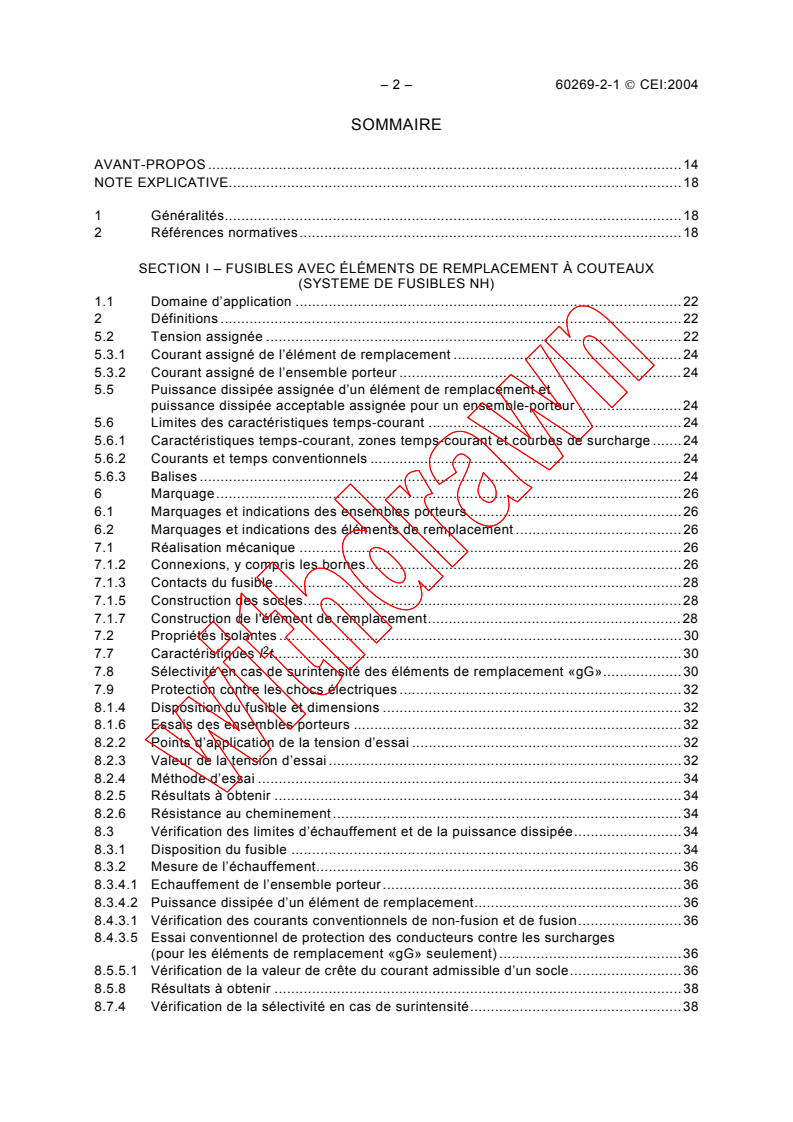
60269-2-1 IEC:2004 – 3 –
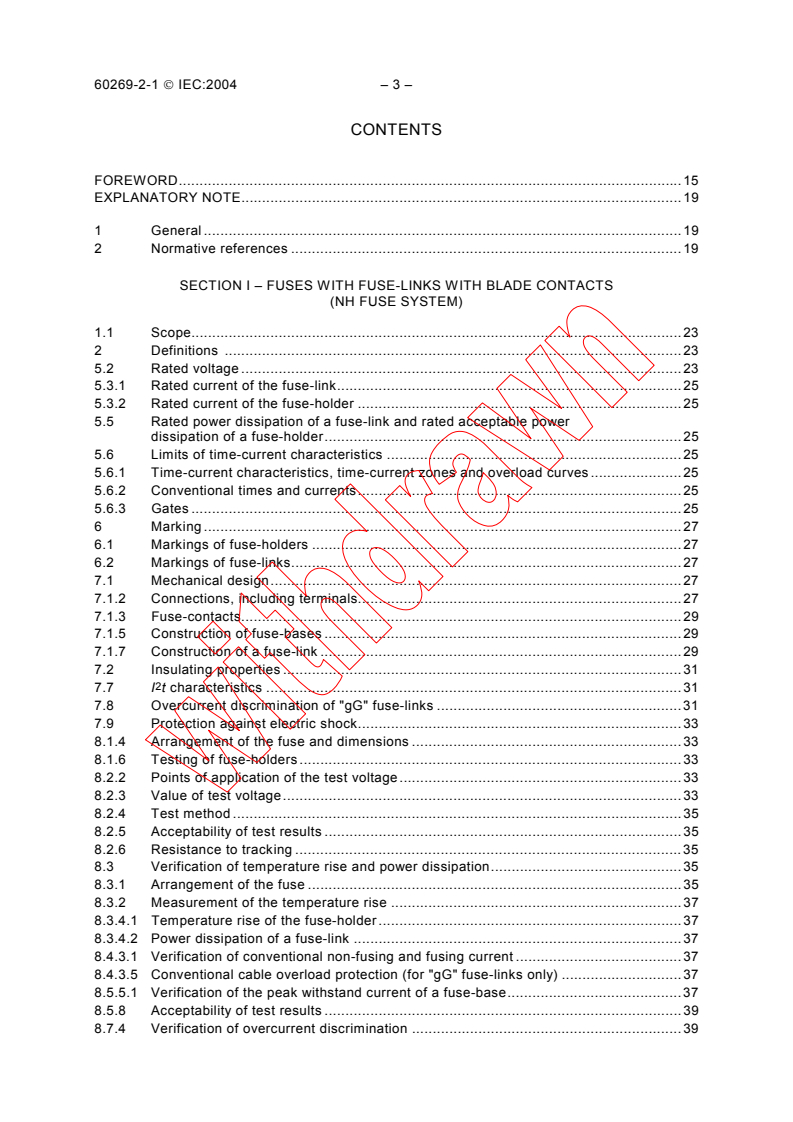
CONTENTS
FOREWORD.15
EXPLANATORY NOTE.19
1 General.19
2 Normative references.19
SECTION I – FUSES WITH FUSE-LINKS WITH BLADE CONTACTS
(NH FUSE SYSTEM)
1.1 Scope.23
2 Definitions .23
5.2 Rated voltage.23
5.3.1 Rated current of the fuse-link.25
5.3.2 Rated current of the fuse-holder .25
5.5 Rated power dissipation of a fuse-link and rated acceptable power
dissipation of a fuse-holder.25
5.6 Limits of time-current characteristics .25
5.6.1 Time-current characteristics, time-current zones and overload curves .25
5.6.2 Conventional times and currents.25
5.6.3 Gates.25
6 Marking.27
6.1 Markings of fuse-holders .27
6.2 Markings of fuse-links.27
7.1 Mechanical design.27
7.1.2 Connections, including terminals.27
7.1.3 Fuse-contacts.29
7.1.5 Construction of fuse-bases .29
7.1.7 Construction of a fuse-link .29
7.2 Insulating properties.31
7.7 I t characteristics .31
7.8 Overcurrent discrimination of "gG" fuse-links .31
7.9 Protection against electric shock.33
8.1.4 Arrangement of the fuse and dimensions .33
8.1.6 Testing of fuse-holders .33
8.2.2 Points of application of the test voltage.33
8.2.3 Value of test voltage.33
8.2.4 Test method.35
8.2.5 Acceptability of test results .35
8.2.6 Resistance to tracking .35
8.3 Verification of temperature rise and power dissipation.35
8.3.1 Arrangement of the fuse .35
8.3.2 Measurement of the temperature rise .37
8.3.4.1 Temperature rise of the fuse-holder .37
8.3.4.2 Power dissipation of a fuse-link .37
8.4.3.1 Verification of conventional non-fusing and fusing current .37
8.4.3.5 Conventional cable overload protection (for "gG" fuse-links only) .37
8.5.5.1 Verification of the peak withstand current of a fuse-base.37
8.5.8 Acceptability of test results .39
8.7.4 Verification of overcurrent discrimination .39
60269-2-1 IEC:2004 – 5 –
8.9 Verification of resistance to heat.43
8.9.1 Fuse-base.43
8.9.2 Fuse-links with gripping lugs of moulded material or of metal fixed in
moulded material.43
8.10 Verification of non-deterioration of contacts and direct
terminal clamps.45
8.10.1 Arrangement of the fuse .45
8.10.2 Test method.49
8.10.3 Acceptability of test results .51
8.11 Mechanical and miscellaneous tests .53
8.11.2.3 Verification of resistance to rusting .57
Figures 1(I) to 12(I) . 59 to 93
Annex A (informative) Special test for cable overload protection.95
SECTION IA – FUSES WITH STRIKER FUSE-LINKS
WITH BLADE CONTACTS (NH FUSE SYSTEM)
1.1 Scope.97
5.2 Rated voltage.97
5.3.1 Rated current of the fuse-link .97
5.3.2 Rated current of the fuse-holder.97
5.5 Rated power dissipation of a fuse-link and rated acceptable power
dissipation of a fuse-holder .97
5.6 Limits of time-current characteristics .97
6 Marking.97
7.1 Mechanical design.97
7.1.2 Connections, including terminals .99
7.1.3 Fuse-contacts.99
7.1.7 Construction of a fuse-link .99
7.7 I t characteristics.99
7.8 Overcurrent discrimination of "gG" fuse-links.99
7.9 Protection against electric shock .99
8.1.6 Testing of fuse-holders .99
8.3 Verification of temperature rise and power dissipation .99
8.4.3.6 Operation of indication devices and strikers, if any .99
8.5.5.1 Verification of the peak withstand current of a fuse-base . 101
8.7.4 Verification of overcurrent discrimination . 101
8.9.1 Fuse-base.101
8.9.1.1 Test arrangement.101
8.9.1.2 Test method.101
8.9.1.3 Acceptability of test results. 101
8.9.2.1 Test arrangement.101
8.9.2.2 Test method.101
8.9.2.3 Acceptability of test results. 101
8.11.1.2 Mechanical strength of the fuse-base . 101
8.11.1.8 Impact resistance of gripping-lugs of moulded material or of metal fixed
in moulded material. 103
8.11.2.4.1 Test method.103
Figures 1(IA) and 2(IA) . 105 to 115
60269-2-1 IEC:2004 – 7 –
SECTION IB – FUSE-RAILS (NH FUSE SYSTEM)
1.1 Scope . 117
2.1.13 Fuse-rails . 117
5.2 Rated voltage . 117
5.3.2 Rated current. 117
5.5.1 Rated power acceptance. 117
6 Markings. 117
7.1 Mechanical design . 117
7.1.2 Connections, including terminals . 117
7.2 Insulating properties . 119
8.1.6 Testing of fuse-holders . 119
8.3 Verification of temperature rise and power dissipation . 119
8.3.1 Arrangement of the fuse. 119
8.5.5.1 Verification of peak withstand current of a fuse-base . 121
8.5.5.1.1 Arrangement of the fuse. 121
8.5.5.1.2 Test method.121
8.10 Verification of non-deterioration of contacts and direct terminal clamps . 121
8.10.1 Arrangement of the fuse. 121
8.10.1.2 Direct terminal clamps . 121
8.11.1.2 Mechanical strength of the fuse-base . 121
8.11.2.4.1 Test method.121
Figures 1(IB) and 2(IB). 123 to 129
SECTION IC – FUSE-BASES FOR BUSBAR MOUNTING (40 mm-SYSTEM)
(NH FUSE SYSTEM)
1.1 Scope . 131
2.1.12 Fuse-base for 40 mm busbar mounting . 131
5.2 Rated voltage . 131
5.3.2 Rated current. 131
5.5.2 Rated power acceptance of tandem fuse-bases. 131
6 Markings. 131
7.1 Mechanical design . 131
7.1.2 Connections, including terminals . 131
7.1.5 Construction of a fuse-base for busbar mounting. 133
8.3 Verification of temperature rise and power dissipation . 133
8.3.1 Arrangement of the fuse. 133
8.3.4.1 Temperature rise of the fuse-holder . 135
8.5.5.1.1 Arrangement of the fuse. 135
8.9.1 Fuse-base . 135
8.9.1.1 Test arrangement . 135
8.9.1.3 Acceptability of test results. 135
8.10 Verification of non-deterioration of contacts and direct terminal clamps . 137
8.10.1 Arrangement of the fuse. 137
8.10.2 Test method . 137
8.11 Mechanical and miscellaneous tests. 137
8.11.1.2 Mechanical strength of the fuse-base . 137
8.11.2.4.1 Test method.137
Figures 1(IC) to 6(IC) . 139 to 151
60269-2-1 IEC:2004 – 9 –
SECTION II – FUSES WITH FUSE-LINKS FOR BOLTED CONNECTIONS
(BS BOLTED FUSE SYSTEM)
1.1 Scope.153
5.3.1 Rated current of the fuse-link. 153
5.3.2 Rated current of the fuse-holder . 153
5.5 Rated power dissipation of a fuse-link and rated acceptable power
dissipation of a fuse-holder. 153
5.6 Limits of time-current characteristics . 153
5.6.1 Time-current characteristics, time-current zones and overload curves . 153
5.6.2 Conventional times and currents. 153
5.6.3 Gates. 155
5.7.2 Rated breaking capacity . 155
7.1 Mechanical design.155
7.1.2 Connections including terminals. 155
7.9 Protection against electric shock. 155
8.3 Verification of temperature rise and power dissipation. 155
8.3.1 Arrangement of the fuse . 155
8.3.3 Measurement of the power dissipation of the fuse-link . 155
8.4 Verification of operation. 155
8.4.1 Arrangement of the fuse . 155
8.5 Verification of breaking capacity . 157
8.5.1 Arrangement of the fuse . 157
8.5.8 Acceptability of test results . 157
8.10 Verification of non-deterioration of contacts . 157
8.10.1 Arrangement of the fuse . 157
8.10.2 Test method.157
8.10.3 Acceptability of test results . 157
Figures 1(II) to 6(II) . 159 to 175
SECTION III – FUSES WITH FUSE-LINKS HAVING CYLINDRICAL CONTACT CAPS
(NF CYLINDRICAL FUSE SYSTEM)
1.1 Scope.177
5.2 Rated voltage.177
5.3.1 Rated current of the fuse-link. 177
5.3.2 Rated current of the fuse-holder . 179
5.5 Rated power dissipation of a fuse-link and rated acceptable power
dissipation of a fuse-holder. 179
5.6 Limits of time-current characteristics . 179
5.6.1 Time-current characteristics, time-current zones and overload curves . 179
5.6.2 Conventional times and currents. 181
5.6.3 Gates . 181
6 Marking.181
6.2 Marking of fuse-links . 183
7.1 Mechanical design.183
7.1.2 Connections including terminals. 183
7.7 I t characteristics . 183
7.8 Overcurrent discrimination of "gG" fuse-links . 185
7.9 Protection against electric shock. 185
60269-2-1 IEC:2004 – 11 –
8.1.6 Testing of fuse holders . 185
8.3.1 Arrangement of the fuse . 185
8.3.4.1 Temperature-rise of the fuse-holder. 185
8.3.4.2 Power dissipation of a fuse-link . 185
8.5.5.1 Verification of the peak withstand current of a fuse-base. 185
8.5.5.1.1 Arrangement of the fuse . 185
8.5.5.1.2 Test method . 185
8.5.5.1.3 Acceptability of test results . 189
8.7.4 Verification of overcurrent discrimination . 189
8.10 Verification of non-deterioration of contacts . 191
8.10.1 Arrangement of the fuse . 191
8.10.2 Test method.191
8.10.3 Acceptability of test results . 191
Figures 1(III) and 2(III) . 193 to 199
SECTION IV – FUSES WITH FUSE-LINKS WITH OFFSET BLADE CONTACTS
(BS CLIP-IN SYSTEM)
1.1 Scope.201
5.2 Rated voltage.201
5.3.1 Rated current of the fuse-link. 201
5.3.2 Rated current of the fuse-holder . 201
5.5 Rated power dissipation of a fuse-link and rated acceptable power
dissipation of a fuse-holder. 201
5.6.1 Time-current characteristics, time-current zones. 201
5.6.2 Conventional times and currents. 203
5.6.3 Gates. 203
5.7.2 Rated breaking capacity . 203
7.1 Mechanical design.203
7.1.2 Connections including terminals. 203
7.7 I t characteristics . 205
7.9 Protection against electric shock. 205
8.3.3 Measurement of the power dissipation of the fuse-link . 205
8.3.4.1 Temperature rise of the fuse-holder . 205
8.4.1 Arrangement of the fuse . 205
8.5.1 Arrangement of the fuse . 205
8.7.4 Verification of overcurrent discrimination . 207
8.10 Verification of non-deterioration of contacts . 207
8.10.1 Arrangement of the fuse . 207
8.10.2 Test method.207
8.10.3 Acceptability of test results . 207
Figures 1(IV) to 5(IV) . 209 to 217
SECTION V – FUSES WITH FUSE-LINKS HAVING "gD" AND "gN" CHARACTERISTICS
(CLASS J AND CLASS L TIME DELAY AND NON TIME DELAY FUSE TYPES)
1.1 Scope.219
5.2 Rated voltage.219
5.3.1 Rated current of the fuse-link. 219
5.3.2 Rated current of the fuse-holder . 219
5.5 Rated power dissipation of a fuse-link and rated power acceptance
of a fuse-holder . 219
5.6 Limits of the time-current characteristics. 219
5.6.1 Time-current characteristics, time-current zones. 219
60269-2-1 IEC:2004 – 13 –
5.6.2 Conventional times and currents. 219
5.6.3 Gates. 221
5.7.2 Rated breaking capacity . 221
7.1 Mechanical design.221
7.6 Cut-off current characteristics. 221
7.7 I t characteristics . 221
7.9 Protection against electric shock. 223
8.3 Verification of temperature rise and power dissipation. 223
8.3.1 Arrangement of the fuse . 223
8.3.4.1 Temperature rise of the fuse-holder . 225
8.3.4.2 Power dissipation of a fuse-link . 225
8.4 Verification of operation. 225
8.4.1 Arrangement of the fuse . 225
8.6 Verification of cut-off current characteristics . 225
8.7 Verification of I t characteristics and overcurrent discrimination . 227
8.10 Verification of non-deterioration of contacts . 229
8.10.1 Arrangement of the fuse . 229
8.10.2 Test method.229
8.10.3 Acceptability of test results . 229
8.11.2 Miscellaneous tests.229
Figures 1(V) to 6(V) . 231 to 253
SECTION VI – gU FUSE-LINKS WITH WEDGE TIGHTENING CONTACTS
1.1 Scope . 255
3.9 Discrimination of fuse-links. 255
5.2 Rated voltage. 255
5.3.1 Rated current of the fuse-link . 255
5.5 Rated power dissipation of a fuse-link . 257
5.6.1 Time-current characteristics, time-current zones. 257
5.6.2 Conventional times and currents. 257
5.6.3 Gates. 257
5.7.2 Rated breaking capacity . 257
5.8 Cut-off current and l t characteristics . 257
7.1 Mechanical design. 257
7.5 Breaking capacity. 257
7.7 I t characteristics. 259
7.8 Overcurrent discrimination of fuse-links . 259
8.1.1 Kind of tests. 259
8.3.1 Arrangement of the fuse. 259
8.3.3 Measurement of the power dissipation of the fuse-link . 261
8.4.1 Arrangement of the fuse. 261
8.4.3.3.2 Verification of gates. 261
8.5.1 Arrangement of the fuse. 261
8.5.2 Characteristics of the test circuit. 261
8.5.5 Test method. 261
8.5.8 Acceptability of test results. 263
8.7.3 Verification of compliance for fuse-links at 0,01 s . 263
8.11.2.2 Verification of resistance to abnormal heat and fire . 263
Figures 1(VI) to 4(VI) . 265 to 281
Bibliography . 283
60269-2-1 IEC:2004 – 15 –
INTERNATIONAL ELECTROTECHNICAL COMMISSION
___________
LOW-VOLTAGE FUSES –
Part 2-1: Supplementary requirements for fuses for use by
authorized persons (fuses mainly for industrial application) –
Sections I to VI: Examples of types of standardized fuses
FOREWORD
1) The International Electrotechnical Commission (IEC) is a worldwide organization for standardization comprising
all national electrotechnical committees (IEC National Committees). The object of IEC is to promote
international co-operation on all questions concerning standardization in the electrical and electronic fields. To
this end and in addition to other activities, IEC publishes International Standards, Technical Specifications,
Technical Reports, Publicly Available Specifications (PAS) and Guides (hereafter referred to as “IEC
Publication(s)”). Their preparation is entrusted to technical committees; any IEC National Committee interested
in the subject dealt with may participate in this preparatory work. International, governmental and non-
governmental organizations liaising with the IEC also participate in this preparation. IEC collaborates closely
with the International Organization for Standardization (ISO) in accordance with conditions determined by
agreement between the two organizations.
2) The formal decisions or agreements of IEC on technical matters express, as nearly as possible, an international
consensus of opinion on the relevant subjects since each technical committee has representation from all
interested IEC National Committees.
3) IEC Publications have the form of recommendations for international use and are accepted by IEC National
Committees in that sense. While all reasonable efforts are made to ensure that the technical content of IEC
Publications is accurate, IEC cannot be held responsible for the way in which they are used or for any
misinterpretation by any end user.
4) In order to promote international uniformity, IEC National Committees undertake to apply IEC Publications
transparently to the maximum extent possible in their national and regional publications. Any divergence
between any IEC Publication and the corresponding national or regional publication shall be clearly indicated in
the latter.
5) IEC provides no marking procedure to indicate its approval and cannot be rendered responsible for any
equipment declared to be in conformity with an IEC Publication.
6) All users should ensure that they have the latest edition of this publication.
7) No liability shall attach to IEC or its directors, employees, servants or agents including individual experts and
members of its technical committees and IEC National Committees for any personal injury, property damage or
other damage of any nature whatsoever, whether direct or indirect, or for costs (including legal fees) and
expenses arising out of the publication, use of, or reliance upon, this IEC Publication or any other IEC
Publications.
8) Attention is drawn to the Normative references cited in this publication. Use of the referenced publications is
indispensable for the correct application of this publication.
9) Attention is drawn to the possibility that some of the elements of this IEC Publication may be the subject of
patent rights. IEC shall not be held responsible for identifying any or all such patent rights.
International Standard IEC 60269-2-1 has been prepared by subcommittee 32B: Low-voltage
fuses, of IEC technical committee 32: Fuses.
This fourth edition of IEC 60269-2-1 cancels and replaces the third edition published in 1998,
amendment 1 (1999), and amendment 2 (2002). This edition constitutes a minor revision.
The document 32B/445/FDIS, circulated to the National Committees as amendment 3, led to
the publication of the new edition.
60269-2-1 IEC:2004 – 17 –
This edition includes the following significant technical changes with respect to the previous
edition:
• addition of a new section IB "Fuse-rails"
• addition of a new section IC "Fuse-bases for busbar mounting"
• section III rewritten to make it independent of section I
• addition of a new section VI "Fuse-links with wedge tightening contacts"
The text of this standard is based on the third edition, its amendment 1, amendment 2 and on
the following document:
FDIS Report on voting
32B/445/FDIS 32B/449/RVD
Full information on the voting for the approval of this standard can be found in the report on
voting indicated in the above table.
The committee has decided that the contents of this publication will remain unchanged until the
maintenance result date indicated on the IEC web site under "http://webstore.iec.ch" in the data
related to the specific publication. At this date, the publication will be
• reconfirmed;
• withdrawn;
• replaced by a revised edition, or
• amended.
60269-2-1 IEC:2004 – 19 –
LOW-VOLTAGE FUSES –
Part 2-1: Supplementary requirements for fuses for use by
authorized persons (fuses mainly for industrial application) –
Sections I to VI: Examples of types of standardized fuses
EXPLANATORY NOTE
In view of the fact that this standard should be read together with IEC 60269-1 and IEC 60269-2,
the numbering of its clauses and subclauses are made to correspond to these publications.
Regarding the tables, their numbering also corresponds to that of IEC 60269-1; however,
when additional tables appear they are referred to by capital letters, for example, Table A,
Table B, etc.
1 General
Fuses for use by authorized persons according to the following sections shall also comply with
all subclauses of
IEC 60269-1, Low-voltage fuses – Part 1: General requirements
IEC 60269-2, Low-voltage fuses – Part 2: Supplementary requirements for fuses for use by
authorized persons (fuses mainly for industrial applications)
This standard is divided into sections, each dealing with a specific example of standardized
fuses for use by authorized persons:
Section I: Fuses with fuse-links with blade contacts (NH fuse system)
Section IA: Fuses with striker fuse-links with blade contacts (NH fuse system)
Section IB: Fuse-rails (NH fuse system)
Section IC: Fuse-bases for busbar mounting (NH fuse system)
Section II: Fuses with fuse-links for bolted connections (BS bolted fuse system)
Section III: Fuses with fuse-links having cylindrical contact caps (NF cylindrical fuse
system)
Section IV: Fuses with fuse-links with offset blade contacts (BS clip-in fuse-system)
Section V: Fuses with fuse-links having "gD" and "gN" characteristic (Class J and class L
time delay and non time delay fuse types)
Section VI: gU fuse-links with wedge tightening contacts
2 Normative references
The following referenced documents are indispensable for the application of this document. For
dated references, only the edition cited applies. For undated references, the latest edition of
the referenced document (including any amendments) applies.
IEC 60060-1:High-voltage test techniques – Part 1: General definitions and test requirements
60269-2-1 IEC:2004 – 21 –
IEC 60112, Method for the determination of the proof and the comparative tracking indices of
solid insulating materials
IEC 60269-1, Low-voltage fuses – Part 1: General requirements
IEC 60269-2, Low-voltage fus
...
NORME CEI
INTERNATIONALE 60269-2-1
Quatrième édition
2004-06
Fusibles basse tension –
Partie 2-1:
Règles supplémentaires pour les fusibles
destinés à être utilisés par des personnes
habilitées (fusibles pour usages
essentiellement industriels) –
Sections I à VI: Exemples de types
de fusibles normalisés
Cette version française découle de la publication d’origine
bilingue dont les pages anglaises ont été supprimées.
Les numéros de page manquants sont ceux des pages
supprimées.
Numéro de référence
CEI 60269-2-1:2004(F)
Numérotation des publications
Depuis le 1er janvier 1997, les publications de la CEI sont numérotées à partir de
60000. Ainsi, la CEI 34-1 devient la CEI 60034-1.
Editions consolidées
Les versions consolidées de certaines publications de la CEI incorporant les
amendements sont disponibles. Par exemple, les numéros d’édition 1.0, 1.1 et 1.2
indiquent respectivement la publication de base, la publication de base incorporant
l’amendement 1, et la publication de base incorporant les amendements 1 et 2
Informations supplémentaires sur les publications de la CEI
Le contenu technique des publications de la CEI est constamment revu par la CEI
afin qu'il reflète l'état actuel de la technique. Des renseignements relatifs à cette
publication, y compris sa validité, sont disponibles dans le Catalogue des
publications de la CEI (voir ci-dessous) en plus des nouvelles éditions, amende-
ments et corrigenda. Des informations sur les sujets à l’étude et l’avancement des
travaux entrepris par le comité d’études qui a élaboré cette publication, ainsi que la
liste des publications parues, sont également disponibles par l’intermédiaire de:
• Site web de la CEI (www.iec.ch)
• Catalogue des publications de la CEI
Le catalogue en ligne sur le site web de la CEI (www.iec.ch/searchpub) vous permet
de faire des recherches en utilisant de nombreux critères, comprenant des
recherches textuelles, par comité d’études ou date de publication. Des informations
en ligne sont également disponibles sur les nouvelles publications, les publications
remplacées ou retirées, ainsi que sur les corrigenda.
• IEC Just Published
Ce résumé des dernières publications parues (www.iec.ch/online_news/justpub)
est aussi disponible par courrier électronique. Veuillez prendre contact avec le
Service client (voir ci-dessous) pour plus d’informations.
• Service clients
Si vous avez des questions au sujet de cette publication ou avez besoin de
renseignements supplémentaires, prenez contact avec le Service clients:
Email: custserv@iec.ch
Tél: +41 22 919 02 11
Fax: +41 22 919 03 00
NORME CEI
INTERNATIONALE 60269-2-1
Quatrième édition
2004-06
Fusibles basse tension –
Partie 2-1:
Règles supplémentaires pour les fusibles
destinés à être utilisés par des personnes
habilitées (fusibles pour usages
essentiellement industriels) –
Sections I à VI: Exemples de types
de fusibles normalisés
IEC 2004 Droits de reproduction réservés
Aucune partie de cette publication ne peut être reproduite ni utilisée sous quelque forme que ce soit et par aucun
procédé, électronique ou mécanique, y compris la photocopie et les microfilms, sans l'accord écrit de l'éditeur.
International Electrotechnical Commission, 3, rue de Varembé, PO Box 131, CH-1211 Geneva 20, Switzerland
Telephone: +41 22 919 02 11 Telefax: +41 22 919 03 00 E-mail: inmail@iec.ch Web: www.iec.ch
CODE PRIX
XG
Commission Electrotechnique Internationale
International Electrotechnical Commission
МеждународнаяЭлектротехническаяКомиссия
Pour prix, voir catalogue en vigueur
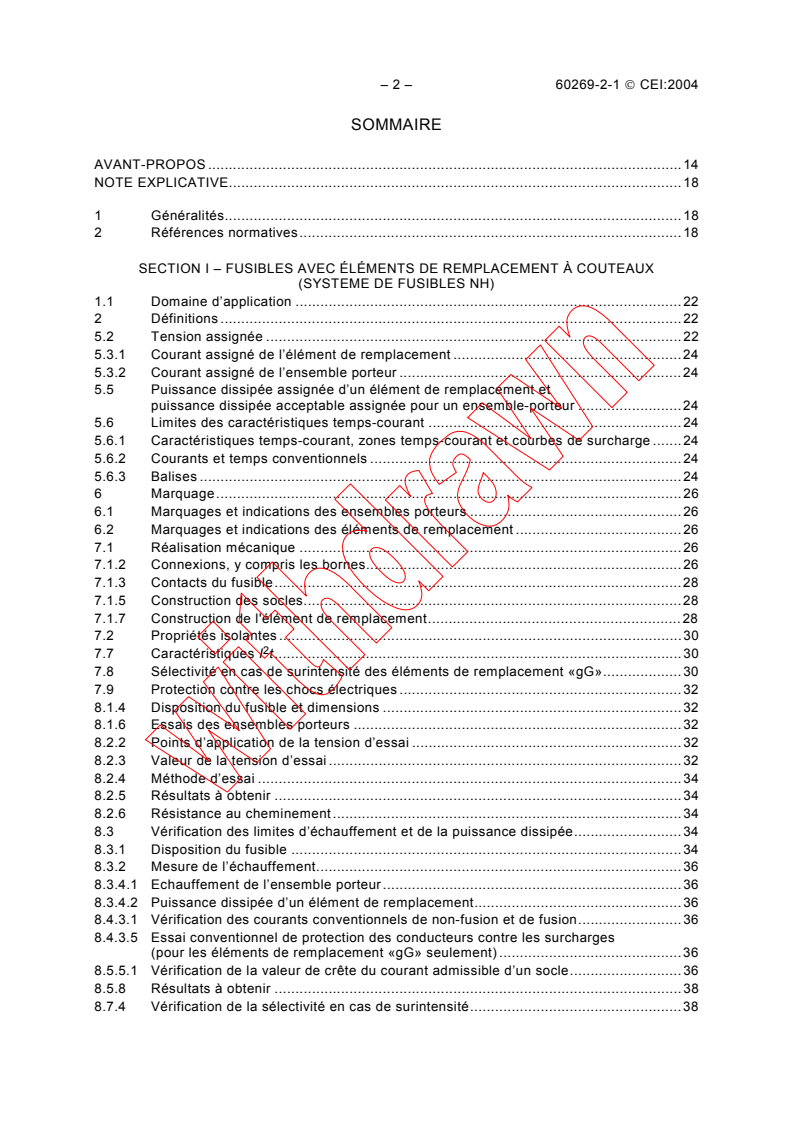
– 2 – 60269-2-1 CEI:2004
SOMMAIRE
AVANT-PROPOS .14
NOTE EXPLICATIVE.18
1 Généralités.18
2 Références normatives.18
SECTION I – FUSIBLES AVEC ÉLÉMENTS DE REMPLACEMENT À COUTEAUX
(SYSTEME DE FUSIBLES NH)
1.1 Domaine d’application.22
2 Définitions.22
5.2 Tension assignée.22
5.3.1 Courant assigné de l’élément de remplacement .24
5.3.2 Courant assigné de l’ensemble porteur .24
5.5 Puissance dissipée assignée d’un élément de remplacement et
puissance dissipée acceptable assignée pour un ensemble-porteur .24
5.6 Limites des caractéristiques temps-courant .24
5.6.1 Caractéristiques temps-courant, zones temps-courant et courbes de surcharge .24
5.6.2 Courants et temps conventionnels .24
5.6.3 Balises.24
6 Marquage.26
6.1 Marquages et indications des ensembles porteurs .26
6.2 Marquages et indications des éléments de remplacement .26
7.1 Réalisation mécanique.26
7.1.2 Connexions, y compris les bornes.26
7.1.3 Contacts du fusible.28
7.1.5 Construction des socles.28
7.1.7 Construction de l'élément de remplacement.28
7.2 Propriétés isolantes.30
7.7 Caractéristiques I t.30
7.8 Sélectivité en cas de surintensité des éléments de remplacement «gG».30
7.9 Protection contre les chocs électriques .32
8.1.4 Disposition du fusible et dimensions .32
8.1.6 Essais des ensembles porteurs .32
8.2.2 Points d’application de la tension d’essai .32
8.2.3 Valeur de la tension d’essai .32
8.2.4 Méthode d’essai.34
8.2.5 Résultats à obtenir .34
8.2.6 Résistance au cheminement.34
8.3 Vérification des limites d’échauffement et de la puissance dissipée.34
8.3.1 Disposition du fusible .34
8.3.2 Mesure de l’échauffement.36
8.3.4.1 Echauffement de l’ensemble porteur.36
8.3.4.2 Puissance dissipée d’un élément de remplacement.36
8.4.3.1 Vérification des courants conventionnels de non-fusion et de fusion.36
8.4.3.5 Essai conventionnel de protection des conducteurs contre les surcharges
(pour les éléments de remplacement «gG» seulement) .36
8.5.5.1 Vérification de la valeur de crête du courant admissible d’un socle.36
8.5.8 Résultats à obtenir .38
8.7.4 Vérification de la sélectivité en cas de surintensité.38
– 4 – 60269-2-1 CEI:2004
8.9 Vérification de la résistance à la chaleur .42
8.9.1 Socle.42
8.9.2 Eléments de remplacement avec pattes d’accrochage en matière moulée ou
en métal fixées dans de la matière moulée .42
8.10 Vérification de la non-détérioration des contacts et des organes de
serrage direct.44
8.10.1 Disposition du fusible .44
8.10.2 Méthode d’essai.48
8.10.3 Résultats à obtenir .50
8.11 Essais mécaniques et divers.52
8.11.2.3 Vérification de la résistance à la rouille .56
Figures 1(I) à 12(I) . 58 à 92
Annexe A (informative) Essai spécial de protection des conducteurs contre les surcharges .94
SECTION IA – FUSIBLES AVEC ÉLÉMENTS DE REMPLACEMENT À COUTEAUX
AVEC PERCUTEUR (SYSTÈME DE FUSIBLES NH)
1.1 Domaine d’application.96
5.2 Tension assignée.96
5.3.1 Courant assigné de l’élément de remplacement.96
5.3.2 Courant assigné de l’ensemble porteur.96
5.5 Puissance dissipée assignée d’un élément de remplacement et
puissance dissipée acceptable assignée pour un ensemble-porteur.96
5.6 Limites des caractéristiques temps-courant.96
6 Marquage.96
7.1 Réalisation mécanique.96
7.1.2 Connexions, y compris les bornes .98
7.1.3 Contacts du fusible .98
7.1.7 Construction de l’élément de remplacement .98
7.7 Caractéristiques I t .98
7.8 Sélectivité en cas de surintensité des éléments de remplacement «gG» .98
7.9 Protection contre les chocs électriques .98
8.1.6 Essais des ensembles porteurs.98
8.3 Vérification des limites d’échauffement et de la puissance dissipée .98
8.4.3.6 Fonctionnement des indicateurs de fusion et des percuteurs éventuels.98
8.5.5.1 Vérification de la valeur de crête du courant admissible d’un socle . 100
8.7.4 Vérification de la sélectivité en cas de surintensité . 100
8.9.1 Socle.100
8.9.1.1 Disposition d'essai.100
8.9.1.2 Méthode d'essai.100
8.9.1.3 Résultats à obtenir. 100
8.9.2.1 Disposition d'essai.100
8.9.2.2 Méthode d'essai.100
8.9.2.3 Résultats à obtenir. 100
8.11.1.2 Rigidité mécanique du socle. 100
8.11.1.8 Vérification de la résistance aux chocs des pattes d'accrochage en matière
moulée ou en métal fixées dans la matière moulée. 102
8.11.2.4.1 Méthode d'essai.102
Figures 1(IA) et 2(IA) .104 à 114
– 6 – 60269-2-1 CEI:2004
SECTION IB – RÉGLETTES À FUSIBLES (SYSTÈME DE FUSIBLES NH)
1.1 Domaine d’application . 116
2.1.13 Réglettes à fusibles . 116
5.2 Tension assignée . 116
5.3.2 Courant assigné . 116
5.5.1 Puissance dissipée assignée . 116
6 Marquage. 116
7.1 Réalisation mécanique . 116
7.1.2 Connexions, y compris les bornes. 116
7.2 Qualités isolantes . 118
8.1.6 Essais des ensembles porteurs . 118
8.3 Vérification des limites d’échauffement et de la puissance dissipée. 118
8.3.1 Disposition du fusible . 118
8.5.5.1 Vérification de la valeur de crête du courant admissible d’un socle . 120
8.5.5.1.1 Disposition du fusible . 120
8.5.5.1.2 Méthode d’essai.120
8.10 Vérification de la non-détérioration des contacts et des organes
de serrage direct. 120
8.10.1 Disposition du fusible . 120
8.10.1.2 Organes de serrage direct. 120
8.11.1.2 Rigidité mécanique du socle. 120
8.11.2.4.1 Méthode d’essai.120
Figures 1(IB) et 2(IB) . 122 à 128
SECTION IC – SOCLES POUR MONTAGE SUR JEU DE BARRES (ENTRAXE DE 40 mm)
(SYSTÈME DE FUSIBLES NH)
1.1 Domaine d’application.130
2.1.12 Socles pour montage sur jeu de barres d’entraxe de 40 mm . 130
5.2 Tension assignée.130
5.3.2 Courant assigné.130
5.5.2 Puissance dissipée assignée de socles associés. 130
6 Marquage.130
7.1 Réalisation mécanique.130
7.1.2 Connexions, y compris les bornes . 130
7.1.5 Construction d’un socle pour montage sur jeu de barres. 132
8.3 Vérification des limites d’échauffement et de la puissance dissipée . 132
8.3.1 Disposition du fusible . 132
8.3.4.1 Echauffement de l’ensemble porteur . 134
8.5.5.1.1 Disposition du fusible . 134
8.9.1 Socle.134
8.9.1.1 Disposition d’essai.134
8.9.1.3 Résultats à obtenir. 134
8.10 Vérification de la non-détérioration des contacts et des organes
de serrage direct. 136
8.10.1 Disposition du fusible . 136
8.10.2 Méthode d’essai.136
8.11 Essais mécaniques et divers . 136
8.11.1.2 Rigidité mécanique du socle. 136
8.11.2.4.1 Méthode d’essai.136
Figures 1(IC) à 6(IC) . 138 à 150
– 8 – 60269-2-1 CEI:2004
SECTION II – FUSIBLES AVEC ÉLÉMENTS DE REMPLACEMENT À PLATINES
(SYSTÈME DE FUSIBLES À PLATINES BS)
1.1 Domaine d’application.152
5.3.1 Courant assigné de l’élément de remplacement . 152
5.3.2 Courant assigné de l’ensemble porteur . 152
5.5 Puissance dissipée assignée d’un élément de remplacement et
puissance dissipée acceptable assignée pour un ensemble-porteur . 152
5.6 Limites des caractéristiques temps-courant . 152
5.6.1 Caractéristiques temps-courant, zones temps-courant et courbes de surcharge . 152
5.6.2 Courants et temps conventionnels . 152
5.6.3 Balises. 154
5.7.2 Pouvoir de coupure assigné. 154
7.1 Réalisation mécanique.154
7.1.2 Connexions, y compris les bornes. 154
7.9 Protection contre les chocs électriques . 154
8.3 Vérification des limites d’échauffement et puissance dissipée . 154
8.3.1 Disposition du fusible . 154
8.3.3 Mesure de la puissance dissipée de l’élément de remplacement . 154
8.4 Vérification du fonctionnement. 154
8.4.1 Disposition du fusible . 154
8.5 Vérification du pouvoir de coupure. 156
8.5.1 Disposition du fusible . 156
8.5.8 Résultats à obtenir . 156
8.10 Vérification de la non-détérioration des contacts . 156
8.10.1 Disposition du fusible . 156
8.10.2 Méthode d’essai.156
8.10.3 Résultats à obtenir . 156
Figures 1(II) à 6(II) . 158 à 174
SECTION III – FUSIBLES AVEC ÉLÉMENTS DE REMPLACEMENT À CAPSULES
CYLINDRIQUES (SYSTEME DE FUSIBLES CYLINDRIQUES NF)
1.1 Domaine d’application.176
5.2 Tension assignée.176
5.3.1 Courant assigné de l’élément de remplacement . 176
5.3.2 Courant assigné de l’ensemble porteur . 178
5.5 Puissance dissipée assignée d’un élément de remplacement et
puissance dissipée acceptable assignée pour un ensemble-porteur . 178
5.6 Limites des caractéristiques temps-courant . 178
5.6.1 Caractéristiques temps-courant, zones temps-courant et courbes de surcharge . 178
5.6.2 Courants et temps conventionnels . 180
5.6.3 Balises. 180
6 Marquage.180
6.2 Marquage des éléments de remplacement. 182
7.1 Réalisation mécanique.182
7.1.2 Connexions, y compris les bornes. 182
7.7 Caractéristiques I t. 182
7.8 Sélectivité en cas de surintensité des éléments de remplacement «gG». 184
7.9 Protection contre les chocs électriques . 184
– 10 – 60269-2-1 CEI:2004
8.1.6 Essais des ensembles porteurs . 184
8.3.1 Disposition du fusible . 184
8.3.4.1 Echauffement de l’ensemble porteur. 184
8.3.4.2 Puissance dissipée d'un élément de remplacement. 184
8.5.5.1 Vérification du courant de crête admissible d’un socle. 184
8.5.5.1.1 Disposition du fusible. 184
8.5.5.1.2 Méthode d’essai . 184
8.5.5.1.3 Résultats à obtenir. 188
8.7.4 Vérification de la sélectivité en cas de surintensité. 188
8.10 Vérification de la non-détérioration des contacts . 190
8.10.1 Disposition du fusible . 190
8.10.2 Méthode d’essai.190
8.10.3 Résultats à obtenir . 190
Figures 1(III) et 2(III) . 192 à 198
SECTION IV – FUSIBLES AVEC ÉLÉMENTS DE REMPLACEMENT À COUTEAUX
DÉPORTÉS (SYSTÈME DE FUSIBLES À PATTES D’ATTACHE BS)
1.1 Domaine d’application.200
5.2 Tension assignée.200
5.3.1 Courant assigné de l’élément de remplacement . 200
5.3.2 Courant assigné de l’ensemble porteur . 200
5.5 Puissance dissipée assignée d’un élément de remplacement et
puissance dissipée acceptable assignée pour un ensemble-porteur . 200
5.6.1 Caractéristiques temps-courant, zones temps-courant . 200
5.6.2 Courants et temps conventionnels . 202
5.6.3 Balises. 202
5.7.2 Pouvoir de coupure assigné. 202
7.1 Réalisation mécanique.202
7.1.2 Connexions y compris les bornes. 202
7.7 Caractéristiques I t. 204
7.9 Protection contre les chocs électriques . 204
8.3.3 Mesure de la puissance dissipée de l’élément de remplacement . 204
8.3.4.1 Echauffement de l’ensemble porteur. 204
8.4.1 Disposition du fusible . 204
8.5.1 Disposition du fusible . 204
8.7.4 Vérification de la sélectivité en cas de surintensités . 206
8.10 Vérification de la non-détérioration des contacts . 106
8.10.1 Disposition du fusible . 206
8.10.2 Méthode d’essai.206
8.10.3 Résultats à obtenir . 206
Figures 1(IV) à 5(IV) . 208 à 216
SECTION V – FUSIBLES DONT LES ÉLÉMENTS DE REMPLACEMENT ONT DES
CARACTÉRISTIQUES «gD» ET «gN» (TYPES DE FUSIBLES TEMPORISÉS OU NON
TEMPORISÉS DE CLASSE J ET DE CLASSE L)
1.1 Domaine d’application.218
5.2 Tension assignée.218
5.3.1 Courant assigné de l’élément de remplacement . 218
5.3.2 Courant assigné de l’ensemble porteur . 218
5.5 Puissance dissipée assignée d’un élément de remplacement et puissance
dissipable assignée pour un ensemble-porteur. 218
5.6 Limites des caractéristiques temps-courant . 218
5.6.1 Caractéristiques temps-courant, zones temps-courant . 218
– 12 – 60269-2-1 CEI:2004
5.6.2 Courants et temps conventionnels . 218
5.6.3 Balises. 220
5.7.2 Pouvoir de coupure assigné. 220
7.1 Réalisation mécanique.220
7.6 Caractéristiques d’amplitude du courant coupé . 220
7.7 Caractéristiques I t. 220
7.9 Protection contre les chocs électriques . 222
8.3 Vérification des limites d’échauffement et de la puissance dissipée. 222
8.3.1 Disposition du fusible . 222
8.3.4.1 Echauffement de l’ensemble porteur. 224
8.3.4.2 Puissance dissipée d’un élément de remplacement. 224
8.4 Vérification du fonctionnement. 224
8.4.1 Disposition du fusible . 224
8.6 Vérification de la caractéristique d’amplitude du courant coupé . 224
8.7 Vérification des caractéristiques I t et sélectivité en cas de surintensités . 226
8.10 Vérification de la non-détérioration des contacts . 228
8.10.1 Disposition du fusible . 228
8.10.2 Méthode d’essai.228
8.10.3 Résultats à obtenir . 228
8.11.2 Essais divers.228
Figures 1(V) à 6(V) . 230 à 252
SECTION VI – ÉLÉMENTS DE REMPLACEMENT gU À CONTACTS
DE SERRAGE À ENCOCHE
1.1 Domaine d’application.254
3.9 Sélectivité des éléments de remplacement . 254
5.2 Tension assignée.254
5.3.1 Courant assigné d’un élément de remplacement. 254
5.5 Puissance dissipée assignée d'un élément de remplacement. 256
5.6.1 Caractéristiques temps-courant, zones temps-courant. 256
5.6.2 Courant et temps conventionnels. 256
5.6.3 Balises.256
5.7.2 Pouvoir de coupure assigné . 256
5.8 Caractéristiques d’amplitude du courant coupé et l t . 256
7.1 Réalisation mécanique.256
7.5 Pouvoir de coupure . 256
7.7 Caractéristiques I t . 258
7.8 Sélectivité en cas de surintensité des éléments de remplacement. 258
8.1.1 Nature des essais . 258
8.3.1 Disposition du fusible . 258
8.3.3 Mesure de la puissance dissipée de l'élément de remplacement . 260
8.4.1 Disposition du fusible . 260
8.4.3.3.2 Vérification des balises . 260
8.5.1 Disposition du fusible . 260
8.5.2 Caractéristiques du circuit d’essai . 260
8.5.5 Méthode d’essai.260
8.5.8 Résultats à obtenir . 262
8.7.3 Vérification de la conformité pour les éléments de remplacement à 0,01 s . 262
8.11.2.2 Vérification de la résistance à la chaleur anormale et au feu . 262
Figures 1(VI) à 4(VI) . 264 à 280
Bibliographie .282
– 14 – 60269-2-1 CEI:2004
COMMISSION ÉLECTROTECHNIQUE INTERNATIONALE
–––––––––––
FUSIBLES BASSE TENSION –
Partie 2-1: Règles supplémentaires pour les fusibles
destinés à être utilisés par des personnes habilitées
(fusibles pour usages essentiellement industriels) –
Sections I à VI: Exemples de types de fusibles normalisés
AVANT-PROPOS
1) La Commission Electrotechnique Internationale (CEI) est une organisation mondiale de normalisation composée
de l'ensemble des comités électrotechniques nationaux (Comités nationaux de la CEI). La CEI a pour objet de
favoriser la coopération internationale pour toutes les questions de normalisation dans les domaines de
l'électricité et de l'électronique. A cet effet, la CEI – entre autres activités – publie des Normes internationales,
des Spécifications techniques, des Rapports techniques, des Spécifications accessibles au public (PAS) et des
Guides (ci-après dénommés "Publication(s) de la CEI"). Leur élaboration est confiée à des comités d'études,
aux travaux desquels tout Comité national intéressé par le sujet traité peut participer. Les organisations
internationales, gouvernementales et non gouvernementales, en liaison avec la CEI, participent également aux
travaux. La CEI collabore étroitement avec l'Organisation Internationale de Normalisation (ISO), selon des
conditions fixées par accord entre les deux organisations.
2) Les décisions ou accords officiels de la CEI concernant les questions techniques représentent, dans la mesure
du possible, un accord international sur les sujets étudiés, étant donné que les Comités nationaux de la CEI
intéressés sont représentés dans chaque comité d’études.
3) Les Publications de la CEI se présentent sous la forme de recommandations internationales et sont agréées
comme telles par les Comités nationaux de la CEI. Tous les efforts raisonnables sont entrepris afin que la CEI
s'assure de l'exactitude du contenu technique de ses publications; la CEI ne peut pas être tenue responsable de
l'éventuelle mauvaise utilisation ou interprétation qui en est faite par un quelconque utilisateur final.
4) Dans le but d'encourager l'uniformité internationale, les Comités nationaux de la CEI s'engagent, dans toute la
mesure possible, à appliquer de façon transparente les Publications de la CEI dans leurs publications
nationales et régionales. Toutes divergences entre toutes Publications de la CEI et toutes publications
nationales ou régionales correspondantes doivent être indiquées en termes clairs dans ces dernières.
5) La CEI n’a prévu aucune procédure de marquage valant indication d’approbation et n'engage pas sa
responsabilité pour les équipements déclarés conformes à une de ses Publications.
6) Tous les utilisateurs doivent s'assurer qu'ils sont en possession de la dernière édition de cette publication.
7) Aucune responsabilité ne doit être imputée à la CEI, à ses administrateurs, employés, auxiliaires ou
mandataires, y compris ses experts particuliers et les membres de ses comités d'études et des Comités
nationaux de la CEI, pour tout préjudice causé en cas de dommages corporels et matériels, ou de tout autre
dommage de quelque nature que ce soit, directe ou indirecte, ou pour supporter les coûts (y compris les frais
de justice) et les dépenses découlant de la publication ou de l'utilisation de cette Publication de la CEI ou de
toute autre Publication de la CEI, ou au crédit qui lui est accordé.
8) L'attention est attirée sur les références normatives citées dans cette publication. L'utilisation de publications
référencées est obligatoire pour une application correcte de la présente publication.
9) L’attention est attirée sur le fait que certains des éléments de la présente Publication de la CEI peuvent faire
l’objet de droits de propriété intellectuelle ou de droits analogues. La CEI ne saurait être tenue pour
responsable de ne pas avoir identifié de tels droits de propriété et de ne pas avoir signalé leur existence.
La Norme internationale CEI 60269-2-1 a été établie par le sous-comité 32B: Coupe-circuit à
fusibles à basse tension, du comité d’études 32 de la CEI: Coupe-circuit à fusibles.
Cette quatrième édition de la CEI 60269-2-1 annule et remplace la troisième édition parue en
1998, l’amendement 1 (1999) et l’amendement 2 (2002). Cette édition constitue une révision
mineure.
Le document 32B/445/FDIS, circulé comme amendement 3 auprès des Comités nationaux de
la CEI, a conduit à la publication de la nouvelle édition.
– 16 – 60269-2-1 CEI:2004
Cette édition inclut les modifications techniques majeures suivantes par rapport à l’édition
précédente :
• adjonction d’une nouvelle section IB «Réglettes à fusibles»
• adjonction d’une nouvelle section IC «Socles pour montage sur jeu de barres»
• réécriture de la section III pour la rendre indépendante de la section I
• adjonction d’une nouvelle section VI «Eléments de remplacement à contacts de serrage à
encoche»
Le texte de cette norme est basé sur la troisième édition, son amendement 1, son amende-
ment 2 et sur les documents suivants:
FDIS Rapport de vote
32B/445/FDIS 32B/449/RVD
Le rapport de vote indiqué dans le tableau ci-dessus donne toute information sur le vote ayant
abouti à l’approbation de cette norme.
Le comité a décidé que le contenu de cette publication ne sera pas modifié avant la date de
maintenance indiquée sur le site web de la CEI sous «http://webstore.iec.ch» dans les données
relatives à la publication recherchée. A cette date, la publication sera
• reconduite;
• supprimée;
• remplacée par une édition révisée, ou
• amendée.
– 18 – 60269-2-1 CEI:2004
FUSIBLES BASSE TENSION –
Partie 2-1: Règles supplémentaires pour les fusibles
destinés à être utilisés par des personnes habilitées
(fusibles pour usages essentiellement industriels) –
Sections I à VI: Exemples de types de fusibles normalisés
NOTE EXPLICATIVE
Etant donné qu'il convient de lire conjointement la présente norme avec la CEI 60269-1 et la CEI
60269-2, la numérotation de leurs articles et de leurs paragraphes correspondent. En ce qui
concerne les tableaux, cette correspondance existe également entre la présente norme et la
CEI 60269-1. Toutefois, en présence de tableaux supplémentaires, l’emploi de lettres
majuscules a été choisi; par exemple: Tableau A, Tableau B, etc.
1 Généralités
Les fusibles destinés à être utilisés par des personnes habilitées et correspondant aux
sections suivantes doivent également répondre à l'ensemble des paragraphes des
CEI 60269-1, Fusibles basse tension – Première partie: Règles générales
CEI 60269-2, Fusibles basse tension – Deuxième partie: Règles supplémentaires pour les
fusibles destinés à être utilisés par des personnes habilitées (fusibles pour usages
essentiellement industriels)
La présente norme est divisée en sections traitant chacune d’un exemple spécifique de fusible
normalisé destiné à être utilisé par des personnes habilitées:
Section I: Fusibles avec éléments de remplacement à couteaux (système de fusibles NH)
Section IA: Fusibles avec éléments de remplacement à couteaux avec percuteur (système de
fusibles NH)
Section IB: Réglettes à fusible (système de fusibles NH)
Section IC: Socles pour montage sur jeu de barres (système de fusibles NH)
Section II: Fusibles avec éléments de remplacement à platines (système de fusibles à
platines BS)
Section III: Fusibles avec éléments de remplacement à capsules cylindriques (système de
fusibles cylindriques NF)
Section IV: Fusibles avec éléments de remplacement à couteaux déportés (système de
fusibles à pattes d'atta
...
NORME CEI
INTERNATIONALE
IEC
60269-2-1
INTERNATIONAL
Quatrième édition
STANDARD
Fourth edition
2004-06
Fusibles basse tension –
Partie 2-1:
Règles supplémentaires pour les fusibles destinés
à être utilisés par des personnes habilitées
(fusibles pour usages essentiellement industriels) –
Sections I à VI: Exemples de types
de fusibles normalisés
Low-voltage fuses –
Part 2-1:
Supplementary requirements for fuses
for use by authorized persons
(fuses mainly for industrial application) –
Sections I to VI: Examples of types of
standardized fuses
Numéro de référence
Reference number
CEI/IEC 60269-2-1:2004
Numérotation des publications Publication numbering
Depuis le 1er janvier 1997, les publications de la CEI As from 1 January 1997 all IEC publications are
sont numérotées à partir de 60000. Ainsi, la CEI 34-1 issued with a designation in the 60000 series. For
devient la CEI 60034-1. example, IEC 34-1 is now referred to as IEC 60034-1.
Editions consolidées Consolidated editions
Les versions consolidées de certaines publications de la The IEC is now publishing consolidated versions of its
CEI incorporant les amendements sont disponibles. Par publications. For example, edition numbers 1.0, 1.1
exemple, les numéros d’édition 1.0, 1.1 et 1.2 indiquent and 1.2 refer, respectively, to the base publication,
respectivement la publication de base, la publication de the base publication incorporating amendment 1 and
base incorporant l’amendement 1, et la publication de the base publication incorporating amendments 1
base incorporant les amendements 1 et 2. and 2.
Informations supplémentaires Further information on IEC publications
sur les publications de la CEI
Le contenu technique des publications de la CEI est The technical content of IEC publications is kept
constamment revu par la CEI afin qu'il reflète l'état under constant review by the IEC, thus ensuring that
actuel de la technique. Des renseignements relatifs à the content reflects current technology. Information
cette publication, y compris sa validité, sont dispo- relating to this publication, including its validity, is
nibles dans le Catalogue des publications de la CEI available in the IEC Catalogue of publications
(voir ci-dessous) en plus des nouvelles éditions, (see below) in addition to new editions, amendments
amendements et corrigenda. Des informations sur les and corrigenda. Information on the subjects under
sujets à l’étude et l’avancement des travaux entrepris consideration and work in progress undertaken by the
par le comité d’études qui a élaboré cette publication, technical committee which has prepared this
ainsi que la liste des publications parues, sont publication, as well as the list of publications issued,
également disponibles par l’intermédiaire de: is also available from the following:
• Site web de la CEI (www.iec.ch) • IEC Web Site (www.iec.ch)
• Catalogue des publications de la CEI • Catalogue of IEC publications
Le catalogue en ligne sur le site web de la CEI The on-line catalogue on the IEC web site
(www.iec.ch/searchpub) vous permet de faire des (www.iec.ch/searchpub) enables you to search by a
recherches en utilisant de nombreux critères, variety of criteria including text searches,
comprenant des recherches textuelles, par comité technical committees and date of publication. On-
d’études ou date de publication. Des informations en line information is also available on recently
ligne sont également disponibles sur les nouvelles issued publications, withdrawn and replaced
publications, les publications remplacées ou retirées, publications, as well as corrigenda.
ainsi que sur les corrigenda.
• IEC Just Published • IEC Just Published
Ce résumé des dernières publications parues This summary of recently issued publications
(www.iec.ch/online_news/justpub) est aussi dispo- (www.iec.ch/online_news/justpub) is also available
nible par courrier électronique. Veuillez prendre by email. Please contact the Customer Service
contact avec le Service client (voir ci-dessous) Centre (see below) for further information.
pour plus d’informations.
• Service clients • Customer Service Centre
Si vous avez des questions au sujet de cette If you have any questions regarding this
publication ou avez besoin de renseignements publication or need further assistance, please
supplémentaires, prenez contact avec le Service contact the Customer Service Centre:
clients:
Email: custserv@iec.ch Email: custserv@iec.ch
Tél: +41 22 919 02 11 Tel: +41 22 919 02 11
Fax: +41 22 919 03 00 Fax: +41 22 919 03 00
.
NORME CEI
INTERNATIONALE
IEC
60269-2-1
INTERNATIONAL
Quatrième édition
STANDARD
Fourth edition
2004-06
Fusibles basse tension –
Partie 2-1:
Règles supplémentaires pour les fusibles destinés
à être utilisés par des personnes habilitées
(fusibles pour usages essentiellement industriels) –
Sections I à VI: Exemples de types
de fusibles normalisés
Low-voltage fuses –
Part 2-1:
Supplementary requirements for fuses
for use by authorized persons
(fuses mainly for industrial application) –
Sections I to VI: Examples of types of
standardized fuses
IEC 2004 Droits de reproduction réservés Copyright - all rights reserved
Aucune partie de cette publication ne peut être reproduite ni No part of this publication may be reproduced or utilized in any
utilisée sous quelque forme que ce soit et par aucun procédé, form or by any means, electronic or mechanical, including
électronique ou mécanique, y compris la photocopie et les photocopying and microfilm, without permission in writing from
microfilms, sans l'accord écrit de l'éditeur. the publisher.
International Electrotechnical Commission, 3, rue de Varembé, PO Box 131, CH-1211 Geneva 20, Switzerland
Telephone: +41 22 919 02 11 Telefax: +41 22 919 03 00 E-mail: inmail@iec.ch Web: www.iec.ch
CODE PRIX
XG
PRICE CODE
Commission Electrotechnique Internationale
International Electrotechnical Commission
МеждународнаяЭлектротехническаяКомиссия
Pour prix, voir catalogue en vigueur
For price, see current catalogue
– 2 – 60269-2-1 CEI:2004
SOMMAIRE
AVANT-PROPOS .14
NOTE EXPLICATIVE.18
1 Généralités.18
2 Références normatives.18
SECTION I – FUSIBLES AVEC ÉLÉMENTS DE REMPLACEMENT À COUTEAUX
(SYSTEME DE FUSIBLES NH)
1.1 Domaine d’application.22
2 Définitions.22
5.2 Tension assignée.22
5.3.1 Courant assigné de l’élément de remplacement .24
5.3.2 Courant assigné de l’ensemble porteur .24
5.5 Puissance dissipée assignée d’un élément de remplacement et
puissance dissipée acceptable assignée pour un ensemble-porteur .24
5.6 Limites des caractéristiques temps-courant .24
5.6.1 Caractéristiques temps-courant, zones temps-courant et courbes de surcharge .24
5.6.2 Courants et temps conventionnels .24
5.6.3 Balises.24
6 Marquage.26
6.1 Marquages et indications des ensembles porteurs .26
6.2 Marquages et indications des éléments de remplacement .26
7.1 Réalisation mécanique.26
7.1.2 Connexions, y compris les bornes.26
7.1.3 Contacts du fusible.28
7.1.5 Construction des socles.28
7.1.7 Construction de l'élément de remplacement.28
7.2 Propriétés isolantes.30
7.7 Caractéristiques I t.30
7.8 Sélectivité en cas de surintensité des éléments de remplacement «gG».30
7.9 Protection contre les chocs électriques .32
8.1.4 Disposition du fusible et dimensions .32
8.1.6 Essais des ensembles porteurs .32
8.2.2 Points d’application de la tension d’essai .32
8.2.3 Valeur de la tension d’essai .32
8.2.4 Méthode d’essai.34
8.2.5 Résultats à obtenir .34
8.2.6 Résistance au cheminement.34
8.3 Vérification des limites d’échauffement et de la puissance dissipée.34
8.3.1 Disposition du fusible .34
8.3.2 Mesure de l’échauffement.36
8.3.4.1 Echauffement de l’ensemble porteur.36
8.3.4.2 Puissance dissipée d’un élément de remplacement.36
8.4.3.1 Vérification des courants conventionnels de non-fusion et de fusion.36
8.4.3.5 Essai conventionnel de protection des conducteurs contre les surcharges
(pour les éléments de remplacement «gG» seulement) .36
8.5.5.1 Vérification de la valeur de crête du courant admissible d’un socle.36
8.5.8 Résultats à obtenir .38
8.7.4 Vérification de la sélectivité en cas de surintensité.38
60269-2-1 IEC:2004 – 3 –
CONTENTS
FOREWORD.15
EXPLANATORY NOTE.19
1 General.19
2 Normative references.19
SECTION I – FUSES WITH FUSE-LINKS WITH BLADE CONTACTS
(NH FUSE SYSTEM)
1.1 Scope.23
2 Definitions .23
5.2 Rated voltage.23
5.3.1 Rated current of the fuse-link.25
5.3.2 Rated current of the fuse-holder .25
5.5 Rated power dissipation of a fuse-link and rated acceptable power
dissipation of a fuse-holder.25
5.6 Limits of time-current characteristics .25
5.6.1 Time-current characteristics, time-current zones and overload curves .25
5.6.2 Conventional times and currents.25
5.6.3 Gates.25
6 Marking.27
6.1 Markings of fuse-holders .27
6.2 Markings of fuse-links.27
7.1 Mechanical design.27
7.1.2 Connections, including terminals.27
7.1.3 Fuse-contacts.29
7.1.5 Construction of fuse-bases .29
7.1.7 Construction of a fuse-link .29
7.2 Insulating properties.31
7.7 I t characteristics .31
7.8 Overcurrent discrimination of "gG" fuse-links .31
7.9 Protection against electric shock.33
8.1.4 Arrangement of the fuse and dimensions .33
8.1.6 Testing of fuse-holders .33
8.2.2 Points of application of the test voltage.33
8.2.3 Value of test voltage.33
8.2.4 Test method.35
8.2.5 Acceptability of test results .35
8.2.6 Resistance to tracking .35
8.3 Verification of temperature rise and power dissipation.35
8.3.1 Arrangement of the fuse .35
8.3.2 Measurement of the temperature rise .37
8.3.4.1 Temperature rise of the fuse-holder .37
8.3.4.2 Power dissipation of a fuse-link .37
8.4.3.1 Verification of conventional non-fusing and fusing current .37
8.4.3.5 Conventional cable overload protection (for "gG" fuse-links only) .37
8.5.5.1 Verification of the peak withstand current of a fuse-base.37
8.5.8 Acceptability of test results .39
8.7.4 Verification of overcurrent discrimination .39
– 4 – 60269-2-1 CEI:2004
8.9 Vérification de la résistance à la chaleur .42
8.9.1 Socle.42
8.9.2 Eléments de remplacement avec pattes d’accrochage en matière moulée ou
en métal fixées dans de la matière moulée .42
8.10 Vérification de la non-détérioration des contacts et des organes de
serrage direct.44
8.10.1 Disposition du fusible .44
8.10.2 Méthode d’essai.48
8.10.3 Résultats à obtenir .50
8.11 Essais mécaniques et divers.52
8.11.2.3 Vérification de la résistance à la rouille .56
Figures 1(I) à 12(I) . 58 à 92
Annexe A (informative) Essai spécial de protection des conducteurs contre les surcharges .94
SECTION IA – FUSIBLES AVEC ÉLÉMENTS DE REMPLACEMENT À COUTEAUX
AVEC PERCUTEUR (SYSTÈME DE FUSIBLES NH)
1.1 Domaine d’application.96
5.2 Tension assignée.96
5.3.1 Courant assigné de l’élément de remplacement.96
5.3.2 Courant assigné de l’ensemble porteur.96
5.5 Puissance dissipée assignée d’un élément de remplacement et
puissance dissipée acceptable assignée pour un ensemble-porteur.96
5.6 Limites des caractéristiques temps-courant.96
6 Marquage.96
7.1 Réalisation mécanique.96
7.1.2 Connexions, y compris les bornes .98
7.1.3 Contacts du fusible .98
7.1.7 Construction de l’élément de remplacement .98
7.7 Caractéristiques I t .98
7.8 Sélectivité en cas de surintensité des éléments de remplacement «gG» .98
7.9 Protection contre les chocs électriques .98
8.1.6 Essais des ensembles porteurs.98
8.3 Vérification des limites d’échauffement et de la puissance dissipée .98
8.4.3.6 Fonctionnement des indicateurs de fusion et des percuteurs éventuels.98
8.5.5.1 Vérification de la valeur de crête du courant admissible d’un socle . 100
8.7.4 Vérification de la sélectivité en cas de surintensité . 100
8.9.1 Socle.100
8.9.1.1 Disposition d'essai.100
8.9.1.2 Méthode d'essai.100
8.9.1.3 Résultats à obtenir. 100
8.9.2.1 Disposition d'essai.100
8.9.2.2 Méthode d'essai.100
8.9.2.3 Résultats à obtenir. 100
8.11.1.2 Rigidité mécanique du socle. 100
8.11.1.8 Vérification de la résistance aux chocs des pattes d'accrochage en matière
moulée ou en métal fixées dans la matière moulée. 102
8.11.2.4.1 Méthode d'essai.102
Figures 1(IA) et 2(IA) .104 à 114
60269-2-1 IEC:2004 – 5 –
8.9 Verification of resistance to heat.43
8.9.1 Fuse-base.43
8.9.2 Fuse-links with gripping lugs of moulded material or of metal fixed in
moulded material.43
8.10 Verification of non-deterioration of contacts and direct
terminal clamps.45
8.10.1 Arrangement of the fuse .45
8.10.2 Test method.49
8.10.3 Acceptability of test results .51
8.11 Mechanical and miscellaneous tests .53
8.11.2.3 Verification of resistance to rusting .57
Figures 1(I) to 12(I) . 59 to 93
Annex A (informative) Special test for cable overload protection.95
SECTION IA – FUSES WITH STRIKER FUSE-LINKS
WITH BLADE CONTACTS (NH FUSE SYSTEM)
1.1 Scope.97
5.2 Rated voltage.97
5.3.1 Rated current of the fuse-link .97
5.3.2 Rated current of the fuse-holder.97
5.5 Rated power dissipation of a fuse-link and rated acceptable power
dissipation of a fuse-holder .97
5.6 Limits of time-current characteristics .97
6 Marking.97
7.1 Mechanical design.97
7.1.2 Connections, including terminals .99
7.1.3 Fuse-contacts.99
7.1.7 Construction of a fuse-link .99
7.7 I t characteristics.99
7.8 Overcurrent discrimination of "gG" fuse-links.99
7.9 Protection against electric shock .99
8.1.6 Testing of fuse-holders .99
8.3 Verification of temperature rise and power dissipation .99
8.4.3.6 Operation of indication devices and strikers, if any .99
8.5.5.1 Verification of the peak withstand current of a fuse-base . 101
8.7.4 Verification of overcurrent discrimination . 101
8.9.1 Fuse-base.101
8.9.1.1 Test arrangement.101
8.9.1.2 Test method.101
8.9.1.3 Acceptability of test results. 101
8.9.2.1 Test arrangement.101
8.9.2.2 Test method.101
8.9.2.3 Acceptability of test results. 101
8.11.1.2 Mechanical strength of the fuse-base . 101
8.11.1.8 Impact resistance of gripping-lugs of moulded material or of metal fixed
in moulded material. 103
8.11.2.4.1 Test method.103
Figures 1(IA) and 2(IA) . 105 to 115
– 6 – 60269-2-1 CEI:2004
SECTION IB – RÉGLETTES À FUSIBLES (SYSTÈME DE FUSIBLES NH)
1.1 Domaine d’application . 116
2.1.13 Réglettes à fusibles . 116
5.2 Tension assignée . 116
5.3.2 Courant assigné . 116
5.5.1 Puissance dissipée assignée . 116
6 Marquage. 116
7.1 Réalisation mécanique . 116
7.1.2 Connexions, y compris les bornes. 116
7.2 Qualités isolantes . 118
8.1.6 Essais des ensembles porteurs . 118
8.3 Vérification des limites d’échauffement et de la puissance dissipée. 118
8.3.1 Disposition du fusible . 118
8.5.5.1 Vérification de la valeur de crête du courant admissible d’un socle . 120
8.5.5.1.1 Disposition du fusible . 120
8.5.5.1.2 Méthode d’essai.120
8.10 Vérification de la non-détérioration des contacts et des organes
de serrage direct. 120
8.10.1 Disposition du fusible . 120
8.10.1.2 Organes de serrage direct. 120
8.11.1.2 Rigidité mécanique du socle. 120
8.11.2.4.1 Méthode d’essai.120
Figures 1(IB) et 2(IB) . 122 à 128
SECTION IC – SOCLES POUR MONTAGE SUR JEU DE BARRES (ENTRAXE DE 40 mm)
(SYSTÈME DE FUSIBLES NH)
1.1 Domaine d’application.130
2.1.12 Socles pour montage sur jeu de barres d’entraxe de 40 mm . 130
5.2 Tension assignée.130
5.3.2 Courant assigné.130
5.5.2 Puissance dissipée assignée de socles associés. 130
6 Marquage.130
7.1 Réalisation mécanique.130
7.1.2 Connexions, y compris les bornes . 130
7.1.5 Construction d’un socle pour montage sur jeu de barres. 132
8.3 Vérification des limites d’échauffement et de la puissance dissipée . 132
8.3.1 Disposition du fusible . 132
8.3.4.1 Echauffement de l’ensemble porteur . 134
8.5.5.1.1 Disposition du fusible . 134
8.9.1 Socle.134
8.9.1.1 Disposition d’essai.134
8.9.1.3 Résultats à obtenir. 134
8.10 Vérification de la non-détérioration des contacts et des organes
de serrage direct. 136
8.10.1 Disposition du fusible . 136
8.10.2 Méthode d’essai.136
8.11 Essais mécaniques et divers . 136
8.11.1.2 Rigidité mécanique du socle. 136
8.11.2.4.1 Méthode d’essai.136
Figures 1(IC) à 6(IC) . 138 à 150
60269-2-1 IEC:2004 – 7 –
SECTION IB – FUSE-RAILS (NH FUSE SYSTEM)
1.1 Scope . 117
2.1.13 Fuse-rails . 117
5.2 Rated voltage . 117
5.3.2 Rated current. 117
5.5.1 Rated power acceptance. 117
6 Markings. 117
7.1 Mechanical design . 117
7.1.2 Connections, including terminals . 117
7.2 Insulating properties . 119
8.1.6 Testing of fuse-holders . 119
8.3 Verification of temperature rise and power dissipation . 119
8.3.1 Arrangement of the fuse. 119
8.5.5.1 Verification of peak withstand current of a fuse-base . 121
8.5.5.1.1 Arrangement of the fuse. 121
8.5.5.1.2 Test method.121
8.10 Verification of non-deterioration of contacts and direct terminal clamps . 121
8.10.1 Arrangement of the fuse. 121
8.10.1.2 Direct terminal clamps . 121
8.11.1.2 Mechanical strength of the fuse-base . 121
8.11.2.4.1 Test method.121
Figures 1(IB) and 2(IB). 123 to 129
SECTION IC – FUSE-BASES FOR BUSBAR MOUNTING (40 mm-SYSTEM)
(NH FUSE SYSTEM)
1.1 Scope . 131
2.1.12 Fuse-base for 40 mm busbar mounting . 131
5.2 Rated voltage . 131
5.3.2 Rated current. 131
5.5.2 Rated power acceptance of tandem fuse-bases. 131
6 Markings. 131
7.1 Mechanical design . 131
7.1.2 Connections, including terminals . 131
7.1.5 Construction of a fuse-base for busbar mounting. 133
8.3 Verification of temperature rise and power dissipation . 133
8.3.1 Arrangement of the fuse. 133
8.3.4.1 Temperature rise of the fuse-holder . 135
8.5.5.1.1 Arrangement of the fuse. 135
8.9.1 Fuse-base . 135
8.9.1.1 Test arrangement . 135
8.9.1.3 Acceptability of test results. 135
8.10 Verification of non-deterioration of contacts and direct terminal clamps . 137
8.10.1 Arrangement of the fuse. 137
8.10.2 Test method . 137
8.11 Mechanical and miscellaneous tests. 137
8.11.1.2 Mechanical strength of the fuse-base . 137
8.11.2.4.1 Test method.137
Figures 1(IC) to 6(IC) . 139 to 151
– 8 – 60269-2-1 CEI:2004
SECTION II – FUSIBLES AVEC ÉLÉMENTS DE REMPLACEMENT À PLATINES
(SYSTÈME DE FUSIBLES À PLATINES BS)
1.1 Domaine d’application.152
5.3.1 Courant assigné de l’élément de remplacement . 152
5.3.2 Courant assigné de l’ensemble porteur . 152
5.5 Puissance dissipée assignée d’un élément de remplacement et
puissance dissipée acceptable assignée pour un ensemble-porteur . 152
5.6 Limites des caractéristiques temps-courant . 152
5.6.1 Caractéristiques temps-courant, zones temps-courant et courbes de surcharge . 152
5.6.2 Courants et temps conventionnels . 152
5.6.3 Balises. 154
5.7.2 Pouvoir de coupure assigné. 154
7.1 Réalisation mécanique.154
7.1.2 Connexions, y compris les bornes. 154
7.9 Protection contre les chocs électriques . 154
8.3 Vérification des limites d’échauffement et puissance dissipée . 154
8.3.1 Disposition du fusible . 154
8.3.3 Mesure de la puissance dissipée de l’élément de remplacement . 154
8.4 Vérification du fonctionnement. 154
8.4.1 Disposition du fusible . 154
8.5 Vérification du pouvoir de coupure. 156
8.5.1 Disposition du fusible . 156
8.5.8 Résultats à obtenir . 156
8.10 Vérification de la non-détérioration des contacts . 156
8.10.1 Disposition du fusible . 156
8.10.2 Méthode d’essai.156
8.10.3 Résultats à obtenir . 156
Figures 1(II) à 6(II) . 158 à 174
SECTION III – FUSIBLES AVEC ÉLÉMENTS DE REMPLACEMENT À CAPSULES
CYLINDRIQUES (SYSTEME DE FUSIBLES CYLINDRIQUES NF)
1.1 Domaine d’application.176
5.2 Tension assignée.176
5.3.1 Courant assigné de l’élément de remplacement . 176
5.3.2 Courant assigné de l’ensemble porteur . 178
5.5 Puissance dissipée assignée d’un élément de remplacement et
puissance dissipée acceptable assignée pour un ensemble-porteur . 178
5.6 Limites des caractéristiques temps-courant . 178
5.6.1 Caractéristiques temps-courant, zones temps-courant et courbes de surcharge . 178
5.6.2 Courants et temps conventionnels . 180
5.6.3 Balises. 180
6 Marquage.180
6.2 Marquage des éléments de remplacement. 182
7.1 Réalisation mécanique.182
7.1.2 Connexions, y compris les bornes. 182
7.7 Caractéristiques I t. 182
7.8 Sélectivité en cas de surintensité des éléments de remplacement «gG». 184
7.9 Protection contre les chocs électriques . 184
60269-2-1 IEC:2004 – 9 –
SECTION II – FUSES WITH FUSE-LINKS FOR BOLTED CONNECTIONS
(BS BOLTED FUSE SYSTEM)
1.1 Scope.153
5.3.1 Rated current of the fuse-link.
...