

IEC 60269-7:2021
(Main)Low-voltage fuses - Part 7: Supplementary requirements for fuse-links for the protection of batteries and battery systems
General Information
- Abstract
IEC 60269-7:2021 These supplementary requirements apply to fuse-links for the protection of batteries and battery systems, including, but not limited to terminology, for electricity storage in equipment for circuits of nominal voltages up to 1 500 V DC.
- Status
- Published
- Publication Date
- 14-Dec-2021
- Technical Committee
- SC 32B - Low-voltage fuses
- Drafting Committee
- MT 9 - TC 32/SC 32B/MT 9
- Current Stage
- PPUB - Publication issued
- Start Date
- 15-Dec-2021
- Completion Date
- 14-Jan-2022
Overview
IEC 60269-7:2021 is an International Standard published by the International Electrotechnical Commission (IEC) that specifies supplementary requirements for low-voltage fuse-links used for the protection of batteries and battery systems. These fuse-links are critical components in ensuring safe and reliable operation of electrical circuits with nominal voltages up to 1,500 V DC, including applications in energy storage systems. This standard complements IEC 60269-1, which covers general requirements for low-voltage fuses, by addressing specific characteristics and conditions pertinent to battery protection.
The scope of IEC 60269-7:2021 includes terminology, construction, testing, ratings, and marking requirements related to fuse-links designed to safeguard cells, battery modules, and entire battery systems. The standard facilitates the interchangeability of fuse-links with identical characteristics and dimensions, supporting consistent and safe battery system designs.
Key Topics
- Scope and Application: Applies to fuse-links protecting batteries and battery systems with nominal DC voltages up to 1,500 V, often extending to higher rated voltages.
- Terminology: Defines critical terms such as battery, cell, battery module, battery system, rated energy, short-circuit current, open circuit voltage (OCV), and rated capacity, helping establish a common language across the industry.
- Rated Voltage and Current: Specifies that the rated DC voltage of fuse-links must exceed the maximum open circuit voltage of the battery to ensure they can adequately interrupt fault currents.
- Construction and Markings: Outlines standard conditions for fuse-link construction and requires clear markings for identification, including rated voltage, current, and utilization category.
- Testing and Performance: Details testing procedures for verifying breaking capacity, response time, and operational safety, thereby ensuring fuse reliability in battery protection scenarios.
- Supplementary Annexes: Includes informative annexes providing examples of standardized fuse-links and guidance on fuse selection for battery systems.
- Compliance and Interoperability: Fuse-links meeting these supplementary requirements can be replaced by equivalents with the same characteristics, promoting uniform safety practices.
Applications
IEC 60269-7:2021 serves as an essential reference for engineers, manufacturers, and testers designing or specifying fuse-links for various battery-related applications such as:
- Battery Energy Storage Systems (BESS): Protecting large-scale energy storage units used in renewable energy integration, grid stabilization, and backup power.
- Electric Vehicles: Safeguarding battery packs powering electric cars, buses, and bikes against overcurrent and short-circuit events.
- Uninterruptible Power Supplies (UPS): Ensuring reliable operation of battery-backed power supplies for data centers, hospitals, and industrial facilities.
- Renewable Energy Equipment: Protecting photovoltaic battery banks and wind power storage installations.
- Consumer Electronics and Portable Devices: Providing overcurrent protection for rechargeable battery modules in laptops, smartphones, and power tools.
By adhering to IEC 60269-7:2021, stakeholders can achieve enhanced safety, prolong battery system life, and comply with international safety standards, thereby reducing risks associated with electrical faults.
Related Standards
- IEC 60269-1: Low-voltage fuses – Part 1: General requirements - foundational document covering overall specifications for low-voltage fuse-links.
- IEC 60050-482: International Electrotechnical Vocabulary - providing terminology related to batteries and electric energy storage.
- ISO/IEC 17025: General requirements for the competence of testing and calibration laboratories - relevant for laboratories performing fuse testing.
- IECEE OD-5014: Conformity assessment system for electrotechnical equipment - addressing quality and testing standards.
- Battery Safety and Performance Standards: Other IEC and ISO standards applicable to battery systems and energy storage safety complement these fuse-link requirements.
Compliance with IEC 60269-7:2021 not only helps manufacturers design fuse-links that meet precise battery protection needs but also supports the global trends towards sustainable and safe energy solutions. For industries involved in battery system development, this standard is crucial for ensuring conformity, operational integrity, and protection against electrical faults in low-voltage DC circuits.
Get Certified
Connect with accredited certification bodies for this standard

IMQ S.p.A. (Certification)
Italian electrical product certification.

SLG Prüf- und Zertifizierungs GmbH
German testing and certification body.

UL Solutions
Global safety science company with testing, inspection and certification.
Sponsored listings
Frequently Asked Questions
IEC 60269-7:2021 is a standard published by the International Electrotechnical Commission (IEC). Its full title is "Low-voltage fuses - Part 7: Supplementary requirements for fuse-links for the protection of batteries and battery systems". This standard covers: IEC 60269-7:2021 These supplementary requirements apply to fuse-links for the protection of batteries and battery systems, including, but not limited to terminology, for electricity storage in equipment for circuits of nominal voltages up to 1 500 V DC.
IEC 60269-7:2021 These supplementary requirements apply to fuse-links for the protection of batteries and battery systems, including, but not limited to terminology, for electricity storage in equipment for circuits of nominal voltages up to 1 500 V DC.
IEC 60269-7:2021 is classified under the following ICS (International Classification for Standards) categories: 29.120.50 - Fuses and other overcurrent protection devices. The ICS classification helps identify the subject area and facilitates finding related standards.
IEC 60269-7:2021 is available in PDF format for immediate download after purchase. The document can be added to your cart and obtained through the secure checkout process. Digital delivery ensures instant access to the complete standard document.
Standards Content (Sample)
IEC 60269-7 ®
Edition 1.0 2021-12
INTERNATIONAL
STANDARD
NORME
INTERNATIONALE
Low voltage fuses –
Part 7: Supplementary Requirements for fuse-links for the protection of batteries
and battery systems
Fusibles basse tension –
Partie 7: Exigences supplémentaires concernant les éléments de remplacement
utilisés pour la protection des batteries et des systèmes de batterie
All rights reserved. Unless otherwise specified, no part of this publication may be reproduced or utilized in any form
or by any means, electronic or mechanical, including photocopying and microfilm, without permission in writing from
either IEC or IEC's member National Committee in the country of the requester. If you have any questions about IEC
copyright or have an enquiry about obtaining additional rights to this publication, please contact the address below or
your local IEC member National Committee for further information.
Droits de reproduction réservés. Sauf indication contraire, aucune partie de cette publication ne peut être reproduite
ni utilisée sous quelque forme que ce soit et par aucun procédé, électronique ou mécanique, y compris la photocopie
et les microfilms, sans l'accord écrit de l'IEC ou du Comité national de l'IEC du pays du demandeur. Si vous avez des
questions sur le copyright de l'IEC ou si vous désirez obtenir des droits supplémentaires sur cette publication, utilisez
les coordonnées ci-après ou contactez le Comité national de l'IEC de votre pays de résidence.
IEC Central Office Tel.: +41 22 919 02 11
3, rue de Varembé info@iec.ch
CH-1211 Geneva 20 www.iec.ch
Switzerland
About the IEC
The International Electrotechnical Commission (IEC) is the leading global organization that prepares and publishes
International Standards for all electrical, electronic and related technologies.
About IEC publications
The technical content of IEC publications is kept under constant review by the IEC. Please make sure that you have the
latest edition, a corrigendum or an amendment might have been published.
IEC publications search - webstore.iec.ch/advsearchform IEC online collection - oc.iec.ch
The advanced search enables to find IEC publications by a Discover our powerful search engine and read freely all the
variety of criteria (reference number, text, technical publications previews. With a subscription you will always
committee, …). It also gives information on projects, replaced have access to up to date content tailored to your needs.
and withdrawn publications.
Electropedia - www.electropedia.org
IEC Just Published - webstore.iec.ch/justpublished
The world's leading online dictionary on electrotechnology,
Stay up to date on all new IEC publications. Just Published
containing more than 22 000 terminological entries in English
details all new publications released. Available online and
and French, with equivalent terms in 18 additional languages.
once a month by email.
Also known as the International Electrotechnical Vocabulary
(IEV) online.
IEC Customer Service Centre - webstore.iec.ch/csc
If you wish to give us your feedback on this publication or
need further assistance, please contact the Customer Service
Centre: sales@iec.ch.
A propos de l'IEC
La Commission Electrotechnique Internationale (IEC) est la première organisation mondiale qui élabore et publie des
Normes internationales pour tout ce qui a trait à l'électricité, à l'électronique et aux technologies apparentées.
A propos des publications IEC
Le contenu technique des publications IEC est constamment revu. Veuillez vous assurer que vous possédez l’édition la
plus récente, un corrigendum ou amendement peut avoir été publié.
Recherche de publications IEC - IEC online collection - oc.iec.ch
webstore.iec.ch/advsearchform Découvrez notre puissant moteur de recherche et consultez
La recherche avancée permet de trouver des publications IEC gratuitement tous les aperçus des publications. Avec un
en utilisant différents critères (numéro de référence, texte, abonnement, vous aurez toujours accès à un contenu à jour
comité d’études, …). Elle donne aussi des informations sur adapté à vos besoins.
les projets et les publications remplacées ou retirées.
Electropedia - www.electropedia.org
IEC Just Published - webstore.iec.ch/justpublished
Le premier dictionnaire d'électrotechnologie en ligne au
Restez informé sur les nouvelles publications IEC. Just
monde, avec plus de 22 000 articles terminologiques en
Published détaille les nouvelles publications parues.
anglais et en français, ainsi que les termes équivalents dans
Disponible en ligne et une fois par mois par email.
16 langues additionnelles. Egalement appelé Vocabulaire
Electrotechnique International (IEV) en ligne.
Service Clients - webstore.iec.ch/csc
Si vous désirez nous donner des commentaires sur cette
publication ou si vous avez des questions contactez-nous:
sales@iec.ch.
IEC 60269-7 ®
Edition 1.0 2021-12
INTERNATIONAL
STANDARD
NORME
INTERNATIONALE
Low voltage fuses –
Part 7: Supplementary Requirements for fuse-links for the protection of
batteries and battery systems
Fusibles basse tension –
Partie 7: Exigences supplémentaires concernant les éléments de remplacement
utilisés pour la protection des batteries et des systèmes de batterie
INTERNATIONAL
ELECTROTECHNICAL
COMMISSION
COMMISSION
ELECTROTECHNIQUE
INTERNATIONALE
ICS 29.120.50 ISBN 978-2-8322-1061-9
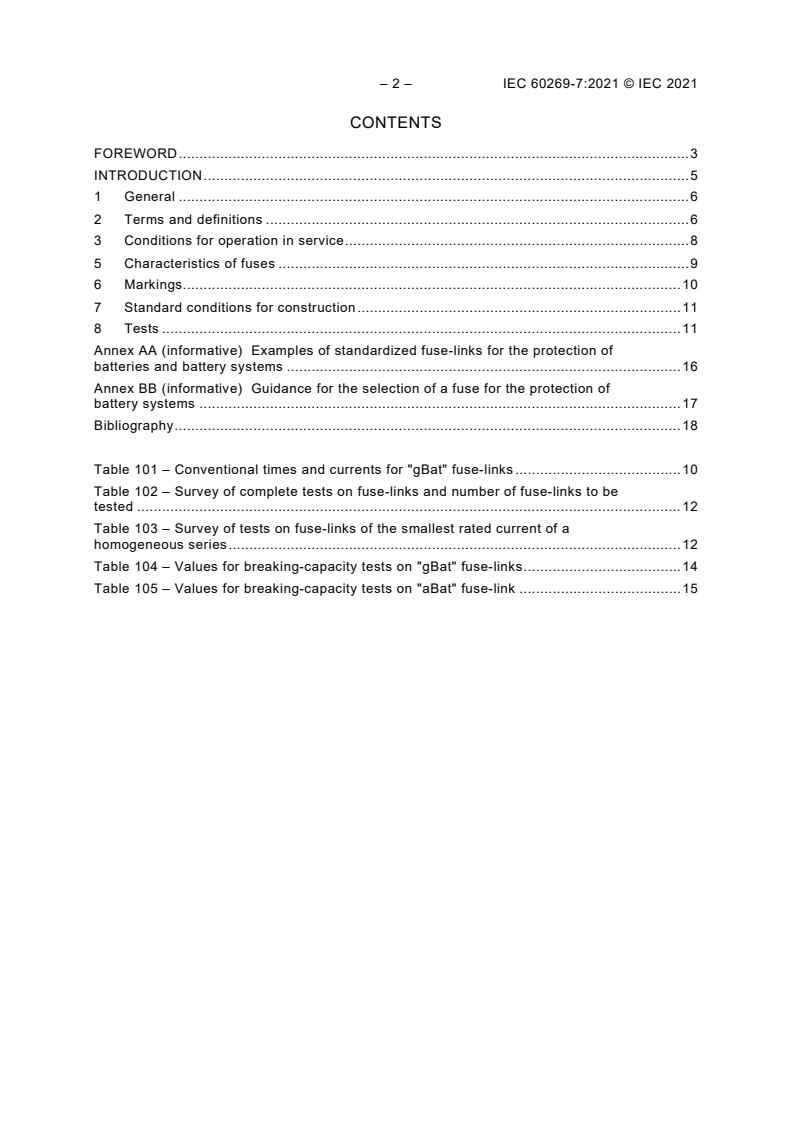
– 2 – IEC 60269-7:2021 © IEC 2021
CONTENTS
FOREWORD . 3
INTRODUCTION . 5
1 General . 6
2 Terms and definitions . 6
3 Conditions for operation in service . 8
5 Characteristics of fuses . 9
6 Markings. 10
7 Standard conditions for construction . 11
8 Tests . 11
Annex AA (informative) Examples of standardized fuse-links for the protection of
batteries and battery systems . 16
Annex BB (informative) Guidance for the selection of a fuse for the protection of
battery systems . 17
Bibliography . 18
Table 101 – Conventional times and currents for "gBat" fuse-links . 10
Table 102 – Survey of complete tests on fuse-links and number of fuse-links to be
tested . 12
Table 103 – Survey of tests on fuse-links of the smallest rated current of a
homogeneous series . 12
Table 104 – Values for breaking-capacity tests on "gBat" fuse-links . 14
Table 105 – Values for breaking-capacity tests on "aBat" fuse-link . 15
INTERNATIONAL ELECTROTECHNICAL COMMISSION
____________
LOW VOLTAGE FUSES –
Part 7: Supplementary Requirements for fuse-links
for the protection of batteries and battery systems
FOREWORD
1) The International Electrotechnical Commission (IEC) is a worldwide organization for standardization comprising
all national electrotechnical committees (IEC National Committees). The object of IEC is to promote international
co-operation on all questions concerning standardization in the electrical and electronic fields. To this end and
in addition to other activities, IEC publishes International Standards, Technical Specifications, Technical Reports,
Publicly Available Specifications (PAS) and Guides (hereafter referred to as "IEC Publication(s)"). Their
preparation is entrusted to technical committees; any IEC National Committee interested in the subject dealt with
may participate in this preparatory work. International, governmental and non-governmental organizations liaising
with the IEC also participate in this preparation. IEC collaborates closely with the International Organization for
Standardization (ISO) in accordance with conditions determined by agreement between the two organizations.
2) The formal decisions or agreements of IEC on technical matters express, as nearly as possible, an international
consensus of opinion on the relevant subjects since each technical committee has representation from all
interested IEC National Committees.
3) IEC Publications have the form of recommendations for international use and are accepted by IEC National
Committees in that sense. While all reasonable efforts are made to ensure that the technical content of IEC
Publications is accurate, IEC cannot be held responsible for the way in which they are used or for any
misinterpretation by any end user.
4) In order to promote international uniformity, IEC National Committees undertake to apply IEC Publications
transparently to the maximum extent possible in their national and regional publications. Any divergence between
any IEC Publication and the corresponding national or regional publication shall be clearly indicated in the latter.
5) IEC itself does not provide any attestation of conformity. Independent certification bodies provide conformity
assessment services and, in some areas, access to IEC marks of conformity. IEC is not responsible for any
services carried out by independent certification bodies.
6) All users should ensure that they have the latest edition of this publication.
7) No liability shall attach to IEC or its directors, employees, servants or agents including individual experts and
members of its technical committees and IEC National Committees for any personal injury, property damage or
other damage of any nature whatsoever, whether direct or indirect, or for costs (including legal fees) and
expenses arising out of the publication, use of, or reliance upon, this IEC Publication or any other IEC
Publications.
8) Attention is drawn to the Normative references cited in this publication. Use of the referenced publications is
indispensable for the correct application of this publication.
9) Attention is drawn to the possibility that some of the elements of this IEC Publication may be the subject of patent
rights. IEC shall not be held responsible for identifying any or all such patent rights.
IEC 60269-7 has been prepared by subcommittee 32B: Low-voltage fuses, of IEC technical
committee 32: Fuses. It is an International Standard.
The text of this International Standard is based on the following documents:
Draft Report on voting
32B/700/CDV 32B/709/RVC
Full information on the voting for its approval can be found in the report on voting indicated in
the above table.
The language used for the development of this International Standard is English.
This part is to be used in conjunction with IEC 60269-1, Low-voltage fuses – Part 1: General
requirements.
– 4 – IEC 60269-7:2021 © IEC 2021
This Part 7 supplements or modifies the corresponding clauses or subclauses of Part 1. Where
no change is necessary, this Part 7 indicates that the relevant clause or subclause of Part 1
applies.
Tables and figures which are additional to those in Part 1 are numbered starting from 101.
Additional annexes are lettered AA, BB, etc.
This document was drafted in accordance with ISO/IEC Directives, Part 2, and developed in
accordance with ISO/IEC Directives, Part 1 and ISO/IEC Directives, IEC Supplement, available
at www.iec.ch/members_experts/refdocs. The main document types developed by IEC are
described in greater detail at www.iec.ch/standardsdev/publications.
A list of all parts of the IEC 60269 series, under the general title: Low-voltage fuses, can be
found on the IEC website.
The committee has decided that the contents of this document will remain unchanged until the
stability date indicated on the IEC website under webstore.iec.ch in the data related to the
specific document. At this date, the document will be
• reconfirmed,
• withdrawn,
• replaced by a revised edition, or
• amended.
INTRODUCTION
This document specifically supports the UN goals:
No. 7: Affordable and clean energy
No. 9: Industry, innovation and infrastructure
No. 11: Sustainable cities and communities
No. 12: Responsible consumption and communities
– 6 – IEC 60269-7:2021 © IEC 2021
LOW VOLTAGE FUSES –
Part 7: Supplementary Requirements for fuse-links
for the protection of batteries and battery systems
1 General
Fuse-links for the protection of battery energy systems shall comply with aIl requirements of
IEC 60269-1, if not otherwise indicated hereinafter, and shall also comply with the
supplementary requirements laid down below.
1.1 Scope and object
These supplementary requirements apply to fuse-links for the protection of batteries and battery
systems, including, but not limited to terminology, for electricity storage in equipment for circuits
of nominal voltages up to 1 500 V DC.
Their rated voltage can be higher than 1 500 V DC.
The object of these supplementary requirements is to establish the characteristics of battery
fuse-links in such a way that they can be replaced by other fuse-links having the same
characteristics, provided that their dimensions are identical.
1.2 Normative references
The following documents are referred to in the text in such a way that some or all of their content
constitutes requirements of this document. For dated references, only the edition cited applies.
For undated references, the latest edition of the referenced document (including any
amendments) applies.
IEC 60269-1, Low-voltage fuses - Part 1: General requirements
IECEE OD-5014, IEC System of Conformity Assessment Schemes for Electrotechnical
Equipment and Components (IECEE System), Committee of Testing Laboratories
(CTL),Instrument Accuracy Limits
ISO/IEC 17025, General requirements for the competence of testing and calibration
laboratories
2 Terms and definitions
For the purposes of this document, the terms and definitions given in IEC 60269-1 and the
following apply.
ISO and IEC maintain terminological databases for use in standardization at the following
addresses:
• IEC Electropedia: available at http://www.electropedia.org/
• ISO Online browsing platform: available at http://www.iso.org/obp
2.1 General terms
2.1.101
battery
one or more cells fitted with devices necessary for use, for example case, terminals, markings
and protective devices etc., as necessary for use
[SOURCE: IEC 60050-482:2004, 482-01-04, modified (replacement of "marking and protective
devices” by “markings and protective devices etc., as necessary for use”)]
2.1.102
cell
basic functional unit, consisting of an assembly of electrodes, electrolyte, container, terminals
and usually separators, that is a source of electric energy obtained by direct conversion of
chemical energy
[SOURCE: IEC 60050-482:2004, 482-01-01, modified (removal of NOTE)]
2.1.103
battery module
group of cells connected together, either in a series and/or parallel configuration with or without
protective devices (e.g. fuse or PTC: Positive Temperature Coefficient) and monitoring circuitry
2.1.104
battery system
battery system which incorporates one or more cells, modules or battery packs including
associated devices
Note 1 to entry: It has battery management unit to cut off in case of overcharging, over current, and overheating. It
may have cooling or heating units.
2.1.105
rated energy
quantity of energy, declared by the manufacturer, which under the specified conditions can be
discharged from fully charged flow battery energy storage system, to fully discharge
Note 1 to entry: The rated energy is expressed in watt hour (Wh).
2.1.106
rated output power
electrical power, declared by the manufacturer, which under the specified operating conditions
is the maximum output power designed to be achieved
Note 1 to entry: The rated output power is normally expressed in watt (W).
2.1.107
short-circuit current
maximum current which can be delivered by a cell or battery into an external circuit with zero
electric resistance, or an external circuit which depresses the cell or battery voltage to
approximately zero volts
[SOURCE: IEC 60050-482:2004, 482-03-26, modified (replacement of "should" by "can" and
"volt" by "volts", removal of NOTE)]
2.1.108
open circuit voltage OCV
off-load voltage U
OC
voltage across the terminals of a cell or battery when no external current is flowing
– 8 – IEC 60269-7:2021 © IEC 2021
[SOURCE; IEC 60050-482:2004, 482-03-32, modified (original definition reads "voltage of a cell
or battery when the discharge current is zero")]
2.1.109
overcurrent protective device
device provided to interrupt an electrical circuit in case the conductor current in the electrical
circuit exceeds a predetermined value for a specified duration
[SOURCE: IEC 60050-826:2004, 826-14-14]
2.1.110
rated capacity
capacity value of a cell or battery determined under specified conditions and declared by the
manufacturer
[SOURCE: IEC 60050-482:2004, 482-03-15, modified (addition of "cell or")]
3 Conditions for operation in service
3.4 Voltage
The DC system voltage has a maximum value not exceeding 100% of the rated voltage of the
fuse.
3.4.1 Rated voltage
The rated DC voltage of a fuse-link shall exceed the maximum value of the open circuit voltage
of the Battery (OCV, UOC, off-load voltage) or of the network. See Annex BB.
3.5 Current
3.5.1 Rated Current
Rated currents are given in 5.3. These values depend upon the utilization categories and rated
voltages. For specific systems and sizes, see Annex AA.
3.6 Frequency, power factor and time constant
3.6.1 Frequency
Not applicable
3.6.2 Power factor
Not applicable
3.6.3 Time constant
The time constants expected in practice are considered to correspond to those in Table 105
and Table 104.
3.10 Temperature inside an enclosure
Since the rated values of the fuse-links are based on specified conditions they do not always
correspond to those prevailing at the point of installation, including the local air conditions, the
user may have to consult the manufacturer to define allowable continuous current under these
specific conditions.
5 Characteristics of fuses
5.1 Summary of characteristics
5.1.2 Fuse-links
a) Rated voltage (see 5.2)
b) Rated current (see 5.3 of IEC 60269-1)
c) Rated power dissipation (see 5.5)
d) Time-current characteristics (see 5.6)
e) Breaking range and utilization category (see 5.7.1)
f) Rated breaking capacity (see 5.7.2)
g) Dimensions or size (if applicable)
5.2 Rated voltage
Table 22 of IEC 60269-1 applies. If it is necessary to choose lower values or intermediate values
or higher values, these values should be selected from the series R10 of ISO 3, and in
exceptional cases, from R20 or R40 of ISO 3.
5.3 Rated current
Subclause 5.3.1 of IEC 60269-1 applies with the addition of the following rated currents: 1 400
– 1 600 – 1 800 – 2 000 – 2 250 – 2 800 – 3 150 – 3 600 – 4 000 – 4 500 – 5 000.
5.5 Rated power dissipation of the fuse-link
In addition to the requirements of IEC 60269-1, the manufacturer shall indicate the power
dissipation as a function of current for the range contained between 50 % to 100 % of the rated
current, or publish the load profile.
Derating-curve for increased ambient temperature has to be given in the manufacturer’s
literature.
5.6 Limits of time-current characteristics
5.6.1 Time-current characteristics, time-current zones
The manufacturer shall provide mean time-current characteristics.
The time/current curve should be plotted for DC with a time constant defined by the
manufacturer within the limits of Table 104 and Table 105.
Time current zone shall be available in the manufacturer’s literature for times greater than
0,001 s for aBat fuses and greater than 0,01s for gBat fuses.
5.6.2 Conventional times and currents
5.6.2.2 Conventional times and currents for "gBat"- fuse-links
The conventional times and currents are given in Table 101.
5.6.2.3 Conventional times and currents for "aBat" – fuse-links
Minimum Breaking Current for "aBat": is given in Table 105. Conventional times are given in
Table 101.
– 10 – IEC 60269-7:2021 © IEC 2021
Table 101 – Conventional times and currents for "gBat" fuse-links
Rated current Conventional time Conventional current
A h Type "gBat"
I I
nf f
I ≤ 63
n
63 < I ≤ 160
n
1,13 I 1,60 I
n n
160 < I ≤ 400
n
I > 400
n
5.6.3 Gates
Due to different battery technologies, gates are to be agreed between the manufacturer and the
user.
5.7 Breaking range and breaking capacity
IEC 60269-1 applies with the following supplementary requirement.
5.7.1 Breaking range and utilization category
Additionally to Part 1:
– "gBat" indicates fuse-links with a full-range DC breaking capacity for the protection of
batteries and battery systems
– "aBat" indicates fuse-links with a partial range DC breaking capacity for the protection of
batteries and battery systems
NOTE "Bat" (for battery) indicates fuse-links with d.c. breaking capacity for battery energy systems. These letters
define with accuracy the time-current characteristics, conventional times and currents, gates.
5.7.2 Rated breaking capacity
Minimum value of rated breaking capacity required by this part is 30 kA. Higher breaking
capacities are permissible.
6 Markings
IEC 60269-1 applies with the following supplementary requirements.
6.2 Markings on fuse-links
Subclause 6.2 of IEC 60269-1 applies with the following addition:
– utilization category "gBat" or "aBat"
– rated breaking capacity
– a combination of symbols of IEC 60417 of a fuse (5016) and a battery (5001A) as shown
below
7 Standard conditions for construction
IEC 60269-1 applies with the following supplementary requirements.
7.3 Temperature rise and power dissipation of the fuse-link
Fuse-links shall be so designed and proportioned as to carry, when tested in accordance with
8.3, the rated current without exceeding
– the temperature rise limit of the hottest upper metal part of the fuse-link indicated by the
manufacturer
– the power dissipation at the rated current indicated by the manufacturer
7.4 Operation
The fuse-link shall be so designed and proportioned as to carry continuously any value of
current up to its rated current.
"aBat" fuse-links shall operate and break the circuit for any current value not exceeding the
rated breaking capacity and not less than a current sufficient to interrupt the fuse-link specified
by the manufacturer.
For "gBat" fuse-links within the conventional time:
– its fuse-link does not operate, when it carries any current not exceeding the conventional
non-fusing current (I )
nf
– it operates when it carries any current equal to, or exceeding, the conventional fusing current
(I ) and equal to or lower than the rated breaking capacity
f
This applies for conditions stated under Subclauses 8.3 and 8.4.
7.5 Breaking capacity
A fuse-link of the utilization category "gBat" shall be capable of breaking, at rated DC voltage,
any circuit having a prospective current between the value as in Test No. 5 in Table 104 and
the rated breaking capacity.
A fuse-link of the utilization category "aBat" shall be capable of breaking, at rated DC voltage,
any circuit having a prospective current between the value of I in Table 105 and the rated
2a
breaking capacity.
8 Tests
IEC 60269-1 applies with the following supplementary requirements.
8.1 General
Measurement uncertainty information of tests is given in ISO/IEC 17025 and in IECEE OD5014.
8.1.4 Arrangement of the fuse and dimensions
The fuse-link shall be mounted open in surroundings free from draughts and, unless otherwise
specified, in a vertical position (see 8.3.1).
– 12 – IEC 60269-7:2021 © IEC 2021
8.1.5 Testing of fuse-links
8.1.5.1 Complete tests
A survey of the complete tests is given in Table 102 and Table 103.
8.1.5.2 Type test exemptions for fuse-links of a homogeneous series
Fuse-links having intermediate values of rated current of a homogeneous series are exempted
from a number of type tests if the fuse-link of the largest rated current has been tested according
to Table 102 and if the fuse-link of the smallest rated current has been tested according to
Table 103.
Table 102 – Survey of complete tests on fuse-links
and number of fuse-links to be tested
Test according to subclause "g"- fuse-link "a"- fuse-link
Number of fuse-links to be tested 1 1 1 3 3 1 1 1 3 3 1
8.1.4 Dimensions X X
8.1.5.1 Resistance X X X X X X X X X X X
8.3.3 Temperature rise and power dissipation X X
8.4.3.1 Conventional non-fusing current (I ) X
nf
Conventional fusing current (I ) X
f
8.4.3.2 Verification of rated current X X
8.4.3.6 Operation of indicating devices and strikers, if any X X X X X X
8.5 No. 1 Breaking capacity and operating characteristics X X
No. 2 Breaking capacity and operating characteristics X X
No. 2a Breaking capacity and operating characteristics X
No. 5 Breaking capacity and operating characteristics X
Table 103 – Survey of tests on fuse-links of the smallest
rated current of a homogeneous series
Test according to subclause "g"- fuse link "a"- fuse link
Number of fuse-links to be tested 1 1 1
8.3.3 Temperature rise and power dissipation X X
8.4.3.1 Conventional non-fusing current (I ) X
nf
8.4.3.1 Conventional fusing current (I ) X
f
8.3 Verification of temperature rise limits and power dissipation
8.3.1 Arrangement of the fuse-link
The fuse-link shall be mounted vertically in the conventional test arrangement.
For special fuse-links that cannot be accommodated in the conventional test arrangement, or
for which this test arrangement is not applicable, special tests shall be performed according to
the manufacturer’s instructions and all pertinent data shall be recorded in the test report.
For fuse links intended to be used in separate fuse-bases or fuse-holders, the test may be
performed in these fuse-bases with conductors according to Table 17 of IEC 60269-1.
8.3.3 Measurement of power dissipation of the fuse-link
In addition to 8.3.3 of IEC 60269-1 the following applies.
The power dissipation test shall be made successively at 50 % and at 100 % of the rated current
on the same fuse-link.
8.3.4.2 Power dissipation of a fuse-link
The test may be made with AC or DC.
8.3.5 Acceptability of test results
Subclause 8.3.5 of IEC 60269-1 applies with the following changes.
The temperature rise and power dissipation of the fuse-link shall not exceed the values specified
by the manufacturer.
8.4 Verification of operation
8.4.1 Arrangement of fuse-link
The arrangement of the fuse-link for the verification of operation shall be as described in 8.1.4
and 8.3.1. of IEC 60269-1.
8.4.3 Test method and acceptability of test results
8.4.3.1 Verification of conventional non-fusing and fusing current
It is permissible to make the following tests at a reduced voltage:
a) the fuse-link is subjected to its conventional non-fusing current (I ) for a time equal to the
nf
conventional time specified in Table 101. It shall not operate during this time;
b) the fuse-link, after having cooled down to ambient temperature, is subjected to the
conventional fusing current (I ). It shall operate within the conventional time as specified in
f
Table 101. This test may be performed with an AC or a DC source.
The fuse-link shall operate without external effects or damage.
8.4.3.2 Verification of rated current
The fuse-Iink is tested under the same test conditions as indicated in 8.3.1.
It is subjected to 100 test cycles, each consisting of an "on" period of 0,1 times the conventional
time as specified in Table 101 at rated current and an "off" period of the same duration. This
test may be performed with an AC or DC source.
After this test, the resistance of the fuse-link at room temperature shall not have changed by
more than 10 %.
The conventional time for "gBat" in Table 101 also applies for this test for "aBat".
8.4.3.6 Operation of indicating devices and strikers, if any
IEC 60269-1 applies with the following changes:
– a current between I and the rated breaking capacity in the case of "gBat" fuse-links
– a current between I and the rated breaking capacity in the case of "aBat" fuse-links
2a
– 14 – IEC 60269-7:2021 © IEC 2021
8.5 Verification of the breaking capacity
8.5.1 Arrangement of the fuse
IEC 60269-1 applies.
8.5.5 Test method
8.5.5.1 In order to verify that the fuse-link satisfies the conditions of 7.5, tests number 1, 2
and 5 or 2a shall be made. The number of fuse-links requested in Table 102 shall be tested
with the values stated in Table 104 or Table 105. Test numbers 1 and 2: If during test number 1,
the requirements of test number 2 are met, then this test need not be repeated as test number 2.
Test numbers 5 or 2a respectively – The value of the test current is specified in Table 105 or
Table 104 respectively.
8.5.5.2 Recovery Voltage
For the tests the recovery voltage shall be maintained at a value of 100%+5%-0% of the rated
voltage at least:
– 30 s after operation of fuse-links not containing organic materials in their body or filler;
– 5 min after operation of the fuse-links in all other cases, switching over to another source
of supply being permitted after 15 s if the switching time (interval without voltage) does not
exceed 0,1 s.
In a lapse of time of at least 6 min and maximum 10 min after the operation, the resistance
between the contacts of the fuse-link shall be measured (see 8.5.8 of IEC 60269-1) and noted.
With the manufacturer’s consent, shorter times are possible if the fuse-link does not contain
organic materials in its body or filler.
8.5.8 Acceptability of test results
IEC 60269-1 applies with the following additions:
– no burning or melting of end caps
– no significant movement of end caps
Table 104 – Values for breaking-capacity tests on "gBat" fuse-links
Tests according to 8.5.5.1
No. 1 No. 2 No. 5
Mean value of recovery 100 %
a) b)
voltage -0 +5 % of the rated voltage
Prospective test current I I I = 2 I
1 2 5 n
Tolerance on current 0 +10 % Not applicable 0 +20 %
b)
1 to 3 ms <= 1ms
Time constant
I current which is used in the designation of the rated breaking capacity (see 5.7).
I current which shall be chosen in such a manner that the test is made under conditions which approximate those
giving maximum arc energy. This condition may be deemed to be satisfied if the current, at the beginning of arcing,
has reached a value between 0,5 and 0,8 times the prospective current.
I test current deemed to verify that the fuse is able to operate satisfactorily in the range of small over-currents.
a)
This tolerance includes ripple.
b)
The upper limit may be exceeded with the manufacturer’s consent.
Table 105 – Values for breaking-capacity tests on "aBat" fuse-link
Tests according to 8.5.5.1
No. 1 No. 2 No. 2a
Mean value of recovery 100 %
a) b)
voltage -0 +5 % of the rated voltage
Prospective test current I I I
1 2 2a
Tolerance on current 0 +10 % Not applicable 0+20 %
b)
1 to 3 ms
Time constant
I current which is used in the designation of the rated breaking capacity (see 5.7).
I current which shall be chosen in such a manner that the test is made under conditions which approximate those
giving maximum arc energy. This condition may be deemed to be satisfied if the current, at the beginning of arcing,
has reached a value between 0,5 and 0,8 times the prospective current.
I is the minimum value of the breaking capacity of the fuse-link in the overcurrent range specified by the
2a
manufacturer or 10 times rated current.
a)
This tolerance includes ripple.
b)
The upper limit may be exceeded with the manufacturer’s consent.
– 16 – IEC 60269-7:2021 © IEC 2021
Annex AA
(informative)
Examples of standardized fuse-links for the protection
of batteries and battery systems
The dimensional systems and shapes are presently under rapid development to meet a number
of different market needs. Therefore there are no specific systems given at the time.
Examples of standardized fuse-links (Dimensions and shapes) for the protection of battery
energy systems can be found in IEC 60269-2, IEC 60269-3, IEC 60269-4 and IEC 60269-6 or
can be agreed between the manufacturer and user.
Annex BB
(informative)
Guidance for the selection of a fuse for the protection of battery systems
BB.1 General
This annex is limited to the use of battery fuse-links in circuits having the characteristics
generally found in electrical energy storage systems of DC installation. It is the object of this
annex to explain the selection of the fuse-links.
BB.2 Voltage characteristics
BB.2.1 Rated voltage
The rated voltage of the fuse-link selected shall be higher than the maximum voltage of the
battery system.
In case of polarity inversion protection one fuse link must be installed for each battery polarity.
Each single fuse must be able to interrupt the short circuit current under maximum voltage of
the system.
BB.3 Current carrying capability
BB.3.1 Rated current
The rated current of the fuse-link selected shall take into account the operation current profile
of the application. Ambient temperature may require higher current ratings of the fuse-link. In
such case the manufacturer should be consulted.
BB.4 Breaking capacity
The maximum short circuit current of the system shall be lower than the rated breaking capacity
of the fuse-link.
In some practical applications, time-constant values may be found which are shorter than those
indicated in the tests and which may result in a more favourable fuse performance.
– 18 – IEC 60269-7:2021 © IEC 2021
Bibliography
IEC 60050-151, International Electrotechnical Vocabulary (IEV) - Part 151: Electrical and
magnetic devices
IEC 60050-521, International Electrotechnical Vocabulary (IEV) - Part 521: Semiconductor
devices and integrated circuits
IEC 60086-4, Primary batteries - Part 4: Safety of lithium batteries
IEC 60364-4-41, Low-voltage electrical installations - Part 4-41: Protection for safety -
Protection against electric shock
IEC 60364-4-43, Low-voltage electrical installations - Part 4-43: Protection for safety -
Protection against overcurrent
IEC 62485-5, Safety requirements for secondary batteries and battery installations - Part 5:
Safe operation of stationary lithium ion batteries
IEC 62485-6, Safety requirements for secondary batteries and battery installations - Part 6:
Safe operation of lithium-ion batteries in traction applications
IEC 62620, Secondary cells and batteries containing alkaline or other non-acid electrolytes -
Secondary lithium cells and batteries for use in industrial applications
IEC TR 62660-4, Secondary lithium-ion cells for the propulsion of electric road vehicles - Part
4: Candidate alternative test methods for the internal short circuit test of IEC 62660-3
IEC 62932-1, Flow battery energy systems for stationary applications - Part 1: Terminology and
general aspects
ISO 3, Preferred numbers – Series of preferred numbers
___________
– 20 – IEC 60269-7:2021 © IEC 2021
SOMMAIRE
AVANT-PROPOS . 21
INTRODUCTION . 23
1 Généralités . 24
2 Termes et définitions . 24
3 Conditions de fonctionnement en service . 26
5 Caractéristiques des fusibles . 27
6 Marquages . 29
7 Conditions normales d'établissement . 29
8 Essais . 30
Annexe AA (informative) Exemples d'éléments de remplacement normalisés pour la
protection des batteries et des systèmes de batterie . 35
Annexe BB (informative) Recommandations pour le choix d'un fusible pour la
protection des systèmes de batterie . 36
Bibliographie . 37
Tableau 101 – Courants et temps conventionnels pour les éléments de remplacement
"gBat" . 28
Tableau 102 – Liste des essais complets des éléments de remplacement et nombre
d'éléments de remplacement à soumettre à l’essai . 30
Tableau 103 – Liste des essais des éléments de remplacement de courant assigné le
plus faible dans une série homogène . 31
Tableau 104 – Valeurs pour les essais de vérification du pouvoir de coupure des
éléments de remplacement "gBat" . 33
Tableau 105 – Valeurs pour les essais de vérification du pouvoir de coupure des
éléments de remplacement "aBat" . 34
COMMISSION ÉLECTROTECHNIQUE INTERNATIONALE
____________
FUSIBLES BASSE TENSION –
Partie 7: Exigences supplémentaires concernant
les éléments de remplacement utilisés pour la protection
des batteries et des systèmes de batterie
AVANT-PROPOS
1) La Commission Electrotechnique Internationale (IEC) est une organisation mondiale de normalisation composée
de l'ensemble des comités électrotechniques nationaux (Comités nationaux de l’IEC). L’IEC a pour objet de
favoriser la coopération internationale pour toutes les questions de normalisation dans les domaines de
l'électricité et de l'électronique. À cet effet, l’IEC – entre autres activités – publie des Normes internationales,
des Spécifications techniques, des Rapports techniques, des Spécifications accessibles au public (PAS) et des
Guides (ci-après dénommés "Publication(s) de l’IEC"). Leur élaboration est confiée à des comités d'études, aux
travaux desquels tout Comité national intéressé par le sujet traité peut participer. Les organisations
internationales, gouvernementales et non gouvernementales, en liaison avec l’IEC, participent également aux
travaux. L’IEC collabore étroitement avec l'Organisation Internationale de Normalisation (ISO), selon des
conditions fixées par accord entre les deux organisations.
2) Les décisions ou accords officiels de l’IEC concernant les questions techniques représentent, dans la mesure du
possible, un accord international sur les sujets étudiés, étant donné que les Comités nationaux de l’IEC intéressés
sont représentés dans chaque comité d’études.
3) Les Publications de l’IEC se présentent sous la forme de recommandations internationales et sont agréées
comme telles par les Comités nationaux de l’IEC. Tous les efforts raisonnables sont entrepris afin que l’IEC
s'assure de l'exactitude du contenu technique de ses publications; l’IEC ne peut pas être tenue responsable de
l'éventuelle mauvaise utilisation ou interprétation qui en est faite par un quelconque utilisateur final.
4) Dans le but d'encourager l'uniformité internationale, les Comités nationaux de l’IEC s'engagent, dans toute la
mesure possible, à appliquer de façon transparente les Publications de l’IEC dans leurs publications nationales
et régionales. Toutes divergences entre toutes Publications de l’IEC et toutes publications nationales ou
régionales correspondantes doivent être indiquées en termes clairs dans ces dernières.
5) L’IEC elle-même ne fournit aucune attestation de conformité. Des organismes de certification indépendants
fournissent des services d'évaluation de conformité et, dans certains secteurs, accèdent aux marques de
conformité de l’IEC. L’IEC n'est responsable d'aucun des services effectués par les organismes de certification
indépendants.
6) Tous les utilisateurs doivent s'assurer qu'ils sont en possession de la dernière édition de cette publication.
7) Aucune responsabilité ne doit être imputée à l’IEC, à ses administrateurs, employés, auxiliaires ou mandataires,
y compris ses experts particuliers et les membres de ses comités d'études et des Comités nationaux de l’IEC,
pour tout préjudice causé en cas de dommages corporels et matériels, ou de tout autre dommage de quelque
nature que ce soit, directe ou indirecte, ou pour supporter les coûts (y compris les frais de justice) et les dépenses
découlant de la publication ou de l'utilisation de cette Publication de l’IEC ou de toute autre Publication de l’IEC
...