

IEC 60269-4:2024
(Amendment)Low-voltage fuses - Part 4: Supplementary requirements for fuse-links for the protection of semiconductor devices
General Information
- Abstract
IEC 60269-4:2024 applies with the following supplementary requirements. Fuse-links for the protection of semiconductor devices shall comply with aIl requirements of IEC 60269-1, if not otherwise indicated hereinafter, and shall also comply with the supplementary requirements laid down below. These supplementary requirements apply to fuse-links for application in equipment containing semiconductor devices for circuits of nominal voltages up to 1 000 V AC or 1 500 V DC. For some fuse‑links higher rated voltages can be used.
- Status
- Published
- Publication Date
- 08-Aug-2024
- Technical Committee
- SC 32B - Low-voltage fuses
- Drafting Committee
- MT 9 - TC 32/SC 32B/MT 9
- Current Stage
- PPUB - Publication issued
- Start Date
- 09-Aug-2024
- Completion Date
- 31-May-2024
Buy Documents
REDLINE IEC 60269-4:2024 CMV - Low-voltage fuses - Part 4: Supplementary requirements for fuse-links for the protection of semiconductor devices Released:8/9/2024
IEC 60269-4:2024 - Low-voltage fuses - Part 4: Supplementary requirements for fuse-links for the protection of semiconductor devices Released:8/9/2024
Overview
IEC 60269-4:2024 - Low‑voltage fuses, Part 4 - defines supplementary requirements for fuse‑links used to protect semiconductor devices. It is Edition 6.0 (2024) and is to be used together with IEC 60269-1:2024 (General requirements). The standard covers fuse‑links intended for equipment containing semiconductor devices for circuits up to 1 000 V AC or 1 500 V DC (with some fuse‑links suitable for higher rated voltages). This edition updates the series by introducing requirements for voltage source inverter (VSI) fuse‑links, expanding AC operating characteristic tests, and refreshing examples of standardized semiconductor fuse‑links.
Key topics and technical requirements
- Scope and conformity: Fuse‑links for semiconductor protection shall meet all applicable requirements of IEC 60269‑1 unless specifically modified by Part 4.
- Essential characteristics specified for semiconductor fuse‑links include:
- Rated values (voltage, current)
- Temperature rise in normal service
- Power dissipation
- Time–current characteristics (selectivity and coordination)
- Breaking capacity
- Cut‑off current characteristics and I²t (energy let‑through)
- Arc voltage characteristics
- Type tests and test methods: Part 4 defines supplementary tests to verify the above characteristics, including provisions for VSI fuse‑links and AC/DC breaking‑capacity verification.
- Markings and documentation: Requirements for legible markings on fuse‑links and the availability of manufacturer data (catalogue information and on‑request technical data) are provided - see normative Annex BB.
- Guidance and examples: Informative and normative annexes include coordination guidance (Annex AA), manufacturer information lists (Annex BB), and standardized fuse‑link examples and dimensions (Annex CC).
Applications and who uses this standard
IEC 60269-4:2024 is essential for:
- Fuse manufacturers designing semiconductor fuse‑links (gR/gS types and VSI variants)
- Power electronics designers (inverters, converters, rectifiers, motor drives, UPS)
- Test laboratories and certification bodies performing type and routine tests
- Safety and compliance engineers, procurement specialists and OEMs who need to specify or replace fuse‑links for semiconductor protection The standard helps ensure safe, interoperable, and interchangeable fuse‑links with predictable let‑through energy and breaking behavior suited to semiconductor device protection.
Related standards
- IEC 60269-1:2024 - Low‑voltage fuses: General requirements (required companion document)
- IEC 60269-2, IEC 60269-3 - Other supplementary parts for different fuse applications
- IEC 60269-6 - Supplementary requirements for photovoltaic systems (related specialty)
Keywords: IEC 60269-4:2024, low‑voltage fuses, semiconductor fuse‑links, voltage source inverter fuse, time‑current characteristics, breaking capacity, I²t, fuse coordination.
Relations
- Effective Date
- 05-Jul-2024
- Effective Date
- 05-Jul-2024
- Effective Date
- 05-Sep-2023
Buy Documents
REDLINE IEC 60269-4:2024 CMV - Low-voltage fuses - Part 4: Supplementary requirements for fuse-links for the protection of semiconductor devices Released:8/9/2024
IEC 60269-4:2024 - Low-voltage fuses - Part 4: Supplementary requirements for fuse-links for the protection of semiconductor devices Released:8/9/2024
Get Certified
Connect with accredited certification bodies for this standard

IMQ S.p.A. (Certification)
Italian electrical product certification.

SLG Prüf- und Zertifizierungs GmbH
German testing and certification body.

UL Solutions
Global safety science company with testing, inspection and certification.
Sponsored listings
Frequently Asked Questions
IEC 60269-4:2024 is a standard published by the International Electrotechnical Commission (IEC). Its full title is "Low-voltage fuses - Part 4: Supplementary requirements for fuse-links for the protection of semiconductor devices". This standard covers: IEC 60269-4:2024 applies with the following supplementary requirements. Fuse-links for the protection of semiconductor devices shall comply with aIl requirements of IEC 60269-1, if not otherwise indicated hereinafter, and shall also comply with the supplementary requirements laid down below. These supplementary requirements apply to fuse-links for application in equipment containing semiconductor devices for circuits of nominal voltages up to 1 000 V AC or 1 500 V DC. For some fuse‑links higher rated voltages can be used.
IEC 60269-4:2024 applies with the following supplementary requirements. Fuse-links for the protection of semiconductor devices shall comply with aIl requirements of IEC 60269-1, if not otherwise indicated hereinafter, and shall also comply with the supplementary requirements laid down below. These supplementary requirements apply to fuse-links for application in equipment containing semiconductor devices for circuits of nominal voltages up to 1 000 V AC or 1 500 V DC. For some fuse‑links higher rated voltages can be used.
IEC 60269-4:2024 is classified under the following ICS (International Classification for Standards) categories: 29.120.50 - Fuses and other overcurrent protection devices. The ICS classification helps identify the subject area and facilitates finding related standards.
IEC 60269-4:2024 has the following relationships with other standards: It is inter standard links to IEC 60269-4:2009/AMD1:2012, IEC 60269-4:2009/AMD2:2016, IEC 60269-4:2009. Understanding these relationships helps ensure you are using the most current and applicable version of the standard.
IEC 60269-4:2024 is available in PDF format for immediate download after purchase. The document can be added to your cart and obtained through the secure checkout process. Digital delivery ensures instant access to the complete standard document.
Standards Content (Sample)
IEC 60269-4 ®
Edition 6.0 2024-08
COMMENTED VERSION
INTERNATIONAL
STANDARD
colour
inside
Low-voltage fuses –
Part 4: Supplementary requirements for fuse-links for the protection of
semiconductor devices
All rights reserved. Unless otherwise specified, no part of this publication may be reproduced or utilized in any form
or by any means, electronic or mechanical, including photocopying and microfilm, without permission in writing from
either IEC or IEC's member National Committee in the country of the requester. If you have any questions about IEC
copyright or have an enquiry about obtaining additional rights to this publication, please contact the address below or
your local IEC member National Committee for further information.
IEC Secretariat Tel.: +41 22 919 02 11
3, rue de Varembé info@iec.ch
CH-1211 Geneva 20 www.iec.ch
Switzerland
About the IEC
The International Electrotechnical Commission (IEC) is the leading global organization that prepares and publishes
International Standards for all electrical, electronic and related technologies.
About IEC publications
The technical content of IEC publications is kept under constant review by the IEC. Please make sure that you have the
latest edition, a corrigendum or an amendment might have been published.
IEC publications search - webstore.iec.ch/advsearchform IEC Products & Services Portal - products.iec.ch
The advanced search enables to find IEC publications by a
Discover our powerful search engine and read freely all the
variety of criteria (reference number, text, technical publications previews, graphical symbols and the glossary.
committee, …). It also gives information on projects, replaced With a subscription you will always have access to up to date
and withdrawn publications. content tailored to your needs.
IEC Just Published - webstore.iec.ch/justpublished
Electropedia - www.electropedia.org
Stay up to date on all new IEC publications. Just Published
The world's leading online dictionary on electrotechnology,
details all new publications released. Available online and
containing more than 22 500 terminological entries in English
once a month by email.
and French, with equivalent terms in 25 additional languages.
Also known as the International Electrotechnical Vocabulary
IEC Customer Service Centre - webstore.iec.ch/csc
(IEV) online.
If you wish to give us your feedback on this publication or
need further assistance, please contact the Customer Service
Centre: sales@iec.ch.
IEC 60269-4 ®
Edition 6.0 2024-08
COMMENTED VERSION
INTERNATIONAL
STANDARD
colour
inside
Low-voltage fuses –
Part 4: Supplementary requirements for fuse-links for the protection of
semiconductor devices
INTERNATIONAL
ELECTROTECHNICAL
COMMISSION
ICS 29.120.50 ISBN 978-2-8322-9552-6
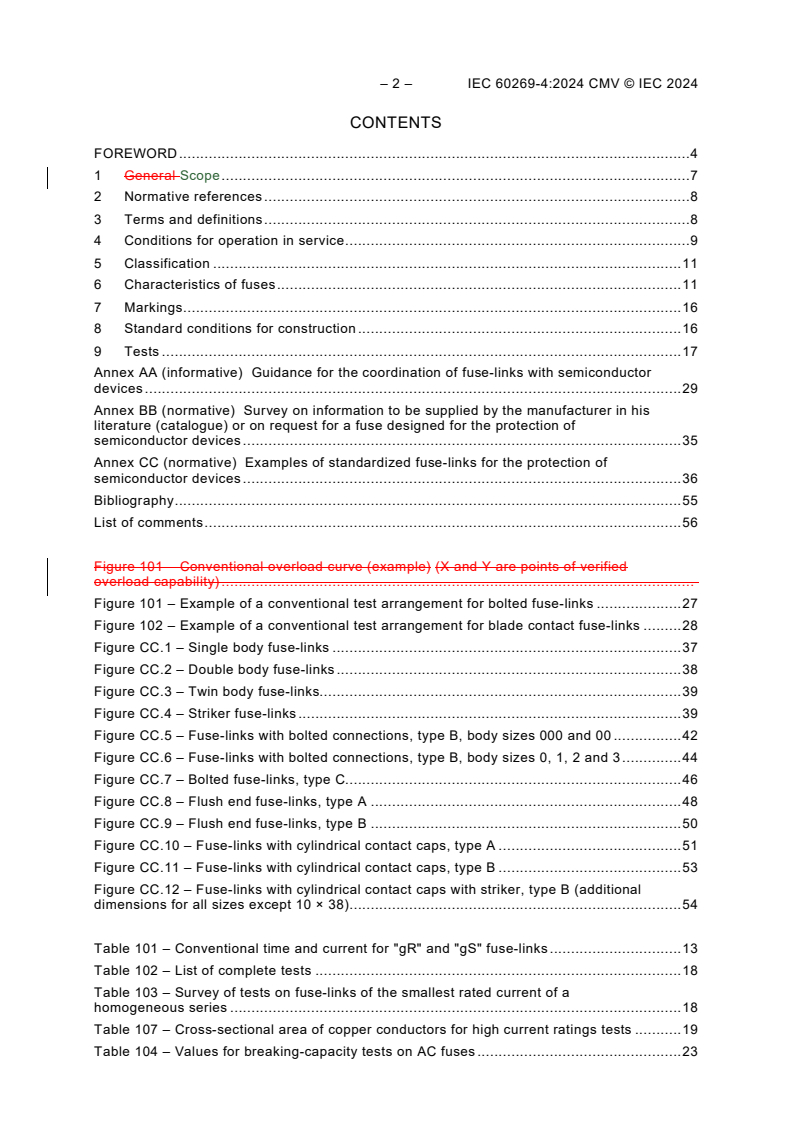
– 2 – IEC 60269-4:2024 CMV © IEC 2024
CONTENTS
FOREWORD .4
1 General Scope .7
2 Normative references .8
3 Terms and definitions .8
4 Conditions for operation in service .9
5 Classification . 11
6 Characteristics of fuses . 11
7 Markings . 16
8 Standard conditions for construction . 16
9 Tests . 17
Annex AA (informative) Guidance for the coordination of fuse-links with semiconductor
devices . 29
Annex BB (normative) Survey on information to be supplied by the manufacturer in his
literature (catalogue) or on request for a fuse designed for the protection of
semiconductor devices . 35
Annex CC (normative) Examples of standardized fuse-links for the protection of
semiconductor devices . 36
Bibliography . 55
List of comments . 56
Figure 101 – Conventional overload curve (example) (X and Y are points of verified
overload capability) .
Figure 101 – Example of a conventional test arrangement for bolted fuse-links . 27
Figure 102 – Example of a conventional test arrangement for blade contact fuse-links . 28
Figure CC.1 – Single body fuse-links . 37
Figure CC.2 – Double body fuse-links . 38
Figure CC.3 – Twin body fuse-links. 39
Figure CC.4 – Striker fuse-links . 39
Figure CC.5 – Fuse-links with bolted connections, type B, body sizes 000 and 00 . 42
Figure CC.6 – Fuse-links with bolted connections, type B, body sizes 0, 1, 2 and 3 . 44
Figure CC.7 – Bolted fuse-links, type C. 46
Figure CC.8 – Flush end fuse-links, type A . 48
Figure CC.9 – Flush end fuse-links, type B . 50
Figure CC.10 – Fuse-links with cylindrical contact caps, type A . 51
Figure CC.11 – Fuse-links with cylindrical contact caps, type B . 53
Figure CC.12 – Fuse-links with cylindrical contact caps with striker, type B (additional
dimensions for all sizes except 10 × 38) . 54
Table 101 – Conventional time and current for "gR" and "gS" fuse-links . 13
Table 102 – List of complete tests . 18
Table 103 – Survey of tests on fuse-links of the smallest rated current of a
homogeneous series . 18
Table 107 – Cross-sectional area of copper conductors for high current ratings tests . 19
Table 104 – Values for breaking-capacity tests on AC fuses . 23
Table 105 – Values for breaking-capacity tests on DC fuses . 24
Table 106 – Values for breaking-capacity tests on VSI fuse-links . 24
Table CC.1 – Conventional time and current for "gR" and "gS" fuse-links .
Table CC.2 – Conventional time and current for "gR" and "gS" fuse-links .
Table CC.4 – Conventional time and current for "gR" and "gS" fuse-links .
Table CC.1 – Typical rated voltages and preferred maximum rated currents. 52
– 4 – IEC 60269-4:2024 CMV © IEC 2024
INTERNATIONAL ELECTROTECHNICAL COMMISSION
____________
LOW-VOLTAGE FUSES –
Part 4: Supplementary requirements for fuse-links
for the protection of semiconductor devices
FOREWORD
1) The International Electrotechnical Commission (IEC) is a worldwide organization for standardization comprising
all national electrotechnical committees (IEC National Committees). The object of IEC is to promote international
co-operation on all questions concerning standardization in the electrical and electronic fields. To this end and
in addition to other activities, IEC publishes International Standards, Technical Specifications, Technical Reports,
Publicly Available Specifications (PAS) and Guides (hereafter referred to as “IEC Publication(s)”). Their
preparation is entrusted to technical committees; any IEC National Committee interested in the subject dealt with
may participate in this preparatory work. International, governmental and non-governmental organizations liaising
with the IEC also participate in this preparation. IEC collaborates closely with the International Organization for
Standardization (ISO) in accordance with conditions determined by agreement between the two organizations.
2) The formal decisions or agreements of IEC on technical matters express, as nearly as possible, an international
consensus of opinion on the relevant subjects since each technical committee has representation from all
interested IEC National Committees.
3) IEC Publications have the form of recommendations for international use and are accepted by IEC National
Committees in that sense. While all reasonable efforts are made to ensure that the technical content of IEC
Publications is accurate, IEC cannot be held responsible for the way in which they are used or for any
misinterpretation by any end user.
4) In order to promote international uniformity, IEC National Committees undertake to apply IEC Publications
transparently to the maximum extent possible in their national and regional publications. Any divergence between
any IEC Publication and the corresponding national or regional publication shall be clearly indicated in the latter.
5) IEC itself does not provide any attestation of conformity. Independent certification bodies provide conformity
assessment services and, in some areas, access to IEC marks of conformity. IEC is not responsible for any
services carried out by independent certification bodies.
6) All users should ensure that they have the latest edition of this publication.
7) No liability shall attach to IEC or its directors, employees, servants or agents including individual experts and
members of its technical committees and IEC National Committees for any personal injury, property damage or
other damage of any nature whatsoever, whether direct or indirect, or for costs (including legal fees) and
expenses arising out of the publication, use of, or reliance upon, this IEC Publication or any other IEC
Publications.
8) Attention is drawn to the Normative references cited in this publication. Use of the referenced publications is
indispensable for the correct application of this publication.
9) IEC draws attention to the possibility that the implementation of this document may involve the use of (a)
patent(s). IEC takes no position concerning the evidence, validity or applicability of any claimed patent rights in
respect thereof. As of the date of publication of this document, IEC had not received notice of (a) patent(s), which
may be required to implement this document. However, implementers are cautioned that this may not represent
the latest information, which may be obtained from the patent database available at https://patents.iec.ch. IEC
shall not be held responsible for identifying any or all such patent rights.
This commented version (CMV) of the official standard IEC 60269-4:2024 edition 6.0
allows the user to identify the changes made to the previous IEC 60269-
4:2009+AMD1:2012+AMD2:2016 CSV edition 5.2. Furthermore, comments from IEC SC
32B experts are provided to explain the reasons of the most relevant changes, or to clarify
any part of the content.
A vertical bar appears in the margin wherever a change has been made. Additions are in
green text, deletions are in strikethrough red text. Experts' comments are identified by a
blue-background number. Mouse over a number to display a pop-up note with the
comment.
This publication contains the CMV and the official standard. The full list of comments is
available at the end of the CMV.
IEC 60269-4 has been prepared by subcommittee 32B: Low-voltage fuses, of IEC technical
committee 32: Fuses. It is an International Standard.
This sixth edition cancels and replaces the fifth edition published in 2009, Amendment 1:2012
and Amendment 2:2016. This edition constitutes a technical revision.
This edition includes the following significant technical changes with respect to the previous
edition:
a) the introduction of voltage source inverter fuse-links, including test requirements.
b) coverage of the tests on operating characteristics for AC. by the breaking capacity tests.
c) the updating of examples of standardised fuse-links for the protection of semiconductor
devices.
The text of this International Standard is based on the following documents:
Draft Report on voting
32B/746/FDIS 32B/753/RVD
Full information on the voting for its approval can be found in the report on voting indicated in
the above table.
The language used for the development of this International Standard is English.
This document was drafted in accordance with ISO/IEC Directives, Part 2, and developed in
accordance with ISO/IEC Directives, Part 1 and ISO/IEC Directives, IEC Supplement, available
at www.iec.ch/members_experts/refdocs. The main document types developed by IEC are
described in greater detail at www.iec.ch/publications.
This part is to be used in conjunction with IEC 60269-1:2024, Low-voltage fuses – Part 1:
General requirements.
This Part 4 supplements or modifies the corresponding clauses or subclauses of Part 1.
Where no change is necessary, this Part 4 indicates that the relevant clause or subclause
applies.
Tables and figures which are additional to those in Part 1 are numbered starting from 101.
Additional annexes are lettered AA, BB, etc.
A list of all parts of the IEC 60269 series, under the general title: Low-voltage fuses, can be
found on the IEC website.
– 6 – IEC 60269-4:2024 CMV © IEC 2024
The committee has decided that the contents of this document will remain unchanged until the
stability date indicated on the IEC website under webstore.iec.ch in the data related to the
specific document. At this date, the document will be
• reconfirmed,
• withdrawn, or
• revised.
IMPORTANT – The "colour inside" logo on the cover page of this document indicates
that it contains colours which are considered to be useful for the correct understanding
of its contents. Users should therefore print this document using a colour printer.
LOW-VOLTAGE FUSES –
Part 4: Supplementary requirements for fuse-links
for the protection of semiconductor devices
1 General Scope 1
IEC 60269-1 applies with the following supplementary requirements.
Fuse-links for the protection of semiconductor devices shall comply with aIl requirements of
IEC 60269-1, if not otherwise indicated hereinafter, and shall also comply with the
supplementary requirements laid down below.
1.1 Scope and object
These supplementary requirements apply to fuse-links for application in equipment containing
semiconductor devices for circuits of nominal voltages up to 1 000 V AC or 1 500 V DC and
also, in so far as they are applicable, for circuits of higher nominal voltages. For some fuse-links
higher rated voltages can be used. 2
NOTE 1 Such fuse-Iinks are commonly referred to as "semiconductor fuse-links".
NOTE 2 In most cases, a part of the associated equipment serves the purpose of a fuse-base. Owing to the great
variety of equipment, no general rules can be given; the suitability of the associated equipment to serve as a fuse-
base should be subject to agreement between the manufacturer and the user. However, if separate fuse-bases or
fuse-holders are used, they should comply with the appropriate requirements of IEC 60269-1.
NOTE 3 IEC 60269-6 (Low-voltage fuses – Part 6: Supplementary requirements for fuse-links for the protection of
solar photovoltaic energy systems) is dedicated to the protection of solar photovoltaic energy systems.
NOTE 4 These fuse-links are intended for use on systems employing the standardized voltages and tolerances of
IEC 60038. Tests carried out on fuse-links in accordance with previous editions of this standard shall remain valid
until such time as complimentary equipment has evolved to the standardized voltages and tolerances of IEC 60038. 3
The object of these supplementary requirements is to establish the characteristics of
semiconductor fuse-links in such a way that they can be replaced by other fuse-links having the
same characteristics, provided that their dimensions are identical. For this purpose, this
standard refers in particular to
a) the following characteristics of fuses:
1) their rated values
2) their temperature rises in normal service
3) their power dissipation
4) their time-current characteristics
5) their breaking capacity
6) their cut-off current characteristics and their I t characteristics
7) their arc voltage characteristics
b) type tests for verification of the characteristics of fuses
c) the markings on fuses
d) availability and presentation of technical data (see Annex BB).
– 8 – IEC 60269-4:2024 CMV © IEC 2024
2 Normative references 4
The following documents are referred to in the text in such a way that some or all of their content
constitutes requirements of this document. For dated references, only the edition cited applies.
For undated references, the latest edition of the referenced document (including any
amendments) applies.
IEC 60269-1:2024, Low-voltage fuses – Part 1: General requirements
IEC 60269-2:2013, Low-voltage fuses – Part 2: Supplementary requirements for fuses for use
by authorized persons (fuses mainly for industrial application) – Examples of standardized
systems of fuses A to K
IEC 60269-2:2013/AMD1:2016
IEC 60269-2:2013/AMD2:2024
IEC 60269-3, Low-voltage fuses – Supplementary requirements for fuses for use by unskilled
persons (fuses mainly for household and similar applications) – Examples of standardized
systems of fuses A to F
IEC TR 60269-5:2014, Low-voltage fuses – Part 5: Guidance for the application of low-voltage
fuses
IEC TR 60269-5:2014/AMD1:2020
IEC 60269-6, Low-voltage fuses – Part 6: Supplementary requirements for fuse-links for the
protection of solar photovoltaic energy systems
IEC 60417, Graphical symbols for use on equipment
IEC 60664-1:2000, Insulation coordination for equipment within low-voltage systems – Part 1:
Principles, requirements and tests
ISO 3, Preferred numbers – Series of preferred numbers
3 Terms and definitions
IEC 60269-1 applies with the following supplementary definitions.
3.2 General terms
3.2.101
semiconductor device
device whose essential characteristics are due to the flow of charge carriers within a
semiconductor.
[SOURCE: IEC 60050-521:2002, 521-04-01]
3.2.102
semiconductor fuse-link
current-limiting fuse-link capable of breaking, under specific conditions, any current value within
the breaking range (see 8.4)
3.2.103
signalling device
device forming part of the fuse and signalling the fuse operation to a remote place
Note 1 to entry: A signalling device consists of a striker and an auxiliary switch. Electronic devices may also be
used.
3.2.104
voltage source inverter
VSI
a voltage stiff inverter
Note 1 to entry: Also referred to as a voltage stiff inverter i.e. an inverter that supplies current without any practical
change in its output voltage.
[SOURCE: IEC 60050-551:1998, 551-12-11] 5
3.2.105
voltage source inverter fuse-link
VSI fuse-link
current-limiting fuse-link capable of breaking, under specified conditions, the short circuit
current supplied by the discharge of a DC-link capacitor in a voltage source inverter
Note 1 to entry: The abbreviation "VSI fuse-link" is used in this document.
Note 2 to entry: A VSI fuse-link usually operates under a short circuit current supplied by the discharge of a DC-
link capacitor through a very low inductance, in order to allow high frequency in normal operation. This short circuit
condition leads to a very high rate of rise of current equivalent to a very low value of time constant, typically 3 ms or
less. The supply voltage is DC, even though the applied voltage decreases as the current increases during the short
circuit.
Note 3 to entry: In some multiple AC drive applications, individual output inverters may be remote from the main
input rectifier. In these cases, the associated fault circuit impedances may influence the operation of the fuse-links.
– the associated time constant and the size of the capacitors need to be considered when choosing the appropriate
short circuit protection.
4 Conditions for operation in service
IEC 60269-1 applies with the following supplementary requirements.
Fuses must be only used according to their rated values. 6
4.5 Voltage
4.5.1 Rated voltage
For AC, the rated voltage of a fuse-link is related to the applied voltage; it is based on the RMS
value of a sinusoidal AC voltage. It is further assumed that the applied voltage retains the same
value throughout the operation of the fuse-link. All tests to verify the ratings are based on this
assumption.
NOTE In many applications, the applied voltage will be sufficiently close to the sinusoidal form for the significant
part of the operating time, but there are many cases where this condition is not satisfied.
The performance of a fuse-link subjected to a non-sinusoidal applied voltage can be evaluated
by comparing, for the first approximation, the arithmetic mean values of the non-sinusoidal and
sinusoidal applied voltages. 7
For DC and VSI fuse-links, the rated voltage of a fuse-link is related to the applied voltage. It is
based on the mean value. When DC is obtained by rectifying AC, the ripple is assumed not to
cause a variation of more than 5 % above or 9 % below the mean value.
4.5.2 Applied voltage in service
Under service conditions, the applied voltage is that voltage which, in the fault circuit, causes
the current to increase to such proportions that the fuse-link will operate.
– 10 – IEC 60269-4:2024 CMV © IEC 2024
For AC, consequently, the value of the applied voltage in a single-phase AC circuit is usually
identical to the power-frequency recovery voltage. For all cases other than the sinusoidal AC
voltage, it is necessary to know the applied voltage as a function of time.
For a unidirectional voltage and for VSI fuse-links, the important values are:
– the average value over the entire period of the operation of the fuse-link;
– the instantaneous value near the end of the arcing period.
4.6 Current
The rated current of a semiconductor fuse-link is based on the RMS value of a sinusoidal AC
current at rated frequency.
For DC, the RMS value of current is assumed not to exceed the RMS value based on a
sinusoidal AC current at rated frequency.
NOTE The thermal response time of the fuse-element may be so short that it cannot be assumed that operation
under conditions which deviate much from sinusoidal current can be estimated on the basis of the RMS current alone.
This is so, in particular at lower frequency values and when the current presents salient peaks separated by
appreciable intervals of insignificant current; for example, in the case of frequency converters and traction
applications.
4.7 Frequency, power factor and time constant
4.7.1 Frequency
The rated frequency refers to the frequency of the sinusoidal current and voltage that form the
basis of the type tests.
NOTE In particular, where service frequency deviates significantly from rated frequency the manufacturer should be
consulted.
4.7.3 Time constant (τ)
For DC, the time constants expected in practice are considered to correspond to those in
Table 105.
NOTE 1 Some service conditions may be found which exceed the specified performance shown in the table as
regards time constant. In such a case, a design of fuse-link which has been tested and marked accordingly should
be used or the suitability of such a fuse-link be subject to agreement between manufacturer and user. In some service
conditions, the time constant is significantly lower than the values stated in the table. In such a case, the applied
voltage can be higher than the rated voltage defined according to Table 105. 8
For VSI fuse-links, equivalent time constants expected in practice are considered to correspond
to those in Table 106.
NOTE 2 The high rate of rise of short circuit current is due to the low inductance, which is considered to be
equivalent to a low time constant.
NOTE 3 Instead of time constant di/dt can be used in case of short circuit condition.
di/dt = E/L.
E = voltage value of the DC power source,
L = total inductance of the capacitor discharge circuit.
3.10 Temperature inside an enclosure 9
Since the rated values of the fuse-links are based on specified conditions that do not always
correspond to those prevailing at the point of installation, including the local air conditions, the
user may have to consult the manufacturer concerning the possible need for re-rating.
5 Classification
IEC 60269-1 applies.
6 Characteristics of fuses
IEC 60269-1 applies with the following supplementary requirements.
6.1 Summary of characteristics
6.1.3 Fuse-links
a) Rated voltage (see 6.2)
b) Rated current (see 6.3 of IEC 60269-1:2024)
c) Kind of current and frequency (see 6.4 of IEC 60269-1:2024)
d) Rated power dissipation (see 6.5 of IEC 60269-1:2024)
e) Time-current characteristics (see 6.6)
f) Breaking range (see 6.7.1 of IEC 60269-1:2024)
g) Rated breaking capacity (see 6.7.2 of IEC 60269-1:2024)
h) Cut-off current characteristics (see 6.8.2)
i) I t characteristics (see 6.8.3)
j) Dimensions or size (if applicable)
k) Arc voltage characteristics (see 6.9)
l) Fuse-links may only be used with the fuse-base and/or fuse-holder assigned by the
manufacturer and defined in the manufacturer’s instructions 10
6.2 Rated voltage
For rated AC voltages up to 690 V and DC voltages up to 750 V, IEC 60269-1 applies; for higher
voltages, the values shall be selected from the R 5 series or, where not possible, from the R 10
series of ISO 3.
A fuse-link shall have an AC voltage rating or a DC voltage rating or a VSI voltage rating. It may
have one or more of these voltage ratings.
6.4 Rated frequency
The rated frequency is that frequency to which the performance data are related.
6.5 Rated power dissipation of the fuse-link and rated acceptable power dissipation of
a fuse-holder 11
In addition to the requirements of IEC 60269-1, the manufacturer shall indicate the power
dissipation as a function of current for the range 50 % to 100 % of the rated current or for 50 %,
63 %, 80 % and 100 % of the rated current. 12
NOTE In cases where the resistance of the fuse-link is of interest, this resistance should be
determined from the functional relation between the power dissipation and the associated value
of current.
– 12 – IEC 60269-4:2024 CMV © IEC 2024
6.6 Limits of time-current characteristics
6.6.2 Time-current characteristics, time-current zones
6.6.2.1 General requirements
The time-current characteristics depend on the design of the fuse-link, and, for a given fuse-
link, on the ambient air temperature and the cooling conditions.
The manufacturer shall provide time-current characteristics based on an ambient temperature
of 20 °C to 25 °C in accordance with the conditions specified in 9.3. The time-current
characteristics of interest are the pre-arcing characteristic and operating characteristics.
For AC, the time-current characteristics are stated at rated frequency and for pre-arcing or
operating times longer than 0,1 s.
For DC, they are stated for time constants according to Table 105 and for pre-arcing or
operating times longer than 15τ.
For the higher values of prospective current (shorter times), the same information shall be
presented in the form of I t characteristics (see 6.8.2).
6.6.2.2 Pre-arcing time-current characteristics
For AC, the pre-arcing time-current characteristic shall be based on a symmetrical AC current
of a stated value of frequency (rated frequency).
For DC, the pre-arcing time-current characteristic is of particular significance for times
exceeding 15τ for the relevant circuit, and is identical to the AC pre-arcing time-current
characteristic in this zone.
NOTE 1 Because of the wide range of circuit time constants likely to be experienced in service, the information for
times shorter than 15τ is conveniently expressed as a pre-arcing I t characteristic.
NOTE 2 The value of 15τ has been chosen to avoid the effects which different rates of rise of current have on the
pre-arcing time-current characteristic at shorter times.
6.6.2.3 Operating time-current characteristics
For AC with times longer than 0,1 s and for DC with times longer than 15τ, the arcing period is
negligible compared to the pre-arcing time. The operating time is then equivalent to the pre-
arcing time.
6.6.3 Conventional times and currents
6.6.3.1 Conventional times and currents for "aR" fuse-links
See 8.4 and Table 101. 13
6.6.3.2 Conventional times and currents for "gR" and "gS" fuse-links
The conventional times and currents are given in Table 101.
Table 101 – Conventional time and current for "gR" and "gS" fuse-links 14
Conventional current
Rated current Conventional time
Type "gR" Type "gS"
A h
I I I I
nf f nf f
I ≤ 4 1 1,1 I 2,1 I 1,5 I 2,1 I
n n n n n
4 < I < 16 1 1,1 I 1,9 I 1,5 I 1,9 I
n n n n n
a 1
I ≤ 63 16 ≤ I ≤ 63
n
n
63 < I ≤ 160 2
n
1,1 I 1,6 I 1,25 I 1,6 I
n n n n
160 < I ≤ 400 3
n
400 < I 4
n
a
In Annex CC, some examples specify the requirements for I ≤ 16.
n
NOTE For explanation of gR and gS see 5.7.1.
NOTE The conventional times also apply for "aR" – fuses
6.6.4 Gates
Not applicable.
5.6.4 Overload curves 15
5.6.4.1 Verified overload capability
The manufacturer shall indicate sets of coordinate points along the time-current characteristics
(see 5.6.1) for which the overload capability has been verified in accordance with the procedure
indicated in 8.4.3.4.
The number and the location of the sets of coordinate points for which the overload capability
shall be verified shall be selected at the discretion of the manufacturer. The time coordinates
for the verification of the overload capability shall be selected within the range of 0,01 s to
60 s. Further sets of the coordinate points may be added according to agreement between
manufacturer and user.
5.6.4.2 Conventional overload curve
The conventional overload curve is formed of straight-line sections emanating from the co-
ordinate points of verified overload capability. From each set of coordinate points, two lines are
drawn:
– one from the verified point and following points of constant values of current towards shorter
times;
– the other from the verified point and following points of constant values of I t towards longer
times.
These line sections, ending at the line representing rated current, form the conventional
overload curve (see Figure 101).
NOTE For practical applications, a few points of verified overload capability are sufficient. As the number of points
of verified overload capability increases, the conventional overload curve becomes more precise.
– 14 – IEC 60269-4:2024 CMV © IEC 2024
6.7 Breaking range and breaking capacity
6.7.1 Breaking range and utilization category class
The first letter shall indicate the breaking range:
– "a" fuse-links (partial-range breaking capacity, see 8.4);
– "g" fuse-links (full-range breaking capacity).
The second letter "R" and "S" shall indicate the utilization category class for fuse-links
complying with this standard for the protection of semiconductor devices.
The type "R" is typically faster acting than type "S" and gives lower I t values. 16
The type "S" generally has lower power dissipation and gives enhanced utilization of cables
compared to type "R".
For example:
– aR indicates fuse-links with partial range breaking capacity for the protection of
semiconductor devices;
– gR indicates fuse-links with full-range breaking capacity for general application and
semiconductor protection, optimised to low I t values;
– gS indicates fuse-links with full range breaking capacity for general application and
semiconductor protection, optimised to low power dissipation.
Some aR fuse-links are used to protect voltage source inverters. Even though they are common
aR fuses on AC, they must be tested differently under VSI DC short-circuit conditions. For these
reasons, their designation is still "aR" but their DC characteristics must be clearly stated "for
VSI protection" in the manufacturer’s data sheets.
6.7.2 Rated breaking capacity
A breaking capacity of at least 50 kA for AC and 8 20 kA for DC is recommended required. 17
For AC, the rated breaking capacity is based on type tests performed in a circuit containing only
linear impedance and with a constant sinusoidal applied voltage of rated frequency.
For DC, the rated breaking capacity is based on type tests performed in a circuit containing
only linear inductance and resistance with mean applied voltage.
For VSI, the rated breaking capacity is based on type tests performed in a circuit containing
very low inductance and resistance with d.c. or capacitor discharged applied voltage with low
time constant. The time constant for tests is defined in Table 106. The required rated maximum
breaking capacity of VSI fuses is at least 20 kA. 18
NOTE The addition in practical applications of non-linear impedances and unidirectional voltage components may
significantly influence the breaking severity either in a favourable or unfavourable direction.
6.8 Cut-off current and I t characteristics
6.8.2 Cut-off current characteristics
The manufacturer shall provide the cut-off current characteristics which shall be given,
according to the example shown in Figure 4 of IEC 60269-1:2024, in a double logarithmic
presentation with the prospective current as abscissa and, if necessary, with applied voltage
and/or frequency as a parameter.
For AC, the cut-off current characteristics shall represent the highest values of current likely to
be experienced in service. They shall refer to the conditions corresponding to the test conditions
of this standard, for example, given voltage, frequency and power-factor values. The cut-off
current characteristics may be defined by the tests specified in 9.6.
For DC, the cut-off current characteristics shall represent the highest values of current likely to
be experienced in service in circuits having a time constant specified in Table 105 for aR, gS
and gR fuse-links, or in Table 106 for aR fuse-links in VSI applications. For aR, gS and gR
fuse-links, these values will be exceeded in circuits of smaller time constants than those of
Table 105. The manufacturer shall provide the relevant information to enable the determination
of these higher cut-off current characteristics.
NOTE The cut-off current characteristic varies with the circuit time constant. The manufacturer should provide the
relevant information to enable these variations to be determined at least for time constants of 5 ms and 10 ms.
6.8.3 I t characteristics
6.8.3.1 Pre-arcing I t characteristic
For AC, the pre-arcing I t characteristic shall be the manufacturer shall provide the pre-arcing
I t characteristic based on a symmetrical AC current at a stated frequency value (rated
frequency). 19
ufacturer shall provide the pre-arcing I t characteristic shall be based on RMS
For DC, the man
DC current at a time constant specified in Table 105 for aR, gS and gR fuse-links or in Table 106
for aR fuse-links in VSI applications.
NOTE For aR and gR and gS fuse-links, the pre-arcing I t characteristic varies with the circuit time constant. The
manufacturer should provide the relevant information to enable these variations to be determined at least for time
constants of 5 ms and 10 ms.
For DC, the prearcing I t value represents the lowest value likely to be experienced in service.
It shall be based on RMS DC current as defined in the test requirements of test No.1 of the
breaking capacity.
t characteristics
6.8.3.2 Operating I
For AC, the manufacturer shall provide the operating I t characteristics shall be given with
applied voltage as a parameter and for a stated power-factor value. In principle, they shall be
based on the moment of current initiation that leads to the highest operating I t value (see 9.7).
The voltage parameters shall include at least 100 %, and 50 % and 25 % of rated voltage.
For DC, the manufacturer shall provide the operating I t characteristics shall be given with the
applied voltage as a parameter and for a time constant specified in the Table 105 for aR, gS
and gR fuse-links, or Table 106 for aR fuse-links in VSI applications. The voltage parameters
shall include at least 100 % and 50 % of rated voltage. It is permitted to determine the operating
I t characteristics at lower voltages from tests in accordance with Table 105 or Table 106
according to their DC. application or VSI application.
The I t at reduced voltages may be calculated using the method described in IEC 60269-1:2024,
Clause B.3. 20
6.9 Arc voltage characteristics
Arc voltage characteristics provided by the manufacturer shall give the highest (peak) value of
arc voltage as a function of the applied voltage of the circuit in which the fuse-link is inserted
and, in the case of AC, for power factors as stated in Table 104 and, in the case of DC at time
constants specified in Table 105 or in Table 106 according to their DC application or VSI
application.
– 16 – IEC 60269-4:2024 CMV © IEC 2024
7 Markings
IEC 60269-1 applies with the following supplementary requirements.
7.3 Marking of fuse-link
Subclause 7.3 of IEC 60269-1:2024 applies with the following addition:
– manufacturer's identification reference and/or symbols enabling all the characteristics listed
in 6.1.3 of IEC 60269-1:2024 to be found;
– utilization category class, "aR" or "gR" or "gS";
– a combination of symbols of IEC 60417 of a fuse (5016) and a rectifier (5186) as shown
below:
Symbol IEC 60417-5016 (2002-10) Symbol IEC 60417-5186 (2002-10)
For VSI rated fuse-links an additional mark, e.g. "1 200V DC VSI" with the voltage rating value
must be stated on the product. 21
8 Standard conditions for construction
IEC 60269-1 applies with the following supplementary requirements.
8.3 Temperature rise and power dissipation of the fuse-link and acceptable power
dissipation of a fuse-holder 22
Fuse-links shall be so designed and proportioned as to carry, when tested in accordance with
9.3, the rated current without exceeding,
– the temperature rise limit of the hottest upper metal part of the fuse-link indicated by the
manufacturer instructions (see Figure 101 and Figure 102). 23
– the power dissipation at the rated current indicated by the manufacturer instructions.
8.4 Operation
The fuse-link shall be so designed and proportioned as to carry continuously any value of
current up to its rated current.
"aR" fuse-links shall operate and break the circuit for any current value not exceeding the rated
breaking capacity and not less than a current sufficient to interrupt the fuse-link specified by
the manufacturer the current I (see Table 104 and Table 105). 24
2a
For "gR" and "gS" fuse-links within the conventional time and at currents defined in Table 101:
– it does shall not operate, when it carries any current not exceeding the conventional non-
fusing current (I );
nf
– it operates shall operate when it carries any current equal to, or exceeding, the conventional
fusing current (I ) and equal to or lower than the rated breaking capacity.
f
8.5 Breaking capacity
A fuse-link shall be capable of breaking, at a voltage not exceeding the voltage specified in 8.5
its rated voltage 25, any circuit having a prospective current between a current according to 8.4
and the rated breaking capacity:
– for a.c. at power factors not lower than those in Table 104 appropriate to the value of the
prospective current;
– for d.c., at time constants not greater than the values specified in Table 105;
– for VSI applications, the fuse-link shall be capable of breaking a current specified in 8.5 at
time constants not greater than the value specified in Table 106.
– for AC, test parameters are given in Table 104;
– for DC, test parameters are given in Table 105;
– for VSI applications, test parameters are given in Table 106.
8.7 I t characteristics
The values of operating I t determined as described in 9.7 shall not exceed those stated by the
manufacturer. The values of pre-arcing I t determined as described in 9.7 shall be not less than
the values stated (see 6.8.2.1 and 6.8.2.2).
8.15 Arc voltage characteristics
The arc voltage values measured as described in 9.7.5 shall not exceed those stated by the
manufacturer (see 6.9).
7.16 Special operating conditions
Special operating conditions, such as high value of acceleration, shall be subject to agreement
between manufacturer and user. 26
9 Tests
IEC 60269-1 applies with the following supplementary requirements.
8.1 General
9.1.5 Arrangement of the fuse-link and dimensions
The fuse-link shall be mounted open in free air in draught-free surroundings free from draughts
and, unless otherwise specified, in a vertical position (see 9.3.1). Examples of test
arrangements are given in Figure 101 and Figure 102. Test arrangements for other kinds of fuse-
links are given in IEC 60269-2 and IEC 60269-3.
9.1.6 Testing of fuse-links
9.1.6.2 Complete tests
The complete tests on fuse-links are listed in Table 102. The internal resistance of all fuse-links
shall be determined and recorded in the test report(s).
– 18 – IEC 60269-4:2024 CMV © IEC 2024
A fuse-link shall have an AC breaking capacity or a DC breaking capacity or a VSI breaking
capacity. It may have one or more of these breaki
...
IEC 60269-4 ®
Edition 6.0 2024-08
INTERNATIONAL
STANDARD
NORME
INTERNATIONALE
Low-voltage fuses –
Part 4: Supplementary requirements for fuse-links for the protection of
semiconductor devices
Fusibles basse tension –
Partie 4: Exigences supplémentaires concernant les éléments de remplacement
utilisés pour la protection des dispositifs à semiconducteurs
All rights reserved. Unless otherwise specified, no part of this publication may be reproduced or utilized in any form
or by any means, electronic or mechanical, including photocopying and microfilm, without permission in writing from
either IEC or IEC's member National Committee in the country of the requester. If you have any questions about IEC
copyright or have an enquiry about obtaining additional rights to this publication, please contact the address below or
your local IEC member National Committee for further information.
Droits de reproduction réservés. Sauf indication contraire, aucune partie de cette publication ne peut être reproduite ni
utilisée sous quelque forme que ce soit et par aucun procédé, électronique ou mécanique, y compris la photocopie et
les microfilms, sans l'accord écrit de l'IEC ou du Comité national de l'IEC du pays du demandeur. Si vous avez des
questions sur le copyright de l'IEC ou si vous désirez obtenir des droits supplémentaires sur cette publication, utilisez
les coordonnées ci-après ou contactez le Comité national de l'IEC de votre pays de résidence.
IEC Secretariat Tel.: +41 22 919 02 11
3, rue de Varembé info@iec.ch
CH-1211 Geneva 20 www.iec.ch
Switzerland
About the IEC
The International Electrotechnical Commission (IEC) is the leading global organization that prepares and publishes
International Standards for all electrical, electronic and related technologies.
About IEC publications
The technical content of IEC publications is kept under constant review by the IEC. Please make sure that you have the
latest edition, a corrigendum or an amendment might have been published.
IEC publications search - webstore.iec.ch/advsearchform IEC Products & Services Portal - products.iec.ch
The advanced search enables to find IEC publications by a Discover our powerful search engine and read freely all the
variety of criteria (reference number, text, technical publications previews, graphical symbols and the glossary.
committee, …). It also gives information on projects, replaced With a subscription you will always have access to up to date
and withdrawn publications. content tailored to your needs.
IEC Just Published - webstore.iec.ch/justpublished
Electropedia - www.electropedia.org
Stay up to date on all new IEC publications. Just Published
The world's leading online dictionary on electrotechnology,
details all new publications released. Available online and once
containing more than 22 500 terminological entries in English
a month by email.
and French, with equivalent terms in 25 additional languages.
Also known as the International Electrotechnical Vocabulary
IEC Customer Service Centre - webstore.iec.ch/csc
(IEV) online.
If you wish to give us your feedback on this publication or need
further assistance, please contact the Customer Service
Centre: sales@iec.ch.
A propos de l'IEC
La Commission Electrotechnique Internationale (IEC) est la première organisation mondiale qui élabore et publie des
Normes internationales pour tout ce qui a trait à l'électricité, à l'électronique et aux technologies apparentées.
A propos des publications IEC
Le contenu technique des publications IEC est constamment revu. Veuillez vous assurer que vous possédez l’édition la
plus récente, un corrigendum ou amendement peut avoir été publié.
Recherche de publications IEC - IEC Products & Services Portal - products.iec.ch
webstore.iec.ch/advsearchform Découvrez notre puissant moteur de recherche et consultez
La recherche avancée permet de trouver des publications IEC gratuitement tous les aperçus des publications, symboles
en utilisant différents critères (numéro de référence, texte, graphiques et le glossaire. Avec un abonnement, vous aurez
comité d’études, …). Elle donne aussi des informations sur les toujours accès à un contenu à jour adapté à vos besoins.
projets et les publications remplacées ou retirées.
Electropedia - www.electropedia.org
IEC Just Published - webstore.iec.ch/justpublished
Le premier dictionnaire d'électrotechnologie en ligne au monde,
Restez informé sur les nouvelles publications IEC. Just
avec plus de 22 500 articles terminologiques en anglais et en
Published détaille les nouvelles publications parues.
français, ainsi que les termes équivalents dans 25 langues
Disponible en ligne et une fois par mois par email.
additionnelles. Egalement appelé Vocabulaire
Electrotechnique International (IEV) en ligne.
Service Clients - webstore.iec.ch/csc
Si vous désirez nous donner des commentaires sur cette
publication ou si vous avez des questions contactez-nous:
sales@iec.ch.
IEC 60269-4 ®
Edition 6.0 2024-08
INTERNATIONAL
STANDARD
NORME
INTERNATIONALE
Low-voltage fuses –
Part 4: Supplementary requirements for fuse-links for the protection of
semiconductor devices
Fusibles basse tension –
Partie 4: Exigences supplémentaires concernant les éléments de remplacement
utilisés pour la protection des dispositifs à semiconducteurs
INTERNATIONAL
ELECTROTECHNICAL
COMMISSION
COMMISSION
ELECTROTECHNIQUE
INTERNATIONALE
ICS 29.120.50 ISBN 978-2-8322-8933-4
– 2 – IEC 60269-4:2024 © IEC 2024
CONTENTS
FOREWORD . 4
1 Scope . 6
2 Normative references . 6
3 Terms and definitions . 7
4 Conditions for operation in service . 8
5 Classification . 9
6 Characteristics of fuses . 9
7 Markings. 13
8 Standard conditions for construction . 14
9 Tests . 14
Annex AA (informative) Guidance for the coordination of fuse-links with semiconductor
devices . 26
Annex BB (normative) Survey on information to be supplied by the manufacturer in his
literature (catalogue) or on request for a fuse designed for the protection of
semiconductor devices. 27
Annex CC (normative) Examples of standardized fuse-links for the protection of
semiconductor devices. 28
Bibliography . 45
Figure 101 – Example of a conventional test arrangement for bolted fuse-links . 24
Figure 102 – Example of a conventional test arrangement for blade contact fuse-links . 25
Figure CC.1 – Single body fuse-links . 29
Figure CC.2 – Double body fuse-links . 30
Figure CC.3 – Twin body fuse-links . 31
Figure CC.4 – Striker fuse-links . 31
Figure CC.5 – Fuse-links with bolted connections, type B, body sizes 000 and 00 . 33
Figure CC.6 – Fuse-links with bolted connections, type B, body sizes 0, 1, 2 and 3 . 34
Figure CC.7 – Bolted fuse-links, type C . 36
Figure CC.8 – Flush end fuse-links, type A . 38
Figure CC.9 – Flush end fuse-links, type B . 40
Figure CC.10 – Fuse-links with cylindrical contact caps, type A . 41
Figure CC.11 – Fuse-links with cylindrical contact caps, type B . 43
Figure CC.12 – Fuse-links with cylindrical contact caps with striker, type B (additional
dimensions for all sizes except 10 × 38) . 44
Table 101 – Conventional time and current for "gR" and "gS" fuse-links . 11
Table 102 – List of complete tests . 15
Table 103 – Survey of tests on fuse-links of the smallest rated current of a
homogeneous series . 16
Table 107 – Cross-sectional area of copper conductors for high current ratings tests . 17
Table 104 – Values for breaking-capacity tests on AC fuses . 20
Table 105 – Values for breaking-capacity tests on DC fuses . 21
Table 106 – Values for breaking-capacity tests on VSI fuse-links . 21
Table CC.1 – Typical rated voltages and preferred maximum rated currents . 42
– 4 – IEC 60269-4:2024 © IEC 2024
INTERNATIONAL ELECTROTECHNICAL COMMISSION
____________
LOW-VOLTAGE FUSES –
Part 4: Supplementary requirements for fuse-links
for the protection of semiconductor devices
FOREWORD
1) The International Electrotechnical Commission (IEC) is a worldwide organization for standardization comprising
all national electrotechnical committees (IEC National Committees). The object of IEC is to promote international
co-operation on all questions concerning standardization in the electrical and electronic fields. To this end and
in addition to other activities, IEC publishes International Standards, Technical Specifications, Technical Reports,
Publicly Available Specifications (PAS) and Guides (hereafter referred to as “IEC Publication(s)”). Their
preparation is entrusted to technical committees; any IEC National Committee interested in the subject dealt with
may participate in this preparatory work. International, governmental and non-governmental organizations liaising
with the IEC also participate in this preparation. IEC collaborates closely with the International Organization for
Standardization (ISO) in accordance with conditions determined by agreement between the two organizations.
2) The formal decisions or agreements of IEC on technical matters express, as nearly as possible, an international
consensus of opinion on the relevant subjects since each technical committee has representation from all
interested IEC National Committees.
3) IEC Publications have the form of recommendations for international use and are accepted by IEC National
Committees in that sense. While all reasonable efforts are made to ensure that the technical content of IEC
Publications is accurate, IEC cannot be held responsible for the way in which they are used or for any
misinterpretation by any end user.
4) In order to promote international uniformity, IEC National Committees undertake to apply IEC Publications
transparently to the maximum extent possible in their national and regional publications. Any divergence between
any IEC Publication and the corresponding national or regional publication shall be clearly indicated in the latter.
5) IEC itself does not provide any attestation of conformity. Independent certification bodies provide conformity
assessment services and, in some areas, access to IEC marks of conformity. IEC is not responsible for any
services carried out by independent certification bodies.
6) All users should ensure that they have the latest edition of this publication.
7) No liability shall attach to IEC or its directors, employees, servants or agents including individual experts and
members of its technical committees and IEC National Committees for any personal injury, property damage or
other damage of any nature whatsoever, whether direct or indirect, or for costs (including legal fees) and
expenses arising out of the publication, use of, or reliance upon, this IEC Publication or any other IEC
Publications.
8) Attention is drawn to the Normative references cited in this publication. Use of the referenced publications is
indispensable for the correct application of this publication.
9) IEC draws attention to the possibility that the implementation of this document may involve the use of (a)
patent(s). IEC takes no position concerning the evidence, validity or applicability of any claimed patent rights in
respect thereof. As of the date of publication of this document, IEC had not received notice of (a) patent(s), which
may be required to implement this document. However, implementers are cautioned that this may not represent
the latest information, which may be obtained from the patent database available at https://patents.iec.ch. IEC
shall not be held responsible for identifying any or all such patent rights.
IEC 60269-4 has been prepared by subcommittee 32B: Low-voltage fuses, of IEC technical
committee 32: Fuses. It is an International Standard.
This sixth edition cancels and replaces the fifth edition published in 2009, Amendment 1:2012
and Amendment 2:2016. This edition constitutes a technical revision.
This edition includes the following significant technical changes with respect to the previous
edition:
a) the introduction of voltage source inverter fuse-links, including test requirements.
b) coverage of the tests on operating characteristics for AC. by the breaking capacity tests.
c) the updating of examples of standardised fuse-links for the protection of semiconductor
devices.
The text of this International Standard is based on the following documents:
Draft Report on voting
32B/746/FDIS 32B/753/RVD
Full information on the voting for its approval can be found in the report on voting indicated in
the above table.
The language used for the development of this International Standard is English.
This document was drafted in accordance with ISO/IEC Directives, Part 2, and developed in
accordance with ISO/IEC Directives, Part 1 and ISO/IEC Directives, IEC Supplement, available
at www.iec.ch/members_experts/refdocs. The main document types developed by IEC are
described in greater detail at www.iec.ch/publications.
This part is to be used in conjunction with IEC 60269-1:2024, Low-voltage fuses – Part 1:
General requirements.
This Part 4 supplements or modifies the corresponding clauses or subclauses of Part 1.
Where no change is necessary, this Part 4 indicates that the relevant clause or subclause
applies.
Tables and figures which are additional to those in Part 1 are numbered starting from 101.
Additional annexes are lettered AA, BB, etc.
A list of all parts of the IEC 60269 series, under the general title: Low-voltage fuses, can be
found on the IEC website.
The committee has decided that the contents of this document will remain unchanged until the
stability date indicated on the IEC website under webstore.iec.ch in the data related to the
specific document. At this date, the document will be
• reconfirmed,
• withdrawn, or
• revised.
– 6 – IEC 60269-4:2024 © IEC 2024
LOW-VOLTAGE FUSES –
Part 4: Supplementary requirements for fuse-links
for the protection of semiconductor devices
1 Scope
IEC 60269-1 applies with the following supplementary requirements.
Fuse-links for the protection of semiconductor devices shall comply with aIl requirements of
IEC 60269-1, if not otherwise indicated hereinafter, and shall also comply with the
supplementary requirements laid down below.
These supplementary requirements apply to fuse-links for application in equipment containing
semiconductor devices for circuits of nominal voltages up to 1 000 V AC or 1 500 V DC. For
some fuse-links higher rated voltages can be used.
NOTE Such fuse-Iinks are commonly referred to as "semiconductor fuse-links".
The object of these supplementary requirements is to establish the characteristics of
semiconductor fuse-links in such a way that they can be replaced by other fuse-links having the
same characteristics, provided that their dimensions are identical. For this purpose, this
standard refers in particular to
a) the following characteristics of fuses:
1) their rated values
2) their temperature rises in normal service
3) their power dissipation
4) their time-current characteristics
5) their breaking capacity
6) their cut-off current characteristics and their I t characteristics
7) their arc voltage characteristics
b) type tests for verification of the characteristics of fuses
c) the markings on fuses
d) availability and presentation of technical data (see Annex BB).
2 Normative references
The following documents are referred to in the text in such a way that some or all of their content
constitutes requirements of this document. For dated references, only the edition cited applies.
For undated references, the latest edition of the referenced document (including any
amendments) applies.
IEC 60269-1:2024, Low-voltage fuses – Part 1: General requirements
IEC 60269-2:2013, Low-voltage fuses – Part 2: Supplementary requirements for fuses for use
by authorized persons (fuses mainly for industrial application) – Examples of standardized
systems of fuses A to K
IEC 60269-2:2013/AMD1:2016
IEC 60269-2:2013/AMD2:2024
IEC TR 60269-5:2014, Low-voltage fuses – Part 5: Guidance for the application of low-voltage
fuses
IEC TR 60269-5:2014/AMD1:2020
IEC 60417, Graphical symbols for use on equipment
ISO 3, Preferred numbers – Series of preferred numbers
3 Terms and definitions
IEC 60269-1 applies with the following supplementary definitions.
3.2 General terms
3.2.101
semiconductor device
device whose essential characteristics are due to the flow of charge carriers within a
semiconductor.
[SOURCE: IEC 60050-521:2002, 521-04-01]
3.2.102
semiconductor fuse-link
current-limiting fuse-link capable of breaking, under specific conditions, any current value within
the breaking range (see 8.4)
3.2.103
signalling device
device forming part of the fuse and signalling the fuse operation to a remote place
Note 1 to entry: A signalling device consists of a striker and an auxiliary switch. Electronic devices may also be
used.
3.2.104
voltage source inverter
VSI
a voltage stiff inverter
Note 1 to entry: Also referred to as a voltage stiff inverter i.e. an inverter that supplies current without any practical
change in its output voltage.
[SOURCE: IEC 60050-551:1998, 551-12-11]
3.2.105
voltage source inverter fuse-link
VSI fuse-link
current-limiting fuse-link capable of breaking, under specified conditions, the short circuit
current supplied by the discharge of a DC-link capacitor in a voltage source inverter
Note 1 to entry: The abbreviation "VSI fuse-link" is used in this document.
Note 2 to entry: A VSI fuse-link usually operates under a short circuit current supplied by the discharge of a DC-
link capacitor through a very low inductance, in order to allow high frequency in normal operation. This short circuit
condition leads to a very high rate of rise of current equivalent to a very low value of time constant, typically 3 ms or
less. The supply voltage is DC, even though the applied voltage decreases as the current increases during the short
circuit.
Note 3 to entry: In some multiple AC drive applications, individual output inverters may be remote from the main
input rectifier. In these cases, the associated fault circuit impedances may influence the operation of the fuse-links.
– the associated time constant and the size of the capacitors need to be considered when choosing the appropriate
short circuit protection.
– 8 – IEC 60269-4:2024 © IEC 2024
4 Conditions for operation in service
IEC 60269-1 applies with the following supplementary requirements.
Fuses must be only used according to their rated values.
4.5 Voltage
4.5.1 Rated voltage
For AC, the rated voltage of a fuse-link is related to the applied voltage; it is based on the RMS
value of a sinusoidal AC voltage. It is further assumed that the applied voltage retains the same
value throughout the operation of the fuse-link. All tests to verify the ratings are based on this
assumption.
For DC and VSI fuse-links, the rated voltage of a fuse-link is related to the applied voltage. It is
based on the mean value. When DC is obtained by rectifying AC, the ripple is assumed not to
cause a variation of more than 5 % above or 9 % below the mean value.
4.5.2 Applied voltage in service
Under service conditions, the applied voltage is that voltage which, in the fault circuit, causes
the current to increase to such proportions that the fuse-link will operate.
For AC, consequently, the value of the applied voltage in a single-phase AC circuit is usually
identical to the power-frequency recovery voltage. For all cases other than the sinusoidal AC
voltage, it is necessary to know the applied voltage as a function of time.
For a unidirectional voltage and for VSI fuse-links, the important values are:
– the average value over the entire period of the operation of the fuse-link;
– the instantaneous value near the end of the arcing period.
4.6 Current
The rated current of a semiconductor fuse-link is based on the RMS value of a sinusoidal AC
current at rated frequency.
For DC, the RMS value of current is assumed not to exceed the RMS value based on a
sinusoidal AC current at rated frequency.
NOTE The thermal response time of the fuse-element may be so short that it cannot be assumed that operation
under conditions which deviate much from sinusoidal current can be estimated on the basis of the RMS current alone.
This is so, in particular at lower frequency values and when the current presents salient peaks separated by
appreciable intervals of insignificant current; for example, in the case of frequency converters and traction
applications.
4.7 Frequency, power factor and time constant
4.7.1 Frequency
The rated frequency refers to the frequency of the sinusoidal current and voltage that form the
basis of the type tests.
4.7.3 Time constant (τ)
For DC, the time constants expected in practice are considered to correspond to those in
Table 105.
For VSI fuse-links, equivalent time constants expected in practice are considered to correspond
to those in Table 106.
NOTE 2 The high rate of rise of short circuit current is due to the low inductance, which is considered to be
equivalent to a low time constant.
NOTE 3 Instead of time constant di/dt can be used in case of short circuit condition.
di/dt = E/L.
E = voltage value of the DC power source,
L = total inductance of the capacitor discharge circuit.
5 Classification
IEC 60269-1 applies.
6 Characteristics of fuses
IEC 60269-1 applies with the following supplementary requirements.
6.1 Summary of characteristics
6.1.3 Fuse-links
a) Rated voltage (see 6.2)
b) Rated current (see 6.3 of IEC 60269-1:2024)
c) Kind of current and frequency (see 6.4 of IEC 60269-1:2024)
d) Rated power dissipation (see 6.5 of IEC 60269-1:2024)
e) Time-current characteristics (see 6.6)
f) Breaking range (see 6.7.1 of IEC 60269-1:2024)
g) Rated breaking capacity (see 6.7.2 of IEC 60269-1:2024)
h) Cut-off current characteristics (see 6.8.2)
i) I t characteristics (see 6.8.3)
j) Dimensions or size (if applicable)
k) Arc voltage characteristics (see 6.9)
l) Fuse-links may only be used with the fuse-base and/or fuse-holder assigned by the
manufacturer and defined in the manufacturer’s instructions
6.2 Rated voltage
For rated AC voltages up to 690 V and DC voltages up to 750 V, IEC 60269-1 applies; for higher
voltages, the values shall be selected from the R 5 series or, where not possible, from the R 10
series of ISO 3.
A fuse-link shall have an AC voltage rating or a DC voltage rating or a VSI voltage rating. It may
have one or more of these voltage ratings.
6.4 Rated frequency
The rated frequency is that frequency to which the performance data are related.
– 10 – IEC 60269-4:2024 © IEC 2024
6.5 Rated power dissipation of the fuse-link and rated acceptable power dissipation of
a fuse-holder
In addition to the requirements of IEC 60269-1, the manufacturer shall indicate the power
dissipation as a function of current for the range 50 % to 100 % of the rated current.
In cases where the resistance of the fuse-link is of interest, this resistance should be determined
from the functional relation between the power dissipation and the associated value of current.
6.6 Limits of time-current characteristics
6.6.2 Time-current characteristics, time-current zones
6.6.2.1 General requirements
The time-current characteristics depend on the design of the fuse-link, and, for a given fuse-
link, on the ambient air temperature and the cooling conditions.
The manufacturer shall provide time-current characteristics based on an ambient temperature
of 20 °C to 25 °C in accordance with the conditions specified in 9.3. The time-current
characteristics of interest are the pre-arcing characteristic and operating characteristics.
For AC, the time-current characteristics are stated at rated frequency and for pre-arcing or
operating times longer than 0,1 s.
For DC, they are stated for time constants according to Table 105 and for pre-arcing or
operating times longer than 15τ.
For the higher values of prospective current (shorter times), the same information shall be
presented in the form of I t characteristics (see 6.8.2).
6.6.2.2 Pre-arcing time-current characteristics
For AC, the pre-arcing time-current characteristic shall be based on a symmetrical AC current
of a stated value of frequency (rated frequency).
For DC, the pre-arcing time-current characteristic is of particular significance for times
exceeding 15τ for the relevant circuit, and is identical to the AC pre-arcing time-current
characteristic in this zone.
NOTE 1 Because of the wide range of circuit time constants likely to be experienced in service, the information for
times shorter than 15τ is conveniently expressed as a pre-arcing I t characteristic.
NOTE 2 The value of 15τ has been chosen to avoid the effects which different rates of rise of current have on the
pre-arcing time-current characteristic at shorter times.
6.6.2.3 Operating time-current characteristics
For AC with times longer than 0,1 s and for DC with times longer than 15τ, the arcing period is
negligible compared to the pre-arcing time. The operating time is then equivalent to the pre-
arcing time.
6.6.3 Conventional times and currents
6.6.3.1 Conventional times and currents for "aR" fuse-links
See 8.4. and Table 101
6.6.3.2 Conventional times and currents for "gR" and "gS" fuse-links
The conventional times and currents are given in Table 101.
Table 101 – Conventional time and current for "gR" and "gS" fuse-links
Conventional current
Rated current Conventional time
Type "gR" Type "gS"
A h
I I I I
nf f nf f
I ≤ 4 1 1,1 I 2,1 I 1,5 I 2,1 I
n n n n n
4 < I < 16 1 1,1 I 1,9 I 1,5 I 1,9 I
n n n n n
16 ≤ I ≤ 63 1
n
63 < I ≤ 160 2
n
1,1 I 1,6 I 1,25 I 1,6 I
n n n n
160 < I ≤ 400 3
n
400 < I 4
n
NOTE The conventional times also apply for "aR" – fuses
6.6.4 Gates
Not applicable.
6.7 Breaking range and breaking capacity
6.7.1 Breaking range and utilization class
The first letter shall indicate the breaking range:
– "a" fuse-links (partial-range breaking capacity, see 8.4);
– "g" fuse-links (full-range breaking capacity).
The second letter "R" and "S" shall indicate the utilization class for fuse-links complying with
this standard for the protection of semiconductor devices.
The type "R" is typically faster acting than type "S" and gives lower I t values.
The type "S" generally has lower power dissipation and gives enhanced utilization of cables
compared to type "R".
For example:
– aR indicates fuse-links with partial range breaking capacity for the protection of
semiconductor devices;
– gR indicates fuse-links with full-range breaking capacity for general application and
semiconductor protection, optimised to low I t values;
– gS indicates fuse-links with full range breaking capacity for general application and
semiconductor protection, optimised to low power dissipation.
Some aR fuse-links are used to protect voltage source inverters. Even though they are common
aR fuses on AC, they must be tested differently under VSI DC short-circuit conditions. For these
reasons, their designation is still "aR" but their DC characteristics must be clearly stated "for
VSI protection" in the manufacturer’s data sheets.
– 12 – IEC 60269-4:2024 © IEC 2024
6.7.2 Rated breaking capacity
A breaking capacity of at least 50 kA for AC and 20 kA for DC is required.
For AC, the rated breaking capacity is based on type tests performed in a circuit containing only
linear impedance and with a constant sinusoidal applied voltage of rated frequency.
For DC, the rated breaking capacity is based on type tests performed in a circuit containing
only linear inductance and resistance with mean applied voltage.
For VSI, the rated breaking capacity is based on type tests performed in a circuit with low time
constant. The time constant for tests is defined in Table 106. The required rated maximum
breaking capacity of VSI fuses is at least 20 kA.
NOTE The addition in practical applications of non-linear impedances and unidirectional voltage components may
significantly influence the breaking severity either in a favourable or unfavourable direction.
6.8 Cut-off current and I t characteristics
6.8.2 Cut-off current characteristics
The manufacturer shall provide the cut-off current characteristics which shall be given,
according to the example shown in Figure 4 of IEC 60269-1:2024, in a double logarithmic
presentation with the prospective current as abscissa and, if necessary, with applied voltage
and/or frequency as a parameter.
For AC, the cut-off current characteristics shall represent the highest values of current likely to
be experienced in service. They shall refer to the conditions corresponding to the test conditions
of this standard, for example, given voltage, frequency and power-factor values. The cut-off
current characteristics may be defined by the tests specified in 9.6.
For DC, the cut-off current characteristics shall represent the highest values of current likely to
be experienced in service in circuits having a time constant specified in Table 105 for aR, gS
and gR fuse-links, or in Table 106 for aR fuse-links in VSI applications. For aR, gS and gR
fuse-links, these values will be exceeded in circuits of smaller time constants than those of
Table 105. The manufacturer shall provide the relevant information to enable the determination
of these higher cut-off current characteristics.
NOTE The cut-off current characteristic varies with the circuit time constant. The manufacturer should provide the
relevant information to enable these variations to be determined at least for time constants of 5 ms and 10 ms.
6.8.3 I t characteristics
6.8.3.1 Pre-arcing I t characteristic
For AC, the manufacturer shall provide the pre-arcing I t characteristic based on a symmetrical
AC current at a stated frequency value (rated frequency).
For DC, the manufacturer shall provide the pre-arcing I t characteristic based on RMS DC
current at a time constant specified in Table 105 for aR, gS and gR fuse-links or in Table 106
for aR fuse-links in VSI applications.
For DC, the prearcing I t value represents the lowest value likely to be experienced in service.
It shall be based on RMS DC current as defined in the test requirements of test No.1 of the
breaking capacity.
6.8.3.2 Operating I t characteristics
For AC, the manufacturer shall provide the operating I t characteristics given with applied
voltage as a parameter and for a stated power-factor value. In principle, they shall be based on
the moment of current initiation that leads to the highest operating I t value (see 9.7). The
voltage parameters shall include at least 100 %, and 50 % of rated voltage.
For DC, the manufacturer shall provide the operating I t characteristics given with the applied
voltage as a parameter and for a time constant specified in the Table 105 for aR, gS and gR
fuse-links, or Table 106 for aR fuse-links in VSI applications. The voltage parameters shall
include at least 100 % and 50 % of rated voltage. It is permitted to determine the operating I t
characteristics at lower voltages from tests in accordance with Table 105 or Table 106
according to their DC. application or VSI application.
The I t at reduced voltages may be calculated using the method described in IEC 60269-1:2024,
Clause B.3.
6.9 Arc voltage characteristics
Arc voltage characteristics provided by the manufacturer shall give the highest (peak) value of
arc voltage as a function of the applied voltage of the circuit in which the fuse-link is inserted
and, in the case of AC, for power factors as stated in Table 104 and, in the case of DC at time
constants specified in Table 105 or in Table 106 according to their DC application or VSI
application.
7 Markings
IEC 60269-1 applies with the following supplementary requirements.
7.3 Marking of fuse-link
Subclause 7.3 of IEC 60269-1:2024 applies with the following addition:
– manufacturer's identification reference and/or symbols enabling all the characteristics listed
in 6.1.3 of IEC 60269-1:2024 to be found;
– utilization class, "aR" or "gR" or "gS";
– a combination of symbols of IEC 60417 of a fuse (5016) and a rectifier (5186) as shown
below:
Symbol IEC 60417-5016 (2002-10) Symbol IEC 60417-5186 (2002-10)
For VSI rated fuse-links an additional mark, e.g. "1 200V DC VSI" with the voltage rating value
must be stated on the product.
– 14 – IEC 60269-4:2024 © IEC 2024
8 Standard conditions for construction
IEC 60269-1 applies with the following supplementary requirements.
8.3 Temperature rise and power dissipation of the fuse-link and acceptable power
dissipation of a fuse-holder
Fuse-links shall be so designed and proportioned as to carry, when tested in accordance with
9.3, the rated current without exceeding,
– the temperature rise limit of the hottest upper metal part of the fuse-link indicated by the
manufacturer instructions (see Figure 101 and Figure 102).
– the power dissipation at the rated current indicated by the manufacturer instructions.
8.4 Operation
The fuse-link shall be so designed and proportioned as to carry continuously any value of
current up to its rated current.
"aR" fuse-links shall operate and break the circuit for any current value not exceeding the rated
breaking capacity and not less than the current I (see Table 104 and Table 105).
2a
For "gR" and "gS" fuse-links within the conventional time and at currents defined in Table 101:
– it shall not operate, when it carries any current not exceeding the conventional non-fusing
current (I );
nf
– it shall operate when it carries any current equal to, or exceeding, the conventional fusing
current (I ) and equal to or lower than the rated breaking capacity.
f
8.5 Breaking capacity
A fuse-link shall be capable of breaking, at a voltage not exceeding its rated voltage, any circuit
having a prospective current between a current according to 8.4 and the rated breaking
capacity:
– for AC, test parameters are given in Table 104;
– for DC, test parameters are given in Table 105;
– for VSI applications, test parameters are given in Table 106.
8.7 I t characteristics
The values of operating I t determined as described in 9.7 shall not exceed those stated by the
manufacturer. The values of pre-arcing I t determined as described in 9.7 shall be not less than
the values stated (see 6.8.2.1 and 6.8.2.2).
8.15 Arc voltage characteristics
The arc voltage values measured as described in 9.7.5 shall not exceed those stated by the
manufacturer (see 6.9).
9 Tests
IEC 60269-1 applies with the following supplementary requirements.
9.1.5 Arrangement of the fuse and dimensions
The fuse-link shall be mounted open in free air in draught-free surroundings free from draughts
and, unless otherwise specified, in a vertical position (see 9.3.1). Examples of test
arrangements are given in Figure 101 and Figure 102. Test arrangements for other kinds of fuse-
links are given in IEC 60269-2 and IEC 60269-3.
9.1.6 Testing of fuse-links
9.1.6.2 Complete tests
The complete tests on fuse-links are listed in Table 102. The internal resistance of all fuse-links
shall be determined and recorded in the test report(s).
A fuse-link shall have an AC breaking capacity or a DC breaking capacity or a VSI breaking
capacity. It may have one or more of these breaking capacities.
Table 102 – List of complete tests
Test according to subclause Number of
fuse-links to
be tested
9.3 Temperature rise and power dissipation 1
9.4.3.1 a) Conventional non-fusing current 1
9.4.3.1 b) Conventional fusing current 1
9.4.3.2 Verification of rated current 1
9.4.3.5 Conventional cable overload test (for "gR" and "gS" fuse-links only) 1
For AC:
9.5 No 5 "gR" and "gS" breaking capacity and operating characteristics 1
No. 2a "aR" breaking capacity and operating characteristics 1
a
No. 2 Breaking capacity and operating characteristics
a
No. 1 Breaking capacity and operating characteristics
For DC:
9.5 No. 13 "gR" and "gS" breaking capacity and operating characteristics 1
No.12a "aR" breaking capacity and operating characteristics 1
No.12 Breaking capacity and operating characteristics 3
No.11 Breaking capacity and operating characteristics 3
For VSI fuse-links:
9.5 No. 21 Breaking capacity and operating characteristics 3
a 2
Valid for pre-arcing I t characteristics, if ambient air temperature is between 10 °C and 30 °C.
9.1.6.3 Testing of fuse-links of a homogeneous series
Fuse-links having intermediate values of rated current of a homogeneous series are exempted
from type tests if the fuse-link of the largest rated current has been tested to the requirements
of 9.1.6.2 and if the fuse-link of the smallest rated current has been submitted to the tests
indicated in Table 103.
– 16 – IEC 60269-4:2024 © IEC 2024
Table 103 – Survey of tests on fuse-links of the smallest rated current
of a homogeneous series
Number of fuse-links
Test according to subclause
to be tested
8.3 Temperature rise and power dissipation 1
9.3 Verification of temperature rise limits and power dissipation
9.3.1 Arrangement of the fuse
Only one fuse-link shall be used for the test. The fuse-link shall be mounted vertically in the
conventional test arrangement. Examples are given in Figure 101 and Figure 102.
The current density of the copper conductors forming part of the conventional test arrangement
2 2
shall be not less than 1 A/mm and not more than 1,6 A/mm , these values being based on the
rated current of the fuse-link. The ratio of width to thickness of these conductors shall not
exceed
– 10 for current ratings less than 200 A;
– 5 for current ratings 200 A and above.
The ambient air temperature during this test shall be between 10 °C and 30 °C.
When conducting the temperature-rise tests, the cross-sectional areas of the conductors
connecting the conventional test arrangement to the supply are important. The cross-sectional
area shall be selected in accordance with Table 18 of IEC 60269-1:2024, excluding the note,
and the conductors on either side of the fuse-link shall be at least 1 m long.
For fuse-links intended to be used in separate fuse-bases, the test may be performed in these
fuse-bases with conductors according to Table 18 of IEC 60269-1:2024; in other cases, the test
shall be performed in the manner described in these requirements.
For special fuse-links or special applications that cannot be accommodated in the conventional
test arrangement, or for which this test arrangement is not applicable, special tests shall be
performed according to the manufacturer’s instructions and all pertinent data shall be recorded
in the test report.
9.3.3 Measurement of power dissipation of the fuse-link
In addition to 9.3.3 of IEC 60269-1:2024, the following applies: the power dissipation test shall
be made successively at least at 50 % and at 100 % of rated current. This test may be performed
with either AC or DC.
9.3.4 Test method
The cross-sectional area of copper conductors for high current ratings tests corresponding to
Subclauses 9.3 and 9.4 is defined in Table 107.
Table 107 – Cross-sectional area of copper conductors for high current ratings tests
Rated current (I ) Cross-sectional area
N
A (mm × mm)
1 600 2 × 100 × 5
2 000 3 × 100 × 5
2 500 4 × 100 × 5
3 150 3 × 100 × 10
2 a
≥ 4 000
I x mm / A
N
a
For currents ≥ 4 000 A the cross-sectional area is defined with a current density
= 1 A/mm .
9.3.5 Acceptability of test results
The temperature rise and the power dissipation of the fuse-link shall be given in the
manufacturer’s documentation.
9.4 Verification of operation
9.4.1 Arrangement of the fuse
The arrangement of the fuse-link for the verification of operation shall be as described in 9.1.5
and 9.3.1.
9.4.3 Test method and acceptability of test results
The following tests may be performed by AC or DC source.
9.4.3.1 Verification of conventional non-fusing and fusing current
"aR" fuse-links:
Not applicable.
"gR" and "gS" fuse-links:
The following test must be made but can be performed with reduced voltage.
) for a time equal to the
a) the fuse-link is subjected to i
...