


IEC 62067:2001
(Main)Power cables with extruded insulation and their accessories for rated voltages above 150 kV (Um = 170 kV) up to 500 kV (Um = 550 kV) - Test methods and requirements
General Information
- Abstract
Specifies test methods and requirements for power cable systems, cables with extruded insulation and their accessories for fixed installations, for rated voltages above 150 kV (Um = 170 kV) up to and including 500 kV (Um = 550 kV). The requirements apply to single-core cables and to their accessories for usual conditions of installation and operation, but not to special cables and their accessories, such as submarine cables, for which modifications to the standard tests may be necessary or special test conditions may need to be devised.
- Status
- Published
- Publication Date
- 13-Mar-2006
- Technical Committee
- TC 20 - Electric cables
- Drafting Committee
- WG 16 - TC 20/WG 16
- Current Stage
- DELPUB - Deleted Publication
- Start Date
- 24-Nov-2011
- Completion Date
- 28-Aug-2026
Buy Documents
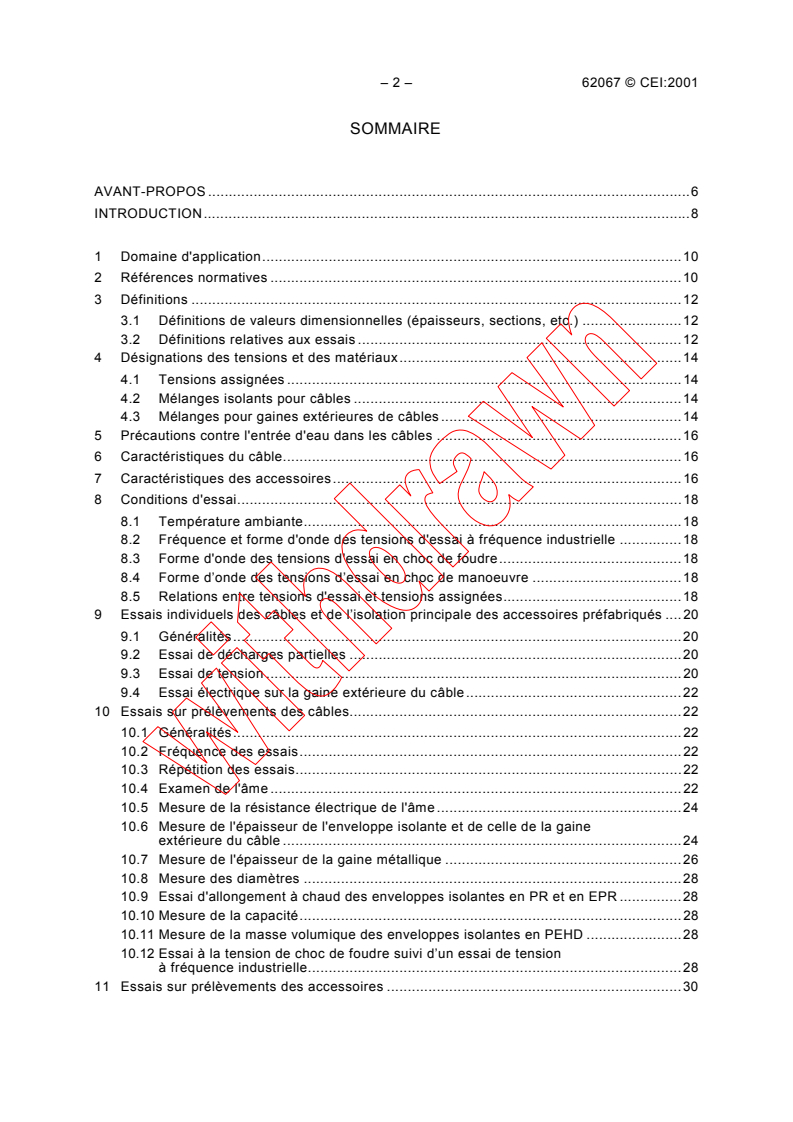
IEC 62067:2001 - Power cables with extruded insulation and their accessories for rated voltages above 150 kV (Um = 170 kV) up to 500 kV (Um = 550 kV) - Test methods and requirements Released:10/24/2001
IEC 62067:2001+AMD1:2006 CSV - Power cables with extruded insulation and their accessories for rated voltages above 150 kV (Um = 170 kV) up to 500 kV (Um = 550 kV) - Test methods and requirements Released:3/14/2006
Overview
IEC 62067:2001 is an international standard developed by the International Electrotechnical Commission (IEC). The standard specifies the test methods and requirements for power cable systems with extruded insulation and their accessories, designed for rated voltages above 150 kV (Um = 170 kV) up to 500 kV (Um = 550 kV). It applies to single-core cables and their accessories used in fixed installations under typical operating conditions. This standard plays a crucial role in ensuring the reliability, safety, and long-term performance of extra-high voltage (EHV) cable systems forming the backbone of modern power transmission networks.
Key Topics
- Scope and Applicability
- Covers cables with extruded insulation and accessories for fixed installations, specifically for voltages above 150 kV up to 500 kV.
- Excludes special cables, such as submarine cables, which may require adapted or additional testing.
- Test Methods
- Defines routine, sample, type, and prequalification tests for cables and accessories.
- Specifies electrical (partial discharge, voltage, impulse, capacitance), mechanical, and material-based tests.
- Test procedures address thermal aging, dimensional measurements, water penetration, and performance after installation.
- Rated Voltages and Materials
- Details voltage designations (U0, U, Um).
- Specifies types of insulating and oversheathing materials appropriate for EHV cables.
- Cable and Accessory Characteristics
- Sets out the required documentation of cable and accessory technical data, including physical and electrical properties.
- Defines identification and assembly requirements for connectors and terminations.
- Performance and Reliability
- Emphasizes reliability due to the strategic role of EHV cables in transmission systems.
- Introduces the prequalification test to assess long-term system reliability.
Applications
IEC 62067:2001 is widely adopted in the power utilities, transmission network operators, and cable manufacturing industries. The standard supports:
- Design and Qualification: Ensures that new EHV cable systems are designed and tested for their intended application and system voltage.
- Manufacturing Quality Control: Provides a framework for routine factory tests and sample checks to maintain product consistency.
- Installation and Commissioning: Guides field testing after installation to verify system integrity and operational readiness.
- Procurement and Specification: Serves as a reference in technical specifications for procurement, supporting bidding and project contracts.
- Lifecycle Asset Management: Facilitates asset reliability and risk assessment by specifying maintenance testing regimes and performance criteria.
Related Standards
For comprehensive cable system compliance and testing, consider these related IEC standards:
- IEC 60840: Power cables with extruded insulation and their accessories for rated voltages above 30 kV (Um = 36 kV) up to 150 kV (Um = 170 kV) – Test methods and requirements
- IEC 60228: Conductors of insulated cables
- IEC 60229: Tests on cable oversheaths with special protective functions
- IEC 60811 Series: Common test methods for insulating and sheathing materials of electric and optical cables
- IEC 60060-1: High-voltage test techniques – Part 1: General definitions and test requirements
- IEC 60885-3: Test methods for partial discharge measurements on lengths of extruded power cables
By aligning with IEC 62067:2001, manufacturers and utilities can ensure that EHV power cable systems are safe, reliable, and fit for purpose in modern high-voltage transmission grids. This standard is essential for anyone involved in the specification, design, installation, or maintenance of extra-high voltage cable systems.
Relations
- Effective Date
- 05-Sep-2023
- Effective Date
- 05-Sep-2023
Buy Documents
IEC 62067:2001 - Power cables with extruded insulation and their accessories for rated voltages above 150 kV (Um = 170 kV) up to 500 kV (Um = 550 kV) - Test methods and requirements Released:10/24/2001
IEC 62067:2001+AMD1:2006 CSV - Power cables with extruded insulation and their accessories for rated voltages above 150 kV (Um = 170 kV) up to 500 kV (Um = 550 kV) - Test methods and requirements Released:3/14/2006
Get Certified
Connect with accredited certification bodies for this standard

IMQ S.p.A. (Certification)
Italian electrical product certification.

SLG Prüf- und Zertifizierungs GmbH
German testing and certification body.

UL Solutions
Global safety science company with testing, inspection and certification.
Sponsored listings
Frequently Asked Questions
IEC 62067:2001 is a standard published by the International Electrotechnical Commission (IEC). Its full title is "Power cables with extruded insulation and their accessories for rated voltages above 150 kV (Um = 170 kV) up to 500 kV (Um = 550 kV) - Test methods and requirements". This standard covers: Specifies test methods and requirements for power cable systems, cables with extruded insulation and their accessories for fixed installations, for rated voltages above 150 kV (Um = 170 kV) up to and including 500 kV (Um = 550 kV). The requirements apply to single-core cables and to their accessories for usual conditions of installation and operation, but not to special cables and their accessories, such as submarine cables, for which modifications to the standard tests may be necessary or special test conditions may need to be devised.
Specifies test methods and requirements for power cable systems, cables with extruded insulation and their accessories for fixed installations, for rated voltages above 150 kV (Um = 170 kV) up to and including 500 kV (Um = 550 kV). The requirements apply to single-core cables and to their accessories for usual conditions of installation and operation, but not to special cables and their accessories, such as submarine cables, for which modifications to the standard tests may be necessary or special test conditions may need to be devised.
IEC 62067:2001 is classified under the following ICS (International Classification for Standards) categories: 29.060.20 - Cables. The ICS classification helps identify the subject area and facilitates finding related standards.
IEC 62067:2001 has the following relationships with other standards: It is inter standard links to IEC 62067:2001/AMD1:2006, IEC 62067:2011. Understanding these relationships helps ensure you are using the most current and applicable version of the standard.
IEC 62067:2001 is available in PDF format for immediate download after purchase. The document can be added to your cart and obtained through the secure checkout process. Digital delivery ensures instant access to the complete standard document.
Standards Content (Sample)
NORME CEI
INTERNATIONALE IEC
INTERNATIONAL
Première édition
STANDARD
First edition
2001-10
Câbles d'énergie à isolation extrudée
et leurs accessoires pour des tensions
assignées supérieures à 150 kV (U = 170 kV)
m
et jusqu'à 500 kV (U = 550 kV) –
m
Méthodes et prescriptions d'essai
Power cables with extruded insulation
and their accessories for rated voltages above
150 kV (U = 170 kV) up to 500 kV (U = 550 kV) –
m m
Test methods and requirements
Numéro de référence
Reference number
CEI/IEC 62067:2001
Numérotation des publications Publication numbering
Depuis le 1er janvier 1997, les publications de la CEI As from 1 January 1997 all IEC publications are
sont numérotées à partir de 60000. Ainsi, la CEI 34-1 issued with a designation in the 60000 series. For
devient la CEI 60034-1. example, IEC 34-1 is now referred to as IEC 60034-1.
Editions consolidées Consolidated editions
Les versions consolidées de certaines publications de la The IEC is now publishing consolidated versions of its
CEI incorporant les amendements sont disponibles. Par publications. For example, edition numbers 1.0, 1.1
exemple, les numéros d’édition 1.0, 1.1 et 1.2 indiquent and 1.2 refer, respectively, to the base publication,
respectivement la publication de base, la publication de the base publication incorporating amendment 1 and
base incorporant l’amendement 1, et la publication de the base publication incorporating amendments 1
base incorporant les amendements 1 et 2. and 2.
Informations supplémentaires Further information on IEC publications
sur les publications de la CEI
Le contenu technique des publications de la CEI est The technical content of IEC publications is kept
constamment revu par la CEI afin qu'il reflète l'état under constant review by the IEC, thus ensuring that
actuel de la technique. Des renseignements relatifs à the content reflects current technology. Information
cette publication, y compris sa validité, sont dispo- relating to this publication, including its validity, is
nibles dans le Catalogue des publications de la CEI available in the IEC Catalogue of publications
(voir ci-dessous) en plus des nouvelles éditions, (see below) in addition to new editions, amendments
amendements et corrigenda. Des informations sur les and corrigenda. Information on the subjects under
sujets à l’étude et l’avancement des travaux entrepris consideration and work in progress undertaken by the
par le comité d’études qui a élaboré cette publication, technical committee which has prepared this
ainsi que la liste des publications parues, sont publication, as well as the list of publications issued,
également disponibles par l’intermédiaire de: is also available from the following:
• Site web de la CEI (www.iec.ch) • IEC Web Site (www.iec.ch)
• Catalogue des publications de la CEI • Catalogue of IEC publications
Le catalogue en ligne sur le site web de la CEI The on-line catalogue on the IEC web site
(www.iec.ch/catlg-f.htm) vous permet de faire des (www.iec.ch/catlg-e.htm) enables you to search
recherches en utilisant de nombreux critères, by a variety of criteria including text searches,
comprenant des recherches textuelles, par comité technical committees and date of publication. On-
d’études ou date de publication. Des informations line information is also available on recently
en ligne sont également disponibles sur les issued publications, withdrawn and replaced
nouvelles publications, les publications rempla- publications, as well as corrigenda.
cées ou retirées, ainsi que sur les corrigenda.
• IEC Just Published
• IEC Just Published
Ce résumé des dernières publications parues
This summary of recently issued publications
(www.iec.ch/JP.htm) est aussi disponible par
(www.iec.ch/JP.htm) is also available by email.
courrier électronique. Veuillez prendre contact
Please contact the Customer Service Centre (see
avec le Service client (voir ci-dessous) pour plus
below) for further information.
d’informations.
• Service clients
• Customer Service Centre
Si vous avez des questions au sujet de cette
If you have any questions regarding this
publication ou avez besoin de renseignements
publication or need further assistance, please
supplémentaires, prenez contact avec le Service
contact the Customer Service Centre:
clients:
Email: custserv@iec.ch
Email: custserv@iec.ch
Tél: +41 22 919 02 11
Tel: +41 22 919 02 11
Fax: +41 22 919 03 00
Fax: +41 22 919 03 00
.
NORME CEI
INTERNATIONALE IEC
INTERNATIONAL
Première édition
STANDARD
First edition
2001-10
Câbles d'énergie à isolation extrudée
et leurs accessoires pour des tensions
assignées supérieures à 150 kV (U = 170 kV)
m
et jusqu'à 500 kV (U = 550 kV) –
m
Méthodes et prescriptions d'essai
Power cables with extruded insulation
and their accessories for rated voltages above
150 kV (U = 170 kV) up to 500 kV (U = 550 kV) –
m m
Test methods and requirements
IEC 2001 Droits de reproduction réservés Copyright - all rights reserved
Aucune partie de cette publication ne peut être reproduite ni No part of this publication may be reproduced or utilized in
utilisée sous quelque forme que ce soit et par aucun procédé, any form or by any means, electronic or mechanical,
électronique ou mécanique, y compris la photocopie et les including photocopying and microfilm, without permission in
microfilms, sans l'accord écrit de l'éditeur. writing from the publisher.
International Electrotechnical Commission 3, rue de Varembé Geneva, Switzerland
Telefax: +41 22 919 0300 e-mail: inmail@iec.ch IEC web site http://www.iec.ch
CODE PRIX
Commission Electrotechnique Internationale
W
PRICE CODE
International Electrotechnical Commission
Pour prix, voir catalogue en vigueur
For price, see current catalogue
– 2 – 62067 © CEI:2001
SOMMAIRE
AVANT-PROPOS .6
INTRODUCTION.8
1 Domaine d'application.10
2 Références normatives .10
3 Définitions .12
3.1 Définitions de valeurs dimensionnelles (épaisseurs, sections, etc.) .12
3.2 Définitions relatives aux essais .12
4 Désignations des tensions et des matériaux.14
4.1 Tensions assignées .14
4.2 Mélanges isolants pour câbles .14
4.3 Mélanges pour gaines extérieures de câbles .14
5 Précautions contre l'entrée d'eau dans les câbles .16
6 Caractéristiques du câble.16
7 Caractéristiques des accessoires.16
8 Conditions d'essai.18
8.1 Température ambiante.18
8.2 Fréquence et forme d'onde des tensions d'essai à fréquence industrielle .18
8.3 Forme d'onde des tensions d'essai en choc de foudre.18
8.4 Forme d’onde des tensions d’essai en choc de manoeuvre .18
8.5 Relations entre tensions d'essai et tensions assignées.18
9 Essais individuels des câbles et de l’isolation principale des accessoires préfabriqués .20
9.1 Généralités.20
9.2 Essai de décharges partielles .20
9.3 Essai de tension .20
9.4 Essai électrique sur la gaine extérieure du câble.22
10 Essais sur prélèvements des câbles.22
10.1 Généralités.22
10.2 Fréquence des essais.22
10.3 Répétition des essais.22
10.4 Examen de l'âme .22
10.5 Mesure de la résistance électrique de l'âme.24
10.6 Mesure de l'épaisseur de l'enveloppe isolante et de celle de la gaine
extérieure du câble .24
10.7 Mesure de l'épaisseur de la gaine métallique .26
10.8 Mesure des diamètres .28
10.9 Essai d'allongement à chaud des enveloppes isolantes en PR et en EPR .28
10.10 Mesure de la capacité.28
10.11 Mesure de la masse volumique des enveloppes isolantes en PEHD .28
10.12 Essai à la tension de choc de foudre suivi d’un essai de tension
à fréquence industrielle.28
11 Essais sur prélèvements des accessoires .30
62067 © IEC:2001 – 3 –
CONTENTS
FOREWORD.7
INTRODUCTION.9
1 Scope.11
2 Normative references.11
3 Definitions .13
3.1 Definitions of dimensional values (thicknesses, cross-sections, etc.) .13
3.2 Definitions concerning the tests .13
4 Voltage designations and materials .15
4.1 Rated voltages .15
4.2 Cable insulating materials.15
4.3 Cable oversheathing materials .15
5 Precautions against water penetration in cables .17
6 Cable characteristics .17
7 Accessory characteristics.17
8 Test conditions .19
8.1 Ambient temperature .19
8.2 Frequency and waveform of power frequency test voltages .19
8.3 Waveform of lightning impulse test voltage .19
8.4 Waveform of switching impulse test voltage .19
8.5 Relationship of test voltages to rated voltages.19
9 Routine tests on cables and on the main insulation of prefabricated accessories .21
9.1 General .21
9.2 Partial discharge test .21
9.3 Voltage test .21
9.4 Electrical test on oversheath of the cable .23
10 Sample tests on cables.23
10.1 General .23
10.2 Frequency of tests .23
10.3 Repetition of tests.23
10.4 Conductor examination .23
10.5 Measurement of electrical resistance of conductor .25
10.6 Measurement of thickness of insulation and cable oversheath.25
10.7 Measurement of thickness of metallic sheath .27
10.8 Measurement of diameter .29
10.9 Hot set test for XLPE and EPR insulations .29
10.10 Measurement of capacitance .29
10.11 Measurement of density of HDPE insulation .29
10.12 Lightning impulse voltage test followed by a power frequency voltage test .29
11 Sample tests on accessories.31
– 4 – 62067 © CEI:2001
12 Essais de type des systèmes de câbles.30
12.1 Généralités.30
12.2 Etendue de l'acceptation de type.30
12.3 Résumé des essais de type .32
12.4 Essais électriques sur systèmes de câble complet .32
12.5 Essais de type non électriques sur les constituants du câble et sur câble
complet .40
13 Essai de préqualification sur le système de câble.46
13.1 Domaine d’acceptation de l’essai de préqualification .46
13.2 Essai de préqualification sur système de câble complet .48
14 Essais électriques après pose.50
14.1 Essai sous tension continue de la gaine extérieure.50
14.2 Essai sous tension alternative de l’enveloppe isolante.50
Annexe A (normative) Arrondissement des nombres.64
Annexe B (normative) Méthode de mesure de la résistivité des écrans semi-
conducteurs .66
Annexe C (normative) Essai de pénétration d'eau.70
Annexe D (normative) Essais de la protection externe des jonctions enterrées.74
Bibliographie .78
Figure B.1 – Préparation des échantillons pour la mesure de la résistivité des écrans
sur âme et sur enveloppe isolante .68
Figure C.1 – Schéma de principe de l’appareillage pour l’essai de pénétration d’eau.72
Tableau 1 – Mélanges isolants pour câbles .52
Tableau 2 – Prescriptions pour tan δ pour les mélanges isolants pour câbles.52
Tableau 3 – Tensions d’essai .52
Tableau 4 – Essais de type non électriques pour mélanges pour enveloppes isolantes
et pour gaines extérieures de câbles .54
Tableau 5 – Prescriptions d'essai pour les caractéristiques mécaniques des mélanges
pour enveloppes isolantes de câbles (avant et après vieillissement) .56
Tableau 6 – Prescriptions d'essai pour les caractéristiques mécaniques des mélanges
pour gaine extérieure de câbles (avant et après vieillissement).58
Tableau 7 – Prescriptions d'essai pour les caractéristiques particulières des mélanges
pour enveloppes isolantes de câbles .60
Tableau 8 – Taux de noir de carbone des mélanges à base de polyéthylène
thermoplastique pour gaines extérieures de câbles.60
Tableau 9 – Prescriptions d'essai pour les caractéristiques particulières des mélanges
à base de PVC pour gaines extérieures de câbles .62
Tableau 10 – Tensions d’essai alternatives après pose.62
Tableau D.1 – Essais aux ondes de choc .76
62067 © IEC:2001 – 5 –
12 Type tests on cable systems .31
12.1 General .31
12.2 Range of type approval .31
12.3 Summary of type tests .33
12.4 Electrical type tests on complete cable systems .33
12.5 Non-electrical type tests on cable components and on complete cable .41
13 Prequalification test of the cable system.47
13.1 Range of prequalification test approval .47
13.2 Prequalification test on complete cable system .49
14 Electrical tests after installation.51
14.1 DC voltage test of the oversheath .51
14.2 AC voltage test of the insulation.51
Annex A (normative) Rounding of numbers.65
Annex B (normative) Method of measuring resistivity of semi-conducting screens .67
Annex C (normative) Water penetration test .71
Annex D (normative) Tests of outer protection for buried joints .75
Bibliography .79
Figure B.1 – Preparation of samples for measurement of resistivity of conductor and
insulation screens .69
Figure C.1 – Schematic diagram of apparatus for water penetration test .73
Table 1 – Insulating compounds for cables .53
Table 2 – Tan δ requirements for insulating compounds for cables .53
Table 3 – Test voltages .53
Table 4 – Non-electrical type tests for insulating and oversheathing compounds
for cables.55
Table 5 – Test requirements for mechanical characteristics of insulating compounds
for cables (before and after ageing).57
Table 6 – Test requirements for mechanical characteristics of oversheathing
compounds for cables (before and after ageing) .59
Table 7 – Test requirements for particular characteristics of insulating compounds
for cables.61
Table 8 – Carbon black content of thermoplastic polyethylene oversheathing compounds
for cables.61
Table 9 – Test requirements for particular characteristics of PVC oversheathing
compounds for cables .63
Table 10 – AC test voltages after installation .63
Table D.1 – Impulse voltage tests.77
– 6 – 62067 © CEI:2001
COMMISSION ÉLECTROTECHNIQUE INTERNATIONALE
__________
CÂBLES D'ÉNERGIE À ISOLATION EXTRUDÉE ET LEURS ACCESSOIRES
POUR DES TENSIONS ASSIGNÉES SUPÉRIEURES À 150 kV (U = 170 kV)
m
ET JUSQU'À 500 kV (U = 550 kV) –
m
MÉTHODES ET PRESCRIPTIONS D'ESSAI
AVANT-PROPOS
1) La CEI (Commission Electrotechnique Internationale) est une organisation mondiale de normalisation
composée de l'ensemble des comités électrotechniques nationaux (Comités nationaux de la CEI). La CEI a
pour objet de favoriser la coopération internationale pour toutes les questions de normalisation dans les
domaines de l'électricité et de l'électronique. A cet effet, la CEI, entre autres activités, publie des Normes
internationales. Leur élaboration est confiée à des comités d'études, aux travaux desquels tout Comité national
intéressé par le sujet traité peut participer. Les organisations internationales, gouvernementales et non
gouvernementales, en liaison avec la CEI, participent également aux travaux. La CEI collabore étroitement
avec l'Organisation Internationale de Normalisation (ISO), selon des conditions fixées par accord entre les deux
organisations.
2) Les décisions ou accords officiels de la CEI concernant les questions techniques représentent, dans la mesure
du possible un accord international sur les sujets étudiés, étant donné que les Comités nationaux intéressés
sont représentés dans chaque comité d’études.
3) Les documents produits se présentent sous la forme de recommandations internationales. Ils sont publiés
comme normes, spécifications techniques, rapports techniques ou guides et agréés comme tels par les
Comités nationaux.
4) Dans le but d'encourager l'unification internationale, les Comités nationaux de la CEI s'engagent à appliquer de
façon transparente, dans toute la mesure possible, les Normes internationales de la CEI dans leurs normes
nationales et régionales. Toute divergence entre la norme de la CEI et la norme nationale ou régionale
correspondante doit être indiquée en termes clairs dans cette dernière.
5) La CEI n’a fixé aucune procédure concernant le marquage comme indication d’approbation et sa responsabilité
n’est pas engagée quand un matériel est déclaré conforme à l’une de ses normes.
6) L’attention est attirée sur le fait que certains des éléments de la présente Norme internationale peuvent faire
l’objet de droits de propriété intellectuelle ou de droits analogues. La CEI ne saurait être tenue pour
responsable de ne pas avoir identifié de tels droits de propriété et de ne pas avoir signalé leur existence.
La Norme internationale CEI 62067 a été établie par le Comité d'études 20 de la CEI: Câbles
électriques.
Le texte de cette norme est issu des documents suivants:
FDIS Rapport de vote
20/482/FDIS 20/489/RVD
Le rapport de vote indiqué dans le tableau ci-dessus donne toute information sur le vote ayant
abouti à l'approbation de cette norme.
Cette publication a été rédigée selon les Directives ISO/CEI, Partie 3.
Les annexes A, B, C et D font partie intégrante de cette norme.
Le comité a décidé que le contenu de cette publication ne sera pas modifié avant 2005. A cette
date, la publication sera
• reconduite;
• supprimée;
• remplacée par une édition révisée, ou
• amendée.
62067 © IEC:2001 – 7 –
INTERNATIONAL ELECTROTECHNICAL COMMISSION
___________
POWER CABLES WITH EXTRUDED INSULATION AND THEIR ACCESSORIES
FOR RATED VOLTAGES ABOVE 150 kV (U = 170 kV)
m
UP TO 500 kV (U = 550 kV) –
m
TEST METHODS AND REQUIREMENTS
FOREWORD
1) The IEC (International Electrotechnical Commission) is a worldwide organization for standardization comprising
all national electrotechnical committees (IEC National Committees). The object of the IEC is to promote
international co-operation on all questions concerning standardization in the electrical and electronic fields. To
this end and in addition to other activities, the IEC publishes International Standards. Their preparation is
entrusted to technical committees; any IEC National Committee interested in the subject dealt with may
participate in this preparatory work. International, governmental and non-governmental organizations liaising
with the IEC also participate in this preparation. The IEC collaborates closely with the International Organization
for Standardization (ISO) in accordance with conditions determined by agreement between the two
organizations.
2) The formal decisions or agreements of the IEC on technical matters express, as nearly as possible, an
international consensus of opinion on the relevant subjects since each technical committee has representation
from all interested National Committees.
3) The documents produced have the form of recommendations for international use and are published in the form
of standards, technical specifications, technical reports or guides and they are accepted by the National
Committees in that sense.
4) In order to promote international unification, IEC National Committees undertake to apply IEC International
Standards transparently to the maximum extent possible in their national and regional standards. Any
divergence between the IEC Standard and the corresponding national or regional standard shall be clearly
indicated in the latter.
5) The IEC provides no marking procedure to indicate its approval and cannot be rendered responsible for any
equipment declared to be in conformity with one of its standards.
6) Attention is drawn to the possibility that some of the elements of this International Standard may be the subject
of patent rights. The IEC shall not be held responsible for identifying any or all such patent rights.
International Standard IEC 62067 has been prepared by IEC technical committee 20: Electric
cables.
The text of this standard is based on the following documents:
FDIS Report on voting
20/482/FDIS 20/489/RVD
Full information on the voting for the approval of this standard can be found in the report on
voting indicated in the above table.
This publication has been drafted in accordance with the ISO/IEC Directives, Part 3.
Annexes A, B, C and D form an integral part of this standard.
The committee has decided that the contents of this publication will remain unchanged until
2005. At this date, the publication will be
• reconfirmed;
• withdrawn;
• replaced by a revised edition, or
• amended.
– 8 – 62067 © CEI:2001
INTRODUCTION
En raison des développements importants des réseaux de câbles à isolation extrudée pour les
tensions supérieures à 150 kV, le Comité d’études 21 de la CIGRE a constitué un groupe de
travail (GT) 21.03 en 1990, dont les termes de référence étaient « de préparer des
recommandations pour les essais de type électriques, les essais sur prélèvements et les
essais individuels, en étendant la norme CEI 60840 (1988) jusqu’à 400 kV, et de faire des
propositions pour les essais de préqualification/développement qui doivent être effectués a
minima ».
Le GT 21.03 a indiqué que l’extension de la CEI 60840 aux tensions supérieures à 150 kV
méritait une considération particulière en raison des facteurs suivants:
– ces câbles constituent l’un des éléments essentiels des réseaux de transport et, par
conséquent, les considérations de fiabilité sont de la plus haute importance;
– ces câbles et leurs accessoires fonctionnent sous des contraintes électriques supérieures
à celles des câbles de tensions jusqu’à 150 kV et, de ce fait, ont une marge de sécurité
plus restreinte par rapport à la performance intrinsèque des liaisons par câbles;
– ces câbles et leurs accessoires ont une épaisseur d’isolation plus forte que celle des
matériels jusqu’à 150 kV et sont donc soumis à des contraintes thermomécaniques plus
fortes;
– la conception et la compatibilité des câbles et de leurs accessoires deviennent plus
difficiles avec l’accroissement des niveaux de tension des réseaux.
Les recommandations du GT 21.03 ont été publiées dans Electra n°151 en décembre 1993 et
prises en compte par la CEI en 1995 dans la préparation de la présente norme pour les
réseaux de câbles à isolation extrudée de tensions supérieures à 150 kV. La CEI a cependant
considéré que cette norme devrait aussi couvrir le niveau 500 kV. Ainsi, lors de sa réunion de
septembre 1996, le Comité d’études 21 de la CIGRE a créé un groupe ad hoc 21.18 pour
étudier l’extension des recommandations initiales au niveau 500 kV. Les recommandations
mises à jour ont été citées dans Electra n° 193 en décembre 2000 et, de nouveau, prises en
compte dans la préparation de la présente norme.
Par rapport à la CEI 60840, première édition (1988), révisée et publiée en 1999 en tant que
CEI 60840, deuxième édition, il existe une différence majeure: la CIGRE a estimé que, afin
d’obtenir des indications sur la fiabilité à long terme d’un réseau de câbles, il est nécessaire de
procéder à un essai de vieillissement accéléré de longue durée. Cet essai, dénommé «essai
de préqualification», doit être effectué sur le système complet comprenant câble, jonctions et
extrémités afin de démontrer la performance du système.
En outre, le GT 21.09 de la CIGRE, dont la tâche était d’étudier les essais après la pose des
réseaux de câbles haute tension à isolation extrudée, a publié ses recommandations dans
Electra n° 173 en août 1997. Celles-ci ont également été prises en compte dans la préparation
de la présente Norme internationale. Ces recommandations indiquent, entre autres, qu'il
convient que les essais sous tension continue soient évités sur l’isolation principale car ils sont
à la fois inefficaces et dangereux. Par contre, les essais sous tension continue sont
recommandés sur les gaines extérieures.
Une liste des références CIGRE appropriées est donnée dans la bibliographie.
62067 © IEC:2001 – 9 –
INTRODUCTION
As a result of major developments in cable systems with extruded insulation for voltages above
150 kV, CIGRE Study Committee 21 set up Working Group (WG) 21.03 in 1990. The terms of
reference of WG 21.03 were "to prepare recommendations for electrical type tests, sample and
routine tests, based on extending IEC 60840 (1988) up to 400 kV and to make proposals for
prequalification/development tests which, as a minimum, should be performed ".
WG 21.03 reported that the extension of IEC 60840 to voltages above 150 kV needed extra
consideration because of the following factors:
– such cables form part of the backbone of the transmission system and, therefore, reliability
considerations are of the highest priority;
– these cables and their accessories operate with higher electrical stresses than cables up to
150 kV and, as a result, have a smaller safety margin with respect to the intrinsic
performance boundaries of the cable system;
– such cables and accessories have a thicker insulation wall than those up to 150 kV and, as
a result, are subjected to greater thermomechanical effects;
– the design and coordination of the cables and accessories become more difficult with
increasing system voltage levels.
The recommendations of the WG 21.03 were published in Electra No. 151 in December 1993
and taken into account by IEC in 1995 in the preparation of this standard for cable systems
with extruded insulation for voltages above 150 kV. IEC considered that this new standard
should also cover the 500 kV level. Thus, at its meeting in September 1996, CIGRE Study
Committee 21 set up a Task Force 21.18 to study the extension of the initial recommendations
to the 500 kV level. The updated recommendations were cited in Electra No. 193 in December
2000 and again taken into account by IEC in the preparation of this standard.
Compared with IEC 60840, first edition (1988), revised and published in 1999 as IEC 60840
edition 2, there is a major difference: CIGRE advised that, in order to gain some indication of
the long term reliability of a cable system, it is necessary to carry out a long term accelerated
ageing test. This test, known as the "prequalification test", is to be performed on the complete
system comprising the cable, joints and terminations in order to demonstrate the performance
of the system.
In addition, CIGRE WG 21.09, given the task to study tests after installation on high-voltage
extruded insulation cable systems, published its recommendations in Electra No 173 in August
1997. In the preparation of this International Standard, account has also been taken of these
recommendations which state, among others, that d.c. tests should be avoided on the main
insulation, as they are both ineffective and dangerous. On the other hand, d.c. tests are
recommended on the oversheath.
A list of relevant CIGRE references is given in the bibliography.
– 10 – 62067 © CEI:2001
CÂBLES D'ÉNERGIE À ISOLATION EXTRUDÉE ET LEURS ACCESSOIRES
POUR DES TENSIONS ASSIGNÉES SUPÉRIEURES À 150 kV (U = 170 kV)
m
ET JUSQU'À 500 kV (U = 550 kV) –
m
MÉTHODES ET PRESCRIPTIONS D'ESSAI
1 Domaine d'application
La présente Norme internationale spécifie les méthodes et les prescriptions d'essai
applicables aux systèmes de câbles d’énergie, comprenant les câbles à isolation extrudée et
leurs accessoires pour installations fixes, pour des tensions assignées supérieures à 150 kV
(U = 170 kV) et jusqu'à 500 kV compris (U = 550 kV).
m m
Les prescriptions sont applicables aux câbles unipolaires et à leurs accessoires, pour des
conditions habituelles d'installation et de fonctionnement, mais ne le sont pas à des câbles
spéciaux et à leurs accessoires comme les câbles sous-marins, pour lesquels il peut être
nécessaire d'apporter des modifications aux essais normaux ou d’élaborer des conditions
d'essai particulières.
2 Références normatives
Les documents normatifs suivants contiennent des dispositions qui, par suite de la référence
qui y est faite, constituent des dispositions valables pour la présente Norme internationale.
Pour les références datées, les amendements ultérieurs ou les révisions de ces publications
ne s’appliquent pas. Toutefois, les parties prenantes aux accords fondés sur la présente
Norme internationale sont invitées à rechercher la possibilité d’appliquer les éditions les plus
récentes des documents normatifs indiqués ci-après. Pour les références non datées, la
dernière édition du document normatif en référence s’applique. Les membres de l’ISO et de la
CEI possèdent le registre des Normes internationales en vigueur.
CEI 60060-1:1989, Techniques des essais à haute tension – Première partie: Définitions et
prescriptions générales relatives aux essais
CEI 60183:1984, Guide pour le choix des câbles à haute tension
CEI 60228:1978, Ames des câbles isolés
CEI 60229:1982, Essais sur les gaines extérieures des câbles, qui ont une fonction spéciale
de protection et sont appliqués par extrusion
CEI 60230:1966, Essais de choc des câbles et de leurs accessoires
CEI 60332-1:1993, Essais des câbles électriques soumis au feu – Partie 1: Essais sur un
conducteur ou câble isolé vertical
CEI 60811-1-1:1993, Méthodes d’essais communes pour les matériaux d’isolation et de
gainage des câbles électriques – Partie 1: Méthodes d'application générale – Section 1: Mesure
des épaisseurs et des dimensions extérieures – Détermination des propriétés mécaniques
CEI 60811-1-2:1985, Méthodes d’essais communes pour les matériaux d’isolation et de
gainage des câbles électriques – Première partie: Méthodes d'application générale –
Section 2: Méthodes de vieillissement thermique
CEI 60811-1-3:1993, Matériaux d’isolation et de gainage des câbles électriques – Méthodes
d’essais communes – Partie 1: Application générale – Section 3: Méthodes de détermination
de la masse volumique – Essais d'absorption d'eau – Essai de rétraction
62067 © IEC:2001 – 11 –
POWER CABLES WITH EXTRUDED INSULATION AND THEIR ACCESSORIES
FOR RATED VOLTAGES ABOVE 150 kV (U = 170 kV)
m
UP TO 500 kV (U = 550 kV) –
m
TEST METHODS AND REQUIREMENTS
1 Scope
This International Standard specifies test methods and requirements for power cable systems,
cables with extruded insulation and their accessories for fixed installations, for rated voltages
above 150 kV (U = 170 kV) up to and including 500 kV (U = 550 kV).
m m
The requirements apply to single-core cables and to their accessories for usual conditions of
installation and operation, but not to special cables and their accessories, such as submarine
cables, for which modifications to the standard tests may be necessary or special test
conditions may need to be devised.
2 Normative references
The following normative documents contain provisions which, through reference in this text,
constitute provisions of this International Standard. For dated references, subsequent
amendments to, or revision of, any of these publications do not apply. However, parties to
agreements based on this International Standard are encouraged to investigate the possibility
of applying the most recent editions of the normative documents indicated below. For undated
references, the latest edition of the normative document referred to applies. Members of ISO
and IEC maintain registers of currently valid International Standards.
IEC 60060-1:1989, High-voltage test techniques – Part 1: General definitions and test
requirements
IEC 60183:1984, Guide to the selection of high-voltage cables
IEC 60228:1978, Conductors of insulated cables
IEC 60229:1982, Tests on cable oversheaths which have a special protective function and are
applied by extrusion
IEC 60230:1966, Impulse tests on cables and their accessories
IEC 60332-1:1993, Tests on electric cables under fire conditions – Part 1: Test on a single
vertical insulated wire or cable
IEC 60811-1-1:1993, Common test methods for insulating and sheathing materials of electric
cables – Part 1: Methods for general application – Section 1: Measurement of thickness and
overall dimensions – Tests for determining the mechanical properties
IEC 60811-1-2:1985, Common test methods for insulating and sheathing materials of electric
cables – Part 1: Methods for general application – Section 2: Thermal ageing methods
IEC 60811-1-3:1993, Insulating and sheathing materials of electric cables – Common test
methods – Part 1: General application – Section 3: Methods for determining the density –
Water absorption tests – Shrinkage test
– 12 – 62067 © CEI:2001
CEI 60811-1-4:1985, Méthodes d’essais communes pour les matériaux d’isolation et de
gainage des câbles électriques – Première partie: Méthodes d'application générale –
Section quatre: Essais à basse température
CEI 60811-2-1:1998, Matériaux d'isolation et de gainage des câbles électriques et optiques –
Méthodes d'essais communes – Partie 2-1: Méthodes spécifiques pour les mélanges élastomères –
Essais relatifs à la résistance à l'ozone, à l'allongement à chaud et à la résistance à l'huile
CEI 60811-3-1:1985, Méthodes d’essais communes pour les matériaux d’isolation et de gainage
des câbles électriques – Troisième partie: Méthodes spécifiques pour les mélanges PVC –
Section une: Essai de pression à température élevée – Essais de résistance à la fissuration
CEI 60811-3-2:1985, Méthodes d’essais communes pour les matériaux d’isolation et de
gainage des câbles électriques – Troisième partie: Méthodes spécifiques pour les mélanges
PVC – Section deux: Essai de perte de masse – Essai de stabilité thermique
CEI 60811-4-1:1985, Méthodes d’essais communes pour les matériaux d’isolation et de
gainage des câbles électriques – Quatrième partie: Méthodes spécifiques pour les mélanges
polyéthylène et polypropylène – Section un: Résistance aux craquelures sous contraintes dues
à l'environnement – Essai d'enroulement après vieillissement thermique dans l'air – Mesure de
l’indice de fluidité à chaud – Mesure dans le PE du taux de noir de carbone et/ou des charges
minérales
CEI 60885-3:1988, Méthodes d’essais électriques pour les câbles électriques – Troisième
partie: Méthodes d’essais pour mesures de décharges partielles sur longueurs de câbles de
puissance extrudés
3 Définitions
Pour les besoins de la présente Norme internationale, les définitions suivantes s'appliquent.
3.1 Définitions de valeurs dimensionnelles (épaisseurs, sections, etc.)
3.1.1
valeur nominale
valeur par laquelle une grandeur est dénommée et qui est souvent utilisée dans les tableaux
NOTE Régulièrement, dans cette norme, les valeurs nominales correspondent à des valeurs qui sont vérifiées par
des mesures, en tenant compte des tolérances spécifiées.
3.1.2
valeur médiane
quand plusieurs résultats d'essais sont obtenus et classés par ordre de valeurs croissantes
(ou décroissantes), valeur du milieu de la série si le nombre de valeurs disponibles est impair,
et moyenne arithmétique des deux valeurs centrales de la série si le nombre est pair
3.2 Définitions relatives aux essais
3.2.1
essais individuels
essais effectués par le fabrica
...
IEC 62067
Edition 1.1 2006-03
INTERNATIONAL
STANDARD
NORME
INTERNATIONALE
Power cables with extruded insulation and their accessories for rated voltages
above 150 kV (U = 170 kV) up to 500 kV (U = 550 kV) – Test methods
m m
and requirements
Câbles d'énergie à isolation extrudée et leurs accessoires pour des tensions
assignées supérieures à 150 kV (U = 170 kV) et jusqu'à 500 kV (U = 550 kV) –
m m
Méthodes et prescriptions d'essai
All rights reserved. Unless otherwise specified, no part of this publication may be reproduced or utilized in any form or by
any means, electronic or mechanical, including photocopying and microfilm, without permission in writing from either IEC or
IEC's member National Committee in the country of the requester.
If you have any questions about IEC copyright or have an enquiry about obtaining additional rights to this publication,
please contact the address below or your local IEC member National Committee for further information.
Droits de reproduction réservés. Sauf indication contraire, aucune partie de cette publication ne peut être reproduite
ni utilisée sous quelque forme que ce soit et par aucun procédé, électronique ou mécanique, y compris la photocopie
et les microfilms, sans l'accord écrit de la CEI ou du Comité national de la CEI du pays du demandeur.
Si vous avez des questions sur le copyright de la CEI ou si vous désirez obtenir des droits supplémentaires sur cette
publication, utilisez les coordonnées ci-après ou contactez le Comité national de la CEI de votre pays de résidence.
IEC Central Office
3, rue de Varembé
CH-1211 Geneva 20
Switzerland
Email: inmail@iec.ch
Web: www.iec.ch
About the IEC
The International Electrotechnical Commission (IEC) is the leading global organization that prepares and publishes
International Standards for all electrical, electronic and related technologies.
About IEC publications
The technical content of IEC publications is kept under constant review by the IEC. Please make sure that you have the
latest edition, a corrigenda or an amendment might have been published.
ƒ Catalogue of IEC publications: www.iec.ch/searchpub
The IEC on-line Catalogue enables you to search by a variety of criteria (reference number, text, technical committee,…).
It also gives information on projects, withdrawn and replaced publications.
ƒ IEC Just Published: www.iec.ch/online_news/justpub
Stay up to date on all new IEC publications. Just Published details twice a month all new publications released. Available
on-line and also by email.
ƒ Electropedia: www.electropedia.org
The world's leading online dictionary of electronic and electrical terms containing more than 20 000 terms and definitions
in English and French, with equivalent terms in additional languages. Also known as the International Electrotechnical
Vocabulary online.
ƒ Customer Service Centre: www.iec.ch/webstore/custserv
If you wish to give us your feedback on this publication or need further assistance, please visit the Customer Service
Centre FAQ or contact us:
Email: csc@iec.ch
Tel.: +41 22 919 02 11
Fax: +41 22 919 03 00
A propos de la CEI
La Commission Electrotechnique Internationale (CEI) est la première organisation mondiale qui élabore et publie des
normes internationales pour tout ce qui a trait à l'électricité, à l'électronique et aux technologies apparentées.
A propos des publications CEI
Le contenu technique des publications de la CEI est constamment revu. Veuillez vous assurer que vous possédez
l’édition la plus récente, un corrigendum ou amendement peut avoir été publié.
ƒ Catalogue des publications de la CEI: www.iec.ch/searchpub/cur_fut-f.htm
Le Catalogue en-ligne de la CEI vous permet d’effectuer des recherches en utilisant différents critères (numéro de référence,
texte, comité d’études,…). Il donne aussi des informations sur les projets et les publications retirées ou remplacées.
ƒ Just Published CEI: www.iec.ch/online_news/justpub
Restez informé sur les nouvelles publications de la CEI. Just Published détaille deux fois par mois les nouvelles
publications parues. Disponible en-ligne et aussi par email.
ƒ Electropedia: www.electropedia.org
Le premier dictionnaire en ligne au monde de termes électroniques et électriques. Il contient plus de 20 000 termes et
définitions en anglais et en français, ainsi que les termes équivalents dans les langues additionnelles. Egalement appelé
Vocabulaire Electrotechnique International en ligne.
ƒ Service Clients: www.iec.ch/webstore/custserv/custserv_entry-f.htm
Si vous désirez nous donner des commentaires sur cette publication ou si vous avez des questions, visitez le FAQ du
Service clients ou contactez-nous:
Email: csc@iec.ch
Tél.: +41 22 919 02 11
Fax: +41 22 919 03 00
IEC 62067
Edition 1.1 2006-03
INTERNATIONAL
STANDARD
NORME
INTERNATIONALE
Power cables with extruded insulation and their accessories for rated voltages
above 150 kV (U = 170 kV) up to 500 kV (U = 550 kV) – Test methods
m m
and requirements
Câbles d'énergie à isolation extrudée et leurs accessoires pour des tensions
assignées supérieures à 150 kV (U = 170 kV) et jusqu'à 500 kV (U = 550 kV) –
m m
Méthodes et prescriptions d'essai
INTERNATIONAL
ELECTROTECHNICAL
COMMISSION
COMMISSION
ELECTROTECHNIQUE
PRICE CODE
INTERNATIONALE
CM
CODE PRIX
ICS 29.060.20 ISBN 2-8318-8539-6
62067 © IEC:2001+A1:2006 – 3 –
– 2 – 62067 © IEC:2001+A1:2006
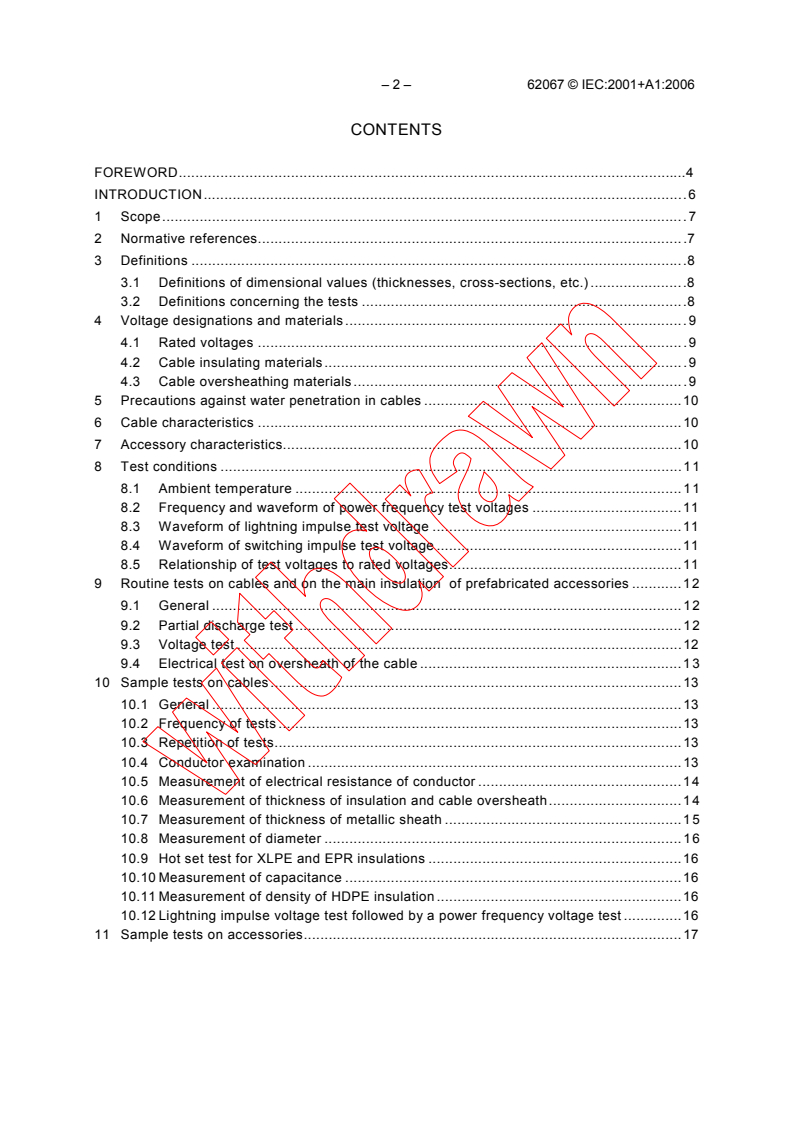
CONTENTS
FOREWORD.4
INTRODUCTION.6
1 Scope.7
2 Normative references.7
3 Definitions .8
3.1 Definitions of dimensional values (thicknesses, cross-sections, etc.) .8
3.2 Definitions concerning the tests .8
4 Voltage designations and materials .9
4.1 Rated voltages .9
4.2 Cable insulating materials.9
4.3 Cable oversheathing materials .9
5 Precautions against water penetration in cables .10
6 Cable characteristics .10
7 Accessory characteristics.10
8 Test conditions .11
8.1 Ambient temperature .11
8.2 Frequency and waveform of power frequency test voltages .11
8.3 Waveform of lightning impulse test voltage .11
8.4 Waveform of switching impulse test voltage .11
8.5 Relationship of test voltages to rated voltages.11
9 Routine tests on cables and on the main insulation of prefabricated accessories .12
9.1 General .12
9.2 Partial discharge test .12
9.3 Voltage test .12
9.4 Electrical test on oversheath of the cable .13
10 Sample tests on cables.13
10.1 General .13
10.2 Frequency of tests .13
10.3 Repetition of tests.13
10.4 Conductor examination .13
10.5 Measurement of electrical resistance of conductor .14
10.6 Measurement of thickness of insulation and cable oversheath.14
10.7 Measurement of thickness of metallic sheath .15
10.8 Measurement of diameter .16
10.9 Hot set test for XLPE and EPR insulations .16
10.10 Measurement of capacitance .16
10.11 Measurement of density of HDPE insulation .16
10.12 Lightning impulse voltage test followed by a power frequency voltage test .16
11 Sample tests on accessories.17
62067 © IEC:2001+A1:2006 – 5 –
62067 © IEC:2001+A1:2006 – 3 –
12 Type tests on cable systems .17
12.1 General .17
12.2 Range of type approval .17
12.3 Summary of type tests .18
12.4 Electrical type tests on complete cable systems .18
12.5 Non-electrical type tests on cable components and on complete cable .22
13 Prequalification test of the cable system.25
13.1 Range of prequalification test approval .25
13.2 Prequalification test on complete cable system .26
14 Electrical tests after installation.27
14.1 DC voltage test of the oversheath .27
14.2 AC voltage test of the insulation.27
Annex A (normative) Rounding of numbers.34
Annex B (normative) Method of measuring resistivity of semi-conducting screens.35
Annex C (normative) Water penetration test .37
Annex D (normative) Tests of outer protection for buried joints .39
Bibliography .41
Figure B.1 – Preparation of samples for measurement of resistivity of conductor and
insulation screens .36
Figure C.1 – Schematic diagram of apparatus for water penetration test .38
Table 1 – Insulating compounds for cables .28
Table 2 – Tan δ requirements for insulating compounds for cables .28
Table 3 – Test voltages .28
Table 4 – Non-electrical type tests for insulating and oversheathing compounds
for cables.29
Table 5 – Test requirements for mechanical characteristics of insulating compounds
for cables (before and after ageing).30
Table 6 – Test requirements for mechanical characteristics of oversheathing
compounds for cables (before and after ageing) .31
Table 7 – Test requirements for particular characteristics of insulating compounds
for cables.32
Table 8 – Carbon black content of thermoplastic polyethylene oversheathing compounds
for cables.32
Table 9 – Test requirements for particular characteristics of PVC oversheathing
compounds for cables .33
Table 10 – AC test voltages after installation .33
Table D.1 – Impulse voltage tests.40
62067 © IEC:2001+A1:2006 – 7 –
– 4 – 62067 © IEC:2001+A1:2006
INTERNATIONAL ELECTROTECHNICAL COMMISSION
____________
POWER CABLES WITH EXTRUDED INSULATION AND THEIR ACCESSORIES
FOR RATED VOLTAGES ABOVE 150 kV (U = 170 kV)
m
UP TO 500 kV (U = 550 kV) –
m
TEST METHODS AND REQUIREMENTS
FOREWORD
1) The International Electrotechnical Commission (IEC) is a worldwide organization for standardization comprising
all national electrotechnical committees (IEC National Committees). The object of IEC is to promote
international co-operation on all questions concerning standardization in the electrical and electronic fields. To
this end and in addition to other activities, IEC publishes International Standards, Technical Specifications,
Technical Reports, Publicly Available Specifications (PAS) and Guides (hereafter referred to as “IEC
Publication(s)”). Their preparation is entrusted to technical committees; any IEC National Committee interested
in the subject dealt with may participate in this preparatory work. International, governmental and non-
governmental organizations liaising with the IEC also participate in this preparation. IEC collaborates closely
with the International Organization for Standardization (ISO) in accordance with conditions determined by
agreement between the two organizations.
2) The formal decisions or agreements of IEC on technical matters express, as nearly as possible, an international
consensus of opinion on the relevant subjects since each technical committee has representation from all
interested IEC National Committees.
3) IEC Publications have the form of recommendations for international use and are accepted by IEC National
Committees in that sense. While all reasonable efforts are made to ensure that the technical content of IEC
Publications is accurate, IEC cannot be held responsible for the way in which they are used or for any
misinterpretation by any end user.
4) In order to promote international uniformity, IEC National Committees undertake to apply IEC Publications
transparently to the maximum extent possible in their national and regional publications. Any divergence
between any IEC Publication and the corresponding national or regional publication shall be clearly indicated in
the latter.
5) IEC provides no marking procedure to indicate its approval and cannot be rendered responsible for any
equipment declared to be in conformity with an IEC Publication.
6) All users should ensure that they have the latest edition of this publication.
7) No liability shall attach to IEC or its directors, employees, servants or agents including individual experts and
members of its technical committees and IEC National Committees for any personal injury, property damage or
other damage of any nature whatsoever, whether direct or indirect, or for costs (including legal fees) and
expenses arising out of the publication, use of, or reliance upon, this IEC Publication or any other IEC
Publications.
8) Attention is drawn to the Normative references cited in this publication. Use of the referenced publications is
indispensable for the correct application of this publication.
9) Attention is drawn to the possibility that some of the elements of this IEC Publication may be the subject of
patent rights. IEC shall not be held responsible for identifying any or all such patent rights.
International Standard IEC 62067 has been prepared by IEC technical committee 20: Electric
cables.
This consolidated version of IEC 62067 consists of the first edition (2001) [documents
20/482/FDIS and 20/489/RVD] and its amendment 1 (2006) [documents 20/784/FDIS and
20/802/RVD].
The technical content is therefore identical to the base edition and its amendment and has
been prepared for user convenience.
It bears the edition number 1.1.
A vertical line in the margin shows where the base publication has been modified by
amendment 1.
Annexes A, B, C and D form an integral part of this standard.
62067 © IEC:2001+A1:2006 – 9 –
62067 © IEC:2001+A1:2006 – 5 –
The committee has decided that the contents of the base publication and its amendments will
remain unchanged until the maintenance result date indicated on the IEC web site under
"http://webstore.iec.ch" in the data related to the specific publication. At this date,
the publication will be
• reconfirmed,
• withdrawn,
• replaced by a revised edition, or
• amended.
62067 © IEC:2001+A1:2006 – 11 –
– 6 – 62067 © IEC:2001+A1:2006
INTRODUCTION
As a result of major developments in cable systems with extruded insulation for voltages above
150 kV, CIGRE Study Committee 21 set up Working Group (WG) 21.03 in 1990. The terms of
reference of WG 21.03 were "to prepare recommendations for electrical type tests, sample and
routine tests, based on extending IEC 60840 (1988) up to 400 kV and to make proposals for
prequalification/development tests which, as a minimum, should be performed ".
WG 21.03 reported that the extension of IEC 60840 to voltages above 150 kV needed extra
consideration because of the following factors:
– such cables form part of the backbone of the transmission system and, therefore, reliability
considerations are of the highest priority;
– these cables and their accessories operate with higher electrical stresses than cables up to
150 kV and, as a result, have a smaller safety margin with respect to the intrinsic
performance boundaries of the cable system;
– such cables and accessories have a thicker insulation wall than those up to 150 kV and, as
a result, are subjected to greater thermomechanical effects;
– the design and coordination of the cables and accessories become more difficult with
increasing system voltage levels.
The recommendations of the WG 21.03 were published in Electra No. 151 in December 1993
and taken into account by IEC in 1995 in the preparation of this standard for cable systems
with extruded insulation for voltages above 150 kV. IEC considered that this new standard
should also cover the 500 kV level. Thus, at its meeting in September 1996, CIGRE Study
Committee 21 set up a Task Force 21.18 to study the extension of the initial recommendations
to the 500 kV level. The updated recommendations were cited in Electra No. 193 in December
2000 and again taken into account by IEC in the preparation of this standard.
Compared with IEC 60840, first edition (1988), revised and published in 1999 as IEC 60840
edition 2, there is a major difference: CIGRE advised that, in order to gain some indication of
the long term reliability of a cable system, it is necessary to carry out a long term accelerated
ageing test. This test, known as the "prequalification test", is to be performed on the complete
system comprising the cable, joints and terminations in order to demonstrate the performance
of the system.
In addition, CIGRE WG 21.09, given the task to study tests after installation on high-voltage
extruded insulation cable systems, published its recommendations in Electra No 173 in August
1997. In the preparation of this International Standard, account has also been taken of these
recommendations which state, among others, that d.c. tests should be avoided on the main
insulation, as they are both ineffective and dangerous. On the other hand, d.c. tests are
recommended on the oversheath.
A list of relevant CIGRE references is given in the bibliography.
62067 © IEC:2001+A1:2006 – 13 –
62067 © IEC:2001+A1:2006 – 7 –
POWER CABLES WITH EXTRUDED INSULATION AND THEIR ACCESSORIES
FOR RATED VOLTAGES ABOVE 150 kV (U = 170 kV)
m
UP TO 500 kV (U = 550 kV) –
m
TEST METHODS AND REQUIREMENTS
1 Scope
This International Standard specifies test methods and requirements for power cable systems,
cables with extruded insulation and their accessories for fixed installations, for rated voltages
above 150 kV (U = 170 kV) up to and including 500 kV (U = 550 kV).
m m
The requirements apply to single-core cables and to their accessories for usual conditions of
installation and operation, but not to special cables and their accessories, such as submarine
cables, for which modifications to the standard tests may be necessary or special test
conditions may need to be devised.
This standard does not cover transition joints between cables with extruded insulation and
paper insulated cables.
2 Normative references
The following referenced documents are indispensable for the application of this document. For
dated references, only the edition cited applies. For undated references, the latest edition of
the referenced document (including any amendments) applies.
IEC 60060-1:1989, High-voltage test techniques – Part 1: General definitions and test
requirements
IEC 60183:1984, Guide to the selection of high-voltage cables
IEC 60228:1978, Conductors of insulated cables
IEC 60229:1982, Tests on cable oversheaths which have a special protective function and are
applied by extrusion
IEC 60230:1966, Impulse tests on cables and their accessories
IEC 60332-1:1993, Tests on electric cables under fire conditions – Part 1: Test on a single
vertical insulated wire or cable
IEC 60811-1-1:1993, Common test methods for insulating and sheathing materials of electric
cables – Part 1: Methods for general application – Section 1: Measurement of thickness and
overall dimensions – Tests for determining the mechanical properties
IEC 60811-1-2:1985, Common test methods for insulating and sheathing materials of electric
cables – Part 1: Methods for general application – Section 2: Thermal ageing methods
IEC 60811-1-3:1993, Insulating and sheathing materials of electric cables – Common test
methods – Part 1: General application – Section 3: Methods for determining the density –
Water absorption tests – Shrinkage test
62067 © IEC:2001+A1:2006 – 15 –
– 8 – 62067 © IEC:2001+A1:2006
IEC 60811-1-4:1985, Common test methods for insulating and sheathing materials of electric
cables – Part 1: Methods for general application – Section Four: Tests at low temperature
IEC 60811-2-1:1998, Insulating and sheathing materials of electric and optical cables –
Common test methods – Part 2-1: Methods specific to elastomeric compounds – Ozone
resistance, hot set and mineral oil immersion tests
IEC 60811-3-1:1985, Common test methods for insulating and sheathing materials of electric
cables – Part 3: Methods specific to PVC compounds – Section One: Pressure test at high
temperature – Tests for resistance to cracking
IEC 60811-3-2:1985, Common test methods for insulating and sheathing materials of electric
cables – Part 3: Methods specific to PVC compounds – Section Two: Loss of mass test –
Thermal stability test
IEC 60811-4-1:1985, Common test methods for insulating and sheathing materials of electric
cables – Part 4: Methods specific to polyethylene and polypropylene compounds – Section
One: Resistance to environmental stress cracking – Wrapping test after thermal ageing in air –
Measurement of the melt flow index – Carbon black and/or mineral content measurement in PE
IEC 60840:2004, Power cables with extruded insulation and their accessories for rated
voltages above 30 kV (U = 36 kV) up to 150 kV (U = 170 kV) – Test methods and
m m
requirements.
IEC 60885-3:1988, Electrical test methods for electric cables – Part 3: Test methods for partial
discharge measurements on lengths of extruded power cables
3 Definitions
For the purpose of this International Standard, the following definitions apply.
3.1 Definitions of dimensional values (thicknesses, cross-sections, etc.)
3.1.1
nominal value
value by which a quantity is designated and which is often used in tables
NOTE Usually, in this standard, nominal values give rise to values to be checked by measurements taking into
account specified tolerances.
3.1.2
median value
when several test results have been obtained and ordered in an increasing (or decreasing)
succession, middle value if the number of available values is odd, and mean of the two middle
values if the number is even
3.2 Definitions concerning the tests
3.2.1
routine tests
tests made by the manufacturer on each manufactured component (length of cable or
accessory) to check that the component meets the specified requirements
3.2.2
sample tests
tests made by the manufacturer on samples of complete cable or components taken from a
complete cable or accessory, at a specified frequency, so as to verify that the finished product
meets the specified requirements
62067 © IEC:2001+A1:2006 – 17 –
62067 © IEC:2001+A1:2006 – 9 –
3.2.3
type tests
tests made before supplying on a general commercial basis a type of cable system covered by
this standard, in order to demonstrate satisfactory performance characteristics to meet the
intended application. Once successfully completed, these tests need not be repeated, unless
changes are made in the cable or accessory materials, or design or manufacturing process
which might change the performance characteristics
3.2.4
prequalification test
test made before supplying on a general commercial basis a type of cable system covered by
this standard, in order to demonstrate satisfactory long term performance of the complete
cable system. The prequalification test need only be carried out once unless there is a
substantial change in the cable system with respect to material, manufacturing process, design
and design levels
NOTE A substantial change is defined as that which might adversely affect the performance of the cable system.
The supplier should provide a detailed case, including test evidence, if modifications are introduced, which are
claimed not to constitute a substantial change.
3.2.5
electrical tests after installation
tests made to demonstrate the integrity of the cable system as installed
3.3
cable system
cable with installed accessories
4 Voltage designations and materials
4.1 Rated voltages
In this standard, the symbols U , U and U are used to designate the rated voltages of cables
0 m
and accessories where these symbols have the meanings given in IEC 60183.
4.2 Cable insulating materials
This standard applies to cables insulated with the materials listed in table 1, which also
specifies for cables with each type of insulating compound the maximum operating conductor
temperatures on which the specified test conditions are based.
4.3 Cable oversheathing materials
Tests are specified for four types of oversheath, as follows:
– ST and ST based on PVC;
1 2
– ST and ST based on polyethylene.
3 7
The choice of the type of oversheath will depend on the design of the cable and the mechanical
and thermal constraints during operation.
The maximum conductor temperatures in normal operation given in IEC 60840 apply to this
standard.
62067 © IEC:2001+A1:2006 – 19 –
– 10 – 62067 © IEC:2001+A1:2006
5 Precautions against water penetration in cables
When cable systems are installed in the ground, in easily flooded galleries or in water, a radial
water impermeable barrier around the cable is recommended.
NOTE A test for radial water penetration is not currently available.
Longitudinal water barriers may also be applied, either by agreement between the purchaser
and the manufacturer or as recommended by the manufacturer, to avoid the need to replace
long sections of cable in case of damage in the presence of water.
A test for longitudinal water penetration is given in 12.5.14.
6 Cable characteristics
For the purpose of carrying out and recording the tests described in this standard, the cable
shall be identified. The following characteristics shall be known or declared.
6.1 Rated voltage: values shall be given for U , U, U (see 4.1 and 8.5).
0 m
6.2 Type of conductor, its material and nominal cross-sectional area, in square millimetres.
Presence, if any, and nature of measures taken to achieve longitudinal watertightness. If the
nominal cross-sectional area is not in accordance with IEC 60228, the d.c. conductor
resistance shall be declared.
6.3 Material and nominal thickness of insulation (see 4.2).
6.4 Type of manufacturing process for insulation system.
6.5 Presence, if any, and nature of watertightness measures in screening area.
6.6 Material and construction of metallic screen, e.g. number and diameter of wires, if any.
Material, construction and nominal thickness of metallic sheath, if any. The d.c. resistance of
the metallic screen shall be declared.
6.7 Material and nominal thickness of oversheath.
6.8 Nominal diameter over conductor (d).
6.9 Nominal diameter over complete cable (D).
6.10 Nominal capacitance between conductor and metallic screen/sheath.
7 Accessory characteristics
For the purpose of carrying out and recording the tests described in this standard, the
accessory shall be identified. The following characteristics shall be known or declared.
7.1 Conductor connectors used within the accessories shall be correctly identified with
respect to
– assembly technique;
– tooling, dies and necessary setting;
– preparation of contact surfaces, if applicable;
– type, reference number and any other identification of the connector.
62067 © IEC:2001+A1:2006 – 21 –
62067 © IEC:2001+A1:2006 – 11 –
7.2 Accessories to be tested shall be correctly identified with respect to
– name of manufacturer;
– type, designation, manufacturing date or date code;
– rated voltage (see 6.1);
– installation instructions (reference and date).
8 Test conditions
8.1 Ambient temperature
Unless otherwise specified in the details for the particular test, tests shall be carried out at an
ambient temperature of (20 ± 15) °C.
8.2 Frequency and waveform of power frequency test voltages
Unless otherwise indicated in this standard, the frequency of the alternating test voltages shall
be in the range 49 Hz to 61 Hz. The waveform shall be substantially sinusoidal. The values
quoted are r.m.s. values.
8.3 Waveform of lightning impulse test voltage
In accordance with IEC 60230, the front time of the standard lightning impulse voltage shall be
between 1 µs and 5 µs. The time to half value shall be 50 µs ± 10 µs as specified in
IEC 60060-1.
8.4 Waveform of switching impulse test voltage
In accordance with IEC 60060-1, the standard switching impulse voltage shall have a time to
peak of 250 µs ± 50 µs and a time to half value of 2 500 µs ± 1 500 µs.
8.5 Relationship of test voltages to rated voltages
Where test voltages are specified in this standard as multiples of the rated voltage U , the
value of U for the determination of the test voltages shall be as specified in table 3.
For cables and accessories of rated voltage not shown in the table, the value of U for
determination of test voltages may be the same as for the nearest rated voltage which is given,
provided that the value of U for the cable and accessory is not higher than the corresponding
m
value in the table. Otherwise, and particularly if the rated voltage is not close to one of the
values in the table, the value of U on which the test voltages are based shall be the rated
value, i.e. U divided by 3 .
The test voltages in this standard are based on the assumption that the cables and accessories
are used on systems of category A, as defined in IEC 60183.
62067 © IEC:2001+A1:2006 – 23 –
– 12 – 62067 © IEC:2001+A1:2006
9 Routine tests on cables and on the main insulation
of prefabricated accessories
9.1 General
The following tests shall be carried out on each manufactured length of cable and on the main
insulation of each prefabricated accessory, to check that the whole of each cable length and
that the main insulation of each prefabricated accessory complies with the requirements.
The order in which these tests are carried out is at the discretion of the manufacturer.
a) Partial discharge test (see 9.2).
b) Voltage test (see 9.3).
c) Electrical test on oversheath of the cable, if required (see 9.4).
The applicability of the test on the oversheath of the cable, in item c) above, when the test is
specified in the particular contract or order, depends upon the function of the oversheath in the
installation (see IEC 60229). Therefore, this test shall only be carried out when required for the
particular contract.
The main insulation of prefabricated accessories is required to undergo partial discharge and
voltage routine tests according to alternative 1), 2) or 3) below:
1) on the main insulation of prefabricated accessories installed on cable;
2) by using a host accessory into which a component of an accessory is substituted for test;
3) by using a simulated accessory rig in which the electrical stress environment of a main
insulation component is reproduced.
In cases 2) and 3), the test voltage shall be selected to obtain stresses at least the same as
those on the component in a complete accessory when subjected to the test voltages specified
in 9.2 and 9.3.
NOTE The main insulation of prefabricated accessories consists of the components that come in direct contact
with the cable insulation and are necessary and essential to control the electrical field distribution in the accessory.
Examples are premoulded or precast elastomer or filled epoxy resin insulating components that may be used singly
or jointly to provide the necessary insulation or screening of accessories.
9.2 Partial discharge test
The partial discharge test shall be carried out in accordance with IEC 60885-3 for cables,
except that the sensitivity as defined in IEC 60885-3 shall be 10 pC or better. Testing of
accessories follow the same principles.
The test voltage shall be raised gradually to and held at 1,75 U for 10 s and then slowly
reduced to 1,5 U (see table 3, column 5).
There shall be no detectable discharge from the test object at 1,5 U .
9.3 Voltage test
The voltage test shall be made at ambient temperature using an alternating test voltage at
power frequency.
The test voltage shall be raised gradually to the specified value which shall then be held for the
specified time between the conductor and metallic screen/sheath according to table 3,
column 4.
No breakdown of the insulation shall occur.
62067 © IEC:2001+A1:2006 – 25 –
62067 © IEC:2001+A1:2006 – 13 –
9.4 Electrical test on oversheath of the cable
If required for the particular contract or order, the oversheath shall be subjected to the routine
electrical test specified in clause 3 of IEC 60229.
10 Sample tests on cables
10.1 General
The following tests shall be carried out on samples which, for the tests in items b) and g), may
be complete drum lengths of cable, taken to represent batches:
a) conductor examination (see 10.4);
b) measurement of electrical resistance of conductor (see 10.5);
c) measurement of thickness of insulation and oversheath (see 10.6);
d) measurement of thickness of metallic sheath (see 10.7);
e) measurement of diameters, if required (see 10.8);
f) hot set test for XLPE and EPR insulations (see 10.9);
g) measurement of capacitance (see 10.10);
h) measurement of density of HDPE insulation (see 10.11);
i) lightning impulse voltage test followed by a power frequency voltage test (see 10.12);
j) water penetration test, if applicable (see 12.5.14).
10.2 Frequency of tests
The sample tests in items a) to h) in 10.1 shall be carried out on one length from each batch of
the same type and cross-section of cable, but shall be limited to not more than 10 % of the
number of lengths in any contract, rounded to the nearest whole number.
The frequency of the tests in items i) and j) in 10.1 shall be according to agreed quality control
procedures. In the absence of such an agreement, tests shall be made on the following basis:
Size of order
Number of samples
(core length)
>4 km and ≤20 km 1
>20 km 2
10.3 Repetition of tests
If the sample from any length selected for the tests fails in any of the tests in clause 10, further
samples shall be taken from two further lengths of the same batch and subjected to the same
tests as those in which the original sample failed. If both additional samples pass the tests, the
other cables in the batch from which they were taken shall be regarded as having complied
with the requirements of this standard. If either fail, this batch of cables shall be regarded as
having failed to comply.
10.4 Conductor examination
Compliance with the requirements of IEC 60228 for conductor construction shall be checked by
inspection and measurement when practicable.
62067 © IEC:2001+A1:2006 – 27 –
– 14 – 62067 © IEC:2001+A1:2006
10.5 Measurement of electrical resistance of conductor
The complete cable length, or a sample thereof, shall be placed in the test room, which shall
be maintained at a reasonably constant temperature for at least 12 h before the test. If there is
a doubt that the conductor temperature is not the same as the room temperature, the
resistance shall be measured after the cable has been in the test room for at least 24 h.
Alternatively, the resistance may be measured on a sample of conductor, conditioned for at
least 1 h in a temperature-controlled liquid bath.
The d.c. resistance of the conductor shall be corrected to a temperature of 20 °C and a length
of 1 km in accordance with the formulae and factors given in IEC 60228.
The d.c. resistance of the conductor at 20 °C shall not exceed the appropriate maximum value
specified in IEC 60228 if applicable.
10.6 Measurement of thickness of insulation and cable oversheath
10.6.1 General
The test method shall be in accordance with clause 8 of IEC 60811-1-1.
Each cable length selected for the test shall be represented by a piece taken from one end
after having discarded, if necessary, any portion that may have suffered damage.
10.6.2 Requirements for the insulation
The lowest measured thickness shall not fall below 90 % of the nominal thickness:
t ≥ 0,90 t
min n
and additionally:
tt−
max min
≤ 0,10
t
max
where
t is the maximum thickness, in millimetres;
max
t is the minimum thickness, in millimetres;
min
t is the nominal thickness, in millimetres.
n
NOTE t and t are measured at the same cross-section of the insulation.
max min
The thickness of the semi-conducting screens on the conductor and over the insulation shall
not be included in the thickness of the insulation.
10.6.3 Requirements for the cable oversheath
The lowest measured thickness shall not fall below the nominal thickness by more than
0,1 mm + 15 % of the nominal thickness:
t ≥ 0,85t – 0,1
min n
where
t is the minimum thickness, in millimetres;
min
t is the nominal thickness, in millimetres.
n
In addition, for oversheaths applied onto a substantially smooth surface, the average of the
measured values rounded to 0,1 mm in accordance with annex A shall be not less than the
nominal thickness.
62067 © IEC:2001+A1:2006 – 29 –
62067 © IEC:2001+A1:2006 – 15 –
The latter requirement does not apply to oversheaths applied onto an irregular surface, such as
one formed by metallic screens of wires and/or tapes or corrugated metallic sheaths.
10.7 Measurement of thickness of metallic sheath
The following tests apply if the cable has a metallic sheath of lead, lead alloy or aluminium.
10.7.1 Lead or lead alloy sheath
If the cable has a lead or lead alloy sheath, the minimum thickness of the metallic sheath shall
not fall below the nominal thickness by more than 0,1 mm + 5 % of the nominal thickness, i.e.
t ≥ 0,95t – 0,1
min n
The thickness of the lead sheath shall be measured by one of the following methods, at the
discretion of the manufacturer.
10.7.1.1 Strip method
The measurement shall be made with a micrometer with plane faces of 4 mm to 8 mm
diameter and an accuracy of ±0,01 mm.
The measurement shall be made on a test piece of lead sheath about 50 mm in length
removed from the complete cable. The piece shall be slit longitudinally and carefully flattened.
After cleaning the test piece, a sufficient number of measurements shall be made along the
circumference of the lead sheath and not less than 10 mm away from the edge of the flattened
piece to ensure that the minimum thickness is measured.
10.7.1.2 Ring method
The measurements shall be made with a micrometer having either one flat nose and one ball
nose, or one flat nose and a flat rectangular nose 0,8 mm wide and 2,4 mm long. The ball nose
or the flat rectangular nose shall be applied to the inside of the ring. The accuracy of the
micrometer shall be ±0,01 mm.
The measurements shall be made on a ring of the lead sheath carefully cut from the sample.
The thickness shall be determined at a sufficient number of points around the circumference of
the ring to ensure that the minimum thickness is measured.
10.7.2 Plain or corrugated aluminium sheath
The measurements shall be made with a micrometer having ball noses of radii about 3 mm.
The accuracy shall be ±0,01 mm.
If the cable has an aluminium sheath, the minimum thickness of the metallic sheath shall not
fall below the nominal thickness by more than 0,1 mm + 10 % of the nominal thickness for plain
aluminium sheath, i.e.
t ≥ 0,9t – 0,1
min n
and by more than 0,1 mm + 15 % of the nominal thickness for corrugated aluminium sheath, i.e.
t ≥ 0,85t – 0,1
min n
62067 © IEC:2001+A1:2006 – 31 –
– 16 – 62067 © IEC:2001+A1:2006
The measu
...