IEC 61980-1:2015/COR1:2017
(Corrigendum)Corrigendum 1 - Electric vehicle wireless power transfer (WPT) systems - Part 1: General requirements
Corrigendum 1 - Electric vehicle wireless power transfer (WPT) systems - Part 1: General requirements
Corrigendum 1 - Systèmes de transfert d'énergie sans fil (WPT) pour véhicule électrique - Partie 1: Exigences générales
General Information
Relations
Standards Content (Sample)
IEC 2017
INTERNATIONAL ELECTROTECHNICAL COMMISSION
COMMISSION ÉLECTROTECHNIQUE INTERNATIONALE
____________
IEC 61980-1 IEC 61980-1
Edition 1.0 2015-07 Édition 1.0 2015-07
ELECTRIC VEHICLE WIRELESS POWER SYSTÈMES DE TRANSFERT D'ÉNERGIE SANS
TRANSFER (WPT) SYSTEMS – FIL (WPT) POUR VÉHICULE ÉLECTRIQUE -
Part 1: General requirements Partie 1: Exigences générales
CORRIGENDUM 1
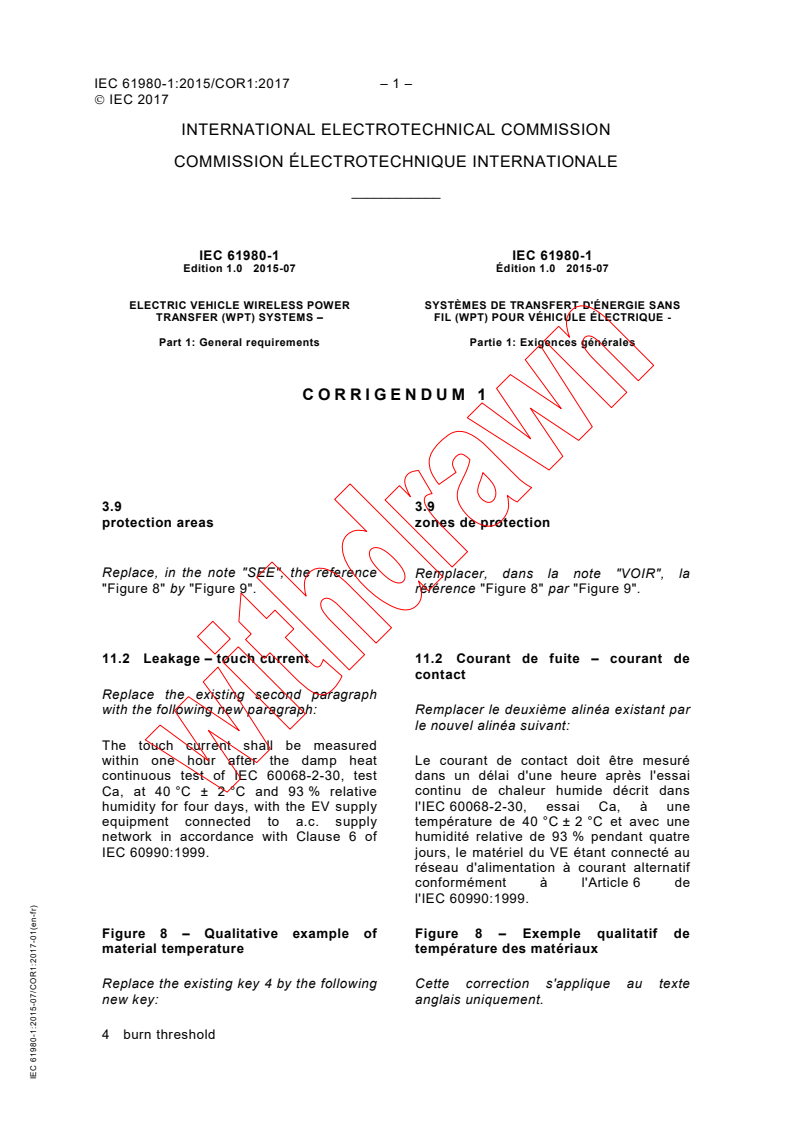
3.9 3.9
protection areas zones de protection
Replace, in the note "SEE", the reference Remplacer, dans la note "VOIR", la
"Figure 8" by "Figure 9". référence "Figure 8" par "Figure 9".
11.2 Leakage – touch current 11.2 Courant de fuite – courant de
contact
Replace the existing second paragraph
Remplacer le deuxième alinéa existant par
with the following new paragraph:
le nouvel alinéa suivant:
The touch current shall be measured
within one hour after the damp heat
Le courant de contact doit être mesuré
continuous test of IEC 60068-2-30, test dans un délai d'une heure après l'essai
continu de chaleur humide décrit dans
Ca, at 40 °C ± 2 °C and 93 % relative
humidity for four days, with the EV supply l'IEC 60068-2-30, essai Ca, à une
equipment connected to a.c. supply température de 40 °C ± 2 °C et avec une
net
...
This May Also Interest You
IEC 63584-210:2025 is the OCPP version 2.1. Version 2.1 is an extension of OCPP 2.0.1. OCPP 2.1 has its own JSON schemas, but the schemas are OCPP 2.0.1 schemas that have been extended with optional fields that are used by OCPP 2.1 functionality. With the minor exceptions mentioned below, all application logic developed for OCPP 2.0.1 will continue to work in OCPP 2.1 without any changes. The new features of OCPP 2.1, of course, require new application logic.
- Standard931 pagesEnglish languagesale 15% off
IEC 63382-1:2025 series specifies the management of distributed energy storage systems, composed of electrically chargeable vehicle batteries (ECV-DESS), which are handled by an aggregator/flexibility operator (FO) to provide energy flexibility services to grid operators.
IEC 63382-1:2025 describes the technical characteristics and architectures of ECV-DESS, including:
– EV charging stations configurations, comprising several AC-EVSEs and/or DC-EVSEs;
– individual EVs connected to grid via an EVSE and managed by an aggregator/FO.
The focus of this document is on the interface between the FO and the FCSBE and the data exchange at this interface, necessary to perform energy flexibility services (FS).
The data exchange between FO and FCSBE typically includes:
– flexibility service request and response;
– flexibility services parameters;
– EV charging station configuration and technical capabilities;
– credentials check of parties involved in the flexibility service;
– FS execution related notifications;
– event log, detailed service record, proof of work.
The exchange of credentials has the purpose to identify, authenticate and authorize the actors involved in the flexibility service transaction, to check the validity of a FS contract and to verify the technical capabilities of the system EV + CS, and conformity to applicable technical standards to provide the requested flexibility service.
This document also describes the technical requirements of ECV-DESS, the use cases, the information exchange between the EV charging station operator (CSO) and the aggregator/FO, including both technical and business data.
It covers many aspects associated to the operation of ECV-DESS, including:
– privacy issues consequent to GDPR application (general data protection regulation);
– cybersecurity issues;
– grid code requirements, as set in national guidelines, to include ancillary services, mandatory functions and remunerated services;
– grid functions associated to V2G operation, including new services, as fast frequency response;
– authentication/authorization/transactions relative to charging sessions, including roaming, pricing and metering information;
– management of energy transfers and reporting, including information interchange, related to power/energy exchange, contractual data, metering data;
– demand response, as smart charging (V1G).
It makes a distinction between mandatory grid functions and market driven services, taking into account the functions which are embedded in the FW control of DER smart inverters.
This document deals with use cases, requirements and architectures of the ECV-DESSs with the associated EV charging stations.
Some classes of energy flexibility services (FS) have been identified and illustrated in dedicated use cases:
– following a dynamic setpoint from FO;
– automatic execution of a droop curve provided by FO, according to local measurements of frequency, voltage and power;
– demand response tasks, stimulated by price signals from FO;
– fast frequency response.
Furthermore, some other more specific flexibility service use cases include:
– V2G for tertiary control with reserve market;
– V2H with dynamic pricing linked to the wholesale market price;
– distribution grid congestion by EV charging and discharging.
FS are performed under flexibility service contracts (FSC) which can be stipulated between:
– FO and EV owner (EVU or EV fleet manager);
– FO and CSP;
– FO and CSO.
Any flexibility service is requested by the aggregator/FO with a flexibility service request (FSR) communicated through the FCSBE interface to the available resources.
The actors EVU, CSO, CSP have always the right to choose opt-in or opt-out options in case of a FSR, unless it is mandatory for safety or grid stability reasons.
A use case shows how to discover flexibility service contract (FSC) holders.
This document describes many use cases, some of them are dedicated to special applications such as
- Standard196 pagesEnglish languagesale 15% off
- Standard215 pagesFrench languagesale 15% off
- Standard411 pagesEnglish and French languagesale 15% off
IEC PAS 61980-4:2025 applies to the off-board supply equipment for high-power wireless power transfer (H-WPT) via magnetic field (MF-WPT) to electric road vehicles for purposes of supplying electric energy to the RESS (rechargeable energy storage system) or other on-board electrical systems, or both.
The MF-WPT system operates at standard supply voltage ratings per IEC 60038 up to 1 000 V AC and up to 1 500 V DC from the supply network. The power transfer takes place while the electric vehicle (EV) is stationary.
The aspects covered in this document include
– the characteristics and operating conditions,
– specific power transfer requirements for the off-board side of magnetic field high-power wireless power transfer systems for electric road vehicles,
– the required level of electrical safety,
– requirements for basic communication for safety and process matters if required by a MF WPT system,
– requirements for positioning to assure efficient and safe MF-WPT power transfer, and
– specific EMC requirements for MF-WPT systems
This document does not apply to
– safety aspects related to maintenance, and
– trolley buses, rail vehicles and vehicles designed primarily for use off-road
- Technical specification63 pagesEnglish languagesale 15% off
This document specifies conformance tests in the form of an abstract test suite (ATS) for a system under test (SUT) that implements an electric-vehicle communication controller (EVCC) or a supply-equipment communication controller (SECC) for all common requirements specified in ISO 15118-20 that are independent of a particular charging type (AC, DC, ACD, WPT charging). These conformance tests specify the testing of capabilities and behaviours of an SUT, as well as checking what is observed against the conformance requirements specified in ISO 15118-20 and against what the implementer states the SUT implementation's capabilities are.
The capability tests within the ATS check that the observable capabilities of the SUT are in accordance with the static conformance requirements specified in ISO 15118-20. The behaviour tests of the ATS examine an implementation as thoroughly as practical over the full range of dynamic conformance requirements specified in ISO 15118-20 and within the capabilities of the SUT.
A test architecture is described in correspondence to the ATS. The abstract test cases in this document are described leveraging this test architecture and are specified in descriptive tabular format covering the ISO/OSI layer 3 to 7 (network to application layers).
In terms of coverage, this document only covers normative sections and requirements in ISO 15118-20. This document additionally refers to specific tests for requirements on referenced standards (e.g. IETF RFCs, W3C Recommendation, etc.) if they are relevant in terms of conformance for implementations according to ISO 15118-20. However, it is explicitly not intended to widen the scope of this conformance specification to such external standards, if it is not technically necessary for the purpose of conformance testing for ISO 15118-20. Furthermore, the conformance tests specified in this document do not include the assessment of performance nor robustness or reliability of an implementation. They cannot provide judgments on the physical realization of abstract service primitives, how a system is implemented, how it provides any requested service, or the environment of the protocol implementation. Furthermore, the abstract test cases specified in this document only consider the communication protocol and the system's behaviour specified in ISO 15118-20. Power flow between the EVSE and the EV is no prerequisite for the test cases specified in this document.
- Standard321 pagesEnglish languagesale 15% off
IEC 63380-2:2025 defines the secure information exchange between local energy management systems and electric vehicle charging stations. The local energy management systems communicate to the charging station controllers via the resource manager. This document maps the generic use case functions defined in IEC 63380-1 to specific data model. This edition of this document defines specifically SPINE Resources and ECHONET Lite Resources mapped from the high-level use case functions defined in IEC 63380-1.
- Standard198 pagesEnglish languagesale 15% off
- Standard210 pagesFrench languagesale 15% off
- Standard408 pagesEnglish and French languagesale 15% off
IEC 63119-1:2025 establishes a basis for the other parts of IEC 63119, specifying the terms and definitions, general description of the system model, classification, information exchange and security mechanisms for roaming between EV charging service providers (CSPs), charging station operators (CSOs) and clearing house platforms through roaming endpoints. It provides an overview and describes the general requirements of the EV roaming service system. The IEC 63119 series is applicable to high-level communication involved in information exchange/interaction between different CSPs, as well as between a CSP and a CSO with or without a clearing house platform through the roaming endpoint. The IEC 63119 series does not specify the information exchange, either between the charging station (CS) and the charging station operator (CSO), or between the EV and the CS. This second edition cancels and replaces the first edition published in 2019.
This edition includes the following significant technical changes with respect to the previous edition:
a) the scope is expanded to include differentiation between home and visited service provider roles and adds an explicit definition of roaming entity;
b) adds definitions for "home charging service provider (home-CSP)", "visited charging station operator (visited-CSO)", and "charging detail record (CDR)", and expands related terms such as "service" and "roaming entity";
c) introduces abbreviation variants for "home-CSP" and "visited-CSO" in the terminology, aligning with North American and European conventions;
d) updates the communication protocol stack by adopting a newer TLS version (upgraded from 1.2 to 1.3);
e) system architecture and communication interfaces include detailed interactions between home-CSP and visited-CSO;
f) adds a definition for "service" to cover a broader range of applications such as parking and reservation management;
g) adds a distinction between "charging detail record (CDR)" and "service detail record (SDR)" and clarifies their relationship in the terminology;
h) enhances the description of user credential transfer methods in communication interfaces with greater diversity;
i) enhances the description of the mixed mode in the classification of roaming service models, emphasizing improved user experience through faster response times.
- Standard30 pagesEnglish languagesale 15% off
IEC 63380-3:2025 defines the secure information exchange between local energy management systems and electric vehicle charging stations. The local energy management systems communicate to the charging station controllers via the resource manager.
This document specifies the application of relevant transport protocols; in this case, SPINE (smart premises interoperable neutral-message exchange), SHIP (smart home IP), and ECHONET Lite. Other communication protocols can be defined in future editions
- Standard180 pagesEnglish languagesale 15% off
- Standard197 pagesFrench languagesale 15% off
- Standard377 pagesEnglish and French languagesale 15% off
IEC 62840-2:2025 provides the safety requirements for a battery swap system, for the purposes of swapping swappable battery system (SBS)/handheld-swappable battery system (HBS) of electric vehicles. The battery swap system is intended to be connected to the supply network. The power supply is up to 1 000 V AC or up to 1 500 V DC in accordance with IEC 60038. This document also applies to battery swap systems supplied from on-site storage systems (e.g. buffer batteries).
Aspects covered in this document:
• safety requirements of the battery swap system and its systems;
• security requirements for communication;
• electromagnetic compatibility (EMC);
• marking and instructions;
• protection against electric shock and other hazards.
This document is applicable to battery swap systems for EV equipped with one or more SBS/HBS.
This document is not applicable to
• aspects related to maintenance and service of the battery swap station (BSS),
• trolley buses, rail vehicles and vehicles designed primarily for use off-road, and
• maintenance and service of EVs.
Requirements for bidirectional energy transfer are under consideration
This second edition cancels and replaces the first edition published in 2016. This edition constitutes a technical revision.
This edition includes the following significant technical changes with respect to the previous edition:
a) expands the scope to encompass both swappable battery systems (SBS) and handheld swappable battery systems (HBS);
b) introduces stricter interoperability requirements through detailed system interface specifications and defined state transition protocols;
c) enhances data security by defining safety message transmission protocols and integrating telecom network requirements;
d) increases electrical safety protection levels for battery swap stations (BSS) with specified capacitor discharge time limits to mitigate electric shock risks;
e) introduces enhanced mechanical safety requirements for automated battery handling systems, with technical alignment to ISO 10218-1 and ISO 10218-2;
f) strengthens overload and short-circuit protection for BSS through standardized testing methods and overcurrent protection specifications;
g) defines upgraded electromagnetic compatibility (EMC) standards to ensure system resilience against external interference, supplemented with EMC-related functional safety measures.
This document is to be read in conjunction with IEC 62840-1:2025.
- Standard87 pagesEnglish languagesale 15% off
IEC 62840-1:2025 gives the general overview for battery swap systems, for the purposes of swapping batteries of electric road vehicles when the vehicle powertrain is turned off and when the battery swap system is connected to the supply network at standard supply voltages according to IEC 60038 with a rated voltage up to 1 000 V AC and up to 1 500 V DC.
This document is applicable for battery swap systems for EV equipped with one or more
– swappable battery systems (SBS), or
– handheld-swappable battery systems (HBS).
This document provides guidance for interoperability.
This document applies to
• battery swap systems supplied from on-site storage systems (for example buffer batteries etc),
• manual, mechanically assisted and automatic systems,
• battery swap systems intended to supply SBS/HBS having communication allowing to identify the battery system characteristics, and
• battery swap systems intended to be installed at an altitude of up to 2 000 m.
This document is not applicable to
• aspects related to maintenance and service of the battery swap station (BSS),
• trolley buses, rail vehicles and vehicles designed primarily for use off-road,
• maintenance and service of EVs,
• safety requirements for mechanical equipment covered by the ISO 10218 series,
• locking compartments systems providing AC socket-outlets for the use of manufacturer specific voltage converter units and manufacturer specific battery systems,
• electrical devices and components, which are covered by their specific product standards,
• any fix-installed equipment of EV, which is covered by ISO, and
• EMC requirements for on-board equipment of EV while connected to the BSS.
This first edition cancels and replaces the first edition of IEC TS 61280-1 published in 2016.
This edition includes the following significant technical changes with respect to IEC TS 61280-1:2016:
a) expanded scope to include handheld-swappable battery systems (HBS) and guidance on interoperability;
b) added definitions for "handheld-swappable battery system" (HBS) and expanded related terms such as "SBS/HBS coupler," "SBS/HBS charger," etc;
c) added classifications based on supply network characteristics, connection method, access and type of BSS;
d) added support for HBS, detailing the different compositions and workflows for type A (SBS) and type B (HBS) battery swap stations;
e) added requirements for functional interoperability, interface interoperability, data interoperability, operational interoperability, compatibility with legacy systems, and scalability;
f) added requirements for communication, protection against electric shock, specific requirements for accessories), cable assembly requirements, BSS constructional requirements, overload and short circuit protection, EMC, emergency switching or disconnect, marking and instructions;
g) expanded annex content, adding solutions for manual swapping stations for motorcycles with HBS and updating use cases.
- Standard71 pagesEnglish and French languagesale 15% off
IEC 63380-1:2025 defines the secure information exchange between local energy management systems and electric vehicle charging stations. The local energy management systems communicate to the charging station controllers via the resource manager.
This document specifies use cases, the sequences of information exchange and generic data models.
- Standard323 pagesEnglish and French languagesale 15% off


Questions, Comments and Discussion
Ask us and Technical Secretary will try to provide an answer. You can facilitate discussion about the standard in here.
Loading comments...