

IEC 60745-2-5:2003
(Main)Hand-held motor-operated electric tools - Safety - Part 2-5: Particular requirements for circular saws
General Information
- Abstract
Deals with the safety of hand-held motor-operated or magnetically driven electric tools, specific requirements for circular saws. The rated voltage being not more than 250 V for single-phase a.c. or d.c., and 440 V for three-phase a.c.tools. This standard does not apply to saws used with abrasive wheels.
- Status
- Published
- Publication Date
- 22-Jan-2003
- Technical Committee
- TC 116 - Safety of motor-operated electric tools
- Current Stage
- DELPUB - Deleted Publication
- Start Date
- 10-Jul-2006
- Completion Date
- 28-Aug-2026
Buy Documents
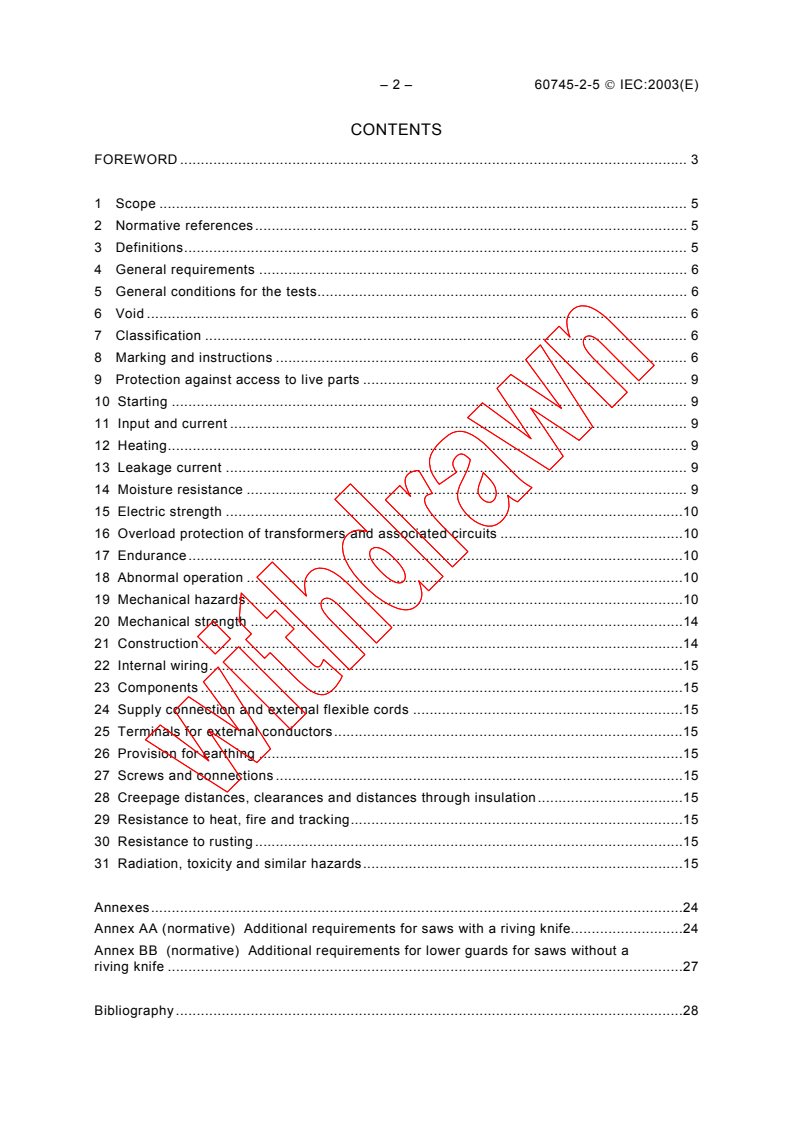
IEC 60745-2-5:2003 - Hand-held motor-operated electric tools - Safety - Part 2-5: Particular requirements for circular saws Released:1/23/2003
IEC 60745-2-5:2003 - Hand-held motor-operated electric tools - Safety - Part 2-5: Particular requirements for circular saws Released:1/23/2003
Overview
IEC 60745-2-5:2003 is an international safety standard developed by the International Electrotechnical Commission (IEC) specifying the particular safety requirements for hand-held motor-operated or magnetically driven electric circular saws. This standard applies to circular saws with a rated voltage not exceeding 250 V for single-phase a.c. or d.c. and 440 V for three-phase a.c tools. It ensures that circular saws are designed and manufactured to minimize risks to users, covering aspects such as blade guarding, electrical safety, and safe operation instructions. Importantly, this standard does not cover saws intended for use with abrasive wheels.
Key Topics
Scope and Definitions: Establishes applicability to all types of circular saws, clarifies terms such as circular saw, guide plate, riving knife, upper/lower guards, and kickback.
Marking and Instructions: Highlights the necessity for clear, indelible markings including direction of rotation, rated no-load speed, and recommended blade diameter. Detailed safety and operation instructions must be provided.
Mechanical Safety:
- Stringent requirements for upper and lower blade guards to prevent accidental contact.
- Specific provisions for riving knives and guide plates to minimize kickback risk.
- Requirements for the automatic return and locking of guards in safe positions.
Electrical Safety:
- Protection against access to live parts.
- Requirements for leakage current, electric strength, and moisture resistance.
Ergonomics and Handling:
- Obligatory design for two handles on larger saws to ensure user control.
- Clear guidance on the secure changing of blades and the requirement for insulated gripping surfaces in specific conditions.
Instructions for Safe Use:
- Comprehensive operator safety instructions must be provided, including warnings to prevent hand injuries, safe support of workpieces, and avoidance of hazardous practices.
Construction:
- The main switch must automatically switch the tool off when released.
- The saw should not be usable as a stationary tool when inverted.
Applications
IEC 60745-2-5:2003 is critical for manufacturers, importers, and regulatory bodies involved with hand-held circular saws. Key applications include:
Product Safety Design: Ensures the design and manufacture of circular saws conform to internationally recognized safety requirements, reducing the risk of injury and liability.
Compliance Assessment: Provides a clear baseline for conformity assessment, factory inspection, and product certification.
Market Access: Enables easier acceptance of equipment in global markets by demonstrating compliance with a widely recognized standard.
User Safety: Promotes safer use of electric circular saws in construction, woodworking, carpentry, and home improvement by ensuring manufacturers provide robust instructions and implement necessary safety features.
Related Standards
- IEC 60745-1: General requirements for hand-held motor-operated electric tools, to be read in conjunction with Part 2-5 for comprehensive coverage.
- IEC 62841 Series: Newer standards covering hand-held and transportable motor-operated electric tools.
- ISO 13849 & ISO 12100: General machinery safety principles relevant to guarding and risk reduction.
- EN 60745-2-5: European adoption harmonizing the IEC standard for EU compliance and CE marking.
Summary
Adhering to IEC 60745-2-5:2003 ensures circular saws are built and labeled for maximum user safety, supporting regulatory compliance, injury prevention, and global marketability. By implementing robust guarding systems, clear operator instructions, and reliable safety mechanisms, this standard enhances the safe use of hand-held circular saws across both professional and consumer applications.
Relations
- Effective Date
- 05-Sep-2023
Buy Documents
IEC 60745-2-5:2003 - Hand-held motor-operated electric tools - Safety - Part 2-5: Particular requirements for circular saws Released:1/23/2003
IEC 60745-2-5:2003 - Hand-held motor-operated electric tools - Safety - Part 2-5: Particular requirements for circular saws Released:1/23/2003
Get Certified
Connect with accredited certification bodies for this standard

DVS-ZERT GmbH
German welding certification society.
CARES (UK Certification Authority for Reinforcing Steels)
UK certification for reinforcing steels and construction.
EWF/IIW (European/International Welding Federation)
International welding personnel certification.
Sponsored listings
Frequently Asked Questions
IEC 60745-2-5:2003 is a standard published by the International Electrotechnical Commission (IEC). Its full title is "Hand-held motor-operated electric tools - Safety - Part 2-5: Particular requirements for circular saws". This standard covers: Deals with the safety of hand-held motor-operated or magnetically driven electric tools, specific requirements for circular saws. The rated voltage being not more than 250 V for single-phase a.c. or d.c., and 440 V for three-phase a.c.tools. This standard does not apply to saws used with abrasive wheels.
Deals with the safety of hand-held motor-operated or magnetically driven electric tools, specific requirements for circular saws. The rated voltage being not more than 250 V for single-phase a.c. or d.c., and 440 V for three-phase a.c.tools. This standard does not apply to saws used with abrasive wheels.
IEC 60745-2-5:2003 is classified under the following ICS (International Classification for Standards) categories: 25.140.20 - Electric tools; 25.140.30 - Hand-operated tools. The ICS classification helps identify the subject area and facilitates finding related standards.
IEC 60745-2-5:2003 has the following relationships with other standards: It is inter standard links to IEC 60745-2-5:2006. Understanding these relationships helps ensure you are using the most current and applicable version of the standard.
IEC 60745-2-5:2003 is available in PDF format for immediate download after purchase. The document can be added to your cart and obtained through the secure checkout process. Digital delivery ensures instant access to the complete standard document.
Standards Content (Sample)
INTERNATIONAL IEC
STANDARD
60745-2-5
Third edition
2003-01
Hand-held motor-operated electric tools –
Safety –
Part 2-5:
Particular requirements for circular saws
Outils électroportatifs à moteur –
Sécurité –
Partie 2-5:
Règles particulières pour les scies circulaires
Reference number
Publication numbering
As from 1 January 1997 all IEC publications are issued with a designation in the
60000 series. For example, IEC 34-1 is now referred to as IEC 60034-1.
Consolidated editions
The IEC is now publishing consolidated versions of its publications. For example,
edition numbers 1.0, 1.1 and 1.2 refer, respectively, to the base publication, the
base publication incorporating amendment 1 and the base publication incorporating
amendments 1 and 2.
Further information on IEC publications
The technical content of IEC publications is kept under constant review by the IEC,
thus ensuring that the content reflects current technology. Information relating to
this publication, including its validity, is available in the IEC Catalogue of
publications (see below) in addition to new editions, amendments and corrigenda.
Information on the subjects under consideration and work in progress undertaken
by the technical committee which has prepared this publication, as well as the list
of publications issued, is also available from the following:
• IEC Web Site (www.iec.ch)
• Catalogue of IEC publications
The on-line catalogue on the IEC web site (http://www.iec.ch/searchpub/cur_fut.htm)
enables you to search by a variety of criteria including text searches, technical
committees and date of publication. On-line information is also available on
recently issued publications, withdrawn and replaced publications, as well as
corrigenda.
• IEC Just Published
This summary of recently issued publications (http://www.iec.ch/online_news/
justpub/jp_entry.htm) is also available by email. Please contact the Customer
Service Centre (see below) for further information.
• Customer Service Centre
If you have any questions regarding this publication or need further assistance,
please contact the Customer Service Centre:
Email: custserv@iec.ch
Tel: +41 22 919 02 11
Fax: +41 22 919 03 00
INTERNATIONAL IEC
STANDARD
60745-2-5
Third edition
2003-01
Hand-held motor-operated electric tools –
Safety –
Part 2-5:
Particular requirements for circular saws
Outils électroportatifs à moteur –
Sécurité –
Partie 2-5:
Règles particulières pour les scies circulaires
IEC 2003 Copyright - all rights reserved
No part of this publication may be reproduced or utilized in any form or by any means, electronic or
mechanical, including photocopying and microfilm, without permission in writing from the publisher.
International Electrotechnical Commission, 3, rue de Varembé, PO Box 131, CH-1211 Geneva 20, Switzerland
Telephone: +41 22 919 02 11 Telefax: +41 22 919 03 00 E-mail: inmail@iec.ch Web: www.iec.ch
PRICE CODE
Commission Electrotechnique Internationale
U
International Electrotechnical Commission
Международная Электротехническая Комиссия
For price, see current catalogue
– 2 – 60745-2-5 IEC:2003(E)
CONTENTS
FOREWORD . 3
1 Scope . 5
2 Normative references . 5
3 Definitions. 5
4 General requirements . 6
5 General conditions for the tests. 6
6 Void . 6
7 Classification . 6
8 Marking and instructions . 6
9 Protection against access to live parts . 9
10 Starting . 9
11 Input and current . 9
12 Heating. 9
13 Leakage current . 9
14 Moisture resistance . 9
15 Electric strength .10
16 Overload protection of transformers and associated circuits .10
17 Endurance .10
18 Abnormal operation .10
19 Mechanical hazards.10
20 Mechanical strength .14
21 Construction .14
22 Internal wiring.15
23 Components .15
24 Supply connection and external flexible cords .15
25 Terminals for external conductors.15
26 Provision for earthing .15
27 Screws and connections .15
28 Creepage distances, clearances and distances through insulation.15
29 Resistance to heat, fire and tracking.15
30 Resistance to rusting.15
31 Radiation, toxicity and similar hazards.15
Annexes.24
Annex AA (normative) Additional requirements for saws with a riving knife.24
Annex BB (normative) Additional requirements for lower guards for saws without a
riving knife .27
Bibliography.28
60745-2-5 IEC:2003(E) – 3 –
INTERNATIONAL ELECTROTECHNICAL COMMISSION
___________
HAND-HELD MOTOR-OPERATED ELECTRIC TOOLS –
SAFETY –
Part 2-5: Particular requirements for circular saws
FOREWORD
1) The IEC (International Electrotechnical Commission) is a worldwide organization for standardization comprising
all national electrotechnical committees (IEC National Committees). The object of the IEC is to promote
international co-operation on all questions concerning standardization in the electrical and electronic fields. To
this end and in addition to other activities, the IEC publishes International Standards. Their preparation is
entrusted to technical committees; any IEC National Committee interested in the subject dealt with may
participate in this preparatory work. International, governmental and non-governmental organizations liaising
with the IEC also participate in this preparation. The IEC collaborates closely with the International
Organization for Standardization (ISO) in accordance with conditions determined by agreement between the
two organizations.
2) The formal decisions or agreements of the IEC on technical matters express, as nearly as possible, an
international consensus of opinion on the relevant subjects since each technical committee has representation
from all interested National Committees.
3) The documents produced have the form of recommendations for international use and are published in the form
of standards, technical specifications, technical reports or guides and they are accepted by the National
Committees in that sense.
4) In order to promote international unification, IEC National Committees undertake to apply IEC International
Standards transparently to the maximum extent possible in their national and regional standards. Any
divergence between the IEC Standard and the corresponding national or regional standard shall be clearly
indicated in the latter.
5) The IEC provides no marking procedure to indicate its approval and cannot be rendered responsible for any
equipment declared to be in conformity with one of its standards.
6) Attention is drawn to the possibility that some of the elements of this International Standard may be the subject
of patent rights. The IEC shall not be held responsible for identifying any or all such patent rights.
International Standard IEC 60745-2-5 has been prepared by subcommittee 61F: Safety of
hand-held motor-operated electric tools, of IEC technical committee 61: Safety of household
and similar electrical appliances.
This third edition cancels and replaces the second edition published in 1993, of which it
constitutes a technical revision.
The text of this standard is based on the following documents:
FDIS Report on voting
61F/503/FDIS 61F/512/RVD
Full information on the voting for the approval of this standard can be found in the report on
voting indicated in the above table.
This publication has been drafted in accordance with the ISO/IEC Directives, Part 2.
This part 2-5 is to be used in conjunction with the third edition of IEC 60745-1: Hand-held
motor-operated electric tools – Safety – Part 1: General Requirements. When this standard
states “addition”, “modification” or “replacement”, the relevant text in Part 1 is to be adapted
accordingly.
– 4 – 60745-2-5 IEC:2003(E)
NOTE in this standard, the following print types are used:
– requirements: in roman type;
– test specifications: in italic type;
– notes: in smaller roman type.
Subclauses, tables and figures which are additional to those in Part 1 are numbered starting from 101; additional
annexes are lettered AA, BB, etc.
The committee has decided that the contents of this publication will remain unchanged until
January 2007. At this date, the publication will be
• reconfirmed;
• withdrawn;
• replaced by a revised edition, or
• amended.
A bilingual version of this publication may be issued at a later date.
60745-2-5 IEC:2003(E) – 5 –
HAND-HELD MOTOR-OPERATED ELECTRIC TOOLS –
SAFETY –
Part 2-5: Particular requirements for circular saws
1 Scope
This clause of Part 1 is applicable, except as follows:
1.1 Addition:
This standard applies to all types of circular saws. Circular saws hereinafter will be referred to
as saws. This standard does not apply to saws used with abrasive wheels.
2 Normative references
This clause of Part 1 is applicable.
3 Definitions
This clause of Part 1 is applicable, except as follows:
Additional definitions:
3.101
circular saw
tool intended for cutting various materials with a rotating toothed blade
3.102
cutting edge zone
the outer 20 % of the blade’s radius
3.103
guide plate
the part of the saw resting on the material to be cut (see Figure 113)
3.104
lower guard
movable blade-covering device which, in the closed or rest position, is generally situated
below the guide plate
3.105
upper guard
fixed and/or movable cover of the blade situated above the guide plate
3.106
riving knife
metal part placed in the plane of the saw blade with the intent of preventing the workpiece
from closing on the rear part of the saw blade
– 6 – 60745-2-5 IEC:2003(E)
3.107
saw with outer pendulum guard
saw having a lower guard which swings outside the upper guard (see Figure 101)
3.108
saw with inner pendulum guard
saw having a lower guard which swings inside the upper guard (see Figure 102)
3.109
saw with tow guard
saw having a lower guard which slides along the upper guard (see Figure 103)
3.110
kickback
sudden reaction to a pinched, bound or misaligned saw blade, causing an uncontrolled saw to
lift up and out of the workpiece
3.111
plunge type saw
saw having only an upper guard into which the saw blade retracts when not in use (see
Figure 104)
4 General requirements
This clause of Part 1 is applicable.
5 General conditions for the tests
This clause of Part 1 is applicable.
6 Void
7 Classification
This clause of Part 1 is applicable.
8 Marking and instructions
This clause of Part 1 is applicable, except as follows:
8.1 Addition:
Saws shall be marked with:
− direction of rotation, indicated on the tool by an arrow, raised or recessed or by any other
means no less visible and indelible;
− rated no-load speed of the output spindle;
− recommended blade diameter.
60745-2-5 IEC:2003(E) – 7 –
8.12.2 a) Addition:
101) Instructions not to use any abrasive wheels
102) For saws with riving knife the instruction shall include the following:
Instructions to ensure that the riving knife is adjusted so that the distance between the
riving knife and the rim of the blade is not more than 5 mm, and the rim of the blade
does not extend more than 5 mm beyond the lowest edge of the riving knife.
8.12.2 b) Addition
101) Instructions for the blade changing procedure
Additional subclause:
8.12.101 The following additional safety instructions shall be given. If in English they shall
be verbatim and in the following order as applicable and equivalent in any other language.
This part may be printed separately from the General Safety Instructions. All notes are not to
be printed, they are information for the designer of the manual.
8.12.101.1 Safety instructions for all saws
DANGER:
a) Keep hands away from cutting area and the blade. Keep your second hand on
auxiliary handle, or motor housing. If both hands are holding the saw, they cannot be
cut by the blade.
NOTE For circular saws with 140 mm or smaller diameter blades, the "Keep your second hand on auxiliary
handle, or motor housing" may be omitted.
b) Do not reach underneath the workpiece. The guard cannot protect you from the blade
below the workpiece.
c) Adjust the cutting depth to the thickness of the workpiece. Less than a full tooth of
the blade teeth should be visible below the workpiece.
d) Never hold piece being cut in your hands or across your leg. Secure the workpiece
to a stable platform. It is important to support the work properly to minimize body
exposure, blade binding, or loss of control.
e) Hold power tool by insulated gripping surfaces when performing an operation where
the cutting tool may contact hidden wiring or its own cord. Contact with a "live" wire
will also make exposed metal parts of the power tool "live" and shock the operator.
f) When ripping always use a rip fence or straight edge guide. This improves the
accuracy of cut and reduces the chance of blade binding.
g) Always use blades with correct size and shape (diamond versus round) of arbour
holes. Blades that do not match the mounting hardware of the saw will run eccentrically,
causing loss of control.
h) Never use damaged or incorrect blade washers or bolt. The blade washers and bolt
were specially designed for your saw, for optimum performance and safety of operation.
8.12.101.2 Further safety instructions for all saws
Causes and operator prevention of kickback:
− kickback is a sudden reaction to a pinched, bound or misaligned saw blade, causing an
uncontrolled saw to lift up and out of the workpiece toward the operator;
− when the blade is pinched or bound tightly by the kerf closing down, the blade stalls and
the motor reaction drives the unit rapidly back toward the operator;
– 8 – 60745-2-5 IEC:2003(E)
− if the blade becomes twisted or misaligned in the cut, the teeth at the back edge of the
blade can dig into the top surface of the wood causing the blade to climb out of the kerf
and jump back toward the operator.
Kickback is the result of saw misuse and/or incorrect operating procedures or conditions and
can be avoided by taking proper precautions as given below.
a) Maintain a firm grip with both hands on the saw and position your arms to resist
kickback forces. Position your body to either side of the blade, but not in line with
the blade. Kickback could cause the saw to jump backwards, but kickback forces can be
controlled by the operator, if proper precautions are taken.
NOTE For circular saws with 140 mm or smaller diameter blades, the words "with both hands" may be omitted.
b) When blade is binding, or when interrupting a cut for any reason, release the trigger
and hold the saw motionless in the material until the blade comes to a complete
stop. Never attempt to remove the saw from the work or pull the saw backward while
the blade is in motion or kickback may occur. Investigate and take corrective actions
to eliminate the cause of blade binding.
c) When restarting a saw in the workpiece, centre the saw blade in the kerf and check
that saw teeth are not engaged into the material. If saw blade is binding, it may walk
up or kickback from the workpiece as the saw is restarted.
d) Support large panels to minimise the risk of blade pinching and kickback. Large
panels tend to sag under their own weight. Supports must be placed under the panel on
both sides, near the line of cut and near the edge of the panel.
e) Do not use dull or damaged blades. Unsharpened or improperly set blades produce
narrow kerf causing excessive friction, blade binding and kickback.
f) Blade depth and bevel adjusting locking levers must be tight and secure before
making cut. If blade adjustment shifts while cutting, it may cause binding and kickback.
g) Use extra caution when making a "plunge cut" into existing walls or other blind
areas. The protruding blade may cut objects that can cause kickback.
8.12.101.3 Safety instructions for saws shown in Figures 101, 102 and 103
a) Check lower guard for proper closing before each use. Do not operate the saw if
lower guard does not move freely and close instantly. Never clamp or tie the lower
guard into the open position. If saw is accidentally dropped, lower guard may be bent.
Raise the lower guard with the retracting handle and make sure it moves freely and does
not touch the blade or any other part, in all angles and depths of cut.
NOTE Alternate wording may be substituted for "retracting handle."
b) Check the operation of the lower guard spring. If the guard and the spring are not
operating properly, they must be serviced before use. Lower guard may operate
sluggishly due to damaged parts, gummy deposits, or a build-up of debris.
c) Lower guard should be retracted manually only for special cuts such as "plunge
cuts" and "compound cuts." Raise lower guard by retracting handle and as soon as
blade enters the material, the lower guard must be released. For all other sawing, the
lower guard should operate automatically.
NOTE Alternate wording may be substituted for "retracting handle."
d) Always observe that the lower guard is covering the blade before placing saw down
on bench or floor. An unprotected, coasting blade will cause the saw to walk backwards,
cutting whatever is in its path. Be aware of the time it takes for the blade to stop after
switch is released.
8.12.101.4 Safety instructions for saws shown in Figure 104
a) Check guard for proper closing before each use. Do not operate the saw if guard
does not move freely and enclose the blade instantly. Never clamp or tie the guard
with the blade exposed. If saw is accidentally dropped, guard may be bent. Check to
make sure that guard moves freely and does not touch the blade or any other part, in all
angles and depths of cut.
60745-2-5 IEC:2003(E) – 9 –
b) Check the operation and condition of the guard return spring. If the guard and the
spring are not operating properly, they must be serviced before use. Guard may
operate sluggishly due to damaged parts, gummy deposits, or a build-up of debris.
c) Assure that the guide plate of the saw will not shift while performing the “plunge
cut” when the blade bevel setting is not at 90°. Blade shifting sideways will cause
binding and likely kick back.
d) Always observe that the guard is covering the blade before placing saw down on
bench or floor. An unprotected, coasting blade will cause the saw to walk backwards,
cutting whatever is in its path. Be aware of the time it takes for the blade to stop after
switch is released.
8.12.101.5 Additional safety instructions for all saws with riving knife
a) Use the appropriate riving knife for the blade being used. For the riving knife to work,
it must be thicker than the body of the blade but thinner than the tooth set of the blade.
b) Adjust the riving knife as described in this instruction manual. Incorrect spacing,
positioning and alignment can make the riving knife ineffective in preventing kickback.
c) Always use the riving knife except when plunge cutting. Riving knife must be
replaced after plunge cutting. Riving knife causes interference during plunge cutting and
can create kickback.
d) For the riving knife to work, it must be engaged in the workpiece. The riving knife is
ineffective in preventing kickback during short cuts.
e) Do not operate the saw if riving knife is bent. Even a light interference can slow the
closing rate of a guard.
9 Protection against access to live parts
This clause of Part 1 is applicable.
10 Starting
This clause of Part 1 is applicable.
11 Input and current
This clause of Part 1 is applicable.
12 Heating
This clause of Part 1 is applicable.
13 Leakage current
This clause of Part 1 is applicable.
14 Moisture resistance
This clause of Part 1 is applicable.
– 10 – 60745-2-5 IEC:2003(E)
15 Electric strength
This clause of Part 1 is applicable.
16 Overload protection of transformers and associated circuits
This clause of Part 1 is applicable.
17 Endurance
This clause of Part 1 is applicable.
18 Abnormal operation
This clause of Part 1 is applicable.
19 Mechanical hazards
This clause of Part 1 is applicable, except as follows:
19.1 Replacement:
Saws shall be so guarded as to minimise the risk of accidental access to the rotating blade as
far as conditions of use will permit. Guarding systems shall not be removable without the aid
of a tool.
There are four commonly used guarding systems for saws, as shown in Figures 101, 102, 103
and 104. Guarding systems can be designed with the blade on the right or on the left side of
the saw. These guarding systems shall comply with the requirements of 19.101 and 19.102.
Each one of these guarding system types can be designed with or without the riving knife
(item 6 in the figures).
− If a guarding system is designed with a riving knife, it shall meet the additional
requirements of Annex AA.
− If a guarding system is designed without a riving knife, it shall meet the additional
requirements of Annex BB.
Other means of achieving the necessary degree of mechanical safety are allowed, provided
that these are as equally effective and reliable as those specified.
Compliance is checked by inspection.
Additional subclauses:
19.101 Guarding above the guide plate
19.101.1 The blade above the guide plate shall be guarded by the upper guard.
19.101.2 Apertures in the guarding system above the guide plate, unless otherwise specified
below, shall be designed such that the test probe ‘a’ of Figure 105, when inserted at any
angle and to the depth allowed by its stop, shall not be able to contact the cutting edge zone
of any recommended blade.
60745-2-5 IEC:2003(E) – 11 –
19.101.2.1 On the motor side of the upper guard, adjacent to the cutting edge zone at the
front of the blade an aperture may be provided for viewing the line of the cut. This viewing
aperture shall either meet the requirements of 19.101.2, as illustrated in Figure 106, or it shall
be limited by proximity and height restrictions.
ƒ Proximity restriction
The straight line distance from a defined measuring point on the auxiliary handle surface to
the cutting edge zone of any recommended blade shall be a minimum of 120 mm as shown in
Figure 107. If there is no auxiliary handle provided, the distance shall be measured from the
motor casing.
Compliance is checked by the following measurements, which shall be conducted with the
guide plate set to maximum depth of cut and 90°.
To establish the measuring point on the auxiliary handle or the motor casing, follow the
procedure outlined below.
a) Establish the closest (A) and
...
NORME CEI
INTERNATIONALE
IEC
60745-2-5
INTERNATIONAL
Troisième édition
STANDARD
Third edition
2003-01
Outils électroportatifs à moteur –
Sécurité –
Partie 2-5:
Règles particulières pour les scies circulaires
Hand-held motor-operated electric tools –
Safety –
Part 2-5:
Particular requirements for circular saws
Numéro de référence
Reference number
CEI/IEC 60745-2-5:2006
Numérotation des publications Publication numbering
Depuis le 1er janvier 1997, les publications de la CEI As from 1 January 1997 all IEC publications are
sont numérotées à partir de 60000. Ainsi, la CEI 34-1 issued with a designation in the 60000 series. For
devient la CEI 60034-1. example, IEC 34-1 is now referred to as IEC 60034-1.
Editions consolidées Consolidated editions
Les versions consolidées de certaines publications de la The IEC is now publishing consolidated versions of its
CEI incorporant les amendements sont disponibles. Par publications. For example, edition numbers 1.0, 1.1
exemple, les numéros d’édition 1.0, 1.1 et 1.2 indiquent and 1.2 refer, respectively, to the base publication,
respectivement la publication de base, la publication de the base publication incorporating amendment 1 and
base incorporant l’amendement 1, et la publication de the base publication incorporating amendments 1
base incorporant les amendements 1 et 2. and 2.
Informations supplémentaires Further information on IEC publications
sur les publications de la CEI
Le contenu technique des publications de la CEI est The technical content of IEC publications is kept
constamment revu par la CEI afin qu'il reflète l'état under constant review by the IEC, thus ensuring that
actuel de la technique. Des renseignements relatifs à the content reflects current technology. Information
cette publication, y compris sa validité, sont dispo- relating to this publication, including its validity, is
nibles dans le Catalogue des publications de la CEI available in the IEC Catalogue of publications
(voir ci-dessous) en plus des nouvelles éditions, (see below) in addition to new editions, amendments
amendements et corrigenda. Des informations sur les and corrigenda. Information on the subjects under
sujets à l’étude et l’avancement des travaux entrepris consideration and work in progress undertaken by the
par le comité d’études qui a élaboré cette publication, technical committee which has prepared this
ainsi que la liste des publications parues, sont publication, as well as the list of publications issued,
également disponibles par l’intermédiaire de: is also available from the following:
• Site web de la CEI (www.iec.ch) • IEC Web Site (www.iec.ch)
• Catalogue des publications de la CEI • Catalogue of IEC publications
Le catalogue en ligne sur le site web de la CEI The on-line catalogue on the IEC web site
(www.iec.ch/searchpub) vous permet de faire des (www.iec.ch/searchpub) enables you to search by a
recherches en utilisant de nombreux critères, variety of criteria including text searches,
comprenant des recherches textuelles, par comité technical committees and date of publication. On-
d’études ou date de publication. Des informations en line information is also available on recently
ligne sont également disponibles sur les nouvelles issued publications, withdrawn and replaced
publications, les publications remplacées ou retirées, publications, as well as corrigenda.
ainsi que sur les corrigenda.
• IEC Just Published • IEC Just Published
Ce résumé des dernières publications parues This summary of recently issued publications
(www.iec.ch/online_news/justpub) est aussi dispo- (www.iec.ch/online_news/justpub) is also available
nible par courrier électronique. Veuillez prendre by email. Please contact the Customer Service
contact avec le Service client (voir ci-dessous) Centre (see below) for further information.
pour plus d’informations.
• Service clients • Customer Service Centre
Si vous avez des questions au sujet de cette If you have any questions regarding this
publication ou avez besoin de renseignements publication or need further assistance, please
supplémentaires, prenez contact avec le Service contact the Customer Service Centre:
clients:
Email: custserv@iec.ch Email: custserv@iec.ch
Tél: +41 22 919 02 11 Tel: +41 22 919 02 11
Fax: +41 22 919 03 00 Fax: +41 22 919 03 00
.
NORME CEI
INTERNATIONALE
IEC
60745-2-5
INTERNATIONAL
Troisième édition
STANDARD
Third edition
2003-01
Outils électroportatifs à moteur –
Sécurité –
Partie 2-5:
Règles particulières pour les scies circulaires
Hand-held motor-operated electric tools –
Safety –
Part 2-5:
Particular requirements for circular saws
IEC 2006 Droits de reproduction réservés Copyright - all rights reserved
Aucune partie de cette publication ne peut être reproduite ni No part of this publication may be reproduced or utilized in any
utilisée sous quelque forme que ce soit et par aucun procédé, form or by any means, electronic or mechanical, including
électronique ou mécanique, y compris la photocopie et les photocopying and microfilm, without permission in writing from
microfilms, sans l'accord écrit de l'éditeur. the publisher.
International Electrotechnical Commission, 3, rue de Varembé, PO Box 131, CH-1211 Geneva 20, Switzerland
Telephone: +41 22 919 02 11 Telefax: +41 22 919 03 00 E-mail: inmail@iec.ch Web: www.iec.ch
CODE PRIX
U
PRICE CODE
Commission Electrotechnique Internationale
International Electrotechnical Commission
МеждународнаяЭлектротехническаяКомиссия
Pour prix, voir catalogue en vigueur
For price, see current catalogue
– 2 – 60745-2-5 CEI:2006
SOMMAIRE
AVANT-PROPOS.6
1 Domaine d’application .10
2 Références normatives.10
3 Définitions .10
4 Règles générales .12
5 Conditions générales d’essai.12
6 Vacant.12
7 Classification.12
8 Marquage et indications .12
9 Protection contre l'accès aux parties actives .20
10 Démarrage .20
11 Puissance et courant .20
12 Echauffements .20
13 Courant de fuite.20
14 Résistance à l’humidité.20
15 Rigidité diélectrique.20
16 Protection contre la surcharge des transformateurs et des circuits associés.20
17 Endurance.20
18 Fonctionnement anormal .20
19 Dangers mécaniques.22
20 Résistance mécanique .30
21 Construction .30
22 Conducteurs internes .32
23 Composants .32
24 Raccordement au réseau et câbles souples extérieurs .32
25 Bornes pour conducteurs externes .32
26 Dispositions de mise à la terre.32
27 Vis et connexions .32
28 Lignes de fuite, distances dans l’air et distances à travers l’isolation .32
29 Résistance à la chaleur, au feu et aux courants de cheminement .32
30 Protection contre la rouille.32
31 Rayonnements, toxicité et dangers analogues .32
Annexes .50
Bibliographie.58
60745-2-5 IEC:2006 – 3 –
CONTENTS
FOREWORD.7
1 Scope.11
2 Normative references .11
3 Definitions .11
4 General requirements .13
5 General conditions for the tests .13
6 Void.13
7 Classification.13
8 Marking and instructions.13
9 Protection against access to live parts.21
10 Starting .21
11 Input and current .21
12 Heating .21
13 Leakage current .21
14 Moisture resistance .21
15 Electric strength .21
16 Overload protection of transformers and associated circuits .21
17 Endurance.21
18 Abnormal operation .21
19 Mechanical hazards.23
20 Mechanical strength .31
21 Construction .31
22 Internal wiring.33
23 Components .33
24 Supply connection and external flexible cords .33
25 Terminals for external conductors.33
26 Provision for earthing .33
27 Screws and connections .33
28 Creepage distances, clearances and distances through insulation.33
29 Resistance to heat, fire and tracking.33
30 Resistance to rusting.33
31 Radiation, toxicity and similar hazards.33
Annexes .51
Bibliography.59
– 4 – 60745-2-5 CEI:2006
Figure 101 – Scie circulaire à protecteur pendulaire extérieur.34
Figure 102 – Scie circulaire à protecteur pendulaire intérieur.34
Figure 103 – Scie circulaire à protecteur montant .34
Figure 104 – Scie plongeante .34
Figure 105 – Calibre d’essai « a ».36
Figure 106 – Ouverture pour la lame et/ou le couteau diviseur dans le protecteur
inférieur et ouverture du protecteur supérieur .36
Figure 107 – Distance de la surface de prise à la zone de coupe de la lame.38
Figure 108 – Restriction de la hauteur de l’ouverture (voir 19.101.2.1).40
Figure 110 – Calibre d’essai « b ».42
Figure 112 – Angle d’exposition de la lame du protecteur inférieur .46
Figure 113 – Dimensions principales de la semelle .46
Figure 114 – Caractéristiques des flasques .48
Figure AA.101 – Essai de stabilité du couteau diviseur .54
Figure AA.102 – Réglage du couteau diviseur.54
60745-2-5 IEC:2006 – 5 –
Figure 101 – Circular saw with outer pendulum guard .35
Figure 102 – Circular saw with inner pendulum guard .35
Figure 103 – Circular saw with tow guard.35
Figure 104 – Plunge type saw.35
Figure 105 – Test probe 'a' .37
Figure 106 – Aperture for blade and/or riving knife in the lower guard and aperture of
the upper guard .37
Figure 107 – Distance from the gripping surface to the blade’s cutting zone .39
Figure 108 – Height restriction of the viewing aperture (see 19.101.2.1) .41
Figure 109 – Distance from the lateral side of the upper guard to the guide plate .43
Figure 110 – Test probe 'b' .43
Figure 111 – Accessibility to the front cutting edge zone.45
Figure 112 – Blade exposure angle of the lower guard.47
Figure 113 – Principal dimensions of the guide plate .47
Figure 114 – Flange characteristics .49
Figure AA.101 – Riving knife stability test .55
Figure AA.102 – Riving knife adjustment.55
– 6 – 60745-2-5 CEI:2006
COMMISSION ÉLECTROTECHNIQUE INTERNATIONALE
___________
OUTILS ÉLECTROPORTATIFS À MOTEUR –
SÉCURITÉ –
Partie 2-5: Règles particulières pour les scies circulaires
AVANT-PROPOS
1) La Commission Electrotechnique Internationale (CEI) est une organisation mondiale de normalisation
composée de l'ensemble des comités électrotechniques nationaux (Comités nationaux de la CEI). La CEI a
pour objet de favoriser la coopération internationale pour toutes les questions de normalisation dans les
domaines de l'électricité et de l'électronique. A cet effet, la CEI – entre autres activités – publie des Normes
internationales, des Spécifications techniques, des Rapports techniques, des Spécifications accessibles au
public (PAS) et des Guides (ci-après dénommés "Publication(s) de la CEI"). Leur élaboration est confiée à des
comités d'études, aux travaux desquels tout Comité national intéressé par le sujet traité peut participer. Les
organisations internationales, gouvernementales et non gouvernementales, en liaison avec la CEI, participent
également aux travaux. La CEI collabore étroitement avec l'Organisation Internationale de Normalisation (ISO),
selon des conditions fixées par accord entre les deux organisations.
2) Les décisions ou accords officiels de la CEI concernant les questions techniques représentent, dans la mesure
du possible, un accord international sur les sujets étudiés, étant donné que les Comités nationaux de la CEI
intéressés sont représentés dans chaque comité d’études.
3) Les Publications de la CEI se présentent sous la forme de recommandations internationales et sont agréées
comme telles par les Comités nationaux de la CEI. Tous les efforts raisonnables sont entrepris afin que la CEI
s'assure de l'exactitude du contenu technique de ses publications; la CEI ne peut pas être tenue responsable
de l'éventuelle mauvaise utilisation ou interprétation qui en est faite par un quelconque utilisateur final.
4) Dans le but d'encourager l'uniformité internationale, les Comités nationaux de la CEI s'engagent, dans toute la
mesure possible, à appliquer de façon transparente les Publications de la CEI dans leurs publications
nationales et régionales. Toutes divergences entre toutes Publications de la CEI et toutes publications
nationales ou régionales correspondantes doivent être indiquées en termes clairs dans ces dernières.
5) La CEI n’a prévu aucune procédure de marquage valant indication d’approbation et n'engage pas sa
responsabilité pour les équipements déclarés conformes à une de ses Publications.
6) Tous les utilisateurs doivent s'assurer qu'ils sont en possession de la dernière édition de cette publication.
7) Aucune responsabilité ne doit être imputée à la CEI, à ses administrateurs, employés, auxiliaires ou
mandataires, y compris ses experts particuliers et les membres de ses comités d'études et des Comités
nationaux de la CEI, pour tout préjudice causé en cas de dommages corporels et matériels, ou de tout autre
dommage de quelque nature que ce soit, directe ou indirecte, ou pour supporter les coûts (y compris les frais
de justice) et les dépenses découlant de la publication ou de l'utilisation de cette Publication de la CEI ou de
toute autre Publication de la CEI, ou au crédit qui lui est accordé.
8) L'attention est attirée sur les références normatives citées dans cette publication. L'utilisation de publications
référencées est obligatoire pour une application correcte de la présente publication.
9) L’attention est attirée sur le fait que certains des éléments de la présente Publication de la CEI peuvent faire
l’objet de droits de propriété intellectuelle ou de droits analogues. La CEI ne saurait être tenue pour
responsable de ne pas avoir identifié de tels droits de propriété et de ne pas avoir signalé leur existence.
La Norme internationale CEI 60745-2-5 a été établie par le sous-comité 61F: Sécurité des
outils électroportatifs à moteur, du comité d’études 61 de la CEI: Sécurité des appareils
électrodomestiques et analogues.
Cette troisième édition annule et remplace la seconde édition parue en 1993 dont elle
constitue une révision technique.
Cette version bilingue (2006-02) remplace la version monolingue anglaise.
Le texte anglais de cette norme est issu des documents 61F/503/FDIS et 61F/512/RVD. Le
rapport de vote 61F/512/RVD donne toute information sur le vote ayant abouti à l’approbation
de cette norme.
60745-2-5 IEC:2006 – 7 –
INTERNATIONAL ELECTROTECHNICAL COMMISSION
___________
HAND-HELD MOTOR-OPERATED ELECTRIC TOOLS –
SAFETY –
Part 2-5: Particular requirements for circular saws
FOREWORD
1) The International Electrotechnical Commission (IEC) is a worldwide organization for standardization comprising
all national electrotechnical committees (IEC National Committees). The object of IEC is to promote
international co-operation on all questions concerning standardization in the electrical and electronic fields. To
this end and in addition to other activities, IEC publishes International Standards, Technical Specifications,
Technical Reports, Publicly Available Specifications (PAS) and Guides (hereafter referred to as “IEC
Publication(s)”). Their preparation is entrusted to technical committees; any IEC National Committee interested
in the subject dealt with may participate in this preparatory work. International, governmental and non-
governmental organizations liaising with the IEC also participate in this preparation. IEC collaborates closely
with the International Organization for Standardization (ISO) in accordance with conditions determined by
agreement between the two organizations.
2) The formal decisions or agreements of IEC on technical matters express, as nearly as possible, an international
consensus of opinion on the relevant subjects since each technical committee has representation from all
interested IEC National Committees.
3) IEC Publications have the form of recommendations for international use and are accepted by IEC National
Committees in that sense. While all reasonable efforts are made to ensure that the technical content of IEC
Publications is accurate, IEC cannot be held responsible for the way in which they are used or for any
misinterpretation by any end user.
4) In order to promote international uniformity, IEC National Committees undertake to apply IEC Publications
transparently to the maximum extent possible in their national and regional publications. Any divergence
between any IEC Publication and the corresponding national or regional publication shall be clearly indicated in
the latter.
5) IEC provides no marking procedure to indicate its approval and cannot be rendered responsible for any
equipment declared to be in conformity with an IEC Publication.
6) All users should ensure that they have the latest edition of this publication.
7) No liability shall attach to IEC or its directors, employees, servants or agents including individual experts and
members of its technical committees and IEC National Committees for any personal injury, property damage or
other damage of any nature whatsoever, whether direct or indirect, or for costs (including legal fees) and
expenses arising out of the publication, use of, or reliance upon, this IEC Publication or any other IEC
Publications.
8) Attention is drawn to the Normative references cited in this publication. Use of the referenced publications is
indispensable for the correct application of this publication.
9) Attention is drawn to the possibility that some of the elements of this IEC Publication may be the subject of
patent rights. IEC shall not be held responsible for identifying any or all such patent rights.
International Standard IEC 60745-2-5 has been prepared by subcommittee 61F: Safety of
hand-held motor-operated electric tools, of IEC technical committee 61: Safety of household
and similar electrical appliances.
This third edition cancels and replaces the second edition published in 1993, of which it
constitutes a technical revision.
This bilingual version (2006-02) replaces the English version.
The text of this standard is based on the following documents:
FDIS Report on voting
61F/503/FDIS 61F/512/RVD
Full information on the voting for the approval of this standard can be found in the report on
voting indicated in the above table.
– 8 – 60745-2-5 CEI:2006
La version française de cette norme n’a pas été soumise au vote.
Cette publication a été rédigée conformément aux Directives ISO/CEI, Partie 2.
La présente Partie 2-5 doit être utilisée conjointement avec la troisième édition de la
CEI 60745-1: Outils électroportatifs à moteur – Sécurité – Partie 1: Règles particulières.
Lorsque la présente norme spécifie «addition», «modification» ou «remplacement», le texte
correspondant de la Partie 1 doit être adapté en conséquence.
NOTE Dans cette norme, les caractères d’imprimerie suivants sont utilisés:
– exigences: caractères romains;
– modalités d'essais: caractères italiques;
– notes: petits caractères romains.
Les paragraphes, tableaux et figures qui sont complémentaires à ceux de la Partie 1 sont numérotés à partir de
101; les annexes complémentaires sont appelées AA, BB, etc.
La CEI 60745 comprend les parties suivantes, présentées sous le titre général Outils
électroportatifs à moteur – Sécurité:
Partie 1: Règles générales
Partie 2-1: Règles particulières pour les perceuses
Partie 2-2: Règles particulières pour les visseuses
Partie 2-3: Règles particulières pour les meuleuses, lustreuses et ponceuses du type à
disque
Partie 2-4: Règles particulières pour les ponceuses et lustreuses, autres que du type à
disque
Partie 2-5: Règles particulières pour les scies circulaires et les couteaux circulaires
Partie 2-6: Règles particulières pour les marteaux
Partie 2-7: Règles particulières pour les pistolets pour liquides non inflammables
Partie 2-8: Règles particulières pour les cisailles à métaux et les grignoteuses
Partie 2-9: Règles particulières pour les taraudeuses
Partie 2-11: Règles particulières pour les scies alternatives (scies sauteuses et scies sabres)
Partie 2-12: Particular requirements for concrete vibrators (disponible en anglais seulement)
Partie 2-13: Règles particulières pour les scies à chaîne
Partie 2-14: Règles particulières pour les rabots
Partie 2-15: Règles particulières pour les taille-haies et ciseaux à gazon
Partie 2-16: Règles particulières pour les agrafeuses
Partie 2-17: Règles particulières pour les défonceuses et les affleureuses
Partie 2-18: Règles particulières pour les outils de cerclage
Partie 2-19: Règles particulières pour les mortaiseuses
Partie 2-20: Règles particulières pour les scies à ruban
Partie 2-21: Règles particulières pour les curettes
Le comité a décidé que le contenu de cette publication ne sera pas modifié avant la date de
maintenance indiquée sur le site web de la CEI sous "http://webstore.iec.ch" dans les
données relatives à la publication recherchée. A cette date, la publication sera
• reconduite,
• supprimée,
• remplacée par une édition révisée, ou
• amendée.
60745-2-5 IEC:2006 – 9 –
The French version of this standard has not been voted upon.
This publication has been drafted in accordance with the ISO/IEC Directives, Part 2.
This part 2-5 is to be used in conjunction with the third edition of IEC 60745-1: Hand-held
motor-operated electric tools – Safety – Part 1: General Requirements. When this standard
states “addition”, “modification” or “replacement”, the relevant text in Part 1 is to be adapted
accordingly.
NOTE in this standard, the following print types are used:
– requirements: in roman type;
– test specifications: in italic type;
– notes: in smaller roman type.
Subclauses, tables and figures which are additional to those in Part 1 are numbered starting from 101; additional
annexes are lettered AA, BB, etc.
IEC 60745 consists of the following parts, under the general title Hand-held motor-operated
electric tools – Safety:
Part 1: General requirements
Part 2-1: Particular requirements for drills and impact drills
Part 2-2: Particular requirements for screwdrivers and impact wrenches
Part 2-3: Particular requirements for grinders, polishers and disk-type sanders
Part 2-4: Particular requirements for sanders and polishers other than disk type
Part 2-5: Particular requirements for circular saws and circular knives
Part 2-6: Particular requirements for hammers
Part 2-7: Particular requirements for spray guns for non-flammable liquids
Part 2-8: Particular requirements for shears and nibblers
Part 2-9: Particular requirements for tappers
Part 2-11: Particular requirements for reciprocating saws (jig and sabre saws)
Part 2-12: Particular requirements for concrete vibrators
Part 2-13: Particular requirements for chain saws
Part 2-14: Particular requirements for planers
Part 2-15: Particular requirements for hedge trimmers and grass shears
Part 2-16: Particular requirements for tackers
Part 2-17: Particular requirements for routers and trimmers
Part 2-18: Particular requirements for strapping tools
Part 2-19: Particular requirements for jointers
Part 2-20: Particular requirements for band saws
Part 2-21: Particular requirements for drain cleaners
The committee has decided that the contents of this publication will remain unchanged until
the maintenance result date indicated on the IEC web site under "http://webstore.iec.ch" in
the data related to the specific publication. At this date, the publication will be
• reconfirmed;
• withdrawn;
• replaced by a revised edition, or
• amended.
– 10 – 60745-2-5 CEI:2006
OUTILS ÉLECTROPORTATIFS À MOTEUR –
SÉCURITÉ –
Partie 2-5: Règles particulières pour les scies circulaires
1 Domaine d’application
L’article de la Partie 1 est applicable avec l’exception suivante.
1.1 Addition:
La présente norme s’applique à tous les types de scies circulaires. Les scies circulaires dont
il est question dans cette norme sont désignées par des scies. La présente norme ne
s’applique pas aux scies utilisées avec des roues abrasives.
2 Références normatives
L’article de la Partie 1 est applicable.
3 Définitions
L’article de la Partie 1 est applicable avec les exceptions suivantes.
Définitions complémentaires:
3.101
scie circulaire
outil destiné à couper différents matériaux avec une lame dentée rotative
3.102
bordure coupante
les 20 % extérieurs du rayon de la lame
3.103
semelle
partie de la scie restant sur le matériau à débiter (voir Figure 113)
3.104
protecteur inférieur
dispositif mobile recouvrant la lame qui, en position fermée ou de repos, est généralement
situé en dessous de la semelle
3.105
protecteur supérieur
carter fixe et/ou mobile de la lame situé au-dessus de la semelle
3.106
couteau diviseur
pièce métallique placée dans le plan de la lame de scie afin d’empêcher que la pièce à
travailler ne soit en contact avec la partie arrière de la lame de scie
60745-2-5 IEC:2006 – 11 –
HAND-HELD MOTOR-OPERATED ELECTRIC TOOLS –
SAFETY –
Part 2-5: Particular requirements for circular saws
1 Scope
This clause of Part 1 is applicable, except as follows:
1.1 Addition:
This standard applies to all types of circular saws. Circular saws hereinafter will be referred to
as saws. This standard does not apply to saws used with abrasive wheels.
2 Normative references
This clause of Part 1 is applicable.
3 Definitions
This clause of Part 1 is applicable, except as follows:
Additional definitions:
3.101
circular saw
tool intended for cutting various materials with a rotating toothed blade
3.102
cutting edge zone
the outer 20 % of the blade’s radius
3.103
guide plate
the part of the saw resting on the material to be cut (see Figure 113)
3.104
lower guard
movable blade-covering device which, in the closed or rest position, is generally situated
below the guide plate
3.105
upper guard
fixed and/or movable cover of the blade situated above the guide plate
3.106
riving knife
metal part placed in the plane of the saw blade with the intent of preventing the workpiece
from closing on the rear part of the saw blade
– 12 – 60745-2-5 CEI:2006
3.107
scie à protecteur pendulaire extérieur
scie dont le protecteur inférieur pivote à l’extérieur du protecteur supérieur (voir Figure 101)
3.108
scie à protecteur pendulaire intérieur
scie dont le protecteur inférieur pivote à l’intérieur du protecteur supérieur (voir Figure 102)
3.109
scie à protecteur montant
scie dont le protecteur inférieur glisse le long du protecteur supérieur (voir Figure 103)
3.110
recul
réaction soudaine observée sur une lame de scie pincée, bloquée ou mal alignée, faisant
sortir la scie de la pièce à travailler de manière incontrôlée
3.111
scie plongeante
scie comportant seulement un protecteur supérieur dans lequel la lame de scie revient se
loger lorsqu’elle n’est pas utilisée (voir Figure 104)
4 Règles générales
L’article de la Partie 1 est applicable.
5 Conditions générales d’essai
L’article de la Partie 1 est applicable.
6 Vacant
7 Classification
L’article de la Partie 1 est applicable.
8 Marquage et indications
L’article de la Partie 1 est applicable avec les exceptions suivantes:
8.1 Addition:
Les scies doivent porter les indications suivantes:
− le sens de rotation, indiqué sur l’outil par une flèche en relief ou encastrée, ou par tout
autre moyen non moins visible et indélébile;
− la vitesse nominale à vide de l’arbre de sortie;
− le diamètre recommandé de la lame.
60745-2-5 IEC:2006 – 13 –
3.107
saw with outer pendulum guard
saw having a lower guard which swings outside the upper guard (see Figure 101)
3.108
saw with inner pendulum guard
saw having a lower guard which swings inside the upper guard (see Figure 102)
3.109
saw with tow guard
saw having a lower guard which slides along the upper guard (see Figure 103)
3.110
kickback
sudden reaction to a pinched, bound or misaligned saw blade, causing an uncontrolled saw to
lift up and out of the workpiece
3.111
plunge type saw
saw having only an upper guard into which the saw blade retracts when not in use (see
Figure 104)
4 General requirements
This clause of Part 1 is applicable.
5 General conditions for the tests
This clause of Part 1 is applicable.
6 Void
7 Classification
This clause of Part 1 is applicable.
8 Marking and instructions
This clause of Part 1 is applicable, except as follows:
8.1 Addition:
Saws shall be marked with:
− direction of rotation, indicated on the tool by an arrow, raised or recessed or by any other
means no less visible and indelible;
− rated no-load speed of the output spindle;
− recommended blade diameter.
– 14 – 60745-2-5 CEI:2006
8.12.2 a) Addition:
101) Instructions interdisant l’usage de roues abrasives
102) Pour les scies avec couteau diviseur, les instructions doivent contenir les informations
suivantes:
s’assurer que le couteau diviseur est réglé de façon que la distance entre le couteau
diviseur et le contour de la lame de scie ne soit pas supérieure à 5 mm, et que le
contour de la lame de scie ne s’étende pas à plus de 5 mm au-delà du bord le plus
bas du couteau diviseur.
8.12.2 b) Addition
101) Instructions pour la procédure de changement de lame
Paragraphe complémentaire:
8.12.101 Les instructions de sécurité complémentaires suivantes doivent être données. Si
elles sont rédigées en anglais, elles doivent figurer textuellement et dans l’ordre suivant, si
applicables et équivalentes dans toute autre langue. La présente partie peut être imprimée
séparément des instructions générales de sécurité. Toutes les notes ne doivent pas être
imprimées, elles constituent des informations pour le concepteur du manuel.
8.12.101.1 Instructions de sécurité pour toutes les scies
DANGER:
a) N’approchez pas les mains de la zone de coupe et de la lame. Gardez la deuxième
main sur la poignée auxiliaire ou sur le boîtier du moteur. Si les deux mains tiennent
la scie, elles ne peuvent pas être coupées par la lame.
NOTE Pour les scies circulaires dont le diamètre des lames est inférieur ou égal à 140 mm, il est possible
que l’instruction « Gardez la deuxième main sur la poignée auxiliaire ou sur le boîtier du moteur » ne figure
pas.
b) N’exposez aucune partie de votre corps sous la pièce à travailler. Le protecteur ne
peut pas vous protéger de la lame sous la pièce à travailler.
c) Ajustez la profondeur de coupe à l’épaisseur de la pièce à travailler. Il convient que
moins de la totalité d’une dent parmi toutes les dents de la lame soit visible sous la pièce
à travailler.
d) Ne tenez jamais la pièce à débiter dans vos mains ou sur vos jambes. Assurez-vous
que la pièce à travailler se trouve sur une plate-forme stable. Il est important que la
pièce à travailler soit soutenue convenablement, afin de minimiser l’exposition du corps,
le grippage de la lame, ou la perte de contrôle.
e) Maintenez l’outil par les surfaces de prise isolantes, si l’outil coupant, en marche,
peut être en contact avec des conducteurs cachés ou avec son propre câble. Le
contact avec un fil « sous tension » mettra également « sous tension » les parties
métalliques exposées de l’outil et provoquera un choc électrique sur l’opérateur.
f) Lors d’une coupe, utilisez toujours un guide parallèle ou un guide à bords droits.
Cela améliore la précision de la coupe et réduit les risques de grippage de la lame.
g) Utilisez toujours des lames dont la taille et la forme (diamètre et rond) des alésages
centraux sont convenables. Les lames qui ne correspondent pas aux éléments de
montage de la scie ne fonctionneront pas bien, provoquant une perte de contrôle.
h) N’utilisez jamais de rondelles ou de boulons de lames endommagés ou inadaptés.
Les rondelles et les boulons de lames ont été spécialement conçus pour votre scie, afin
de garantir une performance optimale et une sécurité de fonctionnement.
60745-2-5 IEC:2006 – 15 –
8.12.2 a) Addition:
101) Instructions not to use any abrasive wheels
102) For saws with riving knife the instruction shall include the following:
Instructions to ensure that the riving knife is adjusted so that the distance between the
riving knife and the rim of the blade is not more than 5 mm, and the rim of the blade
does not extend more than 5 mm beyond the lowest edge of the riving knife.
8.12.2 b) Addition
101) Instructions for the blade changing procedure
Additional subclause:
8.12.101 The following additional safety instructions shall be given. If in English they shall
be verbatim and in the following order as applicable and equivalent in any other language.
This part may be printed separately from the General Safety Instructions. All notes are not to
be printed, they are information for the designer of the manual.
8.12.101.1 Safety instructions for all saws
DANGER:
a) Keep hands away from cutting area and the blade. Keep your second hand on
auxiliary handle, or motor housing. If both hands are holding the saw, they cannot be
cut by the blade.
NOTE For circular saws with 140 mm or smaller diameter blades, the "Keep your second hand on auxiliary
handle, or motor housing" may be omitted.
b) Do not reach underneath the workpiece. The guard cannot protect you from the blade
below the workpiece.
c) Adjust the cutting depth to the thickness of the workpiece. Less than a full tooth of
the blade teeth should be visible below the workpiece.
d) Never hold piece being cut in your hands or across your leg. Secure the workpiece
to a stable platform. It is important to support the work properly to minimize body
exposure, blade binding, or loss of control.
e) Hold power tool by insulated gripping surfaces when performing an operation where
the cutting tool may contact hidden wiring or its own cord. Contact with a "live" wire
will also make exposed metal parts of the power tool "live" and shock the operator.
f) When ripping always use a rip fence or straight edge guide. This improves the
accuracy of cut and reduces the chance of blade binding.
g) Always use blades with correct size and shape (diamond versus round) of arbour
holes. Blades that do not match the mounting hardware of the saw will run eccentrically,
causing loss of control.
h) Never use damaged or incorrect blade washers or bolt. The blade washers and bolt
were specially designed for your saw, for optimum performance and safety of operation.
– 16 – 60745-2-5 CEI:2006
8.12.101.2 Instructions de sécurité supplémentaires pour toutes les scies
Causes du recul et prévention par l’opérateur:
– le recul est une réaction soudaine observée sur une lame de scie pincée, bloquée ou mal
alignée, ce qui empêche de maîtriser la scie et de la retirer de la pièce à travailler, dans la
direction de l’opérateur;
– lorsque la lame est pincée ou bloquée fermement par le fond du trait de
...