

IEC 60966-2-4:2003
(Main)Radio frequency and coaxial cable assemblies - Part 2-4: Detail specification for cable assemblies for radio and TV receivers - Frequency range 0 to 3 000 MHz, IEC 61169-2 connectors
General Information
- Abstract
applies to flexible coaxial cables described in IEC 60096-2. It relates to cable assemblies for radio and TV receivers, and in particular to the cable subfamily 9,52
- Status
- Published
- Publication Date
- 26-Mar-2003
- Current Stage
- DELPUB - Deleted Publication
- Start Date
- 12-Jan-2009
- Completion Date
- 28-Aug-2026
Buy Documents
IEC 60966-2-4:2003 - Radio frequency and coaxial cable assemblies - Part 2-4: Detail specification for cable assemblies for radio and TV receivers - Frequency range 0 to 3 000 MHz, IEC 61169-2 connectors Released:3/27/2003
Overview
IEC 60966-2-4:2003 is an international standard published by the International Electrotechnical Commission (IEC) that specifies requirements for radio frequency (RF) and coaxial cable assemblies for radio and television (TV) receivers. This standard applies to flexible coaxial cables described in IEC 60096-2 and focuses particularly on cable assemblies using IEC 61169-2 connectors within the 9,52 connector subfamily. The standard supports a frequency range from 0 to 3,000 MHz, making it relevant for a broad spectrum of radio and TV reception applications.
The document defines performance requirements, testing methods, and quality assurance for both manufacturers and users. Compliance with IEC 60966-2-4 ensures interoperability and reliability of coaxial cable assemblies in consumer and commercial electronic systems.
Key Topics
Cable Assemblies Scope:
- Focuses on flexible coaxial cables intended for radio and TV receivers.
- Utilizes connectors as detailed in IEC 61169-2 (type 9,52).
- Outlines cable performance and mechanical attributes.
Electrical and Mechanical Performance:
- Covers operational frequency range from 0 to 3,000 MHz.
- Specifies electrical requirements such as reflection properties, insertion loss (attenuation), voltage proof, and insulation resistance.
- Addresses mechanical properties including tensile strength, bending radius, and flexing endurance.
Testing and Quality Assurance:
- Describes standardized test procedures for visual inspection, dimensional checks, and electrical measurements.
- Includes recommended testing severities, periodicity, and sampling plans.
Variants and Compatibility:
- Details different assembly variants based on connector type and cable configuration.
- Includes optional features like marking and taper sleeves.
Applications
IEC 60966-2-4 is crucial for manufacturers, installers, and users of RF and coaxial cable assemblies in radio and TV receiving installations, engineering, and consumer electronics. Key applications include:
- Broadcasting Systems: Reliable transmission of RF signals for TV and radio receivers in residential, commercial, and public installations.
- Consumer Electronics: Compatibility with various TV and radio receiver models through standardized connector types.
- Maintenance and Replacement: Facilitates straightforward replacement and maintenance of cable assemblies owing to standardized dimensions and performance requirements.
- Test and Measurement: Provides a benchmark for verifying the conformity and quality of coaxial cable assemblies used in the field.
By adhering to this standard, organizations enhance product reliability, minimize signal loss, and ensure optimal performance for end-users in multimedia communication environments.
Related Standards
IEC 60966-2-4 should be utilized in conjunction with several related IEC standards to ensure comprehensive compliance and system compatibility, including:
- IEC 60096-2: Describes flexible coaxial cables.
- IEC 60966-1: Generic specification for RF and coaxial cable assemblies, detailing general requirements and test methods.
- IEC 60966-2-1: Sectional specification for flexible coaxial cable assemblies.
- IEC 60966-2-2: Blank detail specification for flexible coaxial cable assemblies.
- IEC 61169-2: Sectional specification for RF coaxial connectors of type 9,52.
- IEC 61196-1: General specification for radio-frequency cables.
- IEC 60410: Procedures for inspection by attributes.
- IEC 61022: Guidelines for interconnection of radio and TV receivers to feeder system outlets.
Referencing these standards collectively ensures end-to-end quality, compatibility, and longevity of cable assembly installations for radio and television receiver applications.
Relations
- Effective Date
- 05-Sep-2023
- Effective Date
- 05-Sep-2023
Buy Documents
IEC 60966-2-4:2003 - Radio frequency and coaxial cable assemblies - Part 2-4: Detail specification for cable assemblies for radio and TV receivers - Frequency range 0 to 3 000 MHz, IEC 61169-2 connectors Released:3/27/2003
Get Certified
Connect with accredited certification bodies for this standard

ANCE
Mexican certification and testing association.

Intertek Slovenia
Intertek testing, inspection, and certification services in Slovenia.

LNE (Laboratoire National de Métrologie et d'Essais)
French national laboratory for metrology and testing.
Sponsored listings
Frequently Asked Questions
IEC 60966-2-4:2003 is a standard published by the International Electrotechnical Commission (IEC). Its full title is "Radio frequency and coaxial cable assemblies - Part 2-4: Detail specification for cable assemblies for radio and TV receivers - Frequency range 0 to 3 000 MHz, IEC 61169-2 connectors". This standard covers: applies to flexible coaxial cables described in IEC 60096-2. It relates to cable assemblies for radio and TV receivers, and in particular to the cable subfamily 9,52
applies to flexible coaxial cables described in IEC 60096-2. It relates to cable assemblies for radio and TV receivers, and in particular to the cable subfamily 9,52
IEC 60966-2-4:2003 is classified under the following ICS (International Classification for Standards) categories: 33.120.10 - Coaxial cables. Waveguides. The ICS classification helps identify the subject area and facilitates finding related standards.
IEC 60966-2-4:2003 has the following relationships with other standards: It is inter standard links to IEC 60966-2-4:2009, IEC 60966-2-4:1997. Understanding these relationships helps ensure you are using the most current and applicable version of the standard.
IEC 60966-2-4:2003 is available in PDF format for immediate download after purchase. The document can be added to your cart and obtained through the secure checkout process. Digital delivery ensures instant access to the complete standard document.
Standards Content (Sample)
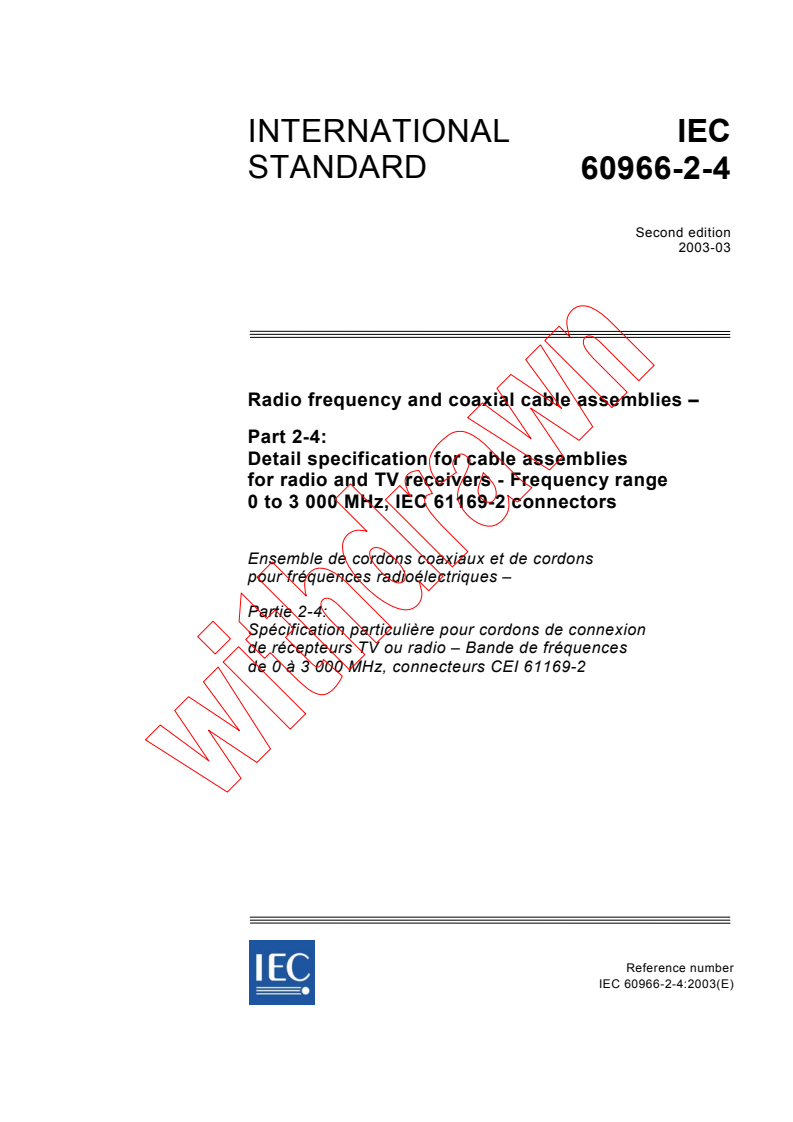
INTERNATIONAL IEC
STANDARD
60966-2-4
Second edition
2003-03
Radio frequency and coaxial cable assemblies –
Part 2-4:
Detail specification for cable assemblies
for radio and TV receivers - Frequency range
0 to 3 000 MHz, IEC 61169-2 connectors
Ensemble de cordons coaxiaux et de cordons
pour fréquences radioélectriques –
Partie 2-4:
Spécification particulière pour cordons de connexion
de récepteurs TV ou radio – Bande de fréquences
de 0 à 3 000 MHz, connecteurs CEI 61169-2
Reference number
Publication numbering
As from 1 January 1997 all IEC publications are issued with a designation in the
60000 series. For example, IEC 34-1 is now referred to as IEC 60034-1.
Consolidated editions
The IEC is now publishing consolidated versions of its publications. For example,
edition numbers 1.0, 1.1 and 1.2 refer, respectively, to the base publication, the
base publication incorporating amendment 1 and the base publication incorporating
amendments 1 and 2.
Further information on IEC publications
The technical content of IEC publications is kept under constant review by the IEC,
thus ensuring that the content reflects current technology. Information relating to
this publication, including its validity, is available in the IEC Catalogue of
publications (see below) in addition to new editions, amendments and corrigenda.
Information on the subjects under consideration and work in progress undertaken
by the technical committee which has prepared this publication, as well as the list
of publications issued, is also available from the following:
• IEC Web Site (www.iec.ch)
• Catalogue of IEC publications
The on-line catalogue on the IEC web site (http://www.iec.ch/searchpub/cur_fut.htm)
enables you to search by a variety of criteria including text searches, technical
committees and date of publication. On-line information is also available on
recently issued publications, withdrawn and replaced publications, as well as
corrigenda.
• IEC Just Published
This summary of recently issued publications (http://www.iec.ch/online_news/
justpub/jp_entry.htm) is also available by email. Please contact the Customer
Service Centre (see below) for further information.
• Customer Service Centre
If you have any questions regarding this publication or need further assistance,
please contact the Customer Service Centre:
Email: custserv@iec.ch
Tel: +41 22 919 02 11
Fax: +41 22 919 03 00
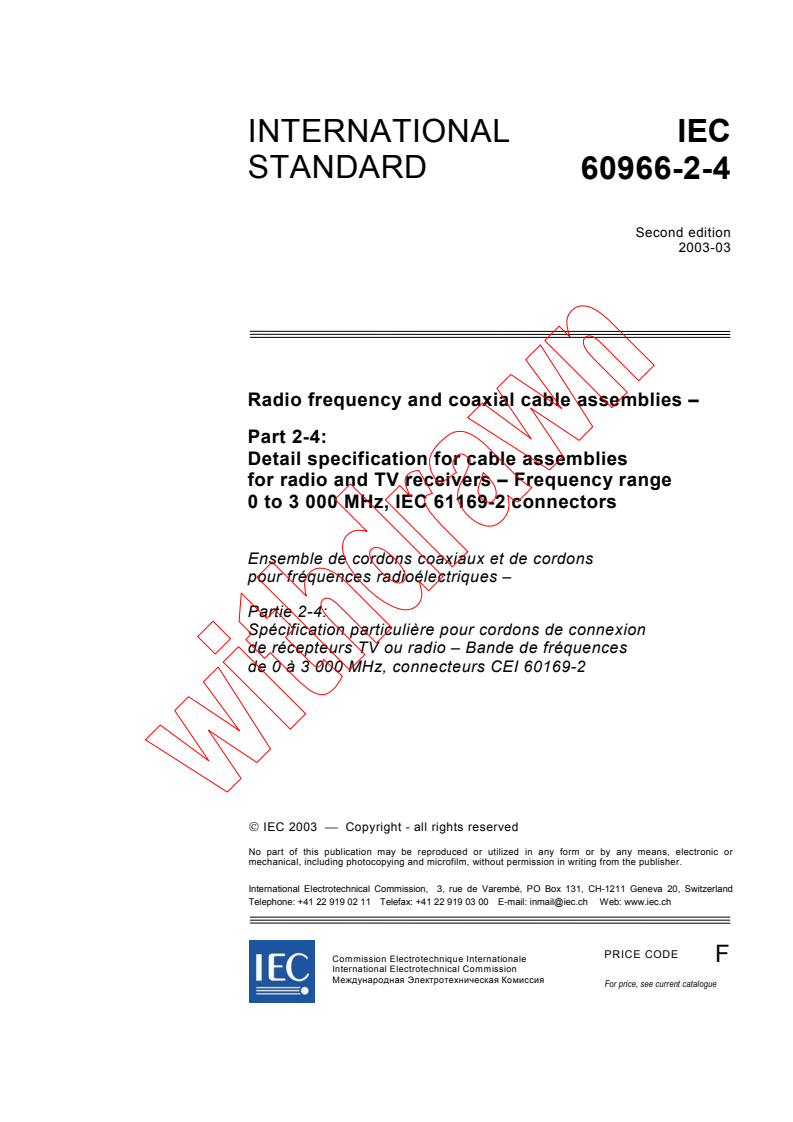
INTERNATIONAL IEC
STANDARD
60966-2-4
Second edition
2003-03
Radio frequency and coaxial cable assemblies –
Part 2-4:
Detail specification for cable assemblies
for radio and TV receivers – Frequency range
0 to 3 000 MHz, IEC 61169-2 connectors
Ensemble de cordons coaxiaux et de cordons
pour fréquences radioélectriques –
Partie 2-4:
Spécification particulière pour cordons de connexion
de récepteurs TV ou radio – Bande de fréquences
de 0 à 3 000 MHz, connecteurs CEI 60169-2
IEC 2003 Copyright - all rights reserved
No part of this publication may be reproduced or utilized in any form or by any means, electronic or
mechanical, including photocopying and microfilm, without permission in writing from the publisher.
International Electrotechnical Commission, 3, rue de Varembé, PO Box 131, CH-1211 Geneva 20, Switzerland
Telephone: +41 22 919 02 11 Telefax: +41 22 919 03 00 E-mail: inmail@iec.ch Web: www.iec.ch
PRICE CODE
Commission Electrotechnique Internationale
F
International Electrotechnical Commission
Международная Электротехническая Комиссия
For price, see current catalogue
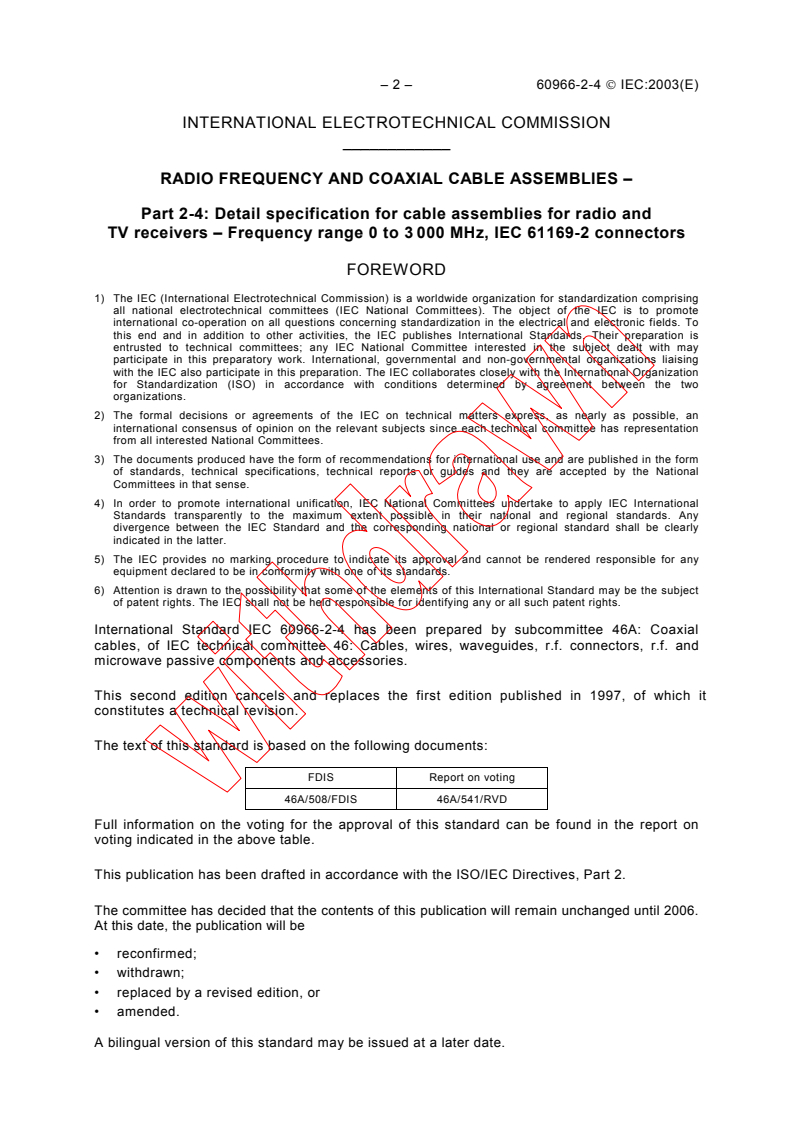
– 2 – 60966-2-4 IEC:2003(E)
INTERNATIONAL ELECTROTECHNICAL COMMISSION
____________
RADIO FREQUENCY AND COAXIAL CABLE ASSEMBLIES –
Part 2-4: Detail specification for cable assemblies for radio and
TV receivers – Frequency range 0 to 3 000 MHz, IEC 61169-2 connectors
FOREWORD
1) The IEC (International Electrotechnical Commission) is a worldwide organization for standardization comprising
all national electrotechnical committees (IEC National Committees). The object of the IEC is to promote
international co-operation on all questions concerning standardization in the electrical and electronic fields. To
this end and in addition to other activities, the IEC publishes International Standards. Their preparation is
entrusted to technical committees; any IEC National Committee interested in the subject dealt with may
participate in this preparatory work. International, governmental and non-governmental organizations liaising
with the IEC also participate in this preparation. The IEC collaborates closely with the International Organization
for Standardization (ISO) in accordance with conditions determined by agreement between the two
organizations.
2) The formal decisions or agreements of the IEC on technical matters express, as nearly as possible, an
international consensus of opinion on the relevant subjects since each technical committee has representation
from all interested National Committees.
3) The documents produced have the form of recommendations for international use and are published in the form
of standards, technical specifications, technical reports or guides and they are accepted by the National
Committees in that sense.
4) In order to promote international unification, IEC National Committees undertake to apply IEC International
Standards transparently to the maximum extent possible in their national and regional standards. Any
divergence between the IEC Standard and the corresponding national or regional standard shall be clearly
indicated in the latter.
5) The IEC provides no marking procedure to indicate its approval and cannot be rendered responsible for any
equipment declared to be in conformity with one of its standards.
6) Attention is drawn to the possibility that some of the elements of this International Standard may be the subject
of patent rights. The IEC shall not be held responsible for identifying any or all such patent rights.
International Standard IEC 60966-2-4 has b
...