

IEC 62153-4-9:2018
(Main)Metallic communication cable test methods - Part 4 - 9: Electromagnetic compatibility (EMC) - Coupling attenuation of screened balanced cables, triaxial method
General Information
- Abstract
IEC 62153-4-9:2018 applies to metallic communication cables. It specifies a test method for determining the coupling attenuation aC of screened balanced cables. Due to the concentric outer tube, measurements are independent of irregularities on the circumference and external electromagnetic fields. A wide dynamic and frequency range can be applied to test even super screened cables with normal instrumentation from low frequencies up to the limit of defined transversal waves in the outer circuit at approximately 4 GHz. However, when using a balun, the upper frequency is limited by the properties of the balun. Measurements can be performed with standard tube procedure (respectively with standard test head) according to IEC 62153-4-4 or with open tube (open test head) procedure.
The procedure described herein to measure the coupling attenuation aC is based on the procedure to measure the screening attenuation aS according to IEC 62153-4-4. This second edition cancels and replaces the first edition published in 2008. This edition constitutes a technical revision. This edition includes the following significant technical changes with respect to the previous edition:
– two test procedures, open head and standard head procedure;
– measuring with balun or with multiport respectively mixed mode VNA;
– extension of frequency range up to and above 2 GHz.
- Status
- Published
- Publication Date
- 17-Jun-2024
- Technical Committee
- TC 46 - Cables, wires, waveguides, RF connectors, RF and microwave passive components and accessories
- Drafting Committee
- WG 5 - TC 46/WG 5
- Current Stage
- PPUB - Publication issued
- Start Date
- 29-May-2018
- Completion Date
- 15-Jun-2018
Buy Documents

IEC 62153-4-9:2018+AMD1:2020 CSV - Metallic communication cable test methods - Part 4 - 9: Electromagnetic compatibility (EMC) - Coupling attenuation of screened balanced cables, triaxial method Released:7/6/2020
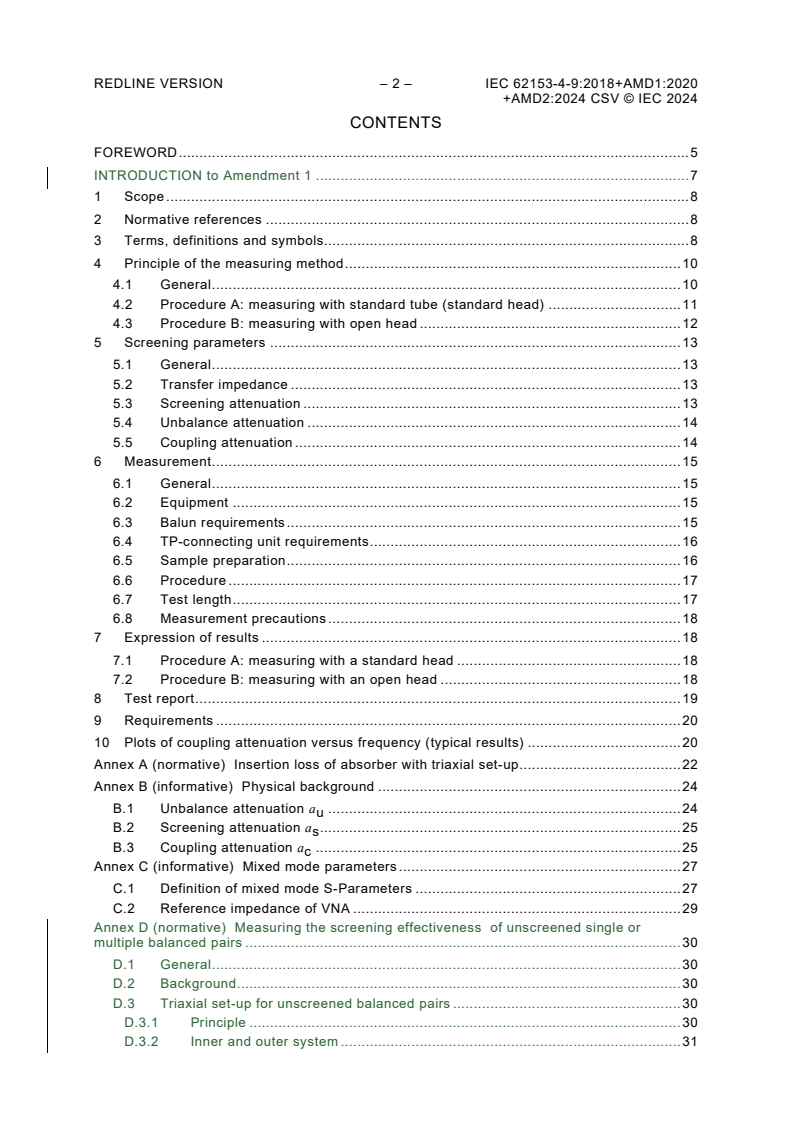
IEC 62153-4-9:2018+AMD1:2020+AMD2:2024 CSV - Metallic communication cable test methods - Part 4-9: Electromagnetic compatibility (EMC) - Coupling attenuation of screened balanced cables, triaxial method Released:6/18/2024
IEC 62153-4-9:2018 RLV - Metallic communication cable test methods - Part 4 - 9: Electromagnetic compatibility (EMC) - Coupling attenuation of screened balanced cables, triaxial method Released:5/29/2018
IEC 62153-4-9:2018 - Metallic communication cable test methods - Part 4 - 9: Electromagnetic compatibility (EMC) - Coupling attenuation of screened balanced cables, triaxial method Released:5/29/2018
Overview
IEC 62153-4-9:2018 defines a standardized triaxial test method for measuring the coupling attenuation (aC) of screened balanced metallic communication cables. The method uses a concentric outer tube (triaxial set-up) so that results are largely independent of surface irregularities and external electromagnetic fields. The second edition (2018) is a technical revision of the 2008 edition and extends frequency capability and measurement options for modern, highly screened cables.
Key topics and technical requirements
- Purpose: Quantify coupling attenuation (aC) of screened balanced cables to assess EMC performance.
- Test configurations: Two validated procedures:
- Standard head (standard tube) procedure
- Open head (open tube) procedure
- Measurement equipment:
- Use of a balun or a multiport / mixed-mode VNA for differential/single-ended conversions.
- Specific balun and TP-connecting unit requirements are detailed in the standard (performance characteristics tables).
- Frequency and dynamic range:
- Applicable from low frequencies up to the limit set by transversal wave propagation in the outer circuit (approximately 4 GHz in theory).
- Practical upper frequency is limited by the balun when one is used; the 2018 edition explicitly extends the frequency range up to and above 2 GHz.
- Measurement basis:
- Procedure builds on screening attenuation methods (see IEC 62153-4-4) and uses triaxial geometry to measure transfer impedance, unbalanced attenuation, and coupling attenuation.
- Test reporting:
- The standard prescribes how to express results and what to include in the test report (sample prep, equipment, test length, plots).
Practical applications and users
Who benefits from IEC 62153-4-9:2018:
- Cable manufacturers validating screen effectiveness for high-speed and shielded pair cables (e.g., Cat 7a, Cat 8.x, twinax).
- EMC test laboratories performing reproducible coupling attenuation measurements with triaxial fixtures.
- Telecom, data center and networking engineers specifying cable screening performance for installations where external EMI could impair differential links.
- Compliance engineers and spec writers who need standardized test data to compare cable designs or to support product claims.
Practical value:
- Enables reliable comparison of shielding performance across cable types.
- Supports design decisions for shielding, connector and balun choices when targeting specific EMC goals.
- Helps verify manufactured cables meet EMC requirements over a wide frequency span.
Related standards
- IEC 62153-4-4 (screening attenuation, triaxial method)
- IEC 62153-4-3 (surface transfer impedance, triaxial method)
- IEC 62153-4-5 (absorbing clamp method)
- IEC TS 62153-4-1 (EMC screening measurements introduction)
- IEC 60050-726 (vocabulary for transmission lines and waveguides)
Keywords: IEC 62153-4-9:2018, coupling attenuation, screened balanced cables, triaxial method, EMC, balun, mixed-mode VNA, standard head, open head, transfer impedance, screening attenuation.
Relations
- Effective Date
- 05-Sep-2023
- Effective Date
- 05-Sep-2023
- Effective Date
- 05-Sep-2023
Buy Documents
IEC 62153-4-9:2018+AMD1:2020 CSV - Metallic communication cable test methods - Part 4 - 9: Electromagnetic compatibility (EMC) - Coupling attenuation of screened balanced cables, triaxial method Released:7/6/2020
IEC 62153-4-9:2018+AMD1:2020+AMD2:2024 CSV - Metallic communication cable test methods - Part 4-9: Electromagnetic compatibility (EMC) - Coupling attenuation of screened balanced cables, triaxial method Released:6/18/2024
IEC 62153-4-9:2018 RLV - Metallic communication cable test methods - Part 4 - 9: Electromagnetic compatibility (EMC) - Coupling attenuation of screened balanced cables, triaxial method Released:5/29/2018
IEC 62153-4-9:2018 - Metallic communication cable test methods - Part 4 - 9: Electromagnetic compatibility (EMC) - Coupling attenuation of screened balanced cables, triaxial method Released:5/29/2018
Get Certified
Connect with accredited certification bodies for this standard

ANCE
Mexican certification and testing association.

Intertek Slovenia
Intertek testing, inspection, and certification services in Slovenia.

LNE (Laboratoire National de Métrologie et d'Essais)
French national laboratory for metrology and testing.
Sponsored listings
Frequently Asked Questions
IEC 62153-4-9:2018 is a standard published by the International Electrotechnical Commission (IEC). Its full title is "Metallic communication cable test methods - Part 4 - 9: Electromagnetic compatibility (EMC) - Coupling attenuation of screened balanced cables, triaxial method". This standard covers: IEC 62153-4-9:2018 applies to metallic communication cables. It specifies a test method for determining the coupling attenuation aC of screened balanced cables. Due to the concentric outer tube, measurements are independent of irregularities on the circumference and external electromagnetic fields. A wide dynamic and frequency range can be applied to test even super screened cables with normal instrumentation from low frequencies up to the limit of defined transversal waves in the outer circuit at approximately 4 GHz. However, when using a balun, the upper frequency is limited by the properties of the balun. Measurements can be performed with standard tube procedure (respectively with standard test head) according to IEC 62153-4-4 or with open tube (open test head) procedure. The procedure described herein to measure the coupling attenuation aC is based on the procedure to measure the screening attenuation aS according to IEC 62153-4-4. This second edition cancels and replaces the first edition published in 2008. This edition constitutes a technical revision. This edition includes the following significant technical changes with respect to the previous edition: – two test procedures, open head and standard head procedure; – measuring with balun or with multiport respectively mixed mode VNA; – extension of frequency range up to and above 2 GHz.
IEC 62153-4-9:2018 applies to metallic communication cables. It specifies a test method for determining the coupling attenuation aC of screened balanced cables. Due to the concentric outer tube, measurements are independent of irregularities on the circumference and external electromagnetic fields. A wide dynamic and frequency range can be applied to test even super screened cables with normal instrumentation from low frequencies up to the limit of defined transversal waves in the outer circuit at approximately 4 GHz. However, when using a balun, the upper frequency is limited by the properties of the balun. Measurements can be performed with standard tube procedure (respectively with standard test head) according to IEC 62153-4-4 or with open tube (open test head) procedure. The procedure described herein to measure the coupling attenuation aC is based on the procedure to measure the screening attenuation aS according to IEC 62153-4-4. This second edition cancels and replaces the first edition published in 2008. This edition constitutes a technical revision. This edition includes the following significant technical changes with respect to the previous edition: – two test procedures, open head and standard head procedure; – measuring with balun or with multiport respectively mixed mode VNA; – extension of frequency range up to and above 2 GHz.
IEC 62153-4-9:2018 is classified under the following ICS (International Classification for Standards) categories: 33.100.10 - Emission; 33.120.10 - Coaxial cables. Waveguides. The ICS classification helps identify the subject area and facilitates finding related standards.
IEC 62153-4-9:2018 has the following relationships with other standards: It is inter standard links to IEC 62153-4-9:2018/AMD1:2020, IEC 62153-4-9:2018/AMD2:2024, IEC 62153-4-9:2008. Understanding these relationships helps ensure you are using the most current and applicable version of the standard.
IEC 62153-4-9:2018 is available in PDF format for immediate download after purchase. The document can be added to your cart and obtained through the secure checkout process. Digital delivery ensures instant access to the complete standard document.
Standards Content (Sample)
IEC 62153-4-9 ®
Edition 2.1 2020-07
CONSOLIDATED VERSION
INTERNATIONAL
STANDARD
colour
inside
Metallic communication cable test methods –
Part 4-9: Electromagnetic compatibility (EMC) – Coupling attenuation of
screened balanced cables, triaxial method
All rights reserved. Unless otherwise specified, no part of this publication may be reproduced or utilized in any form
or by any means, electronic or mechanical, including photocopying and microfilm, without permission in writing from
either IEC or IEC's member National Committee in the country of the requester. If you have any questions about IEC
copyright or have an enquiry about obtaining additional rights to this publication, please contact the address below or
your local IEC member National Committee for further information.
IEC Central Office Tel.: +41 22 919 02 11
3, rue de Varembé info@iec.ch
CH-1211 Geneva 20 www.iec.ch
Switzerland
About the IEC
The International Electrotechnical Commission (IEC) is the leading global organization that prepares and publishes
International Standards for all electrical, electronic and related technologies.
About IEC publications
The technical content of IEC publications is kept under constant review by the IEC. Please make sure that you have the
latest edition, a corrigendum or an amendment might have been published.
IEC publications search - webstore.iec.ch/advsearchform Electropedia - www.electropedia.org
The advanced search enables to find IEC publications by a The world's leading online dictionary on electrotechnology,
variety of criteria (reference number, text, technical containing more than 22 000 terminological entries in English
committee,…). It also gives information on projects, replaced and French, with equivalent terms in 16 additional languages.
and withdrawn publications. Also known as the International Electrotechnical Vocabulary
(IEV) online.
IEC Just Published - webstore.iec.ch/justpublished
Stay up to date on all new IEC publications. Just Published IEC Glossary - std.iec.ch/glossary
details all new publications released. Available online and 67 000 electrotechnical terminology entries in English and
once a month by email. French extracted from the Terms and definitions clause of
IEC publications issued between 2002 and 2015. Some
IEC Customer Service Centre - webstore.iec.ch/csc entries have been collected from earlier publications of IEC
If you wish to give us your feedback on this publication or TC 37, 77, 86 and CISPR.
need further assistance, please contact the Customer Service
Centre: sales@iec.ch.
IEC 62153-4-9 ®
Edition 2.1 2020-07
CONSOLIDATED VERSION
INTERNATIONAL
STANDARD
colour
inside
Metallic communication cable test methods –
Part 4-9: Electromagnetic compatibility (EMC) – Coupling attenuation of
screened balanced cables, triaxial method
INTERNATIONAL
ELECTROTECHNICAL
COMMISSION
ICS 33.100.10; 33.120.10 ISBN 978-2-8322-8633-3
IEC 62153-4-9 ®
Edition 2.1 2020-07
REDLINE VERSION
colour
inside
Metallic communication cable test methods –
Part 4-9: Electromagnetic compatibility (EMC) – Coupling attenuation of
screened balanced cables, triaxial method
– 2 – IEC 62153-4-9:2018+AMD1:2020 CSV
© IEC 2020
CONTENTS
FOREWORD . 4
INTRODUCTION to Amendment 1 . 6
1 Scope . 7
2 Normative references . 7
3 Terms, definitions and symbols. 7
4 Principle of the measuring method . 9
4.1 General . 9
4.2 Procedure A: measuring with standard tube (standard head) . 10
4.3 Procedure B: measuring with open head . 11
5 Screening parameters . 12
5.1 General . 12
5.2 Transfer impedance . 12
5.3 Screening attenuation . 12
5.4 Unbalance attenuation . 13
5.5 Coupling attenuation . 13
6 Measurement . 14
6.1 General . 14
6.2 Equipment . 14
6.3 Balun requirements . 14
6.4 TP-connecting unit requirements . 15
6.5 Sample preparation . 15
6.6 Procedure . 16
6.7 Test length . 16
6.8 Measurement precautions . 17
7 Expression of results . 17
7.1 Procedure A: measuring with a standard head . 17
7.2 Procedure B: measuring with an open head . 17
8 Test report . 18
9 Requirements . 18
10 Plots of coupling attenuation versus frequency (typical results) . 19
Annex A (normative) Insertion loss of absorber with triaxial set-up . 21
Annex B (informative) Physical background . 23
B.1 Unbalance attenuation a . 23
u
B.2 Screening attenuation a . 24
s
B.3 Coupling attenuation a . 24
c
Annex C (informative) Mixed mode parameters . 26
C.1 Definition of mixed mode S-Parameters . 26
C.2 Reference impedance of VNA . 28
Annex D (normative) Measuring the screening effectiveness of unscreened single or
multiple balanced pairs . 29
D.1 General . 29
D.2 Background. 29
D.3 Triaxial set-up for unscreened balanced pairs . 29
D.4 Unscreened single pairs . 30
© IEC 2020
D.5 Screening- and coupling attenuation measurement of multiple unscreened
balanced pairs . 31
D.6 Measurement . 32
D.7 Expression of test results . 32
D.8 Low frequency coupling attenuation . 32
D.9 Set-up verification and measurement uncertainties . 33
Bibliography . 35
Figure 1 – Coupling attenuation, principle test set-up with balun and standard tube . 9
Figure 2 – Coupling attenuation, principle test set-up with balun and open head . 10
Figure 3 – Coupling attenuation, principle set-up with multiport VNA and standard head . 11
Figure 4 – Coupling attenuation, principle set-up with multiport VNA and open head. 11
Figure 5 – Definition of transfer impedance . 12
Figure 6 – Termination of the cable under test with balun feeding . 16
Figure 7 – Test set-up to measure a . 18
tube
Figure 8 – Coupling attenuation Twinax 105, open head procedure. 19
Figure 9 – Coupling attenuation Cat 7a, standard head procedure . 19
Figure 10 – Coupling attenuation Cat 8.2, open head procedure . 20
Figure A.1 – Insertion loss of absorber with triaxial set-up . 21
Figure A.2 – Insertion loss of absorber with triaxial set-up . 21
Figure C.1 – Common two-port network . 26
Figure C.2 – Common four port network . 26
Figure C.3 – Physical and logical ports of VNA . 27
Figure C.4 – Nomenclature of mixed mode S-Parameters . 27
Figure C.5 – Measurement configuration, single ended response . 28
Figure C.6 – Measurement configuration, differential mode response . 28
Figure D.1 – Basic triaxial tube procedure according to IEC 62153-4-3 / IEC 62153-4-4 . 29
Figure D.2 – Screening effectiveness of unscreened balanced pairs, principle set-up . 30
Figure D.3 – Configuration for near end coupling measurement of an unscreened
single pair, principle set-up . 31
Figure D.4 – Far end screening attenuation and coupling attenuation (S and
sc21
S ) of an unscreened balanced pair, principle set-up . 31
sd21
Figure D.5 – Basic configuration of screening attenuation and coupling attenuation
test of multiple unscreened balanced pairs . 32
Figure D.6 – Low frequency coupling attenuation a of a single screened and
C,lf
unscreened balanced pair, 3 m . 33
Figure D.7 – Reflected mode conversion parameter S with a TP-connecting unit
cd11
having an open loop. 34
Table 1 – Balun performance characteristics (1 MHz to 1 GHz) . 15
Table 2 – TP-connecting unit performance characteristics (1 MHz to 2 GHz) . 15
– 4 – IEC 62153-4-9:2018+AMD1:2020 CSV
© IEC 2020
INTERNATIONAL ELECTROTECHNICAL COMMISSION
____________
METALLIC COMMUNICATION CABLE TEST METHODS –
Part 4-9: Electromagnetic compatibility (EMC) –
Coupling attenuation of screened balanced cables, triaxial method
FOREWORD
1) The International Electrotechnical Commission (IEC) is a worldwide organization for standardization comprising
all national electrotechnical committees (IEC National Committees). The object of IEC is to promote
international co-operation on all questions concerning standardization in the electrical and electronic fields. To
this end and in addition to other activities, IEC publishes International Standards, Technical Specifications,
Technical Reports, Publicly Available Specifications (PAS) and Guides (hereafter referred to as “IEC
Publication(s)”). Their preparation is entrusted to technical committees; any IEC National Committee interested
in the subject dealt with may participate in this preparatory work. International, governmental and non-
governmental organizations liaising with the IEC also participate in this preparation. IEC collaborates closely
with the International Organization for Standardization (ISO) in accordance with conditions determined by
agreement between the two organizations.
2) The formal decisions or agreements of IEC on technical matters express, as nearly as possible, an international
consensus of opinion on the relevant subjects since each technical committee has representation from all
interested IEC National Committees.
3) IEC Publications have the form of recommendations for international use and are accepted by IEC National
Committees in that sense. While all reasonable efforts are made to ensure that the technical content of IEC
Publications is accurate, IEC cannot be held responsible for the way in which they are used or for any
misinterpretation by any end user.
4) In order to promote international uniformity, IEC National Committees undertake to apply IEC Publications
transparently to the maximum extent possible in their national and regional publications. Any divergence
between any IEC Publication and the corresponding national or regional publication shall be clearly indicated in
the latter.
5) IEC itself does not provide any attestation of conformity. Independent certification bodies provide conformity
assessment services and, in some areas, access to IEC marks of conformity. IEC is not responsible for any
services carried out by independent certification bodies.
6) All users should ensure that they have the latest edition of this publication.
7) No liability shall attach to IEC or its directors, employees, servants or agents including individual experts and
members of its technical committees and IEC National Committees for any personal injury, property damage or
other damage of any nature whatsoever, whether direct or indirect, or for costs (including legal fees) and
expenses arising out of the publication, use of, or reliance upon, this IEC Publication or any other IEC
Publications.
8) Attention is drawn to the Normative references cited in this publication. Use of the referenced publications is
indispensable for the correct application of this publication.
9) Attention is drawn to the possibility that some of the elements of this IEC Publication may be the subject of
patent rights. IEC shall not be held responsible for identifying any or all such patent rights.
This consolidated version of the official IEC Standard and its amendment has been
prepared for user convenience.
IEC 62153-4-9 edition 2.1 contains the second edition (2018-05) [documents 46/681/FDIS
and 46/685/RVD] and its amendment 1 (2020-07) [documents 46/773/FDIS and
46/776/RVD].
In this Redline version, a vertical line in the margin shows where the technical content
is modified by amendment 1. Additions are in green text, deletions are in strikethrough
red text. A separate Final version with all changes accepted is available in this
publication.
© IEC 2020
International Standard IEC 62153-4-9 has been prepared by IEC technical committee 46:
Cables, wires, waveguides, RF connectors, RF and microwave passive components and
accessories.
This second edition constitutes a technical revision.
This edition includes the following significant technical changes with respect to the previous
edition:
– two test procedures, open head and standard head procedure;
– measuring with balun or with multiport respectively mixed mode VNA;
– extension of frequency range up to and above 2 GHz.
This document has been drafted in accordance with the ISO/IEC Directives, Part 2.
A list of all parts of the IEC 62153 series can be found, under the general title Metallic
communication cable test methods, on the IEC website.
The committee has decided that the contents of the base publication and its amendment will
remain unchanged until the stability date indicated on the IEC web site under
"http://webstore.iec.ch" in the data related to the specific publication. At this date, the
publication will be
• reconfirmed,
• withdrawn,
• replaced by a revised edition, or
• amended.
IMPORTANT – The 'colour inside' logo on the cover page of this publication indicates
that it contains colours which are considered to be useful for the correct
understanding of its contents. Users should therefore print this document using a
colour printer.
– 6 – IEC 62153-4-9:2018+AMD1:2020 CSV
© IEC 2020
INTRODUCTION to Amendment 1
The goal of this amendment is to extent IEC 62153-4-9 such that also the coupling attenuation
of unscreened single or multiple balanced pairs or unscreened quads can be measured with
the triaxial test procedure.
Further complement is the extension of the usable frequency range down to frequencies
below 9 kHz to measure the low frequency coupling attenuation of screened and unscreened
balanced pairs or quads.
© IEC 2020
METALLIC COMMUNICATION CABLE TEST METHODS –
Part 4-9: Electromagnetic compatibility (EMC) –
Coupling attenuation of screened balanced cables, triaxial method
1 Scope
This part of IEC 62153 applies to metallic communication cables. It specifies a test method for
determining the coupling attenuation a of screened balanced cables. Due to the concentric
C
outer tube, measurements are independent of irregularities on the circumference and external
electromagnetic fields.
A wide dynamic and frequency range can be applied to test even super screened cables with
normal instrumentation from low frequencies up to the limit of defined transversal waves in
the outer circuit at approximately 4 GHz. However, when using a balun, the upper frequency
is limited by the properties of the balun.
Measurements can be performed with standard tube procedure (respectively with standard
test head) according to IEC 62153-4-4 or with open tube (open test head) procedure.
The procedure described herein to measure the coupling attenuation a is based on the
C
procedure to measure the screening attenuation a according to IEC 62153-4-4.
S
2 Normative references
The following documents are referred to in the text in such a way that some or all of their
content constitutes requirements of this document. For dated references, only the edition
cited applies. For undated references, the latest edition of the referenced document (including
any amendments) applies.
IEC 60050-726, International Electrotechnical Vocabulary – Chapter 726: Transmission lines
and waveguides
IEC TS 62153-4-1, Metallic communication cable test methods – Part 4-1: Electromagnetic
compatibility (EMC) – Introduction to electromagnetic screening measurements
IEC 62153-4-3, Metallic communication cable test methods – Part 4-3: Electromagnetic
compatibility (EMC) – Surface transfer impedance – Triaxial method
IEC 62153-4-4, Metallic communication cable test methods – Part 4-4: Electromagnetic
compatibility (EMC) – Test method for measuring of the screening attenuation as up to and
above 3 GHz, triaxial method
IEC 62153-4-5, Metallic communication cables test methods – Part 4-5: Electromagnetic
compatibility (EMC) – Coupling or screening attenuation – Absorbing clamp method
3 Terms, definitions and symbols
For the purposes of this document, the terms and definitions given in IEC 60050-726,
IEC TS 62153-4-1 and IEC 62153-4-4, as well as the following symbols apply.
– 8 – IEC 62153-4-9:2018+AMD1:2020 CSV
© IEC 2020
ISO and IEC maintain terminological databases for use in standardization at the following
addresses:
• IEC Electropedia: available at http://www.electropedia.org/
• ISO Online browsing platform: available at http://www.iso.org/obp
a is the screening attenuation which is comparable to the results of the absorbing
s
clamp method in dB;
a is the coupling attenuation related to the radiating impedance of 150 Ω in dB;
c
a is the unbalanced attenuation;
u
a is the attenuation recorded as minimum envelope curve of the measured values
m,min
in dB;
a is the additional attenuation of a possible inserted adapter, if not otherwise
z
eliminated e.g. by the calibration, in dB;
C is the through capacitance of the outer conductor in F/m;
T
c is the vacuum velocity in m/s;
dx is the differential length operator of integration;
λ is the vacuum wavelength in m;
ε is the relative dielectric permittivity of the cable under test;
r1
ε is the relative dielectric permittivity of the secondary circuit;
r2
ε is a normalised value of the relative dielectric permittivity of the environment of the
r2,n
cable;
f is the frequency in Hz;
j is the imaginary operator (square root of minus one);
L is the transmission line parameter-inductance;
l is the effective coupling length in m;
φ is a phase factor in the ratio of the secondary to primary circuit end voltages (U /U );
1 2
P is the feeding power of the primary circuit in W;
is the measured power received on the input impedance;
P
R of the receiver in the secondary circuit in W;
P is the radiated power in the environment of the cable, which is comparable to
r
P + P of the absorbing clamp method in W;
2n 2f
P is the periodic maximum value of the common mode radiated power in W;
r,max
P is the radiated power in the normalised environment of the cable under test,
s
= 150 Ω and |∆ v / v | = 10 % ) in W,
(Z
s 1
ϕ = 2π×( ε − ε )× l /λ
(1)
1 r1 r2 0
ϕ = 2π×( ε + ε )× l /λ
(2)
2 r1 r2 0
ϕ =ϕ −ϕ = 4π× ε × l /λ (3)
3 2 1 r2 0
R is the input impedance of the receiver in Ω;
R is the differential mode termination, Ω;
DM
S is the summing function;
T is the coupling transfer function;
U is the input voltage of the primary circuit formed by the cable in V;
U is the output voltage of the secondary circuit in V;
© IEC 2020
Ω is the radian frequency ω;
Z is the (differential mode) characteristic impedance of the cable under test (primary
circuit) in Ω;
Z is the characteristic impedance of the secondary circuit in Ω;
Z is the common mode (unbalanced);
com
Z is the nominal characteristic impedance of the differential mode (balanced);
diff
Z is the capacitive coupling impedance of the cable under test in Ω/m,
F
Z = Z ⋅ Z ⋅ j⋅ 2⋅π⋅ f⋅C (4)
F 1 2 T
Z is the normalised value of the characteristic impedance of the environment of the
S
cable;
Z is the transfer impedance of the cable under test in Ω/m;
T
4 Principle of the measuring method
4.1 General
Coupling attenuation of screened balanced cables describes the overall effect against
electromagnetic interference (EMI) taking into account both the unbalance attenuation of the
pair and the screening attenuation of the screen.
The disturbing circuit (the inner or primary circuit) consists of the test cable which is fed by a
generator and is impedance-matched at the near and far ends. The disturbed circuit (the outer
or secondary circuit) is formed by the solid metallic tube and the short section of the cable
under test covered by the tube. The disturbed circuit (the outer or secondary circuit) is
terminated at the near end in a short circuit and is terminated at the far end with a calibrated
receiver or network analyser.
The voltage peaks at the far end of the secondary circuit are measured with a calibrated
receiver or network analyser. For this measurement a matched receiver is not necessary.
These voltage peaks are not dependant on the input impedance of the receiver, provided that
the input impedance of the receiver is lower than the characteristic impedance of the
secondary circuit. However, it is advantageous to have a low mismatch, for example by
selecting a range of tube diameters for several cable sizes.
To measure the coupling attenuation as well as to measure the unbalance attenuation a
differential signal is required. This can, for example, be generated using a balun which
converts the unbalanced signal of a 50 Ω network analyser into a balanced signal.
Figure 1 – Coupling attenuation, principle test set-up
with balun and standard tube
– 10 – IEC 62153-4-9:2018+AMD1:2020 CSV
© IEC 2020
Alternatively, a balanced signal may be obtained by using a vector network analyser (VNA)
having two generators with a phase shift of 180°. Another alternative is to measure with a
multi-port VNA (virtual balun). The properties of balanced pairs are determined
mathematically from the measured values of each single conductor of the pair against
reference ground. The coverable frequency range for the determination of the reflection and
transmissions characteristics of symmetrical pairs is no longer limited by the balun but by the
VNA and the connection technique.
A detailed definition of mixed mode S-parameters for measurements with virtual balun is given
in Annex B.
The test set-up (see Figures 1, 2, 3 and 4) is a triaxial system consisting of an outer solid
metallic tube in which the cable under test (CUT) is concentrically positioned.
At the near end, the screen of the screened cable under test is short circuited with the solid
metallic tube.
Figure 2 – Coupling attenuation, principle test set-up with balun and open head
At the far end, the tube can be equipped with a “test head” which can be removed from the
tube for easier connecting of the CUT. The set-up according to IEC 62153-4-4 is designated
as the standard procedure, respectively the procedure with standard head. The advantage is
an overall closed and shielded set-up.
Alternatively, the tube can be equipped with an open head at the far end (see Figures 2 and
4).
4.2 Procedure A: measuring with standard tube (standard head)
The set-up detailed in Procedure A uses the standard test-head and is in principle the same
as described in IEC 62153-4-4. The screened balanced DUT can be fed either in common
mode or in differential mode. In this way, both, screening attenuation of the screen or coupling
attenuation of the screened pair can be measured. In principle, with the same set-up, also the
transfer impedance of the screen can be measured (taking into account the length of the
DUT).
© IEC 2020
Figure 3 – Coupling attenuation, principle set-up with multiport VNA and standard head
The DUT shall be matched at the far end in common and differential mode. Return loss of the
CUT in common and differential mode shall be measured. Values for return loss in common
and differential mode shall be at least 10 dB.
4.3 Procedure B: measuring with open head
In case of measuring with open head the first several meters of a longer length of the cable to
be tested are concentrically positioned in an outer solid metallic tube. The remaining length
(usually of 100 m length) that extends past the tube is placed in a highly shielded box and
terminated with common mode and differential mode terminations (see Figure 6). The cable
screen shall be connected with low impedance to the screened box. The center point of the
differential mode termination shall be connected via the resistor R to the highly screened
CM
box or cable screen (see Figure 6).
Figure 4 – Coupling attenuation, principle set-up with multiport VNA and open head
At the near end, the screen of the screened cable under test is short circuited with the solid
metallic tube.
At the far end, the tube is let open and the signal is picked up by a “pick up wire”, which is
connected to the screen of the cable under test (see Figure 4). The open tube system can
also be equipped with a “test head” which can be removed from the tube for easier connecting
of the CUT.
At the open end of the tube, absorbers shall be applied to match the system and to avoid back
travelling waves into the system. The attenuation of the absorber shall be at least 20 dB. A
combination of a ferrite absorber and/or nanocrystalline absorber may be used. A procedure
to measure the attenuation of absorbers is given in Annex A.
– 12 – IEC 62153-4-9:2018+AMD1:2020 CSV
© IEC 2020
5 Screening parameters
5.1 General
To protect a cable against external electromagnetic interference or to avoid radiation into the
environment, the cable is surrounded with screens made of metal foils and/or braids. For
cables used in harsh electromagnetic environments, elaborate shield structures, made of
several layers or magnetic materials, are also used. In case of balanced cables, also the
overall symmetry of the pair contributes to the screening effectiveness in addition to the
screen.
The sole effect of the screen is described by the transfer impedance and the screening
attenuation. The influence of the symmetry is grasped by the unbalance attenuation. The
overall effect of the screen and the symmetry of the pair (for balanced cables) are described
by the coupling attenuation.
5.2 Transfer impedance
For an electrically short screen, the transfer impedance Z is defined as the quotient of the
T
longitudinal voltage U induced to the inner circuit by the current I fed into the outer circuit or
1 2
vice versa, related to length in Ω/m or in mΩ/m (see Figure 5).
U
Z = (5)
T
I ⋅ l
Figure 5 – Definition of transfer impedance
The test procedure for transfer impedance is described in IEC 62153-4-3. According to the
definition it can be measured on short cable samples.
5.3 Screening attenuation
The screening attenuation a is the measure of the effectiveness of a cable screen. It is the
s
logarithmic ratio of the feeding power P to the maximum radiated power P .
1 r,max
With the arbitrary determined normalized value Z = 150 Ω (see IEC 62153-4-4) one gets:
S
P P 2⋅ Z
1 1 S
a = 10⋅ lg =10⋅ lg ⋅ dB (6)
s
P P R
r,max 2,max
U 2⋅ Z
1 S
dB (7)
a = 20⋅lg + 10⋅lg
s
U Z
2,max 1
whereas R is the input impedance of the receiver. More details are given in IEC TS 62153-4-1
and in IEC 62153-4-4.
With the arbitrary determined normalized value Z = 150 Ω one gets for screened balanced
S
cables (in the common mode) the screening attenuation a :
s
© IEC 2020
P
com
a = 10⋅lg dB (8)
s
P
r,max
U 2⋅ Z
com S
dB (9)
a = 20⋅lg + 10⋅lg
s
U Z
2,max com
5.4 Unbalance attenuation
Screened balanced pairs may be operated in two different modes: the differential mode
(balanced) and the common mode (unbalanced). In the differential mode one conductor
carries the current +I and the other conductor carries the current –I; the screen is without
current. In the common mode, both conductors of the pair carry half of the current +I/2, and
the screen is the return path with the current –I, comparable to a coaxial cable.
Under ideal conditions respectively with ideal cables, both modes are independent from each
other. However under real conditions, both modes influence each other.
The unbalance attenuation a of a pair describes in logarithmic scale how much power
u
couples from the differential mode to the common mode and vice versa. It is the logarithmic
ratio of the input power in the differential mode P to the power which couples to the
diff
common mode P [8] .
com
P
diff
a = 10⋅ lg
dB (10)
u
P
com
U Z
diff com
= 20⋅lg +10⋅lg dB (11)
U Z
com diff
Differences in the resistance of the conductors, in the diameter of the core insulation, in the
core capacitance, unequal twisting and different distances of the cores to the screen are
some reasons for the unbalance of the pair.
At low frequencies, the unbalance attenuation decreases with increasing cable length. At
higher frequencies and/or length, the unbalance attenuation approaches asymptotic to a
maximum value – similar to the screening attenuation – depending on the type of cable and its
distribution of the inhomogeneity along the cable length. Unbalance attenuation may be
determined for the near end as well as for the far end of the cable [5].
5.5 Coupling attenuation
The coupling attenuation of screened balanced pairs describes the global effect against
electromagnetic interference (EMI) and takes into account both the effect of the screen and
the symmetry of the pair.
___________
Figures in square brackets refer to the Bibliography.
– 14 – IEC 62153-4-9:2018+AMD1:2020 CSV
© IEC 2020
6 Measurement
6.1 General
Measurements can be performed with a two-port VNA and balun (see Figures 1 and 2) or with
multiport or mixed mode VNA and connecting unit (see Figures 3 and 4) both with standard
tube, respectively with standard test head, or with open test head procedure.
6.2 Equipment
To measure the coupling attenuation, as well as to measure the unbalance attenuation, a
differential signal is required. This can, for example, be generated using a balun which
converts the unbalanced signal of a 50 Ω network analyser into a balanced (usually 100 Ω)
signal.
Alternatively, a balanced signal may be obtained by using a vector network analyser (VNA)
having two generators with a phase shift of 180°. Another alternative is to measure with a
multi-port VNA (virtual balun). The properties of balanced pairs are determined
mathematically from the measured values of each single conductor of the pair against
reference ground. The coverable frequency range for the determination of the reflection and
transmissions characteristics of symmetrical pairs is no longer limited by the balun, but by the
VNA and the connection technique.
A detailed description of mixed mode parameters is given in Annex C.
The measurement set-ups are shown in Figures 1 to 4 and consist of:
• a metallic non ferromagnetic tube with a length sufficient to produce a superimposition of
waves in narrow frequency bands which enable the envelope curve to be drawn; the test
head of the tube may be standard head according to IEC 62153-4-4 (Figures 1 and 3) or
open head (Figures 2 and 4)
• a two port network analyser when measuring with balun (a separate generator and
receiver may also be used);
• a balun for impedance matching of an unbalanced generator output signal to the
characteristic impedance of balanced cables; or
• a Twisted Pair (TP)-connecting unit when measuring with multiport respectively with mixed
mode VNA;
• absorber rings (ferrite or nanocrystalline) with an attenuation a > 20 dB in the
absorber
measured frequency range when using the open head method;
• metallic boxes to shield the balun and the remaining cable length including the matching
resistors when using the open test head method.
6.3 Balun requirements
A balun may be required to match the output impedance of the generator (a balun is not
required when a balanced output generator is used) to the nominal characteristic impedance
of the cable under test. The balun performance requirements are specified in Table 1.
The attenuation of the balun shall be kept as low as possible because it will limit the dynamic
range of the coupling attenuation measurements.
© IEC 2020
Table 1 – Balun performance characteristics (1 MHz to 1 GHz)
Parameter Value
a
Impedance, primary
50 Ω (unbalanced)
b
Impedance, secondary 100 Ω or 150 Ω (balanced)
c
Insertion loss (including matching pads if used)
≤ 10 dB
Return loss, bi-directional ≥ 6 dB
Power rating To accommodate the power of the generator and
amplifier (if applicable)
d
Output signal balance ≥ 50 dB from 1 MHz to 30 MHz
≥ 50 dB from 30 MHz to 100 MHz
≥ 30 dB from 100 MHz to 1 GHz
a
Primary impedance may differ if necessary to accommodate analyser outputs other than 50 Ω.
b
Balanced outputs of the test baluns should be matched to the nominal impedance of the symmetrical cable
pair. 100 Ω should be used for termination of 120 Ω cabling.
c
The insertion loss of a balun shall be mathematically deduced from three insertion loss measurements with
three baluns back-to-back (see also IEC 62153-4-5).
d
Measured per ITU-T Recommendations G.117 [1] and O.9 [2].
6.4 TP-connecting unit requirements
When measuring with “virtual balun”, a TP connecting unit is required. See Table 2.
Table 2 – TP-connecting unit performance characteristics
(1 MHz to 2 GHz)
Parameter Value
a
Characteristic impedance, primary side (single ended)
50 Ω
a
Characteristic impedance, secondary side (differential)
1 x 100 Ω (differential)
b
Return loss, differential mode > 20 dB
c
Attenuation, differential mode < 0,3 dB
d
Unbalance attenuation (TCTL) > 60 dB-10*log (f), 40 dB max.
a
Two ports with single ended impedances of 50 Ω generate a common mode impedance of 25 Ω and a
differential mode impedance of 100 Ω.
b
To be measured e.g. with a 4 port mixed mode network analyser. One logical port is generated by the
combination of two single ended ports. A second logical port is generated by the combination of two other
single ended ports. The absolute dB value of the S-parameter S then represents the return loss of the
dd11
differential mode.
c b
With the test set-up according to , the absolute dB value of the S-parameter S then represents the
dd21
attenuation of the differential mode.
d b
With the test set-up according to , the absolute dB value of the S-parameter S then represents the
cd21
unbalance attenuation (TCTL).
6.5 Sample preparation
A differential mode termination is required for each pair at the near and far end of the cable.
Z
diff
R = (12)
DM
– 16 – IEC 62153-4-9:2018+AMD1:2020 CSV
© IEC 2020
The termination of the common mode (R //R + R ) is under consideration.
DM DM CM
NOTE Since modern mixed mode VNAs use a 25 Ω generator and receiver impedance as default value for the
common mode (see Clause C.2), a value of zero Ω for R , respectively a short circuit, is used in general.
CM
Figure 6 – Termination of the cable under test with balun feeding
6.6 Procedure
The pair under test is terminated at the far end by differential and common mode terminations
according to Figure 3. The sample is then centered in the tube and fed by a generator in the
differential mode via a balun or with multiport or mixed mode VNA.
The quotient of the voltages at the output of the outer circuit and the input of the cable is
measured, either directly by a network analyser or with a calibrated step attenuator (assuming
that the receiver has the same input impedance as the output impedance of the signal
generator (R = Z )) which is inserted as an alternative to the triaxial apparatus.
Only the peak values of the maximum of the voltage ratio or the minimum of the attenuation
shall be measured and recorded as a function of the frequency in order to determine the
envelope curve.
Attenuation introduced by the inclusion of adapters, instead of direct connection, shall be
taken into account when calibrating the triaxial apparatus.
When using multiport or mixed mode VNA, a complete calibration of all ports shall be
performed according to the specification of the manufacturer, e.g. by using an electronic
calibration kit.
The voltage ratio measured is not dependent on the diameter of the outer tube of the triaxial
test set-up nor on the characteristic impedance Z of the outer system, provided that Z is
2 2
larger than the input impedance of the receiver.
6.7 Test length
The coupling length is electrically long, if
© IEC 2020
c
o
λ
f>
o
≤2× ε − ε or (13), (14)
r1 r2
l
2× l× ε − ε
r1 r2
6.8 Measurement precautions
The cable under test shall be positioned concentric in the tube to obtain homogeneous wave
propagation.
The balun (if applicable) and the remaining cable length including the matching resistors (in
case of open head procedure), shall be positioned in a well-screened box to avoid
disturbances from outside into the test set-up as well as to avoid radiation from the test set-
up.
It is important to place the absorber rings as near as possible to the receiver side of the tube
to absorb interfering, backward travelling waves.
7 Expression of results
7.1 Procedure A: measuring with a standard head
The attenuation of the balun or of the TP-connecting unit shall be subtracted from the
measuring results.
/U shall be measured with calibrated VNA (or calibrated generator
The voltage ratio U
diff 2max
and receiver) and corrected with regard to the influence of test leads and connecting units.
The coupling attenuation a which is comparable to the results of the absorbing clamp method
c
shall be calculated with the arbitrary determined normalized value Z = 150 Ω:
S
P P
diff com
dB, ((10) +(8))
a = 10⋅lg + 10⋅lg
c
P P
com r, max
U Z U 2⋅ Z
diff com com S
dB, ((11) + (9))
a = 20⋅lg + 10⋅lg +20⋅lg + 10⋅lg
c
U Z U Z
com diff 2,max com
U 2⋅ Z
diff S
a = 20⋅lg +10⋅lg (15)
c
U Z
2,max diff
7.2 Procedure B: measuring with an open head
The attenuation of the balun or of the TP-connecting unit shall be subtracted from the
measuring results.
The voltage ratio U /U shall be measured with calibrated VNA (or calibrated generator
diff 2max
and receiver) and corrected with regard to the influence of test leads and connecting units.
The operational attenuation a = 20·lg(U /U ) of the outer system of the test set-up shall be
tube 1 2
measured according to Figure 7
...
IEC 62153-4-9 ®
Edition 2.2 2024-06
CONSOLIDATED VERSION
INTERNATIONAL
STANDARD
colour
inside
Metallic communication cable test methods –
Part 4-9: Electromagnetic compatibility (EMC) related test method for measuring
coupling attenuation of screened balanced cables – Triaxial method
All rights reserved. Unless otherwise specified, no part of this publication may be reproduced or utilized in any form
or by any means, electronic or mechanical, including photocopying and microfilm, without permission in writing from
either IEC or IEC's member National Committee in the country of the requester. If you have any questions about IEC
copyright or have an enquiry about obtaining additional rights to this publication, please contact the address below or
your local IEC member National Committee for further information.
IEC Secretariat Tel.: +41 22 919 02 11
3, rue de Varembé info@iec.ch
CH-1211 Geneva 20 www.iec.ch
Switzerland
About the IEC
The International Electrotechnical Commission (IEC) is the leading global organization that prepares and publishes
International Standards for all electrical, electronic and related technologies.
About IEC publications
The technical content of IEC publications is kept under constant review by the IEC. Please make sure that you have the
latest edition, a corrigendum or an amendment might have been published.
IEC publications search - webstore.iec.ch/advsearchform IEC Products & Services Portal - products.iec.ch
The advanced search enables to find IEC publications by a Discover our powerful search engine and read freely all the
variety of criteria (reference number, text, technical publications previews, graphical symbols and the glossary.
committee, …). It also gives information on projects, replaced With a subscription you will always have access to up to date
and withdrawn publications. content tailored to your needs.
IEC Just Published - webstore.iec.ch/justpublished
Electropedia - www.electropedia.org
Stay up to date on all new IEC publications. Just Published
The world's leading online dictionary on electrotechnology,
details all new publications released. Available online and once
containing more than 22 500 terminological entries in English
a month by email.
and French, with equivalent terms in 25 additional languages.
Also known as the International Electrotechnical Vocabulary
IEC Customer Service Centre - webstore.iec.ch/csc
(IEV) online.
If you wish to give us your feedback on this publication or need
further assistance, please contact the Customer Service
Centre: sales@iec.ch.
IEC 62153-4-9 ®
Edition 2.2 2024-06
CONSOLIDATED VERSION
INTERNATIONAL
STANDARD
colour
inside
Metallic communication cable test methods –
Part 4-9: Electromagnetic compatibility (EMC) related test method for measuring
coupling attenuation of screened balanced cables – Triaxial method
INTERNATIONAL
ELECTROTECHNICAL
COMMISSION
ICS 33.100.10; 33.120.10 ISBN 978-2-8322-9242-6
REDLINE VERSION – 2 – IEC 62153-4-9:2018+AMD1:2020
+AMD2:2024 CSV © IEC 2024
CONTENTS
FOREWORD . 5
INTRODUCTION to Amendment 1 . 7
1 Scope . 8
2 Normative references . 8
3 Terms, definitions and symbols. 8
4 Principle of the measuring method . 10
4.1 General . 10
4.2 Procedure A: measuring with standard tube (standard head) . 11
4.3 Procedure B: measuring with open head . 12
5 Screening parameters . 13
5.1 General . 13
5.2 Transfer impedance . 13
5.3 Screening attenuation . 13
5.4 Unbalance attenuation . 14
5.5 Coupling attenuation . 14
6 Measurement . 15
6.1 General . 15
6.2 Equipment . 15
6.3 Balun requirements . 15
6.4 TP-connecting unit requirements . 16
6.5 Sample preparation . 16
6.6 Procedure . 17
6.7 Test length . 17
6.8 Measurement precautions . 18
7 Expression of results . 18
7.1 Procedure A: measuring with a standard head . 18
7.2 Procedure B: measuring with an open head . 18
8 Test report . 19
9 Requirements . 20
10 Plots of coupling attenuation versus frequency (typical results) . 20
Annex A (normative) Insertion loss of absorber with triaxial set-up . 22
Annex B (informative) Physical background . 24
B.1 Unbalance attenuation a . 24
u
B.2 Screening attenuation a . 25
s
B.3 Coupling attenuation a . 25
c
Annex C (informative) Mixed mode parameters . 27
C.1 Definition of mixed mode S-Parameters . 27
C.2 Reference impedance of VNA . 29
Annex D (normative) Measuring the screening effectiveness of unscreened single or
multiple balanced pairs . 30
D.1 General . 30
D.2 Background. 30
D.3 Triaxial set-up for unscreened balanced pairs . 30
D.3.1 Principle . 30
D.3.2 Inner and outer system . 31
+AMD2:2024 CSV © IEC 2024
D.4 Unscreened single pairs . 31
D.4.1 Near-end coupling attenuation of a single unscreened balanced pair . 31
D.4.2 Far end screening attenuation and coupling attenuation of single
unscreened balanced pairs . 32
D.5 Screening- and coupling attenuation measurement of multiple unscreened
balanced pairs . 32
D.6 Measurement . 33
D.7 Expression of test results . 33
D.8 Low frequency coupling attenuation . 33
D.9 Set-up verification and measurement uncertainties . 34
Annex E (normative) Coupling attenuation expressed by mixed mode scattering
parameter and an envelope line . 36
E.1 General . 36
E.2 Coupling attenuation expressed by mixed mode scattering parameter . 36
E.3 Envelope line of coupling attenuation . 36
Bibliography . 38
Figure 1 – Coupling attenuation, principle test set-up with balun and standard tube . 10
Figure 2 – Coupling attenuation, principle test set-up with balun and open head . 11
Figure 3 – Coupling attenuation, principle set-up with multiport VNA and standard head . 12
Figure 4 – Coupling attenuation, principle set-up with multiport VNA and open head. 12
Figure 5 – Definition of transfer impedance . 13
Figure 6 – Termination of the cable under test with balun feeding . 17
Figure 7 – Test set-up to measure a . 19
tube
Figure 8 – Coupling attenuation Twinax 105, open head procedure. 20
Figure 9 – Coupling attenuation Cat 7a, standard head procedure . 21
Figure 10 – Coupling attenuation Cat 8.2, open head procedure . 21
Figure A.1 – Insertion loss of absorber with triaxial set-up . 22
Figure A.2 – Insertion loss of absorber with triaxial set-up . 22
Figure C.1 – Common two-port network . 27
Figure C.2 – Common four port network . 27
Figure C.3 – Physical and logical ports of VNA . 28
Figure C.4 – Nomenclature of mixed mode S-Parameters . 28
Figure C.5 – Measurement configuration, single ended response . 29
Figure C.6 – Measurement configuration, differential mode response . 29
Figure D.1 – Basic triaxial tube procedure according to IEC 62153-4-3 / IEC 62153-4-4 . 30
Figure D.2 – Screening effectiveness of unscreened balanced pairs, principle set-up . 31
Figure D.3 – Configuration for near end coupling measurement of an unscreened
single pair, principle set-up . 32
Figure D.4 – Far end screening attenuation and coupling attenuation (S and
sc21
S ) of an unscreened balanced pair, principle set-up . 32
sd21
Figure D.5 – Basic configuration of screening attenuation and coupling attenuation
test of multiple unscreened balanced pairs . 33
Figure D.6 – Low frequency coupling attenuation a of a single screened and
C,lf
unscreened balanced pair, 3 m . 34
Figure D.7 – Reflected mode conversion parameter S with a TP-connecting unit
cd11
having an open loop. 35
REDLINE VERSION – 4 – IEC 62153-4-9:2018+AMD1:2020
+AMD2:2024 CSV © IEC 2024
Figure E.1 – Example of coupling attenuation with envelope line . 37
Table 1 – Balun performance characteristics (1 MHz to 1 GHz) . 16
Table 2 – TP-connecting unit performance characteristics (1 MHz to 2 GHz) . 16
+AMD2:2024 CSV © IEC 2024
INTERNATIONAL ELECTROTECHNICAL COMMISSION
____________
METALLIC COMMUNICATION CABLE TEST METHODS –
Part 4-9: Electromagnetic compatibility (EMC) –
Coupling attenuation of screened balanced cables, triaxial method
FOREWORD
1) The International Electrotechnical Commission (IEC) is a worldwide organization for standardization comprising
all national electrotechnical committees (IEC National Committees). The object of IEC is to promote
international co-operation on all questions concerning standardization in the electrical and electronic fields. To
this end and in addition to other activities, IEC publishes International Standards, Technical Specifications,
Technical Reports, Publicly Available Specifications (PAS) and Guides (hereafter referred to as “IEC
Publication(s)”). Their preparation is entrusted to technical committees; any IEC National Committee interested
in the subject dealt with may participate in this preparatory work. International, governmental and non-
governmental organizations liaising with the IEC also participate in this preparation. IEC collaborates closely
with the International Organization for Standardization (ISO) in accordance with conditions determined by
agreement between the two organizations.
2) The formal decisions or agreements of IEC on technical matters express, as nearly as possible, an international
consensus of opinion on the relevant subjects since each technical committee has representation from all
interested IEC National Committees.
3) IEC Publications have the form of recommendations for international use and are accepted by IEC National
Committees in that sense. While all reasonable efforts are made to ensure that the technical content of IEC
Publications is accurate, IEC cannot be held responsible for the way in which they are used or for any
misinterpretation by any end user.
4) In order to promote international uniformity, IEC National Committees undertake to apply IEC Publications
transparently to the maximum extent possible in their national and regional publications. Any divergence
between any IEC Publication and the corresponding national or regional publication shall be clearly indicated in
the latter.
5) IEC itself does not provide any attestation of conformity. Independent certification bodies provide conformity
assessment services and, in some areas, access to IEC marks of conformity. IEC is not responsible for any
services carried out by independent certification bodies.
6) All users should ensure that they have the latest edition of this publication.
7) No liability shall attach to IEC or its directors, employees, servants or agents including individual experts and
members of its technical committees and IEC National Committees for any personal injury, property damage or
other damage of any nature whatsoever, whether direct or indirect, or for costs (including legal fees) and
expenses arising out of the publication, use of, or reliance upon, this IEC Publication or any other IEC
Publications.
8) Attention is drawn to the Normative references cited in this publication. Use of the referenced publications is
indispensable for the correct application of this publication.
9) Attention is drawn to the possibility that some of the elements of this IEC Publication may be the subject of
patent rights. IEC shall not be held responsible for identifying any or all such patent rights.
This consolidated version of the official IEC Standard and its amendments has been
prepared for user convenience.
IEC 62153-4-9 edition 2.2 contains the second edition (2018-05) [documents 46/681/FDIS
and 46/685/RVD], its amendment 1 (2020-07) [documents 46/773/FDIS and 46/776/RVD]
and its amendment 2 (2024-06) [documents 46/990/FDIS and 46/1002/RVD].
In this Redline version, a vertical line in the margin shows where the technical content
is modified by amendments 1 and 2. Additions are in green text, deletions are in
strikethrough red text. A separate Final version with all changes accepted is available
in this publication.
REDLINE VERSION – 6 – IEC 62153-4-9:2018+AMD1:2020
+AMD2:2024 CSV © IEC 2024
International Standard IEC 62153-4-9 has been prepared by IEC technical committee 46:
Cables, wires, waveguides, RF connectors, RF and microwave passive components and
accessories.
This second edition constitutes a technical revision.
This edition includes the following significant technical changes with respect to the previous
edition:
– two test procedures, open head and standard head procedure;
– measuring with balun or with multiport respectively mixed mode VNA;
– extension of frequency range up to and above 2 GHz.
This document has been drafted in accordance with the ISO/IEC Directives, Part 2.
A list of all parts of the IEC 62153 series can be found, under the general title Metallic
communication cable test methods, on the IEC website.
The committee has decided that the contents of this document and its amendments will
remain unchanged until the stability date indicated on the IEC website under webstore.iec.ch
in the data related to the specific document. At this date, the document will be
• reconfirmed,
• withdrawn, or
• revised.
IMPORTANT – The 'colour inside' logo on the cover page of this publication indicates
that it contains colours which are considered to be useful for the correct
understanding of its contents. Users should therefore print this document using a
colour printer.
+AMD2:2024 CSV © IEC 2024
INTRODUCTION to Amendment 1
The goal of this amendment is to extent IEC 62153-4-9 such that also the coupling attenuation
of unscreened single or multiple balanced pairs or unscreened quads can be measured with
the triaxial test procedure.
Further complement is the extension of the usable frequency range down to frequencies
below 9 kHz to measure the low frequency coupling attenuation of screened and unscreened
balanced pairs or quads.
REDLINE VERSION – 8 – IEC 62153-4-9:2018+AMD1:2020
+AMD2:2024 CSV © IEC 2024
METALLIC COMMUNICATION CABLE TEST METHODS –
Part 4-9: Electromagnetic compatibility (EMC) –
Coupling attenuation of screened balanced cables, triaxial method
1 Scope
This part of IEC 62153 applies to metallic communication cables. It specifies a test method for
determining the coupling attenuation a of screened balanced cables. Due to the concentric
C
outer tube, measurements are independent of irregularities on the circumference and external
electromagnetic fields.
A wide dynamic and frequency range can be applied to test even super screened cables with
normal instrumentation from low frequencies up to the limit of defined transversal waves in
the outer circuit at approximately 4 GHz. However, when using a balun, the upper frequency
is limited by the properties of the balun.
Measurements can be performed with standard tube procedure (respectively with standard
test head) according to IEC 62153-4-4 or with open tube (open test head) procedure.
The procedure described herein to measure the coupling attenuation a is based on the
C
procedure to measure the screening attenuation a according to IEC 62153-4-4.
S
2 Normative references
The following documents are referred to in the text in such a way that some or all of their
content constitutes requirements of this document. For dated references, only the edition
cited applies. For undated references, the latest edition of the referenced document (including
any amendments) applies.
IEC 60050-726, International Electrotechnical Vocabulary – Chapter 726: Transmission lines
and waveguides
IEC TS 62153-4-1, Metallic communication cable test methods – Part 4-1: Electromagnetic
compatibility (EMC) – Introduction to electromagnetic screening measurements
IEC 62153-4-3, Metallic communication cable test methods – Part 4-3: Electromagnetic
compatibility (EMC) – Surface transfer impedance – Triaxial method
IEC 62153-4-4, Metallic communication cable test methods – Part 4-4: Electromagnetic
compatibility (EMC) – Test method for measuring of the screening attenuation as up to and
above 3 GHz, triaxial method
IEC 62153-4-5, Metallic communication cables test methods – Part 4-5: Electromagnetic
compatibility (EMC) – Coupling or screening attenuation – Absorbing clamp method
3 Terms, definitions and symbols
For the purposes of this document, the terms and definitions given in IEC 60050-726,
IEC TS 62153-4-1 and IEC 62153-4-4, as well as the following symbols apply.
+AMD2:2024 CSV © IEC 2024
ISO and IEC maintain terminological databases for use in standardization at the following
addresses:
• IEC Electropedia: available at http://www.electropedia.org/
• ISO Online browsing platform: available at http://www.iso.org/obp
a is the screening attenuation which is comparable to the results of the absorbing
s
clamp method in dB;
a is the coupling attenuation related to the radiating impedance of 150 Ω in dB;
c
a is the unbalanced attenuation;
u
a is the attenuation recorded as minimum envelope curve of the measured values
m,min
in dB;
a is the additional attenuation of a possible inserted adapter, if not otherwise
z
eliminated e.g. by the calibration, in dB;
C is the through capacitance of the outer conductor in F/m;
T
c is the vacuum velocity in m/s;
dx is the differential length operator of integration;
λ is the vacuum wavelength in m;
ε is the relative dielectric permittivity of the cable under test;
r1
ε is the relative dielectric permittivity of the secondary circuit;
r2
ε is a normalised value of the relative dielectric permittivity of the environment of the
r2,n
cable;
f is the frequency in Hz;
j is the imaginary operator (square root of minus one);
L is the transmission line parameter-inductance;
l is the effective coupling length in m;
φ is a phase factor in the ratio of the secondary to primary circuit end voltages (U /U );
1 2
P is the feeding power of the primary circuit in W;
is the measured power received on the input impedance;
P
R of the receiver in the secondary circuit in W;
P is the radiated power in the environment of the cable, which is comparable to
r
P + P of the absorbing clamp method in W;
2n 2f
P is the periodic maximum value of the common mode radiated power in W;
r,max
P is the radiated power in the normalised environment of the cable under test,
s
= 150 Ω and |∆ v / v | = 10 % ) in W,
(Z
s 1
ϕ = 2π×( ε − ε )× l /λ
(1)
1 r1 r2 0
ϕ = 2π×( ε + ε )× l /λ
(2)
2 r1 r2 0
ϕ =ϕ −ϕ = 4π× ε × l /λ (3)
3 2 1 r2 0
R is the input impedance of the receiver in Ω;
R is the differential mode termination, Ω;
DM
S is the summing function;
T is the coupling transfer function;
U is the input voltage of the primary circuit formed by the cable in V;
U is the output voltage of the secondary circuit in V;
REDLINE VERSION – 10 – IEC 62153-4-9:2018+AMD1:2020
+AMD2:2024 CSV © IEC 2024
Ω is the radian frequency ω;
Z is the (differential mode) characteristic impedance of the cable under test (primary
circuit) in Ω;
Z is the characteristic impedance of the secondary circuit in Ω;
Z is the common mode (unbalanced);
com
Z is the nominal characteristic impedance of the differential mode (balanced);
diff
Z is the capacitive coupling impedance of the cable under test in Ω/m,
F
Z = Z ⋅ Z ⋅ j⋅ 2⋅π⋅ f⋅C (4)
F 1 2 T
Z is the normalised value of the characteristic impedance of the environment of the
S
cable;
Z is the transfer impedance of the cable under test in Ω/m;
T
4 Principle of the measuring method
4.1 General
Coupling attenuation of screened balanced cables describes the overall effect against
electromagnetic interference (EMI) taking into account both the unbalance attenuation of the
pair and the screening attenuation of the screen.
The disturbing circuit (the inner or primary circuit) consists of the test cable which is fed by a
generator and is impedance-matched at the near and far ends. The disturbed circuit (the outer
or secondary circuit) is formed by the solid metallic tube and the short section of the cable
under test covered by the tube. The disturbed circuit (the outer or secondary circuit) is
terminated at the near end in a short circuit and is terminated at the far end with a calibrated
receiver or network analyser.
The voltage peaks at the far end of the secondary circuit are measured with a calibrated
receiver or network analyser. For this measurement a matched receiver is not necessary.
These voltage peaks are not dependant on the input impedance of the receiver, provided that
the input impedance of the receiver is lower than the characteristic impedance of the
secondary circuit. However, it is advantageous to have a low mismatch, for example by
selecting a range of tube diameters for several cable sizes.
To measure the coupling attenuation as well as to measure the unbalance attenuation a
differential signal is required. This can, for example, be generated using a balun which
converts the unbalanced signal of a 50 Ω network analyser into a balanced signal.
Figure 1 – Coupling attenuation, principle test set-up
with balun and standard tube
+AMD2:2024 CSV © IEC 2024
Alternatively, a balanced signal may be obtained by using a vector network analyser (VNA)
having two generators with a phase shift of 180°. Another alternative is to measure with a
multi-port VNA (virtual balun). The properties of balanced pairs are determined
mathematically from the measured values of each single conductor of the pair against
reference ground. The coverable frequency range for the determination of the reflection and
transmissions characteristics of symmetrical pairs is no longer limited by the balun but by the
VNA and the connection technique.
A detailed definition of mixed mode S-parameters for measurements with virtual balun is given
in Annex B.
The test set-up (see Figures 1, 2, 3 and 4) is a triaxial system consisting of an outer solid
metallic tube in which the cable under test (CUT) is concentrically positioned.
At the near end, the screen of the screened cable under test is short circuited with the solid
metallic tube.
Figure 2 – Coupling attenuation, principle test set-up with balun and open head
At the far end, the tube can be equipped with a “test head” which can be removed from the
tube for easier connecting of the CUT. The set-up according to IEC 62153-4-4 is designated
as the standard procedure, respectively the procedure with standard head. The advantage is
an overall closed and shielded set-up.
Alternatively, the tube can be equipped with an open head at the far end (see Figures 2 and
4).
4.2 Procedure A: measuring with standard tube (standard head)
The set-up detailed in Procedure A uses the standard test-head and is in principle the same
as described in IEC 62153-4-4. The screened balanced DUT can be fed either in common
mode or in differential mode. In this way, both, screening attenuation of the screen or coupling
attenuation of the screened pair can be measured. In principle, with the same set-up, also the
transfer impedance of the screen can be measured (taking into account the length of the
DUT).
REDLINE VERSION – 12 – IEC 62153-4-9:2018+AMD1:2020
+AMD2:2024 CSV © IEC 2024
Figure 3 – Coupling attenuation, principle set-up with multiport VNA and standard head
The DUT shall be matched at the far end in common and differential mode. Return loss of the
CUT in common and differential mode shall be measured. Values for return loss in common
and differential mode shall be at least 10 dB.
4.3 Procedure B: measuring with open head
In case of measuring with open head the first several meters of a longer length of the cable to
be tested are concentrically positioned in an outer solid metallic tube. The remaining length
(usually of 100 m length) that extends past the tube is placed in a highly shielded box and
terminated with common mode and differential mode terminations (see Figure 6). The cable
screen shall be connected with low impedance to the screened box. The center point of the
differential mode termination shall be connected via the resistor R to the highly screened
CM
box or cable screen (see Figure 6).
Figure 4 – Coupling attenuation, principle set-up with multiport VNA and open head
At the near end, the screen of the screened cable under test is short circuited with the solid
metallic tube.
At the far end, the tube is let open and the signal is picked up by a “pick up wire”, which is
connected to the screen of the cable under test (see Figure 4). The open tube system can
also be equipped with a “test head” which can be removed from the tube for easier connecting
of the CUT.
At the open end of the tube, absorbers shall be applied to match the system and to avoid back
travelling waves into the system. The attenuation of the absorber shall be at least 20 dB. A
combination of a ferrite absorber and/or nanocrystalline absorber may be used. A procedure
to measure the attenuation of absorbers is given in Annex A.
+AMD2:2024 CSV © IEC 2024
5 Screening parameters
5.1 General
To protect a cable against external electromagnetic interference or to avoid radiation into the
environment, the cable is surrounded with screens made of metal foils and/or braids. For
cables used in harsh electromagnetic environments, elaborate shield structures, made of
several layers or magnetic materials, are also used. In case of balanced cables, also the
overall symmetry of the pair contributes to the screening effectiveness in addition to the
screen.
The sole effect of the screen is described by the transfer impedance and the screening
attenuation. The influence of the symmetry is grasped by the unbalance attenuation. The
overall effect of the screen and the symmetry of the pair (for balanced cables) are described
by the coupling attenuation.
5.2 Transfer impedance
For an electrically short screen, the transfer impedance Z is defined as the quotient of the
T
longitudinal voltage U induced to the inner circuit by the current I fed into the outer circuit or
1 2
vice versa, related to length in Ω/m or in mΩ/m (see Figure 5).
U
Z = (5)
T
I ⋅ l
Figure 5 – Definition of transfer impedance
The test procedure for transfer impedance is described in IEC 62153-4-3. According to the
definition it can be measured on short cable samples.
5.3 Screening attenuation
The screening attenuation a is the measure of the effectiveness of a cable screen. It is the
s
logarithmic ratio of the feeding power P to the maximum radiated power P .
1 r,max
With the arbitrary determined normalized value Z = 150 Ω (see IEC 62153-4-4) one gets:
S
P P 2⋅ Z
1 1 S
a = 10⋅ lg =10⋅ lg ⋅ dB (6)
s
P P R
r,max 2,max
U 2⋅ Z
1 S
dB (7)
a = 20⋅lg + 10⋅lg
s
U Z
2,max 1
whereas R is the input impedance of the receiver. More details are given in IEC TS 62153-4-1
and in IEC 62153-4-4.
With the arbitrary determined normalized value Z = 150 Ω one gets for screened balanced
S
cables (in the common mode) the screening attenuation a :
s
REDLINE VERSION – 14 – IEC 62153-4-9:2018+AMD1:2020
+AMD2:2024 CSV © IEC 2024
P
com
a = 10⋅lg dB (8)
s
P
r,max
U 2⋅ Z
com S
dB (9)
a = 20⋅lg + 10⋅lg
s
U Z
2,max com
5.4 Unbalance attenuation
Screened balanced pairs may be operated in two different modes: the differential mode
(balanced) and the common mode (unbalanced). In the differential mode one conductor
carries the current +I and the other conductor carries the current –I; the screen is without
current. In the common mode, both conductors of the pair carry half of the current +I/2, and
the screen is the return path with the current –I, comparable to a coaxial cable.
Under ideal conditions respectively with ideal cables, both modes are independent from each
other. However under real conditions, both modes influence each other.
The unbalance attenuation a of a pair describes in logarithmic scale how much power
u
couples from the differential mode to the common mode and vice versa. It is the logarithmic
ratio of the input power in the differential mode P to the power which couples to the
diff
common mode P [8] .
com
P
diff
a = 10⋅ lg
dB (10)
u
P
com
U Z
diff com
= 20⋅lg +10⋅lg dB (11)
U Z
com diff
Differences in the resistance of the conductors, in the diameter of the core insulation, in the
core capacitance, unequal twisting and different distances of the cores to the screen are
some reasons for the unbalance of the pair.
At low frequencies, the unbalance attenuation decreases with increasing cable length. At
higher frequencies and/or length, the unbalance attenuation approaches asymptotic to a
maximum value – similar to the screening attenuation – depending on the type of cable and its
distribution of the inhomogeneity along the cable length. Unbalance attenuation may be
determined for the near end as well as for the far end of the cable [5].
5.5 Coupling attenuation
The coupling attenuation of screened balanced pairs describes the global effect against
electromagnetic interference (EMI) and takes into account both the effect of the screen and
the symmetry of the pair.
___________
Figures in square brackets refer to the Bibliography.
+AMD2:2024 CSV © IEC 2024
6 Measurement
6.1 General
Measurements can be performed with a two-port VNA and balun (see Figures 1 and 2) or with
multiport or mixed mode VNA and connecting unit (see Figures 3 and 4) both with standard
tube, respectively with standard test head, or with open test head procedure.
6.2 Equipment
To measure the coupling attenuation, as well as to measure the unbalance attenuation, a
differential signal is required. This can, for example, be generated using a balun which
converts the unbalanced signal of a 50 Ω network analyser into a balanced (usually 100 Ω)
signal.
Alternatively, a balanced signal may be obtained by using a vector network analyser (VNA)
having two generators with a phase shift of 180°. Another alternative is to measure with a
multi-port VNA (virtual balun). The properties of balanced pairs are determined
mathematically from the measured values of each single conductor of the pair against
reference ground. The coverable frequency range for the determination of the reflection and
transmissions characteristics of symmetrical pairs is no longer limited by the balun, but by the
VNA and the connection technique.
A detailed description of mixed mode parameters is given in Annex C.
The measurement set-ups are shown in Figures 1 to 4 and consist of:
• a metallic non ferromagnetic tube with a length sufficient to produce a superimposition of
waves in narrow frequency bands which enable the envelope curve to be drawn; the test
head of the tube may be standard head according to IEC 62153-4-4 (Figures 1 and 3) or
open head (Figures 2 and 4)
• a two port network analyser when measuring with balun (a separate generator and
receiver may also be used);
• a balun for impedance matching of an unbalanced generator output signal to the
characteristic impedance of balanced cables; or
• a Twisted Pair (TP)-connecting unit when measuring with multiport respectively with mixed
mode VNA;
• absorber rings (ferrite or nanocrystalline) with an attenuation a > 20 dB in the
absorber
measured frequency range when using the open head method;
• metallic boxes to shield the balun and the remaining cable length including the matching
resistors when using the open test head method.
6.3 Balun requirements
A balun may be required to match the output impedance of the generator (a balun is not
required when a balanced output generator is used) to the nominal characteristic impedance
of the cable under test. The balun performance requirements are specified in Table 1.
The attenuation of the balun shall be kept as low as possible because it will limit the dynamic
range of the coupling attenuation measurements.
REDLINE VERSION – 16 – IEC 62153-4-9:2018+AMD1:2020
+AMD2:2024 CSV © IEC 2024
Table 1 – Balun performance characteristics (1 MHz to 1 GHz)
Parameter Value
a
Impedance, primary
50 Ω (unbalanced)
b
Impedance, secondary 100 Ω or 150 Ω (balanced)
c
Insertion loss (including matching pads if used)
≤ 10 dB
Return loss, bi-directional ≥ 6 dB
Power rating To accommodate the power of the generator and
amplifier (if applicable)
d
Output signal balance ≥ 50 dB from 1 MHz to 30 MHz
≥ 50 dB from 30 MHz to 100 MHz
≥ 30 dB from 100 MHz to 1 GHz
a
Primary impedance may differ if necessary to accommodate analyser outputs other than 50 Ω.
b
Balanced outputs of the test baluns should be matched to the nominal impedance of the symmetrical cable
pair. 100 Ω should be used for termination of 120 Ω cabling.
c
The insertion loss of a balun shall be mathematically deduced from three insertion loss measurements with
three baluns back-to-back (see also IEC 62153-4-5).
d
Measured per ITU-T Recommendations G.117 [1] and O.9 [2].
6.4 TP-connecting unit requirements
When measuring with “virtual balun”, a TP connecting unit is required. See Table 2.
Table 2 – TP-connecting unit performance characteristics
(1 MHz to 2 GHz)
Parameter Value
a
Characteristic impedance, primary side (single ended)
50 Ω
a
Characteristic impedance, secondary side (differential)
1 x 100 Ω (differential)
b
Return loss, differential mode > 20 dB
c
Attenuation, differential mode < 0,3 dB
d
Unbalance attenuation (TCTL) > 60 dB-10*log (f), 40 dB max.
a
Two ports with single ended impedances of 50 Ω generate a common mode impedance of 25 Ω and a
differential mode impedance of 100 Ω.
b
To be measured e.g. with a 4 port mixed mode network analyser. One logical port is generated by the
combination of two single ended ports. A second logical port is generated by the combination of two other
single ended ports. The absolute dB value of the S-parameter S then represents the return loss of the
dd11
differential mode.
c b
With the test set-up according to , the absolute dB value of the S-parameter S then represents the
dd21
attenuation of the differential mode.
d b
With the test set-up according to , the absolute dB value of the S-parameter S then represents the
cd21
unbalance attenuation (TCTL).
6.5 Sample preparation
A differential mode termination is required for each pair at the near and far end of the cable.
Z
diff
R = (12)
DM
+AMD2:2024 CSV © IEC 2024
The termination of the common mode (R //R + R ) is under consideration.
DM DM CM
NOTE Since modern mixed mode VNAs use a 25 Ω generator and receiver impedance as default value for the
common mode (see Clause C.2), a value of zero Ω for R , respectively a short circuit, is used in general.
CM
Figure 6 – Termination of the cable under test with balun feeding
6.6 Procedure
The pair under test is terminated at the far end by differential and common mode terminations
according to Figure 3. The sample is then centered in the tube and fed by a generator in the
differential mode via a balun or with multiport or mixed mode VNA.
The quotient of the voltages at the output of the outer circuit and the input of the cable is
measured, either directly by a network analyser or with a calibrated step attenuator (assuming
that the receiver has the same input impedance as the output impedance of the signal
generator (R = Z )) which is inserted as an alternative to the triaxial apparatus.
Only the peak values of the maximum of the voltage ratio or the minimum of the attenuation
shall be measured and recorded as a function of the frequency in order to determine the
envelope curve.
Attenuation introduced by the inclusion of adapters, instead of direct connection, shall be
taken into account when calibrating the triaxial apparatus.
When using multiport or mixed mode VNA, a complete calibration of all ports shall be
performed according to the specification of the manufacturer, e.g. by using an electronic
calibration kit.
The voltage ratio measured is not dependent on the diameter of the outer tube of the triaxial
test set-up nor on the characteristic impedance Z of the outer system, provided that Z is
2 2
larger than the input impedance of the receiver.
6.7 Test length
The coupling length is electrically long, if
REDLINE VERSION – 18 – IEC 62153-4-9:2018+AMD1:2020
+AMD2:2024 CSV © IEC 2024
c
o
λ
f>
o
≤2× ε − ε
or (13), (14)
r1 r2
l
2× l× ε − ε
r1 r2
6.8 Measurement precautions
The cable under test shall be positioned concentric in the tube to obtain homogeneous wave
propagation.
The balun (if applicable) and the remaining cable length including the matching resistors (in
case of open head procedure), shall be positioned in a well-screened box to avoid
disturbances from outside into the test set-up as well as to avoid radiation from the test set-
up.
It is important to place the absorber rings as near as possible to the receiver side of the tube
to absorb interfering,
...
IEC 62153-4-9 ®
Edition 2.0 2018-05
REDLINE VERSION
INTERNATIONAL
STANDARD
colour
inside
Metallic communication cable test methods –
Part 4-9: Electromagnetic compatibility (EMC) – Coupling attenuation of
screened balanced cables, triaxial method
All rights reserved. Unless otherwise specified, no part of this publication may be reproduced or utilized in any form
or by any means, electronic or mechanical, including photocopying and microfilm, without permission in writing from
either IEC or IEC's member National Committee in the country of the requester. If you have any questions about IEC
copyright or have an enquiry about obtaining additional rights to this publication, please contact the address below or
your local IEC member National Committee for further information.
IEC Central Office Tel.: +41 22 919 02 11
3, rue de Varembé info@iec.ch
CH-1211 Geneva 20 www.iec.ch
Switzerland
About the IEC
The International Electrotechnical Commission (IEC) is the leading global organization that prepares and publishes
International Standards for all electrical, electronic and related technologies.
About IEC publications
The technical content of IEC publications is kept under constant review by the IEC. Please make sure that you have the
latest edition, a corrigenda or an amendment might have been published.
IEC Catalogue - webstore.iec.ch/catalogue Electropedia - www.electropedia.org
The stand-alone application for consulting the entire The world's leading online dictionary of electronic and
bibliographical information on IEC International Standards, electrical terms containing 21 000 terms and definitions in
Technical Specifications, Technical Reports and other English and French, with equivalent terms in 16 additional
documents. Available for PC, Mac OS, Android Tablets and languages. Also known as the International Electrotechnical
iPad. Vocabulary (IEV) online.
IEC publications search - webstore.iec.ch/advsearchform IEC Glossary - std.iec.ch/glossary
The advanced search enables to find IEC publications by a 67 000 electrotechnical terminology entries in English and
variety of criteria (reference number, text, technical French extracted from the Terms and Definitions clause of
committee,…). It also gives information on projects, replaced IEC publications issued since 2002. Some entries have been
and withdrawn publications. collected from earlier publications of IEC TC 37, 77, 86 and
CISPR.
IEC Just Published - webstore.iec.ch/justpublished
Stay up to date on all new IEC publications. Just Published IEC Customer Service Centre - webstore.iec.ch/csc
details all new publications released. Available online and If you wish to give us your feedback on this publication or
also once a month by email. need further assistance, please contact the Customer Service
Centre: sales@iec.ch.
IEC 62153-4-9 ®
Edition 2.0 2018-05
REDLINE VERSION
INTERNATIONAL
STANDARD
colour
inside
Metallic communication cable test methods –
Part 4-9: Electromagnetic compatibility (EMC) – Coupling attenuation of
screened balanced cables, triaxial method
INTERNATIONAL
ELECTROTECHNICAL
COMMISSION
ICS 33.100.10; 33.120.10 ISBN 978-2-8322-5776-0
– 2 – IEC 62153-4-9:2018 RLV © IEC 2018
CONTENTS
FOREWORD . 4
1 Scope . 6
2 Normative references . 6
3 Terms, definitions and symbols. 6
4 Principle of the measuring method . 8
4.1 General . 8
4.2 Procedure A: measuring with standard tube (standard head) . 10
4.3 Procedure B: measuring with open head . 10
5 Theorical background Screening parameters . 11
5.1 General . 11
5.2 Transfer impedance . 11
5.3 Screening attenuation . 12
5.4 Unbalanced attenuation a . 13
u
5.5 Coupling attenuation a . 14
c
6 Measurement . 15
6.1 General . 15
6.2 Equipment . 15
6.3 Balun requirements . 16
6.4 TP-connecting unit requirements . 17
6.5 Sample preparation . 17
6.6 Procedure . 18
6.7 Test length . 18
6.8 Measurement precautions . 19
7 Expression of results . 19
7.1 Procedure A: measuring with a standard head . 19
7.2 Procedure B: measuring with an open head . 19
8 Test report . 20
9 Requirements . 21
10 Plots of coupling attenuation versus frequency (typical results) . 21
Annex A (normative) Insertion loss of absorber with triaxial set-up . 25
Annex B (informative) Physical background . 27
B.1 Unbalance attenuation a . 27
u
B.2 Screening attenuation a . 28
s
B.3 Coupling attenuation a . 28
c
Annex C (informative) Mixed mode parameters . 30
C.1 Definition of mixed mode S-Parameters . 30
C.2 Reference impedance of VNA . 32
Bibliography . 33
Figure – Principle test set-up .
Figure – Set-up to measure the coupling attenuation .
Figure – Twinax 105 log .
Figure – Twinax 105 linear .
Figure – FTP log .
Figure – FTP linear .
Figure 1 – Coupling attenuation, principle test set-up with balun and standard tube . 9
Figure 2 – Coupling attenuation, principle test set-up with balun and open head . 10
Figure 3 – Coupling attenuation, principle set-up with multiport VNA and standard head . 10
Figure 4 – Coupling attenuation, principle set-up with multiport VNA and open head. 11
Figure 5 – Definition of transfer impedance . 12
Figure 6 – Termination of the cable under test with balun feeding . 18
Figure 7 – Test set-up to measure a . 20
tube
Figure 8 – Coupling attenuation Twinax 105, open head procedure. 23
Figure 9 – Coupling attenuation Cat 7a, standard head procedure . 23
Figure 10 – Coupling attenuation Cat 8.2, open head procedure . 24
Figure A.1 – Insertion loss of absorber with triaxial set-up . 25
Figure A.2 – Insertion loss of absorber with triaxial set-up . 25
Figure C.1 – Common two-port network . 30
Figure C.2 – Common four port network . 30
Figure C.3 – Physical and logical ports of VNA . 31
Figure C.4 – Nomenclature of mixed mode S-Parameters . 31
Figure C.5 – Measurement configuration, single ended response . 32
Figure C.6 – Measurement configuration, differential mode response . 32
Table 1 – Balun performance characteristics (1 MHz to 1 GHz) . 16
Table 2 – TP-connecting unit performance characteristics (1 MHz to 2 GHz) . 17
– 4 – IEC 62153-4-9:2018 RLV © IEC 2018
INTERNATIONAL ELECTROTECHNICAL COMMISSION
____________
METALLIC COMMUNICATION CABLE TEST METHODS –
Part 4-9: Electromagnetic compatibility (EMC) –
Coupling attenuation of screened balanced cables, triaxial method
FOREWORD
1) The International Electrotechnical Commission (IEC) is a worldwide organization for standardization comprising
all national electrotechnical committees (IEC National Committees). The object of IEC is to promote
international co-operation on all questions concerning standardization in the electrical and electronic fields. To
this end and in addition to other activities, IEC publishes International Standards, Technical Specifications,
Technical Reports, Publicly Available Specifications (PAS) and Guides (hereafter referred to as “IEC
Publication(s)”). Their preparation is entrusted to technical committees; any IEC National Committee interested
in the subject dealt with may participate in this preparatory work. International, governmental and non-
governmental organizations liaising with the IEC also participate in this preparation. IEC collaborates closely
with the International Organization for Standardization (ISO) in accordance with conditions determined by
agreement between the two organizations.
2) The formal decisions or agreements of IEC on technical matters express, as nearly as possible, an international
consensus of opinion on the relevant subjects since each technical committee has representation from all
interested IEC National Committees.
3) IEC Publications have the form of recommendations for international use and are accepted by IEC National
Committees in that sense. While all reasonable efforts are made to ensure that the technical content of IEC
Publications is accurate, IEC cannot be held responsible for the way in which they are used or for any
misinterpretation by any end user.
4) In order to promote international uniformity, IEC National Committees undertake to apply IEC Publications
transparently to the maximum extent possible in their national and regional publications. Any divergence
between any IEC Publication and the corresponding national or regional publication shall be clearly indicated in
the latter.
5) IEC itself does not provide any attestation of conformity. Independent certification bodies provide conformity
assessment services and, in some areas, access to IEC marks of conformity. IEC is not responsible for any
services carried out by independent certification bodies.
6) All users should ensure that they have the latest edition of this publication.
7) No liability shall attach to IEC or its directors, employees, servants or agents including individual experts and
members of its technical committees and IEC National Committees for any personal injury, property damage or
other damage of any nature whatsoever, whether direct or indirect, or for costs (including legal fees) and
expenses arising out of the publication, use of, or reliance upon, this IEC Publication or any other IEC
Publications.
8) Attention is drawn to the Normative references cited in this publication. Use of the referenced publications is
indispensable for the correct application of this publication.
9) Attention is drawn to the possibility that some of the elements of this IEC Publication may be the subject of
patent rights. IEC shall not be held responsible for identifying any or all such patent rights.
This redline version of the official IEC Standard allows the user to identify the changes
made to the previous edition. A vertical bar appears in the margin wherever a change
has been made. Additions are in green text, deletions are in strikethrough red text.
International Standard IEC 62153-4-9 has been prepared by IEC technical committee 46:
Cables, wires, waveguides, RF connectors, RF and microwave passive components and
accessories.
This second edition cancels and replaces the first edition published in 2008. This edition
constitutes a technical revision.
This edition includes the following significant technical changes with respect to the previous
edition:
– two test procedures, open head and standard head procedure;
– measuring with balun or with multiport respectively mixed mode VNA;
– extension of frequency range up to and above 2 GHz.
The text of this International Standard is based on the following documents:
FDIS Report on voting
46/681/FDIS 46/685/RVD
Full information on the voting for the approval of this International Standard can be found in
the report on voting indicated in the above table.
This document has been drafted in accordance with the ISO/IEC Directives, Part 2.
A list of all parts of the IEC 62153 series can be found, under the general title Metallic
communication cable test methods, on the IEC website.
The committee has decided that the contents of this document will remain unchanged until the
stability date indicated on the IEC website under "http://webstore.iec.ch" in the data related to
the specific document. At this date, the document will be
• reconfirmed,
• withdrawn,
• replaced by a revised edition, or
• amended.
IMPORTANT – The 'colour inside' logo on the cover page of this publication indicates
that it contains colours which are considered to be useful for the correct
understanding of its contents. Users should therefore print this document using a
colour printer.
– 6 – IEC 62153-4-9:2018 RLV © IEC 2018
METALLIC COMMUNICATION CABLE TEST METHODS –
Part 4-9: Electromagnetic compatibility (EMC) –
Coupling attenuation of screened balanced cables, triaxial method
1 Scope
This part of IEC 62153 applies to metallic communication cables. It specifies a test method for
determining the coupling attenuation a of screened balanced cables. Due to the concentric
C
outer tube, measurements are independent of irregularities on the circumference and external
electromagnetic fields.
A wide dynamic and frequency range can be applied to test even super screened cables with
normal instrumentation from low frequencies up to the limit of defined transversal waves in
the outer circuit at approximately 4 GHz. However, when using a balun, the upper frequency
is limited by the properties of the baluns.
Measurements can be performed with standard tube procedure (respectively with standard
test head) according to IEC 62153-4-4 or with open tube (open test head) procedure.
The procedure described herein to measure the coupling attenuation a is based on the
C
procedure to measure the screening attenuation a according to IEC 62153-4-5 IEC 62153-4-
S
4.
2 Normative references
The following documents are referred to in the text in such a way that some or all of their
content constitutes requirements of this document. For dated references, only the edition
cited applies. For undated references, the latest edition of the referenced document (including
any amendments) applies.
IEC 60050-726, International Electrotechnical Vocabulary – Chapter 726: Transmission lines
and waveguides
IEC/TR TS 62153-4-1, Metallic communication cable test methods – Part 4-1: Electromagnetic
compatibility (EMC) – Introduction to electromagnetic (EMC) screening measurements
IEC 62153-4-3, Metallic communication cable test methods – Part 4-3: Electromagnetic
compatibility (EMC) – Surface transfer impedance – Triaxial method
IEC 62153-4-4, Metallic communication cable test methods – Part 4-4: Electromagnetic
compatibility (EMC) – Test method for measuring of the screening attenuation as up to and
above 3 GHz, triaxial method
IEC 62153-4-5, Metallic communication cables test methods – Part 4-5: Electromagnetic
compatibility (EMC) – Coupling or screening attenuation – Absorbing clamp method
3 Terms, definitions and symbols
For the purposes of this document, the terms and definitions given in IEC 60050-726,
IEC TS 62153-4-1 and IEC 62153-4-5 IEC 62153-4-4, as well as the following symbols apply.
ISO and IEC maintain terminological databases for use in standardization at the following
addresses:
• IEC Electropedia: available at http://www.electropedia.org/
• ISO Online browsing platform: available at http://www.iso.org/obp
a is the screening attenuation which is comparable to the results of the absorbing
s
clamp method in dB;
a is the coupling attenuation related to the radiating impedance of 150 Ω in dB;
c
a is the unbalanced attenuation;
u
a is the attenuation recorded as minimum envelope curve of the measured values
m,min
in dB;
a is the additional attenuation of an eventually a possible inserted adapter, if not
z
otherwise eliminated e.g. by the calibration, in dB;
C is the through capacitance of the outer conductor in F/m;
T
c is the vacuum velocity in m/s;
dx is the differential length operator of integration;
λ is the vacuum wavelength in m;
ε is the relative dielectric permittivity of the cable under test;
r1
ε is the relative dielectric permittivity of the secondary circuit;
r2
ε is a normalised value of the relative dielectric permittivity of the environment of the
r2,n
cable;
f is the frequency in Hz;
j is the imaginary operator (square root of minus one);
L is the transmission line parameter-inductance;
l is the effective coupling length in m;
φ is a phase factor in the ratio of the secondary to primary circuit end voltages (U /U );
1 2
P is the feeding power of the primary circuit in W;
P is the measured power received on the input impedance;
R of the receiver in the secondary circuit in W;
P is the radiated power in the environment of the cable, which is comparable to
r
P + P of the absorbing clamp method in W;
2n 2f
P is the periodic maximum values of the common mode radiated power in W;
r,max
P is the radiated power in the normalised environment of the cable under test,
s
(Z = 150 Ω and |∆ v / v | = 10 % ) in W,
s 1
ϕ = 2π × ( ε − ε )× l /λ
1 r1 r2 0 (1)
ϕ = 2π × ( ε + ε )× l /λ
(2)
2 r1 r2 0
ϕ = ϕ −ϕ = 4π× ε × l /λ (3)
3 2 1 r2 0
R is the input impedance of the receiver in Ω;
R R is the differential mode termination, Ω;
1 DM
S is the summing function;
T is the coupling transfer function;
U is the input voltage of the primary circuit formed by the cable in V;
– 8 – IEC 62153-4-9:2018 RLV © IEC 2018
U is the output voltage of the secondary circuit in V;
Ω is the radian frequency ω;
Z is the (differential mode) characteristic impedance of the cable under test (primary
circuit) in Ω;
Z is the characteristic impedance of the secondary circuit in Ω;
under test (150 Ω secondary circuit impedance Z ) in Ω;
Z is the common mode (unbalanced);
com
Z is the nominal characteristic differential mode impedance of the differential mode
diff
(balanced);
Z is the capacitive coupling impedance of the cable under test in Ω/m,
F
Z = Z ⋅ Z ⋅ j ⋅ 2 ⋅ π ⋅ f ⋅C (4)
F 1 2 T
Z is the normalised value of the characteristic impedance of the environment of the
S
cable;
Z is the transfer impedance of the cable under test in Ω/m;
T
4 Principle of the measuring method
The test set up (see Figure 1) is a triaxial system consisting of an outer solid metallic tube in
which are concentrically positioned the first several meters of a longer length of the cable to
be tested. The length of the cable under test that extends past the tube is placed in a highly
shielded box and terminated with common mode and differential mode terminations.
4.1 General
Coupling attenuation of screened balanced cables describes the overall effect against
electromagnetic interference (EMI) taking into account both the unbalance attenuation of the
pair and the screening attenuation of the screen.
The disturbing circuit (the inner or primary circuit) consists of the test cable which is fed by a
generator and is impedance-matched at the near and far ends. The disturbed circuit (the outer
or secondary circuit) is formed by the solid metallic tube and the short section of the cable
under test covered by the tube. The disturbed circuit (the outer or secondary circuit) is
terminated at the near end in a short circuit and is terminated at the far end with a calibrated
receiver or network analyser.
The voltage peaks at the far end of the secondary circuit are measured with a calibrated
receiver or network analyser. For this measurement a matched receiver is not necessary.
These voltage peaks are not dependant on the input impedance of the receiver, provided that
it the input impedance of the receiver is lower than the characteristic impedance of the
secondary circuit. However, it is advantageous to have a low mismatch, for example by
selecting a range of tube diameters for several cable sizes.
Figure 1 – Principle test set-up
To measure the coupling attenuation as well as to measure the unbalance attenuation a
differential signal is required. This can, for example, be generated using a balun which
converts the unbalanced signal of a 50 Ω network analyser into a balanced signal.
Figure 1 – Coupling attenuation, principle test set-up
with balun and standard tube
Alternatively, a balanced signal may be obtained by using a vector network analyser (VNA)
having two generators with a phase shift of 180°. Another alternative is to measure with a
multi-port VNA (virtual balun). The properties of balanced pairs are determined
mathematically from the measured values of each single conductor of the pair against
reference ground. The coverable frequency range for the determination of the reflection and
transmissions characteristics of symmetrical pairs is no longer limited by the balun but by the
VNA and the connection technique.
A detailed definition of mixed mode S-parameters for measurements with virtual balun is given
in Annex B.
The test set-up (see Figures 1, 2, 3 and 4) is a triaxial system consisting of an outer solid
metallic tube in which the cable under test (CUT) is concentrically positioned.
At the near end, the screen of the screened cable under test is short circuited with the solid
metallic tube.
– 10 – IEC 62153-4-9:2018 RLV © IEC 2018
Figure 2 – Coupling attenuation, principle test set-up with balun and open head
At the far end, the tube can be equipped with a “test head” which can be removed from the
tube for easier connecting of the CUT. The set-up according to IEC 62153-4-4 is designated
as the standard procedure, respectively the procedure with standard head. The advantage is
an overall closed and shielded set-up.
Alternatively, the tube can be equipped with an open head at the far end (see Figures 2 and
4).
4.2 Procedure A: measuring with standard tube (standard head)
The set-up detailed in Procedure A uses the standard test-head and is in principle the same
as described in IEC 62153-4-4. The screened balanced DUT can be fed either in common
mode or in differential mode. In this way, both, screening attenuation of the screen or coupling
attenuation of the screened pair can be measured. In principle, with the same set-up, also the
transfer impedance of the screen can be measured (taking into account the length of the
DUT).
Figure 3 – Coupling attenuation, principle set-up with multiport VNA and standard head
The DUT shall be matched at the far end in common and differential mode. Return loss of the
CUT in common and differential mode shall be measured. Values for return loss in common
and differential mode shall be at least 10 dB.
4.3 Procedure B: measuring with open head
In case of measuring with open head the first several meters of a longer length of the cable to
be tested are concentrically positioned in an outer solid metallic tube. The remaining length
(usually of 100 m length) that extends past the tube is placed in a highly shielded box and
terminated with common mode and differential mode terminations (see Figure 6). The cable
screen shall be connected with low impedance to the screened box. The center point of the
differential mode termination shall be connected via the resistor R to the highly screened
CM
box or cable screen (see Figure 6).
Figure 4 – Coupling attenuation, principle set-up with multiport VNA and open head
At the near end, the screen of the screened cable under test is short circuited with the solid
metallic tube.
At the far end, the tube is let open and the signal is picked up by a “pick up wire”, which is
connected to the screen of the cable under test (see Figure 4). The open tube system can
also be equipped with a “test head” which can be removed from the tube for easier connecting
of the CUT.
At the open end of the tube, absorbers shall be applied to match the system and to avoid back
travelling waves into the system. The attenuation of the absorber shall be at least 20 dB. A
combination of a ferrite absorber and/or nanocrystalline absorber may be used. A procedure
to measure the attenuation of absorbers is given in Annex A.
5 Theoretical background Screening parameters
5.1 General
To protect a cable against external electromagnetic interference or to avoid radiation into the
environment, the cable is surrounded with screens made of metal foils and/or braids. For
cables used in harsh electromagnetic environments, elaborate shield structures, made of
several layers or magnetic materials, are also used. In case of balanced cables, also the
overall symmetry of the pair contributes to the screening effectiveness in addition to the
screen.
The sole effect of the screen is described by the transfer impedance and the screening
attenuation. The influence of the symmetry is grasped by the unbalance attenuation. The
overall effect of the screen and the symmetry of the pair (for balanced cables) are described
by the coupling attenuation.
5.2 Transfer impedance
For an electrically short screen, the transfer impedance Z is defined as the quotient of the
T
longitudinal voltage U induced to the inner circuit by the current I fed into the outer circuit or
1 2
vice versa, related to length in Ω/m or in mΩ/m (see Figure 5).
– 12 – IEC 62153-4-9:2018 RLV © IEC 2018
U
Z = (5)
T
I ⋅ l
Figure 5 – Definition of transfer impedance
The test procedure for transfer impedance is described in IEC 62153-4-3. According to the
definition it can be measured on short cable samples.
5.3 Screening attenuation a
s
The screening attenuation a is given by
s
P
r,max
a = − 10 × log Env
(10)
s 10
P
At high frequencies and when the cable under test is electrically long:
P c Z − Z Z + Z
2max 0 T F T F
≈ × + (11)
P
1 ω Z × Z ε − ε ε + ε
1 2 r1 r 2 r1 r 2
For exact calculation, if feedback from the secondary to the primary circuit is negligible, the
ratio of the far end voltages U and U are given by:
1 2
U Z − Z Z + Z
− jϕ − jϕ
2 T F T F
1 2
≈ × [1− e ] + × [1− e ] × ×
U ω × Z
ε − ε ε + ε
1 1
r1 r 2 r1 r 2
(12)
c
− jϕ
2 + (Z / R−1)× (1− e )
The screening attenuation a is the measure of the effectiveness of a cable screen. It is the
s
logarithmic ratio of the feeding power P to the maximum radiated power P .
1 r,max
With the arbitrary determined normalized value Z = 150 Ω (see IEC 62153-4-4) one gets:
S
P P 2 ⋅ Z
1 1 S
a = 10 ⋅ lg =10 ⋅ lg ⋅
dB (6)
s
P P R
r,max 2,max
U 2 ⋅ Z
S
dB (7)
a = 20 ⋅lg + 10 ⋅lg
s
U Z
2,max 1
whereas R is the input impedance of the receiver. More details are given in IEC TS 62153-4-1
and in IEC 62153-4-4.
With the arbitrary determined normalized value Z = 150 Ω one gets for screened balanced
S
cables (in the common mode) the screening attenuation a :
s
P
com
a = 10 ⋅lg dB (8)
s
P
r,max
U 2 ⋅ Z
com S
dB (9)
a = 20 ⋅lg + 10 ⋅lg
s
U Z
2,max com
5.4 Unbalanced attenuation a
u
Screened balanced pairs may be operated in two different modes: the differential mode
(balanced) or and the common mode (unbalanced). In the differential mode one conductor
carries the current +I and the other conductor carries the current –I; the screen is without
current. In the common mode, both conductors of the pair carry half of the current +I/2, and
the screen is the return path with the current –I, comparable to a coaxial cable.
Under ideal conditions respectively with ideal cables, both modes are independent of one
another from each other. Actually However under real conditions, both modes influence each
other.
Differences in the diameter of the core insulation, unequal twisting and different distances of
the pair. The unsymmetry is caused by the capacitive unbalance to earth e (transverse -
unsymmetry) and the difference of the inductance and resistance between the two wires r
(longitudinal - unsymmetry).
e = C − C (5)
10 20
r = (R + jω × L ) − (R + jω × L ) (6)
2 2 1 1
The coupling transfer functions between the two modes at the near and far ends is then
expressed by:
l
1 1
−(γ +γ ) × x
diff com
( ( ) ( ))
T = × × jω × e x ×Z ×Z + r x ×e dx
u,n diff com (7)
∫
Z ×Z
diff com
l
1 1
(γ −γ ) × (l − x)
diff com
T = × × (jω × e(x) ×Z ×Z − r (x)) ×e dx
u,f diff com (8)
∫
Z × Z
diff com
Z and Z are in principle the same coupling transfer functions compared to the coupling
diff com
through the screen. The integral may be solved if the distribution of the unsymmetry functions
along the cable length is known.
For a constant unsymmetry along the cable length, the coupling function is expressed by
(similar to the form of the coupling function for cable screens):
1 l
n
n
T = (jω ×e×Z ×Z ± r )× × ×S (9)
u diff com
f f
Z ×Z
diff com
If the cable is electrically long, there is the same phenomenon as for the coupling through the
screen. Depending on the velocity difference between the differential and the common mode
– 14 – IEC 62153-4-9:2018 RLV © IEC 2018
circuit, the envelope of the transfer function approaches a constant value which is frequency
and length independent. However, if the velocity difference is zero, then the transfer function
at the far end increases by 20 dB per decade over the whole frequency range (S = 1). In
f
practice, there are small systematic couplings as well as statistical couplings. Thus T
u,n
increases by approximately 10 dB per decade and T by less then 20 dB per decade.
u,f
The unbalance attenuation a of a pair describes in logarithmic scale how much power
u
couples from the differential mode to the common mode and vice versa. It is the logarithmic
ratio of the input power in the differential mode P to the power which couples to the
diff
common mode P [8] .
com
P
diff
a = 10 ⋅ lg
dB (10)
u
P
com
U Z
diff com
= 20 ⋅lg +10 ⋅lg
dB (11)
U Z
com diff
Differences in the resistance of the conductors, in the diameter of the core insulation, in the
core capacitance, unequal twisting and different distances of the cores to the screen are
some reasons for the unbalance of the pair.
At low frequencies, the unbalance attenuation decreases with increasing cable length. At
higher frequencies and/or length, the unbalance attenuation approaches asymptotic to a
maximum value – similar to the screening attenuation – depending on the type of cable and its
distribution of the inhomogeneity along the cable length. Unbalance attenuation may be
determined for the near end as well as for the far end of the cable [5].
5.5 Coupling attenuation a
c
Balanced cables which are driven in the differential mode may radiate a small part of the input
power, due to irregularities in the cable symmetry. For unscreened balanced cables, this
radiation is related to the unbalanced attenuation a . For screened balanced cables, the
u
unbalance causes a current in the screen which is then coupled by the transfer impedance
and capacitive coupling impedance into the outer circuit. The radiation is attenuated by the
cable screen and is related to the screening attenuation a .
s
Consequently, the effectiveness against electromagnetic disturbances of shielded balanced
cables is the sum of the unbalanced attenuation a of the pair and the screening attenuation
u
a of the screen. Since both quantities are usually given in a logarithmic ratio, they may
s
simply be added to form the coupling attenuation a :
c
a = a + a (13)
c u s
Coupling attenuation a is determined from the logarithmic ratio of the feeding power P and
c
the periodic maximum values of the power P (which may be radiated due to the peaks of
r,max
voltage U in the outer circuit):
P
r,max
a = −10×log Env
(14)
c 10
P
___________
Figures in square brackets refer to the Bibliography.
The relationship of the radiated power P to the measured power P received on the input
r 2
impedance R is:
P P R
S Smax
= = (15)
P P 2×Z
2 2max S
There will be a variation of the voltage U on the far end, caused by the electromagnetic
coupling through the screen and superposition of the partial waves caused by the surface
transfer impedance Z ,the capacitive coupling impedance Z (travelling to the far and near
T F
end) and the totally reflected waves from the near end.
The coupling attenuation of screened balanced pairs describes the global effect against
electromagnetic interference (EMI) and takes into account both the effect of the screen and
the symmetry of the pair.
6 Measurement
6.1 General
Measurements can be performed with a two-port VNA and balun (see Figures 1 and 2) or with
multiport or mixed mode VNA and connecting unit (see Figures 3 and 4) both with standard
tube, respectively with standard test head, or with open test head procedure.
6.2 Equipment
To measure the coupling attenuation, as well as to measure the unbalance attenuation, a
differential signal is required. This can, for example, be generated using a balun which
converts the unbalanced signal of a 50 Ω network analyser into a balanced (usually 100 Ω)
signal.
Alternatively, a balanced signal may be obtained by using a vector network analyser (VNA)
having two generators with a phase shift of 180°. Another alternative is to measure with a
multi-port VNA (virtual balun). The properties of balanced pairs are determined
mathematically from the measured values of each single conductor of the pair against
reference ground. The coverable frequency range for the determination of the reflection and
transmissions characteristics of symmetrical pairs is no longer limited by the balun, but by the
VNA and the connection technique.
A detailed description of mixed mode parameters is given in Annex C.
The measurement set-ups are shown in Figures 2 1 to 4 and consist of:
• a metallic non ferromagnetic tube with a length sufficient to produce a superimposition of
waves in narrow frequency bands which enable the envelope curve to be drawn; the test
head of the tube may be standard head according to IEC 62153-4-4 (Figures 1 and 3) or
open head (Figures 2 and 4)
• a two port network analyser when measuring with balun (a separate generator and
receiver may also be used);
• a balun for impedance matching of an unbalanced generator output signal to the
characteristic impedance of balanced cables , see 6.2; or
• a Twisted Pair (TP)-connecting unit when measuring with multiport respectively with mixed
mode VNA;
• ferrite absorber rings (ferrite or nanocrystalline) with an attenuation a > 10 Db
Ferrite
a > 20 dB in the measured frequency range when using the open head method;
absorber
• metallic boxes to shield the balun and the remaining cable length including the matching
resistors when using the open test head method.
– 16 – IEC 62153-4-9:2018 RLV © IEC 2018
Figure 2 – Set-up to measure the coupling attenuation
6.3 Balun requirements
A balun may be required to match the output impedance of the generator (a balun is not
required when a balanced output generator is used) to the nominal characteristic impedance
of the cable under test. The balun performance requirements are specified in Table 1.
The attenuation of the balun shall be kept as low as possible because it will limit the dynamic
range of the coupling attenuation measurements.
Table 1 – Balun performance characteristics (1 MHz to 1 GHz)
Parameter Value
a
Impedance, primary 50 Ω (unbalanced)
b
Impedance, secondary
100 Ω or 150 Ω (balanced)
c
Insertion loss (including matching pads if used) ≤ 10 dB
Return loss, bi-directional
≥ 6 dB
Power rating To accommodate the power of the generator and
amplifier (if applicable)
d
Output signal balance ≥ 50 dB from 1 MHz to 30 MHz
≥ 50 dB from 30 MHz to 100 MHz
≥ 30 dB from 100 MHz to 1 GHz
a
Primary impedance may differ if necessary to accommodate analyser outputs other than 50 Ω.
b
Balanced outputs of the test baluns should be matched to the nominal impedance of the symmetrical cable
pair. 100 Ω should be used for termination of 120 Ω cabling.
c
The insertion loss of a balun shall be mathematically deduced from three insertion loss measurements with
three baluns back-to-back (see also IEC 62153-4-5).
d
Measured per ITU-T Recommendations G.117 [1] and O.9 [2].
6.4 TP-connecting unit requirements
When measuring with “virtual balun”, a TP connecting unit is required. See Table 2.
Table 2 – TP-connecting unit performance characteristics
(1 MHz to 2 GHz)
Parameter Value
a
Characteristic impedance, primary side (single ended) 50 Ω
a
Characteristic impedance, secondary side (differential)
1 x 100 Ω (differential)
b
Return loss, differential mode > 20 dB
c
Attenuation, differential mode < 0,3 dB
d
Unbalance attenuation (TCTL) > 60 dB-10*log (f), 40 dB max.
a
Two ports with single ended impedances of 50 Ω generate a common mode impedance of 25 Ω and a
differential mode impedance of 100 Ω.
b
To be measured e.g. with a 4 port mixed mode network analyser. One logical port is generated by the
combination of two single ended ports. A second logical port is generated by the combination of two other
single ended ports. The absolute dB value of the S-parameter S then represents the return loss of the
dd11
differential mode.
c b
With the test set-up according to , the absolute dB value of the S-parameter S then represents the
dd21
attenuation of the differential mode.
d b
With the test set-up according to , the absolute dB value of the S-parameter S then represents the
cd21
unbalance attenuation (TCTL).
6.5 Sample preparation
A differential mode termination is required for each pair at the near and far end of the cable.
Z
diff
R =
The center taps of the terminations shall be connected together; and shall be connected to
the screens.
The entire length of the cable shall be at least 100 m.
Z
diff
R = (12)
DM
The termination of the common mode (R //R + R ) is under consideration.
DM DM CM
NOTE Since modern mixed mode VNAs use a 25 Ω generator and receiver impedance as default value for the
common mode (see Clause C.2), a value of zero Ω for R , respectively a short circuit, is used in general.
CM
– 18 – IEC 62153-4-9:2018 RLV © IEC 2018
Figure 6 – Termination of the cable under test with balun feeding
6.6 Procedure
The pair under test is terminated at the far end by differential and common mode terminations
according to Figure 3. The sample is then centered in the tube and fed by a generator in the
differential mode via a balun or with multiport or mixed mode VNA.
The quotient of the voltages at the output of the outer circuit and the input of the cable is
measured, either directly by a network analyser or with a calibrated step attenuator (assuming
that the receiver has the same input impedance as the output impedance of the signal
generator (R = Z )) which is inserted as an alternative to the triaxial apparatus.
Only the peak values of the maximum of the voltage ratio or the minimum of the attenuation
must shall be measured and recorded as a function of the frequency in order to determine the
envelope curve.
Attenuation introduced by the inclusion of adapters, instead of direct connection, must shall
be taken into account when calibrating the triaxial apparatus.
When using
...
IEC 62153-4-9 ®
Edition 2.0 2018-05
INTERNATIONAL
STANDARD
NORME
INTERNATIONALE
colour
inside
Metallic communication cable test methods –
Part 4-9: Electromagnetic compatibility (EMC) – Coupling attenuation of screened
balanced cables, triaxial method
Méthodes d’essais des câbles métalliques de communication –
Partie 4-9: Compatibilité électromagnétique (CEM) – Affaiblissement de couplage
des câbles symétriques écrantés, méthode triaxiale
All rights reserved. Unless otherwise specified, no part of this publication may be reproduced or utilized in any form
or by any means, electronic or mechanical, including photocopying and microfilm, without permission in writing from
either IEC or IEC's member National Committee in the country of the requester. If you have any questions about IEC
copyright or have an enquiry about obtaining additional rights to this publication, please contact the address below or
your local IEC member National Committee for further information.
Droits de reproduction réservés. Sauf indication contraire, aucune partie de cette publication ne peut être reproduite
ni utilisée sous quelque forme que ce soit et par aucun procédé, électronique ou mécanique, y compris la photocopie
et les microfilms, sans l'accord écrit de l'IEC ou du Comité national de l'IEC du pays du demandeur. Si vous avez des
questions sur le copyright de l'IEC ou si vous désirez obtenir des droits supplémentaires sur cette publication, utilisez
les coordonnées ci-après ou contactez le Comité national de l'IEC de votre pays de résidence.
IEC Central Office Tel.: +41 22 919 02 11
3, rue de Varembé info@iec.ch
CH-1211 Geneva 20 www.iec.ch
Switzerland
About the IEC
The International Electrotechnical Commission (IEC) is the leading global organization that prepares and publishes
International Standards for all electrical, electronic and related technologies.
About IEC publications
The technical content of IEC publications is kept under constant review by the IEC. Please make sure that you have the
latest edition, a corrigenda or an amendment might have been published.
IEC Catalogue - webstore.iec.ch/catalogue Electropedia - www.electropedia.org
The stand-alone application for consulting the entire The world's leading online dictionary of electronic and
bibliographical information on IEC International Standards, electrical terms containing 21 000 terms and definitions in
Technical Specifications, Technical Reports and other English and French, with equivalent terms in 16 additional
documents. Available for PC, Mac OS, Android Tablets and languages. Also known as the International Electrotechnical
iPad. Vocabulary (IEV) online.
IEC publications search - webstore.iec.ch/advsearchform IEC Glossary - std.iec.ch/glossary
The advanced search enables to find IEC publications by a 67 000 electrotechnical terminology entries in English and
variety of criteria (reference number, text, technical French extracted from the Terms and Definitions clause of
committee,…). It also gives information on projects, replaced IEC publications issued since 2002. Some entries have been
and withdrawn publications. collected from earlier publications of IEC TC 37, 77, 86 and
CISPR.
IEC Just Published - webstore.iec.ch/justpublished
Stay up to date on all new IEC publications. Just Published IEC Customer Service Centre - webstore.iec.ch/csc
details all new publications released. Available online and If you wish to give us your feedback on this publication or
also once a month by email. need further assistance, please contact the Customer Service
Centre: sales@iec.ch.
A propos de l'IEC
La Commission Electrotechnique Internationale (IEC) est la première organisation mondiale qui élabore et publie des
Normes internationales pour tout ce qui a trait à l'électricité, à l'électronique et aux technologies apparentées.
A propos des publications IEC
Le contenu technique des publications IEC est constamment revu. Veuillez vous assurer que vous possédez l’édition la
plus récente, un corrigendum ou amendement peut avoir été publié.
Catalogue IEC - webstore.iec.ch/catalogue Electropedia - www.electropedia.org
Application autonome pour consulter tous les renseignements
Le premier dictionnaire en ligne de termes électroniques et
bibliographiques sur les Normes internationales,
électriques. Il contient 21 000 termes et définitions en anglais
Spécifications techniques, Rapports techniques et autres
et en français, ainsi que les termes équivalents dans 16
documents de l'IEC. Disponible pour PC, Mac OS, tablettes
langues additionnelles. Egalement appelé Vocabulaire
Android et iPad.
Electrotechnique International (IEV) en ligne.
Recherche de publications IEC -
Glossaire IEC - std.iec.ch/glossary
webstore.iec.ch/advsearchform
67 000 entrées terminologiques électrotechniques, en anglais
La recherche avancée permet de trouver des publications IEC et en français, extraites des articles Termes et Définitions des
en utilisant différents critères (numéro de référence, texte, publications IEC parues depuis 2002. Plus certaines entrées
comité d’études,…). Elle donne aussi des informations sur les antérieures extraites des publications des CE 37, 77, 86 et
projets et les publications remplacées ou retirées. CISPR de l'IEC.
IEC Just Published - webstore.iec.ch/justpublished Service Clients - webstore.iec.ch/csc
Restez informé sur les nouvelles publications IEC. Just Si vous désirez nous donner des commentaires sur cette
Published détaille les nouvelles publications parues. publication ou si vous avez des questions contactez-nous:
Disponible en ligne et aussi une fois par mois par email. sales@iec.ch.
IEC 62153-4-9 ®
Edition 2.0 2018-05
INTERNATIONAL
STANDARD
NORME
INTERNATIONALE
colour
inside
Metallic communication cable test methods –
Part 4-9: Electromagnetic compatibility (EMC) – Coupling attenuation of screened
balanced cables, triaxial method
Méthodes d’essais des câbles métalliques de communication –
Partie 4-9: Compatibilité électromagnétique (CEM) – Affaiblissement de couplage
des câbles symétriques écrantés, méthode triaxiale
INTERNATIONAL
ELECTROTECHNICAL
COMMISSION
COMMISSION
ELECTROTECHNIQUE
INTERNATIONALE
ICS 33.100.10; 33.120.10 ISBN 978-2-8322-5747-0
– 2 – IEC 62153-4-9:2018 © IEC 2018
CONTENTS
FOREWORD . 4
1 Scope . 6
2 Normative references . 6
3 Terms, definitions and symbols. 6
4 Principle of the measuring method . 8
4.1 General . 8
4.2 Procedure A: measuring with standard tube (standard head) . 9
4.3 Procedure B: measuring with open head . 10
5 Screening parameters . 11
5.1 General . 11
5.2 Transfer impedance . 11
5.3 Screening attenuation . 11
5.4 Unbalance attenuation . 12
5.5 Coupling attenuation . 12
6 Measurement . 13
6.1 General . 13
6.2 Equipment . 13
6.3 Balun requirements . 13
6.4 TP-connecting unit requirements . 14
6.5 Sample preparation . 14
6.6 Procedure . 15
6.7 Test length . 15
6.8 Measurement precautions . 16
7 Expression of results . 16
7.1 Procedure A: measuring with a standard head . 16
7.2 Procedure B: measuring with an open head . 16
8 Test report . 17
9 Requirements . 17
10 Plots of coupling attenuation versus frequency (typical results) . 18
Annex A (normative) Insertion loss of absorber with triaxial set-up . 20
Annex B (informative) Physical background . 22
B.1 Unbalance attenuation a . 22
u
B.2 Screening attenuation a . 23
s
B.3 Coupling attenuation a . 23
c
Annex C (informative) Mixed mode parameters . 25
C.1 Definition of mixed mode S-Parameters . 25
C.2 Reference impedance of VNA . 27
Bibliography . 28
Figure 1 – Coupling attenuation, principle test set-up with balun and standard tube . 8
Figure 2 – Coupling attenuation, principle test set-up with balun and open head . 9
Figure 3 – Coupling attenuation, principle set-up with multiport VNA and standard head . 10
Figure 4 – Coupling attenuation, principle set-up with multiport VNA and open head. 10
Figure 5 – Definition of transfer impedance . 11
Figure 6 – Termination of the cable under test with balun feeding . 15
Figure 7 – Test set-up to measure a . 17
tube
Figure 8 – Coupling attenuation Twinax 105, open head procedure. 18
Figure 9 – Coupling attenuation Cat 7a, standard head procedure . 18
Figure 10 – Coupling attenuation Cat 8.2, open head procedure . 19
Figure A.1 – Insertion loss of absorber with triaxial set-up . 20
Figure A.2 – Insertion loss of absorber with triaxial set-up . 20
Figure C.1 – Common two-port network . 25
Figure C.2 – Common four port network . 25
Figure C.3 – Physical and logical ports of VNA . 26
Figure C.4 – Nomenclature of mixed mode S-Parameters . 26
Figure C.5 – Measurement configuration, single ended response . 27
Figure C.6 – Measurement configuration, differential mode response . 27
Table 1 – Balun performance characteristics (1 MHz to 1 GHz) . 14
Table 2 – TP-connecting unit performance characteristics (1 MHz to 2 GHz) . 14
– 4 – IEC 62153-4-9:2018 © IEC 2018
INTERNATIONAL ELECTROTECHNICAL COMMISSION
____________
METALLIC COMMUNICATION CABLE TEST METHODS –
Part 4-9: Electromagnetic compatibility (EMC) –
Coupling attenuation of screened balanced cables, triaxial method
FOREWORD
1) The International Electrotechnical Commission (IEC) is a worldwide organization for standardization comprising
all national electrotechnical committees (IEC National Committees). The object of IEC is to promote
international co-operation on all questions concerning standardization in the electrical and electronic fields. To
this end and in addition to other activities, IEC publishes International Standards, Technical Specifications,
Technical Reports, Publicly Available Specifications (PAS) and Guides (hereafter referred to as “IEC
Publication(s)”). Their preparation is entrusted to technical committees; any IEC National Committee interested
in the subject dealt with may participate in this preparatory work. International, governmental and non-
governmental organizations liaising with the IEC also participate in this preparation. IEC collaborates closely
with the International Organization for Standardization (ISO) in accordance with conditions determined by
agreement between the two organizations.
2) The formal decisions or agreements of IEC on technical matters express, as nearly as possible, an international
consensus of opinion on the relevant subjects since each technical committee has representation from all
interested IEC National Committees.
3) IEC Publications have the form of recommendations for international use and are accepted by IEC National
Committees in that sense. While all reasonable efforts are made to ensure that the technical content of IEC
Publications is accurate, IEC cannot be held responsible for the way in which they are used or for any
misinterpretation by any end user.
4) In order to promote international uniformity, IEC National Committees undertake to apply IEC Publications
transparently to the maximum extent possible in their national and regional publications. Any divergence
between any IEC Publication and the corresponding national or regional publication shall be clearly indicated in
the latter.
5) IEC itself does not provide any attestation of conformity. Independent certification bodies provide conformity
assessment services and, in some areas, access to IEC marks of conformity. IEC is not responsible for any
services carried out by independent certification bodies.
6) All users should ensure that they have the latest edition of this publication.
7) No liability shall attach to IEC or its directors, employees, servants or agents including individual experts and
members of its technical committees and IEC National Committees for any personal injury, property damage or
other damage of any nature whatsoever, whether direct or indirect, or for costs (including legal fees) and
expenses arising out of the publication, use of, or reliance upon, this IEC Publication or any other IEC
Publications.
8) Attention is drawn to the Normative references cited in this publication. Use of the referenced publications is
indispensable for the correct application of this publication.
9) Attention is drawn to the possibility that some of the elements of this IEC Publication may be the subject of
patent rights. IEC shall not be held responsible for identifying any or all such patent rights.
International Standard IEC 62153-4-9 has been prepared by IEC technical committee 46:
Cables, wires, waveguides, RF connectors, RF and microwave passive components and
accessories.
This second edition cancels and replaces the first edition published in 2008. This edition
constitutes a technical revision.
This edition includes the following significant technical changes with respect to the previous
edition:
– two test procedures, open head and standard head procedure;
– measuring with balun or with multiport respectively mixed mode VNA;
– extension of frequency range up to and above 2 GHz.
The text of this International Standard is based on the following documents:
FDIS Report on voting
46/681/FDIS 46/685/RVD
Full information on the voting for the approval of this International Standard can be found in
the report on voting indicated in the above table.
This document has been drafted in accordance with the ISO/IEC Directives, Part 2.
A list of all parts of the IEC 62153 series can be found, under the general title Metallic
communication cable test methods, on the IEC website.
The committee has decided that the contents of this document will remain unchanged until the
stability date indicated on the IEC website under "http://webstore.iec.ch" in the data related to
the specific document. At this date, the document will be
• reconfirmed,
• withdrawn,
• replaced by a revised edition, or
• amended.
IMPORTANT – The 'colour inside' logo on the cover page of this publication indicates
that it contains colours which are considered to be useful for the correct
understanding of its contents. Users should therefore print this document using a
colour printer.
– 6 – IEC 62153-4-9:2018 © IEC 2018
METALLIC COMMUNICATION CABLE TEST METHODS –
Part 4-9: Electromagnetic compatibility (EMC) –
Coupling attenuation of screened balanced cables, triaxial method
1 Scope
This part of IEC 62153 applies to metallic communication cables. It specifies a test method for
determining the coupling attenuation a of screened balanced cables. Due to the concentric
C
outer tube, measurements are independent of irregularities on the circumference and external
electromagnetic fields.
A wide dynamic and frequency range can be applied to test even super screened cables with
normal instrumentation from low frequencies up to the limit of defined transversal waves in
the outer circuit at approximately 4 GHz. However, when using a balun, the upper frequency
is limited by the properties of the balun.
Measurements can be performed with standard tube procedure (respectively with standard
test head) according to IEC 62153-4-4 or with open tube (open test head) procedure.
The procedure described herein to measure the coupling attenuation a is based on the
C
procedure to measure the screening attenuation a according to IEC 62153-4-4.
S
2 Normative references
The following documents are referred to in the text in such a way that some or all of their
content constitutes requirements of this document. For dated references, only the edition
cited applies. For undated references, the latest edition of the referenced document (including
any amendments) applies.
IEC 60050-726, International Electrotechnical Vocabulary – Chapter 726: Transmission lines
and waveguides
IEC TS 62153-4-1, Metallic communication cable test methods – Part 4-1: Electromagnetic
compatibility (EMC) – Introduction to electromagnetic screening measurements
IEC 62153-4-3, Metallic communication cable test methods – Part 4-3: Electromagnetic
compatibility (EMC) – Surface transfer impedance – Triaxial method
IEC 62153-4-4, Metallic communication cable test methods – Part 4-4: Electromagnetic
compatibility (EMC) – Test method for measuring of the screening attenuation as up to and
above 3 GHz, triaxial method
IEC 62153-4-5, Metallic communication cables test methods – Part 4-5: Electromagnetic
compatibility (EMC) – Coupling or screening attenuation – Absorbing clamp method
3 Terms, definitions and symbols
For the purposes of this document, the terms and definitions given in IEC 60050-726,
IEC TS 62153-4-1 and IEC 62153-4-4, as well as the following symbols apply.
ISO and IEC maintain terminological databases for use in standardization at the following
addresses:
• IEC Electropedia: available at http://www.electropedia.org/
• ISO Online browsing platform: available at http://www.iso.org/obp
a is the screening attenuation which is comparable to the results of the absorbing
s
clamp method in dB;
a is the coupling attenuation related to the radiating impedance of 150 Ω in dB;
c
a is the unbalanced attenuation;
u
a is the attenuation recorded as minimum envelope curve of the measured values
m,min
in dB;
a is the additional attenuation of a possible inserted adapter, if not otherwise
z
eliminated e.g. by the calibration, in dB;
C is the through capacitance of the outer conductor in F/m;
T
c is the vacuum velocity in m/s;
dx is the differential length operator of integration;
λ is the vacuum wavelength in m;
ε is the relative dielectric permittivity of the cable under test;
r1
ε is the relative dielectric permittivity of the secondary circuit;
r2
ε is a normalised value of the relative dielectric permittivity of the environment of the
r2,n
cable;
f is the frequency in Hz;
j is the imaginary operator (square root of minus one);
L is the transmission line parameter-inductance;
l is the effective coupling length in m;
φ is a phase factor in the ratio of the secondary to primary circuit end voltages (U /U );
1 2
P is the feeding power of the primary circuit in W;
P is the measured power received on the input impedance;
R of the receiver in the secondary circuit in W;
P is the radiated power in the environment of the cable, which is comparable to
r
P + P of the absorbing clamp method in W;
2n 2f
is the periodic maximum value of the common mode radiated power in W;
P
r,max
P is the radiated power in the normalised environment of the cable under test,
s
(Z = 150 Ω and |∆ v / v | = 10 % ) in W,
s 1
ϕ = 2π×( ε − ε )× l /λ
1 r1 r2 0 (1)
ϕ = 2π×( ε + ε )× l /λ
(2)
2 r1 r2 0
(3)
ϕ =ϕ −ϕ = 4π× ε × l /λ
3 2 1 r2 0
R is the input impedance of the receiver in Ω;
R is the differential mode termination, Ω;
DM
S is the summing function;
T is the coupling transfer function;
U is the input voltage of the primary circuit formed by the cable in V;
U is the output voltage of the secondary circuit in V;
– 8 – IEC 62153-4-9:2018 © IEC 2018
Ω is the radian frequency ω;
Z is the (differential mode) characteristic impedance of the cable under test (primary
circuit) in Ω;
Z is the characteristic impedance of the secondary circuit in Ω;
Z is the common mode (unbalanced);
com
Z is the nominal characteristic impedance of the differential mode (balanced);
diff
Z is the capacitive coupling impedance of the cable under test in Ω/m,
F
Z = Z ⋅ Z ⋅ j⋅ 2⋅π⋅ f⋅C (4)
F 1 2 T
Z is the normalised value of the characteristic impedance of the environment of the
S
cable;
Z is the transfer impedance of the cable under test in Ω/m;
T
4 Principle of the measuring method
4.1 General
Coupling attenuation of screened balanced cables describes the overall effect against
electromagnetic interference (EMI) taking into account both the unbalance attenuation of the
pair and the screening attenuation of the screen.
The disturbing circuit (the inner or primary circuit) consists of the test cable which is fed by a
generator and is impedance-matched at the near and far ends. The disturbed circuit (the outer
or secondary circuit) is formed by the solid metallic tube and the short section of the cable
under test covered by the tube. The disturbed circuit (the outer or secondary circuit) is
terminated at the near end in a short circuit and is terminated at the far end with a calibrated
receiver or network analyser.
The voltage peaks at the far end of the secondary circuit are measured with a calibrated
receiver or network analyser. For this measurement a matched receiver is not necessary.
These voltage peaks are not dependant on the input impedance of the receiver, provided that
the input impedance of the receiver is lower than the characteristic impedance of the
secondary circuit. However, it is advantageous to have a low mismatch, for example by
selecting a range of tube diameters for several cable sizes.
To measure the coupling attenuation as well as to measure the unbalance attenuation a
differential signal is required. This can, for example, be generated using a balun which
converts the unbalanced signal of a 50 Ω network analyser into a balanced signal.
Figure 1 – Coupling attenuation, principle test set-up
with balun and standard tube
Alternatively, a balanced signal may be obtained by using a vector network analyser (VNA)
having two generators with a phase shift of 180°. Another alternative is to measure with a
multi-port VNA (virtual balun). The properties of balanced pairs are determined
mathematically from the measured values of each single conductor of the pair against
reference ground. The coverable frequency range for the determination of the reflection and
transmissions characteristics of symmetrical pairs is no longer limited by the balun but by the
VNA and the connection technique.
A detailed definition of mixed mode S-parameters for measurements with virtual balun is given
in Annex B.
The test set-up (see Figures 1, 2, 3 and 4) is a triaxial system consisting of an outer solid
metallic tube in which the cable under test (CUT) is concentrically positioned.
At the near end, the screen of the screened cable under test is short circuited with the solid
metallic tube.
Figure 2 – Coupling attenuation, principle test set-up with balun and open head
At the far end, the tube can be equipped with a “test head” which can be removed from the
tube for easier connecting of the CUT. The set-up according to IEC 62153-4-4 is designated
as the standard procedure, respectively the procedure with standard head. The advantage is
an overall closed and shielded set-up.
Alternatively, the tube can be equipped with an open head at the far end (see Figures 2 and
4).
4.2 Procedure A: measuring with standard tube (standard head)
The set-up detailed in Procedure A uses the standard test-head and is in principle the same
as described in IEC 62153-4-4. The screened balanced DUT can be fed either in common
mode or in differential mode. In this way, both, screening attenuation of the screen or coupling
attenuation of the screened pair can be measured. In principle, with the same set-up, also the
transfer impedance of the screen can be measured (taking into account the length of the
DUT).
– 10 – IEC 62153-4-9:2018 © IEC 2018
Figure 3 – Coupling attenuation, principle set-up with multiport VNA and standard head
The DUT shall be matched at the far end in common and differential mode. Return loss of the
CUT in common and differential mode shall be measured. Values for return loss in common
and differential mode shall be at least 10 dB.
4.3 Procedure B: measuring with open head
In case of measuring with open head the first several meters of a longer length of the cable to
be tested are concentrically positioned in an outer solid metallic tube. The remaining length
(usually of 100 m length) that extends past the tube is placed in a highly shielded box and
terminated with common mode and differential mode terminations (see Figure 6). The cable
screen shall be connected with low impedance to the screened box. The center point of the
differential mode termination shall be connected via the resistor R to the highly screened
CM
box or cable screen (see Figure 6).
Figure 4 – Coupling attenuation, principle set-up with multiport VNA and open head
At the near end, the screen of the screened cable under test is short circuited with the solid
metallic tube.
At the far end, the tube is let open and the signal is picked up by a “pick up wire”, which is
connected to the screen of the cable under test (see Figure 4). The open tube system can
also be equipped with a “test head” which can be removed from the tube for easier connecting
of the CUT.
At the open end of the tube, absorbers shall be applied to match the system and to avoid back
travelling waves into the system. The attenuation of the absorber shall be at least 20 dB. A
combination of a ferrite absorber and/or nanocrystalline absorber may be used. A procedure
to measure the attenuation of absorbers is given in Annex A.
5 Screening parameters
5.1 General
To protect a cable against external electromagnetic interference or to avoid radiation into the
environment, the cable is surrounded with screens made of metal foils and/or braids. For
cables used in harsh electromagnetic environments, elaborate shield structures, made of
several layers or magnetic materials, are also used. In case of balanced cables, also the
overall symmetry of the pair contributes to the screening effectiveness in addition to the
screen.
The sole effect of the screen is described by the transfer impedance and the screening
attenuation. The influence of the symmetry is grasped by the unbalance attenuation. The
overall effect of the screen and the symmetry of the pair (for balanced cables) are described
by the coupling attenuation.
5.2 Transfer impedance
For an electrically short screen, the transfer impedance Z is defined as the quotient of the
T
longitudinal voltage U induced to the inner circuit by the current I fed into the outer circuit or
1 2
vice versa, related to length in Ω/m or in mΩ/m (see Figure 5).
U
Z = (5)
T
I ⋅ l
Figure 5 – Definition of transfer impedance
The test procedure for transfer impedance is described in IEC 62153-4-3. According to the
definition it can be measured on short cable samples.
5.3 Screening attenuation
The screening attenuation a is the measure of the effectiveness of a cable screen. It is the
s
logarithmic ratio of the feeding power P to the maximum radiated power P .
1 r,max
With the arbitrary determined normalized value Z = 150 Ω (see IEC 62153-4-4) one gets:
S
P P 2⋅ Z
1 1 S
a = 10⋅ lg =10⋅ lg ⋅ dB (6)
s
P P R
r,max 2,max
U 2⋅ Z
1 S
dB (7)
a = 20⋅lg + 10⋅lg
s
U Z
2,max 1
whereas R is the input impedance of the receiver. More details are given in IEC TS 62153-4-1
and in IEC 62153-4-4.
With the arbitrary determined normalized value Z = 150 Ω one gets for screened balanced
S
cables (in the common mode) the screening attenuation a :
s
– 12 – IEC 62153-4-9:2018 © IEC 2018
P
com
a = 10⋅lg dB (8)
s
P
r,max
U 2⋅ Z
com S
dB (9)
a = 20⋅lg + 10⋅lg
s
U Z
2,max com
5.4 Unbalance attenuation
Screened balanced pairs may be operated in two different modes: the differential mode
(balanced) and the common mode (unbalanced). In the differential mode one conductor
carries the current +I and the other conductor carries the current –I; the screen is without
current. In the common mode, both conductors of the pair carry half of the current +I/2, and
the screen is the return path with the current –I, comparable to a coaxial cable.
Under ideal conditions respectively with ideal cables, both modes are independent from each
other. However under real conditions, both modes influence each other.
The unbalance attenuation a of a pair describes in logarithmic scale how much power
u
couples from the differential mode to the common mode and vice versa. It is the logarithmic
ratio of the input power in the differential mode P to the power which couples to the
diff
common mode P [8] .
com
P
diff
a = 10⋅ lg dB (10)
u
P
com
U Z
diff com
= 20⋅lg +10⋅lg dB (11)
U Z
com diff
Differences in the resistance of the conductors, in the diameter of the core insulation, in the
core capacitance, unequal twisting and different distances of the cores to the screen are
some reasons for the unbalance of the pair.
At low frequencies, the unbalance attenuation decreases with increasing cable length. At
higher frequencies and/or length, the unbalance attenuation approaches asymptotic to a
maximum value – similar to the screening attenuation – depending on the type of cable and its
distribution of the inhomogeneity along the cable length. Unbalance attenuation may be
determined for the near end as well as for the far end of the cable [5].
5.5 Coupling attenuation
The coupling attenuation of screened balanced pairs describes the global effect against
electromagnetic interference (EMI) and takes into account both the effect of the screen and
the symmetry of the pair.
___________
Figures in square brackets refer to the Bibliography.
6 Measurement
6.1 General
Measurements can be performed with a two-port VNA and balun (see Figures 1 and 2) or with
multiport or mixed mode VNA and connecting unit (see Figures 3 and 4) both with standard
tube, respectively with standard test head, or with open test head procedure.
6.2 Equipment
To measure the coupling attenuation, as well as to measure the unbalance attenuation, a
differential signal is required. This can, for example, be generated using a balun which
converts the unbalanced signal of a 50 Ω network analyser into a balanced (usually 100 Ω)
signal.
Alternatively, a balanced signal may be obtained by using a vector network analyser (VNA)
having two generators with a phase shift of 180°. Another alternative is to measure with a
multi-port VNA (virtual balun). The properties of balanced pairs are determined
mathematically from the measured values of each single conductor of the pair against
reference ground. The coverable frequency range for the determination of the reflection and
transmissions characteristics of symmetrical pairs is no longer limited by the balun, but by the
VNA and the connection technique.
A detailed description of mixed mode parameters is given in Annex C.
The measurement set-ups are shown in Figures 1 to 4 and consist of:
• a metallic non ferromagnetic tube with a length sufficient to produce a superimposition of
waves in narrow frequency bands which enable the envelope curve to be drawn; the test
head of the tube may be standard head according to IEC 62153-4-4 (Figures 1 and 3) or
open head (Figures 2 and 4)
• a two port network analyser when measuring with balun (a separate generator and
receiver may also be used);
• a balun for impedance matching of an unbalanced generator output signal to the
characteristic impedance of balanced cables; or
• a Twisted Pair (TP)-connecting unit when measuring with multiport respectively with mixed
mode VNA;
> 20 dB in the
• absorber rings (ferrite or nanocrystalline) with an attenuation a
absorber
measured frequency range when using the open head method;
• metallic boxes to shield the balun and the remaining cable length including the matching
resistors when using the open test head method.
6.3 Balun requirements
A balun may be required to match the output impedance of the generator (a balun is not
required when a balanced output generator is used) to the nominal characteristic impedance
of the cable under test. The balun performance requirements are specified in Table 1.
The attenuation of the balun shall be kept as low as possible because it will limit the dynamic
range of the coupling attenuation measurements.
– 14 – IEC 62153-4-9:2018 © IEC 2018
Table 1 – Balun performance characteristics (1 MHz to 1 GHz)
Parameter Value
a
Impedance, primary
50 Ω (unbalanced)
b
Impedance, secondary 100 Ω or 150 Ω (balanced)
c
Insertion loss (including matching pads if used)
≤ 10 dB
Return loss, bi-directional ≥ 6 dB
Power rating To accommodate the power of the generator and
amplifier (if applicable)
d
Output signal balance
≥ 50 dB from 1 MHz to 30 MHz
≥ 50 dB from 30 MHz to 100 MHz
≥ 30 dB from 100 MHz to 1 GHz
a
Primary impedance may differ if necessary to accommodate analyser outputs other than 50 Ω.
b
Balanced outputs of the test baluns should be matched to the nominal impedance of the symmetrical cable
pair. 100 Ω should be used for termination of 120 Ω cabling.
c
The insertion loss of a balun shall be mathematically deduced from three insertion loss measurements with
three baluns back-to-back (see also IEC 62153-4-5).
d
Measured per ITU-T Recommendations G.117 [1] and O.9 [2].
6.4 TP-connecting unit requirements
When measuring with “virtual balun”, a TP connecting unit is required. See Table 2.
Table 2 – TP-connecting unit performance characteristics
(1 MHz to 2 GHz)
Parameter Value
a
Characteristic impedance, primary side (single ended)
50 Ω
a
Characteristic impedance, secondary side (differential)
1 x 100 Ω (differential)
b
Return loss, differential mode > 20 dB
c
Attenuation, differential mode < 0,3 dB
d
Unbalance attenuation (TCTL) > 60 dB-10*log (f), 40 dB max.
a
Two ports with single ended impedances of 50 Ω generate a common mode impedance of 25 Ω and a
differential mode impedance of 100 Ω.
b
To be measured e.g. with a 4 port mixed mode network analyser. One logical port is generated by the
combination of two single ended ports. A second logical port is generated by the combination of two other
single ended ports. The absolute dB value of the S-parameter S then represents the return loss of the
dd11
differential mode.
c b
With the test set-up according to , the absolute dB value of the S-parameter S then represents the
dd21
attenuation of the differential mode.
d b
With the test set-up according to , the absolute dB value of the S-parameter S then represents the
cd21
unbalance attenuation (TCTL).
6.5 Sample preparation
A differential mode termination is required for each pair at the near and far end of the cable.
Z
diff
R = (12)
DM
The termination of the common mode (R //R + R ) is under consideration.
DM DM CM
NOTE Since modern mixed mode VNAs use a 25 Ω generator and receiver impedance as default value for the
common mode (see Clause C.2), a value of zero Ω for R , respectively a short circuit, is used in general.
CM
Figure 6 – Termination of the cable under test with balun feeding
6.6 Procedure
The pair under test is terminated at the far end by differential and common mode terminations
according to Figure 3. The sample is then centered in the tube and fed by a generator in the
differential mode via a balun or with multiport or mixed mode VNA.
The quotient of the voltages at the output of the outer circuit and the input of the cable is
measured, either directly by a network analyser or with a calibrated step attenuator (assuming
that the receiver has the same input impedance as the output impedance of the signal
generator (R = Z )) which is inserted as an alternative to the triaxial apparatus.
Only the peak values of the maximum of the voltage ratio or the minimum of the attenuation
shall be measured and recorded as a function of the frequency in order to determine the
envelope curve.
Attenuation introduced by the inclusion of adapters, instead of direct connection, shall be
taken into account when calibrating the triaxial apparatus.
When using multiport or mixed mode VNA, a complete calibration of all ports shall be
performed according to the specification of the manufacturer, e.g. by using an electronic
calibration kit.
The voltage ratio measured is not dependent on the diameter of the outer tube of the triaxial
test set-up nor on the characteristic impedance Z of the outer system, provided that Z is
2 2
larger than the input impedance of the receiver.
6.7 Test length
The coupling length is electrically long, if
– 16 – IEC 62153-4-9:2018 © IEC 2018
c
o
λ
f>
o
≤2× ε − ε
or (13), (14)
r1 r2
l
2× l× ε − ε
r1 r2
6.8 Measurement precautions
The cable under test shall be positioned concentric in the tube to obtain homogeneous wave
propagation.
The balun (if applicable) and the remaining cable length including the matching resistors (in
case of open head procedure), shall be positioned in a well-screened box to avoid
disturbances from outside into the test set-up as well as to avoid radiation from the test set-
up.
It is important to place the absorber rings as near as possible to the receiver side of the tube
to absorb interfering, backward travelling waves.
7 Expression of results
7.1 Procedure A: measuring with a standard head
The attenuation of the balun or of the TP-connecting unit shall be subtracted from the
measuring results.
The voltage ratio U /U shall be measured with calibrated VNA (or calibrated generator
diff 2max
and receiver) and corrected with regard to the influence of test leads and connecting units.
The coupling attenuation a which is comparable to the results of the absorbing clamp method
c
shall be calculated with the arbitrary determined normalized value Z = 150 Ω:
S
P P
diff com
dB, ((10) +(8))
a = 10⋅lg + 10⋅lg
c
P P
com r, max
U Z U 2⋅ Z
diff com com S
dB, ((11) + (9))
a = 20⋅lg + 10⋅lg +20⋅lg + 10⋅lg
c
U Z U Z
com diff 2,max com
U 2⋅ Z
diff S
a = 20⋅lg +10⋅lg (15)
c
U Z
2,max diff
7.2 Procedure B: measuring with an open head
The attenuation of the balun or of the TP-connecting unit shall be subtracted from the
measuring results.
The voltage ratio U /U shall be measured with calibrated VNA (or calibrated generator
diff 2max
and receiver) and corrected with regard to the influence of test leads and connecting units.
The operational attenuation a = 20·lg(U /U ) of the outer system of the test set-up shall be
tube 1 2
measured according to Figure 7 in case of open head procedure with the same absorber and
DUT configuration as used during the coupling attenuation measurement:
Figure 7 – Test set-up to measure a
tube
The coupling attenuation a which is comparable to the results of the absorbing clamp method
c
shall be calculated with the arbitrary determined normalized value Z = 150 Ω:
S
P P
diff com
dB, ((10) + (8))
a = 10⋅lg + 10⋅lg
c
P P
com r, max
U Z U 2⋅ Z
diff com com S
dB, ((11) +(9))
a = 20⋅lg + 10⋅lg +20⋅lg + 10⋅lg
c
U Z U Z
...