


IEC 60287-3-1:2017
(Main)Electric cables - Calculation of the current rating - Part 3-1: Operating conditions - Site reference conditions
Electric cables - Calculation of the current rating - Part 3-1: Operating conditions - Site reference conditions
IEC 60287-3-1:2017 is applicable to the conditions of steady-state operation of cables at all voltages, buried directly in the ground, in ducts, troughs or in steel pipes, both with and without partial drying-out of the soil, as well as cables in air. The term "steady state" is intended to mean a continuous constant current (100 % load factor) just sufficient to produce asymptotically the maximum conductor temperature, the surrounding ambient conditions being assumed constant. This document defines site reference conditions, however the general values are superseded by specific national requirements. This edition includes the following significant technical changes with respect to the previous edition:
- the updated list of national laying conditions is now covered in Annex A;
- Clause 5 about the information required from the purchaser for the selection of the appropriate type of cable has been removed.
Câbles électriques - Calcul du courant admissible - Partie 3-1: Conditions de fonctionnement - Conditions du site de référence
IEC 60287-3-1:2017 s'applique aux conditions de fonctionnement en régime permanent des câbles de toutes tensions enterrés directement dans le sol, placés dans des fourreaux, caniveaux ou tubes d'acier, avec ou sans assèchement partiel du sol, ainsi que les câbles posés à l'air libre. On entend par "régime permanent" la circulation continue d'un courant constant (facteur de charge 100 %) assez suffisant pour produire asymptotiquement la température maximale à l'âme en supposant que les conditions du milieu ambiant restent constantes. Le présent document définit les conditions du site de référence, cependant les valeurs générales sont remplacées par les exigences spécifiques nationales. Cette édition inclut les modifications techniques majeures suivantes par rapport à l'édition précédente:
- la liste mise à jour des conditions de pose nationales est maintenant couverte par l'Annexe A;
- l'Article 5 relatif aux informations exigées de l'acheteur pour permettre la sélection du type approprié de câble a été supprimé.
General Information
- Status
- Published
- Publication Date
- 07-Jun-2017
- Technical Committee
- TC 20 - Electric cables
- Drafting Committee
- WG 19 - TC 20/WG 19
- Current Stage
- PPUB - Publication issued
- Start Date
- 08-Jun-2017
- Completion Date
- 02-Jun-2017
Relations
- Effective Date
- 05-Sep-2023
- Effective Date
- 05-Sep-2023
Overview
IEC 60287-3-1:2017 - part of the IEC 60287 series on electric cable current rating - defines site reference operating conditions for the steady‑state calculation of cable current ratings (ampacity). It applies to cables at all alternating voltages and to direct voltage systems up to 5 kV, whether buried directly in ground, in ducts, troughs or steel pipes (with or without partial soil drying), or in air. The standard explains how to choose reference ambient temperatures and soil thermal resistivity values used with the formulae in the IEC 60287 parts that compute current rating and thermal resistance. Note: national requirements take precedence over the general reference values in this document.
Key Topics
- Scope and steady‑state definition: steady state is a continuous constant current (100% load factor) producing the asymptotic maximum conductor temperature under constant ambient conditions.
- Site reference conditions: guidance on selecting ambient temperatures and soil thermal resistivities for current‑rating calculations.
- Procedures when national values are missing: methods and considerations to establish appropriate reference values (e.g., ambient temperature at sea level, soil resistivity, solar radiation).
- Country‑specific data: Annex A provides an updated list of national laying/operating conditions (reference values by country).
- Document changes: this 2017 edition updates Annex A and removes the prior Clause 5 concerning purchaser information for cable selection.
- Supporting tables: includes tables for ambient temperatures and soil thermal resistivity that feed into ampacity and thermal resistance calculations.
Applications
- Determining current rating (ampacity) for power and control cables under steady operating conditions.
- Performing thermal analysis for cable installations (buried, ducted, piped, or aerial).
- Informing cable sizing, installation planning and lifecycle expectations based on site thermal conditions.
- Creating specifications and performing compliance checks for utilities, EPC contractors, and infrastructure projects where environmental/soil parameters influence cable performance.
Who should use this standard
- Electrical design engineers and cable system designers
- Utility planners and asset managers
- Cable manufacturers and test laboratories
- Consultants preparing installation specifications and ampacity studies
- Standards writers and regulatory bodies comparing national laying conditions
Related standards
- IEC 60287 (full series) - formulae for current ratings and thermal resistance (Part 1: ratings; Part 2: thermal resistance)
- IEC 60183 - Guide to the selection of high‑voltage cables (referenced for supplementary guidance)
Keywords: IEC 60287-3-1:2017, electric cables, current rating, ampacity, soil thermal resistivity, site reference conditions, steady‑state operation, buried cables, ambient temperature.
REDLINE IEC 60287-3-1:2017 - Electric cables - Calculation of the current rating - Part 3-1: Operating conditions - Site reference conditions Released:6/8/2017 Isbn:9782832244661
IEC 60287-3-1:2017 - Electric cables - Calculation of the current rating - Part 3-1: Operating conditions - Site reference conditions
Get Certified
Connect with accredited certification bodies for this standard

Intertek Testing Services NA Inc.
Intertek certification services in North America.

UL Solutions
Global safety science company with testing, inspection and certification.

ANCE
Mexican certification and testing association.
Sponsored listings
Frequently Asked Questions
IEC 60287-3-1:2017 is a standard published by the International Electrotechnical Commission (IEC). Its full title is "Electric cables - Calculation of the current rating - Part 3-1: Operating conditions - Site reference conditions". This standard covers: IEC 60287-3-1:2017 is applicable to the conditions of steady-state operation of cables at all voltages, buried directly in the ground, in ducts, troughs or in steel pipes, both with and without partial drying-out of the soil, as well as cables in air. The term "steady state" is intended to mean a continuous constant current (100 % load factor) just sufficient to produce asymptotically the maximum conductor temperature, the surrounding ambient conditions being assumed constant. This document defines site reference conditions, however the general values are superseded by specific national requirements. This edition includes the following significant technical changes with respect to the previous edition: - the updated list of national laying conditions is now covered in Annex A; - Clause 5 about the information required from the purchaser for the selection of the appropriate type of cable has been removed.
IEC 60287-3-1:2017 is applicable to the conditions of steady-state operation of cables at all voltages, buried directly in the ground, in ducts, troughs or in steel pipes, both with and without partial drying-out of the soil, as well as cables in air. The term "steady state" is intended to mean a continuous constant current (100 % load factor) just sufficient to produce asymptotically the maximum conductor temperature, the surrounding ambient conditions being assumed constant. This document defines site reference conditions, however the general values are superseded by specific national requirements. This edition includes the following significant technical changes with respect to the previous edition: - the updated list of national laying conditions is now covered in Annex A; - Clause 5 about the information required from the purchaser for the selection of the appropriate type of cable has been removed.
IEC 60287-3-1:2017 is classified under the following ICS (International Classification for Standards) categories: 29.060.20 - Cables. The ICS classification helps identify the subject area and facilitates finding related standards.
IEC 60287-3-1:2017 has the following relationships with other standards: It is inter standard links to IEC 60287-3-1:1995/AMD1:1999, IEC 60287-3-1:1995. Understanding these relationships helps ensure you are using the most current and applicable version of the standard.
IEC 60287-3-1:2017 is available in PDF format for immediate download after purchase. The document can be added to your cart and obtained through the secure checkout process. Digital delivery ensures instant access to the complete standard document.
Standards Content (Sample)
IEC 60287-3-1 ®
Edition 2.0 2017-06
REDLINE VERSION
INTERNATIONAL
STANDARD
colour
inside
Electric cables – Calculation of the current rating –
Part 3-1: Sections on Operating conditions – Site reference operating conditions
and selection of cable type
All rights reserved. Unless otherwise specified, no part of this publication may be reproduced or utilized in any form
or by any means, electronic or mechanical, including photocopying and microfilm, without permission in writing from
either IEC or IEC's member National Committee in the country of the requester. If you have any questions about IEC
copyright or have an enquiry about obtaining additional rights to this publication, please contact the address below or
your local IEC member National Committee for further information.
IEC Central Office Tel.: +41 22 919 02 11
3, rue de Varembé Fax: +41 22 919 03 00
CH-1211 Geneva 20 info@iec.ch
Switzerland www.iec.ch
About the IEC
The International Electrotechnical Commission (IEC) is the leading global organization that prepares and publishes
International Standards for all electrical, electronic and related technologies.
About IEC publications
The technical content of IEC publications is kept under constant review by the IEC. Please make sure that you have the
latest edition, a corrigenda or an amendment might have been published.
IEC Catalogue - webstore.iec.ch/catalogue Electropedia - www.electropedia.org
The stand-alone application for consulting the entire The world's leading online dictionary of electronic and
bibliographical information on IEC International Standards, electrical terms containing 20 000 terms and definitions in
Technical Specifications, Technical Reports and other English and French, with equivalent terms in 16 additional
documents. Available for PC, Mac OS, Android Tablets and languages. Also known as the International Electrotechnical
iPad. Vocabulary (IEV) online.
IEC publications search - www.iec.ch/searchpub IEC Glossary - std.iec.ch/glossary
The advanced search enables to find IEC publications by a 65 000 electrotechnical terminology entries in English and
variety of criteria (reference number, text, technical French extracted from the Terms and Definitions clause of
committee,…). It also gives information on projects, replaced IEC publications issued since 2002. Some entries have been
and withdrawn publications. collected from earlier publications of IEC TC 37, 77, 86 and
CISPR.
IEC Just Published - webstore.iec.ch/justpublished
Stay up to date on all new IEC publications. Just Published IEC Customer Service Centre - webstore.iec.ch/csc
details all new publications released. Available online and If you wish to give us your feedback on this publication or
also once a month by email. need further assistance, please contact the Customer Service
Centre: csc@iec.ch.
IEC 60287-3-1 ®
Edition 2.0 2017-06
REDLINE VERSION
INTERNATIONAL
STANDARD
colour
inside
Electric cables – Calculation of the current rating –
Part 3-1: Sections on Operating conditions – Site reference operating conditions
and selection of cable type
INTERNATIONAL
ELECTROTECHNICAL
COMMISSION
ICS 29.060.20 ISBN 978-2-8322-4466-1
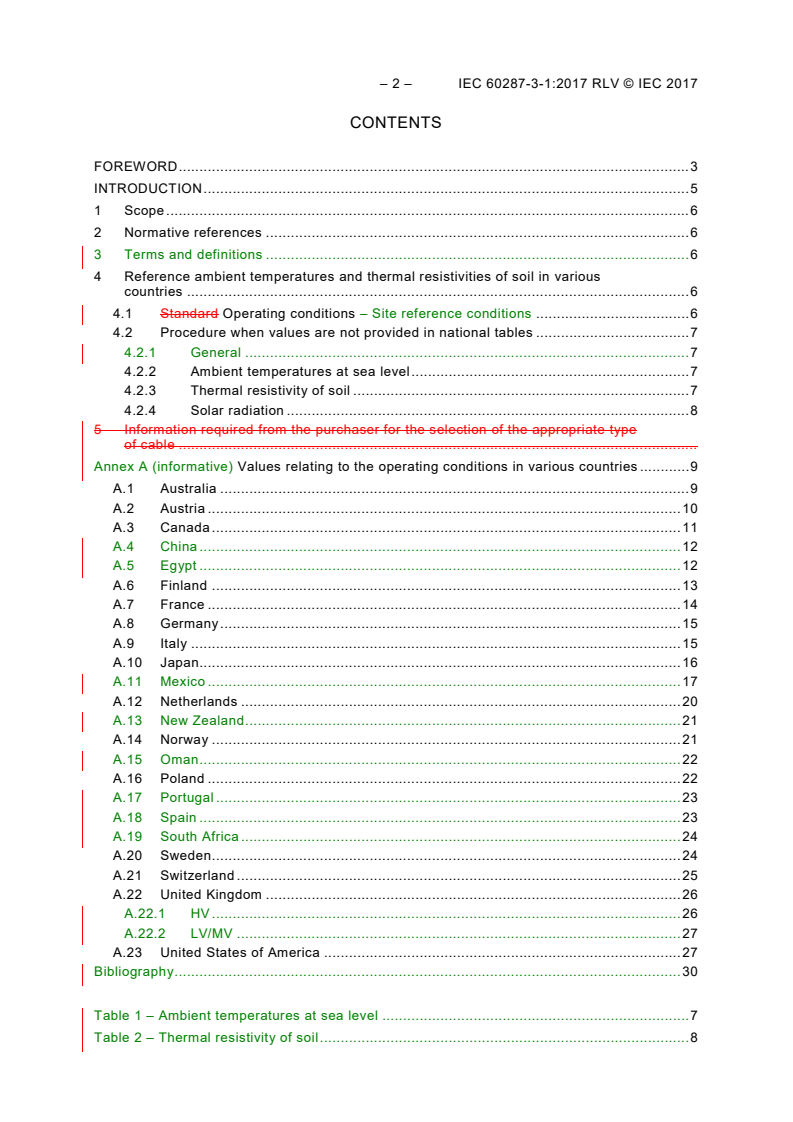
– 2 – IEC 60287-3-1:2017 RLV © IEC 2017
CONTENTS
FOREWORD . 3
INTRODUCTION . 5
1 Scope . 6
2 Normative references . 6
3 Terms and definitions . 6
4 Reference ambient temperatures and thermal resistivities of soil in various
countries . 6
4.1 Standard Operating conditions – Site reference conditions . 6
4.2 Procedure when values are not provided in national tables . 7
4.2.1 General . 7
4.2.2 Ambient temperatures at sea level . 7
4.2.3 Thermal resistivity of soil . 7
4.2.4 Solar radiation . 8
5 Information required from the purchaser for the selection of the appropriate type
of cable .
Annex A (informative) Values relating to the operating conditions in various countries . 9
A.1 Australia . 9
A.2 Austria . 10
A.3 Canada . 11
A.4 China . 12
A.5 Egypt . 12
A.6 Finland . 13
A.7 France . 14
A.8 Germany . 15
A.9 Italy . 15
A.10 Japan. 16
A.11 Mexico . 17
A.12 Netherlands . 20
A.13 New Zealand . 21
A.14 Norway . 21
A.15 Oman . 22
A.16 Poland . 22
A.17 Portugal . 23
A.18 Spain . 23
A.19 South Africa . 24
A.20 Sweden . 24
A.21 Switzerland . 25
A.22 United Kingdom . 26
A.22.1 HV . 26
A.22.2 LV/MV . 27
A.23 United States of America . 27
Bibliography . 30
Table 1 – Ambient temperatures at sea level . 7
Table 2 – Thermal resistivity of soil . 8
INTERNATIONAL ELECTROTECHNICAL COMMISSION
____________
ELECTRIC CABLES –
CALCULATION OF THE CURRENT RATING –
Part 3-1: Sections on Operating conditions –
Site reference operating conditions and selection of cable type
FOREWORD
1) The International Electrotechnical Commission (IEC) is a worldwide organization for standardization comprising
all national electrotechnical committees (IEC National Committees). The object of IEC is to promote
international co-operation on all questions concerning standardization in the electrical and electronic fields. To
this end and in addition to other activities, IEC publishes International Standards, Technical Specifications,
Technical Reports, Publicly Available Specifications (PAS) and Guides (hereafter referred to as “IEC
Publication(s)”). Their preparation is entrusted to technical committees; any IEC National Committee interested
in the subject dealt with may participate in this preparatory work. International, governmental and non-
governmental organizations liaising with the IEC also participate in this preparation. IEC collaborates closely
with the International Organization for Standardization (ISO) in accordance with conditions determined by
agreement between the two organizations.
2) The formal decisions or agreements of IEC on technical matters express, as nearly as possible, an international
consensus of opinion on the relevant subjects since each technical committee has representation from all
interested IEC National Committees.
3) IEC Publications have the form of recommendations for international use and are accepted by IEC National
Committees in that sense. While all reasonable efforts are made to ensure that the technical content of IEC
Publications is accurate, IEC cannot be held responsible for the way in which they are used or for any
misinterpretation by any end user.
4) In order to promote international uniformity, IEC National Committees undertake to apply IEC Publications
transparently to the maximum extent possible in their national and regional publications. Any divergence
between any IEC Publication and the corresponding national or regional publication shall be clearly indicated in
the latter.
5) IEC itself does not provide any attestation of conformity. Independent certification bodies provide conformity
assessment services and, in some areas, access to IEC marks of conformity. IEC is not responsible for any
services carried out by independent certification bodies.
6) All users should ensure that they have the latest edition of this publication.
7) No liability shall attach to IEC or its directors, employees, servants or agents including individual experts and
members of its technical committees and IEC National Committees for any personal injury, property damage or
other damage of any nature whatsoever, whether direct or indirect, or for costs (including legal fees) and
expenses arising out of the publication, use of, or reliance upon, this IEC Publication or any other IEC
Publications.
8) Attention is drawn to the Normative references cited in this publication. Use of the referenced publications is
indispensable for the correct application of this publication.
9) Attention is drawn to the possibility that some of the elements of this IEC Publication may be the subject of
patent rights. IEC shall not be held responsible for identifying any or all such patent rights.
This redline version of the official IEC Standard allows the user to identify the changes
made to the previous edition. A vertical bar appears in the margin wherever a change
has been made. Additions are in green text, deletions are in strikethrough red text.
– 4 – IEC 60287-3-1:2017 RLV © IEC 2017
International Standard IEC 60287-3-1 has been prepared by IEC technical committee 20:
Electric cables.
This second edition cancels and replaces the first edition published in 1995 and
Amendment 1:1999. This edition constitutes a technical revision. This edition includes the
following significant technical changes with respect to the previous edition:
a) the updated list of national laying conditions is now covered in Annex A;
b) Clause 5 about the information required from the purchaser for the selection of the
appropriate type of cable has been removed.
The text of this standard is based on the following documents:
FDIS Report on voting
20/1714/FDIS 20/1730/RVD
Full information on the voting for the approval of this standard can be found in the report on
voting indicated in the above table.
This publication has been drafted in accordance with the ISO/IEC Directives, Part 2.
A list of all parts in the IEC 60287 series, published under the general title Electric cables –
Calculation of the current rating, can be found on the IEC website.
The reader's attention is drawn to the fact that Annex A lists all of the “in-some-country”
clauses on differing practices of a less permanent nature relating to the subject of this
standard.
The committee has decided that the contents of this publication will remain unchanged until
the stability date indicated on the IEC website under "http://webstore.iec.ch" in the data
related to the specific publication. At this date, the publication will be
• reconfirmed,
• withdrawn,
• replaced by a revised edition, or
• amended.
IMPORTANT – The “colour inside” logo on the cover page of this publication indicates
that it contains colours which are considered to be useful for the correct understanding
of its contents. Users should therefore print this publication using a colour printer.
INTRODUCTION
IEC 60287 has been divided into three parts and sections so that revisions of, and additions
to, the document can be carried out more conveniently.
Each part is subdivided into subparts which are published as separate standards.
Part 1: Formulae for ratings (100 % load factor) and power losses
Part 2: Formulae for thermal resistance
Part 3: Sections on Operating conditions
This part of IEC 60287-3 contains reference ambient temperatures and thermal resistivities of
soil in various countries. Also in this section is an outline of the information required from the
purchaser for the selection of the appropriate type of cable.
Quantities related to the operating conditions of cables are liable to vary considerably from
one country to another. For instance, with respect to the ambient temperature and soil thermal
resistivity, the values are governed in various countries by different considerations.
Superficial comparisons between the values used in the various countries may lead to
erroneous conclusions if they are not based on common criteria: for example, there may be
different expectations for the life of the cables, and in some countries design is based on
maximum values of soil thermal resistivity, whereas in others average values are used.
Particularly, in the case of soil thermal resistivity, it is well known that this quantity is very
sensitive to soil moisture content and may vary significantly with time, depending on the soil
type, the topographical and meteorological conditions, and the cable loading.
The following procedure for choosing the values for the various parameters should, therefore,
be adopted.
Numerical values should preferably be based on results of suitable measurements. Often
such results are already included in national specifications as recommended values, so that
the calculation may be based on these values generally used in the country in question; a
survey of such values is given in this part of IEC 60287-3.
– 6 – IEC 60287-3-1:2017 RLV © IEC 2017
ELECTRIC CABLES –
CALCULATION OF THE CURRENT RATING –
Part 3-1: Sections on Operating conditions –
Site reference operating conditions and selection of cable type
1 Scope
This part of IEC 60287-3 is applicable to the conditions of steady-state operation of cables at
all alternating voltages, and direct voltages up to 5 kV, buried directly in the ground, in ducts,
troughs or in steel pipes, both with and without partial drying-out of the soil, as well as cables
in air. The term "steady state" is intended to mean a continuous constant current (100 % load
factor) just sufficient to produce asymptotically the maximum conductor temperature, the
surrounding ambient conditions being assumed constant.
This section concerns reference operating conditions and selection of cable type.
This document defines site reference conditions, however the general values are superseded
by specific national requirements.
2 Normative references
The following normative document contains provisions which, through reference in this text,
constitute provisions of this section of IEC 60287-3. At the time of publication, the edition
indicated was valid. All normative documents are subject to revision, and parties to
agreements based on this section of IEC 60287-3 are encouraged to investigate the
possibility of applying the most recent edition of the normative document indicated below.
Members of IEC and ISO maintain registers of currently valid International Standards.
IEC 60183:1984, Guide to the selection of high-voltage cables
Amendment 1 (1990)
There are no normative references in this document.
3 Terms and definitions
No terms and definitions are listed in this document.
ISO and IEC maintain terminological databases for use in standardization at the following
addresses:
• IEC Electropedia: available at http://www.electropedia.org/
• ISO Online browsing platform: available at http://www.iso.org/obp
4 Reference ambient temperatures and thermal resistivities of soil in various
countries
4.1 Standard Operating conditions – Site reference conditions
In order to use the formulae given in the various parts of IEC 60287, numerical values for the
physical quantities should be chosen relating to the operating conditions.
It is obviously possible to compare the results of two calculations of current rating only when
the assumptions made and the numerical values of the parameters are known.
In particular, the quantities related to the operating conditions of cables are liable likely to
vary considerably from one country to another. An enquiry into this subject has been carried
out and a number of countries have replied.
Annex A summarizes the operating conditions used in various countries. Attention is drawn
to the fact that the information in Annex A is intended only as a guide for cable installation
designers when data provided by a user is incomplete. Care must should be taken not to
draw unjustified conclusions from comparisons of values for different countries. It should be
remembered that the values adopted in any particular country are governed by many factors
some of which might not be of equal importance in other countries.
Values relating to the operating conditions are given in Annex A for the following countries:
Australia Italy Portugal
Austria Japan Spain
Canada Mexico South Africa
China Netherlands Sweden
Egypt New Zealand Switzerland
Finland Norway United Kingdom
France Oman United States of America
Germany Poland
4.2 Procedure when values are not provided in national tables
4.2.1 General
It is recommended that when there is no value laid down in the national tables for the
reference ambient temperature, thermal resistivity of the soil or solar radiation, the values
given in 4.2.2, 4.2.3 and 4.2.4 should be adopted.
4.2.2 Ambient temperatures at sea level
See Table 1.
Table 1 – Ambient temperatures at sea level
Ambient air Ambient ground temperature
temperature at a depth of 1 m
Climate
Min. Max. Min. Max.
°C °C °C °C
Tropical 25 55 25 40
Subtropical 10 40 15 30
Temperate 0 25 10 20
It is essential that current ratings should be valid for the maximum temperatures given. The
lower values are for winter ratings if required. The values correspond with the temperature
limits of winter and summer, alternatively rainy and dry seasons.
When no information about the depth of laying is given, the standard depth is to be taken
as 1 m.
4.2.3 Thermal resistivity of soil
See Table 2.
– 8 – IEC 60287-3-1:2017 RLV © IEC 2017
Table 2 – Thermal resistivity of soil
Thermal resistivity Soil conditions Weather
conditions
K∙m/W
0,7 Very moist Continuously moist
1,0 Moist Regular rainfall
2,0 Dry Seldom rains
3,0 Very dry Little or no rain
4.2.4 Solar radiation
When no information about the intensity of solar radiation a value of 1 000 W/m is adopted.
Annex A
(informative)
Values relating to the operating conditions in various countries
A.1 Australia
Standard conditions Thermal characteristics of the soil
Soil Thermal resistivity, nominal 1,2 K·m/W
Soil ambient temperature, summer 25 °C
Soil ambient temperature, winter 18 °C
a
Depth of laying of cables
Voltage range 1:L.V. cables
under footways 0,5 m
under roadways 0,75 m
Voltage range 2: 11 kV cables
under footways and roadways 0,8 m
Voltage range 3: 33 kV cables and higher voltages
under footways and roadways
1,0 m
Air ambient temperature
Maximum , summer +40 °C
Maximum, winter °C
+30
a
Measured from the ground surface to the centre of the cable, or to the centre of a trefoil group.
– 10 – IEC 60287-3-1:2017 RLV © IEC 2017
A.2 Austria
Thermal characteristics of the soil
Thermal resistivity: 0,7 K.m/W
up to 30 kV, average value 1,0 K.m/W
(max. 1,2; min. 0,7
30 kV, average value
K.m/W)
Thermal resistivity, nominal, season 1 (wet) 1,0 K·m/W
Thermal resistivity, dry zone, season 1 (dry) 2,5 K·m/W
Temperature:
maximum value 20 °C
minimum value 0 °C
Temperature, season 1 20 °C
Depth of laying for buried of cables
All cables up to 1 kV 700 mm
All cables up to 10 kV 800 mm
Paper-insulated cables 10 kV 1 000 mm
Oil-filled cables up to 220 kV 1 200 mm
Voltage range 1: up to 1 kV 0,7 m
0,8 m
Voltage range 2: > 1 kV up to 30 kV
1,2 m
Voltage range 3: > 30 kV
Air ambient temperature
Average value 20 °C
Maximum +40 °C
Minimum -20 °C
A.3 Canada
There are no recognized Canadian national values of soil thermal resistivity and temperature,
and depth of laying, however the values shown below are typical. It is recommended that,
where feasible, soil tests are performed for cable installations.
Thermal characteristics of the soil for cables directly
buried or in ducts
Thermal resistivity:
maximum value 1,2 K.m/W
minimum value 0,6 K.m/W
average value 0,9 K.m/W
Thermal resistivity, nominal 0,5 to 3,0 K·m/W
(Critical temperature 50 °C)
Temperature, season 1 (summer) 20 25 °C
Temperature, season 2 (winter) -5 °C
average value not used as a design basis
Depth of laying of cables (minimum cover)
Paper insulated, solid and non-draining cables for voltages up 1,1 m
to 69 kV
Solid insulation (butyl, ethylene propylene rubber, p.v.c., cross- 0,9 m
linked polyethylene, etc.) cables for voltages up to 46 kV
Oil filled cables for voltages up to 345 kV 1,1 m
Pipe-type (gas or oil pressure) cables for voltages up to 345 kV 1,1 m
Air ambient temperature
Maximum 5 to 40 °C
Minimum -40 -55 to -20 °C
Cyclic ratings
Critical temperature 50 °C
Drying out is not considered for cables in concrete duct banks
Where direct measurements of soil thermal resistivity are not available, it is usual to assume a
thermal resistivity of 0,9 K·m/W. However in cases where it is foreseen that there may be a
progressive deterioration of the thermal characteristics of the environment over a period of
years, and in cases where the climatic conditions may give rise to significant seasonal
variations, it is recommended that the current-carrying capacity be based on a thermal
resistivity of 1,2 K·m/W.
Reference is not made to lower values of resistivity, during winter, as a basis for system
design to any significant extent.
– 12 – IEC 60287-3-1:2017 RLV © IEC 2017
A.4 China
Thermal characteristics of the soil
Thermal resistivity 1,0 to 1,2 K·m/W
Temperature, summer 30 °C
Temperature, winter 5 °C
Depth of laying of cables
≤1 kV 0,7 m
m
>1 kV up to 35 kV 0,7
1,0 m
≥110 kV up to 500 kV
Air ambient temperature
Maximum 40 °C
Minimum -10 °C
Solar radiation
Intensity of solar radiation 1 000
W/m
A.5 Egypt
Thermal characteristics of the soil
Thermal resistivity 1,2 K·m/W
Temperature, summer 35 °C
Temperature, winter 0 °C
Depth of laying of cables
≤1 kV 0,4 m
>1 kV up to 35 kV 0,8 m
a
1,2 m
≥110 kV up to 500 kV
Air ambient temperature
Maximum 47 °C
Minimum -5 °C
Solar radiation
Intensity of solar radiation ≥1 000
W/m
a
Note at soil temperature 25 °C.
A.6 Finland
Thermal characteristics of the soil
Thermal resistivity
Average value to be used for rating calculations. 1,0 K·m/W
For submarine cables where the soil is completely saturated with 0,4 K·m/W
water
Temperature
Maximum value 15 °C
Minimum value 0 °C
(average value 5 °C to 10 °C, exceptional maximum 20 °C)
Depth of laying of cables
All cables up to 36 kV 0,7 m
All cables up to 52 kV 1,0 m
All cables up to 123 kV 1,3 m
All cables up to 245 kV 1,5 m
The actual depth depends on local conditions
Air ambient temperature
Reference value for rating calculations 25 °C
Maximum value 35 °C
Minimum value -20 °C
– 14 – IEC 60287-3-1:2017 RLV © IEC 2017
A.7 France
Thermal characteristics of the soil
Thermal resistivity, nominal, summer 1,20 K·m/W
Thermal resistivity, nominal, winter 0,85 K·m/W
(for main connections at 225 kV and 400 kV direct
measurements are carried out, and an artificial backfill is used if
necessary in order to obtain the rated thermal resistivity)
a
2,5 K·m/W
Thermal resistivity, dry zone , summer
a
2,5 K·m/W
Thermal resistivity, dry zone , winter
Temperature, summer
20 kV cables 20 °C
63 kV, 90 kV, 225 kV, 255 kV and 400 kV cables
hot area 25 °C
intermediate area 22 °C
cold area 20 °C
Temperature, winter
20 kV cables 10 °C
63 kV, 90 kV, 225 kV, 255 kV and 400 kV cables
hot region 17 °C
intermediate region 15 °C
cold region 13 °C
Depth of laying of cables
20 kV cables
1 400 mm in Paris,
800 mm to 1 400 mm generally in the provinces.
in Paris 1,0 to 1,2 m
outside Paris city 0,8 m
63 kV, 90 kV, 225 kV, 255 kV and 400 kV cables 1,3 m
1 300 mm in trenches or in ducts,
700 mm in substations.
The above figures representing the distance between the ground
surface and the axis of the cable in the case of flat-laid cables
and between the ground surface and the centre of the trefoil in
the case of cables laid in trefoil formation.
(These values may vary according to local regulations.)
Air ambient temperature
Maximum 30 °C
Minimum 20 °C
Cyclic ratings
Critical temperature, summer 55 °C
Critical temperature, winter 60 °C
Solar radiation
Intensity of solar radiation 1 000
W/m
a
Drying out of the soil is only considered for high voltage systems.
A.8 Germany
The indicated values are taken as a basis as standard values for current rating calculations
unless there are any requirements specified for the thermal resistivity of the soil, the
temperature and the depth of laying.
Thermal characteristics of the soil
Thermal resistivity, average value 1,0 K·m/W
Thermal resistivity, for calculations considering a dry zone near 2,5 K·m/W
the cable – for the dry zone
Temperature, maximum value 20 °C
Temperature, minimum value 0 °C
Temperature, average value 10 °C
Depth of laying of cables
For cables ≥ 60 kV 1,2 m
a
For cables < 60 kV m
0,7
Air ambient temperature
Maximum 30 °C
Minimum -20 °C
Average value 10 °C
a
In spite of being calculated for 0,7 m, often cables at 20 kV to 30 kV are laid at 0,9 m to 1,0 m depth.
A.9 Italy
Thermal characteristics of the soil
Thermal resistivity, maximum value 1,0 K·m/W
If the thermal characteristics of the soil are found to be poor, a suitable backfill is used and reference is made to
a thermal resistivity intermediate between that of the backfill and that of the surrounding soil.
Temperature, maximum value (to be used in calculations) 20 °C
Temperature, minimum value 5 °C
Depth of laying of cables for directly buried cables
This depth is the maximum adopted unless otherwise specified.
Up to 12 kV 0,8 m
Up to 17,5 kV 1,0 m
Up to 24 kV 1,2 m
Up to 36 kV 1,5 m
Up to 72 kV 1,8 m
Up to 220 kV 2,2 m
Air ambient temperature
Maximum value (to be used in calculations) 30 °C
Minimum value 0 °C
Maximum daily excursion 20 °C
In summer, the maximum temperature may sometimes, for a few hours daily, be higher
by 5 °C (and in special cases even more) than the above-mentioned maximum value. Such an
occurrence is considered to be acceptable due to its short duration.
– 16 – IEC 60287-3-1:2017 RLV © IEC 2017
A.10 Japan
Thermal characteristics of the soil
average value 1,0 K.m/W
(one manufacturer uses 1,2; 0,8 and 0,4 K.m/W for dry, normal
and wet soil respectively).
Thermal resistivity, nominal 1,0 K·m/W
1,5 K⋅m/W, 1,0 K⋅m/W and 0,6 K m/W for dry, normal and wet soil respectively. No distinction for seasons
Temperature, summer 25 °C
15 °C winter
minimum value 10 °C
Depth of laying of cables
Direct burial:
paper and solid insulation up to 33 kV 1 200 mm
oil-filled and pipe cables 1 500 mm
1,2 m for places where the pressure of vehicle or other heavy goods may be applied. 0,6 m for other places
In duct:
less than 66 kV 1 200 mm
66 kV and over 1 500 mm
the use of duct which withstands the pressure of vehicle or other heavy goods is required (there is no regulation
for the depth of duct).
Air ambient temperature
Maximum, summer 40 °C
30 °C winter
Solar radiation
Intensity of solar radiation 1 000 W/m
Japanese Cable Makers’ Association Standard JCS 0501, gives the calculation formulae of
thermal resistance of soil for a 2 layer model having two different thermal resistivities divided
by the boundary such as ground water level. Therefore, the ground water level is one
parameter for variations in thermal resistivity.
A.11 Mexico
Thermal characteristics of the soil
Thermal resistivity, nominal season 1 (summer)
Southern Mexico 0,8 to 2,4 K·m/W
Central Mexico 1,0 to 2,5 K·m/W
Northern Mexico 0,5 to 4,0 K·m/W
Coast Mexico 0,5 to 3,0 K·m/W
Thermal resistivity, nominal season 2 (winter)
Southern Mexico 1,0 to 2,0 K·m/W
Central Mexico 1,3 to 2,1 K·m/W
Northern Mexico 0,8 to 3,6 K·m/W
Coast Mexico 0,8 to 2,7 K·m/W
Thermal resistivity, dry zone season 1 (summer)
Southern Mexico 1,4 to 3,9 K·m/W
Central Mexico 1,6 to 4,0 K·m/W
Northern Mexico 1,0 to 5,5 K·m/W
Coast Mexico 0,9 to 3,5 K·m/W
Thermal resistivity, dry zone season 2 (winter)
Southern Mexico 1,1 to 2,8 K·m/W
Central Mexico 1,0 to 3,0 K·m/W
Northern Mexico 0,8 to 4,7 K·m/W
Coast Mexico 0,6 to 2,9 K·m/W
Where direct measurements of soil thermal resistivity are not available, it is usual to assume a thermal resistivity
of 1,5 K·m/W, however it is recommended that a survey of the thermal characteristics of the soil is carried out
for critical cable links.
Temperature, season 1 (summer)
Southern Mexico 30 °C
Central Mexico 25 °C
Northern Mexico 35 °C
Coast Mexico 30 °C
Temperature, season 2 (winter)
Southern Mexico 25 °C
Central Mexico 20 °C
Northern Mexico 30 °C
Coast Mexico 25 °C
(Critical temperature 50 °C)
When soil temperature measurements are not available a reference value of 25 °C is often used for rating
calculations
– 18 – IEC 60287-3-1:2017 RLV © IEC 2017
A.11 Mexico (continued)
a b
Depth of laying of cables
Voltage range 1: up to 1 kV cables (maximum 2 circuits)
Under footways 0,3 m
Under roads 0,5 m
Voltage range 2: > 1 kV up to 35 kV cables (5 kV, 15 kV, 25 kV
and 35 kV, maximum 4 circuits)
Under footways 0,3 m
Under roads 0,5 m
Voltage range 3: > 35 kV up to138 kV cables (69 kV, 85 kV,
115 kV and 138 kV, maximum 2 circuits)
Only under roadways (normal terrain) 1,0 m
Only under roadways (phreatic zone or rock soils) 0,5 m
Voltage range 4: > 161 kV up to 230 kV cables (161 kV and
230 kV, maximum 2 circuits)
Only under roadways (normal terrain) 1,2 m
Only under roadways (phreatic zone or rock soils) 0,7 m
Voltage range 5: ≥ 400 kV cables (maximum 2 circuits)
Only under roadways (normal terrain) 1,4 m
Only under roadways (phreatic zone or rock soils) 0,9 m
Air ambient temperature
Maximum (annually)
Southern Mexico 25 to 35 °C
Central Mexico 20 to 26 °C
Northern Mexico 36 to 45 °C
Coast Mexico 26 to 36 °C
Minimum (annually)
Southern Mexico 8 to 18 °C
Central Mexico 1 to 12 °C
Northern Mexico -5 to +10 °C
Coast Mexico 12 to 20 °C
Average (annually)
Southern Mexico 28 °C
Central Mexico 21 °C
Northern Mexico 30 °C
Coast Mexico 29 °C
Cyclic ratings
Critical temperature or temperature rise 35 to 50 °C
The critical temperature is highly dependant on the soil composition and location. It may also vary due to
seasonal influences and/or cyclic loading. It is recommended to investigate the critical temperature during a soil
survey, unless it can be demonstrated that no drying out of the soil will occur.
A.11 Mexico (concluded)
c
Solar radiation
Intensity of solar radiation
Southern Mexico 650 to 850
W/m
Central Mexico 700 to 900
W/m
Northern Mexico 850 to 1 100 W/m
Coast Mexico 800 to 1 000
W/m
The values given above for soil thermal resistivity and temperature correspond to measurements made at
different locations in Mexico at different depths (0,9 m, 1,2 m and 1,5 m). It is recommended that, where
feasible, soil measurements are made for cable installations.
a
Measured from the ground surface to the top of the cable ducts, or to the top of a trefoil duct group. Cables
are always laid in HDPE ducts.
b
Depths may be greater depending on any underground obstacles along the cable route.
c
Direct normal irradiance or beam solar radiation value, maximum annual values present for short time
periods.
– 20 – IEC 60287-3-1:2017 RLV © IEC 2017
A.12 Netherlands
Thermal characteristics of the soil
sub-soil water level near to cables 0,5 K.m/W
eastern part of the country 0,8 K.m/W
Thermal resistivity, nominal 1,00 K·m/W
It is recommended that a survey of the thermal characteristics of the soil is carried out for critical cable links.
Thermal resistivity, dry zone 2,5 K·m/W
It is recommended that a survey of the thermal characteristics of the soil is carried out for critical cable links.
Temperature, maximum 20 °C
Temperature, winter 5 °C
Temperature, average 15 °C
Depth of laying for directly buried of cables
Cables up to 10 kV 700 mm
Cables above 10 kV 1 000 mm
Up to 30 kV 0,7 to 1,0 m
Above 30 kV 1,2 m
Air ambient temperature
Maximum 30 °C
Minimum -5 -10 °C
Average 20 °C
Cyclic ratings
Critical temperature 30 °C
The critical temperature is highly dependent on soil composition and location. It may also vary due to seasonal
influences and/or cyclic loading. It is recommended to investigate the critical temperature during a soil survey,
unless it can be demonstrated that no drying out of the soil will occur.
Solar radiation
Intensity of solar radiation 1 000
W/m
The two zone model is regularly used to calculate the current rating of MV cable systems and
incidentally for HV systems. The parameter used to define the boundary between wet and dry
zones is the absolute temperature, isotherm at this boundary, usually in the range between
30 °C (MV cables) and 50 °C (HV cables).
Cable circuits are taken to be thermally independent if the separation is not less than 3 m. For
cables installed deeper than 3 m, such as in horizontal directional drilling, the minimum
separation is not less than 5 m to consider a cable circuit as thermally independent.
A.13 New Zealand
Thermal characteristics of the soil
Thermal resistivity, nominal 1,2 K·m/W
Soil ambient temperature, summer 15 °C
Soil ambient temperature, winter 15 °C
a
Depth of laying of cables
This depth is the minimum adopted unless otherwise specified
Voltage range 1: L.V.
under footways 0,5 m
under roadways 0,75 M
Voltage range 2: 11kV
under footways and roadways 1,0 m
Voltage range 3: 33kV and higher
under footways and roadways 1,0 m
Air ambient temperature
Maximum summer +30 °C
Maximum winter +30 °C
a
Measured from the ground surface to the centre of the cable, or to the centre of a trefoil group.
A.14 Norway
Thermal characteristics of the soil
Thermal resistivity, average value to be used in calculations 1,0 K·m/W
Temperature, Southern Norway max./min. 17/0 °C
Temperature, Central Norway max./min. 15/0 °C
Temperature, Northern Norway max./min. 13/-5 °C
Depth of laying of cables (minimum value)
1 kV 0,5 m
above 1 kV 0,7 m
Air ambient temperature
Maximum value (to be used in calculations) 25 °C
– 22 – IEC 60287-3-1:2017 RLV © IEC 2017
A.15 Oman
Thermal characteristics of the soil
Thermal resistivity, nominal 2,5 K·m/W
No distinction for seasons
Temperature, maximum 40 °C
Temperature, minimum 10 °C
Depth of laying of cables
All cables up to 1 kV 0,5 m
All cables above 1 kV 0,8 m
Air ambient temperature
Maximum 55 °C
Minimum 10 °C
Solar radiation
Intensity of solar radiation 1 200 W/m
A.16 Poland
Thermal characteristics of the soil
Thermal resistivity, average value to be used in calculations 0,8 1,0 K·m/W
Thermal resistivity, nominal, season 2
Temperature, average value to be used in calculations 15 20 °C
Temperature, minimum value 5 °C
Depth of laying of cables for directly buried cables
Paper-insulated and solid type cables
up to 1 kV 700 mm
up to 15 kV 800 mm
Paper-insulated cables at voltages
higher than 15 kV 1 000 mm
Oil-filled cables up to 110 kV 1 000 mm
up to and including 36 kV 0,7 m
above 36 kV 1,0 m
Air ambient temperature
Average value to be used in calculations 25 °C
A.17 Portugal
Thermal characteristics of the soil
Thermal resistivity, nominal, summer 1,2
K·m/W
Thermal resistivity, nominal, winter 0,85
K·m/W
Thermal resistivity, nominal, submarine cables 1,0 K·m/W
Soil ambient temperature, summer 20 °C
Soil ambient temperature, winter 10 °C
Depth of laying of cables
This depth is the minimum adopted unless otherwise specified
Voltage range up to 1 kV 0,7 m
Voltage range up to 30 kV 1,0 m
Voltage range up to 400 kV 1,2 m
Air ambient temperature
Air ambient temperature, summer (at sea level) 30 °C
Air ambient temperature, winter (at sea level) 20 °C
Air ambient temperature, minimum 0 °C
Solar radiation
Intensity of solar radiation 1 000
W/m
A.18 Spain
There are no recognized Spanish national values of soil thermal resistivities, ambient
temperatures and depth of laying, the values shown below are typical
Thermal characteristics of the soil
Thermal resistivity, Cables ≤0,6/1 kV 1 K·m/W
Thermal resistivity, Cables >0,6/1 kV and ≤18/30 kV 1,5 K·m/W
Thermal resistivity, Cables >18/30 kV 1 K·m/W
Where concrete is used for the cable installation it should be
considered for the calculation a value of 0,85 K m/W for the 0,85 K·m/W
volume occupied by the concrete
Temperature 25 °C
Depth of laying of cables
0,6 to 1,5 m
Air ambient temperature
Maximum 40 °C
Solar radiation
Intensity of solar radiation 1 000 W/m
– 24 – IEC 60287-3-1:2017 RLV © IEC 2017
A.19 South Africa
Thermal characteristics of the soil
Thermal resistivity, nominal 1,2 K·m/W
No distinction for seasons
Temperature, season 1 25 °C
No distinction for seasons °C
Depth of laying of cables
Voltage range 1: low voltage 0,5 m
Voltage range 2: all higher voltages 0,8 m
Air ambient temperature
Nominal 30 °C
Solar radiation
Intensity of solar radiation (inland) 1 250
W/m
Intensity of solar radiation (coast) 1 000 W/m
A.20 Sweden
Thermal characteristics of the soil
Thermal resistivity, average value to be used in calculations 1,0 K·m/W
Where the soil is completely saturated with water and for 0,4 K·m/W
submarine cables where the bottom is covered with sand
Maximum value for submarine cables 1,0 K·m/W
For important cables, a measurement of the resistivity and soil 0,6 K·m/W
conditions on the sea bottom is recommended, otherwise:
Temperature, maximum value 15 °C
Temperature, minimum value 0 °C
(for main part of the year between 5 °C and 10 °C)
Depth of laying of cables
For directly buried cables and for short road crossings by means of ducts
All cables up to 24 kV 0,7 m
Paper-insulated cables up to 52 kV 0,7 m
a
Oil-filled cables up to 420 kV m
1,0 to 1,5
a
The depth depends on local conditions. Less than 1 000 mm is not used.
A.21 Switzerland
Thermal characteristics of the soil
Thermal resistivity:
normal value to be used in calculations 1,0 K.m/W (1,3 K.m/W
in case of rocky soil)
Thermal resistivity, nominal, summer (May – October) 1,0 K·m/W
Thermal resistivity, nominal, winter (November – April) 0,85 K·m/W
Thermal resistivity, rocky soil, summer 1,3 K·m/W
Thermal resistivity, rocky soil, winter 1,3 K·m/W
Temperature:
maximum value to be used in calculations 20 °C
minimum values –10 °C in general –15 °C in mountains
NOTE – An additional condition in case of permanent load is
50 °C maximum temperature of the soil near the cable (in
...
IEC 60287-3-1 ®
Edition 2.0 2017-06
INTERNATIONAL
STANDARD
NORME
INTERNATIONALE
Electric cables – Calculation of the current rating –
Part 3-1: Operating conditions – Site reference conditions
Câbles électriques – Calcul du courant admissible –
Partie 3-1: Conditions de fonctionnement – Conditions du site de référence
All rights reserved. Unless otherwise specified, no part of this publication may be reproduced or utilized in any form
or by any means, electronic or mechanical, including photocopying and microfilm, without permission in writing from
either IEC or IEC's member National Committee in the country of the requester. If you have any questions about IEC
copyright or have an enquiry about obtaining additional rights to this publication, please contact the address below or
your local IEC member National Committee for further information.
Droits de reproduction réservés. Sauf indication contraire, aucune partie de cette publication ne peut être reproduite
ni utilisée sous quelque forme que ce soit et par aucun procédé, électronique ou mécanique, y compris la photocopie
et les microfilms, sans l'accord écrit de l'IEC ou du Comité national de l'IEC du pays du demandeur. Si vous avez des
questions sur le copyright de l'IEC ou si vous désirez obtenir des droits supplémentaires sur cette publication, utilisez
les coordonnées ci-après ou contactez le Comité national de l'IEC de votre pays de résidence.
IEC Central Office Tel.: +41 22 919 02 11
3, rue de Varembé Fax: +41 22 919 03 00
CH-1211 Geneva 20 info@iec.ch
Switzerland www.iec.ch
About the IEC
The International Electrotechnical Commission (IEC) is the leading global organization that prepares and publishes
International Standards for all electrical, electronic and related technologies.
About IEC publications
The technical content of IEC publications is kept under constant review by the IEC. Please make sure that you have the
latest edition, a corrigenda or an amendment might have been published.
IEC Catalogue - webstore.iec.ch/catalogue Electropedia - www.electropedia.org
The stand-alone application for consulting the entire The world's leading online dictionary of electronic and
bibliographical information on IEC International Standards, electrical terms containing 20 000 terms and definitions in
Technical Specifications, Technical Reports and other English and French, with equivalent terms in 16 additional
documents. Available for PC, Mac OS, Android Tablets and languages. Also known as the International Electrotechnical
iPad. Vocabulary (IEV) online.
IEC publications search - www.iec.ch/searchpub IEC Glossary - std.iec.ch/glossary
The advanced search enables to find IEC publications by a 65 000 electrotechnical terminology entries in English and
variety of criteria (reference number, text, technical French extracted from the Terms and Definitions clause of
committee,…). It also gives information on projects, replaced IEC publications issued since 2002. Some entries have been
and withdrawn publications. collected from earlier publications of IEC TC 37, 77, 86 and
CISPR.
IEC Just Published - webstore.iec.ch/justpublished
Stay up to date on all new IEC publications. Just Published IEC Customer Service Centre - webstore.iec.ch/csc
details all new publications released. Available online and If you wish to give us your feedback on this publication or
also once a month by email. need further assistance, please contact the Customer Service
Centre: csc@iec.ch.
A propos de l'IEC
La Commission Electrotechnique Internationale (IEC) est la première organisation mondiale qui élabore et publie des
Normes internationales pour tout ce qui a trait à l'électricité, à l'électronique et aux technologies apparentées.
A propos des publications IEC
Le contenu technique des publications IEC est constamment revu. Veuillez vous assurer que vous possédez l’édition la
plus récente, un corrigendum ou amendement peut avoir été publié.
Catalogue IEC - webstore.iec.ch/catalogue Electropedia - www.electropedia.org
Application autonome pour consulter tous les renseignements
Le premier dictionnaire en ligne de termes électroniques et
bibliographiques sur les Normes internationales,
électriques. Il contient 20 000 termes et définitions en anglais
Spécifications techniques, Rapports techniques et autres
et en français, ainsi que les termes équivalents dans 16
documents de l'IEC. Disponible pour PC, Mac OS, tablettes
langues additionnelles. Egalement appelé Vocabulaire
Android et iPad.
Electrotechnique International (IEV) en ligne.
Recherche de publications IEC - www.iec.ch/searchpub
Glossaire IEC - std.iec.ch/glossary
65 000 entrées terminologiques électrotechniques, en anglais
La recherche avancée permet de trouver des publications IEC
en utilisant différents critères (numéro de référence, texte, et en français, extraites des articles Termes et Définitions des
comité d’études,…). Elle donne aussi des informations sur les publications IEC parues depuis 2002. Plus certaines entrées
projets et les publications remplacées ou retirées. antérieures extraites des publications des CE 37, 77, 86 et
CISPR de l'IEC.
IEC Just Published - webstore.iec.ch/justpublished
Service Clients - webstore.iec.ch/csc
Restez informé sur les nouvelles publications IEC. Just
Published détaille les nouvelles publications parues. Si vous désirez nous donner des commentaires sur cette
Disponible en ligne et aussi une fois par mois par email. publication ou si vous avez des questions contactez-nous:
csc@iec.ch.
IEC 60287-3-1 ®
Edition 2.0 2017-06
INTERNATIONAL
STANDARD
NORME
INTERNATIONALE
Electric cables – Calculation of the current rating –
Part 3-1: Operating conditions – Site reference conditions
Câbles électriques – Calcul du courant admissible –
Partie 3-1: Conditions de fonctionnement – Conditions du site de référence
INTERNATIONAL
ELECTROTECHNICAL
COMMISSION
COMMISSION
ELECTROTECHNIQUE
INTERNATIONALE
ICS 29.060.20 ISBN 978-2-8322-4348-0
– 2 – IEC 60287-3-1:2017 © IEC 2017
CONTENTS
FOREWORD . 3
INTRODUCTION . 5
1 Scope . 6
2 Normative references . 6
3 Terms and definitions . 6
4 Reference ambient temperatures and thermal resistivities of soil in various
countries . 6
4.1 Operating conditions – Site reference conditions . 6
4.2 Procedure when values are not provided in national tables . 7
4.2.1 General . 7
4.2.2 Ambient temperatures at sea level . 7
4.2.3 Thermal resistivity of soil . 7
4.2.4 Solar radiation . 7
Annex A (informative) Values relating to the operating conditions in various countries . 8
A.1 Australia . 8
A.2 Austria . 8
A.3 Canada . 9
A.4 China . 10
A.5 Egypt . 10
A.6 Finland . 11
A.7 France . 12
A.8 Germany . 13
A.9 Italy . 14
A.10 Japan. 14
A.11 Mexico . 14
A.12 Netherlands . 17
A.13 New Zealand . 18
A.14 Norway . 18
A.15 Oman . 19
A.16 Poland . 19
A.17 Portugal . 20
A.18 Spain . 20
A.19 South Africa . 21
A.20 Sweden . 21
A.21 Switzerland . 22
A.22 United Kingdom . 22
A.22.1 HV . 22
A.22.2 LV/MV . 23
A.23 United States of America . 23
Bibliography . 24
Table 1 – Ambient temperatures at sea level . 7
Table 2 – Thermal resistivity of soil . 7
INTERNATIONAL ELECTROTECHNICAL COMMISSION
____________
ELECTRIC CABLES –
CALCULATION OF THE CURRENT RATING –
Part 3-1: Operating conditions –
Site reference conditions
FOREWORD
1) The International Electrotechnical Commission (IEC) is a worldwide organization for standardization comprising
all national electrotechnical committees (IEC National Committees). The object of IEC is to promote
international co-operation on all questions concerning standardization in the electrical and electronic fields. To
this end and in addition to other activities, IEC publishes International Standards, Technical Specifications,
Technical Reports, Publicly Available Specifications (PAS) and Guides (hereafter referred to as “IEC
Publication(s)”). Their preparation is entrusted to technical committees; any IEC National Committee interested
in the subject dealt with may participate in this preparatory work. International, governmental and non-
governmental organizations liaising with the IEC also participate in this preparation. IEC collaborates closely
with the International Organization for Standardization (ISO) in accordance with conditions determined by
agreement between the two organizations.
2) The formal decisions or agreements of IEC on technical matters express, as nearly as possible, an international
consensus of opinion on the relevant subjects since each technical committee has representation from all
interested IEC National Committees.
3) IEC Publications have the form of recommendations for international use and are accepted by IEC National
Committees in that sense. While all reasonable efforts are made to ensure that the technical content of IEC
Publications is accurate, IEC cannot be held responsible for the way in which they are used or for any
misinterpretation by any end user.
4) In order to promote international uniformity, IEC National Committees undertake to apply IEC Publications
transparently to the maximum extent possible in their national and regional publications. Any divergence
between any IEC Publication and the corresponding national or regional publication shall be clearly indicated in
the latter.
5) IEC itself does not provide any attestation of conformity. Independent certification bodies provide conformity
assessment services and, in some areas, access to IEC marks of conformity. IEC is not responsible for any
services carried out by independent certification bodies.
6) All users should ensure that they have the latest edition of this publication.
7) No liability shall attach to IEC or its directors, employees, servants or agents including individual experts and
members of its technical committees and IEC National Committees for any personal injury, property damage or
other damage of any nature whatsoever, whether direct or indirect, or for costs (including legal fees) and
expenses arising out of the publication, use of, or reliance upon, this IEC Publication or any other IEC
Publications.
8) Attention is drawn to the Normative references cited in this publication. Use of the referenced publications is
indispensable for the correct application of this publication.
9) Attention is drawn to the possibility that some of the elements of this IEC Publication may be the subject of
patent rights. IEC shall not be held responsible for identifying any or all such patent rights.
International Standard IEC 60287-3-1 has been prepared by IEC technical committee 20:
Electric cables.
This second edition cancels and replaces the first edition published in 1995 and
Amendment 1:1999. This edition constitutes a technical revision. This edition includes the
following significant technical changes with respect to the previous edition:
a) the updated list of national laying conditions is now covered in Annex A;
b) Clause 5 about the information required from the purchaser for the selection of the
appropriate type of cable has been removed.
– 4 – IEC 60287-3-1:2017 © IEC 2017
The text of this standard is based on the following documents:
FDIS Report on voting
20/1714/FDIS 20/1730/RVD
Full information on the voting for the approval of this standard can be found in the report on
voting indicated in the above table.
This publication has been drafted in accordance with the ISO/IEC Directives, Part 2.
A list of all parts in the IEC 60287 series, published under the general title Electric cables –
Calculation of the current rating, can be found on the IEC website.
The reader's attention is drawn to the fact that Annex A lists all of the “in-some-country”
clauses on differing practices of a less permanent nature relating to the subject of this
standard.
The committee has decided that the contents of this publication will remain unchanged until
the stability date indicated on the IEC website under "http://webstore.iec.ch" in the data
related to the specific publication. At this date, the publication will be
• reconfirmed,
• withdrawn,
• replaced by a revised edition, or
• amended.
INTRODUCTION
IEC 60287 has been divided into three parts so that revisions of, and additions to the
document can be carried out more conveniently.
Each part is subdivided into subparts which are published as separate standards.
Part 1: Formulae for ratings (100 % load factor) and power losses
Part 2: Formulae for thermal resistance
Part 3: Operating conditions
This part of IEC 60287-3 contains reference ambient temperatures and thermal resistivities of
soil in various countries.
Quantities related to the operating conditions of cables are liable to vary considerably from
one country to another. For instance, with respect to the ambient temperature and soil thermal
resistivity, the values are governed in various countries by different considerations.
Superficial comparisons between the values used in the various countries may lead to
erroneous conclusions if they are not based on common criteria: for example, there may be
different expectations for the life of the cables, and in some countries design is based on
maximum values of soil thermal resistivity, whereas in others average values are used.
Particularly, in the case of soil thermal resistivity, it is well known that this quantity is very
sensitive to soil moisture content and may vary significantly with time, depending on the soil
type, the topographical and meteorological conditions, and the cable loading.
The following procedure for choosing the values for the various parameters should, therefore,
be adopted.
Numerical values should preferably be based on results of suitable measurements. Often
such results are already included in national specifications as recommended values, so that
the calculation may be based on these values generally used in the country in question; a
survey of such values is given in this part of IEC 60287-3.
– 6 – IEC 60287-3-1:2017 © IEC 2017
ELECTRIC CABLES –
CALCULATION OF THE CURRENT RATING –
Part 3-1: Operating conditions –
Site reference conditions
1 Scope
This part of IEC 60287-3 is applicable to the conditions of steady-state operation of cables at
all voltages, buried directly in the ground, in ducts, troughs or in steel pipes, both with and
without partial drying-out of the soil, as well as cables in air. The term "steady state" is
intended to mean a continuous constant current (100 % load factor) just sufficient to produce
asymptotically the maximum conductor temperature, the surrounding ambient conditions being
assumed constant.
This document defines site reference conditions, however the general values are superseded
by specific national requirements.
2 Normative references
There are no normative references in this document.
3 Terms and definitions
No terms and definitions are listed in this document.
ISO and IEC maintain terminological databases for use in standardization at the following
addresses:
• IEC Electropedia: available at http://www.electropedia.org/
• ISO Online browsing platform: available at http://www.iso.org/obp
4 Reference ambient temperatures and thermal resistivities of soil in various
countries
4.1 Operating conditions – Site reference conditions
In order to use the formulae given in the various parts of IEC 60287, numerical values for the
physical quantities should be chosen relating to the operating conditions.
It is obviously possible to compare the results of two calculations of current rating only when
the assumptions made and the numerical values of the parameters are known.
In particular, the quantities related to the operating conditions of cables are likely to vary
considerably from one country to another. An enquiry into this subject has been carried out
and a number of countries have replied.
Annex A summarizes the operating conditions used in various countries. Attention is drawn
to the fact that the information in Annex A is intended only as a guide for cable installation
designers when data provided by a user is incomplete. Care should be taken not to draw
unjustified conclusions from comparisons of values for different countries. It should be
remembered that the values adopted in any particular country are governed by many factors
some of which might not be of equal importance in other countries.
Values relating to the operating conditions are given in Annex A for the following countries:
Australia Italy Portugal
Austria Japan Spain
Canada Mexico South Africa
China Netherlands Sweden
Egypt New Zealand Switzerland
Finland Norway United Kingdom
France Oman United States of America
Germany Poland
4.2 Procedure when values are not provided in national tables
4.2.1 General
It is recommended that when there is no value laid down in the national tables for the
reference ambient temperature, thermal resistivity of the soil or solar radiation, the values
given in 4.2.2, 4.2.3 and 4.2.4 should be adopted.
4.2.2 Ambient temperatures at sea level
See Table 1.
Table 1 – Ambient temperatures at sea level
Ambient air Ambient ground temperature
temperature at a depth of 1 m
Climate
Min. Max. Min. Max.
°C °C °C °C
Tropical 25 55 25 40
Subtropical 10 40 15 30
Temperate 0 25 10 20
It is essential that current ratings should be valid for the maximum temperatures given. The
lower values are for winter ratings if required. The values correspond with the temperature
limits of winter and summer, alternatively rainy and dry seasons.
When no information about the depth of laying is given, the standard depth is to be taken
as 1 m.
4.2.3 Thermal resistivity of soil
See Table 2.
Table 2 – Thermal resistivity of soil
Thermal resistivity Soil conditions Weather
conditions
K∙m/W
0,7 Very moist Continuously moist
1,0 Moist Regular rainfall
2,0 Dry Seldom rains
3,0 Very dry Little or no rain
4.2.4 Solar radiation
When no information about the intensity of solar radiation a value of 1 000 W/m is adopted.
– 8 – IEC 60287-3-1:2017 © IEC 2017
Annex A
(informative)
Values relating to the operating conditions in various countries
A.1 Australia
Thermal characteristics of the soil
Thermal resistivity, nominal 1,2 K·m/W
Soil ambient temperature, summer 25 °C
Soil ambient temperature, winter 18 °C
a
Depth of laying of cables
Voltage range 1: L.V. cables
under footways 0,5 m
under roadways 0,75 m
Voltage range 2: 11 kV cables
under footways and roadways 0,8 m
Voltage range 3: 33 kV cables and higher voltages
under footways and roadways
1,0 m
Air ambient temperature
Maximum , summer °C
+40
Maximum, winter °C
+30
a
Measured from the ground surface to the centre of the cable, or to the centre of a trefoil group.
A.2 Austria
Thermal characteristics of the soil
Thermal resistivity, nominal, season 1 (wet) 1,0 K·m/W
Thermal resistivity, dry zone, season 1 (dry) 2,5 K·m/W
Temperature, season 1 20 °C
Depth of laying of cables
Voltage range 1: up to 1 kV 0,7 m
0,8 m
Voltage range 2: > 1 kV up to 30 kV
1,2 m
Voltage range 3: > 30 kV
Air ambient temperature
Average value 20 °C
Maximum +40 °C
Minimum -20 °C
A.3 Canada
There are no recognized Canadian national values of soil thermal resistivity and temperature,
and depth of laying, however the values shown below are typical. It is recommended that,
where feasible, soil tests are performed for cable installations.
Thermal characteristics of the soil
Thermal resistivity, nominal 0,5 to 3,0 K·m/W
(Critical temperature 50 °C)
Temperature, season 1 (summer) 25 °C
Temperature, season 2 (winter) -5 °C
Depth of laying of cables (minimum cover)
Paper insulated, solid and non-draining cables for voltages up 1,1 m
to 69 kV
Solid insulation (butyl, ethylene propylene rubber, p.v.c., cross- 0,9 m
linked polyethylene, etc.) cables for voltages up to 46 kV
Oil filled cables for voltages up to 345 kV 1,1 m
Pipe-type (gas or oil pressure) cables for voltages up to 345 kV 1,1 m
Air ambient temperature
Maximum 5 to 40 °C
Minimum -55 to -20 °C
Cyclic ratings
Critical temperature 50 °C
Drying out is not considered for cables in concrete duct banks
Where direct measurements of soil thermal resistivity are not available, it is usual to assume a
thermal resistivity of 0,9 K·m/W. However in cases where it is foreseen that there may be a
progressive deterioration of the thermal characteristics of the environment over a period of
years, and in cases where the climatic conditions may give rise to significant seasonal
variations, it is recommended that the current-carrying capacity be based on a thermal
resistivity of 1,2 K·m/W.
Reference is not made to lower values of resistivity, during winter, as a basis for system
design to any significant extent.
– 10 – IEC 60287-3-1:2017 © IEC 2017
A.4 China
Thermal characteristics of the soil
Thermal resistivity 1,0 to 1,2 K·m/W
Temperature, summer 30 °C
Temperature, winter 5 °C
Depth of laying of cables
≤1 kV 0,7 m
m
>1 kV up to 35 kV 0,7
1,0 m
≥110 kV up to 500 kV
Air ambient temperature
Maximum 40 °C
Minimum -10 °C
Solar radiation
Intensity of solar radiation 1 000
W/m
A.5 Egypt
Thermal characteristics of the soil
Thermal resistivity 1,2 K·m/W
Temperature, summer 35 °C
Temperature, winter 0 °C
Depth of laying of cables
≤1 kV 0,4 m
>1 kV up to 35 kV 0,8 m
a
1,2 m
≥110 kV up to 500 kV
Air ambient temperature
Maximum 47 °C
Minimum -5 °C
Solar radiation
Intensity of solar radiation ≥1 000
W/m
a
Note at soil temperature 25 °C.
A.6 Finland
Thermal characteristics of the soil
Thermal resistivity
Average value to be used for rating calculations. 1,0 K·m/W
For submarine cables where the soil is completely saturated with 0,4 K·m/W
water
Temperature
Maximum value 15 °C
Minimum value 0 °C
(average value 5 °C to 10 °C, exceptional maximum 20 °C)
Depth of laying of cables
All cables up to 36 kV 0,7 m
All cables up to 52 kV 1,0 m
All cables up to 123 kV 1,3 m
All cables up to 245 kV 1,5 m
The actual depth depends on local conditions
Air ambient temperature
Reference value for rating calculations 25 °C
Maximum value 35 °C
Minimum value -20 °C
– 12 – IEC 60287-3-1:2017 © IEC 2017
A.7 France
Thermal characteristics of the soil
Thermal resistivity, nominal, summer 1,20 K·m/W
Thermal resistivity, nominal, winter 0,85 K·m/W
a
2,5 K·m/W
Thermal resistivity, dry zone , summer
a
2,5 K·m/W
Thermal resistivity, dry zone , winter
Temperature, summer
20 kV cables 20 °C
63 kV, 90 kV, 225 kV, 400 kV cables
hot area 25 °C
intermediate area 22 °C
cold area 20 °C
Temperature, winter
20 kV cables 10 °C
63 kV, 90 kV, 225 kV and 400 kV cables
hot region 17 °C
intermediate region 15 °C
cold region 13 °C
Depth of laying of cables
20 kV cables
in Paris 1,0 to 1,2 m
outside Paris city 0,8 m
63 kV, 90 kV, 225 kV and 400 kV cables 1,3 m
Air ambient temperature
Maximum 30 °C
Minimum 20 °C
Cyclic ratings
Critical temperature, summer 55 °C
Critical temperature, winter 60 °C
Solar radiation
Intensity of solar radiation 1 000
W/m
a
Drying out of the soil is only considered for high voltage systems.
A.8 Germany
The indicated values are taken as a basis as standard values for current rating calculations
unless there are any requirements specified for the thermal resistivity of the soil, the
temperature and the depth of laying.
Thermal characteristics of the soil
Thermal resistivity, average value 1,0 K·m/W
Thermal resistivity, for calculations considering a dry zone near 2,5 K·m/W
the cable – for the dry zone
Temperature, maximum value 20 °C
Temperature, minimum value 0 °C
Temperature, average value 10 °C
Depth of laying of cables
For cables ≥ 60 kV 1,2 m
a
For cables < 60 kV m
0,7
Air ambient temperature
Maximum 30 °C
Minimum -20 °C
Average value 10 °C
a
In spite of being calculated for 0,7 m, often cables at 20 kV to 30 kV are laid at 0,9 m to 1,0 m depth.
– 14 – IEC 60287-3-1:2017 © IEC 2017
A.9 Italy
Thermal characteristics of the soil
Thermal resistivity, maximum value 1,0 K·m/W
If the thermal characteristics of the soil are found to be poor, a suitable backfill is used and reference is made to
a thermal resistivity intermediate between that of the backfill and that of the surrounding soil.
Temperature, maximum value (to be used in calculations) 20 °C
Temperature, minimum value 5 °C
Depth of laying of cables
This depth is the maximum adopted unless otherwise specified.
Up to 12 kV 0,8 m
Up to 17,5 kV 1,0 m
Up to 24 kV 1,2 m
Up to 36 kV 1,5 m
Up to 72 kV 1,8 m
Up to 220 kV 2,2 m
Air ambient temperature
Maximum value (to be used in calculations) 30 °C
Minimum value 0 °C
Maximum daily excursion 20 °C
In summer, the maximum temperature may sometimes, for a few hours daily, be higher
by 5 °C (and in special cases even more) than the above-mentioned maximum value. Such an
occurrence is considered to be acceptable due to its short duration.
A.10 Japan
Thermal characteristics of the soil
Thermal resistivity, nominal 1,0 K·m/W
1,5 K⋅m/W, 1,0 K⋅m/W and 0,6 K m/W for dry, normal and wet soil respectively. No distinction for seasons
Temperature, summer 25 °C
Depth of laying of cables
Direct burial: 1,2 m for places where the pressure of vehicle or other heavy goods may be applied. 0,6 m for
other places
In duct: the use of duct which withstands the pressure of vehicle or other heavy goods is required (there is no
regulation for the depth of duct).
Air ambient temperature
Maximum, summer 40 °C
Solar radiation
Intensity of solar radiation 1 000
W/m
Japanese Cable Makers’ Association Standard JCS 0501, gives the calculation formulae of
thermal resistance of soil for a 2 layer model having two different thermal resistivities divided
by the boundary such as ground water level. Therefore, the ground water level is one
parameter for variations in thermal resistivity.
A.11 Mexico
Thermal characteristics of the soil
Thermal resistivity, nominal season 1 (summer)
Southern Mexico 0,8 to 2,4 K·m/W
Central Mexico 1,0 to 2,5 K·m/W
Northern Mexico 0,5 to 4,0 K·m/W
Coast Mexico 0,5 to 3,0 K·m/W
Thermal resistivity, nominal season 2 (winter)
Southern Mexico 1,0 to 2,0 K·m/W
Central Mexico 1,3 to 2,1 K·m/W
Northern Mexico 0,8 to 3,6 K·m/W
Coast Mexico 0,8 to 2,7 K·m/W
Thermal resistivity, dry zone season 1 (summer)
Southern Mexico 1,4 to 3,9 K·m/W
Central Mexico 1,6 to 4,0 K·m/W
Northern Mexico 1,0 to 5,5 K·m/W
Coast Mexico 0,9 to 3,5 K·m/W
Thermal resistivity, dry zone season 2 (winter)
Southern Mexico 1,1 to 2,8 K·m/W
Central Mexico 1,0 to 3,0 K·m/W
Northern Mexico 0,8 to 4,7 K·m/W
Coast Mexico 0,6 to 2,9 K·m/W
Where direct measurements of soil thermal resistivity are not available, it is usual to assume a thermal resistivity
of 1,5 K·m/W, however it is recommended that a survey of the thermal characteristics of the soil is carried out
for critical cable links.
Temperature, season 1 (summer)
Southern Mexico 30 °C
Central Mexico 25 °C
Northern Mexico 35 °C
Coast Mexico 30 °C
Temperature, season 2 (winter)
Southern Mexico 25 °C
Central Mexico 20 °C
Northern Mexico 30 °C
Coast Mexico 25 °C
(Critical temperature 50 °C)
When soil temperature measurements are not available a reference value of 25 °C is often used for rating
calculations
– 16 – IEC 60287-3-1:2017 © IEC 2017
A.11 Mexico (continued)
a b
Depth of laying of cables
Voltage range 1: up to 1 kV cables (maximum 2 circuits)
Under footways 0,3 m
Under roads 0,5 m
Voltage range 2: > 1 kV up to 35 kV cables (5 kV, 15 kV, 25 kV
and 35 kV, maximum 4 circuits)
Under footways 0,3 m
Under roads 0,5 m
Voltage range 3: > 35 kV up to138 kV cables (69 kV, 85 kV,
115 kV and 138 kV, maximum 2 circuits)
Only under roadways (normal terrain) 1,0 m
Only under roadways (phreatic zone or rock soils) 0,5 m
Voltage range 4: > 161 kV up to 230 kV cables (161 kV and
230 kV, maximum 2 circuits)
Only under roadways (normal terrain) 1,2 m
Only under roadways (phreatic zone or rock soils) 0,7 m
Voltage range 5: ≥ 400 kV cables (maximum 2 circuits)
Only under roadways (normal terrain) 1,4 m
Only under roadways (phreatic zone or rock soils) 0,9 m
Air ambient temperature
Maximum (annually)
Southern Mexico 25 to 35 °C
Central Mexico 20 to 26 °C
Northern Mexico 36 to 45 °C
Coast Mexico 26 to 36 °C
Minimum (annually)
Southern Mexico 8 to 18 °C
Central Mexico 1 to 12 °C
Northern Mexico -5 to +10 °C
Coast Mexico 12 to 20 °C
Average (annually)
Southern Mexico 28 °C
Central Mexico 21 °C
Northern Mexico 30 °C
Coast Mexico 29 °C
Cyclic ratings
Critical temperature or temperature rise 35 to 50 °C
The critical temperature is highly dependant on the soil composition and location. It may also vary due to
seasonal influences and/or cyclic loading. It is recommended to investigate the critical temperature during a soil
survey, unless it can be demonstrated that no drying out of the soil will occur.
A.11 Mexico (concluded)
c
Solar radiation
Intensity of solar radiation
Southern Mexico 650 to 850
W/m
Central Mexico 700 to 900
W/m
Northern Mexico 850 to 1 100 W/m
Coast Mexico 800 to 1 000
W/m
The values given above for soil thermal resistivity and temperature correspond to measurements made at
different locations in Mexico at different depths (0,9 m, 1,2 m and 1,5 m). It is recommended that, where
feasible, soil measurements are made for cable installations.
a
Measured from the ground surface to the top of the cable ducts, or to the top of a trefoil duct group. Cables
are always laid in HDPE ducts.
b
Depths may be greater depending on any underground obstacles along the cable route.
c
Direct normal irradiance or beam solar radiation value, maximum annual values present for short time
periods.
A.12 Netherlands
Thermal characteristics of the soil
Thermal resistivity, nominal 1,00 K·m/W
It is recommended that a survey of the thermal characteristics of the soil is carried out for critical cable links.
Thermal resistivity, dry zone 2,5 K·m/W
It is recommended that a survey of the thermal characteristics of the soil is carried out for critical cable links.
Temperature, maximum 20 °C
Temperature, winter 5 °C
Temperature, average 15 °C
Depth of laying of cables
Up to 30 kV 0,7 to 1,0 m
Above 30 kV 1,2 m
Air ambient temperature
Maximum 30 °C
Minimum -10 °C
Average 20 °C
Cyclic ratings
Critical temperature 30 °C
The critical temperature is highly dependent on soil composition and location. It may also vary due to seasonal
influences and/or cyclic loading. It is recommended to investigate the critical temperature during a soil survey,
unless it can be demonstrated that no drying out of the soil will occur.
Solar radiation
Intensity of solar radiation 1 000
W/m
The two zone model is regularly used to calculate the current rating of MV cable systems and
incidentally for HV systems. The parameter used to define the boundary between wet and dry
zones is the absolute temperature, isotherm at this boundary, usually in the range between
30 °C (MV cables) and 50 °C (HV cables).
Cable circuits are taken to be thermally independent if the separation is not less than 3 m. For
cables installed deeper than 3 m, such as in horizontal directional drilling, the minimum
separation is not less than 5 m to consider a cable circuit as thermally independent.
– 18 – IEC 60287-3-1:2017 © IEC 2017
A.13 New Zealand
Thermal characteristics of the soil
Thermal resistivity, nominal 1,2 K·m/W
Soil ambient temperature, summer 15 °C
Soil ambient temperature, winter 15 °C
a
Depth of laying of cables
This depth is the minimum adopted unless otherwise specified
Voltage range 1: L.V.
under footways 0,5 m
under roadways 0,75 M
Voltage range 2: 11kV
under footways and roadways 1,0 m
Voltage range 3: 33kV and higher
under footways and roadways 1,0 m
Air ambient temperature
Maximum summer +30 °C
Maximum winter +30 °C
a
Measured from the ground surface to the centre of the cable, or to the centre of a trefoil group.
A.14 Norway
Thermal characteristics of the soil
Thermal resistivity, average value to be used in calculations 1,0 K·m/W
Temperature, Southern Norway max./min. 17/0 °C
Temperature, Central Norway max./min. 15/0 °C
Temperature, Northern Norway max./min. 13/-5 °C
Depth of laying of cables (minimum value)
1 kV 0,5 m
above 1 kV 0,7 m
Air ambient temperature
Maximum value (to be used in calculations) 25 °C
A.15 Oman
Thermal characteristics of the soil
Thermal resistivity, nominal 2,5 K·m/W
No distinction for seasons
Temperature, maximum 40 °C
Temperature, minimum 10 °C
Depth of laying of cables
All cables up to 1 kV 0,5 m
All cables above 1 kV 0,8 m
Air ambient temperature
Maximum 55 °C
Minimum 10 °C
Solar radiation
Intensity of solar radiation 1 200 W/m
A.16 Poland
Thermal characteristics of the soil
Thermal resistivity, average value to be used in calculations 1,0 K·m/W
Thermal resistivity, nominal, season 2
Temperature, average value to be used in calculations 20 °C
Temperature, minimum value 5 °C
Depth of laying of cables
up to and including 36 kV 0,7 m
above 36 kV 1,0 m
Air ambient temperature
Average value to be used in calculations 25 °C
– 20 – IEC 60287-3-1:2017 © IEC 2017
A.17 Portugal
Thermal characteristics of the soil
Thermal resistivity, nominal, summer 1,2
K·m/W
Thermal resistivity, nominal, winter 0,85
K·m/W
Thermal resistivity, nominal, submarine cables 1,0 K·m/W
Soil ambient temperature, summer 20 °C
Soil ambient temperature, winter 10 °C
Depth of laying of cables
This depth is the minimum adopted unless otherwise specified
Voltage range up to 1 kV 0,7 m
Voltage range up to 30 kV 1,0 m
Voltage range up to 400 kV 1,2 m
Air ambient temperature
Air ambient temperature, summer (at sea level) 30 °C
Air ambient temperature, winter (at sea level) 20 °C
Air ambient temperature, minimum 0 °C
Solar radiation
Intensity of solar radiation 1 000
W/m
A.18 Spain
There are no recognized Spanish national values of soil thermal resistivities, ambient
temperatures and depth of laying, the values shown below are typical
Thermal characteristics of the soil
Thermal resistivity, Cables ≤0,6/1 kV 1 K·m/W
Thermal resistivity, Cables >0,6/1 kV and ≤18/30 kV 1,5 K·m/W
Thermal resistivity, Cables >18/30 kV 1 K·m/W
Where concrete is used for the cable installation it should be
considered for the calculation a value of 0,85 K m/W for the 0,85 K·m/W
volume occupied by the concrete
Temperature 25 °C
Depth of laying of cables
0,6 to 1,5 m
Air ambient temperature
Maximum 40 °C
Solar radiation
Intensity of solar radiation 1 000 W/m
A.19 South Africa
Thermal characteristics of the soil
Thermal resistivity, nominal 1,2 K·m/W
No distinction for seasons
Temperature, season 1 25 °C
No distinction for seasons °C
Depth of laying of cables
Voltage range 1: low voltage 0,5 m
Voltage range 2: all higher voltages 0,8 m
Air ambient temperature
Nominal 30 °C
Solar radiation
Intensity of solar radiation (inland) 1 250
W/m
Intensity of solar radiation (coast) 1 000 W/m
A.20 Sweden
Thermal characteristics of the soil
Thermal resistivity, average value to be used in calculations 1,0 K·m/W
Where the soil is completely saturated with water and for 0,4 K·m/W
submarine cables where the bottom is covered with sand
Maximum value for submarine cables 1,0 K·m/W
For important cables, a measurement of the resistivity and soil 0,6 K·m/W
conditions on the sea bottom is recommended, otherwise:
Temperature, maximum value 15 °C
Temperature, minimum value 0 °C
(for main part of the year between 5 °C and 10 °C)
Depth of laying of cables
For directly buried cables and for short road crossings by means of ducts
All cables up to 24 kV 0,7 m
Paper-insulated cables up to 52 kV 0,7 m
a
Oil-filled cables up to 420 kV m
1,0 to 1,5
a
The depth depends on local conditions. Less than 1 000 mm is not used.
– 22 – IEC 60287-3-1:2017 © IEC 2017
A.21 Switzerland
Thermal characteristics of the soil
Thermal resistivity, nominal, summer (May – October) 1,0 K·m/W
Thermal resistivity, nominal, winter (November – April) 0,85 K·m/W
Thermal resistivity, rocky soil, summer 1,3 K·m/W
Thermal resistivity, rocky soil, winter 1,3 K·m/W
Temperature, summer 20 °C
Temperature, winter 10 °C
Depth of laying of cables
Voltage range 10 kV to 30 kV 0,8 m
Voltage range 50 kV to 400 kV 1,0 m
Air ambient temperature
Maximum, outdoor 30 °C
Minimum, outdoor -25 °C
Solar radiation
Intensity of solar radiation, Swiss plateau (Mittelland) 1 000
W/m
Intensity of solar radiation, Alpine region (Alpenraum) 1 200
W/m
Cables are usually laid in HDPE pipes.
Drying out is usually not considered (otherwise, rho_dry is 2,5 K·m/W; T_boundary is 50 °C).
A.22 United Kingdom
A.22.1 HV
Thermal characteristics of the soil
Thermal resistivity, nominal, winter 1,05 K·m/W
Thermal resistivity, nominal, summer 1,2 K·m/W
Thermal resistivity, dry zone, winter 1,05 K·m/W
Thermal resistivity, dry zone, summer K·m/W
3,0
(critical temperature 50 °C)
Temperature, winter 10 °C
Temperature, summer 15 °C
Depth of laying of cables
0,9 min. (general) m
132 kV and above 0,75 min. (substation sites) m
0,825 min. (Scotland) m
Air ambient temperature
Maximum 30 °C
Minimum 10 °C
Solar radiation
Intensity of solar radiation 1 000 W/m
A.22.2 LV/MV
Thermal characteristics of the soil
Thermal resistivity, nominal 1,2 K·m/W
No distinction for
Thermal resistivity, nominal, season 2
seasons
Thermal resistivity, dry zone K·m/W
1,2
(critical temperature 50 °C)
Temperature, season 1 15 °C
No distinction
...
Questions, Comments and Discussion
Ask us and Technical Secretary will try to provide an answer. You can facilitate discussion about the standard in here.
Loading comments...