

IEC 60079-0:2011
(Main)Explosive atmospheres - Part 0: Equipment - General requirements
General Information
- Abstract
IEC 60079-0:2011 specifies the general requirements for construction, testing and marking of electrical equipment and Ex Components intended for use in explosive atmospheres. Electrical equipment complying with this standard is intended for use in hazardous areas in which explosive gas atmospheres, caused by mixtures of air and gases, vapours or mists, exist under normal atmospheric conditions. The standard atmospheric conditions (relating to the explosion characteristics of the atmosphere) under which it may be assumed that electrical equipment can be operated are:
- temperature -20 °C to +60 °C;
- pressure 80 kPa (0,8 bar) to 110 kPa (1,1 bar); and
- air with normal oxygen content, typically 21 % v/v.
This standard and other standards supplementing this standard specify additional test requirements for equipment operating outside the standard temperature range, but further additional consideration and additional testing may be required for equipment operating outside the standard atmospheric pressure range and standard oxygen content, particularly with respect to types of protection that depend on quenching of a flame such as 'flameproof enclosure "d"' (IEC 60079-1) or limitation of energy, 'intrinsic safety "i"' (IEC 60079-11). This sixth edition cancels and replaces the fifth edition, published in 2007, and constitutes a full technical revision with numerous updates.
IEC 60079-0:2011 is also available as IEC Standards+ 60079-0:2011 which contains the International Standard and its Redline version, showing all changes of the technical content compared to the previous edition.
The contents of the corrigenda of November 2012 and December 2013, and the interpretation sheets of November 2013, October 2014, June 2018 and April 2019 have been included in this copy.
- Status
- Published
- Publication Date
- 21-Jun-2011
- Technical Committee
- TC 31 - Equipment for explosive atmospheres
- Drafting Committee
- WG 22 - TC 31/WG 22
- Current Stage
- DELPUB - Deleted Publication
- Start Date
- 13-Dec-2017
- Completion Date
- 28-Aug-2026
Buy Documents
IEC 60079-0:2011 - Explosive atmospheres - Part 0: Equipment - General requirements Released:6/22/2011

IEC 60079-0:2011 RLV - Explosive atmospheres - Part 0: Equipment - General requirements Released:6/22/2011
Overview
IEC 60079-0:2011, titled Explosive Atmospheres - Part 0: Equipment - General Requirements, is an international standard published by the International Electrotechnical Commission (IEC). This sixth edition outlines the fundamental specifications for the design, construction, testing, and marking of electrical equipment and Ex components intended for use in explosive atmospheres. It applies to hazardous areas where explosive gas atmospheres-a mixture of air with gases, vapours, or mists-occur under normal atmospheric conditions.
The standard is focused on ensuring electrical equipment's safety and reliability for safe operation within specified temperature, pressure, and oxygen concentration ranges. It systematically defines the essential safety requirements needed to prevent ignition risks and maintain operational integrity in environments with explosive risks.
Key Topics
- Scope and Atmospheric Conditions
- Temperature range: -20 °C to +60 °C
- Pressure range: 80 kPa (0.8 bar) to 110 kPa (1.1 bar)
- Air with typical oxygen content (~21% v/v)
- General Construction and Testing Requirements
- Material specifications including plastics, elastomers, and metallic components
- Mechanical testing, such as tensile and thermal endurance tests for cable glands and sealing elements
- Electrical safety parameters including breakdown voltages and arc-quenching tests
- Marking and Certification
- Marking requirements for equipment and Ex components, including combined marking for devices with electrical and non-electrical parts
- Introduction of "X" marking options for non-metallic enclosures not meeting basic electrostatic or material requirements
- Specification of equipment protection levels (EPL), groups, and temperature classes for hazardous gas and dust environments
- Technical Updates and Interpretations
- Clarifications on torque application and re-tightening procedures in mechanical testing
- Expanded qualification options for O-rings and surface resistance criteria
- Inclusion of additional test criteria for ventilating fans and rotating electrical machines
- Revised procedures for temperature classifications at cable entry and branching points in rotating machines
Applications
IEC 60079-0:2011 is essential for manufacturers, engineers, and safety professionals engaged in the design, manufacturing, certification, and maintenance of electrical equipment used in explosive atmospheres, such as:
- Oil and gas industry facilities where flammable gases or vapors may be present
- Chemical plants and refineries with hazardous volatile organic compounds
- Mining operations with explosive gas mixtures
- Manufacturing environments using combustible dusts or mists
- Electrical rotating machines and ventilating fans in hazardous locations
- Equipment intended for integration into explosion-proof or intrinsically safe systems
Compliance with this standard assists in mitigating risks associated with ignition sources, ensuring equipment integrity, and safeguarding personnel and assets within hazardous areas.
Related Standards
IEC 60079-0:2011 serves as a foundational part of the IEC 60079 series for explosive atmospheres and is complemented by related standards including:
- IEC 60079-1: Flameproof enclosure "d" protection
- IEC 60079-11: Intrinsic safety "i" protection
- IEC 60079-32-1 (Upcoming): Guidance on electrostatic hazards in explosive atmospheres
- ISO 80079-36 and ISO 80079-37: Non-electrical equipment for explosive atmospheres
- IEC TS 60079-46: Guidance on marking assemblies with combined electrical and non-electrical parts
These associated documents provide detailed requirements for specific protection methods, equipment types, and installation conditions, enhancing the comprehensive safety framework for explosive atmospheres.
Keywords: IEC 60079-0, explosive atmospheres standard, hazardous area electrical equipment, explosion-proof equipment, Ex components, equipment marking, intrinsic safety, flameproof enclosure, hazardous location standards, cable gland testing, temperature classification, equipment certification
Relations
- Effective Date
- 05-Sep-2023
- Effective Date
- 05-Sep-2023
- Effective Date
- 11-Feb-2026
- Referred By
EN 60079-5:2015 - Explosive atmospheres - Part 5: Equipment protection by powder filling "q" - Effective Date
- 10-Feb-2026
- Effective Date
- 10-Feb-2026
- Effective Date
- 10-Feb-2026
- Effective Date
- 10-Feb-2026
- Effective Date
- 09-Feb-2026
- Effective Date
- 09-Feb-2026
- Effective Date
- 09-Feb-2026
- Effective Date
- 09-Feb-2026
- Effective Date
- 09-Feb-2026
- Effective Date
- 09-Feb-2026
- Effective Date
- 09-Feb-2026
- Effective Date
- 09-Feb-2026
Buy Documents
IEC 60079-0:2011 - Explosive atmospheres - Part 0: Equipment - General requirements Released:6/22/2011
IEC 60079-0:2011 RLV - Explosive atmospheres - Part 0: Equipment - General requirements Released:6/22/2011
Get Certified
Connect with accredited certification bodies for this standard

IMQ S.p.A. (Certification)
Italian electrical product certification.

SLG Prüf- und Zertifizierungs GmbH
German testing and certification body.

UL Solutions
Global safety science company with testing, inspection and certification.
Sponsored listings
Frequently Asked Questions
IEC 60079-0:2011 is a standard published by the International Electrotechnical Commission (IEC). Its full title is "Explosive atmospheres - Part 0: Equipment - General requirements". This standard covers: IEC 60079-0:2011 specifies the general requirements for construction, testing and marking of electrical equipment and Ex Components intended for use in explosive atmospheres. Electrical equipment complying with this standard is intended for use in hazardous areas in which explosive gas atmospheres, caused by mixtures of air and gases, vapours or mists, exist under normal atmospheric conditions. The standard atmospheric conditions (relating to the explosion characteristics of the atmosphere) under which it may be assumed that electrical equipment can be operated are: - temperature -20 °C to +60 °C; - pressure 80 kPa (0,8 bar) to 110 kPa (1,1 bar); and - air with normal oxygen content, typically 21 % v/v. This standard and other standards supplementing this standard specify additional test requirements for equipment operating outside the standard temperature range, but further additional consideration and additional testing may be required for equipment operating outside the standard atmospheric pressure range and standard oxygen content, particularly with respect to types of protection that depend on quenching of a flame such as 'flameproof enclosure "d"' (IEC 60079-1) or limitation of energy, 'intrinsic safety "i"' (IEC 60079-11). This sixth edition cancels and replaces the fifth edition, published in 2007, and constitutes a full technical revision with numerous updates. IEC 60079-0:2011 is also available as IEC Standards+ 60079-0:2011 which contains the International Standard and its Redline version, showing all changes of the technical content compared to the previous edition. The contents of the corrigenda of November 2012 and December 2013, and the interpretation sheets of November 2013, October 2014, June 2018 and April 2019 have been included in this copy.
IEC 60079-0:2011 specifies the general requirements for construction, testing and marking of electrical equipment and Ex Components intended for use in explosive atmospheres. Electrical equipment complying with this standard is intended for use in hazardous areas in which explosive gas atmospheres, caused by mixtures of air and gases, vapours or mists, exist under normal atmospheric conditions. The standard atmospheric conditions (relating to the explosion characteristics of the atmosphere) under which it may be assumed that electrical equipment can be operated are: - temperature -20 °C to +60 °C; - pressure 80 kPa (0,8 bar) to 110 kPa (1,1 bar); and - air with normal oxygen content, typically 21 % v/v. This standard and other standards supplementing this standard specify additional test requirements for equipment operating outside the standard temperature range, but further additional consideration and additional testing may be required for equipment operating outside the standard atmospheric pressure range and standard oxygen content, particularly with respect to types of protection that depend on quenching of a flame such as 'flameproof enclosure "d"' (IEC 60079-1) or limitation of energy, 'intrinsic safety "i"' (IEC 60079-11). This sixth edition cancels and replaces the fifth edition, published in 2007, and constitutes a full technical revision with numerous updates. IEC 60079-0:2011 is also available as IEC Standards+ 60079-0:2011 which contains the International Standard and its Redline version, showing all changes of the technical content compared to the previous edition. The contents of the corrigenda of November 2012 and December 2013, and the interpretation sheets of November 2013, October 2014, June 2018 and April 2019 have been included in this copy.
IEC 60079-0:2011 is classified under the following ICS (International Classification for Standards) categories: 29.260.20 - Electrical apparatus for explosive atmospheres. The ICS classification helps identify the subject area and facilitates finding related standards.
IEC 60079-0:2011 has the following relationships with other standards: It is inter standard links to IEC 61241-0:2004/COR1:2005, IEC 61241-0:2004, EN ISO 13297:2012, EN 60079-5:2015, EN 62282-4-101:2014, EN 60079-26:2015, EN 61800-2:2015, EN ISO 80079-36:2016, EN ISO 16904:2016, EN ISO 10440-1:2007, EN ISO 15970:2014, EN ISO 16923:2018, EN ISO 13691:2002, EN ISO 13631:2002, EN ISO 13137:2013. Understanding these relationships helps ensure you are using the most current and applicable version of the standard.
IEC 60079-0:2011 is available in PDF format for immediate download after purchase. The document can be added to your cart and obtained through the secure checkout process. Digital delivery ensures instant access to the complete standard document.
Standards Content (Sample)
IEC 60079-0 ®
Edition 6.0 2011-06
INTERNATIONAL
STANDARD
NORME
INTERNATIONALE
Explosive atmospheres –
Part 0: Equipment – General requirements
Atmosphères explosives –
Partie 0: Matériel – Exigences générales
All rights reserved. Unless otherwise specified, no part of this publication may be reproduced or utilized in any form or by
any means, electronic or mechanical, including photocopying and microfilm, without permission in writing from either IEC or
IEC's member National Committee in the country of the requester.
If you have any questions about IEC copyright or have an enquiry about obtaining additional rights to this publication,
please contact the address below or your local IEC member National Committee for further information.
Droits de reproduction réservés. Sauf indication contraire, aucune partie de cette publication ne peut être reproduite
ni utilisée sous quelque forme que ce soit et par aucun procédé, électronique ou mécanique, y compris la photocopie
et les microfilms, sans l'accord écrit de la CEI ou du Comité national de la CEI du pays du demandeur.
Si vous avez des questions sur le copyright de la CEI ou si vous désirez obtenir des droits supplémentaires sur cette
publication, utilisez les coordonnées ci-après ou contactez le Comité national de la CEI de votre pays de résidence.
IEC Central Office
3, rue de Varembé
CH-1211 Geneva 20
Switzerland
Email: inmail@iec.ch
Web: www.iec.ch
About the IEC
The International Electrotechnical Commission (IEC) is the leading global organization that prepares and publishes
International Standards for all electrical, electronic and related technologies.
About IEC publications
The technical content of IEC publications is kept under constant review by the IEC. Please make sure that you have the
latest edition, a corrigenda or an amendment might have been published.
Catalogue of IEC publications: www.iec.ch/searchpub
The IEC on-line Catalogue enables you to search by a variety of criteria (reference number, text, technical committee,…).
It also gives information on projects, withdrawn and replaced publications.
IEC Just Published: www.iec.ch/online_news/justpub
Stay up to date on all new IEC publications. Just Published details twice a month all new publications released. Available
on-line and also by email.
Electropedia: www.electropedia.org
The world's leading online dictionary of electronic and electrical terms containing more than 20 000 terms and definitions
in English and French, with equivalent terms in additional languages. Also known as the International Electrotechnical
Vocabulary online.
Customer Service Centre: www.iec.ch/webstore/custserv
If you wish to give us your feedback on this publication or need further assistance, please visit the Customer Service
Centre FAQ or contact us:
Email: csc@iec.ch
Tel.: +41 22 919 02 11
Fax: +41 22 919 03 00
A propos de la CEI
La Commission Electrotechnique Internationale (CEI) est la première organisation mondiale qui élabore et publie des
normes internationales pour tout ce qui a trait à l'électricité, à l'électronique et aux technologies apparentées.
A propos des publications CEI
Le contenu technique des publications de la CEI est constamment revu. Veuillez vous assurer que vous possédez
l’édition la plus récente, un corrigendum ou amendement peut avoir été publié.
Catalogue des publications de la CEI: www.iec.ch/searchpub/cur_fut-f.htm
Le Catalogue en-ligne de la CEI vous permet d’effectuer des recherches en utilisant différents critères (numéro de référence,
texte, comité d’études,…). Il donne aussi des informations sur les projets et les publications retirées ou remplacées.
Just Published CEI: www.iec.ch/online_news/justpub
Restez informé sur les nouvelles publications de la CEI. Just Published détaille deux fois par mois les nouvelles
publications parues. Disponible en-ligne et aussi par email.
Electropedia: www.electropedia.org
Le premier dictionnaire en ligne au monde de termes électroniques et électriques. Il contient plus de 20 000 termes et
définitions en anglais et en français, ainsi que les termes équivalents dans les langues additionnelles. Egalement appelé
Vocabulaire Electrotechnique International en ligne.
Service Clients: www.iec.ch/webstore/custserv/custserv_entry-f.htm
Si vous désirez nous donner des commentaires sur cette publication ou si vous avez des questions, visitez le FAQ du
Service clients ou contactez-nous:
Email: csc@iec.ch
Tél.: +41 22 919 02 11
Fax: +41 22 919 03 00
IEC 60079-0 ®
Edition 6.0 2011-06
INTERNATIONAL
STANDARD
NORME
INTERNATIONALE
Explosive atmospheres –
Part 0: Equipment – General requirements
Atmosphères explosives –
Partie 0: Matériel – Exigences générales
INTERNATIONAL
ELECTROTECHNICAL
COMMISSION
COMMISSION
ELECTROTECHNIQUE
PRICE CODE
INTERNATIONALE
CODE PRIX XD
ICS 29.260.20 ISBN 978-2-88912-519-7
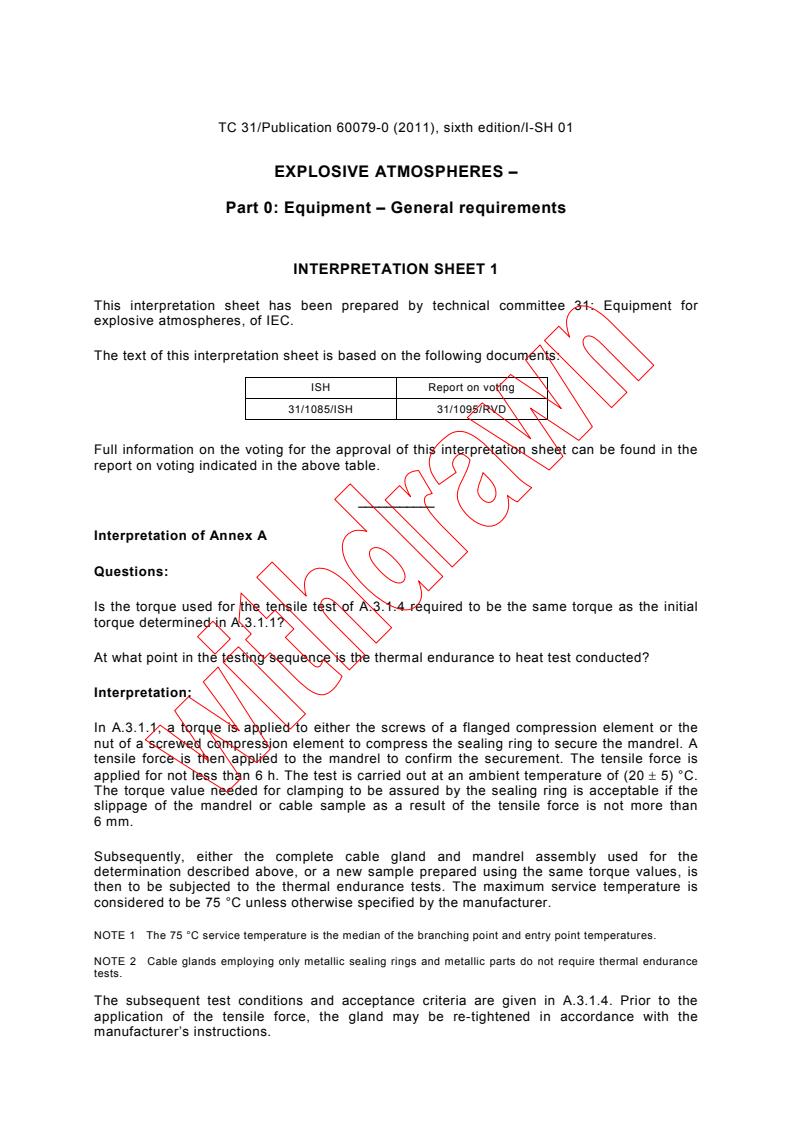
TC 31/Publication 60079-0 (2011), sixth edition/I-SH 01
EXPLOSIVE ATMOSPHERES –
Part 0: Equipment – General requirements
INTERPRETATION SHEET 1
This interpretation sheet has been prepared by technical committee 31: Equipment for
explosive atmospheres, of IEC.
The text of this interpretation sheet is based on the following documents:
ISH Report on voting
31/1085/ISH 31/1095/RVD
Full information on the voting for the approval of this interpretation sheet can be found in the
report on voting indicated in the above table.
___________
Interpretation of Annex A
Questions:
Is the torque used for the tensile test of A.3.1.4 required to be the same torque as the initial
torque determined in A.3.1.1?
At what point in the testing sequence is the thermal endurance to heat test conducted?
Interpretation:
In A.3.1.1, a torque is applied to either the screws of a flanged compression element or the
nut of a screwed compression element to compress the sealing ring to secure the mandrel. A
tensile force is then applied to the mandrel to confirm the securement. The tensile force is
applied for not less than 6 h. The test is carried out at an ambient temperature of (20 ± 5) °C.
The torque value needed for clamping to be assured by the sealing ring is acceptable if the
slippage of the mandrel or cable sample as a result of the tensile force is not more than
6 mm.
Subsequently, either the complete cable gland and mandrel assembly used for the
determination described above, or a new sample prepared using the same torque values, is
then to be subjected to the thermal endurance tests. The maximum service temperature is
considered to be 75 °C unless otherwise specified by the manufacturer.
NOTE 1 The 75 °C service temperature is the median of the branching point and entry point temperatures.
NOTE 2 Cable glands employing only metallic sealing rings and metallic parts do not require thermal endurance
tests.
The subsequent test conditions and acceptance criteria are given in A.3.1.4. Prior to the
application of the tensile force, the gland may be re-tightened in accordance with the
manufacturer’s instructions.
NOTE The torque applied to the screws or nut during retightening is not required to be the same as the initial
torque applied in A.3.1.1.
In A.3.1.5, the “value needed to prevent slipping” is the torque required for A.3.1.4.
It is intended that this interpretation will be introduced in IEC 60079-0 Edition 7 and therefore
an Interpretation Sheet will not be required for this or future editions.
November 2013 ICS 29.260.20
TC 31/IEC 60079-0 (2011), sixth edition/I-SH 02
EXPLOSIVE ATMOSPHERES –
Part 0: Equipment – General requirements
INTERPRETATION SHEET 2
This interpretation sheet has been prepared by IEC technical committee 31: Equipment for
explosive atmospheres.
The text of this interpretation sheet is based on the following documents:
ISH Report on voting
31/1132/ISH 31/1153/RVISH
Full information on the voting for the approval of this interpretation sheet can be found in the
report on voting indicated in the above table.
___________
Following decision No 16 of the TC 31 meeting in Melbourne in 2011, the issuing of an
th
Interpretation Sheet for IEC 60079-0:2011 (6 edition ) was requested, in order to clarify the
th
significance of the changes with respect to the 5 edition.
Question
th
What are the minor editorial, extensions, and major technical changes of the 6 edition with
th
respect to the 5 edition?
Answer
The following table shows the significance of the changes.
The significance of the changes between IEC Standard, IEC 60079-0, Edition 5, 2007-10
(Including Corrigendum No.1 and Interpretation Sheet I-SH 01) and IEC 60079-0, Edition 6,
2011-06 are as listed below:
October 2014 ICS 29.260.20
Type
Explanation of the significance of the changes Clause Minor and Extension Major
editorial technical
changes changes
Expansion of material specification data for 7.1.2 x
plastics and elastomers, including UV resistance
Addition of alternative qualification for O-rings 7.2.3 x
Addition of alternative criteria for surface 7.4.2 a) x
resistance
Addition of alternative breakdown voltage limit for 7.4.2 c) x
non-metallic layers applied to metallic enclosures
Expansion of “X” marking options for non-metallic 7.4.2 d) x
enclosure materials not meeting basic electrostatic 7.4.2 e)
requirements
Clarification that non-metallic enclosure 7.4.3 x
requirements also apply to painted or coated metal
enclosures
Clarification of test to determine capacitance of 7.5 C1
accessible metal parts with reduction in acceptable Table 9
capacitance
Addition of limits on zirconium content for Group III 8.3 x
and Group II (Gb only) enclosures 8.4
Introduction of “X” marking for Group III enclosures 8.4 x
not complying with basic material requirements,
similar to that existing for Group II
Addition of button-head cap screws to permitted 9.2 x
“Special Fasteners”
Reference for protective earthing (PE) 15.3 x
requirements for electrical machines to IEC 60034
Addition of requirements for ventilating fans 17.1.5 C2
Addition of requirement for temperature rating of 17.2 x
bearing lubricants
Addition of alternative construction for 18.2 x
disconnectors
Removal of voltage limits on plugs and sockets 20.2 x
Addition of test requirements for arc-quenching 20.2 C3
test on plugs and sockets
Additional information on cell voltages 23.3 C4
Table 12
Revision to impact test of glass parts 26.4.2 x
Revision to impact test procedure to address 26.4.2 x
“bounce” of impact head
Clarification of the test requirements for “service” 26.5.1.2 x
and “surface” temperature 26.5.1.3
Clarification of temperature rise tests for 26.5.1.3 x
converter-fed motors
Addition of alternative test method for thermal 26.8 x
endurance Table 15
Removal of “charging test” and addition of note Formerly C5
providing guidance 26.14
Clarification of test for the measurement of 26.14 C6
capacitance, revision of maximum capacitance
Addition of tests for ventilating fans 26.15 C2
Addition of alternative o-ring testing 26.16 x
Addition of a “Schedule of Limitations” to 28.2 x
October 2014 ICS 29.260.20
Type
Explanation of the significance of the changes Clause Minor and Extension Major
editorial technical
changes changes
certificates for Ex Components
Clarification of the marking for multiple 29.4 d) x
temperature classes
29.5 d)
Addition of marking for converter-fed motors 29.15 x
Removal of IP marking for Group III 29.5 x
Addition of specific instructions for electrical 30.3 x
machines and for ventilating fans 30.4
NOTE The technical changes referred to include the significance of technical changes in the revised IEC
Standard, but they do not form an exhaustive list of all modifications from the previous version. More guidance
may be found by referring to the Redline Version of the standard.
Explanation of the Types of Changes:
A) Definitions
1. Minor and editorial changes: • Clarification
• Decrease of technical requirements
• Minor technical change
• Editorial corrections
These are changes which modify requirements in an editorial or a minor technical way. They include changes of
the wording to clarify technical requirements without any technical change, or a reduction in level of existing
requirement.
2. Extension: Addition of technical options
These are changes which add new or modify existing technical requirements, in a way that new options are given,
but without increasing requirements for equipment that was fully compliant with the previous standard. Therefore,
these will not have to be considered for products in conformity with the preceding edition.
3. Major technical changes:
• addition of technical requirements
• increase of technical requirements
These are changes to technical requirements (addition, increase of the level or removal) made in a way that a
product in conformity with the preceding edition will not always be able to fulfil the requirements given in the later
edition. These changes have to be considered for products in conformity with the preceding edition. For these
changes additional information is provided in clause B) below.
NOTE These changes represent current technological knowledge. However, these changes should not normally
have an influence on equipment already placed on the market.
B) Information about the background of ‘Major technical changes’
C1 – The values in the table have been significantly reduced based on information that is intended to be published
in IEC TS 60079-32-1 (currently in preparation).
C2 – The requirements for fans was added at the request of the IECEx International Product Certification Scheme.
C3 – The test has been introduced for all disconnectors as an alternative to the voltage and current restrictions in
the previous standard which were considered to be arbitrary.
C4 – There has been a slight increase in some cell voltages. This is a minor change for most protection concepts
but should be regarded as a major change for equipment having a type of protection relying on energy limitation,
e.g. IEC 60079-11
C5 – The charging test was removed as it had been found to be not repeatable. Guidance will be given in IEC TS
60079-32-1 (currently in preparation).
C6 – The limits for capacitance have been decreased based on technical information in CLC/TR 50404.
October 2014 ICS 29.260.20
INTERNATIONAL ELECTROTECHNICAL COMMISSION
____________
IEC 60079-0
Edition 6.0 2011-06
EXPLOSIVE ATMOSPHERES –
Part 0: Equipment – General requirements
INTERPRETATION SHEET 3
This interpretation sheet has been prepared by IEC technical committee 31: Equipment for
explosive atmospheres.
The text of this interpretation sheet is based on the following documents:
FDIS Report on voting
31/1376/FDIS 31/1386/RVD
Full information on the voting for the approval of this interpretation sheet can be found in the
report on voting indicated in the above table.
___________
Question:
How shall marking be shown for equipment covered by both the electrical and non-electrical
standards (IEC 60079 and ISO 80079 series)?
Answer:
Equipment which includes both an electrical part and a non-electrical part shall have
combined marking. For example:
Ex db h IIA T4 Gb
Ex h tb IIIC T135 °C Db
It will be clearer for the user that the combined risk of the electrical part and the non-electrical
part, covered by a single certificate, has been assessed for the complete equipment, stating
one EPL, one equipment Group and one temperature class for Gas and the same for Dust
(but showing a maximum surface temperature instead of a temperature class). It is also noted
that Ex Components are not marked with either a temperature class (Group II) or a maximum
surface temperature (Group III).
ICS 29.260.20
– 2 – IEC 60079-0:2011/ISH3:2018 IEC 2018
For equipment where separate certificates have been prepared, with one for the electrical
parts, and one for the non-electrical parts, it is appropriate to have separate electrical and
non-electrical marking strings, each with its own associated certificate number.
NOTE Additional guidance on the marking of assemblies is given in IEC TS 60079-46.
IEC 2019
INTERNATIONAL ELECTROTECHNICAL COMMISSION
____________
IEC 60079-0
Edition 6.0 2011-06
EXPLOSIVE ATMOSPHERES –
Part 0: Equipment – General requirements
INTERPRETATION SHEET 4
This interpretation sheet has been prepared by IEC technical committee 31: Equipment for
explosive atmospheres.
The text of this interpretation sheet is based on the following documents:
DISH Report on voting
31/1454/DISH 31/1465/RVDISH
Full information on the voting for the approval of this interpretation sheet can be found in the
report on voting indicated in the above table.
___________
Interpretation sheet of Subclause 16.6 of IEC 60079-0:2011
The TC 31/CAG requested (Resolution 2 of 2018-04-19) that WG 22 prepare an interpretation
sheet based on IECEx Decision Sheet DS2018/002 addressing the assignment of entry point
and branching point temperatures of electrical rotating machines.
This interpretation is made available for Edition 6 of this standard due to the current use of
that standard by manufacturers, conformity assessment schemes and national bodies by
means of this “Interpretation Sheet” as follows:
ICS 29.260.20
– 2 – IEC 60079-0:2011/ISH4:2019
IEC 2019
Details of interpretation:
requirements
Interpretation of Subclause 16.6, Temperature at branching point and entry point:
Question: Subclause 16.6 of IEC 60079-0:2011 (Ed. 6) states “When the temperature under
rated conditions is higher than 70 °C at the entry point or 80 °C at the branching point of the
conductors, information shall be marked on the equipment exterior to provide guidance to the
user on the proper selection of cable and cable gland or conductors in conduit.”
It is not normal practice for electrical rotating machines to be tested with the cable entry
devices and cables that might be used in an actual installation, but with the cables available
at the manufacturer’s test area. In many cases, there will be no formal entry device as the
cables will enter via the space reserved for fixing of a gland plate.
How shall the relevant entry point and branching point temperatures be determined?
Interpretation: The use of the maximum internal air space temperature to represent the
maximum service temperature of terminal box gaskets and seals, the cable branching point
temperature, and the entry point temperature reflects the normal practice of testing electrical
rotating machines without prior knowledge of the actual glands and cables to be used for
installation. The production of heat from the electrical rotating machine connections is
generally insignificant with respect to the production of heat from the machine windings and
core.
Further amplification:
1) The entry point of the cable where the temperature is measured should be sealed so far
as possible to ensure that there is minimum air-circulation which can reduce the measured
temperature.
2) This is not intended to apply to any gasket between the terminal box and the frame of the
electrical rotating machine, where higher temperatures may be recorded, but only to the
gasket between the terminal box and its lid.
Although written in the context of electrical rotating machines, there may be other types of
equipment where an equivalent approach is applicable.
– 2 – 60079-0 IEC:2011
CONTENTS
FOREWORD . 7
1 Scope . 10
2 Normative references . 11
3 Terms and definitions . 14
4 Equipment grouping . 26
4.1 Group I . 26
4.2 Group II . 26
4.3 Group III . 26
4.4 Equipment for a particular explosive atmosphere. 27
5 Temperatures . 27
5.1 Environmental influences . 27
5.1.1 Ambient temperature . 27
5.1.2 External source of heating or cooling . 27
5.2 Service temperature . 27
5.3 Maximum surface temperature . 28
5.3.1 Determination of maximum surface temperature . 28
5.3.2 Limitation of maximum surface temperature . 28
5.3.3 Small component temperature for Group I or Group II electrical
equipment . 29
6 Requirements for all electrical equipment . 30
6.1 General . 30
6.2 Mechanical strength of equipment . 30
6.3 Opening times . 30
6.4 Circulating currents in enclosures (e.g. of large electrical machines) . 31
6.5 Gasket retention . 31
6.6 Electromagnetic and ultrasonic energy radiating equipment . 31
6.6.1 Radio frequency sources . 31
6.6.2 Lasers or other continuous wave sources . 32
6.6.3 Ultrasonic sources . 33
7 Non-metallic enclosures and non-metallic parts of enclosures . 33
7.1 General . 33
7.1.1 Applicability . 33
7.1.2 Specification of materials . 33
7.2 Thermal endurance . 34
7.2.1 Tests for thermal endurance . 34
7.2.2 Material selection . 34
7.2.3 Alternative qualification of elastomeric sealing O-rings . 34
7.3 Resistance to light . 34
7.4 Electrostatic charges on external non-metallic materials . 35
7.4.1 Applicability . 35
7.4.2 Avoidance of a build-up of electrostatic charge on Group I or Group II
electrical equipment . 35
7.4.3 Avoidance of a build-up of electrostatic charge on equipment for
Group III . 37
7.5 Accessible metal parts . 37
8 Metallic enclosures and metallic parts of enclosures . 38
60079-0 IEC:2011 – 3 –
8.1 Material composition . 38
8.2 Group I . 38
8.3 Group II . 38
8.4 Group III . 39
9 Fasteners . 39
9.1 General . 39
9.2 Special fasteners . 39
9.3 Holes for special fasteners . 40
9.3.1 Thread engagement . 40
9.3.2 Tolerance and clearance . 40
9.3.3 Hexagon socket set screws . 41
10 Interlocking devices . 41
11 Bushings . 41
12 Materials used for cementing . 41
13 Ex Components . 42
13.1 General . 42
13.2 Mounting . 42
13.3 Internal mounting . 42
13.4 External mounting . 42
13.5 Ex Component certificate . 42
14 Connection facilities and termination compartments . 43
14.1 General . 43
14.2 Termination compartment . 43
14.3 Type of protection . 43
14.4 Creepage and clearance . 43
15 Connection facilities for earthing or bonding conductors . 43
15.1 Equipment requiring earthing . 43
15.1.1 Internal . 43
15.1.2 External . 43
15.2 Equipment not requiring earthing . 43
15.3 Size of conductor connection . 44
15.4 Protection against corrosion . 44
15.5 Secureness of electrical connections . 44
16 Entries into enclosures . 44
16.1 General . 44
16.2 Identification of entries . 44
16.3 Cable glands . 45
16.4 Blanking elements . 45
16.5 Thread adapters . 45
16.6 Temperature at branching point and entry point . 45
16.7 Electrostatic charges of cable sheaths . 46
17 Supplementary requirements for rotating machines . 46
17.1 Ventilation . 46
17.1.1 Ventilation openings . 46
17.1.2 Materials for external fans . 47
17.1.3 Cooling fans of rotating machines . 47
17.1.4 Auxiliary motor cooling fans . 47
17.1.5 Ventilating fans . 47
– 4 – 60079-0 IEC:2011
17.2 Bearings . 48
18 Supplementary requirements for switchgear . 48
18.1 Flammable dielectric . 48
18.2 Disconnectors . 49
18.3 Group I – Provisions for locking . 49
18.4 Doors and covers . 49
19 Supplementary requirements for fuses . 49
20 Supplementary requirements for plugs, socket outlets and connectors . 50
20.1 General . 50
20.2 Explosive gas atmospheres . 50
20.3 Explosive dust atmospheres . 50
20.4 Energized plugs . 50
21 Supplementary requirements for luminaires . 50
21.1 General . 50
21.2 Covers for luminaires of EPL Mb, EPL Gb, or EPL Db . 51
21.3 Covers for luminaires of EPL Gc or EPL Dc . 51
21.4 Sodium lamps . 51
22 Supplementary requirements for caplights and handlights . 52
22.1 Group I caplights . 52
22.2 Group II and Group III caplights and handlights . 52
23 Equipment incorporating cells and batteries . 52
23.1 General . 52
23.2 Batteries . 52
23.3 Cell types . 52
23.4 Cells in a battery . 54
23.5 Ratings of batteries . 54
23.6 Interchangeability . 54
23.7 Charging of primary batteries . 54
23.8 Leakage . 54
23.9 Connections . 54
23.10 Orientation . 54
23.11 Replacement of cells or batteries . 54
23.12 Replaceable battery pack . 55
24 Documentation . 55
25 Compliance of prototype or sample with documents . 55
26 Type tests . 55
26.1 General . 55
26.2 Test configuration . 55
26.3 Tests in explosive test mixtures . 55
26.4 Tests of enclosures . 56
26.4.1 Order of tests . 56
26.4.2 Resistance to impact . 57
26.4.3 Drop test . 59
26.4.4 Acceptance criteria . 59
26.4.5 Degree of protection (IP) by enclosures . 59
26.5 Thermal tests . 60
26.5.1 Temperature measurement . 60
26.5.2 Thermal shock test . 61
60079-0 IEC:2011 – 5 –
26.5.3 Small component ignition test (Group I and Group II) . 62
26.6 Torque test for bushings . 62
26.6.1 Test procedure . 62
26.6.2 Acceptance criteria . 63
26.7 Non-metallic enclosures or non-metallic parts of enclosures . 63
26.7.1 General . 63
26.7.2 Test temperatures . 63
26.8 Thermal endurance to heat . 63
26.9 Thermal endurance to cold . 64
26.10 Resistance to light . 64
26.10.1 Test procedure . 64
26.10.2 Acceptance criteria . 65
26.11 Resistance to chemical agents for Group I electrical equipment . 65
26.12 Earth continuity . 65
26.13 Surface resistance test of parts of enclosures of non-metallic materials . 67
26.14 Measurement of capacitance . 68
26.14.1 General . 68
26.14.2 Test procedure . 68
26.15 Verification of ratings of ventilating fans . 69
26.16 Alternative qualification of elastomeric sealing O-rings . 69
27 Routine tests . 69
28 Manufacturer's responsibility . 70
28.1 Conformity with the documentation . 70
28.2 Certificate . 70
28.3 Responsibility for marking . 70
29 Marking . 70
29.1 Applicability . 70
29.2 Location . 70
29.3 General . 70
29.4 Ex marking for explosive gas atmospheres . 71
29.5 Ex marking for explosive dust atmospheres . 73
29.6 Combined types (or levels) of protection . 74
29.7 Multiple types of protection . 74
29.8 Ga equipment using two independent Gb types (or levels) of protection . 75
29.9 Ex Components . 75
29.10 Small equipment and small Ex Components . 75
29.11 Extremely small equipment and extremely small Ex Components. 76
29.12 Warning markings . 76
29.13 Alternate marking of equipment protection levels (EPLs) . 76
29.13.1 Alternate marking of type of protection for explosive gas
atmospheres . 77
29.13.2 Alternate marking of type of protection for explosive dust
atmospheres . 77
29.14 Cells and batteries . 77
29.15 Converter-fed electrical machines . 78
29.16 Examples of marking . 78
30 Instructions. 81
30.1 General . 81
30.2 Cells and batteries . 81
– 6 – 60079-0 IEC:2011
30.3 Electrical machines . 82
30.4 Ventilating fans . 82
Annex A (normative) Supplementary requirements for cable glands . 83
Annex B (normative) Requirements for Ex Components . 90
Annex C (informative) Example of rig for resistance to impact test . 92
Annex D (informative) Motors supplied by converters . 93
Annex E (informative) Temperature rise testing
...
IEC 60079-0 ®
Edition 6.0 2011-06
REDLINE VERSION
INTERNATIONAL
STANDARD
colour
inside
Explosive atmospheres –
Part 0: Equipment – General requirements
All rights reserved. Unless otherwise specified, no part of this publication may be reproduced or utilized in any form
or by any means, electronic or mechanical, including photocopying and microfilm, without permission in writing from
either IEC or IEC's member National Committee in the country of the requester. If you have any questions about IEC
copyright or have an enquiry about obtaining additional rights to this publication, please contact the address below or
your local IEC member National Committee for further information.
IEC Central Office Tel.: +41 22 919 02 11
3, rue de Varembé info@iec.ch
CH-1211 Geneva 20 www.iec.ch
Switzerland
About the IEC
The International Electrotechnical Commission (IEC) is the leading global organization that prepares and publishes
International Standards for all electrical, electronic and related technologies.
About IEC publications
The technical content of IEC publications is kept under constant review by the IEC. Please make sure that you have the
latest edition, a corrigenda or an amendment might have been published.
IEC Catalogue - webstore.iec.ch/catalogue Electropedia - www.electropedia.org
The stand-alone application for consulting the entire The world's leading online dictionary of electronic and
bibliographical information on IEC International Standards, electrical terms containing 21 000 terms and definitions in
Technical Specifications, Technical Reports and other English and French, with equivalent terms in 16 additional
documents. Available for PC, Mac OS, Android Tablets and languages. Also known as the International Electrotechnical
iPad. Vocabulary (IEV) online.
IEC publications search - webstore.iec.ch/advsearchform IEC Glossary - std.iec.ch/glossary
The advanced search enables to find IEC publications by a 67 000 electrotechnical terminology entries in English and
variety of criteria (reference number, text, technical French extracted from the Terms and Definitions clause of
committee,…). It also gives information on projects, replaced IEC publications issued since 2002. Some entries have been
and withdrawn publications. collected from earlier publications of IEC TC 37, 77, 86 and
CISPR.
IEC Just Published - webstore.iec.ch/justpublished
Stay up to date on all new IEC publications. Just Published IEC Customer Service Centre - webstore.iec.ch/csc
details all new publications released. Available online and If you wish to give us your feedback on this publication or
also once a month by email. need further assistance, please contact the Customer Service
Centre: sales@iec.ch.
IEC 60079-0 ®
Edition 6.0 2011-06
REDLINE VERSION
INTERNATIONAL
STANDARD
colour
inside
Explosive atmospheres –
Part 0: Equipment – General requirements
INTERNATIONAL
ELECTROTECHNICAL
COMMISSION
ICS 29.260.20 ISBN 978-2-8891-2519-7
IEC 60079-0 ®
Edition 6.0 2011-06
INTERNATIONAL
STANDARD
NORME
INTERNATIONALE
Explosive atmospheres –
Part 0: Equipment – General requirements
Atmosphères explosives –
Partie 0: Matériel – Exigences générales
TC 31/Publication 60079-0 (2011), sixth edition/I-SH 01
EXPLOSIVE ATMOSPHERES –
Part 0: Equipment – General requirements
INTERPRETATION SHEET 1
This interpretation sheet has been prepared by technical committee 31: Equipment for
explosive atmospheres, of IEC.
The text of this interpretation sheet is based on the following documents:
ISH Report on voting
31/1085/ISH 31/1095/RVD
Full information on the voting for the approval of this interpretation sheet can be found in the
report on voting indicated in the above table.
___________
Interpretation of Annex A
Questions:
Is the torque used for the tensile test of A.3.1.4 required to be the same torque as the initial
torque determined in A.3.1.1?
At what point in the testing sequence is the thermal endurance to heat test conducted?
Interpretation:
In A.3.1.1, a torque is applied to either the screws of a flanged compression element or the
nut of a screwed compression element to compress the sealing ring to secure the mandrel. A
tensile force is then applied to the mandrel to confirm the securement. The tensile force is
applied for not less than 6 h. The test is carried out at an ambient temperature of (20 ± 5) °C.
The torque value needed for clamping to be assured by the sealing ring is acceptable if the
slippage of the mandrel or cable sample as a result of the tensile force is not more than
6 mm.
Subsequently, either the complete cable gland and mandrel assembly used for the
determination described above, or a new sample prepared using the same torque values, is
then to be subjected to the thermal endurance tests. The maximum service temperature is
considered to be 75 °C unless otherwise specified by the manufacturer.
NOTE 1 The 75 °C service temperature is the median of the branching point and entry point temperatures.
NOTE 2 Cable glands employing only metallic sealing rings and metallic parts do not require thermal endurance
tests.
The subsequent test conditions and acceptance criteria are given in A.3.1.4. Prior to the
application of the tensile force, the gland may be re-tightened in accordance with the
manufacturer’s instructions.
NOTE The torque applied to the screws or nut during retightening is not required to be the same as the initial
torque applied in A.3.1.1.
In A.3.1.5, the “value needed to prevent slipping” is the torque required for A.3.1.4.
It is intended that this interpretation will be introduced in IEC 60079-0 Edition 7 and therefore
an Interpretation Sheet will not be required for this or future editions.
November 2013 ICS 29.260.20
TC 31/IEC 60079-0 (2011), sixth edition/I-SH 02
EXPLOSIVE ATMOSPHERES –
Part 0: Equipment – General requirements
INTERPRETATION SHEET 2
This interpretation sheet has been prepared by IEC technical committee 31: Equipment for
explosive atmospheres.
The text of this interpretation sheet is based on the following documents:
ISH Report on voting
31/1132/ISH 31/1153/RVISH
Full information on the voting for the approval of this interpretation sheet can be found in the
report on voting indicated in the above table.
___________
Following decision No 16 of the TC 31 meeting in Melbourne in 2011, the issuing of an
th
Interpretation Sheet for IEC 60079-0:2011 (6 edition ) was requested, in order to clarify the
th
significance of the changes with respect to the 5 edition.
Question
th
What are the minor editorial, extensions, and major technical changes of the 6 edition with
th
respect to the 5 edition?
Answer
The following table shows the significance of the changes.
The significance of the changes between IEC Standard, IEC 60079-0, Edition 5, 2007-10
(Including Corrigendum No.1 and Interpretation Sheet I-SH 01) and IEC 60079-0, Edition 6,
2011-06 are as listed below:
October 2014 ICS 29.260.20
Type
Explanation of the significance of the changes Clause Minor and Extension Major
editorial technical
changes changes
Expansion of material specification data for 7.1.2 x
plastics and elastomers, including UV resistance
Addition of alternative qualification for O-rings 7.2.3 x
Addition of alternative criteria for surface 7.4.2 a) x
resistance
Addition of alternative breakdown voltage limit for 7.4.2 c) x
non-metallic layers applied to metallic enclosures
Expansion of “X” marking options for non-metallic 7.4.2 d) x
enclosure materials not meeting basic electrostatic 7.4.2 e)
requirements
Clarification that non-metallic enclosure 7.4.3 x
requirements also apply to painted or coated metal
enclosures
Clarification of test to determine capacitance of 7.5 C1
accessible metal parts with reduction in acceptable Table 9
capacitance
Addition of limits on zirconium content for Group III 8.3 x
and Group II (Gb only) enclosures 8.4
Introduction of “X” marking for Group III enclosures 8.4 x
not complying with basic material requirements,
similar to that existing for Group II
Addition of button-head cap screws to permitted 9.2 x
“Special Fasteners”
Reference for protective earthing (PE) 15.3 x
requirements for electrical machines to IEC 60034
Addition of requirements for ventilating fans 17.1.5 C2
Addition of requirement for temperature rating of 17.2 x
bearing lubricants
Addition of alternative construction for 18.2 x
disconnectors
Removal of voltage limits on plugs and sockets 20.2 x
Addition of test requirements for arc-quenching 20.2 C3
test on plugs and sockets
Additional information on cell voltages 23.3 C4
Table 12
Revision to impact test of glass parts 26.4.2 x
Revision to impact test procedure to address 26.4.2 x
“bounce” of impact head
Clarification of the test requirements for “service” 26.5.1.2 x
and “surface” temperature 26.5.1.3
Clarification of temperature rise tests for 26.5.1.3 x
converter-fed motors
Addition of alternative test method for thermal 26.8 x
endurance Table 15
Removal of “charging test” and addition of note Formerly C5
providing guidance 26.14
Clarification of test for the measurement of 26.14 C6
capacitance, revision of maximum capacitance
Addition of tests for ventilating fans 26.15 C2
Addition of alternative o-ring testing 26.16 x
Addition of a “Schedule of Limitations” to 28.2 x
October 2014 ICS 29.260.20
Type
Explanation of the significance of the changes Clause Minor and Extension Major
editorial technical
changes changes
certificates for Ex Components
Clarification of the marking for multiple 29.4 d) x
temperature classes
29.5 d)
Addition of marking for converter-fed motors 29.15 x
Removal of IP marking for Group III 29.5 x
Addition of specific instructions for electrical 30.3 x
machines and for ventilating fans 30.4
NOTE The technical changes referred to include the significance of technical changes in the revised IEC
Standard, but they do not form an exhaustive list of all modifications from the previous version. More guidance
may be found by referring to the Redline Version of the standard.
Explanation of the Types of Changes:
A) Definitions
1. Minor and editorial changes: • Clarification
• Decrease of technical requirements
• Minor technical change
• Editorial corrections
These are changes which modify requirements in an editorial or a minor technical way. They include changes of
the wording to clarify technical requirements without any technical change, or a reduction in level of existing
requirement.
2. Extension: Addition of technical options
These are changes which add new or modify existing technical requirements, in a way that new options are given,
but without increasing requirements for equipment that was fully compliant with the previous standard. Therefore,
these will not have to be considered for products in conformity with the preceding edition.
3. Major technical changes:
• addition of technical requirements
• increase of technical requirements
These are changes to technical requirements (addition, increase of the level or removal) made in a way that a
product in conformity with the preceding edition will not always be able to fulfil the requirements given in the later
edition. These changes have to be considered for products in conformity with the preceding edition. For these
changes additional information is provided in clause B) below.
NOTE These changes represent current technological knowledge. However, these changes should not normally
have an influence on equipment already placed on the market.
B) Information about the background of ‘Major technical changes’
C1 – The values in the table have been significantly reduced based on information that is intended to be published
in IEC TS 60079-32-1 (currently in preparation).
C2 – The requirements for fans was added at the request of the IECEx International Product Certification Scheme.
C3 – The test has been introduced for all disconnectors as an alternative to the voltage and current restrictions in
the previous standard which were considered to be arbitrary.
C4 – There has been a slight increase in some cell voltages. This is a minor change for most protection concepts
but should be regarded as a major change for equipment having a type of protection relying on energy limitation,
e.g. IEC 60079-11
C5 – The charging test was removed as it had been found to be not repeatable. Guidance will be given in IEC TS
60079-32-1 (currently in preparation).
C6 – The limits for capacitance have been decreased based on technical information in CLC/TR 50404.
October 2014 ICS 29.260.20
INTERNATIONAL ELECTROTECHNICAL COMMISSION
____________
IEC 60079-0
Edition 6.0 2011-06
EXPLOSIVE ATMOSPHERES –
Part 0: Equipment – General requirements
INTERPRETATION SHEET 3
This interpretation sheet has been prepared by IEC technical committee 31: Equipment for
explosive atmospheres.
The text of this interpretation sheet is based on the following documents:
FDIS Report on voting
31/1376/FDIS 31/1386/RVD
Full information on the voting for the approval of this interpretation sheet can be found in the
report on voting indicated in the above table.
___________
Question:
How shall marking be shown for equipment covered by both the electrical and non-electrical
standards (IEC 60079 and ISO 80079 series)?
Answer:
Equipment which includes both an electrical part and a non-electrical part shall have
combined marking. For example:
Ex db h IIA T4 Gb
Ex h tb IIIC T135 °C Db
It will be clearer for the user that the combined risk of the electrical part and the non-electrical
part, covered by a single certificate, has been assessed for the complete equipment, stating
one EPL, one equipment Group and one temperature class for Gas and the same for Dust
(but showing a maximum surface temperature instead of a temperature class). It is also noted
that Ex Components are not marked with either a temperature class (Group II) or a maximum
surface temperature (Group III).
ICS 29.260.20
– 2 – IEC 60079-0:2011/ISH3:2018 IEC 2018
For equipment where separate certificates have been prepared, with one for the electrical
parts, and one for the non-electrical parts, it is appropriate to have separate electrical and
non-electrical marking strings, each with its own associated certificate number.
NOTE Additional guidance on the marking of assemblies is given in IEC TS 60079-46.
IEC 2019
INTERNATIONAL ELECTROTECHNICAL COMMISSION
____________
IEC 60079-0
Edition 6.0 2011-06
EXPLOSIVE ATMOSPHERES –
Part 0: Equipment – General requirements
INTERPRETATION SHEET 4
This interpretation sheet has been prepared by IEC technical committee 31: Equipment for
explosive atmospheres.
The text of this interpretation sheet is based on the following documents:
DISH Report on voting
31/1454/DISH 31/1465/RVDISH
Full information on the voting for the approval of this interpretation sheet can be found in the
report on voting indicated in the above table.
___________
Interpretation sheet of Subclause 16.6 of IEC 60079-0:2011
The TC 31/CAG requested (Resolution 2 of 2018-04-19) that WG 22 prepare an interpretation
sheet based on IECEx Decision Sheet DS2018/002 addressing the assignment of entry point
and branching point temperatures of electrical rotating machines.
This interpretation is made available for Edition 6 of this standard due to the current use of
that standard by manufacturers, conformity assessment schemes and national bodies by
means of this “Interpretation Sheet” as follows:
ICS 29.260.20
– 2 – IEC 60079-0:2011/ISH4:2019
IEC 2019
Details of interpretation:
requirements
Interpretation of Subclause 16.6, Temperature at branching point and entry point:
Question: Subclause 16.6 of IEC 60079-0:2011 (Ed. 6) states “When the temperature under
rated conditions is higher than 70 °C at the entry point or 80 °C at the branching point of the
conductors, information shall be marked on the equipment exterior to provide guidance to the
user on the proper selection of cable and cable gland or conductors in conduit.”
It is not normal practice for electrical rotating machines to be tested with the cable entry
devices and cables that might be used in an actual installation, but with the cables available
at the manufacturer’s test area. In many cases, there will be no formal entry device as the
cables will enter via the space reserved for fixing of a gland plate.
How shall the relevant entry point and branching point temperatures be determined?
Interpretation: The use of the maximum internal air space temperature to represent the
maximum service temperature of terminal box gaskets and seals, the cable branching point
temperature, and the entry point temperature reflects the normal practice of testing electrical
rotating machines without prior knowledge of the actual glands and cables to be used for
installation. The production of heat from the electrical rotating machine connections is
generally insignificant with respect to the production of heat from the machine windings and
core.
Further amplification:
1) The entry point of the cable where the temperature is measured should be sealed so far
as possible to ensure that there is minimum air-circulation which can reduce the measured
temperature.
2) This is not intended to apply to any gasket between the terminal box and the frame of the
electrical rotating machine, where higher temperatures may be recorded, but only to the
gasket between the terminal box and its lid.
Although written in the context of electrical rotating machines, there may be other types of
equipment where an equivalent approach is applicable.
– 2 – 60079-0 IEC:2011
CONTENTS
FOREWORD . 7
1 Scope . 10
2 Normative references . 11
3 Terms and definitions . 14
4 Equipment grouping . 26
4.1 Group I . 26
4.2 Group II . 26
4.3 Group III . 26
4.4 Equipment for a particular explosive atmosphere. 27
5 Temperatures . 27
5.1 Environmental influences . 27
5.1.1 Ambient temperature . 27
5.1.2 External source of heating or cooling . 27
5.2 Service temperature . 27
5.3 Maximum surface temperature . 28
5.3.1 Determination of maximum surface temperature . 28
5.3.2 Limitation of maximum surface temperature . 28
5.3.3 Small component temperature for Group I or Group II electrical
equipment . 29
6 Requirements for all electrical equipment . 30
6.1 General . 30
6.2 Mechanical strength of equipment . 30
6.3 Opening times . 30
6.4 Circulating currents in enclosures (e.g. of large electrical machines) . 31
6.5 Gasket retention . 31
6.6 Electromagnetic and ultrasonic energy radiating equipment . 31
6.6.1 Radio frequency sources . 31
6.6.2 Lasers or other continuous wave sources . 32
6.6.3 Ultrasonic sources . 33
7 Non-metallic enclosures and non-metallic parts of enclosures . 33
7.1 General . 33
7.1.1 Applicability . 33
7.1.2 Specification of materials . 33
7.2 Thermal endurance . 34
7.2.1 Tests for thermal endurance . 34
7.2.2 Material selection . 34
7.2.3 Alternative qualification of elastomeric sealing O-rings . 34
7.3 Resistance to light . 34
7.4 Electrostatic charges on external non-metallic materials . 35
7.4.1 Applicability . 35
7.4.2 Avoidance of a build-up of electrostatic charge on Group I or Group II
electrical equipment . 35
7.4.3 Avoidance of a build-up of electrostatic charge on equipment for
Group III . 37
7.5 Accessible metal parts . 37
8 Metallic enclosures and metallic parts of enclosures . 38
60079-0 IEC:2011 – 3 –
8.1 Material composition . 38
8.2 Group I . 38
8.3 Group II . 38
8.4 Group III . 39
9 Fasteners . 39
9.1 General . 39
9.2 Special fasteners . 39
9.3 Holes for special fasteners . 40
9.3.1 Thread engagement . 40
9.3.2 Tolerance and clearance . 40
9.3.3 Hexagon socket set screws . 41
10 Interlocking devices . 41
11 Bushings . 41
12 Materials used for cementing . 41
13 Ex Components . 42
13.1 General . 42
13.2 Mounting . 42
13.3 Internal mounting . 42
13.4 External mounting . 42
13.5 Ex Component certificate . 42
14 Connection facilities and termination compartments . 43
14.1 General . 43
14.2 Termination compartment . 43
14.3 Type of protection . 43
14.4 Creepage and clearance . 43
15 Connection facilities for earthing or bonding conductors . 43
15.1 Equipment requiring earthing . 43
15.1.1 Internal . 43
15.1.2 External . 43
15.2 Equipment not requiring earthing . 43
15.3 Size of conductor connection . 44
15.4 Protection against corrosion . 44
15.5 Secureness of electrical connections . 44
16 Entries into enclosures . 44
16.1 General . 44
16.2 Identification of entries . 44
16.3 Cable glands . 45
16.4 Blanking elements . 45
16.5 Thread adapters . 45
16.6 Temperature at branching point and entry point . 45
16.7 Electrostatic charges of cable sheaths . 46
17 Supplementary requirements for rotating machines . 46
17.1 Ventilation . 46
17.1.1 Ventilation openings . 46
17.1.2 Materials for external fans . 47
17.1.3 Cooling fans of rotating machines . 47
17.1.4 Auxiliary motor cooling fans . 47
17.1.5 Ventilating fans . 47
– 4 – 60079-0 IEC:2011
17.2 Bearings . 48
18 Supplementary requirements for switchgear . 48
18.1 Flammable dielectric . 48
18.2 Disconnectors . 49
18.3 Group I – Provisions for locking . 49
18.4 Doors and covers . 49
19 Supplementary requirements for fuses . 49
20 Supplementary requirements for plugs, socket outlets and connectors . 50
20.1 General . 50
20.2 Explosive gas atmospheres . 50
20.3 Explosive dust atmospheres . 50
20.4 Energized plugs . 50
21 Supplementary requirements for luminaires . 50
21.1 General . 50
21.2 Covers for luminaires of EPL Mb, EPL Gb, or EPL Db . 51
21.3 Covers for luminaires of EPL Gc or EPL Dc . 51
21.4 Sodium lamps . 51
22 Supplementary requirements for caplights and handlights . 52
22.1 Group I caplights . 52
22.2 Group II and Group III caplights and handlights . 52
23 Equipment incorporating cells and batteries . 52
23.1 General . 52
23.2 Batteries . 52
23.3 Cell types . 52
23.4 Cells in a battery . 54
23.5 Ratings of batteries . 54
23.6 Interchangeability . 54
23.7 Charging of primary batteries . 54
23.8 Leakage . 54
23.9 Connections . 54
23.10 Orientation . 54
23.11 Replacement of cells or batteries . 54
23.12 Replaceable battery pack . 55
24 Documentation . 55
25 Compliance of prototype or sample with documents . 55
26 Type tests . 55
26.1 General . 55
26.2 Test configuration . 55
26.3 Tests in explosive test mixtures . 55
26.4 Tests of enclosures . 56
26.4.1 Order of tests . 56
26.4.2 Resistance to impact . 57
26.4.3 Drop test . 59
26.4.4 Acceptance criteria . 59
26.4.5 Degree of protection (IP) by enclosures . 59
26.5 Thermal tests . 60
26.5.1 Temperature measurement . 60
26.5.2 Thermal shock test . 61
60079-0 IEC:2011 – 5 –
26.5.3 Small component ignition test (Group I and Group II) . 62
26.6 Torque test for bushings . 62
26.6.1 Test procedure . 62
26.6.2 Acceptance criteria . 63
26.7 Non-metallic enclosures or non-metallic parts of enclosures . 63
26.7.1 General . 63
26.7.2 Test temperatures . 63
26.8 Thermal endurance to heat . 63
26.9 Thermal endurance to cold . 64
26.10 Resistance to light . 64
26.10.1 Test procedure . 64
26.10.2 Acceptance criteria . 65
26.11 Resistance to chemical agents for Group I electrical equipment . 65
26.12 Earth continuity . 65
26.13 Surface resistance test of parts of enclosures of non-metallic materials . 67
26.14 Measurement of capacitance . 68
26.14.1 General . 68
26.14.2 Test procedure . 68
26.15 Verification of ratings of ventilating fans . 69
26.16 Alternative qualification of elastomeric sealing O-rings . 69
27 Routine tests . 69
28 Manufacturer's responsibility . 70
28.1 Conformity with the documentation . 70
28.2 Certificate . 70
28.3 Responsibility for marking . 70
29 Marking . 70
29.1 Applicability . 70
29.2 Location . 70
29.3 General . 70
29.4 Ex marking for explosive gas atmospheres . 71
29.5 Ex marking for explosive dust atmospheres . 73
29.6 Combined types (or levels) of protection . 74
29.7 Multiple types of protection . 74
29.8 Ga equipment using two independent Gb types (or levels) of protection . 75
29.9 Ex Components . 75
29.10 Small equipment and small Ex Components . 75
29.11 Extremely small equipment and extremely small Ex Components. 76
29.12 Warning markings . 76
29.13 Alternate marking of equipment protection levels (EPLs) . 76
29.13.1 Alternate marking of type of protection for explosive gas
atmospheres . 77
29.13.2 Alternate marking of type of protection for explosive dust
atmospheres . 77
29.14 Cells and batteries . 77
29.15 Converter-fed electrical machines . 78
29.16 Examples of marking . 78
30 Instructions. 81
30.1 General . 81
30.2 Cells and batteries . 81
– 6 – 60079-0 IEC:2011
30.3 Electrical machines . 82
30.4 Ventilating fans . 82
Annex A (normative) Supplementary requirements for cable glands . 83
Annex B (normative) Requirements for Ex Components . 90
Annex C (informative) Example of rig for resistance to impact test . 92
Annex D (informative) Motors supplied by converters . 93
Annex E (informative) Temperature rise testing of electric machines . 94
Annex F (informative) Guideline flowchart for tests of non-metallic enclosures or non-
metallic parts of enclosures (26.4) . 96
Bibliography . 97
Figure 1 – Tolerances and clearance for threaded fasteners . 40
Figure 2 – Contact surface under head of fastener with a reduced shank . 41
Figure 3 – Illustration of entry points and branching points . 46
Figure 4 – Assembly of test sample for earth-continuity test. 67
Figure 5 – Test piece with painted electrodes . 68
Figure 6 – Compression set of an O-ring . 69
Figure A.1 – Illustration of the terms used for cable glands . 84
Figure A.2 – Rounded edge of the point of entry of the flexible cable . 85
Figure C.1 – Example of rig for resistance to impact te
...