

CISPR 16-1-1:2003/AMD1:2005
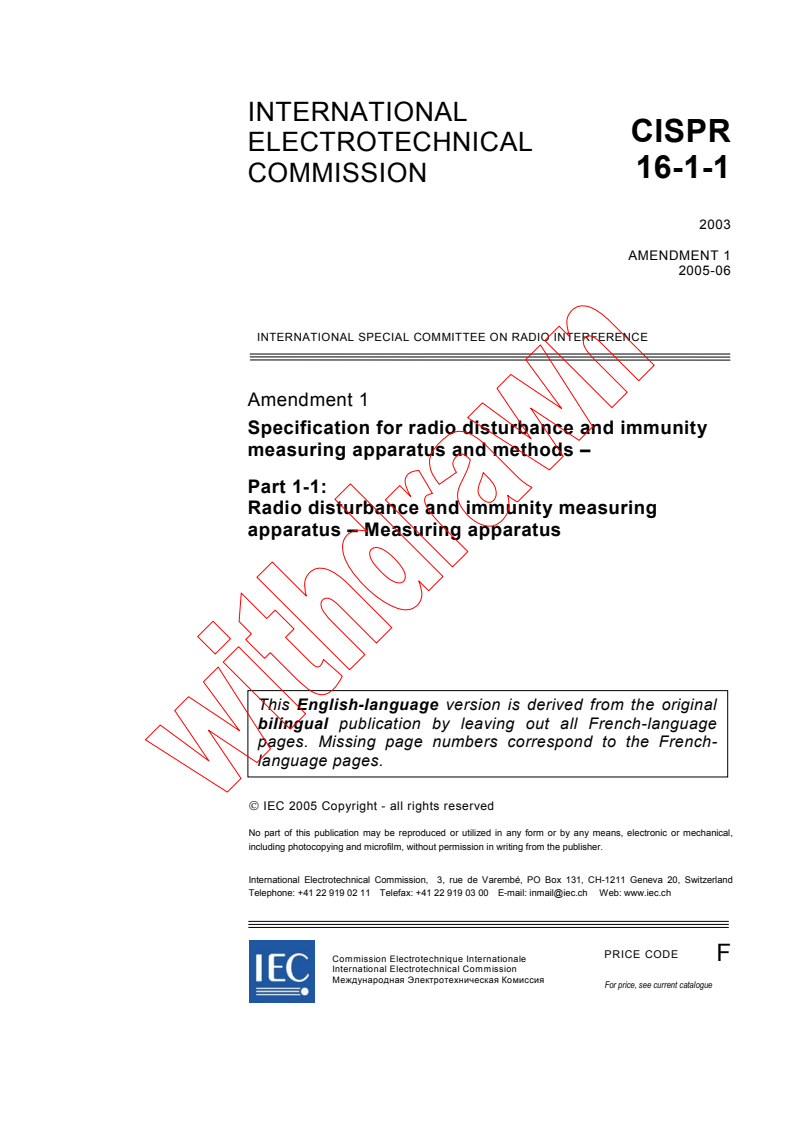
(Amendment)Amendment 1 - Specification for radio disturbance and immunity measuring apparatus and methods - Part 1-1: Radio disturbance and immunity measuring apparatus - Measuring apparatus
General Information
- Abstract
- Status
- Published
- Publication Date
- 23-Jun-2005
- Technical Committee
- CIS/A - Radio-interference measurements and statistical methods
- Current Stage
- DELPUB - Deleted Publication
- Start Date
- 15-Mar-2006
- Completion Date
- 28-Aug-2026
Buy Documents
CISPR 16-1-1:2003/AMD1:2005 - Amendment 1 - Specification for radio disturbance and immunity measuring apparatus and methods - Part 1-1: Radio disturbance and immunity measuring apparatus - Measuring apparatus Released:6/24/2005
CISPR 16-1-1:2003/AMD1:2005 - Amendement 1 - Spécifications des méthodes et des appareils de mesure des perturbations radioélectriques et de l'immunité aux perturbations radioélectriques - Partie 1-1: Appareils de mesure des perturbations radioélectriques et de l'immunité aux perturbations radioélectriques - Appareils de mesure Released:6/24/2005
CISPR 16-1-1:2003/AMD1:2005 - Amendment 1 - Specification for radio disturbance and immunity measuring apparatus and methods - Part 1-1: Radio disturbance and immunity measuring apparatus - Measuring apparatus Released:6/24/2005
Overview
CISPR 16-1-1:2003/AMD1:2005 is an important amendment to the international standard published by the International Electrotechnical Commission (IEC) focusing on radio disturbance and immunity measuring apparatus. This Amendment 1 enhances Part 1-1 of CISPR 16, which deals specifically with radio disturbance and immunity measuring apparatus - Measuring apparatus.
The primary purpose of this amendment is to introduce and specify the Amplitude Probability Distribution (APD) measuring function for disturbance measurement equipment such as spectrum analyzers and scanning receivers operating in the frequency range of 1 GHz to 18 GHz. With growing complexity in communication systems and electromagnetic environments, this standardized function enables more precise evaluation of electromagnetic interference (EMI) and immunity characteristics.
Key Topics
Amplitude Probability Distribution (APD) Measurement
APD is defined as the cumulative distribution representing the "probability of time that the amplitude of disturbance exceeds a specified level." This function allows characterizing the statistical behavior of radio disturbances, providing crucial data for assessing interference potential.Measuring Apparatus Functionality
The APD measuring function may be integrated or attached as an additional feature in radio disturbance measuring instruments like RF receivers or spectrum analyzers. Measurements are typically carried out at fixed frequencies.Implementation Methods
Two main approaches are outlined to realize the APD function:- Using comparators and counters, where each comparator corresponds to a predefined amplitude level.
- Employing an analog-to-digital (A/D) converter, logic circuits, and memory for higher resolution and flexible data handling.
Technical Specifications
The amendment defines critical parameters for the APD measuring function to ensure accuracy and reliability:- Dynamic amplitude range exceeding 60 dB.
- Amplitude accuracy within ±2.7 dB, including threshold offset settings.
- Measurement duration of at least 2 minutes, allowing intermittent measurements with dead time under 1%.
- Minimum measurable probability as low as 10⁻⁷.
- Capability to measure at least two amplitude levels simultaneously with a minimum amplitude resolution of 0.25 dB.
- Sampling rate equal to or greater than 10 million samples per second when using a 1 MHz resolution bandwidth.
- Recommended amplitude resolution for APD display under 0.25 dB when using an A/D converter.
Annex G: Rationale and Justifications
The amendment includes a detailed annex explaining the rationale behind each specification, linking measurement requirements to practical scenarios, such as evaluating interference potential with digital communication systems and ISM equipment standards.
Applications
CISPR 16-1-1 Amendment 1’s specifications for APD measuring functions serve multiple practical applications in the fields of electromagnetic compatibility (EMC) testing and radio interference analysis:
EMC Testing Laboratories can use the APD function to analyze the temporal distribution of disturbances and better understand interference characteristics of equipment under test (EUT).
Product Compliance Evaluation for digital communication and ISM (Industrial, Scientific, and Medical) devices, assessing their potential to cause radio disturbances precisely.
Spectrum Monitoring and Management authorities benefit from statistical disturbance data to set and enforce limits aligned with CISPR requirements.
Design and Development of Measuring Instruments focusing on enhanced EMI and immunity measurement capabilities incorporating APD functionality.
Research and Standards Development where improved measurement techniques support the refinement of electromagnetic compatibility limits and methodologies.
Related Standards
- CISPR 16-3: Discusses product families and measurement context relevant to amplitude probability distribution measurements.
- CISPR 11: Defines emission limits for ISM equipment, referenced here for setting amplitude range limits.
- IEC 61000 Series: General EMC standards that relate to immunity and disturbance testing methodology.
- Other CISPR 16 Parts: Cover measurement methods and apparatus for radio disturbances, complementing the focus of Part 1-1.
Keywords: CISPR 16-1-1 amendment, amplitude probability distribution, APD measurement, radio disturbance measurement, electromagnetic interference (EMI), EMC testing, spectrum analyzer specifications, radio immunity apparatus, IEC standards, measurement apparatus, sampling rate, dynamic range.
Relations
- Effective Date
- 05-Sep-2023
- Effective Date
- 05-Sep-2023
Buy Documents
CISPR 16-1-1:2003/AMD1:2005 - Amendment 1 - Specification for radio disturbance and immunity measuring apparatus and methods - Part 1-1: Radio disturbance and immunity measuring apparatus - Measuring apparatus Released:6/24/2005
CISPR 16-1-1:2003/AMD1:2005 - Amendement 1 - Spécifications des méthodes et des appareils de mesure des perturbations radioélectriques et de l'immunité aux perturbations radioélectriques - Partie 1-1: Appareils de mesure des perturbations radioélectriques et de l'immunité aux perturbations radioélectriques - Appareils de mesure Released:6/24/2005
CISPR 16-1-1:2003/AMD1:2005 - Amendment 1 - Specification for radio disturbance and immunity measuring apparatus and methods - Part 1-1: Radio disturbance and immunity measuring apparatus - Measuring apparatus Released:6/24/2005
Get Certified
Connect with accredited certification bodies for this standard

ANCE
Mexican certification and testing association.

Intertek Slovenia
Intertek testing, inspection, and certification services in Slovenia.

LNE (Laboratoire National de Métrologie et d'Essais)
French national laboratory for metrology and testing.
Sponsored listings
Frequently Asked Questions
CISPR 16-1-1:2003/AMD1:2005 is a standard published by the International Electrotechnical Commission (IEC). Its full title is "Amendment 1 - Specification for radio disturbance and immunity measuring apparatus and methods - Part 1-1: Radio disturbance and immunity measuring apparatus - Measuring apparatus". This standard covers: Amendment 1 - Specification for radio disturbance and immunity measuring apparatus and methods - Part 1-1: Radio disturbance and immunity measuring apparatus - Measuring apparatus
Amendment 1 - Specification for radio disturbance and immunity measuring apparatus and methods - Part 1-1: Radio disturbance and immunity measuring apparatus - Measuring apparatus
CISPR 16-1-1:2003/AMD1:2005 is classified under the following ICS (International Classification for Standards) categories: 33.100.10 - Emission; 33.100.20 - Immunity. The ICS classification helps identify the subject area and facilitates finding related standards.
CISPR 16-1-1:2003/AMD1:2005 has the following relationships with other standards: It is inter standard links to CISPR 16-1-1:2003, CISPR 16-1-1:2006. Understanding these relationships helps ensure you are using the most current and applicable version of the standard.
CISPR 16-1-1:2003/AMD1:2005 is available in PDF format for immediate download after purchase. The document can be added to your cart and obtained through the secure checkout process. Digital delivery ensures instant access to the complete standard document.
Standards Content (Sample)
INTERNATIONAL
CISPR
ELECTROTECHNICAL
16-1-1
COMMISSION
AMENDMENT 1
2005-06
INTERNATIONAL SPECIAL COMMITTEE ON RADIO INTERFERENCE
Amendment 1
Specification for radio disturbance and immunity
measuring apparatus and methods –
Part 1-1:
Radio disturbance and immunity measuring
apparatus – Measuring apparatus
This English-language version is derived from the original
bilingual publication by leaving out all French-language
pages. Missing page numbers correspond to the French-
language pages.
IEC 2005 Copyright - all rights reserved
No part of this publication may be reproduced or utilized in any form or by any means, electronic or mechanical,
including photocopying and microfilm, without permission in writing from the publisher.
International Electrotechnical Commission, 3, rue de Varembé, PO Box 131, CH-1211 Geneva 20, Switzerland
Telephone: +41 22 919 02 11 Telefax: +41 22 919 03 00 E-mail: inmail@iec.ch Web: www.iec.ch
PRICE CODE
F
Commission Electrotechnique Internationale
International Electrotechnical Commission
МеждународнаяЭлектротехническаяКомиссия
For price, see current catalogue
CISPR 16-1-1 Amend. 1 IEC:2005 – 3 –
FOREWORD
This amendment has been prepared by CISPR subcommittee A: Radio interference
measurements and statistical methods.
The text of this amendment is based on the following documents:
FDIS Report on voting
CISPR/A/579/FDIS CISPR/A/593/RVD
Full information on the voting for the approval of this amendment can be found in the report
on voting indicated in the above table.
The committee has decided that the contents of this amendment and the base publication will
remain unchanged until the maintenance result date indicated on the IEC web site under
"http://webstore.iec.ch" in the data related to the specific publication. At this date, the
publication will be
• reconfirmed,
• withdrawn,
• replaced by a revised edition, or
• amended.
Page 59
8.2 Spectrum analysers and scanning receivers for the frequency range
1 GHz to 18 GHz
Add, after item g) on page 61, the following new item:
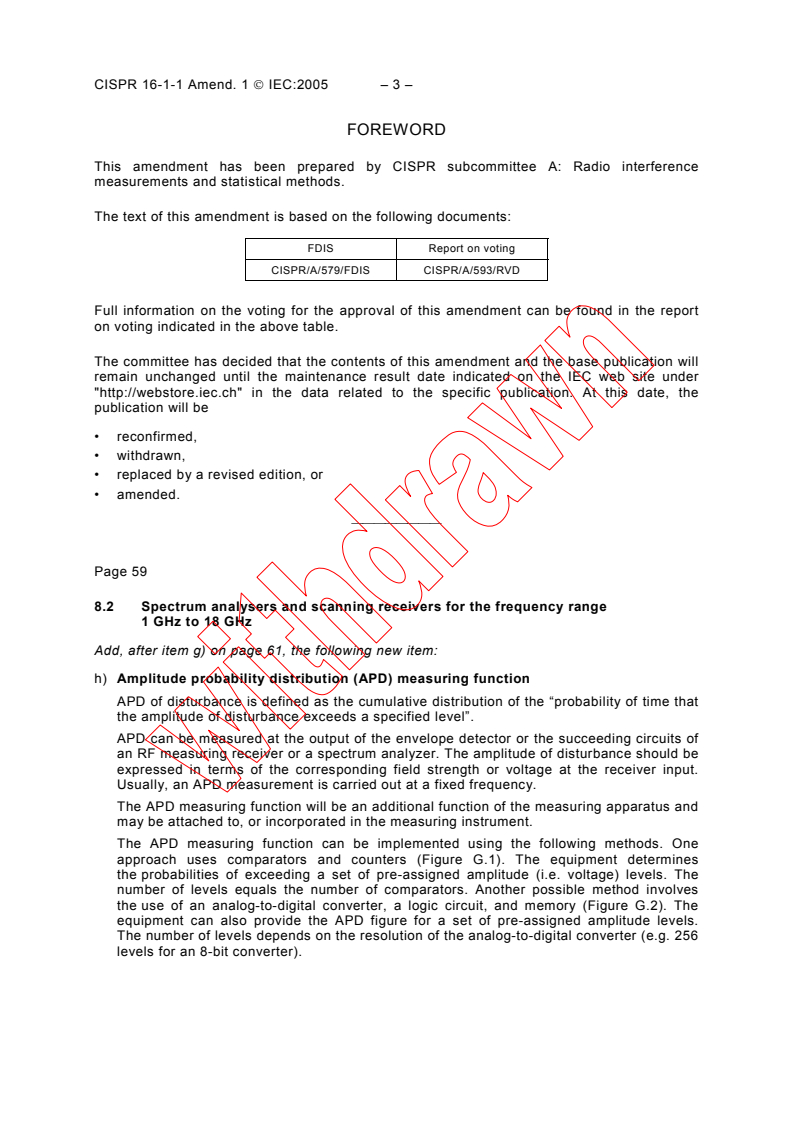
h) Amplitude probability distribution (APD) measuring function
APD of disturbance is defined as the cumulative distribution of the “probability of time that
the amplitude of disturbance exceeds a specified level”.
APD can be measured at the output of the envelope detector or the succeeding circuits of
an RF measuring receiver or a spectrum analyzer. The amplitude of disturbance should be
expressed in terms of the corresponding field strength or voltage at the receiver input.
Usually, an APD measurement is carried out at a fixed frequency.
The APD measuring function will be an additional function of the measuring apparatus and
may be attached to, or incorporated in the measuring instrument.
The APD measuring function can be implemented using the following methods. One
approach uses comparators and counters (Figure G.1). The equipment determines
the probabilities of exceeding a set of pre-assigned amplitude (i.e. voltage) levels. The
number of levels equals the number of comparators. Another possible method involves
the use of an analog-to-digital converter, a logic circuit, and memory (Figure G.2). The
equipment can also provide the APD figure for a set of pre-assigned amplitude levels.
The number of levels depends on the resolution of the analog-to-digital converter (e.g. 256
levels for an 8-bit converter).
CISPR 16-1-1 Amend. 1 IEC:2005 – 5 –
APD measurements using the aforementioned function are applicable to products or
product families if their potential to cause interference to digital communication systems is
1)
to be determined (see CISPR 16-3, Amendment 1 , subclause 4.7, for background
material to amplitude probability distribution (APD) specifications).
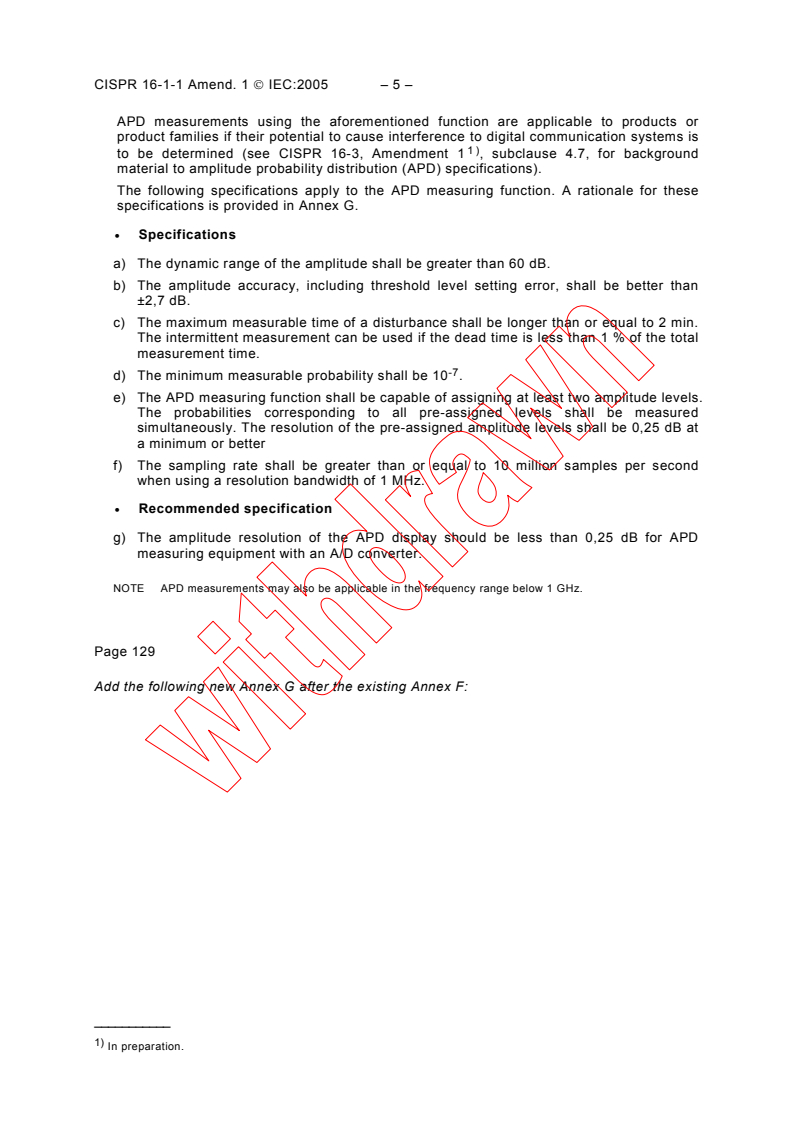
The following specifications apply to the APD measuring function. A rationale for these
specifications is provided in Annex G.
• Specifications
a) The dynamic range of the amplitude shall be greater than 60 dB.
b) The amplitude accuracy, including threshold level setting error, shall be better than
±2,7 dB.
c) The maximum measurable time of a disturbance shall be longer than or equal to 2 min.
The intermittent measurement can be used if the dead time is less than 1 % of the total
measurement time.
-7
d) The minimum
...
COMMISSION
CISPR
ÉLECTROTECHNIQUE
16-1-1
INTERNATIONALE
AMENDEMENT 1
2005-06
COMITÉ INTERNATIONAL SPÉCIAL DES PERTURBATIONS RADIOÉLECTRIQUES
Amendement 1
Spécifications des méthodes et des appareils
de mesure des perturbations radioélectriques
et de l'immunité aux perturbations
radioélectriques –
Partie 1-1:
Appareils de mesure des perturbations radio-
électriques et de l'immunité aux perturbations
radioélectriques – Appareils de mesure
Cette version française découle de la publication d’origine
bilingue dont les pages anglaises ont été supprimées.
Les numéros de page manquants sont ceux des pages
supprimées.
IEC 2005 Droits de reproduction réservés
Aucune partie de cette publication ne peut être reproduite ni utilisée sous quelque forme que ce soit et par aucun
procédé, électronique ou mécanique, y compris la photocopie et les microfilms, sans l'accord écrit de l'éditeur.
International Electrotechnical Commission, 3, rue de Varembé, PO Box 131, CH-1211 Geneva 20, Switzerland
Telephone: +41 22 919 02 11 Telefax: +41 22 919 03 00 E-mail: inmail@iec.ch Web: www.iec.ch
CODE PRIX
F
Commission Electrotechnique Internationale
International Electrotechnical Commission
МеждународнаяЭлектротехническаяКомиссия
Pour prix, voir catalogue en vigueur
– 2 – CISPR 16-1-1 Amend. 1 CEI:2005
AVANT-PROPOS
Cet amendement a été établi par le sous-comité A du CISPR: Mesures des perturbations
radioélectriques et méthodes statistiques.
Le texte de cet amendement est issu des documents suivants:
FDIS Rapport de vote
CISPR/A/579/FDIS CISPR/A/593/RVD
Le rapport de vote indiqué dans le tableau ci-dessus donne toute information sur le vote ayant
abouti à l'approbation de cet amendement.
Le comité a décidé que le contenu de cet amendement et de la publication de base ne sera
pas modifié avant la date de maintenance indiquée sur le site web de la CEI sous
"http://webstore.iec.ch" dans les données relatives à la publication recherchée. A cette date,
la publication sera
• reconduite,
• supprimée,
• remplacée par une édition révisée, ou
• amendée.
Page 58
8.2 Analyseurs de spectre et récepteurs à balayage pour la gamme de fréquences
1 GHz à 18 GHz
Ajouter le nouveau point suivant après l’alinéa g) de la page 60:
h) Fonction de mesure de la distribution de probabilité des amplitudes (DPA)
La DPA d'une perturbation est définie comme une distribution cumulative de la “probabilité
de la durée nécessaire à l’amplitude d’une perturbation pour dépasser un niveau spécifié”.
La DPA peut être mesurée à la sortie du détecteur d’enveloppe ou à la suite des circuits
d’un récepteur de mesure RF ou d’un analyseur de spectre. Il convient que l’amplitude de
la perturbation soit exprimée par rapport à la valeur du champ ou à la tension à l’entrée du
récepteur. Généralement, une mesure DPA s’effectue à une fréquence fixe.
La fonction de mesure DPA est une fonction supplémentaire des appareils de mesure, et
peut être soit rattachée à, soit incorporée dans les appareils de mesure.
La fonction de mesure DPA peut être mise en œuvre en utilisant les méthodes suivantes.
Une approche utilise des comparateurs et des compteurs (Figure G.1). L’appareillage
détermine les probabilités de dépasser un ensemble de niveaux d’amplitude pré-assignés
(par exemple en tension). Le nombre de niveaux est identique au nombre de
comparateurs. Une autre méthode possible implique l’utilisation d’un convertisseur
analogique-numérique, d'un circuit logique et d’une mémoire (Figure G.2). L’appareillage
peut aussi fournir le schéma de la DPA pour un ensemble de niveaux d’amplitude pré-
assignés. Le nombre de niveaux dépend de la résolution du convertisseur analogique–
numérique (par exemple 256 niveaux pour un convertisseur 8 bits).
– 4 – CISPR 16-1-1 Amend. 1 CEI:2005
Les mesures DPA qui utilisent la fonction mentionnée ci-dessus sont applicables aux
produits ou familles de produits si leur potentiel à engendrer des perturbations aux
systèmes de communications numériques doit être déterminé (voir CISPR 16-3, Amende-
1)
ment 1 , Article 4.7 éléments de contexte général pour les spécifications de distribution
de probabilité d’amplitude (DPA)).
Les spécifications suivantes s’appliquent à la fonction de mesure de la DPA. La
justification de ces spécifications est donnée à l’Annexe G.
• Spécifications
a) La plage dynamique de l’amplitude doit être supérieure à 60 dB.
b) La précision de l’amplitude, y compris le réglage du décalage par rapport au niveau de
seuil, doit être supérieure à ±2,7 dB.
c) La durée maximale mesurable d’une perturbation doit être supérieure ou égale à 2 min.
La mesure intermittente peut être utilisée si la durée du temps mort est inférieure à 1 %
de la durée totale de la mesure.
–7
d) La probabilité minimale mesurable doit être de 10 .
...
COMMISSION
CISPR
ÉLECTROTECHNIQUE
16-1-1
INTERNATIONALE
INTERNATIONAL
ELECTROTECHNICAL
AMENDEMENT 1
AMENDMENT 1
COMMISSION
2005-06
COMITÉ INTERNATIONAL SPÉCIAL DES PERTURBATIONS RADIOÉLECTRIQUES
INTERNATIONAL SPECIAL COMMITTEE ON RADIO INTERFERENCE
Amendement 1
Spécifications des méthodes et des appareils
de mesure des perturbations radioélectriques
et de l'immunité aux perturbations
radioélectriques –
Partie 1-1:
Appareils de mesure des perturbations radio-
électriques et de l'immunité aux perturbations
radioélectriques – Appareils de mesure
Amendment 1
Specification for radio disturbance and immunity
measuring apparatus and methods –
Part 1-1:
Radio disturbance and immunity measuring
apparatus – Measuring apparatus
IEC 2005 Droits de reproduction réservés Copyright - all rights reserved
International Electrotechnical Commission, 3, rue de Varembé, PO Box 131, CH-1211 Geneva 20, Switzerland
Telephone: +41 22 919 02 11 Telefax: +41 22 919 03 00 E-mail: inmail@iec.ch Web: www.iec.ch
CODE PRIX
F
PRICE CODE
Commission Electrotechnique Internationale
International Electrotechnical Commission
МеждународнаяЭлектротехническаяКомиссия
Pour prix, voir catalogue en vigueur
For price, see current catalogue
– 2 – CISPR 16-1-1 Amend. 1 CEI:2005
AVANT-PROPOS
Cet amendement a été établi par le sous-comité A du CISPR: Mesures des perturbations
radioélectriques et méthodes statistiques.
Le texte de cet amendement est issu des documents suivants:
FDIS Rapport de vote
CISPR/A/579/FDIS CISPR/A/593/RVD
Le rapport de vote indiqué dans le tableau ci-dessus donne toute information sur le vote ayant
abouti à l'approbation de cet amendement.
Le comité a décidé que le contenu de cet amendement et de la publication de base ne sera
pas modifié avant la date de maintenance indiquée sur le site web de la CEI sous
"http://webstore.iec.ch" dans les données relatives à la publication recherchée. A cette date,
la publication sera
• reconduite,
• supprimée,
• remplacée par une édition révisée, ou
• amendée.
Page 58
8.2 Analyseurs de spectre et récepteurs à balayage pour la gamme de fréquences
1 GHz à 18 GHz
Ajouter le nouveau point suivant après l’alinéa g) de la page 60:
h) Fonction de mesure de la distribution de probabilité des amplitudes (DPA)
La DPA d'une perturbation est définie comme une distribution cumulative de la “probabilité
de la durée nécessaire à l’amplitude d’une perturbation pour dépasser un niveau spécifié”.
La DPA peut être mesurée à la sortie du détecteur d’enveloppe ou à la suite des circuits
d’un récepteur de mesure RF ou d’un analyseur de spectre. Il convient que l’amplitude de
la perturbation soit exprimée par rapport à la valeur du champ ou à la tension à l’entrée du
récepteur. Généralement, une mesure DPA s’effectue à une fréquence fixe.
La fonction de mesure DPA est une fonction supplémentaire des appareils de mesure, et
peut être soit rattachée à, soit incorporée dans les appareils de mesure.
La fonction de mesure DPA peut être mise en œuvre en utilisant les méthodes suivantes.
Une approche utilise des comparateurs et des compteurs (Figure G.1). L’appareillage
détermine les probabilités de dépasser un ensemble de niveaux d’amplitude pré-assignés
(par exemple en tension). Le nombre de niveaux est identique au nombre de
comparateurs. Une autre méthode possible implique l’utilisation d’un convertisseur
analogique-numérique, d'un circuit logique et d’une mémoire (Figure G.2). L’appareillage
peut aussi fournir le schéma de la DPA pour un ensemble de niveaux d’amplitude pré-
assignés. Le nombre de niveaux dépend de la résolution du convertisseur analogique–
numérique (par exemple 256 niveaux pour un convertisseur 8 bits).
CISPR 16-1-1 Amend. 1 IEC:2005 – 3 –
FOREWORD
This amendment has been prepared by CISPR subcommittee A: Radio interference
measurements and statistical methods.
The text of this amendment is based on the following documents:
FDIS Report on voting
CISPR/A/579/FDIS CISPR/A/593/RVD
Full information on the voting for the approval of this amendment can be found in the report
on voting indicated in the above table.
The committee has decided that the contents of this amendment and the base publication will
remain unchanged until the maintenance result date indicated on the IEC web site under
"http://webstore.iec.ch" in the data related to the specific publication. At this date, the
publication will be
• reconfirmed,
• withdrawn,
• replaced by a revised edition, or
• amended.
Page 59
8.2 Spectrum analysers and scanning receivers for the frequency range
1 GHz to 18 GHz
Add, after item g) on page 61, the following new item:
h) Amplitude probability distribution (APD) measuring function
APD of disturbance is defined as the cumulative distribution of the “probability of time that
the amplitude of disturbance exceeds a specified level”.
APD can be measured at the output of the envelope detector or the succeeding circuits of
an RF measuring receiver or a spectrum analyzer. The amplitude of disturbance should be
expressed in terms of the corresponding field strength or voltage at the receiver input.
Usually, an APD measurement is carried out at a fixed frequency.
The APD measuring function will be an additional function of the measuring apparatus and
may be attached to, or incorporated in the measuring instrument.
The APD measuring function can be implemented using the following methods. One
approach uses comparators and counters (Figure G.1). The equipment determines
the probabilities of exceeding a set of pre-assigned amplitude (i.e. voltage) levels. The
number of levels equals the number of comparators. Another possible method involves
the use of an analog-to-digital converter, a logic circuit, and memory (Figure G.2). The
equipment can also provide the APD figure for a set of pre-assigned amplitude levels.
The number of levels depends on the resolution of the analog-to-digital converter (e.g. 256
levels for an 8-bit converter).
– 4 – CISPR 16-1-1 Amend. 1 CEI:2005
Les mesures DPA qui utilisent la fonction mentionnée ci-dessus sont applicables aux
produits ou familles de produits si leur potentiel à engendrer des perturbations aux
systèmes de communications numériques doit être déterminé (voir CISPR 16-3, Amende-
1)
ment 1 , Article 4.7 éléments de contexte général pour les spécifications de distribution
de probabilité d’amplitude (DPA)).
Les spécifications suivantes s’appliquent à la fonction de mesure de la DPA. La
justification de ces spécifications est donnée à l’Annexe G.
• Spécifications
a) La plage dynamique de l’amplitude doit être supérieure à 60 dB.
b) La précision de l’amplitude, y compris le réglage du décalage par rapport au niveau de
seuil, doit être supérieure à ±2,7 dB.
c) La durée maximale mesurable d’une perturbation doit être supérieure ou égale à 2 min.
La mesure intermittente peut être utilisée si la durée du temps mort est inférieure à 1 %
de la durée totale de la mesure.
–7
d) La probabilité minimale mesurable doit être de 10 .
e) La fonction de mesure de DPA doit être capable d’assigner au moins deux niveaux
d’amplitude. Les probabilités correspondant à tous les niveaux pré-assignés doivent
être mesurées simultanément. La résolution des niveaux d’amplitude pré-assignés doit
être au minimum 0,25 dB ou mieux.
f) Le taux d’échantillonnage doit être supérieur ou égal à 10 millions d’échantillons par
seconde en utilisant une largeur de bande de résolution de 1 MHz.
• Spécification recommandée
g) Il convient que la résolution de l’amplitude de l’affichage de la DPA soit inférieure à
0,25 dB pour un appareil de mesure de DPA ayant un convertisseur A/N.
NOTE Les mesures de DPA peuvent aussi s’appliquer aux gammes de fréquences inférieures à 1 GHz.
Page 128
Ajouter la nouvelle Annexe G suivante après l’Annexe F existante:
___________
1)
En préparation.
CISPR 16-1-1 Amend. 1 IEC:2005 – 5 –
APD measurements using the aforementioned function are applicable to products or
product families if their potential to cause interference to digital communication systems is
1)
to be determined (see CISPR 16-3, Amendment 1 , subclause 4.7, for background
material to amplitude probability distribution (APD) specifications).
The following specifications apply to the APD measuring function. A rationale for these
specifications is provided in Annex G.
• Specifications
a) The dynamic range of the am
...