


IEC 61337-1:2004
(Main)Filters using waveguide type dielectric resonators - Part 1: Generic specification
General Information
- Abstract
IEC 61337-1:2004 applies to filters using waveguide type dielectric resonators of assessed quality using either capability approval or qualification approval procedures. It also lists the test and measurement procedures which may be selected for use in detail specifications for such filters.
- Status
- Published
- Publication Date
- 01-Nov-2004
- Technical Committee
- TC 49 - Piezoelectric, dielectric and electrostatic devices and associated materials for frequency control, selection and detection
- Drafting Committee
- WG 10 - TC 49/WG 10
- Current Stage
- PPUB - Publication issued
- Start Date
- 02-Nov-2004
- Completion Date
- 31-Jan-2005
Buy Documents
IEC 61337-1:2004 - Filters using waveguide type dielectric resonators - Part 1: Generic specification Released:11/2/2004
IEC 61337-1:2004 - Filters using waveguide type dielectric resonators - Part 1: Generic specification Released:11/2/2004
Overview
IEC 61337-1:2004 - "Filters using waveguide type dielectric resonators – Part 1: Generic specification" is an international standard published by the IEC that defines the generic requirements, terminology, quality-assessment routes and selectable test & measurement procedures for waveguide‑type dielectric resonator filters. The scope covers filters of assessed quality using capability approval or qualification approval procedures and lists the tests and measurements that can be referenced in detail specifications.
Key Topics
- Scope & terminology: standardized terms and definitions for dielectric filters, mono-block filters, stripline/microstripline/coplanar types, pass‑ and stop‑band concepts, trap and cut‑off frequencies, mid‑band frequency, etc.
- Electrical characteristics: definitions of coupling factor (k), unloaded/loaded/external quality factors (Q) and frequency response descriptors for band‑pass and band‑stop filters.
- Quality assessment procedures: manufacturer and process approvals, procedures for primary manufacture, sub‑contracting, structurally similar components, screening, rework/repair, certified records and release/validity rules.
- Test & measurement procedures: recommended selectable tests including visual inspection, dimensional gauging, electrical tests (insertion loss, return attenuation, group delay), and mechanical & environmental procedures.
- Environmental and reliability tests: references to established environmental tests (IEC 60068 series) for cold, dry heat, vibration, shock, damp heat, solderability and related conditions.
- Order of precedence & normative references: guidance on hierarchy of documents (detail → sectional → generic → other IEC documents) and essential referenced standards.
Applications and Who Uses It
IEC 61337-1:2004 is intended for:
- Filter manufacturers developing waveguide‑type dielectric resonator filters who need to specify test routines and quality assessment;
- Test laboratories and QA teams implementing measurement and environmental test procedures;
- Design and RF/microwave engineers who specify filter performance (pass‑band/stop‑band, coupling, Q);
- Procurement and compliance officers building contractual detail specifications for components used in telecommunications, satellite, radar, aerospace and other RF systems;
- Standards writers and certification bodies referencing generic requirements when creating detail or sectional specifications.
Practical value: ensures consistent terminology, repeatable test methods, and defined approval paths to achieve reliable, high‑quality dielectric resonator filters for RF/microwave systems.
Related Standards
- IEC 61337-2 (Part 2: Guidance for use)
- IEC 60068 series (environmental testing)
- IEC 60027, IEC 60050(561), IEC 60617 (terminology, symbols)
- QC 001001 / QC 001002 (IECQ quality assessment rules)
- ISO 1000 (units)
Keywords: IEC 61337-1:2004, waveguide type dielectric resonators, dielectric filter standards, coupling factor, quality assessment, RF/microwave filter testing.
Relations
- Replaces
IEC 61337-1-2:1999 - Filters using waveguide type dielectric resonators - Part 1-2: Test conditions - Effective Date
- 05-Sep-2023
Buy Documents
IEC 61337-1:2004 - Filters using waveguide type dielectric resonators - Part 1: Generic specification Released:11/2/2004
IEC 61337-1:2004 - Filters using waveguide type dielectric resonators - Part 1: Generic specification Released:11/2/2004
Frequently Asked Questions
IEC 61337-1:2004 is a standard published by the International Electrotechnical Commission (IEC). Its full title is "Filters using waveguide type dielectric resonators - Part 1: Generic specification". This standard covers: IEC 61337-1:2004 applies to filters using waveguide type dielectric resonators of assessed quality using either capability approval or qualification approval procedures. It also lists the test and measurement procedures which may be selected for use in detail specifications for such filters.
IEC 61337-1:2004 applies to filters using waveguide type dielectric resonators of assessed quality using either capability approval or qualification approval procedures. It also lists the test and measurement procedures which may be selected for use in detail specifications for such filters.
IEC 61337-1:2004 is classified under the following ICS (International Classification for Standards) categories: 31.140 - Piezoelectric devices. The ICS classification helps identify the subject area and facilitates finding related standards.
IEC 61337-1:2004 has the following relationships with other standards: It is inter standard links to IEC 61337-1-2:1999. Understanding these relationships helps ensure you are using the most current and applicable version of the standard.
IEC 61337-1:2004 is available in PDF format for immediate download after purchase. The document can be added to your cart and obtained through the secure checkout process. Digital delivery ensures instant access to the complete standard document.
Standards Content (Sample)
INTERNATIONAL IEC
STANDARD 61337-1
First edition
2004-11
Filters using waveguide type
dielectric resonators –
Part 1:
Generic specification
Reference number
Publication numbering
As from 1 January 1997 all IEC publications are issued with a designation in the
60000 series. For example, IEC 34-1 is now referred to as IEC 60034-1.
Consolidated editions
The IEC is now publishing consolidated versions of its publications. For example,
edition numbers 1.0, 1.1 and 1.2 refer, respectively, to the base publication, the
base publication incorporating amendment 1 and the base publication incorporating
amendments 1 and 2.
Further information on IEC publications
The technical content of IEC publications is kept under constant review by the IEC,
thus ensuring that the content reflects current technology. Information relating to
this publication, including its validity, is available in the IEC Catalogue of
publications (see below) in addition to new editions, amendments and corrigenda.
Information on the subjects under consideration and work in progress undertaken
by the technical committee which has prepared this publication, as well as the list
of publications issued, is also available from the following:
• IEC Web Site (www.iec.ch)
• Catalogue of IEC publications
The on-line catalogue on the IEC web site (www.iec.ch/searchpub) enables you to
search by a variety of criteria including text searches, technical committees
and date of publication. On-line information is also available on recently issued
publications, withdrawn and replaced publications, as well as corrigenda.
• IEC Just Published
This summary of recently issued publications (www.iec.ch/online_news/ justpub)
is also available by email. Please contact the Customer Service Centre (see
below) for further information.
• Customer Service Centre
If you have any questions regarding this publication or need further assistance,
please contact the Customer Service Centre:
Email: custserv@iec.ch
Tel: +41 22 919 02 11
Fax: +41 22 919 03 00
INTERNATIONAL IEC
STANDARD 61337-1
First edition
2004-11
Filters using waveguide type
dielectric resonators –
Part 1:
Generic specification
IEC 2004 Copyright - all rights reserved
No part of this publication may be reproduced or utilized in any form or by any means, electronic or
mechanical, including photocopying and microfilm, without permission in writing from the publisher.
International Electrotechnical Commission, 3, rue de Varembé, PO Box 131, CH-1211 Geneva 20, Switzerland
Telephone: +41 22 919 02 11 Telefax: +41 22 919 03 00 E-mail: inmail@iec.ch Web: www.iec.ch
PRICE CODE
Commission Electrotechnique Internationale T
International Electrotechnical Commission
МеждународнаяЭлектротехническаяКомиссия
For price, see current catalogue
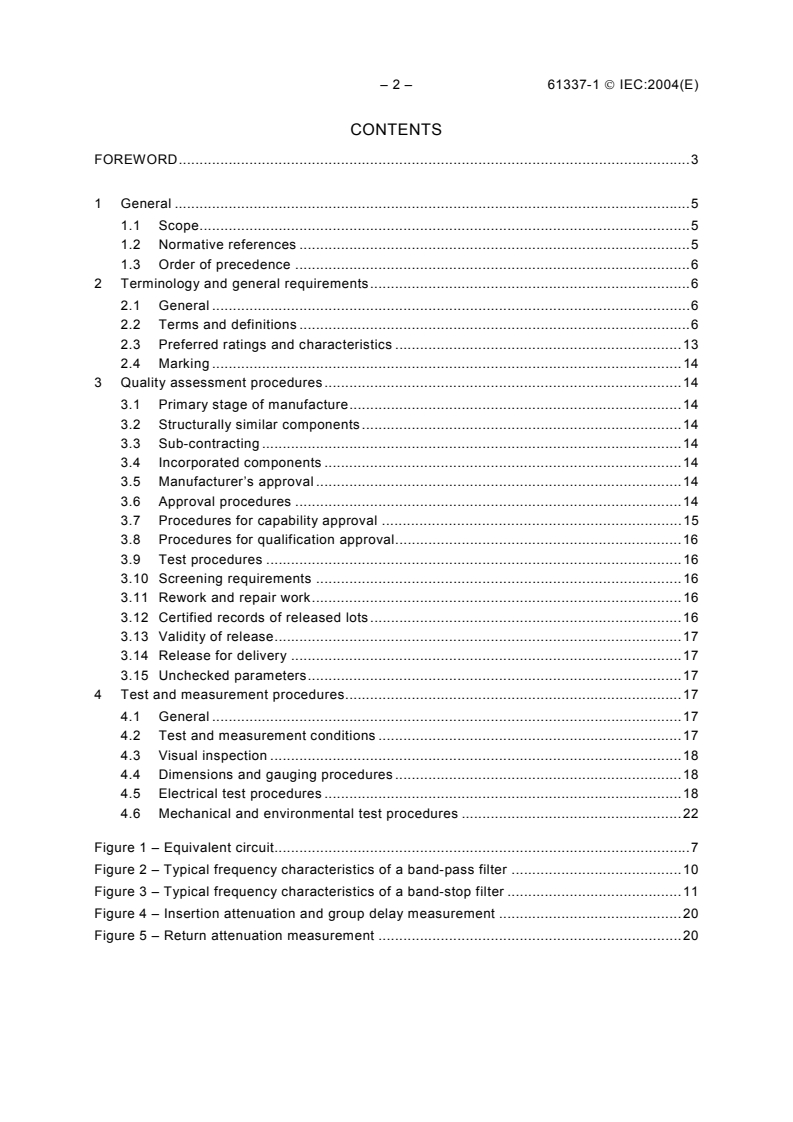
– 2 – 61337-1 IEC:2004(E)
CONTENTS
FOREWORD.3
1 General .5
1.1 Scope.5
1.2 Normative references .5
1.3 Order of precedence .6
2 Terminology and general requirements.6
2.1 General .6
2.2 Terms and definitions .6
2.3 Preferred ratings and characteristics .13
2.4 Marking .14
3 Quality assessment procedures.14
3.1 Primary stage of manufacture.14
3.2 Structurally similar components.14
3.3 Sub-contracting .14
3.4 Incorporated components .14
3.5 Manufacturer’s approval .14
3.6 Approval procedures .14
3.7 Procedures for capability approval .15
3.8 Procedures for qualification approval.16
3.9 Test procedures .16
3.10 Screening requirements .16
3.11 Rework and repair work.16
3.12 Certified records of released lots.16
3.13 Validity of release.17
3.14 Release for delivery .17
3.15 Unchecked parameters.17
4 Test and measurement procedures.17
4.1 General .17
4.2 Test and measurement conditions .17
4.3 Visual inspection .18
4.4 Dimensions and gauging procedures .18
4.5 Electrical test procedures .18
4.6 Mechanical and environmental test procedures .22
Figure 1 – Equivalent circuit.7
Figure 2 – Typical frequency characteristics of a band-pass filter .10
Figure 3 – Typical frequency characteristics of a band-stop filter .11
Figure 4 – Insertion attenuation and group delay measurement .20
Figure 5 – Return attenuation measurement .20
61337-1 IEC:2004(E) – 3 –
INTERNATIONAL ELECTROTECHNICAL COMMISSION
____________
FILTERS USING WAVEGUIDE TYPE
DIELECTRIC RESONATORS –
Part 1: Generic specification
FOREWORD
1) The International Electrotechnical Commission (IEC) is a worldwide organization for standardization comprising
all national electrotechnical committees (IEC National Committees). The object of IEC is to promote
international co-operation on all questions concerning standardization in the electrical and electronic fields. To
this end and in addition to other activities, IEC publishes International Standards, Technical Specifications,
Technical Reports, Publicly Available Specifications (PAS) and Guides (hereafter referred to as “IEC
Publication(s)”). Their preparation is entrusted to technical committees; any IEC National Committee interested
in the subject dealt with may participate in this preparatory work. International, governmental and non-
governmental organizations liaising with the IEC also participate in this preparation. IEC collaborates closely
with the International Organization for Standardization (ISO) in accordance with conditions determined by
agreement between the two organizations.
2) The formal decisions or agreements of IEC on technical matters express, as nearly as possible, an international
consensus of opinion on the relevant subjects since each technical committee has representation from all
interested IEC National Committees.
3) IEC Publications have the form of recommendations for international use and are accepted by IEC National
Committees in that sense. While all reasonable efforts are made to ensure that the technical content of IEC
Publications is accurate, IEC cannot be held responsible for the way in which they are used or for any
misinterpretation by any end user.
4) In order to promote international uniformity, IEC National Committees undertake to apply IEC Publications
transparently to the maximum extent possible in their national and regional publications. Any divergence
between any IEC Publication and the corresponding national or regional publication shall be clearly indicated in
the latter.
5) IEC provides no marking procedure to indicate its approval and cannot be rendered responsible for any
equipment declared to be in conformity with an IEC Publication.
6) All users should ensure that they have the latest edition of this publication.
7) No liability shall attach to IEC or its directors, employees, servants or agents including individual experts and
members of its technical committees and IEC National Committees for any personal injury, property damage or
other damage of any nature whatsoever, whether direct or indirect, or for costs (including legal fees) and
expenses arising out of the publication, use of, or reliance upon, this IEC Publication or any other IEC
Publications.
8) Attention is drawn to the Normative references cited in this publication. Use of the referenced publications is
indispensable for the correct application of this publication.
9) Attention is drawn to the possibility that some of the elements of this IEC Publication may be the subject of
patent rights. IEC shall not be held responsible for identifying any or all such patent rights.
International Standard IEC 61337-1 has been prepared by IEC technical committee 49:
Piezoelectric and dielectric devices for frequency control and selection.
This part of IEC 61337 cancels and replaces IEC 61337-1-1:1995 and IEC 61337-1-2:1999.
The text of this standard is based on the following documents:
FDIS Report on voting
49/685/FDIS 49/695/RVD
Full information on the voting for the approval of this standard can be found in the report on
voting indicated in the above table.
This publication has been drafted in accordance with the ISO/IEC Directives, Part 2.
– 4 – 61337-1 IEC:2004(E)
IEc 61337 consists of the following parts, under the general title Filters using waveguide type
dielectric resonators:
Part 1: Generic specification
Part 2: Guidance for use
The committee has decided that the contents of this publication will remain unchanged until
the maintenance result date indicated on the IEC web site under "http://webstore.iec.ch" in
the data related to the specific publication. At this date, the publication will be
• reconfirmed;
• withdrawn;
• replaced by a revised edition, or
• amended.
A bilingual edition of this generic specification may be issued at a later date.
61337-1 IEC:2004(E) – 5 –
FILTERS USING WAVEGUIDE TYPE
DIELECTRIC RESONATORS –
Part 1: Generic specification
1 General
1.1 Scope
This part of IEC 61337 applies to filters using waveguide type dielectric resonators of
assessed quality using either capability approval or qualification approval procedures. It also
lists the test and measurement procedures which may be selected for use in detail
specifications for such filters.
1.2 Normative references
The following referenced documents are indispensable for the application of this document.
For dated references, only the edition cited applies. For undated references, the latest edition
of the referenced document (including any amendments) applies.
IEC 60027 (all parts), Letter symbols to be used in electrical technology
IEC 60050(561):1991, International Electrotechnical Vocabulary (IEV) – Chapter 561: Piezo-
electric devices for frequency control and selection
IEC 60068-1:1988, Environmental testing – Part 1: General and guidance
IEC 60068-2-1:1990, Environmental testing – Part 2: Tests – Test A: Cold
IEC 60068-2-2:1974, Environmental testing – Part 2: Tests – Test B: Dry Heat
IEC 60068-2-6:1995, Environmental testing – Part 2: Tests – Test Fc: Vibration (sinusoidal)
IEC 60068-2-7:1983, Environmental testing – Part 2: Tests – Test Ga: Acceleration, steady
state
IEC 60068-2-13:1983, Environmental testing – Part 2: Tests – Test M: Low air pressure
IEC 60068-2-14:1984, Environmental testing – Part 2: Tests – Test N: Change of temperature
IEC 60068-2-20:1979, Environmental testing – Part 2: Tests – Test T: Soldering
IEC 60068-2-21:1999, Environmental testing – Part 2-21: Tests – Test U: Robustness of
terminations and integral mounting devices
IEC 60068-2-27:1987, Environmental testing – Part 2: Tests – Test Ea and guidance: Shock
IEC 60068-2-29:1987, Environmental testing – Part 2: Tests – Test Eb and guidance: Bump
IEC 60068-2-30:1980, Environmental testing – Part 2: Tests – Test Db and guidance: Damp
heat, cyclic (12 + 12 hour cycle)
– 6 – 61337-1 IEC:2004(E)
IEC 60068-2-58:1999, Environmental testing – Part 2-58: Tests – Tests Td: Test methods for
solderability, resistance to dissolution of metalization and to soldering heat of surface
mounting devices (SMD)
IEC 60068-2-78:2001, Environmental testing – Part 2-78: Tests – Test Cab: Damp heat,
steady state
IEC 60617 (all parts) [DB] , Graphical symbols for diagrams
QC 001001:2000, IEC Quality Assessment System for Electronic Components (IECQ) – Basic
Rules
QC 001002-2:1998, IEC Quality Assessment System for Electronic Components (IECQ) –
Rules of Procedure – Part 2: Documentation
QC 001002-3:1998, IEC Quality Assessment System for Electronic Components (IECQ) –
Rules of Procedure – Part 3: Approval Procedures
QC 001005:2000, Register of Firms, Products and Services approved under the IECQ System,
including ISO 9000
ISO 1000:1992, SI units and recommendation for the use of their multiples and of certain
other units
1.3 Order of precedence
Where any discrepancies occur for any reason, documents shall rank in the following order of
authority:
– detail specification;
– sectional specification;
– generic specification;
– any other international documents (for example, of the IEC) to which reference is made.
The same order of precedence shall apply to equivalent national documents.
2 Terminology and general requirements
2.1 General
Units, graphical symbols, letter symbols and terminology shall whenever possible, be taken
from IEC 60617, IEC 60027, IEC 60050(561) and ISO 1000.
Any other units, symbols and terminology peculiar to one of the components covered by the
Generic Specification, shall be taken from the relevant IEC or ISO documents listed under 1.2.
2.2 Terms and definitions
For the purposes of this part of IEC 61337, the following terms and definitions apply.
Further detailed information may be provided in IEC 61994-1 for some of the following terms.
___________
“DB” refers to the IEC on-line database.
61337-1 IEC:2004(E) – 7 –
2.2.1
dielectric filter
filter in which one or more dielectric resonators are incorporated
2.2.2
dielectric mono-block filter
filter consisting of a metallized rectangular ceramic block with cylindrical holes, which
functions as a TEM (Transverse-ElectroMagnetic) mode filter with two or more stages
2.2.3
stripline filter
filter consisting of stripline resonators, which functions as a TEM mode filter with two or more
stages
2.2.4
microstripline filter
filter consisting of microstripline resonators, which functions as a TEM mode filter with two or
more stages
2.2.5
coplanar filter
filter consisting of coplanar line resonators, which functions as a TEM mode filter with two or
more stages
2.2.6
coupling factor
k
coupling factor of a band-pass filter is the degree of coupling between two resonators.
NOTE The coupling between dielectric resonators is mainly done either magnetically or electrically. According to
each case, the equivalent circuit of coupling is expressed by inductive or capacitive coupling, respectively, see
Figure 1.
C
m
M
C – C
2 m
C L L C L L
1 1 2 2 1 2
C – C
1 m
IEC 1343/04 IEC 1344/04
(a) Inductive coupling (b) Capacitive coupling
Figure 1 – Equivalent circuit
The coupling factor by inductive or capacitive coupling is defined by the following respective
equations:
M C
m
k = k =
L × L C × C
1 2 1 2
where
L , C and L , C are the resonance circuit elements;
1 1 2 2
M is the mutual inductance;
C is the coupling capacitance;
m
k is the coupling factor.
– 8 – 61337-1 IEC:2004(E)
In the case of a symmetrical circuit of coupling, the coupling factor can be obtained from two
resonance frequencies calculated or measured for the coupled resonators:
2 2
f − f
o e
k =
2 2
f + f
o e
where
f is the resonance frequency in the case of even mode excitation (open-circuited
e
symmetric plane);
f is the resonance frequency in the case of odd mode excitation (short-circuited
o
symmetric plane).
The coupling factor of a band-stop filter is the degree of coupling between the resonator and
the transmission line. The coupling factor k is defined as the ratio of the external power loss
(P ) of the resonator system to the internal power loss (P ) of the resonator and can be
e u
expressed by a function of quality factor as follows:
P Q Q
e u u
k = = = −1
P Q Q
u e L
where
Q is the unloaded quality factor of resonator;
u
Q is the external quality factor of resonator;
e
Q is the loaded quality factor of resonator.
L
2.2.7
mid-band frequency
arithmetic mean of the cut-off frequencies (see Figures 2 and 3)
2.2.8
cut-off frequency
frequency of the pass band at which the relative attenuation reaches a specified value (see
Figures 2 and 3)
2.2.9
trap frequency
frequency of the trap at which the attenuation reaches a large peak value (see Figure 2)
2.2.10
pass-band
band of frequencies in which the relative attenuation is equal to or less than a specified value
(see Figures 2 and 3)
2.2.11
pass bandwidth
separation of the frequencies between which the attenuation is equal to or less than a
specified value (see Figure 2)
2.2.12
stop band
band of frequencies in which the relative attenuation is equal to or greater than a specified
value (see Figures 2 and 3)
61337-1 IEC:2004(E) – 9 –
2.2.13
stop bandwidth
separation of frequencies between which the attenuation is equal to or greater than a
specified value (see Figures 2 and 3)
2.2.14
fractional bandwidth
a) ratio of the pass bandwidth to the mid-band frequency in the case of band-pass filter
b) ratio of the stop bandwidth to the mid-band frequency in the case of band-stop filter
2.2.15
insertion attenuation
logarithmic ratio of the power delivered directly to the load impedance before insertion of the
filter to the power delivered to the load impedance after the insertion of the filter
The value is defined by
P
o
10log ()dB
P
t
where
P is the power delivered to the load impedance before insertion of the filter;
o
P is the power delivered to the load impedance after insertion of the filter.
t
– 10 – 61337-1 IEC:2004(E)
Minimum insertion
attenuation
Pass-band
Maximum insertion
ripple
attenuation
Spurius response
Pass band
Pass bandwidth
Stop bandwidth
Stop band
Frequency
Cut-off
Mid-band Cut-off
frequency
frequency frequency
Trap frequency
Frequency
Frequency
IEC 1345/04
Figure 2 – Typical frequency characteristics of a band-pass filter
Insertion phase shift
Insertion attenuation dB
Return attenuation dB
Group delay
61337-1 IEC:2004(E) – 11 –
Maximum insertion
Minimum insertion
attenuation Pass-band
attenuation
ripple
Pass band Pass band
Stop
bandwidth
Stop
band
Frequency
Cut-off Mid-band
Cut-off
frequency frequency
frequency
Frequency
Frequency
IEC 1346/04
Figure 3 – Typical frequency characteristics of a band-stop filter
Insertion attenuation dB
Insertion phase shift
Return attenuation dB
Group delay
– 12 – 61337-1 IEC:2004(E)
2.2.16
relative attenuation
difference between the attenuation at a given frequency and the attenuation at the reference
frequency
2.2.17
minimum insertion attenuation
the minimum value of insertion attenuation in the pass band
2.2.18
maximum insertion attenuation
the maximum value of insertion attenuation in the pass band
2.2.19
pass-band ripple
maximum variation of attenuation within a defined portion of a pass band (see Figures 2 and 3)
2.2.20
spurious response
the response of a filter other than that associated with the working frequency (see Figure 2)
2.2.21
spurious response rejection
difference between the maximum level of spurious response and the minimum insertion
attenuation
2.2.22
return attenuation
logarithmic ratio of the power P to the power P
o r
The value is defined by
P
o
10log ()dB
P
r
where
P is the power available from the oscillator;
o
P is the power reflected from the filter after insertion of the filter with the load impedance.
r
NOTE Alternative expression by VSWR (Voltage Standing Wave Ratio) is:
1+ Γ
VSWR =
1− Γ
where
P
r
is the modulus of the reflection coefficient.
Γ =
P
o
2.2.23
insertion phase shift
change in phase caused by the insertion of the filter into a transmission system
2.2.24
group delay
time equal to the first derivative of the phase shift in radians with respect to the angular
frequency
61337-1 IEC:2004(E) – 13 –
2.2.25
group delay distortion
difference between the lowest and highest value of group delay in a specified frequency band
2.2.26
maximum power level
power level above which intolerable signal distortion or irreversible changes in a
...
IEC 61337-1 ®
Edition 1.0 2004-11
INTERNATIONAL
STANDARD
NORME
INTERNATIONALE
Filters using waveguide type dielectric resonators –
Part 1: Generic specification
Filtres utilisant des résonateurs diélectriques à modes guidés –
Partie 1: Spécification générique
All rights reserved. Unless otherwise specified, no part of this publication may be reproduced or utilized in any form
or by any means, electronic or mechanical, including photocopying and microfilm, without permission in writing from
either IEC or IEC's member National Committee in the country of the requester.
If you have any questions about IEC copyright or have an enquiry about obtaining additional rights to this publication,
please contact the address below or your local IEC member National Committee for further information.
Droits de reproduction réservés. Sauf indication contraire, aucune partie de cette publication ne peut être reproduite ni
utilisée sous quelque forme que ce soit et par aucun procédé, électronique ou mécanique, y compris la photocopie et les
microfilms, sans l'accord écrit de la CEI ou du Comité national de la CEI du pays du demandeur.
Si vous avez des questions sur le copyright de la CEI ou si vous désirez obtenir des droits supplémentaires sur cette
publication, utilisez les coordonnées ci-après ou contactez le Comité national de la CEI de votre pays de résidence.
IEC Central Office Tel.: +41 22 919 02 11
3, rue de Varembé Fax: +41 22 919 03 00
CH-1211 Geneva 20 info@iec.ch
Switzerland www.iec.ch
About the IEC
The International Electrotechnical Commission (IEC) is the leading global organization that prepares and publishes
International Standards for all electrical, electronic and related technologies.
About IEC publications
The technical content of IEC publications is kept under constant review by the IEC. Please make sure that you have the
latest edition, a corrigenda or an amendment might have been published.
Useful links:
IEC publications search - www.iec.ch/searchpub Electropedia - www.electropedia.org
The advanced search enables you to find IEC publications The world's leading online dictionary of electronic and
by a variety of criteria (reference number, text, technical electrical terms containing more than 30 000 terms and
committee,…). definitions in English and French, with equivalent terms in
It also gives information on projects, replaced and additional languages. Also known as the International
withdrawn publications. Electrotechnical Vocabulary (IEV) on-line.
IEC Just Published - webstore.iec.ch/justpublished Customer Service Centre - webstore.iec.ch/csc
Stay up to date on all new IEC publications. Just Published If you wish to give us your feedback on this publication
details all new publications released. Available on-line and or need further assistance, please contact the
also once a month by email. Customer Service Centre: csc@iec.ch.
A propos de la CEI
La Commission Electrotechnique Internationale (CEI) est la première organisation mondiale qui élabore et publie des
Normes internationales pour tout ce qui a trait à l'électricité, à l'électronique et aux technologies apparentées.
A propos des publications CEI
Le contenu technique des publications de la CEI est constamment revu. Veuillez vous assurer que vous possédez
l’édition la plus récente, un corrigendum ou amendement peut avoir été publié.
Liens utiles:
Recherche de publications CEI - www.iec.ch/searchpub Electropedia - www.electropedia.org
La recherche avancée vous permet de trouver des Le premier dictionnaire en ligne au monde de termes
publications CEI en utilisant différents critères (numéro de électroniques et électriques. Il contient plus de 30 000
référence, texte, comité d’études,…). termes et définitions en anglais et en français, ainsi que
Elle donne aussi des informations sur les projets et les les termes équivalents dans les langues additionnelles.
publications remplacées ou retirées. Egalement appelé Vocabulaire Electrotechnique
International (VEI) en ligne.
Just Published CEI - webstore.iec.ch/justpublished
Service Clients - webstore.iec.ch/csc
Restez informé sur les nouvelles publications de la CEI.
Just Published détaille les nouvelles publications parues. Si vous désirez nous donner des commentaires sur
Disponible en ligne et aussi une fois par mois par email. cette publication ou si vous avez des questions
contactez-nous: csc@iec.ch.
IEC 61337-1 ®
Edition 1.0 2004-11
INTERNATIONAL
STANDARD
NORME
INTERNATIONALE
Filters using waveguide type dielectric resonators –
Part 1: Generic specification
Filtres utilisant des résonateurs diélectriques à modes guidés –
Partie 1: Spécification générique
INTERNATIONAL
ELECTROTECHNICAL
COMMISSION
COMMISSION
ELECTROTECHNIQUE
PRICE CODE
INTERNATIONALE
CODE PRIX T
ICS 31.140 ISBN 978-2-8322-0999-8
– 2 – 61337-1 IEC:2004
CONTENTS
FOREWORD . 3
1 General . 5
1.1 Scope . 5
1.2 Normative references . 5
1.3 Order of precedence . 6
2 Terminology and general requirements . 6
2.1 General . 6
2.2 Terms and definitions . 6
2.3 Preferred ratings and characteristics . 13
2.4 Marking . 14
3 Quality assessment procedures . 14
3.1 Primary stage of manufacture . 14
3.2 Structurally similar components . 14
3.3 Sub-contracting . 14
3.4 Incorporated components . 14
3.5 Manufacturer’s approval . 14
3.6 Approval procedures . 14
3.7 Procedures for capability approval . 15
3.8 Procedures for qualification approval . 16
3.9 Test procedures . 16
3.10 Screening requirements . 16
3.11 Rework and repair work . 16
3.12 Certified records of released lots . 16
3.13 Validity of release . 17
3.14 Release for delivery . 17
3.15 Unchecked parameters . 17
4 Test and measurement procedures . 17
4.1 General . 17
4.2 Test and measurement conditions . 17
4.3 Visual inspection . 18
4.4 Dimensions and gauging procedures . 18
4.5 Electrical test procedures . 18
4.6 Mechanical and environmental test procedures . 22
Figure 1 – Equivalent circuit. 7
Figure 2 – Typical frequency characteristics of a band-pass filter . 10
Figure 3 – Typical frequency characteristics of a band-stop filter . 11
Figure 4 – Insertion attenuation and group delay measurement . 20
Figure 5 – Return attenuation measurement . 20
61337-1 IEC:2004 – 3 –
INTERNATIONAL ELECTROTECHNICAL COMMISSION
____________
FILTERS USING WAVEGUIDE TYPE
DIELECTRIC RESONATORS –
Part 1: Generic specification
FOREWORD
1) The International Electrotechnical Commission (IEC) is a worldwide organization for standardization comprising
all national electrotechnical committees (IEC National Committees). The object of IEC is to promote
international co-operation on all questions concerning standardization in the electrical and electronic fields. To
this end and in addition to other activities, IEC publishes International Standards, Technical Specifications,
Technical Reports, Publicly Available Specifications (PAS) and Guides (hereafter referred to as “IEC
Publication(s)”). Their preparation is entrusted to technical committees; any IEC National Committee interested
in the subject dealt with may participate in this preparatory work. International, governmental and non-
governmental organizations liaising with the IEC also participate in this preparation. IEC collaborates closely
with the International Organization for Standardization (ISO) in accordance with conditions determined by
agreement between the two organizations.
2) The formal decisions or agreements of IEC on technical matters express, as nearly as possible, an international
consensus of opinion on the relevant subjects since each technical committee has representation from all
interested IEC National Committees.
3) IEC Publications have the form of recommendations for international use and are accepted by IEC National
Committees in that sense. While all reasonable efforts are made to ensure that the technical content of IEC
Publications is accurate, IEC cannot be held responsible for the way in which they are used or for any
misinterpretation by any end user.
4) In order to promote international uniformity, IEC National Committees undertake to apply IEC Publications
transparently to the maximum extent possible in their national and regional publications. Any divergence
between any IEC Publication and the corresponding national or regional publication shall be clearly indicated in
the latter.
5) IEC provides no marking procedure to indicate its approval and cannot be rendered responsible for any
equipment declared to be in conformity with an IEC Publication.
6) All users should ensure that they have the latest edition of this publication.
7) No liability shall attach to IEC or its directors, employees, servants or agents including individual experts and
members of its technical committees and IEC National Committees for any personal injury, property damage or
other damage of any nature whatsoever, whether direct or indirect, or for costs (including legal fees) and
expenses arising out of the publication, use of, or reliance upon, this IEC Publication or any other IEC
Publications.
8) Attention is drawn to the Normative references cited in this publication. Use of the referenced publications is
indispensable for the correct application of this publication.
9) Attention is drawn to the possibility that some of the elements of this IEC Publication may be the subject of
patent rights. IEC shall not be held responsible for identifying any or all such patent rights.
International Standard IEC 61337-1 has been prepared by IEC technical committee 49:
Piezoelectric and dielectric devices for frequency control and selection.
This part of IEC 61337 cancels and replaces IEC 61337-1-1:1995 and IEC 61337-1-2:1999.
This bilingual version (2013-08) corresponds to the monolingual English version, published in
2004-11.
The text of this standard is based on the following documents:
FDIS Report on voting
49/685/FDIS 49/695/RVD
Full information on the voting for the approval of this standard can be found in the report on
voting indicated in the above table.
– 4 – 61337-1 IEC:2004
The French version of this standard has not been voted upon.
This publication has been drafted in accordance with the ISO/IEC Directives, Part 2.
IEC 61337 consists of the following parts, under the general title Filters using waveguide type
dielectric resonators:
Part 1: Generic specification
Part 2: Guidance for use
The committee has decided that the contents of this publication will remain unchanged until
the maintenance result date indicated on the IEC web site under "http://webstore.iec.ch" in
the data related to the specific publication. At this date, the publication will be
• reconfirmed;
• withdrawn;
• replaced by a revised edition, or
• amended.
61337-1 IEC:2004 – 5 –
FILTERS USING WAVEGUIDE TYPE
DIELECTRIC RESONATORS –
Part 1: Generic specification
1 General
1.1 Scope
This part of IEC 61337 applies to filters using waveguide type dielectric resonators of
assessed quality using either capability approval or qualification approval procedures. It also
lists the test and measurement procedures which may be selected for use in detail
specifications for such filters.
1.2 Normative references
The following referenced documents are indispensable for the application of this document.
For dated references, only the edition cited applies. For undated references, the latest edition
of the referenced document (including any amendments) applies.
IEC 60027 (all parts), Letter symbols to be used in electrical technology
IEC 60050(561):1991, International Electrotechnical Vocabulary (IEV) – Chapter 561: Piezo-
electric devices for frequency control and selection
IEC 60068-1:1988, Environmental testing – Part 1: General and guidance
IEC 60068-2-1:1990, Environmental testing – Part 2: Tests – Test A: Cold
IEC 60068-2-2:1974, Environmental testing – Part 2: Tests – Test B: Dry Heat
IEC 60068-2-6:1995, Environmental testing – Part 2: Tests – Test Fc: Vibration (sinusoidal)
IEC 60068-2-7:1983, Environmental testing – Part 2: Tests – Test Ga: Acceleration, steady
state
IEC 60068-2-13:1983, Environmental testing – Part 2: Tests – Test M: Low air pressure
IEC 60068-2-14:1984, Environmental testing – Part 2: Tests – Test N: Change of temperature
IEC 60068-2-20:1979, Environmental testing – Part 2: Tests – Test T: Soldering
IEC 60068-2-21:1999, Environmental testing – Part 2-21: Tests – Test U: Robustness of
terminations and integral mounting devices
IEC 60068-2-27:1987, Environmental testing – Part 2: Tests – Test Ea and guidance: Shock
IEC 60068-2-29:1987, Environmental testing – Part 2: Tests – Test Eb and guidance: Bump
IEC 60068-2-30:1980, Environmental testing – Part 2: Tests – Test Db and guidance: Damp
heat, cyclic (12 + 12 hour cycle)
– 6 – 61337-1 IEC:2004
IEC 60068-2-58:1999, Environmental testing – Part 2-58: Tests – Tests Td: Test methods for
solderability, resistance to dissolution of metalization and to soldering heat of surface
mounting devices (SMD)
IEC 60068-2-78:2001, Environmental testing – Part 2-78: Tests – Test Cab: Damp heat,
steady state
, Graphical symbols for diagrams
IEC 60617 (all parts) [DB]
QC 001001:2000, IEC Quality Assessment System for Electronic Components (IECQ) – Basic
Rules
QC 001002-2:1998, IEC Quality Assessment System for Electronic Components (IECQ) –
Rules of Procedure – Part 2: Documentation
QC 001002-3:1998, IEC Quality Assessment System for Electronic Components (IECQ) –
Rules of Procedure – Part 3: Approval Procedures
QC 001005:2000, Register of Firms, Products and Services approved under the IECQ System,
including ISO 9000
ISO 1000:1992, SI units and recommendation for the use of their multiples and of certain
other units
1.3 Order of precedence
Where any discrepancies occur for any reason, documents shall rank in the following order of
authority:
– detail specification;
– sectional specification;
– generic specification;
– any other international documents (for example, of the IEC) to which reference is made.
The same order of precedence shall apply to equivalent national documents.
2 Terminology and general requirements
2.1 General
Units, graphical symbols, letter symbols and terminology shall whenever possible, be taken
from IEC 60617, IEC 60027, IEC 60050(561) and ISO 1000.
Any other units, symbols and terminology peculiar to one of the components covered by the
Generic Specification, shall be taken from the relevant IEC or ISO documents listed under 1.2.
2.2 Terms and definitions
For the purposes of this part of IEC 61337, the following terms and definitions apply.
Further detailed information may be provided in IEC 61994-1 for some of the following terms.
___________
“DB” refers to the IEC on-line database.
61337-1 IEC:2004 – 7 –
2.2.1
dielectric filter
filter in which one or more dielectric resonators are incorporated
2.2.2
dielectric mono-block filter
filter consisting of a metallized rectangular ceramic block with cylindrical holes, which
functions as a TEM (Transverse-ElectroMagnetic) mode filter with two or more stages
2.2.3
stripline filter
filter consisting of stripline resonators, which functions as a TEM mode filter with two or more
stages
2.2.4
microstripline filter
filter consisting of microstripline resonators, which functions as a TEM mode filter with two or
more stages
2.2.5
coplanar filter
filter consisting of coplanar line resonators, which functions as a TEM mode filter with two or
more stages
2.2.6
coupling factor
k
coupling factor of a band-pass filter is the degree of coupling between two resonators.
NOTE The coupling between dielectric resonators is mainly done either magnetically or electrically. According to
each case, the equivalent circuit of coupling is expressed by inductive or capacitive coupling, respectively, see
Figure 1.
C
m
M
C – C
2 m
C L L C L L
1 1 2 2 1 2
C – C
1 m
IEC 1343/04 IEC 1344/04
(a) Inductive coupling (b) Capacitive coupling
Figure 1 – Equivalent circuit
The coupling factor by inductive or capacitive coupling is defined by the following respective
equations:
C
M
m
k= k=
L × L C × C
1 2 1 2
where
L , C and L , C are the resonance circuit elements;
1 1 2 2
M is the mutual inductance;
C is the coupling capacitance;
m
k is the coupling factor.
– 8 – 61337-1 IEC:2004
In the case of a symmetrical circuit of coupling, the coupling factor can be obtained from two
resonance frequencies calculated or measured for the coupled resonators:
2 2
f − f
o e
k=
2 2
f + f
o e
where
f is the resonance frequency in the case of even mode excitation (open-circuited
e
symmetric plane);
f is the resonance frequency in the case of odd mode excitation (short-circuited
o
symmetric plane).
The coupling factor of a band-stop filter is the degree of coupling between the resonator and
the transmission line. The coupling factor k is defined as the ratio of the external power loss
(P ) of the resonator system to the internal power loss (P ) of the resonator and can be
e u
expressed by a function of quality factor as follows:
P Q Q
e u u
k= = = −1
P Q Q
u e L
where
Q is the unloaded quality factor of resonator;
u
Q is the external quality factor of resonator;
e
Q is the loaded quality factor of resonator.
L
2.2.7
mid-band frequency
arithmetic mean of the cut-off frequencies (see Figures 2 and 3)
2.2.8
cut-off frequency
frequency of the pass band at which the relative attenuation reaches a specified value (see
Figures 2 and 3)
2.2.9
trap frequency
frequency of the trap at which the attenuation reaches a large peak value (see Figure 2)
2.2.10
pass-band
band of frequencies in which the relative attenuation is equal to or less than a specified value
(see Figures 2 and 3)
2.2.11
pass bandwidth
separation of the frequencies between which the attenuation is equal to or less than a
specified value (see Figure 2)
2.2.12
stop band
band of frequencies in which the relative attenuation is equal to or greater than a specified
value (see Figures 2 and 3)
61337-1 IEC:2004 – 9 –
2.2.13
stop bandwidth
separation of frequencies between which the attenuation is equal to or greater than a
specified value (see Figures 2 and 3)
2.2.14
fractional bandwidth
a) ratio of the pass bandwidth to the mid-band frequency in the case of band-pass filter
b) ratio of the stop bandwidth to the mid-band frequency in the case of band-stop filter
2.2.15
insertion attenuation
logarithmic ratio of the power delivered directly to the load impedance before insertion of the
filter to the power delivered to the load impedance after the insertion of the filter
The value is defined by
P
o
10log (dB)
P
t
where
P is the power delivered to the load impedance before insertion of the filter;
o
P is the power delivered to the load impedance after insertion of the filter.
t
– 10 – 61337-1 IEC:2004
Minimum insertion
attenuation
Pass-band
Maximum insertion
ripple
attenuation
Spurius response
Pass band
Pass bandwidth
Stop bandwidth
Stop band
Frequency
Cut-off
Mid-band Cut-off
frequency
frequency frequency
Trap frequency
Frequency
Frequency
IEC 1345/04
Figure 2 – Typical frequency characteristics of a band-pass filter
Insertion phase shift
Insertion attenuation dB
Return attenuation dB
Group delay
61337-1 IEC:2004 – 11 –
Maximum insertion
Minimum insertion
Pass-band
attenuation
attenuation
ripple
Pass band Pass band
Stop
bandwidth
Stop
band
Frequency
Cut-off
Mid-band
Cut-off
frequency frequency
frequency
Frequency
Frequency
IEC 1346/04
Figure 3 – Typical frequency characteristics of a band-stop filter
Insertion attenuation dB
Insertion phase shift
Return attenuation dB
Group delay
– 12 – 61337-1 IEC:2004
2.2.16
relative attenuation
difference between the attenuation at a given frequency and the attenuation at the reference
frequency
2.2.17
minimum insertion attenuation
the minimum value of insertion attenuation in the pass band
2.2.18
maximum insertion attenuation
the maximum value of insertion attenuation in the pass band
2.2.19
pass-band ripple
maximum variation of attenuation within a defined portion of a pass band (see Figures 2 and 3)
2.2.20
spurious response
the response of a filter other than that associated with the working frequency (see Figure 2)
2.2.21
spurious response rejection
difference between the maximum level of spurious response and the minimum insertion
attenuation
2.2.22
return attenuation
logarithmic ratio of the power P to the power P
o r
The value is defined by
P
o
10log (dB)
P
r
where
P is the power available from the oscillator;
o
P is the power reflected from the filter after insertion of the filter with the load impedance.
r
NOTE Alternative expression by VSWR (Voltage Standing Wave Ratio) is:
1+Γ
VSWR=
1−Γ
where
P
r
Γ = is the modulus of the reflection coefficient.
P
o
2.2.23
insertion phase shift
change in phase caused by the insertion of the filter into a transmission system
2.2.24
group delay
time equal to the first derivative of the phase shift in radians with respect to the angular
frequency
61337-1 IEC:2004 – 13 –
2.2.25
group delay distortion
difference between the lowest and highest value of group delay in a specified frequency band
2.2.26
maximum power level
power level above which intolerable signal distortion or irreversible changes in a structure
may take place
2.2.27
reference frequency
frequency defined by the specification to which other frequencies may be referred
2.2.28
Band-Pass Filter
BPF
filter having a signal pass band between two specified stop bands
2.2.29
Band-Stop Filter
BSF
filter having a signal stop band between two specified pass bands
2.3 Preferred ratings and characteristics
Values should preferably be chosen from the following Subclauses.
2.3.1 Temperature ranges in degrees Celsius (°C) for ambient operation
–20 to +75 –30 to +60 –35 to +85 0 to +55
NOTE Other temperature ranges may be used, but the lowest temperature should not be lower than –60 °C and
the highest temperature should not exceed 125 °C.
2.3.2 Climatic category
40/085/56
For requirements where the operating temperature range of the filter is greater than –40 °C to
+85 °C, a climatic category consistent with the operating temperature range shall be specified.
2.3.3 Bump severity
4 000 ± 10 bumps at 40 g peak acceleration in each direction along three mutually
n
perpendicular axis. Pulse duration 6 ms.
2.3.4 Vibration severity
Frequency Vibration severity
10 to 500 Hz 0,75 mm amplitude or 10 g acceleration;
n
10 to 2 000 Hz 0,75 mm amplitude or 10 g acceleration;
n
10 to 2 000 Hz 1,5 mm amplitude or 20 g acceleration.
n
2.3.5 Shock severity
6 ms duration, 100 g acceleration.
n
– 14 – 61337-1 IEC:2004
2.4 Marking
Each filter shall be clearly and durably marked with the following minimum information:
– type designation as defined in the detail specification;
– nominal frequency in MHz;
– year and week of manufacture;
– manufacturer’s name or trade mark.
Each package of filters shall be marked with the following information:
– quantity (if applicable);
– type designation;
– number of the detail specification;
– manufacturer’s factory identification code;
– date code;
– additional marking as required by the detail specification.
3 Quality assessment procedures
3.1 Primary stage of manufacture
The primary stage of manufacture for a filter using waveguide type dielectric resonators, in
accordance with Clauses 3 and 4 of QC 001002-3, is the assembly of the filter.
3.2 Structurally similar components
The grouping of structurally similar filters for the purpose of qualification approval, capability
approval and quality conformance inspection shall be prescribed in the relevant sectional
specification.
3.3 Sub-contracting
These procedures shall be in accordance with Clause 3 of QC 001002-3.
3.4 Incorporated components
Where the final component contains components of a type covered by a generic specification
in the IEC series, these shall be produced using the normal IEC release procedures.
3.5 Manufacturer’s approval
To obtain manufacturer’s approval, the manufacturer shall meet the requirements of Clause 2
of QC 001002-3.
3.6 Approval procedures
3.6.1 General
To qualify a filter, either capability approval or qualification approval procedures may be used.
These procedures conform to those stated in QC 001001 and QC 001002-3.
3.6.2 Capability approval
Capability approval is appropriate when structurally similar filters based on common design
rules are fabricated by a group of common processes.
61337-1 IEC:2004 – 15 –
Under capability approval, detail specifications fall into the following three categories.
3.6.2.1 Capability Qualifying Components (CQCs)
A detail specification shall be prepared in accordance with the National Supervising
Inspectorate (NSI). It shall identify the purpose of the CQC and include all relevant stress
levels and test limits.
3.6.2.2 Standard catalogue items
When a component covered by the capability approval procedure is intended to be offered as
a standard catalogue item, a detail specification complying with the blank detail specification
shall be written. Such specifications shall be registered by the IECQ and the component may
be listed in QC 001005.
3.6.2.3 Custom built filters
The content of the detail specification shall be by agreement between the manufacturer and
the customer in accordance with Clause 4 of QC 001002-3.
Further information on detail specifications is contained in the sectional specification.
The product and capability qualifying components (CQCs) are tested in combination and
approval given to a manufacturing facility on the basis of validated design rules, processes
and quality control procedures. Further information is given in 3.7 and in the sectional
specification.
3.6.3 Qualification approval
Qualification approval is appropriate for components manufactured to a standard design and
established production process and conforming to a published detail specification.
The programme of tests defined in the detail specification for the appropriate assessment and
severity level applies directly to the filter to be qualified, as prescribed in 3.8 and the sectional
specification.
3.7 Procedures for capability approval
3.7.1 General
The procedures for capability approval shall be in accordance with QC 001002-3.
3.7.2 Eligibility for capability approval
The manufacturer shall comply with the requirements of Clause 4 of QC 001002-3 and the
primary stage of manufacture as defined in 3.1 of this generic specification.
3.7.3 Application for capability approval
In order to obtain capability approval, the manufacturer shall apply the rules of procedure
given in Clause 4 of QC 001002-3.
3.7.4 Granting of capability approval
Capability approval shall be granted when the procedures in accordance with Clause 4 of
QC 001002-3 have been successfully completed.
– 16 – 61337-1 IEC:2004
3.7.5 Description of capability
The contents of the description of capability shall be in accordance with the requirements of
the sectional specification.
The NIS shall treat the description of capability as a confidential document. The manufacturer
may, if he so wishes, disclose part or all of it to a third party.
3.8 Procedures for qualification approval
3.8.1 General
The procedures for qualification approval shall be in accordance with Clause 3 of QC 001002-3.
3.8.2 Eligibility for qualification approval
The manufacturer shall comply with the requirements of Clause 3 of QC 001002-3 and the
primary stage of manufacture as defined in 3.1 of this generic specification.
3.8.3 Application for qualification approval
In order to obtain qualification approval, the manufacturer shall apply the rules of procedure
given in Clause 3 of QC 001002-3.
3.8.4 Granting of qualification approval
Qualification approval shall be granted when the procedures in accordance with Clause 3 of
QC 001002-3 have been successfully completed.
3.8.5 Quality conformance inspection
The blank detail specification associated with the sectional specification shall prescribe the
test schedule for quality conformance inspection.
3.9 Test procedures
The test procedures to be used shall be selected from this generic specification. If any
required test is not included it shall then be defined in the detail specification.
3.10 Screening requirements
Where screening is required by the customer for filters, this shall be specified in the detail
specification.
3.11 Rework and repair work
3.11.1 Rework
Rework is the rectification of processing errors and shall not be carried out.
3.11.2 Repair work
Repair work is the correction of defects in a component after release to the customer.
3.12 Certified records of released lots
The requirements of clause 1 of QC 001002-2 shall apply. When certified records of released
lots (CRRL) are prescribed in the sectional specification for qualification approval and are
requested by the customer, the results of the specified tests shall be summarized.
61337-1 IEC:2004 – 17 –
3.13 Validity of release
Filters held for a period exceeding two years following acceptance inspection shall be re-
inspected for the electrical tests detailed in 4.5.2 with a sample tested as described in 4.6.4.2
prior to release.
3.14 Release for delivery
Filters shall be released in accordance with Clauses 3 and 4 of QC 001002-3.
3.15 Unchecked parameters
Only those parameters of a component which have been specified in a detail specification and
which were subject to testing can be assumed to be within the specified limits. It should not
be assumed that any parameter not specified will remain unchanged from one component to
another. Should it be necessary for further parameters to be controlled, then a new, more
extensive, detail specification should be used. The additional test method(s) shall be fully
described and appropriate limits, quality and inspection levels specified.
4 Test and measurement procedures
4.1 General
The test and measurement procedures shall be carried out in accordance with the relevant
detail specification.
4.2 Test and measurement conditions
4.2.1 Standard conditions for testing
Unless otherwise specified all tests shall be carried out under standard atmospheric
conditions for testing as specified in 5.3 of IEC 60068-1.
Temperature 15 °C to 35 °C
Relative humidity 25 % to 75 %
Air pressure 86 kPa to 106 kPa
In case of dispute, the reference conditions are:
Temperature (23 ± 1) °C
Relative humidity 48 % to 52 %
Air pressure 86 kPa to 106 kPa
Before measurements are made, the filter shall be stored at the measuring temperature for a
time sufficient to allow the filter to reach thermal equilibrium. Controlled recovery conditions
and standard conditions for assisted drying are given in 5.4 and 5.5 of IEC 60068-1.
When measurements are made at a temperature other then the standard temperature, the
results shall, where necessary, be corrected to the specified temperature.
The ambient temperature during measurements shall be recorded and stated in the test report.
4.2.2 Precision of measurement
The limits given in detail specifications are true values. Measurement inaccuracies shall be
taken into account when evaluating the results. Precautions shall be taken to reduce
measurement errors to a minimum.
– 18 – 61337-1 IEC:2004
4.2.3 Alternative test methods
Measurements shall preferably be carried out using the methods specified. Any other method
giving equivalent results may be used except in case of dispute.
NOTE By “equivalent” is meant that the value of the characteristic established by a such other method falls within
the specified limits when measured by the specified method.
4.3 Visual inspection
Unless otherwise specified, the visual examination shall be performed under normal factory
lighting and visual conditions.
The filter shall be visually examined to ensure that the condition, workmanship and finish are
satisfactory. The marking shall be legible. Filters with metal enclosures shall have earthing
facilities unless otherwise specified.
4.4 Dimensions and gauging procedures
The dimensions shall be measured and shall comply with the specified values.
4.5 Electrical test procedures
4.5.1 General
The following test procedures are described using network analyzers which usually have
system impedance of 50 Ω, it is therefore necessary to take into consideration the termination
condition between the filters and the equipment when making measurements.
4.5.2 Insertion attenuation
4.5.2.1 Principle of measurement
The insertion attenuation is obtained as a ratio of the signal level measured when the test port
cables are connected through the reference transmission line having the same characteristics
as the line of the test fixture to the signal level measured when the filter is inserted in the test
fixture (see Figure 4).
In the case of filters with input/output connectors such as SMA connectors, the reference level
can be given by the direct connection of the test port cables.
4.5.2.2 Measuring circuit
The measurement set-up is shown in Figure 4. All connections shall be made with rf cables
whose nominal impedance should be exactly equal to the system impedance.
4.5.2.3 Filter test fixture
If the filter under test has no coaxial connector interface, an appropriate test fixture shall be
used whose output shall be well shielded from the input and minimizing the insertion
attenuation.
4.5.2.4 Measurement method
Connect port 1 and 2 test cables directly together or through a straight line in order to make
the reference level calibration of the network analyzer.
Disconnect the test port cables and insert the filter under test and record the measurement.
61337-1 IEC:2004 – 19 –
The ratio of the two measurements is the insertion attenuation which shall be within the limits
stated in the detail specification.
4.5.3 Insertion attenuation as a function of temperature
The filter shall be inserted into the test circuit as shown in Figure 4 and as described in 4.5.2.
The insertion attenuation measurements shall be made as described in 4.5.2 except that they
shall be measured over the specified temperature range and at the nominal level of drive.
The insertion attenuation shall be within the limits specified in the detail specification.
4.5.4 Group delay
4.5.4.1 Principle of measurement
Group delay t is calculated from the following formula.
g
∂ϕ
t =
g
∂ω
where
t is the group delay;
g
ϕ is the phase (lag) of the filter in radian;
ω is the angular frequency.
In practice, measurement t is determined by measuring the phase shift ∆ϕ between two
g
frequencies which are expressed as ω ± ∆ω/2 where ω = 2πf
∆ϕ
Then t =
g
∆ω
4.5.4.2 Measuring circuit
The measuring circuit is as shown in Figure 4 and the filter test equipment set to the group
delay indication mode.
4.5.4.3 Filter test fixture
The test fixture used shall be as described in 4.5.2.3.
4.5.4.4 Measurement method
The filter test equipment shall be set to the group delay indication mode and the filter under
test inserted. The group delay shall be measured and shall be within the limits stated in the
detail specification.
– 20 – 61337-1 IEC:2004
Reference transmission line
2L
Test fixture
Connector
SMD type filter
L L
Test port
cable
Substrate
Port 1 Port 2
Network analyzer
IEC 1347/04
Figure 4 – Insertion attenuation and group delay measurement
Connector
Test fixture
SMD type filter
L L
Test port
Termination
cable
Substrate
Port 1
Network analyzer
IEC 1348/04
Figure 5 – Return attenuation measurement
4.5.5 Group delay as a function of temperature
The filter shall be inserted into the test circuit as shown in Figure 4 and as described in 4.5.4.
The group delay measurements shall be made as described in 4.5.4 except that they shall be
measured over the specified temperature range and at the nominal level of drive.
The group delay shall be within the limits as specified in the detail specification.
61337-1 IEC:2004 – 21 –
4.5.6 Return attenuation
4.5.6.1 Principle of measurement
The return attenuation is obtained as a ratio of the signal level measured when the test port
cable is open- or short-circuited when the filter is connected to the test port cables (see
Figure 5).
4.5.6.2 Measuring circuit
The measuring circuit shall be as shown in Figure 5.
NOTE The distance between the test port and the filter under test should be as short as possible to ensure
accurate measurements.
4.5.6.3 Filter test fixture
If the filter under test has no coaxial connector interface, an appropriate test fixture, which
minimizes both insertion attenuation and impedance discontinuity, shall be used.
4.5.6.4 Measurement method
The filter under test shall be inserted into the test circuit as shown in Figure 5 and
measurements taken.
The return attenuation shall be within the limits as specified in the detail specification.
4.5.7 Insulation resistance
The insulation resistance shall be measured by means of direct voltage as specified in the
detail specification. The voltage shall be applied between:
– the terminations;
– the terminations connected together and the metal case.
The insulation resistance shall be not less than the value specified in the detail specification.
4.5.8 Voltage proof
An alternating voltage of a value specified in the detail specification shall be applied for a
period of 5 s between:
– the terminations;
– the terminations connected together and the metal case.
There shall be no evidence of arcing, flashover, insulation breakdown or damage.
4.5.9 Power capability
A power level as specified in the detail specification shall be applied to the filter for a period
of 1 h.
There shall be no evidence of damage.
– 22 – 61337-1 IEC:2004
4.6 Mechanical and environmental test procedures
4.6.1 Storage (non-destructive)
Unless otherwise specified in the detail specification, the filter shall be stored for 2 000 h
without operation at either the minimum or maximum temperature, as specified, of the rated
operating temperature range ±3 K.
After the test period, the filter shall be kept at standard atmospheric conditions for testing until
thermal equilibrium has been reached.
The specified test shall be carried out and the final measurements shall be within the limits
specified in the detail specification.
4.6.2 High temperature ageing (non-destructive)
The filter shall be maintained at (85 ± 3) °C for a continuous period of 30 days unless
otherwise specified in the detail specification.
After the test, the filter shall be kept at standard atmospheric conditions for testing until
thermal equilibrium has been reached.
The specified test shall be carried out and the final measurements shall be within the limits
specified in the detail specification.
4.6.3 Robustness of terminations (destructive)
4.6.3.1 Tensile and thrust test
The test shall be performed in accordance with Test Ua : Tensile, and Test Ua : Thrust, of
1 2
IEC 60068-2-21.
4.6.3.2 Bend test
The test shall be performed in accordance with Test Ub: Bending, of IEC 60068-2-21.
4.6.3.3 Torque test
The test shall be performed in accordance with Test Ud: Torque, of IEC 60068-2-21.
4.6.4 Soldering (destructiv
...