


IEC 60122-2:2025
(Main)Quartz crystal units of assessed quality - Part 2: Guidelines for the use
General Information
- Abstract
IEC 60122-2:2025 has been compiled in response to a generally expressed desire on the part of both users and manufacturers for guidelines to the use of quartz crystal units for filters and oscillators so that the crystal units may be used to their best advantage.
It draws attention to some of the more fundamental questions which will be considered by the user before it places its order for a unit for a new application, and in so doing will, it is hoped, help ensure against unsatisfactory performance, unfavourable cost and non-availability. It is not the function of this document to explain theory, nor to attempt to cover all the eventualities that can arise in practical circumstances. Lastly, it it is not considered as a substitute for close liaison between manufacturer and user.
Standard specifications, such as those of the IEC of which these guidelines form a part, and national specifications or detail specifications issued by manufacturers, will define the available combinations of the resonant characteristics and the temperature characteristic. These specifications are compiled to include a wide range of quartz crystal units with standardized performances. It cannot be over-emphasized that it is the responsibility of the user , wherever possible, to select the quartz crystal units from these specifications, when available, even if it can lead to making small modifications to the circuit to enable the use of standard resonators. This applies particularly to the selection of the nominal frequency.
This edition includes the following significant technical changes with respect to the previous edition:
a) addition of SC cut type and related requirements;
b) addition of ageing calculation and low level of drive requirements according to the general specification,
c) update of the frequency temperature curve according to the common cut requirements;
d) removal of infrequently used product types.
- Status
- Published
- Publication Date
- 26-Jun-2025
- Technical Committee
- TC 49 - Piezoelectric, dielectric and electrostatic devices and associated materials for frequency control, selection and detection
- Drafting Committee
- WG 1 - TC 49/WG 1
- Current Stage
- PPUB - Publication issued
- Start Date
- 27-Jun-2025
- Completion Date
- 18-Jul-2025
Overview
IEC 60122-2:2025, titled Quartz Crystal Units of Assessed Quality - Part 2: Guidelines for the Use, is an international standard developed by the International Electrotechnical Commission (IEC). This standard provides essential guidelines for users and manufacturers on the effective use of quartz crystal units in filters and oscillators. It aims to enable the best possible utilization of quartz crystal units, minimizing issues such as unsatisfactory performance, excessive costs, and shortages in availability.
The standard focuses primarily on practical guidance rather than theoretical explanations. It encourages users to consider fundamental performance factors before ordering units for new applications and emphasizes the importance of close collaboration between manufacturers and users for optimal results. The 2025 edition introduces significant updates including the addition of SC cut crystal types, new aging calculation methods, updated frequency-temperature curve requirements, and the removal of rarely used product types.
Key Topics
IEC 60122-2:2025 covers a wide range of critical aspects related to quartz crystal units:
- Modes of Vibration and Equivalent Circuits: Overview of vibration modes, including the most common crystal cuts such as AT and SC, and their equivalent electrical circuits.
- Frequency vs. Temperature Characteristics: Detailed presentation of frequency stability over temperature ranges for different crystal cuts, crucial for ensuring reliable oscillator and filter performance.
- Drive Level Specifications: Important considerations on low and high drive levels and their impacts on crystal unit operation and longevity.
- Load Capacitance and Frequency Pulling: Insights into how load capacitance influences frequency control and how to manage frequency pulling for precise applications.
- Ageing and Reliability: Guidelines for estimating crystal ageing behavior to maintain long-term frequency stability and mechanical reliability.
- Oscillator and Filter Application Guidelines: Practical advice on oscillator circuit types, oscillation conditions, and filter design using crystal units.
- Cost and Availability Factors: Discussion on key factors influencing the cost and availability of quartz crystal units, such as frequency tolerance ranges, enclosure types, and environmental factors.
Applications
The guidelines presented in IEC 60122-2:2025 are directly applicable to several high-precision and critical electronic components and systems, including:
- Frequency Control in Communications: Ensuring stable, accurate frequency sources in RF and microwave communications through well-selected quartz crystal units.
- Oscillators for Timing and Synchronization: Improving oscillator circuits used in embedded systems, clocks, and instrumentation by adhering to recommended crystal unit parameters.
- Crystal Filters in Signal Processing: Design and implementation of quartz crystal filters with predictable performance and minimized unwanted responses.
- Industrial and Consumer Electronics: Applying standardized crystal units in a variety of electronic devices to ensure reliability and interoperability.
- Military and Aerospace technologies: High-reliability applications requiring stringent adherence to crystal frequency tolerance and aging specifications.
Related Standards
Adhering to IEC 60122-2:2025 should be complemented with reference to related standards and specifications to ensure comprehensive compliance and performance optimization:
- IEC 60122 Series: Other parts of this series offer specifications on performance, testing, and assessment of quartz crystal units.
- National and Manufacturer Standards: Customized detail specifications by manufacturers and national bodies often complement IEC guidelines.
- IEC 60749 Series: Covers semiconductor device reliability, which can be relevant when integrating quartz crystal units in semiconductor devices.
- IEC 60068 Series: Environmental testing standards applicable to quartz crystal units for assessing performance under diverse conditions.
Keywords: IEC 60122-2:2025, quartz crystal units, quartz crystal filters, oscillator guidelines, frequency stability, crystal vibration modes, frequency temperature characteristic, crystal aging, drive level, frequency pulling, crystal unit reliability, electronic components standards.
Frequently Asked Questions
IEC 60122-2:2025 is a standard published by the International Electrotechnical Commission (IEC). Its full title is "Quartz crystal units of assessed quality - Part 2: Guidelines for the use". This standard covers: IEC 60122-2:2025 has been compiled in response to a generally expressed desire on the part of both users and manufacturers for guidelines to the use of quartz crystal units for filters and oscillators so that the crystal units may be used to their best advantage. It draws attention to some of the more fundamental questions which will be considered by the user before it places its order for a unit for a new application, and in so doing will, it is hoped, help ensure against unsatisfactory performance, unfavourable cost and non-availability. It is not the function of this document to explain theory, nor to attempt to cover all the eventualities that can arise in practical circumstances. Lastly, it it is not considered as a substitute for close liaison between manufacturer and user. Standard specifications, such as those of the IEC of which these guidelines form a part, and national specifications or detail specifications issued by manufacturers, will define the available combinations of the resonant characteristics and the temperature characteristic. These specifications are compiled to include a wide range of quartz crystal units with standardized performances. It cannot be over-emphasized that it is the responsibility of the user , wherever possible, to select the quartz crystal units from these specifications, when available, even if it can lead to making small modifications to the circuit to enable the use of standard resonators. This applies particularly to the selection of the nominal frequency. This edition includes the following significant technical changes with respect to the previous edition: a) addition of SC cut type and related requirements; b) addition of ageing calculation and low level of drive requirements according to the general specification, c) update of the frequency temperature curve according to the common cut requirements; d) removal of infrequently used product types.
IEC 60122-2:2025 has been compiled in response to a generally expressed desire on the part of both users and manufacturers for guidelines to the use of quartz crystal units for filters and oscillators so that the crystal units may be used to their best advantage. It draws attention to some of the more fundamental questions which will be considered by the user before it places its order for a unit for a new application, and in so doing will, it is hoped, help ensure against unsatisfactory performance, unfavourable cost and non-availability. It is not the function of this document to explain theory, nor to attempt to cover all the eventualities that can arise in practical circumstances. Lastly, it it is not considered as a substitute for close liaison between manufacturer and user. Standard specifications, such as those of the IEC of which these guidelines form a part, and national specifications or detail specifications issued by manufacturers, will define the available combinations of the resonant characteristics and the temperature characteristic. These specifications are compiled to include a wide range of quartz crystal units with standardized performances. It cannot be over-emphasized that it is the responsibility of the user , wherever possible, to select the quartz crystal units from these specifications, when available, even if it can lead to making small modifications to the circuit to enable the use of standard resonators. This applies particularly to the selection of the nominal frequency. This edition includes the following significant technical changes with respect to the previous edition: a) addition of SC cut type and related requirements; b) addition of ageing calculation and low level of drive requirements according to the general specification, c) update of the frequency temperature curve according to the common cut requirements; d) removal of infrequently used product types.
IEC 60122-2:2025 is classified under the following ICS (International Classification for Standards) categories: 31.140 - Piezoelectric devices. The ICS classification helps identify the subject area and facilitates finding related standards.
IEC 60122-2:2025 is available in PDF format for immediate download after purchase. The document can be added to your cart and obtained through the secure checkout process. Digital delivery ensures instant access to the complete standard document.
Standards Content (Sample)
IEC 60122-2 ®
Edition 3.0 2025-06
INTERNATIONAL
STANDARD
NORME
INTERNATIONALE
Quartz crystal units of assessed quality –
Part 2: Guidelines for the use
Résonateurs à quartz sous assurance de la qualité –
Partie 2: Lignes directrices pour l’utilisation
ICS 31.140 ISBN 978-2-8327-0529-2
All rights reserved. Unless otherwise specified, no part of this publication may be reproduced or utilized in any form or
by any means, electronic or mechanical, including photocopying and microfilm, without permission in writing from either
IEC or IEC's member National Committee in the country of the requester. If you have any questions about IEC copyright
or have an enquiry about obtaining additional rights to this publication, please contact the address below or your local
IEC member National Committee for further information.
Droits de reproduction réservés. Sauf indication contraire, aucune partie de cette publication ne peut être reproduite ni
utilisée sous quelque forme que ce soit et par aucun procédé, électronique ou mécanique, y compris la photocopie et
les microfilms, sans l'accord écrit de l'IEC ou du Comité national de l'IEC du pays du demandeur. Si vous avez des
questions sur le copyright de l'IEC ou si vous désirez obtenir des droits supplémentaires sur cette publication, utilisez
les coordonnées ci-après ou contactez le Comité national de l'IEC de votre pays de résidence.
IEC Secretariat Tel.: +41 22 919 02 11
3, rue de Varembé info@iec.ch
CH-1211 Geneva 20 www.iec.ch
Switzerland
About the IEC
The International Electrotechnical Commission (IEC) is the leading global organization that prepares and publishes
International Standards for all electrical, electronic and related technologies.
About IEC publications
The technical content of IEC publications is kept under constant review by the IEC. Please make sure that you have the
latest edition, a corrigendum or an amendment might have been published.
IEC publications search - IEC Products & Services Portal - products.iec.ch
webstore.iec.ch/advsearchform Discover our powerful search engine and read freely all the
The advanced search enables to find IEC publications by a publications previews, graphical symbols and the glossary.
variety of criteria (reference number, text, technical With a subscription you will always have access to up to date
committee, …). It also gives information on projects, content tailored to your needs.
replaced and withdrawn publications.
Electropedia - www.electropedia.org
IEC Just Published - webstore.iec.ch/justpublished The world's leading online dictionary on electrotechnology,
Stay up to date on all new IEC publications. Just Published containing more than 22 500 terminological entries in English
details all new publications released. Available online and and French, with equivalent terms in 25 additional languages.
once a month by email. Also known as the International Electrotechnical Vocabulary
(IEV) online.
IEC Customer Service Centre - webstore.iec.ch/csc
If you wish to give us your feedback on this publication or
need further assistance, please contact the Customer
Service Centre: sales@iec.ch.
A propos de l'IEC
La Commission Electrotechnique Internationale (IEC) est la première organisation mondiale qui élabore et publie des
Normes internationales pour tout ce qui a trait à l'électricité, à l'électronique et aux technologies apparentées.
A propos des publications IEC
Le contenu technique des publications IEC est constamment revu. Veuillez vous assurer que vous possédez l’édition la
plus récente, un corrigendum ou amendement peut avoir été publié.
Recherche de publications IEC - IEC Products & Services Portal - products.iec.ch
webstore.iec.ch/advsearchform Découvrez notre puissant moteur de recherche et consultez
La recherche avancée permet de trouver des publications gratuitement tous les aperçus des publications, symboles
IEC en utilisant différents critères (numéro de référence, graphiques et le glossaire. Avec un abonnement, vous aurez
texte, comité d’études, …). Elle donne aussi des toujours accès à un contenu à jour adapté à vos besoins.
informations sur les projets et les publications remplacées
ou retirées. Electropedia - www.electropedia.org
Le premier dictionnaire d'électrotechnologie en ligne au
IEC Just Published - webstore.iec.ch/justpublished monde, avec plus de 22 500 articles terminologiques en
Restez informé sur les nouvelles publications IEC. Just anglais et en français, ainsi que les termes équivalents
Published détaille les nouvelles publications parues. dans 25 langues additionnelles. Egalement appelé
Disponible en ligne et une fois par mois par email. Vocabulaire Electrotechnique International (IEV) en ligne.
Service Clients - webstore.iec.ch/csc
Si vous désirez nous donner des commentaires sur cette
publication ou si vous avez des questions contactez-
nous: sales@iec.ch.
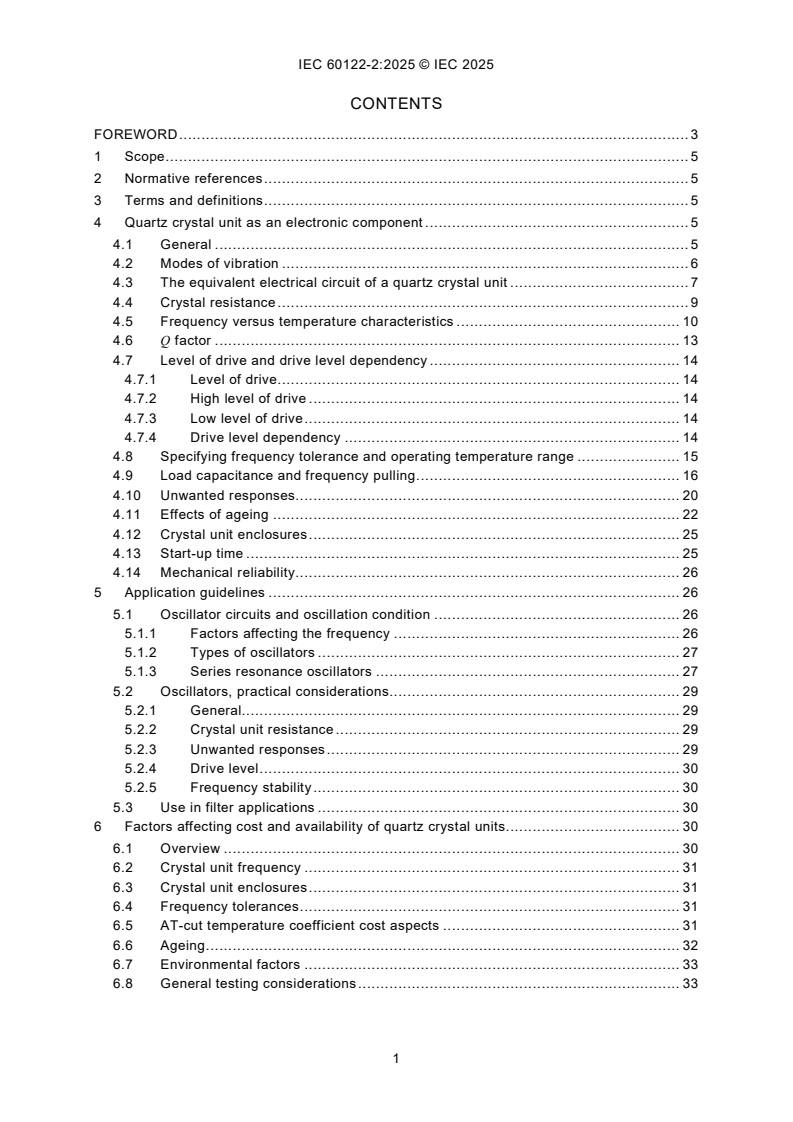
CONTENTS
FOREWORD . 3
1 Scope . 5
2 Normative references . 5
3 Terms and definitions . 5
4 Quartz crystal unit as an electronic component . 5
4.1 General . 5
4.2 Modes of vibration . 6
4.3 The equivalent electrical circuit of a quartz crystal unit . 7
4.4 Crystal resistance . 9
4.5 Frequency versus temperature characteristics . 10
4.6 Q factor . 13
4.7 Level of drive and drive level dependency . 14
4.7.1 Level of drive . 14
4.7.2 High level of drive . 14
4.7.3 Low level of drive . 14
4.7.4 Drive level dependency . 14
4.8 Specifying frequency tolerance and operating temperature range . 15
4.9 Load capacitance and frequency pulling . 16
4.10 Unwanted responses . 20
4.11 Effects of ageing . 22
4.12 Crystal unit enclosures . 25
4.13 Start-up time . 25
4.14 Mechanical reliability . 26
5 Application guidelines . 26
5.1 Oscillator circuits and oscillation condition . 26
5.1.1 Factors affecting the frequency . 26
5.1.2 Types of oscillators . 27
5.1.3 Series resonance oscillators . 27
5.2 Oscillators, practical considerations . 29
5.2.1 General. 29
5.2.2 Crystal unit resistance . 29
5.2.3 Unwanted responses . 29
5.2.4 Drive level . 30
5.2.5 Frequency stability . 30
5.3 Use in filter applications . 30
6 Factors affecting cost and availability of quartz crystal units . 30
6.1 Overview . 30
6.2 Crystal unit frequency . 31
6.3 Crystal unit enclosures . 31
6.4 Frequency tolerances . 31
6.5 AT-cut temperature coefficient cost aspects . 31
6.6 Ageing . 32
6.7 Environmental factors . 33
6.8 General testing considerations . 33
7 Technical data to accompany the order form . 33
7.1 Check list of crystal unit parameters to be specified in article sheet . 33
7.2 Requirements . 34
Bibliography . 36
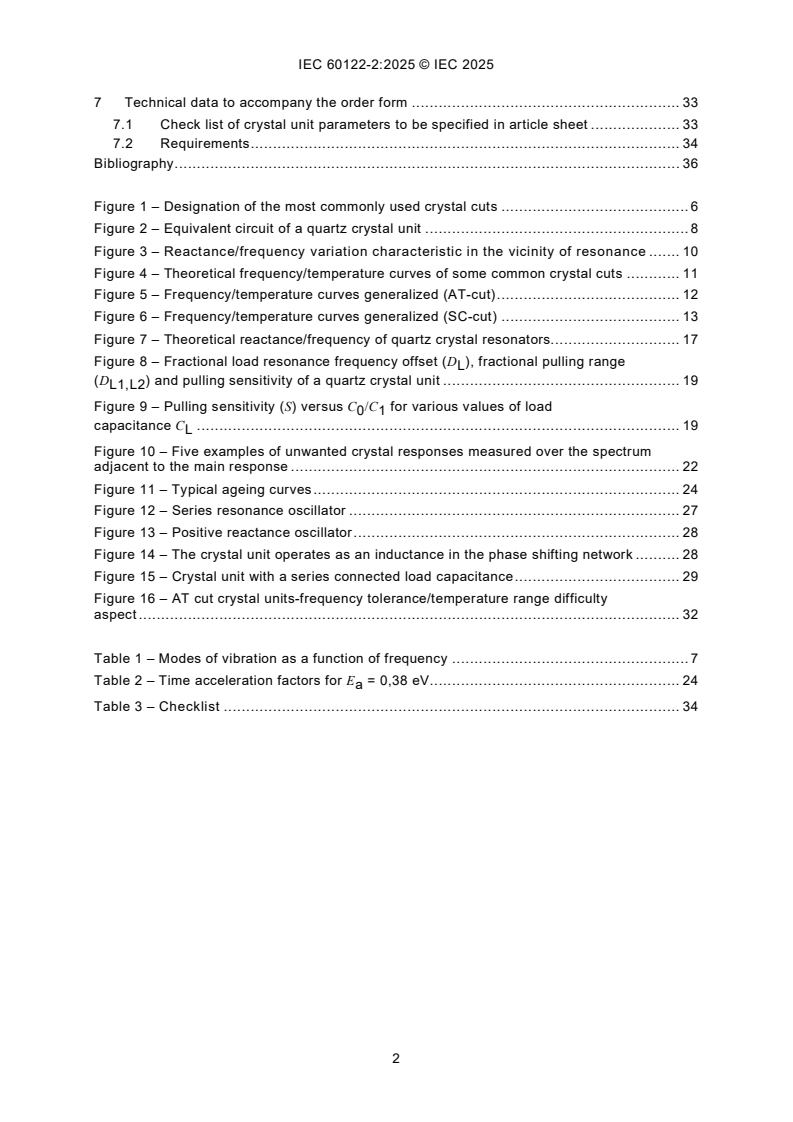
Figure 1 – Designation of the most commonly used crystal cuts . 6
Figure 2 – Equivalent circuit of a quartz crystal unit . 8
Figure 3 – Reactance/frequency variation characteristic in the vicinity of resonance . 10
Figure 4 – Theoretical frequency/temperature curves of some common crystal cuts . 11
Figure 5 – Frequency/temperature curves generalized (AT-cut) . 12
Figure 6 – Frequency/temperature curves generalized (SC-cut) . 13
Figure 7 – Theoretical reactance/frequency of quartz crystal resonators. 17
Figure 8 – Fractional load resonance frequency offset (D ), fractional pulling range
L
(D ) and pulling sensitivity of a quartz crystal unit . 19
L1,L2
Figure 9 – Pulling sensitivity (S) versus C /C for various values of load
0 1
capacitance C . 19
L
Figure 10 – Five examples of unwanted crystal responses measured over the spectrum
adjacent to the main response . 22
Figure 11 – Typical ageing curves . 24
Figure 12 – Series resonance oscillator . 27
Figure 13 – Positive reactance oscillator . 28
Figure 14 – The crystal unit operates as an inductance in the phase shifting network . 28
Figure 15 – Crystal unit with a series connected load capacitance . 29
Figure 16 – AT cut crystal units-frequency tolerance/temperature range difficulty
aspect . 32
Table 1 – Modes of vibration as a function of frequency . 7
Table 2 – Time acceleration factors for E = 0,38 eV . 24
a
Table 3 – Checklist . 34
INTERNATIONAL ELECTROTECHNICAL COMMISSION
____________
Quartz crystal units of assessed quality -
Part 2: Guidelines for the use
FOREWORD
1) The International Electrotechnical Commission (IEC) is a worldwide organization for standardization comprising
all national electrotechnical committees (IEC National Committees). The object of IEC is to promote international
co-operation on all questions concerning standardization in the electrical and electronic fields. To this end and
in addition to other activities, IEC publishes International Standards, Technical Specifications, Technical Reports,
Publicly Available Specifications (PAS) and Guides (hereafter referred to as “IEC Publication(s)”). Their
preparation is entrusted to technical committees; any IEC National Committee interested in the subject dealt with
may participate in this preparatory work. International, governmental and non-governmental organizations liaising
with the IEC also participate in this preparation. IEC collaborates closely with the International Organization for
Standardization (ISO) in accordance with conditions determined by agreement between the two organizations.
2) The formal decisions or agreements of IEC on technical matters express, as nearly as possible, an international
consensus of opinion on the relevant subjects since each technical committee has representation from all
interested IEC National Committees.
3) IEC Publications have the form of recommendations for international use and are accepted by IEC National
Committees in that sense. While all reasonable efforts are made to ensure that the technical content of IEC
Publications is accurate, IEC cannot be held responsible for the way in which they are used or for any
misinterpretation by any end user.
4) In order to promote international uniformity, IEC National Committees undertake to apply IEC Publications
transparently to the maximum extent possible in their national and regional publications. Any divergence between
any IEC Publication and the corresponding national or regional publication shall be clearly indicated in the latter.
5) IEC itself does not provide any attestation of conformity. Independent certification bodies provide conformity
assessment services and, in some areas, access to IEC marks of conformity. IEC is not responsible for any
services carried out by independent certification bodies.
6) All users should ensure that they have the latest edition of this publication.
7) No liability shall attach to IEC or its directors, employees, servants or agents including individual experts and
members of its technical committees and IEC National Committees for any personal injury, property damage or
other damage of any nature whatsoever, whether direct or indirect, or for costs (including legal fees) and
expenses arising out of the publication, use of, or reliance upon, this IEC Publication or any other IEC
Publications.
8) Attention is drawn to the Normative references cited in this publication. Use of the referenced publications is
indispensable for the correct application of this publication.
9) IEC draws attention to the possibility that the implementation of this document may involve the use of (a)
patent(s). IEC takes no position concerning the evidence, validity or applicability of any claimed patent rights in
respect thereof. As of the date of publication of this document, IEC had not received notice of (a) patent(s), which
may be required to implement this document. However, implementers are cautioned that this may not represent
the latest information, which may be obtained from the patent database available at https://patents.iec.ch. IEC
shall not be held responsible for identifying any or all such patent rights.
IEC 60122-2 has been prepared by IEC technical committee 49: Piezoelectric, dielectric and
electrostatic devices and associated materials for frequency control, selection and detection. It
is an International Standard.
This third edition cancels and replaces the second edition published in 1983. This edition
constitutes a technical revision.
This edition includes the following significant technical changes with respect to the previous
edition:
a) addition of SC cut type and related requirements;
b) addition of ageing calculation and low level of drive requirements according to the general
specification,
c) update of the frequency temperature curve according to the common cut requirements;
d) removal of infrequently used product types.
The text of this International Standard is based on the following documents:
Draft Report on voting
49/1506/FDIS 49/1513/RVD
Full information on the voting for its approval can be found in the report on voting indicated in
the above table.
The language used for the development of this International Standard is English.
This document was drafted in accordance with ISO/IEC Directives, Part 2, and developed in
accordance with ISO/IEC Directives, Part 1 and ISO/IEC Directives, IEC Supplement, available
at www.iec.ch/members_experts/refdocs. The main document types developed by IEC are
described in greater detail at www.iec.ch/publications.
A list of all parts in the IEC 60122 series, published under the general title Quartz crystal units
of assessed quality, can be found on the IEC website.
The committee has decided that the contents of this document will remain unchanged until the
stability date indicated on the IEC website under webstore.iec.ch in the data related to the
specific document. At this date, the document will be
• reconfirmed,
• withdrawn, or
• revised.
1 Scope
This part of IEC 60122 has been compiled in response to a generally expressed desire on the
part of both users and manufacturers for guidelines to the use of quartz crystal units for filters
and oscillators so that the crystal units may be used to their best advantage.
It draws attention to some of the more fundamental questions which will be considered by the
user before it places its order for a unit for a new application, and in so doing will, it is hoped,
help ensure against unsatisfactory performance, unfavourable cost and non-availability. It is
not the function of this document to explain theory, nor to attempt to cover all the eventualities
that can arise in practical circumstances. Lastly, it it is not considered as a substitute for close
liaison between manufacturer and user.
Standard specifications, such as those of the IEC of which these guidelines form a part, and
national specifications or detail specifications issued by manufacturers, will define the available
combinations of the resonant characteristics and the temperature characteristic. These
specifications are compiled to include a wide range of quartz crystal units with standardized
performances. It cannot be over-emphasized that it is the responsibility of the user , wherever
possible, to select the quartz crystal units from these specifications, when available, even if it
can lead to making small modifications to the circuit to enable the use of standard resonators.
This applies particularly to the selection of the nominal frequency.
2 Normative references
The following documents are referred to in the text in such a way that some or all of their content
constitutes requirements of this document. For dated references, only the edition cited applies.
For undated references, the latest edition of the referenced document (including any
amendments) applies.
IEC 60122-1:2002, Quartz crystal units of assessed quality – Part 1: Generic specification
IEC 60122-1:2002/AMD1:2017
3 Terms and definitions
For the purposes of this document, the terms and definitions given in IEC 60122-1 apply.
ISO and IEC maintain terminology databases for use in standardization at the following
addresses:
• IEC Electropedia: available at https://www.electropedia.org/
• ISO Online browsing platform: available at https://www.iso.org/obp
4 Quartz crystal unit as an electronic component
4.1 General
The quartz crystal element is a vibrating resonant structure whose orientation and dimensions
determine its frequency for a given mode of vibration and which relies on the piezoelectric effect
to couple it to an electrical circuit. The intrinsic properties of quartz make it a unique device for
highly accurate and stable frequency control and selection because of its high "quality factor"
Q. Crystal units are not a primary frequency standard, but when precisely defined, can provide
stabilization far in excess of most requirements in the electronic industry.
The crystal element is cut from monocrystal quartz with precise orientation to the
crystallographic axes as shown in Figure 1, which shows only generalized examples of the most
commonly used crystal cuts.
Figure 1 – Designation of the most commonly used crystal cuts
Figure 1 shows a natural quartz crystal. However, most manufacturers now use synthetic
material. Techniques have advanced to a point where synthetic quartz is almost
indistinguishable from natural material with regard to electrical performance.
There are a number of different cuts and modes of vibration which will produce crystal units of
near zero temperature coefficients over a wide frequency range.
4.2 Modes of vibration
The frequency range covered commercially by quartz crystal units can be taken to be a few kHz
to 500 MHz. Use is made of many cuts and modes of vibration to cover this range and crystals
of the common types are summarized in Table 1.
AT-cut crystal units can also be produced in the range from 400 kHz to 800 kHz, but they usually
require larger enclosures.
The choice of mode or cut can be affected by the enclosure size or parameters other than the
frequency itself.
Table 1 – Modes of vibration as a function of frequency
Designation of cut Mode of vibration Usual frequency range
XY Flexural 1 kHz to 80k Hz
5° X bar Extensional 40 kHz to 200 kHz
800 kHz to 500 MHz
Thickness shear (fundamental)
3rd overtone 5 MHz to 215 MHz
AT
5th overtone 5 MHz to 150 MHz
7th overtone 100 MHz to 200 MHz
3 MHz to 30 MHz
BT Thickness shear (fundamental)
DT Face shear 100 kHz to 500 kHz
Thickness shear (fundamental) 8,192 MHz to 30 MHz
SC
3rd overtone 5 MHz to 100 MHz
5th overtone 5 MHz to 130 MHz
GT Coupled mode by two extensional modes 100 kHz to 550 kHz
Fundamental 8,192 MHz to 30 MHz
IT
3rd overtone 5 MHz to 100 MHz
NOTE The by far most frequently used cuts are XY-cut for “watch crystals” (32.768 kHz), AT-cut for industrial
applications in the MHz range, SC-cut and IT cut for high-precision applications.
4.3 The equivalent electrical circuit of a quartz crystal unit
The properties of any mode of a lightly damped mechanical vibrator piezoelectrically excited
through electrodes can be represented, in the region of the resonance frequency, by an
equivalent electrical circuit which consists of a capacitance (C ), inductance (L ) and resistance
1 1
(R ) in series, shunted by a second capacitance (C ). A representation of the quartz crystal unit
1 0
equivalent circuit is shown in Figure 2.
C is the shunt (parallel) capacitance in the equivalent electric circuit( farad)
C is the motional capacitance in the equivalent electric circuit (farad)
L is the motional inductance in the equivalent electric circuit (henry)
R is the motional resistance in the equivalent electric circuit (ohm)
R is the equivalent series resistance of the resonator (ohm)
e
X is the equivalent series reactance of the resonator (ohm)
e
G is the equivalent parallel conductance of resonator(siemens)
p
B is the equivalent parallel susceptance of resonator(siemens)
p
Figure 2 – Equivalent circuit of a quartz crystal unit
The parameters are independent of frequency for isolated modes of motion. For identification
of symbols used in this document, see IEC 60122-1:2002, Table 1.
This representation of a quartz crystal unit is true only if the parameters are constant and
independent of frequency and amplitude. The parameters are independent of frequency if the
vibrator has no other mode of motion near the particular resonance. Generally, the mode in
question is sufficiently isolated from other modes to permit this assumption. When this is not
true, the equations and measuring methods normally used do not apply. The validity of the
circuit representation can be determined by measuring and plotting the impedance or
admittance of the vibrator as a function of frequency.
The inductance represents the vibrating mass, the series capacitance, the compliance of the
quartz element and the resistance, the internal friction of the element, mechanical losses in the
mounting system and acoustical losses to the surrounding environment. The shunt capacitance
is made up of the static capacitance between the electrodes, together with stray capacitances
of the mounting system.
There are two zero-phase frequencies associated with this simple circuit, one is resonance
frequency, zero reactance f , the other is at anti-resonance frequency, zero susceptance
( )
r
f .
( )
a
4.4 Crystal resistance
The following points on the resistance parameters should be noted:
– The lowest values will be found under vacuum.
– There are certain differences in the resistance parameters of the same lot of crystal
elements, and lot-to-lot variations can be even larger.
– The smaller the enclosure chosen for a given frequency the higher the average values of R
are likely to be.
and L
– In general, the resistance of low frequency cuts rises appreciably with temperature. For
example, crystal units employing DT-cuts can have twice the resistance at 85 °C than they
have at 25 °C.
The equivalent circuit of the crystal unit has one other important parameter, this is R , the
motional resistance. This parameter controls the Q of the crystal unit and will define the level
of oscillation in any maintaining circuit. The load resonance resistance for a given crystal unit
depends upon the load capacitance with which that unit is intended to operate.
As was seen earlier, the frequency of oscillation in an appropriate circuit is approximately the
same in either a series or parallel connection of the load capacitance (C ). If the external
L
capacitance is designated, the load resonance resistance (R ) can be calculated as follows:
L
C
(1)
RR 1+
L1
C
L
The equivalent shunt or parallel resistance (R ) at the load resonance frequency is
P
approximately:
−2
R ωC+C
( ) (2)
p 0L
R
It should be remembered that R does not change; thus, the effective parameters of any user
network can be readily calculated.
In most cases, the resistance of a particular unit cannot be predicted during manufacture; it is
only possible to ensure that it is less than the maximum given in the specification.
Finally, it should always be remembered when specifying that the resistance with a series
capacitor is always increased over the value of the crystal itself. Some purchase specifications
give values of resonance resistance with load capacitance as well as without load capacitance.
When used in an oscillator, quartz crystal units will operate at any frequency within the broken
lines of Figure 3, as determined by the phase and effective reactance of the maintaining circuit.
=
=
By variation of this reactive condition, the crystal frequency can be trimmed to a limited extent.
The degree to which this frequency can be varied (frequency pulling) is inversely proportional
to the capacitance ratio:
C
γ=
(3)
C
The C /C ratios are typical values. However, various techniques adopted by individual
0 1
manufacturers in the design of quartz crystal units can lead to quite wide variations; C is the
shunt capacitance and C is the motional capacitance.
For AT- and BT-cuts, the C /C ratio will tend to increase with smaller enclosures, particularly
0 1
at the lower end of the frequency range.
In filter applications, the bandwidth can be affected by this ratio. In general, the higher the ratio
the narrower the bandwidth.
Figure 3 – Reactance/frequency variation characteristic in the vicinity of resonance
4.5 Frequency versus temperature characteristics
These are, to a first approximation, determined by the temperature coefficients of density,
dimensions and elastic modulus of the quartz plate. When the resultant of these three properties
becomes zero, the stability of the frequency with respect to temperature will be optimum.
Manufacturers can accept specifications that require specific inversion points over a wide
temperature range. Common values are between 25 °C and 110 °C, placing the inversion point
within approximately ±10 °C, and this uncertainty is caused by manufacturing tolerances.
A more complete series of theoretical curves are shown in Figure 4 to Figure 6. These curves
indicate that specific angular ranges can be selected to give a limited performance spread over
a particular range of temperatures. However, due to various manufacturing and design
limitations, the theoretical curves should be used for guidance only. The manufacturer will
advise on the tolerances obtainable in practice for the frequencies required.
Figure 4 – Theoretical frequency/temperature curves of some common crystal cuts
XY-cuts are mainly used in low-frequency crystals, and typical applications are quartz tuning
forks. The zero temperature coefficient point of the tuning fork is related to the cut angle and
edge ratio. A typical frequency-temperature profile is shown in Figure 4. Its flatter frequency
curve around 25 °C allows for smaller frequency errors in everyday use.
Figure 5 – Frequency/temperature curves generalized (AT-cut)
The frequency of the AT-cut resonator is a cubic function of temperature (see Figure 5).
Therefore, the oscillator made of the AT-cut resonator has better frequency temperature
characteristics. It can be seen that accurately deciphering the performance of the resonator and
crystal oscillator is a necessary condition obtaining the maximum cost-effective crystal oscillator.
One of the disadvantages of AT-cut resonators is the presence of large thermal overshoot.
When the temperature of the environment in which the resonator is located jumps from a
constant value to another value, the frequency of the resonator will produce an overshoot, and
then slowly tend to another stable frequency, when the ambient temperature suddenly
decreases, the opposite is true that frequency overshoot can also occur.
Figure 6 – Frequency/temperature curves generalized (SC-cut)
Since SC-cut resonators are characterized by stress compensation and thermal transient
compensation, oscillators made of SC-cut resonators have many advantages (see Figure 6).
For low-noise crystal oscillators used in ranging and high-speed target tracking, outer space
communication systems, tactical crystal oscillators that require fast start-up and crystal
oscillators used in environments with strong radiation, strong vibration, and rapid temperature
changes are suitable for crystal oscillators made of SC cut resonators; of course, the price of
this SC-cut crystal oscillator will be higher.
These curves indicate that specific angular ranges can be selected to give a limited
performance spread over a particular range of temperatures. However, due to various
manufacturing and design limitations, the theoretical curves should be used for guidance only.
The manufacturer will advise on the tolerances obtainable in practice for the frequencies
required.
4.6 Q factor
Quartz crystal resonator is used as a resonant part in the oscillation circuit. The Q factor of the
resonator is an important parameter, which has a close relationship with the frequency stability
of the oscillator; the higher the Q value, the better the frequency stability. The figure of merit of
a quartz resonator is determined by its dynamic parameters.
The Q factor of the resonator indicates the ratio of energy stored to energy lost in a resonance
cycle, which varies with the cut type and vibration mode. The maximum Q value of the resonator
can be expressed as:
Q =
(4)
max
2πfτ
Q=
(5)
2πf RC
s 11
where:
f is the frequency;
τ is the time constant.
There are many factors that affect the Q factor of a resonator. They mainly include: cutting type,
crystal material, wafer geometry, wafer surface condition, overtone number, electrode shape,
parasitic mode and internal environment of resonator.
4.7 Level of drive and drive level dependency
4.7.1 Level of drive
The level of drive can be calculated by measuring the current flowing, through the motional arm
R , L , C of the crystal. When the crystal resonator is working, the appropriate excitation level
1 1 1
should be selected. The frequency of all crystal units will change to some degree with variations
of the drive level. Therefore, it is necessary that the drive level specified is that being used in
the equipment.
The effect of excessive drive on the crystal unit could also cause an irreversible frequency
change and it is essential that the equipment designer ensures that this condition will not occur.
In general, the frequency change with increase of drive level will be positive on AT-cut crystals
and negative on low frequency cuts.
Some of the major effects of drive level are summarized in 4.7.2, 4.7.3 and 4.7.4:
4.7.2 High level of drive
A high level of drive causes non-linear effects resulting in:
– excitation of unwanted modes causing serious deformation of the frequency/temperature
and resistance/temperature characteristics;
– frequency shifts due to crystal heating (usually reversible);
– frequency shifts due to overstress (usually irreversible);
– abrupt resistance changes.
In extreme cases, it can also result in recurring fluctuation of amplitude and frequency or
catastrophic failure.
4.7.3 Low level of drive
At very low levels of drive (a few microwatts or less), the resonance resistance of the crystal
unit can be much higher than at more normal levels, resulting in oscillator starting problems.
Units with similar resistance values at normal drive levels can be quite different at very low
levels. This effect can be aggravated by a period of non-operating storage and is commonly
known as "second level of drive effect" or "drive level dependence". When this effect cannot be
tolerated, it can usually be eliminated by special care in processing and fabrication.
4.7.4 Drive level dependency
Drive level dependency (DLD) is the effect of changes in drive level conditions upon the
resonance resistance of the crystal unit.
When normal operation is required at small excitation power or variable excitation power,
crystals with low level correlation (DLD) are prone to unstable operation or failure under certain
excitation conditions.
The DLD parameters of the unit are variable and uncertain. A DLD defective crystal can pass
the next test and its electrical performance parameters can remain qualified for some time.
However, after a long period of time, its frequency or impedance characteristics can deteriorate
again, and serious cases will lead to the line vibration, which is often referred to in the industry
as the crystal entering the "sleep" state. This is because some defective DLD products will be
briefly activated after electrical excitation and return to near-normal parameters, but can return
to abnormal conditions after a period.
4.8 Specifying frequency tolerance and operating temperature range
The engineer can specify a frequency tolerance only at room temperature. In applications that
require a given tolerance over a specified operating temperature range this shall also be
specified. In so doing, allowance should be made for temperature rise caused by the equipment.
There are five principal methods of specifying frequency tolerances over the operating
temperature range. This method is typically used in applications with wide frequency differences
without frequency trimming:
1) Method 1: specify an overall frequency tolerance over the operating temperature range such
-6
as: ±50 × 10 from - 55 °C to 85 °C. This method is generally used with relatively wide
tolerances in applications where frequency trimming is not employed.
2) Method 2: specify "partial" tolerances; this method is generally used in situations with tight
frequency differences and frequency traction to eliminate the frequency difference under
the reference temperature:
-6
a) Tolerance at reference temperature ±10 × 10 , the general reference temperature is
25 °C, which means that the frequency difference at 25 °C should be better than
-6.
±10 × 10
-6
b) Tolerance over the temperature range - 20 °C ~70 °C, ±20 × 10 referred to the actual
frequency at the reference temperature.
This method is generally used with tighter frequency tolerances where frequency pulling is
used to eliminate the frequency tolerance at the reference temperature.
3) Method 3: The frequency difference of a parabolic crystal
For crystal units having parabolic frequency/temperature curves, the frequency tolerance at
-6
the reference temperature can be specified as -"X" to 0 × 10 . This method can be used to
give an improved performance over the operating temperature range without employing
frequency pulling.
4) Method 4: The frequency difference of the crystal element for thermostatic crystal oscillators
For crystal elements used in thermostatic crystal oscillators, it is generally required that the
crystal elements operate near the inflection point of the frequency-temperature curve. For
example, the inflection point temperature range is 85 °C ± 5 °C, and the inflection point
-6
down frequency difference is ±2 × 10 . The temperature of the inflection point is obtained
by using cubic curve fitting of the measurement frequency at each temperature point from
normal temperature to high temperature. This approach allows the thermostatic crystal
oscillator to achieve more precise frequency control over its operating temperature range.
5) Method 5: The frequency difference of the crystal used for temperature compensated crystal
oscillators
The frequency difference of the crystal element used for temperature compensated crystal
oscillator is generally described in the form of method 2. To achieve a better temperature
compensation effect, there is generally a requirement of frequency hop point. The frequency
hop point of AT-cut crystal refers to the difference between the frequency difference
measured at each temperature point in the entire temperature range and the frequency
difference fitted to the cubic curve.
For example, the frequency jump point requirement is better than
-6
±0,5 × 10 (-40 °C~85 °C), which means that in the temperature range of -40 °C~85 °C, the
difference between the frequency difference actually tested at each temperature point and
-6
the frequency difference fitted to the cubic curve should be better than ±0,5 × 10 , so that
the best frequency temperature stability of the temperature compensated crystal oscillator
-6
produced by such crystals can reach ±0,5 × 10 (-40 °C~85 °C).
When the specification is being written, allowance should also be made for the ageing of the
crystal unit.
Reference should be made to the international or national specifications for "preferred"
combinations of temperature range and frequency tolerance, or the manufacturer should be
consulted.
Where maximum frequency stability is required and power and space are available, controlled
temperature operation should be considered.
4.9 Load capacitance and frequency pulling
For many applications, there are requirements to pull the crystal frequency by using a load
reactive element. This can be necessary to trim out the manufacturing tolerance or in phase
locked loop and frequency modulation applications.
Figure 7 – Theoretical reactance/frequency of quartz crystal resonators
For example, in an oscillator circuit the combination of a crystal unit and a capacitor (Figure 7
b)) acts as a crystal unit with the load resonance frequency (f ) in a similar low impedance
L
condition to Figure 7 a).
The frequency difference between the load resonance frequency (f ) and the resonance
L
frequency (f ) is called "load resonant frequency offset ".
∆f
( )
L
r
∆=f ff−
(6)
L Lr
It can be calculated approximately from:
fC
r1
∆≈f
(7)
L
2 CC+
( )
0L
In usage, the load resonance frequency offset for a given value of load capacitance can be
∆f
L
written as, for instance, (30pF)or (20pF) to indicate the actual value of load
∆f ∆f
30 20
capacitance in picofarads involved.
The fractional load resonance frequency offset can be calculated using the following formula:
ff−
Lr
D =
(8)
L
f
r
It can be calculated approximately from:
C
D ≈
(9)
L
2 CC+
( )
0L
This can also be written as, for instance, or to indicate the fractional load resonance
D D
30 20
frequency offset D with a load capacitance of 30 pF or 20pF.
L
In many applications, a variable capacitor (trimmer) is used as the load reactive element to
adjust the frequency. The fractional frequency range available between specified values of this
load reactive element is called the "fractional pulling range (D )" and it can be calculated
L1,L2
by using the following formula:
ff−
L1 L2
D DD−
(10)
L1,L2 L1 L2
f
r
It can be calculated approximately from:
CC − C
( )
1 L2 L1
D ≈
(11)
L1,L2
2 CC++CC
( )( )
0 L1 0 2
A useful parameter to the design engineer is the pulling sensitivity (S) at a specified value of
load capacitance. It is defined as the incremental fractional frequency change for an incremental
change in the load capacitance.
-6
/pF and can be calculated from the following formula:
...