

IEC 62321-14:2026
(Main)Determination of certain substances in electrotechnical products - Part 14: Short-chain chlorinated paraffins (SCCPs) and medium-chain chlorinated paraffins (MCCPs) in plastics by gas chromatography-negative chemical ionization-mass spectrometry (GC-NCI-MS)
- Abstract
IEC 62321-14:2026 specifies one technique for the determination of short-chain and medium-chain chlorinated paraffins (SCCPs: C10-C13 and MCCPs: C14-C17) in plastics of electrotechnical products.
This document specifies a quantitative method for the determination of short-chain and medium-chain chlorinated paraffins in electrotechnical products by means of solvent extraction and gas chromatography-negative chemical ionization-mass spectrometry (GC-NCI-MS).
This document is a basic environment horizontal publication focusing on test methods and is primarily intended for use by committees in the preparation of publications within the area of environment in accordance with the principles laid down in IEC Guide 123. Wherever applicable, it is the responsibility of committees to make use of environment basic publications in the preparation of their environment group and product publications. Committees can apply this document directly to products when they do not develop a product publication in the area of environment.
WARNING – Persons using this International Standard should be familiar with normal laboratory practice. This International Standard does not purport to address all of the safety problems, if any, associated with its use. It is the responsibility of the user to establish appropriate safety and health practices and to ensure compliance with any national regulatory conditions.
- Status
- Published
- Publication Date
- 28-May-2026
- Technical Committee
- TC 111 - Environmental standardization for electrical and electronic products and systems
- Drafting Committee
- WG 3 - TC 111/WG 3
- Current Stage
- PPUB - Publication issued
- Start Date
- 29-May-2026
- Completion Date
- 29-May-2026
Buy Documents
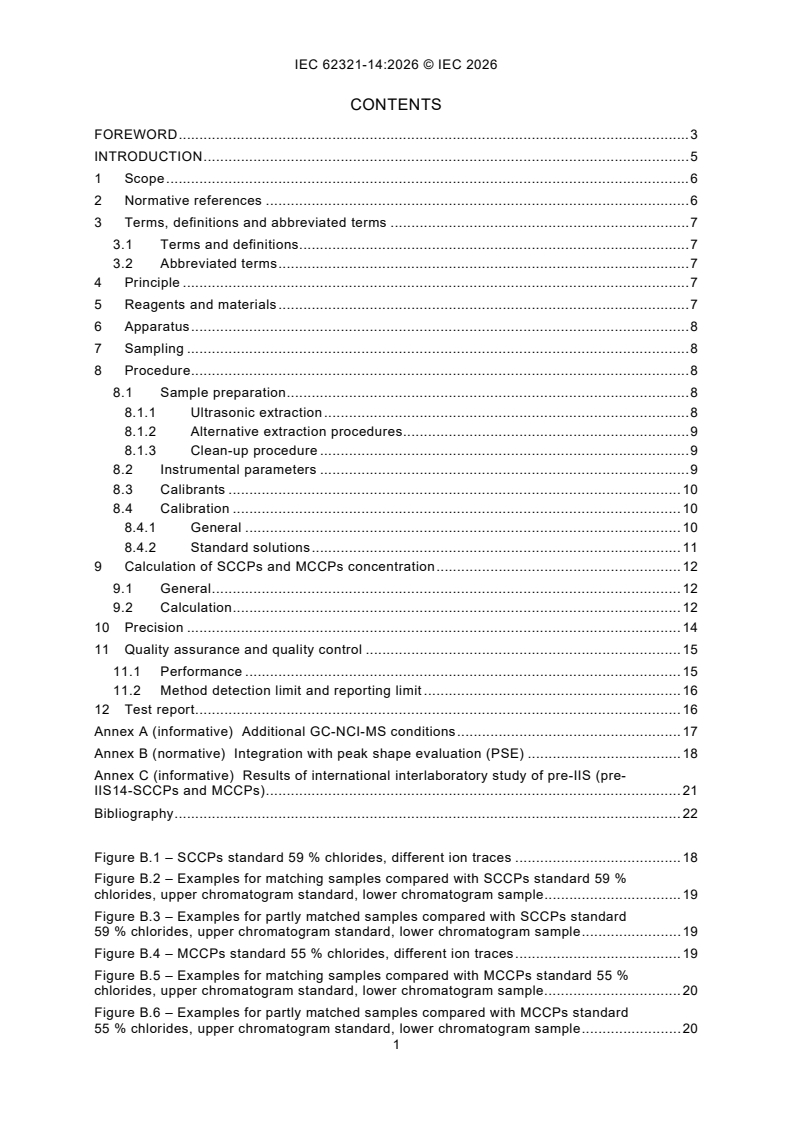
IEC 62321-14:2026 - Determination of certain substances in electrotechnical products - Part 14: Short-chain chlorinated paraffins (SCCPs) and medium-chain chlorinated paraffins (MCCPs) in plastics by gas chromatography-negative chemical ionization-mass spectrometry (GC-NCI-MS)
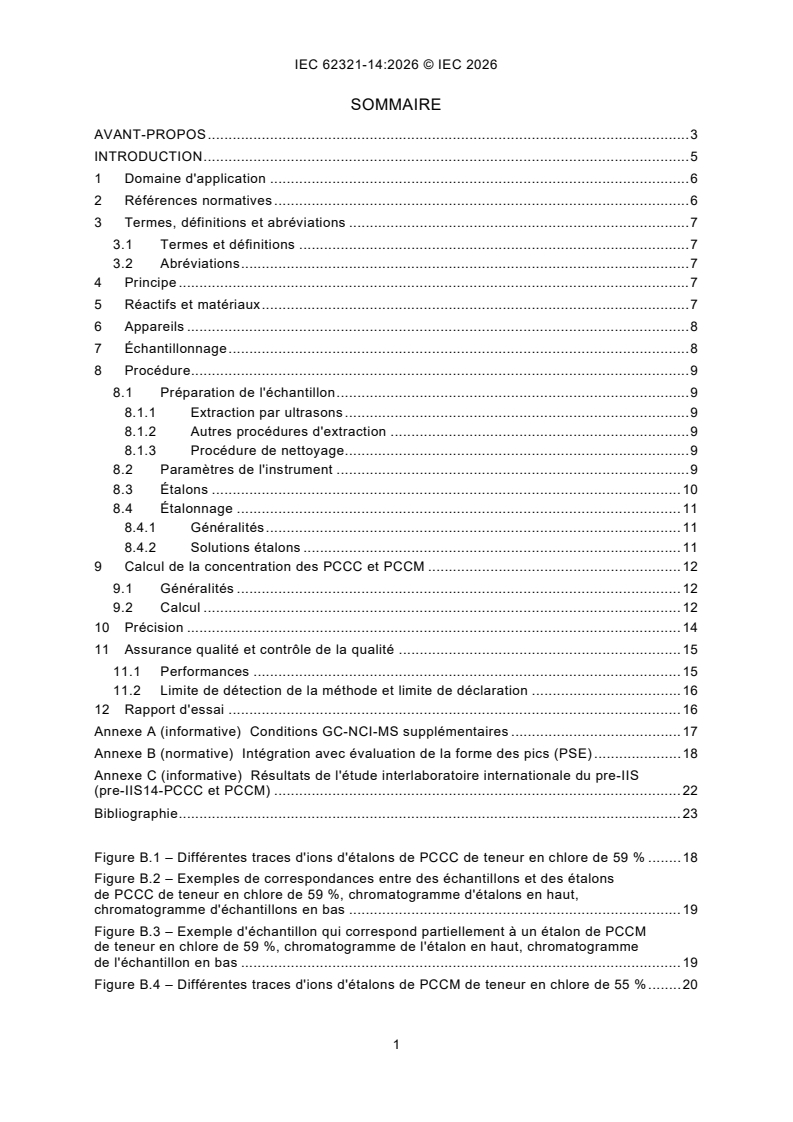
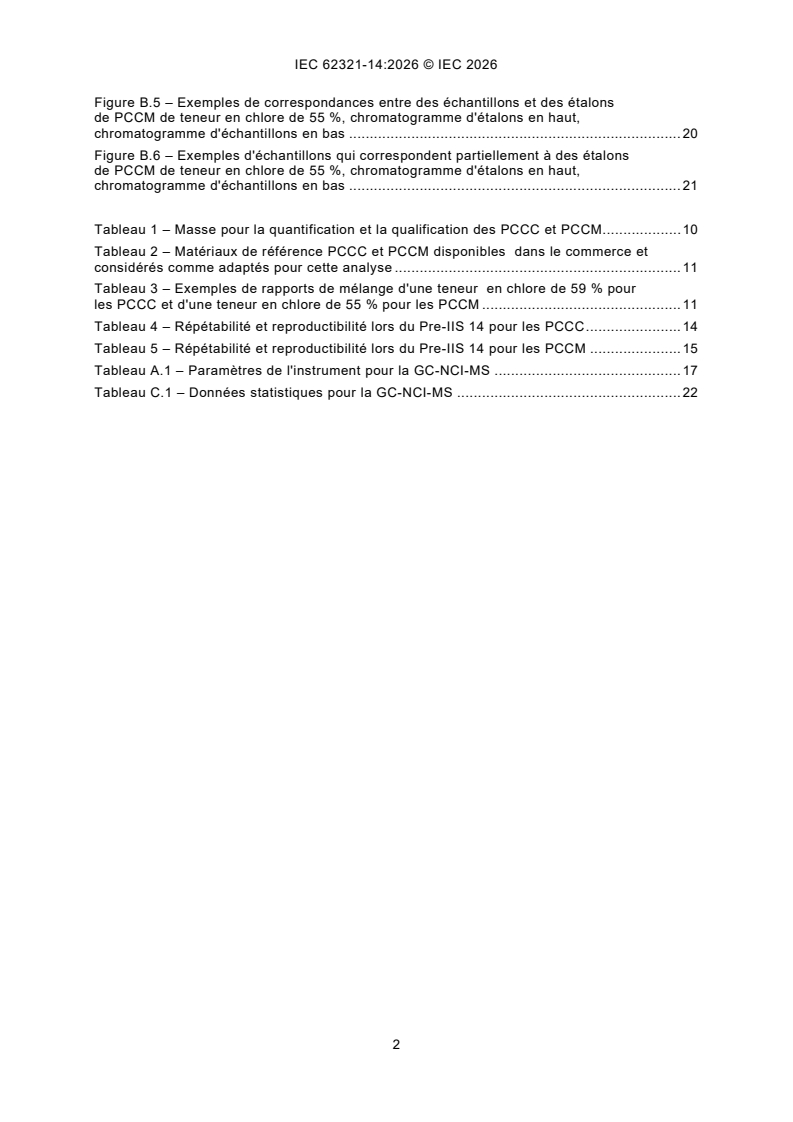
IEC 62321-14:2026 - Détermination de certaines substances dans les produits électrotechniques – Partie 14: Paraffines chlorées a chaîne courte (PCCC) et paraffines chlorées a chaîne moyenne (PCCM) dans les plastiques par chromatographie en phase gazeuse couplée a la spectrométrie de masse avec ionisation chimique négative (GC-NCI-MS)
IEC 62321-14:2026 is an International Electrotechnical Commission (IEC) standard for determining short-chain chlorinated paraffins (SCCPs) and medium-chain chlorinated paraffins (MCCPs) in plastics from electrotechnical products. It specifies a quantitative test method based on solvent extraction and gas chromatography-negative chemical ionization-mass spectrometry (GC-NCI-MS), and it is written for use in IEC environmental work, laboratory testing, and product compliance.
What does IEC 62321-14:2026 specify?
IEC 62321-14:2026 specifies one technique for measuring SCCPs and MCCPs in plastics of electrotechnical products. The method is quantitative, so it is meant to produce a concentration result rather than a simple yes/no screening answer.
The document is organized as a horizontal IEC publication with clauses for scope, references, terms, principle, reagents, apparatus, sampling, procedure, calculation, precision, quality assurance and quality control, and test report. It also includes annexes with extra GC-NCI-MS conditions, the peak shape evaluation rule, and interlaboratory study results.
| Annex | What it covers |
|---|---|
| Annex A | Additional GC-NCI-MS conditions |
| Annex B | Integration with peak shape evaluation (PSE) |
| Annex C | Results of the preliminary international interlaboratory study for SCCPs and MCCPs |
In practice, the scope is focused on plastics in electrotechnical products. The method was evaluated for ABS and PVC within the concentration ranges reported in Annex C, so users normally check matrix type and expected concentration before relying on it for routine work.
What are the key requirements of IEC 62321-14:2026?
Sample preparation and extraction
IEC 62321-14:2026 requires samples to be cut to about 2 mm by 2 mm or smaller and mixed well before analysis. Sampling follows IEC 62321-2, and contact with polymer materials is to be avoided during sampling.
The main extraction route uses 0.5 g of sample, toluene, ultrasonic extraction at about 60 °C, n-hexane precipitation, filtration, evaporation, and re-dissolution with internal standard solution. For a toluene-insoluble polymer such as PVC, an alternative extraction route is given. In practice, this means the analyst has a defined way to get SCCPs and MCCPs out of the plastic matrix before the instrument step.
Clean-up and instrumental analysis
IEC 62321-14:2026 recommends sulfuric acid clean-up before measurement to remove interferences. The extract is shaken with concentrated sulfuric acid and the upper organic layer is collected, with centrifugation allowed for better phase separation.
The analysis is done by GC-NCI-MS. Annex A gives example instrument conditions, and Table 1 gives the ion masses for quantification and qualification. In practice, the method depends on matching the correct ions and retaining enough chromatographic separation to distinguish SCCPs and MCCPs from interferences.
Peak shape evaluation and integration
IEC 62321-14:2026 requires integration with peak shape evaluation (PSE) in accordance with Annex B. The sample chromatogram is compared with the calibration standard for retention time, peak shape, and quantifier/qualifier ratio.
Matching peaks are integrated over the standard retention-time range, partly matching peaks are integrated only over the matching area, and non-matching peaks are rejected. The document also says that if one or more chain-length peaks are missing, the specimen is still treated as positive for SCCPs or MCCPs. In practice, this prevents false negatives caused by incomplete pattern matching.
Calibration and reference materials
IEC 62321-14:2026 requires calibration curves with at least four calibration solutions, and the sample and standard solutions must use the same solvent. SCCPs and MCCPs are calibrated separately because they interfere with each other.
The standard solutions are prepared from reference materials with the chlorination degrees given in the document, and the internal standard is lindane. The calibration response is checked against linear regression, and the relative standard deviation (RSD) of the linear calibration function must be within the limit stated in the document. In practice, this means the lab must control calibration quality before reporting results.
Calculation of concentration
IEC 62321-14:2026 uses internal-standard-based calculation formulas to convert instrument response into concentration in the sample. If a result falls outside the calibration range, the sample is diluted and re-analysed, and the dilution factor is used in the final calculation.
That matters because SCCPs and MCCPs can occur at very different levels in different plastics. The calculation section gives the analyst a defined route from extract response to final concentration in micrograms per gram.
Quality assurance, detection limits and reporting
IEC 62321-14:2026 requires routine blank checks, matrix spikes, continuing calibration checks (CCC), and monitoring of internal standard response. The method blank has to stay below the method detection limit, matrix spike recovery has to be within the stated recovery window, and CCC recovery has to stay within the stated control range.
The method detection limit (MDL) has to be established with replicate analyses and repeated whenever the method or instrument changes significantly. The MDL for SCCPs and MCCPs has to be at or below the value stated in the document, and the reporting limit must be at least three times the MDL. In practice, this gives the lab the minimum performance level needed for defensible reporting.
Precision
IEC 62321-14:2026 includes repeatability and reproducibility data from the preliminary interlaboratory study for SCCPs and MCCPs. These data support method performance checks and help users judge whether their own results are behaving as expected.
What terms does IEC 62321-14:2026 define?
- SCCPs - short-chain chlorinated paraffins, identified in the document as C10-C13 chlorinated paraffins.
- MCCPs - medium-chain chlorinated paraffins, identified in the document as C14-C17 chlorinated paraffins.
- GC-NCI-MS - gas chromatography-negative chemical ionization-mass spectrometry, the measurement technique used for the analysis.
- PSE - peak shape evaluation, the integration rule used to decide whether a chromatographic peak is accepted.
- MDL - method detection limit, the minimum concentration that can be measured and reported with the confidence stated in the document.
- CCC - continuing calibration check, a mid-range calibrant run during the sequence to verify calibration stability.
- IS - internal standard, used here to correct injection variation during measurement.
- SIM - selective ion monitoring, an acquisition mode mentioned as possible for the GC-NCI-MS system.
Who uses IEC 62321-14:2026?
IEC 62321-14:2026 is intended primarily for IEC technical committees preparing environmental publications and product publications. It can also be applied directly to products when no product-specific environmental publication exists.
It is used by laboratory analysts, test method developers, and product compliance teams in the electrotechnical sector. Their tasks include sample preparation, GC-NCI-MS measurement, calibration, quality control, and reporting SCCPs and MCCPs in plastics.
Manufacturers, buyers, and regulatory or quality staff use it when they need a common analytical method for checking plastics in electrotechnical products. That is practical when the question is whether a plastic part contains these chlorinated paraffins and how much is present.
What changed in IEC 62321-14:2026 from the previous edition?
IEC 62321-14:2026 is the first edition of Part 14 and introduces SCCPs and MCCPs as a new subject in the IEC 62321 series. It adds a dedicated method for these substances in plastics by GC-NCI-MS.
Which standards are used with IEC 62321-14:2026?
- IEC 62321-1:2013 - provides the shared terms and definitions for the series, and its test report clause is applied for reporting.
- IEC 62321-2 - provides disassembly, disjointment, and mechanical sample preparation, and its sampling approach is used unless otherwise indicated.
- ISO 3696 - provides the water specification used for laboratory preparation.
- ISO 4787 - provides requirements for laboratory glass and plastic ware and volumetric instruments.
What does the IEC 62321-14:2026 document contain?
IEC 62321-14:2026 contains the full test workflow, from sampling through extraction, clean-up, calibration, calculation, and reporting. It gives the ion selections, calibration mix examples, concentration equations, and quality-control checks needed for routine analysis.
The document also includes example GC-NCI-MS operating conditions in Annex A and the PSE decision rule in Annex B. Annex C supplies the interlaboratory study statistics that support the precision statements in the main text.
Figures B.1 to B.6 illustrate how matching and partly matching SCCPs and MCCPs peaks are judged against standards. Tables 1 to 5 support the method with ion masses, reference materials, calibration mix ratios, and precision data.
Buy Documents
IEC 62321-14:2026 - Determination of certain substances in electrotechnical products - Part 14: Short-chain chlorinated paraffins (SCCPs) and medium-chain chlorinated paraffins (MCCPs) in plastics by gas chromatography-negative chemical ionization-mass spectrometry (GC-NCI-MS)
IEC 62321-14:2026 - Détermination de certaines substances dans les produits électrotechniques – Partie 14: Paraffines chlorées a chaîne courte (PCCC) et paraffines chlorées a chaîne moyenne (PCCM) dans les plastiques par chromatographie en phase gazeuse couplée a la spectrométrie de masse avec ionisation chimique négative (GC-NCI-MS)
Get Certified
Connect with accredited certification bodies for this standard

TÜV Rheinland
TÜV Rheinland is a leading international provider of technical services.

TÜV SÜD
TÜV SÜD is a trusted partner of choice for safety, security and sustainability solutions.

BSI Group
BSI (British Standards Institution) is the business standards company that helps organizations make excellence a habit.
Sponsored listings
Frequently Asked Questions
IEC 62321-14:2026 is a standard published by the International Electrotechnical Commission (IEC). Its full title is "Determination of certain substances in electrotechnical products - Part 14: Short-chain chlorinated paraffins (SCCPs) and medium-chain chlorinated paraffins (MCCPs) in plastics by gas chromatography-negative chemical ionization-mass spectrometry (GC-NCI-MS)". This standard covers: IEC 62321-14:2026 specifies one technique for the determination of short-chain and medium-chain chlorinated paraffins (SCCPs: C10-C13 and MCCPs: C14-C17) in plastics of electrotechnical products. This document specifies a quantitative method for the determination of short-chain and medium-chain chlorinated paraffins in electrotechnical products by means of solvent extraction and gas chromatography-negative chemical ionization-mass spectrometry (GC-NCI-MS). This document is a basic environment horizontal publication focusing on test methods and is primarily intended for use by committees in the preparation of publications within the area of environment in accordance with the principles laid down in IEC Guide 123. Wherever applicable, it is the responsibility of committees to make use of environment basic publications in the preparation of their environment group and product publications. Committees can apply this document directly to products when they do not develop a product publication in the area of environment. WARNING – Persons using this International Standard should be familiar with normal laboratory practice. This International Standard does not purport to address all of the safety problems, if any, associated with its use. It is the responsibility of the user to establish appropriate safety and health practices and to ensure compliance with any national regulatory conditions.
IEC 62321-14:2026 specifies one technique for the determination of short-chain and medium-chain chlorinated paraffins (SCCPs: C10-C13 and MCCPs: C14-C17) in plastics of electrotechnical products. This document specifies a quantitative method for the determination of short-chain and medium-chain chlorinated paraffins in electrotechnical products by means of solvent extraction and gas chromatography-negative chemical ionization-mass spectrometry (GC-NCI-MS). This document is a basic environment horizontal publication focusing on test methods and is primarily intended for use by committees in the preparation of publications within the area of environment in accordance with the principles laid down in IEC Guide 123. Wherever applicable, it is the responsibility of committees to make use of environment basic publications in the preparation of their environment group and product publications. Committees can apply this document directly to products when they do not develop a product publication in the area of environment. WARNING – Persons using this International Standard should be familiar with normal laboratory practice. This International Standard does not purport to address all of the safety problems, if any, associated with its use. It is the responsibility of the user to establish appropriate safety and health practices and to ensure compliance with any national regulatory conditions.
IEC 62321-14:2026 is classified under the following ICS (International Classification for Standards) categories: 13.020.01 - Environment and environmental protection in general; 43.040.10 - Electrical and electronic equipment. The ICS classification helps identify the subject area and facilitates finding related standards.
IEC 62321-14:2026 is available in PDF format for immediate download after purchase. The document can be added to your cart and obtained through the secure checkout process. Digital delivery ensures instant access to the complete standard document.
Standards Content (Sample)
IEC 62321-14 ®
Edition 1.0 2026-05
INTERNATIONAL
STANDARD
HORIZONTAL PUBLICATION
Determination of certain substances in electrotechnical products -
Part 14: Short-chain chlorinated paraffins (SCCPs) and medium-chain
chlorinated paraffins (MCCPs) in plastics by gas chromatography-negative
chemical ionization-mass spectrometry (GC-NCI-MS)
ICS 13.020.01; 43.040.10 ISBN 978-2-8327-1227-6
All rights reserved. Unless otherwise specified, no part of this publication may be reproduced or utilized in any form or
by any means, electronic or mechanical, including photocopying and microfilm, without permission in writing from either
IEC or IEC's member National Committee in the country of the requester. If you have any questions about IEC copyright
or have an enquiry about obtaining additional rights to this publication, please contact the address below or your local
IEC member National Committee for further information.
IEC Secretariat Tel.: +41 22 919 02 11
3, rue de Varembé info@iec.ch
CH-1211 Geneva 20 www.iec.ch
Switzerland
About the IEC
The International Electrotechnical Commission (IEC) is the leading global organization that prepares and publishes
International Standards for all electrical, electronic and related technologies.
About IEC publications
The technical content of IEC publications is kept under constant review by the IEC. Please make sure that you have the
latest edition, a corrigendum or an amendment might have been published.
IEC publications search - IEC Products & Services Portal - products.iec.ch
webstore.iec.ch/advsearchform Discover our powerful search engine and read freely all the
The advanced search enables to find IEC publications by a publications previews, graphical symbols and the glossary.
variety of criteria (reference number, text, technical With a subscription you will always have access to up to date
committee, …). It also gives information on projects, content tailored to your needs.
replaced and withdrawn publications.
Electropedia - www.electropedia.org
The world's leading online dictionary on electrotechnology,
IEC Just Published - webstore.iec.ch/justpublished
Stay up to date on all new IEC publications. Just Published containing more than 22 500 terminological entries in English
details all new publications released. Available online and and French, with equivalent terms in 25 additional languages.
once a month by email. Also known as the International Electrotechnical Vocabulary
(IEV) online.
IEC Customer Service Centre - webstore.iec.ch/csc
If you wish to give us your feedback on this publication or
need further assistance, please contact the Customer
Service Centre: sales@iec.ch.
CONTENTS
FOREWORD . 3
INTRODUCTION . 5
1 Scope . 6
2 Normative references . 6
3 Terms, definitions and abbreviated terms . 7
3.1 Terms and definitions. 7
3.2 Abbreviated terms . 7
4 Principle . 7
5 Reagents and materials . 7
6 Apparatus . 8
7 Sampling . 8
8 Procedure . 8
8.1 Sample preparation . 8
8.1.1 Ultrasonic extraction . 8
8.1.2 Alternative extraction procedures. 9
8.1.3 Clean-up procedure . 9
8.2 Instrumental parameters . 9
8.3 Calibrants . 10
8.4 Calibration . 10
8.4.1 General . 10
8.4.2 Standard solutions . 11
9 Calculation of SCCPs and MCCPs concentration . 12
9.1 General . 12
9.2 Calculation . 12
10 Precision . 14
11 Quality assurance and quality control . 15
11.1 Performance . 15
11.2 Method detection limit and reporting limit . 16
12 Test report . 16
Annex A (informative) Additional GC-NCI-MS conditions . 17
Annex B (normative) Integration with peak shape evaluation (PSE) . 18
Annex C (informative) Results of international interlaboratory study of pre-IIS (pre-
IIS14-SCCPs and MCCPs) . 21
Bibliography . 22
Figure B.1 – SCCPs standard 59 % chlorides, different ion traces . 18
Figure B.2 – Examples for matching samples compared with SCCPs standard 59 %
chlorides, upper chromatogram standard, lower chromatogram sample. 19
Figure B.3 – Examples for partly matched samples compared with SCCPs standard
59 % chlorides, upper chromatogram standard, lower chromatogram sample . 19
Figure B.4 – MCCPs standard 55 % chlorides, different ion traces . 19
Figure B.5 – Examples for matching samples compared with MCCPs standard 55 %
chlorides, upper chromatogram standard, lower chromatogram sample. 20
Figure B.6 – Examples for partly matched samples compared with MCCPs standard
55 % chlorides, upper chromatogram standard, lower chromatogram sample . 20
Table 1 – Mass for quantification and qualification of SCCPs and MCCPs . 10
Table 2 – Commercially available SCCPs and MCCPs reference materials considered
suitable for this analysis . 10
Table 3 – Example of mixing ratio of SCCPs 59 % chlorides content and MCCPs 55 %
chlorides content . 11
Table 4 – Pre-IIS 14 repeatability and reproducibility for SCCPs . 14
Table 5 – Pre-IIS 14 repeatability and reproducibility for MCCPs . 14
Table A.1 – Instrumental parameters for GC-NCI-MS . 17
Table C.1 – Statistical data for GC-NCI-MS . 21
INTERNATIONAL ELECTROTECHNICAL COMMISSION
____________
Determination of certain substances in electrotechnical products -
Part 14: Short-chain chlorinated paraffins (SCCPs) and medium-chain
chlorinated paraffins (MCCPs) in plastics by gas chromatography-
negative chemical ionization-mass spectrometry (GC-NCI-MS)
FOREWORD
1) The International Electrotechnical Commission (IEC) is a worldwide organization for standardization comprising
all national electrotechnical committees (IEC National Committees). The object of IEC is to promote international
co-operation on all questions concerning standardization in the electrical and electronic fields. To this end and
in addition to other activities, IEC publishes International Standards, Technical Specifications, Technical Reports,
Publicly Available Specifications (PAS) and Guides (hereafter referred to as “IEC Publication(s)”). Their
preparation is entrusted to technical committees; any IEC National Committee interested in the subject dealt with
may participate in this preparatory work. International, governmental and non-governmental organizations liaising
with the IEC also participate in this preparation. IEC collaborates closely with the International Organization for
Standardization (ISO) in accordance with conditions determined by agreement between the two organizations.
2) The formal decisions or agreements of IEC on technical matters express, as nearly as possible, an international
consensus of opinion on the relevant subjects since each technical committee has representation from all
interested IEC National Committees.
3) IEC Publications have the form of recommendations for international use and are accepted by IEC National
Committees in that sense. While all reasonable efforts are made to ensure that the technical content of IEC
Publications is accurate, IEC cannot be held responsible for the way in which they are used or for any
misinterpretation by any end user.
4) In order to promote international uniformity, IEC National Committees undertake to apply IEC Publications
transparently to the maximum extent possible in their national and regional publications. Any divergence between
any IEC Publication and the corresponding national or regional publication shall be clearly indicated in the latter.
5) IEC itself does not provide any attestation of conformity. Independent certification bodies provide conformity
assessment services and, in some areas, access to IEC marks of conformity. IEC is not responsible for any
services carried out by independent certification bodies.
6) All users should ensure that they have the latest edition of this publication.
7) No liability shall attach to IEC or its directors, employees, servants or agents including individual experts and
members of its technical committees and IEC National Committees for any personal injury, property damage or
other damage of any nature whatsoever, whether direct or indirect, or for costs (including legal fees) and
expenses arising out of the publication, use of, or reliance upon, this IEC Publication or any other IEC
Publications.
8) Attention is drawn to the Normative references cited in this publication. Use of the referenced publications is
indispensable for the correct application of this publication.
9) IEC draws attention to the possibility that the implementation of this document may involve the use of (a)
patent(s). IEC takes no position concerning the evidence, validity or applicability of any claimed patent rights in
respect thereof. As of the date of publication of this document, IEC had not received notice of (a) patent(s), which
may be required to implement this document. However, implementers are cautioned that this may not represent
the latest information, which may be obtained from the patent database available at https://patents.iec.ch. IEC
shall not be held responsible for identifying any or all such patent rights.
IEC 62321-14 has been prepared by IEC technical committee 111: Environmental
standardization for electrical and electronic products and systems. It is an International
Standard.
This document has been given the status of a horizontal document in accordance with the
ISO/IEC Directives, Part 1.
The text of this International Standard is based on the following documents:
Draft Report on voting
111/870/FDIS 111/888/RVD
Full information on the voting for its approval can be found in the report on voting indicated in
the above table.
The language used for the development of this International Standard is English.
This document was drafted in accordance with ISO/IEC Directives, Part 2, and developed in
accordance with ISO/IEC Directives, Part 1 and ISO/IEC Directives, IEC Supplement, available
at www.iec.ch/members_experts/refdocs. The main document types developed by IEC are
described in greater detail at www.iec.ch/publications.
A list of all parts in the IEC 62321 series, published under the general title Determination of
certain substances in electrotechnical products, can be found on the IEC website.
The committee has decided that the contents of this document will remain unchanged until the
stability date indicated on the IEC website under webstore.iec.ch in the data related to the
specific document. At this date, the document will be
– reconfirmed,
– withdrawn, or
– revised.
INTRODUCTION
The widespread use of electrotechnical products has drawn increased attention to their impact
on the environment. In many countries this has resulted in the adoption of regulations affecting
wastes, substances and energy use of electrotechnical products.
The use of certain substances (e.g. lead (Pb), cadmium (Cd) and polybrominated diphenyl
ethers (PBDEs)) in electrotechnical products is a source of concern in current and proposed
regional legislation.
The purpose of the IEC 62321 series is therefore to provide test methods that will allow the
electrotechnical industry to determine the levels of certain substances of concern in
electrotechnical products on a consistent global basis.
This first edition of IEC 62321-14 introduces a new subject covering short-chain chlorinated
paraffins (SCCPs) and medium-chain chlorinated paraffins (MCCPs).
1 Scope
This part of IEC 62321 specifies one technique for the determination of short-chain and
medium-chain chlorinated paraffins (SCCPs: C10-C13 and MCCPs: C14-C17) in plastics of
electrotechnical products.
This document specifies a quantitative method for the determination of short-chain and medium-
chain chlorinated paraffins in electrotechnical products by means of solvent extraction and gas
chromatography-negative chemical ionization-mass spectrometry (GC-NCI-MS).
This test method has been evaluated for use with ABS (acrylonitrile butadiene styrene) and
PVC (polyvinyl chloride) containing individual SCCPs ranging from 369,7 mg/kg to
8 653,9 mg/kg and MCCPs ranging from 2 141,1 mg/kg to 27 329,6 mg/kg as shown in the pre-
IIS 14 results in Annex C. The use of this test method for other plastics and concentration
ranges has not been specifically evaluated.
This document is a basic environment horizontal publication focusing on test methods and is
primarily intended for use by committees in the preparation of publications within the area of
environment in accordance with the principles laid down in IEC Guide 123. Wherever applicable,
it is the responsibility of committees to make use of environment basic publications in the
preparation of their environment group and product publications. Committees can apply this
document directly to products when they do not develop a product publication in the area of
environment.
WARNING – Persons using this International Standard should be familiar with normal laboratory
practice. This International Standard does not purport to address all of the safety problems, if
any, associated with its use. It is the responsibility of the user to establish appropriate safety
and health practices and to ensure compliance with any national regulatory conditions.
2 Normative references
The following documents are referred to in the text in such a way that some or all of their content
constitutes requirements of this document. For dated references, only the edition cited applies.
For undated references, the latest edition of the referenced document (including any
amendments) applies.
IEC 62321-1:2013, Determination of certain substances in electrotechnical products - Part 1:
Introduction and overview
IEC 62321-2, Determination of certain substances in electrotechnical products - Part 2:
Disassembly, disjointment and mechanical sample preparation
ISO 3696, Water for analytical laboratory use - Specification and test methods
ISO 4787, Laboratory glass and plastic ware - Volumetric instruments - Methods for testing of
capacity and for use
3 Terms, definitions and abbreviated terms
3.1 Terms and definitions
For the purposes of this document, the terms and definitions given in IEC 62321-1 apply.
ISO and IEC maintain terminology databases for use in standardization at the following
addresses:
– IEC Electropedia: available at https://www.electropedia.org/
– ISO Online browsing platform: available at https://www.iso.org/obp
3.2 Abbreviated terms
ABS acrylonitrile butadiene styrene
CCC continuing calibration check
CI chemical ionization
GC gas chromatography
GC-NCI-MS gas chromatography negative chemical ionization mass spectrometry
IS internal standard
MDL method detection limit
MCCPs medium-chain chlorinated paraffins
PSE peak shape evaluation
PVC polyvinyl chloride
RSD relative standard deviation
SCCPs short-chain chlorinated paraffins
SIM selective ion monitoring
TIC total ion chromatogram
4 Principle
The test samples are extracted by ultrasonic extraction followed by a sulfuric acid clean-up.
The analysis is carried out using gas chromatography-negative chemical ionization-mass
spectrometry (GC-NCI-MS).
5 Reagents and materials
Analytical grade chemicals shall be used, unless otherwise specified:
a) water (Grade 1 specified in ISO 3696 used for preparation of labware and others);
b) n-hexane;
c) toluene;
d) SCCPs standard solution: Standard substances of short-chain chlorinated paraffins with
55,5 % and 63 % chlorination degree, respectively, with a concentration of 100 µg/ml;
e) MCCPs standard solution: Standard substances of medium-chain chlorinated paraffins with
52 % and 57 % chlorination degree, respectively, with a concentration of 100 µg/ml;
f) IS solution A: Lindane as internal standard in solution, about 100 µg of IS/ml in n-hexane;
g) IS solution B: Dilute IS solution A (see item f)) in a ratio 1/50 in n-hexane. Lindane as internal
standard in solution, 2 µg of IS/ml in n-hexane;
h) concentrated sulfuric acid (ρ = 1,84 g/ml at 20 °C);
i) helium (purity of greater than a volume fraction of 99,999 %);
j) methane (CI gas, purity of greater than a volume fraction of 99,995 %);
k) nitrogen (purity of greater than a volume fraction of 99,9 %).
6 Apparatus
The usual laboratory equipment and laboratory glassware, in accordance with ISO 4787, shall
be used, in addition to the following:
a) pipettes in required sizes and variable pipettes;
b) analytical balance with a precision of at least 0,000 1 g;
c) tight sealable glass vials with lids, in capacities of 20 ml and 2 ml, suitable for solvent
extraction, sulfuric acid clean-up and GC-NCI-MS analysis;
d) evaporation apparatus, for example heating block with a controlled flow of gas over the
liquid or vacuum rotary evaporator with vacuum control;
e) membrane filter, pore of a width of 0,45 µm;
f) vortex agitator;
g) shaker, ensuring an efficient mixing of the phases;
h) gas chromatograph coupled to a negative chemical ionization mass selective detector
GC-NCI-MS system;
i) cryogenic grinder with liquid nitrogen cooling;
j) centrifuge, capable of speeds greater than or equal to 4 000 r/min;
k) ultrasonic bath, with controllable heating, capable of maintaining a temperature of about
60 °C.
7 Sampling
As described in IEC 62321-2, the following procedure shall be used, unless indicated otherwise.
Cut samples into pieces of a size of approximately 2 mm × 2 mm or smaller and mix them well.
Contact with any polymer material shall be avoided during sampling.
8 Procedure
8.1 Sample preparation
8.1.1 Ultrasonic extraction
The following steps shall be followed for sample extraction.
a) Weigh a sample of 0,5 g and place the test specimen into a 20 ml vial (see Clause 6 c)).
Sample weight can be lowered to 0,1 g when the sample is expected to contain a high level
of SCCPs or MCCPs compared to the highest level of calibration solution.
b) Add 5 ml of toluene (see Clause 5 c)) to the vial and cap the vial tightly.
c) Place the vial in an ultrasonic water bath (see Clause 6 k)) at (60 ± 5) °C for 60 min, and
then allow the vial to cool down to room temperature.
d) Add 10 ml of n-hexane (see Clause 5 b)) to precipitate the sample matrix and filter the
solution through a 0,45 µm membrane filter (see Clause 6 e)).
e) Transfer 5 ml of the filtrate into a 20 ml vial and evaporate to near dryness with nitrogen
(see Clause 5 k)) using an evaporation apparatus (see Clause 6 d)).
f) Add 2 ml IS solution B (see Clause 5 g)) to redissolve the residue using a vortex agitator
(see Clause 6 f)) for 30 s, and filter the solution through a membrane (see Clause 6 e)) to
be ready for sulfuric acid clean-up.
8.1.2 Alternative extraction procedures
For a toluene insoluble polymer (e.g. PVC), the following alternative extraction procedure may
be applied.
a) Weigh a sample of 0,5 g and place the test specimen into a 20 ml vial (see Clause 6 c)).
Sample weight can be lowered to 0,1 g when the sample is expected to contain a high level
of SCCPs or MCCPs comparing to the highest level of calibration solution.
b) Add 5 ml of toluene (see Clause 5 c)) to the vial and cap the vial tightly.
c) Place the vial in an ultrasonic water bath (see Clause 6 k)) at (60 ± 5) °C for 60 min, and
then allow the vial to cool down to room temperature.
d) Transfer 2 ml of the extract into a 20 ml vial and evaporate to near dryness with nitrogen
(see Clause 5 k)) using an evaporation apparatus (see Clause 6 d)).
e) Add 2 ml of IS solution B (see Clause 5 g)) to redissolve the residue using a vortex agitator
(see Clause 6 f)) for 30 s, and filter the solution through a membrane (see Clause 6 e)) to
be ready for sulfuric acid clean-up.
8.1.3 Clean-up procedure
The sample extract is recommended to be cleaned-up by sulf
...
IEC 62321-14 ®
Edition 1.0 2026-05
NORME
INTERNATIONALE
PUBLICATION HORIZONTALE
Détermination de certaines substances dans les produits électrotechniques –
Partie 14: Paraffines chlorées à chaîne courte (PCCC) et paraffines chlorées à
chaîne moyenne (PCCM) dans les plastiques par chromatographie en phase
gazeuse couplée à la spectrométrie de masse avec ionisation chimique négative
(GC‑NCI‑MS)
ICS 13.020.01; 43.040.10 ISBN 978-2-8327-1227-6
Droits de reproduction réservés. Sauf indication contraire, aucune partie de cette publication ne peut être reproduite ni
utilisée sous quelque forme que ce soit et par aucun procédé, électronique ou mécanique, y compris la photocopie et
les microfilms, sans l'accord écrit de l'IEC ou du Comité national de l'IEC du pays du demandeur. Si vous avez des
questions sur le copyright de l'IEC ou si vous désirez obtenir des droits supplémentaires sur cette publication, utilisez
les coordonnées ci-après ou contactez le Comité national de l'IEC de votre pays de résidence.
IEC Secretariat Tel.: +41 22 919 02 11
3, rue de Varembé info@iec.ch
CH-1211 Geneva 20 www.iec.ch
Switzerland
A propos de l'IEC
La Commission Electrotechnique Internationale (IEC) est la première organisation mondiale qui élabore et publie des
Normes internationales pour tout ce qui a trait à l'électricité, à l'électronique et aux technologies apparentées.
A propos des publications IEC
Le contenu technique des publications IEC est constamment revu. Veuillez vous assurer que vous possédez l’édition la
plus récente, un corrigendum ou amendement peut avoir été publié.
Recherche de publications IEC - IEC Products & Services Portal - products.iec.ch
webstore.iec.ch/advsearchform Découvrez notre puissant moteur de recherche et consultez
La recherche avancée permet de trouver des publications gratuitement tous les aperçus des publications, symboles
IEC en utilisant différents critères (numéro de référence, graphiques et le glossaire. Avec un abonnement, vous aurez
texte, comité d’études, …). Elle donne aussi des toujours accès à un contenu à jour adapté à vos besoins.
informations sur les projets et les publications remplacées
ou retirées. Electropedia - www.electropedia.org
Le premier dictionnaire d'électrotechnologie en ligne au
IEC Just Published - webstore.iec.ch/justpublished monde, avec plus de 22 500 articles terminologiques en
Restez informé sur les nouvelles publications IEC. Just anglais et en français, ainsi que les termes équivalents
dans 25 langues additionnelles. Egalement appelé
Published détaille les nouvelles publications parues.
Disponible en ligne et une fois par mois par email. Vocabulaire Electrotechnique International (IEV) en ligne.
Service Clients - webstore.iec.ch/csc
Si vous désirez nous donner des commentaires sur cette
publication ou si vous avez des questions contactez-
nous: sales@iec.ch.
SOMMAIRE
AVANT-PROPOS . 3
INTRODUCTION . 5
1 Domaine d'application . 6
2 Références normatives . 6
3 Termes, définitions et abréviations . 7
3.1 Termes et définitions . 7
3.2 Abréviations . 7
4 Principe . 7
5 Réactifs et matériaux . 7
6 Appareils . 8
7 Échantillonnage . 8
8 Procédure . 9
8.1 Préparation de l'échantillon . 9
8.1.1 Extraction par ultrasons . 9
8.1.2 Autres procédures d'extraction . 9
8.1.3 Procédure de nettoyage . 9
8.2 Paramètres de l'instrument . 9
8.3 Étalons . 10
8.4 Étalonnage . 11
8.4.1 Généralités . 11
8.4.2 Solutions étalons . 11
9 Calcul de la concentration des PCCC et PCCM . 12
9.1 Généralités . 12
9.2 Calcul . 12
10 Précision . 14
11 Assurance qualité et contrôle de la qualité . 15
11.1 Performances . 15
11.2 Limite de détection de la méthode et limite de déclaration . 16
12 Rapport d'essai . 16
Annexe A (informative) Conditions GC-NCI-MS supplémentaires . 17
Annexe B (normative) Intégration avec évaluation de la forme des pics (PSE) . 18
Annexe C (informative) Résultats de l'étude interlaboratoire internationale du pre-IIS
(pre-IIS14-PCCC et PCCM) . 22
Bibliographie . 23
Figure B.1 – Différentes traces d'ions d'étalons de PCCC de teneur en chlore de 59 % . 18
Figure B.2 – Exemples de correspondances entre des échantillons et des étalons
de PCCC de teneur en chlore de 59 %, chromatogramme d'étalons en haut,
chromatogramme d'échantillons en bas .
Figure B.3 – Exemple d'échantillon qui correspond partiellement à un étalon de PCCM
de teneur en chlore de 59 %, chromatogramme de l'étalon en haut, chromatogramme
de l'échantillon en bas . 19
Figure B.4 – Différentes traces d'ions d'étalons de PCCM de teneur en chlore de 55 % . 20
Figure B.5 – Exemples de correspondances entre des échantillons et des étalons
de PCCM de teneur en chlore de 55 %, chromatogramme d'étalons en haut,
chromatogramme d'échantillons en bas . 20
Figure B.6 – Exemples d'échantillons qui correspondent partiellement à des étalons
de PCCM de teneur en chlore de 55 %, chromatogramme d'étalons en haut,
chromatogramme d'échantillons en bas . 21
Tableau 1 – Masse pour la quantification et la qualification des PCCC et PCCM. 10
Tableau 2 – Matériaux de référence PCCC et PCCM disponibles dans le commerce et
considérés comme adaptés pour cette analyse . 11
Tableau 3 – Exemples de rapports de mélange d'une teneur en chlore de 59 % pour
les PCCC et d'une teneur en chlore de 55 % pour les PCCM . 11
Tableau 4 – Répétabilité et reproductibilité lors du Pre-IIS 14 pour les PCCC . 14
Tableau 5 – Répétabilité et reproductibilité lors du Pre-IIS 14 pour les PCCM . 15
Tableau A.1 – Paramètres de l'instrument pour la GC-NCI-MS . 17
Tableau C.1 – Données statistiques pour la GC-NCI-MS . 22
COMMISSION ÉLECTROTECHNIQUE INTERNATIONALE
____________
Détermination de certaines substances
dans les produits électrotechniques -
Partie 14: Paraffines chlorées à chaîne courte (PCCC) et paraffines
chlorées à chaîne moyenne (PCCM) dans les plastiques par
chromatographie en phase gazeuse couplée à la spectrométrie
de masse avec ionisation chimique négative (GC-NCI-MS)
AVANT-PROPOS
1) La Commission Électrotechnique Internationale (IEC) est une organisation mondiale de normalisation composée
de l'ensemble des comités électrotechniques nationaux (Comités nationaux de l'IEC). L'IEC a pour objet
de favoriser la coopération internationale pour toutes les questions de normalisation dans les domaines
de l'électricité et de l'électronique. À cet effet, l'IEC – entre autres activités – publie des Normes internationales,
des Spécifications techniques, des Rapports techniques, des Spécifications accessibles au public (PAS) et
des Guides (ci-après dénommés "Publication(s) de l'IEC"). Leur élaboration est confiée à des comités d'études,
aux travaux desquels tout Comité national intéressé par le sujet traité peut participer. Les organisations
internationales, gouvernementales et non gouvernementales, en liaison avec l'IEC, participent également
aux travaux. L'IEC collabore étroitement avec l'Organisation Internationale de Normalisation (ISO), selon
des conditions fixées par accord entre les deux organisations.
2) Les décisions ou accords officiels de l'IEC concernant les questions techniques représentent, dans la mesure
du possible, un accord international sur les sujets étudiés, étant donné que les Comités nationaux de l'IEC
intéressés sont représentés dans chaque comité d'études.
3) Les Publications de l'IEC se présentent sous la forme de recommandations internationales et sont agréées
comme telles par les Comités nationaux de l'IEC. Tous les efforts raisonnables sont entrepris afin que l'IEC
s'assure de l'exactitude du contenu technique de ses publications; l'IEC ne peut pas être tenue responsable
de l'éventuelle mauvaise utilisation ou interprétation qui en est faite par un quelconque utilisateur final.
4) Dans le but d'encourager l'uniformité internationale, les Comités nationaux de l'IEC s'engagent, dans toute
la mesure possible, à appliquer de façon transparente les Publications de l'IEC dans leurs publications nationales
et régionales. Toutes divergences entre toutes Publications de l'IEC et toutes publications nationales ou
régionales correspondantes doivent être indiquées en termes clairs dans ces dernières.
5) L'IEC elle-même ne fournit aucune attestation de conformité. Des organismes de certification indépendants
fournissent des services d'évaluation de conformité et, dans certains secteurs, accèdent aux marques
de conformité de l'IEC. L'IEC n'est responsable d'aucun des services effectués par les organismes de certification
indépendants.
6) Tous les utilisateurs doivent s'assurer qu'ils sont en possession de la dernière édition de cette publication.
7) Aucune responsabilité ne doit être imputée à l'IEC, à ses administrateurs, employés, auxiliaires ou mandataires,
y compris ses experts particuliers et les membres de ses comités d'études et des Comités nationaux de l'IEC,
pour tout préjudice causé en cas de dommages corporels et matériels, ou de tout autre dommage de quelque
nature que ce soit, directe ou indirecte, ou pour supporter les coûts (y compris les frais de justice) et les dépenses
découlant de la publication ou de l'utilisation de cette Publication de l'IEC ou de toute autre Publication de l'IEC,
ou au crédit qui lui est accordé.
8) L'attention est attirée sur les références normatives citées dans cette publication. L'utilisation de publications
référencées est obligatoire pour une application correcte de la présente publication.
9) L'IEC attire l'attention sur le fait que la mise en application du présent document peut entraîner l'utilisation d'un ou
de plusieurs brevets. L'IEC ne prend pas position quant à la preuve, à la validité et à l'applicabilité de tout droit
de brevet revendiqué à cet égard. À la date de publication du présent document, l'IEC n'avait pas reçu notification
qu'un ou plusieurs brevets pouvaient être nécessaires à sa mise en application. Toutefois, il y a lieu d'avertir
les responsables de la mise en application du présent document que des informations plus récentes
sont susceptibles de figurer dans la base de données de brevets, disponible à l'adresse https://patents.iec.ch.
L'IEC ne saurait être tenue pour responsable de ne pas avoir identifié de tels droits de brevets.
L'IEC 62321-14 a été établie par le comité d'études 111 de l'IEC: Normalisation
environnementale pour les produits et les systèmes électriques et électroniques. Il s'agit
d'une Norme internationale.
Le présent document a obtenu le statut de publication horizontale conformément
aux Directives ISO/IEC, Partie 1.
Le texte de cette Norme internationale est issu des documents suivants:
Projet Rapport de vote
111/870/FDIS 111/888/RVD
Le rapport de vote indiqué dans le tableau ci-dessus donne toute information sur le vote ayant
abouti à son approbation.
La langue employée pour l'élaboration de cette Norme internationale est l'anglais.
Ce document a été rédigé selon les Directives ISO/IEC, Partie 2, il a été développé
selon les Directives ISO/IEC, Partie 1 et les Directives ISO/IEC, Supplément IEC, disponibles
sous www.iec.ch/members_experts/refdocs. Les principaux types de documents développés
par l'IEC sont décrits plus en détail sous www.iec.ch/publications.
Une liste de toutes les parties de la série IEC 62321, publiées sous le titre général
Détermination de certaines substances dans les produits électrotechniques, se trouve
sur le site web de l'IEC.
Le comité a décidé que le contenu de ce document ne sera pas modifié avant la date de stabilité
indiquée sur le site web de l'IEC sous webstore.iec.ch dans les données relatives au document
recherché. À cette date, le document sera
– reconduit,
– supprimé, ou
– révisé.
INTRODUCTION
L'utilisation largement répandue des produits électrotechniques suscite une attention accrue
concernant leur incidence sur l'environnement. Dans de nombreux pays, ceci a conduit
à l'adoption de réglementations relatives aux déchets, aux substances et à la consommation
d'énergie des produits électrotechniques.
L'utilisation de certaines substances (comme le plomb (Pb), le cadmium (Cd) et
les diphényléthers polybromés (PBDE)) dans les produits électrotechniques est une source
de préoccupation dans la législation régionale en vigueur et en cours d'élaboration.
L'objet de la série IEC 62321 est par conséquent de fournir, à une échelle mondiale et
de manière cohérente, des méthodes d'essai qui permettent à l'industrie électrotechnique
de déterminer les niveaux de certaines substances, sources de préoccupation,
dans les produits électrotechniques.
Cette première édition de l'IEC 62321-14 introduit un nouveau sujet qui couvre les paraffines
chlorées à chaîne courte (PCCC) et les paraffines chlorées à chaîne moyenne (PCCM).
1 Domaine d'application
La présente partie de l'IEC 62321 spécifie une technique pour la détermination des paraffines
chlorées à chaîne courte et à chaîne moyenne (PCCC: C10-C13 et PCCM: C14-C17)
dans les plastiques des produits électrotechniques.
Le présent document spécifie une méthode quantitative pour la détermination des paraffines
chlorées à chaîne courte et à chaîne moyenne dans les produits électrotechniques au moyen
de l'extraction par solvant et de la chromatographie en phase gazeuse couplée
à la spectrométrie de masse avec ionisation chimique négative (GC-NCI-MS).
Cette méthode d'essai a été évaluée pour une utilisation avec l'ABS (acrylonitrile butadiène
styrène) et le PVC (polychlorure de vinyle) contenant respectivement des concentrations
de PCCC de 369,7 mg/kg à 8 653,9 mg/kg et de PCCM de 2 141,1 mg/kg à 27 329,6 mg/kg,
conformément aux résultats du pre-IIS 14 fournis à l'Annexe C. L'utilisation de cette méthode
d'essai sur d'autres matières plastiques et d'autres plages de concentrations n'a pas été
expressément évaluée.
Le présent document est une publication horizontale environnementale fondamentale qui met
l'accent sur les méthodes d'essai et est principalement destiné à être utilisé par les comités
pour l'élaboration de publications relevant du domaine de l'environnement, conformément
aux principes énoncés dans le Guide 123 de l'IEC. Le cas échéant, il incombe aux comités
d'utiliser les publications environnementales fondamentales dans le cadre de l'élaboration
de leurs publications environnementales et leurs publications de produits. Les comités peuvent
appliquer le présent document directement aux produits lorsqu'ils n'élaborent pas de publication
de produit dans le domaine de l'environnement.
AVERTISSEMENT – Il convient que les personnes qui utilisent la présente Norme
internationale aient une bonne connaissance des pratiques normales de laboratoire.
La présente Norme internationale ne prétend pas traiter tous les problèmes de sécurité
éventuels associés à son utilisation. Il incombe à l'utilisateur de mettre en place les pratiques
adéquates en matière de sécurité et de santé, mais aussi d'assurer la conformité aux conditions
réglementaires nationales.
2 Références normatives
Les documents suivants sont cités dans le texte de sorte qu'ils constituent, pour tout ou partie
de leur contenu, des exigences du présent document. Pour les références datées, seule
l'édition citée s'applique. Pour les références non datées, la dernière édition du document
de référence s'applique (y compris les éventuels amendements).
IEC 62321-1:2013, Détermination de certaines substances dans les produits
électrotechniques - Partie 1: Introduction et présentation
IEC 62321-2, Détermination de certaines substances dans les produits électrotechniques -
Partie 2: Démontage, défabrication et préparation mécanique de l'échantillon
ISO 3696, Eau pour laboratoire à usage analytique - Spécification et méthodes d'essai
ISO 4787, Verrerie et matériel en plastique de laboratoire - Instruments volumétriques -
Méthodes d'essai de la capacité et d'utilisation
3 Termes, définitions et abréviations
3.1 Termes et définitions
Pour les besoins du présent document, les termes et les définitions de l'IEC 62321-1
s'appliquent.
L'ISO et l'IEC tiennent à jour des bases de données terminologiques destinées à être utilisées
en normalisation, consultables aux adresses suivantes:
– IEC Electropedia: disponible à l'adresse https://www.electropedia.org/
– ISO Online browsing platform: disponible à l'adresse https://www.iso.org/obp
3.2 Abréviations
ABS acrylonitrile butadiène styrène
CCC (Continuing Calibration Check) vérification continue de l'étalonnage
CI (Chemical Ionization) ionisation chimique
GC (Gas Chromatography) chromatographie en phase gazeuse
GC-NCI-MS (Gas Chromatography chromatographie en phase gazeuse couplée à
Negative Chemical Ionization Mass la spectrométrie de masse avec ionisation
Spectrometry) chimique négative
IS (Internal Standard) étalon interne
MDL (Method Detection Limit) limite de détection de la méthode
PCCM paraffines chlorées à chaîne moyenne
PSE (Peak Shape Evaluation) évaluation de la forme des pics
PVC (Polyvinyl Chloride) polychlorure de vinyle
RSD (Relative Standard Deviation) écart-type relatif
PCCC paraffines chlorées à chaîne courte
SIM (Selected Ion Monitoring) détection d'ions sélective
TIC (Total Ion Chromatogram) chromatogramme ionique total
4 Principe
Les échantillons d'essai sont extraits au moyen d'une extraction par ultrasons suivie
d'un nettoyage à l'acide sulfurique. L'analyse est effectuée par chromatographie en phase
gazeuse couplée à la spectrométrie de masse avec ionisation chimique négative (GC-NCI-MS).
5 Réactifs et matériaux
Sauf spécification contraire, des produits chimiques de qualité analytique doivent être utilisés:
a) eau (Qualité 1 spécifiée dans l'ISO 3696, utilisée pour la préparation du matériel
de laboratoire et autres matériels);
b) n-hexane;
c) toluène;
d) solution étalon PCCC: substances étalons de paraffines chlorées à chaîne courte avec un
degré de chloration de 55,5 % et 63 %, respectivement, avec une concentration de
100 μg/ml;
e) solution étalon PCCM: substances étalons de paraffines chlorées à chaîne courte avec un
degré de chloration de 52 % et 57 %, respectivement, avec une concentration de 100 μg/ml;
f) solution IS A: lindane en tant qu'étalon interne en solution, environ 100 μg d'IS/ml dans du
n-hexane;
g) solution IS B: diluer la solution IS A (voir le point f) selon un rapport de 1/50 dans du
n-hexane. Lindane en tant qu'étalon interne en solution, 2 μg d'IS/ml dans du n-hexane;
h) acide sulfurique concentré (ρ = 1,84 g/ml à 20 °C);
i) hélium (d'une pureté supérieure à une fraction volumique de 99,999 %);
j) méthane (gaz CI, d'une pureté supérieure à une fraction volumique de 99,995 %);
k) azote (d'une pureté supérieure à une fraction volumique de 99,9 %).
6 Appareils
Le matériel de laboratoire habituel et de la verrerie de laboratoire, conformément à l'ISO 4787,
doivent être utilisés, en plus des matériels suivants:
a) pipettes de tailles exigées et pipettes variables;
b) balance d'analyse avec une précision d'au moins 0,000 1 g;
c) fioles en verre fermables hermétiquement avec couvercles, de capacités de 20 ml et
de 2 ml, adaptées à l'extraction par solvant, au nettoyage à l'acide sulfurique et à l'analyse
par GC-NCI-MS;
d) appareil d'évaporation, par exemple bloc chauffant avec un débit de gaz contrôlé
à la surface du liquide ou évaporateur rotatif sous vide avec contrôle du vide;
e) filtre à membrane, largeur des pores 0,45 µm;
f) agitateur vortex;
g) agitateur qui assure un mélange efficace des phases;
h) chromatographe en phase gazeuse couplé à système GC-NCI-MS à détecteur sélectif
de masse à ionisation chimique négative;
i) broyeur cryogénique avec refroidissement par de l'azote liquide;
j) centrifugeuse, capable d'atteindre des vitesses supérieures ou égales à 4 000 r/min;
k) bain d'ultrasons, avec chauffage contrôlable, capable de maintenir une température
d'environ 60 °C.
7 Échantillonnage
Comme cela est décrit dans l'IEC 62321-2, sauf indication contraire, la procédure suivante
doit être utilisée.
Couper les échantillons en morceaux d'une taille d'environ 2 mm × 2 mm ou moins et bien
les mélanger. Tout contact avec un matériau polymère doit être évité pendant l'échantillonnage.
8 Procédure
8.1 Préparation de l'échantillon
8.1.1 Extraction par ultrasons
Pour l'extraction de l'échantillon, les étapes suivantes doivent être suivies.
a) Peser un échantillon de 0,5 g et placer l'éprouvette dans une fiole de 20 ml
(voir l'Article 6 c)). Le poids de l'échantillon peut être abaissé à 0,1 g lorsqu'il est prévu
que l'échantillon contienne un niveau élevé de PCCC ou de PCCM par rapport au niveau
de solution d'étalonnage le plus élevé.
b) Ajouter 5 ml de toluène (voir l'Article 5 c)) dans la fiole, puis fermer hermétiquement la fiole.
c) Placer la fiole dans un bain d'eau à ultrasons (voir l'Article 6 k)) à (60 ± 5) °C pendant
60 min, puis laisser la fiole refroidir jusqu'à la température ambiante.
d) Ajouter 10 ml de n-hexane (voir l'Article 5 b)) pour précipiter la matrice d'échantillon et filtrer
la solution à travers un filtre à membrane de 0,45 μm (voir l'Article 6 e)).
e) Transférer 5 ml du filtrat dans une fiole de 20 ml et évaporer jusqu'à quasi dessication
avec de l'azote (voir l'Article 5 k)) à l'aide d'un appareil d'évaporation (voir l'Article 6 d)).
f) Ajouter 2 ml de solution IS B (voir l'Article 5 g)) pour redissoudre le résidu à l'aide
d'un agitateur vortex (voir l'Article 6 f)) pendant 30 s, puis filtrer la solution à travers
une membrane (voir l'Article 6 e)) pour qu'elle soit prête pour le nettoyage à l'acide
sulfurique.
8.1.2 Autres procédures d'extraction
Pour un polymère insoluble dans le toluène (PVC, par exemple), l'autre procédure d'extraction
suivante peut être appliquée.
a) Peser un échantillon de 0,5 g et placer l'éprouvette dans une fiole de 20 ml
(voir l'Article 6 c)). Le poids de l'échantillon peut être abaissé à 0,1 g lorsqu'il est prévu
que l'échantillon contienne un niveau élevé de PCCC ou de PCCM par rapport au niveau
de solution d'étalonnage le plus élevé.
b) Ajouter 5 ml de toluène (voir l'Article 5 c)) dans la fiole, puis fermer hermétiquement la fiole.
c) Placer la fiole dans un bain d'eau à ultrasons (voir l'Article 6 k)) à (60 ± 5) °C
pendant 60 min, puis laisser la fiole refroidir jusqu'à la température ambiante.
d) Transférer 2 ml de l'extrait dans une fiole de 20 ml et évaporer jusqu'à quasi dessication
avec de l'azote (voir l'Article 5 k)) à l'aide d'un appareil d'évaporation (voir l'Article 6 d)).
e) Ajouter 2 ml de solution IS B (voir l'Article 5 g)) pour redissoudre le résidu à l'aide
d'un agitateur vortex (voir l'Article 6 f)) pendant 30 s, puis filtrer la solution à travers
une membrane (voir l'Article 6 e)) pour qu'elle soit prête pour le nettoyage à l'acide
sulfurique.
8.1.3 Procédure de nettoyage
Il est recommandé de nettoyer l'extrait d'échantillon à l'acide sulfurique afin d'éliminer
les interférences. Prélever 1 ml de solution à partir de l'extrait (voir le 8.1.1 f) ou le 8.1.2 e)) et
ajouter 0,5 ml d'acide sulfurique concentré (voir l'Article 5 h)), puis agiter pendant 30 min
à l'aide d'un a
...