

EN 61096:1993/A1:1996
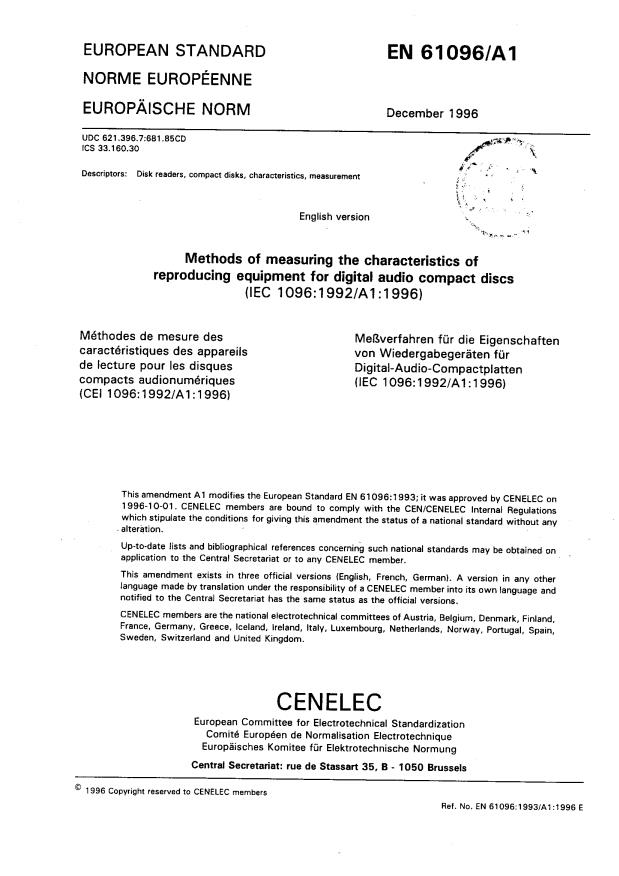
(Amendment)Methods of measuring the characteristics of reproducing equipment for digital audio compact discs
General Information
- Abstract
EN following parallel vote
- Status
- Published
- Publication Date
- 05-Dec-1996
- Withdrawal Date
- 30-Jun-1997
- Technical Committee
- CLC/TC 100X - Audio, video and multimedia systems and equipment and related sub-systems
- Drafting Committee
- IEC/TC 100 - IEC_TC_100
- Parallel Committee
- IEC/TC 100 - IEC_TC_100
- Current Stage
- 9093 - Decision to confirm - Review Enquiry
- Start Date
- 27-Apr-2026
- Completion Date
- 25-Aug-2026

Overview
EN 61096:1993/A1:1996 (adopted by CLC) defines standardized methods of measuring the characteristics of reproducing equipment for digital audio compact discs (CD players). This European adoption of IEC 61096 with Amendment 1 (1996) provides measurement procedures, test signals and reporting requirements to assess mechanical, acoustic and functional performance of CD reproducers under repeatable laboratory conditions.
Key Topics and Technical Requirements
- Mechanical performance (shock & vibration)
Procedures for shock and vibration tests (based on IEC 68-2-27) including test set‑up, stimulus (e.g. 1 kHz test tone), oscilloscope-based observation and reporting of the lowest acceleration level producing visible distortion. Both pulse shock and stationary/random vibration methods are specified. - Acoustic noise
Measurement of radiated mechanism noise during modes such as loading/unloading, seek and playback. Tests are performed in anechoic or low-reverberation rooms using A-weighted SPL and one‑third octave spectra (see IEC 651, ISO 374x series, ISO 532). - Access times
Definitions and measurement methods for start‑up, short, long and (optional) next‑disc access times using recommended test discs and repeat measurements to derive mean timings. - Trackability (CD defect tolerance)
Methods to quantify the player’s ability to reproduce simulated disc defects without audible or measurable nuisance, using distortion meters and defined test signals (e.g., 400 Hz mono). - Test CD requirements (Annex C)
Specifies restricted mechanical, optical and recording tolerances for test discs used in these measurements, for example: centre hole diameter 15.05 mm ± 0.03 mm, substrate thickness 1.20 mm ± 0.05 mm, peak deflection ±0.2 mm, angular deviation ±0.3°, reflected‑beam limit ≤ 0.8°, birefringence ≤ 70 nm. It also requires conformity with IEC 908 for recording and defect parameters.
Practical Applications and Who Uses It
- Manufacturers of CD players and transport mechanisms - for design verification, compliance testing and performance benchmarking.
- Test laboratories and QA teams - to carry out repeatable mechanical, acoustic and functional tests.
- Product standards committees and procurement/specification authors - to reference objective measurement methods in specifications and tenders.
- Repair, service and certification bodies - to validate resilience to shock, vibration and defective media.
Related Standards
- IEC 61096 / IEC 908 (test disc and recording references)
- IEC 68-2-27 (shock testing), IEC 651 (sound level meters)
- ISO 3740–3745 series, ISO 532, ISO 1996 (acoustic measurement and noise evaluation)
EN 61096:1993/A1:1996 is essential when you need standardized, traceable methods to quantify CD reproducer behavior (shock/vibration resistance, noise, access times, trackability) and to ensure comparable test results across labs and products. Keywords: EN 61096:1993/A1:1996, digital audio compact discs, CD player measurement, trackability, shock and vibration, acoustic noise, access times, test CD requirements.
Relations
- Effective Date
- 10-Feb-2026
- Effective Date
- 10-Feb-2026
- Effective Date
- 10-Feb-2026
- Effective Date
- 10-Feb-2026
- Effective Date
- 10-Feb-2026
- Effective Date
- 09-Feb-2026
- Effective Date
- 09-Feb-2026
- Effective Date
- 09-Feb-2026
- Effective Date
- 09-Feb-2026
- Effective Date
- 03-Feb-2026
- Effective Date
- 03-Feb-2026
- Referred By
EN IEC 61897:2020 - Overhead lines - Requirements and tests for Aeolian vibration dampers - Effective Date
- 03-Feb-2026
- Effective Date
- 28-Jan-2023
Get Certified
Connect with accredited certification bodies for this standard

ANCE
Mexican certification and testing association.

Intertek Slovenia
Intertek testing, inspection, and certification services in Slovenia.

LNE (Laboratoire National de Métrologie et d'Essais)
French national laboratory for metrology and testing.
Sponsored listings
Frequently Asked Questions
EN 61096:1993/A1:1996 is a amendment published by CLC. Its full title is "Methods of measuring the characteristics of reproducing equipment for digital audio compact discs". This standard covers: EN following parallel vote
EN following parallel vote
EN 61096:1993/A1:1996 is classified under the following ICS (International Classification for Standards) categories: 33.160.30 - Audio systems. The ICS classification helps identify the subject area and facilitates finding related standards.
EN 61096:1993/A1:1996 has the following relationships with other standards: It is inter standard links to ISO 532:1975, ISO 3745:1977, EN 23741:1991, ISO 1996-1:1982, ISO 3740:1980, EN ISO 3744:2009, EN 23742:1991, EN ISO 3743-2:2009, EN ISO 3743-1:2009, EN 60651:1994, EN 60068-2-27:1993, EN IEC 61897:2020, EN 61096:1993. Understanding these relationships helps ensure you are using the most current and applicable version of the standard.
EN 61096:1993/A1:1996 is available in PDF format for immediate download after purchase. The document can be added to your cart and obtained through the secure checkout process. Digital delivery ensures instant access to the complete standard document.
Standards Content (Sample)
SLOVENSKI STANDARD
01-julij-1999
Methods of measuring the characteristics of reproducing equipment for digital
audio compact discs (IEC 61096:1992/A1:1996)
Methods of measuring the characteristics of reproducing equipment for digital audio
compact discs
Meßverfahren für die Eigenschaften von Wiedergabegeräten für Digital-Audio-
Compactplatten
Méthodes de mesure des caractéristiques des appareils de lecture pour les disques
compacts audionumériques
Ta slovenski standard je istoveten z: EN 61096:1993/A1:1996
ICS:
33.160.30 Avdio sistemi Audio systems
2003-01.Slovenski inštitut za standardizacijo. Razmnoževanje celote ali delov tega standarda ni dovoljeno.
NORME
CEI
INTERNATIONALE
IEC
INTERNATIONAL
STANDARD
AMENDEMENT 1
AMENDMENT 1
1996-10
Amendement 1
Méthodes de mesure des caractéristiques
des appareils de lecture pour les disques
compacts audionumériques
Amendment 1
Methods of measuring the characteristics
of reproducing equipment for digital
audio compact discs
CEI 1996 Droits de reproduction réservés Copyright - all rights reserved
Bureau central de la Commission Electrotechnique Internationale 3, rue de Varembé Genève, Suisse
CODE PRIX
Commission Electrotechnique Internationale
K
International Electrotechnical Commission PRICE CODE
Pour prix, voir catalogue en vigueur
For price, see current catalogue
1096 Amend. 1 © IEC:1996 – 3 –
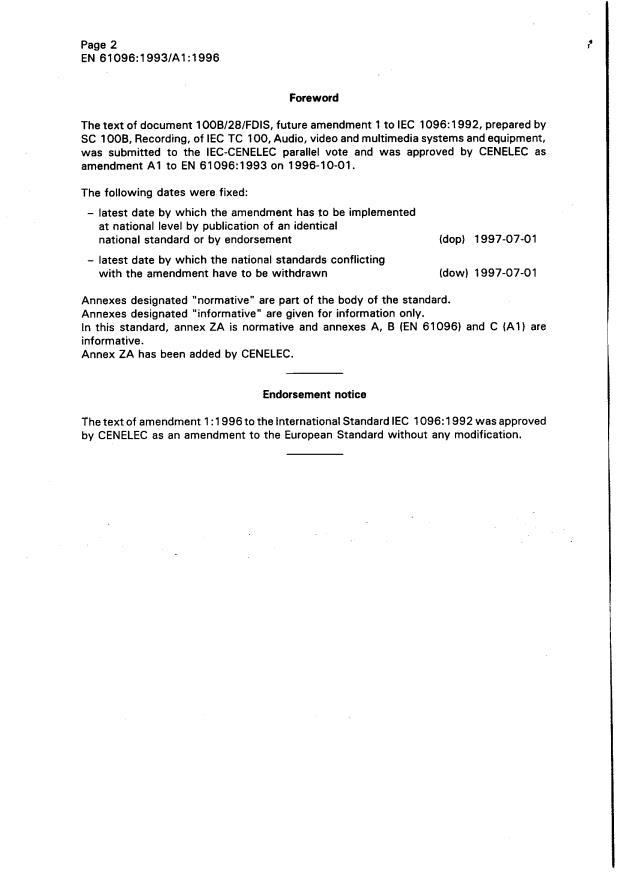
FOREWORD
This amendment has been prepared by subcommittee 100B: Recording, of IEC technical
committee 100: Audio, video and multimedia systems and equipment.
The text of this amendment is based on the following documents:
FDIS Report on voting
100B/28/FDIS 100B/50/RVD
Full information on the voting for the approval of this amendment can be found in the report on
voting indicated in the above table.
__________
Page 7
2 Normative references
Insert, in the existing list, the titles of the following standards:
IEC 68-2-27: 1987, Environmental testing – Part 2: Tests – Test Ea and guidance: Shock
IEC 651: 1979, Sound level meters
IEC 721-3-5: 1985, Classification of environmental conditions – Part 3: Classification of groups
of environmental parameters and their severities. Ground vehicle installations
ISO 532: 1975, Acoustics – Methods for calculating loudness levels
ISO 1996: Acoustics – Description and measurement of environmental noise
ISO 3740: 1980, Acoustics – Determination of sound power levels of noise sources –
Guidelines for the use of basic standards and for the preparation of noise test codes
ISO 3741: 1988, Acoustics – Determination of sound power levels of noise sources – Precision
methods for broad-band sources in reverberation rooms
ISO 3742: 1988, Acoustics – Determination of sound power levels of noise sources – Precision
methods for discrete-frequency and narrow-band sources in reverberation rooms
ISO 3743-1: 1994, Acoustics – Determination of sound power levels of noise sources –
Engineering methods for small, movable sources in reverberant fields – Part 1: Comparison
method for hard-walled test rooms
ISO 3743-2: 1994, Acoustics – Determination of sound power levels of noise sources using
sound pressure – Engineering methods for small, movable sources in reverberant fields –
Part 2: Methods for special reverberation test rooms
ISO 3744: 1994, Acoustics – Determination of sound power levels of noise sources using
sound pressure – Engineering method in an essentially free field over a reflecting plane
ISO 3745: 1977, Acoustics – Determination of sound power levels of noise sources – Precision
methods for anechoic and semi-anechoic rooms
1096 Amend. 1 © IEC:1996 – 5 –
Page 15
4.3.1 Mechanical performance claims
Replace the text of this subclause by the following:
4.3.1.1 Shock and vibration resistance
Definition
The player insensitivity against direct or indirect mechanical shocks and vibrations as caused
by the supporting surface in vertical (z-direction) or in horizontal direction (x and y directions)
on the player cabinet.
a) Shock test
CD player + Oscilloscope
test disc
Mechanical
shock table
+z
+y
Direction of
+x
-x
acceleration
-y
-z
Shock table: according to IEC 68-2-27.
Oscilloscope: input A, LF direct;
input B LF 90° out of phase with A;
x-deflection via input B.
CD player: line output, left channel, directly connected to oscilloscope input A.
Test signal: 1 kHz left and right
Table excitation: according to IEC 68-2-27, figure 2: D = 3 ms, A = variable.
Test CD: according to annexes A and C of this standard for restricted CD parameters.
Method
Place the player on a board horizontally.
Apply shocks with increasing severity and observe the circle on the scope.
Set oscilloscope sensitivity of A and B input so that a circle will be displayed.
Observe the circle during the shock test run.
The distortion of the circle is a measure for the shock influence.
It is advised to also listen for audible effects.
The test should be repeated three times in all directions (+/–X, +/–Y +/–Z) for every severity
level.
1096 Amend. 1 © IEC:1996 – 7 –
The following table gives an extension of table 1 of IEC 68-2-27 with g values applicable for CD
equipment.
Table 1 – Acceleration and duration of pulse
Peak acceleration Corresponding duration Corresponding
for the nominal pulse velocity change
-3
A
D
ΔV = 2/π x AD x 10
g Equivalent ms m/s
n
m/s
1 (10) 3 0,02
2 (20) 3 0,04
3 (30) 3 0,06
4 (40) 3 0,08
5 (50) 3 0,1
6 (60) 30 1,0
Result
Give for every direction the lowest severity level (in g’s) resulting in visible distortion of the
circle.
b) Vibration test
Low-pass
Distortion
CD player +
filter
meter
test disc
Mechanical
vibration table
+z
+y
Direction of
+x
-x
acceleration
-y
-z
Test signals
Test CD (see annexes A and C of this standard for restricted CD parameters):
400 Hz or 1 kHz preferably, 0 dB, mono-signal.
Acceleration signal: specified noise according to IEC 721-3-5, table VI:
a) stationary vibration, sinusoidal: frequency range 9 Hz – 200 Hz;
b) stationary vibration, random: frequency range 10 Hz – 200 Hz.
Duration: 1 min.
Method
Play the test CD and increase the acceleration intensity every minute up to the point just before
the audio sound reproduction is negatively affected by distortion variations. The limit is thus
established between complete error correction and the beginning of interpolation.
1096 Amend. 1 © IEC:1996 – 9 –
Result
Besides the disturbance direction (horizontal or vertical), the type of acceleration signal, the
maximum acceleration amplitude (in meters per second, squared, peak-to-peak) and the
related frequency (in hertz) or random noise shall be named.
4.3.1.2 Acoustic noise
Definition
The noise radiated by the player mechanism during various modes of application. Such modes
are:
– disc loading, unloading, disc change action;
– search within a track, track search, pause and playback.
Test disc
Any test disc covered in annexes A and C of this standard which refer to restricted CD
parameters.
Method
The measurements should be carried out preferably in an anechoic room in order to minimize
the effect of sound reflected by the room surfaces. A room with reverberation time less than 1 s
for frequencies higher than 100 Hz will lead to nearly the same results, if the distance between
each measuring point and the next reflecting surface is at least three times the distance of the
same measuring point to the sound source.
The ambient noise (noise without object under test) shall be at least 10 dB lower than the
sound pressure at the measuring point in each frequency band.
Test room parameters shall conform with ISO 3740, ISO 3741, ISO 3742, ISO 3743-1, ISO 3743-2,
ISO 3744 and ISO 3745.
Place the player on a wooden board of 800 mm x 1200 mm x 20 mm size (depth x width x
thickness) supported by a thin ant
...