


EN IEC 63478-2:2025
(Main)User’s quality of experience on multimedia conferencing services - Part 2: Requirements
General Information
- Abstract
IEC 63478-2:2025 describes the requirements to measure users’ quality of experience (QoE) on multimedia conferencing services.
- Status
- Published
- Publication Date
- 27-Nov-2025
- Current Stage
- 6060 - Document made available - Publishing
- Start Date
- 28-Nov-2025
- Due Date
- 19-Mar-2027
- Completion Date
- 28-Nov-2025

Overview
EN IEC 63478-2:2025 - "User’s quality of experience on multimedia conferencing services - Part 2: Requirements" (CLC adoption of IEC 63478-2) defines the requirements for measuring users’ Quality of Experience (QoE) on multimedia conferencing services. It forms Part 2 of the IEC 63478 series and sets out the parameters, functional entities and operations needed to reliably assess how well conferencing services meet user expectations across audio, video, synchronization and usability dimensions.
Key topics and technical requirements
- Scope: Requirements to measure user QoE for multimedia conferencing (clients, servers and measurement functions).
- QoE parameters: Covers video quality, audio quality, video‑audio synchronization, accessibility, interoperability, participation, openness, and UI/UX. Each parameter is expressed via QoE factors that may be mandatory or optional for measurement.
- Measurement approaches: Supports both subjective (user feedback) and objective methods for evaluating QoE factors.
- Functional entities:
- MCC - Multimedia Conferencing Client
- MCS - Multimedia Conferencing Server
- QMA - QoE Measurement Agent
- QMM - QoE Measurement Manager
- Required operations:
- QoE initialization - negotiation of parameters and measurement methods when a service starts.
- QoE monitoring - collection and aggregation of parameter measurements during sessions.
- QoE evaluation - analysis of aggregated measurements by QMM and reporting to MCS.
- Classification and reporting: Parameter lists and entity requirements are documented to ensure consistent collection, aggregation and reporting of QoE data.
Applications and who should use it
EN IEC 63478-2 is practical for organizations that design, deliver or evaluate multimedia conferencing services:
- Service providers and operators - for benchmarking service quality, SLA verification and network troubleshooting.
- Product manufacturers (clients & servers) - to design QoE-aware features and interoperability.
- Test laboratories and QA teams - to create consistent test cases and validation plans for QoE.
- UX researchers and accessibility specialists - to include user-centric metrics and accessibility checks in evaluations.
- Enterprise IT and procurement - to compare vendor offerings and verify promised user experience levels.
Practical use cases include session-level QoE monitoring, vendor comparison, root-cause analysis of audio/video degradation, accessibility compliance checks, and UI/UX performance optimization.
Related standards
- IEC 63478-1 - Part 1: General (technical report with general considerations)
- IEC 63478-3 - Part 3: Measurement methods (details on how to measure the QoE parameters defined in Part 2)
Keywords: EN IEC 63478-2:2025, QoE, multimedia conferencing, QoE measurement, MCC, MCS, QMA, QMM, audio quality, video quality, synchronization, UI/UX, interoperability.
Get Certified
Connect with accredited certification bodies for this standard

ANCE
Mexican certification and testing association.

Intertek Slovenia
Intertek testing, inspection, and certification services in Slovenia.

LNE (Laboratoire National de Métrologie et d'Essais)
French national laboratory for metrology and testing.
Sponsored listings
Frequently Asked Questions
EN IEC 63478-2:2025 is a draft published by CLC. Its full title is "User’s quality of experience on multimedia conferencing services - Part 2: Requirements". This standard covers: IEC 63478-2:2025 describes the requirements to measure users’ quality of experience (QoE) on multimedia conferencing services.
IEC 63478-2:2025 describes the requirements to measure users’ quality of experience (QoE) on multimedia conferencing services.
EN IEC 63478-2:2025 is classified under the following ICS (International Classification for Standards) categories: 33.160.60 - Multimedia systems and teleconferencing equipment. The ICS classification helps identify the subject area and facilitates finding related standards.
EN IEC 63478-2:2025 is available in PDF format for immediate download after purchase. The document can be added to your cart and obtained through the secure checkout process. Digital delivery ensures instant access to the complete standard document.
Standards Content (Sample)
SLOVENSKI STANDARD
01-marec-2025
Kakovost uporabniške izkušnje (QoE) za multimedijske konferenčne storitve – 2.
del: Zahteve
User’s quality of experience (QoE) on multimedia conferencing services - Part 2:
Requirements
Qualité de l'expérience de l'utilisateur (QoE) pour les services de conférence multimédia
- Partie 2: Exigences
Ta slovenski standard je istoveten z: prEN IEC 63478-2:2025
ICS:
33.160.60 Večpredstavni (multimedijski) Multimedia systems and
sistemi in oprema za teleconferencing equipment
telekonference
2003-01.Slovenski inštitut za standardizacijo. Razmnoževanje celote ali delov tega standarda ni dovoljeno.
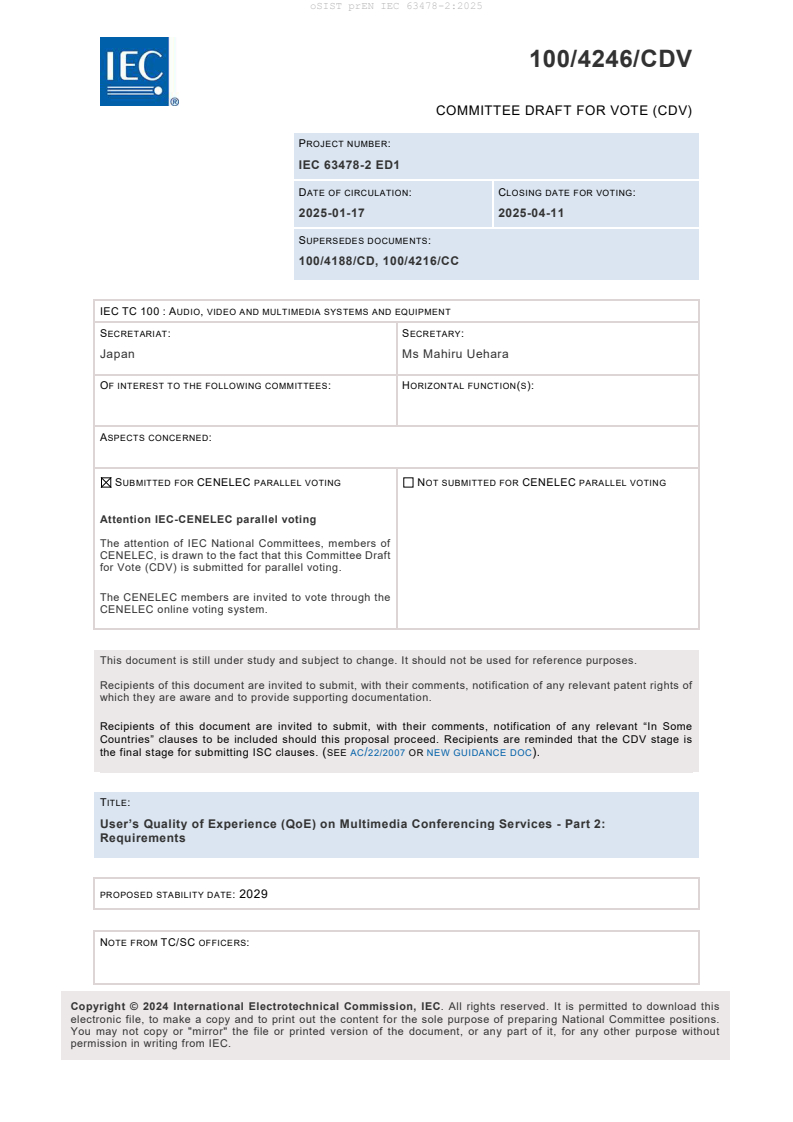
100/4246/CDV
COMMITTEE DRAFT FOR VOTE (CDV)
PROJECT NUMBER:
IEC 63478-2 ED1
DATE OF CIRCULATION: CLOSING DATE FOR VOTING:
2025-01-17 2025-04-11
SUPERSEDES DOCUMENTS:
100/4188/CD, 100/4216/CC
IEC TC 100 : AUDIO, VIDEO AND MULTIMEDIA SYSTEMS AND EQUIPMENT
SECRETARIAT: SECRETARY:
Japan Ms Mahiru Uehara
OF INTEREST TO THE FOLLOWING COMMITTEES: HORIZONTAL FUNCTION(S):
ASPECTS CONCERNED:
SUBMITTED FOR CENELEC PARALLEL VOTING NOT SUBMITTED FOR CENELEC PARALLEL VOTING
Attention IEC-CENELEC parallel voting
The attention of IEC National Committees, members of
CENELEC, is drawn to the fact that this Committee Draft
for Vote (CDV) is submitted for parallel voting.
The CENELEC members are invited to vote through the
CENELEC online voting system.
This document is still under study and subject to change. It should not be used for reference purposes.
Recipients of this document are invited to submit, with their comments, notification of any relevant patent rights of
which they are aware and to provide supporting documentation.
Recipients of this document are invited to submit, with their comments, notification of any relevant “In Some
Countries” clauses to be included should this proposal proceed. Recipients are reminded that the CDV stage is
the final stage for submitting ISC clauses. (SEE AC/22/2007 OR NEW GUIDANCE DOC).
TITLE:
User’s Quality of Experience (QoE) on Multimedia Conferencing Services - Part 2:
Requirements
PROPOSED STABILITY DATE: 2029
NOTE FROM TC/SC OFFICERS:
electronic file, to make a copy and to print out the content for the sole purpose of preparing National Committee positions.
You may not copy or "mirror" the file or printed version of the document, or any part of it, for any other purpose without
permission in writing from IEC.
100/4246/CDV – 2 – IEC CDV 63478-2 © IEC 2025
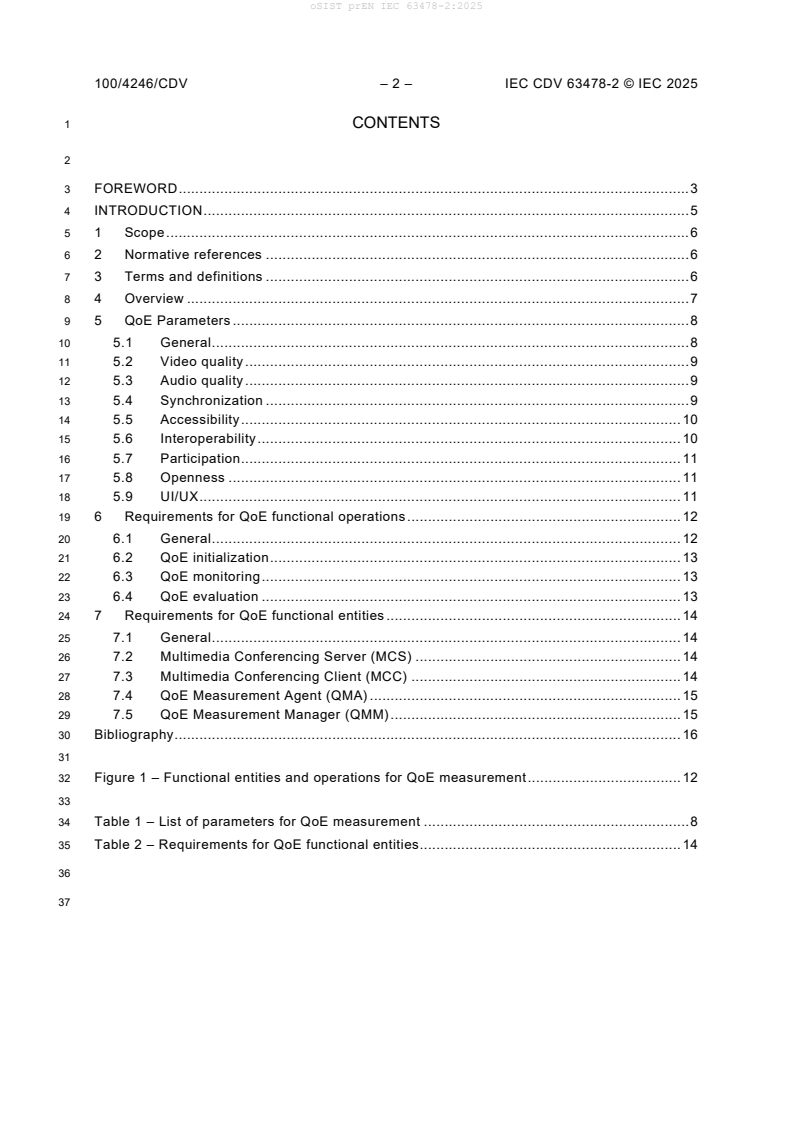
1 CONTENTS
3 FOREWORD . 3
4 INTRODUCTION . 5
5 1 Scope . 6
6 2 Normative references . 6
7 3 Terms and definitions . 6
8 4 Overview . 7
9 5 QoE Parameters . 8
10 5.1 General . 8
11 5.2 Video quality . 9
12 5.3 Audio quality . 9
13 5.4 Synchronization . 9
14 5.5 Accessibility . 10
15 5.6 Interoperability . 10
16 5.7 Participation . 11
17 5.8 Openness . 11
18 5.9 UI/UX . 11
19 6 Requirements for QoE functional operations . 12
20 6.1 General . 12
21 6.2 QoE initialization . 13
22 6.3 QoE monitoring . 13
23 6.4 QoE evaluation . 13
24 7 Requirements for QoE functional entities . 14
25 7.1 General . 14
26 7.2 Multimedia Conferencing Server (MCS) . 14
27 7.3 Multimedia Conferencing Client (MCC) . 14
28 7.4 QoE Measurement Agent (QMA) . 15
29 7.5 QoE Measurement Manager (QMM) . 15
30 Bibliography . 16
32 Figure 1 – Functional entities and operations for QoE measurement . 12
34 Table 1 – List of parameters for QoE measurement . 8
35 Table 2 – Requirements for QoE functional entities . 14
IEC CDV 63478-2 © IEC 2025 – 3 – 100/4246/CDV
38 INTERNATIONAL ELECTROTECHNICAL COMMISSION
39 ____________
41 USER’S QUALITY OF EXPERIENCE ON MULTIMEDIA CONFERENCING
42 SERVICES
44 Part 2: Requirements
48 FOREWORD
49 1) The International Electrotechnical Commission (IEC) is a worldwide organization for standardization comprising
50 all national electrotechnical committees (IEC National Committees). The object of IEC is to promote international
51 co-operation on all questions concerning standardization in the electrical and electronic fields. To this end and
52 in addition to other activities, IEC publishes International Standards, Technical Specifications, Technical Reports,
53 Publicly Available Specifications (PAS) and Guides (hereafter referred to as "IEC Publication(s)"). Their
54 preparation is entrusted to technical committees; any IEC National Committee interested in the subject dealt with
55 may participate in this preparatory work. International, governmental and non-governmental organizations liaising
56 with the IEC also participate in this preparation. IEC collaborates closely with the International Organization for
57 Standardization (ISO) in accordance with conditions determined by agreement between the two organizations.
58 2) The formal decisions or agreements of IEC on technical matters express, as nearly as possible, an international
59 consensus of opinion on the relevant subjects since each technical committee has representation from all
60 interested IEC National Committees.
61 3) IEC Publications have the form of recommendations for international use and are accepted by IEC National
62 Committees in that sense. While all reasonable efforts are made to ensure that the technical content of IEC
63 Publications is accurate, IEC cannot be held responsible for the way in which they are used or for any
64 misinterpretation by any end user.
65 4) In order to promote international uniformity, IEC National Committees undertake to apply IEC Publications
66 transparently to the maximum extent possible in their national and regional publications. Any divergence between
67 any IEC Publication and the corresponding national or regional publication shall be clearly indicated in the latter.
68 5) IEC itself does not provide any attestation of conformity. Independent certification bodies provide conformity
69 assessment services and, in some areas, access to IEC marks of conformity. IEC is not responsible for any
70 services carried out by independent certification bodies.
71 6) All users should ensure that they have the latest edition of this publication.
72 7) No liability shall attach to IEC or its directors, employees, servants or agents including individual experts and
73 members of its technical committees and IEC National Committees for any personal injury, property damage or
74 other damage of any nature whatsoever, whether direct or indirect, or for costs (including legal fees) and
75 expenses arising out of the publication, use of, or reliance upon, this IEC Publication or any other IEC
76 Publications.
77 8) Attention is drawn to the Normative references cited in this publication. Use of the referenced publications is
78 indispensable for the correct application of this publication.
79 9) IEC draws attention to the possibility that the implementation of this document may involve the use of (a)
80 patent(s). IEC takes no position concerning the evidence, validity or applicability of any claimed patent rights in
81 respect thereof. As of the date of publication of this document, IEC had not received notice of (a) patent(s), which
82 may be required to implement this document. However, implementers are cautioned that this may not represent
83 the latest information, which may be obtained from the patent database available at https://patents.iec.ch or
84 www.iso.org/patents. IEC shall not be held responsible for identifying any or all such patent rights.
85 IEC 63478-2 has been prepared by subcommittee WG 11: USER’S QUALITY OF EXPERIENCE
86 (QoE) ON MULTIMEDIA CONFERENCING SERVICES, of IEC technical committee TC 100:
87 AUDIO, VIDEO AND MULTIMEDIA SYSTEMS AND EQUIPMENT. It is an International
88 Standard.
89 The text of this International Standard is based on the following documents:
Draft Report on voting
XX/XX/FDIS XX/XX/RVD
100/4246/CDV – 4 – IEC CDV 63478-2 © IEC 2025
91 Full information on the voting for its approval can be found in the report on voting indicated in
92 the above table.
93 The language used for the development of this International Standard is English.
94 This document was drafted in accordance with ISO/IEC Directives, Part 2, and developed in
95 accordance with ISO/IEC Directives, Part 1 and ISO/IEC Directives, IEC Supplement available
96 at www.iec.ch/members_experts/refdocs. The main document types developed by IEC are
97 described in greater detail at www.iec.ch/publications.
98 The committee has decided that the contents of this document will remain unchanged until the
99 stability date indicated on the IEC website under webstore.iec.ch in the data related to the
100 specific document. At this date, the document will be
101 • reconfirmed,
102 • withdrawn,
103 • replaced by a revised edition, or
104 • amended.
IEC CDV 63478-2 © IEC 2025 – 5 – 100/4246/CDV
106 INTRODUCTION
107 With the global COVID-19 pandemic, the meetings on business and education have shifted from
108 offline to online modes. Consequently, a range of multimedia conferencing services have been
109 developed, enabling users to choose and enjoy conferencing services based on personal
110 preferences. To ensure optimal user experience, it is essential to measure the Quality of
111 Experience (QoE) for multimedia conferencing services. However, there is currently a lack of
112 standardized methods for measuring a user's QoE in this context. Thus, there is a pressing
113 need to provide standards for measuring and evaluating a user's QoE for multimedia
114 conferencing services.
115 Traditionally, Quality of Service (QoS) has been measured for network data communication,
116 represented by objective index values like delay, throughput, and jitter. In contrast, QoE
117 represents a user's level of satisfaction with a specific service and reflects human emotional
118 quality. As such, QoE is subject to overall service performance from the user's perspective. In
119 the case of multimedia conferencing services, measuring QoE is challenging due to varying
120 user preferences, as well as varying services and application characteristics. Therefore, a
121 unified framework is necessary to measure and evaluate a user's QoE for multimedia
122 conferencing services.
123 This document (IEC 63478) aims to provide standards for enhancing a user's QoE for
124 multimedia conferencing services. The series specifies general considerations and
125 requirements to enhance a user's QoE and measurement methods for associated QoE
126 parameters.
127 The IEC 63478 consists of the following parts:
128 - Part 1: General;
129 - Part 2: Requirements; and
130 - Part 3: Measurement methods.
131 Part 1 of IEC 63478-1 (Technical Report) describes general considerations to measure user's
132 QoE.
133 Part 2 of IEC 63478-2 (International Standard) describes the requirements to be considered to
134 measure user's QoE.
135 Part 3 of IEC 63478-3 (International Standard) describes the measurement methods for QoE
136 parameters.
100/4246/CDV – 6 – IEC CDV 63478-2 © IEC 2025
138 USER’S QUALITY OF EXPERIENCE ON MULTIMEDIA CONFERENCING
139 SERVICES
141 Part 2: Requirements
145 1 Scope
146 This part of IEC 63478-2 describes the requirements to measure user’s Quality of Experience
147 (QoE) on multimedia conferencing services.
148 2 Normative references
149 There are no normative references in this document.
150 3 Terms and definitions
151 For the purposes of this document, the following terms and definitions apply.
152 ISO and IEC maintain terminology databases for use in standardization at the following
153 addresses:
154 • IEC Electropedia: available at https://www.electropedia.org/
155 • ISO Online browsing platform: available at https://www.iso.org/obp
156 3.1
157 MCC
158 Multimedia Conferencing Client
159 3.2
160 MCS
161 Multimedia Conferencing Server
162 3.3
163 QMA
164 QoE Measurement Agent
165 3.4
166 QMM
167 QoE Measurement Manager
168 3.5
169 QoE
170 Quality of Experience
171 3.6
172 UI/UX
173 User Interface / User eXperience
IEC CDV 63478-2 © IEC 2025 – 7 – 100/4246/CDV
175 4 Overview
176 One crucial aspect of multimedia conferencing services is the Quality of Experience (QoE),
177 which describes a user's overall satisfaction level with a particular service. It measures how
178 well a service meets users' expectations and needs and can be influenced by various factors
179 including audio and video quality, responsiveness, reliability and ease of use. As the use of
180 multimedia conferencing services for remote communication increases, the importance of
181 measuring user QoE also increases. Reliable and high-quality services that meet user
182 expectations are essential for continued use and to prevent users from switching to other
183 providers. Therefore, a QoE measurement standard for multimedia conferencing services is
184 required to ensure a consistent and high-quality user experience across various platforms,
185 services and devices.
186 Moreover, QoE measurement standards can help service providers optimize their services and
187 identify areas for improvement. By measuring and analyzing QoE, service providers can identify
188 service problems and take corrective action to improve service quality. QoE measurement
189 standards allow service providers to compare services with other providers and benchmark
190 service quality. The complex nature of multimedia communications underscores the need for
191 QoE measurement standards in multimedia conferencing services. Quality problems such as
192 latency, jitter, packet loss and network congestion can affect the user experience and degrade
193 QoE, making it essential to measure and optimize QoE to provide a high-quality user experience.
194 The key factors for effective QoE measurement include the QoE parameters to be measured
195 and the QoE measurement operations to be performed among the QoE functional entities.
196 These QoE parameters are subdivided into QoE factors, which are classified into 'mandatory'
197 and 'optional' depending on their impact on QoE. The QoE measurement in multimedia
198 conferencing services can be measured by measuring the QoE factor, which is measured
199 through the operation between functional entities. To measure QoE, the following operations
200 are required.
201 a) QoE initialization: This is a procedure for parameter negotiation and measurement method
202 negotiation between QoE functional entities when a multimedia service begins.
203 b) QoE monitoring: This is the process of measuring parameters and aggregating the measured
204 QoE parameter values to measure the QoE of multimedia services.
205 c) QoE evaluation: This is the process of analysis of the aggregated QoE parameters by QMM
206 and report of QoE measurement results to MCS.
207 The QoE in multimedia conferencing services should be measured through these requirements
208 for QoE measurement.
100/4246/CDV – 8 – IEC CDV 63478-2 © IEC 2025
209 5 QoE Parameters
210 5.1 General
211 To measure user’s QoE for multimedia conferencing services, a variety of QoE parameters
212 need to be considered, which can be consisted to video quality, audio quality, video & audio
213 synchronization, accessibility, interconnectivity, openness, participation and UI/UX as
214 described in Table 1. Each QoE parameter can be measured with a set of QoE factors. Some
215 QoE factors shall be used as mandatory for effective QoE measurement, whereas the others
216 may be employed optionally. For measurement of a specific QoE factor, the subjective and/or
217 objective approaches can be used. The subjective measurement is based on user’s feedback,
218 whereas the objective measurement is based on the quantitative measurement of multimedia
219 conferencing services. The detailed method of QoE parameters shall be negotiated among the
220 concerned QoE functional entities.
221 Table 1 – List of parameters for QoE measurement
QoE parameter QoE factor Mandatory/Optional
Visual clarity Mandatory
Video quality
Latency Mandatory
Clarity Mandatory
Noise Mandatory
Audio quality Latency Mandatory
Dynamic range
Echo cancellation
Accuracy Mandatory
Synchronization Adaptive
Consistency
Support for assistive technologies Mandatory
Accessibility Compatibility with assistive devices
Captioning and transcription Mandatory
Cross-platform compatibility Mandatory
Interoperability Integration with other services Mandatory
security Mandatory
User group size Mandatory
Participation
Collaboration tools Mandatory
Transparency
Openness
Open API/SDK
Intuitive and user-friendly design Mandatory
Consistency across platform
UI/UX
Customizability
Feedback and notifications Mandatory
IEC CDV 63478-2 © IEC 2025
...