


EN 61821:2003
(Main)Electrical installations for lighting and beaconing of aerodromes - Maintenance of aeronautical ground lighting constant current series circuits
General Information
- Abstract
This International Standard applies to the maintenance of AGL constant current series circuits. This International Standard · covers constant current series circuits for AGL installed at aerodromes and heliports; · concentrates on providing the safety requirements for the maintenance of an AGL constant current series circuit. It is recognised that AGL constant current series circuits of different design characteristics and parameters are in existence; · is mainly concerned with safety to persons by specifying the rules and fundamental principles for the maintenance of AGL constant current series circuits; · is not intended to apply to AGL primary series circuits supplied directly from a mains constant voltage source; · is not intended to be used for public street lighting, roadway lighting or any other installation requiring the use of constant current series circuits.
- Status
- Withdrawn
- Publication Date
- 06-Jan-2003
- Drafting Committee
- IEC/TC 97 - IEC_TC_97
- Parallel Committee
- IEC/TC 97 - IEC_TC_97
- Current Stage
- 9960 - Withdrawal effective - Withdrawal
- Start Date
- 03-Nov-2014
- Completion Date
- 03-Nov-2014



Relations
- Effective Date
- 29-Jan-2023
- Effective Date
- 10-Feb-2026
- Effective Date
- 09-Feb-2026
Get Certified
Connect with accredited certification bodies for this standard

IMQ S.p.A. (Certification)
Italian electrical product certification.

SLG Prüf- und Zertifizierungs GmbH
German testing and certification body.

UL Solutions
Global safety science company with testing, inspection and certification.
Sponsored listings
Frequently Asked Questions
EN 61821:2003 is a standard published by CLC. Its full title is "Electrical installations for lighting and beaconing of aerodromes - Maintenance of aeronautical ground lighting constant current series circuits". This standard covers: This International Standard applies to the maintenance of AGL constant current series circuits. This International Standard · covers constant current series circuits for AGL installed at aerodromes and heliports; · concentrates on providing the safety requirements for the maintenance of an AGL constant current series circuit. It is recognised that AGL constant current series circuits of different design characteristics and parameters are in existence; · is mainly concerned with safety to persons by specifying the rules and fundamental principles for the maintenance of AGL constant current series circuits; · is not intended to apply to AGL primary series circuits supplied directly from a mains constant voltage source; · is not intended to be used for public street lighting, roadway lighting or any other installation requiring the use of constant current series circuits.
This International Standard applies to the maintenance of AGL constant current series circuits. This International Standard · covers constant current series circuits for AGL installed at aerodromes and heliports; · concentrates on providing the safety requirements for the maintenance of an AGL constant current series circuit. It is recognised that AGL constant current series circuits of different design characteristics and parameters are in existence; · is mainly concerned with safety to persons by specifying the rules and fundamental principles for the maintenance of AGL constant current series circuits; · is not intended to apply to AGL primary series circuits supplied directly from a mains constant voltage source; · is not intended to be used for public street lighting, roadway lighting or any other installation requiring the use of constant current series circuits.
EN 61821:2003 is classified under the following ICS (International Classification for Standards) categories: 29.140.50 - Lighting installation systems; 93.120 - Construction of airports. The ICS classification helps identify the subject area and facilitates finding related standards.
EN 61821:2003 has the following relationships with other standards: It is inter standard links to EN 61821:2011, IEC TS 62143:2002, EN ISO 4135:1996. Understanding these relationships helps ensure you are using the most current and applicable version of the standard.
EN 61821:2003 is available in PDF format for immediate download after purchase. The document can be added to your cart and obtained through the secure checkout process. Digital delivery ensures instant access to the complete standard document.
Standards Content (Sample)
SLOVENSKI SIST EN 61821:2003
STANDARD
april 2003
Electrical installations for lighting and beaconing of aerodromes - Maintenance of
aeronautical ground lighting constant current series circuits
ICS 29.140.50; 93.120 Referenčna številka
© Standard je založil in izdal Slovenski inštitut za standardizacijo. Razmnoževanje ali kopiranje celote ali delov tega dokumenta ni dovoljeno
EUROPEAN STANDARD EN 61821
NORME EUROPÉENNE
EUROPÄISCHE NORM January 2003
ICS 93.120; 29.140.50
English version
Electrical installations for lighting and beaconing of aerodromes -
Maintenance of aeronautical ground lighting
constant current series circuits
(IEC 61821:2002)
Installations électriques pour l'éclairage Elektrische Anlagen für Beleuchtung
et le balisage des aérodromes - und Befeuerung von Flugplätzen -
Maintenance des circuits série Wartung von Konstantstrom-
à courant constant pour le balisage Serienstromkreisen
aéronautique au sol für Flugplatzbefeuerungsanlagen
(CEI 61821:2002) (IEC 61821:2002)
This European Standard was approved by CENELEC on 2002-12-03. CENELEC members are bound to
comply with the CEN/CENELEC Internal Regulations which stipulate the conditions for giving this European
Standard the status of a national standard without any alteration.
Up-to-date lists and bibliographical references concerning such national standards may be obtained on
application to the Central Secretariat or to any CENELEC member.
This European Standard exists in three official versions (English, French, German). A version in any other
language made by translation under the responsibility of a CENELEC member into its own language and
notified to the Central Secretariat has the same status as the official versions.
CENELEC members are the national electrotechnical committees of Austria, Belgium, Czech Republic,
Denmark, Finland, France, Germany, Greece, Hungary, Iceland, Ireland, Italy, Luxembourg, Malta,
Netherlands, Norway, Portugal, Slovakia, Spain, Sweden, Switzerland and United Kingdom.
CENELEC
European Committee for Electrotechnical Standardization
Comité Européen de Normalisation Electrotechnique
Europäisches Komitee für Elektrotechnische Normung
Central Secretariat: rue de Stassart 35, B - 1050 Brussels
© 2003 CENELEC - All rights of exploitation in any form and by any means reserved worldwide for CENELEC members.
Ref. No. EN 61821:2003 E
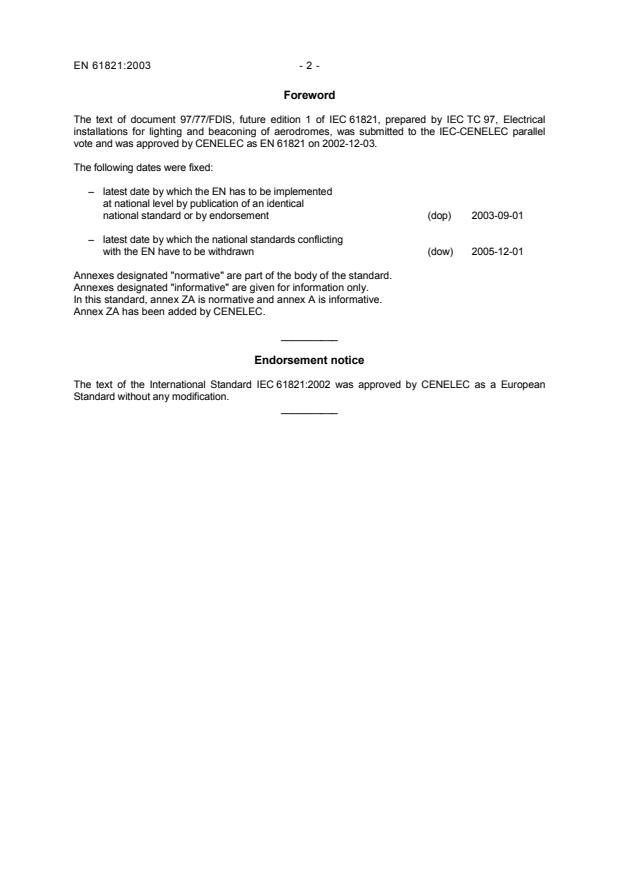
Foreword
The text of document 97/77/FDIS, future edition 1 of IEC 61821, prepared by IEC TC 97, Electrical
installations for lighting and beaconing of aerodromes, was submitted to the IEC-CENELEC parallel
vote and was approved by CENELEC as EN 61821 on 2002-12-03.
The following dates were fixed:
– latest date by which the EN has to be implemented
at national level by publication of an identical
national standard or by endorsement (dop) 2003-09-01
– latest date by which the national standards conflicting
with the EN have to be withdrawn (dow) 2005-12-01
Annexes designated "normative" are part of the body of the standard.
Annexes designated "informative" are given for information only.
In this standard, annex ZA is normative and annex A is informative.
Annex ZA has been added by CENELEC.
__________
Endorsement notice
The text of the International Standard IEC 61821:2002 was approved by CENELEC as a European
Standard without any modification.
__________
- 3 - EN 61821:2003
Annex ZA
(normative)
Normative references to international publications
with their corresponding European publications
This European Standard incorporates by dated or undated reference, provisions from other
publications. These normative references are cited at the appropriate places in the text and the
publications are listed hereafter. For dated references, subsequent amendments to or revisions of any
of these publications apply to this European Standard only when incorporated in it by amendment or
revision. For undated references the latest edition of the publication referred to applies (including
amendments).
NOTE When an international publication has been modified by common modifications, indicated by (mod), the relevant
EN/HD applies.
Publication Year Title EN/HD Year
IEC 60903 (mod) 1988 Specification for gloves and mitts of EN 60903 1992
insulating material for live working
1)
IEC/TS 62143 - Electrical installations for lighting and - -
beaconing of aerodromes - Aeronautical
ground lighting systems - Guidelines for
the development of a safety lifecycle
methodology
ISO/IEC Guide 51 1999 Safety aspects - Guidelines for their - -
inclusion in standards
1)
Undated reference.
NORME
CEI
INTERNATIONALE IEC
INTERNATIONAL
Première édition
STANDARD
First edition
2002-03
Electrical installations for lighting
and beaconing of aerodromes –
Maintenance of aeronautical ground
lighting constant current series circuits
Installations électriques pour l'éclairage
et le balisage des aérodromes –
Maintenance des circuits série à courant
constant pour le balisage aéronautique
au sol
© IEC 2002 Droits de reproduction réservés ⎯ Copyright - all rights reserved
Aucune partie de cette publication ne peut être reproduite ni No part of this publication may be reproduced or utilized in any
utilisée sous quelque forme que ce soit et par aucun procédé, form or by any means, electronic or mechanical, including
électronique ou mécanique, y compris la photocopie et les photocopying and microfilm, without permission in writing from
microfilms, sans l'accord écrit de l'éditeur. the publisher.
International Electrotechnical Commission, 3, rue de Varembé, PO Box 131, CH-1211 Geneva 20, Switzerland
Telephone: +41 22 919 02 11 Telefax: +41 22 919 03 00 E-mail: inmail@iec.ch Web: www.iec.ch
CODE PRIX
U
Commission Electrotechnique Internationale PRICE CODE
International Electrotechnical Commission
ɆɟɠɞɭɧɚɪɨɞɧɚɹɗɥɟɤɬɪɨɬɟɯɧɢɱɟɫɤɚɹɄɨɦɢɫɫɢɹ
Pour prix, voir catalogue en vigueur
For price, see current catalogue
61821 © IEC:2002 – 3 –
CONTENTS
FOREWORD.5
INTRODUCTION.7
1 Scope.9
2 Normative references .9
3 Definitions .9
4 Competence of persons.15
4.1 Objective.15
4.2 Requirements.15
5 Management of maintenance activities .17
5.1 Objective.17
5.2 Requirements.17
5.2.1 Organisational roles and responsibilities.17
5.2.2 Use of contractors .17
5.2.3 Maintenance policy.17
5.2.4 Maintenance procedures .19
5.2.5 Admittance to AGL work areas .21
5.2.6 Manning levels .21
6 Safety requirements .21
6.1 Objective.21
6.2 Requirements.23
6.2.1 Safety procedures .23
6.2.2 Live working .25
6.2.3 Safety checks.25
6.2.4 Tools and test equipment .27
6.2.5 Safety equipment.27
6.2.6 Personal protective equipment.27
7 AGL maintenance procedures.27
7.1 Objective.27
7.2 Requirements.29
7.2.1 General .29
7.2.2 Pre-work procedures .29
7.2.3 AGL constant current series circuits .31
7.2.4 Cables.31
7.2.5 Completion of work.31
7.2.6 Records and documentation .33
Annex A (informative) Maintenance organisation model .35
Figure A.1 – AGL maintenance organisation structural diagram .37
Figure A.2 – AGL constant current series circuit maintenance model .49
Figure A.3 – Example of a permit-to-work/sanction-to-test sheet.51
Figure A.4 – Example of a permit-to-work/sanction-to-test sheet.53
61821 © IEC:2002 – 5 –
INTERNATIONAL ELECTROTECHNICAL COMMISSION
___________
ELECTRICAL INSTALLATIONS FOR LIGHTING
AND BEACONING OF AERODROMES –
MAINTENANCE OF AERONAUTICAL GROUND LIGHTING
CONSTANT CURRENT SERIES CIRCUITS
FOREWORD
1) The IEC (International Electrotechnical Commission) is a worldwide organization for standardization comprising
all national electrotechnical committees (IEC National Committees). The object of the IEC is to promote
international co-operation on all questions concerning standardization in the electrical and electronic fields. To
this end and in addition to other activities, the IEC publishes International Standards. Their preparation is
entrusted to technical committees; any IEC National Committee interested in the subject dealt with may
participate in this preparatory work. International, governmental and non-governmental organizations liaising
with the IEC also participate in this preparation. The IEC collaborates closely with the International
Organization for Standardization (ISO) in accordance with conditions determined by agreement between the
two organizations.
2) The formal decisions or agreements of the IEC on technical matters express, as nearly as possible, an
international consensus of opinion on the relevant subjects since each technical committee has representation
from all interested National Committees.
3) The documents produced have the form of recommendations for international use and are published in the form
of standards, technical specifications, technical reports or guides and they are accepted by the National
Committees in that sense.
4) In order to promote international unification, IEC National Committees undertake to apply IEC International
Standards transparently to the maximum extent possible in their national and regional standards. Any
divergence between the IEC Standard and the corresponding national or regional standard shall be clearly
indicated in the latter.
5) The IEC provides no marking procedure to indicate its approval and cannot be rendered responsible for any
equipment declared to be in conformity with one of its standards.
6) Attention is drawn to the possibility that some of the elements of this International Standard may be the subject
of patent rights. The IEC shall not be held responsible for identifying any or all such patent rights.
International Standard IEC 61821 has been prepared by IEC technical committee 97:
Electrical installations for lighting and beaconing of aerodromes.
The text of this standard is based on the following documents:
FDIS Report on voting
97/77/FDIS 97/84/RVD
Full information on the voting for the approval of this standard can be found in the report on
voting indicated in the above table.
This publication has been drafted in accordance with the ISO/IEC Directives, Part 3.
The committee has decided that the contents of this publication will remain unchanged
until 2006. At this date, the publication will be
• reconfirmed;
• withdrawn;
• replaced by a revised edition, or
• amended.
61821 © IEC:2002 – 7 –
INTRODUCTION
This International Standard contains the management, safety and procedural requirements
specific to the maintenance of an aeronautical ground lighting (AGL) constant current series
circuit and has taken into consideration existing national standards, requirements and
practices. The maintenance activities are required to ensure that the AGL constant current
series circuit continues to meet the operational requirements and minimise the occurrence of
operational failures.
To conform to this International Standard it should be demonstrated to the relevant bodies
that the requirements have been satisfied and therefore that the clause objective(s) has(have)
been met.
NOTE Examples of relevant bodies would include the following:
• certification and licensing authorities;
• safety regulators;
• notified bodies for international or European directives;
• national standards bodies.
61821 © IEC:2002 – 9 –
ELECTRICAL INSTALLATIONS FOR LIGHTING
AND BEACONING OF AERODROMES –
MAINTENANCE OF AERONAUTICAL GROUND LIGHTING
CONSTANT CURRENT SERIES CIRCUITS
1 Scope
This International Standard applies to the maintenance of AGL constant current series
circuits.
This International Standard
• covers constant current series circuits for AGL installed at aerodromes and heliports;
• concentrates on providing the safety requirements for the maintenance of an AGL
constant current series circuit. It is recognised that AGL constant current series circuits of
different design characteristics and parameters are in existence;
• is mainly concerned with safety to persons by specifying the rules and fundamental
principles for the maintenance of AGL constant current series circuits;
• is not intended to apply to AGL primary series circuits supplied directly from a mains
constant voltage source;
• is not intended to be used for public street lighting, roadway lighting or any other
installation requiring the use of constant current series circuits.
2 Normative references
The following referenced documents are indispensable for the application of this document.
For dated references, only the edition cited applies. For undated references, the latest edition
of the referenced document (including any amendments) applies.
IEC 60903:1988, Specification for gloves and mitts of insulating material for live working
IEC/TS 62143, – Electrical installations for the lighting and beaconing of aerodromes –
Aeronautical ground lighting systems – Guidelines for the development of a safety life-cycle
1)
methodology
IEC/ISO Guide 51:1999, Safety aspects – Guidelines for their inclusion in standards
3 Definitions
For the purpose of this International Standard the following definitions apply.
________
1)
To be published.
61821 © IEC:2002 – 11 –
3.1
aerodrome authority
organisation accountable for the safety and security of persons, aircraft operations and
facilities at an aerodrome
3.2
AGL constant current series circuit
apparatus configured as an electrical circuit designed to produce and operate with a constant
current, independent of specified load variations, in order to provide a specified light for
aeronautical purposes
3.3
AGL operator
person responsible for the control of the AGL to permit the safe movement of aircraft
3.4
caution sign
non-metallic safety sign attached to equipment conveying a warning against interference with
such equipment
3.5
constant current regulator (CCR)
apparatus which produces a current output at a constant r.m.s. value independent of varia-
tions in the constant current series circuit load, input voltage and service conditions as specified
3.6
contractor
organisation or person(s) given a written order to provide a service or undertake specified work
3.7
dead
free from any electrical connection to a source of potential difference and from electric
charge; not having a potential different from that of the earth
3.8
earthed
connected to the general mass of earth in such a manner as to ensure at all times an
immediate discharge of electrical energy without harm
3.9
electrical equipment
anything used, intended to be used or installed for use, to generate, provide, transmit, trans-
form, rectify, convert, conduct, distributes, control, store, measure or use electrical energy
3.10
harm
physical injury or damage to the health of people either directly, or indirectly, as a result of
damage to property or to the environment.
[ISO/IEC Guide 51, 3.3, modified]
61821 © IEC:2002 – 13 –
3.11
hazard
potential source of harm.
NOTE The term includes hazards to persons arising within a short time scale (for example, fire and explosion)
and also those that have a long-term effect on a person’s health (for example, release of a toxic substance).
[ISO/IEC Guide 51, 3.5, modified]
3.12
hazardous event
occurrence, with possible hazardous consequences, arising as the result of a hazardous
condition
3.13
hazard sign
non-metallic safety sign that conveys a warning against risk of harm
3.14
isolate
disconnect and separate electrical equipment from the normal source(s) of electrical energy in
such a way that the disconnection and separation is secure
3.15
live
electrically connected to a source of electricity or which has acquired a charge by other
means
3.16
maintenance
act of diagnosing and physically repairing, or preventing, equipment failures
3.17
personal protective equipment
equipment used to protect persons from harm in the working environment
NOTE Personal protective equipment includes such items as special tools, protective clothing, insulating
screening, safety harnesses and safety signs.
3.18
prove dead
demonstrate with the use of test equipment that no electrical potential liable to cause harm is
present
3.19
risk
combination of the probability of occurrence of harm and the severity of that harm
[ISO/IEC Guide 51, 3.2]
3.20
risk assessment
1. systematic quantitative assessment of the magnitude of the threat to safety induced by the
accumulation of controlled and unresolved residual hazards;
2. integrated analysis of the risks inherent in a product, system or facility and their signi-
ficance in an appropriate context
61821 © IEC:2002 – 15 –
3.21
test equipment
equipment to undertake particular tests, that is suitable for the use for which it is provided,
that is maintained in a condition suitable for that use, and that is properly used
3.22
test/testing (of equipment)
1. providing a sequence of operations or the measuring of electrical characteristics of live
electrical equipment (for example, diagnostic testing of faulty equipment);
2. applying voltages, currents or signals for the purposes of providing insulation, continuity or
other characteristic of isolated electrical equipment (for example, before a permanent
electrical installation is energised from the normal source(s) of electrical energy)
3.23
work/working (on electrical equipment)
installing, dismantling, assembling, maintaining or repairing of electrical equipment
4 Competence of persons
4.1 Objective
The objective of the requirements of this clause is to ensure that persons who have
responsibility for any activity, or are directly engaged in the maintenance of AGL constant
current series circuits are competent to discharge those duties or perform those tasks.
NOTE It is recommended that the appropriate administration or aerodrome authority encourage the development
of a formal and structured competency training programme(s). The training programme(s) should consist of multiple
tiers that enhance progressively a person’s skills and ensure a recognised level of competency for those persons
who have satisfactorily completed the programme(s).
4.2 Requirements
In accordance with national legislation, all persons involved in any activity, including manage-
ment and maintenance activities, shall have the appropriate and verifiable training, technical
knowledge, experience and qualifications relevant to the specific duties they have to perform.
In particular, where involved in work on constant current series circuits, they shall be
knowledgeable of the specific risks and the safety procedures involved in the work. The
training, experience and qualifications of all persons involved in any activity shall be justified
taking into account all the relevant competence factors. The justification shall be recorded in
appropriate documentation.
NOTE The following competence factors should be addressed when assessing and justifying the competence of
persons carrying out their duties:
• engineering appropriate to the application area;
• engineering appropriate to the technology (for example, mechanical, electrical/electronic/software engineering);
• safety engineering appropriate to the technology;
• knowledge of the legal and safety regulatory framework;
• knowledge of the operational aspects related to the AGL system at the aerodrome;
• the consequences in the event of a failure of a constant current series circuit;
• the consequences of failure to adhere to safety procedures when working on constant current series circuits;
• the novelty of the design, design procedures or application;
• previous experience relevant to the specific duties to be performed and the technology being employed;
• relevance of qualifications to the specific duties performed.
61821 © IEC:2002 – 17 –
5 Management of maintenance activities
5.1 Objective
The objective of the requirements of this clause is to detail the roles and responsibilities of
those personnel engaged in maintenance activities on or near AGL constant current series
circuits and the procedures to ensure that safety is addressed.
5.2 Requirements
5.2.1 Organisational roles and responsibilities
The aerodrome authority shall appoint one or more named persons to manage, supervise or
undertake specific maintenance tasks. Those persons shall be identified on any applicable
record or other documentation associated with the task. All persons involved in work on the
AGL shall be aware of
• their role and responsibilities;
• their duties and how to perform those duties;
• the procedures to be followed;
• contingency working arrangements.
The content of this clause is a minimum requirement. Annex A illustrates a model hierarchy of
a more structured and comprehensive maintenance organisation.
NOTE IEC 62143 contains details of requirements for the safety management of an AGL system at an aerodrome.
5.2.2 Use of contractors
The aerodrome authority retains full accountability under these requirements for all work
undertaken on an AGL constant current series circuit by a contractor. This accountability shall
include where the AGL constant current series circuit, or part of it, is to be under the control
of a contractor. The aerodrome authority shall ensure that all other organisations, including
the users and operators of the AGL and other applicable aerodrome facilities, are notified
prior to the commencement of the work and the procedures used. Contractors and other non-
aerodrome employees shall follow the safety rules and procedures provided by the aerodrome
authority (see 5.2.4).
5.2.3 Maintenance policy
5.2.3.1 Concept
A maintenance policy shall be produced and implemented. The maintenance policy shall
include the following aspects:
• the maintenance philosophy, that includes and takes account of
– the maintenance objectives;
– the operational requirements;
– the maintenance resources;
61821 © IEC:2002 – 19 –
• a maintenance schedule and procedures (see 5.2.4), which includes
– planned, controlled, conditional and corrective maintenance programmes;
– post-maintenance activities;
– the modification or upgrading of equipment;
• reference to the maintenance procedures (see 5.2.4);
• reference to specific safety procedures (see 6.2.1);
• the management of records and documentation (see 7.2.6);
• the provision of spares, tools, test and safety equipment (see 6.2.4 and 6.2.5);
• inspections (see 7.2);
• provision for the review and amendment of the maintenance policy.
NOTE 1 Maintenance activities can be described as
• planned, where prescribed tasks are carried out on a routine basis;
• controlled, where an analysis of the equipment is carried out in order to minimise the amount of planned
maintenance required;
• conditional, where the maintenance requirements have changed during the life of the equipment;
• corrective, in order to restore equipment to the required operational state.
NOTE 2 Figure A.2 of annex A illustrates an example model for a maintenance policy that includes the above
maintenance activities.
5.2.3.2 Operational aspects
The maintenance of AGL equipment shall consider the objectives of aerodrome operations
and address the impact on such operations whilst maintenance activities are being carried
out.
NOTE For example, the following should be considered:
• the withdrawal of operational facilities and the closing of movement areas to aircraft operations prior to works;
• the return of operational facilities and movement areas when operationally necessary even though the works
may not be completed;
• the raising of a notice to airmen (NOTAM) where work will affect the availability of operational facilities;
• procedures for entering and being recalled from active operational areas;
• precautions to prevent the possibility of foreign object damage (FOD) to aircraft by maintenance (particularly
vehicles) and excavating plant;
• procedures for communication with the AGL operator before, during and after works.
5.2.4 Maintenance procedures
5.2.4.1 Procedures manual
Maintenance procedures that instruct on the correct and safe method of maintenance shall be
provided for each maintenance activity that is to be undertaken on the AGL. The maintenance
procedures shall be contained in a suitable document (for example, an AGL operation and
maintenance plan, see IEC 62143) and shall be provided and used at all times. A copy of the
maintenance procedures shall be made available to all AGL maintenance personnel and any
contractors' representative(s). They shall read and understand the maintenance procedures
and their implication to both themselves and others. Ignorance of the procedures shall not be
accepted as an excuse for neglect of responsible action or failure to implement them.
The aerodrome authority shall keep an appropriately controlled record of this action.
61821 © IEC:2002 – 21 –
Any questions of safety shall be raised with the aerodrome authority who shall have the
matter investigated and satisfactorily resolved before the applicable work commences.
In all appropriate work areas there shall be access to the following items:
• a copy of the maintenance procedures;
• instructions and details of procedures designed to protect personnel;
• applicable safety equipment;
• all relevant and appropriate drawings of the equipment and its identification and location;
• all relevant service manuals;
• local safety and operational procedures.
5.2.4.2 Authorisation procedures
The aerodrome authority shall determine which activities require authorisation, who is able to
give the authorisation, how the authorisation, including written permission, is to be obtained,
and all other safety procedures associated with the activity. One method, a safe system of
work involving the issuance of permits/sanctions, is illustrated in annex A. The authorisation
procedures shall be outlined explicitly in a suitable document.
5.2.5 Admittance to AGL work areas
When entering an AGL indoor work area, all persons shall sign a logbook. The logbook shall
be located in the work area.
NOTE 1 Such work areas may include sub-stations, switchrooms, plant and machinery rooms, AGL control
centres, diesel generator rooms and electrical workshops.
NOTE 2 The logbook should contain the following information:
a) time of entry;
b) name and signature of all persons present;
c) reason for visit;
d) permit/sanction serial number (if applicable, see 5.2.4.2 and annex A);
e) brief detail of the work to be carried out;
f) time of exit.
5.2.6 Manning levels
Unless determined safe to do so (see 6.2.1), a person shall not work on AGL electrical
equipment unaccompanied.
6 Safety requirements
6.1 Objective
The objective of the requirements of this clause is to detail the measures to ensure
operational safety and safety to personnel engaged in maintenance activities on or near AGL
constant current series circuits.
61821 © IEC:2002 – 23 –
6.2 Requirements
6.2.1 Safety procedures
The aerodrome authority shall perform a risk assessment of all work to be performed on AGL
constant current series circuits. A risk assessment shall include, inter alia, the determination
of the required manning level to complete the work safely. Care shall be taken to ensure that
maintenance equipment and other materials do not present a hazard to aircraft. The
completed risk assessments shall be contained in a suitable document and retained by the
aerodrome authority. They should be reviewed and updated periodically or whenever
necessary, for example, due to a hazardous event.
Safety procedures shall be developed that take into account the completed risk assessment
for the work and shall consider
• that work shall not be performed on live electrical conductors or equipment, except where
special procedures shall be implemented to prevent harm (see 6.2.2);
• that, where required, authorisation to perform work or testing on AGL electrical equipment
shall be obtained prior to that work commencing and that the authorisation shall remain
valid for the duration of the work (see 5.2.4.2 and annex A);
• that power shall always be assumed to be on and electrical equipment is live until the true
condition is determined (see 7.2.2);
• that, unless determined otherwise by a risk assessment, at least two persons shall be
assigned to carry out maintenance work on AGL electrical equipment (see 5.2.6);
• that maintenance procedures shall begin only after a visual inspection has been made and
possible hazards have been identified, evaluated in a risk assessment and recorded
(see 7.2.2);
• specific safety training for personnel (see 4.2);
• that a safety protection device is intended to prevent hazards. The deliberate discon-
nection of such device shall only be authorised in accordance with specific safety
procedures (see 6.2.3.2);
• the use of safety signs and instructions (see 6.2.3.3);
• the availability of earth terminals and other safety facilities (see 6.2.3.4);
• that some equipment is exposed to weather and moisture and may develop electrical
shock hazards through damage from lightning or insulation deterioration from exposure
(see 6.2.3.5);
• that all tools and test equipment shall be appropriate for the task (see 6.2.4);
• the use of appropriate safety equipment (see 6.2.5);
• the periodic inspection and/or calibration of tools, test and safety equipment (see 6.2.4
and 6.2.5);
• that equipment shall not be returned to operational service without verifying that it is
functioning correctly and that all the maintenance activities have been satisfactorily
completed (see 7.2.5).
61821 © IEC:2002 – 25 –
6.2.2 Live working
No work of any kind shall be performed on live AGL constant current series circuits unless the
aerodrome authority has undertaken a risk assessment and provided procedures that have
been assessed by that authority as safe. In this case, all practical precautions to prevent
harm shall be taken.
Fault finding or testing on live electrical equipment shall only be undertaken when it is
unavoidable for the equipment to be made dead. Any subsequent repair shall not be
performed on live equipment.
6.2.3 Safety checks
6.2.3.1 Securing the work area
Equipment covers shall be replaced and doors closed whenever equipment is left unattended.
If equipment door locks are provided they shall be left locked with keys made available for
authorised use. Any electrical equipment in the vicinity of the work in progress that cannot be
made dead shall be identified and appropriate precautions shall be taken to prevent any
additional hazard.
6.2.3.2 Safety protection devices
Fault diagnosis may require defeating interlocks or the removal of covers to give access to
live equipment. On such occasions testing shall be limited to the use of appropriate test
equipment and shall follow a formalised procedure. This procedure may include a written
checklist, agreed routines or any other precautions deemed necessary to maintain safety.
Where interlocks have been defeated or covers removed for test purposes, the interlocks shall
be re-instated and covers replaced at the earliest opportunity. The safety protection devices
shall be re-set, tested and verified as operating correctly before the equipment is returned to
operational service.
6.2.3.3 Safety signs
The working area shall be screened off by suitable barriers and indicated by appropriate
signs. Caution signs shall be affixed to all switchgear controlling the equipment which has
been made dead and on which work is proceeding. Hazard signs shall also be attached on, or
adjacent to, live equipment and at the limits of the area in which work may be carried out. In
all cases a safety or job tag shall be securely attached at the point of isolation giving the
name of the person who carried out the isolation procedure, essential contact telephone
number(s) and date and time of isolation. If any test equipment or equipment under test
cannot be placed within the screened area it shall be separately screened. Any safety signs
that are not in use shall be stored in the appropriate place. A sign or placard, giving details of
emergency resuscitation in the event of electric shock and first aid, shall be displayed in AGL
indoor work areas where persons may be at risk of electric shock.
6.2.3.4 Earthing facilities
Earth connections shall be installed and maintained in conformance with the installation
instructions. Earth connections, including devices for providing the temporary connection of
an earth, shall be tested and the measurement recorded on a regular basis.
NOTE This test should take into account seasonal variations in the soil and should be performed on a nine-month
cycle.
61821 © IEC:2002 – 27 –
6.2.3.5 Proving circuit is dead
Where necessary (see 6.2.2), appropriate measures shall be taken to assure that the circuit
on which work is to be performed is dead. The circuit should be earthed during the time taken
to do the work (see 7.2.2 e)).
NOTE A constant current series circuit may be live even when no voltage is detected at the test point.
6.2.3.6 Environmental factors
Equipment that is normally covered but has to be exposed as a necessary result of the
maintenance activities shall be protected from water and other undesirable elements. Work in
exposed areas shall take account of adverse weather conditions, flora and fauna. No work on
an AGL constant current series circuit shall take place in the presence of lightning.
6.2.4 Tools and test equipment
Appropriate tools and test equipment shall be used at all times. All test equipment shall be
calibrated and be in good working order.
6.2.5 Safety equipment
Safety equipment shall be provided, worn and used wherever necessary. Adequate training
in the use, safe keeping and inspection of safety equipment shall be given to the user.
Before and after each occasion of use, the user shall inspect safety equipment for visible
defects and any suspect item shall be withdrawn and replaced. Periodic inspections shall be
recorded in a suitable document.
6.2.6 Personal protective equipment
Rubber boots, insulating gloves, insulating mats and other appropriate personal protective
equipment shall be readily available at all times. Insulating gloves shall be tested in
accordance with IEC 60903 and shall be indelibly marked with the date of the test. Insulating
gloves tested more than 12 months previously shall not be used and shall either be mutilated
to prevent re-use or returned for testing.
NOTE Where insulating gloves are to be used for replacing lamps, potential heat hazards should be taken into
consideration.
7 AGL maintenance procedures
7.1 Objective
The objective of the requirements of this clause is to detail the procedures to ensure
operational safety and safety to personnel engaged in maintenance activities on or near AGL
constant current series circuits.
61821 © IEC:2002 – 29 –
7.2 Requirements
7.2.1 General
Where appropriate, manufacturer's recommendations shall be used for the maintenance of
specific equipment including CCRs, AGL series transformers, and light fittings. Defective
equipment shall be removed from service and appropriately marked.
7.2.2 Pre-work procedures
The following procedures shall be carried out prior to any work commencing:
a) where necessary, permission to commence work shall be obtained from the AGL operator
and/or an authorisation shall be issued (see 5.2.4.2);
b) a pre-work visual inspection shall be carried out prior to commencing work in order to
• locate and identify equipment, including safety devices;
• locate applicable documentation (see 7.2.6);
• locate tools, test and safety equipment;
• identify any potential hazards;
c) permanent and temporary earth connections shall be checked (see 6.2.3.4) and applied
where necessary;
d) where necessary, safety signs shall be placed in the correct position;
e) where necessary (see 6.2.2), the equipment or circuit to be worked on shall be electrically
isolated by the following procedure;
i) the relevant AGL electrical equipment shall be positively identified;
ii) the remote control of AGL equipment shall be disabled;
iii) the input power to all relevant CCRs shall be removed and secured. An appropriate
method of preventing the re-energising of circuits or equipment that is under
maintenance shall be incorporated. To secure against re-connection of power the
operating mechanism shall be either lockable, or be in a secure area;
iv) the primary series circuit shall be disconnected from the CCR output terminals using
an appropriate disconnector. The conductors at the open ends of the primary series
circuit shall be shorted together and earthed;
v) all applicable equipment shall be proved dead by using appropriate current and
voltage test equipment. The test equipment shall be proved operative before and after
the test;
vi) all disconnectors shall be securely locked in an electrically isolated and earthed
condition.
NOTE 1 The use of a safety key or mechanical interlock system is an effective method of preventing unauthorised
re-energisation of equipment.
NOTE 2 For testing purposes an earth may be temporarily removed.
61821 © IEC:2002 – 31 –
7.2.3 AGL constant current series circuits
Tests for the commissioning of a new constant current series circuit installation and
operational tests for specific AGL electrical equipment are included in the applicable national
and IEC standards. The procedures and tests described in these standards shall be followed
where appropriate to the maintenance policy. Frequent checks, as set by the aerodrome
authority, of the series circuit insulation resistance shall be undertaken. If a significant
difference from the last recorded value is measured or a marked deterioration trend is
noticed, the cause shall be identified and any problem rectified.
Earth connections that have been applied for the purpose of performing maintenance may be
temporarily removed if necessary to perform specific tests. The earth connections shall only
be disconnected whilst those tests are being performed and shall be reconnected upon
completion of the tests.
7.2.4 Cables
Cables shall be positively identified, isolated and proved dead before cutting or disconnection.
Whenever practical, cables that are no longer in use shall be positively identified, proven
dead using appropriate current and voltage test equipment and removed. The test equipment
shall be verified before and after the test. Cables that cannot be removed immediately shall
be appropriately marked at both ends and at any point of access. The ends of the conductors
shall, where possible, be shorted together and earthed.
7.2.5 Completion of work
A post-work inspection shall be carried out on the completion of any work and prior to
returning the equipment to operational service in order to verify that
a) the equipment, including the operation of system interlocks, has been tested for correct
operation, is fully serviceable and in an operational state;
b) the remote control of AGL equipment has been restored;
c) all relevant organisations and persons have been informed of the re-energisation and
serviceability of the equipment;
d) all the maintenance activities and any changes to the AGL are recorded in the appropriate
documentation and the documentation is stored in the appropriate location;
e) safety signs have been removed;
f) all test and safety equipment are serviceable and returned to their correct storage location;
g) earth connections are removed or re-installed as appropriate, equipment covers and
safety devices are re-installed;
h) the area is clean and tidy and clear of all non-essential equipment.
If applicable, any relevant work authorisation issued shall be cancelled and the equipment
shall only be re-connected and re-energised on the satisfaction and instruction of the person
appointed by the aerodrome authority to be responsible for the work (see 5.2.4.2).
61821 © IEC:2002 – 33 –
7.2.6 Records and documentation
All activities and work carried out on the AGL constant current series circuit shall be recorded
in a suitable log or other form of documentation. Each entry shall be identified by a reference
that allows traceability of all coherent activities that have taken place. All relevant records and
documentation shall be made available at places of work. The documentation shall record,
inter alia, the following:
a) the activity that has taken place;
b) the results of any measurements or tes
...