

EN 50725:2025
(Main)Specification for portable electrical apparatus designed to measure draught and gas pressure of heating appliances and systems
General Information
- Abstract
This document specifies the requirements and test methods concerning, in particular the construction, safety, and fitness for purpose, as well as the capability and marking of a hand-held battery powered pressure and leakage measurement instrument, hereafter referred to as "pressure meters", for gas pipework in buildings, gas pipes of appliances and draught in chimneys. NOTE Areas of application can be supply pressure of gas appliances, nozzle pressure of gas appliances (see relevant instruction manuals of gas appliances) as well as strength test, tightness test and fitness test of gas pipework as defined in EN 1775 (see Annex A) and relevant national standards (see Annex B) for gas pipework in buildings, and draught measurement in chimneys of heating appliances. This document covers pressure meters with the capability of - use with air, natural gas, liquid petroleum gas (LPG), hydrogen and mixtures of natural gas and hydrogen, - measuring pressure in units of bar, mbar, Pa, hPa, kPa, MPa, in H2O, mm H2O, or PSI, - measuring leakage rate in l/h, - withstanding the every-day working environment encountered by installation and service engineers in domestic, commercial, or industrial premises. Such pressure meters might be capable of - being switchable between units by the user, - storing and/or transmitting said measurements to a remote user.
- Status
- Published
- Publication Date
- 27-Feb-2025
- Technical Committee
- CLC/TC 216 - Gas detectors (see also SC 31-9)
- Current Stage
- 6060 - Document made available - Publishing
- Start Date
- 28-Feb-2025
- Due Date
- 18-Jul-2023
- Completion Date
- 28-Feb-2025

Overview
EN 50725:2025 (CLC) is a European specification for portable electrical apparatus - commonly called pressure meters - used to measure draught and gas pressure of heating appliances and gas systems. The standard covers handheld, battery‑powered pressure and leakage measurement instruments for gas pipework in buildings, appliance gas pipes and chimney draught. It defines construction, safety, performance, marking and test methods for devices used with air, natural gas, LPG, hydrogen and natural‑gas/hydrogen blends.
Key topics and requirements
- Scope and media: Instruments intended for use with air, natural gas, LPG, hydrogen and mixtures; suitable for domestic, commercial and industrial environments.
- Measurement capabilities:
- Pressure units: bar, mbar, Pa, hPa, kPa, MPa, H2O/mm H2O, PSI.
- Leakage rate: expressed in l/h (standard and operating volume flow concepts defined).
- Typical display/response requirements (examples from the standard):
- Low range: −50 Pa to +200 Pa, resolution 1 Pa, detection limit 1 Pa, t90 = 10 s.
- Mid range: 0 Pa to 20 000 Pa, resolution 10 Pa, detection limit 100 Pa, t90 = 10 s.
- High range: 0 Pa to 300 000 Pa, resolution 100 Pa, detection limit 500 Pa, t90 = 10 s.
- Leakage: 0 to 8 l/h, resolution 0.1 l/h or ±5% rel.
- Construction and materials: Components and sampling connectors must resist expected vapours/chemicals; sampling system tightness must be verifiable in practice.
- User interface and safety: Clear display of measured value, unit, battery status, mode, out‑of‑range indications and software version; battery warnings and operational lock‑outs when accuracy drops.
- Security and adjustment: Sensitivity controls accessible only with tools, passcodes or sealed access; calibration and adjustment procedures required.
- Data handling: If provided, printers, data loggers or transmission functions must include date/time and parameter data.
- Test methods and conformity: Mechanical, electrical and software tests, tests with pressure supply and environmental conditioning; Annex C addresses measurement uncertainty determination.
Applications
- Commissioning, maintenance and safety testing of gas installations and heating appliances.
- Measuring supply pressure and nozzle pressure of appliances and draught in chimneys.
- Performing strength, tightness and fitness tests of gas pipework as referenced to EN 1775 and national regulations.
- Leak detection and quantification for installation engineers, HVAC technicians and service personnel.
- Product design, verification and type testing by manufacturers and calibration laboratories.
Who uses this standard
- Gas installers and service/maintenance engineers
- HVAC and heating appliance technicians
- Gas safety inspectors and regulatory bodies
- Chimney sweeps and combustion specialists
- Manufacturers of pressure meters and data‑logging equipment
- Testing and calibration laboratories
Related standards
- EN 1775 (gas pipework tests and procedures)
- EN IEC 61326‑1 (EMC for measurement equipment)
- EN 50271 (software/digital requirements for gas measurement apparatus)
- EN IEC 60335‑1, EN 60529, ISO/IEC Guide 98‑3 (measurement uncertainty guidance)
For procurement, compliance or product development, reference EN 50725:2025 to ensure portable pressure meters meet required safety, accuracy and usability criteria for gas and draught measurement.
Relations
- Effective Date
- 03-Feb-2026
- Effective Date
- 03-Feb-2026
- Effective Date
- 03-Feb-2026
- Effective Date
- 03-Feb-2026
- Effective Date
- 03-Feb-2026
- Effective Date
- 03-Feb-2026
- Effective Date
- 03-Feb-2026
- Effective Date
- 03-Feb-2026
Get Certified
Connect with accredited certification bodies for this standard

CIS Institut d.o.o.
Personal Protective Equipment (PPE) certification body. Notified Body NB-2890 for EU Regulation 2016/425 PPE.

Kiwa BDA Testing
Building and construction product certification.
Kmetijski inštitut Slovenije
Agricultural Institute of Slovenia. Soil testing, plant health, agricultural product analysis.
Sponsored listings
Frequently Asked Questions
EN 50725:2025 is a standard published by CLC. Its full title is "Specification for portable electrical apparatus designed to measure draught and gas pressure of heating appliances and systems". This standard covers: This document specifies the requirements and test methods concerning, in particular the construction, safety, and fitness for purpose, as well as the capability and marking of a hand-held battery powered pressure and leakage measurement instrument, hereafter referred to as "pressure meters", for gas pipework in buildings, gas pipes of appliances and draught in chimneys. NOTE Areas of application can be supply pressure of gas appliances, nozzle pressure of gas appliances (see relevant instruction manuals of gas appliances) as well as strength test, tightness test and fitness test of gas pipework as defined in EN 1775 (see Annex A) and relevant national standards (see Annex B) for gas pipework in buildings, and draught measurement in chimneys of heating appliances. This document covers pressure meters with the capability of - use with air, natural gas, liquid petroleum gas (LPG), hydrogen and mixtures of natural gas and hydrogen, - measuring pressure in units of bar, mbar, Pa, hPa, kPa, MPa, in H2O, mm H2O, or PSI, - measuring leakage rate in l/h, - withstanding the every-day working environment encountered by installation and service engineers in domestic, commercial, or industrial premises. Such pressure meters might be capable of - being switchable between units by the user, - storing and/or transmitting said measurements to a remote user.
This document specifies the requirements and test methods concerning, in particular the construction, safety, and fitness for purpose, as well as the capability and marking of a hand-held battery powered pressure and leakage measurement instrument, hereafter referred to as "pressure meters", for gas pipework in buildings, gas pipes of appliances and draught in chimneys. NOTE Areas of application can be supply pressure of gas appliances, nozzle pressure of gas appliances (see relevant instruction manuals of gas appliances) as well as strength test, tightness test and fitness test of gas pipework as defined in EN 1775 (see Annex A) and relevant national standards (see Annex B) for gas pipework in buildings, and draught measurement in chimneys of heating appliances. This document covers pressure meters with the capability of - use with air, natural gas, liquid petroleum gas (LPG), hydrogen and mixtures of natural gas and hydrogen, - measuring pressure in units of bar, mbar, Pa, hPa, kPa, MPa, in H2O, mm H2O, or PSI, - measuring leakage rate in l/h, - withstanding the every-day working environment encountered by installation and service engineers in domestic, commercial, or industrial premises. Such pressure meters might be capable of - being switchable between units by the user, - storing and/or transmitting said measurements to a remote user.
EN 50725:2025 is classified under the following ICS (International Classification for Standards) categories: 13.320 - Alarm and warning systems. The ICS classification helps identify the subject area and facilitates finding related standards.
EN 50725:2025 has the following relationships with other standards: It is inter standard links to EN IEC 60335-1:2023, EN 50271:2018, EN IEC 60335-1:2023/A11:2023, EN 60529:1991/A2:2013, EN 60529:1991/A1:2000, EN 60068-2-6:2008, EN 60529:1991, EN IEC 61326-1:2021. Understanding these relationships helps ensure you are using the most current and applicable version of the standard.
EN 50725:2025 is available in PDF format for immediate download after purchase. The document can be added to your cart and obtained through the secure checkout process. Digital delivery ensures instant access to the complete standard document.
Standards Content (Sample)
SLOVENSKI STANDARD
01-april-2025
Specifikacija za prenosne električne naprave za merjenje prepiha in tlaka plina v
grelnih napravah in sistemih
Specification for portable electrical apparatus designed to measure draught and gas
pressure of heating appliances and systems
Anforderungen an tragbare elektrische Geräte zur Messung des Differenzdrucks und des
Gasdruckes von Heizungsgeräten und -anlagen
Spécification pour les appareils électriques portatifs conçus pour mesurer la pression du
tirage et des gaz dans les conduits d’évacuation des appareils et systèmes de chauffage
Ta slovenski standard je istoveten z: EN 50725:2025
ICS:
13.320 Alarmni in opozorilni sistemi Alarm and warning systems
91.140.10 Sistemi centralnega Central heating systems
ogrevanja
2003-01.Slovenski inštitut za standardizacijo. Razmnoževanje celote ali delov tega standarda ni dovoljeno.
EUROPEAN STANDARD EN 50725
NORME EUROPÉENNE
EUROPÄISCHE NORM February 2025
ICS 13.320
English Version
Specification for portable electrical apparatus designed to
measure draught and gas pressure of heating appliances and
systems
Spécification pour les appareils électriques portatifs conçus Anforderungen an tragbare elektrische Geräte zur Messung
pour mesurer la pression du tirage et des gaz dans les des Differenzdrucks und des Gasdruckes von
conduits d'évacuation des appareils et systèmes de Heizungsgeräten und -anlagen
chauffage
This European Standard was approved by CENELEC on 2025-01-27. CENELEC members are bound to comply with the CEN/CENELEC
Internal Regulations which stipulate the conditions for giving this European Standard the status of a national standard without any alteration.
Up-to-date lists and bibliographical references concerning such national standards may be obtained on application to the CEN-CENELEC
Management Centre or to any CENELEC member.
This European Standard exists in three official versions (English, French, German). A version in any other language made by translation
under the responsibility of a CENELEC member into its own language and notified to the CEN-CENELEC Management Centre has the
same status as the official versions.
CENELEC members are the national electrotechnical committees of Austria, Belgium, Bulgaria, Croatia, Cyprus, the Czech Republic,
Denmark, Estonia, Finland, France, Germany, Greece, Hungary, Iceland, Ireland, Italy, Latvia, Lithuania, Luxembourg, Malta, the
Netherlands, Norway, Poland, Portugal, Republic of North Macedonia, Romania, Serbia, Slovakia, Slovenia, Spain, Sweden, Switzerland,
Türkiye and the United Kingdom.
European Committee for Electrotechnical Standardization
Comité Européen de Normalisation Electrotechnique
Europäisches Komitee für Elektrotechnische Normung
CEN-CENELEC Management Centre: Rue de la Science 23, B-1040 Brussels
© 2025 CENELEC All rights of exploitation in any form and by any means reserved worldwide for CENELEC Members.
Ref. No. EN 50725:2025 E
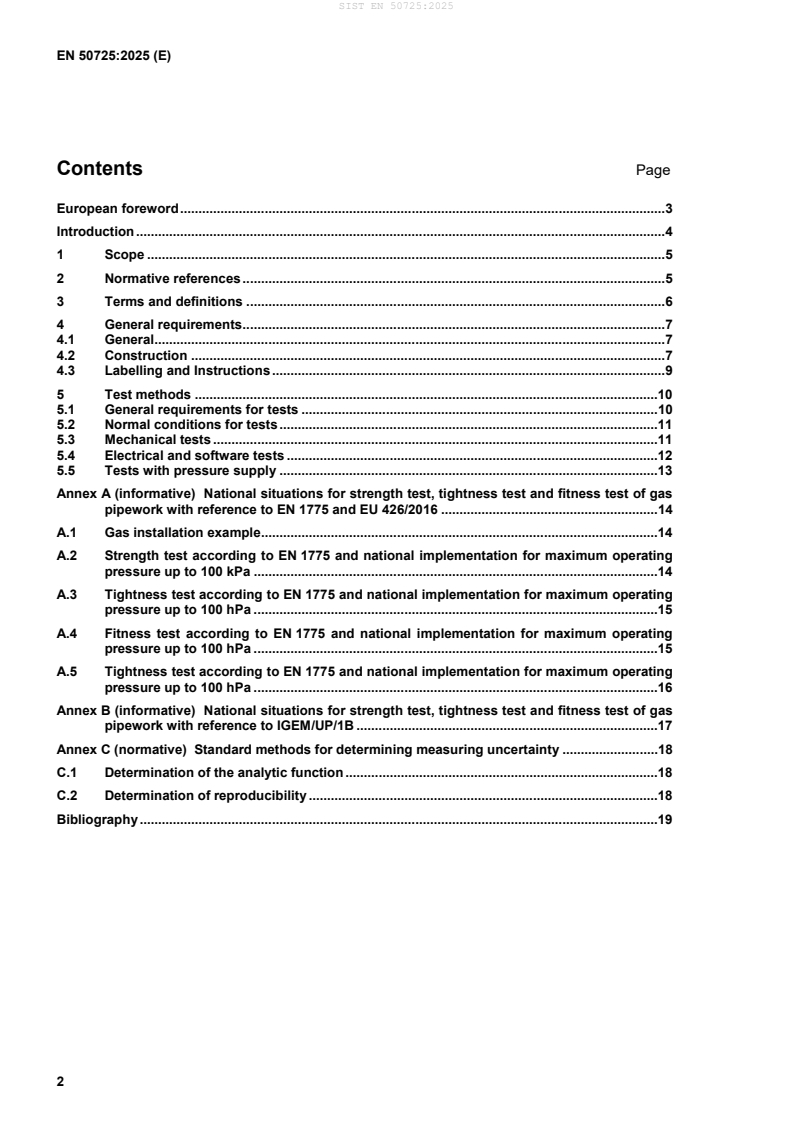
Contents Page
European foreword . 3
Introduction . 4
1 Scope . 5
2 Normative references . 5
3 Terms and definitions . 6
4 General requirements . 7
4.1 General . 7
4.2 Construction . 7
4.3 Labelling and Instructions . 9
5 Test methods .10
5.1 General requirements for tests .10
5.2 Normal conditions for tests .11
5.3 Mechanical tests .11
5.4 Electrical and software tests .12
5.5 Tests with pressure supply .13
Annex A (informative) National situations for strength test, tightness test and fitness test of gas
pipework with reference to EN 1775 and EU 426/2016 .14
A.1 Gas installation example .14
A.2 Strength test according to EN 1775 and national implementation for maximum operating
pressure up to 100 kPa .14
A.3 Tightness test according to EN 1775 and national implementation for maximum operating
pressure up to 100 hPa .15
A.4 Fitness test according to EN 1775 and national implementation for maximum operating
pressure up to 100 hPa .15
A.5 Tightness test according to EN 1775 and national implementation for maximum operating
pressure up to 100 hPa .16
Annex B (informative) National situations for strength test, tightness test and fitness test of gas
pipework with reference to IGEM/UP/1B .17
Annex C (normative) Standard methods for determining measuring uncertainty .18
C.1 Determination of the analytic function .18
C.2 Determination of reproducibility .18
Bibliography .19
European foreword
This document (EN 50725:2025) has been prepared by CLC/TC/216 “Gas Detectors”.
The following dates are fixed:
• latest date by which this document has to be (dop) 2026-02-28
implemented at national level by publication of
an identical national standard or by
endorsement
• latest date by which the national standards (dow) 2028-02-29
conflicting with this document have to be
withdrawn
Attention is drawn to the possibility that some of the elements of this document may be the subject of patent
rights. CENELEC shall not be held responsible for identifying any or all such patent rights.
Any feedback and questions on this document should be directed to the users’ national committee. A complete
listing of these bodies can be found on the CENELEC website.
Introduction
This document covers apparatus for measuring draught and gas pressure of heating appliances and systems.
It forms a specification of portable electrical apparatus designed to measure draught and gas pressure of heating
appliances and systems.
The measuring uncertainty should be justified by internationally accepted methods over the whole measuring
range. The determination of measuring uncertainty is described in Annex C.
1 Scope
This document specifies the requirements and test methods concerning, in particular the construction, safety,
and fitness for purpose, as well as the capability and marking of a hand-held battery powered pressure and
leakage measurement instrument, hereafter referred to as “pressure meters”, for gas pipework in buildings, gas
pipes of appliances and draught in chimneys.
NOTE Areas of application can be supply pressure of gas appliances, nozzle pressure of gas appliances (see relevant
instruction manuals of gas appliances) as well as strength test, tightness test and fitness test of gas pipework as defined in
EN 1775 (see Annex A) and relevant national standards (see Annex B) for gas pipework in buildings, and draught
measurement in chimneys of heating appliances.
This document covers pressure meters with the capability of
• use with air, natural gas, liquid petroleum gas (LPG), hydrogen and mixtures of natural gas and hydrogen,
• measuring pressure in units of bar, mbar, Pa, hPa, kPa, MPa, in H O, mm H2O, or PSI,
• measuring leakage rate in l/h,
• withstanding the every-day working environment encountered by installation and service engineers in
domestic, commercial, or industrial premises.
Such pressure meters might be capable of
• being switchable between units by the user,
• storing and/or transmitting said measurements to a remote user.
2 Normative references
The following documents are referred to in the text in such a way that some or all of their content constitutes
requirements of this document. For dated references, only the edition cited applies. For undated references, the
latest edition of the referenced document (including any amendments) applies.
EN IEC 61326-1, Electrical equipment for measurement, control and laboratory use — EMC requirements
— Part 1: General requirements (IEC 61326-1)
EN 50271:2018, Electrical apparatus for the detection and measurement of combustible gases, toxic gases or
oxygen — Requirements and tests for apparatus using software and/or digital technologies
EN 60068-2-6, Environmental testing — Part 2-6: Tests — Test Fc: Vibration (sinusoidal) (IEC 60068-2-6)
EN IEC 60335-1:2023, Household and similar electrical appliances — Safety — Part 1: General requirements
(IEC 60335-1:2020)
EN 60529:1991, Degrees of protection provided by enclosures (IP Code)
ISO/IEC Guide 98-3:2008, Uncertainty of measurement — Part 3 — Guide to the expression of uncertainty in
measurement (GUM: 1995)
As impacted by EN IEC 60335-1:2023/A11:2023.
As impacted by EN 60529:1991/corrigendum May 1993, EN 60529:1991/AC:2016-12,
EN 60529:1991/A1:2000 and EN 60529:1991/A2:2013.
3 Terms and definitions
For the purposes of this document, the following terms and definitions apply.
ISO and IEC maintain terminology databases for use in standardization at the following addresses:
• ISO Online browsing platform: available at https://www.iso.org/obp
• IEC Electropedia: available at https://www.electropedia.org/
3.1
domestic residential and commercial premises
any place of residence of a household, family or person (whether temporary or permanent) and commercial
premises whether residential or not and including recreational boats, caravans and mobile homes
3.2
sensors
assembly in which the sensing element is housed and which may contain associated circuit components
3.3
sensing element
device, the output of which will change with variation of the parameter of interest
3.4
spot reading
apparatus intended to be used for short periods of time in the range of minutes, as required
3.5
mains powered apparatus
apparatus designed to be powered by the domestic mains electrical supply with or without an additional power
source
3.6
battery powered apparatus
apparatus designed to be energised from batteries alone, whether disposable or rechargeable
3.7
sampling point connector
part of the apparatus that is used to connect the apparatus to the appliance for the purpose of sampling the
pressure
3.8
initial start up delay
time taken for the apparatus to reach the operating mode from switch-on, or after replacing batteries, or following
power failure in the case of mains powered equipment
3.9
calibration
process of determining the deviation of an apparatus relative to a reference
3.10
reference
in laboratory tests, a measuring device with certification proving traceability to a national or international
metrology institute
3.11
adjustment
process of tuning the apparatus, in order to return the deviation found in calibration to within the admissible
error
3.12
functional module
all components required for one measurement task, including both hardware and software
Note 1 to entry: A functional module may consist of one or more separate pieces of equipment or may be completely
integrated with the apparatus.
3.13
response time (t90)
time interval with the apparatus in a warmed-up condition, between the time when an Instantaneous variation
of the parameter to be measured is produced at the apparatus inlet, and the time when the response reaches
and remains beyond 90 % of the final indication
3.14
gas leakage rate
volume flow (unit l/h) of burnable gas that escapes from the line system during a specified duration due to
leakage
3.15
standard volume flow
volume flow (unit l/h) with reference to the physical standard temperature and pressure at a temperature of
273,15 K and a pressure of 1 013,25 hPa
3.16
operating volume flow
volume flow (unit l/h) with reference to the operating conditions (pressure, temperature) prevailing at the place
of measurement
3.17
operating pressure
actual operating pressure as standing pressure found at the time of measurement
3.18
reference operating pressure
reference pressure for determining the leakage quantity as operating volume flow
4 General requirements
4.1 General
The apparatus shall reliably measure the applied pressure and shall clearly display the result.
4.2 Construction
4.2.1 General
All parts of the apparatus, including the sensors, shall be constructed of materials that will not be adversely
affected by vapours and gases or chemical substances to be expected during normal operation of the apparatus,
see 4.3.2 g). Similar consideration shall also be given to the sampling system and components that can be in
contact with the measuring medium, as appropriate. The sampling point connector shall be constructed of
materials that will not be adversely affected by environmental conditions found in applications within the scope
of this document.
4.2.2 Sampling system
The method of testing tightness of the complete gas sampling system, as specified by the manufacturer or
installer, shall be checked and verified in practice.
4.2.3 Adjustment
Access to sensitivity controls shall only be possible by the use of special tool or a software pass-code or by
destroying a special seal. Any regular checks shall be performed automatically or by access as described above.
4.2.4 Power supply
Apparatus which derives its power from internal batteries may give a visual warning before the battery capacity
falls to a point where either the apparatus sensitivity or the stated display accuracy falls outside the
requirements. When this point is actually reached, a clear Indication shall be given to alert the user and the
display shall switch out of normal operational mode.
4.2.5 Display
Indicators shall be provided to show the following:
— measured value(s) and physical unit;
— low battery warning;
— mode of operation or instrument status (e.g. warm-up, measurement);
— when values lie outside the indicating range; and
— software version.
For each separate parameter measured, the apparatus shall display the value, the physical unit and parameter
description. For a combination of parameters, the display may switch automatically from one indication to
another. If the display switches between information of simultaneous parameters it shall be clear and
understandable. Displayed measured values shall be refreshed at intervals no greater than 3 s. If the apparatus
is equipped with seven-segment displays it shall have a device or self-testing function for checking the displays.
4.2.6 Measuring range and resolution
Table 1 lists the different parameters covered by this document. For each parameter given it specifies:
— minimum indication range;
— minimum display resolution;
— accuracy of the apparatus;
— the detection limit; and
— maximum response time.
4.2.7 Indication range
The indication ranges are the minimum ranges for the apparatus. Higher ranges are allowed but will not change
the values for accuracy or detection limit.
4.2.8 Accuracy of the apparatus
The values in Table 1 e.g. “± 20 Pa or 5 % rel.” have the meaning: “The permitted deviation is up to ± 20 Pa or
± 5 % of the reading, whichever is the greater”.
4.2.9 Detection limit
Values Indicated below the detection limit are not significant.
Table 1 — Requirements for accuracy
Display Detection Response
Parameter Indication range Accuracy
resolution limit time t90
± 2 Pa
Low range −50 Pa to +200 Pa 1 Pa 1 Pa 10s
or 5 % rel.
± 50 Pa or
Mid-range 0 Pa to 20 000 Pa 10 Pa 100 Pa 10 s
3 % rel.
± 200 Pa
High range 0 Pa to 300 000 Pa 100 Pa 500 Pa 10 s
or 3 % rel.
± 0,2 l/h
Leakage rate 0 to 8 l/h 0,1 l/h or ± 5 % 0,1l/h N/A
rel.
4.2.10 Printer or data storage or transmission
If the apparatus is provided with a printer or any means for data storage or transmission e.g. a data logger it
shall print, store or transmit the date, time and values or parameters, as specified in 4.2.6, taken at the time of
the printout.
4.2
...