

EN 50194-1:2023
(Main)Electrical apparatus for the detection of flammable gases in household premises - Part 1: Test methods and performance requirements
General Information
- Abstract
This document specifies general requirements for the construction, testing and performance of electrically operated apparatus for the detection of flammable gases, designed for continuous operation in a fixed installation in household premises. The apparatus can be mains or battery powered. Additional requirements for apparatus to be used in recreational vehicles and similar premises are specified in EN 50194-2. NOTE For caravan holiday homes EN 50194-1 applies. This document specifies four types of apparatus to warn and/or alarm in the event of an escape of town gas, natural gas or liquefied petroleum gas (LPG), Hydrogen and flammable refrigerant gases: — Type A apparatus – provides a visual and audible alarm and an executive action in the form of an output signal that can actuate directly or indirectly a shut-off device and/or other ancillary device in the event of an escape of town gas, natural gas (LNG) liquefied petroleum gas (LPG) and Hydrogen gases; — Type B apparatus – same as Type A but provides a visual and audible alarm only; — Type C apparatus – provides a visual and audible alarm and an executive action in the form of an output signal that can actuate directly or indirectly a shut-off device and/or other ancillary device in the event of an escape of flammable refrigerant gas A2L, A2 or A3 as classified in other International Standards, e.g. ISO 817; — Type D apparatus – intended to be installed where there can be a source of danger to the public, designed for continuous operation in fixed installations in non-classified explosive atmosphere premises (where the requirements for electrical Ex-safety are not requested). Intended for any flammable gases. Typically Type D apparatus are available with analogue or digital output, designed as detection system. These systems are regularly maintained by competent persons and/or have a protection of IP44 or higher. For type D apparatus, EN 60079-29-1 is applied. See Annex C for further clarification on the apparatus types and their application. NOTE Apparatus complying with this document is not considered suitable for installation in potentially explosive atmospheres, in which case the EN 60079 series applies. NOTE Apparatus complying with EN 60079-29-1 will not necessarily comply with this document. This document does not apply to any of the following: — apparatus intended for the detection of dusts or mists in air; — scientific or laboratory-based apparatus used only for analysis or measurement; — apparatus used exclusively for process measurement purposes; — apparatus for medical purposes; — apparatus used for breath alcohol measurement; — apparatus intended for the direct measurement of automotive exhaust gases; — apparatus intended for use in industrial environments.
- Status
- Published
- Publication Date
- 12-Oct-2023
- Technical Committee
- CLC/TC 216 - Gas detectors (see also SC 31-9)
- Drafting Committee
- CLC/TC 216/WG 15 - Working group for the revision of EN 50194-1
- Current Stage
- 6060 - Document made available - Publishing
- Start Date
- 13-Oct-2023
- Due Date
- 19-Oct-2022
- Completion Date
- 13-Oct-2023

Overview
EN 50194-1:2023 (CLC / CENELEC) specifies test methods and performance requirements for electrical apparatus for detection of flammable gases in household premises. It applies to mains- or battery-powered fixed installations intended for continuous operation in homes (including caravan holiday homes). The standard defines four apparatus types (A, B, C, D) and covers construction, labelling, testing, performance, user instructions and packaging for domestic gas detectors.
Key topics and technical requirements
This standard addresses practical design and verification topics commonly required for gas detector compliance:
- Apparatus types and functions
- Type A: visual + audible alarm and an executive output to actuate shut-off/ancillary devices for town gas, natural gas, LPG and Hydrogen.
- Type B: visual + audible alarm only.
- Type C: visual + audible alarm plus executive output for flammable refrigerant gases (A2L/A2/A3).
- Type D: detection systems for public non-classified premises, analogue/digital outputs, IP44+, maintained by competent persons (EN 60079-29-1 applied).
- Construction and design requirements: housing, indicators, alarms, end‑of‑life prediction, fault warnings, battery connections and battery reversal protection.
- Performance and testing: alarm set points, response time, long-term stability, temperature/humidity/air‑velocity effects, slow gas concentration increase, effects of other gases, ignition testing and refrigerant/oil poisoning tests (Type C).
- Electrical and communications: transmittable output signals (Type A/C), EMC testing, supply-voltage variation tests, radio‑link range and failure modes for wireless interconnectable detectors.
- Battery and power: low voltage warning, battery capacity assessment, removable/replacable sensor instructions and back-up power monitoring.
- User information: installation location guidance, emergency actions, maintenance and replacement instructions.
Applications and who uses it
EN 50194-1:2023 is used by:
- Manufacturers and product designers developing domestic gas detectors to meet European performance requirements.
- Test laboratories and certification bodies performing type testing, EMC and environmental verification.
- Installers and competent persons specifying compliant devices for homes and caravan holiday homes.
- Regulators and safety engineers writing procurement specifications or policies for household flammable gas detection. This standard helps ensure reliable flammable gas detection, safe alarm behaviour, correct sensor end-of-life handling, and interoperability where required.
Related standards
- EN 50194-2: additional requirements for recreational vehicles (RVs).
- EN 60079 series / EN 60079-29-1: applicable for potentially explosive atmospheres and Type D system guidance - detectors compliant with one standard may not automatically comply with the other.
Keywords: EN 50194-1:2023, gas detectors, flammable gas detection, household premises, test methods, performance requirements, Type A B C D, CLC, CENELEC.
Relations
- Effective Date
- 01-Jun-2021
- Effective Date
- 10-Feb-2026
- Effective Date
- 09-Feb-2026
- Effective Date
- 09-Feb-2026
- Effective Date
- 03-Feb-2026
- Effective Date
- 03-Feb-2026
- Effective Date
- 03-Feb-2026
- Effective Date
- 03-Feb-2026
- Effective Date
- 03-Feb-2026
- Effective Date
- 03-Feb-2026
- Effective Date
- 03-Feb-2026
- Effective Date
- 03-Feb-2026
- Effective Date
- 03-Feb-2026
Get Certified
Connect with accredited certification bodies for this standard

CIS Institut d.o.o.
Personal Protective Equipment (PPE) certification body. Notified Body NB-2890 for EU Regulation 2016/425 PPE.

Kiwa BDA Testing
Building and construction product certification.
Kmetijski inštitut Slovenije
Agricultural Institute of Slovenia. Soil testing, plant health, agricultural product analysis.
Sponsored listings
Frequently Asked Questions
EN 50194-1:2023 is a standard published by CLC. Its full title is "Electrical apparatus for the detection of flammable gases in household premises - Part 1: Test methods and performance requirements". This standard covers: This document specifies general requirements for the construction, testing and performance of electrically operated apparatus for the detection of flammable gases, designed for continuous operation in a fixed installation in household premises. The apparatus can be mains or battery powered. Additional requirements for apparatus to be used in recreational vehicles and similar premises are specified in EN 50194-2. NOTE For caravan holiday homes EN 50194-1 applies. This document specifies four types of apparatus to warn and/or alarm in the event of an escape of town gas, natural gas or liquefied petroleum gas (LPG), Hydrogen and flammable refrigerant gases: — Type A apparatus – provides a visual and audible alarm and an executive action in the form of an output signal that can actuate directly or indirectly a shut-off device and/or other ancillary device in the event of an escape of town gas, natural gas (LNG) liquefied petroleum gas (LPG) and Hydrogen gases; — Type B apparatus – same as Type A but provides a visual and audible alarm only; — Type C apparatus – provides a visual and audible alarm and an executive action in the form of an output signal that can actuate directly or indirectly a shut-off device and/or other ancillary device in the event of an escape of flammable refrigerant gas A2L, A2 or A3 as classified in other International Standards, e.g. ISO 817; — Type D apparatus – intended to be installed where there can be a source of danger to the public, designed for continuous operation in fixed installations in non-classified explosive atmosphere premises (where the requirements for electrical Ex-safety are not requested). Intended for any flammable gases. Typically Type D apparatus are available with analogue or digital output, designed as detection system. These systems are regularly maintained by competent persons and/or have a protection of IP44 or higher. For type D apparatus, EN 60079-29-1 is applied. See Annex C for further clarification on the apparatus types and their application. NOTE Apparatus complying with this document is not considered suitable for installation in potentially explosive atmospheres, in which case the EN 60079 series applies. NOTE Apparatus complying with EN 60079-29-1 will not necessarily comply with this document. This document does not apply to any of the following: — apparatus intended for the detection of dusts or mists in air; — scientific or laboratory-based apparatus used only for analysis or measurement; — apparatus used exclusively for process measurement purposes; — apparatus for medical purposes; — apparatus used for breath alcohol measurement; — apparatus intended for the direct measurement of automotive exhaust gases; — apparatus intended for use in industrial environments.
This document specifies general requirements for the construction, testing and performance of electrically operated apparatus for the detection of flammable gases, designed for continuous operation in a fixed installation in household premises. The apparatus can be mains or battery powered. Additional requirements for apparatus to be used in recreational vehicles and similar premises are specified in EN 50194-2. NOTE For caravan holiday homes EN 50194-1 applies. This document specifies four types of apparatus to warn and/or alarm in the event of an escape of town gas, natural gas or liquefied petroleum gas (LPG), Hydrogen and flammable refrigerant gases: — Type A apparatus – provides a visual and audible alarm and an executive action in the form of an output signal that can actuate directly or indirectly a shut-off device and/or other ancillary device in the event of an escape of town gas, natural gas (LNG) liquefied petroleum gas (LPG) and Hydrogen gases; — Type B apparatus – same as Type A but provides a visual and audible alarm only; — Type C apparatus – provides a visual and audible alarm and an executive action in the form of an output signal that can actuate directly or indirectly a shut-off device and/or other ancillary device in the event of an escape of flammable refrigerant gas A2L, A2 or A3 as classified in other International Standards, e.g. ISO 817; — Type D apparatus – intended to be installed where there can be a source of danger to the public, designed for continuous operation in fixed installations in non-classified explosive atmosphere premises (where the requirements for electrical Ex-safety are not requested). Intended for any flammable gases. Typically Type D apparatus are available with analogue or digital output, designed as detection system. These systems are regularly maintained by competent persons and/or have a protection of IP44 or higher. For type D apparatus, EN 60079-29-1 is applied. See Annex C for further clarification on the apparatus types and their application. NOTE Apparatus complying with this document is not considered suitable for installation in potentially explosive atmospheres, in which case the EN 60079 series applies. NOTE Apparatus complying with EN 60079-29-1 will not necessarily comply with this document. This document does not apply to any of the following: — apparatus intended for the detection of dusts or mists in air; — scientific or laboratory-based apparatus used only for analysis or measurement; — apparatus used exclusively for process measurement purposes; — apparatus for medical purposes; — apparatus used for breath alcohol measurement; — apparatus intended for the direct measurement of automotive exhaust gases; — apparatus intended for use in industrial environments.
EN 50194-1:2023 is classified under the following ICS (International Classification for Standards) categories: 13.320 - Alarm and warning systems. The ICS classification helps identify the subject area and facilitates finding related standards.
EN 50194-1:2023 has the following relationships with other standards: It is inter standard links to EN 50194-1:2009, IEC 60335-2-40:2022, EN 1775:2007, EN 437:2021, EN 60704-1:2010, EN 60335-1:2002, EN 60529:1991, EN 60335-1:2012, EN 50271:2018, EN 50270:2015, EN 50244:2016, EN 50270:2006, EN 50194-2:2006. Understanding these relationships helps ensure you are using the most current and applicable version of the standard.
EN 50194-1:2023 is available in PDF format for immediate download after purchase. The document can be added to your cart and obtained through the secure checkout process. Digital delivery ensures instant access to the complete standard document.
Standards Content (Sample)
SLOVENSKI STANDARD
01-december-2023
Električne naprave za zaznavanje vnetljivih plinov, ki se uporabljajo v
gospodinjskih okoljih - 1. del: Preskusne metode in zahtevane lastnosti
Electrical apparatus for the detection of flammable gases in household premises - Part 1:
Test methods and performance requirements
Elektrische Geräte für die Detektion von brennbaren Gasen in Wohnhäusern – Teil 1:
Prüfverfahren und Anforderungen an das Betriebsverhalten
Matériels électriques pour la détection des gaz inflammables dans les locaux à usage
domestique - Partie 1: Méthodes d’essai et exigences d’aptitude à la fonction
Ta slovenski standard je istoveten z: EN 50194-1:2023
ICS:
13.320 Alarmni in opozorilni sistemi Alarm and warning systems
2003-01.Slovenski inštitut za standardizacijo. Razmnoževanje celote ali delov tega standarda ni dovoljeno.
EUROPEAN STANDARD EN 50194-1
NORME EUROPÉENNE
EUROPÄISCHE NORM October 2023
ICS 13.320 Supersedes EN 50194-1:2009
English Version
Electrical apparatus for the detection of flammable gases in
household premises - Part 1: Test methods and performance
requirements
Matériels électriques pour la détection des gaz Elektrische Geräte für die Detektion von brennbaren Gasen
inflammables dans les locaux à usage domestique - in Wohnhäusern - Teil 1: Prüfverfahren und Anforderungen
Partie 1: Méthodes d'essai et exigences d'aptitude à la an das Betriebsverhalten
fonction
This European Standard was approved by CENELEC on 2023-08-14. CENELEC members are bound to comply with the CEN/CENELEC
Internal Regulations which stipulate the conditions for giving this European Standard the status of a national standard without any alteration.
Up-to-date lists and bibliographical references concerning such national standards may be obtained on application to the CEN-CENELEC
Management Centre or to any CENELEC member.
This European Standard exists in three official versions (English, French, German). A version in any other language made by translation
under the responsibility of a CENELEC member into its own language and notified to the CEN-CENELEC Management Centre has the
same status as the official versions.
CENELEC members are the national electrotechnical committees of Austria, Belgium, Bulgaria, Croatia, Cyprus, the Czech Republic,
Denmark, Estonia, Finland, France, Germany, Greece, Hungary, Iceland, Ireland, Italy, Latvia, Lithuania, Luxembourg, Malta, the
Netherlands, Norway, Poland, Portugal, Republic of North Macedonia, Romania, Serbia, Slovakia, Slovenia, Spain, Sweden, Switzerland,
Türkiye and the United Kingdom.
European Committee for Electrotechnical Standardization
Comité Européen de Normalisation Electrotechnique
Europäisches Komitee für Elektrotechnische Normung
CEN-CENELEC Management Centre: Rue de la Science 23, B-1040 Brussels
© 2023 CENELEC All rights of exploitation in any form and by any means reserved worldwide for CENELEC Members.
Ref. No. EN 50194-1:2023 E
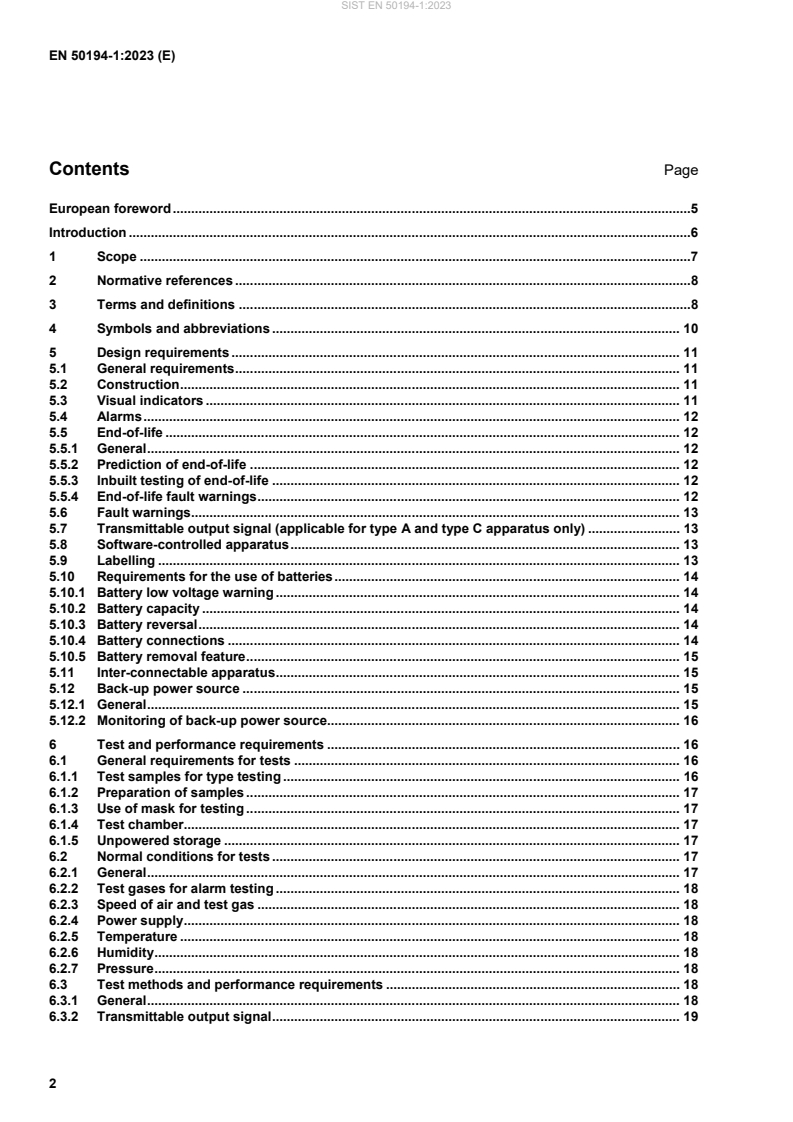
Contents Page
European foreword .5
Introduction .6
1 Scope .7
2 Normative references .8
3 Terms and definitions .8
4 Symbols and abbreviations . 10
5 Design requirements . 11
5.1 General requirements . 11
5.2 Construction . 11
5.3 Visual indicators . 11
5.4 Alarms . 12
5.5 End-of-life . 12
5.5.1 General . 12
5.5.2 Prediction of end-of-life . 12
5.5.3 Inbuilt testing of end-of-life . 12
5.5.4 End-of-life fault warnings . 12
5.6 Fault warnings . 13
5.7 Transmittable output signal (applicable for type A and type C apparatus only) . 13
5.8 Software-controlled apparatus . 13
5.9 Labelling . 13
5.10 Requirements for the use of batteries . 14
5.10.1 Battery low voltage warning . 14
5.10.2 Battery capacity . 14
5.10.3 Battery reversal . 14
5.10.4 Battery connections . 14
5.10.5 Battery removal feature . 15
5.11 Inter-connectable apparatus . 15
5.12 Back-up power source . 15
5.12.1 General . 15
5.12.2 Monitoring of back-up power source. 16
6 Test and performance requirements . 16
6.1 General requirements for tests . 16
6.1.1 Test samples for type testing . 16
6.1.2 Preparation of samples . 17
6.1.3 Use of mask for testing . 17
6.1.4 Test chamber . 17
6.1.5 Unpowered storage . 17
6.2 Normal conditions for tests . 17
6.2.1 General . 17
6.2.2 Test gases for alarm testing . 18
6.2.3 Speed of air and test gas . 18
6.2.4 Power supply . 18
6.2.5 Temperature . 18
6.2.6 Humidity . 18
6.2.7 Pressure . 18
6.3 Test methods and performance requirements . 18
6.3.1 General . 18
6.3.2 Transmittable output signal . 19
6.3.3 Alarm set point . 19
6.3.4 Alarm during warm-up time . 19
6.3.5 Response time . 19
6.3.6 Temperature effects . 20
6.3.7 Humidity effects . 20
6.3.8 Air velocity test . 20
6.3.9 Supply voltage variations (mains powered apparatus only) . 20
6.3.10 Electromagnetic compatibility . 21
6.3.11 Slow increase of gas volume ratio . 21
6.3.12 Effects of other gases . 21
6.3.13 Long term stability . 22
6.3.14 Ignition test . 22
6.3.15 Refrigerant poisoning and oil spray test (for Type C apparatus only) . 23
6.3.16 Alarm sound level . 23
6.3.17 Degree of protection . 24
6.3.18 Mechanical strength . 24
6.3.19 Stability in high humidity test (for type C apparatus) . 24
6.3.20 Stability to low humidity test (for type C apparatus) . 25
7 Apparatus using radio links . 25
7.1 General . 25
7.1.1 General . 25
7.1.2 RF range and reproducibility tests . 25
7.1.3 Failure of radio link . 25
7.1.4 Identification codes . 25
7.1.5 Environmental requirements . 25
7.2 Radio link tests . 26
7.2.1 RF Range . 26
7.2.2 Failure of radio link tests . 26
7.2.3 Identification codes verification tests . 26
7.2.4 Environmental tests . 27
8 Self-contained battery powered apparatus . 27
8.1 Battery low voltage warning . 27
8.1.1 General . 27
8.1.2 Test . 27
8.1.3 Performance requirements . 28
8.2 Battery capacity . 28
8.2.1 General . 28
8.2.2 Assessment . 28
8.2.3 Performance requirements . 28
8.3 Battery reversal . 28
8.3.1 General . 28
8.3.2 Test . 28
8.3.3 Performance requirements . 28
8.4 Battery connections with flexible leads only. 29
8.4.1 General . 29
8.4.2 Test . 29
8.4.3 Performance requirements . 29
8.5 Back-up power source . 29
8.5.1 Objective. 29
8.5.2 Test . 29
8.5.3 Performance requirements . 29
9 User instructions . 30
9.1 General . 30
9.2 Instructions for apparatus with replaceable sensor . 31
9.3 Instructions on location of the gas detection apparatus . 31
9.4 Instructions on emergency actions . 31
10 Packaging . 32
Annex A (informative) Test arrangement schematics for sound level test . 33
Annex B (informative) Calculation of the expected battery service life . 34
B.1 General requirements . 34
B.2 Example . 34
Annex C (informative) Clarification of the Type A, Type B, Type C and Type D apparatus. 36
Bibliography . 37
European foreword
This document (EN 50194-1:2023) has been prepared by CLC/TC 216 “Gas detectors”, the secretariat of which
is held by BSI.
The following dates are fixed:
• latest date by which this document has to be (dop) 2024-08-14
implemented at national level by publication of
an identical national standard or by
endorsement
• latest date by which the national standards (dow) 2026-08-14
conflicting with this document have to be
withdrawn
This document supersedes EN 50194-1:2009 and all of its amendments and corrigenda (if any).
Description Clause
This document has been completely revised following the structure of All
EN 50291-1:2018
End of Life indicator has been made mandatory and shall include an audible and 5.5
visible warning
Guidance has been added for assessing battery capacity and expected life 8.2
Requirements for mains powered alarms with back-up supply have been added 8.5
The number of potential interference gases has been increased
Tests have been added for an optional alarm silence facility
Requirements have been added for apparatus using radio links Clause 7
Added requirements for the use of batteries 5.10
Annex B has been added Annex B
New requirement to comply with EN 50271 Standard for software 5.8
Defined type C apparatus for refrigerant gases Clause 1
Bibliography has been added
Annex C “A-deviations” has been removed
Tests for stability in high humidity (non-condensing) and low humidity for Type C 6.3.19 and 6.3.20
apparatus has been added
Ignition test for Hydrogen and Type C apparatus has been added 6.3.14
Tests for refrigerant poisoning and oil spray for Type C apparatus has been added 6.3.15
Revision of the Normative references Clause 2
Attention is drawn to the possibility that some of the elements of this document may be the subject of patent
rights. CENELEC shall not be held responsible for identifying any or all such patent rights.
Any feedback and questions on this document should be directed to the users’ national committee. A complete
listing of these bodies can be found on the CENELEC website.
Introduction
This document defines test methods and performance requirements for all electrical gas detection apparatus
used in residential and household premises by means of measurement of one or more threshold alarm levels.
It is addressed to the manufacturers of such apparatus and test laboratories which validate it.
This document is an updated revision of the previous EN 50194-1 issued in 2009 and includes some new
concepts of detection:
The term of “domestic” has been implemented in “household premises” in order to include further applications,
i.e. shops, offices, hotel rooms, residential premises and in general where household appliances are installed
(as defined in IEC/EN 60335-1).
This document implements a new range of the flammable gases to be detected. In the premises within the
scope of this document, also flammable refrigerant gases, R-717 (Ammonia) at LFL level and Hydrogen in fuel
cells applications may be present and are thus necessary to consider.
Finally, the document structure has been completely revised in order to align this revision with the similar
standard EN 50291-1:2018 for Carbon Monoxide and other new standards concerning digital and software
technologies.
1 Scope
This document specifies general requirements for the construction, testing and performance of electrically
operated apparatus for the detection of flammable gases, designed for continuous operation in a fixed
installation in household premises. The apparatus can be mains or battery powered.
Additional requirements for apparatus to be used in recreational vehicles and similar premises are specified in
EN 50194-2.
NOTE For caravan holiday homes EN 50194-1 applies.
This document specifies four types of apparatus to warn and/or alarm in the event of an escape of town gas,
natural gas or liquefied petroleum gas (LPG), Hydrogen and flammable refrigerant gases:
— Type A apparatus – provides a visual and audible alarm and an executive action in the form of an output
signal that can actuate directly or indirectly a shut-off device and/or other ancillary device in the event of an
escape of town gas, natural gas (LNG) liquefied petroleum gas (LPG) and Hydrogen gases;
— Type B apparatus – same as Type A but provides a visual and audible alarm only;
— Type C apparatus – provides a visual and audible alarm and an executive action in the form of an output
signal that can actuate directly or indirectly a shut-off device and/or other ancillary device in the event of an
escape of flammable refrigerant gas A2L, A2 or A3 as classified in other International Standards, e.g.
ISO 817;
— Type D apparatus – intended to be installed where there can be a source of danger to the public, designed
for continuous operation in fixed installations in non-classified explosive atmosphere premises (where the
requirements for electrical Ex-safety are not requested). Intended for any flammable gases.
Typically Type D apparatus are available with analogue or digital output, designed as detection system.
These systems are regularly maintained by competent persons and/or have a protection of IP44 or higher.
For type D apparatus, EN 60079-29-1 is applied.
See Annex C for further clarification on the apparatus types and their application.
NOTE Apparatus complying with this document is not considered suitable for installation in potentially explosive
atmospheres, in which case the EN 60079 series applies.
NOTE Apparatus complying with EN 60079-29-1 will not necessarily comply with this document.
This document does not apply to any of the following:
— apparatus intended for the detection of dusts or mists in air;
— scientific or laboratory-based apparatus used only for analysis or measurement;
— apparatus used exclusively for process measurement purposes;
— apparatus for medical purposes;
— apparatus used for breath alcohol measurement;
— apparatus intended for the direct measurement of automotive exhaust gases;
— apparatus intended for use in industrial environments.
2 Normative references
The following documents are referred to in the text in such a way that some or all of their content constitutes
requirements of this document. For dated references, only the edition cited applies. For undated references, the
latest edition of the referenced document (including any amendments) applies.
EN 437:2021, Test gases. Test pressures. Appliance categories
EN 1775, Gas supply - Gas pipework for buildings - Maximum operating pressure less than or equal to 5 bar -
Functional recommendations
EN 50244:2016, Electrical apparatus for the detection of combustible gases in domestic premises - Guide on
the selection, installation, use and maintenance
EN 50270, Electromagnetic compatibility - Electrical apparatus for the detection and measurement of
combustible gases, toxic gases or oxygen
EN 50271, Electrical apparatus for the detection and measurement of combustible gases, toxic gases or oxygen
-Requirements and tests for apparatus using software and/or digital technologies
EN 60335-1:2002, Household and similar electrical appliances - Safety - Part 1: General requirements
EN 60335-1:2012, Household and similar electrical appliances – Safety - Part 1: General requirements
IEC 60335-2-40:2022, Household and similar electrical appliances. Safety - Part 2-40: Particular requirements
for electrical heat pumps, air-conditioners and dehumidifiers
EN 60529:1991, Degrees of protection provided by enclosures (IP Code) (IEC 60529:1989)
EN 60704-1:2010, Household and similar electrical appliances - Test code for the determination of airborne
acoustical noise - Part 1: General requirements (IEC 60704-1:2010)
3 Terms and definitions
For the purposes of this document, the following terms and definitions apply.
ISO and IEC maintain terminological databases for use in standardization at the following addresses:
— IEC Electropedia: available at https://www.electropedia.org/
— ISO Online browsing platform: available at https://www.iso.org/obp
3.1
ambient conditions
normal atmosphere surrounding the apparatus
3.2
clean air
air which is free from combustible gases, interfering and contaminating substances
3.3
household premises
any house or building being a place of residence or home of a household, family or person
3.4
fixed installation
apparatus which is intended to have all parts except replaceable batteries permanently installed
3.5
latching alarm
alarm which, once activated, requires deliberate action for resetting
3.6
lower flammable limit
LFL
volume ratio of flammable gas or vapour in air below which an explosive gas atmosphere will not be formed
3.6.1
Upper Flammable Limit
UFL
volume ratio of flammable gas or vapour in air above which an explosive gas atmosphere will not be formed
3.7
sensor
assembly in which the sensing element is housed and which may contain associated circuit components
3.8
sensing element
part of the sensor which is sensitive to the gas/vapour to be measured, the output of which will change in the
presence of flammable gas
3.8.1
integral sensor
sensor which is within or directly mounted to the equipment housing
3.9
volume ratio
V/V
ratio of the volume of a component to the volume of the gas mixture
3.10
transmittable output signal
signal characterised by a standby and an activation state by which action may be initiated
EXAMPLE Triggering a ventilation device.
3.11
warm-up time
time interval between the time when the apparatus is switched on and the time when the apparatus is fully
operational
3.12
alarm set point
fixed setting of the apparatus that determines the volume ratio of combustible gas at which the apparatus will
automatically initiate an alarm and for Type A and Type C apparatus, an output signal
3.13
fault warning
visual or audible warning signal indicating a faulty or failed apparatus
3.14
LPG
butane, propane or mixtures thereof
3.14.1
flammable refrigerant gas
refrigerant gas classified as safety group A2L, A2 or A3 according to ISO 817
3.15
mains powered apparatus
apparatus designed to be powered by the domestic or household mains electrical supply, with or without
additional power source
3.16
self-contained battery powered apparatus
apparatus provided with an internal battery to provide the necessary amount of energy for a predefined duration
of operation
3.17
continuous operation
apparatus which is continuously powered with continuous or intermittent automatic sensing
3.18
recreational vehicle
vehicle such as a recreational craft, caravan and motor caravan
NOTE Other motorised vehicles like trucks are known to have residential accommodation. They are not recreational
vehicles but are considered as similar premises in respect of this document.
3.19
caravan holiday home
transportable leisure accommodation vehicle that does not meet requirements for construction and use of road
vehicles, that retains means for mobility, and that is for temporary or seasonal occupation
[SOURCE: EN 13878:2019]
3.20
gas detection apparatus
detector
apparatus comprising the sensor, remote sensor if applicable, alarm and other circuit components, power supply
and for Type A and Type C apparatus a means of providing an output signal
3.21
end-of-life
point in time when the apparatus is replaced
3.22
free-field conditions
conditions where there are a minimum number of sound reflecting surfaces or radio frequency reflecting
surfaces
4 Symbols and abbreviations
For the purposes of this document, the following symbols and abbreviations apply.
U supply voltage at which the low battery warning is given
E
U rated battery voltage
R
R resistance at which the low battery warning is given with a supply voltage U
A
R
5 Design requirements
5.1 General requirements
5.1.1 Unless otherwise stated, the requirements specified are applicable to Type A, Type B and Type C
apparatus.
5.1.2 The apparatus shall reliably detect the presence of combustible gas under the stated application
conditions, shall produce an alarm, and in the case of Type A and Type C apparatus, shall be able to initiate
executive actions whenever the level exceeds a pre-set alarm volume ratio.
5.1.3 Apparatus which includes additional functionality outside the scope of this document, shall perform
according to the requirements of this document.
5.1.4 The apparatus, electrical assemblies and components shall comply with the construction requirements
of 5.2 to 5.6 and the test and performance requirements of Clause 6. Apparatus shall be designed for fixed
installation and continuous operation. The apparatus shall not be class 0 as defined in EN 60335-1:2002, 3.3.7.
5.1.5 Where the sensor (defined in 3.7) is replaceable, the design of the apparatus shall be such that
replacement of the sensor does not affect the compliance of the entire apparatus with the requirements of this
document.
5.1.6 The apparatus shall indicate end-of-life as per 5.5.4.
5.1.7 The apparatus shall be provided with an installation and maintenance instruction booklet or leaflet
meeting the requirements of Clause 9.
5.1.8 The apparatus shall be designed so as to discourage unauthorised interference or adjustment.
5.1.9 Except for batteries and replaceable sensors, the apparatus shall not have any user-replaceable or
serviceable components.
5.2 Construction
When the sensor is replaceable, mechanical and/or electrical means shall guarantee the replacement of the
sensor without errors. In the case of electrical recognition of the incorrect connection or the absence of the
sensor, the detector shall automatically signal a fault and/or alarm. Moreover, it shall be impossible, or
recognized as an error, to connect a sensor designed for a certain type of gas to a detector designed for a
different type of gas.
5.3 Visual indicators
5.3.1 The power supply visual indicator shall be fitted and shall be coloured green. For mains-powered
apparatus the visual indicator shall be continuously illuminated. For battery powered apparatus the visual
indicator shall flash at least once per minute.
5.3.2 The visual alarm indicator shall be fitted and shall be coloured red.
5.3.3 The visual fault indicator shall be fitted and shall be yellow.
5.3.4 The visual indicators shall be marked to show their function. Alternatively, the function of the visual
indicator may be marked somewhere else on the apparatus, where it is visible in the normally installed position.
5.3.5 The visual indicators shall be visible when the apparatus is installed in its operating position according
to the manufacturer’s instructions.
5.4 Alarms
5.4.1 The apparatus, if stand alone or part of a detection system, shall have an audible alarm
5.4.2 The visual alarm indicator and audible alarm shall operate simultaneously at the set points.
5.4.3 An audible alarm shall have a continuous temporal pattern with no silent period greater than 6 s.
5.4.4 The red visual indicators shall flash continuously or in sync with the temporal pattern of the audible
alarm.
5.4.5 Once activated, the alarm shall remain in operation until the flammable concentration has decreased
below the alarm level, unless silenced manually by the user.
5.4.6 Visual indicators and audible alarms, shall operate at a volume ratio above 3 % LFL and below 20 %
LFL of the gas to be monitored for type A and B and above 1 % LFL and below 25 % LFL for Type C. The
alarms shall remain in operation at gas volume ratios above that alarm set point.
For some apparatus, for example catalytic gas detectors, the measured flammable concentration will drop below
LFL when concentration reaches above UFL. A latched alarm can for such apparatus be used to make sure the
alarm stays active until it has been verified no gas at alarm level is present.
The manufacturer shall declare the alarm set point of the apparatus. When measured as specified in 6.3.3.2,
the alarm shall operate within ± 2,5 % LFL of the declared value. For all tests thereafter, the alarm set point
shall be within ± 5 % LFL of the declared value but within the overall band of above 3 % LFL and not exceeding
20 % LFL for type A and B and above 1 % and below 25 % LFL for type C
5.5 End-of-life
5.5.1 General
The end-of-life indicator shall be activated at a point that is determined either by prediction or inbuilt testing.
The manufacturer shall determine the minimum length of time, either by prediction or extended stability testing.
When end-of-life is reached, the apparatus shall be replaced.
5.5.2 Prediction of end-of-life
Where the apparatus utilizes the battery voltage to determine end-of-life, the manufacturer shall supply
calculations of worst-case current consumption, worst-case battery capacity, typical duty-cycle, likely
temperature excursions and sensor data to ensure that the operating lifetime of the battery does not exceed the
lifetime of any other components including the sensor.
Where the apparatus utilizes the battery low voltage to determine end-of-life, the battery shall be tamperproof
and it shall not be possible to remove it without the use of a tool.
The manufacturer shall submit to the test laboratory, and retain evidence of, the methodology and any
supporting calculations which have been used to predict the end-of-life.
5.5.3 Inbuilt testing of end-of-life
The manufacturer shall submit to the test laboratory, and retain evidence of, the methodology and any
supporting calculations which demonstrate the operation of the inbuilt testing of the end-of-life detection. This
shall be a fully automated process.
The manufacturer shall submit to the test laboratory, and retain evidence of, evidence that the frequency of
testing is sufficient to detect the end-of-life, within 30 days of its occurrence.
5.5.4 End-of-life fault warnings
The end-of-life indication shall utilize either the visual fault warning or a separate end-of-life visual indicator.
The end-of-life audible indication shall be clearly different from the gas alarm indication.
5.6 Fault warnings
5.6.1 The apparatus shall provide an audible and visible fault warning within 10 min of loss of continuity or
short circuit to the sensor.
5.6.2 The audible fault warning shall be clearly identified and different from a gas alarm.
5.6.3 The visual fault warning shall be as per 5.3.3.
5.6.4 The audible low battery warning shall be clearly identified and different from a gas alarm.
5.7 Transmittable output signal (applicable for type A and type C apparatus only)
The type A and type C apparatus shall provide a transmittable output signal at each of the alarm conditions.
Open-circuit or short-circuit failure of the transmittable output signal shall not prevent the correct operation of
the apparatus as a stand-alone alarm.
The transmittable output signal shall be tested in accordance with 6.3.2.
5.8 Software-controlled apparatus
The apparatus shall fulfil the requirements of EN 50271.
5.9 Labelling
5.9.1 For the text on the apparatus, national regulations can apply.
5.9.2 The apparatus shall carry durable label(s) or markings carrying the following information:
a) the manufacturer's or supplier's name, trademark or other means of identification;
b) the name of apparatus, model number (if any) and the type of gas to be detected;
c) the number of this document;
d) the type of apparatus, A, B or C;
e) the serial number or manufacturing date code of the apparatus;
f) for mains-powered apparatus the electricity supply voltage and frequency and maximum power
consumption;
g) for battery-powered apparatus the type and size of replacement batteries (where replaceable);
h) indication of the maximum lifetime recommended for the apparatus;
i) when the apparatus has a replaceable sensor, indication that the apparatus shall be de-energised before
the sensor is replaced.
5.9.3 The markings b) and h) shall be clearly visible with the apparatus in a typical installed position.
5.9.4 Where the sensor is replaceable, the apparatus shall carry the next replacement date of the sensor that
shall be clearly visible with the apparatus in a typical installed position. This data shall be updated in the
apparatus at each revision or replacement of the sensor, with the new date given by the manufacturer. If the
updating procedure provides the application of a pre-printed label, this shall be supplied with the new sensor
with a warning to replace the previous label attached to the apparatus with the new one: Every sensor shall be
provided with a marking which allows traceability of the manufacturing and calibration information of each single
sensor (e.g. serial number, manufacturing batch/production date, expected lifetime of the apparatus, etc.).
5.9.5 The markings shall be legible and durable. The durability of the markings shall be checked by
establishing that it cannot be removed when rubbed lightly with a piece of cloth soaked in petroleum spirit and
then water. When symbols are used, they shall comply with EN 60335-1:2012, 7.6.
5.9.6 The apparatus shall carry a caution, on a label attached to the apparatus (or be marked on the
apparatus), giving the following or equivalent information:
CAUTION: READ THE INSTRUCTIONS CAREFULLY
BEFORE OPERATING OR SERVICING.
5.10 Requirements for the use of batteries
5.10.1 Battery low voltage warning
Battery-powered apparatus shall give a visual fault indicator per 5.3.3 and a coincident audible fault warning
before a decrease in the performance of the battery prevents correct operation of the apparatus. This shall not
inhibit the alarm condition.
For a apparatus powered by a primary battery the low voltage warning duration shall be at least 30 days.
The battery low voltage warning shall be indicated by:
a) a visual fault indicator per 5.3.3, and
b) an audible indicator which sounds at least once per minute coincident with the visual indicator.
The battery low voltage warning audible indication shall be clearly different for the gas alarm indication.
If the apparatus is in an alarm condition, the low battery indications shall be overridden and the alarm shall
function as specified in 5.4.2.
If a facility is activated to silence battery low voltage warning it shall not inhibit the audible alarm signal.
5.10.2 Battery capacity
Batteries shall be capable of supplying the quiescent load of the apparatus together with the additional load of
routine testing, for a period of 12 months, or longer if specified by the apparatus manufacturer, before the battery
low voltage warning is given. At the point when the Battery low voltage warning commences, the batteries shall
have sufficient capacity to give an alarm signal as specified in 5.4. The manufacturer shall provide, to the test
laboratory, the discharge curves. Corresponding to the standby current of the alarm as well as accelerated
discharge currents (for example 10 times or 100 times standby current) for the batteries intended for use. This
data and not the battery manufacturer data shall be used to estimate the battery capacity.
Guidance on the calculation of the expected battery service life is given in Annex B.
5.10.3 Battery reversal
The battery reversal test shall be applied to apparatus inc
...