


prEN IEC 61803:2025
(Main)Determination of power losses in high-voltage direct current (HVDC) converter stations
Determination of power losses in high-voltage direct current (HVDC) converter stations
Détermination des pertes en puissance dans les stations de conversion en courant continu à haute tension (CCHT)
Ugotavljanje močnostnih izgub v visokonapetostnih enosmernih (HVDC) pretvorniških postajah
General Information
- Status
- Not Published
- Publication Date
- 03-Jan-2027
- Technical Committee
- CLC/TC 22X - Power electronics
- Current Stage
- 4060 - Enquiry results established and sent to TC, SR, BTTF - Enquiry
- Start Date
- 29-Aug-2025
- Completion Date
- 29-Aug-2025
Relations
- Effective Date
- 06-Feb-2024
Overview
The prEN IEC 61803:2025 standard, titled Determination of Power Losses in High-Voltage Direct Current (HVDC) Converter Stations, provides a comprehensive methodology for calculating power losses in HVDC converter stations. Developed by the CLC under the International Electrotechnical Commission (IEC), this third edition updates and expands on previous versions, incorporating modern technologies and refined calculation methods. The document is designed for use with HVDC converter stations employing either line-commutated converters (LCC) or voltage-sourced converters (VSC), specifically MMC-type or similar low harmonic generating designs.
This standard supports utility-scale power transmission systems by providing accurate, standardized processes to assess operational efficiency and optimize station performance. It includes guidelines for loss determination covering no-load and operating conditions essential for system planning, maintenance, and performance evaluation.
Key Topics
Scope and Applicability
Applies to HVDC converter stations with LCC and VSC technologies. Key focus is on 12-pulse thyristor converters for LCC and MMC-type VSCs. Excludes loss determination for synchronous compensators, static var compensators (SVC), and static synchronous compensators (STATCOM).Loss Determination Methods
Offers detailed calculation procedures for various types of equipment losses including:- Thyristor valve losses specific to LCC
- Transformer no-load and operating losses
- AC filter, shunt capacitor bank, shunt reactor, DC smoothing reactor, and DC filter losses
- Auxiliary and station service losses
- Series and valve reactor losses (particularly for VSC)
Environmental and Operating Conditions
Establishes reference conditions for ambient temperature, coolant temperature, and air pressure to ensure consistency in loss calculations.Technical Enhancements
Incorporates recent advances in thyristor technology affecting conduction and switching losses, reflecting improved thyristor parameter consistency. Adjusts total station load loss calculations to improve accuracy.Informative Annexes
Include guidance on harmonic currents and voltages for LCC, typical station loss values for LCC and VSC, and illustrative examples demonstrating loss evaluation under various operational scenarios.
Applications
Utility HVDC Power Transmission
Engineered specifically for power utilities to systematically quantify and minimize losses in converter stations, aiding in efficiency improvement and cost reduction.Converter Station Design and Optimization
Essential for engineers and planners designing HVDC converter stations to predict operational losses accurately, enabling better sizing, cooling, and component selection.Maintenance and Performance Monitoring
Facilitates condition-based maintenance by providing baseline loss data for detecting deviations indicative of equipment degradation or failure.Energy Management and Regulatory Compliance
Assists in documenting and reporting efficiency performance to comply with energy regulations and support sustainability goals.Academic and Industrial Research
Serves as a reference framework for research on HVDC conversion technology, contributing to innovations and advancements in power electronics for electrical transmission.
Related Standards
IEC 62751: Covers power loss determination specifically for valves in VSC HVDC systems, complementing IEC 61803 by addressing detailed VSC valve losses.
IEC 61803 (Previous Editions): Earlier editions provide foundational methodologies which are refined and enhanced in the 2025 version.
IEC Technical Committee 22 Publications: Includes various standards related to power electronics systems and equipment for electrical transmission and distribution.
Standards on Power Transformers and Equipment: Relevant for understanding transformer losses and cooling considerations in converter stations.
By adhering to the prEN IEC 61803:2025 standard, power system operators, engineers, and manufacturers gain a reliable and internationally harmonized approach for assessing HVDC converter station losses-crucial for optimizing high-voltage direct current transmission infrastructure and improving overall grid efficiency.

Get Certified
Connect with accredited certification bodies for this standard

UL Solutions
Global safety science company with testing, inspection and certification.

CEPREI Certification Center (Guangzhou Saibao)
Pioneer of third-party certification, subsidiary of Electronic Fifth Research Institute.
CESI Beijing Certification (Saisi)
Subsidiary of China Electronics Standardization Institute (CESI), established 1963.
Sponsored listings
Frequently Asked Questions
prEN IEC 61803:2025 is a draft published by CLC. Its full title is "Determination of power losses in high-voltage direct current (HVDC) converter stations". This standard covers: Determination of power losses in high-voltage direct current (HVDC) converter stations
Determination of power losses in high-voltage direct current (HVDC) converter stations
prEN IEC 61803:2025 is classified under the following ICS (International Classification for Standards) categories: 29.200 - Rectifiers. Convertors. Stabilized power supply. The ICS classification helps identify the subject area and facilitates finding related standards.
prEN IEC 61803:2025 has the following relationships with other standards: It is inter standard links to EN IEC 61803:2020. Understanding these relationships helps ensure you are using the most current and applicable version of the standard.
prEN IEC 61803:2025 is available in PDF format for immediate download after purchase. The document can be added to your cart and obtained through the secure checkout process. Digital delivery ensures instant access to the complete standard document.
Standards Content (Sample)
SLOVENSKI STANDARD
01-julij-2025
Ugotavljanje močnostnih izgub v visokonapetostnih enosmernih (HVDC)
pretvorniških postajah
Determination of power losses in high-voltage direct current (HVDC) converter stations
Détermination des pertes en puissance dans les postes de conversion en courant
continu à haute tension (CCHT)
Ta slovenski standard je istoveten z: prEN IEC 61803:2025
ICS:
29.200 Usmerniki. Pretvorniki. Rectifiers. Convertors.
Stabilizirano električno Stabilized power supply
napajanje
2003-01.Slovenski inštitut za standardizacijo. Razmnoževanje celote ali delov tega standarda ni dovoljeno.
22F/821/CDV
COMMITTEE DRAFT FOR VOTE (CDV)
PROJECT NUMBER:
IEC 61803 ED3
DATE OF CIRCULATION: CLOSING DATE FOR VOTING:
2025-06-06 2025-08-29
SUPERSEDES DOCUMENTS:
22F/778/CD, 22F/800A/CC
IEC SC 22F : POWER ELECTRONICS FOR ELECTRICAL TRANSMISSION AND DISTRIBUTION SYSTEMS
SECRETARIAT: SECRETARY:
IEC Secretariat Ms Suzanne Yap
OF INTEREST TO THE FOLLOWING COMMITTEES: HORIZONTAL FUNCTION(S):
TC 115
ASPECTS CONCERNED:
SUBMITTED FOR CENELEC PARALLEL VOTING NOT SUBMITTED FOR CENELEC PARALLEL VOTING
Attention IEC-CENELEC parallel voting
The attention of IEC National Committees, members of
CENELEC, is drawn to the fact that this Committee Draft for
Vote (CDV) is submitted for parallel voting.
The CENELEC members are invited to vote through the
CENELEC online voting system.
This document is still under study and subject to change. It should not be used for reference purposes.
Recipients of this document are invited to submit, with their comments, notification of any relevant patent rights of which
they are aware and to provide supporting documentation.
Recipients of this document are invited to submit, with their comments, notification of any relevant “In Some Countries”
clauses to be included should this proposal proceed. Recipients are reminded that the CDV stage is the final stage for
submitting ISC clauses. (SEE AC/22/2007 OR NEW GUIDANCE DOC).
TITLE:
Determination of power losses in high-voltage direct current (HVDC) converter stations
PROPOSED STABILITY DATE: 2029
NOTE FROM TC/SC OFFICERS:
This CDV is prepared based on 22F/778/CD and the agreed NC comments in 22F/800A/CC by SC 22F/MT 14
(Convenor: Mr. Sanjay Mukoo).
electronic file, to make a copy and to print out the content for the sole purpose of preparing National Committee positions.
You may not copy or "mirror" the file or printed version of the document, or any part of it, for any other purpose without
permission in writing from IEC.
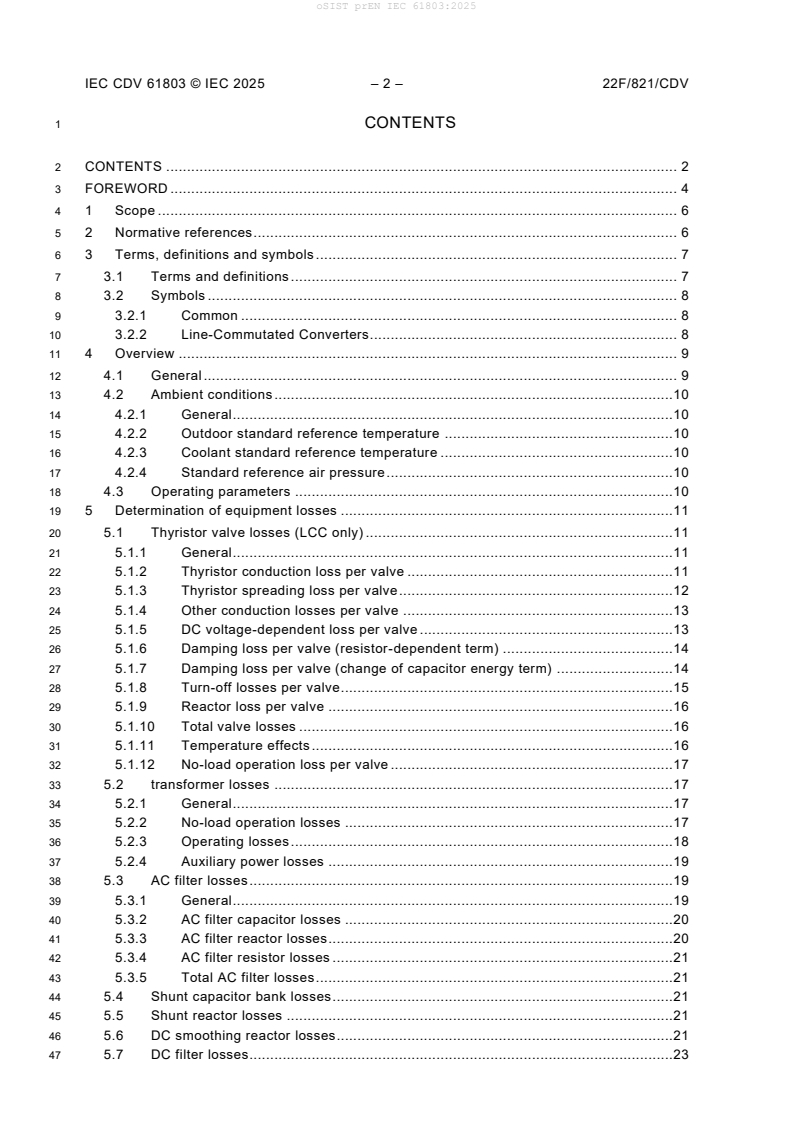
IEC CDV 61803 © IEC 2025 – 2 – 22F/821/CDV
1 CONTENTS
2 CONTENTS . 2
3 FOREWORD . 4
4 1 Scope . 6
5 2 Normative references . 6
6 3 Terms, definitions and symbols . 7
7 3.1 Terms and definitions . 7
8 3.2 Symbols . 8
9 3.2.1 Common . 8
10 3.2.2 Line-Commutated Converters. 8
11 4 Overview . 9
12 4.1 General . 9
13 4.2 Ambient conditions . 10
14 4.2.1 General . 10
15 4.2.2 Outdoor standard reference temperature . 10
16 4.2.3 Coolant standard reference temperature . 10
17 4.2.4 Standard reference air pressure . 10
18 4.3 Operating parameters . 10
19 5 Determination of equipment losses . 11
20 5.1 Thyristor valve losses (LCC only) . 11
21 5.1.1 General . 11
22 5.1.2 Thyristor conduction loss per valve . 11
23 5.1.3 Thyristor spreading loss per valve . 12
24 5.1.4 Other conduction losses per valve . 13
25 5.1.5 DC voltage-dependent loss per valve . 13
26 5.1.6 Damping loss per valve (resistor-dependent term) . 14
27 5.1.7 Damping loss per valve (change of capacitor energy term) . 14
28 5.1.8 Turn-off losses per valve . 15
29 5.1.9 Reactor loss per valve . 16
30 5.1.10 Total valve losses . 16
31 5.1.11 Temperature effects . 16
32 5.1.12 No-load operation loss per valve . 17
33 5.2 transformer losses . 17
34 5.2.1 General . 17
35 5.2.2 No-load operation losses . 17
36 5.2.3 Operating losses . 18
37 5.2.4 Auxiliary power losses . 19
38 5.3 AC filter losses . 19
39 5.3.1 General . 19
40 5.3.2 AC filter capacitor losses . 20
41 5.3.3 AC filter reactor losses . 20
42 5.3.4 AC filter resistor losses . 21
43 5.3.5 Total AC filter losses . 21
44 5.4 Shunt capacitor bank losses . 21
45 5.5 Shunt reactor losses . 21
46 5.6 DC smoothing reactor losses. 21
47 5.7 DC filter losses. 23
IEC CDV 61803 © IEC 2025 – 3 – 22F/821/CDV
48 5.7.1 General . 23
49 5.7.2 DC filter capacitor losses . 23
50 5.7.3 DC filter reactor losses . 23
51 5.7.4 DC filter resistor losses . 24
52 5.7.5 Total DC filter losses . 24
53 5.8 Auxiliaries and station service losses . 24
54 5.9 Series filter losses . 25
55 5.10 Phase reactor losses (VSC only) . 26
56 5.11 Valve reactor losses (VSC only) . 26
57 5.12 Other equipment losses . 27
58 Annex A (informative) Calculation of harmonic currents and voltages (LCC only) . 35
59 A.1 Harmonic currents in converter transformers . 35
60 A.2 Harmonic currents in the AC filters . 35
61 A.3 Harmonic voltages on the DC side . 36
62 A.4 DC side harmonic currents in the smoothing reactor. 36
63 Annex B (informative) Typical station losses . 37
64 Annex C (informative) HVDC converter station loss evaluation – An illustration . 38
65 C.1 General . 38
66 C.2 Loss evaluation under various cases . 39
67 Bibliography . 41
69 Figure 1 – Typical high-voltage direct current (HVDC) equipment for one pole of a HVDC
70 scheme .30
71 Figure 2 – Simplified three-phase diagram of an HVDC 12-pulse converter (LCC) .31
72 Figure 3 – Simplified equivalent circuit of a typical thyristor valve .31
73 Figure 4 – Current and voltage waveforms of a valve operating in a 12-pulse converter .32
74 Figure 5 – Thyristor on-state characteristic .33
75 Figure 6 – Conduction current and voltage drop of thyristor .33
76 Figure 7 – Distribution of commutating inductance between L and L .34
1 2
77 Figure 8 – Thyristor current during reverse recovery .34
79 Table B.1 – Typical values of losses for a LCC Station.37
80 Table B.2 – Typical values of losses for a VSC MMC Station .37
81 Table C.1 – Conditions for calculation of losses in case D1 .40
82 Table C.2 – Conditions for calculation of losses in case D2 .40
IEC CDV 61803 © IEC 2025 – 4 – 22F/821/CDV
85 INTERNATIONAL ELECTROTECHNICAL COMMISSION
86 ____________
88 DETERMINATION OF POWER LOSSES IN HIGH-VOLTAGE
89 DIRECT CURRENT (HVDC) CONVERTER STATIONS
92 FOREWORD
93 1) The International Electrotechnical Commission (IEC) is a worldwide organization for standardization comprising all national
94 electrotechnical committees (IEC National Committees). The object of IEC is to promote international co -operation on all
95 questions concerning standardization in the electrical and electronic fields. To this end and in addition to other activities ,
96 IEC publishes International Standards, Technical Specifications, Technical Reports, Publicly Available Specifications
97 (PAS) and Guides (hereafter referred to as "IEC Publication(s)"). Their preparation is entrusted to technical committees;
98 any IEC National Committee interested in the subject dealt with may participate in this preparatory work. International,
99 governmental and non-governmental organizations liaising with the IEC also participate in this preparation. IEC
100 collaborates closely with the International Organization for Standardization (ISO) in accordance with conditions determined
101 by agreement between the two organizations.
102 2) The formal decisions or agreements of IEC on technical matters express, as nearly as possible, an international consensus
103 of opinion on the relevant subjects since each technical committee has representation from all interested IEC National
104 Committees.
105 3) IEC Publications have the form of recommendations for international use and are accepted by IEC National Committees
106 in that sense. While all reasonable efforts are made to ensure that the technical content of IEC Publications is accurate,
107 IEC cannot be held responsible for the way in which they are used or for any misinterpretation by any end user.
108 4) In order to promote international uniformity, IEC National Committees undertake to apply IEC Publications transparently
109 to the maximum extent possible in their national and regional publications. Any divergence between any IEC Publication
110 and the corresponding national or regional publication shall be clearly indicated in the latter.
111 5) IEC itself does not provide any attestation of conformity. Independent certification bodies provide conformity assessment
112 services and, in some areas, access to IEC marks of conformity. IEC is not responsible for any services carried out by
113 independent certification bodies.
114 6) All users should ensure that they have the latest edition of this publication.
115 7) No liability shall attach to IEC or its directors, employees, servants or agents including individual experts and members of
116 its technical committees and IEC National Committees for any personal injury, property damage or other damage of any
117 nature whatsoever, whether direct or indirect, or for costs (including legal fees) and expenses arising out of the publicatio n,
118 use of, or reliance upon, this IEC Publication or any other IEC Publications.
119 8) Attention is drawn to the Normative references cited in this publication. Use of the referenced publications is indispensable
120 for the correct application of this publication.
121 9) Attention is drawn to the possibility that some of the elements of this IEC Publication may be the subject of patent rights.
122 IEC shall not be held responsible for identifying any or all such patent rights.
123 International Standard IEC 61803 has been prepared by subcommittee 22F: Power electronics for
124 electrical transmission and distribution systems, of IEC technical committee 22: Power electronic
125 systems and equipment.
126 This third edition cancels and replaces the second edition published in 2020. This edition constitutes
127 a technical revision.
128 This edition includes the following significant technical changes with respect to the previous edition:
129 a) HVDC stations with Voltage-Sourced Converters (VSC) technology have been included:
130 b) to facilitate the application of this document and to ensure its quality remains consistent, 5.1.8 and
131 5.8 have been reviewed, taking into consideration that the present thyristor production technology
132 provides considerably less thyristor parameters dispersion comparing with the situation in 1999
133 when the first edition of IEC 61803 was developed, and therefore the production records of
134 thyristors can be used for the power losses calculation;
135 c) the calculation of the total station load losses (cases D1 and D2 in Annex C) has been corrected.
136 The text of this International Standard is based on the following documents:
IEC CDV 61803 © IEC 2025 – 5 – 22F/821/CDV
FDIS Report on voting
22F/XXX/FDIS 22F/XXX/RVD
138 Full information on the voting for the approval of this International Standard can be found in the report
139 on voting indicated in the above table.
140 This document has been drafted in accordance with the ISO/IEC Directives, Part 2.
141 The committee has decided that the contents of this document will remain unchanged until the stability
142 date indicated on the IEC website under "http://webstore.iec.ch" in the data related to the specific
143 document. At this date, the document will be
144 • reconfirmed,
145 • withdrawn,
146 • replaced by a revised edition, or
147 • amended.
IEC CDV 61803 © IEC 2025 – 6 – 22F/821/CDV
150 DETERMINATION OF POWER LOSSES IN HIGH-VOLTAGE
151 DIRECT CURRENT (HVDC) CONVERTER STATIONS
156 1 Scope
157 This document applies to all high-voltage direct current (HVDC) converter stations with line-
158 commutated converters (LCC) as well with voltage-sourced converters (VSC) used for power exchange
159 (power transmission or back-to-back installation) in utility systems. For line-commutated converters
160 (LCC) this document presumes the use of 12-pulse thyristor converters, but can with due care, also be
161 used for 6-pulse thyristor converters.
162 Where VSC is referred to in this document, it is assumed to be of the MMC-type or similar, with very
163 low harmonic generation. Other types of VSC HVDC should be treated as appropriate.
164 In some applications, synchronous compensators, static var compensators (SVC), or static
165 synchronous compensator (STATCOM) may be connected to the AC bus of the HVDC converter station.
166 The loss determination procedures for such equipment are not included in this document.
167 This document presents a set of standard procedures for determining the total losses of an HVDC
168 converter station, except for VSC valves which are covered by IEC 62751. The procedures cover all
169 parts, except as noted above, and address no-load operation and operating losses together with their
170 methods of calculation which use, wherever possible, measured parameters.
171 Converter station designs employing novel components or circuit configurations compared to the typical
172 design assumed in this document, or designs equipped with unusual auxiliary circuits that could affect
173 the losses, are assessed on their own merits.
174 2 Normative references
175 The following documents are referred to in the text in such a way that some or all of their content
176 constitutes requirements of this document. For dated references, only the edition cited applies. For
177 undated references, the latest edition of the referenced document (including any amendments) applies.
178 IEC 60076-1, Power transformers – Part 1: General
179 IEC 60076-6, Power transformers – Part 6: Reactors
180 IEC 60633, High-voltage direct current (HVDC) transmission – Vocabulary
181 IEC 60700-1:2015, Thyristor valves for high voltage direct current (HVDC) power transmission – Part
182 1: Electrical testing
183 IEC 60871-1, Shunt capacitors for a.c. power systems having a rated voltage above 1 000 V – Part 1:
184 General
185 IEC 62747, Terminology for voltage-sourced converters (VSC) for high-voltage direct current (HVDC)
186 systems
IEC CDV 61803 © IEC 2025 – 7 – 22F/821/CDV
187 3 Terms, definitions and symbols
188 For the purposes of this document, the terms and definition given in IEC 60633, IEC 62747 and the
189 following apply.
190 ISO and IEC maintain terminological databases for use in standardization at the following addresses:
191 • IEC Electropedia: available at http://www.electropedia.org/
192 • ISO Online browsing platform: available at http://www.iso.org/obp
193 3.1 Terms and definitions
194 3.1.1
195 auxiliary losses
196 electric power required to feed the converter station auxiliary loads
197 Note 1 to entry: The auxiliary losses depend on the number of converter units used and whether the station is in no -load
198 operation or carrying load, in which case the auxiliary losses depend on the load level.
199 3.1.2
200 equipment no-load operation losses
201 losses produced in an item of equipment with the converter station energised but with the converters
202 blocked and all station service loads and auxiliary equipment connected as required for immediate
203 pick-up of load to specified minimum power
204 3.1.3
205 load level
206 set of AC system and converter operating conditions at which the converter station is operating
207 Note 1 to entry: For LCC schemes, the load level is defined by the direct current, direct voltage, firing angle, AC system
208 voltage and converter transformer tap-changer position.
209 Note 2 to entry: For VSC schemes, the load level is defined by the direct current, direct voltage, AC system voltage, interf ace
210 transformer tap-changer position (where appropriate), converter AC voltage, converter AC current and the phase angle
211 between converter AC voltage and current.
212 3.1.4
213 equipment operating losses
214 losses produced in an item of equipment at a given load level with the converter station energi sed and
215 the converters operating
216 3.1.5
217 rated load
218 load corresponding to operation at nominal values of the operating conditions defined in 3.1.3.
219 Note 1 to entry: The AC system shall be assumed to be at nominal frequency, and its 3-phase voltages are nominal and
220 balanced. The position of the tap-changer of the converter/interface transformer and the number of AC filters and shunt
221 reactive elements, if any connected shall be consistent with operation at rated load, coincident with nominal conditions.
222 3.1.6
223 total station no-load operation losses
224 sum of all equipment no-load operation losses (3.1.2) and corresponding auxiliary losses (3.1.1)
225 3.1.7
226 total station operating losses
227 sum of all equipment operating losses (3.1.4) and corresponding auxiliary losses (3.1.1) at a particular
228 load level
229 Note 1 to entry: An illustrative example using total station operating losses and corresponding loss evaluation is given in
230 Annex C, case D1.
IEC CDV 61803 © IEC 2025 – 8 – 22F/821/CDV
231 3.1.8
232 total station load losses
233 difference between total station operating losses (3.1.7) and total station no-load operation losses
234 (3.1.6)
235 Note 1 to entry: Such calculated total station load losses are considered as being quantitatively equivalent to load losses as
236 in conventional AC substation practice.
237 Note 2 to entry: It is recognized that some purchasers evaluate total station no-load operation losses (3.1.6) and total station
238 load losses individually instead of the evaluating total station operating losses (3.1.7).
239 Note 3 to entry: An illustrative example to derive load losses, equivalent load losses and corresponding loss evaluation is
240 given in Annex C, case D2.
241 3.1.9
242 station essential auxiliary load
243 load whose failure will affect the conversion capability of the HVDC converter station (e.g. valve
244 cooling), as well as load that shall remain working in case of complete loss of AC power supply (e.g.
245 battery chargers, operating mechanisms)
246 3.2 Symbols
247 3.2.1 Common
f AC system frequency, in hertz (Hz)
I direct current, in amperes (A)
d
I harmonic RMS current of order n, in amperes (A)
n
n harmonic order
P power loss in an item of equipment, in watts (W)
Q
quality factor at harmonic order n
n
R
resistance value, in ohms ()
U direct voltage, in volts (V)
d
U
harmonic RMS voltage of order n, in volts (V)
n
X
inductive reactance at harmonic order n, in ohms ()
n
248 3.2.2 Line-Commutated Converters
(trigger/firing) delay angle, in radians (rad)
overlap angle, in radians (rad)
L1 inductance, in henrys (H), referred to the valve winding, between the commutating
voltage source and the point of common coupling between star- and delta-connected
windings. L1 shall include any external inductance between the transformer line-
winding terminals and the point of connection of the AC harmonic filters.
L2 inductance, in henrys (H), referred to the valve winding, between the point of common
coupling between star- and delta-connected windings, and the valve. L2 shall include
the saturated inductance of the valve reactors.
m electromagnetic notch coupling factor, m = L1/(L1 + L2)
Nt number of series-connected thyristors per valve
U RMS value of the phase-to-phase no-load voltage on the valve side of the converter
vo
transformer excluding harmonics, in volts (V)
IEC CDV 61803 © IEC 2025 – 9 – 22F/821/CDV
250 4 Overview
251 4.1 General
252 Suppliers need to know in detail how and where losses are generated, since this affects component
253 and equipment ratings. Purchasers are interested in a verifiable loss figure which allows equitable bid
254 comparison and in a procedure after delivery which can objectively verify the guaranteed performance
255 requirements of the supplier.
256 As a general principle, it would be desirable to determine the efficiency of an HVDC converter station
257 by a direct measurement of its energy losses. However, attempts to determine the station losses by
258 subtracting the measured output power from the measured input power should recognize that such
259 measurements have an inherent inaccuracy, especially if performed at high voltage. The losses of an
260 HVDC converter station at full load are generally less than 1 % of the transmitted power. Therefore,
261 the loss measured as a small difference between two large quantities is not likely to be a sufficiently
262 accurate indication of the actual losses.
263 In some special circumstances, it may be possible, for example, to arrange a temporary test connection
264 in which two converters are operated from the same AC source and also connected together via their
265 DC terminals. In this connection, the power drawn from the AC source equals the losses in the circuit.
266 However, the AC source shall also provide var support and commutating voltage to the two converters.
267 Once again, there are practical measurement difficulties, and it still would need to be
268 recalculated/corrected for nominal parameters and ambient/operating conditions.
269 In order to avoid the problems described above since these practical measurements are unreliable and
270 also will depend on the type of HVDC solution, it is recommended to use this document which
271 standardizes a method of calculating the HVDC converter station losses by summing the losses
272 calculated for each item of equipment. The standardized calculation method will help the purchaser to
273 meaningfully compare the competing bids. It will also allow an easy generation of performance curves
274 for the wide range of operating conditions in which the performance has to be known. In the absence
275 of an inexpensive experimental method which could be employed for an objective verification of losses
276 during type tests, the calculation method is the next best alternative as it uses, wherever possible,
277 experimental data obtained from measurements on individual equipment and components under
278 conditions equivalent to those encountered in real operation.
279 Typical high-voltage direct current (HVDC) equipment for one pole of a LCC HVDC substation is shown
280 in Figure 1a and for one pole of a VSC HVDC substation in Figure 1b.The calculation of harmonic
281 currents and voltages in HVDC equipment for Line-Commutated Converter stations is described in
282 Annex A.
283 Compared with LCCs, VSCs for HVDC systems generate a much less distorted AC side current
284 waveform. Depending on the converter topology and the control methods employed, the network side
285 voltage generated by the converter may approach a clean fundamental frequency sinusoid. The
286 converter may be considered as a harmonic voltage source behind an internal impedance, rather than
287 a current source as for LCCs, as it is the generated harmonic voltage which remains independent of
288 load. The harmonic levels may be extremely low compared to LCCs, but due to the adopted switching
289 regime may have a significant frequency range much higher than for LCCs, and may contain inter-
290 harmonics, which are a product of the control strategy adopted. Refer to the IEC TR 62001-5 for
291 harmonics generation of VSC converters.
292 NOTE Where the term “harmonic” is used for VSC converters, it should be considered to mean the “harmonic group” according
293 to IEC 61000-4-7, which includes the integer harmonic and the spectral bins from h-0.5 to h+0.5, instead of “harmonic number
294 n”.
295 It is important to note that the power loss in each item of equipment will depend on the ambient
296 conditions under which it operates, as well as on the operating conditions or duty cycles to which it is
297 subjected. Therefore, the ambient and operating conditions shall be defined for each item of equipment,
298 based on the ambient and operating conditions of the entire HVDC converter station.
IEC CDV 61803 © IEC 2025 – 10 – 22F/821/CDV
299 It is recognized that for AC and DC side filter equipment, the specified notional requirements may not
300 represent the actual losses to be expected in service, however the simplified approach as specified in
301 this document, is considered reasonable to estimate losses and compare different bids .
302 4.2 Ambient conditions
303 4.2.1 General
304 A set of standard reference ambient conditions shall be used for determining the power losses in HVDC
305 converter stations.
306 4.2.2 Outdoor standard reference temperature
307 An outdoor ambient dry bulb temperature of 20 °C shall be used as the standard reference temperature
308 for determining the total converter station losses. Corresponding valve hall temperature may be defined
309 by the supplier if necessary. The equivalent wet-bulb temperature (where necessary) shall be defined
310 by the purchaser.
311 If not defined, the wet-bulb temperature is recommended to be 14 °C, which corresponds to
312 approximately 50 % RH at 20 °C dry bulb temperature.
313 4.2.3 Coolant standard reference temperature
314 Where forced cooling is used for equipment, the flow rate and temperature of the coolant can influence
315 the temperature rise and associated losses of that equipment. Therefore, the coolant temperatures and
316 flow rates established by the purchaser and the supplier shall be used as a basis for determining the
317 losses.
318 4.2.4 Standard reference air pressure
319 The reference air pressure to be used for the evaluation of total converter station power losses shall
320 be the standard atmospheric pressure (101,3 kPa) corrected to the altitude of the installation in
321 question when station is located above 1000 m above sea level.
322 4.3 Operating parameters
323 The losses of an HVDC converter station depend on its operating parameters.
324 The losses of HVDC converter stations are classified into two categories, referred to as operating
325 losses (3.1.4 and 3.1.7) and no-load operation losses (3.1.2 and 3.1.6).
326 The operating losses and auxiliary losses are affected by the load level of the station because the
327 numbers of certain types of energised equipment (for example harmonic filters and cooling equipment)
328 may depend upon the load level and because losses in individual items of equipment themselves vary
329 with the load level.
330 HVDC converter station losses shall be determined for nominal (balanced) AC system voltage and
331 frequency, symmetrical impedances of the transformer (between phases, and for LCC schemes,
332 between the star and delta-connected bridges) and, for LCC schemes, symmetrical firing angles. The
333 transformer tap-changer shall be assumed to be in the position corresponding to nominal AC system
334 voltage or as decided by the control system for the defined operating condition .
335 The operating losses shall be determined for the load levels specified by the purchaser, or at rated
336 load if no such conditions are specified. For each load level, the converter operating conditions defined
337 in 3.1.3, shunt compensation and harmonic filtering equipment shall be consistent with the respective
338 load level and other specified performance requirements, relating, for example, to harmonic distortion
339 and minimum reactive power exchange with the connected ac network. Cooling and other auxiliary
340 equipment, as appropriate to the standard reference temperature (see 4.2.2 and 4.2.3), shall be
341 assumed to be connected to support the respective load level. Unless specifically specified, reactive
342 power shall be assumed zero for a VSC station
IEC CDV 61803 © IEC 2025 – 11 – 22F/821/CDV
343 For the no-load operation mode, transformers shall be energised and the converters blocked. All filters
344 and reactive power compensation equipment shall be assumed to be disconnected except for those
345 which are required to sustain operation at zero load in order, for example, to meet the specified reactive
346 power requirements. Station service loads and auxiliary equipment (e.g. cooling-water pumps) shall be
347 assumed to be connected as required for immediate pick-up of load for the converter station (without
348 waiting for tap changer movement) to specified minimum power.
349 NOTE For some MMC VSC valves, it may not be feasible to let the converter blocked with AC circuit breaker closed for a
350 while, due to a need for balancing the submodule capacitor voltages. The operating state generally known as “idling operating
351 state” will also have additional contribution of valve losses. However, for the purpose of guarantee loss calculation, it is
352 sufficient to compare losses for No-load operation losses as defined in 3.1.2 at zero active and reactive power.
353 5 Determination of equipment losses
354 5.1 Thyristor valve losses (LCC only)
355 5.1.1 General
356 The loss production mechanisms applicable when the valves are blocked (no-load operation losses)
357 are different from those applicable in normal operation (operating losses). Operating losses are dealt
358 with in 5.1.2 to 5.1.11, and no-load operation losses are dealt with in 5.1.12. Auxiliary losses are dealt
359 with in 5.8.
360 A simplified three-phase diagram of an HVDC 12-pulse converter is shown in Figure 2. Individual valves
361 are marked in the order of their conduction sequence.
362 A simplified equivalent circuit of a typical valve is shown in Figure 3 – Symbol "th" combines together
363 the effects of N thyristors connected in series in the valve. C and R are the corresponding
t AC AC
364 combined values of R-C damping circuits used for voltage sharing and overvoltage suppression. R
DC
365 represents DC grading resistors and other resistive components which incur loss when the valve blocks
366 voltage. It also includes the effects of the thyristor leakage current (see 5.1.5 and 5.1.12). C includes
s
367 both stray capacitances and surge distribution capacitors (if used). L represents saturable reactors
s
368 used to limit the di/dt stresses to safe values and to improve the distribution of fast rising voltages. R
s
369 represents the resistances of the current conducting components of the valve such as the busbars,
370 contact resistances, resistance of the windings of the saturable reactors, etc. Power losses in the valve
371 surge arrester (not shown) shall be neglected.
372 Figure 4 – shows, as an example, current and voltage waveforms of valve 1 (according to Figure 2)
373 operating in rectifier – Figure 4 – a) – and inverter – Figure 4 – b) – modes. In the example shown, the
374 firing instants of the valves of the upper bridge are delayed by 30° with respect to the valves of the
375 lower bridge due to the phase shift between the two secondaries. For each valve, the length of the
376 conduction intervals is 130° (2/3 + μ). During commutations, the valve current is assumed, for this
377 document, to be changing linearly whereas in reality the valve currents follow portions of sine waves.
378 This simplification has negligible effect on the resulting losses, while the trapezoidal waveform
379 significantly simplifies the calculations. The voltage blocked by the valve shows notches caused by
380 commutations between individual valves.
381 5.1.2 Thyristor conduction loss per valve
382 A typical thyristor on-state characteristic is shown in Figure 5 –. Thyristor conduction loss component
383 is the product of the conduction current i(t) – Figure 6 – a) and the corresponding ideal on-state voltage
384 as shown in Figure 5 –. Formula P shall be used provided that the DC bridge current is well
V1a
385 smoothed. In the event that the root sum square value of the DC side harmonic currents, determined
386 in accordance with Clause A.4, exceeds 5 % of the DC component, formula P shall be used instead.
V1b
NI 2 −
td
387 P = U + R I
V1a 0 0 d
32
IEC CDV 61803 © IEC 2025 – 12 – 22F/821/CDV
n=48
N I U N R 2−
t d 0 t 022
388 P = + I + I
V1b d n
3 3 2
n=12
389 where
390 U is the current-independent component of the on-state voltage of the average thyristor (see note
391 below), in volts;
392 R is the slope resistance of the on-state characteristic of the average thyristor (see note below), in
393 ohms;
th
394 I is the calculated RMS value of the n harmonic current in the bridge DC connection according to
n
395 Clause A.4, in amperes.
396 NOTE U and R (see Figure 5 –) are determined from the fully spread on-state voltage measured at the appropriate current
0 0
397 and junction temperature. The average value of U and R is obtained from production records of the thyristors. The
0 0
398 temperature dependence of U and R is established from type tests or routine tests on a statistically significant number of
0 0
399 the thyristors employed, and is used, where necessary, to correct U and R to the appropriate service junction temperature.
0 0
400 If parallel connection of p thyristors is employed, the appropriate 100 % current is the nominal DC bridge current divided by
401 p. The calculated result is then multiplied by p.
402 5.1.3 Thyristor spreading loss per valve
403 This loss component is an additional conduction loss of the thyristors arising from the delay in
404 establishing full conduction of the silicon after the thyristor has been turned on. The additional loss is
405 the product of the current and the voltage by which the thyristor voltage exceeds the ideal thyristor on -
406 state voltage drop – see the hatched area in Figure 6 – b).
t1
407 P = N f u t − u t i t dt
( ) ( ) ( )
V2 t B A
408 where
409 t is the length of the conduction interval, in seconds, which is given by:
+
410 t = ;
2f
411 u (t) is the instantaneous on-state voltage, in volts, of a thyristor whose fully spread on-state voltage
B
412 is typical for the thyristors used; the instantaneous on-state voltage shall be determined for the
413 appropriate junction temperature measured with a trapezoidal current pulse exhibiting the
414 correct amplitude and commutation overlap periods (see Figure 5 – and Figure 6 –);
415 u (t) is the calculated instantaneous on-state voltage of the average thyristor at the same junction
A
416 temperature for the same current pulse but with the conducting area fully established throughout
417 the conduction, as derived from its on-state characteristic represented by U and R only (see
0 0
418 Figure 5 –);
419 i(t) is the instantaneous current in the thyristor, in amperes.
420 Instantaneous on-state voltage data, including the effects of spreading, are usually not available from
421 production records. Measurements of typical thyristor on-state voltage, including spreading, should
422 therefore be obtained during the valve periodic firing and extinction type test ( IEC 60700-1:2015,
423 Clause 9) or, alternatively, from a separate laboratory test on a statistically significant number of
424 thyristors.
IEC CDV 61803 © IEC 2025 – 13 – 22F/821/CDV
425 5.1.4 Other conduction losses per valve
426 These are the conduction losses in the main circuit of the valve due to components other than the
427 thyristors.
RI
2−
sd
428 P =
V3
32
429 where
430 R is the DC resistance of the valve terminal-to-terminal circuit excluding the thyristors, in ohms
s
431 (see Figure 3 –).
432 The value of R is determined by direct measurement on a representative valve section that includes
s
433 all elements of the main circuit of a valve in the correct proportions, but in which the thyristors have
434 been replaced by copper blocks of the appropriate dimensions and with contacts treated in the same
435 way as for real thyristors. Alternatively, the resistance may be calculated, in which case the calculation
436 methods shall be documented.
437 5.1.5 DC voltage-dependent loss per valve
438 This loss component is the loss in the shunt resistance R of the valve (see Figure 3 –), arising from
DC
439 the voltage which appears between valve terminals during the non-conducting interval (see Figure 4
440 –). It includes losses due to thyristor off-state and reverse leakage, losses in DC grading resistors,
441 other resistive circuits and elements connected in parallel with the thyristors, resistance of the coolant
442 in coolant pipes, resistivity effects of the structure, fibre optics, etc.
U 4 3 6mm−−12 7
v0
443
P = π + cos (2 ) + cos (2 + 2 ) + sin (2 ) − sin (2 + 2 ) + 2
v4
2πR 3 4 8
DC
444 where
445 R is the effective off-state DC resistance of a complete valve determined by measuring the current
DC
446 drawn during the valve terminal-to-terminal DC voltage type test (according to IEC 60700-
447 1:2015, 8.3.1) in ohms; if a type test is not performed on the thyristor valve, R shall be
DC
448 determined by reference to a previous type test (see also the paragraph after Note 1 below);
449 m = L /(L + L );
1 1 2
450 L is the inductance, in henrys, referred to the valve winding, between the commutating voltage
451 source and the point of common
...
Questions, Comments and Discussion
Ask us and Technical Secretary will try to provide an answer. You can facilitate discussion about the standard in here.
Loading comments...