


prEN IEC 63087:2025
(Main)Assistive listening devices and systems for active assisted living
Assistive listening devices and systems for active assisted living
Hörassistenzgeräte und -systeme für Active Assisted Living – Teil 1: Allgemeines
Dispositifs et systèmes d'aide à l'audition pour l'assistance à l'autonomie à domicile
Pomožni slušni aparati in sistemi za aktivno življenje s pomočjo
General Information
- Status
- Not Published
- Publication Date
- 23-Nov-2026
- Current Stage
- 4060 - Enquiry results established and sent to TC, SR, BTTF - Enquiry
- Start Date
- 25-Jul-2025
- Completion Date
- 25-Jul-2025
Relations
- Effective Date
- 04-Jun-2024
Overview
The prEN IEC 63087:2025 standard, developed by the CLC and aligned with the International Electrotechnical Commission (IEC), addresses assistive listening devices and systems designed to enhance active assisted living. This standard focuses on the technical requirements and design considerations for assistive listening systems (ALS) that support individuals with hearing impairments. It covers a broad spectrum of topics from system design, audio quality, latency, and interconnection to practical aspects like user awareness, training, and complaint handling. The stable reference date for this standard is projected until 2028, ensuring ongoing relevance in assistive audio technology.
Key Topics
- End User Requirements: The standard specifies expectations for audio quality, signal levels, system interconnections, and latency. It highlights the importance of meeting end users' needs for clear, reliable audio in various environments.
- System Design and Implementation: prEN IEC 63087:2025 includes detailed guidelines on system coverage, equipment layout, sound quality categories (high, good, fair), privacy considerations, and integration with public address and emergency communication systems.
- Signal Sources and Interconnection: Detailed treatment of audiovisual (AV) sources, microphone placement, ambient sound usage, and confidence signals to enhance listening experience.
- Device Specifications: Defines requirements for ALS transmitters, receivers, neckloops, and other listening devices, focusing on usability, control information, and audio performance.
- Venue Provisions and Maintenance: Emphasizes staff training, signage for assistive listening services, system monitoring, and handling of user complaints effectively.
- Compliance and Testing: Covers subjective and objective assessment methods, including tests for noise, frequency response, latency, and speech intelligibility (STI). Requirements for certifications and accessibility signage are also detailed.
- Technology Overview: Informative annexes introduce various ALS technologies such as hearing loops, infrared systems, FM wireless, audio over Wi-Fi, and Auracast.
- Applications Across Venues: Classifications for large area and small area systems tailored for classrooms, stadiums, museums, transportation, service points, and personal use.
- Latency Measurement: Normative annexes discuss the critical impact of delay on user experience, including lip-reading synchronization and sound propagation measurements.
- Signage and Symbols: Normative annexes define the standardized symbols for different ALS types, ensuring clear communication of available assistive services.
Applications
prEN IEC 63087:2025 serves as a comprehensive framework for designing and implementing assistive listening solutions in numerous contexts, including:
- Public Venues: Theatres, stadiums, museums, and conference centers where clear audio access improves audience engagement and accessibility.
- Educational Facilities: Classrooms and lecture halls benefit from tailored soundfield systems and ALS integration to support hearing-impaired students.
- Transportation: On-board communication and infotainment systems in buses, trains, and aircraft to assist passengers with hearing devices.
- Healthcare and Residential Care: Active assisted living settings maximize quality of life for individuals with hearing challenges via personal and environmental ALS.
- Emergency Systems: Integration with voice alarm and communication setups ensures critical messages reach those with hearing impairments effectively.
- Retail and Public Information Points: Service desks, help points, and malls equipped with ALS improve customer interaction and accessibility.
Related Standards
This European and international standard complements and references various other standards related to audio systems and hearing aids, such as:
- IEC 60118 series covering hearing aids and induction loop systems.
- IEC TC 29 standards on analogue and digital audio systems for assistive technologies.
- Accessibility standards addressing user interaction, privacy, and safety considerations in assistive device usage.
- CENELEC parallel processes facilitate harmonization with European regulatory frameworks for assistive listening technologies.
Keywords: assistive listening devices, active assisted living, ALS system design, hearing loop, infrared assistive listening, FM wireless systems, audio latency, speech intelligibility, hearing impaired access, IEC standard 63087, assistive hearing technology, public address integration, ALS signage and certification.

Get Certified
Connect with accredited certification bodies for this standard

NSF International
Global independent organization facilitating standards development and certification.

TL 9000 QuEST Forum
Telecommunications quality management system.

ANCE
Mexican certification and testing association.
Sponsored listings
Frequently Asked Questions
prEN IEC 63087:2025 is a draft published by CLC. Its full title is "Assistive listening devices and systems for active assisted living". This standard covers: Assistive listening devices and systems for active assisted living
Assistive listening devices and systems for active assisted living
prEN IEC 63087:2025 is classified under the following ICS (International Classification for Standards) categories: 13.180 - Ergonomics; 33.160.99 - Other audio, video and audiovisual equipment. The ICS classification helps identify the subject area and facilitates finding related standards.
prEN IEC 63087:2025 has the following relationships with other standards: It is inter standard links to EN IEC 63087-1:2021. Understanding these relationships helps ensure you are using the most current and applicable version of the standard.
prEN IEC 63087:2025 is available in PDF format for immediate download after purchase. The document can be added to your cart and obtained through the secure checkout process. Digital delivery ensures instant access to the complete standard document.
Standards Content (Sample)
SLOVENSKI STANDARD
01-julij-2025
Pomožni slušni aparati in sistemi za aktivno življenje s pomočjo
Assistive listening devices and systems for active assisted living
Dispositifs et systèmes d'aide à l'audition pour l'assistance à l'autonomie à domicile
Ta slovenski standard je istoveten z: prEN IEC 63087:2025
ICS:
11.180.15 Pripomočki za gluhe osebe in Aids for deaf and hearing
osebe z okvaro sluha impaired people
33.160.30 Avdio sistemi Audio systems
2003-01.Slovenski inštitut za standardizacijo. Razmnoževanje celote ali delov tega standarda ni dovoljeno.
100/4305/CDV
COMMITTEE DRAFT FOR VOTE (CDV)
PROJECT NUMBER:
IEC 63087 ED1
DATE OF CIRCULATION: CLOSING DATE FOR VOTING:
2025-05-02 2025-07-25
SUPERSEDES DOCUMENTS:
100/4158/CD, 100/4211/CC
IEC TA 20 : ANALOGUE AND DIGITAL AUDIO
SECRETARIAT: SECRETARY:
Japan Mr Nobukazu Suzuki
OF INTEREST TO THE FOLLOWING COMMITTEES: HORIZONTAL FUNCTION(S):
TC 29
ASPECTS CONCERNED:
SUBMITTED FOR CENELEC PARALLEL VOTING NOT SUBMITTED FOR CENELEC PARALLEL VOTING
Attention IEC-CENELEC parallel voting
The attention of IEC National Committees, members of
CENELEC, is drawn to the fact that this Committee Draft
for Vote (CDV) is submitted for parallel voting.
The CENELEC members are invited to vote through the
CENELEC online voting system.
This document is still under study and subject to change. It should not be used for reference purposes.
Recipients of this document are invited to submit, with their comments, notification of any relevant patent rights of
which they are aware and to provide supporting documentation.
Recipients of this document are invited to submit, with their comments, notification of any relevant “In Some
Countries” clauses to be included should this proposal proceed. Recipients are reminded that the CDV stage is
the final stage for submitting ISC clauses. (SEE AC/22/2007 OR NEW GUIDANCE DOC).
TITLE:
Assistive listening devices and systems for active assisted living
PROPOSED STABILITY DATE: 2028
NOTE FROM TC/SC OFFICERS:
**
electronic file, to make a copy and to print out the content for the sole purpose of preparing National Committee positions.
You may not copy or "mirror" the file or printed version of the document, or any part of it, for any other purpose without
permission in writing from IEC.
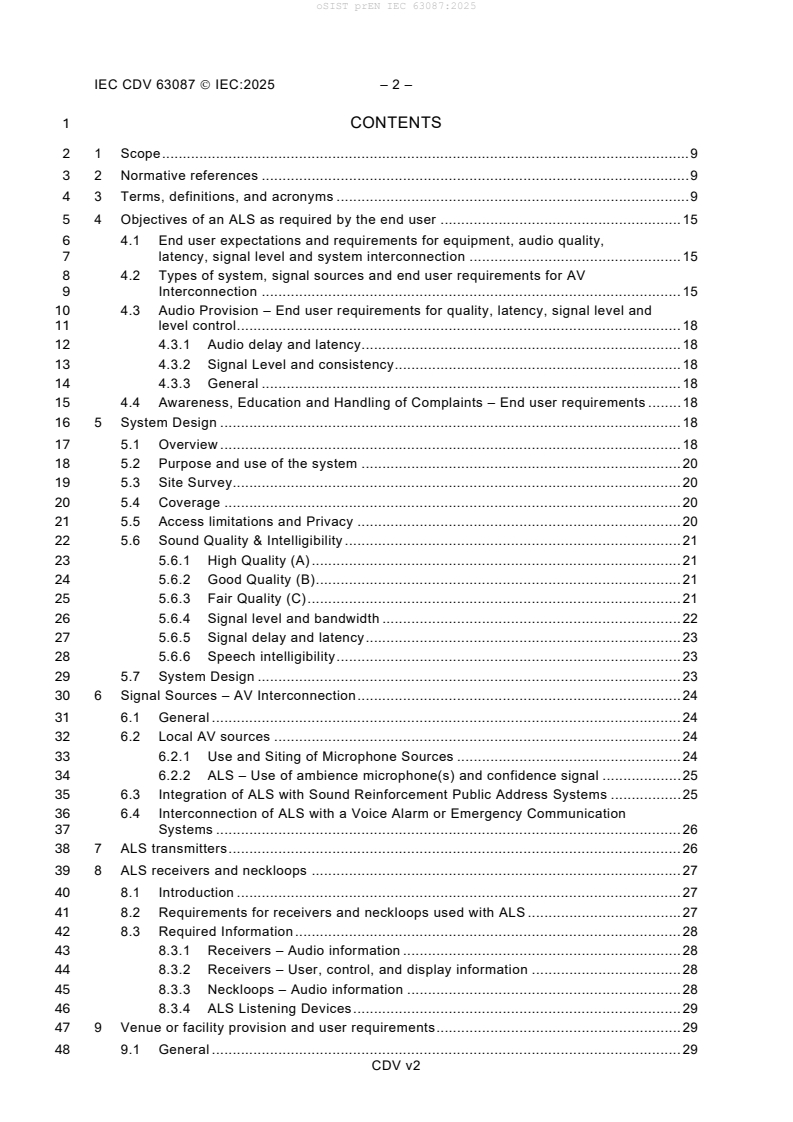
IEC CDV 63087 IEC:2025 – 2 –
1 CONTENTS
2 1 Scope . 9
3 2 Normative references . 9
4 3 Terms, definitions, and acronyms . 9
5 4 Objectives of an ALS as required by the end user . 15
6 4.1 End user expectations and requirements for equipment, audio quality,
7 latency, signal level and system interconnection . 15
8 4.2 Types of system, signal sources and end user requirements for AV
9 Interconnection . 15
10 4.3 Audio Provision – End user requirements for quality, latency, signal level and
11 level control . 18
12 4.3.1 Audio delay and latency. 18
13 4.3.2 Signal Level and consistency . 18
14 4.3.3 General . 18
15 4.4 Awareness, Education and Handling of Complaints – End user requirements . 18
16 5 System Design . 18
17 5.1 Overview . 18
18 5.2 Purpose and use of the system . 20
19 5.3 Site Survey. 20
20 5.4 Coverage . 20
21 5.5 Access limitations and Privacy . 20
22 5.6 Sound Quality & Intelligibility . 21
23 5.6.1 High Quality (A) . 21
24 5.6.2 Good Quality (B) . 21
25 5.6.3 Fair Quality (C) . 21
26 5.6.4 Signal level and bandwidth . 22
27 5.6.5 Signal delay and latency . 23
28 5.6.6 Speech intelligibility . 23
29 5.7 System Design . 23
30 6 Signal Sources – AV Interconnection . 24
31 6.1 General . 24
32 6.2 Local AV sources . 24
33 6.2.1 Use and Siting of Microphone Sources . 24
34 6.2.2 ALS – Use of ambience microphone(s) and confidence signal . 25
35 6.3 Integration of ALS with Sound Reinforcement Public Address Systems . 25
36 6.4 Interconnection of ALS with a Voice Alarm or Emergency Communication
37 Systems . 26
38 7 ALS transmitters . 26
39 8 ALS receivers and neckloops . 27
40 8.1 Introduction . 27
41 8.2 Requirements for receivers and neckloops used with ALS . 27
42 8.3 Required Information . 28
43 8.3.1 Receivers – Audio information . 28
44 8.3.2 Receivers – User, control, and display information . 28
45 8.3.3 Neckloops – Audio information . 28
46 8.3.4 ALS Listening Devices . 29
47 9 Venue or facility provision and user requirements . 29
48 9.1 General . 29
CDV v2
IEC CDV 63087 IEC:2025 – 3 –
49 9.2 Staff awareness & training . 30
50 9.3 Signage . 30
51 9.4 Monitoring and Maintenance . 31
52 10 Awareness, Education and Handling of Complaints . 32
53 11 System Compliance, Testing and Certification . 33
54 11.1 Overview . 33
55 11.2 General . 33
56 11.3 Room and equipment layout . 34
57 11.4 Subjective Assessment . 34
58 11.5 Objective Assessment . 35
59 11.5.1 System Noise . 35
60 11.5.2 Magentic Noise . 35
61 11.5.3 Coverage . 36
62 11.5.4 Frequency response . 36
63 11.5.5 Latency . 36
64 11.5.6 Objective Speech Intelligibility (STI) . 37
65 11.6 Access limitations and privacy . 37
66 11.7 Signage . 37
67 Annex A Assistive Listening Systems - Technology overview (Informative) . 38
68 A.1 Hearing Loops . 38
69 A.2 Infra-red . 38
70 A.3 FM wireless systems . 39
71 A.4 Audio over Wi-Fi . 40
72 A.5 Auracast . 40
73 Annex B ALS Formats for different venues and applications (Normative) . 43
74 B.1 Large Area Systems: Types 1A – 1E . 43
75 B.1.1 Large Area System - Type 1A – with sound system operator . 43
76 B.1.2 Large Area System - Type 1B/1C – without sound system . 43
77 B.1.3 Large Area System - Type 1D – with simple sound system . 43
78 B.1.4 Large Area System - Type 1E – with simple sound system . 44
79 B.2 Large Area System - Type 2 – classroom & soundfield systems . 44
80 B.3 Large Area System: Type 3 – Stadiums and Arenas . 44
81 B.4 Large Area System: Type 4 – Meeting rooms without a sound system . 45
82 B.5 Large Area System: Type 5 – Infotainment venues . 45
83 B.6 Large Area System: Type 6 – Concourses and malls . 46
84 B.7 Large Area System: Type 7 – Museum exhibits . 46
85 B.8 Large Area System: Type 8 – Tour Guide systems . 46
86 B.9 Small Area System: Type 9 – Transportation – On-board Communication and
87 Information . 46
88 B.10 Small Area System: Type 10 – Transportation – On-board Infotainment . 46
89 B.11 Small Area System: Type 11 – Transportation – On-board Communication. 46
90 B.12 Small Area System: Type 12 – Help points, intercoms & safety refuges . 46
91 B.13 Small Area System: Type 13 – Service Points & Information Desks . 47
92 B.14 Portable & temporary small area systems . 47
93 B.15 Temporary Area coverage systems - . 48
94 B.16 Domestic systems . 48
95 B.17 Personal Systems - Type 14 – Communication . 48
96 Annex C Personal Listeners (Informative) . 49
CDV v2
IEC CDV 63087 IEC:2025 – 4 –
97 C.1 Personal Systems - Communication . 49
98 C.1.1 General . 49
99 C.1.2 Types of personal listener, hearables and remote wireless
100 microphones . 49
101 C.2 Streaming Audio . 51
102 Annex D ALS Design Checklists (Informative) . 52
103 Annex E Assessment Report (Normative) . 55
104 E.1 Room / space & Equipment Layout . 55
105 E.2 Acoustic Noise - Ambient level . 56
106 E.3 ALS Coverage . 56
107 E.4 Frequency Response . 56
108 E.5 Signal to Noise Ratio - SNR . 57
109 E.6 Subjective test . 57
110 E.7 Latency / Delay . 58
111 E.8 Speech intelligibility (STI) . 58
112 E.9 Access Limitations / Privacy . 59
113 E.10 Accessibility & Signage . 59
114 Annex F - Example ALS Certificate of Compliance (Informative) . 61
115 Annex G (Informative) ALS information that can usefully be provided on venue’s or
116 facility's website . 62
117 Annex H Latency and Measurement of ALS delay (normative) . 63
118 H.1 Introduction . 63
119 H.1.1 Difference between audible speech signals (ALS and airborne sound) . 63
120 H.1.2 Hearing one’s own voice through an ALS . 63
121 H.1.3 Influence of delay on lip-reading . 64
122 H.2 Delay of different transmission channels . 65
123 H.2.1 General . 65
124 H.2.2 Total delay of an ALS . 65
125 H.2.3 Total delay of a loudspeaker system . 65
126 H.3 Measurement of delay for live speech via loudspeakers . 66
127 H.3.1 Measurement methods . 66
128 H.3.2 Inputting the test signal . 66
129 H.3.3 Time calibration of the measurement system . 66
130 H.3.4 Measuring the delay of the ALS . 66
131 H.3.5 Measuring the propagation time of airborne sound via loudspeakers . 66
132 H.3.6 Determining the propagation time of direct sound from the talker . 67
133 H.4 Measurement of the difference between image and ALS . 67
134 H.4.1 Measurement methods . 67
135 H.4.2 Calibration . 67
136 H.4.3 Playing or generating the test signal . 67
137 H.4.4 Measurement of the time difference between image and ALS . 67
138 H.4.5 Measurement of the difference between Image and airborne sound . 68
139 Annex I Signage for Assistive Listening Systems (normative). 69
140 I.1 Introduction . 69
141 I.2 Symbols and signage for Assistive Listening Systems . 69
142 I.2.1 Hearing Loop based system . 69
143 I.2.2 Infrared based system . 69
144 I.2.3 FM radio-based system . 70
CDV v2
IEC CDV 63087 IEC:2025 – 5 –
145 I.2.4 Auracast based system. 70
146 I.2.5 Joint Hearing Loop and Auracast systems . 70
147 I.2.6 Unspecified ALS . 71
148 12 Bibliography . 72
CDV v2
IEC CDV 63087 IEC:2025 – 6 –
150 List of Figures:
151 Figure 9.1 - Sign indicating ALS system . 31
152 Figure 9.2 -Sign indicating area without compliant ALS coverage . 31
153 Figure H1 Visual and audio signal . 64
154 Figure H2 Addition of a loudspeaker . 64
155 Figure H3 Addition of a video display . 64
156 Figure I 2.1 Hearing loop sign . 69
157 Figure I 2.2 Infrared sign. 70
158 Figure I 2.3 FM radio system sign . 70
159 Figure I 2.4 Auracast system sign . 70
160 Figure I 2.5 Dual Auracast and Hearing Loop system sign . 71
161 Figure I 2.6 Sign to be used for unspecified ALS . 71
162 List of Tables:
163 Table 1: ALS Formats & Requirements . 16
164 Table 2 - Assistive listening systems comparison summary . 41
165 Table H1 Components contributing to the total ALS delay . 65
166 Table H2 Delays in a loudspeaker system . 65
CDV v2
IEC CDV 63087 IEC:2025 – 7 –
168 FOREWORD
169 1) The International Electrotechnical Commission (IEC) is a worldwide organization for
170 standardization comprising all national electrotechnical committees (IEC National
171 Committees). The object of IEC is to promote international co-operation on all questions
172 concerning standardization in the electrical and electronic fields. To this end and in addition
173 to other activities, IEC publishes International Standards, Technical Specifications,
174 Technical Reports, Publicly Available Specifications (PAS) and Guides (hereafter referred
175 to as “IEC Publication(s)”). Their preparation is entrusted to technical committees; any IEC
176 National Committee interested in the subject dealt with may participate in this preparatory
177 work. International, governmental and non-governmental organizations liaising with the IEC
178 also participate in this preparation. IEC collaborates closely with the International
179 Organization for Standardization (ISO) in accordance with conditions determined by
180 agreement between the two organizations.
181 2) The formal decisions or agreements of IEC on technical matters express, as nearly as
182 possible, an international consensus of opinion on the relevant subjects since each
183 technical committee has representation from all interested IEC National Committees.
184 3) IEC Publications have the form of recommendations for international use and are accepted
185 by IEC National Committees in that sense. While all reasonable efforts are made to ensure
186 that the technical content of IEC Publications is accurate, IEC cannot be held responsible
187 for the way in which they are used or for any misinterpretation by any end user.
188 4) In order to promote international uniformity, IEC National Committees undertake to apply
189 IEC Publications transparently to the maximum extent possible in their national and regional
190 publications. Any divergence between any IEC Publication and the corresponding national
191 or regional publication shall be clearly indicated in the latter.
192 5) IEC itself does not provide any attestation of conformity. Independent certification bodies
193 provide conformity assessment services and, in some areas, access to IEC marks of
194 conformity. IEC is not responsible for any services carried out by independent certification
195 bodies.
196 6) All users should ensure that they have the latest edition of this publication.
197 7) No liability shall attach to IEC or its directors, employees, servants or agents including
198 individual experts and members of its technical committees and IEC National Committees
199 for any personal injury, property damage or other damage of any nature whatsoever,
200 whether direct or indirect, or for costs (including legal fees) and expenses arising out of the
201 publication, use of, or reliance upon, this IEC Publication or any other IEC Publications.
202 8) Attention is drawn to the Normative references cited in this publication. Use of the
203 referenced publications is indispensable for the correct application of this publication.
204 9) Attention is drawn to the possibility that some of the elements of this IEC Publication may
205 be the subject of patent rights. IEC shall not be held responsible for identifying any or all
206 such patent rights.
207 IEC 63087 has been prepared by IEC technical committee 100: Audio, video and multimedia
208 systems and equipment It is an International Standard.
209 The text of this International Standard is based on the following documents:
Draft Report on voting
XX/XX/FDIS XX/XX/RVD
210 Full information on the voting for its approval can be found in the report on voting indicated in
211 the above table.
212 The language used for the development of this International Standard is English.
CDV v2
IEC CDV 63087 IEC:2025 – 8 –
213 INTRODUCTION
214 The audibility and intelligibility of speech and music can be degraded by the ambient sound and
215 reverberation of the acoustic space in which it is heard. For a person with hearing difficulties
216 intelligibility is disproportionately degraded.
217 An Assistive Listening System (ALS) enables the undesirable effects of an acoustic space to
218 be mitigated through the direct transmission or streaming of speech, music or other audio
219 information to an end-user device (often a hearing-aid or cochlear implant), delivered in a way
220 that improves the listening experience for the user.
221 An (ALS) is beneficial when the listener is located at some distance from a talker or the source
222 of sound and / or when the background noise level is such as to be clearly audible – for example
223 when:
224 • A talker is using a raised voice when they are more than 3m from a listener or where
225 the ambient noise level exceeds 40 dBA.
226 • A talker is using normal, conversational voice levels in large spaces at distances greater
227 than 2m from a listener and/ or when the noise level exceeds 45 dBA.
228 In noisy environments, bringing an appropriate pick-up microphone close to the talker or desired
229 sound source can increase the signal to noise ratio for the listener by as much as 15-20 dB,
230 and in enclosed spaces it can overcome the detrimental effects of reverberation as compared
231 to the normal listening situation. This can significantly increase speech intelligibility and reduce
232 listening effort.
233 An ALS is explicitly designed to deliver audible and intelligible sound wherever the intended
234 listener is located within a room, area or at a specific service point, and in a manner that
235 provides a genuine benefit to the end-user. An assistive listening system may also be provided
236 as an adjunct facility to an intercom system, for example: ticket machines or station/platform
237 help points. They are also often found in buses, taxis, and some trains where passenger
238 announcements and information can be relayed directly to a user’s hearing device. Many
239 airports provide ALS at check-in counters and departure gates as well as in other specific areas
240 such as baggage claims. Systems are also widely found in shops and stores at point-of-sale
241 locations and at service counters in banks and ticket offices. ALS are also commonly connected
242 to sound reinforcement and public address systems in a wide variety of venues and sites
243 including theatres, auditoriums, conference centres, meeting rooms, public buildings, and
244 houses of worship. Designated seating areas and facilities within sports grounds and stadiums
245 are also often provided with an ALS where it is not possible to provide complete coverage.
246 ALSs have also been found to be beneficial for listeners with normal hearing but who are
247 listening in less-than-ideal acoustic conditions, such as in lecture theatres and classrooms.
248 Although predominantly used for speech, an ALS may also be used to improve the reception of
249 music or musical performances particularly in situations where both speech and music are
250 present.
251 Several different transmission technologies are available, and some may be better suited to a
252 given situation than others. However, no matter what the transmission medium or situation, the
253 objective is the same, which is to provide an audible benefit to the intended listener. This
254 standard sets out the technical and operational requirements needed to achieve this, regardless
255 of the underlying technology.
CDV v2
IEC CDV 63087 IEC:2025 – 9 –
256 Assistive listening devices and systems
257 1 Scope
258 This document sets out the requirements for the provision of Assistive Listening Systems in
259 places or situations where there is a benefit for hearing-aid, cochlear implant, and other hearing
260 device users, compared to listening to the acoustic signal directly at that location.
261 This document applies to all ALS used for communication, entertainment, or educational
262 purposes in public, private, domestic and public transport installations.
263 This document does not apply to other forms of audio transmission, for example simultaneous
264 interpretation or audio description or audio-streams other than those broadcast as part of an
265 ALS. However, this document provides useful ancillary information for such systems and shall
266 be applied as far as possible.
267 Personal listening / intelligibility enhancement devices and systems are also included within the
268 scope as they constitute a special case and incorporate some unique features and
269 requirements.
270 This document does not apply to hearing aids and medical hearing devices themselves or to
271 speech enhancement and communication systems found in some private motor vehicles which
272 are sometimes referred to as assistive listening.
273 2 Normative references
274 The following documents are referred to in the text in such a way that some or all of their content
275 constitutes requirements of this document. For dated references, only the edition cited applies.
276 For undated references, the latest edition of the referenced document (including any
277 amendments) applies.
278 IEC 60118-4: Electroacoustics – Hearing aids: Induction-loop systems for hearing aid purposes
279 – System performance requirements
280 IEC 60118-17: (Progress of standard to be monitored & action as required)
281 IEC 60268-8 Sound system equipment: automatic gain control devices
282 IEC 60268-16: Objective rating of speech intelligibility by speech transmission index
283 IEC TR 63079: Code of practice for hearing-loop systems (HLS)
284 IEC 62489-1: Electroacoustics – Audio-frequency induction loop systems for assisted hearing:
285 Methods of measuring and specifying the performance of system components.
286 ETSI EN300 422-4, part 4 Assistive Listening Devices
287 EN 50332-2 Sound system equipment: Headphones and earphones associated with
288 portable audio equipment
289 3 Terms, definitions, and acronyms
290 For the purposes of this document, the following terms and definitions apply. ISO and IEC
291 maintain terminological databases for use in standardization at the following addresses:
292 • IEC Electropedia: available at http://www.electropedia.org
293 • ISO Online browsing platform: available at http://www.iso.org/obp
CDV v2
IEC CDV 63087 IEC:2025 – 10 –
294 3.1 accessibility
295 degree to which an ALS product (e.g., device, service, and environment) is available to the
296 intended users and compatible with their listening devices
297 3.2 AFFL – above finished floor level
298 3.3 AFILS – Audio Frequency Induction Loop System
299 system including amplifier(s), microphones and/or other signal sources, in which magnetic fields
300 are created by the flow of audio-frequency current in a conductor arranged in the form of one
301 or more loops or a coil or solenoid.
302 Note: often called a hearing loop.
303 3.4 Assistive Listening Device (ALD)
304 a device that can directly access an ALS – e.g. Hearing Aid, Cochlear Implant, Hearable, Mobile
305 phone, ALS receiver or personal listener.
306 3.5 Assistive Listening System (ALS)
307 a device or system that helps people with hearing impairment to hear and understand wanted
308 sounds or enables them to access the sound being transmitted by a Public Address (PA),
309 Paging, Sound Reinforcement, or dedicated microphone system.
310 Note 1: Assistive listening systems may also be used by listeners who are not hard of hearing to improve the clarity
311 and intelligibility received speech.
312 Note 2: a personal listener may connect to an assistive listening system.
TM
313 3.6 audio over Wi-Fi
314 a system that enables wireless transmission of audio via a Wi-Fi network, allowing the user’s
315 own device (smartphone or tablet) to act as the receiver.
TM
316 3.7 Auracast
317 a proprietary audio transmission system using Bluetooth® LE available from Bluetooth® core
318 Specification v5.3 onwards that enables several separate audio streams to be simultaneously
319 transmitted to multiple compatible listening devices at distances of typically up to 50m
320 depending on the local conditions and transmitter power. To allow as many receivers as
321 possible to access an audio stream within the reception range Auracast does not use a
322 traditional two-way Bluetooth® ‘Connected link’, instead relying on the stream source operating
323 as a ‘Broadcast’ transmitter and advertising it’s availability with a range of quality and access
324 options.
325 3.8 automatic gain control (AGC)
326 a means (other than peak clipping) by which the gain is automatically controlled as a function
327 of the level of the signal being amplified with the objective of providing a stable output signal
328 level.
329 Note also often called a leveller.
330 3.9 Bluetooth / Bluetooth Classic
331 a low power radio system that can continuously stream data over 79 channels in the 2.4 GHz
332 unlicensed industrial, scientific, and medical (ISM) frequency band.
CDV v2
IEC CDV 63087 IEC:2025 – 11 –
333 3.10 Bluetooth Low Energy (BLE)
334 a Bluetooth® system designed for very low power operation, transmitting data over 40 channels
335 in the 2.4 GHz unlicensed ISM frequency band.
336 Note: – BLE remains in sleep mode except when a connection is initiated. Power consumption is lower and data
337 rates are higher than Classic Bluetooth, but connection is not continuous.
338 3.11 BYOD
339 Bring your own device – the scenario in which a user provides their own means to access an
340 ALS.
341 3.12 C50 – Clarity
342 a measure of the direct to reverberant ratio whereby the sound energy arriving within the first
343 50ms after the arrival of the direct sound is divided by the late sound energy arriving after 50ms.
344 Note: C50 provides a measure of the ratio of useful sound energy to later arriving and reverberant energy that is
345 considered to inhibit the intelligibility of speech and is often used as a measure of Direct to Reverberant (D/R) ratio.
346 3.13 Critical Distance (Dc)
347 The distance from a sound source, in a room or enclosed space, were the Direct and
348 Reverberant sound energies become equal.
349 3.14 Cochlear Implant (CI)
350 a cochlear implant is a small electronic medical device that electrically stimulates the cochlear
351 nerve to provide a sensation of sound.
352 Note 1: CIs comprise two parts, the implant and a control / processing device that is worn behind the ear in a similar
353 manner to a hearing aid.
354 Note 2: CI processing devices are generally fitted with a T-coil and so can be used with hearing loops and neck-
355 loops.
356 3.15 competent person
357 person with the relevant current training and experience, and with access to the requisite tools,
358 equipment, and information, and capable of carrying out a defined task
359 3.16 EHIMA European Hearing Instrument Manufacturers Association
360 3.17 ear hook
361 a small inductive device in the form of a hook that sits behind the ear and is placed adjacent to
362 a hearing device in order to inductively transmit an audio signal to the device’s telecoil.
363 3.18 echo
364 an undesired signal which arrives at a given point, with sufficient magnitude and delay for it to
365 be perceptible, as a distinct repetition of the direct signal.
366 Note: the audibility of an acoustic or audio echo depends on the magnitude of the signal and its relative delay, with
367 perception typically occurring with delays greater than 35 to 50 ms
368 3.19 electromagnetic interference (EMI)
369 interference that is caused by one electrical or electronic device to another by the
370 electromagnetic fields generated by its operation.
CDV v2
IEC CDV 63087 IEC:2025 – 12 –
371 3.20 emergency sound system (ECS)
372 a sound system specifically intended to broadcast emergency announcements and messages.
373 Note: such systems generally incorporate fault and status monitoring and are required to meet associated national
374 or international standards.
375 3.21 FM/ Radio assistive listening system
376 an assistive listening transmission system based on radio technology.
377 Note: FM/radio assistive listening receivers may be connected to a neck-loop so that the signal may be received by
378 a compatible hearing aid or cochlear implant.
379 3.22 hearable
380 a type of personal listener, usually in the form of personal earbuds or earphones that contain
381 both a pickup microphone and loudspeaker in each unit together with complex speech and noise
382 suppression processing to provide sound amplification.
383 Note: hearables are often termed ‘over the counter’, non-prescription hearing aid devices.
384 3.23 hearing aid (HA)
385 portable instrument intended to assist the hearing of persons with impaired hearing, usually
386 consisting of a microphone, amplifier and earphone or bone vibrator.
387 Note: A hearing aid is a medical device selected and fitted by an appropriately trained and competent hearing care
388 professional.
389 3.24 hearing device (HD)
390 a user device which can directly access an ALS – e.g., Hearing Aid, Cochlear Implant, Hearable,
391 Mobile phone, ALS receiver, or personal listener etc.
392 3.25 hearing loop
393 an audio frequency induction loop (AFILS) assistive listening technology.
394 Note: A loop or loops of cable or copper tape are typically installed at floor level in a room or area to be covered to
395 create an electromagnetic field that can be picked up by a hearing aid, cochlear implant or listening device employing
396 a suitable pick up or telecoil. The loop is fed from either a dedicated pick-up microphone or from the output of a
397 sound system.
398 3.26 hearing loss
399 the reduction in hearing acuity
400 Note 1: Hearing loss is a common problem caused by exposure to noise, aging, disease, trauma, and heredity.
401 Note 2: Four different levels of hearing loss have been defined: Mild (25-45dB loss), Moderate (40-75dB loss), Severe
402 (75-90dB loss) and Profound (>90dB loss)
403 3.27 HoW - House of Worship
404 3.28 infrared (IR) assistive listening system
405 an assistive listening transmission system based on infrared technology.
406 Note1: IR systems are often used in environments where it is desired to contain the signal within the confines of a
407 room.
408 Note2: IR assistive listening receivers may incorporate a neck-loop so that the signal may be received by a compatible
409 hearing aid or cochlear implant.
CDV v2
IEC CDV 63087 IEC:2025 – 13 –
410 3.29 ISTS International speech test signal
411 ISTS was developed by EHIMA to create reproducible measurement conditions for the purpose
412 of analysing the processing of speech by a hearing aid and associated equipment. ISTS is a
413 standard test signal which features all or most relevant properties of natural speech e.g. the
414 modulation spectrum, the fundamental frequency and its harmonics.
415 Note: The ISTS is based on natural recordings but is largely non-intelligible because of segmentation and remixing.
416 The signal comprises real speech from multiple talkers but presented in a manner such as to have no meaning nor
417 gaps between words.
418 3.30 loop receiver
419 a device fitted with a telecoil / T-coil allowing it to pick up signals from a hearing loop.
420 3.31 latency
421 the discrepancy in time between when an audio signal enters a system or electronic device and
422 when it emerges.
423 Note – Potential causes of latency in an audio system include analogue-to-digital conversion, buffering, digital signal
424 processing, transmission time, digital-to-analogue conversion, and the speed of sound in the transmission medium.
425 3.32 Lip Sync
426 the synchronisation of the visual image of the face and lips with the associated audio speech
427 signal
428 Note: to enable lip reading, the maximum allowable discrepancy between the visual and audio signals is 40ms
429 3.33 Long Term Average Speech Level (LTASL)
430 the unweighted speech signal level averaged over a period of at least 30 seconds
431 Note This may be measured either as an Leq value or by means of a r.m.s. meter with suitably long integration time.
432 3.34 neckloop
433 a device that allows a personal listener or ALS receiver to be used with a hearing aid that is
434 fitted with a telecoil.
435 Note 1: A neckloop shall provide a signal compliant to IEC 60118-4 when measured as specified in IEC 62489-1
436 Note 2: Neck-loops are usually passive devices and often dedicated to a particular receiver, although active types
437 and non-product specific types are also available.
438 3.35 personal listener
439 a system for relaying an acoustic input signal to an acoustic output transducer, for listening
440 purposes. A system will at least comprise a microphone, an amplifier and earphones or
441 headphones.
442 Note 1: Additional items can be included, such as a neck-loop for use with hearing aids, or a magnetic pick-up coil
443 for use with hearing-loop systems.
444 Note 2: The sound picked up by a personal listener may also be transmitted directly to a hearing aid via Bluetooth
445 or other, defined, radio-based system.
446 3.36 recruitment
447 the rapid and abnormal growth of perceived loudness of sounds for those with a hearing
448 impairment and which is frequency-dependent in nature.
CDV v2
IEC CDV 63087 IEC:2025 – 14 –
449 3.37 remote (extension) microphone
450 a microphone, specifically intended to pick up the wanted sound to enable it to be broadcast to
451 an assistive listening system, personal listener, or hearing device.
452 Note 1: for speech applications the microphone needs to be located close to the talker to minimise the pick-up noise
453 and reverberation.
454 Note 2: remote microphones may be active devices and in
...
Questions, Comments and Discussion
Ask us and Technical Secretary will try to provide an answer. You can facilitate discussion about the standard in here.
Loading comments...