


EN 60947-5-2:1998
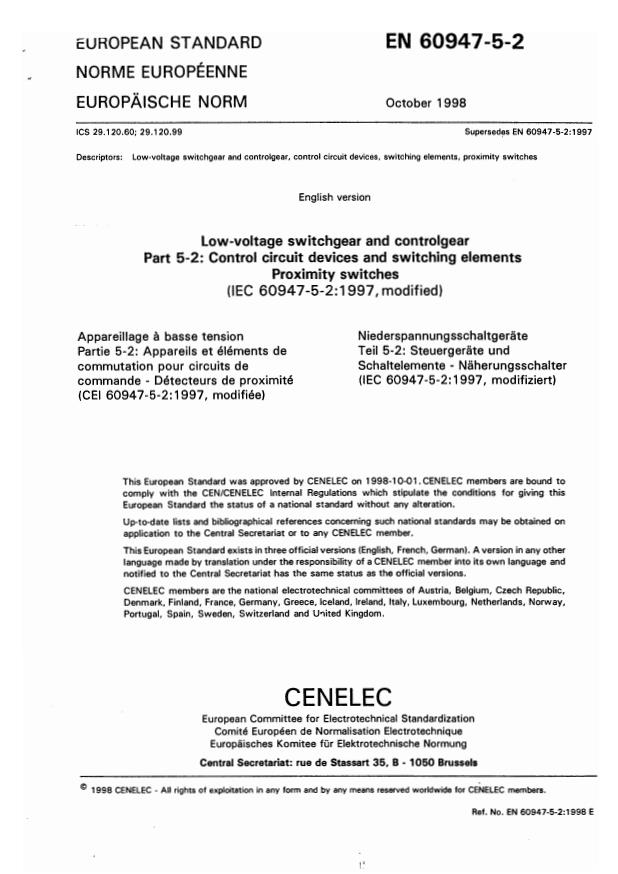
(Main)Low-voltage switchgear and controlgear - Part 5-2: Control circuit devices and switching elements - Proximity switches
Low-voltage switchgear and controlgear - Part 5-2: Control circuit devices and switching elements - Proximity switches
Applies to inductive and capacitive proximity switches that sense the presence of metallic and/or non-metallic objects, ultrasonic proximity switches that sense the presence of sound reflecting objects, photoelectric proximity switches that sense the presence of objects and non-mechanical magnetic proximity switches that sense the presence of objects with a magnetic field. These proximity switches are self-contained, have semiconductor switching elements and are intended to be connected to circuits the rated voltage of which does not exceed 250 V 50 Hz/60 Hz a.c. or 300 V d.c. This Standard is not intended to cover proximity switches with analogue outputs.
Niederspannungsschaltgeräte - Teil 5-2: Steuergeräte und Schaltelemente - Näherungsschalter
Appareillage à basse tension - Partie 5-2: Appareils et éléments de commutation pour circuits de commande - Détecteurs de proximité
S'applique aux détecteurs de proximité inductifs et capacitifs qui détectent la présence d'objets métalliques et/ou non métalliques, aux détecteurs de proximité ultrasoniques qui détectent la présence d'objets réfléchissantS les ultrasons, aux détecteurs de proximité photoélectriques qui détectent la présence d'objets et aux détecteurs de proximité magnétiques non mécaniques qui détectent la présence d'objets avec un champ magnétique. Ces détecteurs de proximité sont des appareils complets, comprenant des éléments de commutation à semiconducteurs et sont destinés à être connectés à des circuits dont la tension nominale n'excède pas 250 V 50 Hz/60 Hz courant alternatif ou 300 V courant continu. La présente norme n'est pas prévue pour couvrir les détecteurs de proximité analogiques.
Nizkonapetostne stikalne in krmilne naprave – 5-2. del: Krmilne naprave in stikalni elementi – Približevalna stikala
General Information
- Status
- Withdrawn
- Publication Date
- 18-Oct-1998
- Technical Committee
- CLC/TC 17B - Low-voltage switchgear and controlgear including dimensional standardization
- Drafting Committee
- IEC/SC 17B - IEC_SC_17B
- Parallel Committee
- IEC/SC 17B - IEC_SC_17B
- Current Stage
- 9960 - Withdrawal effective - Withdrawal
- Start Date
- 01-Nov-2010
- Completion Date
- 01-Nov-2010
Relations
- Effective Date
- 28-Jan-2023
- Effective Date
- 28-Jan-2023
- Effective Date
- 10-Feb-2026
- Effective Date
- 09-Feb-2026
- Effective Date
- 09-Feb-2026
- Effective Date
- 03-Feb-2026
- Effective Date
- 03-Feb-2026
- Effective Date
- 03-Feb-2026
- Effective Date
- 03-Feb-2026
- Effective Date
- 03-Feb-2026
- Effective Date
- 03-Feb-2026
- Effective Date
- 03-Feb-2026
- Effective Date
- 03-Feb-2026
- Effective Date
- 03-Feb-2026
- Effective Date
- 03-Feb-2026

Get Certified
Connect with accredited certification bodies for this standard

Intertek Testing Services NA Inc.
Intertek certification services in North America.

UL Solutions
Global safety science company with testing, inspection and certification.

ANCE
Mexican certification and testing association.
Sponsored listings
Frequently Asked Questions
EN 60947-5-2:1998 is a standard published by CLC. Its full title is "Low-voltage switchgear and controlgear - Part 5-2: Control circuit devices and switching elements - Proximity switches". This standard covers: Applies to inductive and capacitive proximity switches that sense the presence of metallic and/or non-metallic objects, ultrasonic proximity switches that sense the presence of sound reflecting objects, photoelectric proximity switches that sense the presence of objects and non-mechanical magnetic proximity switches that sense the presence of objects with a magnetic field. These proximity switches are self-contained, have semiconductor switching elements and are intended to be connected to circuits the rated voltage of which does not exceed 250 V 50 Hz/60 Hz a.c. or 300 V d.c. This Standard is not intended to cover proximity switches with analogue outputs.
Applies to inductive and capacitive proximity switches that sense the presence of metallic and/or non-metallic objects, ultrasonic proximity switches that sense the presence of sound reflecting objects, photoelectric proximity switches that sense the presence of objects and non-mechanical magnetic proximity switches that sense the presence of objects with a magnetic field. These proximity switches are self-contained, have semiconductor switching elements and are intended to be connected to circuits the rated voltage of which does not exceed 250 V 50 Hz/60 Hz a.c. or 300 V d.c. This Standard is not intended to cover proximity switches with analogue outputs.
EN 60947-5-2:1998 is classified under the following ICS (International Classification for Standards) categories: 29.120.40 - Switches; 29.120.99 - Other electrical accessories; 29.130.20 - Low voltage switchgear and controlgear. The ICS classification helps identify the subject area and facilitates finding related standards.
EN 60947-5-2:1998 has the following relationships with other standards: It is inter standard links to EN 60947-5-2:1997, EN 60947-5-2:2007, IEC 60050-441:1984, EN ISO 3680:2004, EN 14042:2003, EN 60068-2-27:1993, EN 61000-3-2:1995, EN 60947-1:1997, EN 60068-2-6:1995, EN 61000-3-3:1995, HD 366 S1:1977, EN 55011:1991, EN 61000-4-4:1995, EN 61000-4-3:1996, EN 60068-2-14:1999. Understanding these relationships helps ensure you are using the most current and applicable version of the standard.
EN 60947-5-2:1998 is associated with the following European legislation: EU Directives/Regulations: 2004/108/EC, 2004/108/EU, 2006/95/EC, 73/23/EEC, 89/336/EEC; Standardization Mandates: M/404. When a standard is cited in the Official Journal of the European Union, products manufactured in conformity with it benefit from a presumption of conformity with the essential requirements of the corresponding EU directive or regulation.
EN 60947-5-2:1998 is available in PDF format for immediate download after purchase. The document can be added to your cart and obtained through the secure checkout process. Digital delivery ensures instant access to the complete standard document.
Questions, Comments and Discussion
Ask us and Technical Secretary will try to provide an answer. You can facilitate discussion about the standard in here.
Loading comments...