


EN 50126-1:2017/A1:2024
(Amendment)Railway applications - The specification and demonstration of Reliability, Availability, Maintainability and Safety (RAMS) - Part 1: Generic RAMS process
Railway applications - The specification and demonstration of Reliability, Availability, Maintainability and Safety (RAMS) - Part 1: Generic RAMS process
This part 1 of EN 50126 - considers RAMS, understood as reliability, availability, maintainability and safety and their interaction; - considers the generic aspects of the RAMS life cycle. The guidance in this part can still be used in the application of specific standards; - defines: - a process, based on the system life cycle and tasks within it, for managing RAMS; - a systematic process, tailorable to the type and size of the system under consideration, for specifying requirements for RAMS and demonstrating that these requirements are achieved; - addresses railway specifics; - enables conflicts between RAMS elements to be controlled and managed effectively; - does not define: - RAMS targets, quantities, requirements or solutions for specific railway applications; - rules or processes pertaining to the certification of railway products against the requirements of this standard; - an approval process for the railway stakeholders. This part 1 of EN 50126 is applicable to railway application fields, namely Command, Control and Signalling, Rolling Stock and Fixed Installations, and specifically: - to the specification and demonstration of RAMS for all railway applications and at all levels of such an application, as appropriate, from complete railway systems to major systems and to individual and combined subsystems and components within these major systems, including those containing software; in particular: - to new systems; - to new systems integrated into existing systems already accepted, but only to the extent and insofar as the new system with the new functionality is being integrated. It is otherwise not applicable to any unmodified aspects of the existing system; - as far as reasonably practicable, to modifications and extensions of existing systems already accepted, but only to the extent and insofar as existing systems are being modified. It is otherwise not applicable to any unmodified aspect of the existing system; - at all relevant phases of the life cycle of an application; - for use by railway duty holders and the railway suppliers. It is not required to apply this standard to existing systems which remain unmodified, including those systems already compliant with any former version of EN 50126. The process defined by this European Standard assumes that railway duty holders and railway suppliers have business-level policies addressing Quality, Performance and Safety. The approach defined in this standard is consistent with the application of quality management requirements contained within EN ISO 9001.
Bahnanwendungen - Spezifikation und Nachweis von Zuverlässigkeit, Verfügbarkeit, Instandhaltbarkeit und Sicherheit (RAMS) - Teil 1: Generischer RAMS-Prozess
Applications ferroviaires - Spécification et démonstration de la fiabilité, de la disponibilité, de la maintenabilité et de la sécurité (FDMS) - Partie 1: Processus FDMS générique
La présente Partie 1 de l'EN 50126 : - définit la FDMS en termes de fiabilité, de disponibilité, de maintenabilité et de sécurité et leurs interactions ; - prend en considération les aspects génériques du cycle de vie FDMS. Les lignes directrices de la présente partie s'appliquent également lors de l'application de normes spécifiques ; - définit : - un processus de management de la FDMS fondé sur le cycle de vie du système et les tâches qui en font partie ; - un processus systématique adaptable au type et à la taille du système en cours d'examen, permettant de spécifier les exigences de la FDMS et de démontrer que ces exigences sont satisfaites ; - prend en compte les spécificités du domaine ferroviaire ; - permet de contrôler et de gérer efficacement les conflits entre les composantes de la FDMS ; - ne définit pas : - les objectifs de FDMS, ni les grandeurs, les exigences ou les solutions pour des applications ferroviaires spécifiques ; - les règles ou les processus de certification des produits ferroviaires vis-à-vis des exigences de la présente norme ; - un processus d'homologation pour les parties prenantes ferroviaires. La présente Partie 1 de l'EN 50126 s'applique aux domaines d'application ferroviaire, à savoir Contrôle commande et Signalisation, Matériel Roulant et Installations Fixes, et spécifiquement : - à la spécification et à la démonstration des exigences de FDMS pour toute application ferroviaire et à tout niveau d'une telle application, selon le cas, allant des systèmes ferroviaires complets aux grands systèmes et aux sous-systèmes et équipements (individuels et combinés) de ces grands systèmes, y compris ceux qui comportent des logiciels. Elle est notamment applicable : - aux nouveaux systèmes ; - aux nouveaux systèmes intégrés dans des systèmes préexistants acceptés, mais seulement dans la mesure où, et dans la façon dont le nouveau système comprenant la nouvelle fonctionnalité y est intégré. Elle n'est sinon pas applicable aux parties inchangées du système existant ; - dans toute la mesure du possible, aux modifications et extensions des systèmes préexistants, mais seulement dans la mesure où, et dans la façon dont les systèmes existants sont modifiés. Elle n'est sinon pas applicable aux parties inchangées du système existant ; - à toutes les phases concernées du cycle de vie d'une application donnée ; - à l'utilisation des sociétés d'exploitation ferroviaire et des industries ferroviaires. Il n'est pas nécessaire d'appliquer la présente norme aux systèmes existants qui ne sont pas modifiés, y compris ceux déjà conformes à toute version antérieure de l'EN 50126. Le processus défini par la présente Norme européenne part du principe que les sociétés d'exploitation et les industries ferroviaires ont développé au niveau de l'entreprise des politiques de Qualité, Performances et Sécurité. L'approche définie dans la présente norme est en accord avec l'application des exigences de management de la qualité de l'EN ISO 9001.
Železniške naprave - Specifikacija in prikaz zanesljivosti, razpoložljivosti, vzdrževalnosti in varnosti (RAMS) - 1. del: Generični procesi RAMS - Dopolnilo A1
General Information
- Status
- Published
- Publication Date
- 14-Nov-2024
- Technical Committee
- CLC/TC 9X - Electrical and electronic applications for railways
- Drafting Committee
- CLC/TC 9X/WG 21 - Revision of EN 50126-1 & -2
- Current Stage
- 6060 - Document made available - Publishing
- Start Date
- 15-Nov-2024
- Due Date
- 07-Dec-2022
- Completion Date
- 15-Nov-2024
Relations
- Effective Date
- 09-Feb-2026
- Effective Date
- 09-Feb-2026
- Effective Date
- 09-Feb-2026
- Referred By
EN 14752:2019+A1:2021 - Railway applications - Bodyside entrance systems for rolling stock - Effective Date
- 09-Feb-2026
- Effective Date
- 09-Feb-2026
- Effective Date
- 09-Feb-2026
- Effective Date
- 09-Feb-2026
- Effective Date
- 09-Feb-2026
- Effective Date
- 09-Feb-2026
- Effective Date
- 09-Feb-2026
- Effective Date
- 03-Feb-2026
- Effective Date
- 03-Feb-2026
- Effective Date
- 26-May-2020
Overview
EN 50126-1:2017/A1:2024 is a key European standard developed by CLC focusing on railway applications. It defines the generic process for managing and demonstrating the Reliability, Availability, Maintainability, and Safety (RAMS) aspects of railway systems throughout their entire life cycle. This standard provides a structured and tailorable approach to specifying RAMS requirements and proving their achievement. It is designed to address the unique challenges of railway systems including command, control, signalling, rolling stock, and fixed installations.
This standard does not prescribe specific RAMS targets or certification rules, but instead offers a flexible framework supporting the integration of new systems, modifications, or extensions into existing railway infrastructure. It is geared for use by railway duty holders and suppliers to ensure that RAMS performance is systematically managed, enhancing overall railway safety and operational integrity.
Key Topics
- RAMS life cycle management: The standard outlines a comprehensive life cycle approach to manage RAMS from initial concept through design, operation, maintenance, and decommissioning phases.
- Interrelations of RAMS elements: It considers how reliability, availability, maintainability and safety interact, enabling conflicts between these elements to be identified and resolved effectively.
- Tailorable RAMS processes: The process outlined can be adapted based on system type and size, ensuring applicability across various railway subsystem levels and technology implementations.
- RAMS specification and demonstration: Provides guidance on how to specify requirements systematically and demonstrate compliance to those requirements.
- Railway-specific considerations: Addresses the specific operational and environmental conditions prevailing in railway systems.
- Terminology and definitions: Incorporates updated terms consistent with IEC and ISO standards to support clear communication within the RAMS domain.
- Compliance framework: Supports alignment with Quality Management Systems such as EN ISO 9001 and interfaces with related standards like EN 50126-2 which focuses on safety approaches.
Applications
- New railway system development: Facilitates rigorous RAMS planning and verification during the design and introduction of new railway systems or technologies.
- System modifications and integrations: Guides assessment and management of RAMS when integrating new functionalities into existing, operational railway systems.
- Rolling stock and fixed installations: Applies to multiple railway application fields including vehicles, signaling devices, and infrastructure components.
- Railway duty holders and suppliers: Supports stakeholders responsible for ensuring RAMS compliance in procurement, maintenance, and operational activities.
- Quality and safety management alignment: Enhances existing quality policies by embedding RAMS considerations consistent with recognized international standards.
- Lifecycle RAMS assurance: Helps ensure consistent attention to RAMS objectives throughout all life cycle stages of railway assets, boosting reliability and safety resilience.
Related Standards
- EN 50126-2:2017: Complements Part 1 by providing a systems approach specifically targeting the safety dimension of RAMS.
- EN ISO 9001: Quality management standard that this RAMS process aligns with to promote integrated quality and safety practices.
- EU Interoperability Directives: Supports conformity with EU Directive (EU) 2016/797 requirements, assisting railways in meeting interoperability and safety obligations within the EU market.
- IEC 60050 series: Provides harmonized definitions and terminology referenced within the standard for RAMS and related concepts.
- Technical Specifications for Interoperability (TSI): This standard aligns with TSI guidelines for control-command and signalling, rolling stock, and trackside subsystems to facilitate regulatory compliance.
EN 50126-1:2017/A1:2024 establishes a robust generic RAMS process critical for ensuring railway systems’ safety, availability, reliability, and maintainability. Its life cycle based and adaptable approach makes it essential for both new railway projects and modifications of existing systems, supporting greater operational excellence and compliance with international and European regulatory frameworks.

Get Certified
Connect with accredited certification bodies for this standard

Intertek Testing Services NA Inc.
Intertek certification services in North America.

UL Solutions
Global safety science company with testing, inspection and certification.

ANCE
Mexican certification and testing association.
Sponsored listings
Frequently Asked Questions
EN 50126-1:2017/A1:2024 is a amendment published by CLC. Its full title is "Railway applications - The specification and demonstration of Reliability, Availability, Maintainability and Safety (RAMS) - Part 1: Generic RAMS process". This standard covers: This part 1 of EN 50126 - considers RAMS, understood as reliability, availability, maintainability and safety and their interaction; - considers the generic aspects of the RAMS life cycle. The guidance in this part can still be used in the application of specific standards; - defines: - a process, based on the system life cycle and tasks within it, for managing RAMS; - a systematic process, tailorable to the type and size of the system under consideration, for specifying requirements for RAMS and demonstrating that these requirements are achieved; - addresses railway specifics; - enables conflicts between RAMS elements to be controlled and managed effectively; - does not define: - RAMS targets, quantities, requirements or solutions for specific railway applications; - rules or processes pertaining to the certification of railway products against the requirements of this standard; - an approval process for the railway stakeholders. This part 1 of EN 50126 is applicable to railway application fields, namely Command, Control and Signalling, Rolling Stock and Fixed Installations, and specifically: - to the specification and demonstration of RAMS for all railway applications and at all levels of such an application, as appropriate, from complete railway systems to major systems and to individual and combined subsystems and components within these major systems, including those containing software; in particular: - to new systems; - to new systems integrated into existing systems already accepted, but only to the extent and insofar as the new system with the new functionality is being integrated. It is otherwise not applicable to any unmodified aspects of the existing system; - as far as reasonably practicable, to modifications and extensions of existing systems already accepted, but only to the extent and insofar as existing systems are being modified. It is otherwise not applicable to any unmodified aspect of the existing system; - at all relevant phases of the life cycle of an application; - for use by railway duty holders and the railway suppliers. It is not required to apply this standard to existing systems which remain unmodified, including those systems already compliant with any former version of EN 50126. The process defined by this European Standard assumes that railway duty holders and railway suppliers have business-level policies addressing Quality, Performance and Safety. The approach defined in this standard is consistent with the application of quality management requirements contained within EN ISO 9001.
This part 1 of EN 50126 - considers RAMS, understood as reliability, availability, maintainability and safety and their interaction; - considers the generic aspects of the RAMS life cycle. The guidance in this part can still be used in the application of specific standards; - defines: - a process, based on the system life cycle and tasks within it, for managing RAMS; - a systematic process, tailorable to the type and size of the system under consideration, for specifying requirements for RAMS and demonstrating that these requirements are achieved; - addresses railway specifics; - enables conflicts between RAMS elements to be controlled and managed effectively; - does not define: - RAMS targets, quantities, requirements or solutions for specific railway applications; - rules or processes pertaining to the certification of railway products against the requirements of this standard; - an approval process for the railway stakeholders. This part 1 of EN 50126 is applicable to railway application fields, namely Command, Control and Signalling, Rolling Stock and Fixed Installations, and specifically: - to the specification and demonstration of RAMS for all railway applications and at all levels of such an application, as appropriate, from complete railway systems to major systems and to individual and combined subsystems and components within these major systems, including those containing software; in particular: - to new systems; - to new systems integrated into existing systems already accepted, but only to the extent and insofar as the new system with the new functionality is being integrated. It is otherwise not applicable to any unmodified aspects of the existing system; - as far as reasonably practicable, to modifications and extensions of existing systems already accepted, but only to the extent and insofar as existing systems are being modified. It is otherwise not applicable to any unmodified aspect of the existing system; - at all relevant phases of the life cycle of an application; - for use by railway duty holders and the railway suppliers. It is not required to apply this standard to existing systems which remain unmodified, including those systems already compliant with any former version of EN 50126. The process defined by this European Standard assumes that railway duty holders and railway suppliers have business-level policies addressing Quality, Performance and Safety. The approach defined in this standard is consistent with the application of quality management requirements contained within EN ISO 9001.
EN 50126-1:2017/A1:2024 is classified under the following ICS (International Classification for Standards) categories: 29.280 - Electric traction equipment; 45.020 - Railway engineering in general. The ICS classification helps identify the subject area and facilitates finding related standards.
EN 50126-1:2017/A1:2024 has the following relationships with other standards: It is inter standard links to EN 17168:2021, EN 16207:2014+A1:2019, EN 16185-1:2014, EN 14752:2019+A1:2021, EN 14752:2015, EN 17023:2018, EN 16185-1:2014+A1:2020, EN 16207:2014, EN 14752:2025, EN 14752:2019, EN 50617-2:2015, EN 50617-1:2015, EN 50126-1:2017. Understanding these relationships helps ensure you are using the most current and applicable version of the standard.
EN 50126-1:2017/A1:2024 is associated with the following European legislation: EU Directives/Regulations: 2016/797/EU; Standardization Mandates: M/483, M/591. When a standard is cited in the Official Journal of the European Union, products manufactured in conformity with it benefit from a presumption of conformity with the essential requirements of the corresponding EU directive or regulation.
EN 50126-1:2017/A1:2024 is available in PDF format for immediate download after purchase. The document can be added to your cart and obtained through the secure checkout process. Digital delivery ensures instant access to the complete standard document.
Standards Content (Sample)
SLOVENSKI STANDARD
01-januar-2025
Železniške naprave - Specifikacija in prikaz zanesljivosti, razpoložljivosti,
vzdrževalnosti in varnosti (RAMS) - 1. del: Generični procesi RAMS - Dopolnilo A1
Railway Applications - The Specification and Demonstration of Reliability, Availability,
Maintainability and Safety (RAMS) - Part 1: Generic RAMS Process
Bahnanwendungen - Spezifikation und Nachweis von Zuverlässigkeit, Verfügbarkeit,
Instandhaltbarkeit und Sicherheit (RAMS) - Teil 1: Generischer RAMS-Prozess
Applications ferroviaires - Spécification et démonstration de la fiabilité, de la disponibilité,
de la maintenabilité et de la sécurité (FDMS) - Partie 1 : Processus FMDS générique
Ta slovenski standard je istoveten z: EN 50126-1:2017/A1:2024
ICS:
03.120.01 Kakovost na splošno Quality in general
45.020 Železniška tehnika na Railway engineering in
splošno general
2003-01.Slovenski inštitut za standardizacijo. Razmnoževanje celote ali delov tega standarda ni dovoljeno.
EUROPEAN STANDARD EN 50126-1:2017/A1
NORME EUROPÉENNE
EUROPÄISCHE NORM November 2024
ICS 29.280; 45.020
English Version
Railway applications - The specification and demonstration of
Reliability, Availability, Maintainability and Safety (RAMS) -
Part 1: Generic RAMS process
Applications ferroviaires - Spécification et démonstration de Bahnanwendungen - Spezifikation und Nachweis von
la fiabilité, de la disponibilité, de la maintenabilité et de la Zuverlässigkeit, Verfügbarkeit, Instandhaltbarkeit und
sécurité (FDMS) - Partie 1: Processus FMDS générique Sicherheit (RAMS) - Teil 1: Generischer RAMS-Prozess
This amendment A1 modifies the European Standard EN 50126-1:2017; it was approved by CENELEC on 2024-10-14. CENELEC
members are bound to comply with the CEN/CENELEC Internal Regulations which stipulate the conditions for giving this amendment the
status of a national standard without any alteration.
Up-to-date lists and bibliographical references concerning such national standards may be obtained on application to the CEN-CENELEC
Management Centre or to any CENELEC member.
This amendment exists in three official versions (English, French, German). A version in any other language made by translation under the
responsibility of a CENELEC member into its own language and notified to the CEN-CENELEC Management Centre has the same status as
the official versions.
CENELEC members are the national electrotechnical committees of Austria, Belgium, Bulgaria, Croatia, Cyprus, the Czech Republic,
Denmark, Estonia, Finland, France, Germany, Greece, Hungary, Iceland, Ireland, Italy, Latvia, Lithuania, Luxembourg, Malta, the
Netherlands, Norway, Poland, Portugal, Republic of North Macedonia, Romania, Serbia, Slovakia, Slovenia, Spain, Sweden, Switzerland,
Türkiye and the United Kingdom.
European Committee for Electrotechnical Standardization
Comité Européen de Normalisation Electrotechnique
Europäisches Komitee für Elektrotechnische Normung
CEN-CENELEC Management Centre: Rue de la Science 23, B-1040 Brussels
© 2024 CENELEC All rights of exploitation in any form and by any means reserved worldwide for CENELEC Members.
Ref. No. EN 50126-1:2017/A1:2024 E
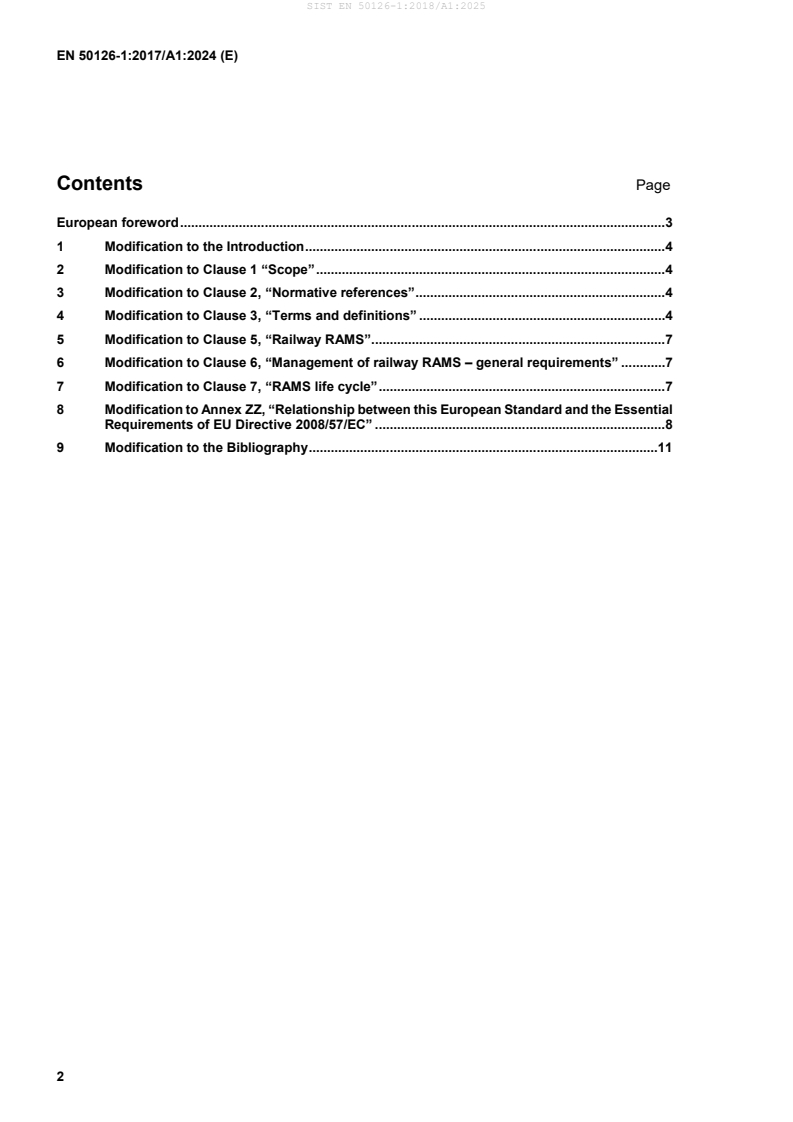
Contents Page
European foreword . 3
1 Modification to the Introduction . 4
2 Modification to Clause 1 “Scope” . 4
3 Modification to Clause 2, “Normative references” . 4
4 Modification to Clause 3, “Terms and definitions” . 4
5 Modification to Clause 5, “Railway RAMS” . 7
6 Modification to Clause 6, “Management of railway RAMS – general requirements” . 7
7 Modification to Clause 7, “RAMS life cycle” . 7
8 Modification to Annex ZZ, “Relationship between this European Standard and the Essential
Requirements of EU Directive 2008/57/EC” . 8
9 Modification to the Bibliography .11
European foreword
This document (EN 50126-1:2017/A1:2024) has been prepared by Technical Committee CLC/TC 9X “Electrical
and electronic applications for railways”.
The following dates are fixed:
• latest date by which this document has to be (dop) 2025-11-30
implemented at national level by publication of
an identical national standard or by
endorsement
• latest date by which the national standards (dow) 2027-11-30
conflicting with this document have to be
withdrawn
Attention is drawn to the possibility that some of the elements of this document may be the subject of patent
rights. CENELEC shall not be held responsible for identifying any or all such patent rights.
This document has been prepared under a standardization request addressed to CENELEC by the European
Commission. The Standing Committee of the EFTA States subsequently approves these requests for its
Member States.
For the relationship with EU Legislation, see informative Annex ZZ, which is an integral part of this document.
Any feedback and questions on this document should be directed to the users’ national committee. A complete
listing of these bodies can be found on the CENELEC website.
1 Modification to the Introduction
In the second paragraph, replace “the practical usage of EN 50126” with “the practical usage of this document”.
In the fifth paragraph, replace “EN 50126 forms part of” with “the EN 50126 series forms part of”.
Replace the seventh paragraph with the following:
“The EN 50126 series is independent from the technology used. As far as safety is concerned, the
EN 50126 series takes the perspective of safety with a functional approach.”
2 Modification to Clause 1 “Scope”
In the first and second paragraph, replace “This part 1 of EN 50126” with “this document”.
In the penultimate paragraph, replace “any former version of EN 50126” with “any former version of this
document.”
3 Modification to Clause 2, “Normative references”
Add the following text:
“The following documents are referred to in the text in such a way that some or all of their content constitutes
requirements of this document. For dated references, only the edition cited applies. For undated references, the
latest edition of the referenced document (including any amendments) applies.
EN 50126-2:2017, Railway Applications — The specification and demonstration of Reliability, Availability,
Maintainability and Safety (RAMS) — Part 2: Systems approach to safety
“.
4 Modification to Clause 3, “Terms and definitions”
In all subclauses, replace “[SOURCE: IEC 60050-821:FDIS2016]” with “[SOURCE: IEC 60050-821:2017]“.
Replace term entry 3.2 with the following:
“
3.2
accident
unintended event or series of events that results in harm
[SOURCE: IEC 60050-821:2017, 821-12-02, modified – “that results in death, injury, loss of a system or service,
or environmental damage” has been replaced with “that results in harm]”
Replace term entry 3.5 with the following:
“
3.5
audit
systematic, independent, documented process for obtaining records, statements of fact or other relevant
information and assessing them objectively to determine the extent to which specified requirements are fulfilled
[SOURCE: IEC 60050-902:2013, 902-03-04, modified – The Note 1 to entry has been omitted]”
Replace term entry 3.6 with the following:
“
As impacted by EN 50126-2:2017/A1:2024.
3.6
availability
ability of an item to be in a state to perform a required function under given conditions at a
given instant of time or over a given time interval, assuming that the required external resources are provided
[SOURCE: IEC 60050-821:2017, 821-05-82, modified – “of a product” has been changed with “for railway
RAMS”]”
Replace term entry 3.7 with the following:
“
3.7
basic integrity
−5 -1
integrity attribute for a safety-related function with a TFFR equal to, or higher than (less demanding), 10 h ;
or for a non-safety-related function”
Replace term entry 3.10 with the following:
“
3.10
common cause failures
pl
failures of multiple items, which would otherwise be considered independent of one another, resulting from a
single cause
Note 1 to entry: Common cause failures can also be “common mode failures”.
Note 2 to entry: The potential for common cause failures reduces the effectiveness of system redundancy.
[SOURCE: IEC 60050-192:2015; 192-03-18]”
Replace term entry 3.21 with the following:
“
3.21
failure
loss of ability to perform as required
Note 1 to entry: Qualifiers, such as catastrophic, critical, major, minor, marginal and insignificant, may be used to categorize
failures according to the severity of consequences, the choice and definitions of severity criteria depending upon the field of
application.
Note 2 to entry: Qualifiers, such as misuse, mishandling and weakness, may be used to categorize failures according to the
cause of failure.
Note 3 to entry: “Failure” is an event, as distinguished from “fault”, which is a state.
Note 4 to entry: Inability to perform a function during maintenance activities does not need to be considered.
[SOURCE: IEC 60050-821:2017, 821-11-19, modified – Notes 3 and 4 to entry have been added]”
Replace term entry 3.23 with the following:
“
3.23
failure rate
limit of the ratio of the conditional probability that the instant of time, T, of a failure of a product falls within a
given time interval (t, t + Δt) and the duration of this interval, Δt, when Δt tends towards zero, given that the item
is in an up state at the start of the time interval
Note 1 to entry: For applications where distance travelled or number of cycles of operation is more relevant than time then
the unit of time can be replaced by the unit of distance or cycles, as appropriate.
Note 2 to entry: The term “failure rate” is often used in the sense of “mean failure rate” defined in IEV 192-05-07.
[SOURCE: IEC 60050-821:2017, 821-12-21]”
Replace term entry 3.25 with the following:
“
3.25
function
specified action or activity which can be performed by technical means and/or human beings and
has a defined output in response to a defined input
Note 1 to entry: A function can be specified or described without refere
...
Questions, Comments and Discussion
Ask us and Technical Secretary will try to provide an answer. You can facilitate discussion about the standard in here.
Loading comments...