

FprEN IEC 63330-1:2024
(Main)Repurposing of secondary batteries - Part 1: General requirements
General Information
- Abstract
IEC 63330-1:2024 provides general requirements for repurposing of secondary cells, modules, battery packs and battery systems, herein also referred to as "PRODUCT", that are originally manufactured for other applications such as electric vehicles. This document specifies the procedure to evaluate the performance and safety of used PRODUCT for repurposing. This document also provides basic requirements for application of repurposed PRODUCT. This document targets secondary lithium ion PRODUCT and battery technologies with data traceability. This document intends to provide basic requirements and a procedure to evaluate the performance and safety of used batteries and battery systems, and also provide general requirements for application of repurposed batteries.
- Status
- Not Published
- Publication Date
- 30-Jun-2024
- Technical Committee
- CLC/TC 21X - Secondary cells and batteries
- Drafting Committee
- IEC/TC 21 - IEC_TC_21
- Current Stage
- 5098 - Decision to drop project - Standstill maintained / released - Formal Approval
- Start Date
- 25-Jun-2024
- Completion Date
- 25-Aug-2026

Overview
FprEN IEC 63330-1:2024 is an international standard published by the CLC that sets general requirements for the repurposing of secondary batteries, especially focusing on secondary lithium-ion technologies. The standard covers secondary cells, modules, battery packs, and battery systems originally manufactured for applications such as electric vehicles. It provides standardized procedures to assess the performance and safety of used battery products intended for repurposing, as well as fundamental requirements for their subsequent application.
This document addresses the growing need for sustainable energy storage solutions by enabling the reuse of batteries after their first life cycle. Repurposing supports environmental goals by reducing waste and optimizing resource usage in batteries that retain sufficient performance after primary use.
Key Topics
Scope of Repurposing: The standard defines repurposing as operating batteries, which are not waste, for different applications than originally intended. This includes reusing cells, modules, or battery packs either in the same type of application with modifications or in new applications altogether.
Product Definitions:
- Secondary cell: Basic rechargeable battery unit.
- Module: Group of cells connected with or without protective devices.
- Battery pack: Assemblies containing cells or modules with monitoring circuitry.
- Battery system: One or more battery packs managed by a Battery Management System (BMS).
Evaluation Procedures:
- Inspection of battery condition and removal of damaged products.
- Diagnosis of residual performance and safety, including operational history and failure records.
- Assessment of the usable period remaining after primary use.
- Data traceability requirements for effective lifecycle management.
Operating Conditions: The standard distinguishes between the operating region of cells and the operating range of battery systems, emphasizing adherence to voltage, current, and temperature limits for safe use.
Safety and Performance Design: Detailed guidelines for ensuring repurposed batteries maintain safety standards through design considerations mitigating systematic and random failures.
Application Requirements:
- Guidelines for repurposed battery operating ranges.
- Criteria for performance levels and usage timelines.
- Design modifications when changing the system design during repurposing.
Applications
FprEN IEC 63330-1:2024 is instrumental for industries involved in battery reuse and second-life battery systems, including:
- Electric Vehicle (EV) Batteries: Repurposing EV batteries for stationary energy storage, grid support, or backup power systems after their primary automotive use.
- Renewable Energy Storage: Utilizing second-life batteries in solar or wind energy storage to increase sustainability and reduce costs.
- Commercial and Residential Energy Solutions: Integrating repurposed battery systems in building energy management and microgrid applications.
- Battery Lifecycle Management Providers: Offering evaluation, certification, and repurposing services based on standardized safety and performance protocols.
The standard provides practical value by ensuring repurposed batteries meet reliable safety and performance criteria, thereby fostering consumer and industry confidence.
Related Standards
- IEC 63338 (under development): Offers general guidance for the reuse of secondary lithium cells and batteries with a focus on safety and performance.
- IEC 62619 series: Addresses safety requirements for secondary lithium cells and batteries for industrial applications, which influences definitions and safety guidelines in IEC 63330-1.
- ISO/IEC Directives: This standard follows ISO/IEC directives for consistency in international standards preparation.
- Other relevant IEC technical committee documents on battery management systems and secondary battery safety.
Keywords: secondary batteries, battery repurposing, lithium-ion batteries, battery safety, performance evaluation, battery system, second-life batteries, energy storage, electric vehicle batteries, IEC 63330-1, battery reuse standard, sustainable energy solutions, battery management system (BMS).
Get Certified
Connect with accredited certification bodies for this standard

TÜV Rheinland
TÜV Rheinland is a leading international provider of technical services.

TÜV SÜD
TÜV SÜD is a trusted partner of choice for safety, security and sustainability solutions.

DEKRA Certification Inc.
DEKRA US certification services.
Sponsored listings
Frequently Asked Questions
FprEN IEC 63330-1:2024 is a draft published by CLC. Its full title is "Repurposing of secondary batteries - Part 1: General requirements". This standard covers: IEC 63330-1:2024 provides general requirements for repurposing of secondary cells, modules, battery packs and battery systems, herein also referred to as "PRODUCT", that are originally manufactured for other applications such as electric vehicles. This document specifies the procedure to evaluate the performance and safety of used PRODUCT for repurposing. This document also provides basic requirements for application of repurposed PRODUCT. This document targets secondary lithium ion PRODUCT and battery technologies with data traceability. This document intends to provide basic requirements and a procedure to evaluate the performance and safety of used batteries and battery systems, and also provide general requirements for application of repurposed batteries.
IEC 63330-1:2024 provides general requirements for repurposing of secondary cells, modules, battery packs and battery systems, herein also referred to as "PRODUCT", that are originally manufactured for other applications such as electric vehicles. This document specifies the procedure to evaluate the performance and safety of used PRODUCT for repurposing. This document also provides basic requirements for application of repurposed PRODUCT. This document targets secondary lithium ion PRODUCT and battery technologies with data traceability. This document intends to provide basic requirements and a procedure to evaluate the performance and safety of used batteries and battery systems, and also provide general requirements for application of repurposed batteries.
FprEN IEC 63330-1:2024 is classified under the following ICS (International Classification for Standards) categories: 29.220.20 - Acid secondary cells and batteries; 29.220.30 - Alkaline secondary cells and batteries; 43.040.10 - Electrical and electronic equipment. The ICS classification helps identify the subject area and facilitates finding related standards.
FprEN IEC 63330-1:2024 is available in PDF format for immediate download after purchase. The document can be added to your cart and obtained through the secure checkout process. Digital delivery ensures instant access to the complete standard document.
Standards Content (Sample)
SLOVENSKI STANDARD
oSIST prEN IEC 63330:2022
01-december-2022
Zahteve za ponovno uporabo sekundarnih baterij
Requirements for reuse of secondary batteries
Prescriptions pour la ré-utilisation des batteries d'accumulateurs
Ta slovenski standard je istoveten z: prEN IEC 63330:2022
ICS:
29.220.01 Galvanski členi in baterije na Galvanic cells and batteries
splošno in general
oSIST prEN IEC 63330:2022 en
2003-01.Slovenski inštitut za standardizacijo. Razmnoževanje celote ali delov tega standarda ni dovoljeno.
oSIST prEN IEC 63330:2022
oSIST prEN IEC 63330:2022
21/1155/CDV
COMMITTEE DRAFT FOR VOTE (CDV)
PROJECT NUMBER:
IEC 63330 ED1
DATE OF CIRCULATION: CLOSING DATE FOR VOTING:
2022-10-28 2023-01-20
SUPERSEDES DOCUMENTS:
21/1090/CD, 21/1130A/CC
IEC TC 21 : SECONDARY CELLS AND BATTERIES
SECRETARIAT: SECRETARY:
France Mr Yves Boudou
OF INTEREST TO THE FOLLOWING COMMITTEES: PROPOSED HORIZONTAL STANDARD:
SC 21A,TC 120
Other TC/SCs are requested to indicate their interest, if any,
in this CDV to the secretary.
FUNCTIONS CONCERNED:
EMC ENVIRONMENT QUALITY ASSURANCE SAFETY
SUBMITTED FOR CENELEC PARALLEL VOTING NOT SUBMITTED FOR CENELEC PARALLEL VOTING
Attention IEC-CENELEC parallel voting
The attention of IEC National Committees, members of
CENELEC, is drawn to the fact that this Committee Draft
for Vote (CDV) is submitted for parallel voting.
The CENELEC members are invited to vote through the
CENELEC online voting system.
This document is still under study and subject to change. It should not be used for reference purposes.
Recipients of this document are invited to submit, with their comments, notification of any relevant patent rights of which
they are aware and to provide supporting documentation.
TITLE:
Requirements for reuse of secondary batteries
PROPOSED STABILITY DATE: 2027
NOTE FROM TC/SC OFFICERS:
this electronic file, to make a copy and to print out the content for the sole purpose of preparing National Committee
positions. You may not copy or "mirror" the file or printed version of the document, or any part of it, for any other
purpose without permission in writing from IEC.
oSIST prEN IEC 63330:2022
21/1155/CDV – 2 – IEC CDV 63330 © IEC 2022
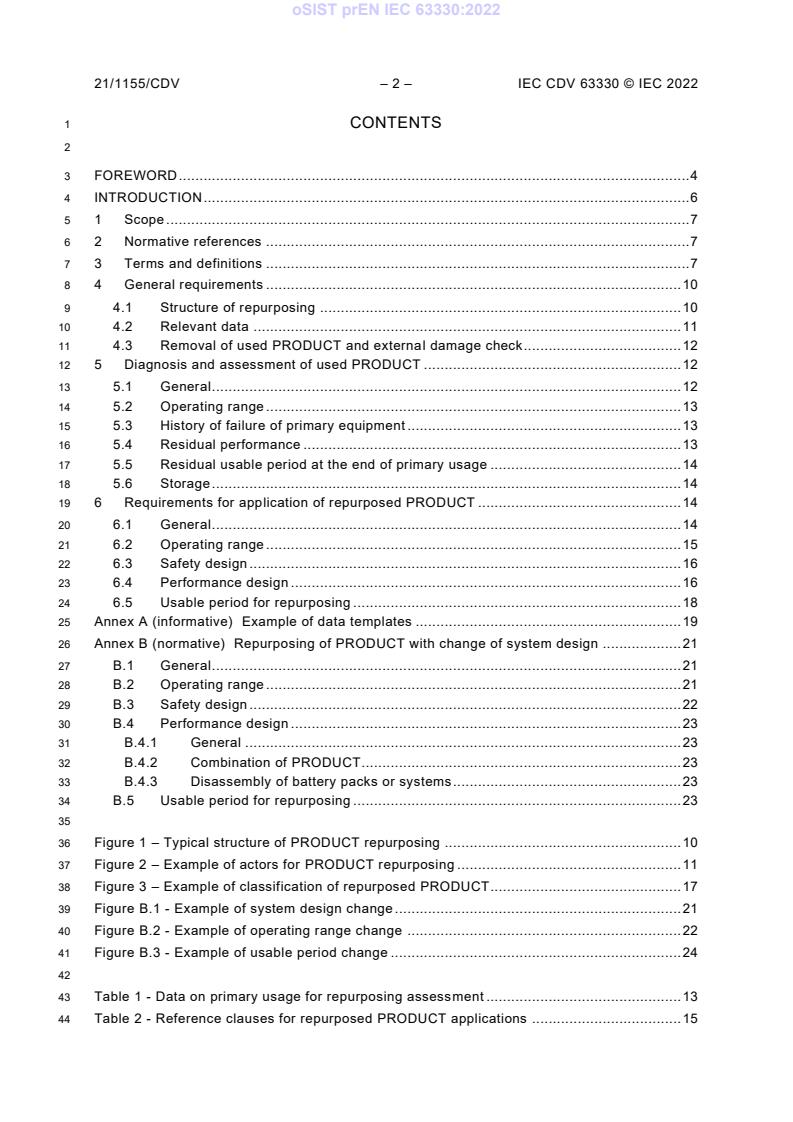
1 CONTENTS
3 FOREWORD . 4
4 INTRODUCTION . 6
5 1 Scope . 7
6 2 Normative references . 7
7 3 Terms and definitions . 7
8 4 General requirements . 10
9 4.1 Structure of repurposing . 10
10 4.2 Relevant data . 11
11 4.3 Removal of used PRODUCT and external damage check . 12
12 5 Diagnosis and assessment of used PRODUCT . 12
13 5.1 General . 12
14 5.2 Operating range . 13
15 5.3 History of failure of primary equipment . 13
16 5.4 Residual performance . 13
17 5.5 Residual usable period at the end of primary usage . 14
18 5.6 Storage . 14
19 6 Requirements for application of repurposed PRODUCT . 14
20 6.1 General . 14
21 6.2 Operating range . 15
22 6.3 Safety design . 16
23 6.4 Performance design . 16
24 6.5 Usable period for repurposing . 18
25 Annex A (informative) Example of data templates . 19
26 Annex B (normative) Repurposing of PRODUCT with change of system design . 21
27 B.1 General . 21
28 B.2 Operating range . 21
29 B.3 Safety design . 22
30 B.4 Performance design . 23
31 B.4.1 General . 23
32 B.4.2 Combination of PRODUCT. 23
33 B.4.3 Disassembly of battery packs or systems . 23
34 B.5 Usable period for repurposing . 23
36 Figure 1 – Typical structure of PRODUCT repurposing . 10
37 Figure 2 – Example of actors for PRODUCT repurposing . 11
38 Figure 3 – Example of classification of repurposed PRODUCT. 17
39 Figure B.1 - Example of system design change . 21
40 Figure B.2 - Example of operating range change . 22
41 Figure B.3 - Example of usable period change . 24
43 Table 1 - Data on primary usage for repurposing assessment . 13
44 Table 2 - Reference clauses for repurposed PRODUCT applications . 15
oSIST prEN IEC 63330:2022
IEC CDV 63330 © IEC 2022 – 3 – 21/1155/CDV
45 Table 3 - Example of classification of repurposed PRODUCT by performance level . 17
46 Table A.1 – Example of template for data on PRODUCT to be repurposed . 19
47 Table A.2 – Example of template for data on application of repurposed PRODUCT . 20
oSIST prEN IEC 63330:2022
21/1155/CDV – 4 – IEC CDV 63330 © IEC 2022
49 INTERNATIONAL ELECTROTECHNICAL COMMISSION
50 ____________
52 General requirements for repurposing of secondary batteries
55 FOREWORD
56 1) The International Electrotechnical Commission (IEC) is a worldwide organization for standardization comprising
57 all national electrotechnical committees (IEC National Committees). The object of IEC is to promote
58 international co-operation on all questions concerning standardization in the electrical and electronic fields. To
59 this end and in addition to other activities, IEC publishes International Standards, Technical Specifications,
60 Technical Reports, Publicly Available Specifications (PAS) and Guides (hereafter referred to as “IEC
61 Publication(s)”). Their preparation is entrusted to technical committees; any IEC National Committee interested
62 in the subject dealt with may participate in this preparatory work. International, governmental and non -
63 governmental organizations liaising with the IEC also participate in this preparation. IEC collaborates closely
64 with the International Organization for Standardization (ISO) in accordance with conditions determined by
65 agreement between the two organizations.
66 2) The formal decisions or agreements of IEC on technical matters express, as nearly as possible, an international
67 consensus of opinion on the relevant subjects since each technical committee has representation from all
68 interested IEC National Committees.
69 3) IEC Publications have the form of recommendations for international use and are accepted by IEC National
70 Committees in that sense. While all reasonable efforts are made to ensure that the technical content of IEC
71 Publications is accurate, IEC cannot be held responsible for the way in which they are used or for any
72 misinterpretation by any end user.
73 4) In order to promote international uniformity, IEC National Committees undertake to apply IEC Publications
74 transparently to the maximum extent possible in their national and regional publications. Any divergence
75 between any IEC Publication and the corresponding national or regional publication shall be clearly indicated in
76 the latter.
77 5) IEC itself does not provide any attestation of conformity. Independent certification bodies provide conformity
78 assessment services and, in some areas, access to IEC marks of conformity. IEC is not responsible for any
79 services carried out by independent certification bodies.
80 6) All users should ensure that they have the latest edition of this publication.
81 7) No liability shall attach to IEC or its directors, employees, servants or agents including individual experts and
82 members of its technical committees and IEC National Committees for any personal injury, property damage or
83 other damage of any nature whatsoever, whether direct or indirect, or for costs (including legal fees) and
84 expenses arising out of the publication, use of, or reliance upon, this IEC Publication or any other IEC
85 Publications.
86 8) Attention is drawn to the Normative references cited in this publication. Use of the referenced publications is
87 indispensable for the correct application of this publication.
88 9) Attention is drawn to the possibility that some of the elements of this IEC Publication may be the subject of
89 patent rights. IEC shall not be held responsible for identifying any or all such patent rights.
90 International Standard IEC 63330 has been prepared by IEC technical committee 21:
91 Secondary cells and batteries.
92 The text of this International Standard is based on the following documents:
FDIS Report on voting
21/XX/FDIS 21/XX/RVD
94 Full information on the voting for the approval of this International Standard can be found in
95 the report on voting indicated in the above table.
96 This document has been drafted in accordance with the ISO/IEC Directives, Part 2.
97 The committee has decided that the contents of this document will remain unchanged until the
98 stability date indicated on the IEC website under "http://webstore.iec.ch" in the data related to
99 the specific document. At this date, the document will be
oSIST prEN IEC 63330:2022
IEC CDV 63330 © IEC 2022 – 5 – 21/1155/CDV
100 • reconfirmed,
101 • withdrawn,
102 • replaced by a revised edition, or
103 • amended.
oSIST prEN IEC 63330:2022
21/1155/CDV – 6 – IEC CDV 63330 © IEC 2022
105 INTRODUCTION
106 Increasing concerns about the global warming, air quality and energy saving have been
107 encouraging the utilization of rechargeable energy storage systems for different applications
108 such as electric mobility. In parallel, technical advance in secondary batteries, especially in
109 lithium-ion batteries, provides the market with practical option to repurpose the used batteries
110 and battery systems that may maintain substantial performance even after the end of use of
111 original equipment such as electric vehicle.
112 In order to foster such new business and to accelerate effective and safe utilization of energy
113 source, it is indispensable to establish a basic international standard for evaluation of safety
114 and performance of used batteries and battery systems, which derive from different
115 equipment with different histories, and will be repurposed for different applications.
116 This document intends to provide basic requirements and procedure how to evaluate the
117 performance and safety of used batteries and battery systems, and also provide general
118 requirements for application of repurposed batteries.
oSIST prEN IEC 63330:2022
IEC CDV 63330 © IEC 2022 – 7 – 21/1155/CDV
121 General requirements for repurposing of secondary batteries
125 1 Scope
126 This document provides general requirements for repurposing of secondary cells, modules,
127 battery packs and battery systems, herein also referred to as "PRODUCT", that are originally
128 manufactured for other applications such as electric vehicles.
129 This document specifies the procedure to evaluate the performance and safety of used
130 PRODUCT for repurposing.
131 This document also provides basic requirements for application of repurposed PRODUCT.
132 This document targets secondary lithium PRODUCT mainly, but not exclusively.
133 The redox flow batteries are not covered by this document.
134 NOTE - General guidance for reuse of secondary lithium cells and batteries is provided in IEC 63338 (under
135 development).
136 2 Normative references
137 There are no normative references in this document.
138 3 Terms and definitions
139 For the purposes of this document, the following terms and definitions apply.
140 ISO and IEC maintain terminological databases for use in standardization at the following
141 addresses:
142 • IEC Electropedia: available at http://www.electropedia.org/
143 • ISO Online browsing platform: available at http://www.iso.org/obp
144 3.1
145 repurposing
146 operation by which PRODUCT that are not waste are used again in a different application to
147 when first placed on the market
148 Note 1 to entry: In this document, PRODUCT is cell, battery, module, battery pack and battery system.
149 Note 2 to entry: The repurposing in this document includes usage of used battery for the same type of purpose as
150 original equipment, with change of battery pack composition.
151 Note 3 to entry: Alternative common terms for repurposing include "second use" and "second life".
152 3.2
153 secondary cell
154 cell
155 basic manufactured unit providing a source of electrical energy by direct conversion of
156 chemical energy, that consists of electrodes, separators, electrolyte, container and terminals,
157 and that is designed to be charged electrically
oSIST prEN IEC 63330:2022
21/1155/CDV – 8 – IEC CDV 63330 © IEC 2022
158 3.3
159 module
160 group of cells connected together either in a series and/or parallel configuration with or
161 without protective devices (e.g. fuse or positive temperature coefficient device) and
162 monitoring circuitry
163 [SOURCE: IEC 62619: 202x, 3.10]
164 3.4
165 battery pack
166 energy storage device, which is comprised of one or more cells or modules electrically
167 connected and has monitoring circuitry which provides information (e.g. cell voltage) to a
168 battery system to influence the battery’s safety, performance and/or service life
169 Note 1 to entry: It may incorporate a protective housing and be provided with terminals or other interconnection
170 arrangements.
171 [SOURCE: IEC 62619: 202x, 3.10]
172 3.5
173 battery system
174 system which comprises one or more cells, modules or battery packs and has a battery
175 management system capable of controlling current in case of overcharge, overcurrent,
176 overdischarge, and overheating
177 Note 1 to entry: The battery system may have cooling or heating units. More than one battery systems may
178 constitute a larger battery system. The battery system is sometimes also referred to as a battery.
179 [SOURCE: IEC 62619: 202x, 3.11, modified - The second preferred term and Note 1 have
180 been deleted. ]
181 3.6
182 battery management system
183 BMS
184 electronic system associated of a battery which has functions to control current in case of
185 overcharge, overcurrent, overdischarge, and overheating and which monitors and/or manages
186 its state, calculates secondary data, reports that data and/or controls its environment to
187 influence the battery’s safety, performance and/or service life
188 Note 1 to entry: Overdischarge cut off is not mandatory.
189 Note 2 to entry: The function of the BMS can be assigned to the battery pack or to equipment that uses the battery.
190 Note 3 to entry: The BMS can be divided and it can be found partially in the battery pack and partially on the
191 equipment that uses the battery.
192 Note 4 to entry: The BMS is sometimes also referred to as a BMU (battery management unit)
193 [SOURCE: IEC 62619: 202x, 3.12, modified - Note 1 to Note 3 have been modified. ]
194 3.7
195 rated capacity
196 C
n
197 capacity value of a cell or battery in ampere hour (Ah) determined under specified conditions
198 and declared by the cell manufacturer
199 3.8
200 state of charge
201 SOC
202 capacity in a battery expressed as a percentage of rated capacity
oSIST prEN IEC 63330:2022
IEC CDV 63330 © IEC 2022 – 9 – 21/1155/CDV
203 3.9
204 operating region
205 conditions during charging and discharging in which the cell operates within the range of
206 voltage, current and temperature as specified by the cell manufacturer to ensure the safe use
207 of the cell
208 Note 1 to entry: The limits of the operating region are specified for the minimum safety, and different from the
209 charging voltage and temperature to optimize the performance of the cell such as cycle life.
210 3.10
211 operating range
212 conditions during charging and discharging in which the battery system operates within the
213 range of voltage, current and temperature as specified by the system manufacturer to ensure
214 the safe use of the battery system
215 Note 1 to entry: Figure B.2 shows the relation between the operating range and the operating regio n.
216 3.11
217 safety design
218 battery design to avoid or control systematic failures and to detect or control random
219 hardware failures, or mitigate their harmful effects
220 3.12
221 systematic failure
222 failure related in a deterministic way to a certain cause, that can only be el iminated by a
223 change of the design or of the manufacturing process, operational procedures, documentation
224 or other relevant factors
225 3.13
226 random hardware failure
227 failure that can occur unpredictably during the lifetime of battery and that follows a probability
228 distribution
229 3.14
230 failure
231 termination of an intended behavior of battery due to a fault manifestation
232 3.15
233 fault
234 abnormal condition that can cause battery to fail
235 3.16
236 service life
237 total period of useful life of PRODUCT in operation which is specified for original usage
238 Note 1 to entry - For secondary cells and batteries, the service life may be expressed in time, number of
239 charge/discharge cycles, capacity in ampere hours (Ah) and operating conditions (temperature range, C rate,
240 depth of discharge, etc.).
241 Note 2 to entry - The service life does not equal the guarantee or warrantee period provided by the original
242 manufacturer.
243 Note 3 to entry - The service life is not clearly specified for vehicle propulsion application.
244 [SOURCE: IEC 60050-482:2004, 482-03-46, modified]
245 3.17
246 residual usable period
247 remaining period of service life or estimated remaining period of useful life of battery in
248 operation
oSIST prEN IEC 63330:2022
21/1155/CDV – 10 – IEC CDV 63330 © IEC 2022
249 3.18
250 usable period for repurposing
251 period usable in secondary application specified by designer of system with repurposed
252 PRODUCT
253 3.19
254 basic system design
255 design of repurposed PRODUCT in order to use repurposed PRODUCT safely in system or
256 subsystem for energy storage
257 4 General requirements
258 4.1 Structure of repurposing
259 Typical structure for repurposing of PRODUCT is shown in Figure 1. In this document,
260 requirements for the following phases are specified:
261 – removal of PRODUCT from original equipment
262 – inspection and assessment of used PRODUCT
263 – storage of PRODUCT to be repurposed
264 – basic system design using repurposed PRODUCT
IEC 63330
End of primary
Production
Primary
usage & removal
application
of PRODUCT
(4.3)
Assessment for
Storage
Basic system
repurposing
design (Clause 6)
(5.6)
(5.1 – 5.5)
End of secondary
Secondary
Equipment design
usage &
& production
application
recycle/disposal
267 Figure 1 – Typical structure of PRODUCT repurposing
268 Figure 2 shows examples of actors for PRODUCT repurposing.
oSIST prEN IEC 63330:2022
IEC CDV 63330 © IEC 2022 – 11 – 21/1155/CDV
Cell/battery manufacturer
Primary equipment manufacturer
Example of actors and businesses for
User of primary equipment
PRODUCT repurposing
Removal & collection service
a a a a
Assessment service
b i
j
f f
Storage service
k
c
h
Basic system design
d d
g g
Design & production of equipment
e e e
with repurposed PRODUCT
User of equipment
Recycle/disposal service
271 Key
a - k actors per business
272 Figure 2 – Example of actors for PRODUCT repurposing
273 This document may be applied for the PRODUCT that is repurposed after the second use. If
274 the PRODUCT is repurposed for multiple times, all the data on primary usage (Table 1) and
275 subsequent usage(s) shall be assessed.
276 NOTE - For specific requirements for electrical energy storage (EES) systems using reused battery, see IEC
277 62933-4-4 (under development) and IEC 62933-5-3 (under development).
278 4.2 Relevant data
279 Data required for repurposing of PRODUCT are as follows:
280 1) basic information
281 – manufacturer of original equipment
282 – chemistry
283 – manufacture year and month
284 – serial number, if available
285 – battery pack dismantling safety procedure
287 2) data on primary usage
288 – operating range
289 – history of failure
290 – residual performance
291 – residual usable period at the end of primary usage
292 – storage
IEC 63330
oSIST prEN IEC 63330:2022
21/1155/CDV – 12 – IEC CDV 63330 © IEC 2022
293 NOTE - If the PRODUCT is repaired according to the specification by the manufacturer, relevant data should be
294 provided.
295 3) data for designing system with repurposing PRODUCT
296 – operating range
297 – usable period for repurposing
298 – performance design
299 – safety design
300 Annex A provides example of data templates to be used for collection and management of
301 data from1) to 3).
302 4.3 Removal of used PRODUCT and external damage check
303 Used PRODUCT shall be removed from the original equipment as instructed in a dismantle or
304 disassembly manual issued by the original equipment manufacturer. If such instructions are
305 not available, relevant local rules or standards shall be applied with special caution for high
306 voltage hazards. The removal of battery systems may result in harm if adequate precautions
307 are not taken. The removal should only be performed by qualified and experienced persons
308 using adequate protection.
309 For PRODUCT from an electric vehicle application, it is recommended to obtain the data on
310 usage and failure before removal from the vehicle using e.g. vehicle diagnostic device.
311 After removal from original equipment, the PRODUCT shall be checked externally as follows:
312 – Make sure there is no leakage of electrolyte by visual confirmation or by using an odor
313 sensor. If fluid leakage is detected in liquid cooled battery pack, the PRODUCT shall be
314 identified as damaged unless coolant leakage or water ingress.
315 Used PRODUCT with external damage, e.g. severe deformation, crack or blemish in the outer
316 case of the PRODUCT, shall not be repurposed, and are recommended to be recycled or
317 disposed according to relevant laws or regulations.
318 Used PRODUCT without external damage shall be assessed for feasibility of repurposing
319 according to Clause 5.
320 If available and not damaged, the module and BMS of battery packs and systems may be
321 reused even if the battery pack/system has a damaged outer case. Degree of damage and, if
322 possible, cause of damage of outer case shall be recorded.
323 5 Diagnosis and assessment of u
...