


EN 60335-2-6:2003
(Main)Household and similar electrical appliances - Safety - Part 2-6: Particular requirements for stationary cooking ranges, hobs, ovens and similar appliances
General Information
- Abstract
Applicable to the safety of stationary electric cooking ranges, hobs, ovens and similar appliances, their rated voltage being not more than 250 V for single-phase appliances connected between one phase and neutral, and 480 V for other appliances.
- Status
- Withdrawn
- Publication Date
- 19-Mar-2003
- Withdrawal Date
- 28-Feb-2006
- Technical Committee
- CLC/TC 61 - Safety of household and similar electrical appliances
- Drafting Committee
- IEC/TC 61 - IEC_TC_61
- Parallel Committee
- IEC/TC 61 - IEC_TC_61
- Current Stage
- 9960 - Withdrawal effective - Withdrawal
- Start Date
- 09-Feb-2018
- Completion Date
- 09-Feb-2018
- Directive
- Not Harmonized2006/95/EC - Directive 2006/95/EC of the European Parliament and of the Council of 12 December 2006 on the harmonisation of the laws of Member States relating to electrical equipment designed for use within certain voltage limits (codified version)OJ Ref: C 71/, C 71/17, C 348/03 OJ Date: 28-Nov-2013
Harmonized Standard2014/35/EU - Directive 2014/35/EU of the European Parliament and of the Council of 26 February 2014 on the harmonisation of the laws of the Member States relating to the making available on the market of electrical equipment designed for use within certain voltage limitsOJ Ref: C 249/03 OJ Date: 08-Jul-2016
Not Harmonized73/23/EEC - Electrical equipment designed for use within certain voltage limitsOJ Ref: C 208

Relations
- Effective Date
- 29-Jan-2023
- Effective Date
- 29-Jan-2023
- Effective Date
- 28-Jan-2023
- Effective Date
- 03-Feb-2026
- Effective Date
- 09-Feb-2026
- Referred By
EN 30-1-1:2008+A2:2010 - Domestic cooking appliances burning gas - Part 1-1: Safety - General - Effective Date
- 09-Feb-2026
- Referred By
EN 30-1-1:2008+A3:2013 - Domestic cooking appliances burning gas - Part 1-1: Safety - General - Effective Date
- 09-Feb-2026
- Effective Date
- 09-Feb-2026
- Effective Date
- 03-Feb-2026
- Effective Date
- 03-Feb-2026
- Effective Date
- 03-Feb-2026
- Effective Date
- 29-Jan-2023
- Effective Date
- 29-Jan-2023
- Effective Date
- 29-Jan-2023
- Effective Date
- 28-Jan-2023
Get Certified
Connect with accredited certification bodies for this standard

CIS Institut d.o.o.
Personal Protective Equipment (PPE) certification body. Notified Body NB-2890 for EU Regulation 2016/425 PPE.

Kiwa BDA Testing
Building and construction product certification.
Kmetijski inštitut Slovenije
Agricultural Institute of Slovenia. Soil testing, plant health, agricultural product analysis.
Sponsored listings
Frequently Asked Questions
EN 60335-2-6:2003 is a standard published by CLC. Its full title is "Household and similar electrical appliances - Safety - Part 2-6: Particular requirements for stationary cooking ranges, hobs, ovens and similar appliances". This standard covers: Applicable to the safety of stationary electric cooking ranges, hobs, ovens and similar appliances, their rated voltage being not more than 250 V for single-phase appliances connected between one phase and neutral, and 480 V for other appliances.
Applicable to the safety of stationary electric cooking ranges, hobs, ovens and similar appliances, their rated voltage being not more than 250 V for single-phase appliances connected between one phase and neutral, and 480 V for other appliances.
EN 60335-2-6:2003 is classified under the following ICS (International Classification for Standards) categories: 13.120 - Domestic safety; 97.040.20 - Cooking ranges, working tables, ovens and similar appliances. The ICS classification helps identify the subject area and facilitates finding related standards.
EN 60335-2-6:2003 has the following relationships with other standards: It is inter standard links to EN 60335-2-6:1999/A1:2001, EN 60335-2-6:1999, EN 60335-2-6:2015, EN 60584-1:1995, EN 30-1-3:2003+A1:2006, EN 30-1-1:2008+A2:2010, EN 30-1-1:2008+A3:2013, EN 30-1-2:2012, EN 60335-2-25:2012, EN 60335-2-25:2002, EN 50615:2015, EN 60335-2-6:2003/A1:2005, EN 60335-2-6:2003/A11:2010, EN 60335-2-6:2003/A2:2008, EN 60335-2-6:2003/A12:2012. Understanding these relationships helps ensure you are using the most current and applicable version of the standard.
EN 60335-2-6:2003 is associated with the following European legislation: EU Directives/Regulations: 2006/95/EC, 2014/35/EU, 2014/53/EU, 73/23/EEC. When a standard is cited in the Official Journal of the European Union, products manufactured in conformity with it benefit from a presumption of conformity with the essential requirements of the corresponding EU directive or regulation.
EN 60335-2-6:2003 is available in PDF format for immediate download after purchase. The document can be added to your cart and obtained through the secure checkout process. Digital delivery ensures instant access to the complete standard document.
Standards Content (Sample)
2003-01.Slovenski inštitut za standardizacijo. Razmnoževanje celote ali delov tega standarda ni dovoljeno.VSUHPHQMHQSicherheit elektrischer Geräte für den Hausgebrauch und ähnliche Zwecke -- Teil 2-6: Besondere Anforderungen für ortsfeste Herde, Kochmulden, Backöfen und ähnliche GeräteAppareils électrodomestiques et analogues - Sécurité -- Partie 2-6: Règles particulières pour les cuisinières, les tables de cuisson, les fours et appareils fixes analoguesHousehold and similar electrical appliances - Safety -- Part 2-6: Particular requirements for stationary cooking ranges, hobs, ovens and similar appliances97.040.20Cooking ranges, working tables, ovens and similar appliances13.120Varnost na domuDomestic safetyICS:Ta slovenski standard je istoveten z:EN 60335-2-6:2003SIST EN 60335-2-6:2003en01-september-2003SIST EN 60335-2-6:2003SLOVENSKI
STANDARDSIST EN 60335-2-6:2000/A1:2002SIST EN 60335-2-6:20001DGRPHãþD
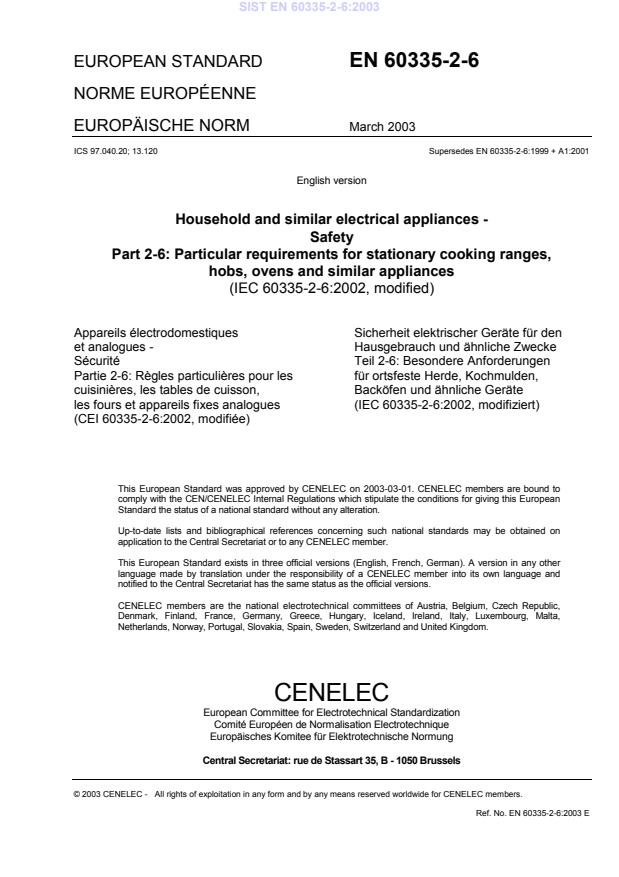
EUROPEAN STANDARD
EN 60335-2-6 NORME EUROPÉENNE EUROPÄISCHE NORM
March 2003 CENELEC European Committee for Electrotechnical Standardization Comité Européen de Normalisation Electrotechnique Europäisches Komitee für Elektrotechnische Normung
Central Secretariat: rue de Stassart 35, B - 1050 Brussels
© 2003 CENELEC - All rights of exploitation in any form and by any means reserved worldwide for CENELEC members.
Ref. No. EN 60335-2-6:2003 E
ICS 97.040.20; 13.120 Supersedes EN 60335-2-6:1999 + A1:2001
English version
Household and similar electrical appliances -
Safety Part 2-6: Particular requirements for stationary cooking ranges,
hobs, ovens and similar appliances (IEC 60335-2-6:2002, modified)
Appareils électrodomestiques
et analogues -
Sécurité Partie 2-6: Règles particulières pour les cuisinières, les tables de cuisson,
les fours et appareils fixes analogues (CEI 60335-2-6:2002, modifiée)
Sicherheit elektrischer Geräte für den Hausgebrauch und ähnliche Zwecke Teil 2-6: Besondere Anforderungen
für ortsfeste Herde, Kochmulden, Backöfen und ähnliche Geräte (IEC 60335-2-6:2002, modifiziert)
This European Standard was approved by CENELEC on 2003-03-01. CENELEC members are bound to comply with the CEN/CENELEC Internal Regulations which stipulate the conditions for giving this European Standard the status of a national standard without any alteration.
Up-to-date lists and bibliographical references concerning such national standards may be obtained on application to the Central Secretariat or to any CENELEC member.
This European Standard exists in three official versions (English, French, German). A version in any other language made by translation under the responsibility of a CENELEC member into its own language and notified to the Central Secretariat has the same status as the official versions.
CENELEC members are the national electrotechnical committees of Austria, Belgium, Czech Republic, Denmark, Finland, France, Germany, Greece, Hungary, Iceland, Ireland, Italy, Luxembourg, Malta, Netherlands, Norway, Portugal, Slovakia, Spain, Sweden, Switzerland and United Kingdom.
national standard or by endorsement
(dop) 2004-03-01 - date on which national standards conflicting with the EN have to be withdrawn
(dow) 2006-03-01 This part 2 has to be used in conjunction with EN 60335-1, Household and similar electrical appliances – Safety – Part 1: General requirements. It was established on the basis of the 2002 edition of that standard. Amendments and revisions of Part 1 have also to be taken into account and the dates when such changes become applicable will be stated in the relevant amendment or revision of Part 1. This part 2 supplements or modifies the corresponding clauses of EN 60335-1, so as to convert it into the European Standard: Safety requirements for stationary electric cooking ranges, hobs, ovens and similar appliances. When a particular subclause of Part 1 is not mentioned in this part 2, that subclause applies as far as is reasonable. When this standard states "addition", "modification" or "replacement", the relevant text of Part 1 is to be adapted accordingly.
NOTE 1 The following numbering system is used:
- subclauses, tables and figures that are numbered starting from 101 are additional to those in Part 1; - unless notes are in a new subclause or involve notes in Part 1, they are numbered starting from 101, including those in a replaced clause or subclause; - additional annexes are lettered AA, BB, etc.; - subclauses, notes and annexes that are additional to those in the IEC standard are prefixed with the letter Z. NOTE 2 The following print types are used: - requirements: in roman type; - test specifications: in italic type; - notes: in small roman type. Words in bold in the text are defined in Clause 3. When a definition concerns an adjective, the adjective and the associated noun are also in bold. There are no special national conditions causing a deviation from this European Standard, other than those listed in Annex ZA to EN 60335-1. There are no national deviations from this European Standard, other than those listed in Annex ZB to
EN 60335-1. p NOTE
In this document, p is used in the margin to indicate instructions for preparing the printed version. _____________ SIST EN 60335-2-6:2003
- 3 - EN 60335-2-6:2003 Introduction p Add: An investigation by CENELEC TC 61 has shown that all risks from products within the scope of this standard are fully covered by the Low Voltage Directive, 73/23/EEC. For products having mechanical moving parts, a risk assessment in accordance with the Machinery Directive, 98/37/EC, has shown that the risks are mainly of electrical origin and consequently this directive is not applicable. However, the relevant essential safety requirements of the Machinery Directive are covered by this standard together with the principal objectives of the Low Voltage Directive. ____________ Endorsement notice The text of the International Standard IEC 60335-2-6:2002 was approved by CENELEC as a European Standard with agreed common modifications as given below. COMMON MODIFICATIONS 1 Scope p 1.1 Add: NOTE Z101 For appliances that are supplied with gas, EN 30 is also applicable.
8 Protection against access to live parts p 8.1.2 Add: NOTE Z101 Appliance outlets for grill heating elements are considered to be socket-outlets. ____________ p Add: Annex ZC
(normative)
Normative references to international publications
with their corresponding European publications Publication Year Title EN/HD Year IEC 60584-1 –1) Thermocouples – Part 1: Reference tables EN 60584-1 1995 2) ____________
1) undated reference 2) valid edition at date of issue SIST EN 60335-2-6:2003
NORME INTERNATIONALECEIIEC INTERNATIONAL STANDARD 60335-2-6Cinquième éditionFifth edition2002-07 Appareils électrodomestiques et analogues – Sécurité – Partie 2-6: Règles particulières pour les cuisinières, les tables de cuisson, les fours et les appareils fixes analogues
Household and similar electrical appliances – Safety – Part 2-6: Particular requirements for stationary
cooking ranges, hobs, ovens and similar appliances
Pour prix, voir catalogue en vigueur For price, see current catalogue IEC 2005
Droits de reproduction réservés
Copyright - all rights reserved Aucune partie de cette publication ne peut être reproduite ni utilisée sous quelque forme que ce soit et par aucun procédé, électronique ou mécanique, y compris la photocopie et les microfilms, sans l'accord écrit de l'éditeur. No part of this publication may be reproduced or utilized in any form or by any means, electronic or mechanical, including photocopying and microfilm, without permission in writing from the publisher. International Electrotechnical Commission,
3, rue de Varembé, PO Box 131, CH-1211 Geneva 20, SwitzerlandTelephone: +41 22 919 02 11 Telefax: +41 22 919 03 00 E-mail: inmail@iec.ch
Web: www.iec.ch CODE PRIX PRICE CODE W Commission Electrotechnique InternationaleInternational Electrotechnical Commission
60335-2-6 IEC:2005 – 3 – CONTENTS FOREWORD.5 INTRODUCTION.11 1 Scope.13 2 Normative references.13 3 Definitions.15 4 General requirement.21 5 General conditions for the tests.21 6 Classification.23 7 Marking and instructions.23 8 Protection against access to live parts.29 9 Starting of motor-operated appliances.29 10 Power input and current.29 11 Heating.29 12 Void.39 13 Leakage current and electric strength at operating temperature.39 14 Transient overvoltages.41 15 Moisture resistance.41 16 Leakage current and electric strength.43 17 Overload protection of transformers and associated circuits.45 18 Endurance.45 19 Abnormal operation.45 20 Stability and mechanical hazards.49 21 Mechanical strength.49 22 Construction.53 23 Internal wiring.61 24 Components.61 25 Supply connection and external flexible cords.63 26 Terminals for external conductors.63 27 Provision for earthing.65 28 Screws and connections.65 29 Clearances, creepage distances and solid insulation.65 30 Resistance to heat and fire.65 31 Resistance to rusting.65 32 Radiation, toxicity and similar hazards.65
Figure 101 – Vessel for testing hob elements.69 Figure 102 – Vessel for testing induction hob elements.69 Figure 103 – Load for testing rotating spits.71 Figure 104 – Probe for measuring surface temperatures.73
60335-2-6 IEC:2005 – 5 – INTERNATIONAL ELECTROTECHNICAL COMMISSION ___________
HOUSEHOLD AND SIMILAR ELECTRICAL APPLIANCES – SAFETY –
Part 2-6: Particular requirements for stationary cooking ranges,
hobs, ovens and similar appliances
FOREWORD 1) The International Electrotechnical Commission (IEC) is a worldwide organization for standardization comprising all national electrotechnical committees (IEC National Committees). The object of IEC is to promote international co-operation on all questions concerning standardization in the electrical and electronic fields. To this end and in addition to other activities, IEC publishes International Standards, Technical Specifications, Technical Reports, Publicly Available Specifications (PAS) and Guides (hereafter referred to as “IEC Publication(s)”). Their preparation is entrusted to technical committees; any IEC National Committee interested in the subject dealt with may participate in this preparatory work. International, governmental and non-governmental organizations liaising with the IEC also participate in this preparation. IEC collaborates closely with the International Organization for Standardization (ISO) in accordance with conditions determined by agreement between the two organizations. 2) The formal decisions or agreements of IEC on technical matters express, as nearly as possible, an international consensus of opinion on the relevant subjects since each technical committee has representation from all interested IEC National Committees.
3) IEC Publications have the form of recommendations for international use and are accepted by IEC National Committees in that sense. While all reasonable efforts are made to ensure that the technical content of IEC Publications is accurate, IEC cannot be held responsible for the way in which they are used or for any misinterpretation by any end user. 4) In order to promote international uniformity, IEC National Committees undertake to apply IEC Publications transparently to the maximum extent possible in their national and regional publications. Any divergence between any IEC Publication and the corresponding national or regional publication shall be clearly indicated in the latter. 5) IEC provides no marking procedure to indicate its approval and cannot be rendered responsible for any equipment declared to be in conformity with an IEC Publication. 6) All users should ensure that they have the latest edition of this publication. 7) No liability shall attach to IEC or its directors, employees, servants or agents including individual experts and members of its technical committees and IEC National Committees for any personal injury, property damage or other damage of any nature whatsoever, whether direct or indirect, or for costs (including legal fees) and expenses arising out of the publication, use of, or reliance upon, this IEC Publication or any other IEC Publications.
8) Attention is drawn to the Normative references cited in this publication. Use of the referenced publications is indispensable for the correct application of this publication. 9) Attention is drawn to the possibility that some of the elements of this IEC Publication may be the subject of patent rights. IEC shall not be held responsible for identifying any or all such patent rights. This part of International Standard IEC 60335 has been prepared by IEC technical committee 61: Safety of household and similar electrical appliances. This fifth edition cancels and replaces the fourth edition published in 1997 and its amendment 1 (2000). It constitutes a technical revision. This bilingual version (2005-02) replaces the English version. SIST EN 60335-2-6:2003
60335-2-6 IEC:2005 – 7 – The text of this part of IEC 60335 is based on the following documents:
FDIS Report on voting 61/2137/FDIS 61/2162/RVD
Full information on the voting for the approval of this standard can be found in the report on voting indicated in the above table. The French version of this standard has not been voted upon. This part 2 is to be used in conjunction with the latest edition of IEC 60335-1 and its amendments. It was established on the basis of the fourth edition (2001) of that standard. NOTE 1 When “Part 1” is mentioned in this standard, it refers to IEC 60335-1. This part 2 supplements or modifies the corresponding clauses in IEC 60335-1, so as to convert that publication into the IEC standard: Safety requirements for stationary electric cooking ranges, hobs, ovens and similar appliances. When a particular subclause of Part 1 is not mentioned in this part 2, that subclause applies as far as is reasonable. When this standard states "addition", "modification" or "replacement", the relevant text in Part 1 is to be adapted accordingly.
NOTE 2 The following numbering system is used: – subclauses, tables and figures that are numbered starting from 101 are additional to those in Part 1; – unless notes are in a new subclause or involve notes in Part 1, they are numbered starting from 101, including those in a replaced clause or subclause;
– additional annexes are lettered AA, BB, etc.
NOTE 3 The following print types are used: – requirements: in roman type; – test specifications: in italic type; – notes: in small roman type.
Words in bold in the text are defined in Clause 3. When a definition concerns an adjective, the adjective and the associated noun are also in bold.
The following differences exist in the countries indicated below. – 3.1.6: The diversity factor is not used (USA). – 3.1.9: Other test conditions are used (USA). – 6.1: Class 0I appliances are allowed (Japan). – 7.1: Instructions for pyrolytic self-cleaning ovens are to be marked on the outside of the oven (USA). – 7.1: Miniature fuse links are not to be used to protect socket-outlets (USA). – 7.12: The minimum indicated water pressure is 1 MPa (Norway). – 7.12.4: The instructions shall state the name of the manufacturer and model number of the control panel to be used with built-in appliances (USA). – 11.7: The duration of the test is different (Canada and USA). – 11.8: 65 K applies for all wooden surfaces (Norway, Sweden and USA). – 11.8: Lower temperature limits apply to handles, knobs and other surfaces accessible during the self-cleaning operation (USA). – 11.101: The test is different (Australia, Canada and USA). SIST EN 60335-2-6:2003
60335-2-6 IEC:2005 – 9 – – 13.2: Leakage current measurements are not carried out (USA). – 13.3: The electric strength test is not carried out (USA). – 15.2: Tests are only carried out on controls mounted in the hob surface (USA). – 16.2: Leakage current measurements are not carried out (USA). – 19.4: The temperature limit is 315 °C (USA). – 19.101: Different disc sizes are used (USA). – 20.101: Heavier loads are used (USA). – 21.101: Additional requirements for oven shelves are specified (Australia, New Zealand and USA). – 21.102: Different test loads and test methods are used (USA). – Clause 22: Ovens installed at a height below 80 cm above the floor shall be constructed so that the oven door cannot be opened by a simple operation (Sweden). – Clause 22: Hob elements are required to be inaccessible to children (Sweden). – 22.2: For appliances with more than one heating unit, each unit shall be provided with all-pole disconnection (Norway). – 22.107: The requirement does not apply (USA). – 22.108: The test is different (USA). – 22.109: A centre oven temperature of 315 °C is specified (USA). – 22.110: Larger quantities of different soils are used (USA). – 22.111: Larger quantities of different soils are used (USA). – 22.113: The test is not carried out (USA). – 22.115: The test is not carried out (USA). – 24.1.4: The number of cycles of operation is different (USA). – 24.101: Socket-outlets have to be provided with residual current devices which may be combined with the overcurrent protective device (Australia). – 24.102: The current limitation is different and socket-outlets are required to be de-energized when the cooking elements are in use (USA). – 25.3: Ranges that are not built-in shall not be permanently connected to the fixed wiring (New Zealand and Norway). – Clause 27: Earthing terminals are permitted to be connected to the neutral (USA). The committee has decided that the contents of this publication will remain unchanged until the maintenance result date indicated on the IEC web site under "http://webstore.iec.ch" in the data related to the specific publication. At this date, the publication will be
• reconfirmed; • withdrawn; • replaced by a revised edition, or • amended.
60335-2-6 IEC:2005 – 11 – INTRODUCTION It has been assumed in the drafting of this International Standard that the execution of its provisions is entrusted to appropriately qualified and experienced persons.
This standard recognizes the internationally accepted level of protection against hazards such as electrical, mechanical, thermal, fire and radiation of appliances when operated as in normal use taking into account the manufacturer's instructions. It also covers abnormal situations that can be expected in practice. This standard takes into account the requirements of IEC 60364 as far as possible so that there is compatibility with the wiring rules when the appliance is connected to the supply mains. However, national wiring rules may differ. If an appliance within the scope of this standard also incorporates functions that are covered by another part 2 of IEC 60335, the relevant part 2 is applied to each function separately, as far as is reasonable. If applicable, the influence of one function on the other is taken into account.
This standard is a product family standard dealing with the safety of appliances and takes precedence over horizontal and generic standards covering the same subject.
An appliance that complies with the text of this standard will not necessarily be considered to comply with the safety principles of the standard if, when examined and tested, it is found to have other features that impair the level of safety covered by these requirements. An appliance employing materials or having forms of construction differing from those detailed in the requirements of this standard may be examined and tested according to the intent of the requirements and, if found to be substantially equivalent, may be considered to comply with the standard.
60335-2-6 IEC:2005 – 13 – HOUSEHOLD AND SIMILAR ELECTRICAL APPLIANCES – SAFETY –
Part 2-6: Particular requirements for stationary cooking ranges,
hobs, ovens and similar appliances
1 Scope This clause of Part 1 is replaced by the following. This International Standard deals with the safety of stationary electric cooking ranges, hobs, ovens and similar appliances for household use, their rated voltage being not more than 250 V for single-phase appliances connected between one phase and neutral, and 480 V for other appliances. NOTE 101 Examples of appliances that are within the scope of this standard are – griddles; – grills; – induction hobs; – pyrolytic self-cleaning ovens; – steam ovens. As far as is practicable, this standard deals with the common hazards presented by appliances that are encountered by all persons in and around the home. However, in general, it does not take into account – the use of appliances by young children or infirm persons without supervision; – playing with the appliance by young children. NOTE 102 Attention is drawn to the fact that – for appliances intended to be used in vehicles or on board ships or aircraft, additional requirements may be necessary; – in many countries additional requirements are specified by the national health authorities, the national authorities responsible for the protection of labour, the national water supply authorities and similar authorities. NOTE 103 This standard does not apply to – appliances intended for commercial catering; – appliances intended to be used in locations where special conditions prevail, such as the presence of a corrosive or explosive atmosphere (dust, vapour or gas); – grills, toasters and similar portable cooking appliances (IEC 60335-2-9); – microwave ovens (IEC 60335-2-25). 2 Normative references This clause of Part is applicable except as follows. Addition: IEC 60584-1, Thermocouples – Part 1: Reference tables SIST EN 60335-2-6:2003
60335-2-6 IEC:2005 – 15 – 3 Definitions This clause of Part 1 is applicable except as follows. 3.1.6 Addition: NOTE 101 For appliances having more than three heating units per phase, a diversity factor is applied to the rated current or rated power input when determining the current used to establish the size of the terminals and the nominal cross-sectional area of the supply cord. The diversity factor F is calculated from the following formula, where N is the number of heating units per phase that can be energized together: NF0,650,35+= 3.1.9 Replacement: normal operation operation of the appliance as specified in 3.1.9.101 to 3.1.9.107 3.1.9.101 Hob elements, other than induction hob elements, are operated with vessels containing cold water. The vessel is made of unpolished commercial quality aluminium, has a flat bottom and is covered with a lid. Thermal controls are adjusted to their highest setting until the water boils and then adjusted so that the water boils gently. Water is added to maintain the level during boiling. NOTE 1 The lid is positioned so that steam does not affect the test. In case of doubt, vessels as specified in Figure 101 are used. Induction hob elements are operated with vessels as specified in Figure 102 that contain approximately half their capacity of cooking oil at room temperature. Thermal controls are adjusted to their highest setting until the oil temperature reaches 180 °C ± 4 °C and then adjusted so that this temperature is maintained. For all hob elements the diameter of the bottom of the vessel is approximately equal to the diameter of the cooking zone and the quantity of liquid is specified in Table 101. The vessel is positioned centrally on the cooking zone. NOTE 2 If several cooking zones are marked for one hob element, the most unfavourable zone is used for the test. NOTE 3 For non-circular cooking zones, the smallest non-circular vessel is used which will cover the cooking zone as far as possible, taking into account the hob rim and the other vessels. The quantity of liquid is determined on the basis of the minor diameter of the cooking zone. Table 101 – Quantity of liquid in the vessel Diameter of cooking zone mm Quantity of water or oil l
≤ 110
0,6 > 110 and ≤ 145
1,0 > 145 and ≤ 180
1,5 > 180 and ≤ 220
2,0 > 220 and ≤ 300
3,0
60335-2-6 IEC:2005 – 17 – 3.1.9.102 Ovens are operated empty with the door closed. Thermal controls are adjusted so that the mean temperature in the centre of the oven is maintained at
220 °C ± 4 °C for ovens with forced air circulation;
240 °C ± 4 °C for other ovens. NOTE If the temperature cannot be attained, the thermal control is adjusted to its highest setting. Ovens without thermal controls are switched on and off so that the temperature in the centre of the oven is maintained at 240 °C ± 15 °C. Steam ovens are operated in accordance with the instructions. Controls are adjusted to their highest setting until the cooking temperature is reached and then adjusted to the lowest setting that maintains this temperature. Steam generators intended to be filled by hand are filled according to the instructions, water being added to maintain the steam generation. Steam generators intended to be filled automatically are connected to a water supply, the pressure of which is set according to the instructions. The supply water has a temperature of
15 °C ± 5 °C for appliances to be connected to a cold water supply;
60 °C ± 5 °C or the temperature indicated in the instructions, whichever is the higher, for appliances to be connected to a hot water supply. Steam ovens are also operated while generating steam but with the thermal controls adjusted as for operation without steam. 3.1.9.103 Grills are operated empty with the grill pan and food supports in the most unfavourable position for normal use, the door and any other accessories being positioned in accordance with the instructions. In the absence of such instructions, the door and other accessories are placed in the most unfavourable position in which they may be left. Thermal controls are adjusted to their highest setting. However, if the instructions for grills incorporated in ovens specify a lower setting, this setting is used. Any reflectors intended to be placed above heating elements are in position. 3.1.9.104 Rotating spits in ovens or grills are operated with the load on the rotating spit as shown in Figure 103. The appliance is operated taking into account the instructions with regard to – the heating elements to be operated; – the setting of the thermal control; – the position of the door and grill pan. In the absence of such instructions, the control is adjusted to its highest setting and the door is fully open or is placed in the most unfavourable intermediate position in which it may be left. Any grill pan is placed in its lowest position. SIST EN 60335-2-6:2003
60335-2-6 IEC:2005 – 19 – 3.1.9.105 Warming drawers and similar compartments are operated in the closed position with their controls adjusted to the highest setting. 3.1.9.106 Griddles are operated so that the temperature at the centre of the heated surface is maintained at 275 °C ± 15 °C by adjusting their thermal controls or by switching the supply on or off. 3.1.9.107 Cooking ranges are operated with their individual heating units being operated under their stated conditions of normal operation. 3.101 oven appliance having a heated cavity with a door and constructed so that food, which may be in a container, can be placed on a shelf 3.102 grill heating unit constructed so that the food is supported on a grid or spit and is cooked by radiant heat NOTE The cooking operation in a grill is known as grilling or broiling. 3.103 hob appliance that incorporates a hob surface and one or more hob elements, and is built in or part of a cooking range 3.104 cooking range appliance incorporating a hob and an oven and which may incorporate a grill or griddle 3.105 pyrolytic self-cleaning oven oven in which cooking deposits are removed by heating the oven to a temperature exceeding 350 °C 3.106 steam oven oven intended for cooking food by steam generated at atmospheric pressure in the appliance 3.107 griddle heating unit having a surface on which the food is placed directly for cooking 3.108 induction hob hob containing at least one induction hob element 3.109 heating unit any part of the appliance that fulfils an independent cooking or warming function NOTE Examples are hob elements, ovens, grills and warming drawers. SIST EN 60335-2-6:2003
60335-2-6 IEC:2005 – 21 – 3.110 hob surface horizontal part of the appliance on which vessels can be placed 3.111 hob element heating unit attached to the hob surface or positioned below the cooking zone 3.112 induction hob element hob element that heats metallic vessels by means of eddy currents NOTE The eddy currents are induced in the bottom of the vessel by the electromagnetic field of a coil. 3.113 pan detector device incorporated in a hob element that prevents its operation unless a vessel is placed on the cooking zone 3.114 cooking zone area marked on a hob surface where the vessel is placed for heating food NOTE When a hob element protrudes above the hob surface, its surface is the cooking zone. 3.115 touch control control actuated by contact or proximity of a finger, with little or no movement of the contact surface 3.116 temperature-sensing probe device that is inserted into the food to measure its temperature and which is a part of an oven control 3.117 rated water pressure water pressure assigned to the appliance by the manufacturer 4 General requirement This clause of Part 1 is applicable. 5 General conditions for the tests This clause of Part 1 is applicable except as follows. 5.3 Addition: For pyrolytic self-cleaning ovens, the tests of 22.108 to 22.111 are carried out before the tests of Clause 19. SIST EN 60335-2-6:2003
60335-2-6 IEC:2005 – 23 – 5.4 Addition: Appliances that also use gas are supplied with gas at the appropriate rated pressure. Vessels having a diameter of approximately 220 mm are filled with 2 l of water, covered with a lid and placed on the hob burners. The controls are adjusted to their highest setting until the water boils. They are then adjusted so that the water simmers, water being added when necessary to maintain the level. 5.101 Class III temperature-sensing probes are only subjected to the tests of Clause 19. 6 Classification This clause of Part 1 is applicable except as follows. 6.1 Modification: Appliances shall be class I, class II or class III. 7 Marking and instructions This clause of Part 1 is applicable except as follows. 7.1 Addition: The total rated power input or rated current of induction hob elements shall be marked. If a cooking range incorporates a socket-outlet protected by means of fuses, other than D type fuses, it shall be marked with the rated current of the relevant fuse. When a miniature fuse-link is provided, this marking shall indicate that the fuse-link is to have a high breaking capacity. 7.6 Addition:
[symbol 5010 of IEC 60417-1]
ON/OFF (push-push)
7.10 Addition: The off position of touch controls for hobs shall be marked by the figure O and the on position by the figure I. If there is no touch control for the hob, this requirement applies to the touch controls for each hob element. NOTE 101 If the same touch control is used for switching on and off, symbol 5010 of IEC 60417-1 may be used. 7.12 Addition: If the hob surface is of glass-ceramic or similar material and protects live parts,
the instructions shall include the substance of the following: WARNING: If the surface is cracked, switch off the appliance to avoid the possibility of electric shock. SIST EN 60335-2-6:2003
60335-2-6 IEC:2005 – 25 – The instructions for cooking ranges and ovens shall include the substance of the following: During use the appliance becomes hot. Care should be taken
to avoid touching heating elements inside the oven. If the instructions state that the oven can be used as a grill with the door open, they shall contain the substance of the following: WARNING: Accessible parts may become hot when the grill is in use.
Children should be kept away. The instructions for pyrolytic self-cleaning ovens shall state that excess spillage must be removed before cleaning and shall specify which utensils can be left in the oven during cleaning. If, for cleaning, the manufacturer instructs the user to set the controls to a position higher than for normal cooking purposes, the instructions shall state that under such conditions the surfaces may get hotter than usual and children should be kept away. The instructions for ovens incorporating a fan with a guard that can be removed for cleaning shall state that the oven must be switched off before removing the guard and that, after cleaning, the guard must be replaced in accordance with the instructions. The instructions for ovens provided with a facility to use a temperature-sensing probe shall include the substance of the following: Only use the temperature probe recommended for this oven. The instructions for cooking ranges, hobs and ovens shall state that a steam cleaner is not to be used. The instructions for induction hobs shall include the substance of the following: Metallic objects such as knives, forks, spoons and lids should not be placed
on the hob surface since they can get hot. The instructions for hobs incorporating a lid shall state that any spillage should be removed from the lid before opening. They shall also state that the hob surface should be allowed to cool before closing the lid. The instructions for hobs incorporating halogen lamps shall warn the user not to stare at the hob elements. The instructions for hobs incorporating a pan detector shall include the substance of the following: After use, switch off the hob element by its control and do not rely on the pan detector. If the appliance incorporates a lamp for illumination, and does not incorporate a switch providing full disconnection under overvoltage category III conditions, the instructions shall include the substance of the following: WARNING: Ensure that the appliance is switched off before replacing the lamp
to avoid the possibility of electric shock. SIST EN 60335-2-6:2003
60335-2-6 IEC:2005 – 27 – 7.12.1 Addition: The installation instructions for cooking ranges that are placed on the floor shall state that if the range is placed on a base, measures have to be taken to prevent the appliance slipping from the base. NOTE 101 This statement is not required if the instructions specify that the range should not be placed on a base. The installation instructions for appliances intended to be connected to the water mains shall include the maximum rated water pressure in megapascals. 7.12.3 Addition: If a cooking range does not have a supply cord, the instructions shall state the type of cord to be used, taking into account the temperature of the rear surface of the appliance. 7.12.4 Addition: The instructions for built-in appliances having separate control panels shall state that the control panel is only to be connected to the heating units specified in order to avoid a possible hazard. 7.15 Addition: When it is not practical for the marking of fixed appliances to be visible after the appliance has been installed, the relevant information shall be included in the instructions or on an additional label that can be fixed near the appliance after installation. NOTE 101 An example of such an appliance is a built-in hob. The marking for the rated current of the fuse protecting a socket-outlet shall be placed on or near the socket-outlet. 7.101 Steam generators intended to be filled manually shall be marked with the maximum water level, which shall be visible during filling. Compliance is checked by inspection. 7.102 The cooking zone of hob surfaces shall be identified by appropriate marking unless it is obvious. Compliance is checked by inspection. SIST EN 60335-2-6:2003
60335-2-6 IEC:2005 – 29 – 8 Protection against access to live parts This clause of Part 1 is applicable except as follows. 8.1.2 Addition: Test probe 12 of IEC 61032 is applied without appreciable force to parts liable to be touched accidentally in normal use by a fork or similar pointed object. It shall not be possible to touch live parts. 8.1.3 Modification: The use of test probe 41 instead of test probe B and test probe 13 is only allowed when visibly glowing heating elements are situated at the top of an oven or grilling compartment. 9 Starting of motor-operated appliances This clause of Part 1 is not applicable. 10 Power input and current This clause of Part 1 is applicable except as follows. 10.1 Addition: The power input of induction hob elements is measured separately and the tolerances for motor-operated appliances apply. The contribution of a socket-outlet to the power input is considered to be 1 kW. NOTE 101 Socket-outlets are not loaded during the test. 10.2 Addition: The current of induction hob elements is measured separately and the tolerances for motor-operated appliances apply. The contribution of a socket-outlet to the current is considered to be 1 kW divided by the rated voltage. NOTE 101 Socket-outlets are not loaded during the test. 11 Heating This clause of Part 1 is applicable except as follows. 11.1 Addition: For cooking ranges and ovens, compliance is also checked by the test of 11.101. SIST EN 60335-2-6:2003
60335-2-6 IEC:2005 – 31 – 11.2 Addition: For appliances intended to stand on the floor, a closed rectangular box is placed as close as possible to the free side of the appliance and against the rear wall of the test corner. The box is made of dull black painted plywood 10 mm thick. It has a width of 150 mm, its top being level with the hob surface and its front flush with the front surface of the appliance. Appliances having a lid to cover the hob surface are tested with the lid open. Lids that can be removed without the aid of a tool are removed, unless the hob element cannot operate with the lid removed. Temperature-sensing probes are placed in the oven in any position likely to occur during normal use. They are not connected to control the oven temperature. The test for pyrolytic self-cleaning ovens is carried out with temperature-sensing probes in position, unless otherwise specified in the instructions. Detachable parts that are intended to be used to reduce the temperature of control panels are removed. NOTE 101 A retractable part is not considered to be a detachable part. 11.3 Addition: The temperature of the centre of the oven and the temperature rises of the surface of the rectangular box are determined using the thermocouples specified for the walls of the test corner. NOTE 101 If the magnetic field of an induction hob element unduly influences the results, the temperature rises can be determined using platinum resistances with twisted connecting wires or any equivalent means.
11.4 Addition: Induction hob elements are supplied separately and operated as specified for motor-operated appliances. Cooking ranges are operated at 1,15 rated power input under normal operation. The supply voltage is measured when the power input has stabilized. This voltage is used to supply the heating units of the cooking range during the tests. 11.6 Replacement: Combined appliances are operated as specified for heating appliances. If the temperature rise limits are exceeded in appliances incorporating motors, transformers or electronic circuits, and the power input is lower than the rated power input, the test is repeated with the appliance supplied at 1,06 times rated voltage. 11.7 Replacement: Appliances are operated for the duration specified in 11.7.101 to 11.7.106. NOTE 101 Steady conditions are considered to be established if the temperature does not rise by more than 1 K in 15 min. SIST EN 60335-2-6:2003
60335-2-6 IEC:2005 – 33 – 11.7.101 Induction hob elements are operated for 30 min. Other hob elements are operated for 60 min. 11.7.102 Ovens are operated for 60 min. If a rotating spit is provided, it is in operation. NOTE 1 Steam ovens are operated in each mode of operation. NOTE 2 Lamps in ovens are not manually switched on. If an appliance incorporates two ovens that can be energized simultaneously, they are tested together. Pyrolytic self-cleaning ovens are also operated under the cleaning conditions specified in the instructions for the maximum time allowed by the control or until steady conditions are established, whichever is shorter. During this period, other heating units that can be energized are operated under normal operation. 11.7.103 Grills are operated for 30 min. However, grills having means to reduce the power input are operated for 15 min with their controls adjusted to the highest setting and then for 15 min at a setting which reduces the average power input by approximately 50 %. Grills provided with a rotating spit are also operated with the spit rotating for 60 min. 11.7.104 Griddles incorporating a thermal control are operated until steady conditions are established. Oth
...