


prEN IEC 60947-7-4:2025
(Main)Low-voltage switchgear and controlgear - Part 7-4: Ancillary equipment - PCB terminal blocks for copper conductors
Low-voltage switchgear and controlgear - Part 7-4: Ancillary equipment - PCB terminal blocks for copper conductors
Niederspannungsschaltgeräte - Teil 7-4: Hilfseinrichtungen - Leiterplatten-Anschlussklemmen für Kupferleiter
Appareillage à basse tension - Partie 7-4: Matériels accessoires - Blocs de jonction pour cartes de circuits imprimés pour conducteurs en cuivre
Nizkonapetostne stikalne in krmilne naprave - 7-4. del: Pomožna oprema - Priključni bloki na tiskanih vezjih za bakrene vodnike
General Information
- Status
- Not Published
- Publication Date
- 18-Jul-2027
- Technical Committee
- CLC/TC 121A - Low-voltage switchgear and controlgear
- Current Stage
- 4020 - Enquiry circulated - Enquiry
- Start Date
- 19-Dec-2025
- Due Date
- 08-May-2026
- Completion Date
- 19-Dec-2025
Relations
- Effective Date
- 13-May-2025
Overview
prEN IEC 60947-7-4:2025 defines the requirements and testing procedures for ancillary equipment specifically focusing on PCB terminal blocks used for copper conductors in low-voltage switchgear and controlgear assemblies. Developed by the International Electrotechnical Commission (IEC) and adopted by CENELEC (CLC), this standard supports product safety, reliability, and interoperability in electrical control and distribution systems. As part of the IEC 60947 series, it provides a harmonized framework for manufacturers and users to assess and select PCB terminal blocks fit for integration into printed circuit boards (PCBs).
Key Topics
Scope and Application
The standard specifies constructional, performance, and testing requirements for PCB terminal blocks designed for copper conductors, used in low-voltage environments.Product Classification and Characteristics
It outlines the classification of PCB terminal blocks, including summary of key characteristics such as rated and limiting values, types, and connecting capacities.Marking and Information
Requirements for clear, standardized marking and additional product information are specified to assist identification and application suitability.Testing and Verification
Details procedures for mechanical, electrical, thermal, and EMC (electromagnetic compatibility) testing to ensure compliance and reliable product performance.Performance and Safety
The standard emphasizes aspects such as clamping units, mounting and installation, terminal identification, clearances, creepage distances, resistance to heat and fire, and ageing tests.Product Information Exchange
Guidance is included on information exchange between manufacturers and users, covering additional data and testing requirements on request.
Applications
PCB terminal blocks conforming to prEN IEC 60947-7-4:2025 are crucial in various sectors where reliable and safe electrical connections are required on printed circuit boards in low-voltage environments. Typical applications include:
Industrial Automation
Used in control panels and PLC modules to connect sensors, actuators, and field devices.Building Automation and Smart Infrastructure
Integral for wiring in HVAC, lighting controls, security systems, and energy management solutions.Electrical Distribution
Deployed in protective switchgear assemblies for efficient wiring and circuit management.Equipment Manufacturing
Embedded in instruments and machinery that require modular PCB designs and robust copper connections.
By adhering to IEC 60947-7-4, designers and OEMs can ensure consistent connection quality, minimize downtime, and meet international compliance and safety regulations.
Related Standards
PCB terminal blocks and their use in low-voltage switchgear and controlgear are closely associated with several other international standards, including:
- IEC 60947-1: General rules for low-voltage switchgear and controlgear.
- IEC 60947-7-1: Terminal blocks for copper conductors.
- IEC 60947-7-2: Protective conductor terminal blocks.
- IEC 60352: Solderless connections.
- IEC 60512: Connectors for electronic equipment testing methods.
Reference to these related standards helps ensure comprehensive conformity across assemblies and guarantees compatibility with wider electrical systems.
Keywords: PCB terminal blocks, copper conductors, low-voltage switchgear, controlgear, IEC 60947-7-4, electrical accessories, standardization, CENELEC, ancillary equipment, electrical safety, international standard, PCB connectivity, EMC testing.

Get Certified
Connect with accredited certification bodies for this standard

UL Solutions
Global safety science company with testing, inspection and certification.

CEPREI Certification Center (Guangzhou Saibao)
Pioneer of third-party certification, subsidiary of Electronic Fifth Research Institute.
CESI Beijing Certification (Saisi)
Subsidiary of China Electronics Standardization Institute (CESI), established 1963.
Sponsored listings
Frequently Asked Questions
prEN IEC 60947-7-4:2025 is a draft published by CLC. Its full title is "Low-voltage switchgear and controlgear - Part 7-4: Ancillary equipment - PCB terminal blocks for copper conductors". This standard covers: Low-voltage switchgear and controlgear - Part 7-4: Ancillary equipment - PCB terminal blocks for copper conductors
Low-voltage switchgear and controlgear - Part 7-4: Ancillary equipment - PCB terminal blocks for copper conductors
prEN IEC 60947-7-4:2025 is classified under the following ICS (International Classification for Standards) categories: 29.130.20 - Low voltage switchgear and controlgear. The ICS classification helps identify the subject area and facilitates finding related standards.
prEN IEC 60947-7-4:2025 has the following relationships with other standards: It is inter standard links to EN IEC 60947-7-4:2019. Understanding these relationships helps ensure you are using the most current and applicable version of the standard.
prEN IEC 60947-7-4:2025 is available in PDF format for immediate download after purchase. The document can be added to your cart and obtained through the secure checkout process. Digital delivery ensures instant access to the complete standard document.
Standards Content (Sample)
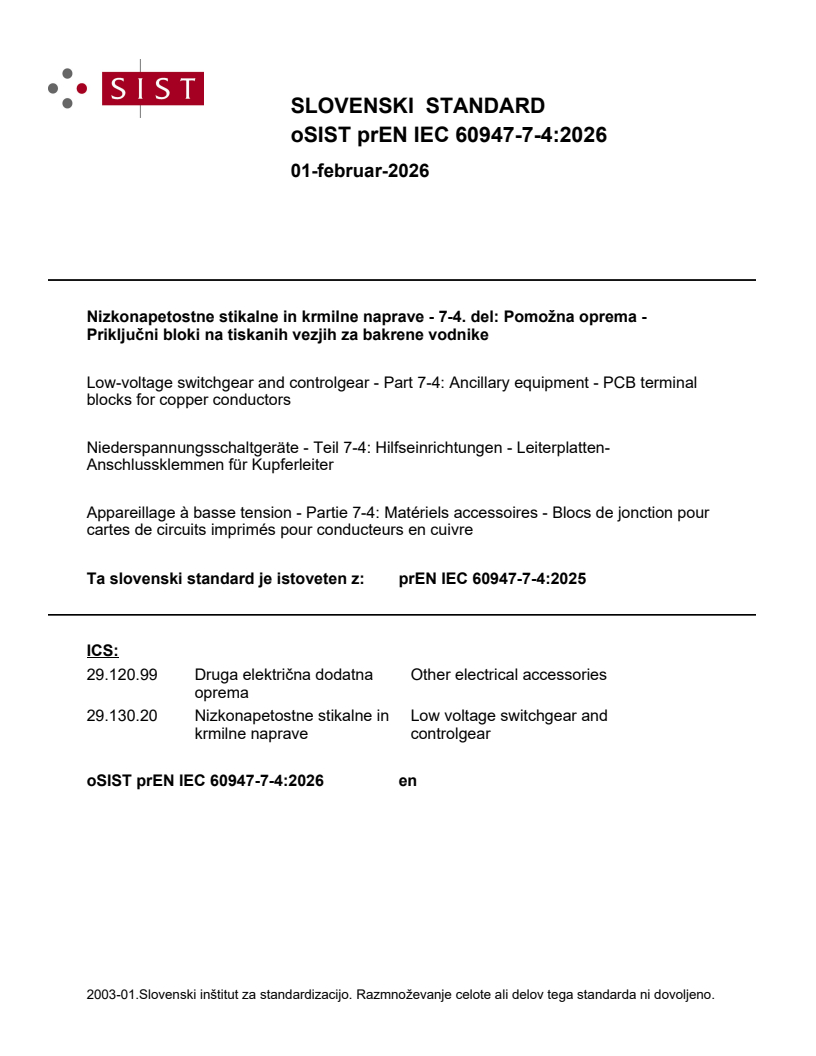
SLOVENSKI STANDARD
01-februar-2026
Nizkonapetostne stikalne in krmilne naprave - 7-4. del: Pomožna oprema -
Priključni bloki na tiskanih vezjih za bakrene vodnike
Low-voltage switchgear and controlgear - Part 7-4: Ancillary equipment - PCB terminal
blocks for copper conductors
Niederspannungsschaltgeräte - Teil 7-4: Hilfseinrichtungen - Leiterplatten-
Anschlussklemmen für Kupferleiter
Appareillage à basse tension - Partie 7-4: Matériels accessoires - Blocs de jonction pour
cartes de circuits imprimés pour conducteurs en cuivre
Ta slovenski standard je istoveten z: prEN IEC 60947-7-4:2025
ICS:
29.120.99 Druga električna dodatna Other electrical accessories
oprema
29.130.20 Nizkonapetostne stikalne in Low voltage switchgear and
krmilne naprave controlgear
2003-01.Slovenski inštitut za standardizacijo. Razmnoževanje celote ali delov tega standarda ni dovoljeno.
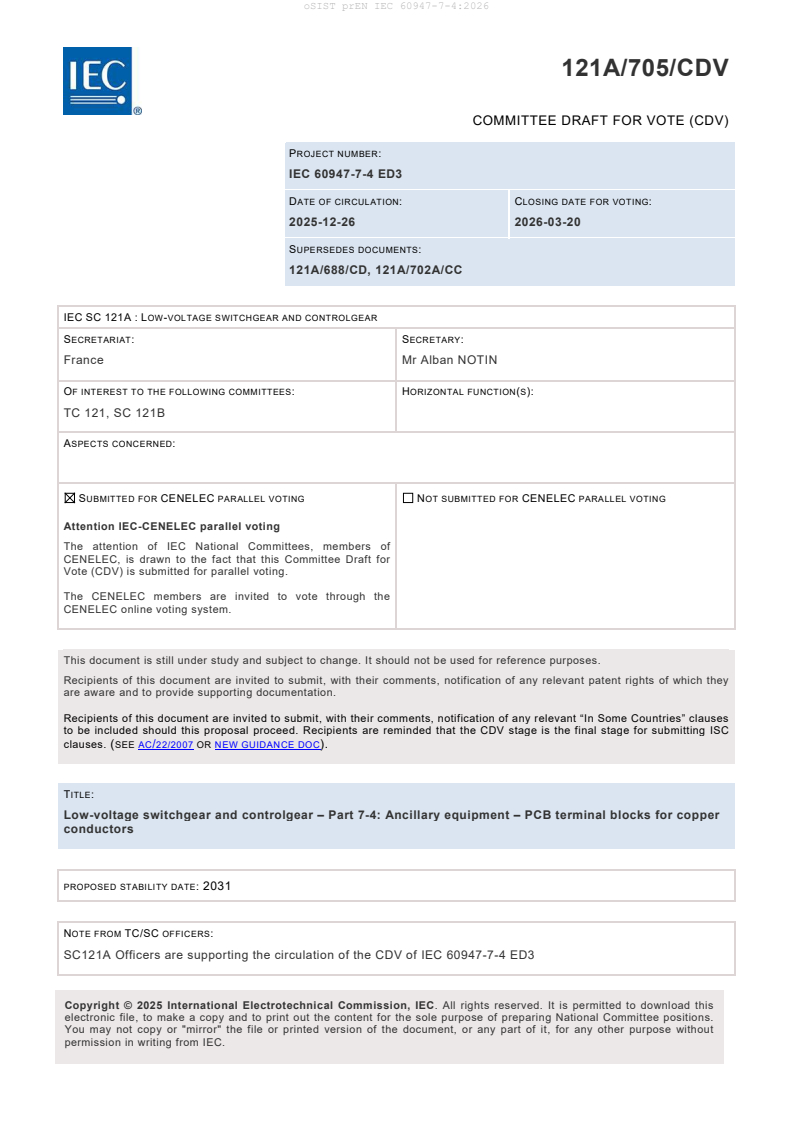
121A/705/CDV
COMMITTEE DRAFT FOR VOTE (CDV)
PROJECT NUMBER:
IEC 60947-7-4 ED3
DATE OF CIRCULATION: CLOSING DATE FOR VOTING:
2025-12-26 2026-03-20
SUPERSEDES DOCUMENTS:
121A/688/CD, 121A/702A/CC
IEC SC 121A : LOW-VOLTAGE SWITCHGEAR AND CONTROLGEAR
SECRETARIAT: SECRETARY:
France Mr Alban NOTIN
OF INTEREST TO THE FOLLOWING COMMITTEES: HORIZONTAL FUNCTION(S):
TC 121, SC 121B
ASPECTS CONCERNED:
SUBMITTED FOR CENELEC PARALLEL VOTING NOT SUBMITTED FOR CENELEC PARALLEL VOTING
Attention IEC-CENELEC parallel voting
The attention of IEC National Committees, members of
CENELEC, is drawn to the fact that this Committee Draft for
Vote (CDV) is submitted for parallel voting.
The CENELEC members are invited to vote through the
CENELEC online voting system.
This document is still under study and subject to change. It should not be used for reference purposes.
Recipients of this document are invited to submit, with their comments, notification of any relevant patent rights of which they
are aware and to provide supporting documentation.
Recipients of this document are invited to submit, with their comments, notification of any relevant “In Some Countries” clauses
to be included should this proposal proceed. Recipients are reminded that the CDV stage is the final stage for submitting ISC
clauses. (SEE AC/22/2007 OR NEW GUIDANCE DOC).
TITLE:
Low-voltage switchgear and controlgear – Part 7-4: Ancillary equipment – PCB terminal blocks for copper
conductors
PROPOSED STABILITY DATE: 2031
NOTE FROM TC/SC OFFICERS:
SC121A Officers are supporting the circulation of the CDV of IEC 60947-7-4 ED3
electronic file, to make a copy and to print out the content for the sole purpose of preparing National Committee positions.
You may not copy or "mirror" the file or printed version of the document, or any part of it, for any other purpose without
permission in writing from IEC.
Link to Committee Draft for Vote (CDV) online document:
Click here
How to access
This link leads you to the Online Standards Development (OSD) platform for National Mirror Committee’s
(NMC) comments. The project draft may be found further down this document.
Resource materials
We recommend NCs to review the available materials to better understand the member commenting on
the OSD platform.
This includes the:
• OSD NC roles overview
• How to add and submit comments to the IEC
Contact
Should you require any assistance, please contact the IEC IT Helpdesk.
IEC CDV 60947-7-4 ED3 © IEC 2025
CONTENTS
FOREWORD . 3
INTRODUCTION . 5
1 Scope . 6
2 Normative references . 6
3 Terms and definitions . 8
4 Classification . 9
5 Characteristics . 9
5.1 Summary of characteristics . 9
5.2 Type of PCB terminal block . 9
5.3 Rated and limiting values . 9
5.3.1 Rated voltages . 9
5.3.2 Rated current. 9
5.3.3 Standard cross-sections . 10
5.3.4 Maximum cross-section . 12
5.3.5 Connecting capacity . 12
6 Product information . 12
6.1 Marking . 12
6.2 Additional information . 12
7 Normal service, mounting and transport conditions . 13
8 Constructional and performance requirements . 13
8.1 Constructional requirements . 13
8.1.1 Clamping units . 13
8.1.2 Mounting and installation . 13
8.1.3 Clearances and creepage distances . 14
8.1.4 Terminal identification and marking . 14
8.1.5 Resistance to abnormal heat and fire . 14
8.1.6 Maximum cross-section and connecting capacity . 14
8.2 Performance requirements . 15
8.2.1 Temperature-rise (current-temperature derating) . 15
8.2.2 Dielectric properties . 15
8.2.3 Short-time withstand current . 15
8.2.4 Contact resistance . 15
8.2.5 Ageing tests . 15
8.3 Electromagnetic compatibility (EMC) . 16
9 Tests . 16
9.1 Kinds of test . 16
9.2 General . 16
9.3 Verification of mechanical characteristics . 17
9.3.1 General . 17
9.3.2 Attachment of the PCB terminal block on its support . 17
9.3.3 Vacant . 18
9.3.4 Verification of the maximum cross-section and connecting capacity . 18
9.3.5 Verification of maximum cross-section (special test with gauges) . 18
9.4 Verification of electrical characteristics . 18
9.4.1 General . 18
9.4.2 Verification of clearances and creepage distances . 18
IEC CDV 60947-7-4 ED3 © IEC 2025
9.4.3 Dielectric tests . 19
9.4.4 Verification of contact resistance . 20
9.4.5 Temperature-rise test (current-temperature derating) . 21
9.4.6 Short-time withstand current test . 23
9.4.7 Ageing tests . 24
9.5 Verification of thermal characteristics . 28
9.6 Verification of EMC characteristics . 29
9.6.1 General . 29
9.6.2 Immunity . 29
9.6.3 Emission . 29
Annex A (informative) Structure of a PCB terminal block . 30
Annex B (informative) Additional information to be specified between the manufacturer
and the user . 31
B.1 Additional information available on request of the user . 31
B.2 Information for testing in addition to those mentioned above . 31
Annex C (informative) Examples of PCBs and PCB terminal blocks for high-current
application . 32
C.1 Layout of high-current PCBs (schematic diagram) . 32
C.2 High-current PCB terminal blocks . 33
Bibliography . 34
Figure 1 – Test assembly for the measurement of contact resistance and temperature-
rise . 21
Figure 2 – Example of wiring structure of a multi-tier PCB terminal block (3.2) . 22
Figure 3 – Test assembly for the measurement of short-time withstand current . 24
Figure 4 – Test sequence . 25
Figure 5 – Test sequence for PCB terminal blocks with contact pressure via insulating
material . 26
Figure 6 – Current cycling ageing test procedure . 28
Figure A.1 – Structure of a PCB terminal block . 30
Figure C.1 – Structure of a high current PCB . 32
Figure C.2 – PCB terminal block with soldered connection to the PCB . 33
Figure C.3 – PCB terminal block with screwed connection to the PCB . 33
Table 1 – Standard cross-sections and connecting capacity of PCB terminal blocks . 10
Table 2 – Standards for clamping units and connecting methods . 13
Table 3 – Tightening torques for PCB terminal blocks with screw-type clamping units . 17
Table 4 – Dielectric test voltage corresponding to the rated insulation voltage . 19
Table 5 – Length of connectable conductors and conductor loops . 22
Table 6 – Examples of cross-sectional distribution of interconnections on printed circuit
boards . 23
IEC CDV 60947-7-4 ED3 © IEC 2025
INTERNATIONAL ELECTROTECHNICAL COMMISSION
____________
Low-voltage switchgear and controlgear -
Part 7-4: Ancillary equipment - PCB terminal blocks for copper
conductors
FOREWORD
1) The International Electrotechnical Commission (IEC) is a worldwide organization for
standardization comprising all national electrotechnical committees (IEC National Committees).
The object of IEC is to promote international co-operation on all questions concerning
standardization in the electrical and electronic fields. To this end and in addition to other
activities, IEC publishes International Standards, Technical Specifications, Technical Reports,
Publicly Available Specifications (PAS) and Guides (hereafter referred to as “IEC
Publication(s)”). Their preparation is entrusted to technical committees; any IEC National
Committee interested in the subject dealt with may participate in this preparatory work.
International, governmental and non-governmental organizations liaising with the IEC also
participate in this preparation. IEC collaborates closely with the International Organization for
Standardization (ISO) in accordance with conditions determined by agreement between the
two organizations.
2) The formal decisions or agreements of IEC on technical matters express, as nearly as
possible, an international consensus of opinion on the relevant subjects since each technical
committee has representation from all interested IEC National Committees.
3) IEC Publications have the form of recommendations for international use and are accepted
by IEC National Committees in that sense. While all reasonable efforts are made to ensure that
the technical content of IEC Publications is accurate, IEC cannot be held responsible for the
way in which they are used or for any misinterpretation by any end user.
4) In order to promote international uniformity, IEC National Committees undertake to apply
IEC Publications transparently to the maximum extent possible in their national and regional
publications. Any divergence between any IEC Publication and the corresponding national or
regional publication shall be clearly indicated in the latter.
5) IEC itself does not provide any attestation of conformity. Independent certification bodies
provide conformity assessment services and, in some areas, access to IEC marks of conformity.
IEC is not responsible for any services carried out by independent certification bodies.
6) All users should ensure that they have the latest edition of this publication.
7) No liability shall attach to IEC or its directors, employees, servants or agents including
individual experts and members of its technical committees and IEC National Committees for
any personal injury, property damage or other damage of any nature whatsoever, whether direct
or indirect, or for costs (including legal fees) and expenses arising out of the publication, use
of, or reliance upon, this IEC Publication or any other IEC Publications.
8) Attention is drawn to the Normative references cited in this publication. Use of the referenced
publications is indispensable for the correct application of this publication.
9) IEC draws attention to the possibility that the implementation of this document may involve
the use of (a) patent(s). IEC takes no position concerning the evidence, validity or applicability
of any claimed patent rights in respect thereof. As of the date of publication of this document,
IEC [had/had not] received notice of (a) patent(s), which may be required to implement this
IEC CDV 60947-7-4 ED3 © IEC 2025
document. However, implementers are cautioned that this may not represent the latest
information, which may be obtained from the patent database available at https://patents.iec.ch.
IEC shall not be held responsible for identifying any or all such patent rights.
IEC 60947-7-4 has been prepared by subcommittee 121A: Low-voltage switchgear and
controlgear, of IEC technical committee 121: Switchgear and controlgear and their assemblies
for low voltage. It is an International Standard.
This 3rd edition cancels and replaces the 2nd edition published in [publication_date],
Amendment 1:[publication_date] and Amendment 2:[publication_date]. This edition constitutes
a technical revision.
This edition includes the following significant technical changes with respect to the previous
edition:
a) additional test for PCB terminal blocks with clamping units, where contact pressure is
transmitted through insulating materials;
b) tightening torques for screws now given in Table 3 of this document (previously given in
Table 4 of IEC 60947–1:2007); tightening torques added for an additional type of screw;
c) new criteria for verification of contact resistance introduced;
d) clarification in the description of the temperature-rise test (current-temperature derating);
corrections in the test sequence according to Figure 4.
The text of this International Standard is based on the following documents:
Draft Report on voting
121A/XX/FDIS 121A/XX/RVD
Full information on the voting for its approval can be found in the report on voting indicated in
the above table.
The language used for the development of this International Standard is English.
This document was drafted in accordance with ISO/IEC Directives, Part 2, and developed in
accordance with ISO/IEC Directives, Part 1 and ISO/IEC Directives, IEC Supplement, available
at http://www.iec.ch/members_experts/refdocs. The main document types developed by IEC
are described in greater detail at http://www.iec.ch/publications.
A list of all parts in the IEC 60947 series, published under the general title Low-voltage
switchgear and controlgear, can be found on the IEC website.
The committee has decided that the contents of this document will remain unchanged until the
stability date indicated on the IEC website under webstore.iec.ch in the data related to the
specific document. At this date, the document will be
– reconfirmed,
– withdrawn, or
– revised.
IEC CDV 60947-7-4 ED3 © IEC 2025
INTRODUCTION
This document covers not only the terminal block requirements in accordance with the IEC
60947–7 series but also takes into account the specifications of connectors in accordance with
IEC 61984 [1] as the requirements for both components are highly similar owing to equivalent
applications.
IEC CDV 60947-7-4 ED3 © IEC 2025
1 Scope
This part of IEC 60947-7 specifies requirements for PCB terminal blocks primarily intended for
industrial or similar use.
Mounting and fixing on the printed circuit board is made by soldering, press-in or equivalent
methods to provide electrical and mechanical connection between copper conductors and the
printed circuit board.
This document applies to PCB terminal blocks intended to connect round copper conductors,
2 2
with or without special preparation, having a cross-section between 0,05 mm and 300 mm
(AWG 28-600 kcmil), intended to be used in circuits of a rated voltage not exceeding 1 000 V
AC up to 1 000 Hz or 1 500 V DC.
NOTE 1 AWG is the abbreviation of “American Wire Gage” (Gage (US) = Gauge (UK)).
1 kcmil = 1 000 cmil;
1 cmil = 1 circular mil = surface area of a circle having a diameter of 1 mil;
1 mil = 1/1 000 inch.
NOTE 2 Large-cross-section terminal blocks are dedicated to the specific design of high-current PCBs. The range
up to 300 mm is kept to cover any possible application. Examples of high current PCBs and PCB terminal blocks
are shown in Annex C.
This document can be used as a guide for special types of PCB terminal blocks with
components, such as disconnect units, integrated cartridge fuse-links and the like or with other
dimensions of conductors.
If applicable, in this document the term “clamping unit” is used instead of “terminal”. This is
taken into account in the case of references to IEC 60947–1.
2 Normative references
The following documents are referred to in the text in such a way that some or all of their content
constitutes requirements of this document. For dated references, only the edition cited applies.
For undated references, the latest edition of the referenced document (including any
amendments) applies.
IEC 60068-2-20:2021, Environmental testing - Part 2-20: Tests - Test Ta and Tb: Test methods
for solderability and resistance to soldering heat of devices with leads
IEC 60352–1, Solderless connections – Part 1: Wrapped connections – General requirements,
test methods and practical guidance
IEC 60352–2, Solderless connections – Part 2: Crimped connections – General requirements,
test methods and practical guidance
IEC 60352–3, Solderless connections – Part 3: Solderless accessible insulation displacement
connections – General requirements, test methods and practical guidance
IEC 60352-3, Solderless connections - Part 3: Accessible insulation displacement (ID)
connections - General requirements, test methods and practical guidance
IEC 60352–4, Solderless connections – Part 4: Solderless non-accessible insulation
displacement connections – General requirements, test methods and practical guidance
IEC CDV 60947-7-4 ED3 © IEC 2025
IEC 60352–5, Solderless connections – Part 5: Press-in connections – General requirements,
test methods and practical guidance
IEC 60352–6, Solderless connections – Part 6: Insulation piercing connections – General
requirements, test methods and practical guidance
IEC 60352–7, Solderless connections – Part 7: Spring clamp connections – General
requirements, test methods and practical guidance
IEC 60352-9:2024, Solderless connections - Part 9: Ultrasonically welded connections -
General requirements, test methods and practical guidance
IEC 60512–2–2:2003, Connectors for electronic equipment – Tests and measurements – Part
2-2: Electrical continuity and contact resistance tests – Test 2b: Contact resistance –Specified
test current method
IEC 60512–4–1, Connectors for electronic equipment – Tests and measurements – Part 4-1:
Voltage stress tests – Test 4a: Voltage proof
IEC 60512–5–2:2002, Connectors for electronic equipment – Tests and measurements – Part
5-2: Current-carrying capacity tests – Test 5b: Current-temperature derating
IEC 60512–11–7, Connectors for electronic equipment – Tests and measurements – Part 11-7:
Climatic tests – Test 11g: Flowing mixed gas corrosion test
IEC 60512–11–9, Connectors for electronic equipment – Tests and measurements – Part 11-9:
Climatic tests – Test 11i: Dry heat
IEC 60512–11–10, Connectors for electronic equipment – Tests and measurements – Part 11-
10: Climatic tests – Test 11j: Cold
IEC 60664-1:2020, Insulation coordination for equipment within low-voltage supply systems -
Part 1: Principles, requirements and tests
IEC 60695–2–10, Fire hazard testing – Part 2-10: Glowing/hot-wire based test methods – Glow-
wire apparatus and common test procedure
IEC 60695–2–11, Fire hazard testing – Part 2-11: Glowing/hot-wire based test methods – Glow-
wire flammability test method for end-products (GWEPT)
IEC 60695–2–12, Fire hazard testing – Part 2-12: Glowing/hot-wire based test methods – Glow-
wire flammability index (GWFI) test method for materials
IEC 60695–2–13, Fire hazard testing – Part 2-13: Glowing/hot-wire based test methods – Glow-
wire ignition temperature (GWIT) test method for materials
IEC 60947-1:2020, Low-voltage switchgear and controlgear - Part 1: General rules
IEC 60998–2–3, Connecting devices for low-voltage circuits for household and similar purposes
– Part 2-3: Particular requirements for connecting devices as separate entities with insulation-
piercing clamping units
IEC 60999–1, Connecting devices – Electrical copper conductors – Safety requirements for
screw-type and screwless-type clamping units – Part 1: General requirements and particular
requirements for clamping units for conductors from 0,2 mm2 up to 35 mm2 (included)
IEC CDV 60947-7-4 ED3 © IEC 2025
IEC 60999–2, Connecting devices – Electrical copper conductors – Safety requirements for
screw-type and screwless-type clamping units – Part 2: Particular requirements for clamping
units for conductors above 35 mm2 up to 300 mm2 (included)
IEC 61210, Connecting devices – Flat quick-connect terminations for electrical copper
conductors – Safety requirements
ISO 22479:2019, Corrosion of metals and alloys — Sulfur dioxide test in a humid atmosphere
(fixed gas method)
3 Terms and definitions
For the purposes of this document, the following terms and definitions apply.
ISO and IEC maintain terminological databases for use in standardization at the following
addresses:
– IEC Electropedia: available at http://www.electropedia.org/
– ISO Online browsing platform: available at http://www.iso.org/obp
3.1
printed circuit board
PCB
piece of insulating material with fixed metal traces to connect electronic, electrical and
mechanical components
Note 1 to entry: Printed circuit boards are typically subdivided according to:
– their structure (e.g. single- and double-sided, multilayers);
– the nature of the base material (e.g. rigid, flexible).
Note 2 to entry: This note applies to the French language only.
3.2
PCB terminal block
part intended to be mounted on a printed circuit board (3.1) and carrying one or more mutually
insulated contact units and which provides an electrical and mechanical connection between
copper conductor and printed circuit board (3.1)
3.3
rated current [I ]
n
current value assigned by the manufacturer, which the PCB terminal block (3.2) can carry
continuously (without interruption) and simultaneously through all its poles connected with the
maximum cross-section, preferably at an ambient temperature of 40 °C, without the upper
limiting temperature (3.5) being exceeded
3.4
contact unit
conductive part establishing the connection between printed circuit board (3.1) and connectable
conductor(s)
Note 1 to entry: See Annex A for description of the structure of a PCB terminal block (3.2).
3.5
upper limiting temperature
ULT
maximum temperature assigned by the manufacturer in the PCB terminal block (3.2) as outcome
(sum) of the ambient temperature and the temperature-rise due to current flow, at which the
PCB terminal block (3.2) is intended to be operational
IEC CDV 60947-7-4 ED3 © IEC 2025
Note 1 to entry: This note applies to the French language only.
3.6
lower limiting temperature
LLT
minimum temperature of a PCB terminal block (3.2) assigned by the manufacturer, at which a
PCB terminal block (3.2) is intended to be operational
Note 1 to entry: This note applies to the French language only.
4 Classification
A distinction is made between various types of PCB terminal blocks, if applicable, as follows:
a) type of clamping unit (see 8.1.1);
b) ability to accept prepared conductors (see 2.3.28 of IEC 60947–1:2007/AMD1:2010);
c) type of electrical contact to the printed circuit board (3.1);
d) type of mechanical fastening to the printed circuit board (3.1);
e) number of poles;
f) pitch (centre to centre pin spacing);
g) contact unit (3.4) with identical or dissimilar clamping units;
h) number of clamping units on each contact unit (3.4);
i) service conditions.
5 Characteristics
5.1 Summary of characteristics
The characteristics of a PCB terminal block (3.2) are as follows:
– type of PCB terminal block (3.2) (see 5.2);
– rated and limiting values (see 5.3).
5.2 Type of PCB terminal block
The following shall be stated:
– type of clamping units (see 8.1.1);
– type of contacting on the printed circuit board (3.1);
– number of clamping units.
5.3 Rated and limiting values
5.3.1 Rated voltages
Subclause 5.3.1.2 and 5.3.1.3 IEC 60947-1:2020 apply.
5.3.2 Rated current
Verification of the rated current specified by the manufacturer is carried out in accordance with
9.4.5.
If an ambient temperature other than 40 °C is used for the definition of the rated current, the
manufacturer should state, in the technical documentation, the ambient temperature on which
the rating is based, with reference, if appropriate, to the derating curve defined in IEC 60512–
5–2.
IEC CDV 60947-7-4 ED3 © IEC 2025
The derating curve is obtained by applying a reduction factor of 0,8 in accordance with IEC
60512–5–2. If another reduction factor is used, this shall be stated in the technical
documentation.
5.3.3 Standard cross-sections
The standard values for cross-sections of copper conductors to be used are given in Table 1.
Table 1 – Standard cross-sections and connecting capacity of PCB terminal blocks
Standard cross-section Connecting capacity
AWG/kcmil
2 2
mm mm /AWG/kcmil
(mm )
0,05 - 0,05
-
(0,055 )
- 30 – 28
(0,079)
0,08 - 0,05 – 0,08
- 30 – 28 – 26
(0,124)
0,13 - 0,05 – 0,08 – 0,14
0,2 - 0,08 – 0,14 – 0,2
- 28 – 26 – 24
(0,205)
- 26 – 24 – 22
(0,324)
0,34 - 0,14 – 0,2 – 0,34
0,5 - 0,2 – 0,34 – 0,5
. 24 – 22 – 20
(0,519)
0,75 - 0,34 – 0,5 – 0,75
- 22 – 20 – 18
(0,82)
1 - 0,5 – 0,75 – 1
- 20 – 18 – 16
(1,3)
1,5 - 0,75 – 1 – 1,5
- 18 – 16 – 14
(2,1)
2,5 - 1 – 1,5 – 2,5
- 16 – 14 – 12
(3,3)
4 - 1,5 – 2,5 – 4
- 14 – 12 – 10
(5,3)
6 - 2,5 – 4 – 6
- 8 12 – 10 – 8
IEC CDV 60947-7-4 ED3 © IEC 2025
Standard cross-section Connecting capacity
AWG/kcmil
2 2
mm mm /AWG/kcmil
(mm )
(8,4)
10 - 4 – 6 – 10
- 10 – 8 – 6
(13,3)
16 - 6 – 10 – 16
- 8 – 6 – 4
(21,2)
25 - 10 – 16 – 25
- 6 – 4 – 3
(26,7)
- 4 – 3 – 2
(33,6)
35 - 16 – 25 – 35
- 3 – 2 – 1
(42,4)
50 - 25 – 35 – 50
0 (1/0)
-
2 – 1 – 0
(53,5)
00 (2/0)
- 1 – 0 – 00
(67,4)
70 - 35 – 50 – 70
000 (3/0)
- 0 – 00 – 000
(85)
95 - 50 – 70 – 95
0000 (4/0)
- 00 – 000 – 0000
(107)
120 - 70 – 95 – 120
- 000 – 0000 – 250
(127)
150 - 95 – 120 – 150
- 0000 – 250 – 300
(152)
- 250 – 300 – 350
(177)
185 - 120 – 150 – 185
- 300 – 350 – 400
(203)
240 - 150 – 185 – 240
- 350 – 400 – 500
(253)
300 - 185 – 240 – 300
- 600 400 – 500 – 600
IEC CDV 60947-7-4 ED3 © IEC 2025
Standard cross-section Connecting capacity
AWG/kcmil
2 2
mm mm /AWG/kcmil
(mm )
(304)
5.3.4 Maximum cross-section
The maximum cross-section shall be selected from the standard cross-sections given in Table
1.
5.3.5 Connecting capacity
2 2
For PCB terminal blocks with a maximum cross-section between 0,05 mm and 35 mm
inclusive, the minimum range contained in Table 1 applies. The conductors may be rigid (solid
or stranded) or flexible. The manufacturer shall state the types and the maximum and minimum
cross-sections of conductors that can be connected and, if applicable, the number of conductors
simultaneously connectable to each clamping unit. The manufacturer shall also state any
necessary preparation of the end of the conductor.
6 Product information
6.1 Marking
A PCB terminal block (3.2) shall be marked in a durable and legible manner with the following:
a) the name of the manufacturer or a trade mark by which the manufacturer can be readily
identified;
b) a type reference permitting its identification in order to obtain relevant information from the
manufacturer or their catalogue.
Very small PCB terminal blocks with a surface that cannot be marked shall be marked only in
accordance with a). In those cases, all specified information shall be marked on the smallest
packing unit.
6.2 Additional information
The following information shall be stated by the manufacturer, if applicable, e.g. in the
manufacturer's data sheet or their catalogue or on the packing unit:
a) the maximum cross-section;
b) the connecting capacity, if different from Table 1, including the number of conductors
simultaneously connectable;
c) the following information for non-universal terminal blocks, depending on the classification
of clamping units and connecting methods in Table 2, shall be used, if applicable:
1) – for clamping units declared for solid conductors "solid" or the abbreviations "s" or "sol";
2) – for clamping units declared for rigid stranded conductors "rigid stranded" or the
abbreviation "r";
3) – for clamping units declared for flexible conductors "flexible" or the abbreviation "f";
d) the rated current and the reduction factor to determine the derating curve if different from
0,8;
NOTE Unless otherwise specified, the rated current is preferably determined on four-pole contact units.
e) the rated insulation voltage (U );
i
f) the rated impulse withstand voltage (U ), when determined;
imp
g) service conditions, if different from those stated in Clause 7;
IEC CDV 60947-7-4 ED3 © IEC 2025
h) special preparation of the end of the conductor;
i) additional information to be specified stated in Annex B, if applicable.
7 Normal service, mounting and transport conditions
Clause 6 of IEC 60947-1:2020 applies.
8 Constructional and performance requirements
8.1 Constructional requirements
8.1.1 Clamping units
The clamping units shall allow the conductors to be connected by means ensuring that a reliable
mechanical linkage and electrical contact is properly maintained.
In addition, the test described in 9.4.7.3 shall be performed if contact pressure of the clamping
unit is transmitted through insulating material. If this contact pressure is transmitted via ceramic
or pure mica, the test according to 9.4.7.3 is not deemed necessary.
Clamping units and connecting methods listed in Table 2 fulfil the mechanical requirements of
this document.
Additional requirements are given in this document.
Other terminations and connection methods shall be tested in accordance with the relevant
standards.
Table 2 – Standards for clamping units and connecting methods
Ref. Clamping units and connecting methods Reference standards
a) Screw-type clamping unit IEC 60999–1 or IEC 60999–2
b) Screw-less-type clamping unit IEC 60999–1 or IEC 60999–2 or IEC 60352–7
c) Wrapped connection IEC 60352–1
d) Crimped connection IEC 60352–2
e) Insulation displacement connection (accessible) IEC 60352-3 or IEC 60998–2–3
f) Insulation displacement connection (non accessible) IEC 60352–4 or IEC 60998–2–3
g) Press-in connection IEC 60352–5
h) Insulation piercing connection IEC 60352–6 or IEC 60998–2–3
i) Flat quick-connect termination IEC 61210
j) Soldered connection a
IEC 60068-2-20:2021
k) Ultrasonically welded connections IEC 60352-9:2024
NOTE The relevant standard applies for the preconditioning of prepared conductors.
a
The test method selected shall be stated in the test report.
8.1.2 Mounting and installation
PCB terminal blocks shall be designed so that safe mounting on a printed circuit board (3.1) is
possible by means of soldering, pressing-in, screwing, etc. The connection to the printed circuit
board (3.1) shall not be damaged by connecting the conductors.
Tests shall be carried out in accordance with 9.3.2.
IEC CDV 60947-7-4 ED3 © IEC 2025
8.1.3 Clearances and creepage distances
For PCB terminal blocks for which the manufacturer has stated values of rated impulse
withstand voltage (Uimp) and rated insulation voltage (Ui), minimum values of clearances and
creepage distances are given in Table 13 and Table 15 of IEC 60947-1:2020.
For PCB terminal blocks for which the manufacturer has not declared a value of rated impulse
withstand voltage (Uimp), guidance for minimum values is given in Annex H of IEC 60947-
1:2020.
Electrical requirements are given in 8.2.2.
8.1.4 Terminal identification and marking
Subclause 7.1.8.4 of IEC 60947–1:2007 applies with the following addition.
A PCB terminal block (3.2) shall have provision, or at least space, for identification marks or
numbers for each clamping unit or contact unit (3.4) related to the circuit of which it forms a
part, except when such marking is not physically possible.
Such provision may consist of separate marking items, such as marking tags, identification
labels, etc.
8.1.5 Resistance to abnormal heat and fire
The insulation materials of PCB terminal blocks shall not be adversely affected by abnormal
heat and fire.
Compliance is checked by:
a) the glow-wire test on the complete product in accordance with 9.5 or
b) verification of the insulating material in accordance with
1) IEC 60695–2–12, method GWFI at a temperature of 850 °C, or
2) IEC 60695–2–13, method GWIT at a temperature of 775 °C.
This verification is not necessary for small parts (see IEC 60695–2–11).
NOTE 1 The relevant test method is specified by the manufacturer.
NOTE 2 For some applications it can be mandatory to check compliance by the glow-wire test on the complete
product in accordance with 9.5 only. The need is either defined in the end-product standard or by agreement between
the manufacturer and the users. See Clause B.1.
8.1.6 Maximum cross-section and connecting capacity
PCB terminal blocks shall be so designed that conductors of the maximum cross-section and
the connecting capacity, if applicable, can be accepted.
Compliance is checked by the test described in 9.3.4.
The verification of the maximum cross-section may be performed by the special test in
accordance with 9.3.5.
IEC CDV 60947-7-4 ED3 © IEC 2025
8.2 Performance requirements
8.2.1 Temperature-rise (current-temperature derating)
PCB terminal blocks shall be tested in accordance with 9.4.5. The sum of ambient air
temperature and temperature-rise of the PCB terminal block (3.2) shall not exceed the upper
limiting temperature (3.5).
8.2.2 Dielectric properties
If the manufacturer has declared a value of the rated impulse withstand voltage (U ) (see
imp
4.3.1.3 of IEC 60947–1:2007), the requirements of 7.2.3 and 7.2.3.1 of IEC 60947–
1:2007/AMD1:2010 apply. If applicable, the impulse withstand voltage test shall be carried out
in accordance with 9.4.3, list item a).
For the verification of solid insulation the power-frequency withstand voltage test shall be
carried out in accordance with 9.4.3, list item b).
The verification of sufficient clearances and creepage distances shall be made in accordance
with 9.4.2. For PCB terminal blocks for which the manufacturer has not declared a value of
rated impulse withstand voltage (U ), guidance for minimum values is given in Annex H of
imp
IEC 60947-1:2020.
8.2.3 Short-time withstand current
A PCB terminal block (3.2) shall be capable of withstanding the short-time withstand current
which corresponds to 120 A/mm for 1 s, in accordance with 9.4.6.
The test shall be performed using the smallest cross-section in the current path of the contact
unit (3.4) as declared by the manufacturer.
8.2.4 Contact resistance
When measured in accordance with 9.4.4, the change in contact resistance of a PCB terminal
block (3.2) caused by the conductor connection and the mounting on the printed circuit board
(3.1) shall not exceed the permissible deviations.
8.2.5 Ageing tests
8.2.5.1 Climatic sequence and corrosion test
For the verification of the resistance of connections against the influence of temperatures and
corrosive atmospheres, the climatic sequence test shall be carried out for all kinds of PCB
terminal blocks.
Compliance is checked by the test described in 9.4.7.1.
8.2.5.2 Ageing test for screw-less-type PCB terminal blocks
For the verification of screw-less-type PCB terminal blocks the ageing test shall be carried out.
Compliance is checked by the test described in 9.4.7.2 (if relevant).
For screw-less-type PCB terminal blocks with contact pressure via insulating material, only the
current cycling ageing test in accordance with 9.4.7.3 shall be performed.
IEC CDV 60947-7-4 ED3 © IEC 2025
8.2.5.3 Current cycling ageing test for PCB terminal blocks with contact pressure via
insulating material
For the verification of the resistance of connections against the influence of contact pressure
via insulating material, the current cycling ageing test shall be carried out.
Compliance is checked by the test described in 9.4.7.3 (if relevant).
8.3 Electromagnetic compatibility (EMC)
Subclause 7.3 of IEC 60947–1:2007, IEC 60947–1:2007/AMD1:2010 and IEC 60947–
1:2007/AMD2:2014 applies.
9 Tests
9.1 Kinds of test
Subclause 8.1.1 of IEC 60947–1:2007 applies with the following addition.
No routine tests are specified. The verification of the maximum cross-section in accordance
with 9.3.5 is a special test. All other tests are type tests.
9.2 General
Unless otherwise specified, PCB terminal blocks are tested in new and in clean condition, and
installed as for normal use (see 6.3 of IEC 60947–1:2007) at an ambient temperature of (25
±10) °C.
The tests are carried out in the order described in 9.3, 9.4 and 9.5.
Each test is carried out on new individual specimens with at least four contact units (one set)
where each multipole PCB terminal block (3.2) may contain the required number of contact
units.
For a PCB terminal block (3.2) family with the same design and comparable form, tests need
only be performed on specimens representing the most unfavourable case.
The surface of the conductors shall be free of contamination and corrosion that degrades
performance.
Care shall be taken when stripping conductors to avoid cutting, nicking, scraping or otherwise
damaging the conductors.
In cases where the manufacturer has stated that special preparation of the end of the conductor
is necessary, the test report shall indicate the method of preparation used.
The tests are carried out with the type of conductors (rigid or flexible) as stated by
...
Questions, Comments and Discussion
Ask us and Technical Secretary will try to provide an answer. You can facilitate discussion about the standard in here.
Loading comments...