


prEN IEC 60940:2025
(Main)Application of capacitors, resistors, inductors and complete filter units for electromagnetic interference suppression - General rules and safety requirements
Application of capacitors, resistors, inductors and complete filter units for electromagnetic interference suppression - General rules and safety requirements
Grundlagen für die Anwendung von Kondensatoren, Widerständen, Drosseln und vollständigen Filtereinheiten zur Unterdrückung elektromagnetischer Störungen
Emploi des condensateurs, résistances, inductances et filtres complets d’antiparasitage - Règles générales et exigences de sécurité
Uporaba kondenzatorjev, uporov, tuljav in celotnih filtrskih enot za dušenje elektromagnetnih motenj - Splošna pravila in varnostne zahteve
General Information
- Status
- Not Published
- Publication Date
- 03-Jan-2027
- Technical Committee
- CLC/TC 40XA - CLC/TC 40XA
- Drafting Committee
- IEC/TC 40 - IEC_TC_40
- Current Stage
- 4060 - Enquiry results established and sent to TC, SR, BTTF - Enquiry
- Start Date
- 29-Aug-2025
- Completion Date
- 29-Aug-2025
Relations
- Effective Date
- 23-Jan-2023
Overview
prEN IEC 60940:2025 provides general rules and safety requirements for the application of capacitors, resistors, inductors and complete filter units used for electromagnetic interference (EMI) suppression. Applicable to supplies with nominal voltages not exceeding 1000 V AC (≤400 Hz) or 1500 V DC, this 3rd edition has been updated to include new safety clauses and structured guidance to support product safety standards and practical engineering decisions.
This document is published as a Committee Draft for Vote (CDV) and is submitted for IEC–CENELEC parallel voting. It aims to help designers, manufacturers, standards drafters, service providers and regulators address safety aspects and reasonably foreseeable misuse of EMI suppression components.
Key benefits:
- Harmonised safety rules for EMI components and filter units
- Practical selection guidance for ratings and environmental classes
- Clear criteria for insulation, clearance and creepage
- Information useful for product safety standard drafters and assessors
Key Topics
The standard addresses the following core topics and safety considerations:
- Scope and application limits: nominal supply voltages up to 1000 V AC/400 Hz, or 1500 V DC.
- Classification of suppression components: capacitors, resistors, inductors and filters and their intended use in EMI suppression networks.
- General safety aspects: protective provisions, single-fault conditions, series connections and earth leakage current.
- Selection rules: choice of voltage and current ratings, environmental classification, insertion loss and component-specific guidance.
- Clearance and creepage: dimensioning rules for cased, conformal-coated and surface-mounted components, and mounted-stage requirements.
- Additional topics: passive/active flammability, use of X and Y capacitors up to 400 Hz, and rules for three-phase filter capacitor arrangements.
The standard references key normative documents including IEC 60384-14, IEC 60664-1, IEC 60939-3 and CISPR 17 for measurements and safety coordination.
Applications
prEN IEC 60940:2025 is designed to be used by:
- Electronic component designers selecting EMI suppression parts for mains-connected equipment
- System integrators and OEMs specifying filters and protective networks
- Test labs and compliance engineers assessing clearance, creepage and earth leakage
- Standards committees and regulators drafting product safety requirements
Practical use-cases include mains EMI filters for consumer and industrial equipment, design checks for component derating, and safety assessment of filter assemblies in product certification.
Related Standards
Relevant standards and references cited in the document:
- IEC 60384-14 - fixed capacitors for EMI suppression
- IEC 60664-1 - insulation coordination for low-voltage equipment
- IEC 60939-3 - passive filter units for EMI suppression
- CISPR 17 - measurement methods for suppression characteristics
For implementers, prEN IEC 60940:2025 links practical EMC suppression design with safety requirements, helping reduce risk while meeting electromagnetic compatibility objectives.

Get Certified
Connect with accredited certification bodies for this standard

TL 9000 QuEST Forum
Telecommunications quality management system.

ANCE
Mexican certification and testing association.

Intertek Slovenia
Intertek testing, inspection, and certification services in Slovenia.
Sponsored listings
Frequently Asked Questions
prEN IEC 60940:2025 is a draft published by CLC. Its full title is "Application of capacitors, resistors, inductors and complete filter units for electromagnetic interference suppression - General rules and safety requirements". This standard covers: Application of capacitors, resistors, inductors and complete filter units for electromagnetic interference suppression - General rules and safety requirements
Application of capacitors, resistors, inductors and complete filter units for electromagnetic interference suppression - General rules and safety requirements
prEN IEC 60940:2025 is classified under the following ICS (International Classification for Standards) categories: 33.100.01 - Electromagnetic compatibility in general. The ICS classification helps identify the subject area and facilitates finding related standards.
prEN IEC 60940:2025 has the following relationships with other standards: It is inter standard links to EN 60940:2015. Understanding these relationships helps ensure you are using the most current and applicable version of the standard.
prEN IEC 60940:2025 is available in PDF format for immediate download after purchase. The document can be added to your cart and obtained through the secure checkout process. Digital delivery ensures instant access to the complete standard document.
Standards Content (Sample)
SLOVENSKI STANDARD
01-julij-2025
Uporaba kondenzatorjev, uporov, tuljav in celotnih filtrskih enot za dušenje
elektromagnetnih motenj - Splošna pravila in varnostne zahteve
Application of capacitors, resistors, inductors and complete filter units for
electromagnetic interference suppression - General rules and safety requirements
Grundlagen für die Anwendung von Kondensatoren, Widerständen, Drosseln und
vollständigen Filtereinheiten zur Unterdrückung elektromagnetischer Störungen
Emploi des condensateurs, résistances, inductances et filtres complets d’antiparasitage -
Règles générales et exigences de sécurité
Ta slovenski standard je istoveten z: prEN IEC 60940:2025
ICS:
31.020 Elektronske komponente na Electronic components in
splošno general
33.100.01 Elektromagnetna združljivost Electromagnetic compatibility
na splošno in general
2003-01.Slovenski inštitut za standardizacijo. Razmnoževanje celote ali delov tega standarda ni dovoljeno.
40/3221/CDV
COMMITTEE DRAFT FOR VOTE (CDV)
PROJECT NUMBER:
IEC 60940 ED3
DATE OF CIRCULATION: CLOSING DATE FOR VOTING:
2025-06-06 2025-08-29
SUPERSEDES DOCUMENTS:
40/3174/CD, 40/3210/CC
IEC TC 40 : CAPACITORS AND RESISTORS FOR ELECTRONIC EQUIPMENT
SECRETARIAT: SECRETARY:
Netherlands Mr Ronald Drenthen
OF INTEREST TO THE FOLLOWING COMMITTEES: HORIZONTAL FUNCTION(S):
TC 9,SC 22H,TC 23,SC 23B,SC 23E,SC 23J,SC
23K,SC 34C,SC 34D,TC 56,TC 61,SC 62A,SC 62D,TC
65,TC 72,TC 78,TC 96,TC 105,TC 108,TC 116
ASPECTS CONCERNED:
SUBMITTED FOR CENELEC PARALLEL VOTING NOT SUBMITTED FOR CENELEC PARALLEL VOTING
Attention IEC-CENELEC parallel voting
The attention of IEC National Committees, members of
CENELEC, is drawn to the fact that this Committee Draft
for Vote (CDV) is submitted for parallel voting.
The CENELEC members are invited to vote through the
CENELEC online voting system.
This document is still under study and subject to change. It should not be used for reference purposes.
Recipients of this document are invited to submit, with their comments, notification of any relevant patent rights of
which they are aware and to provide supporting documentation.
Recipients of this document are invited to submit, with their comments, notification of any relevant “In Some
Countries” clauses to be included should this proposal proceed. Recipients are reminded that the CDV stage is
the final stage for submitting ISC clauses. (SEE AC/22/2007 OR NEW GUIDANCE DOC).
TITLE:
Application of capacitors, resistors, inductors and complete filter units for electromagnetic
interference suppression - General rules and safety requirements
PROPOSED STABILITY DATE: 2033
NOTE FROM TC/SC OFFICERS:
download this electronic file, to make a copy and to print out the content for the sole purpose of preparing National
Committee positions. You may not copy or "mirror" the file or printed version of the document, or any part of it, for
any other purpose without permission in writing from IEC.
IEC CDV 60940 © IEC:2025 – 2 – 40/3221/CDV
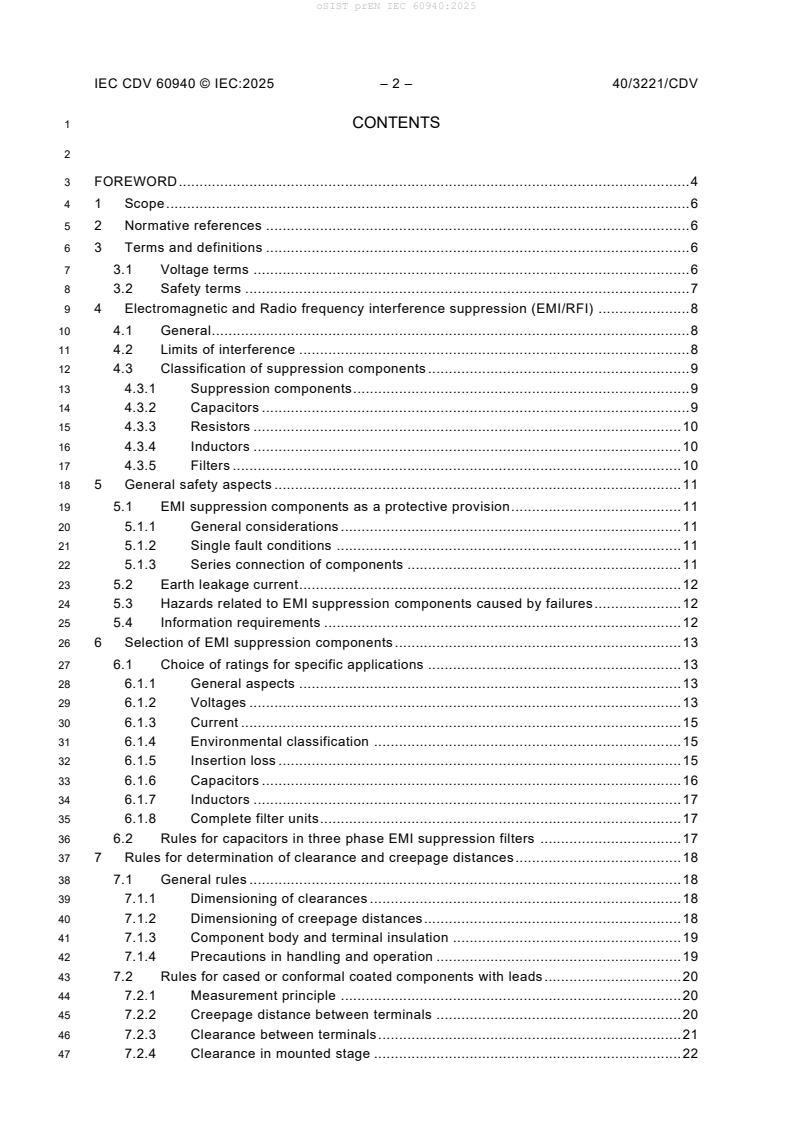
1 CONTENTS
3 FOREWORD . 4
4 1 Scope . 6
5 2 Normative references . 6
6 3 Terms and definitions . 6
7 3.1 Voltage terms . 6
8 3.2 Safety terms . 7
9 4 Electromagnetic and Radio frequency interference suppression (EMI/RFI) . 8
10 4.1 General . 8
11 4.2 Limits of interference . 8
12 4.3 Classification of suppression components . 9
13 4.3.1 Suppression components . 9
14 4.3.2 Capacitors . 9
15 4.3.3 Resistors . 10
16 4.3.4 Inductors . 10
17 4.3.5 Filters . 10
18 5 General safety aspects . 11
19 5.1 EMI suppression components as a protective provision. 11
20 5.1.1 General considerations . 11
21 5.1.2 Single fault conditions . 11
22 5.1.3 Series connection of components . 11
23 5.2 Earth leakage current. 12
24 5.3 Hazards related to EMI suppression components caused by failures . 12
25 5.4 Information requirements . 12
26 6 Selection of EMI suppression components . 13
27 6.1 Choice of ratings for specific applications . 13
28 6.1.1 General aspects . 13
29 6.1.2 Voltages . 13
30 6.1.3 Current . 15
31 6.1.4 Environmental classification . 15
32 6.1.5 Insertion loss . 15
33 6.1.6 Capacitors . 16
34 6.1.7 Inductors . 17
35 6.1.8 Complete filter units . 17
36 6.2 Rules for capacitors in three phase EMI suppression filters . 17
37 7 Rules for determination of clearance and creepage distances. 18
38 7.1 General rules . 18
39 7.1.1 Dimensioning of clearances . 18
40 7.1.2 Dimensioning of creepage distances . 18
41 7.1.3 Component body and terminal insulation . 19
42 7.1.4 Precautions in handling and operation . 19
43 7.2 Rules for cased or conformal coated components with leads . 20
44 7.2.1 Measurement principle . 20
45 7.2.2 Creepage distance between terminals . 20
46 7.2.3 Clearance between terminals . 21
47 7.2.4 Clearance in mounted stage . 22
IEC CDV 60940 © IEC:2025 – 3 – 40/3221/CDV
48 7.2.5 Conductors between terminals . 23
49 7.3 Rules for surface mounted components . 23
50 7.3.1 Clearances and creepage distances – component body . 23
51 7.3.2 Clearances and creepage distances – components in mounted stage . 24
52 7.3.3 Requirements . 24
53 8 Passive and active flammability . 25
54 9 Use of X and Y capacitors in AC mains up to 400 Hz . 25
55 9.1 Overview . 25
56 9.2 Background . 25
57 9.3 Guidelines . 25
58 9.3.1 General . 25
59 9.3.2 Capacitors >10µF . 25
60 9.3.3 Voltage derating with. frequency . 25
61 Annex A Bibliography . 27
63 Figure 1 – Example use of suppression components in an EMI-filter . 9
64 Figure 2 – EMI capacitors star-connected . 17
65 Figure 3 – Cased and conformal coated types . 19
66 Figure 4 – Description . 20
67 Figure 5 – Creepage distance – cased style . 21
68 Figure 6 – Creepage distance – conformal coated style . 21
69 Figure 7 – Clearance between terminals . 21
70 Figure 8 – Clearance in mounted stage – cased style . 22
71 Figure 9 – Clearance - component body larger than lead pitch . 22
72 Figure 10 – Clearance – component body smaller than lead pitch . 23
73 Figure 11 – Clearance and creepage distances - different component styles. 23
74 Figure 12 – Clearance and creepage distances in mounted stage . 24
76 Table 1 – Criteria for cases where in OVC III and OVC IV C2 shall be class Y . 17
IEC CDV 60940 © IEC:2025 – 4 – 40/3221/CDV
80 INTERNATIONAL ELECTROTECHNICAL COMMISSION
81 ____________
83 APPLICATION OF CAPACITORS, RESISTORS, INDUCTORS AND
84 COMPLETE FILTER UNITS FOR ELECTROMAGNETIC INTERFERENCE
85 SUPPRESSION -
87 General rules and safety requirements
91 FOREWORD
92 1) The International Electrotechnical Commission (IEC) is a worldwide organization for standardization comprising
93 all national electrotechnical committees (IEC National Committees). The object of IEC is to promote international
94 co-operation on all questions concerning standardization in the electrical and electronic fields. To this end and
95 in addition to other activities, IEC publishes International Standards, Technical Specifications, Technical Reports,
96 Publicly Available Specifications (PAS) and Guides (hereafter referred to as “IEC Publication(s)”). Their
97 preparation is entrusted to technical committees; any IEC National Committee interested in the subject dealt with
98 may participate in this preparatory work. International, governmental and non-governmental organizations liaising
99 with the IEC also participate in this preparation. IEC collaborates closely with the International Organization for
100 Standardization (ISO) in accordance with conditions determined by agreement between the two organizations.
101 2) The formal decisions or agreements of IEC on technical matters express, as nearly as possible, an international
102 consensus of opinion on the relevant subjects since each technical committee has representation from all
103 interested IEC National Committees.
104 3) IEC Publications have the form of recommendations for international use and are accepted by IEC National
105 Committees in that sense. While all reasonable efforts are made to ensure that the technical content of IEC
106 Publications is accurate, IEC cannot be held responsible for the way in which they are used or for any
107 misinterpretation by any end user.
108 4) In order to promote international uniformity, IEC National Committees undertake to apply IEC Publications
109 transparently to the maximum extent possible in their national and regional publications. Any divergence between
110 any IEC Publication and the corresponding national or regional publication shall be clearly indicated in the latter.
111 5) IEC itself does not provide any attestation of conformity. Independent certification bodies provide conformity
112 assessment services and, in some areas, access to IEC marks of conformity. IEC is not responsible for any
113 services carried out by independent certification bodies.
114 6) All users should ensure that they have the latest edition of this publication.
115 7) No liability shall attach to IEC or its directors, employees, servants or agents including individual experts and
116 members of its technical committees and IEC National Committees for any personal injury, property damage or
117 other damage of any nature whatsoever, whether direct or indirect, or for costs (including legal fees) and
118 expenses arising out of the publication, use of, or reliance upon, this IEC Publication or any other IEC
119 Publications.
120 8) Attention is drawn to the Normative references cited in this publication. Use of the referenced publications is
121 indispensable for the correct application of this publication.
122 9) Attention is drawn to the possibility that some of the elements of this IEC Publication may be the subject of patent
123 rights. IEC shall not be held responsible for identifying any or all such patent rights.
124 IEC 60940 has been prepared by IEC technical committee 40: Capacitors and resistors for
125 electronic equipment. It is an International Standard.
126 This 3rd edition cancels and replaces the 2nd edition published in 2015, This edition constitutes
127 a structural and technical revision.
128 This edition includes the following significant technical changes with respect to the previous
129 edition:
130 a) New title to change the document from “guidance” into “general rules and safety
131 requirements;
132 b) New content added (Clauses 5 to 10);
133 c) The previous edition is partly contained in Clause 4.
IEC CDV 60940 © IEC:2025 – 5 – 40/3221/CDV
134 The text of this International Standard is based on the following documents:
Draft Report on voting
XX/XX/FDIS XX/XX/RVD
136 Full information on the voting for its approval can be found in the report on voting indicated in
137 the above table.
138 The language used for the development of this International Standard is English.
139 This document was drafted in accordance with ISO/IEC Directives, Part 2, and developed in
140 accordance with ISO/IEC Directives, Part 1 and ISO/IEC Directives, IEC Supplement, available
141 at www.iec.ch/members_experts/refdocs. The main document types developed by IEC are
142 described in greater detail at www.iec.ch/standardsdev/publications.
143 The committee has decided that the contents of this document will remain unchanged until the
144 stability date indicated on the IEC website under "http://webstore.iec.ch" in the data related to
145 the specific document. At this date, the document will be
146 • reconfirmed,
147 • withdrawn,
148 • replaced by a revised edition, or
149 • amended.
IEC CDV 60940 © IEC:2025 – 6 – 40/3221/CDV
152 APPLICATION OF CAPACITORS, RESISTORS, INDUCTORS AND
153 COMPLETE FILTER UNITS FOR ELECTROMAGNETIC INTERFERENCE
154 SUPPRESSION -
155 General rules and safety requirements
158 1 Scope
159 This document establishes general rules and safety requirements on the application of capacitors,
160 resistors, inductors, and complete filter units for electromagnetic interference suppression which will
161 be connected to an AC mains or other supply (DC or AC) with a nominal voltage not exceeding 1000
162 V AC having a nominal frequency not exceeding 400 Hz, or 1500 V DC.
163 It should facilitate drafters of product safety standards and other stakeholders such as
164 designers, manufacturers, service providers, policy makers and regulators to consider safety
165 aspects for the intended use and the reasonably foreseeable misuse of these components in
166 its products and systems and apply risk reduction measures to achieve a tolerable risk level.
167 2 Normative references
168 The following documents are referred to in the text in such a way that some or all of their content
169 constitutes requirements of this document. For dated references, only the edition cited applies.
170 For undated references, the latest edition of the referenced document (including any
171 amendments) applies.
172 IEC 60384-14, FIXED CAPACITORS FOR USE IN ELECTRONIC EQUIPMENT – Part 14:
173 Sectional specification – Fixed capacitors for electromagnetic interference suppression and
174 connection to the supply mains
175 IEC 60664-1:2020, Insulation coordination for equipment within low-voltage systems – Part 1:
176 Principles, requirements, and tests
177 IEC 60939-3, Passive filter units for electromagnetic interference suppression - Part 3: Passive
178 filter units for which safety tests are appropriate
179 CISPR 17, Methods of measurement of the suppression characteristics of passive EMC filtering
180 devices
181 3 Terms and definitions
182 For the purposes of this document, the terms and definitions given in ISO/IEC Guide 51,
183 IEC Guide 104, IEC Guide 116 , IEC 60664-1:2020 and the following apply.
184 ISO and IEC maintain terminological databases for use in standardization at the following
185 addresses:
186 • IEC Electropedia: available at https://www.electropedia.org/
187 • ISO Online browsing platform: available at https://www.iso.org/obp
189 3.1 Voltage terms
190 3.1.1
191 overvoltage category
192 numeral defining a transient overvoltage condition
193 Note 1 to entry: Overvoltage categories I, II, III and IV are used, see IEC 60664 -1:2020, 4.3.2.
194 [SOURCE: IEV 426-04-48]
IEC CDV 60940 © IEC:2025 – 7 – 40/3221/CDV
195 3.1.2
196 transient overvoltage
197 short duration overvoltage of a few milliseconds or less, oscillatory or non-oscillatory, usually
198 highly damped
199 [SOURCE: IEC 60664-1:2020, 3.1.13]
200 3.1.3
201 recurring peak voltage
202 maximum peak value of periodic excursions of the voltage waveform resulting from distortions
203 of an AC voltage or from AC components superimposed on a DC voltage
204 Note 1 to entry: Random overvoltages, for example due to occasional switching, are not considered to be recurring
205 peak voltages.
206 [SOURCE: IEC 60664-1:2020, 3.1.10]
207 3.2 Safety terms
208 3.2.1
209 fault protection
210 protection against electric shock under single fault conditions
211 [SOURCE: IEC 61140:2016, 3.1.2]
212 3.2.2
213 single fault condition
214 condition in which one means for protection against electric shock is defective or one fault is
215 present which could cause a hazard
216 [SOURCE: IEC 61140:2016, 3.1.4]
217 Note 1 to entry: If a single fault condition results in one or more other fault conditions, all are considered as one
218 single fault condition.
IEC CDV 60940 © IEC:2025 – 8 – 40/3221/CDV
222 4 Electromagnetic and Radio frequency interference suppression (EMI/RFI)
223 4.1 General
224 Electromagnetic interference (EMI) is any electromagnetic disturbance which causes an
225 undesirable response, malfunctioning or degradation in the performance of electrical
226 equipment. Radio frequency interference (RFI) is any electrical energy within the frequency
227 range dedicated to radio frequency transmission.
228 The lower frequency range up to 30 MHz is often analysed by means of voltage or current
229 measurements. The measured spectra are called “conducted interference” at certain points in
230 a circuit. The higher frequency range up to many GHz is often analysed by means of field
231 measurements like electric field E, magnetic field H or radiated power. The measured spectra
232 are called “radiated interference” as they are measured with special antennas for each field
233 type and frequency range instead of a voltage or current probe. Radiated interference is always
234 analysed in a defined distance to the device under test.
235 Electrical machines and apparatus may generate EMI which is fed back into its power supply
236 mains. This electromagnetic interference may be picked up by apparatus connected to the same
237 power system up to a certain distance from the machine or apparatus. EMI-filters limit this
238 interference to certain levels which do not make any harm.
239 Differential-mode interference occurs symmetrical between lines of different polarity. Common-
240 mode interference occurs with reference to ground. These two types of interference have
241 different sources and different propagation paths and need different counter measures.
242 EMI can be suppressed by providing a low impedance path for interference currents providing
243 a short path back to its source by means of EMI-capacitors according to IEC 60384-14. This
244 can be combined with a high impedance element in series to prevent interference from taking
245 this way. Such a high impedance can be a choke according to IEC 60938 series. Using the
246 principle of current compensation makes so-called Common-Mode chokes very effective
247 against Common-Mode interference.
248 Besides filtering with capacitors and chokes, shielding with metal enclosures can be very
249 effective against interference.
250 4.2 Limits of interference
251 In Europe and many other countries, mandatory limits are set for both emission of interference
252 and immunity against interference by EMC standards. The compatibility levels are defined for
253 different applications and apparatus in the CISPR standards or other product standards for
254 different environments like household or industrial surroundings.
255 Some sensitive electrical equipment requires an interference-free power-supply to a greater
256 extent than that guaranteed by the common compatibility levels. In these cases, additional
257 measures should be taken at a place in the power supply system close to the place where the
258 apparatus is connected. When the apparatus is shielded or placed in a shielded room,
259 interference suppression will generally be applied at each point where the power supply system
260 enters the shielded enclosure.
IEC CDV 60940 © IEC:2025 – 9 – 40/3221/CDV
262 4.3 Classification of suppression components
263 4.3.1 Suppression components
264 An example of use of suppression components in an EMI-filter is shown in Figure 1.
267 a) Single phase EMI-filter
270 b) Three phase EMI-filter
271 Key:
272 P1, P2 Input, output terminals for a line conductor (single phase system)
273 N1, N2 Input, output terminals for a neutral conductor
274 U1, U2 Input, output terminals for line conductor U (phase 1)
275 V1, V2 Input, output terminals for line conductor V (phase 2)
276 W1, W2 Input, output terminals for line conductor W (phase 3)
277 Figure 1 – Example use of suppression components in an EMI-filter
278 4.3.2 Capacitors
279 Capacitors for electromagnetic interference suppression can be divided into the following
280 groups:
281 a) Two-terminal capacitors, which can be connected to the machine, apparatus or supply
282 system to provide for either symmetrical or asymmetrical interference suppression.
283 b) Combinations of capacitors (either combinations of separate capacitors or multi-section
284 capacitor the sections of which may be connected in a certain manner), which can be
285 connected to the machine, apparatus or supply system to provide for both symmetrical and
286 asymmetrical interference suppression.
287 c) Lead-through capacitors or combinations thereof, in which one or more sets of terminations
288 are interconnected by means of a conductor intended to carry the power supply current.
289 These capacitors are especially suited to provide interference suppression at the place
290 where the supply system phases through a shielded housing.
IEC CDV 60940 © IEC:2025 – 10 – 40/3221/CDV
291 d) Capacitor-Resistor parallel combinations: Consisting of a capacitor in parallel with a resistor
292 which is used for discharging the capacitor for safety reasons.
293 e) Capacitor-Resistor series combinations: Consisting of a capacitor with a resistor in series.
294 The resistor can be integrated into the capacitor by using the resistance of the capacitor
295 connector. RC combinations are often used for the suppression of switching coils to handle
296 the inductive surge pulse.
297 4.3.3 Resistors
298 An electrical resistor is a passive component that reduces the voltage or limits the current
299 flowing through a circuit. For a safe use, power loss generated in the resistor must be
300 considered. Resistors can be divided into two groups:
301 a) Fixed resistors, which offer one resistance value.
302 b) Variable resistors, which offer broad resistance values - predominantly used to control either
303 current or voltage by changing the resistance value.
304 4.3.4 Inductors
305 Inductors for electromagnetic interference suppression can be divided into the following groups:
306 a) Simple air coils or coils with magnetic core.
307 They are used for attenuating both symmetrical or asymmetrical voltages. They attenuate
308 common mode and differential mode currents equally well. They are often characterized by an
309 extensive independence of the inductance from the pre-magnetization of the operating current.
310 The constructive structure can ensure low winding capacity, which leads to a broad interference
311 suppression effect. UHF chokes are one example of this type of inductor.
312 b) Coils wound on a closed magnetic core.
313 These inductors can have two or more coils wound on the same core. Using the principle of
314 current compensation, the windings are often arranged, so that there is no resultant
315 magnetization in the core due to the power current. This makes it possible to use high
316 permeable cores, so that large inductances per winding can be achieved. Only the leakage
317 inductance affects the operating current. Accordingly, the symmetrical interference suppression
318 of the current compensated choke is relatively low.
319 c) Ferrite bead
320 This type of inductor suppresses high frequency noise simply by applying them to lead wires,
321 conductors or cables. Large ferrite beads are commonly seen on external cabling. Various
322 smaller ferrite beads are used internally in circuits or around the pins of small circuit -board
323 components, such as transistors or connectors.
324 For inductors using ferromagnetic cores, it is important to be aware of the possible loss of
325 suppression caused by saturation of the core. This saturation may be caused by peaks of load
326 current or interference current, or continuous excessive load current.
327 4.3.5 Filters
328 Filters for electromagnetic interference suppression are mostly passive low-pass filters without
329 active elements. They essentially consist of various combinations of chokes and capacitors for
330 electromagnetic interference suppression.
331 In addition, resistors or overvoltage elements such as varistors can be used.
332 Two different types may be distinguished:
333 d) Filters assembled with approved components either as an unprotected assembly or with a
334 simple protective housing. The approval testing of these can be simplified based on already
335 existing approval tests of the components themselves.
336 b) Filters constructed from components which are not approved, or which are constructed from
337 capacitive, inductive or resistive elements all contained in housing. For such filters it is
338 necessary to carry out a full range of qualification approval tests.
IEC CDV 60940 © IEC:2025 – 11 – 40/3221/CDV
340 5 General safety aspects
341 5.1 EMI suppression components as a protective provision
342 5.1.1 General considerations
343 An EMI SUPPRESSION component or assembly of EMI suppression components is considered
344 a protective provision if its impedance and construction limit electrical parameters such as
345 current, voltage and electric charge or a combination of these parameters to safe values.
346 NOTE 1 For further information of the concept of protective provision and protective measures see IEC 61140 .
347 The protective provision for basic protection limits the electrical parameters to safe values under
348 normal conditions (operation in intended use and absence of fault). An example of this is a
349 capacitor that bridges a basic insulation.
350 The protective provision for fault protection limits the electrical parameters to safe values under
351 single-fault conditions. This is achieved usually by a further protective provision, independent
352 of that for basic protection. An example of this is a capacitor that bridges a supplementary
353 insulation.
354 Enhanced protective provision limits the electrical parameters to safe values under both normal
355 and single-fault conditions. An example of this is a capacitor that bridges a reinforce insulation.
356 Such EMI suppression component or assembly of EMI suppression components is also referred
357 to as protective impedance or protective impedance device.
358 NOTE 2 In equipment standards, the enhanced protective provision is also referred to as reinforce provision or
359 reinforce safeguard.
360 An EMI suppression component or assembly of EMI suppression components connected
361 between electrically separated circuits shall withstand the electrical stresses specified for the
362 bridged insulation and its impedance shall limit the expected current through the component to
363 non-hazardous values specified in a corresponding equipment standard.
364 Dangerous situation shall not arise due to a failure of the component.
365 For the enhanced protective provision, these requirements also apply to any probable failure of
366 a single component of the protective impedance device.
367 5.1.2 Single fault conditions
368 Based on the concept of IEC 61140, simultaneous failure of independent protective provisions
369 is unlikely and need not normally be taken into consideration. Reliance is placed on the
370 unaffected protective provisions remaining. This concept is also adopted in this document. The
371 single fault conditions are considered for fault evaluation.
372 A single fault condition is a condition in which one means for protection against electric shock
373 is defective or one fault is present which could cause a hazard.
374 The component failure is simulated usually by short-circuiting any two leads and disconnecting
375 any one lead of the component one at a time. This also apply to the single component in the
376 assembly of EMI suppression components.
377 The degradation of EMI suppression components parameters (e.g. impedance) is usually not
378 referred to as a single fault condition in the equipment standard. It is assumed that the reliability
379 of the EMI suppression component for expected component lifetime is the part of appropriate
380 component standard and component approval.
381 5.1.3 Series connection of components
382 At a series connection the failure of a single component can cause a breakdown of next
383 components. Thus,
384 • the components shall provide a safety margin sufficient to comply to the requirements for
385 its function as protective provision in the equipment in case double or reinforced insulation
386 is bridged,
IEC CDV 60940 © IEC:2025 – 12 – 40/3221/CDV
387 • the voltage sharing ratio shall be considered, which, in case of AC voltage is applied, is
388 determined by the impedance, in case of DC voltage is applied, is determined by the internal
389 resistance of the components (in case of capacitors by the insulation resistance).
390 For rules specific for components refer to 6.1.
391 5.2 Earth leakage current
392 Earth leakage current is defined as “current flowing from the live parts of an installation to earth,
393 in the absence of an insulation fault” (IEC 60050-442:1998, 442-01-24). These currents appear
394 when EMI suppression components (for example capacitors) are connected from line to earth.
395 Under operating conditions, the earth leakage current of the appliance shall not exceed the
396 limits given in the relevant product safety standards. If the calculated leakage current exceeds
397 3,5 mA RMS, a warning "Connect to earth before connecting to supply" or equivalent text shall
398 be applied. Details for calculation of the earth leakage current can be found in IEC 60939-3,
399 Annex A.
400 5.3 Hazards related to EMI suppression components caused by failures
401 EMI suppression components can fail, for example by short or open circuit, breakdown of
402 insulation or drift of electrical parameters.
403 The hazards associated with these failures can roughly be categorized into electrical shock,
404 temperature rise, fire and evaporation of gases. If the components are located in a tight
405 container, the evaporation of gases in addition can cause bursting of the container or explosion,
406 if gases can ignite.
407 In depth information on safety related risk assessment and risk reduction can be found in IEC
408 Guide 116 and in group and product safety standards relevant for the application.
409 5.4 Information requirements
410 It is the responsibility of manufacturers of EMI suppression components to provide information
411 related to failure modes and probability in order to enable users to perform the necessary risk
412 assessment.
413 In case the safety related risk assessment performed as described in 5.3 results in an
414 inacceptable risk, additional protective provisions can become necessary, as for example surge
415 protectors, fuses, additional insulation or housing.
IEC CDV 60940 © IEC:2025 – 13 – 40/3221/CDV
417 6 Selection of EMI suppression components
418 6.1 Choice of ratings for specific applications
419 6.1.1 General aspects
420 The selection of EMI suppression components requires consideration of technical
421 characteristics with regard to application and in relation to surroundings and environmental
422 conditions present at the component’s body (operating conditions and micro-climate inside
423 equipment).
424 6.1.2 Voltages
425 6.1.2.1 Overview
426 Requirements to components connected to public mains (AC and DC) and those connected to
427 other voltage sources shall be based on related overvoltage categories and internally created
428 transients (impulse voltages). See IEC 60664-1:2020, 4.3.2 for information.
429 The following voltages are generated externally by AC or DC power distribution systems,
430 electrical installation and external circuits or internally within the equipment:
431 • steady-state voltage
432 • recurring peak voltages
433 • internal transients
434 • temporary overvoltages
435 • transient overvoltages
436 NOTE: See IEC 60664-1 for definitions and further information.
437 It is important to note, that the definitions of rated voltage, nominal voltage and working voltage
438 can be different for the system, equipment or a component.
439 When considering the performances of EMI suppression components, the voltages described
440 in 6.1.2.2 to 6.1.2.5, which occur at the component’s terminations are relevant for the selection
441 of EMI suppression components.
442 6.1.2.2 Steady-state voltage
443 A steady-state voltage (e.g. rated voltage, rated insulation voltage, nominal voltage, working
444 voltage) is an operating voltage that is applied continuously (steady-state) to the terminations
445 of EMI suppression components. It will not take short-term voltage variations, transient and
446 random overvoltages into account.
447 This voltage:
448 • can appear externally as a rated voltage, nominal voltage
449 − of any AC or DC power distribution system,
450 − from external circuits.
451 • can be defined by rules of insulation coordination as a rated insulation voltage .
452 • can be generated internally as a working voltage.
453 The operating voltage can be lower, equal, or higher than the rated voltage or nominal voltage
454 of the equipment. Especially for internal circuits, the steady-state voltage at the EMI
455 suppression component’s termination might be significantly higher than the rated voltage of
456 equipment. This voltage can also differ in the form and frequency from power distribution system
457 voltages and from external circuits’ voltages and can contain recurring peaks.
458 The following rules shall be taken into consideration for the selection of EMI suppression
459 components with regard to steady-state voltages, further or different rules can be required by
460 product safety standards:
IEC CDV 60940 © IEC:2025 – 14 – 40/3221/CDV
461 • Steady-state voltage: The highest operating or by equipment design defined steady-state
462 voltage (RMS value of the AC or DC value) at EMI suppression component’s termination.
463 • Steady-state peak voltage: The peak value of the steady-state working voltage.
464 – The rated voltage of the EMI suppression component multiplied by √2 shall be at least
465 equal to the steady-state peak voltage at EMI suppression component’s termination
466 – The rated DC voltage, if defined for the EMI suppression component, shall be at least
467 equal to the steady-state peak voltage at EMI suppression component’s termination.
468 6.1.2.3 Overvoltage
469 • Temporary overvoltages
470 The concept and values of temporary overvoltages is based on the IEC 60364 -4-44:2007,
471 Clause 442. The temporary overvoltage is an overvoltage at mains power frequency for
472 relatively long duration. The temporary overvoltage appears in the AC mains distribution
473 system. This voltage is relevant for the selection of EMI suppression components connected to
474 the AC mains voltages.
475 The temporary overvoltage is already usually considered for the EMI suppression components
476 and for the equipment when defining the clearances and the voltage proof test parameters.
477 • Transient overvoltages
478 Peak voltages of different values and frequencies coming from other sources can occur and
479 need to be considered in addition, if relevant.
480 The type test voltage proof of the EMI suppression component shall be not less than the
481 required test voltage at EMI suppression component’s termination in the equipment.
482 • Recurring peak voltage
483 Maximum peak value of periodic excursions of the voltage waveform.
484 Consideration shall be given to the extent that partial discharges can occur in solid insulation
485 or along surfaces of insulation.
486 The rated voltage of capacitors shall be higher than the recurring peak voltages.
487 Note : Random overvoltages, for example due to occasional switching, are not considered as recurring peak voltages.
488 6.1.2.4 Impulse withstand voltage
489 An impulse withstand voltage requirement
490 • results from the transient overvoltages of power distribution system based on the system
491 voltage and the relevant overvoltage category according to the IEC 60664-1 or according to
492 the relevant product standard of the equipment, or
493 • is specified by the relevant product standard of equipment according to the transient
494 overvoltages to be expected in the circuit (e.g. transient overvoltages generated by external
495 circuits or transient overvoltages generated internally in the equipment).
496 The impulse withstand voltage is usually already considered for the EMI suppression
497 components and for the equipment when defining the clearances and the impulse test voltage
498 parameters.
499 The type test impulse voltage test parameters of the EMI suppression component shall be not
500 less than the required impulse withstand voltage at EMI suppression component’s termination
501 in the equipment. See IEC 60664-1:2020, Table F.1 for guidance.
502 Additional impulse tests, for example at elevated temperatures, can be required by product
503 standards.
504 6.1.2.5 Operating frequencies
505 The operating voltage in the equipment on the EMI suppression component’s termination can
506 differ in form and frequency from power distribution system voltages and from external circuits
507 voltages.
IEC CDV 60940 © IEC:2025 – 15 – 40/3221/CDV
508 Besides the nominal frequency, mixed frequencies and higher operating frequencies can occur
509 causing additional risks like excessive currents or voltage slopes, self-heating and other effects
510 influencing the reliability of EMI suppression components and electric strength of insulation.
511 The voltage withstand capability of clearances, creepage distances and solid insulation will be
512 reduced with increased frequency. This effect can be observed from 1 kHz. The design of
513 clearances, creepage distances and solid insulation according to IEC 60664-1 cover the effect
514 of high frequencies up to 30 kHz. Requirements for insulation coordination for equipment within
515 low-voltage systems with rated frequencies above 30 kHz are given in IEC 60664-4.
516 6.1.3 Current
517 The rated current is the maximum which the component can carry at a temperature up to the
...
Questions, Comments and Discussion
Ask us and Technical Secretary will try to provide an answer. You can facilitate discussion about the standard in here.
Loading comments...